
1 Samuel 9:25

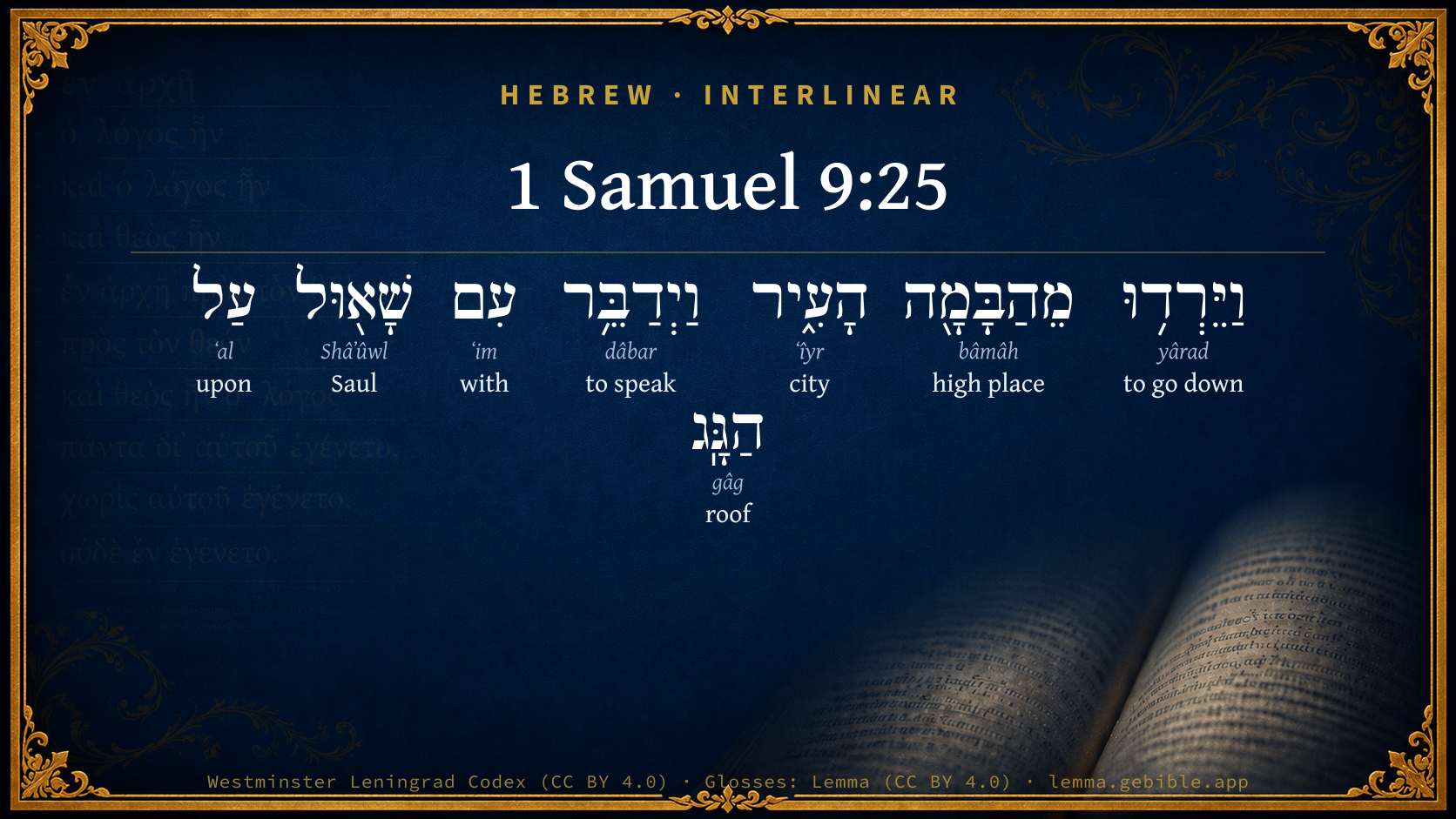
Hebrew (Westminster Leningrad Codex) 1 Samuel 9:25 appears in the Hebrew Old Testament. The text above is from the Westminster Leningrad Codex. Each word links to its Strong’s number, a concise gloss, and parsing drawn from the Open Scriptures Hebrew Bible morphology. Click any word for its full Brown-Driver-Briggs (BDB) entry.
Download image
Cite this verse

1 Samuel 9:25 (World English Bible). Public Domain. Lemma interlinear Bible study tool, https://lemma.gebible.app/v/1-samuel/9/25.

Show BibTeX & RIS
BibTeX
RIS
English Translation
When they were come down from the high place into the city, he talked with Saul on the housetop.
World English Bible · Public Domain
Download a study sheet

One document with this verse’s original text, its word-by-word gloss line, the meaning frame, cross-references with their text, attributed commentary, and full source and license credits — printable, and it pastes into notes with its structure intact.

This verse Autodidact and up

Study sheet (.html) Plain text (.txt)

A passage Seminary Student

Up to 50 verses in one chapter. A passage sheet keeps up to 6 commentary sources and 12 cross-references per verse, in the order this page ranks them, and says so on the sheet whenever that leaves anything out. Ask for a single verse and you get the Autodidact verse sheet above.

Everything on this page stays free to read, with no account — the sheet is a download of what is already on screen, not access to it.

Want to remove ads? Support Godless Engineer
Compare translations 3

The same verse in 3 English versions, stacked beneath the original-language interlinear above. Click any original word for its lexicon entry.

Each is an independent rendering of the whole verse — the interlinear is not word-aligned to these translations.

Highlighted words mark where these versions differ — a whole-verse word diff, not a word-by-word alignment.

  • World English Bible Public Domain
    When they were come down from the high place into the city, he talked with Saul on the housetop.
  • King James Version Public Domain
    And when they were come down from the high place into the city, Samuel communed with Saul upon the top of the house.
  • unfoldingWord Literal Text CC BY-SA 4.0
    And they came down from the high place the city. And he spoke with Saul on the roof.

unfoldingWord Literal Text — © unfoldingWord, licensed CC BY-SA 4.0. Word-aligned USFM3 via Door43 (git.door43.org/unfoldingWord/en_ult).

Versions to compare (up to 4)

3 of 4 selected

Show all 18 translations

Every available English version of this verse, each an independent rendering of the whole verse.

  • World English Bible Public Domain
    When they were come down from the high place into the city, he talked with Saul on the housetop.
  • Berean Standard Bible Public Domain
    And after they had come down from the high place into the city, Samuel spoke with Saul on the roof of his house.
  • Majority Standard Bible Public Domain
    And after they had come down from the high place into the city, Samuel spoke with Saul on the roof of his house.
  • King James Version Public Domain
    And when they were come down from the high place into the city, Samuel communed with Saul upon the top of the house.
  • American Standard Version (1901) Public Domain
    And when they were come down from the high place into the city, he communed with Saul upon the housetop.
  • Revised Version (1885) Public Domain
    And when they were come down from the high place into the city, he communed with Saul upon the housetop.
  • Geneva Bible (1599) Public Domain
    And when they were come downe from the hie place into the citie, he communed with Saul vpon the top of the house.
  • Douay-Rheims (1899) Public Domain
    And they went down from the high place into the town, and he spoke with Saul upon the top of the house: and he prepared a bed for Saul on the top of the house, and he slept.
  • Young's Literal Translation Public Domain
    And they come down from the high place to the city, and he speaketh with Saul on the roof.
  • Literal Standard Version CC BY-SA 4.0
    And they come down from the high place to the city, and he speaks with Saul on the roof.
  • Unlocked Literal Bible CC BY-SA 4.0
    When they had come down from the high place into the city, Samuel spoke with Saul on the rooftop.
  • unfoldingWord Literal Text CC BY-SA 4.0
    And they came down from the high place the city. And he spoke with Saul on the roof.
  • Darby Bible Public Domain
    And they came down from the high place into the city, and he spoke with Saul upon the roof.
  • World Messianic Bible Public Domain
    When they had come down from the high place into the city, he talked with Saul on the housetop.
  • Webster's Bible Public Domain
    And when they had come down from the high place into the city, Samuel communed with Saul upon the top of the house.
  • Free Bible Version CC BY-SA 4.0
    Once they had returned from the high place to the town, Samuel spoke with Saul on the roof of his house.
  • Bible in Basic English Public Domain
    And when they had come down from the high place into the town, where a bed was made ready for Saul, he went to rest.
  • JPS Tanakh (1917) Public Domain
    And when they were come down from the high place into the city, he spoke with Saul upon the housetop.

Literal Standard Version (2020), Covenant Press — licensed CC BY-SA 4.0. Text via the HelloAO Bible API (eBible.org). Unlocked Literal Bible (unfoldingWord) — licensed CC BY-SA 4.0. Text via the HelloAO Bible API (eBible.org). unfoldingWord Literal Text — © unfoldingWord, licensed CC BY-SA 4.0. Word-aligned USFM3 via Door43 (git.door43.org/unfoldingWord/en_ult). Free Bible Version, Dr. Jonathan Gallagher — licensed CC BY-SA 4.0. Text via the HelloAO Bible API (eBible.org).

Word by word

More ways to search: Search by grammar → Find every occurrence → Compare this word →

Practice this passage: Drill this verse → Learn its vocabulary →

About this verse

These counts appear in no published source. They are computed here, from the morphology-tagged text and Lemma’s own curated glosses. What Lemma adds →

8
words
8
distinct lemmas
Historical
section

Shared distinctive vocabulary

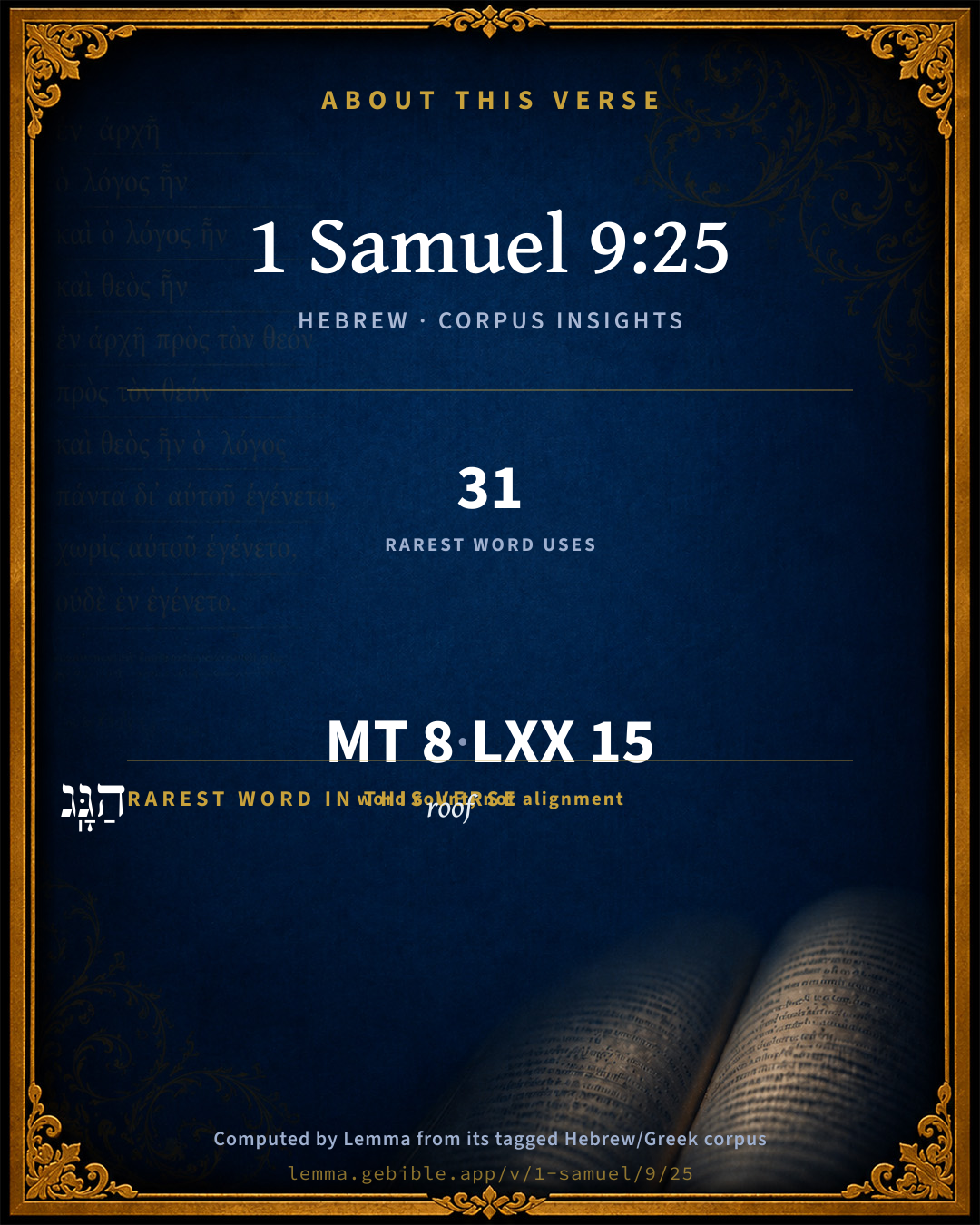
הַגָּֽג roof H1406 occurs in 27 verses of the Hebrew Bible. Also found in:

Grammatical profile

  • 2 verbs
  • 4 nouns
  • 2 prepositions

Verb forms

  • וַיֵּרְד֥וּ Qal · Sequential Imperfect
  • וַיְדַבֵּ֥ר Piel · Sequential Imperfect

Hebrew & Septuagint length

In English translation the verse runs 19 words from the Hebrew and 23 from the Septuagint (LXX English) — closely comparable.

A rough comparison of the two English renderings, which tokenize alike — not a word-level alignment.

Word counts can differ between the Hebrew and the Greek without any difference in meaning — e.g. the Hebrew direct-object marker אֵת has no separate Greek word, and Greek often adds the article ὁ.

In the original languages it is 8 Hebrew tokens and 15 Greek tokens — but the two are counted differently (Hebrew bundles its prefixes and suffixes into one token; the Greek is in lemma form), so that isn’t a like-for-like length.

Cross-references

6

Topical passages linked to 1 Samuel 9:25 in the Treasury of Scripture Knowledge — connected by theme and wording, ordered by reader-vote popularity; previews shown in the World English Bible.

  • Deuteronomy 22:8 When you build a new house, then you shall make a battlement for your roof, that you don't bring blood on your house, if any man fall from there.
  • Acts 10:9 Now on the next day as they were on their journey, and got close to the city, Peter went up on the housetop to pray at about noon.
  • 2 Samuel 11:2 It happened at evening, that David arose from off his bed, and walked on the roof of the king's house: and from the roof he saw a woman bathing; and the woman was very beautiful to look on.
  • Nehemiah 8:16 So the people went forth, and brought them, and made themselves booths, everyone on the roof of his house, and in their courts, and in the courts of the house of God, and in the broad place of the water gate, and in the broad place of the gate of Ephraim.
  • Jeremiah 19:13 and the houses of Jerusalem, and the houses of the kings of Judah, which are defiled, shall be as the place of Topheth, even all the houses on whose roofs they have burned incense to all the host of the sky, and have poured out drink-offerings to other gods.
  • Matthew 10:27 What I tell you in the darkness, speak in the light; and what you hear whispered in the ear, proclaim on the housetops.

Cross-references courtesy of OpenBible.info (CC BY 4.0).

Hebrew and Greek witnesses Masoretic Hebrew ↔ Greek Septuagint

The same verse in the two great witnesses to the Old Testament, shown verse-for-verse.

These are two independent witnesses, not word-aligned to each other, and the Septuagint is shown in lemma (dictionary) form.

Hebrew 1 Samuel 9:25 Masoretic · Westminster Leningrad Codex

וַיֵּרְד֥וּ מֵהַבָּמָ֖ה הָעִ֑יר וַיְדַבֵּ֥ר עִם שָׁא֖וּל עַל הַגָּֽג

When they were come down from the high place into the city, he talked with Saul on the housetop.

World English Bible · Public Domain

Greek LXX 1 Samuel 9:25 Septuagint · lemma form

καί καταβαίνω ἐκ ὁ βαμα ἐν ὁ πόλις καί διαστρώννυμι ὁ σαούλ ἐπί ὁ δῶμα

And he went down from Bama into the city; and they prepared a lodging for Saul on the roof, and he lay down.

LXX2012 (modern English Septuagint) · Public Domain

On this verse, Keil & Delitzsch discusses the Septuagint’s reading. Read the note in Commentary ↓

Hebrew: Westminster Leningrad Codex (CC BY 4.0). Greek: Septuagint (public domain); English from LXX2012 (modern English Septuagint) (Public Domain). How the Septuagint differs from the Hebrew →

Targum (Aramaic paraphrase)

1

The Targum is the ancient Jewish Aramaic paraphrase of the Hebrew Scriptures — an interpretive translation, not the Hebrew text itself. Onkelos (literal) and Pseudo-Jonathan (expansive) render the Torah, and Jonathan the Prophets. Coverage is partial: where no permissively-licensed English translation exists for a verse, only the Aramaic is shown. This is verse-level text, not a word-by-word alignment to the Hebrew.

  1. Targum Jonathan Prophets (Joshua–Malachi)
    וּנְחָתוּ מִבֵּית אַסְחֲרוּתָא לְקַרְתָּא וּמַלֵיל עִם שָׁאוּל עַל אִיגָרָא:

    (no public-domain English translation for this verse)

    Targum Jonathan — Aramaic: “Mikraot Gedolot” (public domain). English: “Sefaria Community Translation” (CC0 1.0 (public-domain dedication)); “London "Chaldee Paraphrase," 1871” (public domain). Text via Sefaria.

Commentary

Notes on 1 Samuel 9:25 from classic Christian and Jewish commentators (each source and its license shown beneath its notes). The classic Christian expositions comment on the surrounding passage and are grouped to its opening verse, so a note may address several verses; the Jewish commentaries on the Tanakh (Rashi and others) are per-verse, so they appear only where the commentator wrote on this verse.

Lemma curates 59 commentaries, every one of them public domain or Creative Commons licensed, each selected and text-cleaned for this edition rather than reprinted as found. About our sources →

Trapp's Complete Commentary

John Trapp

1Sa 9:25 And when they were come down from the high place into the city, [Samuel] communed with Saul upon the top of the house.

Ver. 25. Samuel communed with Saul.] Gave him good counsel, better than any is to be found in Lipsius’s "Beehive," Macchiavel’s "Spider’s Web," or Castalio’s "Curialis," the book that Charles V so much delighted in.

John Trapp, A Commentary or Exposition upon All the Books of the Old and New Testament (1647–1656) — public domain. Text from a community e-Sword module.

Joseph Benson's Commentary

1Sa 9:25. Samuel communed with Saul — Concerning the kingdom designed for him by God, and his administration of the government; upon the top of the house — For coolness in the evening, and privacy. The Vulgate adds here, Saul prepared him a bed on the top of the house, and slept, an addition which Houbigant approves, accounting very plausibly for the deficiency of the Hebrew. The Seventy also understood the passage in a similar way, translating it, And they spread a bed for Saul on the top of the house, and he slept.

Joseph Benson's Commentary on the Old and New Testaments (1811–1818) — public domain. Text from a community e-Sword module.

Keil & Delitzsch

C. F. Keil & F. Delitzsch

When the sacrificial meal was over, Samuel and Saul went down from the high place into the town, and he (Samuel) talked with him upon the roof (of the house into which Samuel had entered). The flat roofs of the East were used as placed of retirement for private conversation (see at Deu 22:8). This conversation did not refer of course to the call of Samuel to the royal dignity, for that was not made known to him as a word of Jehovah till the following day (Sa1 9:27); but it was intended to prepare him for that announcement: so that O. v. Gerlach's conjecture is probably the correct one, viz., that Samuel "talked with Saul concerning the deep religious and political degradation of the people of God, the oppression of the heathen, the causes of the inability of the Israelites to stand against these foes, the necessity for a conversion of the people, and the want of a leader who was entirely devoted to the Lord."

(Note: For הגּג על עם־שׁאוּל וידבּר the lxx have καὶ διέστρωσαν τῷ Σαοὺλ ἐπι τῷ δώματι καὶ ἐκοιμήθη, "they prepared Saul a bed upon the house, and he slept," from which Clericus conjectured that these translators had read לשאול וירבדו (וירבּדוּ or ויּרבּדוּ); and Ewald and Thenius propose to alter the Hebrew text in this way. But although וגו ויּשׁכּימוּ (Sa1 9:26) no doubt presupposes that Saul had slept in Samuel's house, and in fact upon the roof, the remark of Thenius, "that the private conversation upon the roof (Sa1 9:25) comes too early, as Saul did not yet know, and was not to learn till the following day, what was about to take place," does not supply any valid objection to the correctness of the Masoretic text, or any argument in favour of the Septuagint rendering or interpretation, since it rests upon an altogether unfounded and erroneous assumption, viz., that Samuel had talked with Saul about his call to the throne. Moreover, "the strangeness" of the statement in Sa1 9:26, "they rose up early," and then "when the morning dawned, Samuel called," etc., cannot possibly throw any suspicion upon the integrity of the Hebrew text, as this "strangeness" vanishes when we take וגו כּעלות ויהי as a more precise definition of ויּשׁכּימוּ. The Septuagint translators evidently held the same opinion as their modern defenders. They took offence at Samuel's private conversation with Saul, because he did not make known to him the word of God concerning his call to the throne till the next morning; and, on the other hand, as their rising the next morning is mentioned in Sa1 9:26, they felt the absence of any allusion to their sleeping, and consequently not only interpreted ידבר by a conjectural emendation as standing for ירבד rof, because מרבדּים רבד is used in Pro 7:16 to signify the spreading of mats or carpets for a bed, but also identified וישׁכמו with ישׁכבו, and rendered it ἐκοιμήθη. At the same time, they did not reflect that the preparation of the bed and their sleeping during the night were both of them matters of course, and there was consequently no necessity to mention them; whereas Samuel's talking with Saul upon the roof was a matter of importance in relation to the whole affair, and one which could not be passed over in silence. Moreover, the correctness of the Hebrew text is confirmed by all the other ancient versions. Not only do the Chaldee, Syriac, and Arabic follow the Masoretic text, but Jerome does the same in the rendering adopted by him, "Et locutus est cum Saule in solario. Cumque mane surrexissent;" though the words "stravitque Saul in solario et dormivit" have been interpolated probably from the Itala into the text of the Vulgate which has come down to us.)

Sa1 9:26-27

"And they rose up early in the morning: namely, when the morning dawn arose, Samuel called to Saul upon the roof (i.e., he called from below within the house up to the roof, where Saul was probably sleeping upon the balcony; cf. Kg2 4:10), Get up, I will conduct thee." As soon as Saul had risen, "they both (both Samuel and Saul) went out (into the street)." And when they had gone down to the extremity of the town, Samuel said to Saul, "Let the servant pass on before us (and he did so), and do thou remain here for the present; I will show thee a word of God."

Keil & Delitzsch — Biblical Commentary on the Old Testament (1861–1891) — public domain (CC PDM 1.0). Text via the HelloAO Bible API. (Old Testament only.)

Tyndale Open Study Notes

Tyndale Open Resources

9:25 A typical house had a flat roof that was used for a variety of purposes, such as sleeping in warm weather (see Deut 22:8; 2 Kgs 4:10).

Tyndale Open Study Notes — © Tyndale Open Resources, licensed CC BY-SA 4.0. Text via the HelloAO Bible API.

Jamieson, Fausset & Brown

Robert Jamieson, A. R. Fausset & David Brown

Samuel communed with Saul upon the top of the house--Saul was taken to lodge with the prophet for that night. Before retiring to rest, they communed on the flat roof of the house, the couch being laid there (Jos 2:6), when, doubtless, Samuel revealed the secret and described the peculiar duties of a monarch in a nation so related to the Divine King as Israel. Next morning early, Samuel roused his guest, and conveying him on his way towards the skirts of the city, sought, before parting, a private interview--the object of which is narrated in the next chapter.

Next: 1 Samuel Chapter 10

Jamieson, Fausset & Brown — Commentary Critical and Explanatory on the Whole Bible (1871) — public domain (CC PDM 1.0). Text via the HelloAO Bible API.

Adam Clarke's Commentary

Verse 25. Upon the top of the house.] All the houses in the East were flat-roofed; on these people walked, talked, and frequently slept, for the sake of fresh and cooling air.

Adam Clarke's Commentary on the Bible (1810–1826) — public domain. Text from a community e-Sword/MySword module.

Ellicott's Commentary for English Readers

(25) And when they were come down.—After the public sacrificial meal at which such signal honours had been shown to the Benjamite stranger and his servant, the prophet-judge detained Saul from continuing his journey homewards, and persuaded him to remain as his guest that night at Ramah. He conducted him to the flat roof of his house, often the favourite locality in the East for quiet conversation or rest, and where frequently the honoured guest was lodged for the night: there the prophet had a long interview with his young guest, The conversation that evening probably did not turn upon the royal dignity, so soon to be conferred on Saul; of that Samuel spoke at length, we know, on the following morning. The solemn words of the old man that evening on the house-top in “Ramah of the Watchers” referred, no doubt, to the sad religious and political decline of the people of God, from which he (Samuel) had laboured, not unsuccessfully, to rescue them, “to the opposition of the heathen nations, the causes of the impotency of Israel to oppose their enemies, the necessity of a religious change in the people, and of a leader thoroughly obedient to the Lord.”—Otto von Gerlach, quoted in Lange. It has been suggested that this conversation was the connecting link between that on the height (1Sa_9:19-20) and the communication which Samuel made to Saul the following morning. The LXX. reads here, instead of “communed with Saul on the top of the house,” “they strewed a couch for Saul on the top of the house, and he lay down.” But the Chaldee and Syriac Versions agree with the Hebrew text. The strange LXX. variation is apparently a correction. These Greek translators could not understand a conversation of the prophet and Saul taking place in the evening, when the announcement of the crown was made so formally on the following morning. Why did Samuel not tell Saul of God’s intention during that evening spent together?

A Bible Commentary for English Readers, edited by Charles John Ellicott (1878–1897) — public domain. Text from a community e-Sword module.

The Cambridge Bible for Schools and Colleges

gen. ed. J. J. S. Perowne

25–10:8. Saul anointed by Samuel and promised three signs in confirmation of his call

25, 26. Samuel communed with Saul] Preparing him for the announcement which he was going to make next morning. On the housetop they would be open to the public view so that all could see the honour Samuel shewed his guest, while they would have opportunity for undisturbed conversation. The Sept. however reads, “And he came down from the high place into the city: and they prepared a bed for Saul on the housetop and he slept. And it came to pass, &c.” This may perhaps represent the original text, for it seems strange to say first “they arose early,” and then proceed to describe Samuel’s calling Saul. The flat roof of an oriental house is still “resorted to for business, relaxation, or for sleeping … During a large part of he year it is the most agreeable place about the establishment, especially in the morning and evening.” See Thomson’s Land and the Book, p. 39 ff.

The Cambridge Bible for Schools and Colleges (gen. ed. J. J. S. Perowne; Cambridge University Press, 1878–1918) — public domain. Text from a community e-Sword module.

John Gill's Exposition

And when they came down from the high place into the city,.... After the feast was ended; and though Ramah itself was situated on an eminence, yet it seems this high place was higher than that, being without the city upon an hill, and therefore they are said to come down from the one to the other; or they came down from the high place, and then ascended the hill to the city:

Samuel communed with Saul upon the top of the house: of Samuel's house; when they were come thither, Samuel took Saul up to the roof of his house, which was flat, as the roofs of houses in this country were; see Deu 22:8 on which they could walk to and fro, and converse together; hence you read of preaching and praying on housetops, Mat 10:27 what they communed about is not said, but may be guessed at, that it was about Saul's being made king; of the certainty of it, by divine designation; of the manner of executing that office wisely and justly; about the objections Saul had made of the smallness of his tribe and family; and of Samuel's willingness to resign the government to him, with other things of the like kind.

John Gill's Exposition of the Whole Bible (1746–1763) — public domain (CC PDM 1.0). Text via the HelloAO Bible API.

Haydock's Catholic Bible Commentary

House, probably giving him some instructions respecting his future dignity. --- As he, &c. This seems to be a second translation of the former sentence, taken from the Septuagint. It is omitted in several Latin manuscripts. (Calmet) --- Septuagint, "and he went down from the Bama (perhaps "the steps" or high places, where the sacrifice and feast had been celebrated) into the city; and they made a bed for Saul, on the house top; and he lay down, (26) and when the day dawned, Samuel," &c. The roofs are flat in those countries, and such an airy situation would be most agreeable in such hot climates. (Haydock) --- The common people, generally, only spread a mat on the ground, and covered themselves with a sheet; to take their rest, either under a gallery, or in the open air. Homer places his strangers, with their upon the ground under the gallery, which was erected before the house. Aristophanes (in Vespis) mentions the custom of sleeping on the house top. See 2 Kings xvi. 22. (Calmet) --- Saul had not been educated with the greatest delicacy. (Menochius)

George Leo Haydock (1774–1849), Haydock's Catholic Family Bible and Commentary, 1859 edition — public domain. Excludes Psalms (Douay-Rheims chapter numbering differs from Protestant) and Deuterocanonical books (Catholic canon only).

Matthew Poole's English Annotations

Samuel communed with Saul, concerning the kingdom designed to him by God, and his duty to expect it patiently, till God actually called him to it; and to administer it piously, and justly, and valiantly.

The top of the house was flat, after the manner, Deu 22:8; and so fit for walking, and for secret prayers, Dan 6:10; Act 10:9, or any private and familiar discourses among friends.

Matthew Poole's English Annotations on the Holy Bible (1683–1685) — public domain. Text from a community e-Sword/MySword module.

Whedon's Commentary on the Bible

Daniel D. Whedon

25. From the high place into the city — So the place of this sacrifice was outside of the city, and apparently on a hill overhanging it. Communed with Saul upon the top of the house — The flat roofs of oriental houses were places of evening recreation as well as sleeping places. Otto Von Gerlach supposes that the topics of this conversation upon the roof were “the deep religious and political degradation of the people of God, the oppression by the heathen, the causes of the inability of the Israelites to stand before their foes, the necessity for a conversion of the people, and the want of a leader who was entirely devoted to God.”

Daniel D. Whedon (gen. ed.), Commentary on the Old and New Testaments (1874–1909) — public domain. Text from a community e-Sword module.

The Pulpit Commentary

When the feast was over they went down from the high place, and, having entered the city, proceeded to Samuel"s dwelling, where he communed with Saul upon the top of the house. The Septuagint has a very probable reading, namely, "And they spread a bed for Saul upon the roof, and he lay down;" but the Syriac and Chaldee agree with the Hebrew. Without communicating to Saul that he was to be king, which was not revealed to him till the next day, (1Sa_10:1) Samuel might be anxious to impress on Saul"s mind the great principles of the theocratic government, and also the nature of the remedies necessary for Israel"s recovery from its present misery.

Vers. 25-27.

Interest in public affairs.

The facts are

1. After the public intimation of Saul s coming distinction Samuelconverses with him in private.

2. On sending him away on the next day Samuel will have no one presentat the moment of parting. Saul is passive. Samuel is still the most important. As yet all had been public. Enough had been said to call up from Saul"s heart feelings and aspirations which in his quiet life had lain dormant (ver. 19). He now felt that God had something for him to do in Israel, and his heart revealed sentiments answering to the shadowed honour. It was fit, therefore, to commence privately on topics connected with the condition and prospects of Israel. The invitation to the privacy of the house-top for this purpose was thus in keeping with Samuel"s wise procedure, and a good illustration of his deep interest in the public welfare. The most probable explanation of the conduct of Samuel certainly is, that his concern for the welfare of the nation and of the coming king irresistibly prompted him to converse on the wants of the age, and the responsibilities of Saul"s new position as a chosen servant.

I IT IS THE DUTY OF A RELIGIOUS MAN, AND IN KEEPING WITH HIS CHARACTER AND PROFESSION, TO TAKE A DEEP INTEREST IN PUBLIC AFFAIRS. Samuel"s interest in affairs was, it is true, official, as head of the state, but the official acts had their root in a deep personal longing for the prosperity of Israel. "Pray for the peace of Jerusalem." "They shall prosper that love thee," was the feeling which every true descendant of Abraham was supposed to entertain. The best days of Israel"s history show that the pious were proud of their country, its institutions, its rulers, its laws, and the order and purity of its administration.

1. The state claims our interest.

(1) The law of benevolence supports this claim. Every man in the state is our neighbour; his comfort and peace and safety depend on the administration of affairs; we can only reach the individuals by doing our part to render affairs useful to all.

(2) The principles of religion are applicable to state affairs. Faith in Christ and repentance toward God are not the whole of practical religion, though they are the spring and support of many other feelings and principles. Righteousness, purity, supreme regard for the Unseen, kindliness and generosity, unselfishness and truth, can find expression in laws, in commercial arrangements, and in foreign and domestic policy. Loyalty to these religious principles requires that we see that they are recognised everywhere.

(3) The adaptation of Christianity to the entire life of man is one of the most commanding evidences of its Divine character. It professes to make all things new. It forms the true, perfect manhood. A religion which is seen practically to enter into every sphere of human activity, as the conserving "salt," carries with it the proof that it comes from the Creator of man and of society. He, then, who loves his Christianity, and would advance its conquests, must show by his interest in the State that it is "profitable unto all things," even to public affairs.

(4) The great calamities brought on communities have resulted from the predominance in state affairs of irreligious principles. When "rulers of Sodom," men of godless lives, are left to have charge of affairs, when the holy and conscientious leave their country"s business to persons with whom they would not leave their own private affairs, disaster has come, and will ever come. There can be nothing in such a line of conduct at variance with Christian character or profession. The enforcement of righteousness all over the world must be right. To love Christ supremely, and to labour that souls may be converted to him, is no more inconsistent with promoting righteousness in state affairs, and watching its progress there with keen interest, than with seeing that our private business is honestly transacted.

II EMERGENCIES WILL ARISE WHEN INTEREST IN PUBLIC AFFAIRS MAY FIND DISTINCT EXPRESSION. The emergency which developed Samuel"s deep interest did not create it. There is a fountain of strong feeling and righteous thought in a truly good man"s nature. Crises in a people"s history bring out the latent feeling, and shape it into word or deed. There should not be a day on which a Christian does not bear all the interests of his country on his heart, and give them some direct or indirect support. But in the changes of human affairs, and in the incessant struggle between the good and evil forces of society, there arise now and then opportunities forevery righteous man to do his best towards securing a righteousness in the State.

III The MANNER IN WHICH INTEREST IS SHOWN WILL DEPEND ON POSITION AND OPPORTUNITIES. Samuel showed his interest by discussing with Saul the general question of the people"s welfare, and by fitting his mind for coming responsibilities. Every Christian can express his interest intelligently, faithfully, kindly, and prayerfully by seizing the opportunities appropriate to his situation in life. But prayer for kings and rulers, personal observance of the course of events, acquaintance with the real needs of the country, encouragement of a sound, righteous, political literature, support to men of tested character, exercise of powers conferred by law, infusion into controversies of a generous, truth-loving spirit these are means within reach of most, and cannot but issue in blessing to all. The interest thus due to public state affairs is also due by the Christian to the general affairs of the Church of God. Every one should bear on his heart the welfare of the body of Christ, and do all he can to heal its wounds, cleanse its spirit, and insure its highest happiness and prosperity. Do men sufficiently identify their personal religious interests with those of the one Church? Is the oneness of the body of Christ properly appreciated? Do our prayers and tears flow forth as they ought for the kingdom of God?

General considerations:

1. The causes of so little interest in public affairs by many Christian people.

2. How Christian people can manifest a proper interest apart from thepainful contentions to which they are perhaps constitutionally unfitted.

3. The degree of sympathy due to good men who from sense of duty enterinto the perils and annoyances of public life, and how it can be expressed.

4. The question of how much of national trouble, sorrow, and poverty isconnected with neglect on the part of the morally powerful sections of society.

5. How far Christian men are really making love of righteousness and truthand peace superior to social customs and party ties.

The Pulpit Commentary (1880–1919), ed. H.D.M. Spence-Jones & Joseph S. Exell — public domain. Text from a community e-Sword module.

John Wesley's Explanatory Notes

Communed - Concerning the kingdom designed for him by God.

John Wesley, Explanatory Notes Upon the Whole Bible (1754–1765) — public domain. Text via the GEBible commentary corpus.

unfoldingWord translationNotes

Door43 World Missions Community

on the rooftop

This is a normal place for family and guests to eat, visit, and sleep. It tends to be cooler in the evening and at night than the inside of the house.

Samuel called to Saul on the rooftop and said

What Saul was doing on the rooftop can be made explicit. AT: "while Saul was sleeping on the rooftop, Samuel called to him and said" (See: Assumed Knowledge and Implicit Information)

translationWords

high place

Samuel

Saul (OT)

send

unfoldingWord translationNotes — © Distant Shores Media and the Door43 World Missions Community, licensed CC BY-SA 4.0. Source: git.door43.org/Door43/en_tn.

Rashi

Rabbi Shlomo Yitzchaki (Rashi)

And he spoke with Shaul on the roof. Reproving him and teaching him to fear the Holy One, Blessed is He.

Rashi on the Tanakh — English translations: “The Judaica Press complete Tanach with Rashi, translated by A. J. Rosenberg” (CC BY 4.0); “Pentateuch with Rashi's commentary by M. Rosenbaum and A.M. Silbermann, 1929-1934” (public domain); “The Metsudah Tanach series, Lakewood, N.J” (CC BY 4.0); and “The Book of Joshua, Metsudah Publications, 1997” (CC BY 4.0). Text via Sefaria.

Lesson kit

Teaching starters — assembled from the data on this page, not authored interpretation. Every prompt links to the verse data it draws on. Edit before teaching.

1 Samuel, in the Historical, opens this verse with 8 words (8 distinct Hebrew lemmas). Its most distinctive word is gâg (“roof”). A historical commentator’s framing appears above. Read the whole chapter for the surrounding context.

Discussion questions

  1. What does “roof” (gâg) contribute to the verse as a whole?
  2. Exodus 30:3 shares the word «roof» with this verse. How do the two illuminate each other?
  3. The translations on this page render this verse differently — a whole-verse word diff, not a word-by-word alignment. What might account for the different wordings?
  4. The verb «וַיֵּרְד֥וּ» is Qal Sequential Imperfect. How does its form color the action?
  5. Reading how Trapp's Complete Commentary and Joseph Benson's Commentary read this verse, where do the two commentators agree and where do they part?

Things to notice

Reading settings

Reading text

Shown beneath each verse's original-language words.

Old Testament
Old Testament edition

Read the OT as the Masoretic Hebrew (MT) or the Greek Septuagint (LXX).

English shown for the Greek Septuagint (in the Hebrew ↔ Greek comparison).

Comparing translations? Open the Compare panel on any verse page to stack up to four side by side.