
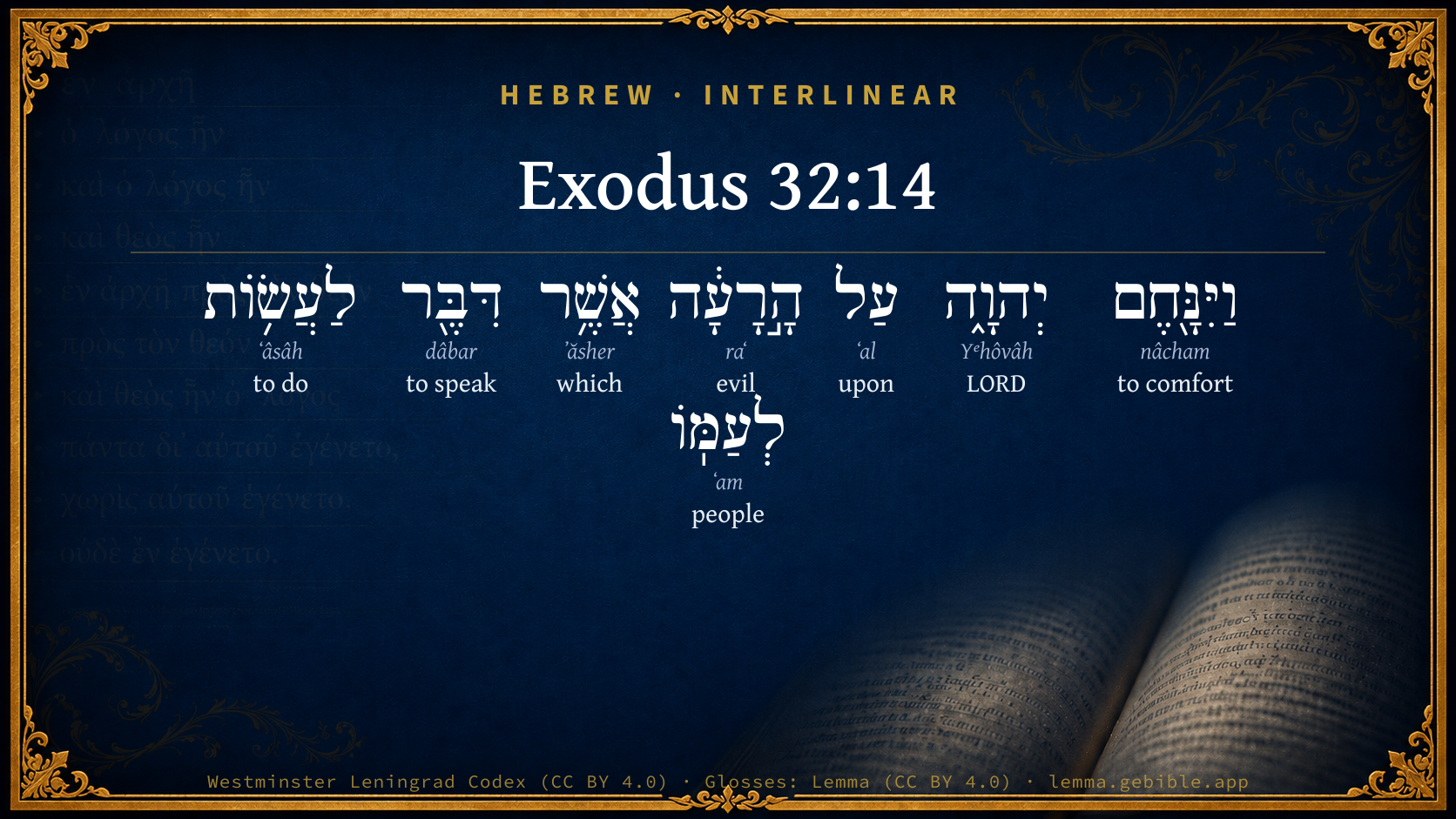
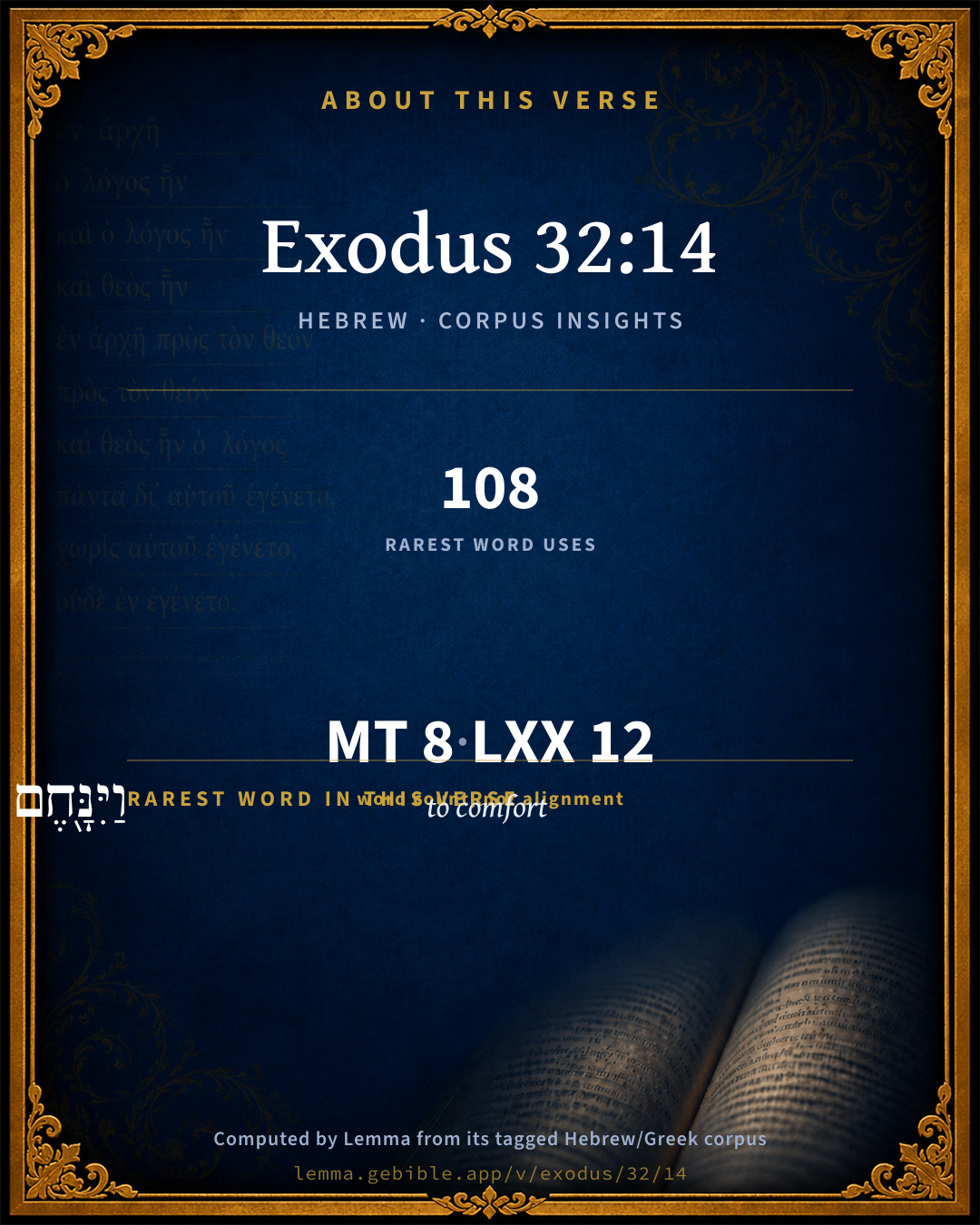
Exodus 32:14

Hebrew (Westminster Leningrad Codex) Exodus 32:14 appears in the Hebrew Old Testament. The text above is from the Westminster Leningrad Codex. Each word links to its Strong’s number, a concise gloss, and parsing drawn from the Open Scriptures Hebrew Bible morphology. Click any word for its full Brown-Driver-Briggs (BDB) entry.
Download image
Cite this verse

Exodus 32:14 (World English Bible). Public Domain. Lemma interlinear Bible study tool, https://lemma.gebible.app/v/exodus/32/14.

Show BibTeX & RIS
BibTeX
RIS
English Translation
Yahweh repented of the evil which he said he would do to his people.
World English Bible · Public Domain
Download a study sheet

One document with this verse’s original text, its word-by-word gloss line, the meaning frame, cross-references with their text, attributed commentary, and full source and license credits — printable, and it pastes into notes with its structure intact.

This verse Autodidact and up

Study sheet (.html) Plain text (.txt)

A passage Seminary Student

Up to 50 verses in one chapter. A passage sheet keeps up to 6 commentary sources and 12 cross-references per verse, in the order this page ranks them, and says so on the sheet whenever that leaves anything out. Ask for a single verse and you get the Autodidact verse sheet above.

Everything on this page stays free to read, with no account — the sheet is a download of what is already on screen, not access to it.

Want to remove ads? Support Godless Engineer
Compare translations 3

The same verse in 3 English versions, stacked beneath the original-language interlinear above. Click any original word for its lexicon entry.

Each is an independent rendering of the whole verse — the interlinear is not word-aligned to these translations.

Highlighted words mark where these versions differ — a whole-verse word diff, not a word-by-word alignment.

  • World English Bible Public Domain
    Yahweh repented of the evil which he said he would do to his people.
  • King James Version Public Domain
    And the LORD repented of the evil which he thought to do unto his people.
  • unfoldingWord Literal Text CC BY-SA 4.0
    Then Yahweh repented from the evil that he had spoken to do to his people.

unfoldingWord Literal Text — © unfoldingWord, licensed CC BY-SA 4.0. Word-aligned USFM3 via Door43 (git.door43.org/unfoldingWord/en_ult).

Versions to compare (up to 4)

3 of 4 selected

Show all 18 translations

Every available English version of this verse, each an independent rendering of the whole verse.

  • World English Bible Public Domain
    Yahweh repented of the evil which he said he would do to his people.
  • Berean Standard Bible Public Domain
    So the LORD relented from the calamity He had threatened to bring on His people.
  • Majority Standard Bible Public Domain
    So the LORD relented from the calamity He had threatened to bring on His people.
  • King James Version Public Domain
    And the LORD repented of the evil which he thought to do unto his people.
  • American Standard Version (1901) Public Domain
    And Jehovah repented of the evil which he said he would do unto his people.
  • Revised Version (1885) Public Domain
    And the LORD repented of the evil which he said he would do unto his people.
  • Geneva Bible (1599) Public Domain
    Then the Lord changed his minde from the euil, which he threatned to do vnto his people.
  • Douay-Rheims (1899) Public Domain
    And the Lord was appeased from doing the evil which he had spoken against his people.
  • Young's Literal Translation Public Domain
    and Jehovah repenteth of the evil which He hath spoken of doing to His people.
  • Literal Standard Version CC BY-SA 4.0
    and YHWH relents from the evil which He has spoken of doing to His people.
  • Unlocked Literal Bible CC BY-SA 4.0
    Then Yahweh relented from the punishment that he had said he would inflict on his people.
  • unfoldingWord Literal Text CC BY-SA 4.0
    Then Yahweh repented from the evil that he had spoken to do to his people.
  • Darby Bible Public Domain
    And Jehovah repented of the evil that he had said he would do to his people.
  • World Messianic Bible Public Domain
    So the LORD turned away from the evil which he said he would do to his people.
  • Webster's Bible Public Domain
    And the LORD repented of the evil which he thought to do to his people.
  • Free Bible Version CC BY-SA 4.0
    The Lord changed his mind over the disaster he threatened to cause his people.
  • Bible in Basic English Public Domain
    So the Lord let himself be turned from his purpose of sending punishment on his people.
  • JPS Tanakh (1917) Public Domain
    And the LORD repented of the evil which He said He would do unto His people.

Literal Standard Version (2020), Covenant Press — licensed CC BY-SA 4.0. Text via the HelloAO Bible API (eBible.org). Unlocked Literal Bible (unfoldingWord) — licensed CC BY-SA 4.0. Text via the HelloAO Bible API (eBible.org). unfoldingWord Literal Text — © unfoldingWord, licensed CC BY-SA 4.0. Word-aligned USFM3 via Door43 (git.door43.org/unfoldingWord/en_ult). Free Bible Version, Dr. Jonathan Gallagher — licensed CC BY-SA 4.0. Text via the HelloAO Bible API (eBible.org).

Word by word

More ways to search: Search by grammar → Find every occurrence → Compare this word →

Practice this passage: Drill this verse → Learn its vocabulary →

וַיִּנָּ֖חֶם
nâcham
H5162
“and · to comfort”
Conjunction + Verb, Niphal, Sequential Imperfect, 3rd Person, Masculine, Singular
Part of Speech
Conjunction + Verb
Stem
Niphal
Form
Sequential Imperfect
Person
3rd Person
Gender
Masculine
Number
Singular
Full BDB Definition

Origin: a primitive root

TWOT: 1344

to be sorry, console oneself, repent, regret, comfort, be comforted - (Niphal) - to be sorry, be moved to pity, have compassion - to be sorry, rue, suffer grief, repent - to comfort oneself, be comforted - to comfort oneself, ease oneself - (Piel) to comfort, console - (Pual) to be comforted, be consoled - (Hithpael) - to be sorry, have compassion - to rue, repent of - to comfort oneself, be comforted - to ease oneself
  1. יְהוָ֑ה Yᵉhôvâh H3068 “LORD” Noun, Proper
  2. עַל ʻal H5921 “upon” Preposition
  3. הָ֣רָעָ֔ה raʻ H7451 “the · evil” Particle, Definite Article + Noun, Common, Feminine, Singular, Absolute
  4. אֲשֶׁ֥ר ʼăsher H834 “which” Particle, Relative
  5. דִּבֶּ֖ר dâbar H1696 “to speak” Verb, Piel, Perfect, 3rd Person, Masculine, Singular
  6. לַעֲשׂ֥וֹת ʻâsâh H6213 “to do” Preposition + Verb, Qal, Infinitive Construct
  7. לְעַמּֽוֹ ʻam H5971 “to/for · people · his” Preposition + Noun, Common, Masculine, Singular, Construct + Suffix, Personal, 3rd Person, Masculine, Singular

About this verse

These counts appear in no published source. They are computed here, from the morphology-tagged text and Lemma’s own curated glosses. What Lemma adds →

8
words
8
distinct lemmas
Pentateuch
section

Grammatical profile

  • 3 verbs
  • 3 nouns
  • 1 preposition
  • 1 particle

Verb forms

  • וַיִּנָּ֖חֶם Niphal · Sequential Imperfect
  • דִּבֶּ֖ר Piel · Perfect
  • לַעֲשׂ֥וֹת Qal · Infinitive Construct

Hebrew & Septuagint length

In English translation the verse runs 14 words from the Hebrew and 10 from the Septuagint (LXX English) — the Septuagint runs noticeably shorter here. See the side-by-side →

A rough comparison of the two English renderings, which tokenize alike — not a word-level alignment.

Word counts can differ between the Hebrew and the Greek without any difference in meaning — e.g. the Hebrew direct-object marker אֵת has no separate Greek word, and Greek often adds the article ὁ.

In the original languages it is 8 Hebrew tokens and 12 Greek tokens — but the two are counted differently (Hebrew bundles its prefixes and suffixes into one token; the Greek is in lemma form), so that isn’t a like-for-like length.

Cross-references

10

Topical passages linked to Exodus 32:14 in the Treasury of Scripture Knowledge — connected by theme and wording, ordered by reader-vote popularity; previews shown in the World English Bible.

  • Jonah 3:10 God saw their works, that they turned from their evil way. God repented of the evil which he said he would do to them, and he didn't do it.
  • Psalms 106:45 He remembered for them his covenant, And repented according to the multitude of his loving kindnesses.
  • Jeremiah 26:13 Now therefore amend your ways and your doings, and obey the voice of Yahweh your God; and Yahweh will repent him of the evil that he has pronounced against you.
  • 1 Chronicles 21:15 God sent an angel to Jerusalem to destroy it: and as he was about to destroy, Yahweh saw, and he repented him of the evil, and said to the destroying angel, It is enough; now stay your hand. The angel of Yahweh was standing by the threshing floor of Ornan the Jebusite.
  • 2 Samuel 24:16 When the angel stretched out his hand toward Jerusalem to destroy it, Yahweh repented him of the evil, and said to the angel who destroyed the people, It is enough; now stay your hand. The angel of Yahweh was by the threshing floor of Araunah the Jebusite.
  • Jeremiah 18:8 if that nation, concerning which I have spoken, turn from their evil, I will repent of the evil that I thought to do to them.
  • Jonah 4:2 He prayed to Yahweh, and said, "Please, Yahweh, wasn't this what I said when I was still in my own country? Therefore I hurried to flee to Tarshish, for I knew that you are a gracious God, and merciful, slow to anger, and abundant in loving kindness, and you repent of the evil.
  • Jeremiah 26:19 Did Hezekiah king of Judah and all Judah put him to death? Didn't he fear Yahweh, and entreat the favor of Yahweh, and Yahweh repented him of the evil which he had pronounced against them? Thus should we commit great evil against our own souls.
  • Joel 2:13 Tear your heart, and not your garments, And turn to Yahweh, your God; For he is gracious and merciful, Slow to anger, and abundant in loving kindness, And relents from sending calamity.
  • Deuteronomy 32:26 I said, I would scatter them afar, I would make the memory of them to cease from among men;

Cross-references courtesy of OpenBible.info (CC BY 4.0).

Hebrew and Greek witnesses Masoretic Hebrew ↔ Greek Septuagint

The same verse in the two great witnesses to the Old Testament, shown verse-for-verse.

Here the Septuagint runs noticeably shorter than the Hebrew — LXX2012 (modern English Septuagint) 10 words vs World English Bible 14. A rough length comparison of the two English translations, not a word-level alignment — read both below.

These are two independent witnesses, not word-aligned to each other, and the Septuagint is shown in lemma (dictionary) form.

Hebrew Exodus 32:14 Masoretic · Westminster Leningrad Codex

וַיִּנָּ֖חֶם יְהוָ֑ה עַל הָ֣רָעָ֔ה אֲשֶׁ֥ר דִּבֶּ֖ר לַעֲשׂ֥וֹת לְעַמּֽוֹ

Yahweh repented of the evil which he said he would do to his people.

World English Bible · Public Domain

Greek LXX Exodus 32:14 Septuagint · lemma form

καί ἱλάσκομαι κύριος περί ὁ κακία ὅς εἶπον ποιέω ὁ λαός αὐτός

And the Lord was prevailed upon to preserve his people.

LXX2012 (modern English Septuagint) · Public Domain

Hebrew: Westminster Leningrad Codex (CC BY 4.0). Greek: Septuagint (public domain); English from LXX2012 (modern English Septuagint) (Public Domain). How the Septuagint differs from the Hebrew →

Targum (Aramaic paraphrase)

2

The Targum is the ancient Jewish Aramaic paraphrase of the Hebrew Scriptures — an interpretive translation, not the Hebrew text itself. Onkelos (literal) and Pseudo-Jonathan (expansive) render the Torah, and Jonathan the Prophets. Coverage is partial: where no permissively-licensed English translation exists for a verse, only the Aramaic is shown. This is verse-level text, not a word-by-word alignment to the Hebrew.

  1. Targum Onkelos Torah (Genesis–Deuteronomy)
    וְתַב יְיָ מִן בִּישְׁתָא דִי מַלִיל לְמֶעְבַּד לְעַמֵהּ:

    (no public-domain English translation for this verse)

    Targum Onkelos — Aramaic: “Onkelos Genesis” (public domain); “Onkelos Exodus” (public domain); “Onkelos Leviticus” (public domain); “Onkelos Numbers” (public domain); “Onkelos Deuteronomy” (public domain). English: “Sefaria Community Translation” (CC0 1.0 (public-domain dedication)); “J.W. Etheridge. The Targums of Onkelos and Jonathan Ben Uzziel on the Pentateuch. London: Longmans, Green, 1862” (public domain). Text via Sefaria.

  2. Targum Pseudo-Jonathan Torah (Genesis–Deuteronomy)
    וַהֲוָה תוֹהוּ מִן קֳדָם יְיָ עַל בִּישְׁתָּא דְחָשִׁיב לְמֶעְבַּד לְעַמֵּיהּ

    And there was relenting before the Lord over the evil which He had thought to do unto His people.

    Targum Pseudo-Jonathan — Aramaic: “Targum Jonathan on Genesis” (public domain); “Targum Jonathan on Exodus” (public domain); “Targum Jonathan on Leviticus” (public domain); “Targum Jonathan on Numbers” (public domain); “Targum Jonathan on Deuteronomy” (public domain). English: “The Targum of Jonathan ben Uzziel, trans. J. W. Etheridge, London, 1862” (public domain). Text via Sefaria.

Commentary

Notes on Exodus 32:14 from classic Christian and Jewish commentators (each source and its license shown beneath its notes). The classic Christian expositions comment on the surrounding passage and are grouped to its opening verse, so a note may address several verses; the Jewish commentaries on the Tanakh (Rashi and others) are per-verse, so they appear only where the commentator wrote on this verse.

Lemma curates 59 commentaries, every one of them public domain or Creative Commons licensed, each selected and text-cleaned for this edition rather than reprinted as found. About our sources →

Trapp's Complete Commentary

John Trapp

Exo 32:14 And the LORD repented of the evil which he thought to do unto his people.

Ver. 14. And the Lord repented.] See Exo 32:12. Moses here had a hard pull, but he carried it.

John Trapp, A Commentary or Exposition upon All the Books of the Old and New Testament (1647–1656) — public domain. Text from a community e-Sword module.

Joseph Benson's Commentary

Exo 32:14. The Lord repented of the evil — Changed his sentence at the entreaty of Moses, who in this represented the Lord Christ, the great Mediator and Intercessor for all the sinful race. He was pleased not to inflict upon them that punishment which he threatened, (Exo 32:10,) and so acted as men do when they repent and change their minds. Though he designed to punish them, yet he would not ruin them. See here the power of prayer! God suffers himself to be prevailed with by humble, believing importunity. And see the compassion of God toward poor sinners, and how ready he is to forgive! It must, however, be well observed that such expressions as this, of the Lord’s repenting, must be understood as spoken after the manner of men. For that no proper change or repentance can take place in the Divine Mind, plainly follows from the perfection of the divine knowledge, which comprehends at one view all things, past, present, and to come, and can never be surprised at their happening as they do, or change his mind on that account. See this further explained on Gen 6:6.

Joseph Benson's Commentary on the Old and New Testaments (1811–1818) — public domain. Text from a community e-Sword module.

Tyndale Open Study Notes

Tyndale Open Resources

32:14 In response to Moses’ argument, the Lord changed his mind. This is not the picture of a raging tyrant who is, with great difficulty, finally persuaded to back down. The Lord is much more inclined to be merciful than to insist on vengeance, and he invites those who are near him, like Moses, to give him an occasion for his mercy through faithful intercession.

Tyndale Open Study Notes — © Tyndale Open Resources, licensed CC BY-SA 4.0. Text via the HelloAO Bible API.

Adam Clarke's Commentary

Verse 14. And the Lord repented of the evil] This is spoken merely after the manner of men who, having formed a purpose, permit themselves to be diverted from it by strong and forcible reasons, and so change their minds relative to their former intentions.

Adam Clarke's Commentary on the Bible (1810–1826) — public domain. Text from a community e-Sword/MySword module.

The Cambridge Bible for Schools and Colleges

gen. ed. J. J. S. Perowne

14. And Jehovah repented, &c.] so Gen_6:7, Jdg_2:18, 1Sa_15:11; 1Sa_15:35, 2Sa_24:16 al. Hebrew writers often express themselves ‘anthropopathically,’ i.e. attribute to God the feelings or emotions of a man. God is thus said to ‘repent,’ not because He really changes His purpose, but because He does so apparently, when, in consequence of a change in the character and conduct of men, He is obliged to make a corresponding change in the purpose towards them which He had previously announced, and adopt towards them a new attitude. See esp. Jeremiah 18, where it is taught that if man repents, a threat may be withdrawn (cf. Jer_26:3; Jer_26:13; Jer_26:19, Jon_3:9-10), while on the other hand if man turns to evil a promise may be revoked. Here Jehovah ‘repents,’ as a consequence of Moses’ intercession (cf. Amo_7:3; Amo_7:6). God is also said to ‘repent,’ when he stops a judgement in the midst, as it seems, of its course, through compassion (2Sa_24:16, Deu_32:36). Where, however, nothing is likely to occur to cause a change in Jehovah’s declared purpose, He is said to be ‘not a man, that he should repent’ (1Sa_15:29; cf. Num_23:19).

The Cambridge Bible for Schools and Colleges (gen. ed. J. J. S. Perowne; Cambridge University Press, 1878–1918) — public domain. Text from a community e-Sword module.

John Gill's Exposition

And the Lord repented of the evil which he thought to do unto his people. He did not do what he threatened to do, and seemed to have in his thoughts and designs, but did what Moses desired he would, Exo 32:12 not that any of God's thoughts or the determinations of his mind are alterable; for the thoughts of his heart are to all generations; but he changes the outward dispensations of his providence, or his methods of acting with men, which he has been taking or threatened to take; and this being similar to what they do when they repent of anything, who alter their course, hence repentance is ascribed to God, though, properly speaking, it does not belong to him, see Jer 18:8. Aben Ezra thinks that the above prayer of Moses, which was so prevalent with God, does not stand in its proper place, but should come after Exo 32:31 for, to what purpose, says he, should Moses say to the Israelites, Exo 32:30 "peradventure I shall make an atonement for your sin": if he was appeased by his prayer before?

"peradventure I shall make an atonement for your sin": if he was appeased by his prayer before?

Exodus 32:15

exo 32:15

exo 32:15

exo 32:15And Moses turned, and went down from the mount,.... He turned himself from God, with whom he had been conversing forty days; his back was to the ascent of the mount, and he turned himself in order to go down; or "he looked" (g), as a man considers what is to be done, as Aben Ezra observes, and he saw that he was obliged to go down in haste:

and the two tables of the testimony were in his hand; or hands, as in Exo 32:19 for they were, perhaps, as much as he could carry in both hands, being of stone, as in Exo 31:18 on which was written the law, the "testimony" of the will of God with respect to what was to be done or not done:

the letters were written on both their sides, on the one side and on the other were they written; some think that the engraving of the letters was such, that it went through the stones, and in a miraculous manner the letters and lines were in a regular order, and might be read on the other sides; to which Jarchi seems to incline, saying, the letters might be read, and it was a work of wonders; others think that the letters were written both within and without, like Ezekiel's book of woes; that the same that was within side was written without, that so, when held up, they might be read by those that stood before and those that stood behind; but rather so it was that the whole was written within, some of the commands on the right, and some on the left, and so the tables might be clapped together as a book is folded.

(g) "et aspexit", Pagninus.

John Gill's Exposition of the Whole Bible (1746–1763) — public domain (CC PDM 1.0). Text via the HelloAO Bible API.

Haydock's Catholic Bible Commentary

Appeased. Yet of this Moses was not fully assured, and in effect only those who were less guilty, were reprieved to be punished afterwards, ver. 30, 35. (Haydock)

George Leo Haydock (1774–1849), Haydock's Catholic Family Bible and Commentary, 1859 edition — public domain. Excludes Psalms (Douay-Rheims chapter numbering differs from Protestant) and Deuterocanonical books (Catholic canon only).

Matthew Poole's English Annotations

i.e. Changed his sentence. See on Gen 6:6.

Matthew Poole's English Annotations on the Holy Bible (1683–1685) — public domain. Text from a community e-Sword/MySword module.

Whedon's Commentary on the Bible

Daniel D. Whedon

14. The Lord repented — See notes at Gen_6:6; Jdg_2:18, and 1Sa_15:11.

Daniel D. Whedon (gen. ed.), Commentary on the Old and New Testaments (1874–1909) — public domain. Text from a community e-Sword module.

The Pulpit Commentary

The Lord repented of the evil. Changes of purpose are, of course, attributed to God by an "economy," or accommodation of the truth to human modes of speech and conception. "God is not a man that he should repent." He "knows the end from the beginning." When he threatened to destroy Israel, he knew that he would spare; but, as he communicated to Moses, first, his anger, and then, at a later period, his intention to spare, he is said to have "repented." The expression is an anthropomorphic one, like so many others, on which we have already commented. (See the comment on Exo_2:24, 25 3:7, 8 31:17; etc.)

HOMILIES BY G. A. GOODHART Ver. 14. Some powers restrain, some compel.

Here we see a restraining power, and one which can even restrain God. Notice

I EVIL THREATENED.

1. Justly merited. Remember all that had gone before: deliverance after a series of awe-inspiring judgments on the oppressors; warnings after previous murmurings; now, with a fuller revelation of God"s majesty, this act of impatient apostasy: all compelled to the conclusion that the people were utterly stiff-necked (ver. 9).

2. Complete and final. As a moulder in clay, when he finds his material getting hard and intractable, throws it down, casts it away, and takes up with something more pliable, so God determines with regard to Israel (ver. 10). Let the children of Israel go, and let the children of Moses inherit the promises.

II THE INTERCESSION. Only one thing held back the judgment (ver. 10). As though God could not act without the consent of Moses. Cf. Hot sun would melt snow but for shadow of protecting wall. The heat of God"s wrath cannot consume so long as Moses stands in the way and screens those against whom it burns. What a power! See how it was exercised:

1. Unselfishly. He might have thought, "A disgrace to we if these people are lost when I have led them;" this fear, however, provided against by the promise that he shall be made "a great nation," The intercession is prompted by pure unselfishness; Moses identifies himself with those for whom he pleads; and this gives the power. To come between the sun and any object, you must be in the line of the sun"s rays; and to come, as Moses did, between God and a people, you must be in the line of God"s will

2. With perfect freedom. Moses talks with Jehovah as a trusted steward might with his employer:

(1) Why so angry when he has exercised such power on their behalf? (ver. 11).

(2) Why should the Egyptians be permitted to taunt him with caprice and cruelty? (ver. 12).

(3) Let him remember his oath to Abraham, Isaac, and Jacob (ver. 13). The unselfish man need not fear to speak thus openly with God. Unselfishness is so God-like that it permits familiarity whilst it guards against irreverence.

III EVIL REPENTED OF. Notice:

1. The repentance was in direct answer to the intercession (cf. vers. 12, 14). God did as Moses begged that he would do. Had Moses been less firm, God"s wrath would certainly have consumed the people. Yet

2. God cannot change! No: but Moses kept his place cf. the wall screeningthe snow; and therefore the conditions were never such as they must have been for judgment to be executed. God"s repentance was one with Moses" persistence. The evil threatened was against the people, but the people apart from Moses. Moses identifying himself with them altered the character of the total.

Conclusion What Moses did for his people that our Lord does for his Church. (Rom_8:34; Heb_7:25) That also we may do, each in his measure in behalf of others. It is the Pharisee who thanks God that he is not as other men are! True men love rather to identify themselves with their race, thus, salt-like, saving it from corruption; giving it shelter by the intercession of their lives. G.

The Pulpit Commentary (1880–1919), ed. H.D.M. Spence-Jones & Joseph S. Exell — public domain. Text from a community e-Sword module.

John Wesley's Explanatory Notes

And the Lord repented of the evil he thought to do - Though he designed to punish them, yet he would not ruin them. See here, the power of prayer, God suffers himself to be prevailed with by humble believing importunity. And see the compassion of God towards poor sinners, and how ready he is to forgive.

John Wesley, Explanatory Notes Upon the Whole Bible (1754–1765) — public domain. Text via the GEBible commentary corpus.

Scofield Reference Notes

C. I. Scofield

repented

(See Scofield "Zec 8:14").

The Scofield Reference Bible (1917 edition), notes by C. I. Scofield — public domain. Text from a community e-Sword module.

Ibn Ezra

Rabbi Abraham ibn Ezra

Ad-noy reconsidered. Obviously God does not change His mind. The Torah is merely speaking in terms that human beings can relate to, as it does elsewhere.

Ibn Ezra on the Tanakh — English translations: “Sefaria Community Translation” (CC0 1.0 (public-domain dedication)); “Yalkut, Sifsei Chachomim Chumash, Metsudah Publications, 2009” (CC BY 4.0); and “Commentary of Ibn Ezra on Isaiah - trans. by M. Friedlander, 1873” (public domain). Text via Sefaria.

Lesson kit

Teaching starters — assembled from the data on this page, not authored interpretation. Every prompt links to the verse data it draws on. Edit before teaching.

Exodus, in the Pentateuch, opens this verse with 8 words (8 distinct Hebrew lemmas). Its most distinctive word is nâcham (“to comfort”). The Greek Septuagint runs shorter here. A historical commentator’s framing appears above. Read the whole chapter for the surrounding context.

Discussion questions

  1. What does “to comfort” (nâcham) contribute to the verse as a whole?
  2. Jonah 3:10 shares this passage’s theme. How do the two illuminate each other?
  3. Compared with the Hebrew, the Septuagint runs shorter here. What questions does that raise?
  4. These translations render this verse differently. What is at stake in choosing one wording over another?
  5. The verb «וַיִּנָּ֖חֶם» is Niphal Sequential Imperfect. How does its form color the action?
  6. Reading how Trapp's Complete Commentary and Joseph Benson's Commentary read this verse, where do the two commentators agree and where do they part?

Things to notice

Reading settings

Reading text

Shown beneath each verse's original-language words.

Old Testament
Old Testament edition

Read the OT as the Masoretic Hebrew (MT) or the Greek Septuagint (LXX).

English shown for the Greek Septuagint (in the Hebrew ↔ Greek comparison).

Comparing translations? Open the Compare panel on any verse page to stack up to four side by side.