
1 Kings 22:14

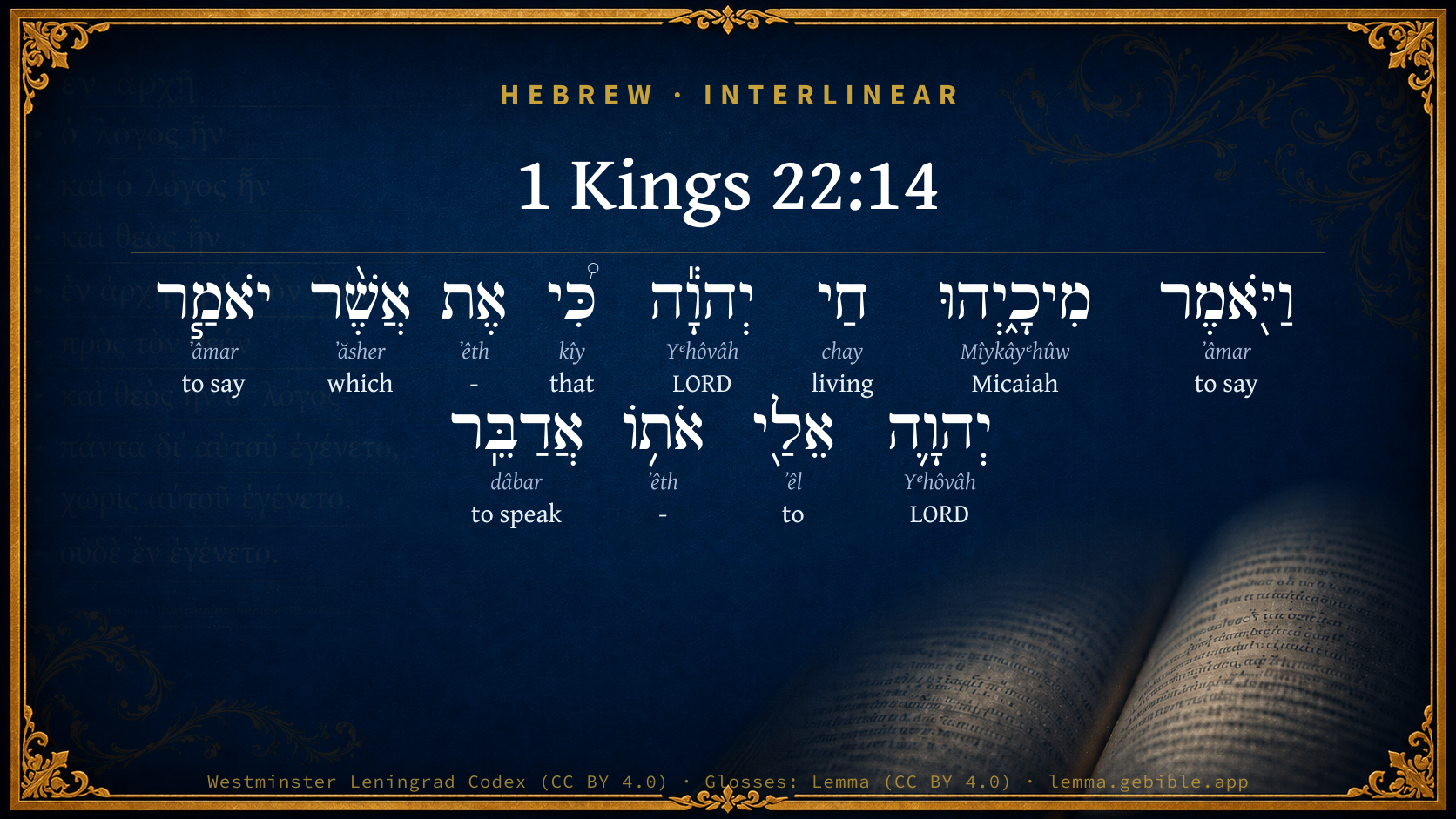
Hebrew (Westminster Leningrad Codex) 1 Kings 22:14 appears in the Hebrew Old Testament. The text above is from the Westminster Leningrad Codex. Each word links to its Strong’s number, a concise gloss, and parsing drawn from the Open Scriptures Hebrew Bible morphology. Click any word for its full Brown-Driver-Briggs (BDB) entry.
Download image
Cite this verse

1 Kings 22:14 (World English Bible). Public Domain. Lemma interlinear Bible study tool, https://lemma.gebible.app/v/1-kings/22/14.

Show BibTeX & RIS
BibTeX
RIS
English Translation
Micaiah said, As Yahweh lives, what Yahweh says to me, that will I speak.
World English Bible · Public Domain
Download a study sheet

One document with this verse’s original text, its word-by-word gloss line, the meaning frame, cross-references with their text, attributed commentary, and full source and license credits — printable, and it pastes into notes with its structure intact.

This verse Autodidact and up

Study sheet (.html) Plain text (.txt)

A passage Seminary Student

Up to 50 verses in one chapter. A passage sheet keeps up to 6 commentary sources and 12 cross-references per verse, in the order this page ranks them, and says so on the sheet whenever that leaves anything out. Ask for a single verse and you get the Autodidact verse sheet above.

Everything on this page stays free to read, with no account — the sheet is a download of what is already on screen, not access to it.

Want to remove ads? Support Godless Engineer
Compare translations 3

The same verse in 3 English versions, stacked beneath the original-language interlinear above. Click any original word for its lexicon entry.

Each is an independent rendering of the whole verse — the interlinear is not word-aligned to these translations.

Highlighted words mark where these versions differ — a whole-verse word diff, not a word-by-word alignment.

  • World English Bible Public Domain
    Micaiah said, As Yahweh lives, what Yahweh says to me, that will I speak.
  • King James Version Public Domain
    And Micaiah said, As the LORD liveth, what the LORD saith unto me, that will I speak.
  • unfoldingWord Literal Text CC BY-SA 4.0
    And Micaiah said, “The life of Yahweh, surely what Yahweh says to me, I will speak it.”

unfoldingWord Literal Text — © unfoldingWord, licensed CC BY-SA 4.0. Word-aligned USFM3 via Door43 (git.door43.org/unfoldingWord/en_ult).

Versions to compare (up to 4)

3 of 4 selected

Show all 18 translations

Every available English version of this verse, each an independent rendering of the whole verse.

  • World English Bible Public Domain
    Micaiah said, As Yahweh lives, what Yahweh says to me, that will I speak.
  • Berean Standard Bible Public Domain
    But Micaiah said, “As surely as the LORD lives, I will speak whatever the LORD tells me.”
  • Majority Standard Bible Public Domain
    But Micaiah said, “As surely as the LORD lives, I will speak whatever the LORD tells me.”
  • King James Version Public Domain
    And Micaiah said, As the LORD liveth, what the LORD saith unto me, that will I speak.
  • American Standard Version (1901) Public Domain
    And Micaiah said, As Jehovah liveth, what Jehovah saith unto me, that will I speak.
  • Revised Version (1885) Public Domain
    And Micaiah said, As the LORD liveth, what the LORD saith unto me, that will I speak.
  • Geneva Bible (1599) Public Domain
    And Michaiah saide, As the Lord liueth, whatsoeuer the Lord sayth vnto me, that will I speake.
  • Douay-Rheims (1899) Public Domain
    But Micheas said to him: As the Lord liveth, whatsoever the Lord shall say to me, that will I speak.
  • Young's Literal Translation Public Domain
    And Micaiah saith, `Jehovah liveth; surely that which Jehovah saith unto me -- it I speak.'
  • Literal Standard Version CC BY-SA 4.0
    And Micaiah says, “YHWH lives; surely that which YHWH says to me—it I speak.”
  • Unlocked Literal Bible CC BY-SA 4.0
    Micaiah replied, “As Yahweh lives, it is what Yahweh says to me that I will say.”
  • unfoldingWord Literal Text CC BY-SA 4.0
    And Micaiah said, “The life of Yahweh, surely what Yahweh says to me, I will speak it.”
  • Darby Bible Public Domain
    And Micah said, As Jehovah liveth, even what Jehovah shall say to me, that will I speak.
  • World Messianic Bible Public Domain
    Micaiah said, “As the LORD lives, what the LORD says to me, that I will speak.”
  • Webster's Bible Public Domain
    And Micaiah said, As the LORD liveth, what the LORD saith to me, that will I speak.
  • Free Bible Version CC BY-SA 4.0
    But Micaiah replied, “As the Lord lives, I can only say what my God tells me.”
  • Bible in Basic English Public Domain
    And Micaiah said, By the living Lord, whatever the Lord says to me I will say.
  • JPS Tanakh (1917) Public Domain
    And Micaiah said: 'As the LORD liveth, what the LORD saith unto me, that will I speak.'

Literal Standard Version (2020), Covenant Press — licensed CC BY-SA 4.0. Text via the HelloAO Bible API (eBible.org). Unlocked Literal Bible (unfoldingWord) — licensed CC BY-SA 4.0. Text via the HelloAO Bible API (eBible.org). unfoldingWord Literal Text — © unfoldingWord, licensed CC BY-SA 4.0. Word-aligned USFM3 via Door43 (git.door43.org/unfoldingWord/en_ult). Free Bible Version, Dr. Jonathan Gallagher — licensed CC BY-SA 4.0. Text via the HelloAO Bible API (eBible.org).

Word by word

More ways to search: Search by grammar → Find every occurrence → Compare this word →

Practice this passage: Drill this verse → Learn its vocabulary →

מִיכָ֑יְהוּ
Mîykâyᵉhûw
H4321
“Micaiah”
Noun, Proper
Part of Speech
Noun
Type
Proper
Full BDB Definition

Origin: abbrev. for H4322

TWOT: None

Micah or Micaiah or Michaiah = "who is like God" - an Ephraimite during the period of the judges - son of Imlah and a prophet of Samaria who predicted the defeat and death of king Ahab of Israel - son of Gemariah in the time of Jeremiah
  1. וַיֹּ֖אמֶר ʼâmar H559 “and · to say” Conjunction + Verb, Qal, Sequential Imperfect, 3rd Person, Masculine, Singular
  2. חַי chay H2416 “living” Adjective, Adjective, Masculine, Singular, Absolute
  3. יְהוָ֕ה Yᵉhôvâh H3068 “LORD” Noun, Proper
  4. כִּ֠י kîy H3588 “that” Conjunction
  5. אֶת ʼêth H853 “-” Particle, Direct Object
  6. אֲשֶׁ֨ר ʼăsher H834 “which” Particle, Relative
  7. יֹאמַ֧ר ʼâmar H559 “to say” Verb, Qal, Imperfect, 3rd Person, Masculine, Singular
  8. יְהוָ֛ה Yᵉhôvâh H3068 “LORD” Noun, Proper
  9. אֵלַ֖י ʼêl H413 “to · me” Preposition + Suffix, Personal, 1st Person, Common, Singular
  10. אֹת֥וֹ ʼêth H853 “- · him” Particle, Direct Object + Suffix, Personal, 3rd Person, Masculine, Singular
  11. אֲדַבֵּֽר dâbar H1696 “to speak” Verb, Piel, Imperfect, 1st Person, Common, Singular

About this verse

These counts appear in no published source. They are computed here, from the morphology-tagged text and Lemma’s own curated glosses. What Lemma adds →

12
words
9
distinct lemmas
Historical
section

Notable vocabulary

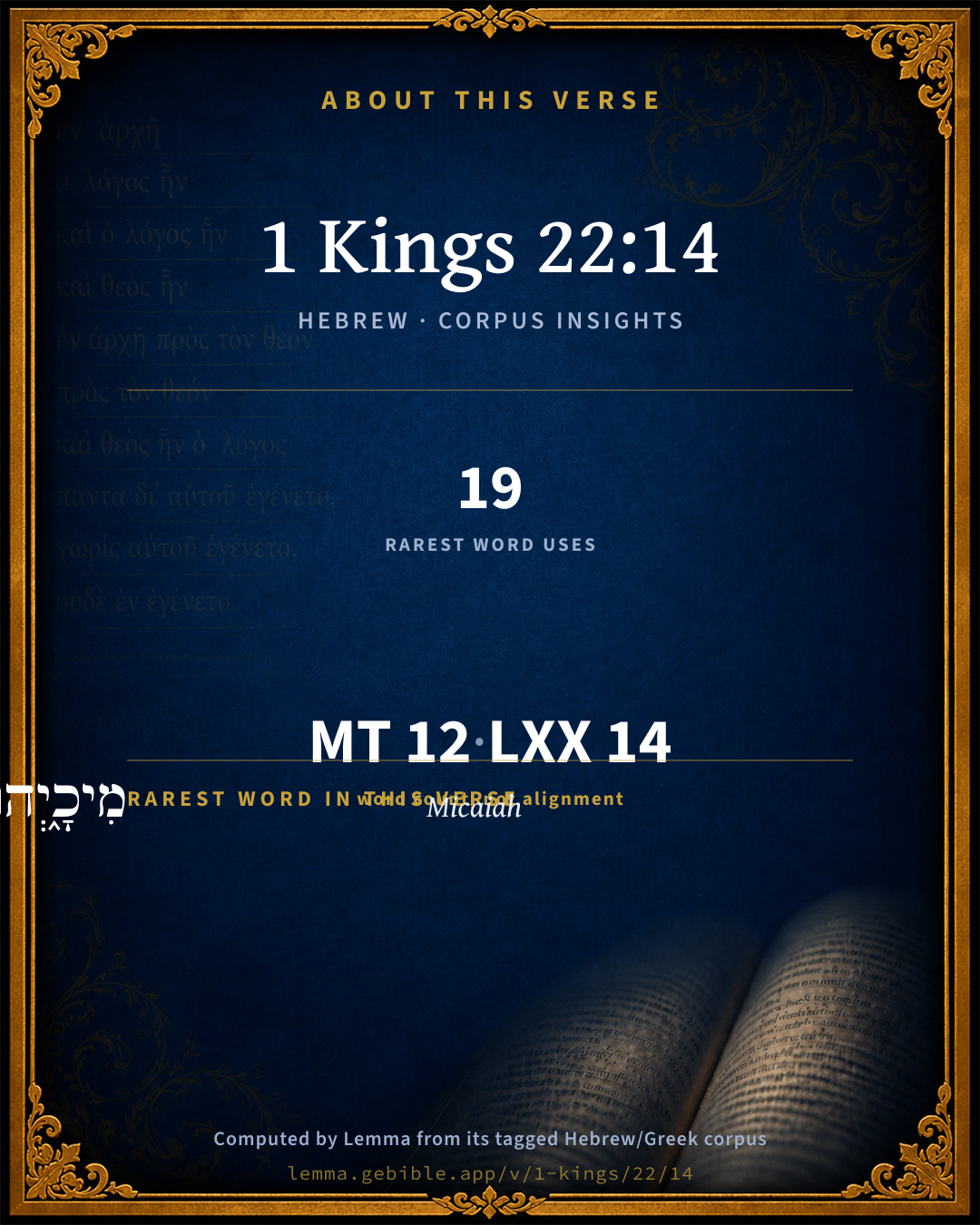
The rarest word here is מִיכָ֑יְהוּ Micaiah H4321 — appearing just 19 times in the whole Hebrew Bible.

Shared distinctive vocabulary

מִיכָ֑יְהוּ Micaiah H4321 occurs in 19 verses of the Hebrew Bible. Also found in:

Grammatical profile

  • 3 verbs
  • 3 nouns
  • 1 adjective
  • 1 preposition
  • 1 conjunction
  • 3 particles

Verb forms

  • וַיֹּ֖אמֶר Qal · Sequential Imperfect
  • יֹאמַ֧ר Qal · Imperfect
  • אֲדַבֵּֽר Piel · Imperfect

Repetition

Words recur within this verse — often emphatic in Hebrew:

  • וַיֹּ֖אמֶר to say H559 ×2
  • יְהוָ֕ה LORD H3068 ×2

Hebrew & Septuagint length

In English translation the verse runs 14 words from the Hebrew and 18 from the Septuagint (LXX English) — closely comparable.

A rough comparison of the two English renderings, which tokenize alike — not a word-level alignment.

Word counts can differ between the Hebrew and the Greek without any difference in meaning — e.g. the Hebrew direct-object marker אֵת has no separate Greek word, and Greek often adds the article ὁ.

In the original languages it is 12 Hebrew tokens and 14 Greek tokens — but the two are counted differently (Hebrew bundles its prefixes and suffixes into one token; the Greek is in lemma form), so that isn’t a like-for-like length.

Cross-references

15

Topical passages linked to 1 Kings 22:14 in the Treasury of Scripture Knowledge — connected by theme and wording, ordered by reader-vote popularity; previews shown in the World English Bible.

  • Numbers 24:13 If Balak would give me his house full of silver and gold, I can't go beyond the word of Yahweh, to do either good or bad of my own mind; what Yahweh speaks, that will I speak?
  • Numbers 22:18 Balaam answered the servants of Balak, If Balak would give me his house full of silver and gold, I can't go beyond the word of Yahweh my God, to do less or more.
  • Numbers 22:38 Balaam said to Balak, Behold, I have come to you: have I now any power at all to speak anything? the word that God puts in my mouth, that shall I speak.
  • 2 Chronicles 18:12–13 The messenger who went to call Micaiah spoke to him, saying, Behold, the words of the prophets [declare] good to the king with one mouth: let your word therefore, Please be like one of theirs, and speak you good.
  • Jeremiah 26:2–3 Thus says Yahweh: Stand in the court of Yahweh's house, and speak to all the cities of Judah, which come to worship in Yahweh's house, all the words that I command you to speak to them; don't diminish a word.
  • Ezekiel 3:17–19 Son of man, I have made you a watchman to the house of Israel: therefore hear the word at my mouth, and give them warning from me.
  • 1 Kings 18:10 As Yahweh your God lives, there is no nation or kingdom, where my lord has not sent to seek you: and when they said, He is not here, he took an oath of the kingdom and nation, that they didn't find you.
  • 1 Kings 18:15 Elijah said, As Yahweh of Hosts lives, before whom I stand, I will surely show myself to him today.
  • Jeremiah 42:4 Then Jeremiah the prophet said to them, I have heard you; behold, I will pray to Yahweh your God according to your words; and it shall happen that whatever thing Yahweh shall answer you, I will declare it to you; I will keep nothing back from you.
  • Ezekiel 2:4–8 The children are impudent and stiff-hearted: I do sent you to them; and you shall tell them, Thus says the Lord Yahweh.
  • Acts 20:26–27 Therefore I testify to you this day that I am clean from the blood of all men,
  • 2 Corinthians 2:17 For we are not as so many, peddling the word of God. But as of sincerity, but as of God, in the sight of God, we speak in Christ.
  • 2 Corinthians 4:2 But we have renounced the hidden things of shame, not walking in craftiness, nor handling the word of God deceitfully; but by the manifestation of the truth commending ourselves to every man's conscience in the sight of God.
  • Galatians 1:10 For am I now seeking the favor of men, or of God? Or am I striving to please men? For if I were still pleasing men, I wouldn't be a servant of Christ.
  • Jeremiah 23:28 The prophet who has a dream, let him tell a dream; and he who has my word, let him speak my word faithfully. What is the straw to the wheat? says Yahweh.

Cross-references courtesy of OpenBible.info (CC BY 4.0).

Hebrew and Greek witnesses Masoretic Hebrew ↔ Greek Septuagint

The same verse in the two great witnesses to the Old Testament, shown verse-for-verse.

These are two independent witnesses, not word-aligned to each other, and the Septuagint is shown in lemma (dictionary) form.

Hebrew 1 Kings 22:14 Masoretic · Westminster Leningrad Codex

וַיֹּ֖אמֶר מִיכָ֑יְהוּ חַי יְהוָ֕ה כִּ֠י אֶת אֲשֶׁ֨ר יֹאמַ֧ר יְהוָ֛ה אֵלַ֖י אֹת֥וֹ אֲדַבֵּֽר

Micaiah said, As Yahweh lives, what Yahweh says to me, that will I speak.

World English Bible · Public Domain

Greek LXX 1 Kings 22:14 Septuagint · lemma form

καί εἶπον μιχαιας ζάω κύριος ὅτι ὅς ἄν εἶπον κύριος πρός ἐγώ οὗτος λαλέω

And Michaias said, As the Lord lives, whatever the Lord shall say to me, that will I speak.

LXX2012 (modern English Septuagint) · Public Domain

Hebrew: Westminster Leningrad Codex (CC BY 4.0). Greek: Septuagint (public domain); English from LXX2012 (modern English Septuagint) (Public Domain). How the Septuagint differs from the Hebrew →

Targum (Aramaic paraphrase)

1

The Targum is the ancient Jewish Aramaic paraphrase of the Hebrew Scriptures — an interpretive translation, not the Hebrew text itself. Onkelos (literal) and Pseudo-Jonathan (expansive) render the Torah, and Jonathan the Prophets. Coverage is partial: where no permissively-licensed English translation exists for a verse, only the Aramaic is shown. This is verse-level text, not a word-by-word alignment to the Hebrew.

  1. Targum Jonathan Prophets (Joshua–Malachi)
    וַאֲמַר מִיכָיְהוּ קַיָם הוּא יְיָ אֲרֵי יַת דְיֵימַר יְיָ לִי יָתֵיהּ אֲמַלֵל:

    (no public-domain English translation for this verse)

    Targum Jonathan — Aramaic: “Mikraot Gedolot” (public domain). English: “Sefaria Community Translation” (CC0 1.0 (public-domain dedication)); “London "Chaldee Paraphrase," 1871” (public domain). Text via Sefaria.

Commentary

Notes on 1 Kings 22:14 from classic Christian and Jewish commentators (each source and its license shown beneath its notes). The classic Christian expositions comment on the surrounding passage and are grouped to its opening verse, so a note may address several verses; the Jewish commentaries on the Tanakh (Rashi and others) are per-verse, so they appear only where the commentator wrote on this verse.

Lemma curates 59 commentaries, every one of them public domain or Creative Commons licensed, each selected and text-cleaned for this edition rather than reprinted as found. About our sources →

Trapp's Complete Commentary

John Trapp

1Ki 22:14 And Micaiah said, [As] the LORD liveth, what the LORD saith unto me, that will I speak.

Ver. 14. As the Lord liveth, what the Lord saith unto me.] He was resolved to speak the naked truth, though he were sure to kiss the stocks for his stiffness.

John Trapp, A Commentary or Exposition upon All the Books of the Old and New Testament (1647–1656) — public domain. Text from a community e-Sword module.

Jamieson, Fausset & Brown

Robert Jamieson, A. R. Fausset & David Brown

what the Lord saith unto me, that will I speak--On the way the messenger who conducted [Micaiah] to the royal presence informed him of the tenor of the prophecies already given and recommended him to agree with the rest, no doubt from the kindly motive of seeing him released from imprisonment. But Micaiah, inflexibly faithful to his divine mission as a prophet, announced his purpose to proclaim honestly whatever God should bid him. On being asked by the king, "Shall I go against Ramoth-gilead, or shall I forbear?" the prophet gave precisely the same answer as the previous oracles that had been consulted; but it must have been given in a sarcastic tone and in ironical mockery of their way of speaking. Being solemnly urged to give a serious and truthful answer, Micaiah then declared the visionary scene the Spirit had revealed to him;--

Jamieson, Fausset & Brown — Commentary Critical and Explanatory on the Whole Bible (1871) — public domain (CC PDM 1.0). Text via the HelloAO Bible API.

The Cambridge Bible for Schools and Colleges

gen. ed. J. J. S. Perowne

14. what the Lord saith] In 2Ch_18:13 it is ‘what my God saith.’

The Cambridge Bible for Schools and Colleges (gen. ed. J. J. S. Perowne; Cambridge University Press, 1878–1918) — public domain. Text from a community e-Sword module.

John Gill's Exposition

And he said,.... The prophet, in a serious and solemn manner, being adjured by the king:

I saw all Israel scattered on the hills, as sheep that have not a shepherd; the armies of Israel routed, dispersed, and fleeing, some one way and some another, on the mountains of Gilead near Ramoth, weak and helpless, not knowing where to go for safety, having none to direct them; and this was either now instantly represented to his mind, or what had been before in a dream or vision:

and the Lord said, these have no master; these sheep have no shepherd this army hath no general,

Israel has lost its king: let them return every man to his house in peace, very few slain, Jarchi thinks Ahab only, see Kg1 22:31 that part of the threatening, Kg1 20:42 was now to he accomplished, "thy life shall go for his life", but the other part, "and thy people for his people", was to be deferred to another time.

John Gill's Exposition of the Whole Bible (1746–1763) — public domain (CC PDM 1.0). Text via the HelloAO Bible API.

Albert Barnes' Notes on the Bible

Micaiah, as a true prophet of Yahweh, of course rejected the counsel offered him, which he felt to be at once wicked and foolish. Compare also the resolution of Balaam, marginal reference.

Albert Barnes' Notes on the Bible (1834–1885) — public domain. Text from a community e-Sword/MySword module.

Matthew Poole's English Annotations

What answer God shall put into my mind and mouth; which, it seems, was not yet done.

Matthew Poole's English Annotations on the Holy Bible (1683–1685) — public domain. Text from a community e-Sword/MySword module.

The Pulpit Commentary

And Micaiah said, As the Lord liveth, what the Lord saith unto me, that will I speak. We are forcibly reminded of the answer of Balaam, Num_22:18, Num_22:38. And we may see not only in the suggestion of this messenger, but also in Ahab"s belief (ver. 8), that Micaiah could prophesy at pleasure, a striking correspondence with the ideas of Balak (ib. 5:6, 17). Instead of regarding the prophet as being merely the mouthpiece of Deity, he was believed in that age to have a supernatural influence with God, and to be entrusted with magical powers to shape the future, as well as to foretell it.

The Pulpit Commentary (1880–1919), ed. H.D.M. Spence-Jones & Joseph S. Exell — public domain. Text from a community e-Sword module.

John Wesley's Explanatory Notes

Said - What answer God shall put in to my mouth. Bravely resolved! And as became one who had an eye to a greater king than either of these.

John Wesley, Explanatory Notes Upon the Whole Bible (1754–1765) — public domain. Text via the GEBible commentary corpus.

Lesson kit

Teaching starters — assembled from the data on this page, not authored interpretation. Every prompt links to the verse data it draws on. Edit before teaching.

1 Kings, in the Historical, opens this verse with 12 words (9 distinct Hebrew lemmas). Its most distinctive word is Mîykâyᵉhûw (“Micaiah”). A historical commentator’s framing appears above. Read the whole chapter for the surrounding context.

Discussion questions

  1. What does “Micaiah” (Mîykâyᵉhûw) contribute to the verse as a whole?
  2. 1 Kings 22:8 shares the word «Micaiah» with this verse. How do the two illuminate each other?
  3. “to say” occurs 2× in this one verse. What is the effect of the repetition?
  4. These translations render this verse differently; the difference is in the English rendering, not the original. What questions does that raise?
  5. The verb «וַיֹּ֖אמֶר» is Qal Sequential Imperfect. How does its form color the action?
  6. Reading how Trapp's Complete Commentary and Jamieson, Fausset & Brown read this verse, where do the two commentators agree and where do they part?

Things to notice

Reading settings

Reading text

Shown beneath each verse's original-language words.

Old Testament
Old Testament edition

Read the OT as the Masoretic Hebrew (MT) or the Greek Septuagint (LXX).

English shown for the Greek Septuagint (in the Hebrew ↔ Greek comparison).

Comparing translations? Open the Compare panel on any verse page to stack up to four side by side.