Jeremiah 22:21

Hebrew (Westminster Leningrad Codex) Jeremiah 22:21 appears in the Hebrew Old Testament. The text above is from the Westminster Leningrad Codex. Each word links to its Strong’s number, a concise gloss, and parsing drawn from the Open Scriptures Hebrew Bible morphology. Click any word for its full Brown-Driver-Briggs (BDB) entry.
Download image
Cite this verse

Jeremiah 22:21 (World English Bible). Public Domain. Lemma interlinear Bible study tool, https://lemma.gebible.app/v/jeremiah/22/21.

Show BibTeX & RIS
BibTeX
RIS
English Translation
I spoke to you in your prosperity; but you said, I will not hear. This has been your manner from your youth, that you didn't obey my voice.
World English Bible · Public Domain
Download a study sheet

One document with this verse’s original text, its word-by-word gloss line, the meaning frame, cross-references with their text, attributed commentary, and full source and license credits — printable, and it pastes into notes with its structure intact.

This verse Autodidact and up

Study sheet (.html) Plain text (.txt)

A passage Seminary Student

Up to 50 verses in one chapter. A passage sheet keeps up to 6 commentary sources and 12 cross-references per verse, in the order this page ranks them, and says so on the sheet whenever that leaves anything out. Ask for a single verse and you get the Autodidact verse sheet above.

Everything on this page stays free to read, with no account — the sheet is a download of what is already on screen, not access to it.

Want to remove ads? Support Godless Engineer
Compare translations 3

The same verse in 3 English versions, stacked beneath the original-language interlinear above. Click any original word for its lexicon entry.

Each is an independent rendering of the whole verse — the interlinear is not word-aligned to these translations.

Highlighted words mark where these versions differ — a whole-verse word diff, not a word-by-word alignment.

  • World English Bible Public Domain
    I spoke to you in your prosperity; but you said, I will not hear. This has been your manner from your youth, that you didn't obey my voice.
  • King James Version Public Domain
    I spake unto thee in thy prosperity; but thou saidst, I will not hear. This hath been thy manner from thy youth, that thou obeyedst not my voice.
  • unfoldingWord Literal Text CC BY-SA 4.0
    I spoke to you in your prosperity; you said, ‘I will not hear.’ This been your way from your youth, for you have not heard my voice.

unfoldingWord Literal Text — © unfoldingWord, licensed CC BY-SA 4.0. Word-aligned USFM3 via Door43 (git.door43.org/unfoldingWord/en_ult).

Versions to compare (up to 4)

3 of 4 selected

Show all 18 translations

Every available English version of this verse, each an independent rendering of the whole verse.

  • World English Bible Public Domain
    I spoke to you in your prosperity; but you said, I will not hear. This has been your manner from your youth, that you didn't obey my voice.
  • Berean Standard Bible Public Domain
    I warned you when you were secure. You said, ‘I will not listen.’ This has been your way from youth, that you have not obeyed My voice.
  • Majority Standard Bible Public Domain
    I warned you when you were secure. You said, ‘I will not listen.’ This has been your way from youth, that you have not obeyed My voice.
  • King James Version Public Domain
    I spake unto thee in thy prosperity; but thou saidst, I will not hear. This hath been thy manner from thy youth, that thou obeyedst not my voice.
  • American Standard Version (1901) Public Domain
    I spake unto thee in thy prosperity; but thou saidst, I will not hear. This hath been thy manner from thy youth, that thou obeyedst not my voice.
  • Revised Version (1885) Public Domain
    I spake unto thee in thy prosperity; but thou saidst, I will not hear. This hath been thy manner from thy youth, that thou obeyedst not my voice.
  • Geneva Bible (1599) Public Domain
    I spake vnto thee when thou wast in prosperitie: but thou saidest, I will not heare: this hath bene thy maner from thy youth, that thou wouldest not obey my voyce.
  • Douay-Rheims (1899) Public Domain
    I spoke to thee in thy properity: and thoiu saidst: I will not hear: this hath been thy way from thy youth, because thou hast not heard my voice.
  • Young's Literal Translation Public Domain
    I have spoken unto thee in thine ease, Thou hast said, `I do not hearken,' This `is' thy way from thy youth, For thou hast not hearkened to My voice.
  • Literal Standard Version CC BY-SA 4.0
    I have spoken to you in your ease, || You have said, I do not listen, || This [is] your way from your youth, || For you have not listened to My voice.
  • Unlocked Literal Bible CC BY-SA 4.0
    I spoke to you when you were safe, but you said, 'I will not listen.' This was your custom since your youth, for you have not listened to my voice.
  • unfoldingWord Literal Text CC BY-SA 4.0
    I spoke to you in your prosperity; you said, ‘I will not hear.’ This been your way from your youth, for you have not heard my voice.
  • Darby Bible Public Domain
    I spoke unto thee in thy prosperity; [but] thou saidst, I will not hear. This hath been thy way from thy youth, that thou hearkenedst not unto my voice.
  • World Messianic Bible Public Domain
    I spoke to you in your prosperity, but you said, ‘I will not listen.’ This has been your way from your youth, that you didn’t obey my voice.
  • Webster's Bible Public Domain
    I spoke to thee in thy prosperity; but thou saidest, I will not hear. This hath been thy manner from thy youth, that thou hast not obeyed my voice.
  • Free Bible Version CC BY-SA 4.0
    I warned you when you thought you were safe and sound. But you replied, “I'm not going to listen!” That's been your attitude since you were young—you never did what I told you.
  • Bible in Basic English Public Domain
    My word came to you in the time of your well-being; but you said, I will not give ear. This has been your way from your earliest years, you did not give attention to my voice.
  • JPS Tanakh (1917) Public Domain
    I spoke unto thee in thy prosperity, but thou saidst: 'I will not hear.' This hath been thy manner from thy youth, that thou hearkenedst not to My voice.

Literal Standard Version (2020), Covenant Press — licensed CC BY-SA 4.0. Text via the HelloAO Bible API (eBible.org). Unlocked Literal Bible (unfoldingWord) — licensed CC BY-SA 4.0. Text via the HelloAO Bible API (eBible.org). unfoldingWord Literal Text — © unfoldingWord, licensed CC BY-SA 4.0. Word-aligned USFM3 via Door43 (git.door43.org/unfoldingWord/en_ult). Free Bible Version, Dr. Jonathan Gallagher — licensed CC BY-SA 4.0. Text via the HelloAO Bible API (eBible.org).

Word by word

More ways to search: Search by grammar → Find every occurrence → Compare this word →

Practice this passage: Drill this verse → Learn its vocabulary →

בְּשַׁלְוֺתַ֔יִךְ
shalvâh
H7962
“in/at · quietness · your”
Preposition + Noun, Common, Feminine, Plural, Construct + Suffix, Personal, 2nd Person, Feminine, Singular
Part of Speech
Preposition + Noun
Type
Common
Gender
Feminine
Number
Plural
State
Construct
Full BDB Definition

Origin: from H7951

TWOT: 2392d

quietness, ease, prosperity
  1. דִּבַּ֤רְתִּי dâbar H1696 “to speak” Verb, Piel, Perfect, 1st Person, Common, Singular
  2. אֵלַ֨יִךְ֙ ʼêl H413 “to · you” Preposition + Suffix, Personal, 2nd Person, Feminine, Singular
  3. אָמַ֖רְתְּ ʼâmar H559 “to say” Verb, Qal, Perfect, 2nd Person, Feminine, Singular
  4. לֹ֣א lôʼ H3808 “not” Particle, Negative
  5. אֶשְׁמָ֑ע shâmaʻ H8085 “to hear” Verb, Qal, Imperfect, 1st Person, Common, Singular
  6. זֶ֤ה zeh H2088 “this” Pronoun, Demonstrative, Masculine, Singular
  7. דַרְכֵּךְ֙ derek H1870 “way · your” Noun, Common, Both, Singular, Construct + Suffix, Personal, 2nd Person, Feminine, Singular
  8. מִנְּעוּרַ֔יִךְ nâʻûwr H5271 “from · youth · your” Preposition + Noun, Common, Both, Plural, Construct + Suffix, Personal, 2nd Person, Feminine, Singular
  9. כִּ֥י kîy H3588 “that” Conjunction
  10. לֹֽא lôʼ H3808 “not” Particle, Negative
  11. שָׁמַ֖עַתְּ shâmaʻ H8085 “to hear” Verb, Qal, Perfect, 2nd Person, Feminine, Singular
  12. בְּקוֹלִֽי qôwl H6963 “in/at · voice · my” Preposition + Noun, Common, Masculine, Singular, Construct + Suffix, Personal, 1st Person, Common, Singular

About this verse

These counts appear in no published source. They are computed here, from the morphology-tagged text and Lemma’s own curated glosses. What Lemma adds →

13
words
11
distinct lemmas
Prophets
section

Notable vocabulary

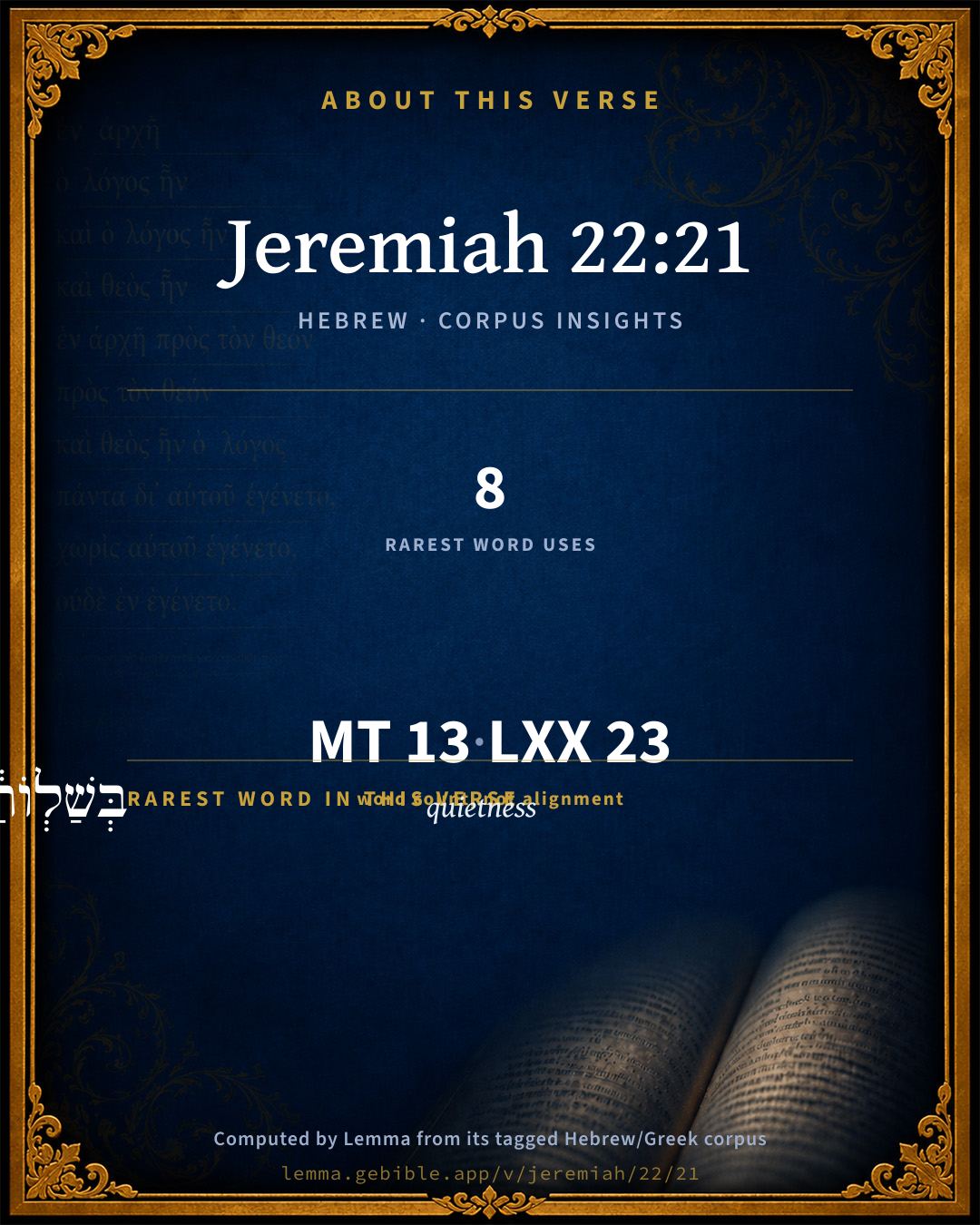
The rarest word here is בְּשַׁלְוֺתַ֔יִךְ quietness H7962 — appearing just 8 times in the whole Hebrew Bible.

Shared distinctive vocabulary

בְּשַׁלְוֺתַ֔יִךְ quietness H7962 occurs in 8 verses of the Hebrew Bible. Also found in:

Grammatical profile

  • 4 verbs
  • 4 nouns
  • 1 pronoun
  • 1 preposition
  • 1 conjunction
  • 2 particles

Verb forms

  • דִּבַּ֤רְתִּי Piel · Perfect
  • אָמַ֖רְתְּ Qal · Perfect
  • אֶשְׁמָ֑ע Qal · Imperfect
  • שָׁמַ֖עַתְּ Qal · Perfect

Repetition

Words recur within this verse — often emphatic in Hebrew:

  • אֶשְׁמָ֑ע to hear H8085 ×2
  • לֹ֣א not H3808 ×2

Hebrew & Septuagint length

In the original languages it is 13 Hebrew tokens and 23 Greek tokens — but the two are counted differently (Hebrew bundles its prefixes and suffixes into one token; the Greek is in lemma form), so that isn’t a like-for-like length.

Cross-references

23

Topical passages linked to Jeremiah 22:21 in the Treasury of Scripture Knowledge — connected by theme and wording, ordered by reader-vote popularity; previews shown in the World English Bible.

  • Jeremiah 32:30 For the children of Israel and the children of Judah have done only that which was evil in my sight from their youth; for the children of Israel have only provoked me to anger with the work of their hands, says Yahweh.
  • Jeremiah 3:25 Let us lie down in our shame, and let our confusion cover us; for we have sinned against Yahweh our God, we and our fathers, from our youth even to this day; and we have not obeyed the voice of Yahweh our God.
  • Jeremiah 7:22–28 For I didn't speak to your fathers, nor command them in the day that I brought them out of the land of Egypt, concerning burnt offerings or sacrifices:
  • Proverbs 30:9 Lest I be full, deny you, and say, 'Who is Yahweh?' Or lest I be poor, and steal, And so dishonor the name of my God.
  • Isaiah 48:8 Yes, you didn't hear; yes, you didn't know; yes, from of old your ear was not opened: for I knew that you did deal very treacherously, and was called a transgressor from the womb.
  • Ezekiel 23:3–39 and they played the prostitute in Egypt; they played the prostitute in their youth; there were their breasts pressed, and there was handled the bosom of their virginity.
  • Jeremiah 6:16 Thus says Yahweh, Stand you in the ways and see, and ask for the old paths, where is the good way; and walk therein, and you shall find rest for your souls: but they said, We will not walk [therein].
  • Jeremiah 35:15 I have sent also to you all my servants the prophets, rising up early and sending them, saying, Return you now every man from his evil way, and amend your doings, and don't go after other gods to serve them, and you shall dwell in the land which I have given to you and to your fathers: but you have not inclined your ear, nor listened to me.
  • Ezekiel 20:8 But they rebelled against me, and would not listen to me; they did not every man cast away the abominations of their eyes, neither did they forsake the idols of Egypt. Then I said I would pour out my wrath on them, to accomplish my anger against them in the midst of the land of Egypt.
  • Deuteronomy 9:7 Remember, don't forget, how you provoked Yahweh your God to wrath in the wilderness: from the day that you went forth out of the land of Egypt, until you came to this place, you have been rebellious against Yahweh.
  • Deuteronomy 9:24 You have been rebellious against Yahweh from the day that I knew you.
  • Deuteronomy 31:27 For I know your rebellion, and your stiff neck: behold, while I am yet alive with you this day, you have been rebellious against Yahweh; and how much more after my death?
  • Deuteronomy 32:15–20 But Jeshurun grew fat, and kicked: You have grown fat, you are grown thick, you are become sleek; Then he forsook God who made him, Lightly esteemed the Rock of his salvation.
  • Judges 2:11–19 The children of Israel did that which was evil in the sight of Yahweh, and served the Baals;
  • 2 Chronicles 33:10 Yahweh spoke to Manasseh, and to his people; but they gave no heed.
  • 2 Chronicles 36:16–17 but they mocked the messengers of God, and despised his words, and scoffed at his prophets, until the wrath of Yahweh arose against his people, until there was no remedy.
  • Nehemiah 9:16–37 But they and our fathers dealt proudly and hardened their neck, and didn't listen to your commandments,
  • Psalms 106:6–48 We have sinned with our fathers. We have committed iniquity. We have done wickedly.
  • Jeremiah 2:31 Generation, see the word of Yahweh. Have I been a wilderness to Israel? or a land of thick darkness? why say my people, We are broken loose; we will come no more to you?
  • Jeremiah 36:21–26 So the king sent Jehudi to get the scroll; and he took it out of the chamber of Elishama the scribe. Jehudi read it in the ears of the king, and in the ears of all the princes who stood beside the king.
  • Ezekiel 20:13 But the house of Israel rebelled against me in the wilderness: they didn't walk in my statutes, and they rejected my ordinances, which if a man keep, he shall live in them; and my Sabbaths they greatly profaned. Then I said I would pour out my wrath on them in the wilderness, to consume them.
  • Ezekiel 20:21 But the children rebelled against me; they didn't walk in my statutes, neither kept my ordinances to do them, which if a man do, he shall live in them; they profaned my Sabbaths. Then I said I would pour out my wrath on them, to accomplish my anger against them in the wilderness.
  • Ezekiel 20:28 For when I had brought them into the land, which I swore to give to them, then they saw every high hill, and every thick tree, and they offered there their sacrifices, and there they presented the provocation of their offering; there also they made their sweet savor, and they poured out there their drink-offerings.

Cross-references courtesy of OpenBible.info (CC BY 4.0).

Hebrew and Greek witnesses Masoretic Hebrew ↔ Greek Septuagint

The same verse in the two great witnesses to the Old Testament, shown verse-for-verse.

These are two independent witnesses, not word-aligned to each other, and the Septuagint is shown in lemma (dictionary) form.

Hebrew Jeremiah 22:21 Masoretic · Westminster Leningrad Codex

דִּבַּ֤רְתִּי אֵלַ֨יִךְ֙ בְּשַׁלְוֺתַ֔יִךְ אָמַ֖רְתְּ לֹ֣א אֶשְׁמָ֑ע זֶ֤ה דַרְכֵּךְ֙ מִנְּעוּרַ֔יִךְ כִּ֥י לֹֽא שָׁמַ֖עַתְּ בְּקוֹלִֽי

I spoke to you in your prosperity; but you said, I will not hear. This has been your manner from your youth, that you didn't obey my voice.

World English Bible · Public Domain

Greek LXX Structure differs

In the Septuagint, Jeremiah is about an eighth shorter than the Hebrew and arranges its material differently — the Oracles Against the Nations (Hebrew chapters 46–51) appear in the middle of the Greek book, after 25:13. Because the chapter and verse boundaries do not line up, a verse-for-verse comparison with the Hebrew is not shown.

A verse-for-verse comparison isn’t shown here because the chapters and verses don’t line up. Switch to the LXX edition with the MT / LXX toggle above to read the Greek directly.

Hebrew: Westminster Leningrad Codex (CC BY 4.0). Greek: Septuagint (public domain); English from a public-domain English Septuagint. How the Septuagint differs from the Hebrew →

Targum (Aramaic paraphrase)

1

The Targum is the ancient Jewish Aramaic paraphrase of the Hebrew Scriptures — an interpretive translation, not the Hebrew text itself. Onkelos (literal) and Pseudo-Jonathan (expansive) render the Torah, and Jonathan the Prophets. Coverage is partial: where no permissively-licensed English translation exists for a verse, only the Aramaic is shown. This is verse-level text, not a word-by-word alignment to the Hebrew.

  1. Targum Jonathan Prophets (Joshua–Malachi)
    וּשְׁלָחִית לְוָתִיךְ יַת כָּל עַבְדֵי נְבִיַיָא כַּד הֲוֵית יָתְבָא שְׁלֵוְיָא אֲמַרְתְּ לֵית אֲנָא מְקַבְּלָא אוּלְפַן דָא אוֹרְחָתַיִךְ מִזְעוּרַיִךְ אֲרֵי לָא קַבֵּילְתְּ לְמֵימְרִי:

    (no public-domain English translation for this verse)

    Targum Jonathan — Aramaic: “Mikraot Gedolot” (public domain). English: “Sefaria Community Translation” (CC0 1.0 (public-domain dedication)); “London "Chaldee Paraphrase," 1871” (public domain). Text via Sefaria.

Commentary

Notes on Jeremiah 22:21 from classic Christian and Jewish commentators (each source and its license shown beneath its notes). The classic Christian expositions comment on the surrounding passage and are grouped to its opening verse, so a note may address several verses; the Jewish commentaries on the Tanakh (Rashi and others) are per-verse, so they appear only where the commentator wrote on this verse.

Lemma curates 59 commentaries, every one of them public domain or Creative Commons licensed, each selected and text-cleaned for this edition rather than reprinted as found. About our sources →

Trapp's Complete Commentary

John Trapp

Jer 22:21 I spake unto thee in thy prosperity; [but] thou saidst, I will not hear. This [hath been] thy manner from thy youth, that thou obeyedst not my voice.

Ver. 21. I spake unto thee in thy prosperity.] Heb., In thy prosperities, or tranquillities. Prosperity rendereth men refractory. Demetrius called a peaceable and prosperous life a dead sea; because, being not tossed with any considerable troubles, it slayeth the simple, as Solomon hath it. {Pro 1:32} Men are usually best when worst, and worst when best: like the snake which, when frozen, lieth quiet and still, but waxing warm, stirreth and stingeth. The parable of the sun and the wind is known, Anglica gens est optima flens et pessima ridens. The English people are best crying and worst laughing. Some of those who, in Queen Mary’s days, kept their garments close about them, wore them afterwards more loosely. It is as hard to bear prosperity, as to drink much wine and not be giddy. It is, at least, as strong waters to a weak stomach; which, however they do not intoxicate, yet they weaken the brain: plus deceptionis semper habet quam delectationis; it always has greater deception then amusments, it is able to entice, and ready to kill the entangled. In rest we contract rust; neither are men’s ears opened to hear instruction but by correction. {Job 33:16} God holdeth us to hard meat, that he may be true to oar souls. {Psa 119:75}

This hath been thy manner from thy youth.] "Jeshurun waxed fat, and kicked," is an old complaint. {Deu 32:15} To have been an old sinner, habituated and hardened in iniquity, is no small aggravation of it: Eze 20:13, "But the house of Israel rebelled against me in the wilderness"; there they murmured against God and Moses ten times; "forty years was he there grieved with that perverse generation." They began as soon as ever they were moulded into a state, like as Esau began to persecute Jacob in the very womb, that no time might be lost.

John Trapp, A Commentary or Exposition upon All the Books of the Old and New Testament (1647–1656) — public domain. Text from a community e-Sword module.

The Biblical Illustrator

Joseph S. Exell

Jer_22:21

I spake unto thee in thy prosperity; but thou saidst, I will not hear.

Influence of prosperity

In heaven, the more abundantly Gods bounties are dispensed, the more is He loved and adored; but on earth, the richer His gifts, the more will He be neglected and disobeyed. A striking proof of our depravity, that constant prosperity hardens, and is unfavourable to piety.

I. Abundant earthly blessings do tend to make the heart rebellious towards God.

1. Scripture teachings are emphatic on this matter (Deu_8:12-14; Hos_13:6; Pro_30:8-9).

2. Experience confirms Scripture. In many instances we see that the highest human virtues and holiest saints of God were unable to withstand the influence of prosperity. They could endure affliction, and profit thereby; as certain liquors ripen in the shade, which under the noonday beams turn to acidity and corruption.

3. It is doubtful whether there ever was a single instance of piety which could pass uninjured through the ordeal of unmingled prosperity. The tone of religion is lowered amid riches and honours. Where simplicity and humility of spirit are preserved amid prosperity, it is owing to some hidden trouble, which like the cord on the feet of the aspiring bird keeps the proud spirit lowly and abased.

II. What, then, must be the effect of prosperity on those who have no religious principle to counteract it, and who are avowedly lovers of the world and its pleasures?

1. They will not heed the messages of God.

2. Religion, with its sober realities, is despised.

3. Those favoured of fortune are the most pitiable objects in the world.

III. They who have worldly prosperity should be led to self-inquiry as to its effect on themselves.

1. Are you the same simple-hearted and sincere follower of Jesus as when you began to lay the foundation of your worldly exaltation?

2. What a caution is here to those who are seeking prosperity! Can you discover a means of preserving a lowly spiritual mind amid prosperity? Unless so, there is no alternative but that you must suffer adversity to keep you humble, or become worldly and spiritually hardened.

3. They who have become more indisposed to hear the voice of God should awake to their peril.

4. Prosperous ones may well regard their ease with apprehension. (W. H. Lewis, D. D.)

Prosperity baneful

I. The exactness with which God observes all that relates to human character and conduct.

1. All our relative circumstances are immediately before His eye; and He notices with tender and faithful scrutiny the various effects which His merciful dispensations have upon the mind.

2. The circumstances of human life, however produced, are undoubtedly under the guidance of providence, and therefore subservient to a wise and perfect design. Each mans history is arranged and adapted with utmost precision to the growth of permanent character.

II. The tendency of unsanctified prosperity to render us insensible to the claims of religion and separate us still further from God.

1. Uninterrupted comfort tends to lessen our confidence in God: to form in the mind a feeling of self-confidence: a security nothing can shake: so much so that religion can make no entrance into the mind.

2. It hardens the heart. God would have every temporal blessing raise the inquiry, Lord, what is man? But wicked and irreligious men are only concerned for enjoyment, and for scope for their ambition. They feed and grovel like swine beneath the oak, without looking up to the boughs that bore the fruit, or the hand that shakes it down.

3. Then comes pride. Nebuchadnezzar. God is forgotten, prayer neglected.

4. Leaves a dulness and lethargy of mind. All Divine threatenings, warnings, promises unheeded.

III. Various ways in which God rebukes this tendency and humbles men. God speaks to men in various ways, and He distinctly marks the various impressions produced upon the mind by His communications. He speaks to us by His Word and ordinances, by the instructions we receive in religious education, by the various dispensations of His providence, by affliction, by mercies. (S. Thodey.)

The perverseness of prosperity

Why is prosperity so perverse?

I. Because prosperity often tends to hardness of heart.

II. Because prosperity often grows proud and self-sufficient. Religion and the Bible are well enough for the poor, who need comfort, but what do they want with it, who have more than heart could wish?

III. Because prosperity is often immersed in cares or pleasures. There is no room for religion. The voices of the counting house, the mart of commerce, the shop; or the voices of the pleasure takers, who call men to partake of their pastimes, so fill their ear that they will not obey the voice of God. I have my nest in the cedars. (Anon.)

The Christian prospering in business

The voice of God to the prosperous, which they are in danger of not hearing, concerns--

I. Humility.

1. This humility will be shown towards God. There is a natural tendency in wealth to foster a spirit of sinful self-sufficience and independence of God. Many things conspire to this. Wealth is power. Not only the labour of the hands, but the thoughts, the will, and consciences of men may be bought. Wealth not only gives a sort of independence, but a sort of sovereignty. And, thus, it is an object of esteem and reverence. Now, whatever natural religion may teach us, it is certain that the Bible teaches, that God giveth power to get wealth, and that we have nothing which we have not received. Now, how comprehensive is the claim for humility involved in all this! It makes every difference, whether we be the authors of our wealth, or whether it be the gift of God. If we receive all, the more we have, the more we have received. The prosperous Christian should realise this; and, realising this, he will be grateful. The bounty of Providence will endear the thought of God. In proportion to his joy will be his thankfulness.

2. This feeling of dependence will respect the future, will influence the mode of regarding the continuance of good things. He who feels deeply that we are in the hands of God; that we are in a state of probation; that the great purpose of God is to try us, to reveal us, to exercise us, and especially to sanctify us; that we deserve nothing, while we receive everything; and that crosses and afflictions are often among the most gracious methods of Divine discipline; will regard the fluctuations of life as Divine dispensations. He will not say only, It is the course of things, It is the lot of man, It must be expected, It cant be helped, but he will say also, It is the will of God.

3. Another aspect of this humility will be towards men. In pleading for humility in the rich Christian, I do not advocate an impossible equality, or a forgetfulness of outward distinctions. But I mean, that the feeling of human brotherhood and of Christian respect and affection should be displayed towards all; and that the favours of Providence should only bind us to a more careful regard to the will of our common Father, and a more delicate respect to the feelings of our brethren.

II. Spirituality.

1. Spirituality is opposed to extravagance. He who prizes the manliness and integrity of his soul; he who would not render himself unfit for the possible reverses of life; he who would maintain a taste for the most exalted pleasures; he who is duly alive to the perilous corruption within him, ever ready, like a magazine of powder, to ignite from the smallest spark, or, like a river, on the removal of a little portion of embankment, to burst forth with desolating violence; he will err on the side rather of defect than of excess, and deny himself too much rather than smooth the way and strengthen the temptations of the lust of the eye, the lust of the flesh, and the pride of life.

2. Spirituality is opposed to worldliness. He is worldly who walks not with God; whose conversation is not in heaven; whose affections are not set on things above; who has no keen eye for the mysteries of the kingdom, no quick ear for its voices, no delicate sensibility to its impressions. Have you not many before your minds who have become worldly through prosperity

3. Spirituality is opposed to indolence. Prosperity says, Take thine ease! and men are but too ready to comply with the suggestion. The man well-to-do contributes to societies that perform the works in which he was engaged. He now works by proxy. He assigns his sphere to others. He is not idle; he supports all good things. But, my brother, the power to do this is additional to the powers you used to have, not instead of them. You did good then by personal service. That obligation remains. The ability to give does not destroy the ability to labour, and the purse cannot answer the demand for activity and effort.

III. Benevolence. The very means of riches, the common way and method of getting rich, should teach this lesson. Why has God appointed commerce? Why given to men different faculties and spheres? Is it not all designed to impress the doctrine of brotherhood, and to draw out affections and promote deeds in keeping with it? The prosperous Christian should be a liberal Christian. It is not enough that he continue his gifts; he must increase them Proportion is Gods rule. He estimates what we part with according to what we keep. A healthy saint will delight in being able to relieve his brethren, and one of the chief charms of prosperity, will be the power it gives him to be a minister for good. His first care will be his own, the needy kindred whose trials he may soothe by generous gifts, or whom he may more worthily and wisely serve by enabling them to serve themselves. His next will be the welfare of those by whose assistance he has succeeded. He will not think his duty done by a mere payment of wages; but will seek to promote their physical and mental and moral well-being. (A. J. Morris.)

The danger of self-confidence

Christians are taught, at least in words, to believe that riches and, indeed, any kind of worldly prosperity are exceedingly dangerous to us--that they prove, very often, too great a trial for mens principles; a snare in which they are entangled to their own destruction. It is easier for a camel to go through the eye of a needle, than for a rich man to enter into the kingdom of God, to submit himself to the mortifying precepts of the Gospel. The word in the text translated prosperity signifies properly calmness, tranquillity, self-satisfaction. It does not merely mean the possession of money, and other such advantages, but also any state or business of life, which makes a person unwilling to apply to his heart or his conscience those truths of the Gospel especially, which might lessen his confidence about himself, and him spiritual estate. When God speaks to men in this their fancied prosperity, how often in the pride . . . of their hearts do they refuse to hear. They will not hear, because they will not consider. Thus, for instance, when things go well with a man, and he has sufficient to maintain himself and his family comfortably his case is one of great difficulty and danger. There is this which makes prosperity a greater danger to us than adversity, that it renders us less willing to listen to the voice of truth and conscience. When worldly things have gone well with a person, and he has yet neglected his eternal interests, there is still hope that adversity may bring him back to his God. But if things have gone ill with a man, and yet he is still worldly-minded and irreligious, what hope is there that prosperity will effect what adversity could not do? The reason is, because worldly business, especially if it be at an successful, is apt to intoxicate the mind, as a dram, and to make a man unable to collect his thoughts and fix them steadily on any object which is not some way or other connected with his immediate interests. But adversity, and suffering, if the heart be not quite hardened against the convictions of conscience, as they make us feel our frailty and dependency, so they have a natural tendency to make us look beyond this present scene for support and consolation. Let it also be considered, that a life of prosperity, and ease, and freedom from trouble, is the least suited for the exercise of those graces and virtues which are peculiarly Christian, and by which our souls are to be fitted for an entrance into that blessed land where sin and sorrow shall be lab more. It is quite certain and unquestionable, that the Gospel of Christ is uniformly addressed to us, as to persons on their trial and probation for an everlasting reward,--to persona who have it in their power to refuse or to receive the gracious offers made to them,--to persons who are to be through life exercised and disciplined, and led on by degrees towards that perfection of holiness from which our nature was degraded by the transgression of our first parents. Here, then, we may see and acknowledge the great danger of a life of prosperity, ease, and self-satisfaction; and, at the same time, the real benefit of adversity, suffering, and self-distrust. If, then, our gracious God have spoken to us in our prosperity, and we have refused to hear; if He have spoken to us in adversity, and our hearts have been somewhat softened at His gracious chastisement, then let us learn to bless Him for all His dispensations, indeed, but most of all for His punishments. (Plain Sermons by Contributors to the Tracts for the Times.)

Man in material prosperity

I. Addressed by almighty God.

1. Be humble. Charge them that are rich, etc. Through the depravity of the heart, wealth has a tendency to fill the soul with self-sufficiency and pride.

2. Be spiritual. Through the depravity of the heart, wealth is often used so to pamper the appetites as to carnalise the soul.

3. Be generous. There is a tendency in wealth so to feed selfishness.

II. Refusing an audience with his Maker. Material indulgence deadens the moral tympanum of the heart. I will not hear though Thou speakest in nature, in Providence, in the Bible, in conscience, in a thousand holy ministries, I will not hear. Why?--

1. Because I am happy as I am. I have all that I want; not only to supply my needs, but to gratify my passions, to satisfy my vanity and ambition.

2. Because Thy voice will disturb me. (Homilist.)

Sin in prosperity

I. The divine condescension. I spake unto thee. What is man that God should notice him at all? It is not so much that man is fallen, but he is rebellious, wilfully ignorant, deliberately sinful, and infinitely beneath God in capacity, duration, power.

II. The hardness of man. Thou wouldst not hear. Surely, one would think that when the great God comes down to commune with man, man, out of mere reverence, would stay to listen. On the contrary, he turns away with disdain. The worm turns upon its Maker and King. This hardness is astonishing--

1. On account of the disrespect it manifests. So great, so good, so merciful a Being demands our attention, our love, our all.

2. On account of the pain it gives. Could you spurn a loving friend, and not cause him grief?

3. On account of the loss it entails. Why does God speak to man?

(1) In order that He may save him from evil--from the evil of sin, of death, of eternal loss.

(2) In order that He may do him good--that He may raise his intellect body and soul, and exalt him to eternal life and glory. It is, then, an astonishing fact that man refuses to hear.

III. The unnatural reason implied. I spake unto thee in thy prosperity.

1. This is a strange assertion. It is strange because--

(1) All prosperity comes from God. The natural thought respecting it, then, would be that it would excite greater reverence and love towards Him who so mercifully bestowed it.

(2) All prosperity gives greater prosperity and enjoyment, and demands a greater return in thanksgiving and sacrifice.

2. It is a true assertion, as history and experience infallibly prove.

(1) When men have prosperity, they get engrossed with their possessions.

(2) When men have prosperity, they get satisfied with what they possess. This makes them refuse the invitations and solicitations of God. (Homilist.)

Danger of prosperity

The long reign of Philip of Macedon--over forty years--witnessed the great decadence of the Hellenic Empire. When he came to the throne she was still a strong empire, full of fairest prospects. But he was one of those characters that are only kept within the bounds of good sense and justice by the sternest adversity. As soon as he found himself safe, his idleness, his tempers and lusts broke out. It was a misfortune both to himself and the world that he was not obliged, Like his predecessors, to recover by arms the kingdom to which he had succeeded by right. Prosperity enervated him; adversity would have braced him. (H. O. Mackay.)

How Gods voice is drowned

On entering a mill the noise of the machinery stunned and bewildered me. The owner of the mill explained the various processes as we went on, but it was a dumb show to me, I heard nothing. Suppose when I came out I had been asked whether the gentleman spoke to me during my visit and I had replied No! would it have been true? Certainly not. He spoke but I did not hear. His voice was drowned in the surrounding noise. And so it is with thousands of those around us. God speaks to them, but His voice is drowned in the hubbub by which they are surrounded. They are awakened in the morning with the postmans knock, and before they have time for a though about God or eternity the noise of their own mill is all around them; before the letters are finished the morning papers arrive, and the roar of the world is added to the sound which already existed, and henceforth it is whirl and excitement till evening. (Charles Garrett.)

This hath been thy manner from thy youth.

Youthful habits retained

I. Habits formed in youth generally continue in future life. This applies to those--

1. Whose Life is given to the luxury of pleasure.

2. Who pass the season of youth in gross vices.

(1) Sabbath breaker.

(2) Profaner.

(3) Drunkard.

3. Equally relevant to vices of the mind.

(1) Selfishness.

(2) Pride.

(3) Malignity.

4. So also as regards their attitude towards religion.

(1) Those who pass their youth in a merely formal regard to the external duties of religion usually become formalists.

(2) Those who practise guile and deceit become hypocritical.

(3) Those who in youth slight the Gospel, in old age are seen to be unfeeling and hardened.

(4) Those who are sceptical frequently become confirmed infidels.

II. Custom in any course generally issues in confirmed habits.

1. The commencement of a course in life is often attended with a struggle and with difficulties.

2. But continuance in a course renders habits congenial and easy.

III. Solemn cautions and exhortations.

1. Cautions. Guard against slighting--

(1) Parental instruction.

(2) The Gospel.

(3) The Sabbath.

(4) Avoid ungodly companions.

2. Exhortations.

(1) Accustom yourself to consider your accountability to God.

(2) Study the sacred Book, by which your future should be directed.

(3) Decide early in favour of religion. (Anon.)

The Biblical Illustrator, edited by Joseph S. Exell (c. 1880s–1900s) — public domain. Text from a community e-Sword module.

Joseph Benson's Commentary

Jer 22:21. I spake unto thee in thy prosperity — Spake by my servants the prophets, in reproofs, admonitions, counsels; but thou saidst, I will not hear — Didst manifest by thy conduct that thou wouldest not obey. Such is too often the effect of prosperity. It puffs men up with pride and high-mindedness, and makes them despise the word of God, thinking themselves too wise to stand in need of advice, and therefore they defer attending to it, till they are in extremities, when it becomes of little or no benefit to them. The word שׁלוה, however, which we translate prosperity, properly signifies security, and may be spoken of the false security in which the inhabitants of Judah and Jerusalem lived in times when they were threatened with the most grievous calamities, and which had been denounced to them by the prophets, from the time of Hezekiah on account of the idolatries and various other acts of wickedness of their kings and people; who nevertheless continued in their vices without any amendment. This hath been thy manner from thy youth — From thy being first formed into a people. See the margin.

Joseph Benson's Commentary on the Old and New Testaments (1811–1818) — public domain. Text from a community e-Sword module.

Jamieson, Fausset & Brown

Robert Jamieson, A. R. Fausset & David Brown

I admonished thee in time. Thy sin has not been a sin of ignorance or thoughtlessness, but wilful.

prosperity--given thee by Me; yet thou wouldest not hearken to the gracious Giver. The Hebrew is plural, to express, "In the height of thy prosperity"; so "droughts" (Isa 58:11).

thou saidst--not in words, but in thy conduct, virtually.

thy youth--from the time that I brought thee out of Egypt, and formed thee into a people (Jer 7:25; Jer 2:2; Isa 47:12).

Jamieson, Fausset & Brown — Commentary Critical and Explanatory on the Whole Bible (1871) — public domain (CC PDM 1.0). Text via the HelloAO Bible API.

Adam Clarke's Commentary

Verse 21. I spake unto thee in thy prosperity] In all states and circumstances I warned thee by my prophets; and thou wilt only be ashamed of thy conduct when thou shalt be stripped of all thy excellencies, and reduced to poverty and disgrace, Jer 22:22.

Adam Clarke's Commentary on the Bible (1810–1826) — public domain. Text from a community e-Sword/MySword module.

John Calvin's Commentaries

Here God shews that the people were worthy of the reward he had mentioned, even to mourn and to seek aid on every side without finding any. It, indeed, often happens that the excessive severity of a husband alienates his wife from his society; and when a husband, through want of thought, attends to other things and neglects his domestic affairs, and thus his wife goes astray; or when he connives at things when he sees his wife exposed to dangerous allurements and flatteries, the fault is in part to be ascribed to him. But God shews here that he had performed the duties of a good and faithful husband, and also that it was not his fault that the people did not perform their part.

I spoke to thee, he says; that is, thou canst not say that thou hast gone astray through ignorance; for they who are proved guilty are wont to flee to this kind of excuse, — “I did not think; had I been warned, I would have attended to good advice; but on slippery ground it is easy to fall, especially when no one stretches forth his hand to give any help.” But God takes away here every pretext of this kind, and says, that he had spoken; as though he had said, “I warned thee in time; thou hast not then sinned through ignorance or want of thought.” In short, God condemns here the perverseness of the people, that they knowingly and wilfully abandoned themselves to every kind of wickedness. Now this passage deserves special notice; for we see that it is a twofold crime, when God in due time speaks to us and calls us to the right way, and we refuse to hear; for our wickedness is inexcusable when we suffer not ourselves to be corrected by him.

I spoke to thee, he adds, in thy tranquillity By this circumstance also their crime is aggravated; for God not only by his Prophets made known to his people what was right, but had also, by his blessing, conciliated them to himself. For when a husband counsels his wife, and is at the same time austere or peevish, his wife will disregard whatever she may hear, for her mind will be preoccupied with dislike; but when a husband treats his wife kindly, and proves by his benevolence the love he entertains for her, and at the same time shews prudence in his conduct towards her, she must necessarily be of a very bad disposition if she is not moved by such advice, kindness, and benevolence on the part of her husband. Now, God shews here that he had sent Prophets in order to keep his people in the faithful discharge of their duties, and that he had also been kind and bountiful to them, that thereby they might be sweetly drawn to obey him. Therefore, by the word “tranquillity,” the Prophet sets forth God’s kindness and bounty towards his people.

It is, indeed, true what Moses says, that men are like mettlesome and wanton horses when they become fat. (Deuteronomy 32:15.) So fatness and tranquillity have such effect as to render us more refractory. Yet this cannot avail for an excuse when God kindly invites us, and connects with his doctrine kind and paternal benevolence, and confirms it by the effects when we are teachable and yield him willing obedience. Thus the Prophet closed the mouths of the Jews, for they would have sought probably to make this objection, — that vengeance was too vehemently denounced on them, and that God suddenly assailed them; but he shews that when in tranquillity and prosperity they might have acknowledged God’s paternal kindness, they had yet been rebellious and had abused the indulgence of God.

I spoke to thee, he says, in thy tranquillity, and thou didst say, I will not hear It is not, indeed, probable that the Jews had spoken so insolently as to say openly and in such plain words, that they would not be obedient; but the Prophet regards their life and not their words. Though, then, the Jews did not express these words, — that they would not obey God; yet such language might have been clearly inferred from their conduct, for they were so perverse as not to render obedience to God and to his counsels.

He adds, in the third place, that it had been the custom of the people from their childhood not to hear the voice of God. It is the height of impiety when we are not only refractory for one day or a short time, but when we pursue wickedness continually. God in the meantime intimates that he had from the beginning been solicitous for the safety of his people, but in vain. It sometimes happens that he who has become hardened in his vices, begins to be taught after the thirtieth or fortieth: year, but he is not very pliable; for men become hard by long usage; we see that old men are less teachable than the young; and why? because age in a manner makes them sturdy, so that they cannot bear to be turned and ruled. But God shews here, that such was the wickedness of his people, that they had been rebellious from their childhood; as though he had said, “Thou canst not make this excuse, that thou hast been for a long time without a teacher that thou hast been without any wisdom and understanding, and that on this account thou hast become hardened in evils; no, because I have found thee wholly unteachable from thy very childhood; it was thy custom, or manner, not to hear my voice,” or, “This has been thy custom, that thou didst not hear my voice;” literally, “because thou didst not hear my voice;” but it ought to be rendered as above, for כי, is not here a connective, but all expletive or an exegetical particle. It follows, —

John Calvin's Commentaries (1540-1563) — public domain. Text from the Calvin Translation Society English edition (1840s-50s) via the Christian Classics Ethereal Library (ccel.org). Calvin's coverage is partial (roughly two-thirds of the Bible); uncommented books and verses are honest gaps, never fabricated. The 19th-century editor's footnotes and remarks are omitted so the notes are faithfully Calvin's own voice.

Ellicott's Commentary for English Readers

(21) In thy prosperity.—Literally, prosperities. The word is used, as in Pro_1:32; Eze_16:49; Psa_30:6, in reference to what in old English was called “security,” the careless, reckless temper engendered by outward prosperity. The plural is used to include all the forms of that temper that had been manifested in the course of centuries.

A Bible Commentary for English Readers, edited by Charles John Ellicott (1878–1897) — public domain. Text from a community e-Sword module.

John Gill's Exposition

I spake unto thee in thy prosperity,.... Or "prosperities", or "tranquillities" (y); when in their greatest affluence, in the height of it; this he did, when he sent to them his servants the prophets, as the Targum, and by them exhorted, reproved, and advised them:

but thou saidst, I will not hear; this was the language of their hearts and actions, though not of their mouths:

this hath been thy manner from thy youth; from the time they came out of Egypt, and first became a church and body politic; while they were in the wilderness; or when first settled in the land of Canaan: this was the infancy of their state; and from that time it was their manner and custom to reject the word of the Lord, and turn a deaf ear to it:

that thou obeyest not my voice; in his law, and by his prophets.

(y) "in tranquillitatibus fuis", Vatablus, Cocceius, Schmidt; "felicitatibus tuis", Pagninus; "securitatibus tuis", Montanus.

John Gill's Exposition of the Whole Bible (1746–1763) — public domain (CC PDM 1.0). Text via the HelloAO Bible API.

Albert Barnes' Notes on the Bible

Prosperity - literally, as in the margin. God spake thus not once only, but whenever Judah was at peace.

Albert Barnes' Notes on the Bible (1834–1885) — public domain. Text from a community e-Sword/MySword module.

Matthew Poole's English Annotations

I, by my prophets, spake to thee while all things went well with thee, so as thou hast not sinned ignorantly or without warning; I have not surprised thee with my judgments, but thou refusedst to hearken and obey my admonitions and precepts. From the time that I brought thee out of the land of Egypt, thou hast been thus a rebellious people.

Matthew Poole's English Annotations on the Holy Bible (1683–1685) — public domain. Text from a community e-Sword/MySword module.

Whedon's Commentary on the Bible

Daniel D. Whedon

21. Thy prosperity — Literally, prosperities; that is, times of prosperity, or possibly the many conditions which go to make up prosperity.

Daniel D. Whedon (gen. ed.), Commentary on the Old and New Testaments (1874–1909) — public domain. Text from a community e-Sword module.

The Pulpit Commentary

From thy youth; i.e. from the time that thou didst become a nation. (comp. Jer_2:2 Hos_2:15) It is tile Exodus which is referred to.

The voice of God disregarded in prosperity.

I GOD SPEAKS TO US IN OUR PROSPERITY.

1. There are important words which need to be spoken to us at such a time. We can never have all the wants of our souls supplied by the richest abundance of material good things, and we need heavenly words for our soul"s sustenance then as much as in the conscious helplessness of trouble. We have special duties belonging to the time of prosperity. Prosperity brings talents, opens up opportunities for enlarged service, calls for renewed devotion of love and gratitude. There are also peculiar dangers attending prosperity, and it is well that we should hear a Divine voice warn us against them, and heed a Divine counsel which will direct us how to conquer them.

2. There are means by which God speaks to us in prosperity. He is ever speaking to us, even when we do not hear his voice by the Bible we should be reading, by the ordinances of the Church and the institution of preaching, by the course of providence, by the life of nature, by the still small voice of conscience. But there are special voices of prosperity. Prosperity speaks to us of the goodness of God exercised towards us in spite of our ill-desert and in a degree beyond all reckoning.

II THERE IS DANGER LEST WE SHOULD DISREGARD THE VOICE OF GOD IN PROSPERITY. God does not thrust his messages upon unwilling ears. We may refuse to hear. Yet he speaks so that we may always hear, so that if we do not heed his voice it must be because we will not hearken to it.

1. Prosperity may disincline us to do this because it seems to satisfy us without God. Really satisfy us it cannot. But temporarily it acts as an opiate, and when we do not feel the need of God we are tempted selfishly to disregard his voice.

2. Then prosperity is distracting. Sorrow is lonely and silent, and leaves us in the dark night to listen to heaven? voices and gaze on the wonders of the world above. The garish day of prosperity, with its noisy and dazzling distractions, withdraws our attention from such things.

3. Further, prosperity begets pride. It leads us to think much of self, to yield to self-will, and to rebel against the requirement to act as God"s servants and stoop beneath the yoke of his will. Hence it inclines us to a rebellious disregard for his voice.

4. If men have been hardened against God from their youth, it is not likely that they will heed his voice in the time of prosperity. The longer we neglect this voice the more deaf do we become to it. It is terrible to think of the folly and wickedness of persistent disregard to God"s truth while he is patient and long-suffering and persevering in seeking access to our hearts: Some great shock seems to be required to disturb this habit of hardened indifference. An earthquake of adversity may be required to break up such fallow ground. If trouble comes with this end it is a great blessing. The adversity of the Captivity was such a blessing to the Jews; it led them to regard the voice that was unheeded in their prosperity. So our sorrows are often blessings if they make us to hear the voice of our Father in heaven.

The Pulpit Commentary (1880–1919), ed. H.D.M. Spence-Jones & Joseph S. Exell — public domain. Text from a community e-Sword module.

Rashi

Rabbi Shlomo Yitzchaki (Rashi)

in your peaceful times when you lived in peace.

Rashi on the Tanakh — English translations: “The Judaica Press complete Tanach with Rashi, translated by A. J. Rosenberg” (CC BY 4.0); “Pentateuch with Rashi's commentary by M. Rosenbaum and A.M. Silbermann, 1929-1934” (public domain); “The Metsudah Tanach series, Lakewood, N.J” (CC BY 4.0); and “The Book of Joshua, Metsudah Publications, 1997” (CC BY 4.0). Text via Sefaria.

Lesson kit

Teaching starters — assembled from the data on this page, not authored interpretation. Every prompt links to the verse data it draws on. Edit before teaching.

Jeremiah, in the Prophets, opens this verse with 13 words (11 distinct Hebrew lemmas). Its most distinctive word is shalvâh (“quietness”). A historical commentator’s framing appears above. Read the whole chapter for the surrounding context.

Discussion questions

  1. The word shalvâh carries the sense “quietness.” How does it shape the verse?
  2. Psalms 122:7 shares the word «quietness» with this verse. How do the two illuminate each other?
  3. “to hear” occurs 2× in this one verse. What is the effect of the repetition?
  4. The translations on this page render this verse differently — a whole-verse word diff, not a word-by-word alignment. What might account for the different wordings?
  5. The verb «דִּבַּ֤רְתִּי» is Piel Perfect. How does its form color the action?
  6. Reading how Trapp's Complete Commentary and The Biblical Illustrator read this verse, where do the two commentators agree and where do they part?

Things to notice

Reading settings

Reading text

Shown beneath each verse's original-language words.

Old Testament
Old Testament edition

Read the OT as the Masoretic Hebrew (MT) or the Greek Septuagint (LXX).

English shown for the Greek Septuagint (in the Hebrew ↔ Greek comparison).

Comparing translations? Open the Compare panel on any verse page to stack up to four side by side.