
Ezekiel 5:15

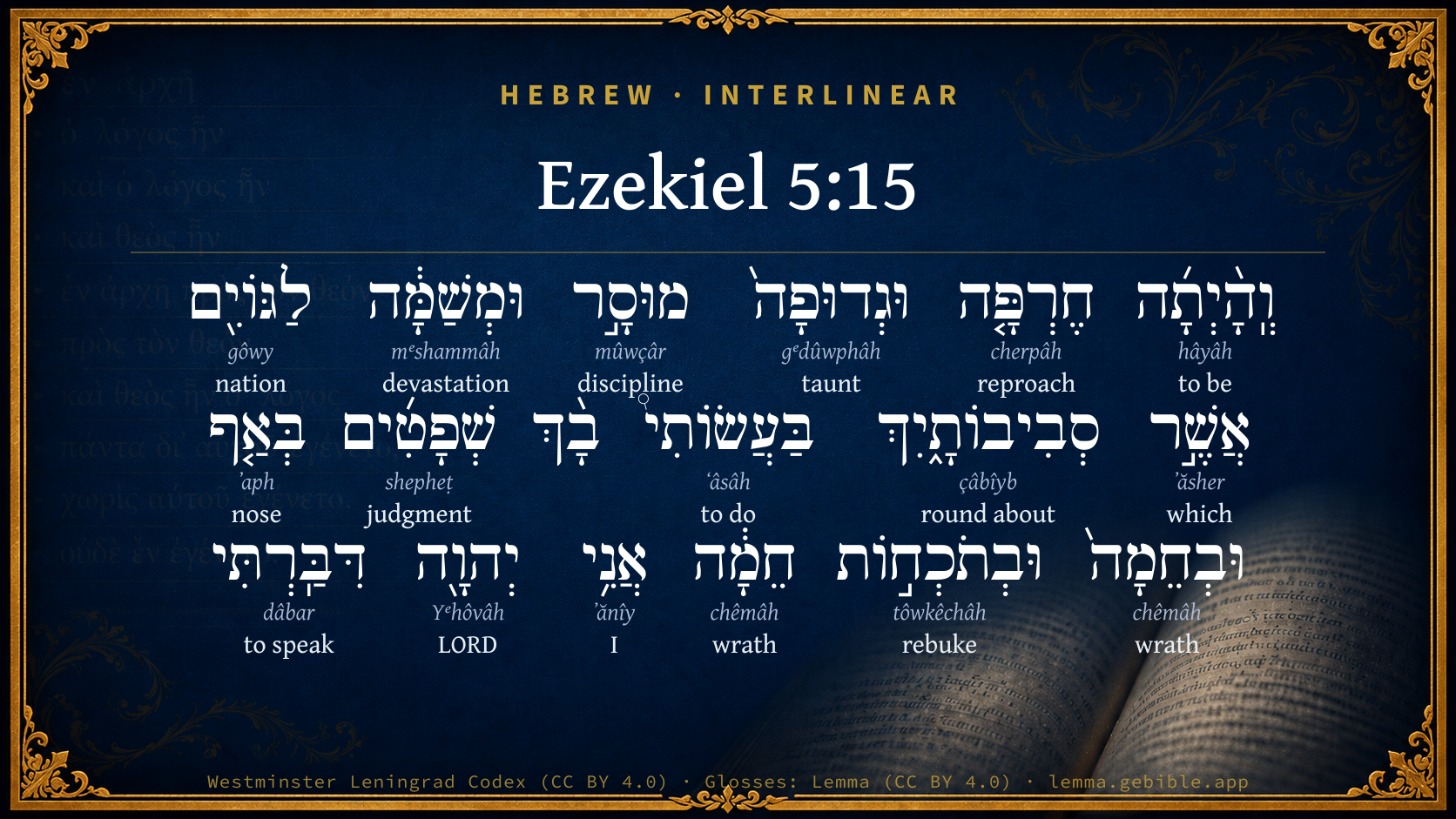
Hebrew (Westminster Leningrad Codex) Ezekiel 5:15 appears in the Hebrew Old Testament. The text above is from the Westminster Leningrad Codex. Each word links to its Strong’s number, a concise gloss, and parsing drawn from the Open Scriptures Hebrew Bible morphology. Click any word for its full Brown-Driver-Briggs (BDB) entry.
Download image
Cite this verse

Ezekiel 5:15 (World English Bible). Public Domain. Lemma interlinear Bible study tool, https://lemma.gebible.app/v/ezekiel/5/15.

Show BibTeX & RIS
BibTeX
RIS
English Translation
So it shall be a reproach and a taunt, an instruction and an astonishment, to the nations that are round about you, when I shall execute judgments on you in anger and in wrath, and in wrathful rebukes; (I, Yahweh, have spoken it;)
World English Bible · Public Domain
Highlights
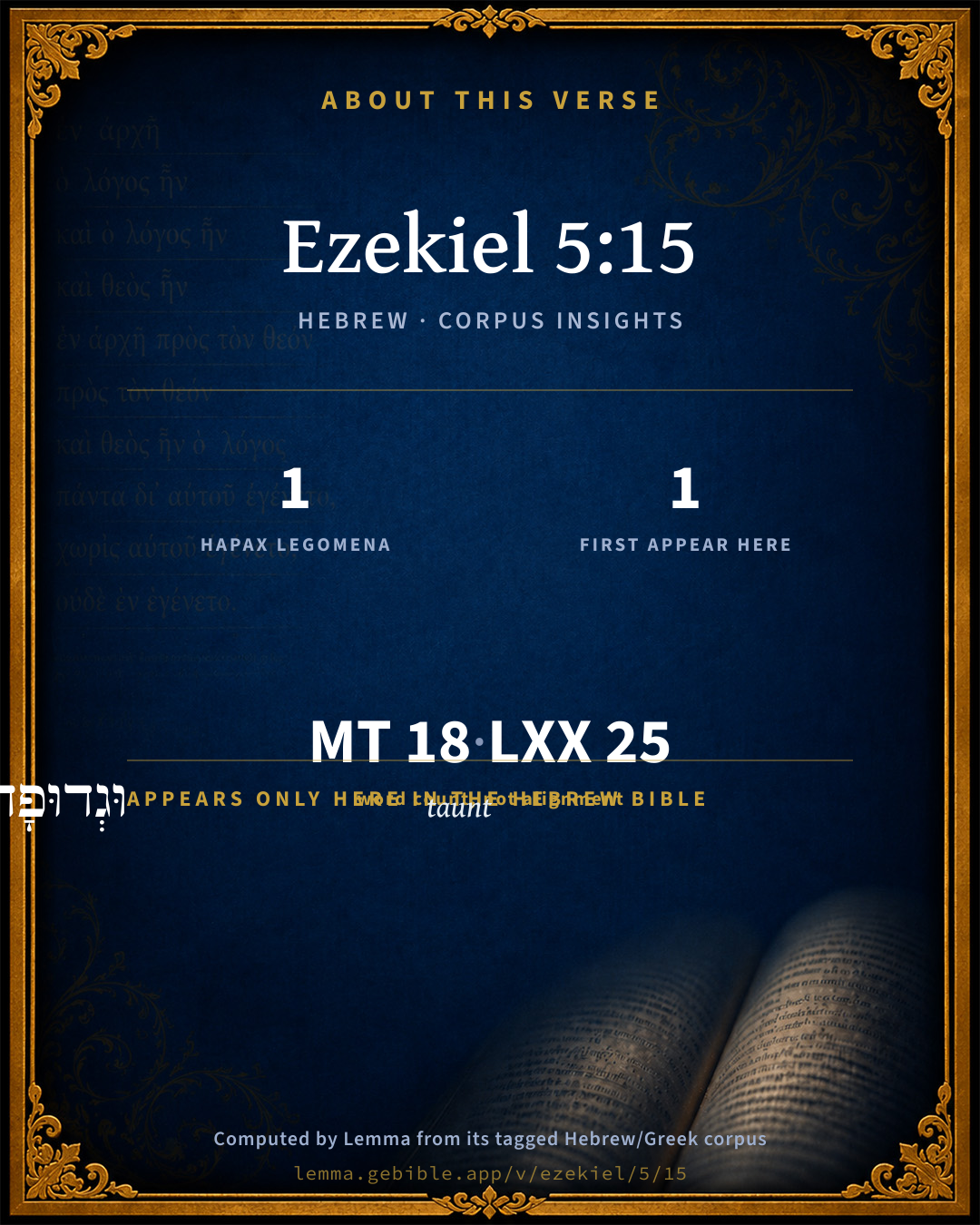
  • 1 hapax legomenon — only here in the Hebrew Bible
  • 1 first appearance in the Hebrew Bible
Full analysis ↓
Download a study sheet

One document with this verse’s original text, its word-by-word gloss line, the meaning frame, cross-references with their text, attributed commentary, and full source and license credits — printable, and it pastes into notes with its structure intact.

This verse Autodidact and up

Study sheet (.html) Plain text (.txt)

A passage Seminary Student

Up to 50 verses in one chapter. A passage sheet keeps up to 6 commentary sources and 12 cross-references per verse, in the order this page ranks them, and says so on the sheet whenever that leaves anything out. Ask for a single verse and you get the Autodidact verse sheet above.

Everything on this page stays free to read, with no account — the sheet is a download of what is already on screen, not access to it.

Want to remove ads? Support Godless Engineer
Compare translations 3

The same verse in 3 English versions, stacked beneath the original-language interlinear above. Click any original word for its lexicon entry.

Each is an independent rendering of the whole verse — the interlinear is not word-aligned to these translations.

Highlighted words mark where these versions differ — a whole-verse word diff, not a word-by-word alignment.

  • World English Bible Public Domain
    So it shall be a reproach and a taunt, an instruction and an astonishment, to the nations that are round about you, when I shall execute judgments on you in anger and in wrath, and in wrathful rebukes; (I, Yahweh, have spoken it;)
  • King James Version Public Domain
    So it shall be a reproach and a taunt, an instruction and an astonishment unto the nations that are round about thee, when I shall execute judgments in thee in anger and in fury and in furious rebukes. I the LORD have spoken it.
  • unfoldingWord Literal Text CC BY-SA 4.0
    So Jerusalem will become something for other people to condemn and to mock, a warning and a horror to the nations that surround you. I will execute judgments against you in wrath and fury, and with a furious rebuke—I, Yahweh have declared this!

unfoldingWord Literal Text — © unfoldingWord, licensed CC BY-SA 4.0. Word-aligned USFM3 via Door43 (git.door43.org/unfoldingWord/en_ult).

Versions to compare (up to 4)

3 of 4 selected

Show all 18 translations

Every available English version of this verse, each an independent rendering of the whole verse.

  • World English Bible Public Domain
    So it shall be a reproach and a taunt, an instruction and an astonishment, to the nations that are round about you, when I shall execute judgments on you in anger and in wrath, and in wrathful rebukes; (I, Yahweh, have spoken it;)
  • Berean Standard Bible Public Domain
    So you will be a reproach and a taunt, a warning and a horror to the nations around you, when I execute judgments against you in anger, wrath, and raging fury. I, the LORD, have spoken.
  • Majority Standard Bible Public Domain
    So you will be a reproach and a taunt, a warning and a horror to the nations around you, when I execute judgments against you in anger, wrath, and raging fury. I, the LORD, have spoken.
  • King James Version Public Domain
    So it shall be a reproach and a taunt, an instruction and an astonishment unto the nations that are round about thee, when I shall execute judgments in thee in anger and in fury and in furious rebukes. I the LORD have spoken it.
  • American Standard Version (1901) Public Domain
    So it shall be a reproach and a taunt, an instruction and an astonishment, unto the nations that are round about thee, when I shall execute judgments on thee in anger and in wrath, and in wrathful rebukes; (I, Jehovah, have spoken it;)
  • Revised Version (1885) Public Domain
    So it shall be a reproach and a taunt, an instruction and an astonishment, unto the nations that are round about thee, when I shall execute judgments in thee in anger and in fury, and in furious rebukes: I the LORD have spoken it:
  • Geneva Bible (1599) Public Domain
    So thou shalt bee a reproche and shame, a chastisement and an astonishment vnto the nations, that are rounde about thee, when I shall execute iudgements in thee, in anger and in wrath, and in sharpe rebukes: I the Lord haue spoken it.
  • Douay-Rheims (1899) Public Domain
    And thou shalt be a reproach, and a scoff, an example, and an astonishment amongst the nations that are round about thee, when I shall have executed judgments in thee in anger, and in indignation, and in wrathful rebukes.
  • Young's Literal Translation Public Domain
    And it hath been a reproach and a reviling, An instruction and an astonishment, To nations that `are' round about thee, In My doing in thee judgments, In anger and fury, and in furious reproofs, I, Jehovah, have spoken.
  • Literal Standard Version CC BY-SA 4.0
    And it has been a reproach and a reviling, || An instruction and an astonishment, || To nations that [are] around you, || In My doing judgments in you, || In anger and fury, and in furious reproofs, || I, YHWH, have spoken.
  • Unlocked Literal Bible CC BY-SA 4.0
    So Jerusalem will become something for other people to condemn and to mock, a warning and a horror to the nations that surround you. I will execute judgments against you in wrath and fury, and with a furious rebuke—I, Yahweh have declared this!
  • unfoldingWord Literal Text CC BY-SA 4.0
    So Jerusalem will become something for other people to condemn and to mock, a warning and a horror to the nations that surround you. I will execute judgments against you in wrath and fury, and with a furious rebuke—I, Yahweh have declared this!
  • Darby Bible Public Domain
    And it shall be a reproach, and a taunt, an instruction, and an astonishment unto the nations that are round about thee, when I shall execute judgments upon thee in anger, and in fury, and in furious rebukes: I, Jehovah, have spoken.
  • World Messianic Bible Public Domain
    So it will be a reproach and a taunt, an instruction and an astonishment, to the nations that are around you, when I execute judgments on you in anger and in wrath, and in wrathful rebukes—I, the LORD, have spoken it—
  • Webster's Bible Public Domain
    So it shall be a reproach and a taunt, an instruction and an astonishment to the nations that are around thee, when I shall execute judgments in thee in anger and in fury and in furious rebukes. I the LORD have spoken it.
  • Free Bible Version CC BY-SA 4.0
    You will be criticized and mocked, you'll be a warning and something horrifying to the surrounding nations when I carry out my sentence against you in my rage and furious anger. I the Lord have spoken.
  • Bible in Basic English Public Domain
    And you will be a name of shame and a cause of bitter words, an example and a wonder to the nations round about you, when I give effect to my judging among you in wrath and in passion and in burning protests: I the Lord have said it:
  • JPS Tanakh (1917) Public Domain
    So it shall be a reproach and a taunt, an instruction and an astonishment, unto the nations that are round about thee, when I shall execute judgments in thee in anger and in fury, and in furious rebukes; I the LORD have spoken it;

Literal Standard Version (2020), Covenant Press — licensed CC BY-SA 4.0. Text via the HelloAO Bible API (eBible.org). Unlocked Literal Bible (unfoldingWord) — licensed CC BY-SA 4.0. Text via the HelloAO Bible API (eBible.org). unfoldingWord Literal Text — © unfoldingWord, licensed CC BY-SA 4.0. Word-aligned USFM3 via Door43 (git.door43.org/unfoldingWord/en_ult). Free Bible Version, Dr. Jonathan Gallagher — licensed CC BY-SA 4.0. Text via the HelloAO Bible API (eBible.org).

Word by word

More ways to search: Search by grammar → Find every occurrence → Compare this word →

Practice this passage: Drill this verse → Learn its vocabulary →

וּגְדוּפָה֙
gᵉdûwphâh
H1422
“and · taunt”
Conjunction + Noun, Common, Feminine, Singular, Absolute
Part of Speech
Conjunction + Noun
Type
Common
Gender
Feminine
Number
Singular
State
Absolute
Full BDB Definition

Origin: pass. participle of H1442

TWOT: 317g

a taunt
  1. וְֽהָ֨יְתָ֜ה hâyâh H1961 “and · to be” Conjunction + Verb, Qal, Sequential Perfect, 3rd Person, Feminine, Singular
  2. חֶרְפָּ֤ה cherpâh H2781 “reproach” Noun, Common, Feminine, Singular, Absolute
  3. מוּסָ֣ר mûwçâr H4148 “discipline” Noun, Common, Masculine, Singular, Absolute
  4. וּמְשַׁמָּ֔ה mᵉshammâh H4923 “and · devastation” Conjunction + Noun, Common, Feminine, Singular, Absolute
  5. לַגּוֹיִ֖ם gôwy H1471 “to/for the · nations” Preposition, Determined + Noun, Common, Masculine, Plural, Absolute
  6. אֲשֶׁ֣ר ʼăsher H834 “which” Particle, Relative
  7. סְבִיבוֹתָ֑יִךְ çâbîyb H5439 “surroundings · your” Noun, Common, Both, Plural, Construct + Suffix, Personal, 2nd Person, Feminine, Singular
  8. בַּעֲשׂוֹתִי֩ ʻâsâh H6213 “in/at · to do · me” Preposition + Verb, Qal, Infinitive Construct + Suffix, Personal, 1st Person, Common, Singular
  9. שְׁפָטִ֜ים shepheṭ H8201 “judgments” Noun, Common, Masculine, Plural, Absolute
  10. בְּאַ֤ף ʼaph H639 “in/at · nose” Preposition + Noun, Common, Masculine, Singular, Absolute
  11. וּבְחֵמָה֙ chêmâh H2534 “and · in/at · wrath” Conjunction + Preposition + Noun, Common, Feminine, Singular, Absolute
  12. וּבְתֹכְח֣וֹת tôwkêchâh H8433 “and · in/at · rebukes of” Conjunction + Preposition + Noun, Common, Feminine, Plural, Construct
  13. חֵמָ֔ה chêmâh H2534 “wrath” Noun, Common, Feminine, Singular, Absolute
  14. אֲנִ֥י ʼănîy H589 “I” Pronoun, Personal, 1st Person, Common, Singular
  15. יְהוָ֖ה Yᵉhôvâh H3068 “LORD” Noun, Proper
  16. דִּבַּֽרְתִּי dâbar H1696 “to speak” Verb, Piel, Perfect, 1st Person, Common, Singular

About this verse

These counts appear in no published source. They are computed here, from the morphology-tagged text and Lemma’s own curated glosses. What Lemma adds →

18
words
16
distinct lemmas
Prophets
section

Notable vocabulary

1 hapax legomenon — a word that appears only here in the entire Hebrew Bible:

  • וּגְדוּפָה֙ taunt H1422

First appearance in Scripture

This word makes its first canonical appearance in the Hebrew Bible here:

  • וּגְדוּפָה֙ taunt H1422

Shared distinctive vocabulary

וּמְשַׁמָּ֔ה devastation H4923 occurs in 7 verses of the Hebrew Bible. Also found in:

Grammatical profile

  • 3 verbs
  • 12 nouns
  • 1 pronoun
  • 1 preposition
  • 1 particle

Verb forms

  • וְֽהָ֨יְתָ֜ה Qal · Sequential Perfect
  • בַּעֲשׂוֹתִי֩ Qal · Infinitive Construct
  • דִּבַּֽרְתִּי Piel · Perfect

Repetition

A word recurs within this verse — often emphatic in Hebrew:

  • וּבְחֵמָה֙ wrath H2534 ×2

Hebrew & Septuagint length

In English translation the verse runs 43 words from the Hebrew and 32 from the Septuagint (LXX English) — closely comparable.

A rough comparison of the two English renderings, which tokenize alike — not a word-level alignment.

Word counts can differ between the Hebrew and the Greek without any difference in meaning — e.g. the Hebrew direct-object marker אֵת has no separate Greek word, and Greek often adds the article ὁ.

In the original languages it is 18 Hebrew tokens and 25 Greek tokens — but the two are counted differently (Hebrew bundles its prefixes and suffixes into one token; the Greek is in lemma form), so that isn’t a like-for-like length.

Cross-references

9

Topical passages linked to Ezekiel 5:15 in the Treasury of Scripture Knowledge — connected by theme and wording, ordered by reader-vote popularity; previews shown in the World English Bible.

  • Ezekiel 25:17 I will execute great vengeance on them with wrathful rebukes; and they shall know that I am Yahweh, when I shall lay my vengeance on them.
  • Jeremiah 22:8–9 Many nations shall pass by this city, and they shall say every man to his neighbor, Why has Yahweh done thus to this great city?
  • 1 Kings 9:7 then will I cut off Israel out of the land which I have given them; and this house, which I have made holy for my name, will I cast out of my sight; and Israel shall be a proverb and a byword among all peoples.
  • Isaiah 26:9 With my soul have I desired you in the night; yes, with my spirit within me will I seek you earnestly: for when your judgments are in the earth, the inhabitants of the world learn righteousness.
  • Isaiah 66:15–16 For, behold, Yahweh will come with fire, and his chariots shall be like the whirlwind; to render his anger with fierceness, and his rebuke with flames of fire.
  • 1 Corinthians 10:11 Now all these things happened to them by way of example, and they were written for our admonition, on whom the ends of the ages have come.
  • Deuteronomy 29:24–28 even all the nations shall say, Why has Yahweh done thus to this land? what means the heat of this great anger?
  • Psalms 79:4 We have become a reproach to our neighbors, A scoffing and derision to those who are around us.
  • Nahum 1:2 Yahweh is a jealous God and avenges. Yahweh avenges and is full of wrath. Yahweh takes vengeance on his adversaries, and he maintains wrath against his enemies.

Cross-references courtesy of OpenBible.info (CC BY 4.0).

Hebrew and Greek witnesses Masoretic Hebrew ↔ Greek Septuagint

The same verse in the two great witnesses to the Old Testament, shown verse-for-verse.

These are two independent witnesses, not word-aligned to each other, and the Septuagint is shown in lemma (dictionary) form.

Hebrew Ezekiel 5:15 Masoretic · Westminster Leningrad Codex

וְֽהָ֨יְתָ֜ה חֶרְפָּ֤ה וּגְדוּפָה֙ מוּסָ֣ר וּמְשַׁמָּ֔ה לַגּוֹיִ֖ם אֲשֶׁ֣ר סְבִיבוֹתָ֑יִךְ בַּעֲשׂוֹתִי֩ בָ֨ךְ שְׁפָטִ֜ים בְּאַ֤ף וּבְחֵמָה֙ וּבְתֹכְח֣וֹת חֵמָ֔ה אֲנִ֥י יְהוָ֖ה דִּבַּֽרְתִּי

So it shall be a reproach and a taunt, an instruction and an astonishment, to the nations that are round about you, when I shall execute judgments on you in anger and in wrath, and in wrathful rebukes; (I, Yahweh, have spoken it;)

World English Bible · Public Domain

Greek LXX Ezekiel 5:15 Septuagint · lemma form

καί εἰμί στενακτός καί δηλαϊστός ἐν ὁ ἔθνος ὁ κύκλος σύ ἐν ὁ ποιέω ἐγώ ἐν σύ κρίμα ἐν ἐκδίκησις θυμός ἐγώ ἐγώ κύριος λαλέω

And you shall be mourned over and miserable among the nations round about you, when I have executed judgments in you in the vengeance of my wrath. I the Lord have spoken.

LXX2012 (modern English Septuagint) · Public Domain

Hebrew: Westminster Leningrad Codex (CC BY 4.0). Greek: Septuagint (public domain); English from LXX2012 (modern English Septuagint) (Public Domain). How the Septuagint differs from the Hebrew →

Targum (Aramaic paraphrase)

1

The Targum is the ancient Jewish Aramaic paraphrase of the Hebrew Scriptures — an interpretive translation, not the Hebrew text itself. Onkelos (literal) and Pseudo-Jonathan (expansive) render the Torah, and Jonathan the Prophets. Coverage is partial: where no permissively-licensed English translation exists for a verse, only the Aramaic is shown. This is verse-level text, not a word-by-word alignment to the Hebrew.

  1. Targum Jonathan Prophets (Joshua–Malachi)
    וּתְהֵין לְחִסוּדִין וּלְאִתְרַבְרְבָא עֲלָךְ צָדוּ וְאִשְׁתְּמָמוּ לְעַמְמַיָא דִבְסָחֳרָנִיךְ כַּד אַעְבֵיד בִּיךְ פּוּרְעֲנוּת דִינִין בִּרְגַז וּבְחֵמָה וּבִתְקוֹף רְגַז אֲנָא יְיָ גְזַרֵית בְּמֵימְרִי:

    (no public-domain English translation for this verse)

    Targum Jonathan — Aramaic: “Mikraot Gedolot” (public domain). English: “Sefaria Community Translation” (CC0 1.0 (public-domain dedication)); “London "Chaldee Paraphrase," 1871” (public domain). Text via Sefaria.

Commentary

Notes on Ezekiel 5:15 from classic Christian and Jewish commentators (each source and its license shown beneath its notes). The classic Christian expositions comment on the surrounding passage and are grouped to its opening verse, so a note may address several verses; the Jewish commentaries on the Tanakh (Rashi and others) are per-verse, so they appear only where the commentator wrote on this verse.

Lemma curates 59 commentaries, every one of them public domain or Creative Commons licensed, each selected and text-cleaned for this edition rather than reprinted as found. About our sources →

Trapp's Complete Commentary

John Trapp

Eze 5:15 So it shall be a reproach and a taunt, an instruction and an astonishment unto the nations that [are] round about thee, when I shall execute judgments in thee in anger and in fury and in furious rebukes. I the LORD have spoken [it].

Ver. 15. So it shall be a reproach and taunt.] See this fulfilled, Lam 2:15-16.

An instruction.] They shall enjoy thy folly, grow wise by thy harms. I will make thee an example to the heathen. {a}

An astonishment.] A terror, some render it.

{a} Exemplum. - Vulg.

John Trapp, A Commentary or Exposition upon All the Books of the Old and New Testament (1647–1656) — public domain. Text from a community e-Sword module.

Joseph Benson's Commentary

Eze 5:15-17. So it shall be an instruction to the nations — They shall learn from such an example of vengeance to fear me, and be afraid of my judgments. When I shall send upon them the evil arrows of famine — Hail, tempest, drought, mildew, locusts, all which contribute to make a famine. So will I send upon you famine and evil beasts — Wild beasts multiply in a land when it becomes uninhabited, Exo 23:29. This likewise is a punishment which, among others, was threatened against the Jews by Moses: see the margin. Pestilence and blood shall pass through thee — Blood signifies any unusual sort of death, and may denote here such a pestilence as would destroy multitudes; or that, in addition to destruction by pestilence, they should be slaughtered by their enemies throughout their land.

Joseph Benson's Commentary on the Old and New Testaments (1811–1818) — public domain. Text from a community e-Sword module.

Jamieson, Fausset & Brown

Robert Jamieson, A. R. Fausset & David Brown

instruction--literally, "a corrective chastisement," that is, a striking example to warn all of the fatal consequences of sin. For "it shall be"; all ancient versions have "thou," which the connection favors.

Jamieson, Fausset & Brown — Commentary Critical and Explanatory on the Whole Bible (1871) — public domain (CC PDM 1.0). Text via the HelloAO Bible API.

John Calvin's Commentaries

He further explains how the Jews should be devastated and become a reproach among the nations. Now, he does not speak of their dispersion, but uses two words for one idea: he puts חרפה, cherepheh, which signifies a reproach, and adds גדופה, gedopheh, which signifies a taunt and a mocking: but this could not take place without the slaughter of the people. Unless the profane heathen had some ground for it, there was no reason why they should utter their taunts and hissings against the Jews. Hence destruction and complete slaughter are comprehended under the words reproach and taunt, or laughing-stock. But this sentence belongs to the former verse: there it was said, I will make thee: here, thou shalt be Meanwhile the execution of God’s vengeance is marked; when, therefore, God reproaches us, we are compelled to lie under the power of his hand, because an attempt to resist him is vain. We shall wrestle, indeed, as the ungodly do, but unless we yield willingly, the violence of his power will crush us. Hence we must observe the context: I will make thee a reproach, and thou shalt be one, because God signifies that his threats should not be either empty or in vain. He adds, thou shalt be a correction: מוסר, moser, signifies discipline and instruction, but is often used for that correction which springs from a sense of God’s wrath. When, therefore, God chastises his people, if they repent, they are said to profit by his discipline, since they have learnt themselves to be sinners by the punishments which he has inflicted on them. But he says that the Jews should be a correction to the profane nations, because they should grow wise by their punishments; for while we apply examples to our use, this is a timely correction, since we do not wait till God strikes us; but when he takes vengeance on the despisers of his law at a distance, if we are moved by such examples, this is, as I said, correction in good time: for the Prophet now applies it to the nations, not without the disgrace of the elect people: as if he had said that their punishment would be so notorious that the very blind would recognize them, and tremble at the perception of their import.

Afterwards he adds — in astonishment These words, indeed, do not seem sufficiently in agreement with the Jews being for a wonder and a correction; but the Prophet does not simply mean that those who perceived the judgment of God should be either stupid or docile, he only means that in God’s severity material would be proposed for all, as well of correction as of astonishment, so that they should be horrified when they saw God treating his elect people so harshly. For he adds, when I shall execute judgments on thee in wrath, and in fury, and in burnings of anger. He confirms what we saw before, namely, that God’s judgment would be remarkable, because he had so long borne with a reprobate people. Since he had so long borne their impiety, he broke forth at length in one impulse, and then exercised the formidable judgment of which he speaks. This is the reason why he says the nations shall be astonished when I execute my judgments upon thee. What, then, were these judgments? — in truth, anger, and burning, and furious rebukes. Here the Prophet seems verbose; but he could not be too much so, since the sluggishness of the people was so great that they were not moved by any prophecies. As we have formerly seen, he had been, doubtless, derided by those Jews in Chaldea, who as yet remained at home tranquil, as it were, in their nests. “Does he, the wretched exile, threaten us? let him be content with his own lot: since God has spared us, he seems to be stirred up to vex us by envy alone; but we have no reason to fear the envy of a captive and an exile.” Since, then, the Prophet knew that he was contemptible among the Jews, it was necessary to heap up such forms of speech, that his teaching might have more weight: nor does he look: at the Jews alone, but at those people also who had been dragged into the same exile; for he has to advise them, for the reasons which we have formerly explained. Now, therefore, we understand his meaning when he speaks concerning anger and burning, and adds, at the same time, burning rebukes He adds also, I Jehovah have spoken it: which he will repeat at the last verse of the chapter. And this confirmation is also very useful, because when both the Israelites and the Jews looked at a mortal and abject man, a captive and a slave of an impious people, they would doubtless have despised all his prophecies. Hence he sets God before them, by which he means that he was not the author of the threats, but spoke only from the mouth of God, as the organ of the Spirit. It follows —

John Calvin's Commentaries (1540-1563) — public domain. Text from the Calvin Translation Society English edition (1840s-50s) via the Christian Classics Ethereal Library (ccel.org). Calvin's coverage is partial (roughly two-thirds of the Bible); uncommented books and verses are honest gaps, never fabricated. The 19th-century editor's footnotes and remarks are omitted so the notes are faithfully Calvin's own voice.

The Cambridge Bible for Schools and Colleges

gen. ed. J. J. S. Perowne

15. So it shall be] So shall she be, i.e. Jerusalem. The ancient versions, however, give: and thou shalt be.

an instruction] i.e. a lesson of warning, cf. ch. Eze_23:48, “that all women may be taught (take warning) not to do after your lewdness.” Cf. Deu_29:23 seq.

The Cambridge Bible for Schools and Colleges (gen. ed. J. J. S. Perowne; Cambridge University Press, 1878–1918) — public domain. Text from a community e-Sword module.

John Gill's Exposition

So it shall be a reproach and a taunt,.... The subject of the reproaches and taunts of the enemy; see Jer 24:9; this is repeated for the greater confirmation of it:

an instruction; or "discipline", or "correction" (x). The meaning is, that the Gentiles, seeing the judgments of God upon the Jews, would hereby learn righteousness, forsake their sins, amend their ways, and fear, the Lord:

and an astonishment unto the nations that are round about thee; being amazed that such judgments should fall upon a people that had been so highly favoured of God; and at their stupidity, hardness, and incorrigibleness under them:

when I shall execute judgments in thee in anger and in fury, and in furious rebukes; a heap of words, not only denoting the certainty of divine judgments, but the greatness and fierceness of divine wrath, in the execution of them; that these were not fatherly chastisements, rebukes in love, but the effects of vindictive justice:

I the Lord have spoken it; or those things, as the Arabic version; and as sure as I have spoken, I will do. The Targum is,

"I the Lord have decreed in my word;''

and so in Eze 5:13; where it is added, and I will confirm or accomplish.

(x) "disciplina", Pagninus; "castigatio", Vatablus, Starckius.

John Gill's Exposition of the Whole Bible (1746–1763) — public domain (CC PDM 1.0). Text via the HelloAO Bible API.

Haydock's Catholic Bible Commentary

Scoff. Literally, "blasphemy;" which is here used improperly, to denote derision. (Worthington)

George Leo Haydock (1774–1849), Haydock's Catholic Family Bible and Commentary, 1859 edition — public domain. Excludes Psalms (Douay-Rheims chapter numbering differs from Protestant) and Deuterocanonical books (Catholic canon only).

Matthew Poole's English Annotations

A reproach: see Eze 5:14.

A taunt; a very proverb among men.

An instruction; sinners like thee shall learn by thy miseries what they may expect from me, and they shall acknowledge Divine justice in all.

When I shall execute judgments, in highest degrees of severity.

I the Lord; I, who can do it, because almighty; who may do it, because provoked; who will do it, because they repented not; I have spoken, and will do it, as Jer 25:9.

Matthew Poole's English Annotations on the Holy Bible (1683–1685) — public domain. Text from a community e-Sword/MySword module.

The Pulpit Commentary

A reproach and a taunt, etc. An echo of Deu_28:37. The accumulation of synonyms in both clauses of the verse iseminently characteristic of Ezekiel"s style. Word follows word, like the strokes of a sledge hammer. The word for "instruction" is that which occurs so often in the Book of Proverbs (Pro_1:2, Pro_1:3, and in twenty-two other passages). In Deu_11:12; Isa_53:5; Jer_30:14, the Authorized Version renders it "chastisement," and that sense is manifestly implied here. Jerusalem was, as it were, to be the great object lesson in God"s education of mankind. And the final stroke of all is that the words were not the prophet"s own, but "I the Lord have spokes it." The words reappear in ver. 17.

The Pulpit Commentary (1880–1919), ed. H.D.M. Spence-Jones & Joseph S. Exell — public domain. Text from a community e-Sword module.

John Wesley's Explanatory Notes

Taunt - A very proverb among them. Instruction - Sinners shall learn by thy miseries, what they may expect from me.

John Wesley, Explanatory Notes Upon the Whole Bible (1754–1765) — public domain. Text via the GEBible commentary corpus.

unfoldingWord translationNotes

Door43 World Missions Community

General Information:

Yahweh continues to speak to the people of Israel and Judah.

in wrath and fury

The words "wrath" and "fury" mean basically the same thing and emphasize that Yahweh is very angry. AT: "because I will be very angry with you" (See: Doublet)

will send out harsh arrows of famine against you

The word "arrows" is a metonym for the sharp pains that people feel when they have had no food for a long time. AT: "will make you feel the pain of intense hunger" (See: Metonymy)

increase the famine on you

"make the famine more severe for you" or "make the famine last longer for you" or "make sure that there is less and less for you to eat"

break your staff of bread

A "staff" was something that people leaned upon to support them. This phrase is a metaphor that means removing the supply of food that the people were depending upon. See how "staff of bread" is translated in Ezekiel 4:16. AT: "cut off your food supply" (See: Metaphor)

Plague and blood will pass through you

Sickness and violent death are spoken of as if they were soldiers going through the city killing everyone they could. AT: "Many people will die of disease, and many others will die in war" (See: Personification)

I will bring a sword against you

The word "sword" is a metonym for soldiers who kill people using swords. AT: "I myself will cause soldiers to come and kill you" (See: Metonymy)

translationWords

Jerusalem

condemn

judge

wrath

rebuke

famine

staff

bread

plague

blood

sword

declare

unfoldingWord translationNotes — © Distant Shores Media and the Door43 World Missions Community, licensed CC BY-SA 4.0. Source: git.door43.org/Door43/en_tn.

Rashi

Rabbi Shlomo Yitzchaki (Rashi)

and a taunt A disgrace.

a chastisement Heb. מוּסָר torments.

and an astonishment A wonder.

Rashi on the Tanakh — English translations: “The Judaica Press complete Tanach with Rashi, translated by A. J. Rosenberg” (CC BY 4.0); “Pentateuch with Rashi's commentary by M. Rosenbaum and A.M. Silbermann, 1929-1934” (public domain); “The Metsudah Tanach series, Lakewood, N.J” (CC BY 4.0); and “The Book of Joshua, Metsudah Publications, 1997” (CC BY 4.0). Text via Sefaria.

Lesson kit

Teaching starters — assembled from the data on this page, not authored interpretation. Every prompt links to the verse data it draws on. Edit before teaching.

Ezekiel, in the Prophets, opens this verse with 18 words (16 distinct Hebrew lemmas). Its most distinctive word is gᵉdûwphâh (“taunt”). A historical commentator’s framing appears above. Read the whole chapter for the surrounding context.

Discussion questions

  1. What does “taunt” (gᵉdûwphâh) contribute to the verse as a whole?
  2. This verse holds 1 word here found nowhere else in the Hebrew Bible. What might the rare word draw attention to?
  3. The word “taunt” first appears here in Scripture. What is being introduced at this debut?
  4. Isaiah 15:6 shares the word «devastation» with this verse. How do the two illuminate each other?
  5. “wrath” occurs 2× in this one verse. What is the effect of the repetition?
  6. The translations on this page render this verse differently — a whole-verse word diff, not a word-by-word alignment. What might account for the different wordings?
  7. The verb «וְֽהָ֨יְתָ֜ה» is Qal Sequential Perfect. How does its form color the action?
  8. Reading how Trapp's Complete Commentary and Joseph Benson's Commentary read this verse, where do the two commentators agree and where do they part?

Things to notice

  • 1 word in this verse appears nowhere else in the Hebrew Bible.
  • 1 word makes its first canonical appearance in Scripture here.
  • This verse counts 18 Hebrew ↔ 25 Greek words.
  • These translations choose different wording for 32 words in this verse.
  • “wrath” occurs 2× in this single verse.

Reading settings

Reading text

Shown beneath each verse's original-language words.

Old Testament
Old Testament edition

Read the OT as the Masoretic Hebrew (MT) or the Greek Septuagint (LXX).

English shown for the Greek Septuagint (in the Hebrew ↔ Greek comparison).

Comparing translations? Open the Compare panel on any verse page to stack up to four side by side.