
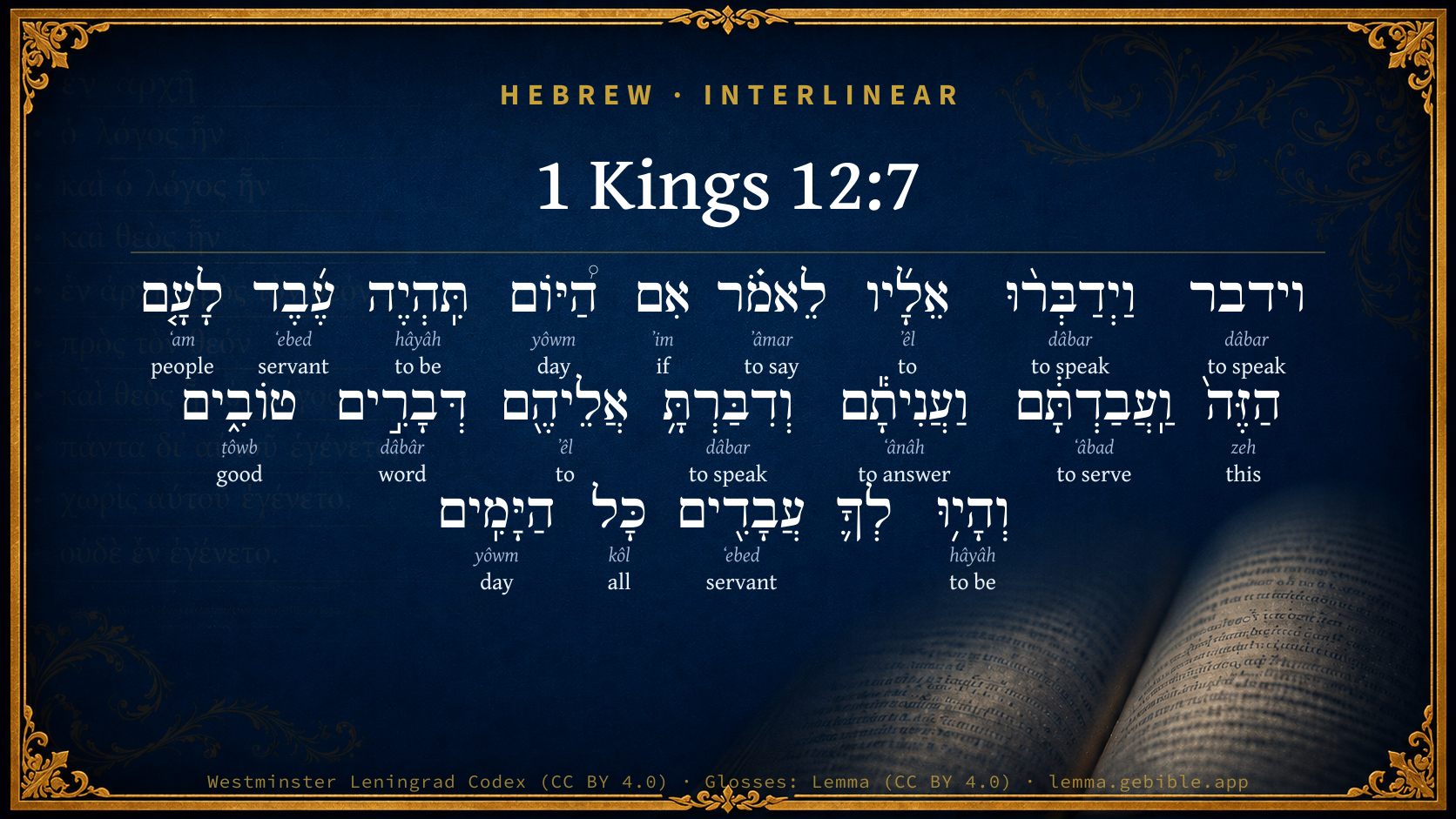
1 Kings 12:7

Hebrew (Westminster Leningrad Codex) 1 Kings 12:7 appears in the Hebrew Old Testament. The text above is from the Westminster Leningrad Codex. Each word links to its Strong’s number, a concise gloss, and parsing drawn from the Open Scriptures Hebrew Bible morphology. Click any word for its full Brown-Driver-Briggs (BDB) entry.
Download image
Cite this verse

1 Kings 12:7 (World English Bible). Public Domain. Lemma interlinear Bible study tool, https://lemma.gebible.app/v/1-kings/12/7.

Show BibTeX & RIS
BibTeX
RIS
English Translation
They spoke to him, saying, If you will be a servant to this people this day, and will serve them, and answer them, and speak good words to them, then they will be your servants forever.
World English Bible · Public Domain
Download a study sheet

One document with this verse’s original text, its word-by-word gloss line, the meaning frame, cross-references with their text, attributed commentary, and full source and license credits — printable, and it pastes into notes with its structure intact.

This verse Autodidact and up

Study sheet (.html) Plain text (.txt)

A passage Seminary Student

Up to 50 verses in one chapter. A passage sheet keeps up to 6 commentary sources and 12 cross-references per verse, in the order this page ranks them, and says so on the sheet whenever that leaves anything out. Ask for a single verse and you get the Autodidact verse sheet above.

Everything on this page stays free to read, with no account — the sheet is a download of what is already on screen, not access to it.

Want to remove ads? Support Godless Engineer
Compare translations 3

The same verse in 3 English versions, stacked beneath the original-language interlinear above. Click any original word for its lexicon entry.

Each is an independent rendering of the whole verse — the interlinear is not word-aligned to these translations.

Highlighted words mark where these versions differ — a whole-verse word diff, not a word-by-word alignment.

  • World English Bible Public Domain
    They spoke to him, saying, If you will be a servant to this people this day, and will serve them, and answer them, and speak good words to them, then they will be your servants forever.
  • King James Version Public Domain
    And they spake unto him, saying, If thou wilt be a servant unto this people this day, and wilt serve them, and answer them, and speak good words to them, then they will be thy servants for ever.
  • unfoldingWord Literal Text CC BY-SA 4.0
    And they spoke to him, saying, “If today you will be a servant to this people and serve them and you answer them and speak good words to them, then they will be servants to you all of the days.”

unfoldingWord Literal Text — © unfoldingWord, licensed CC BY-SA 4.0. Word-aligned USFM3 via Door43 (git.door43.org/unfoldingWord/en_ult).

Versions to compare (up to 4)

3 of 4 selected

Show all 18 translations

Every available English version of this verse, each an independent rendering of the whole verse.

  • World English Bible Public Domain
    They spoke to him, saying, If you will be a servant to this people this day, and will serve them, and answer them, and speak good words to them, then they will be your servants forever.
  • Berean Standard Bible Public Domain
    They replied, “If you will be a servant to these people and serve them this day, and if you will respond by speaking kind words to them, they will be your servants forever.”
  • Majority Standard Bible Public Domain
    They replied, “If you will be a servant to these people and serve them this day, and if you will respond by speaking kind words to them, they will be your servants forever.”
  • King James Version Public Domain
    And they spake unto him, saying, If thou wilt be a servant unto this people this day, and wilt serve them, and answer them, and speak good words to them, then they will be thy servants for ever.
  • American Standard Version (1901) Public Domain
    And they spake unto him, saying, If thou wilt be a servant unto this people this day, and wilt serve them, and answer them, and speak good words to them, then they will be thy servants for ever.
  • Revised Version (1885) Public Domain
    And they spake unto him, saying, If thou wilt be a servant unto this people this day, and wilt serve them, and answer them, and speak good words to them, then they will be thy servants for ever.
  • Geneva Bible (1599) Public Domain
    And they spake vnto him, saying, If thou be a seruant vnto this people this day, and serue them, and answere them, and speake kinde wordes to them, they will be thy seruants for euer.
  • Douay-Rheims (1899) Public Domain
    They said to him: If thou wilt yield to this people to day, and condescend to them, and grant their petition, and wilt speak gentle words to them, they will be thy servants always.
  • Young's Literal Translation Public Domain
    And they speak unto him, saying, `If, to-day, thou art servant to this people, and hast served them, and answered them, and spoken unto them good words, then they have been to thee servants all the days.'
  • Literal Standard Version CC BY-SA 4.0
    And they speak to him, saying, “If, today, you are a servant of this people, and have served them, and answered them, and spoken good words to them, then they have been servants to you [for] all the days.”
  • Unlocked Literal Bible CC BY-SA 4.0
    They spoke to him and said, “If you will be a servant today to these people and serve them, and answer them by saying good words to them, then they will always be your servants.”
  • unfoldingWord Literal Text CC BY-SA 4.0
    And they spoke to him, saying, “If today you will be a servant to this people and serve them and you answer them and speak good words to them, then they will be servants to you all of the days.”
  • Darby Bible Public Domain
    And they spoke to him saying, If this day thou wilt be a servant to this people, and wilt serve them and answer them and speak good words to them, they will be thy servants for ever.
  • World Messianic Bible Public Domain
    They replied, “If you will be a servant to this people today, and will serve them, and answer them with good words, then they will be your servants forever.”
  • Webster's Bible Public Domain
    And they spoke to him, saying, If thou wilt be a servant to this people this day, and wilt serve them, and answer them, and speak good words to them, then they will be thy servants for ever.
  • Free Bible Version CC BY-SA 4.0
    They replied, “If you are a servant to these people today, if you serve them and answer them, by speaking kindly to them, they will always serve you.”
  • Bible in Basic English Public Domain
    And they said to him, If you will be a servant to this people today, caring for them and giving them a gentle answer, then they will be your servants for ever.
  • JPS Tanakh (1917) Public Domain
    And they spoke unto him, saying: 'If thou wilt be a servant unto this people this day, and wilt serve them, and answer them, and speak good words to them, then they will be thy servants for ever.'

Literal Standard Version (2020), Covenant Press — licensed CC BY-SA 4.0. Text via the HelloAO Bible API (eBible.org). Unlocked Literal Bible (unfoldingWord) — licensed CC BY-SA 4.0. Text via the HelloAO Bible API (eBible.org). unfoldingWord Literal Text — © unfoldingWord, licensed CC BY-SA 4.0. Word-aligned USFM3 via Door43 (git.door43.org/unfoldingWord/en_ult). Free Bible Version, Dr. Jonathan Gallagher — licensed CC BY-SA 4.0. Text via the HelloAO Bible API (eBible.org).

Word by word

More ways to search: Search by grammar → Find every occurrence → Compare this word →

Practice this passage: Drill this verse → Learn its vocabulary →

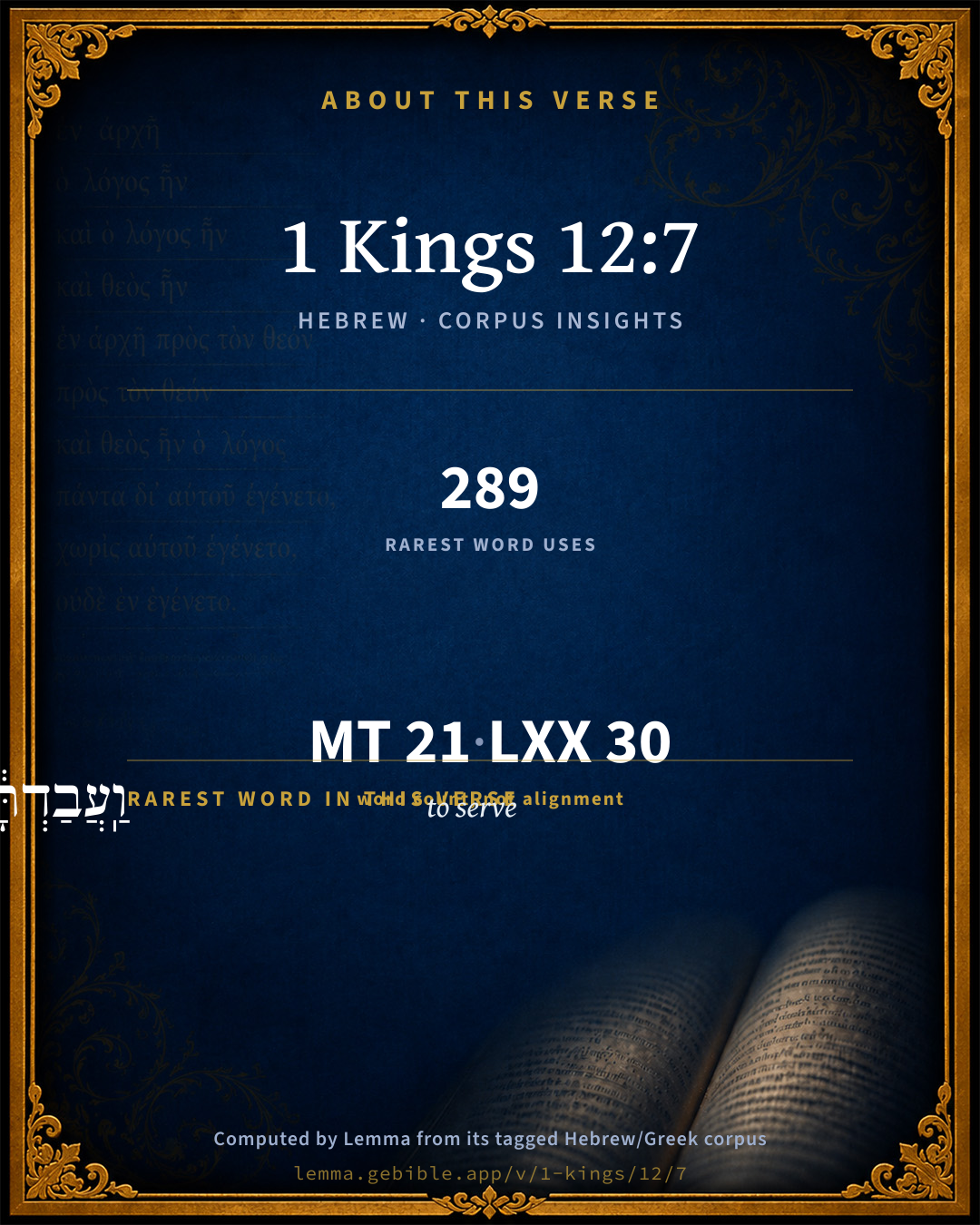
וַֽעֲבַדְתָּ֔ם
ʻâbad
H5647
“and · to serve · them”
Conjunction + Verb, Qal, Sequential Perfect, 2nd Person, Masculine, Singular + Suffix, Personal, 3rd Person, Masculine, Plural
Part of Speech
Conjunction + Verb
Stem
Qal
Form
Sequential Perfect
Person
2nd Person
Gender
Masculine
Number
Singular
Full BDB Definition

Origin: a primitive root

TWOT: 1553

to work, serve - (Qal) - to labour, work, do work - to work for another, serve another by labour - to serve as subjects - to serve (God) - to serve (with Levitical service) - (Niphal) - to be worked, be tilled (of land) - to make oneself a servant - (Pual) to be worked - (Hiphil) - to compel to labour or work, cause to labour, cause to serve - to cause to serve as subjects - (Hophal) to be led or enticed to serve
  1. וידבר dâbar H1696 “and · to speak” Conjunction + Verb, Piel, Sequential Imperfect, 3rd Person, Masculine, Singular
  2. וַיְדַבְּר֨וּ dâbar H1696 “and · to speak” Conjunction + Verb, Piel, Sequential Imperfect, 3rd Person, Masculine, Plural
  3. אֵלָ֜יו ʼêl H413 “to · him” Preposition + Suffix, Personal, 3rd Person, Masculine, Singular
  4. לֵאמֹ֗ר ʼâmar H559 “to say” Preposition + Verb, Qal, Infinitive Construct
  5. אִם ʼim H518 “if” Conjunction
  6. הַ֠יּוֹם yôwm H3117 “the · day” Particle, Definite Article + Noun, Common, Masculine, Singular, Absolute
  7. תִּֽהְיֶה hâyâh H1961 “to be” Verb, Qal, Imperfect, 2nd Person, Masculine, Singular
  8. עֶ֜בֶד ʻebed H5650 “servant” Noun, Common, Masculine, Singular, Absolute
  9. לָעָ֤ם ʻam H5971 “to/for the · people” Preposition, Determined + Noun, Common, Masculine, Singular, Absolute
  10. הַזֶּה֙ zeh H2088 “the · this” Particle, Definite Article + Pronoun, Demonstrative, Masculine, Singular
  11. וַעֲנִיתָ֕ם ʻânâh H6030 “and · to answer · them” Conjunction + Verb, Qal, Sequential Perfect, 2nd Person, Masculine, Singular + Suffix, Personal, 3rd Person, Masculine, Plural
  12. וְדִבַּרְתָּ֥ dâbar H1696 “and · to speak” Conjunction + Verb, Piel, Sequential Perfect, 2nd Person, Masculine, Singular
  13. אֲלֵיהֶ֖ם ʼêl H413 “to · them” Preposition + Suffix, Personal, 3rd Person, Masculine, Plural
  14. דְּבָרִ֣ים dâbâr H1697 “words” Noun, Common, Masculine, Plural, Absolute
  15. טוֹבִ֑ים ṭôwb H2896 “good” Adjective, Adjective, Masculine, Plural, Absolute
  16. וְהָי֥וּ hâyâh H1961 “and · to be” Conjunction + Verb, Qal, Sequential Perfect, 3rd Person, Common, Plural
  17. עֲבָדִ֖ים ʻebed H5650 “servants” Noun, Common, Masculine, Plural, Absolute
  18. כָּל kôl H3605 “all of” Noun, Common, Masculine, Singular, Construct
  19. הַיָּמִֽים yôwm H3117 “the · days” Particle, Definite Article + Noun, Common, Masculine, Plural, Absolute

About this verse

These counts appear in no published source. They are computed here, from the morphology-tagged text and Lemma’s own curated glosses. What Lemma adds →

21
words
14
distinct lemmas
Historical
section

Grammatical profile

  • 8 verbs
  • 7 nouns
  • 1 adjective
  • 1 pronoun
  • 3 prepositions
  • 1 conjunction

Verb forms

  • וידבר Piel · Sequential Imperfect
  • וַיְדַבְּר֨וּ Piel · Sequential Imperfect
  • לֵאמֹ֗ר Qal · Infinitive Construct
  • תִּֽהְיֶה Qal · Imperfect
  • וַֽעֲבַדְתָּ֔ם Qal · Sequential Perfect
  • וַעֲנִיתָ֕ם Qal · Sequential Perfect
  • וְדִבַּרְתָּ֥ Piel · Sequential Perfect
  • וְהָי֥וּ Qal · Sequential Perfect

Repetition

Words recur within this verse — often emphatic in Hebrew:

  • וידבר to speak H1696 ×3
  • הַ֠יּוֹם day H3117 ×2
  • תִּֽהְיֶה to be H1961 ×2
  • עֶ֜בֶד servant H5650 ×2
  • אֵלָ֜יו to H413 ×2

Hebrew & Septuagint length

In English translation the verse runs 36 words from the Hebrew and 35 from the Septuagint (LXX English) — closely comparable.

A rough comparison of the two English renderings, which tokenize alike — not a word-level alignment.

Word counts can differ between the Hebrew and the Greek without any difference in meaning — e.g. the Hebrew direct-object marker אֵת has no separate Greek word, and Greek often adds the article ὁ.

In the original languages it is 21 Hebrew tokens and 30 Greek tokens — but the two are counted differently (Hebrew bundles its prefixes and suffixes into one token; the Greek is in lemma form), so that isn’t a like-for-like length.

Cross-references

8

Topical passages linked to 1 Kings 12:7 in the Treasury of Scripture Knowledge — connected by theme and wording, ordered by reader-vote popularity; previews shown in the World English Bible.

  • Proverbs 15:1 A gentle answer turns away wrath, But a harsh word stirs up anger.
  • 2 Samuel 15:3–6 Absalom said to him, Behold, your matters are good and right; but there is no man deputized of the king to hear you.
  • 1 Kings 12:13 The king answered the people roughly, and forsook the counsel of the old men which they had given him,
  • 2 Chronicles 10:6–7 King Rehoboam took counsel with the old men, who had stood before Solomon his father while he yet lived, saying, What counsel give you me to return answer to this people?
  • Ecclesiastes 10:4 If the spirit of the ruler rises up against you, don't leave your place; for gentleness lays great offenses to rest.
  • Zechariah 1:13 Yahweh answered the angel who talked with me with kind and comforting words.
  • Mark 10:43–44 But it shall not be so among you, but whoever wants to become great among you shall be your servant.
  • Philippians 2:7–11 but emptied himself, taking the form of a servant, being made in the likeness of men.

Cross-references courtesy of OpenBible.info (CC BY 4.0).

Hebrew and Greek witnesses Masoretic Hebrew ↔ Greek Septuagint

The same verse in the two great witnesses to the Old Testament, shown verse-for-verse.

These are two independent witnesses, not word-aligned to each other, and the Septuagint is shown in lemma (dictionary) form.

Hebrew 1 Kings 12:7 Masoretic · Westminster Leningrad Codex

וידבר וַיְדַבְּר֨וּ אֵלָ֜יו לֵאמֹ֗ר אִם הַ֠יּוֹם תִּֽהְיֶה עֶ֜בֶד לָעָ֤ם הַזֶּה֙ וַֽעֲבַדְתָּ֔ם וַעֲנִיתָ֕ם וְדִבַּרְתָּ֥ אֲלֵיהֶ֖ם דְּבָרִ֣ים טוֹבִ֑ים וְהָי֥וּ לְךָ֛ עֲבָדִ֖ים כָּל הַיָּמִֽים

They spoke to him, saying, If you will be a servant to this people this day, and will serve them, and answer them, and speak good words to them, then they will be your servants forever.

World English Bible · Public Domain

Greek LXX 1 Kings 12:7 Septuagint · lemma form

καί λαλέω πρός αὐτός λέγω εἰ ἐν ὁ ἡμέρα οὗτος εἰμί δοῦλος ὁ λαός οὗτος καί δουλεύω αὐτός καί λαλέω αὐτός λόγος ἀγαθός καί εἰμί σύ δοῦλος πᾶς ὁ ἡμέρα

And they spoke to him, saying, If you will this day be a servant to this people, and will serve them, and will speak to them good words, then will they be your servants continually.

LXX2012 (modern English Septuagint) · Public Domain

On this verse, The Cambridge Bible for Schools and Colleges discusses the Septuagint’s reading. Read the note in Commentary ↓

Hebrew: Westminster Leningrad Codex (CC BY 4.0). Greek: Septuagint (public domain); English from LXX2012 (modern English Septuagint) (Public Domain). How the Septuagint differs from the Hebrew →

Targum (Aramaic paraphrase)

1

The Targum is the ancient Jewish Aramaic paraphrase of the Hebrew Scriptures — an interpretive translation, not the Hebrew text itself. Onkelos (literal) and Pseudo-Jonathan (expansive) render the Torah, and Jonathan the Prophets. Coverage is partial: where no permissively-licensed English translation exists for a verse, only the Aramaic is shown. This is verse-level text, not a word-by-word alignment to the Hebrew.

  1. Targum Jonathan Prophets (Joshua–Malachi)
    וּמַלִילוּ עִמֵיהּ לְמֵימַר אִם יוֹמָא דֵין תִּתְעַלֵיב לְעַמָא הָדֵין וּתִפְלְחִינוּן וְתַעֲנִינוּן מִלִין טָבָן וּתְמַלֵיל עִמְהוֹן פִּתְגָמִין תַּקְנִין וִיהוֹן לָךְ עַבְדִין כָּל יוֹמַיָא:

    (no public-domain English translation for this verse)

    Targum Jonathan — Aramaic: “Mikraot Gedolot” (public domain). English: “Sefaria Community Translation” (CC0 1.0 (public-domain dedication)); “London "Chaldee Paraphrase," 1871” (public domain). Text via Sefaria.

Commentary

Notes on 1 Kings 12:7 from classic Christian and Jewish commentators (each source and its license shown beneath its notes). The classic Christian expositions comment on the surrounding passage and are grouped to its opening verse, so a note may address several verses; the Jewish commentaries on the Tanakh (Rashi and others) are per-verse, so they appear only where the commentator wrote on this verse.

Lemma curates 59 commentaries, every one of them public domain or Creative Commons licensed, each selected and text-cleaned for this edition rather than reprinted as found. About our sources →

Trapp's Complete Commentary

John Trapp

1Ki 12:7 And they spake unto him, saying, If thou wilt be a servant unto this people this day, and wilt serve them, and answer them, and speak good words to them, then they will be thy servants for ever.

Ver. 7. If thou wilt be a servant to this people this day.] Lenity and moderation in a prince is very prevalent with the people, as to win their affections at first, so to hold them in obedience ever after. The advice of an ancient French counseller to his sovereign at his departure from court, hath been elsewhere related. Being wished to lay down some general rules for government, he took a paper, and wrote on the top of it ‘moderation,’ in the middle of the leaf ‘moderation,’ and at the bottom ‘moderation.’

Then they will serve thee for ever.] Thou mayest afterwards use them at thy pleasure. Thus these politicians, according to that of the poet,

“ Nil pudet assuetos sceptris. ”

England was once called the Pope’s ass; and his officer John Florentinus was nicknamed Ferentinus for bearing away so much money from the English, of whom he received no less sums of curses than of coin, saith the chronicler. {a}

{a} Speed.

John Trapp, A Commentary or Exposition upon All the Books of the Old and New Testament (1647–1656) — public domain. Text from a community e-Sword module.

The Biblical Illustrator

Joseph S. Exell

1Ki_12:7

If thou wilt be a servant unto this people this day . . . then they will be thy servants for ever.

A royal servant

These words are of deep-reaching import, and contain a principle of universal application. They especially apply to starts in life. When the son leaves the parental home for his new calling, for foreign land, to make his way in the world, our text contains a sentence which the father may, at the last moment of departure, whisper in his ear as an expression of the deepest thoughts in his heart for the guidance of the young beginner. To fulfil these words beautifies life, to have fulfilled them softens death. They contain a prescription which one can never repent of following.

I. The folly of Rehoboam. In the ancient, town of Shechem, a town that recalls to the Israelite memories of patriarchal limes, a king is about to be crowned. Solomon the Great has gone the way of all his fathers, and by right of succession the crown falls to Rehoboam his son. All Israel assembled at Shechem to make him king. For ages that old city had retained traces of its ancient dignity, just as Rheims, the old capital of France, continued to be the scene of coronations long after it had ceased to be the national capital. There was a time when Amsterdam was threatened to be deprived of its right of Royal Coronation, but since the severance of Belgium and Holland, the New Church here holds that honour undisputed. Shechem was full of representatives from all parts of the country. The king came down in royal state from Jerusalem. No opposition was offered to Rehoboams succession. He was the only son of Solomon, and the people were prepared to receive him as such. They had, however, many grievances which they wished to have redressed. Solomon had not been everything that a king should be.

II. The prerogative of service. A wise king would have at once acceded to such a request. But Rehoboam, although the son of a wise father, had not the common sense to do so. Wisdom is not inherited. Who knoweth whether his son will be a wise man or a fool? He was the king. The people had no rights but what he chose to give them. They were his servants, not he their servant. His will was their law. He knew nothing and would hear nothing of the rights of the individual. According to the mind of Jesus, he is the greatest who renders the greatest service to others. They assert that the strength of a monarchs throne is service for and sympathy with his people. A throne built on such a foundation will last unshaken for ever. Oh, happy king to have such counsellors! Oh, foolish man to turn aside from them! The consequence of this incredibly foolish reply was such as might have been expected. The work of two generations was undone in a moment. Under the leadership of Jeroboam, who promised them the reforms they wanted, the Ten Tribes revolted.

III. Selfish autocracy. It is the old story of the consequence of selfish and inconsiderate autocracy. It is a lesson which makes but slow progress in the minds of men. The old heathen idea of forcible dominion is still largely the governing one of politics--that to be great is to receive much service, not to render it. Politics has too often been a game of ambition rather than a sphere of service. (W. Thomson, M. A. , B. D.)

The king as a servant

The honour of service is emphasised by Solomon in the title he gives to his father. He speaks of him by a more honourable name than that of king--Thy servant David. Solomon recognised that he owed his exalted.position entirely to God. The most universal function in nature is that of service. Nothing in creation is serving itself, but every element is intended to serve some other. The flowers bloom in beauty, but soon serve us by transformation into seed. The winds purify the earth. The clouds carry moisture across all regions. The sun is regal in majestic splendour, but this monarch of the planets is, in reality, far more their servant, as their light and heat bearer. Above all, the idea of service is ennobled by Jesus, who as minister to His disciples was servant of all. So are we to seek to serve God and man. (Christian Commonwealth.)

The Biblical Illustrator, edited by Joseph S. Exell (c. 1880s–1900s) — public domain. Text from a community e-Sword module.

Geneva Bible (1599)

Geneva Bible translators

They showed him that there was no way to win the people’s hearts, but to grant them their just petition.

Geneva Bible (1599) marginal notes — public domain. Text via Bolls.life.

Adam Clarke's Commentary

Verse 7. If thou wilt be a servant unto this people] This is a constitutional idea of a king: he is the servant, but not the slave of his people; every regal act of a just king is an act of service to the state. The king is not only the fountain of law and justice; but as he has the appointment of all officers and judges, consequently he is the executor of the laws; and all justice is administered in his name. Properly speaking, a good and constitutional king is the servant of his people; and in being such he is their father and their king.

They will be thy servants for ever.] The way to insure the obedience of the people is to hold the reins of empire with a steady and impartial hand; let the people see that the king lives for them, and not for himself; and they will obey, love, and defend him. The state is maintained on the part of the ruler and the ruled by mutual acts of service and benevolence. A good king has no self-interest; and such a king will ever have obedient and loving subjects. The haughty, proud tyrant will have a suspicious and jealous people, hourly ripening for revolt. The king is made for the people, not the people for the king. Let every potentate wisely consider this; and let every subject know that the heaviest cares rest on the heart, and the heaviest responsibility rests on the head, of the king. Let them therefore, under his government, fashion themselves as obedient children; acknowledge him their head; and duly consider whose authority he has; that they may love, honour and obey him. Happy are the people who have such a king; safe is the king who has such a people.

Adam Clarke's Commentary on the Bible (1810–1826) — public domain. Text from a community e-Sword/MySword module.

Ellicott's Commentary for English Readers

(7) If thou wilt be a servant.—Both the policies suggested show how corrupt and cynical the government of Israel had become. For the advice of the old counsellors has no largeness of policy or depth of wisdom. It is simply the characteristic advice of experienced and crafty politicians—who had seen the gradual development of despotic power, and had still remembrance of the comparative freedom of earlier days—understanding at once the dangerous vehemence of popular excitement, and the facility with which it may be satisfied by temporary concessions, and perhaps desiring to defeat that private ambition, which was making use for its own purposes of the natural sense of grievance. It is to give “good words,” and to be for the moment “a servant to the people,” with, perhaps, the intention of abolishing certain excessive grievances, but by no means of yielding up substantial power. Whether it was in itself more than superficially prudent, would depend on the seriousness of the grievances, and the social and political condition of the people.

A Bible Commentary for English Readers, edited by Charles John Ellicott (1878–1897) — public domain. Text from a community e-Sword module.

The Cambridge Bible for Schools and Colleges

gen. ed. J. J. S. Perowne

7. If thou wilt be a servant unto this people this day] Here the words of 2 Chron. are ‘If thou be kind to this people and please them.’ What was meant was that for the time the king should give way and obey the popular voice. This short service would win for him their constant allegiance. The LXX. does not represent ‘and answer them’ in this verse.

The Cambridge Bible for Schools and Colleges (gen. ed. J. J. S. Perowne; Cambridge University Press, 1878–1918) — public domain. Text from a community e-Sword module.

John Gill's Exposition

And they spake unto him, saying,.... They gave their advice as follows:

if thou wilt be servant unto this people this day, and wilt serve them; condescend to them, behave in an humble manner towards them, for this day however, and gratify and oblige them; though indeed a king is but a servant to his people, and his administration of government a doing service to them; hence Antigonus (f), a king, mild, humble, and gentle, perceiving his son to behave in a fierce and violent manner towards his subjects, said to him, my son, dost thou not know that our glorious kingdom is a servitude?

and answer them, and speak good words unto them; give them a soft answer, and speak kindly and gently to them, and make them fair promises, and give them reason to expect that their requests will be granted:

then they will be thy servants for ever; such conduct would so win upon them, and make such an impressions upon them, that they would for ever after entertain high opinion of him, and be strongly affected and attached to him, and readily serve him.

(f) Apud Aelian. Var. Hist. l. 2. c. 20.

John Gill's Exposition of the Whole Bible (1746–1763) — public domain (CC PDM 1.0). Text via the HelloAO Bible API.

Albert Barnes' Notes on the Bible

The advice was not that the king should permanently resign the office of ruler, but that he should “for once” be ruled by his people.

Albert Barnes' Notes on the Bible (1834–1885) — public domain. Text from a community e-Sword/MySword module.

Haydock's Catholic Bible Commentary

They said. Hebrew, "he said." The transcribers, probably not understanding what they wrote, frequently make singular for plural verbs. So ver. 21, "They came," instead of he came. Some manuscripts and the ancient versions are correct. (Kennicott) --- Yield. Hebrew, "serve." By the submission of one day he might have acquired the kingdom. Great attention is requisite at first. Tacitus (Hist. iv.) represents Vespasian, Novo principatu suspensum, & vultus quoque ac sermones omnium circumspectantem.

George Leo Haydock (1774–1849), Haydock's Catholic Family Bible and Commentary, 1859 edition — public domain. Excludes Psalms (Douay-Rheims chapter numbering differs from Protestant) and Deuterocanonical books (Catholic canon only).

Matthew Poole's English Annotations

If thou wilt be a servant unto this people this day, by complying with their desires, and condescending to them for a season, till the troubled humours be quieted, and the opportunity they now have, and that some of them seek, for sedition be gone, and thou be better stablished in thy throne. They use this expression, as foreseeing that some would dissuade him from this course, as servile or slavish, and below the majesty of a prince.

And answer them, for that is, answer them. Thy service, say they, is not hard; it is only a few good words, which it is as easy to give as bad ones.

Matthew Poole's English Annotations on the Holy Bible (1683–1685) — public domain. Text from a community e-Sword/MySword module.

Whedon's Commentary on the Bible

Daniel D. Whedon

7. Be a servant unto this people this day — The ruler that would hold the affections of his people must first learn to be their servant. He must consult their wishes and interests so as not to seem unmindful of his most humble subject. But it is easy to see, as Bahr remarks, that such a proposition might not be very agreeable to a rash and imperious young king, in whose veins Ammonite blood flowed.

Daniel D. Whedon (gen. ed.), Commentary on the Old and New Testaments (1874–1909) — public domain. Text from a community e-Sword module.

The Pulpit Commentary

And they spake unto him, saying, If thou wilt be a servant unto this people this day, and wilt serve them Keil questions the propriety and expediency of this advice. He says, "The king could not become the db,, of the people without prejudicing the authority entrusted to him by God." But they do not propose that he should become their servant, except for one clay, and then only in the sense of making reasonable concessions. What they mean is this: "If thou wilt brook for once to accede to their terms instead of dictating thine own," etc. The form of their answer was probably suggested by the temper of the king. They saw what was passing in his mind, viz., that he would fain play the autocrat, and that he resented it exceedingly that his subjects, just as he had begun to taste the sweets of royalty, should presume to parley with him; and they say in effect, "You think that they are reversing your relations, that they are making you, their sovereign, their servant. Be it so. It is but for one day. Then they will be your slaves forever", and answer them i.e., favourably; grant their request; (cf., Psa_22:22 Psa_65:6) and speak good words to them, then will they be thy servants forever. "Thy servants," in opposition to "a servant" above; "forever" in opposition to "this day."

The Pulpit Commentary (1880–1919), ed. H.D.M. Spence-Jones & Joseph S. Exell — public domain. Text from a community e-Sword module.

John Wesley's Explanatory Notes

This day - By complying with their desires, and condescending to them for a season, till thou art better established in thy throne. They use this expression, fore-seeing that some would dissuade him from this course, as below the majesty of a prince. And answer - Thy service is not hard, it is only a few good words, which it is as easy to give as bad ones.

John Wesley, Explanatory Notes Upon the Whole Bible (1754–1765) — public domain. Text via the GEBible commentary corpus.

Lesson kit

Teaching starters — assembled from the data on this page, not authored interpretation. Every prompt links to the verse data it draws on. Edit before teaching.

1 Kings, in the Historical, opens this verse with 21 words (14 distinct Hebrew lemmas). Its most distinctive word is ʻâbad (“to serve”). A historical commentator’s framing appears above. Read the whole chapter for the surrounding context.

Discussion questions

  1. How does “to serve” (ʻâbad) shape what this verse is saying?
  2. How does Proverbs 15:1, which shares this passage’s theme, read alongside this verse?
  3. What does the repetition of “to speak” (3× in this one verse) do in this verse?
  4. These translations render this verse differently. What is at stake in choosing one wording over another?
  5. «וידבר» is a Piel Sequential Imperfect verb. How does that grammatical form shape the action described?
  6. Compare how Trapp's Complete Commentary and The Biblical Illustrator read this verse. Where do they agree or differ?

Things to notice

Reading settings

Reading text

Shown beneath each verse's original-language words.

Old Testament
Old Testament edition

Read the OT as the Masoretic Hebrew (MT) or the Greek Septuagint (LXX).

English shown for the Greek Septuagint (in the Hebrew ↔ Greek comparison).

Comparing translations? Open the Compare panel on any verse page to stack up to four side by side.