
Daniel 11:27

Hebrew (Westminster Leningrad Codex) Daniel 11:27 appears in the Hebrew Old Testament. The text above is from the Westminster Leningrad Codex. Each word links to its Strong’s number, a concise gloss, and parsing drawn from the Open Scriptures Hebrew Bible morphology. Click any word for its full Brown-Driver-Briggs (BDB) entry.
Download image
Cite this verse

Daniel 11:27 (World English Bible). Public Domain. Lemma interlinear Bible study tool, https://lemma.gebible.app/v/daniel/11/27.

Show BibTeX & RIS
BibTeX
RIS
English Translation
As for both these kings, their hearts shall be to do mischief, and they shall speak lies at one table: but it shall not prosper; for yet the end shall be at the time appointed.
World English Bible · Public Domain
Highlights
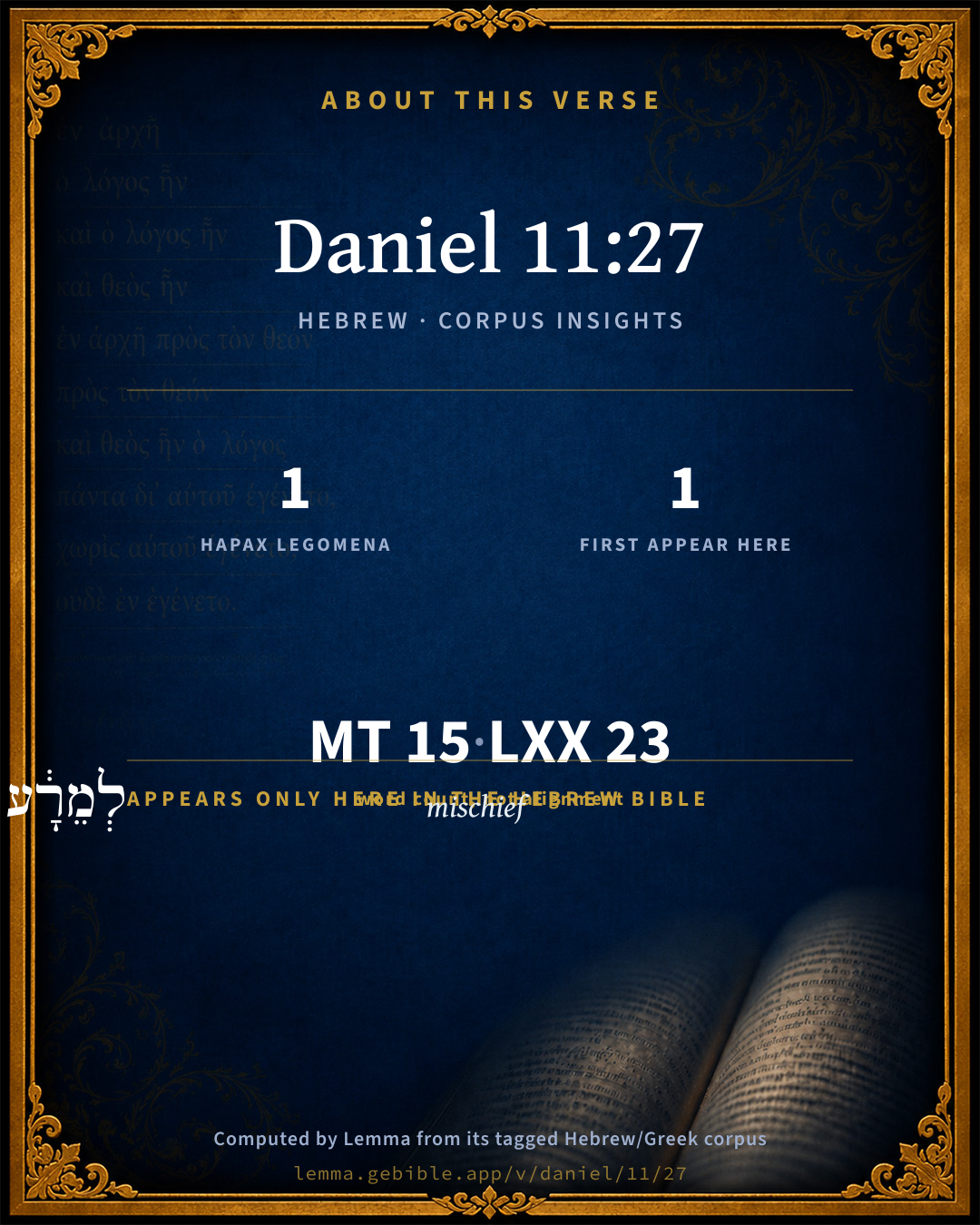
  • 1 hapax legomenon — only here in the Hebrew Bible
  • 1 first appearance in the Hebrew Bible
Full analysis ↓
Download a study sheet

One document with this verse’s original text, its word-by-word gloss line, the meaning frame, cross-references with their text, attributed commentary, and full source and license credits — printable, and it pastes into notes with its structure intact.

This verse Autodidact and up

Study sheet (.html) Plain text (.txt)

A passage Seminary Student

Up to 50 verses in one chapter. A passage sheet keeps up to 6 commentary sources and 12 cross-references per verse, in the order this page ranks them, and says so on the sheet whenever that leaves anything out. Ask for a single verse and you get the Autodidact verse sheet above.

Everything on this page stays free to read, with no account — the sheet is a download of what is already on screen, not access to it.

Want to remove ads? Support Godless Engineer
Compare translations 3

The same verse in 3 English versions, stacked beneath the original-language interlinear above. Click any original word for its lexicon entry.

Each is an independent rendering of the whole verse — the interlinear is not word-aligned to these translations.

Highlighted words mark where these versions differ — a whole-verse word diff, not a word-by-word alignment.

  • World English Bible Public Domain
    As for both these kings, their hearts shall be to do mischief, and they shall speak lies at one table: but it shall not prosper; for yet the end shall be at the time appointed.
  • King James Version Public Domain
    And both of these kings' hearts shall be to do mischief, and they shall speak lies at one table; but it shall not prosper: for yet the end shall be at the time appointed.
  • unfoldingWord Literal Text CC BY-SA 4.0
    The two kings, with their hearts bent on evil, will speak lies at the same table, but it will not succeed, for the end is still to come at the appointed time.

unfoldingWord Literal Text — © unfoldingWord, licensed CC BY-SA 4.0. Word-aligned USFM3 via Door43 (git.door43.org/unfoldingWord/en_ult).

Versions to compare (up to 4)

3 of 4 selected

Show all 18 translations

Every available English version of this verse, each an independent rendering of the whole verse.

  • World English Bible Public Domain
    As for both these kings, their hearts shall be to do mischief, and they shall speak lies at one table: but it shall not prosper; for yet the end shall be at the time appointed.
  • Berean Standard Bible Public Domain
    And the two kings, with their hearts bent on evil, will speak lies at the same table, but to no avail, for still the end will come at the appointed time.
  • Majority Standard Bible Public Domain
    And the two kings, with their hearts bent on evil, will speak lies at the same table, but to no avail, for still the end will come at the appointed time.
  • King James Version Public Domain
    And both of these kings' hearts shall be to do mischief, and they shall speak lies at one table; but it shall not prosper: for yet the end shall be at the time appointed.
  • American Standard Version (1901) Public Domain
    And as for both these kings, their hearts shall be to do mischief, and they shall speak lies at one table: but it shall not prosper; for yet the end shall be at the time appointed.
  • Revised Version (1885) Public Domain
    And as for both these kings, their hearts shall be to do mischief, and they shall speak lies at one table: but it shall not prosper; for yet the end shall be at the time appointed.
  • Geneva Bible (1599) Public Domain
    And both these Kings hearts shall be to do mischiefe, and they shall talke of deceite at one table: but it shall not auaile: for yet the ende shall be at the time appointed.
  • Douay-Rheims (1899) Public Domain
    And the heart of the two kings shall be to do evil, and they shall speak lies at one table, and they shall not prosper: because as yet the end is unto another time.
  • Young's Literal Translation Public Domain
    `And both of the kings' hearts `are' to do evil, and at one table they speak lies, and it doth not prosper, for yet the end `is' at a time appointed.
  • Literal Standard Version CC BY-SA 4.0
    And both of the kings’ hearts [are] to do evil, and at one table they speak lies, and it does not prosper, for yet the end [is] at a time appointed.
  • Unlocked Literal Bible CC BY-SA 4.0
    Both these kings, with their hearts set on evil against each other, will sit at the same table and lie to each other, but it will be of no use. For the end will come at the time that has been fixed.
  • unfoldingWord Literal Text CC BY-SA 4.0
    The two kings, with their hearts bent on evil, will speak lies at the same table, but it will not succeed, for the end is still to come at the appointed time.
  • Darby Bible Public Domain
    And both these kings' hearts [shall meditate] mischief, and they shall speak lies at one table; but it shall not prosper; for yet the end shall be at the time appointed.
  • World Messianic Bible Public Domain
    As for both these kings, their hearts will be to do evil, and they will speak lies at one table; but it won’t prosper, for the end will still be at the appointed time.
  • Webster's Bible Public Domain
    And both these kings hearts shall be to do mischief, and they shall speak lies at one table; but it shall not prosper: for yet the end shall be at the time appointed.
  • Free Bible Version CC BY-SA 4.0
    The two kings, with evil intentions, will tell each other lies even as they sit together at the same table. But their scheming is pointless—the end will come at the time predicted.
  • Bible in Basic English Public Domain
    And as for these two kings, their hearts will be fixed on doing evil and they will say false words at one table; but it will come to nothing: for the end will be at the time fixed.
  • JPS Tanakh (1917) Public Domain
    And as for both these kings, their hearts shall be to do mischief, and they shall speak lies at one table; but it shall not prosper, for the end remaineth yet for the time appointed.

Literal Standard Version (2020), Covenant Press — licensed CC BY-SA 4.0. Text via the HelloAO Bible API (eBible.org). Unlocked Literal Bible (unfoldingWord) — licensed CC BY-SA 4.0. Text via the HelloAO Bible API (eBible.org). unfoldingWord Literal Text — © unfoldingWord, licensed CC BY-SA 4.0. Word-aligned USFM3 via Door43 (git.door43.org/unfoldingWord/en_ult). Free Bible Version, Dr. Jonathan Gallagher — licensed CC BY-SA 4.0. Text via the HelloAO Bible API (eBible.org).

Word by word

More ways to search: Search by grammar → Find every occurrence → Compare this word →

Practice this passage: Drill this verse → Learn its vocabulary →

לְמֵרָ֔ע
mêraʻ
H4827
“to/for · mischief”
Preposition + Noun, Common, Masculine, Singular, Absolute
Part of Speech
Preposition + Noun
Type
Common
Gender
Masculine
Number
Singular
State
Absolute
Full BDB Definition

Origin: from H7489

TWOT: 2186f

(Hiphil) mischief - (TWOT) confidential friend
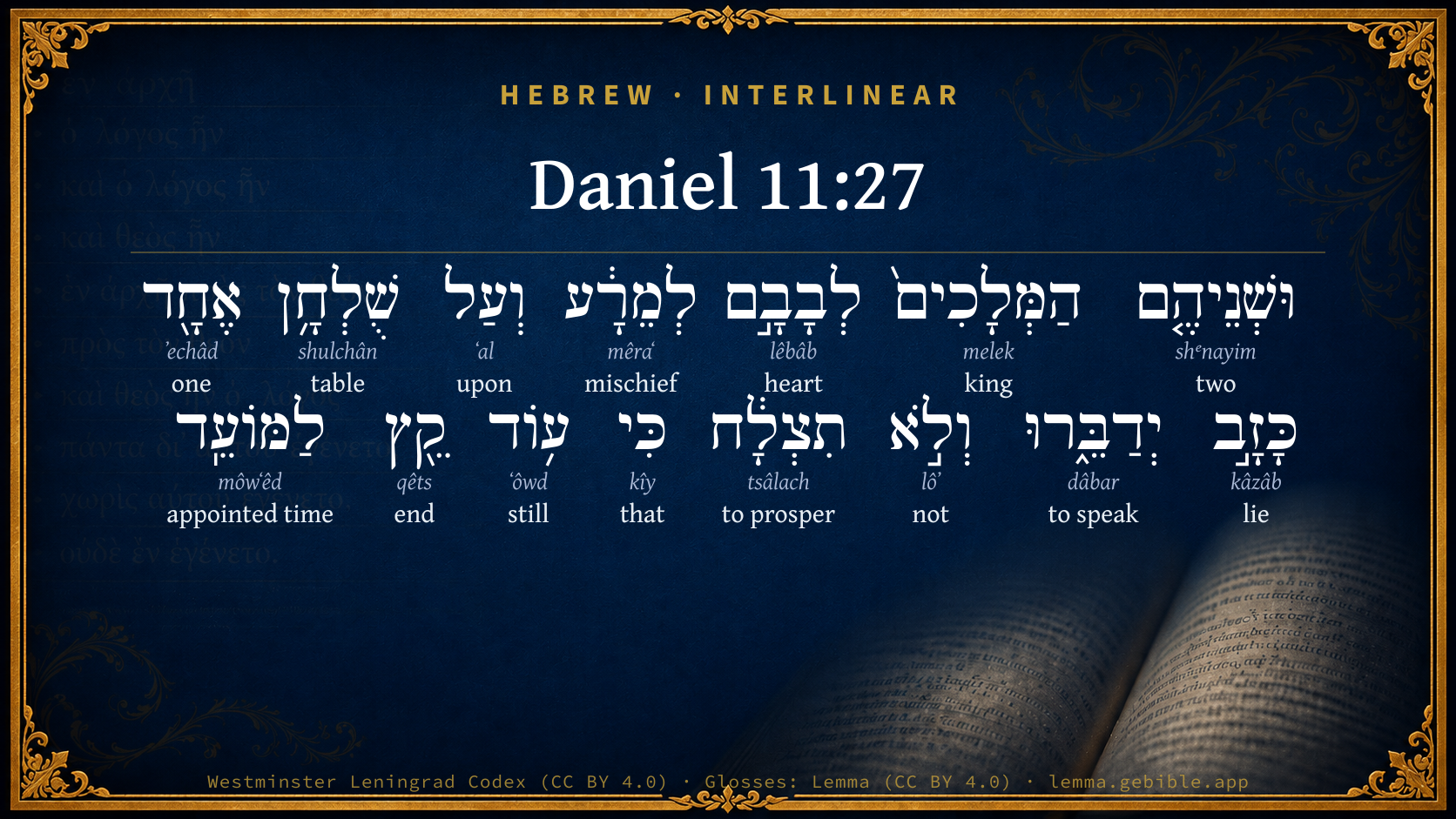
  1. וּשְׁנֵיהֶ֤ם shᵉnayim H8147 “and · two · their” Conjunction + Adjective, Cardinal number, Masculine, Dual, Construct + Suffix, Personal, 3rd Person, Masculine, Plural
  2. הַמְּלָכִים֙ melek H4428 “the · kings” Particle, Definite Article + Noun, Common, Masculine, Plural, Absolute
  3. לְבָבָ֣ם lêbâb H3824 “heart · their” Noun, Common, Masculine, Singular, Construct + Suffix, Personal, 3rd Person, Masculine, Plural
  4. וְעַל ʻal H5921 “and · upon” Conjunction + Preposition
  5. שֻׁלְחָ֥ן shulchân H7979 “table” Noun, Common, Masculine, Singular, Absolute
  6. אֶחָ֖ד ʼechâd H259 “one” Adjective, Cardinal number, Masculine, Singular, Absolute
  7. כָּזָ֣ב kâzâb H3577 “lie” Noun, Common, Masculine, Singular, Absolute
  8. יְדַבֵּ֑רוּ dâbar H1696 “to speak” Verb, Piel, Imperfect, 3rd Person, Masculine, Plural
  9. וְלֹ֣א lôʼ H3808 “and · not” Conjunction + Particle, Negative
  10. תִצְלָ֔ח tsâlach H6743 “to prosper” Verb, Qal, Imperfect, 3rd Person, Feminine, Singular
  11. כִּי kîy H3588 “that” Conjunction
  12. ע֥וֹד ʻôwd H5750 “still” Adverb
  13. קֵ֖ץ qêts H7093 “end” Noun, Common, Masculine, Singular, Absolute
  14. לַמּוֹעֵֽד môwʻêd H4150 “to/for the · appointed time” Preposition, Determined + Noun, Common, Masculine, Singular, Absolute

About this verse

These counts appear in no published source. They are computed here, from the morphology-tagged text and Lemma’s own curated glosses. What Lemma adds →

15
words
15
distinct lemmas
Prophets
section

Notable vocabulary

1 hapax legomenon — a word that appears only here in the entire Hebrew Bible:

  • לְמֵרָ֔ע mischief H4827

First appearance in Scripture

This word makes its first canonical appearance in the Hebrew Bible here:

  • לְמֵרָ֔ע mischief H4827

Shared distinctive vocabulary

כָּזָ֣ב lie H3577 occurs in 29 verses of the Hebrew Bible. Also found in:

Grammatical profile

  • 2 verbs
  • 7 nouns
  • 2 adjectives
  • 1 preposition
  • 1 conjunction
  • 1 adverb
  • 1 particle

Verb forms

  • יְדַבֵּ֑רוּ Piel · Imperfect
  • תִצְלָ֔ח Qal · Imperfect

Hebrew & Septuagint length

In English translation the verse runs 35 words from the Hebrew and 34 from the Septuagint (LXX English) — closely comparable.

A rough comparison of the two English renderings, which tokenize alike — not a word-level alignment.

Word counts can differ between the Hebrew and the Greek without any difference in meaning — e.g. the Hebrew direct-object marker אֵת has no separate Greek word, and Greek often adds the article ὁ.

In the original languages it is 15 Hebrew tokens and 23 Greek tokens — but the two are counted differently (Hebrew bundles its prefixes and suffixes into one token; the Greek is in lemma form), so that isn’t a like-for-like length.

Cross-references

22

Topical passages linked to Daniel 11:27 in the Treasury of Scripture Knowledge — connected by theme and wording, ordered by reader-vote popularity; previews shown in the World English Bible.

  • Psalms 12:2 Everyone lies to his neighbor. They speak with flattering lips, and with a double heart.
  • Jeremiah 9:3–5 They bend their tongue, [as it were] their bow, for falsehood; and they are grown strong in the land, but not for truth: for they proceed from evil to evil, and they don't know me, says Yahweh.
  • Daniel 11:35 Some of those who are wise shall fall, to refine them, and to purify, and to make them white, even to the time of the end; because it is yet for the time appointed.
  • Habakkuk 2:3 For the vision is yet for the appointed time, and it hurries toward the end, and won't prove false. Though it takes time, wait for it; because it will surely come. It won't delay.
  • Psalms 52:1 Why do you boast of mischief, mighty man? God's loving kindness endures continually.
  • Psalms 58:2 No, in your heart you plot injustice. You measure out the violence of your hands in the earth.
  • Psalms 64:6 They plot injustice, saying, "We have made a perfect plan!" Surely man's mind and heart are cunning.
  • Proverbs 12:20 Deceit is in the heart of those who plot evil, But joy comes to the promoters of peace.
  • Proverbs 23:6–8 Don't eat the food of him who has a stingy eye, And don't crave his delicacies:
  • Proverbs 26:23 Like silver dross on an earthen vessel Are the lips of a fervent one with an evil heart.
  • Jeremiah 41:1–3 Now it happened in the seventh month, that Ishmael the son of Nethaniah, the son of Elishama, of the seed royal and [one of] the chief officers of the king, and ten men with him, came to Gedaliah the son of Ahikam to Mizpah; and there they ate bread together in Mizpah.
  • Daniel 8:19 He said, Behold, I will make you know what shall be in the latter time of the indignation; for it belongs to the appointed time of the end.
  • Daniel 11:40 At the time of the end shall the king of the south contend with him; and the king of the north shall come against him like a whirlwind, with chariots, and with horsemen, and with many ships; and he shall enter into the countries, and shall overflow and pass through.
  • 2 Samuel 13:26 Then said Absalom, If not, please let my brother Amnon go with us. The king said to him, Why should he go with you?
  • Psalms 62:9 Surely men of low degree are just a breath, And men of high degree are a lie. In the balances they will go up. They are together lighter than a breath.
  • Proverbs 19:21 There are many plans in a man's heart, But Yahweh's counsel will prevail.
  • Ezekiel 17:9 Say you, Thus says the Lord Yahweh: Shall it prosper? shall he not pull up the roots of it, and cut off the fruit of it, that it may wither; that all its fresh springing leaves may wither? and not by a strong arm or much people can it be raised from the roots of it.
  • Daniel 10:1 In the third year of Cyrus king of Persia a thing was revealed to Daniel, whose name was called Belteshazzar; and the thing was true, even a great warfare: and he understood the thing, and had understanding of the vision.
  • Daniel 11:29 At the time appointed he shall return, and come into the south; but it shall not be in the latter time as it was in the former.
  • Acts 1:7 He said to them, "It isn't for you to know times or seasons which the Father has set within His own authority.
  • Acts 17:31 because he has appointed a day in which he will judge the world in righteousness by the man whom he has ordained; of which he has given assurance to all men, in that he has raised him from the dead."
  • 1 Thessalonians 5:1 But concerning the times and the seasons, brothers, you have no need that anything be written to you.

Cross-references courtesy of OpenBible.info (CC BY 4.0).

Hebrew and Greek witnesses Masoretic Hebrew ↔ Greek Septuagint

The same verse in the two great witnesses to the Old Testament, shown verse-for-verse.

These are two independent witnesses, not word-aligned to each other, and the Septuagint is shown in lemma (dictionary) form.

Hebrew Daniel 11:27 Masoretic · Westminster Leningrad Codex

וּשְׁנֵיהֶ֤ם הַמְּלָכִים֙ לְבָבָ֣ם לְמֵרָ֔ע וְעַל שֻׁלְחָ֥ן אֶחָ֖ד כָּזָ֣ב יְדַבֵּ֑רוּ וְלֹ֣א תִצְלָ֔ח כִּי ע֥וֹד קֵ֖ץ לַמּוֹעֵֽד

As for both these kings, their hearts shall be to do mischief, and they shall speak lies at one table: but it shall not prosper; for yet the end shall be at the time appointed.

World English Bible · Public Domain

Greek LXX Daniel 11:27 Septuagint · lemma form

καί δύο βασιλεύς μόνος δειπνέω ἐπί ὁ αὐτός καί ἐπί εἷς τράπεζα ἐσθίω καί ψευδολογέω καί οὐ εὐοδόω ἔτι γάρ συντέλεια εἰς καιρός

And as for both the kings, their hearts are set upon mischief, and they shall speak lies at one table; but it shall not prosper; for yet the end is for a fixed time.

LXX2012 (modern English Septuagint) · Public Domain

On this verse, The Pulpit Commentary discusses the Septuagint’s reading. Read the note in Commentary ↓

Hebrew: Westminster Leningrad Codex (CC BY 4.0). Greek: Septuagint (public domain); English from LXX2012 (modern English Septuagint) (Public Domain). How the Septuagint differs from the Hebrew →

Commentary

Notes on Daniel 11:27 from classic Christian and Jewish commentators (each source and its license shown beneath its notes). The classic Christian expositions comment on the surrounding passage and are grouped to its opening verse, so a note may address several verses; the Jewish commentaries on the Tanakh (Rashi and others) are per-verse, so they appear only where the commentator wrote on this verse.

Lemma curates 59 commentaries, every one of them public domain or Creative Commons licensed, each selected and text-cleaned for this edition rather than reprinted as found. About our sources →

The Cambridge Bible for Schools and Colleges

gen. ed. J. J. S. Perowne

27. And as for the two kings, their heart (shall be) for mischief; and at one table they shall speak lies] Antiochus and Philometor, after the latter had fallen into his uncle’s hands, were outwardly on friendly terms with one another; but their friendship was insincere, as is expressively shewn by the picture which the writer’s words suggest: sitting and eating at one table, they both in fact spoke lies,—Antiochus, in professing disinterestedness, as though his only object were to gain Egypt for his nephew’s benefit, (cui regnum quaeri suis viribus simulabat, Livy xlv.11), and Philometor in feigning that he believed his uncle’s assurances, and cherished for him gratitude and regard.

but it shall not prosper] The common plan, on which they were supposed to be agreed, the conquest of Egypt, ostensibly for Philometor, in reality for Antiochus.

for the end (remaineth) yet for the time appointed] matters will not yet be settled in Egypt: the end of Antiochus’ doings there belongs still to a time fixed in the future.

It must be admitted that some of the references in Dan_11:25-27 (esp. in Dan_11:27) would be more pointed and significant, if they could be supposed to allude to events in the second Egyptian campaign of Antiochus, as well as to events in the first. Upon the chronology adopted above (which is that of most modern historians), this can only be, if the author, neglecting the strict chronological sequence, throws the first two Egyptian campaigns together, and then (Dan_11:28) proceeds to describe the attack upon Jerusalem. We do not, however, possess any continuous narrative of the events of Antiochus’ reign; nor does there seem to be any express statement that Antiochus returned to Syria, or even that he left Egypt, at the close of what is described above as his ‘first’ Egyptian expedition; hence it is possible that Mahaffy[380] is right in his contention that Antiochus’ first two campaigns (as they are commonly called) were in reality only two stages in one campaign—the first stage ending at Pelusium, and the second embracing the conquest of Egypt, and both belonging to the year b.c. 170. If this view be adopted, the attack upon Jerusalem (Dan_11:28; 1Ma_1:20-24) will come at the end of what is called above the ‘second’ Egyptian expedition (but thrown back now to b.c. 170)[381], and both that and the ‘first’ Egyptian expedition will be summarized in Dan_11:25-28 and 1Ma_1:16-19.

[380] Empire of the Ptolemies, p. 494 f., cf. pp. 333–337, 340. So Wellhausen, Isr. und Jüd. Gesch. (1894), p. 203 n. (ed. 3, 1897, p. 246 n.).

[381] An interval of two years between this attack upon Jerusalem, and the persecuting edict of b.c. 168 is required by the dates in 1Ma_1:20 and 1Ma_1:29; 1Ma_1:54.

The Cambridge Bible for Schools and Colleges (gen. ed. J. J. S. Perowne; Cambridge University Press, 1878–1918) — public domain. Text from a community e-Sword module.

Trapp's Complete Commentary

John Trapp

Dan 11:27 And both these kings’ hearts [shall be] to do mischief, and they shall speak lies at one table; but it shall not prosper: for yet the end [shall be] at the time appointed.

Ver. 27. And both these kings’ hearts shall be to do mischief.] Philometor being beaten, shall seek agreement, give great gifts to Antiochus, and feast him, sed reconciliatione vulpina, but with a fox-like and feigned amity, each of them still retaining their ancient hatreds. "Burning lips and a wicked heart are like a potsherd covered with silver dross." {Pro 26:23}

And they shall speak lies.] This is ordinary with the wicked; {Psa 62:9} but it is the property of the godly man to "speak the truth from his heart." {Psa 15:2}

For yet the end shall be at the time appointed,] i.e., The end of those wars shall be at the time when God seeth good, and hath pre-determined it.

John Trapp, A Commentary or Exposition upon All the Books of the Old and New Testament (1647–1656) — public domain. Text from a community e-Sword module.

Joseph Benson's Commentary

Dan 11:27. And both these kings’ hearts shall be to do mischief, and they shall speak lies at one table — Antiochus and Ptolemy Philometor often met together at Memphis, and frequently ate at the same table as friends, Antiochus pretending to take care of the interests of his nephew Philometor, especially after the Alexandrians had proclaimed his brother Euergetes king; and Philometor seemingly confiding in his uncle’s protection. But herein they were both insincere, designing to impose upon each other; Antiochus’s design being to seize the kingdom of Egypt to himself, and Philometor’s to disappoint that design, by coming to an agreement with Euergetes and the Alexandrians. But still these artifices did not prosper on either side; for neither did Antiochus obtain the kingdom, nor did Philometor utterly exclude him; but at last the pretended friendship broke out into open wars, which were not to have an end till the time appointed, which was not yet come.

Joseph Benson's Commentary on the Old and New Testaments (1811–1818) — public domain. Text from a community e-Sword module.

Geneva Bible (1599)

Geneva Bible translators

Signifying, that it standeth not in the counsel of men to bring things to pass, but in the providence of God, who ruleth the Kings by a secret bridle, that they cannot do what they list themselves.

The uncle and the nephew shall take truce, and banquet together, yet in their hearts they shall imagine mischief one against the other.

Geneva Bible (1599) marginal notes — public domain. Text via Bolls.life.

Jamieson, Fausset & Brown

Robert Jamieson, A. R. Fausset & David Brown

both . . . to do mischief--each to the other.

speak lies at one table--They shall, under the semblance of intimacy, at Memphis try to deceive one another (see on Dan 11:3; Dan 11:25).

it shall not prosper--Neither of them shall carry his point at this time.

yet the end shall be--"the end" of the contest between them is reserved for "the time appointed" (Dan 11:29-30).

Jamieson, Fausset & Brown — Commentary Critical and Explanatory on the Whole Bible (1871) — public domain (CC PDM 1.0). Text via the HelloAO Bible API.

Adam Clarke's Commentary

Verse 27. And both these kings' hearts shall be to do mischief] That is, Antiochus, and Ptolemy Philometer, who was nephew to the former, and whose interest he now pretended to have much at heart, since the Alexandrians had renounced their allegiance to him, and set his younger brother Euergetes upon the throne. When Antiochus came to Memphis, he and Philometer had frequent conferences at the same table; and at these times they spoke lies to each other, Antiochus professing great friendship to his nephew and concern for his interests, yet in his heart designing to ruin the kingdom by fomenting the discords which already subsisted between the two brothers. On the other hand, Philometer professed much gratitude to his uncle for the interest he took in his affairs, and laid the blame of the war upon his minister Eulaeus; while at the same time he spoke lies, determining as soon as possible to accommodate matters with his brother, and join all their strength against their deceitful uncle.

But it shall not prosper] Neither succeeded in his object; for the end of the appointed time was not yet come.

Adam Clarke's Commentary on the Bible (1810–1826) — public domain. Text from a community e-Sword/MySword module.

John Calvin's Commentaries

The angel here narrates that the close of this war should be by treaties and a hollow pretense of peace after the slaughter which Ptolemy had sustained. Although Antiochus might have followed up his own good fortune, yet he durst not venture to push his advantage to the extremity, but according to his disposition, he thought it more to his interest to make peace with his enemy. We have already alluded to his craftiness and his want of openness and integrity. The angel predicts the existence of bad faith in both these kings; the uncle and nephew will meet, says he, and sup together, and pretend the greatest friendship, but they shall speak lies, says he, at the same table; meaning, they shall plot against each other, and each shall act fraudulently for his own ends. This prophecy indeed seems to be of little consequence to the faithful; but it was needful to shew that in such a state of confusion they could not hold out without being furnished with all kinds of support. If the angel had only said generally, first there shall be war, and then a temporary peace, this would not have been sufficient to sustain the minds of the pious; but when the details are so clearly pointed out, a remarkable confirmation is afforded them. Thus the faithful have no reason for doubting that God has spoken, when the angel predicts the future so exactly, and so openly narrates it, as if a matter of history.

He next adds, Yet it shall not prosper, because the end is for the time, says he. The angel recalls the faithful to the providence of God, as our minds always naturally rest in the midst of earthly things. We apprehend with our minds only as far as we see with our eyes. We always ask the reasons “why this happens” and “why that course of proceeding has not turned out well,” entirely omitting the will of God. Hence the angel meets this fault and stupidity of men by saying, that whatever these kings were plotting should fail of success, since the end was for the time; meaning, God would hold many occurrences in suspense. While, therefore, we are considering only second causes, we perceive how the supreme power resides with God alone, and he governs by his will the mutual transactions of mankind. No slight advantage would result to the faithful from this instruction, because, while kings are devising many schemes, and using great cunning and all the perverse artifices of diplomacy, God still restrains their minds. He holds events by his secret bridle, and allows nothing to happen without his heavenly decree. Although we may gather this general instruction from this passage, yet the angel doubtless restricts what I have said to the historical events immediately before us. The end had not yet approached, yet the fitting time was fixed beforehand by God’s secret counsel, so that Antiochus conquers at one period and retreats at another, as we shall see. It follows: —

John Calvin's Commentaries (1540-1563) — public domain. Text from the Calvin Translation Society English edition (1840s-50s) via the Christian Classics Ethereal Library (ccel.org). Calvin's coverage is partial (roughly two-thirds of the Bible); uncommented books and verses are honest gaps, never fabricated. The 19th-century editor's footnotes and remarks are omitted so the notes are faithfully Calvin's own voice.

Ellicott's Commentary for English Readers

(27) Both these kings.—The two rival kings are here described as living upon terms of outward friendship, while each is inwardly trying to outwit the other. The context is opposed to any reference to the combination of Antiochus and Philometor against Physcon (see Livy, xlv. 11; Polyb. xxix. 8). The object of the paragraph is to show that the southern king was attempting to fight his rival with his own weapons—viz., deceit—but the plots of each king fail.

For yet . . .—i.e., the end of each will come only at the time definitely ordained by God for the consummation of His kingdom (Dan_11:35). Man cannot hasten the events decreed by God’s providence. For an interesting commentary, read Isa_18:4-6.

A Bible Commentary for English Readers, edited by Charles John Ellicott (1878–1897) — public domain. Text from a community e-Sword module.

John Gill's Exposition

And both these kings' hearts shall be to do mischief,.... Antiochus Epiphanes, king of Syria, and Ptolemy Philometor, king of Egypt, the latter being now in the hands of the former; whether he was taken by him, or voluntarily came to him, is not certain; but though they seemed to carry it very friendly to one another, yet at the same time they were contriving in their minds to do as much mischief to each other as they could:

and they shall speak lies at one table: at an entertainment at Memphis, where they met to eat food together, which shows great familiarity; or at the council table, where they pretended to consult each other's good, and to secure the peace of both kingdoms, but imposed on each other with lies. Antiochus pretended a great respect for Ptolemy, and that he had nothing more at heart than to take care of his affairs, and defend him against his brother Euergetes, whom the Alexandrians had set up for king; when his design was no other than to seize the kingdom of Egypt for himself: on the other hand, Ptolemy seemed greatly satisfied with his uncle's protection, and to place great confidence in him; when his view was to disappoint his scheme, and come to an agreement with his brother; neither of them meant what they said:

but it shall not prosper; the consultations they held, the schemes they laid, succeeded not; the peace made between them did not last:

for yet the end shall be at the time appointed; by the Lord, by whom all events are predetermined; whose counsel shall stand, notwithstanding all the devices in the hearts of men, and of kings themselves: the end of this peace between these two kings, and the end of the wars between them, yea, the end of the two kingdoms, when they should cease, and come into other hands; all was fixed to a time appointed of God, and should surely come to pass, as he had decreed.

John Gill's Exposition of the Whole Bible (1746–1763) — public domain (CC PDM 1.0). Text via the HelloAO Bible API.

Albert Barnes' Notes on the Bible

And both these kings’ hearts shall be to do mischief - Margin, “their hearts.” The meaning is, that their hearts were set on some evil or unjust purpose. The reference here is, evidently, to Antiochus and Ptolemy Philometor, and the time alluded to is when Ptolemy was in the possession of Antiochus, and when they were together forming their plans. Antiochus invaded the country under pretenee of aiding Ptolemy and establishing him in the government, and for the same reason, under pretence of protecting him, he had him now in his possession. At first. also, it would seem that Ptolemy coincided with his plans, or was so far deceived by the acts of Antiochus as to believe in his friendship, and to unite with him in his schemes, for it is expressly said by the historians, as quoted above, that when Antiochus left Egypt, leaving Ptolemy at Memphis, and a strong garrison in Pelusium, Ptolemy began to see through his crafty designs, and to act accordingly. Until that time, however, he seems to have re garded the professions of Antiochus as sincere, and to have entered fully into his plans. To that fact there is allusion here; and the meaning is, that they were forming united schemes of evil - of conquests, and robbery, and oppression. The guiding spirit in this was undoubtedly Antiochus, but Ptolemy seems to have concurred in it.

And they shall speak lies at one table - At the same table. Ptolemy was a captive, and was entirely in the possession of Antiochus, but it was a matter of policy with the latter to hide from him as far as poossible the fact that he was a prisoner, and to treat him as a king. It is to be presumed, therefore, that he would do so, and that they would be seated at the same table; that is, that Ptolemy would be treated outwardly with the respect due to a king. In this familiar condition - in this state of apparently respectful and confidential intercourse - they would form their plans. Yet the devices of both would be “false” - or would be, in fact, “speak ing lies.” Antiochus would be acting perfidiously throughout, endeavoring to impose on Ptolemy, and making promises, and giving assurances, which he knew to be false; and Ptolemy would be equally acting a deceitful part - entering into engagements which, perhaps, he did not intend to keep, and which would, at any rate, be soon violated. It is impossible now to know “how” he came into the hands of Antiochus - whether he surrendered himself in war; or whether he was persuaded to do it by the arts of his courtiers; or whether he was really deceived by Antiochus and supposed that he was his friend, and that his protection was necessary. On any of these suppositions it cannot be supposed that he would be very likely to be sincere in his transactions with Antiochus.

But it shall not prosper - The scheme con cocted, whatever it was, would not be successful. The plan of Antiochus was to obtain possession of the whole of Egypt, but in this he failed; and so far as Ptolemy entered into the scheme proposed by Antiochus, on pretence for the good of his country, it also failed. Whatever the purpose was, it was soon broken up by the fact that Antiochus left Egypt, and made war on Jerusalem.

For yet the end shall be at the time appointed - See Dan 11:29. The end - the result - shall not be now, and in the manner contemplated by these two kings. It shall be at the time “appointed,” to wit, by God, and in another manner. The whole case shall issue differently from what they design, and at the time which an over ruling Providence has designated. The “reason” implied here why they could not carry out their design was, that there was an “appointed time” when these affairs were to be determined, and that no purposes of theirs could be allowed to frustrate the higher counsels of the Most High.

Albert Barnes' Notes on the Bible (1834–1885) — public domain. Text from a community e-Sword/MySword module.

Haydock's Catholic Bible Commentary

Two kings: Epiphanes and Philometor. --- Time. Epiphanes, vexed that he should thus be duped, returned again into Egypt. (ver. 21.) (Calmet)

George Leo Haydock (1774–1849), Haydock's Catholic Family Bible and Commentary, 1859 edition — public domain. Excludes Psalms (Douay-Rheims chapter numbering differs from Protestant) and Deuterocanonical books (Catholic canon only).

Matthew Poole's English Annotations

They shall speak lies at one table; they shall meet under pretence of peace, but ‘with treacherous intents on both sides; they both played the gipsies with each other at Memphis, where Ptolemy invited Antiochus to a feast. These interviews of neighbour kings jealous one of another have ever proved fatal, though under the smoothest pro. raises.

But it shall not prosper; for neither shall Antiochus gain Egypt by all his artifice, nor Ptolemy Syria.

At the time appointed, viz. by the Lord, whose purpose and counsel shall stand, whatever the devices of men’s hearts are.

Matthew Poole's English Annotations on the Holy Bible (1683–1685) — public domain. Text from a community e-Sword/MySword module.

Whedon's Commentary on the Bible

Daniel D. Whedon

27. They shall speak lies at one table — After the Egyptians who had plotted against Philometer had placed Physton, his brother, on the throne Antiochus changed front with regard to his captive and joined hands with him in a plan to snatch the Egyptian scepter from the usurper. That they both lied to each other in their professions of mutual trust and pledges of future help there can be no doubt. But how vivid is this description! It sounds as if the writer had been sitting at the table with them taking notes.

Yet the end shall be at the time appointed — The heavenly powers rule and overrule, notwithstanding the plots of earthly kings. (See note Dan_10:21.) No shrewdness on the part of Antiochus can avert the divine decree.

Daniel D. Whedon (gen. ed.), Commentary on the Old and New Testaments (1874–1909) — public domain. Text from a community e-Sword module.

The Pulpit Commentary

And both these kings" hearts shall be to do mischief, and they shall speak lies at one table; but it shall not prosper: for yet the end shall be at the time appointed. The Septuagint Version is, "And two kings shall dine alone at the same time, and eat at one table, and they shall speak lies, and they shall not prosper." The translator has read instead of Theodotion is closer to the Massoretic, agreeing in this with the Peshitta and Vulgate. The probable reference is to Ptolemy Philometor, conveyed practically a prisoner with his uncle"s army, while Epiphanes carried on his invasion of Egypt. They dined at one table, and probably deceived each the other. The purpose of Ptolemy was to get his usurping brother Physcon dethroned; the object of Antiochus was to possess Egypt for himself. Rashi sees in this a reference to the quarrels and reconciliations which diversified the conflict between John Hyrcanus II and his brother Aristobulns. Jephet-ibn-Alimakes the two kings mean Arabia and Rome, since, according to him, these are respectively the kings of the south and of the north. Yet the end shall be at the time appointed. The progress of Antiochus was interrupted by the Romans.

The Pulpit Commentary (1880–1919), ed. H.D.M. Spence-Jones & Joseph S. Exell — public domain. Text from a community e-Sword module.

John Wesley's Explanatory Notes

At one table - They shall meet under pretense of peace. But it shall not prosper - For neither shall Antiochus gain Egypt by all his artifice, nor Ptolemy, Syria. At the time appointed - By the Lord, whose purpose and counsel shall stand.

John Wesley, Explanatory Notes Upon the Whole Bible (1754–1765) — public domain. Text via the GEBible commentary corpus.

Rashi

Rabbi Shlomo Yitzchaki (Rashi)

As for the two kings the officer of the Romans and the king with whom they made to covenant, which is mentioned above. That is Hyrcanus, who will form an alliance to aid him so that he, too, will aid him against Aristobulus his brother, ruling in Jerusalem.

their hearts are to do evil to the people of your nation, to harm Judea.

and on one table They will murmur lies about the kingdom of Aristobulus.

but it will not succeed for Israel will not be surrendered to destruction in those days.

for there is still an end to the appointed time of the destruction, at the end of sixty two weeks [of years], stated in this Book (9:25), and that appointed time is in the days of Agrippa, the son of Agrippa of the seed of Herod.

Rashi on the Tanakh — English translations: “The Judaica Press complete Tanach with Rashi, translated by A. J. Rosenberg” (CC BY 4.0); “Pentateuch with Rashi's commentary by M. Rosenbaum and A.M. Silbermann, 1929-1934” (public domain); “The Metsudah Tanach series, Lakewood, N.J” (CC BY 4.0); and “The Book of Joshua, Metsudah Publications, 1997” (CC BY 4.0). Text via Sefaria.

Lesson kit

Teaching starters — assembled from the data on this page, not authored interpretation. Every prompt links to the verse data it draws on. Edit before teaching.

Daniel, in the Prophets, opens this verse with 15 words (15 distinct Hebrew lemmas). Its most distinctive word is mêraʻ (“mischief”). A historical commentator’s framing appears above. Read the whole chapter for the surrounding context.

Discussion questions

  1. What does “mischief” (mêraʻ) contribute to the verse as a whole?
  2. This verse holds 1 word here found nowhere else in the Hebrew Bible. What might the rare word draw attention to?
  3. The word “mischief” first appears here in Scripture. What is being introduced at this debut?
  4. Psalms 4:2 shares the word «lie» with this verse. How do the two illuminate each other?
  5. These translations render this verse differently. What is at stake in choosing one wording over another?
  6. The verb «יְדַבֵּ֑רוּ» is Piel Imperfect. How does its form color the action?
  7. Reading how The Cambridge Bible for Schools and Colleges and Trapp's Complete Commentary read this verse, where do the two commentators agree and where do they part?

Things to notice

Reading settings

Reading text

Shown beneath each verse's original-language words.

Old Testament
Old Testament edition

Read the OT as the Masoretic Hebrew (MT) or the Greek Septuagint (LXX).

English shown for the Greek Septuagint (in the Hebrew ↔ Greek comparison).

Comparing translations? Open the Compare panel on any verse page to stack up to four side by side.