
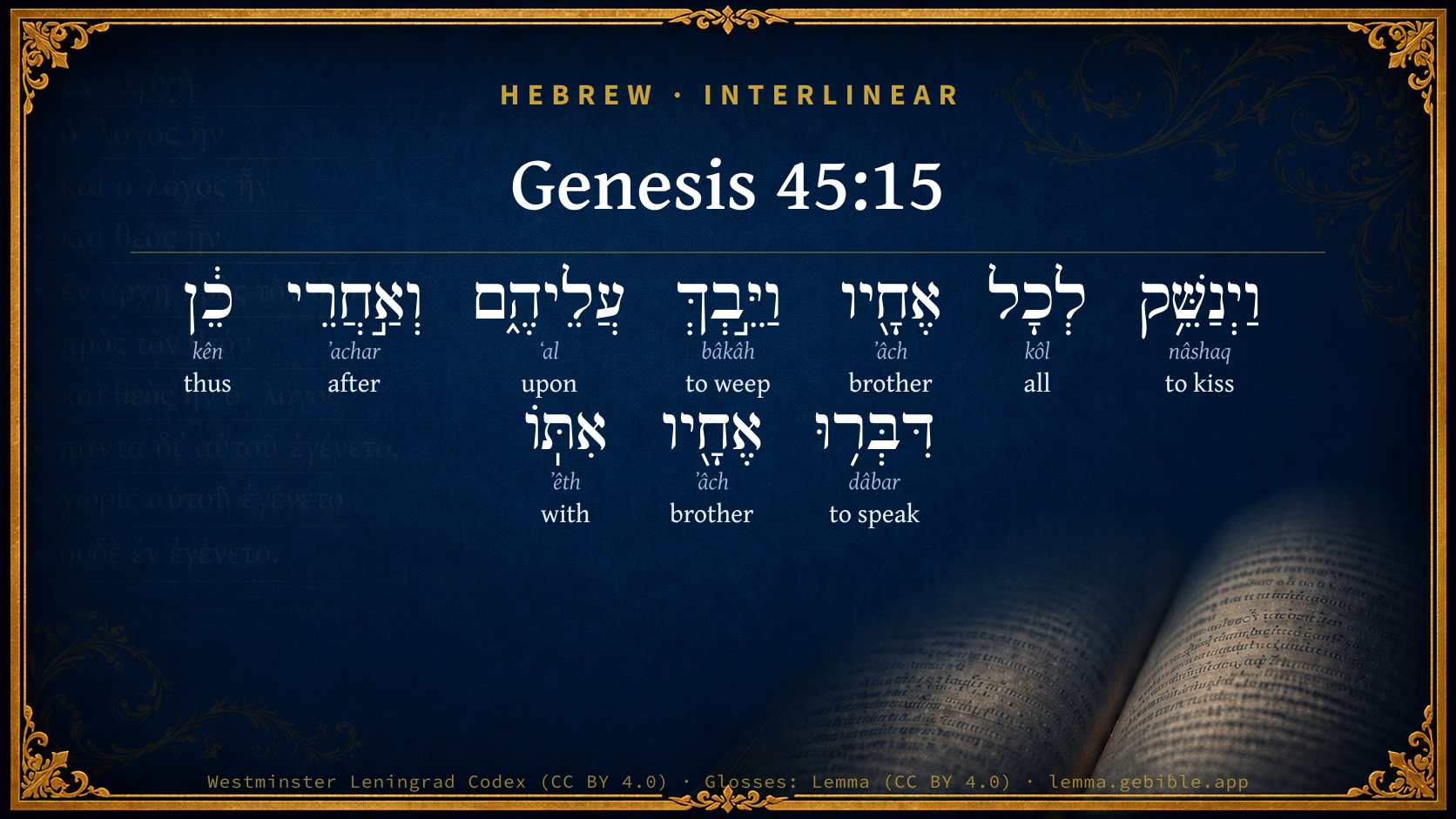
Genesis 45:15

Hebrew (Westminster Leningrad Codex) Genesis 45:15 appears in the Hebrew Old Testament. The text above is from the Westminster Leningrad Codex. Each word links to its Strong’s number, a concise gloss, and parsing drawn from the Open Scriptures Hebrew Bible morphology. Click any word for its full Brown-Driver-Briggs (BDB) entry.
Download image
Cite this verse

Genesis 45:15 (World English Bible). Public Domain. Lemma interlinear Bible study tool, https://lemma.gebible.app/v/genesis/45/15.

Show BibTeX & RIS
BibTeX
RIS
English Translation
He kissed all his brothers, and wept on them. After that his brothers talked with him.
World English Bible · Public Domain
Download a study sheet

One document with this verse’s original text, its word-by-word gloss line, the meaning frame, cross-references with their text, attributed commentary, and full source and license credits — printable, and it pastes into notes with its structure intact.

This verse Autodidact and up

Study sheet (.html) Plain text (.txt)

A passage Seminary Student

Up to 50 verses in one chapter. A passage sheet keeps up to 6 commentary sources and 12 cross-references per verse, in the order this page ranks them, and says so on the sheet whenever that leaves anything out. Ask for a single verse and you get the Autodidact verse sheet above.

Everything on this page stays free to read, with no account — the sheet is a download of what is already on screen, not access to it.

Want to remove ads? Support Godless Engineer
Compare translations 3

The same verse in 3 English versions, stacked beneath the original-language interlinear above. Click any original word for its lexicon entry.

Each is an independent rendering of the whole verse — the interlinear is not word-aligned to these translations.

Highlighted words mark where these versions differ — a whole-verse word diff, not a word-by-word alignment.

  • World English Bible Public Domain
    He kissed all his brothers, and wept on them. After that his brothers talked with him.
  • King James Version Public Domain
    Moreover he kissed all his brethren, and wept upon them: and after that his brethren talked with him.
  • unfoldingWord Literal Text CC BY-SA 4.0
    Then he kissed all his brothers and cried over them. And after that his brothers talked with him.

unfoldingWord Literal Text — © unfoldingWord, licensed CC BY-SA 4.0. Word-aligned USFM3 via Door43 (git.door43.org/unfoldingWord/en_ult).

Versions to compare (up to 4)

3 of 4 selected

Show all 18 translations

Every available English version of this verse, each an independent rendering of the whole verse.

  • World English Bible Public Domain
    He kissed all his brothers, and wept on them. After that his brothers talked with him.
  • Berean Standard Bible Public Domain
    Joseph kissed each of his brothers as he wept over them. And afterward his brothers talked with him.
  • Majority Standard Bible Public Domain
    Joseph kissed each of his brothers as he wept over them. And afterward his brothers talked with him.
  • King James Version Public Domain
    Moreover he kissed all his brethren, and wept upon them: and after that his brethren talked with him.
  • American Standard Version (1901) Public Domain
    And he kissed all his brethren, and wept upon them: and after that his brethren talked with him.
  • Revised Version (1885) Public Domain
    And he kissed all his brethren, and wept upon them: and after that his brethren talked with him.
  • Geneva Bible (1599) Public Domain
    Moreouer, he kissed all his brethren, and wept vpon them: and afterwarde his brethren talked with him.
  • Douay-Rheims (1899) Public Domain
    And Joseph kissed all his brethren, and wept upon every one of them: after which they were emboldened to,peak to him.
  • Young's Literal Translation Public Domain
    and he kisseth all his brethren, and weepeth over them; and afterwards have his brethren spoken with him.
  • Literal Standard Version CC BY-SA 4.0
    and he kisses all his brothers, and weeps over them; and afterward his brothers have spoken with him.
  • Unlocked Literal Bible CC BY-SA 4.0
    He kissed all his brothers and wept over them. After that his brothers talked with him.
  • unfoldingWord Literal Text CC BY-SA 4.0
    Then he kissed all his brothers and cried over them. And after that his brothers talked with him.
  • Darby Bible Public Domain
    And he kissed all his brethren, and wept upon them; and after that his brethren talked with him.
  • World Messianic Bible Public Domain
    He kissed all his brothers, and wept on them. After that his brothers talked with him.
  • Webster's Bible Public Domain
    Moreover, he kissed all his brethren, and wept upon them: and after that his brethren talked with him.
  • Free Bible Version CC BY-SA 4.0
    He kissed all his brothers and wept over them, and after that his brothers were able to start talking with him.
  • Bible in Basic English Public Domain
    Then he gave a kiss to all his brothers, weeping over them; and after that his brothers had no fear of talking to him.
  • JPS Tanakh (1917) Public Domain
    And he kissed all his brethren, and wept upon them; and after that his brethren talked with him.

Literal Standard Version (2020), Covenant Press — licensed CC BY-SA 4.0. Text via the HelloAO Bible API (eBible.org). Unlocked Literal Bible (unfoldingWord) — licensed CC BY-SA 4.0. Text via the HelloAO Bible API (eBible.org). unfoldingWord Literal Text — © unfoldingWord, licensed CC BY-SA 4.0. Word-aligned USFM3 via Door43 (git.door43.org/unfoldingWord/en_ult). Free Bible Version, Dr. Jonathan Gallagher — licensed CC BY-SA 4.0. Text via the HelloAO Bible API (eBible.org).

Word by word

More ways to search: Search by grammar → Find every occurrence → Compare this word →

Practice this passage: Drill this verse → Learn its vocabulary →

וַיְנַשֵּׁ֥ק
nâshaq
H5401
“and · to kiss”
Conjunction + Verb, Piel, Sequential Imperfect, 3rd Person, Masculine, Singular
Part of Speech
Conjunction + Verb
Stem
Piel
Form
Sequential Imperfect
Person
3rd Person
Gender
Masculine
Number
Singular
Full BDB Definition

Origin: a primitive root [identical with H5400 , through the idea of fastening up

TWOT: 1435 , 1436

to put together, kiss - (Qal) to kiss - (Piel) to kiss - (Hiphil) to touch gently - to handle, be equipped with - (Qal) to be equipped
  1. לְכָל kôl H3605 “to/for · all of” Preposition + Noun, Common, Masculine, Singular, Construct
  2. אֶחָ֖יו ʼâch H251 “brothers · his” Noun, Common, Masculine, Plural, Construct + Suffix, Personal, 3rd Person, Masculine, Singular
  3. וַיֵּ֣בְךְּ bâkâh H1058 “and · to weep” Conjunction + Verb, Qal, Sequential Imperfect, 3rd Person, Masculine, Singular
  4. עֲלֵיהֶ֑ם ʻal H5921 “upon · them” Preposition + Suffix, Personal, 3rd Person, Masculine, Plural
  5. וְאַ֣חֲרֵי ʼachar H310 “and · after” Conjunction + Preposition
  6. כֵ֔ן kên H3651 “thus” Adverb
  7. דִּבְּר֥וּ dâbar H1696 “to speak” Verb, Piel, Perfect, 3rd Person, Common, Plural
  8. אֶחָ֖יו ʼâch H251 “brothers · his” Noun, Common, Masculine, Plural, Construct + Suffix, Personal, 3rd Person, Masculine, Singular
  9. אִתּֽוֹ ʼêth H854 “with · him” Preposition + Suffix, Personal, 3rd Person, Masculine, Singular

About this verse

These counts appear in no published source. They are computed here, from the morphology-tagged text and Lemma’s own curated glosses. What Lemma adds →

10
words
9
distinct lemmas
Pentateuch
section

Shared distinctive vocabulary

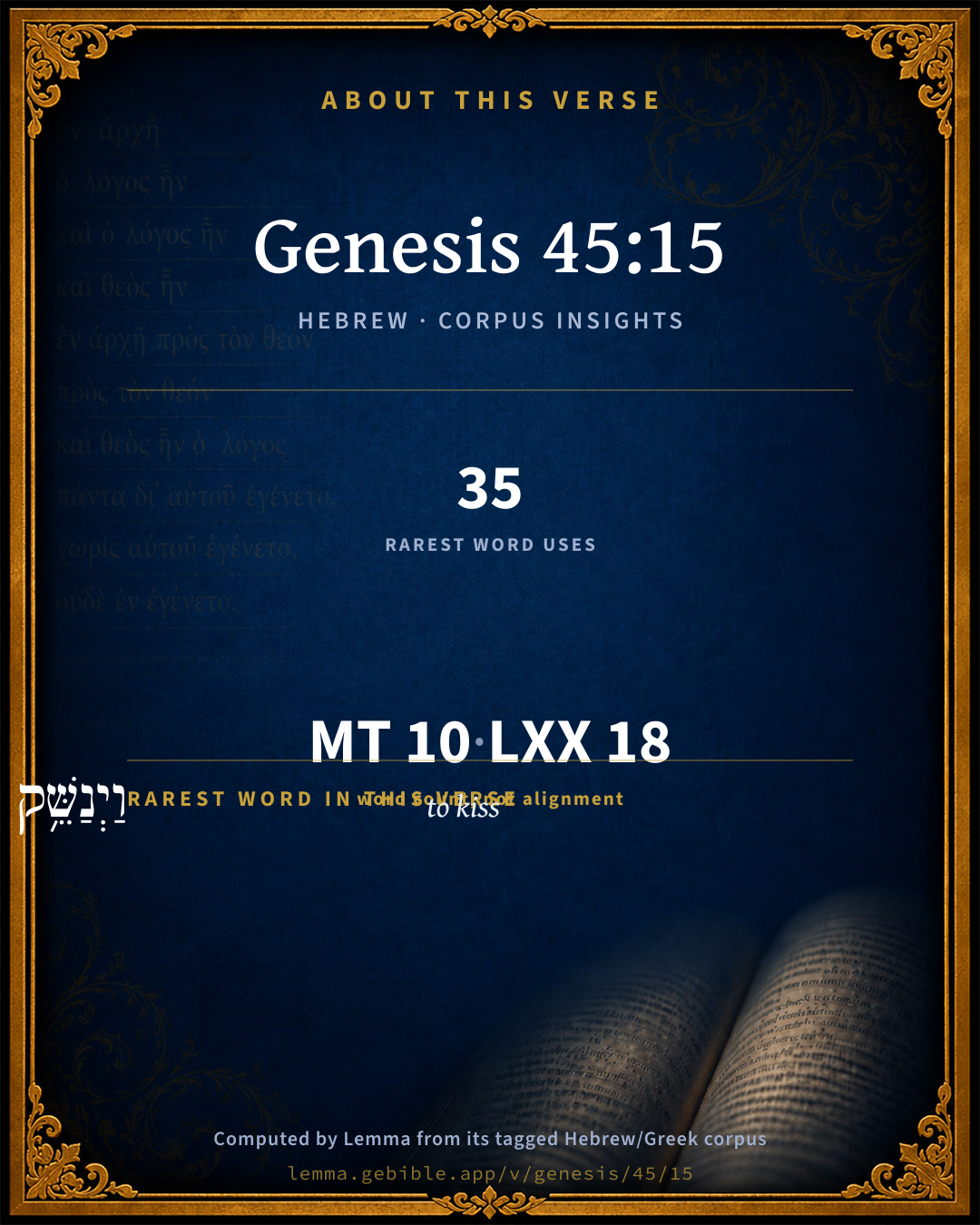
וַיְנַשֵּׁ֥ק to kiss H5401 occurs in 35 verses of the Hebrew Bible. Also found in:

Grammatical profile

  • 3 verbs
  • 3 nouns
  • 3 prepositions
  • 1 adverb

Verb forms

  • וַיְנַשֵּׁ֥ק Piel · Sequential Imperfect
  • וַיֵּ֣בְךְּ Qal · Sequential Imperfect
  • דִּבְּר֥וּ Piel · Perfect

Repetition

A word recurs within this verse — often emphatic in Hebrew:

  • אֶחָ֖יו brother H251 ×2

Hebrew & Septuagint length

In English translation the verse runs 16 words from the Hebrew and 19 from the Septuagint (LXX English) — closely comparable.

A rough comparison of the two English renderings, which tokenize alike — not a word-level alignment.

Word counts can differ between the Hebrew and the Greek without any difference in meaning — e.g. the Hebrew direct-object marker אֵת has no separate Greek word, and Greek often adds the article ὁ.

In the original languages it is 10 Hebrew tokens and 18 Greek tokens — but the two are counted differently (Hebrew bundles its prefixes and suffixes into one token; the Greek is in lemma form), so that isn’t a like-for-like length.

Cross-references

13

Topical passages linked to Genesis 45:15 in the Treasury of Scripture Knowledge — connected by theme and wording, ordered by reader-vote popularity; previews shown in the World English Bible.

  • Luke 15:20 "He arose, and came to his father. But while he was still far off, his father saw him, and was moved with compassion, and ran, and fell on his neck, and kissed him.
  • Genesis 29:11 Jacob kissed Rachel, and lifted up his voice, and wept.
  • Genesis 29:13 It happened, when Laban heard the news of Jacob, his sister's son, that he ran to meet Jacob, and embraced him, and kissed him, and brought him to his house. Jacob told Laban all these things.
  • Genesis 33:4 Esau ran to meet him, embraced him, fell on his neck, kissed him, and they wept.
  • Genesis 45:2 He wept aloud. The Egyptians heard, and the house of Pharaoh heard.
  • Exodus 4:27 Yahweh said to Aaron, "Go into the wilderness to meet Moses." He went, and met him on God's mountain, and kissed him.
  • Ruth 1:9 Yahweh grant you that you may find rest, each of you in the house of her husband. Then she kissed them, and they lifted up their voice, and wept.
  • Ruth 1:14 They lifted up their voice, and wept again: and Orpah kissed her mother-in-law, but Ruth joined with her.
  • 1 Samuel 10:1 Then Samuel took the vial of oil, and poured it on his head, and kissed him, and said, Isn't it that Yahweh has anointed you to be prince over his inheritance?
  • 1 Samuel 20:41 As soon as the boy was gone, David arose out of [a place] toward the South, and fell on his face to the ground, and bowed himself three times: and they kissed one another, and wept one with another, until David exceeded.
  • 2 Samuel 14:33 So Joab came to the king, and told him; and when he had called for Absalom, he came to the king, and bowed himself on his face to the ground before the king: and the king kissed Absalom.
  • Psalms 77:4 You hold my eyelids open. I am so troubled that I can't speak.
  • Acts 20:37 They all wept a lot, and fell on Paul's neck and kissed him,

Cross-references courtesy of OpenBible.info (CC BY 4.0).

Hebrew and Greek witnesses Masoretic Hebrew ↔ Greek Septuagint

The same verse in the two great witnesses to the Old Testament, shown verse-for-verse.

These are two independent witnesses, not word-aligned to each other, and the Septuagint is shown in lemma (dictionary) form.

Hebrew Genesis 45:15 Masoretic · Westminster Leningrad Codex

וַיְנַשֵּׁ֥ק לְכָל אֶחָ֖יו וַיֵּ֣בְךְּ עֲלֵיהֶ֑ם וְאַ֣חֲרֵי כֵ֔ן דִּבְּר֥וּ אֶחָ֖יו אִתּֽוֹ

He kissed all his brothers, and wept on them. After that his brothers talked with him.

World English Bible · Public Domain

Greek LXX Genesis 45:15 Septuagint · lemma form

καί καταφιλέω πᾶς ὁ ἀδελφός αὐτός κλαίω ἐπί αὐτός καί μετά οὗτος λαλέω ὁ ἀδελφός αὐτός πρός αὐτός

And he kissed all his brethren, and wept on them; and after these things his brethren spoke to him.

LXX2012 (modern English Septuagint) · Public Domain

Hebrew: Westminster Leningrad Codex (CC BY 4.0). Greek: Septuagint (public domain); English from LXX2012 (modern English Septuagint) (Public Domain). How the Septuagint differs from the Hebrew →

Targum (Aramaic paraphrase)

2

The Targum is the ancient Jewish Aramaic paraphrase of the Hebrew Scriptures — an interpretive translation, not the Hebrew text itself. Onkelos (literal) and Pseudo-Jonathan (expansive) render the Torah, and Jonathan the Prophets. Coverage is partial: where no permissively-licensed English translation exists for a verse, only the Aramaic is shown. This is verse-level text, not a word-by-word alignment to the Hebrew.

  1. Targum Onkelos Torah (Genesis–Deuteronomy)
    וּנְשַׁק לְכָל אֲחוֹהִי וּבְכָא עֲלֵיהוֹן וּבָתַר כֵּן מַלִּילוּ אֲחוֹהִי עִמֵּהּ

    (no public-domain English translation for this verse)

    Targum Onkelos — Aramaic: “Onkelos Genesis” (public domain); “Onkelos Exodus” (public domain); “Onkelos Leviticus” (public domain); “Onkelos Numbers” (public domain); “Onkelos Deuteronomy” (public domain). English: “Sefaria Community Translation” (CC0 1.0 (public-domain dedication)); “J.W. Etheridge. The Targums of Onkelos and Jonathan Ben Uzziel on the Pentateuch. London: Longmans, Green, 1862” (public domain). Text via Sefaria.

  2. Targum Pseudo-Jonathan Torah (Genesis–Deuteronomy)
    וּנְשֵׁיק לְכָל אָחוֹי וּבְכָא עֲלֵיהוֹן דְחָמָא דְמִשְׁתַּעַבְּדִין לְבֵינֵי עַמְמַיָא וּמִן בָּתַר כְּדֵין מַלִילוּ אָחוֹי עִמֵיהּ

    And he kissed all his brethren, and wept over them, because he saw that the sons of his people would be brought into bondage. And afterward his brethren discoursed with him.

    Targum Pseudo-Jonathan — Aramaic: “Targum Jonathan on Genesis” (public domain); “Targum Jonathan on Exodus” (public domain); “Targum Jonathan on Leviticus” (public domain); “Targum Jonathan on Numbers” (public domain); “Targum Jonathan on Deuteronomy” (public domain). English: “The Targum of Jonathan ben Uzziel, trans. J. W. Etheridge, London, 1862” (public domain). Text via Sefaria.

Commentary

Notes on Genesis 45:15 from classic Christian and Jewish commentators (each source and its license shown beneath its notes). The classic Christian expositions comment on the surrounding passage and are grouped to its opening verse, so a note may address several verses; the Jewish commentaries on the Tanakh (Rashi and others) are per-verse, so they appear only where the commentator wrote on this verse.

Lemma curates 59 commentaries, every one of them public domain or Creative Commons licensed, each selected and text-cleaned for this edition rather than reprinted as found. About our sources →

Trapp's Complete Commentary

John Trapp

Gen 45:15 Moreover he kissed all his brethren, and wept upon them: and after that his brethren talked with him.

Ver. 15. Kissed all his brethren.] {See Trapp on "Gen 39:11"}

John Trapp, A Commentary or Exposition upon All the Books of the Old and New Testament (1647–1656) — public domain. Text from a community e-Sword module.

The Biblical Illustrator

Joseph S. Exell

Gen_45:15

He kissed all his brethren

A day of reconciliation

A day of reconciliation! A family made one.

Brethren coming together again after long separation. It is a beautiful picture. Why should it not be completed, where it needs completion, in our own day amongst ourselves? Ministers sometimes have misunderstandings and say unkind things about one another--and exile one another from love and confidence for years. Is there never to be a day of reconciliation and Christian forgetfulness of wrongs, even where positive wrong has been done? Families and households often get awry. The younger brother differs with his eldest brother--sisters fall out. One wants more than belongs to him; another is knocked to the wall because he is weak; and there comes in the heart bitterness and alienation, and often brothers and sisters never have a kind word to say about one another. Is it always to be so? Dont merely make it up, dont patch it up, dont cover it up--go right down to the base. You will never be made one, until you meet at the Cross and hear Him say, He that doeth the will of My Father, which is in heaven, the same is My mother, and sister, and brother. It is in Christs sorrow that we are to forget our woes, in Christs sacrifice we find the answer to our sin, in Christs union with the Father that we are to find all true and lasting reconciliation. But who is to begin? That is the wonderful question that is often asked us. Who is to begin? One would imagine that there were some very nice people about who only wanted somebody to tell them who was to begin. They want to be reconciled, only they dont know who is to begin. I can tell you. You are! That is exactly how it is. But I am the eldest--yes, and therefore ought to begin. But I am the youngest. Then whyshould the youngest be an obstinate pig-headed child? Who are you that you should not go and throw yourself down at your brothers feet and say, I have done you wrong, pardon me! Who is to begin? You! Which! Both! When! Now! Oh! beware of the morality which says, I am looking for the opportunity, and if things should so get together-- Sir! death may be upon you before you reason out your wretched casuistry; the injured or the injurer may be in the grave before you get to the end of your long melancholy process of self-laudation and anti-Christian logic. (J. Parker, D. D.)

The reconciled brethren

I. JOSEPHS AVOWAL.

II. MUTUAL SALUTATIONS.

III. THE MESSAGE TO JACOB. Learn:

1. To avoid strife.

2. To repel any revengeful feelings.

3. To be kind and ready to forgive. (W. S. Smith, B. D.)

Emblem of forgiveness

Nothing is more moving to man than the spectacle of reconciliation; our weaknesses are thus indemnified, and are not too costly, being the price we pay for the hour of forgiveness; and the archangel who has never felt anger has reason to envy the man who subdues it. When thou forgivest, the man who has pierced thy heart stands to thee in the relation of the sea-worm, that perforates the shell of the mussel, which straightway closes the wound with a pearl. (W. Richter.)

The Biblical Illustrator, edited by Joseph S. Exell (c. 1880s–1900s) — public domain. Text from a community e-Sword module.

The Cambridge Bible for Schools and Colleges

gen. ed. J. J. S. Perowne

15. kissed] See note on Gen_45:2.

after that] Joseph’s brethren were evidently slow to believe that they might rely upon his sincerity.

The Cambridge Bible for Schools and Colleges (gen. ed. J. J. S. Perowne; Cambridge University Press, 1878–1918) — public domain. Text from a community e-Sword module.

John Gill's Exposition

Moreover, he kissed all his brethren,.... In their turns, to testify his real affection for them, and hearty reconciliation to them:

and wept upon them; that is, upon their necks, as he had on Benjamin's:

and after that his brethren talked with him: being emboldened by this carriage of his to them, and encouraged to believe that he really forgave them their sin against him, and was truly reconciled unto them, and had a real affection for them, and had no reason to fear he would avenge himself on them: they entered into a free conversation, and talked of their father and their family, and the concerns of it, and of what passed since the time he was separated from them.

John Gill's Exposition of the Whole Bible (1746–1763) — public domain (CC PDM 1.0). Text via the HelloAO Bible API.

Matthew Poole's English Annotations

To wit, freely and familiarly, being encouraged by his kindness.

Matthew Poole's English Annotations on the Holy Bible (1683–1685) — public domain. Text from a community e-Sword/MySword module.

Whedon's Commentary on the Bible

Daniel D. Whedon

15. After that his brethren talked with him — That is, after the embracing of Benjamin (Gen_45:14) and the weeping and kissing of them all. “They were so stunned and bewildered that they could not utter a word till his tears washed out their terrors.” — Newhall.

Daniel D. Whedon (gen. ed.), Commentary on the Old and New Testaments (1874–1909) — public domain. Text from a community e-Sword module.

Rashi

Rabbi Shlomo Yitzchaki (Rashi)

ואחרי כן AND AFTER THAT — after they saw that he wept and realized that he was peaceably inclined towards them, דברו אחיו אתו HIS BRETHREN SPAKE WITH HIM — For at first they felt abashed before him.

Rashi on the Tanakh — English translations: “The Judaica Press complete Tanach with Rashi, translated by A. J. Rosenberg” (CC BY 4.0); “Pentateuch with Rashi's commentary by M. Rosenbaum and A.M. Silbermann, 1929-1934” (public domain); “The Metsudah Tanach series, Lakewood, N.J” (CC BY 4.0); and “The Book of Joshua, Metsudah Publications, 1997” (CC BY 4.0). Text via Sefaria.

Radak

Rabbi David Kimhi (Radak)

ויבך עליהם, but the brothers did not cry being too ashamed to do so ואחרי כן דברו אחיו אתו, seeing that he had wept and kissed them they knew that he did not harbour a grudge against them and they now asked him about what had happened to him during all the years since he had left his father’s house.

Radak on the Tanakh — English translations: “Sefaria Community Translation” (CC0 1.0 (public-domain dedication)); “Eliyahu Munk, HaChut Hameshulash” (CC BY 4.0); “Rabbi Mike Feuer, Jerusalem Anthology” (CC BY 4.0); and “R. David Kimhi on the first book of Psalms, Translated by R.G. Finch, London, 1919” (public domain). Text via Sefaria.

Lesson kit

Teaching starters — assembled from the data on this page, not authored interpretation. Every prompt links to the verse data it draws on. Edit before teaching.

Genesis, in the Pentateuch, opens this verse with 10 words (9 distinct Hebrew lemmas). Its most distinctive word is nâshaq (“to kiss”). A historical commentator’s framing appears above. Read the whole chapter for the surrounding context.

Discussion questions

  1. How does “to kiss” (nâshaq) shape what this verse is saying?
  2. How does Genesis 27:26, which shares the word «to kiss», read alongside this verse?
  3. What does the repetition of “brother” (2× in this one verse) do in this verse?
  4. These translations render this verse differently; the difference is in the English rendering, not the original. What questions does that raise?
  5. «וַיְנַשֵּׁ֥ק» is a Piel Sequential Imperfect verb. How does that grammatical form shape the action described?
  6. Compare how Trapp's Complete Commentary and The Biblical Illustrator read this verse. Where do they agree or differ?

Things to notice

Reading settings

Reading text

Shown beneath each verse's original-language words.

Old Testament
Old Testament edition

Read the OT as the Masoretic Hebrew (MT) or the Greek Septuagint (LXX).

English shown for the Greek Septuagint (in the Hebrew ↔ Greek comparison).

Comparing translations? Open the Compare panel on any verse page to stack up to four side by side.