Joshua 20:2

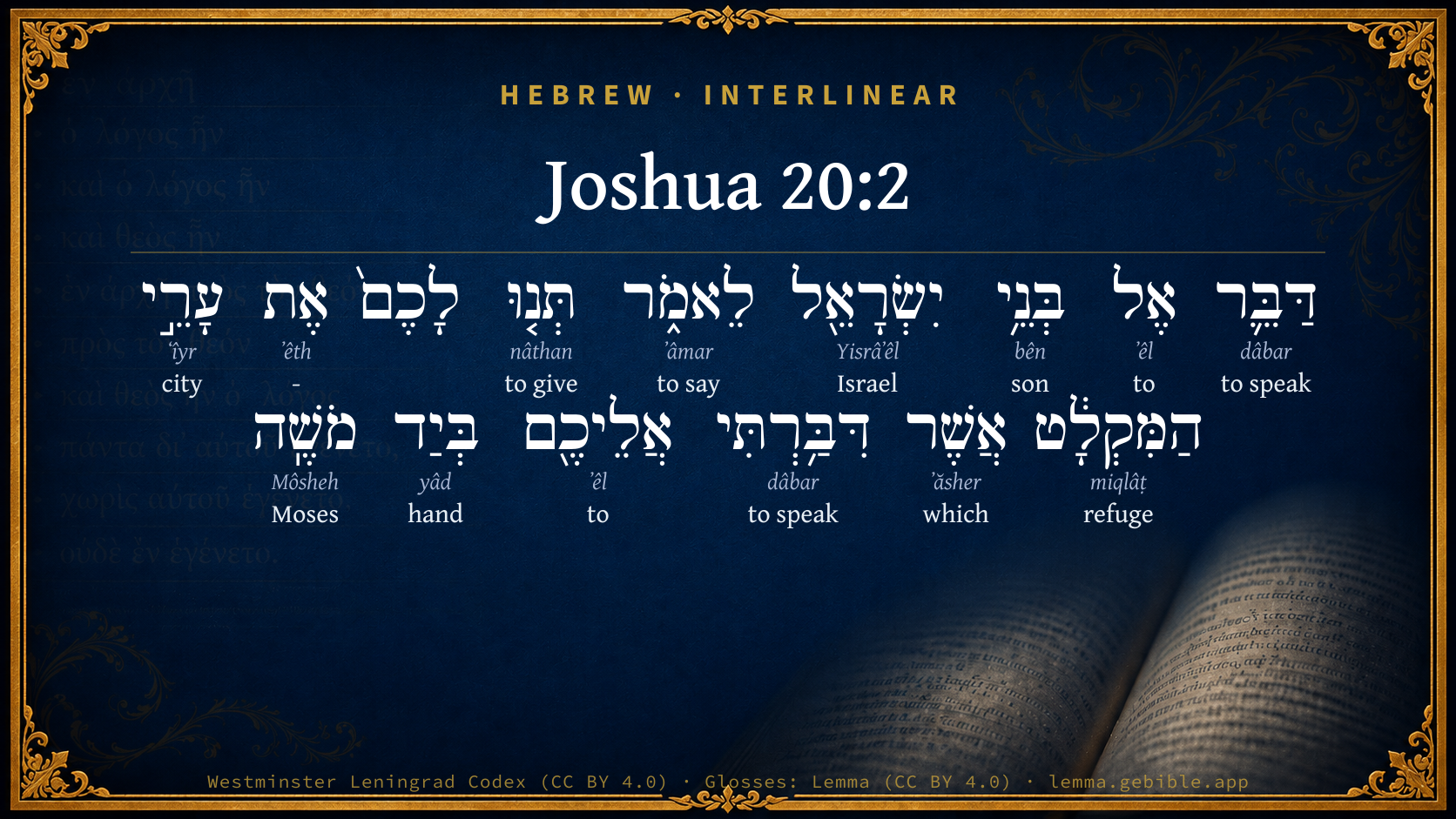
Hebrew (Westminster Leningrad Codex) Joshua 20:2 appears in the Hebrew Old Testament. The text above is from the Westminster Leningrad Codex. Each word links to its Strong’s number, a concise gloss, and parsing drawn from the Open Scriptures Hebrew Bible morphology. Click any word for its full Brown-Driver-Briggs (BDB) entry.
Download image
Cite this verse

Joshua 20:2 (World English Bible). Public Domain. Lemma interlinear Bible study tool, https://lemma.gebible.app/v/joshua/20/2.

Show BibTeX & RIS
BibTeX
RIS
English Translation
Speak to the children of Israel, saying, Assign you the cities of refuge, of which I spoke to you by Moses,
World English Bible · Public Domain
Download a study sheet

One document with this verse’s original text, its word-by-word gloss line, the meaning frame, cross-references with their text, attributed commentary, and full source and license credits — printable, and it pastes into notes with its structure intact.

This verse Autodidact and up

Study sheet (.html) Plain text (.txt)

A passage Seminary Student

Up to 50 verses in one chapter. A passage sheet keeps up to 6 commentary sources and 12 cross-references per verse, in the order this page ranks them, and says so on the sheet whenever that leaves anything out. Ask for a single verse and you get the Autodidact verse sheet above.

Everything on this page stays free to read, with no account — the sheet is a download of what is already on screen, not access to it.

Want to remove ads? Support Godless Engineer
Compare translations 3

The same verse in 3 English versions, stacked beneath the original-language interlinear above. Click any original word for its lexicon entry.

Each is an independent rendering of the whole verse — the interlinear is not word-aligned to these translations.

Highlighted words mark where these versions differ — a whole-verse word diff, not a word-by-word alignment.

  • World English Bible Public Domain
    Speak to the children of Israel, saying, Assign you the cities of refuge, of which I spoke to you by Moses,
  • King James Version Public Domain
    Speak to the children of Israel, saying, Appoint out for you cities of refuge, whereof I spake unto you by the hand of Moses:
  • unfoldingWord Literal Text CC BY-SA 4.0
    “Speak to the sons of Israel, saying, ‘Give for yourselves the cities of refuge that I spoke to you by the hand of Moses

unfoldingWord Literal Text — © unfoldingWord, licensed CC BY-SA 4.0. Word-aligned USFM3 via Door43 (git.door43.org/unfoldingWord/en_ult).

Versions to compare (up to 4)

3 of 4 selected

Show all 18 translations

Every available English version of this verse, each an independent rendering of the whole verse.

  • World English Bible Public Domain
    Speak to the children of Israel, saying, Assign you the cities of refuge, of which I spoke to you by Moses,
  • Berean Standard Bible Public Domain
    “Tell the Israelites to designate the cities of refuge, as I instructed you through Moses,
  • Majority Standard Bible Public Domain
    “Tell the Israelites to designate the cities of refuge, as I instructed you through Moses,
  • King James Version Public Domain
    Speak to the children of Israel, saying, Appoint out for you cities of refuge, whereof I spake unto you by the hand of Moses:
  • American Standard Version (1901) Public Domain
    Speak to the children of Israel, saying, Assign you the cities of refuge, whereof I spake unto you by Moses,
  • Revised Version (1885) Public Domain
    Speak to the children of Israel, saying, Assign you the cities of refuge, whereof I spake unto you by the hand of Moses:
  • Geneva Bible (1599) Public Domain
    Speake to the children of Israel, and say, Appoint you cities of refuge, whereof I spake vnto you by the hand of Moses,
  • Douay-Rheims (1899) Public Domain
    Appoint cities of refuge, a of which I spoke to you by the hand of Moses:
  • Young's Literal Translation Public Domain
    `Speak unto the sons of Israel, saying, Give for you cities of refuge, as I have spoken unto you by the hand of Moses,
  • Literal Standard Version CC BY-SA 4.0
    “Speak to the sons of Israel, saying, Give cities of refuge for yourselves, as I have spoken to you by the hand of Moses,
  • Unlocked Literal Bible CC BY-SA 4.0
    “Speak to the people of Israel, saying, 'Appoint the cities of refuge of which I spoke to you by the hand of Moses.
  • unfoldingWord Literal Text CC BY-SA 4.0
    “Speak to the sons of Israel, saying, ‘Give for yourselves the cities of refuge that I spoke to you by the hand of Moses
  • Darby Bible Public Domain
    Speak to the children of Israel, saying, Appoint for yourselves the cities of refuge, whereof I spoke unto you through Moses,
  • World Messianic Bible Public Domain
    “Speak to the children of Israel, saying, ‘Assign the cities of refuge, of which I spoke to you by Moses,
  • Webster's Bible Public Domain
    Speak to the children of Israel, saying, Appoint for you cities of refuge, of which I spoke to you by the hand of Moses:
  • Free Bible Version CC BY-SA 4.0
    “Tell the Israelites, ‘Assign sanctuary towns, as I instructed you through Moses.
  • Bible in Basic English Public Domain
    Say to the children of Israel, Let certain towns be marked out as safe places, as I said to you by the mouth of Moses,
  • JPS Tanakh (1917) Public Domain
    'Speak to the children of Israel, saying: Assign you the cities of refuge, whereof I spoke unto you by the hand of Moses;

Literal Standard Version (2020), Covenant Press — licensed CC BY-SA 4.0. Text via the HelloAO Bible API (eBible.org). Unlocked Literal Bible (unfoldingWord) — licensed CC BY-SA 4.0. Text via the HelloAO Bible API (eBible.org). unfoldingWord Literal Text — © unfoldingWord, licensed CC BY-SA 4.0. Word-aligned USFM3 via Door43 (git.door43.org/unfoldingWord/en_ult). Free Bible Version, Dr. Jonathan Gallagher — licensed CC BY-SA 4.0. Text via the HelloAO Bible API (eBible.org).

Word by word

More ways to search: Search by grammar → Find every occurrence → Compare this word →

Practice this passage: Drill this verse → Learn its vocabulary →

הַמִּקְלָ֔ט
miqlâṭ
H4733
“the · refuge”
Particle, Definite Article + Noun, Common, Masculine, Singular, Absolute
Part of Speech
Particle + Noun
Type
Common
Gender
Masculine
Number
Singular
State
Absolute
Full BDB Definition

Origin: from H7038 in the sense of taking in

TWOT: 2026a

refuge, asylum
  1. דַּבֵּ֛ר dâbar H1696 “speak” Verb, Piel, Imperative, 2nd Person, Masculine, Singular
  2. אֶל ʼêl H413 “to” Preposition
  3. בְּנֵ֥י bên H1121 “sons of” Noun, Common, Masculine, Plural, Construct
  4. יִשְׂרָאֵ֖ל Yisrâʼêl H3478 “Israel” Noun, Proper
  5. לֵאמֹ֑ר ʼâmar H559 “to say” Preposition + Verb, Qal, Infinitive Construct
  6. תְּנ֤וּ nâthan H5414 “give” Verb, Qal, Imperative, 2nd Person, Masculine, Plural
  7. אֶת ʼêth H853 “-” Particle, Direct Object
  8. עָרֵ֣י ʻîyr H5892 “cities of” Noun, Common, Feminine, Plural, Construct
  9. אֲשֶׁר ʼăsher H834 “which” Particle, Relative
  10. דִּבַּ֥רְתִּי dâbar H1696 “to speak” Verb, Piel, Perfect, 1st Person, Common, Singular
  11. אֲלֵיכֶ֖ם ʼêl H413 “to · you” Preposition + Suffix, Personal, 2nd Person, Masculine, Plural
  12. בְּיַד yâd H3027 “in/at · hand of” Preposition + Noun, Common, Both, Singular, Construct
  13. מֹשֶֽׁה Môsheh H4872 “Moses” Noun, Proper

About this verse

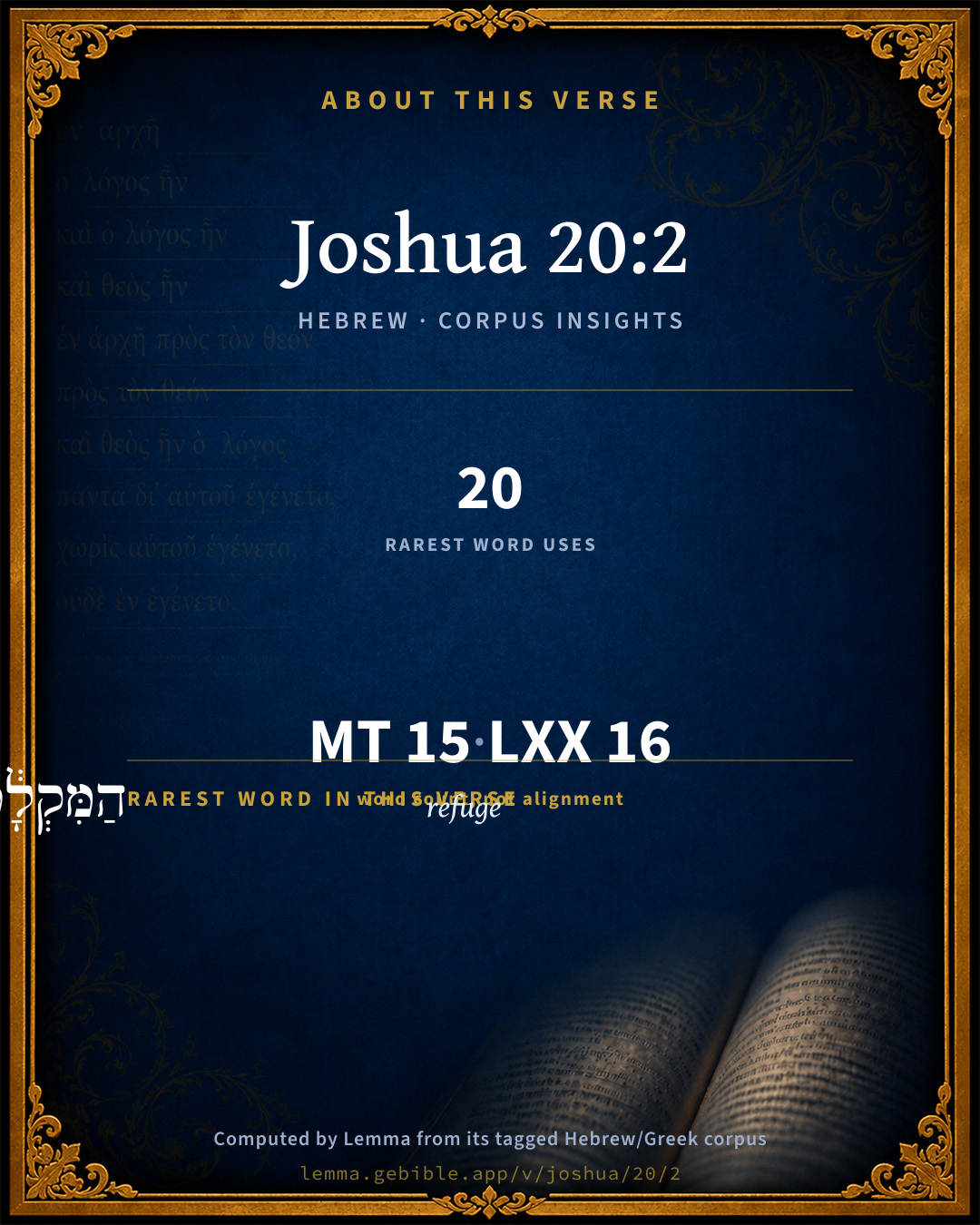
These counts appear in no published source. They are computed here, from the morphology-tagged text and Lemma’s own curated glosses. What Lemma adds →

15
words
12
distinct lemmas
Historical
section

Notable vocabulary

The rarest word here is הַמִּקְלָ֔ט refuge H4733 — appearing just 20 times in the whole Hebrew Bible.

Shared distinctive vocabulary

הַמִּקְלָ֔ט refuge H4733 occurs in 20 verses of the Hebrew Bible. Also found in:

Grammatical profile

  • 4 verbs
  • 6 nouns
  • 3 prepositions
  • 2 particles

Verb forms

  • דַּבֵּ֛ר Piel · Imperative
  • לֵאמֹ֑ר Qal · Infinitive Construct
  • תְּנ֤וּ Qal · Imperative
  • דִּבַּ֥רְתִּי Piel · Perfect

Repetition

Words recur within this verse — often emphatic in Hebrew:

  • דַּבֵּ֛ר to speak H1696 ×2
  • אֶל to H413 ×2

Hebrew & Septuagint length

In English translation the verse runs 21 words from the Hebrew and 20 from the Septuagint (LXX English) — closely comparable.

A rough comparison of the two English renderings, which tokenize alike — not a word-level alignment.

Word counts can differ between the Hebrew and the Greek without any difference in meaning — e.g. the Hebrew direct-object marker אֵת has no separate Greek word, and Greek often adds the article ὁ.

In the original languages it is 15 Hebrew tokens and 16 Greek tokens — but the two are counted differently (Hebrew bundles its prefixes and suffixes into one token; the Greek is in lemma form), so that isn’t a like-for-like length.

Cross-references

8

Topical passages linked to Joshua 20:2 in the Treasury of Scripture Knowledge — connected by theme and wording, ordered by reader-vote popularity; previews shown in the World English Bible.

  • Deuteronomy 19:2–13 you shall set apart three cities for you in the midst of your land, which Yahweh your God gives you to possess it.
  • Numbers 35:6 The cities which you shall give to the Levites, they shall be the six cities of refuge, which you shall give for the manslayer to flee to: and besides them you shall give forty-two cities.
  • Numbers 35:11–24 then you shall appoint you cities to be cities of refuge for you, that the manslayer who kills any person unwittingly may flee there.
  • Deuteronomy 4:41–43 Then Moses set apart three cities beyond the Jordan toward the sunrise;
  • Romans 8:1 There is therefore now no condemnation to those who are in Christ Jesus, who don't walk according to the flesh, but according to the Spirit.
  • Exodus 21:13–14 but not if it is unintentional, but God allows it to happen: then I will appoint you a place where he shall flee.
  • Romans 8:33–34 Who could bring a charge against God's chosen ones? It is God who justifies.
  • Hebrews 6:18–19 that by two immutable things, in which it is impossible for God to lie, we may have a strong encouragement, who have fled for refuge to take hold of the hope set before us.

Cross-references courtesy of OpenBible.info (CC BY 4.0).

Hebrew and Greek witnesses Masoretic Hebrew ↔ Greek Septuagint

The same verse in the two great witnesses to the Old Testament, shown verse-for-verse.

These are two independent witnesses, not word-aligned to each other, and the Septuagint is shown in lemma (dictionary) form.

Hebrew Joshua 20:2 Masoretic · Westminster Leningrad Codex

דַּבֵּ֛ר אֶל בְּנֵ֥י יִשְׂרָאֵ֖ל לֵאמֹ֑ר תְּנ֤וּ לָכֶם֙ אֶת עָרֵ֣י הַמִּקְלָ֔ט אֲשֶׁר דִּבַּ֥רְתִּי אֲלֵיכֶ֖ם בְּיַד מֹשֶֽׁה

Speak to the children of Israel, saying, Assign you the cities of refuge, of which I spoke to you by Moses,

World English Bible · Public Domain

Greek LXX Joshua 20:2 Septuagint · lemma form

λαλέω ὁ υἱός ἰσραήλ λέγω δίδωμι ὁ πόλις ὁ φυγαδευτήριον ὅς εἶπον πρός σύ διά μωυσῆς

Speak to the children of Israel, saying, Assign the cities of refuge, of which I spoke to you by Moses.

LXX2012 (modern English Septuagint) · Public Domain

Hebrew: Westminster Leningrad Codex (CC BY 4.0). Greek: Septuagint (public domain); English from LXX2012 (modern English Septuagint) (Public Domain). How the Septuagint differs from the Hebrew →

Targum (Aramaic paraphrase)

1

The Targum is the ancient Jewish Aramaic paraphrase of the Hebrew Scriptures — an interpretive translation, not the Hebrew text itself. Onkelos (literal) and Pseudo-Jonathan (expansive) render the Torah, and Jonathan the Prophets. Coverage is partial: where no permissively-licensed English translation exists for a verse, only the Aramaic is shown. This is verse-level text, not a word-by-word alignment to the Hebrew.

  1. Targum Jonathan Prophets (Joshua–Malachi)
    מַלֵיל עִם בְּנֵי יִשְׂרָאֵל לְמֵימַר הָבוּ לְכוֹן יַת קִרְוֵי שֵׁיזָבוּתָא דְמַלֵילִית עִמְכוֹן בִּידָא דְמֹשֶׁה:

    (no public-domain English translation for this verse)

    Targum Jonathan — Aramaic: “Mikraot Gedolot” (public domain). English: “Sefaria Community Translation” (CC0 1.0 (public-domain dedication)); “London "Chaldee Paraphrase," 1871” (public domain). Text via Sefaria.

Commentary

Notes on Joshua 20:2 from classic Christian and Jewish commentators (each source and its license shown beneath its notes). The classic Christian expositions comment on the surrounding passage and are grouped to its opening verse, so a note may address several verses; the Jewish commentaries on the Tanakh (Rashi and others) are per-verse, so they appear only where the commentator wrote on this verse.

Lemma curates 59 commentaries, every one of them public domain or Creative Commons licensed, each selected and text-cleaned for this edition rather than reprinted as found. About our sources →

Trapp's Complete Commentary

John Trapp

Jos 20:2 Speak to the children of Israel, saying, Appoint out for you cities of refuge, whereof I spake unto you by the hand of Moses:

Ver. 2. Speak unto the children of Israel.] They had been spoken to before by Moses to do thus but made no haste to do it: such is men’s slackness in procuring the good of others.

Appoint out for you cities of refuge.] Susceptionis aut recollectionis, for the preservation of man’s precious life, if causelessly sought after: not such sanctuaries of roguery as Romulus opened about the beginning of his reign to bring more company about him: nor as the Romanists now-a-days do for wilfnl murderers and other wicked persons, who should be pulled from the altar to the halter, as Joab was. See Exo 21:14. If a malefactor be going to execution, and a cardinal meeting him put his red hat upon his head, he is thereby free immediately, Proh nefas! The scripture saith, "A man that doeth violence to the blood of any person shall flee to the pit; let no man stay him." {Pro 28:17} But the Pope professeth to have power to dispense against the New Testament and the Old: which made Sir Walter Raleigh say, that if he were to choose a religion for licentious liberty, he would become a Papist.

John Trapp, A Commentary or Exposition upon All the Books of the Old and New Testament (1647–1656) — public domain. Text from a community e-Sword module.

Adam Clarke's Commentary

Verse 2. Cities of refuge] An institution of this kind was essentially necessary wherever the patriarchal law relative to the right of redemption and the avenging of blood was in force; we have already seen that the nearest of kin to a deceased person had not only the right of redeeming an inheritance that had been forfeited or alienated, but had also authority to slay on the spot the person who had slain his relative. Now, as a man might casually kill another against whom he had no ill-will, and with whom he had no quarrel, and might have his life taken away by him who was called the avenger of blood, though he had not forfeited his life to the law; therefore these privileged cities were appointed, where the person might have protection till the cause had been fully heard by the magistrates, who certainly had authority to deliver him up to the avenger, if they found, on examination, that he was not entitled to this protection. On this subject see the notes on Nu 35:11 to the end.

Adam Clarke's Commentary on the Bible (1810–1826) — public domain. Text from a community e-Sword/MySword module.

The Cambridge Bible for Schools and Colleges

gen. ed. J. J. S. Perowne

2. cities of refuge] “The cityes of fugityues,” Wyclif. Prior to the Mosaic age, it was required of the nearest of kin, as a matter of duty, to avenge the death of a slain relative. He was called the Goel or Avenger, and together with his office inherited the property of the deceased. Sometimes a whole family took upon them this duty (2Sa_14:7). Among the Arab tribes of the present day, “any bloodshed whatever, whether wilful or accidental, laid the homicide open to the duteous revenge of the relatives and family of the slain person, who again in their turn were then similarly watched and hunted by the opposite party, until a family war of extermination had legally settled itself from generation to generation, without the least prospect of a peaceful termination.” It was the aim of the Mosaic Law, without altogether abolishing this long-established custom, to mitigate its evils as far as possible.

whereof I spake unto you] The general directions on this subject will be found in (a) Exo_21:13; (b) Num_35:9 ff.; (c) Deu_19:2. The reference to them here is one of the numerous instances in which the book of Joshua presupposes the existence of the Pentateuch.

The Cambridge Bible for Schools and Colleges (gen. ed. J. J. S. Perowne; Cambridge University Press, 1878–1918) — public domain. Text from a community e-Sword module.

John Gill's Exposition

Speak to the children of Israel, saying,.... Whom the affair concerned the Lord spake to Joshua about, they having now the whole land divided among them:

appoint out for you cities of refuge; of the name, nature, use, and number of these cities; see Gill on Num 35:6,

whereof I spake unto you by the hand of Moses: Num 35:1.

John Gill's Exposition of the Whole Bible (1746–1763) — public domain (CC PDM 1.0). Text via the HelloAO Bible API.

Matthew Poole's English Annotations

The possessions being now divided among you, do you reserve some of them for the use which I have commanded.

Matthew Poole's English Annotations on the Holy Bible (1683–1685) — public domain. Text from a community e-Sword/MySword module.

The Pulpit Commentary

HOMILIES BY W.F. ADENEY Ver. 2. Cities of refuge.

I THE APPOINTMENT OF CITIES OF REFUGE EXEMPLIFIES UNIVERSAL PRINCIPLES OF JUSTICE. We do not need such cities because we can attain the end they were set apart to accomplish by simpler means, but we are called to observe the principles they were instituted to maintain.

(1) The justice which brings retribution on offenders is natural and right. But this must be distinguished from vengeance. Justice seeks the honour of law and the maintenance of the public good. Vengeance aims only at the infliction of harm on the offender. The latter is unchristian and wicked.

(2) We should not be hasty in passing judgment. The city of refuge afforded time for evidence to be collected and a mature judgment to be formed. First impressions are often deceptive. Anger blinds judgment.

(3) It is well to refer our quarrels to the decision of others. The avenger of blood was required to refer his case to the congregation. Interested persons can rarely form impartial opinions. It is well to resort to Christian arbitration when differences cannot be settled amicably in private. (Mat_18:15-17)

(4) It is difficult to judge of the conduct of others, because of our uncertainty as to their motives. The man slayer may be a murderer or he may be innocently concerned in a pure accident. Thus he may be guiltless, while the person who inflicts no harm on another may be a murderer at heart. "Whosoever hateth his brother is a murderer". (1Jn_3:15) Guilt attaches to motives, not to outward acts. Therefore

(a) do not judge others needlessly; (Mat_7:1)

(b) when it is necessary to judge do not be deceived by outward appearance, but consider differences of motive. (Joh_7:24)

II THE APPOINTMENT OF CITIES OF REFUGE IS AN ILLUSTRATION OF GOD"S GRACE OF REDEMPTION.

(1) God provides a city of refuge in Christ. He is a refuge from the dangers that beset us, from the consequences of our own acts, from the indwelling power of sin.

(2) This refuge is for the most guilty. The Levitical cities were for the innocent; Christ is a refuge for the guilty. Men fled to them for justice; they flee to Christ for mercy. (Mat_9:12, Mat_9:13)

(3) This refuge is in our midst. The six cities of refuge were situated in convenient central positions at different points of the land, so that every Israelite might be within reach of one. Yet even this arrangement could not secure safety in all cases. Christ is in our midst. We have not to bring Him from heaven; He dwells among us. He is near and ready to receive us at any moment, None need perish on the road to Christ.

(4) This refuge must be entered to secure safety. It was vain for the fugitive Israelite merely to ran in the direction of the city, or even to be within sight of it, if he did not enter its precincts. It is useless for a man only to have inclinations towards Christianity, to know the truth of it, to begin to turn Christward. He must seek Christ and come to Him in trust and submission. As the fugitive must enter the city to be safe, so the sinner must be "in Christ". (Rom_8:1)

(5) It is dangerous to delay entering this refuge. While the fugitive stayed, the avenger of blood was upon him, "Now" is the appointed time. The opportunity may soon pass. W.F.A.

HOMILIES BY S.R. ALDRIDGE Vers. 2, 3. Danger and safety.

The Book of Joshua supplements the Pentateuch. It tells Us of the execution of the behests contained in the law. Hence it preaches a continual lesson of obedience. How far do our lives exhibit a conformity of practice to gospel precepts? Surely God says to us, as to Joshua, "Be mindful of the commandment given by the hand of My servant.

I A PREVALENT CUSTOM MODIFIED. The rights of kinsmen were various and strongly insisted on. The exaction of vengeance for the death of a relative was deemed among the most important of these rights. The nearest kinsman became the "avenger." To abrogate such an institution might have been impossible; at any rate, it was wisely ordained that particular rules should regulate its operation and soften its character. Legislation must ever have regard to the prevalent opinion, must not be too far in advance of the age. This principle of directing popular thoughts to more wholesome channels was recognised by the Church of the early centuries, when it sought to lead men away from orgies and revelries to joyous Christian festivals, and missionaries of modern days have adopted this plan with success. We may alter the ship"s course even if we cannot absolutely check her progress. The modification of Goelism introduced

(1) Acknowledged the sanctity of human life.

(2) Distinguished between the quality and the matter of actions a vital distinction in ethics, which regards the intention as well as the consequence of behaviour, before it can be censured or approved of. To slay a man unwittingly was not murder. On the other hand, Jesus Christ afterwards showed that the indulgence of an angry thought towards a brother is an infraction of the sixth commandment. So also 1Jn_3:15.

(3) Placed this department of equity under the special supervision of the religious authorities. The places of refuge were chosen from the Levitical cities, whose rulers might be trusted to carry out the law in respect both of justice and of mercy. The unintentional man slayer was considered as the prisoner of the high priest, and on the death of the latter was released. Religion never looks more beautiful than when she wears her benign garb of mercy, protecting the helpless and friendless. It is part of her office to prevent injustice and oppression. The laws of God are deposited with the Church as a sacred trust for the benefit of mankind. How she perverts her functions when she employs her strength in bitter enmity and persecution!

II POINTS OF RESEMBLANCE BETWEEN THE CITIES OF REFUGE AND THE SALVATION OFFERED IN THE GOSPEL, That the ordinances of the Israelites were a figure for the time to come, is in many places of the New Testament expressly affirmed. (see 1Co_10:6, 11 Heb_9:9 Heb_10:1) And with great likelihood the words of Heb_11:18 have been supposed to refer to the very institution now under discussion.

(1) Easiness of access. The cities were so selected as to be scattered throughout the land at equal distances, no part of the country being remote from one of these centres. And Jesus Christ is nigh unto every one of us, a very present help in trouble. It need not take even half a day to reach Him, the heart may be surrendered to Him at once and find rest.

(2) The way readily known. The road to the nearest city of refuge was plainly indicated by the words "Refuge! Refuge!" written at each turning, and the way was always kept clear of obstacles. (see Deu_19:8) "He that runneth can read" and understand the plan of salvation. Redemption freely offered in Christ, who died for sinners. Prophets and apostles point to Him, saying, "Behold the Lamb of God.

(3) Available forevery inhabitant. Equally for the stranger or sojourner and one born in the land (ver. 9). God is no respecter of persons. He gave His Son, that "whosoever believeth in Him should not perish." "Whosoever, will let him take the water of life freely.

(4) The gates always open. We learn this from Maimonides, as also that the rulers of the city furnished the refugee with shelter and food so long as he remained with them. Jesus "ever liveth to make intercession for those who come unto God by Him." No sinner need fear lest the door of mercy should be shut against him. There are no specially appointed days for obtaining relief. It is always, "now is the accepted time." God will not allow one of His little ones to perish. "Seek first the kingdom of God and His righteousness, and all other things shall be added unto you." Several other particulars might be mentioned, such as that even the suburbs of the city were a refuge, (Num_35:26, Num_35:27) like as to touch the hem of Christ"s garment heals the sick; and the cities saved by virtue of God"s appointment, not so much by reason of their natural strength, even as God hath set forth Christ to be a propitiation through faith in His blood. But let us note

III THE SUPERIORITY OF THE GOSPEL SALVATION.

(1) Accessible even to the guilty. In fact, there are no innocent ones, "all have sinned." The Apostle called attention to the mercy and longsuffering of Jesus Christ, who "came into the world to save sinners; of whom I am chief". (1Ti_1:15) "The blood of Jesus Christ cleanseth from all sin." Ho! ye despairing ones, there is hope for you. And ye who are polluted with stains of deepest dye, you may be "clothed in white robes," and to you there shall be "therefore now no condemnation.

(2) The refuge no confinement, but rather enlargement of liberty. The man-slayer was unable to follow his ordinary avocation or to resume his wonted place until the death of the high priest. Our Saviour has been already slain as the victim, and is entered as High Priest into the holiest of all; hence there is no period of waiting for us, but instant pardon and deliverance from thraldom. The busy man goes to business with lighter heart, and the mother, troubled with domestic cares, has obtained ease and rest by casting her burden upon the Lord.

CONCLUSION. Flee to this refuge! Delay, and the footstep of the avenger shall be heard close behind you, and fear shall paralyse your flight. "Satan hath desired to have you;" but haste to the Saviour, let His strong arms protect you, and sheltered "neath His smile your panting heart shall cease tumultuously to beat. And if you have won Christ and are "found in Him," not having your own righteousness, how secure and peaceful you may be. What rejoicing should be yours! To be tormented with doubt while you are in such a stronghold is foolish, and impairs the glory of the salvation Christ hath wrought. "Neither shall any man pluck them out of My hand. A.

HOMILIES BY E. DE PRESSENSE Ver. 2. The cities of refuge.

We know how strictly the law of Moses applied the avenging law. He who had killed was himself to be killed. The nearest relation of the victim had the right, and it was his duty, to pursue the offender. He was the avenger of blood. The law, under its original form, made no distinction between a murder committed purposely and of premeditation, and an unintentional murder. It may well be said that in this respect it was the inexorable law of the letter which killeth.

I The establishment of cities of refuge, intended to serve as a sanctuary to the murderer who had killed some one by accident, IS LIKE THE FIRST STEP TOWARDS THE NEW LEGISLATION WHICH DEALS RATHER WITH THE INTENTION THAN WITH THE ACT, and is aimed primarily at the heart. The last commandment of the Decalogue, which prohibits covetousness, carries the Divine law into the inner region of the moral life, showing that its scope is far wider than the sphere of outward action or speech. The man who has unintentionally committed murder, finds in the city of refuge a means of escaping the vengeance of the pursuer. This provision is in itself a protest against the Pharisaic spirit which based its judgment upon the outward act alone. The new covenant gives yet riffler application to the same moral principle, when it declares that hatred in the heart involves the moral guilt of murder, as lust does of adultery.

II The establishment of cities of refuge is AN ADMIRABLE EMBLEM OF THE CHURCH. The Church is the city set upon a hill, whose gates stand open day and night to those whom the law condemns. Only those to whom it offers shelter are not exclusively persons who have transgressed unwittingly, as was the case with the Israelitish cities; all who have broken the law of God, even with open eyes, may there find shelter, on the one condition that they enter by the door. "I am the door," says Jesus Christ, "no man cometh unto the Father but by me". (Joh_10:7) This is a strait gate so strait that none can pass through it except on bended knees and laying aside every weight. By repentance and faith everything that is of self and sin must be abjured. But so soon as these conditions are fulfilled, the door is opened. No one is too great a sinner to enter there. Publicans and harlots, all the sorrowful and sinful, let them hasten, arise and enter in. The city of refuge is open for all. The Church of the middle ages restored in a literal sense the Jewish custom of having cities of refuge. It opened its sanctuaries to murderers and spread over them the shield of its protection. This was called the privilege of sanctuary; but it became a grave abuse. Let us cleave to the one great privilege of finding refuge in the true Church built upon the great Cornerstone. The old cities of refuge promised safety from the avenging arm of the inflexible law. We have a further pledge of our safety in the blood that was shed for our sins, in the redeeming sacrifice by which our debt was paid. Sheltered beneath this outspread wing of everlasting love, we are safe from the condemnation of the righteous law which we have broken. E. DE P.

The Pulpit Commentary (1880–1919), ed. H.D.M. Spence-Jones & Joseph S. Exell — public domain. Text from a community e-Sword module.

John Wesley's Explanatory Notes

Appoint - The possessions being now divided among you, reserve some of them for the use which I have commanded. Cities of refuge - Designed to typify the relief which the gospel provides for poor, penitent sinners, and their protection from the curse of the law and the wrath of God, in our Lord Jesus, to whom believers fly for refuge.

John Wesley, Explanatory Notes Upon the Whole Bible (1754–1765) — public domain. Text via the GEBible commentary corpus.

Lesson kit

Teaching starters — assembled from the data on this page, not authored interpretation. Every prompt links to the verse data it draws on. Edit before teaching.

Joshua, in the Historical, opens this verse with 15 words (12 distinct Hebrew lemmas). Its most distinctive word is miqlâṭ (“refuge”). A historical commentator’s framing appears above. Read the whole chapter for the surrounding context.

Discussion questions

  1. What does “refuge” (miqlâṭ) contribute to the verse as a whole?
  2. Numbers 35:6 shares the word «refuge» with this verse. How do the two illuminate each other?
  3. “to speak” occurs 2× in this one verse. What is the effect of the repetition?
  4. These translations render this verse differently. What is at stake in choosing one wording over another?
  5. The verb «דַּבֵּ֛ר» is Piel Imperative. How does its form color the action?
  6. Reading how Trapp's Complete Commentary and Adam Clarke's Commentary read this verse, where do the two commentators agree and where do they part?

Things to notice

Reading settings

Reading text

Shown beneath each verse's original-language words.

Old Testament
Old Testament edition

Read the OT as the Masoretic Hebrew (MT) or the Greek Septuagint (LXX).

English shown for the Greek Septuagint (in the Hebrew ↔ Greek comparison).

Comparing translations? Open the Compare panel on any verse page to stack up to four side by side.