
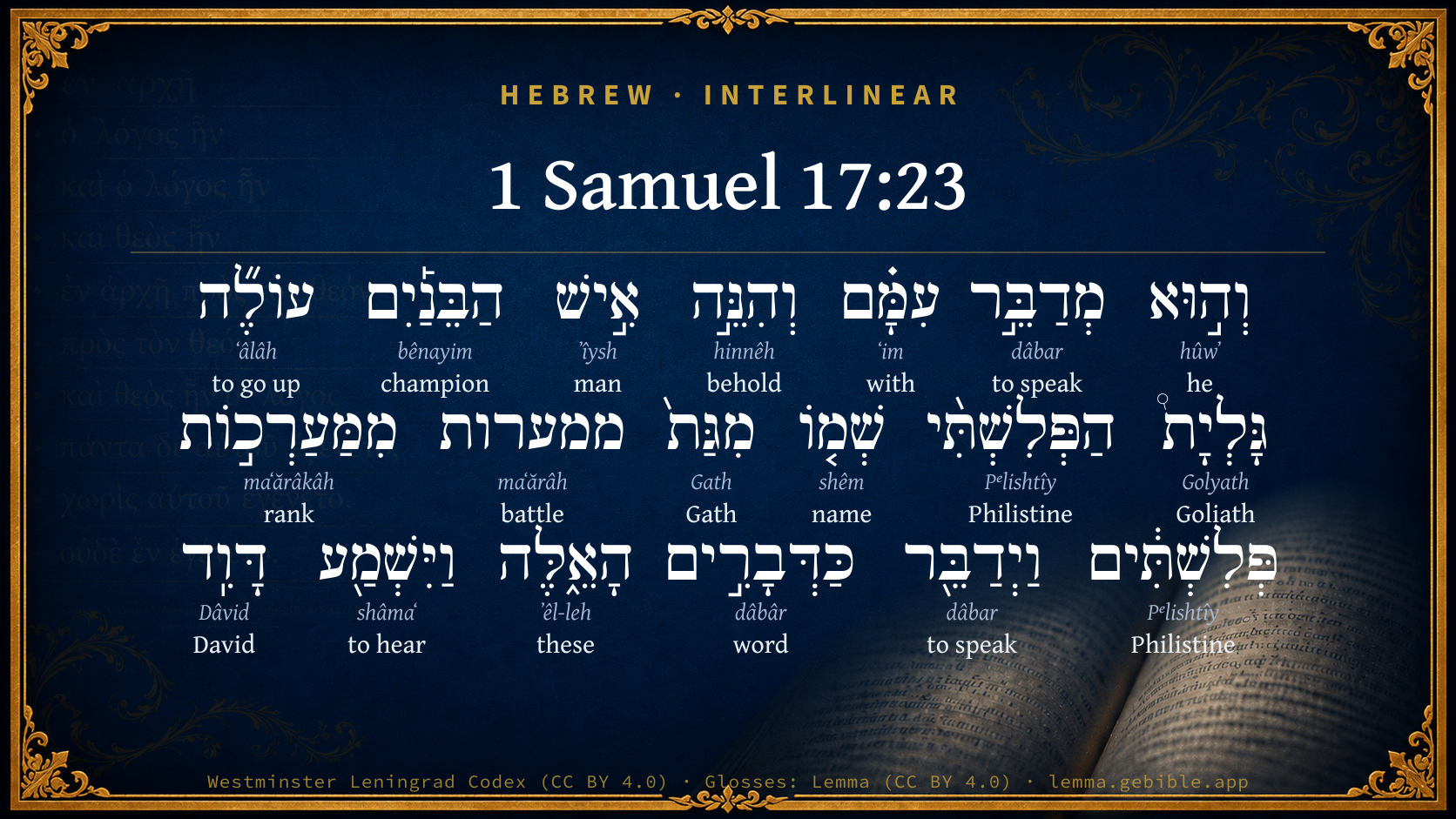
1 Samuel 17:23

Hebrew (Westminster Leningrad Codex) 1 Samuel 17:23 appears in the Hebrew Old Testament. The text above is from the Westminster Leningrad Codex. Each word links to its Strong’s number, a concise gloss, and parsing drawn from the Open Scriptures Hebrew Bible morphology. Click any word for its full Brown-Driver-Briggs (BDB) entry.
Download image
Cite this verse

1 Samuel 17:23 (World English Bible). Public Domain. Lemma interlinear Bible study tool, https://lemma.gebible.app/v/1-samuel/17/23.

Show BibTeX & RIS
BibTeX
RIS
English Translation
As he talked with them, behold, there came up the champion, the Philistine of Gath, Goliath by name, out of the ranks of the Philistines, and spoke according to the same words: and David heard them.
World English Bible · Public Domain
Highlights
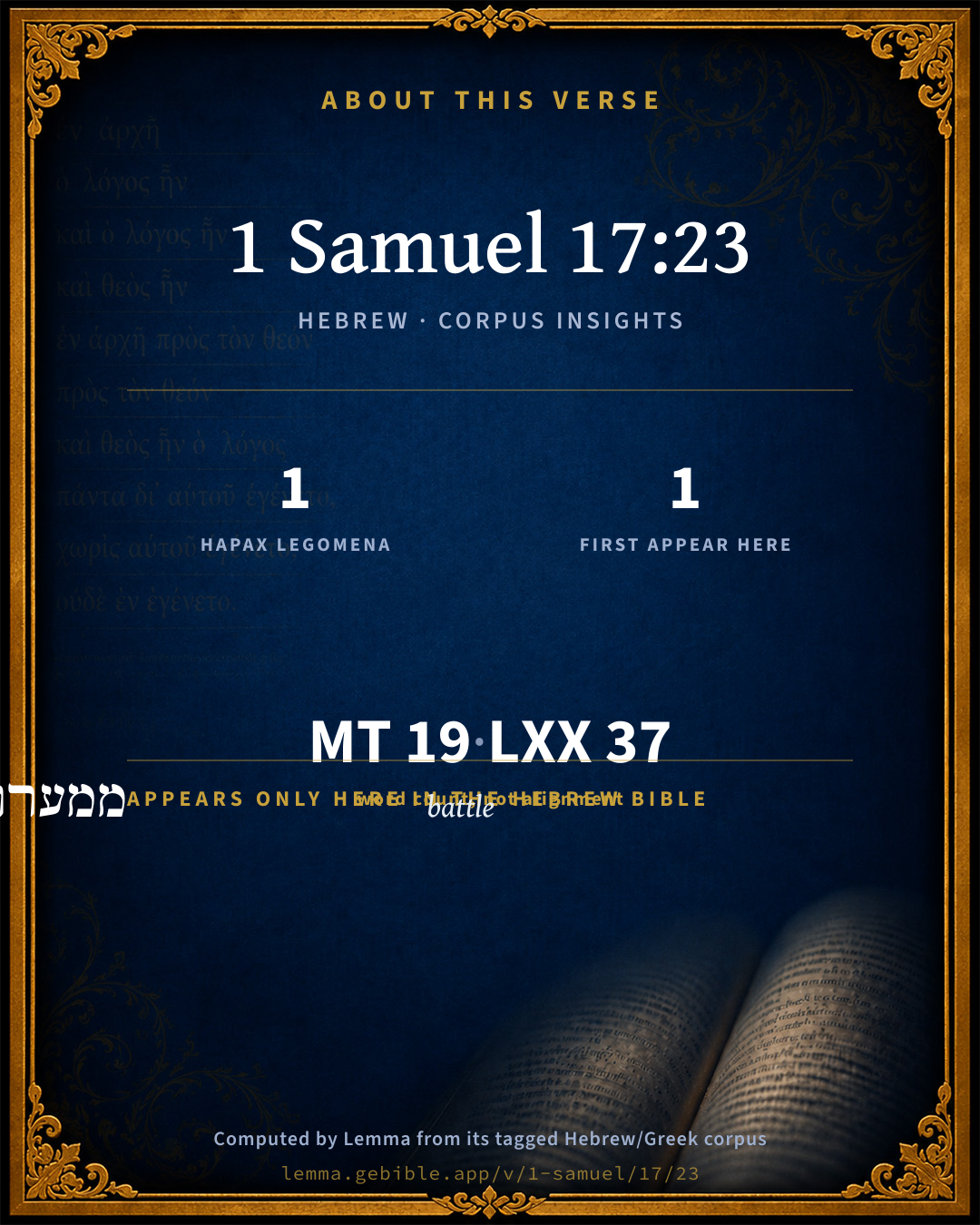
  • 1 hapax legomenon — only here in the Hebrew Bible
  • 1 first appearance in the Hebrew Bible
Full analysis ↓
Download a study sheet

One document with this verse’s original text, its word-by-word gloss line, the meaning frame, cross-references with their text, attributed commentary, and full source and license credits — printable, and it pastes into notes with its structure intact.

This verse Autodidact and up

Study sheet (.html) Plain text (.txt)

A passage Seminary Student

Up to 50 verses in one chapter. A passage sheet keeps up to 6 commentary sources and 12 cross-references per verse, in the order this page ranks them, and says so on the sheet whenever that leaves anything out. Ask for a single verse and you get the Autodidact verse sheet above.

Everything on this page stays free to read, with no account — the sheet is a download of what is already on screen, not access to it.

Want to remove ads? Support Godless Engineer
Compare translations 3

The same verse in 3 English versions, stacked beneath the original-language interlinear above. Click any original word for its lexicon entry.

Each is an independent rendering of the whole verse — the interlinear is not word-aligned to these translations.

Highlighted words mark where these versions differ — a whole-verse word diff, not a word-by-word alignment.

  • World English Bible Public Domain
    As he talked with them, behold, there came up the champion, the Philistine of Gath, Goliath by name, out of the ranks of the Philistines, and spoke according to the same words: and David heard them.
  • King James Version Public Domain
    And as he talked with them, behold, there came up the champion, the Philistine of Gath, Goliath by name, out of the armies of the Philistines, and spake according to the same words: and David heard them.
  • unfoldingWord Literal Text CC BY-SA 4.0
    And he was speaking with them, and behold, the man of the betweens was coming up, Goliath the Philistine his name, from Gath, from the array of the Philistines, and he spoke like these words. And David heard.

unfoldingWord Literal Text — © unfoldingWord, licensed CC BY-SA 4.0. Word-aligned USFM3 via Door43 (git.door43.org/unfoldingWord/en_ult).

Versions to compare (up to 4)

3 of 4 selected

Show all 18 translations

Every available English version of this verse, each an independent rendering of the whole verse.

  • World English Bible Public Domain
    As he talked with them, behold, there came up the champion, the Philistine of Gath, Goliath by name, out of the ranks of the Philistines, and spoke according to the same words: and David heard them.
  • Berean Standard Bible Public Domain
    And as he was speaking with them, suddenly the champion named Goliath, the Philistine from Gath, came forward from the Philistines and shouted his usual words, which David also heard.
  • Majority Standard Bible Public Domain
    And as he was speaking with them, suddenly the champion named Goliath, the Philistine from Gath, came forward from the ranks of the Philistines and shouted his usual words, which David also heard.
  • King James Version Public Domain
    And as he talked with them, behold, there came up the champion, the Philistine of Gath, Goliath by name, out of the armies of the Philistines, and spake according to the same words: and David heard them.
  • American Standard Version (1901) Public Domain
    And as he talked with them, behold, there came up the champion, the Philistine of Gath, Goliath by name, out of the ranks of the Philistines, and spake according to the same words: and David heard them.
  • Revised Version (1885) Public Domain
    And as he talked with them, behold, there came up the champion, the Philistine of Gath, Goliath by name, out of the ranks of the Philistines, and spake according to the same words: and David heard them.
  • Geneva Bible (1599) Public Domain
    And as hee talked with them, beholde, the man that was betweene the two armies, came vp, (whose name was Goliath ye Philistim of Gath) out of the armie of the Philistims, and spake such woordes, and Dauid heard them.
  • Douay-Rheims (1899) Public Domain
    And as he talked with them, that baseborn man whose name was Goliath, the Philistine, of Geth, shewed himself coming up from the camp of the Philistines: and he spoke according to the same words, and David heard them.
  • Young's Literal Translation Public Domain
    And he is speaking with them, and lo, a man of the duellists is coming up, Goliath the Philistine `is' his name, of Gath, out of the ranks of the Philistines, and he speaketh according to those words, and David heareth;
  • Literal Standard Version CC BY-SA 4.0
    And he is speaking with them, and behold, a man, the champion, is coming up, his name [is] Goliath the Philistine, from Gath, out of the ranks of the Philistines, and he speaks according to those words, and David hears;
  • Unlocked Literal Bible CC BY-SA 4.0
    As he talked with them, the strong man, the Philistine of Gath, Goliath by name, and he came out of the ranks of the Philistines, and said the same words as before, and David heard them.
  • unfoldingWord Literal Text CC BY-SA 4.0
    And he was speaking with them, and behold, the man of the betweens was coming up, Goliath the Philistine his name, from Gath, from the array of the Philistines, and he spoke like these words. And David heard.
  • Darby Bible Public Domain
    And as he talked with them, behold there came up the champion, the Philistine of Gath, Goliath by name, out of the ranks of the Philistines, and spoke according to the same words; and David heard [them].
  • World Messianic Bible Public Domain
    As he talked with them, behold, the champion, the Philistine of Gath, Goliath by name, came up out of the ranks of the Philistines, and said the same words; and David heard them.
  • Webster's Bible Public Domain
    And as he talked with them, behold, there came up the champion, the Philistine of Gath, Goliath by name, from the armies of the Philistines, and spoke according to the same words: and David heard them.
  • Free Bible Version CC BY-SA 4.0
    While he was talking with them, Goliath, the Philistine champion from Gath, came up out of his lines and shouted his challenge as he had before, and David heard what he said.
  • Bible in Basic English Public Domain
    And while he was talking to them, the fighter, the Philistine of Gath, Goliath by name, came out from the Philistines' lines and said the same words, in David's hearing.
  • JPS Tanakh (1917) Public Domain
    And as he talked with them, behold, there came up the champion, the Philistine of Gath, Goliath by name, out of the ranks of the Philistines, and spoke according to the same words; and David heard them.

Literal Standard Version (2020), Covenant Press — licensed CC BY-SA 4.0. Text via the HelloAO Bible API (eBible.org). Unlocked Literal Bible (unfoldingWord) — licensed CC BY-SA 4.0. Text via the HelloAO Bible API (eBible.org). unfoldingWord Literal Text — © unfoldingWord, licensed CC BY-SA 4.0. Word-aligned USFM3 via Door43 (git.door43.org/unfoldingWord/en_ult). Free Bible Version, Dr. Jonathan Gallagher — licensed CC BY-SA 4.0. Text via the HelloAO Bible API (eBible.org).

Word by word

More ways to search: Search by grammar → Find every occurrence → Compare this word →

Practice this passage: Drill this verse → Learn its vocabulary →

ממערות
maʻărâh
H4630
“from · battle lines of”
Preposition + Noun, Common, Feminine, Plural, Construct
Part of Speech
Preposition + Noun
Type
Common
Gender
Feminine
Number
Plural
State
Construct
Full BDB Definition

Origin: from H4629

TWOT: 1692d

army, battle-line - (TWOT) nakedness
  1. וְה֣וּא hûwʼ H1931 “and · he” Conjunction + Pronoun, Personal, 3rd Person, Masculine, Singular
  2. מְדַבֵּ֣ר dâbar H1696 “speaking” Verb, Piel, Participle Active, Masculine, Singular, Absolute
  3. עִמָּ֗ם ʻim H5973 “with · them” Preposition + Suffix, Personal, 3rd Person, Masculine, Plural
  4. וְהִנֵּ֣ה hinnêh H2009 “and · behold” Conjunction + Particle, Demonstrative
  5. אִ֣ישׁ ʼîysh H376 “man of” Noun, Common, Masculine, Singular, Construct
  6. הַבֵּנַ֡יִם bênayim H1143 “the · champion” Particle, Definite Article + Noun, Common, Masculine, Dual, Absolute
  7. עוֹלֶ֞ה ʻâlâh H5927 “going up” Verb, Qal, Participle Active, Masculine, Singular, Absolute
  8. גָּלְיָת֩ Golyath H1555 “Goliath” Noun, Proper
  9. הַפְּלִשְׁתִּ֨י Pᵉlishtîy H6430 “the · Philistine” Particle, Definite Article + Noun, Gentilic, Masculine, Singular, Absolute
  10. שְׁמ֤וֹ shêm H8034 “name · his” Noun, Common, Masculine, Singular, Construct + Suffix, Personal, 3rd Person, Masculine, Singular
  11. מִגַּת֙ Gath H1661 “from · Gath” Preposition + Noun, Proper
  12. מִמַּעַרְכ֣וֹת maʻărâkâh H4634 “from · ranks of” Preposition + Noun, Common, Feminine, Plural, Construct
  13. פְּלִשְׁתִּ֔ים Pᵉlishtîy H6430 “Philistines” Noun, Gentilic, Masculine, Plural, Absolute
  14. וַיְדַבֵּ֖ר dâbar H1696 “and · to speak” Conjunction + Verb, Piel, Sequential Imperfect, 3rd Person, Masculine, Singular
  15. כַּדְּבָרִ֣ים dâbâr H1697 “like/as the · words” Preposition, Determined + Noun, Common, Masculine, Plural, Absolute
  16. הָאֵ֑לֶּה ʼêl-leh H428 “the · these” Particle, Definite Article + Pronoun, Demonstrative, Common, Plural
  17. וַיִּשְׁמַ֖ע shâmaʻ H8085 “and · to hear” Conjunction + Verb, Qal, Sequential Imperfect, 3rd Person, Masculine, Singular
  18. דָּוִֽד Dâvid H1732 “David” Noun, Proper

About this verse

These counts appear in no published source. They are computed here, from the morphology-tagged text and Lemma’s own curated glosses. What Lemma adds →

19
words
17
distinct lemmas
Historical
section

Notable vocabulary

1 hapax legomenon — a word that appears only here in the entire Hebrew Bible:

  • ממערות battle H4630

First appearance in Scripture

This word makes its first canonical appearance in the Hebrew Bible here:

  • ממערות battle H4630

Shared distinctive vocabulary

הַבֵּנַ֡יִם champion H1143 occurs in 2 verses of the Hebrew Bible. Also found in:

Grammatical profile

  • 4 verbs
  • 11 nouns
  • 2 pronouns
  • 1 preposition
  • 1 particle

Verb forms

  • מְדַבֵּ֣ר Piel · Participle Active
  • עוֹלֶ֞ה Qal · Participle Active
  • וַיְדַבֵּ֖ר Piel · Sequential Imperfect
  • וַיִּשְׁמַ֖ע Qal · Sequential Imperfect

Repetition

Words recur within this verse — often emphatic in Hebrew:

  • מְדַבֵּ֣ר to speak H1696 ×2
  • הַפְּלִשְׁתִּ֨י Philistine H6430 ×2

Hebrew & Septuagint length

In English translation the verse runs 36 words from the Hebrew and 32 from the Septuagint (LXX English) — closely comparable.

A rough comparison of the two English renderings, which tokenize alike — not a word-level alignment.

Word counts can differ between the Hebrew and the Greek without any difference in meaning — e.g. the Hebrew direct-object marker אֵת has no separate Greek word, and Greek often adds the article ὁ.

In the original languages it is 19 Hebrew tokens and 37 Greek tokens — but the two are counted differently (Hebrew bundles its prefixes and suffixes into one token; the Greek is in lemma form), so that isn’t a like-for-like length.

Cross-references

1

Topical passages linked to 1 Samuel 17:23 in the Treasury of Scripture Knowledge — connected by theme and wording, ordered by reader-vote popularity; previews shown in the World English Bible.

  • 1 Samuel 17:8–10 He stood and cried to the armies of Israel, and said to them, Why are you come out to set your battle in array? am I not a Philistine, and you servants to Saul? choose you a man for you, and let him come down to me.

Cross-references courtesy of OpenBible.info (CC BY 4.0).

Hebrew and Greek witnesses Masoretic Hebrew ↔ Greek Septuagint

The same verse in the two great witnesses to the Old Testament, shown verse-for-verse.

These are two independent witnesses, not word-aligned to each other, and the Septuagint is shown in lemma (dictionary) form.

Hebrew 1 Samuel 17:23 Masoretic · Westminster Leningrad Codex

וְה֣וּא מְדַבֵּ֣ר עִמָּ֗ם וְהִנֵּ֣ה אִ֣ישׁ הַבֵּנַ֡יִם עוֹלֶ֞ה גָּלְיָת֩ הַפְּלִשְׁתִּ֨י שְׁמ֤וֹ מִגַּת֙ ממערות מִמַּעַרְכ֣וֹת פְּלִשְׁתִּ֔ים וַיְדַבֵּ֖ר כַּדְּבָרִ֣ים הָאֵ֑לֶּה וַיִּשְׁמַ֖ע דָּוִֽד

As he talked with them, behold, there came up the champion, the Philistine of Gath, Goliath by name, out of the ranks of the Philistines, and spoke according to the same words: and David heard them.

World English Bible · Public Domain

Greek LXX 1 Samuel 17:23 Septuagint · lemma form

καί εἶπον ὁ ἀλλόφυλος πρός δαυίδ ὡσεί κύων ἐγώ εἰμί ὅτι σύ ἔρχομαι ἐπί ἐγώ ἐν ῥάβδος καί λίθος καί εἶπον δαυίδ οὐ ἀλλά ἤ χειρέω κύων καί καταἀράομαι ὁ ἀλλόφυλος ὁ δαυίδ ἐν ὁ θεός αὐτός

And while he was speaking with them, behold the Amessaean advanced, Goliath by name, the Philistine of Geth, of the armies of the Philistines, and he spoke as before, and David heard.

LXX2012 (modern English Septuagint) · Public Domain

Hebrew: Westminster Leningrad Codex (CC BY 4.0). Greek: Septuagint (public domain); English from LXX2012 (modern English Septuagint) (Public Domain). How the Septuagint differs from the Hebrew →

Targum (Aramaic paraphrase)

1

The Targum is the ancient Jewish Aramaic paraphrase of the Hebrew Scriptures — an interpretive translation, not the Hebrew text itself. Onkelos (literal) and Pseudo-Jonathan (expansive) render the Torah, and Jonathan the Prophets. Coverage is partial: where no permissively-licensed English translation exists for a verse, only the Aramaic is shown. This is verse-level text, not a word-by-word alignment to the Hebrew.

  1. Targum Jonathan Prophets (Joshua–Malachi)
    וְהוּא מְמַלֵיל עִמְהוֹן וְהָא גַבְרָא מִבֵּינֵיהוֹן סְלִיק גָלְיַת פְּלִשְׁתָּאָה שְׁמֵיהּ מִגָת מִסִדְרֵי פְלִשְׁתָּאֵי וּמַלֵיל כְּפִתְגָמַיָא הָאִלֵין וּשְׁמַע דָוִד:

    (no public-domain English translation for this verse)

    Targum Jonathan — Aramaic: “Mikraot Gedolot” (public domain). English: “Sefaria Community Translation” (CC0 1.0 (public-domain dedication)); “London "Chaldee Paraphrase," 1871” (public domain). Text via Sefaria.

Commentary

Notes on 1 Samuel 17:23 from classic Christian and Jewish commentators (each source and its license shown beneath its notes). The classic Christian expositions comment on the surrounding passage and are grouped to its opening verse, so a note may address several verses; the Jewish commentaries on the Tanakh (Rashi and others) are per-verse, so they appear only where the commentator wrote on this verse.

Lemma curates 59 commentaries, every one of them public domain or Creative Commons licensed, each selected and text-cleaned for this edition rather than reprinted as found. About our sources →

Trapp's Complete Commentary

John Trapp

1Sa 17:23 And as he talked with them, behold, there came up the champion, the Philistine of Gath, Goliath by name, out of the armies of the Philistines, and spake according to the same words: and David heard [them].

Ver. 23. The Philistine of Gath, Goliath by name.] Which signifieth Captivity; a terrible name, {a} such as was that of Bellarmine ( Bellum, arma, minae), the Pope’s late great champion.

“ Cur Bellarminum te, Bellarmine, vocamus?

Nempe Malerminus rectius esse potes. ”{ b}

{a} Apud Plautum militis nomen est Therapontigonoplata-gidorias.

{b} Owen, Epigram.

John Trapp, A Commentary or Exposition upon All the Books of the Old and New Testament (1647–1656) — public domain. Text from a community e-Sword module.

Joseph Benson's Commentary

1Sa 17:23-24. Behold there came up the champion — Although the armies stood ready to engage, yet the vanity of Goliath made him once more desirous that the matter might be determined by single combat, and to challenge the whole host of Israel to produce a man to fight with him. And all the men of Israel fled from him — That is, none of the Israelites dared to come to an equal distance from their camp as Goliath did from that of the Philistines; and probably some that had advanced farther than the rest, retired back when they saw him approaching. Nay, it seems wherever he advanced they fled from him. But surely one Philistine could never have thus dismayed and put ten thousand Israelites to flight, unless their Rock, being forsaken by them, had justly sold them, and shut them up, Deu 32:30.

Joseph Benson's Commentary on the Old and New Testaments (1811–1818) — public domain. Text from a community e-Sword module.

Geneva Bible (1599)

Geneva Bible translators

Or, valley.

As are above rehearsed, verses 8 and 9.

Geneva Bible (1599) marginal notes — public domain. Text via Bolls.life.

Ellicott's Commentary for English Readers

(23) The Philistine of Gath.—There is a difficulty connected with the Philistine giant’s name, for we read in 2Sa_21:19 how that Goliath of Gath, the giant, “the staff of whose spear was like a weaver’s beam,” was slain by Elhanan, the son of Jaare-oregim, a Bethlehemite, after David had been made king. It is possible that Goliath was a general designation of these monstrous descendants of the ancient Anakim in Gath; but Ewald suggests that the name Goliath really only belongs to the giant slain by Elhanan, some years after the exploit of the youthful son of Jesse, and that it was transferred in error to the “champion” whom David slew (who is, moreover, generally called simply “the Philistine”) when his proper name had been lost.

A Bible Commentary for English Readers, edited by Charles John Ellicott (1878–1897) — public domain. Text from a community e-Sword module.

John Gill's Exposition

And as he talked with them,.... About their health, and the errand he came upon, and the message of his father to them, and how it was with him, who sent them his best wishes:

behold, there came up the champion, the Philistine of Gath, Goliath by name: of whom see Sa1 17:4; he came out of the valley, and drew near to the mountain the Israelites were descending:

out of the armies of the Philistines: from the plains where they were encamped, as Kimchi, though they seem to have been encamped on a mountain as the Israelites were; or from the ranks of the Philistines; according to the marginal reading, he came out of one of the battalions that were set in array:

and spake according to the same words; which he had spoken time after time forty days successively, namely, what is expressed Sa1 17:8,

and David heard them; and observed them.

John Gill's Exposition of the Whole Bible (1746–1763) — public domain (CC PDM 1.0). Text via the HelloAO Bible API.

Haydock's Catholic Bible Commentary

CHAPTER XVII.

Up, or proceeding into the vale. (Menochius) --- Camp. Hebrew, "ranks, or armies."

George Leo Haydock (1774–1849), Haydock's Catholic Family Bible and Commentary, 1859 edition — public domain. Excludes Psalms (Douay-Rheims chapter numbering differs from Protestant) and Deuterocanonical books (Catholic canon only).

The Pulpit Commentary

Vers. 23, 24. The champion, the Philistine of Oath, Goliath by name. The Hebrew is, "The champion (see on ver. 4), Goliath the Philistine his name, of Gath," probably the very words of the original record. Out of the armies, or ranks. This is a very probable correction of the Kri, made by restoring a letter which has apparently dropped out. The word in the written text might mean "the open space between the two armies;" but it occurs nowhere else, and this space was chiefly occupied by the ravine. The men of Israel fled from him. Ie. they drew back in haste from the edge of the ravine, which Goliath could no more have crossed, encased in armour weighing two and a half hundred-weight, than a knight could have done in the middle ages. In ver. 40 we read that it was out of this ravine that David selected his pebbles, and, being encumbered with no armour, it was easy for him to climb up the other side and attack his heavily armed opponent.

The Pulpit Commentary (1880–1919), ed. H.D.M. Spence-Jones & Joseph S. Exell — public domain. Text from a community e-Sword module.

Rashi

Rabbi Shlomo Yitzchaki (Rashi)

From Philistines camp. [The text] is written מִמַּעֲרוֹת; our Rabbis expounded [from the word מַעֲרוֹת] that one hundred men had relations with his [Golyas'] mother Orpoh, after she left Rus and her mother-in-law Naomi.

Rashi on the Tanakh — English translations: “The Judaica Press complete Tanach with Rashi, translated by A. J. Rosenberg” (CC BY 4.0); “Pentateuch with Rashi's commentary by M. Rosenbaum and A.M. Silbermann, 1929-1934” (public domain); “The Metsudah Tanach series, Lakewood, N.J” (CC BY 4.0); and “The Book of Joshua, Metsudah Publications, 1997” (CC BY 4.0). Text via Sefaria.

Lesson kit

Teaching starters — assembled from the data on this page, not authored interpretation. Every prompt links to the verse data it draws on. Edit before teaching.

1 Samuel, in the Historical, opens this verse with 19 words (17 distinct Hebrew lemmas). Its most distinctive word is maʻărâh (“battle”). A historical commentator’s framing appears above. Read the whole chapter for the surrounding context.

Discussion questions

  1. What does “battle” (maʻărâh) contribute to the verse as a whole?
  2. 1 word here appears nowhere else in the Hebrew Bible. Why might the author reach for such rare wording?
  3. This is the first place “battle” appears in Scripture (first appears here). What does its debut here establish?
  4. How does 1 Samuel 17:4, which shares the word «champion», read alongside this verse?
  5. What does the repetition of “to speak” (2× in this one verse) do in this verse?
  6. These translations render this verse differently; the difference is in the English rendering, not the original. What questions does that raise?
  7. «מְדַבֵּ֣ר» is a Piel Participle Active verb. How does that grammatical form shape the action described?
  8. Compare how Trapp's Complete Commentary and Joseph Benson's Commentary read this verse. Where do they agree or differ?

Things to notice

  • 1 word in this verse appears nowhere else in the Hebrew Bible.
  • 1 word makes its first canonical appearance in Scripture here.
  • This verse counts 19 Hebrew ↔ 37 Greek words.
  • These translations choose different wording for 17 words in this verse.
  • “to speak” occurs 2× in this single verse.

Reading settings

Reading text

Shown beneath each verse's original-language words.

Old Testament
Old Testament edition

Read the OT as the Masoretic Hebrew (MT) or the Greek Septuagint (LXX).

English shown for the Greek Septuagint (in the Hebrew ↔ Greek comparison).

Comparing translations? Open the Compare panel on any verse page to stack up to four side by side.