1 Samuel 25:40

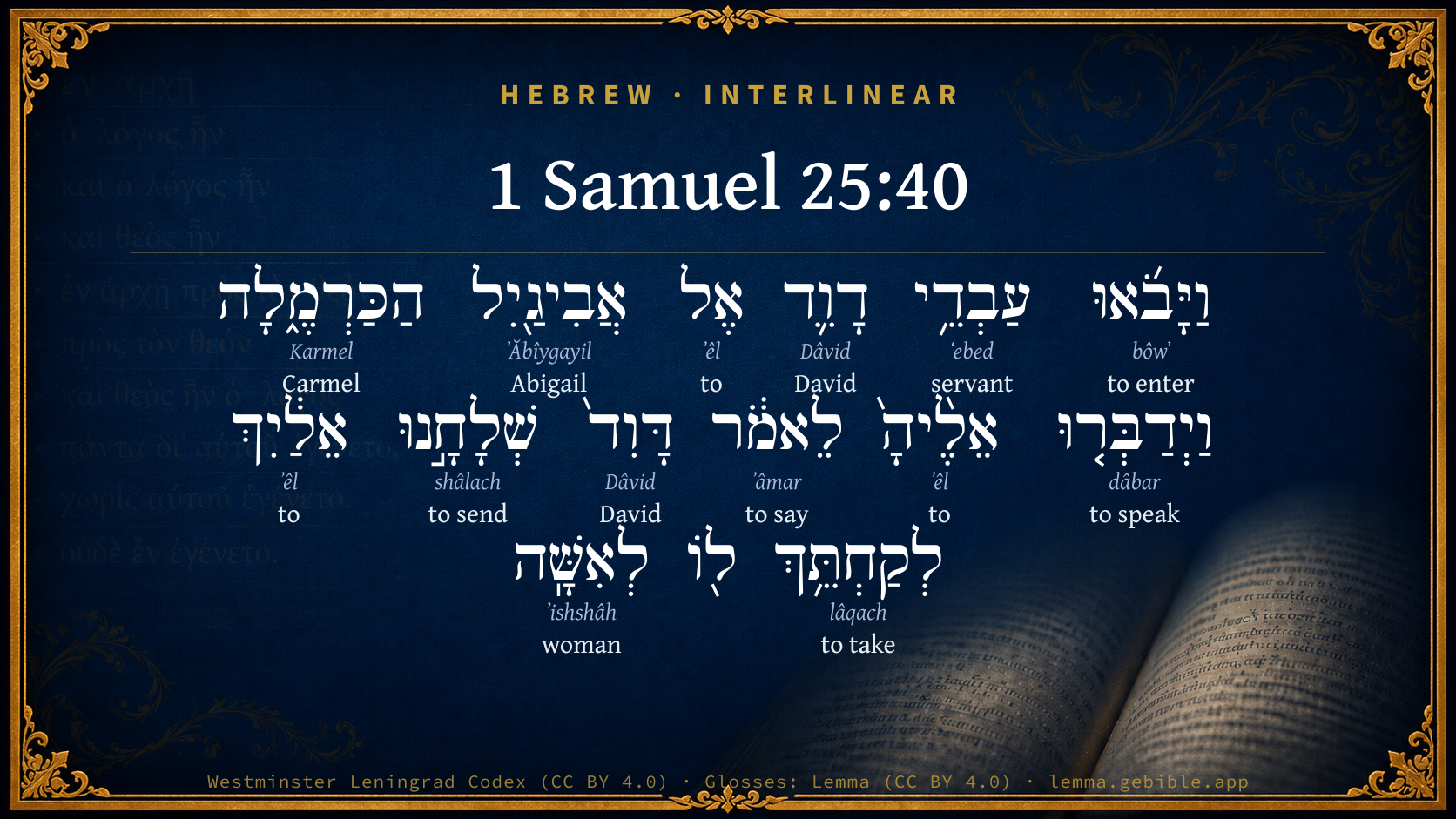
Hebrew (Westminster Leningrad Codex) 1 Samuel 25:40 appears in the Hebrew Old Testament. The text above is from the Westminster Leningrad Codex. Each word links to its Strong’s number, a concise gloss, and parsing drawn from the Open Scriptures Hebrew Bible morphology. Click any word for its full Brown-Driver-Briggs (BDB) entry.
Download image
Cite this verse

1 Samuel 25:40 (World English Bible). Public Domain. Lemma interlinear Bible study tool, https://lemma.gebible.app/v/1-samuel/25/40.

Show BibTeX & RIS
BibTeX
RIS
English Translation
When the servants of David were come to Abigail to Carmel, they spoke to her, saying, David has sent us to you, to take you to him as wife.
World English Bible · Public Domain
Download a study sheet

One document with this verse’s original text, its word-by-word gloss line, the meaning frame, cross-references with their text, attributed commentary, and full source and license credits — printable, and it pastes into notes with its structure intact.

This verse Autodidact and up

Study sheet (.html) Plain text (.txt)

A passage Seminary Student

Up to 50 verses in one chapter. A passage sheet keeps up to 6 commentary sources and 12 cross-references per verse, in the order this page ranks them, and says so on the sheet whenever that leaves anything out. Ask for a single verse and you get the Autodidact verse sheet above.

Everything on this page stays free to read, with no account — the sheet is a download of what is already on screen, not access to it.

Want to remove ads? Support Godless Engineer
Compare translations 3

The same verse in 3 English versions, stacked beneath the original-language interlinear above. Click any original word for its lexicon entry.

Each is an independent rendering of the whole verse — the interlinear is not word-aligned to these translations.

Highlighted words mark where these versions differ — a whole-verse word diff, not a word-by-word alignment.

  • World English Bible Public Domain
    When the servants of David were come to Abigail to Carmel, they spoke to her, saying, David has sent us to you, to take you to him as wife.
  • King James Version Public Domain
    And when the servants of David were come to Abigail to Carmel, they spake unto her, saying, David sent us unto thee, to take thee to him to wife.
  • unfoldingWord Literal Text CC BY-SA 4.0
    And the servants of David came to Abigail at Carmel, and they spoke to her, saying, “David has sent us to you to take you to him for a wife.”

unfoldingWord Literal Text — © unfoldingWord, licensed CC BY-SA 4.0. Word-aligned USFM3 via Door43 (git.door43.org/unfoldingWord/en_ult).

Versions to compare (up to 4)

3 of 4 selected

Show all 18 translations

Every available English version of this verse, each an independent rendering of the whole verse.

  • World English Bible Public Domain
    When the servants of David were come to Abigail to Carmel, they spoke to her, saying, David has sent us to you, to take you to him as wife.
  • Berean Standard Bible Public Domain
    When his servants came to Abigail at Carmel, they said, “David has sent us to take you as his wife.”
  • Majority Standard Bible Public Domain
    When his servants came to Abigail at Carmel, they said, “David has sent us to take you as his wife.”
  • King James Version Public Domain
    And when the servants of David were come to Abigail to Carmel, they spake unto her, saying, David sent us unto thee, to take thee to him to wife.
  • American Standard Version (1901) Public Domain
    And when the servants of David were come to Abigail to Carmel, they spake unto her, saying, David hath sent us unto thee, to take thee to him to wife.
  • Revised Version (1885) Public Domain
    And when the servants of David were come to Abigail to Carmel, they spake unto her, saying, David hath sent us unto thee, to take thee to him to wife.
  • Geneva Bible (1599) Public Domain
    And whe the seruants of Dauid were come to Abigail to Carmel, they spake vnto her, saying, Dauid sent vs to thee, to take thee to his wife.
  • Douay-Rheims (1899) Public Domain
    And David's servants came to Abigail to Carmel, and spoke to her, saying: David hath sent us to thee, to take thee to himself for a wife.
  • Young's Literal Translation Public Domain
    And the servants of David come in unto Abigail at Carmel, and speak unto her, saying, `David hath sent us unto thee to take thee to him for a wife.'
  • Literal Standard Version CC BY-SA 4.0
    And the servants of David come to Abigail at Carmel, and speak to her, saying, “David has sent us to you to take you to himself for a wife.”
  • Unlocked Literal Bible CC BY-SA 4.0
    When David's servants had come to Abigail at Carmel, they spoke to her and said, “David has sent us to you to take you to him as his wife.”
  • unfoldingWord Literal Text CC BY-SA 4.0
    And the servants of David came to Abigail at Carmel, and they spoke to her, saying, “David has sent us to you to take you to him for a wife.”
  • Darby Bible Public Domain
    And the servants of David came to Abigail to Carmel, and spoke to her, saying, David has sent us to thee, to take thee as his wife.
  • World Messianic Bible Public Domain
    When David’s servants had come to Abigail to Carmel, they spoke to her, saying, “David has sent us to you, to take you to him as wife.”
  • Webster's Bible Public Domain
    And when the servants of David had come to Abigail to Carmel, they spoke to her, saying, David hath sent us to thee, to take thee to him for a wife.
  • Free Bible Version CC BY-SA 4.0
    When David's men arrived at Carmel, they said to Abigail, “David has sent us to you to bring you back to become his wife.”
  • Bible in Basic English Public Domain
    And when David's servants came to Carmel, to Abigail, they said to her, David has sent us to you to take you to him as his wife.
  • JPS Tanakh (1917) Public Domain
    And when the servants of David were come to Abigail to Carmel, they spoke unto her, saying: 'David hath sent us unto thee, to take thee to him to wife.'

Literal Standard Version (2020), Covenant Press — licensed CC BY-SA 4.0. Text via the HelloAO Bible API (eBible.org). Unlocked Literal Bible (unfoldingWord) — licensed CC BY-SA 4.0. Text via the HelloAO Bible API (eBible.org). unfoldingWord Literal Text — © unfoldingWord, licensed CC BY-SA 4.0. Word-aligned USFM3 via Door43 (git.door43.org/unfoldingWord/en_ult). Free Bible Version, Dr. Jonathan Gallagher — licensed CC BY-SA 4.0. Text via the HelloAO Bible API (eBible.org).

Word by word

More ways to search: Search by grammar → Find every occurrence → Compare this word →

Practice this passage: Drill this verse → Learn its vocabulary →

אֲבִיגַ֖יִל
ʼĂbîygayil
H26
“Abigail”
Noun, Proper
Part of Speech
Noun
Type
Proper
Full BDB Definition

Origin: from H1 and H1524

TWOT: None

Abigail = "my father is joy" - wife of Nabal, then of David - sister of David
  1. וַיָּבֹ֜אוּ bôwʼ H935 “and · to enter” Conjunction + Verb, Qal, Sequential Imperfect, 3rd Person, Masculine, Plural
  2. עַבְדֵ֥י ʻebed H5650 “servants of” Noun, Common, Masculine, Plural, Construct
  3. דָוִ֛ד Dâvid H1732 “David” Noun, Proper
  4. אֶל ʼêl H413 “to” Preposition
  5. הַכַּרְמֶ֑לָה Karmel H3760 “the · Carmel · toward” Particle, Definite Article + Noun, Proper + Suffix, Demonstrative
  6. וַיְדַבְּר֤וּ dâbar H1696 “and · to speak” Conjunction + Verb, Piel, Sequential Imperfect, 3rd Person, Masculine, Plural
  7. אֵלֶ֨יהָ֙ ʼêl H413 “to · her” Preposition + Suffix, Personal, 3rd Person, Feminine, Singular
  8. לֵאמֹ֔ר ʼâmar H559 “to say” Preposition + Verb, Qal, Infinitive Construct
  9. דָּוִד֙ Dâvid H1732 “David” Noun, Proper
  10. שְׁלָחָ֣נוּ shâlach H7971 “to send · us” Verb, Qal, Perfect, 3rd Person, Masculine, Singular + Suffix, Personal, 1st Person, Common, Plural
  11. אֵלַ֔יִךְ ʼêl H413 “to · you” Preposition + Suffix, Personal, 2nd Person, Feminine, Singular
  12. לְקַחְתֵּ֥ךְ lâqach H3947 “to take · you” Preposition + Verb, Qal, Infinitive Construct + Suffix, Personal, 2nd Person, Feminine, Singular
  13. לְאִשָּֽׁה ʼishshâh H802 “to/for · woman” Preposition + Noun, Common, Feminine, Singular, Absolute

About this verse

These counts appear in no published source. They are computed here, from the morphology-tagged text and Lemma’s own curated glosses. What Lemma adds →

15
words
11
distinct lemmas
Historical
section

Notable vocabulary

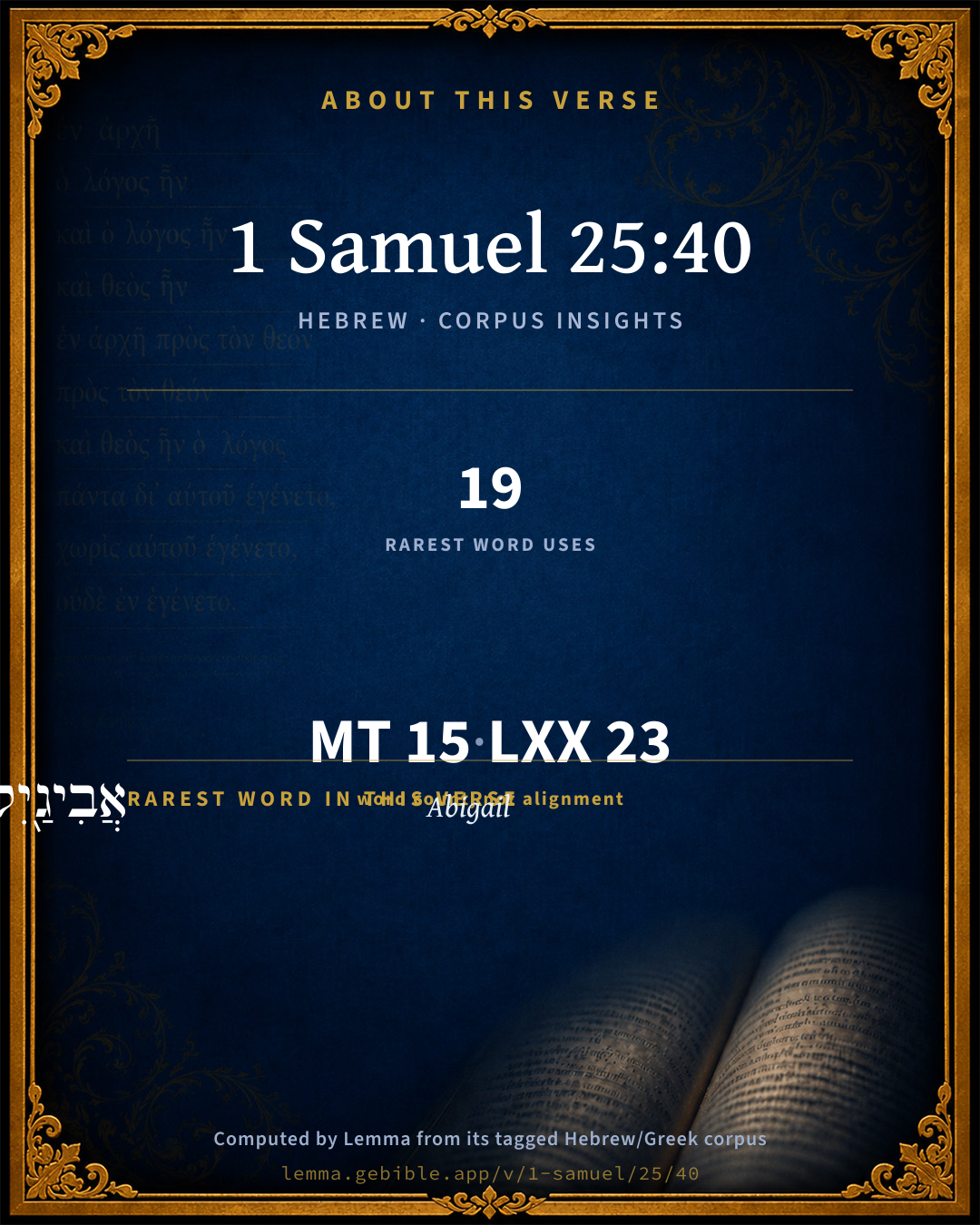
The rarest word here is אֲבִיגַ֖יִל Abigail H26 — appearing just 19 times in the whole Hebrew Bible.

Shared distinctive vocabulary

אֲבִיגַ֖יִל Abigail H26 occurs in 17 verses of the Hebrew Bible. Also found in:

Grammatical profile

  • 5 verbs
  • 6 nouns
  • 4 prepositions

Verb forms

  • וַיָּבֹ֜אוּ Qal · Sequential Imperfect
  • וַיְדַבְּר֤וּ Piel · Sequential Imperfect
  • לֵאמֹ֔ר Qal · Infinitive Construct
  • שְׁלָחָ֣נוּ Qal · Perfect
  • לְקַחְתֵּ֥ךְ Qal · Infinitive Construct

Repetition

Words recur within this verse — often emphatic in Hebrew:

  • דָוִ֛ד David H1732 ×2
  • אֶל to H413 ×3

Hebrew & Septuagint length

In English translation the verse runs 29 words from the Hebrew and 29 from the Septuagint (LXX English) — the same length.

A rough comparison of the two English renderings, which tokenize alike — not a word-level alignment.

Word counts can differ between the Hebrew and the Greek without any difference in meaning — e.g. the Hebrew direct-object marker אֵת has no separate Greek word, and Greek often adds the article ὁ.

In the original languages it is 15 Hebrew tokens and 23 Greek tokens — but the two are counted differently (Hebrew bundles its prefixes and suffixes into one token; the Greek is in lemma form), so that isn’t a like-for-like length.

Cross-references

2

Topical passages linked to 1 Samuel 25:40 in the Treasury of Scripture Knowledge — connected by theme and wording, ordered by reader-vote popularity; previews shown in the World English Bible.

  • Genesis 24:51 Behold, Rebekah is before you, take her, and go, and let her be your master's son's wife, as Yahweh has spoken."
  • Genesis 24:37–38 My master made me swear, saying, 'You shall not take a wife for my son of the daughters of the Canaanites, in whose land I live,

Cross-references courtesy of OpenBible.info (CC BY 4.0).

Hebrew and Greek witnesses Masoretic Hebrew ↔ Greek Septuagint

The same verse in the two great witnesses to the Old Testament, shown verse-for-verse.

These are two independent witnesses, not word-aligned to each other, and the Septuagint is shown in lemma (dictionary) form.

Hebrew 1 Samuel 25:40 Masoretic · Westminster Leningrad Codex

וַיָּבֹ֜אוּ עַבְדֵ֥י דָוִ֛ד אֶל אֲבִיגַ֖יִל הַכַּרְמֶ֑לָה וַיְדַבְּר֤וּ אֵלֶ֨יהָ֙ לֵאמֹ֔ר דָּוִד֙ שְׁלָחָ֣נוּ אֵלַ֔יִךְ לְקַחְתֵּ֥ךְ ל֖וֹ לְאִשָּֽׁה

When the servants of David were come to Abigail to Carmel, they spoke to her, saying, David has sent us to you, to take you to him as wife.

World English Bible · Public Domain

Greek LXX 1 Samuel 25:40 Septuagint · lemma form

καί ἔρχομαι ὁ παῖς δαυίδ πρός αβιγαιαν εἰς κάρμηλος καί λαλέω αὐτός λέγω δαυίδ ἀποστέλλω ἐγώ πρός σύ λαμβάνω σύ αὐτός εἰς γυνή

So the servants of David came to Abigaia to Carmel, and spoke to her, saying, David has sent us to you, to take you to himself for a wife.

LXX2012 (modern English Septuagint) · Public Domain

Hebrew: Westminster Leningrad Codex (CC BY 4.0). Greek: Septuagint (public domain); English from LXX2012 (modern English Septuagint) (Public Domain). How the Septuagint differs from the Hebrew →

Targum (Aramaic paraphrase)

1

The Targum is the ancient Jewish Aramaic paraphrase of the Hebrew Scriptures — an interpretive translation, not the Hebrew text itself. Onkelos (literal) and Pseudo-Jonathan (expansive) render the Torah, and Jonathan the Prophets. Coverage is partial: where no permissively-licensed English translation exists for a verse, only the Aramaic is shown. This is verse-level text, not a word-by-word alignment to the Hebrew.

  1. Targum Jonathan Prophets (Joshua–Malachi)
    וַאֲתוּ עַבְדֵי דָוִד לְוַת אֲבִיגַיִל לְכַרְמְלָא וּמַלִילוּ עִמָה לְמֵימַר דָוִד שַׁלְחָנָא לְוָתִיךְ לְמִסְבִיךְ לֵיהּ לְאִתּוּ:

    (no public-domain English translation for this verse)

    Targum Jonathan — Aramaic: “Mikraot Gedolot” (public domain). English: “Sefaria Community Translation” (CC0 1.0 (public-domain dedication)); “London "Chaldee Paraphrase," 1871” (public domain). Text via Sefaria.

Commentary

Notes on 1 Samuel 25:40 from classic Christian and Jewish commentators (each source and its license shown beneath its notes). The classic Christian expositions comment on the surrounding passage and are grouped to its opening verse, so a note may address several verses; the Jewish commentaries on the Tanakh (Rashi and others) are per-verse, so they appear only where the commentator wrote on this verse.

Lemma curates 59 commentaries, every one of them public domain or Creative Commons licensed, each selected and text-cleaned for this edition rather than reprinted as found. About our sources →

Trapp's Complete Commentary

John Trapp

1Sa 25:40 And when the servants of David were come to Abigail to Carmel, they spake unto her, saying, David sent us unto thee, to take thee to him to wife.

Ver. 40. David sent us unto thee.] He sent rather than went, lest her love should seem to be forced; and that if he had a repulse, it might not be so grievous to him. Ministers are Christ’s spokesmen, {2Co 11:2} pity but he should speed.

John Trapp, A Commentary or Exposition upon All the Books of the Old and New Testament (1647–1656) — public domain. Text from a community e-Sword module.

Ellicott's Commentary for English Readers

(40) When the servants of David were come to Abigail.—The time that had elapsed between the death of Nabal and this mission of David to Abigail is not specified. The legal time of mourning was fixed at only seven days, but a very considerable period may have elapsed in this case. S. Ambrose allegorises here, as is usual in Patristic expositions, and compares the espousals of Abigail to David after Nabar’s death to the union of the Church (i.e., the Gentile world) to Christ after the cessation of its connection with heathenism.—S. Ambrose, Ep. 31 (quoted in Words worth).

A Bible Commentary for English Readers, edited by Charles John Ellicott (1878–1897) — public domain. Text from a community e-Sword module.

John Gill's Exposition

And when the servants of David were come to Abigail to Carmel,.... For though Nabal lived in Maon, yet having possessions in Camel, he had no doubt an house there also; and here Abigail was, and perhaps chose to be after his death, rather than at Maon:

they spake unto her; delivered the message to her they were sent with by David:

saying, David sent us unto thee, to take thee to him to wife; that is, to treat with her about his marriage to her, to propose it to her, and, if they could prevail upon her, to bring her with them, that David might espouse her.

John Gill's Exposition of the Whole Bible (1746–1763) — public domain (CC PDM 1.0). Text via the HelloAO Bible API.

Albert Barnes' Notes on the Bible

There is no note of the exact interval that elapsed between Nabal’s death and David’s hearing of it, or, again, between David’s hearing of it and his message to Abigail; nor is there any reason to suppose that the marriage took place with unbecoming haste. The widow of such a husband as Nabal had been could not, however, be expected to revere his memory. After the usual mourning of seven days, she would probably feel herself free to act as custom allowed. (See 2Sa 11:26.)

Albert Barnes' Notes on the Bible (1834–1885) — public domain. Text from a community e-Sword/MySword module.

Lesson kit

Teaching starters — assembled from the data on this page, not authored interpretation. Every prompt links to the verse data it draws on. Edit before teaching.

1 Samuel, in the Historical, opens this verse with 15 words (11 distinct Hebrew lemmas). Its most distinctive word is ʼĂbîygayil (“Abigail”). A historical commentator’s framing appears above. Read the whole chapter for the surrounding context.

Discussion questions

  1. How does “Abigail” (ʼĂbîygayil) shape what this verse is saying?
  2. How does 1 Samuel 25:3, which shares the word «Abigail», read alongside this verse?
  3. What does the repetition of “David” (2× in this one verse) do in this verse?
  4. The translations on this page render this verse differently — a whole-verse word diff, not a word-by-word alignment. What might account for the different wordings?
  5. «וַיָּבֹ֜אוּ» is a Qal Sequential Imperfect verb. How does that grammatical form shape the action described?
  6. Compare how Trapp's Complete Commentary and Ellicott's Commentary for English Readers read this verse. Where do they agree or differ?

Things to notice

Reading settings

Reading text

Shown beneath each verse's original-language words.

Old Testament
Old Testament edition

Read the OT as the Masoretic Hebrew (MT) or the Greek Septuagint (LXX).

English shown for the Greek Septuagint (in the Hebrew ↔ Greek comparison).

Comparing translations? Open the Compare panel on any verse page to stack up to four side by side.