Judges 1:20

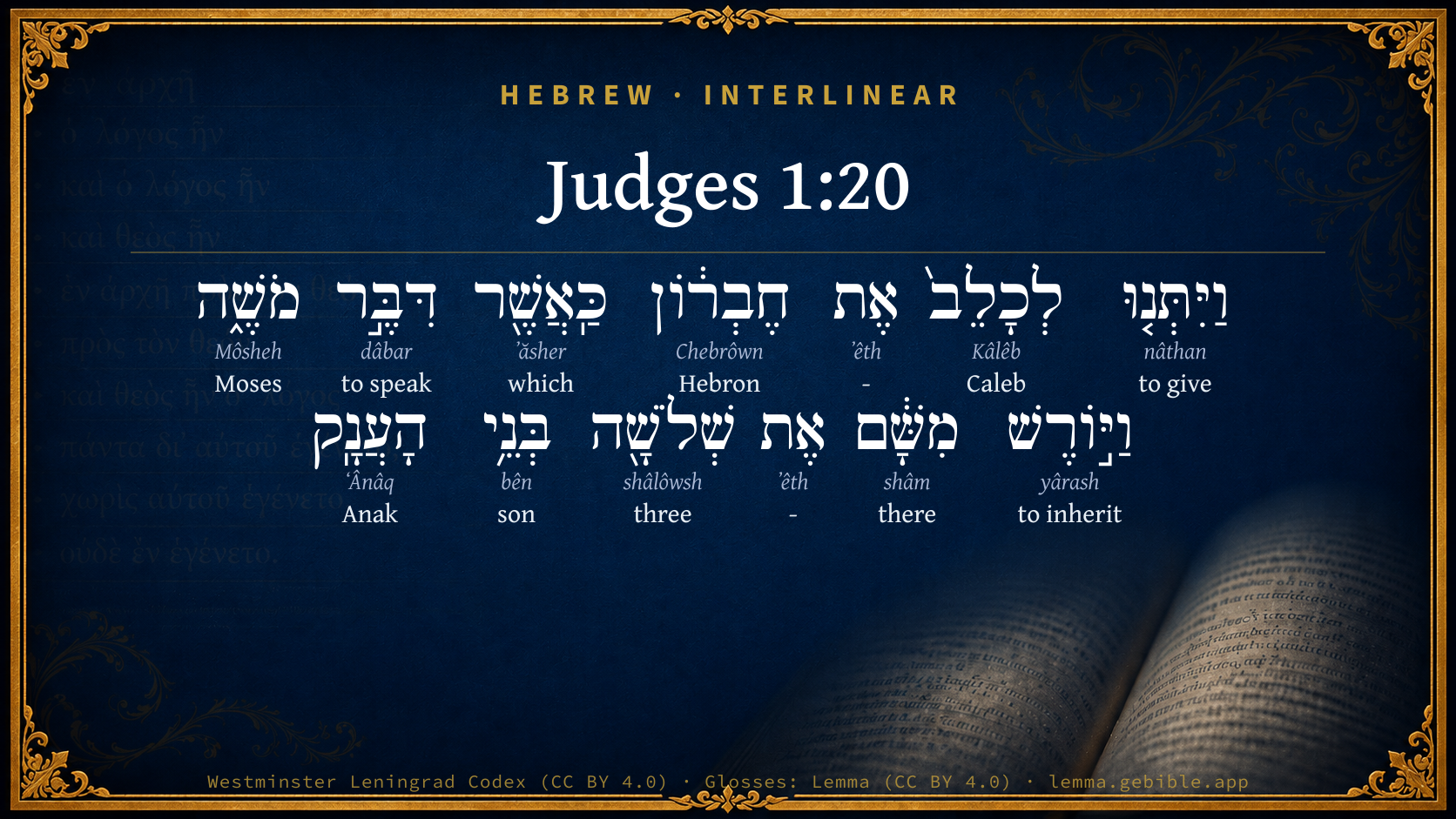
Hebrew (Westminster Leningrad Codex) Judges 1:20 appears in the Hebrew Old Testament. The text above is from the Westminster Leningrad Codex. Each word links to its Strong’s number, a concise gloss, and parsing drawn from the Open Scriptures Hebrew Bible morphology. Click any word for its full Brown-Driver-Briggs (BDB) entry.
Download image
Cite this verse

Judges 1:20 (World English Bible). Public Domain. Lemma interlinear Bible study tool, https://lemma.gebible.app/v/judges/1/20.

Show BibTeX & RIS
BibTeX
RIS
English Translation
They gave Hebron to Caleb, as Moses had spoken: and he drove out there the three sons of Anak.
World English Bible · Public Domain
Download a study sheet

One document with this verse’s original text, its word-by-word gloss line, the meaning frame, cross-references with their text, attributed commentary, and full source and license credits — printable, and it pastes into notes with its structure intact.

This verse Autodidact and up

Study sheet (.html) Plain text (.txt)

A passage Seminary Student

Up to 50 verses in one chapter. A passage sheet keeps up to 6 commentary sources and 12 cross-references per verse, in the order this page ranks them, and says so on the sheet whenever that leaves anything out. Ask for a single verse and you get the Autodidact verse sheet above.

Everything on this page stays free to read, with no account — the sheet is a download of what is already on screen, not access to it.

Want to remove ads? Support Godless Engineer
Compare translations 3

The same verse in 3 English versions, stacked beneath the original-language interlinear above. Click any original word for its lexicon entry.

Each is an independent rendering of the whole verse — the interlinear is not word-aligned to these translations.

Highlighted words mark where these versions differ — a whole-verse word diff, not a word-by-word alignment.

  • World English Bible Public Domain
    They gave Hebron to Caleb, as Moses had spoken: and he drove out there the three sons of Anak.
  • King James Version Public Domain
    And they gave Hebron unto Caleb, as Moses said: and he expelled thence the three sons of Anak.
  • unfoldingWord Literal Text CC BY-SA 4.0
    But they gave Hebron to Caleb, according to what Moses had spoken, and he dispossessed from there the three sons of the Anak.

unfoldingWord Literal Text — © unfoldingWord, licensed CC BY-SA 4.0. Word-aligned USFM3 via Door43 (git.door43.org/unfoldingWord/en_ult).

Versions to compare (up to 4)

3 of 4 selected

Show all 18 translations

Every available English version of this verse, each an independent rendering of the whole verse.

  • World English Bible Public Domain
    They gave Hebron to Caleb, as Moses had spoken: and he drove out there the three sons of Anak.
  • Berean Standard Bible Public Domain
    Just as Moses had promised, Judah gave Hebron to Caleb, who drove out the descendants of the three sons of Anak.
  • Majority Standard Bible Public Domain
    Just as Moses had promised, Judah gave Hebron to Caleb, who drove out the descendants of the three sons of Anak.
  • King James Version Public Domain
    And they gave Hebron unto Caleb, as Moses said: and he expelled thence the three sons of Anak.
  • American Standard Version (1901) Public Domain
    And they gave Hebron unto Caleb, as Moses had spoken: and he drove out thence the three sons of Anak.
  • Revised Version (1885) Public Domain
    And they gave Hebron unto Caleb, as Moses had spoken: and he drave out thence the three sons of Anak.
  • Geneva Bible (1599) Public Domain
    And they gaue Hebron vnto Caleb, as Moses had saide, and hee expelled thence the three sonnes of Anak.
  • Douay-Rheims (1899) Public Domain
    And they gave Hebron to Caleb, as Moses had said, who destroyed out of it the three sons of Enac.
  • Young's Literal Translation Public Domain
    And they give to Caleb Hebron, as Moses hath spoken, and he dispossesseth thence the three sons of Anak.
  • Literal Standard Version CC BY-SA 4.0
    And they give Hebron to Caleb, as Moses has spoken, and he dispossesses the three sons of Anak there.
  • Unlocked Literal Bible CC BY-SA 4.0
    Hebron was given to Caleb (like Moses had said), and he drove out from there the three sons of Anak.
  • unfoldingWord Literal Text CC BY-SA 4.0
    But they gave Hebron to Caleb, according to what Moses had spoken, and he dispossessed from there the three sons of the Anak.
  • Darby Bible Public Domain
    And Hebron was given to Caleb, as Moses had said; and he drove out from it the three sons of Anak.
  • World Messianic Bible Public Domain
    They gave Hebron to Caleb, as Moses had said, and he drove the three sons of Anak out of there.
  • Webster's Bible Public Domain
    And they gave Hebron to Caleb, as Moses said: and he expelled thence the three sons of Anak.
  • Free Bible Version CC BY-SA 4.0
    As Moses had stipulated, Hebron was given to Caleb, who drove out from it the descendants of three sons of Anak.
  • Bible in Basic English Public Domain
    And they gave Hebron to Caleb, as Moses had said; and he took the land of the three sons of Anak, driving them out from there.
  • JPS Tanakh (1917) Public Domain
    And they gave Hebron unto Caleb, as Moses had spoken; and he drove out thence the three sons of Anak.

Literal Standard Version (2020), Covenant Press — licensed CC BY-SA 4.0. Text via the HelloAO Bible API (eBible.org). Unlocked Literal Bible (unfoldingWord) — licensed CC BY-SA 4.0. Text via the HelloAO Bible API (eBible.org). unfoldingWord Literal Text — © unfoldingWord, licensed CC BY-SA 4.0. Word-aligned USFM3 via Door43 (git.door43.org/unfoldingWord/en_ult). Free Bible Version, Dr. Jonathan Gallagher — licensed CC BY-SA 4.0. Text via the HelloAO Bible API (eBible.org).

Word by word

More ways to search: Search by grammar → Find every occurrence → Compare this word →

Practice this passage: Drill this verse → Learn its vocabulary →

הָעֲנָֽק
ʻÂnâq
H6061
“the · Anak”
Particle, Definite Article + Noun, Proper
Part of Speech
Particle + Noun
Type
Proper
Full BDB Definition

Origin: the same as H6060

TWOT: None

Anak = "neck" - progenitor of a family, or tribe of the giant people in Canaan
  1. וַיִּתְּנ֤וּ nâthan H5414 “and · to give” Conjunction + Verb, Qal, Sequential Imperfect, 3rd Person, Masculine, Plural
  2. לְכָלֵב֙ Kâlêb H3612 “to/for · Caleb” Preposition + Noun, Proper
  3. אֶת ʼêth H853 “-” Particle, Direct Object
  4. חֶבְר֔וֹן Chebrôwn H2275 “Hebron” Noun, Proper
  5. כַּֽאֲשֶׁ֖ר ʼăsher H834 “like/as · which” Preposition + Particle, Relative
  6. דִּבֶּ֣ר dâbar H1696 “to speak” Verb, Piel, Perfect, 3rd Person, Masculine, Singular
  7. מֹשֶׁ֑ה Môsheh H4872 “Moses” Noun, Proper
  8. וַיּ֣וֹרֶשׁ yârash H3423 “and · to inherit” Conjunction + Verb, Hiphil, Sequential Imperfect, 3rd Person, Masculine, Singular
  9. מִשָּׁ֔ם shâm H8033 “from · there” Preposition + Adverb
  10. אֶת ʼêth H853 “-” Particle, Direct Object
  11. שְׁלֹשָׁ֖ה shâlôwsh H7969 “three” Adjective, Cardinal number, Masculine, Singular, Absolute
  12. בְּנֵ֥י bên H1121 “sons of” Noun, Common, Masculine, Plural, Construct

About this verse

These counts appear in no published source. They are computed here, from the morphology-tagged text and Lemma’s own curated glosses. What Lemma adds →

13
words
12
distinct lemmas
Historical
section

Notable vocabulary

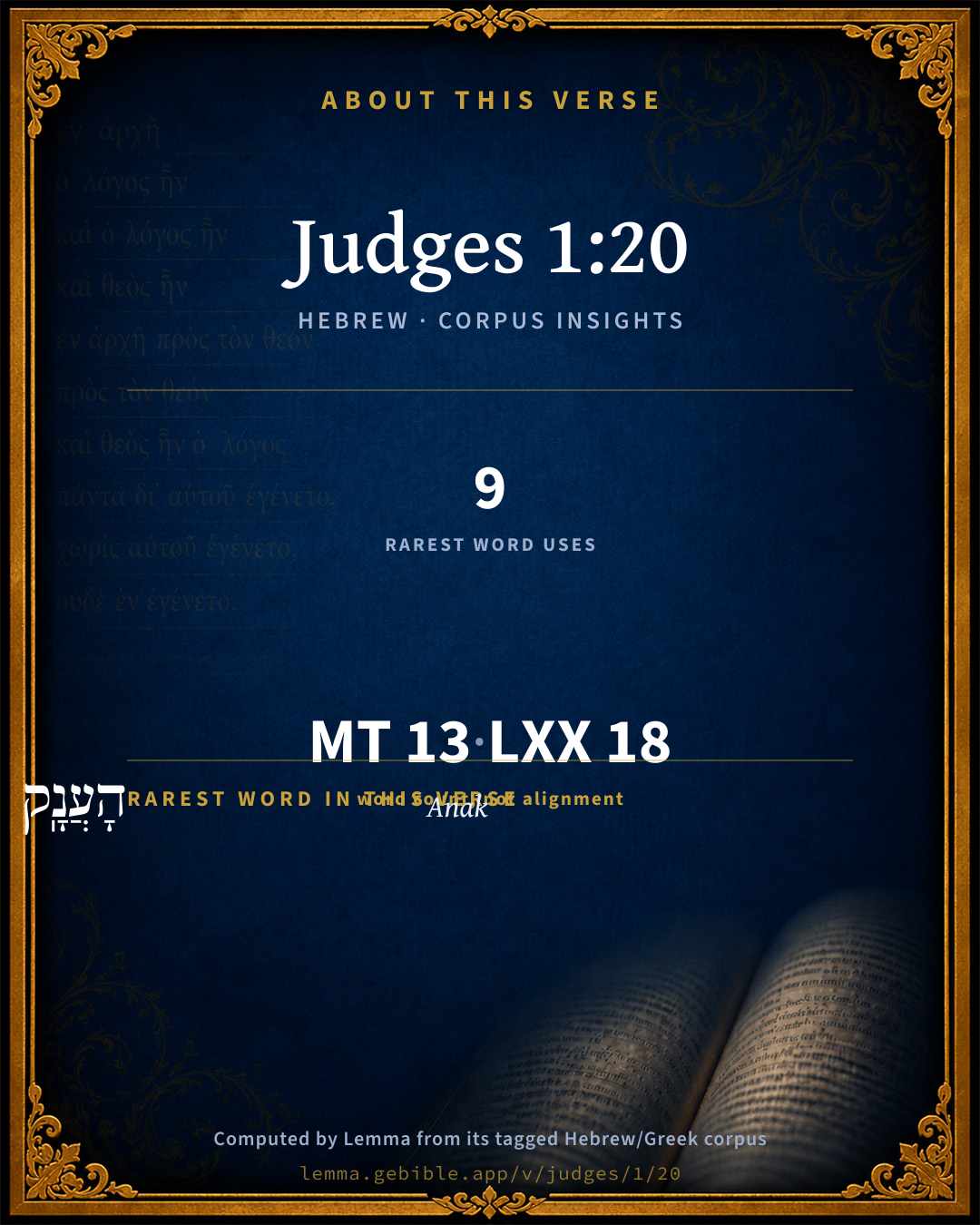
The rarest word here is הָעֲנָֽק Anak H6061 — appearing just 9 times in the whole Hebrew Bible.

Shared distinctive vocabulary

הָעֲנָֽק Anak H6061 occurs in 8 verses of the Hebrew Bible. Also found in:

Grammatical profile

  • 3 verbs
  • 5 nouns
  • 1 adjective
  • 1 adverb
  • 3 particles

Verb forms

  • וַיִּתְּנ֤וּ Qal · Sequential Imperfect
  • דִּבֶּ֣ר Piel · Perfect
  • וַיּ֣וֹרֶשׁ Hiphil · Sequential Imperfect

Hebrew & Septuagint length

In English translation the verse runs 19 words from the Hebrew and 21 from the Septuagint (LXX English) — closely comparable.

A rough comparison of the two English renderings, which tokenize alike — not a word-level alignment.

Word counts can differ between the Hebrew and the Greek without any difference in meaning — e.g. the Hebrew direct-object marker אֵת has no separate Greek word, and Greek often adds the article ὁ.

In the original languages it is 13 Hebrew tokens and 18 Greek tokens — but the two are counted differently (Hebrew bundles its prefixes and suffixes into one token; the Greek is in lemma form), so that isn’t a like-for-like length.

Cross-references

7

Topical passages linked to Judges 1:20 in the Treasury of Scripture Knowledge — connected by theme and wording, ordered by reader-vote popularity; previews shown in the World English Bible.

  • Judges 1:10 Judah went against the Canaanites who lived in Hebron (now the name of Hebron before was Kiriath Arba); and they struck Sheshai, and Ahiman, and Talmai.
  • Numbers 14:24 but my servant Caleb, because he had another spirit with him, and has followed me fully, him will I bring into the land into which he went; and his seed shall possess it.
  • Deuteronomy 1:36 save Caleb the son of Jephunneh: he shall see it; and to him will I give the land that he has trodden on, and to his children, because he has wholly followed Yahweh.
  • Joshua 15:13–14 To Caleb the son of Jephunneh he gave a portion among the children of Judah, according to the commandment of Yahweh to Joshua, even Kiriath Arba, [which Arba was] the father of Anak (the same is Hebron).
  • Numbers 13:22 They went up by the South, and came to Hebron; and Ahiman, Sheshai, and Talmai, the children of Anak, were there. (Now Hebron was built seven years before Zoan in Egypt.)
  • Joshua 14:9–14 Moses swore on that day, saying, Surely the land whereon your foot has trodden shall be an inheritance to you and to your children forever, because you have wholly followed Yahweh my God.
  • Joshua 21:11–12 They gave them Kiriath Arba, [which Arba was] the father of Anak (the same is Hebron), in the hill-country of Judah, with the suburbs of it round about it.

Cross-references courtesy of OpenBible.info (CC BY 4.0).

Hebrew and Greek witnesses Masoretic Hebrew ↔ Greek Septuagint

The same verse in the two great witnesses to the Old Testament, shown verse-for-verse.

These are two independent witnesses, not word-aligned to each other, and the Septuagint is shown in lemma (dictionary) form.

Hebrew Judges 1:20 Masoretic · Westminster Leningrad Codex

וַיִּתְּנ֤וּ לְכָלֵב֙ אֶת חֶבְר֔וֹן כַּֽאֲשֶׁ֖ר דִּבֶּ֣ר מֹשֶׁ֑ה וַיּ֣וֹרֶשׁ מִשָּׁ֔ם אֶת שְׁלֹשָׁ֖ה בְּנֵ֥י הָעֲנָֽק

They gave Hebron to Caleb, as Moses had spoken: and he drove out there the three sons of Anak.

World English Bible · Public Domain

Greek LXX Judges 1:20 Septuagint · lemma form

καί δίδωμι ὁ χαλεβ ὁ χεβρων καθώς λαλέω μωυσῆς καί κληρονομέω ἐκεῖθεν ὁ τρεῖς πόλις ὁ υἱός ενακ

And they gave Chebron to Chaleb, as Moses said; and thence he inherited the three cities of the children of Enac.

LXX2012 (modern English Septuagint) · Public Domain

On this verse, Haydock's Catholic Bible Commentary discusses the Septuagint’s reading. Read the note in Commentary ↓

Hebrew: Westminster Leningrad Codex (CC BY 4.0). Greek: Septuagint (public domain); English from LXX2012 (modern English Septuagint) (Public Domain). How the Septuagint differs from the Hebrew →

Targum (Aramaic paraphrase)

1

The Targum is the ancient Jewish Aramaic paraphrase of the Hebrew Scriptures — an interpretive translation, not the Hebrew text itself. Onkelos (literal) and Pseudo-Jonathan (expansive) render the Torah, and Jonathan the Prophets. Coverage is partial: where no permissively-licensed English translation exists for a verse, only the Aramaic is shown. This is verse-level text, not a word-by-word alignment to the Hebrew.

  1. Targum Jonathan Prophets (Joshua–Malachi)
    וִיהַבוּ לְכָלֵב יַת חֶבְרוֹן כְּמָא דְמַלֵיל מֹשֶׁה וְתָרֵיךְ מִתַּמָן יַת תְּלָתָא בְּנֵי גִבָּרַיָא:

    (no public-domain English translation for this verse)

    Targum Jonathan — Aramaic: “Mikraot Gedolot” (public domain). English: “Sefaria Community Translation” (CC0 1.0 (public-domain dedication)); “London "Chaldee Paraphrase," 1871” (public domain). Text via Sefaria.

Commentary

Notes on Judges 1:20 from classic Christian and Jewish commentators (each source and its license shown beneath its notes). The classic Christian expositions comment on the surrounding passage and are grouped to its opening verse, so a note may address several verses; the Jewish commentaries on the Tanakh (Rashi and others) are per-verse, so they appear only where the commentator wrote on this verse.

Lemma curates 59 commentaries, every one of them public domain or Creative Commons licensed, each selected and text-cleaned for this edition rather than reprinted as found. About our sources →

Trapp's Complete Commentary

John Trapp

Jdg 1:20 And they gave Hebron unto Caleb, as Moses said: and he expelled thence the three sons of Anak.

Ver. 20. And they gave Hebron.] See Jos 14:6-7. {See Trapp on "Jos 14:6"} {See Trapp on "Jos 14:7"}

20 But ye, beloved, building up yourselves on your most holy faith, praying in the Holy Ghost,

Ver. 20. Building up] By holy conference, a singular help, a most needful but too much neglected duty.

Praying in the Holy Ghost] Whose creature fervent prayer is.

John Trapp, A Commentary or Exposition upon All the Books of the Old and New Testament (1647–1656) — public domain. Text from a community e-Sword module.

Matthew Poole's English Annotations

Above mentioned Jdg 1:20

Matthew Poole's English Annotations on the Holy Bible (1683–1685) — public domain. Text from a community e-Sword/MySword module.

Whedon's Commentary on the Bible

Daniel D. Whedon

EXPLOITS OF CALEB, AND COWARDICE OF BENJAMIN, Jdg_1:20-21.

20. Hebron — For the allotment of this city to Caleb, see Jos_15:13-14, notes. The account is repeated here as a contrast to the pusillanimity of Benjamin, who, in permitting the Jebusites to hold Jerusalem, failed to accomplish a much less difficult task than the expulsion of the terrible Anakim from Hebron. Its repetition in this connexion may also contain the thought that it was only after Judah had conquered and taken possession of his territory that Caleb could quietly enjoy his possession of Hebron.

Daniel D. Whedon (gen. ed.), Commentary on the Old and New Testaments (1874–1909) — public domain. Text from a community e-Sword module.

Adam Clarke's Commentary

Verse 20. They gave Hebron unto Caleb] See this whole transaction explained Jos 14:12, &c.

Adam Clarke's Commentary on the Bible (1810–1826) — public domain. Text from a community e-Sword/MySword module.

Ellicott's Commentary for English Readers

(20) Hebron.—See Jos_14:12-15; Jos_15:13-14.

As Moses said.—Num_14:21.

It is remarkable that after this time Judah is only mentioned in Jdg_10:9; Jdg_15:10; Jdg_20:18. The tribe produced no judge, with the possible exception of Ibzan (see Jdg_12:8), nor is it mentioned in the song of Deborah. Perhaps we may see a reason for this in the strength which had won for Judah so secure a position. On the other hand, their conduct towards Samson was of the most abject kind (Jdg_15:13). “As the nation gained in settled position and command of the soil it lost in unity and strength of external action. Each tribe looked out for itself” (Ewald, ii. 264).

A Bible Commentary for English Readers, edited by Charles John Ellicott (1878–1897) — public domain. Text from a community e-Sword module.

The Cambridge Bible for Schools and Colleges

gen. ed. J. J. S. Perowne

20. See the note on Jdg_1:10.

as Moses had spoken] Num_14:24 JE; cf. Deu_1:36, Jos_14:6-15 D.

the three sons of Anak] lit. of the Anak; the article shews that the noun is to be taken as a collective, i.e. as the name, not of an individual but of a tribe of people: similarly in Jos_15:13. These Anâkites, or (long-)necked people, were a race of very tall men, for centuries remembered by the Hebrews, Deu_1:28; Deu_9:2; they were specially associated with Hebron, Jos_11:21; Jos_14:12; Jos_14:15.

The Cambridge Bible for Schools and Colleges (gen. ed. J. J. S. Perowne; Cambridge University Press, 1878–1918) — public domain. Text from a community e-Sword module.

John Gill's Exposition

And they gave Hebron unto Caleb, as Moses said,.... Which was done in the times of Joshua, both by him and all the people, according to the order of Moses. This is to be understood not of the city which was given to the Levites, but of the fields and parts adjacent, Jos 14:13,

and he expelled thence the three sons of Anak: whose names are given Jdg 1:10; this shows that this refers to the same expedition as in Jos 15:14; and is expressed in the same manner.

John Gill's Exposition of the Whole Bible (1746–1763) — public domain (CC PDM 1.0). Text via the HelloAO Bible API.

Haydock's Catholic Bible Commentary

Enac, mentioned [in] ver. 10. Septuagint add, that "he took the three cities....and destroyed," &c. See Josue xv. 14. (Haydock)

George Leo Haydock (1774–1849), Haydock's Catholic Family Bible and Commentary, 1859 edition — public domain. Excludes Psalms (Douay-Rheims chapter numbering differs from Protestant) and Deuterocanonical books (Catholic canon only).

The Pulpit Commentary

They gave Hebron, etc. Caleb, the son of Jephunneh, the Kenezite, an Edomitish tribe, was one of the spies sent up to spy the land, and in doing so he came to Hebron, and there saw the giants, the sons of. (Num_13:22) When all the spies brought up an evil report of the land, and by doing so raised a rebellion against Moses and Aaron, Caleb the Kenezite, alone with Joshua, stood firm, and, as a reward of his faithfulness, received the promise that he and his seed should possess the land on which his feet had trodden. Accordingly Hebron became the inheritance of Caleb the Kenezite. (see Nu 13 Nu 14 Deu_1:36 Jos_14:6-15 Jos_15:13, Jos_15:14)

The Pulpit Commentary (1880–1919), ed. H.D.M. Spence-Jones & Joseph S. Exell — public domain. Text from a community e-Sword module.

unfoldingWord translationNotes

Door43 World Missions Community

Hebron was given to Caleb (like Moses had said)

This can be stated in active form. AT: "Moses had given Hebron to Caleb" (See: Active or Passive)

three sons of Anak

The leaders of the people groups are used to refer to the entire group. AT: "three sons of Anak and their people" (See: Synecdoche)

Anak

This is the name of a man. Anak and his descendants were famous for being very tall. (See: How to Translate Names)

to this day

"until now." This refers to the time the book of Judges was written.

translationWords

Hebron

Caleb

Moses

cast out

people group

Benjamin

Jebus

Jerusalem

unfoldingWord translationNotes — © Distant Shores Media and the Door43 World Missions Community, licensed CC BY-SA 4.0. Source: git.door43.org/Door43/en_tn.

Lesson kit

Teaching starters — assembled from the data on this page, not authored interpretation. Every prompt links to the verse data it draws on. Edit before teaching.

Judges, in the Historical, opens this verse with 13 words (12 distinct Hebrew lemmas). Its most distinctive word is ʻÂnâq (“Anak”). A historical commentator’s framing appears above. Read the whole chapter for the surrounding context.

Discussion questions

  1. What does “Anak” (ʻÂnâq) contribute to the verse as a whole?
  2. How does Numbers 13:22, which shares the word «Anak», read alongside this verse?
  3. The translations on this page render this verse differently — a whole-verse word diff, not a word-by-word alignment. What might account for the different wordings?
  4. «וַיִּתְּנ֤וּ» is a Qal Sequential Imperfect verb. How does that grammatical form shape the action described?
  5. Compare how Trapp's Complete Commentary and Matthew Poole's English Annotations read this verse. Where do they agree or differ?

Things to notice

Reading settings

Reading text

Shown beneath each verse's original-language words.

Old Testament
Old Testament edition

Read the OT as the Masoretic Hebrew (MT) or the Greek Septuagint (LXX).

English shown for the Greek Septuagint (in the Hebrew ↔ Greek comparison).

Comparing translations? Open the Compare panel on any verse page to stack up to four side by side.