1 Samuel 20:26

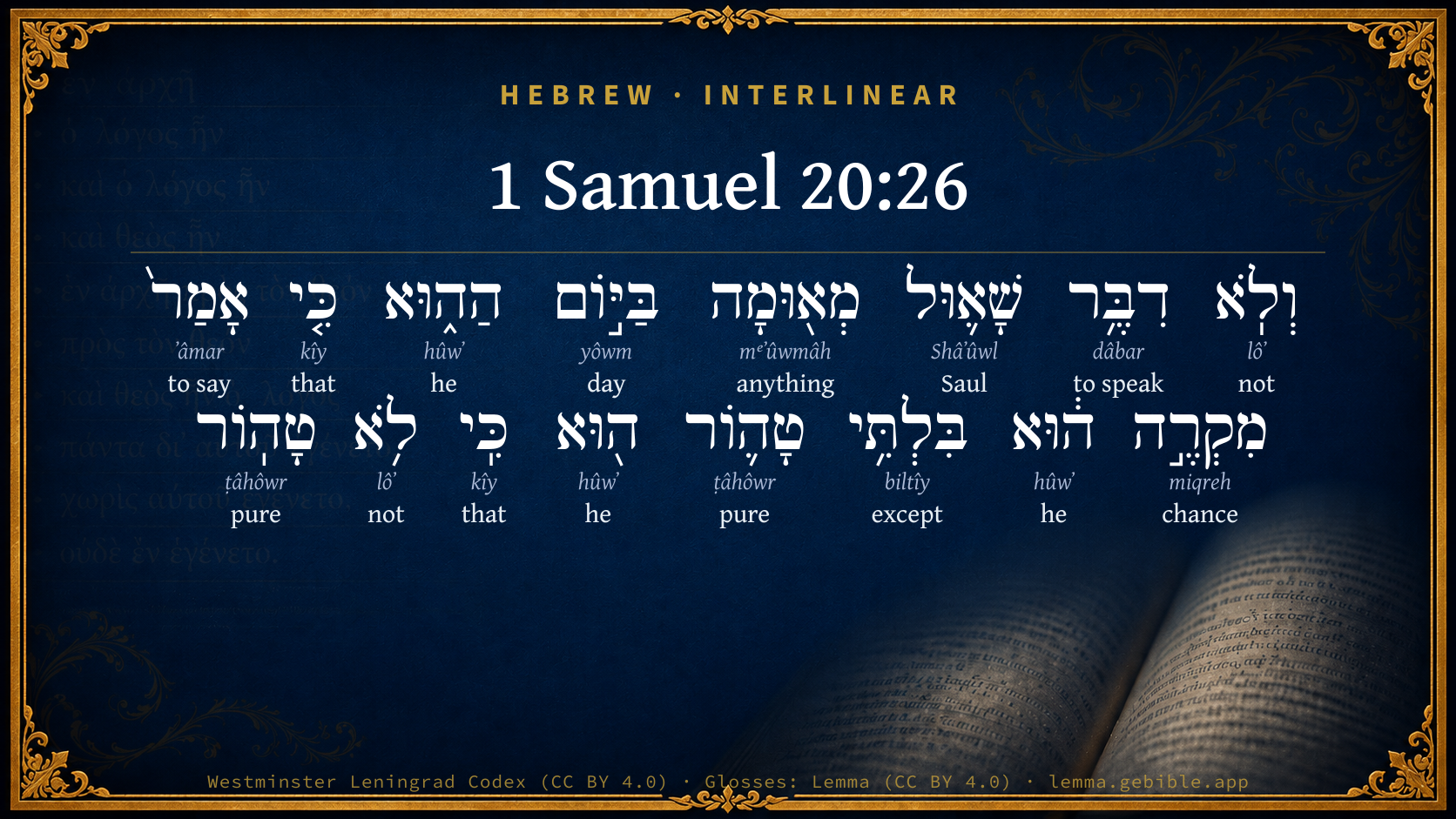
Hebrew (Westminster Leningrad Codex) 1 Samuel 20:26 appears in the Hebrew Old Testament. The text above is from the Westminster Leningrad Codex. Each word links to its Strong’s number, a concise gloss, and parsing drawn from the Open Scriptures Hebrew Bible morphology. Click any word for its full Brown-Driver-Briggs (BDB) entry.
Download image
Cite this verse

1 Samuel 20:26 (World English Bible). Public Domain. Lemma interlinear Bible study tool, https://lemma.gebible.app/v/1-samuel/20/26.

Show BibTeX & RIS
BibTeX
RIS
English Translation
Nevertheless Saul didn't say anything that day: for he thought, Something has happened to him. He is not clean. Surely he is not clean.
World English Bible · Public Domain
Download a study sheet

One document with this verse’s original text, its word-by-word gloss line, the meaning frame, cross-references with their text, attributed commentary, and full source and license credits — printable, and it pastes into notes with its structure intact.

This verse Autodidact and up

Study sheet (.html) Plain text (.txt)

A passage Seminary Student

Up to 50 verses in one chapter. A passage sheet keeps up to 6 commentary sources and 12 cross-references per verse, in the order this page ranks them, and says so on the sheet whenever that leaves anything out. Ask for a single verse and you get the Autodidact verse sheet above.

Everything on this page stays free to read, with no account — the sheet is a download of what is already on screen, not access to it.

Want to remove ads? Support Godless Engineer
Compare translations 3

The same verse in 3 English versions, stacked beneath the original-language interlinear above. Click any original word for its lexicon entry.

Each is an independent rendering of the whole verse — the interlinear is not word-aligned to these translations.

Highlighted words mark where these versions differ — a whole-verse word diff, not a word-by-word alignment.

  • World English Bible Public Domain
    Nevertheless Saul didn't say anything that day: for he thought, Something has happened to him. He is not clean. Surely he is not clean.
  • King James Version Public Domain
    Nevertheless Saul spake not any thing that day: for he thought, Something hath befallen him, he is not clean; surely he is not clean.
  • unfoldingWord Literal Text CC BY-SA 4.0
    But Saul did not say anything on that day, for he said, “It an accident. He not clean, surely not clean.”

unfoldingWord Literal Text — © unfoldingWord, licensed CC BY-SA 4.0. Word-aligned USFM3 via Door43 (git.door43.org/unfoldingWord/en_ult).

Versions to compare (up to 4)

3 of 4 selected

Show all 18 translations

Every available English version of this verse, each an independent rendering of the whole verse.

  • World English Bible Public Domain
    Nevertheless Saul didn't say anything that day: for he thought, Something has happened to him. He is not clean. Surely he is not clean.
  • Berean Standard Bible Public Domain
    Saul said nothing that day because he thought, “Something has happened to David to make him ceremonially unclean—surely he is unclean.”
  • Majority Standard Bible Public Domain
    Saul said nothing that day because he thought, “Something has happened to David to make him ceremonially unclean—surely he is unclean.”
  • King James Version Public Domain
    Nevertheless Saul spake not any thing that day: for he thought, Something hath befallen him, he is not clean; surely he is not clean.
  • American Standard Version (1901) Public Domain
    Nevertheless Saul spake not anything that day: for he thought, Something hath befallen him, he is not clean; surely he is not clean.
  • Revised Version (1885) Public Domain
    Nevertheless Saul spake not any thing that day: for he thought, Something hath befallen him, he is not clean; surely he is not clean.
  • Geneva Bible (1599) Public Domain
    And Saul sayde nothing that day: for hee thought, Some thing hath befallen him, though he were cleane, or els becaus he was not purified.
  • Douay-Rheims (1899) Public Domain
    And Saul said nothing that day, for he thought it might have happened to him, that he was not clean, nor purified.
  • Young's Literal Translation Public Domain
    And Saul hath not spoken anything on that day, for he said, `It `is' an accident; he is not clean -- surely not clean.'
  • Literal Standard Version CC BY-SA 4.0
    And Saul has not spoken anything on that day, for he said, “It [is] an accident; he is not clean—surely not clean.”
  • Unlocked Literal Bible CC BY-SA 4.0
    Yet Saul did not say anything that day, because he thought, “Something has happened to him. He is not clean; surely he is not clean.”
  • unfoldingWord Literal Text CC BY-SA 4.0
    But Saul did not say anything on that day, for he said, “It an accident. He not clean, surely not clean.”
  • Darby Bible Public Domain
    And Saul said nothing that day; for he thought, Something has befallen [him], that he is not clean: surely he is not clean.
  • World Messianic Bible Public Domain
    Nevertheless Saul didn’t say anything that day, for he thought, “Something has happened to him. He is not clean. Surely he is not clean.”
  • Webster's Bible Public Domain
    Nevertheless Saul spoke not any thing that day: for he thought, Something hath befallen him, he is not clean; surely he is not clean.
  • Free Bible Version CC BY-SA 4.0
    Saul didn't say anything that day because he thought, “Something has probably happened to David to make him ceremonially unclean—yes, he must be unclean.”
  • Bible in Basic English Public Domain
    But Saul said nothing that day, for his thought was, Something has taken place making him unclean; it is clear that he is not clean.
  • JPS Tanakh (1917) Public Domain
    Nevertheless Saul spoke not any thing that day; for he thought: 'Something hath befallen him, he is unclean; surely he is not clean.'

Literal Standard Version (2020), Covenant Press — licensed CC BY-SA 4.0. Text via the HelloAO Bible API (eBible.org). Unlocked Literal Bible (unfoldingWord) — licensed CC BY-SA 4.0. Text via the HelloAO Bible API (eBible.org). unfoldingWord Literal Text — © unfoldingWord, licensed CC BY-SA 4.0. Word-aligned USFM3 via Door43 (git.door43.org/unfoldingWord/en_ult). Free Bible Version, Dr. Jonathan Gallagher — licensed CC BY-SA 4.0. Text via the HelloAO Bible API (eBible.org).

Word by word

More ways to search: Search by grammar → Find every occurrence → Compare this word →

Practice this passage: Drill this verse → Learn its vocabulary →

מִקְרֶ֣ה
miqreh
H4745
“chance”
Noun, Common, Masculine, Singular, Absolute
Part of Speech
Noun
Type
Common
Gender
Masculine
Number
Singular
State
Absolute
Full BDB Definition

Origin: from H7136

TWOT: 2068c

unforeseen meeting or event, accident, happening, chance, fortune - accident, chance - fortune, fate
  1. וְלֹֽא lôʼ H3808 “and · not” Conjunction + Particle, Negative
  2. דִבֶּ֥ר dâbar H1696 “to speak” Verb, Piel, Perfect, 3rd Person, Masculine, Singular
  3. שָׁא֛וּל Shâʼûwl H7586 “Saul” Noun, Proper
  4. מְא֖וּמָה mᵉʼûwmâh H3972 “anything” Noun, Common, Feminine, Singular, Absolute
  5. בַּיּ֣וֹם yôwm H3117 “in/at the · day” Preposition, Determined + Noun, Common, Masculine, Singular, Absolute
  6. הַה֑וּא hûwʼ H1931 “the · he” Particle, Definite Article + Pronoun, Personal, 3rd Person, Masculine, Singular
  7. כִּ֤י kîy H3588 “that” Conjunction
  8. אָמַר֙ ʼâmar H559 “to say” Verb, Qal, Perfect, 3rd Person, Masculine, Singular
  9. ה֔וּא hûwʼ H1931 “he” Pronoun, Personal, 3rd Person, Masculine, Singular
  10. בִּלְתִּ֥י biltîy H1115 “except” Conjunction
  11. טָה֛וֹר ṭâhôwr H2889 “pure” Adjective, Adjective, Masculine, Singular, Absolute
  12. ה֖וּא hûwʼ H1931 “he” Pronoun, Personal, 3rd Person, Masculine, Singular
  13. כִּֽי kîy H3588 “that” Conjunction
  14. לֹ֥א lôʼ H3808 “not” Particle, Negative
  15. טָהֽוֹר ṭâhôwr H2889 “pure” Adjective, Adjective, Masculine, Singular, Absolute

About this verse

These counts appear in no published source. They are computed here, from the morphology-tagged text and Lemma’s own curated glosses. What Lemma adds →

16
words
11
distinct lemmas
Historical
section

Notable vocabulary

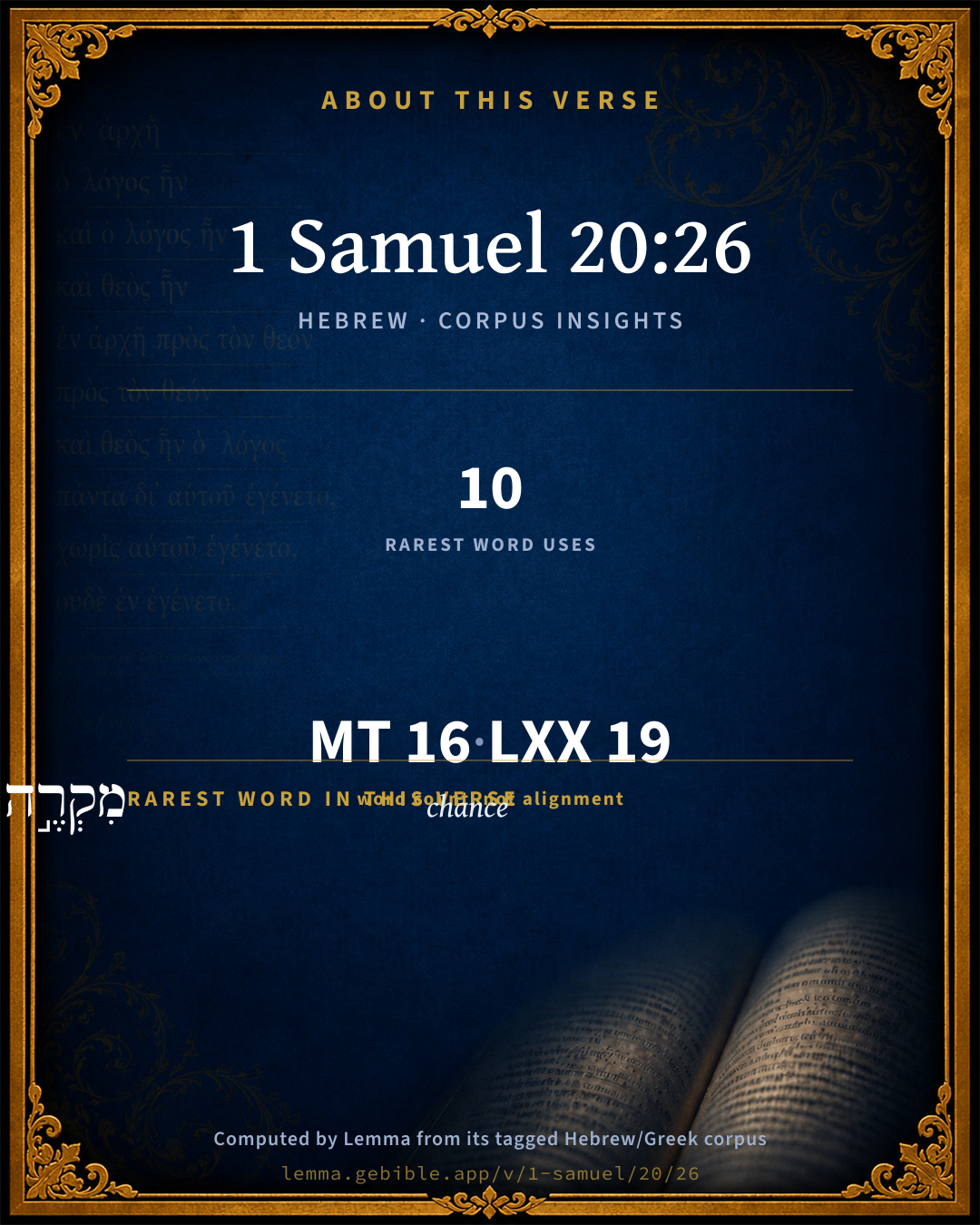
The rarest word here is מִקְרֶ֣ה chance H4745 — appearing just 10 times in the whole Hebrew Bible.

Shared distinctive vocabulary

מִקְרֶ֣ה chance H4745 occurs in 8 verses of the Hebrew Bible. Also found in:

Grammatical profile

  • 2 verbs
  • 4 nouns
  • 2 adjectives
  • 3 pronouns
  • 3 conjunctions
  • 2 particles

Verb forms

  • דִבֶּ֥ר Piel · Perfect
  • אָמַר֙ Qal · Perfect

Repetition

Words recur within this verse — often emphatic in Hebrew:

  • טָה֛וֹר pure H2889 ×2
  • הַה֑וּא he H1931 ×3
  • וְלֹֽא not H3808 ×2
  • כִּ֤י that H3588 ×2

Hebrew & Septuagint length

In English translation the verse runs 24 words from the Hebrew and 27 from the Septuagint (LXX English) — closely comparable.

A rough comparison of the two English renderings, which tokenize alike — not a word-level alignment.

Word counts can differ between the Hebrew and the Greek without any difference in meaning — e.g. the Hebrew direct-object marker אֵת has no separate Greek word, and Greek often adds the article ὁ.

In the original languages it is 16 Hebrew tokens and 19 Greek tokens — but the two are counted differently (Hebrew bundles its prefixes and suffixes into one token; the Greek is in lemma form), so that isn’t a like-for-like length.

Cross-references

10

Topical passages linked to 1 Samuel 20:26 in the Treasury of Scripture Knowledge — connected by theme and wording, ordered by reader-vote popularity; previews shown in the World English Bible.

  • Leviticus 15:5 Whoever touches his bed shall wash his clothes, and bathe himself in water, and be unclean until the evening.
  • Leviticus 11:24 "'By these you will become unclean: whoever touches the carcass of them shall be unclean until the evening.
  • Leviticus 11:27 Whatever goes on its paws, among all animals that go on all fours, they are unclean to you. Whoever touches their carcass shall be unclean until the evening.
  • Leviticus 7:20–21 but the soul who eats of the flesh of the sacrifice of peace offerings, that belongs to Yahweh, having his uncleanness on him, that soul shall be cut off from his people.
  • Leviticus 11:31 These are they which are unclean to you among all that creep. Whoever touches them when they are dead, shall be unclean until the evening.
  • Leviticus 11:40 He who eats of its carcass shall wash his clothes, and be unclean until the evening. He also who carries its carcass shall wash his clothes, and be unclean until the evening.
  • Leviticus 15:16–17 "'If any man has an emission of semen, then he shall bathe all his flesh in water, and be unclean until the evening.
  • Leviticus 15:19–21 "'If a woman has a discharge, and her discharge in her flesh is blood, she shall be in her impurity seven days: and whoever touches her shall be unclean until the evening.
  • Numbers 19:16 Whoever in the open field touches one who is slain with a sword, or a dead body, or a bone of a man, or a grave, shall be unclean seven days.
  • 1 Samuel 16:5 He said, Peaceably; I am come to sacrifice to Yahweh: sanctify yourselves, and come with me to the sacrifice. He sanctified Jesse and his sons, and called them to the sacrifice.

Cross-references courtesy of OpenBible.info (CC BY 4.0).

Hebrew and Greek witnesses Masoretic Hebrew ↔ Greek Septuagint

The same verse in the two great witnesses to the Old Testament, shown verse-for-verse.

These are two independent witnesses, not word-aligned to each other, and the Septuagint is shown in lemma (dictionary) form.

Hebrew 1 Samuel 20:26 Masoretic · Westminster Leningrad Codex

וְלֹֽא דִבֶּ֥ר שָׁא֛וּל מְא֖וּמָה בַּיּ֣וֹם הַה֑וּא כִּ֤י אָמַר֙ מִקְרֶ֣ה ה֔וּא בִּלְתִּ֥י טָה֛וֹר ה֖וּא כִּֽי לֹ֥א טָהֽוֹר

Nevertheless Saul didn't say anything that day: for he thought, Something has happened to him. He is not clean. Surely he is not clean.

World English Bible · Public Domain

Greek LXX 1 Samuel 20:26 Septuagint · lemma form

καί οὐ λαλέω σαούλ οὐδείς ἐν ὁ ἡμέρα ἐκεῖνος ὅτι εἶπον σύμπτωμα φαίνω μή καθαρός εἰμί ὅτι οὐ καθαρίζω

And Saul said nothing on that day, for he said, It seems to have fallen out that he is not clean, because he has not purified himself.

LXX2012 (modern English Septuagint) · Public Domain

Hebrew: Westminster Leningrad Codex (CC BY 4.0). Greek: Septuagint (public domain); English from LXX2012 (modern English Septuagint) (Public Domain). How the Septuagint differs from the Hebrew →

Targum (Aramaic paraphrase)

1

The Targum is the ancient Jewish Aramaic paraphrase of the Hebrew Scriptures — an interpretive translation, not the Hebrew text itself. Onkelos (literal) and Pseudo-Jonathan (expansive) render the Torah, and Jonathan the Prophets. Coverage is partial: where no permissively-licensed English translation exists for a verse, only the Aramaic is shown. This is verse-level text, not a word-by-word alignment to the Hebrew.

  1. Targum Jonathan Prophets (Joshua–Malachi)
    וְלָא מַלֵיל שָׁאוּל מִדַעַם בְּיוֹמָא הַהוּא אֲרֵי אֲמַר דִלְמָא עִירוּעַ הוּא לֵיהּ וְלָא דְכֵי הוּא אוֹ דִלְמָא לְאוֹרַח אֲזַל וַאֲנַחֲנָא לָא זַמְנִינְהִי:

    (no public-domain English translation for this verse)

    Targum Jonathan — Aramaic: “Mikraot Gedolot” (public domain). English: “Sefaria Community Translation” (CC0 1.0 (public-domain dedication)); “London "Chaldee Paraphrase," 1871” (public domain). Text via Sefaria.

Commentary

Notes on 1 Samuel 20:26 from classic Christian and Jewish commentators (each source and its license shown beneath its notes). The classic Christian expositions comment on the surrounding passage and are grouped to its opening verse, so a note may address several verses; the Jewish commentaries on the Tanakh (Rashi and others) are per-verse, so they appear only where the commentator wrote on this verse.

Lemma curates 59 commentaries, every one of them public domain or Creative Commons licensed, each selected and text-cleaned for this edition rather than reprinted as found. About our sources →

Trapp's Complete Commentary

John Trapp

1Sa 20:26 Nevertheless Saul spake not any thing that day: for he thought, Something hath befallen him, he [is] not clean; surely he [is] not clean.

Ver. 26. Something hath befallen him.] Casus est, it is some of those chances wherewith men are defiled and unfitted for holy services; such as were the touching of dead bodies, nocturnal pollutions, &c. {Lev 7:19-20}

He is not clean.] Himself, then, surely was clean, sc., from those legal pollutions; but his heart was full of filth, and his hands of blood. This is the guise of hypocrites.

John Trapp, A Commentary or Exposition upon All the Books of the Old and New Testament (1647–1656) — public domain. Text from a community e-Sword module.

Tyndale Open Study Notes

Tyndale Open Resources

20:26-27 A number of circumstances could render a person ceremonially unclean and thus unfit for attending a sacred festival (see Lev 7:20-21). Often, an unclean person was required to be excluded from such functions only until the evening of the same day (Lev 15). This explains why Saul became suspicious after David did not arrive the next day. • Saul referred to David as the son of Jesse (also in 1 Sam 20:31; 22:7), a description that functioned as David’s surname.

Tyndale Open Study Notes — © Tyndale Open Resources, licensed CC BY-SA 4.0. Text via the HelloAO Bible API.

Geneva Bible (1599)

Geneva Bible translators

Yet he might have some business to let him.

Geneva Bible (1599) marginal notes — public domain. Text via Bolls.life.

Jamieson, Fausset & Brown

Robert Jamieson, A. R. Fausset & David Brown

he is not clean--No notice was taken of David's absence, as he might be laboring under some ceremonial defilement.

Jamieson, Fausset & Brown — Commentary Critical and Explanatory on the Whole Bible (1871) — public domain (CC PDM 1.0). Text via the HelloAO Bible API.

The Cambridge Bible for Schools and Colleges

gen. ed. J. J. S. Perowne

26. he is not clean] Persons who were ceremonially unclean were peremptorily excluded from participating in a religious festival. See Lev_7:20-21; 1Sa_16:5.

The Cambridge Bible for Schools and Colleges (gen. ed. J. J. S. Perowne; Cambridge University Press, 1878–1918) — public domain. Text from a community e-Sword module.

John Gill's Exposition

Nevertheless, Saul spake not anything that day,.... About David's absence, took no notice of it, said nothing about it:

for he thought something had befallen him; some impurity, some nocturnal pollution, see Lev 15:16,

he is not clean, surely he is not clean; which he repeated in his mind for the confirmation of it, and in contempt, and to the reproach of David; and in this way he accounted for his absence the first day, and so was easy, it not being lawful and fitting for an unclean person in a ceremonial sense to eat of the peace offerings, which Saul and his family were now partaking of.

John Gill's Exposition of the Whole Bible (1746–1763) — public domain (CC PDM 1.0). Text via the HelloAO Bible API.

Albert Barnes' Notes on the Bible

He is not clean - The new moon being a religious feast, and the meat to be eaten being peace-offerings, no one could assist at the feast who had any ceremonial uncleanness upon him (marginal references).

Albert Barnes' Notes on the Bible (1834–1885) — public domain. Text from a community e-Sword/MySword module.

Haydock's Catholic Bible Commentary

Purified, having perhaps touched some dead body, &c., Leviticus xi. 24.

George Leo Haydock (1774–1849), Haydock's Catholic Family Bible and Commentary, 1859 edition — public domain. Excludes Psalms (Douay-Rheims chapter numbering differs from Protestant) and Deuterocanonical books (Catholic canon only).

Matthew Poole's English Annotations

Something hath befallen; some accident which hath rendered him unclean, and so unfit to partake of this feast, which consisted in part of the remainders of these peace-offerings, according to the law, Lev 7:20; unfit also to come into any company, much more into the king’s company, lest he should pollute them also. See Poole "1Sa 20:5". See also Le 11 Le 15.

Matthew Poole's English Annotations on the Holy Bible (1683–1685) — public domain. Text from a community e-Sword/MySword module.

Whedon's Commentary on the Bible

Daniel D. Whedon

26. He is not clean — Some ceremonial defilement prevents his attendance at this festival of the new moon. Compare marginal references.

Daniel D. Whedon (gen. ed.), Commentary on the Old and New Testaments (1874–1909) — public domain. Text from a community e-Sword module.

John Wesley's Explanatory Notes

Something - Some accident which has rendered him unclean, and so unfit to partake of this feast, which consisted in part of the remainders of the peace-offerings, according to the law, Levit vii, 20. Unfit also to come into any company, much more, into the king's company, lest he should pollute them also.

John Wesley, Explanatory Notes Upon the Whole Bible (1754–1765) — public domain. Text via the GEBible commentary corpus.

unfoldingWord translationNotes

Door43 World Missions Community

He is not clean; surely he is not clean

According to the law of Moses, a person who is ceremonially unclean is not to participate in the feast until the priest declares that he is clean. Saul repeats this phrase as if he is trying to convince himself.

translationWords

Saul (OT)

clean

Jesse

unfoldingWord translationNotes — © Distant Shores Media and the Door43 World Missions Community, licensed CC BY-SA 4.0. Source: git.door43.org/Door43/en_tn.

Rashi

Rabbi Shlomo Yitzchaki (Rashi)

Something happened. He has experienced [a discharge of] semen.

He must be impure. And he has not yet immersed himself for his [discharge of] semen, for had he immersed himself for his [discharge of] semen, he would not have to wait for sunset [to eat] ordinary food.

For he is not ritually pure. This [clause] gives reason for the matter, because he is not pure, he, therefore, did not come, so that he would not contaminate the feast.

Rashi on the Tanakh — English translations: “The Judaica Press complete Tanach with Rashi, translated by A. J. Rosenberg” (CC BY 4.0); “Pentateuch with Rashi's commentary by M. Rosenbaum and A.M. Silbermann, 1929-1934” (public domain); “The Metsudah Tanach series, Lakewood, N.J” (CC BY 4.0); and “The Book of Joshua, Metsudah Publications, 1997” (CC BY 4.0). Text via Sefaria.

Lesson kit

Teaching starters — assembled from the data on this page, not authored interpretation. Every prompt links to the verse data it draws on. Edit before teaching.

1 Samuel, in the Historical, opens this verse with 16 words (11 distinct Hebrew lemmas). Its most distinctive word is miqreh (“chance”). A historical commentator’s framing appears above. Read the whole chapter for the surrounding context.

Discussion questions

  1. How does “chance” (miqreh) shape what this verse is saying?
  2. Ruth 2:3 shares the word «chance» with this verse. How do the two illuminate each other?
  3. “pure” occurs 2× in this one verse. What is the effect of the repetition?
  4. These translations render this verse differently; the difference is in the English rendering, not the original. What questions does that raise?
  5. The verb «דִבֶּ֥ר» is Piel Perfect. How does its form color the action?
  6. Reading how Trapp's Complete Commentary and Tyndale Open Study Notes read this verse, where do the two commentators agree and where do they part?

Things to notice

Reading settings

Reading text

Shown beneath each verse's original-language words.

Old Testament
Old Testament edition

Read the OT as the Masoretic Hebrew (MT) or the Greek Septuagint (LXX).

English shown for the Greek Septuagint (in the Hebrew ↔ Greek comparison).

Comparing translations? Open the Compare panel on any verse page to stack up to four side by side.