2 Chronicles 22:10

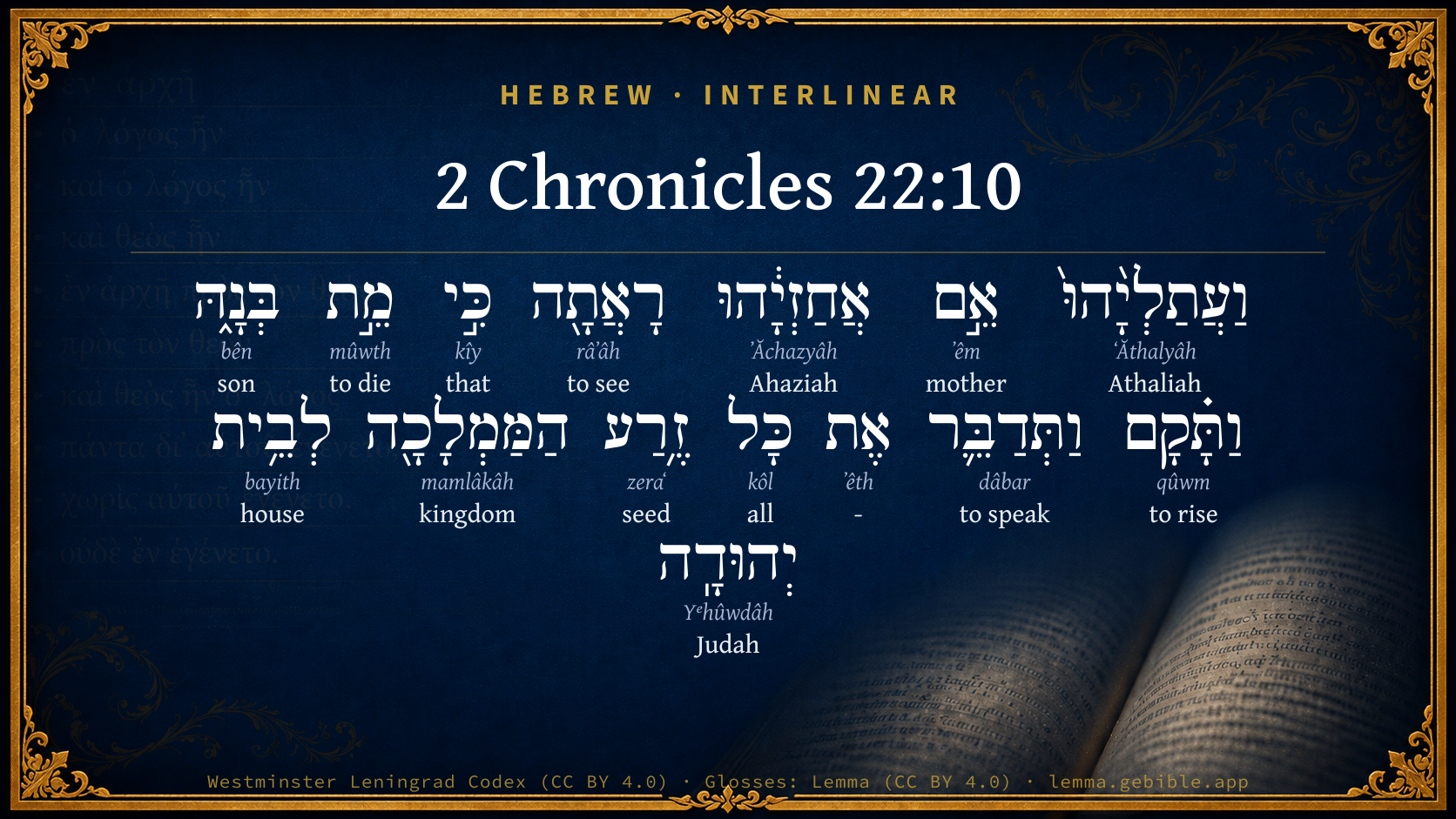
Hebrew (Westminster Leningrad Codex) 2 Chronicles 22:10 appears in the Hebrew Old Testament. The text above is from the Westminster Leningrad Codex. Each word links to its Strong’s number, a concise gloss, and parsing drawn from the Open Scriptures Hebrew Bible morphology. Click any word for its full Brown-Driver-Briggs (BDB) entry.
Download image
Cite this verse

2 Chronicles 22:10 (World English Bible). Public Domain. Lemma interlinear Bible study tool, https://lemma.gebible.app/v/2-chronicles/22/10.

Show BibTeX & RIS
BibTeX
RIS
English Translation
Now when Athaliah the mother of Ahaziah saw that her son was dead, she arose and destroyed all the seed royal of the house of Judah.
World English Bible · Public Domain
Download a study sheet

One document with this verse’s original text, its word-by-word gloss line, the meaning frame, cross-references with their text, attributed commentary, and full source and license credits — printable, and it pastes into notes with its structure intact.

This verse Autodidact and up

Study sheet (.html) Plain text (.txt)

A passage Seminary Student

Up to 50 verses in one chapter. A passage sheet keeps up to 6 commentary sources and 12 cross-references per verse, in the order this page ranks them, and says so on the sheet whenever that leaves anything out. Ask for a single verse and you get the Autodidact verse sheet above.

Everything on this page stays free to read, with no account — the sheet is a download of what is already on screen, not access to it.

Want to remove ads? Support Godless Engineer
Compare translations 3

The same verse in 3 English versions, stacked beneath the original-language interlinear above. Click any original word for its lexicon entry.

Each is an independent rendering of the whole verse — the interlinear is not word-aligned to these translations.

Highlighted words mark where these versions differ — a whole-verse word diff, not a word-by-word alignment.

  • World English Bible Public Domain
    Now when Athaliah the mother of Ahaziah saw that her son was dead, she arose and destroyed all the seed royal of the house of Judah.
  • King James Version Public Domain
    But when Athaliah the mother of Ahaziah saw that her son was dead, she arose and destroyed all the seed royal of the house of Judah.
  • unfoldingWord Literal Text CC BY-SA 4.0
    And Athaliah, the mother of Ahaziah, saw that her son died, and she arose, and she destroyed all the seed of the kingdom of the house of Judah.

unfoldingWord Literal Text — © unfoldingWord, licensed CC BY-SA 4.0. Word-aligned USFM3 via Door43 (git.door43.org/unfoldingWord/en_ult).

Versions to compare (up to 4)

3 of 4 selected

Show all 18 translations

Every available English version of this verse, each an independent rendering of the whole verse.

  • World English Bible Public Domain
    Now when Athaliah the mother of Ahaziah saw that her son was dead, she arose and destroyed all the seed royal of the house of Judah.
  • Berean Standard Bible Public Domain
    When Athaliah the mother of Ahaziah saw that her son was dead, she proceeded to annihilate all the royal heirs of the house of Judah.
  • Majority Standard Bible Public Domain
    When Athaliah the mother of Ahaziah saw that her son was dead, she proceeded to annihilate all the royal heirs of the house of Judah.
  • King James Version Public Domain
    But when Athaliah the mother of Ahaziah saw that her son was dead, she arose and destroyed all the seed royal of the house of Judah.
  • American Standard Version (1901) Public Domain
    Now when Athaliah the mother of Ahaziah saw that her son was dead, she arose and destroyed all the seed royal of the house of Judah.
  • Revised Version (1885) Public Domain
    Now when Athaliah the mother of Ahaziah saw that her son was dead, she arose and destroyed all the seed royal of the house of Judah.
  • Geneva Bible (1599) Public Domain
    Therefore when Athaliah the mother of Ahaziah sawe that her sonne was dead, shee arose and destroyed all the Kings seede of the house of Iudah.
  • Douay-Rheims (1899) Public Domain
    For Athalia his mother, seeing that her son was dead, rose up, and killed all the royal family of the house of Joram.
  • Young's Literal Translation Public Domain
    And Athaliah mother of Ahaziah hath seen that her son is dead, and she riseth and destroyeth the whole seed of the kingdom of the house of Judah.
  • Literal Standard Version CC BY-SA 4.0
    And Athaliah mother of Ahaziah has seen that her son is dead, and she rises and destroys the whole seed of the kingdom of the house of Judah.
  • Unlocked Literal Bible CC BY-SA 4.0
    Now when Athaliah, the mother of Ahaziah, saw that her son was dead, she arose and killed all the royal children in the house of Judah.
  • unfoldingWord Literal Text CC BY-SA 4.0
    And Athaliah, the mother of Ahaziah, saw that her son died, and she arose, and she destroyed all the seed of the kingdom of the house of Judah.
  • Darby Bible Public Domain
    And when Athaliah the mother of Ahaziah saw that her son was dead, she rose up and exterminated all the royal seed of the house of Judah.
  • World Messianic Bible Public Domain
    Now when Athaliah the mother of Ahaziah saw that her son was dead, she arose and destroyed all the royal offspring of the house of Judah.
  • Webster's Bible Public Domain
    But when Athaliah the mother of Ahaziah saw that her son was dead, she arose, and destroyed all the seed royal of the house of Judah.
  • Free Bible Version CC BY-SA 4.0
    When Athaliah Ahaziah's mother found out that her son was dead, she proceeded to kill all who remained of the royal family of Judah.
  • Bible in Basic English Public Domain
    Now when Athaliah, the mother of Ahaziah, saw that her son was dead, she had all the rest of the seed of the kingdom of Judah put to death.
  • JPS Tanakh (1917) Public Domain
    Now when Athaliah the mother of Ahaziah saw that her son was dead, she arose and destroyed all the seed royal of the house of Judah.

Literal Standard Version (2020), Covenant Press — licensed CC BY-SA 4.0. Text via the HelloAO Bible API (eBible.org). Unlocked Literal Bible (unfoldingWord) — licensed CC BY-SA 4.0. Text via the HelloAO Bible API (eBible.org). unfoldingWord Literal Text — © unfoldingWord, licensed CC BY-SA 4.0. Word-aligned USFM3 via Door43 (git.door43.org/unfoldingWord/en_ult). Free Bible Version, Dr. Jonathan Gallagher — licensed CC BY-SA 4.0. Text via the HelloAO Bible API (eBible.org).

Word by word

More ways to search: Search by grammar → Find every occurrence → Compare this word →

Practice this passage: Drill this verse → Learn its vocabulary →

וַעֲתַלְיָ֨הוּ֙
ʻĂthalyâh
H6271
“and · Athaliah”
Conjunction + Noun, Proper
Part of Speech
Conjunction + Noun
Type
Proper
Full BDB Definition

Origin: from the same as H6270 and H3050

TWOT: None

Athaliah = "afflicted of the Lord" - son of Jeroham of the tribe of Benjamin (noun proper masculine) - father of Jeshaiah of the sons of Elam who was one of the heads of a family who returned with Ezra from exile (noun proper masculine) - the daughter of Ahab and Jezebel and the wife of king Jehoram of Judah; killer of all the members of the royal family of Judah with the exception of one baby named Joash who was hidden by the high priest Jehoiada until 6 years had passed and Jehoiada led the revolution to put him on the throne, overthrowing Athaliah and putting her to death (noun proper feminine)
  1. אֵ֣ם ʼêm H517 “mother of” Noun, Common, Feminine, Singular, Construct
  2. אֲחַזְיָ֔הוּ ʼĂchazyâh H274 “Ahaziah” Noun, Proper
  3. רָאֲתָ֖ה râʼâh H7200 “to see” Verb, Qal, Perfect, 3rd Person, Feminine, Singular
  4. כִּ֣י kîy H3588 “that” Conjunction
  5. מֵ֣ת mûwth H4191 “to die” Verb, Qal, Perfect, 3rd Person, Masculine, Singular
  6. בְּנָ֑הּ bên H1121 “son · her” Noun, Common, Masculine, Singular, Construct + Suffix, Personal, 3rd Person, Feminine, Singular
  7. וַתָּ֗קָם qûwm H6965 “and · to rise” Conjunction + Verb, Qal, Sequential Imperfect, 3rd Person, Feminine, Singular
  8. וַתְּדַבֵּ֛ר dâbar H1696 “and · to speak” Conjunction + Verb, Piel, Sequential Imperfect, 3rd Person, Feminine, Singular
  9. אֶת ʼêth H853 “-” Particle, Direct Object
  10. כָּל kôl H3605 “all of” Noun, Common, Masculine, Singular, Construct
  11. זֶ֥רַע zeraʻ H2233 “seed of” Noun, Common, Masculine, Singular, Construct
  12. הַמַּמְלָכָ֖ה mamlâkâh H4467 “the · kingdom” Particle, Definite Article + Noun, Common, Feminine, Singular, Absolute
  13. לְבֵ֥ית bayith H1004 “to/for · house of” Preposition + Noun, Common, Masculine, Singular, Construct
  14. יְהוּדָֽה Yᵉhûwdâh H3063 “Judah” Noun, Proper

About this verse

These counts appear in no published source. They are computed here, from the morphology-tagged text and Lemma’s own curated glosses. What Lemma adds →

15
words
15
distinct lemmas
Historical
section

Notable vocabulary

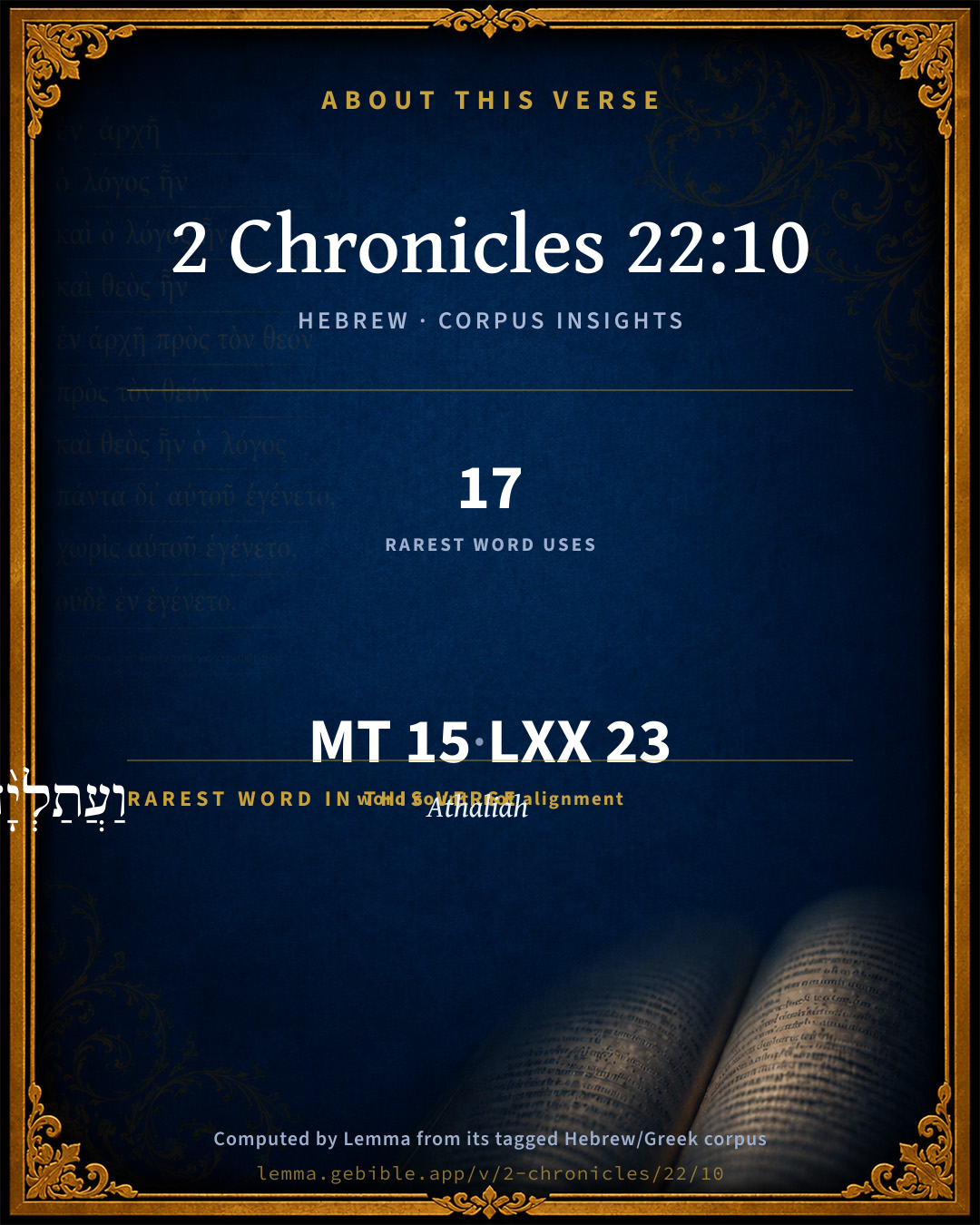
The rarest word here is וַעֲתַלְיָ֨הוּ֙ Athaliah H6271 — appearing just 17 times in the whole Hebrew Bible.

Shared distinctive vocabulary

וַעֲתַלְיָ֨הוּ֙ Athaliah H6271 occurs in 17 verses of the Hebrew Bible. Also found in:

Grammatical profile

  • 4 verbs
  • 9 nouns
  • 1 conjunction
  • 1 particle

Verb forms

  • רָאֲתָ֖ה Qal · Perfect
  • מֵ֣ת Qal · Perfect
  • וַתָּ֗קָם Qal · Sequential Imperfect
  • וַתְּדַבֵּ֛ר Piel · Sequential Imperfect

Hebrew & Septuagint length

In English translation the verse runs 26 words from the Hebrew and 26 from the Septuagint (LXX English) — the same length.

A rough comparison of the two English renderings, which tokenize alike — not a word-level alignment.

Word counts can differ between the Hebrew and the Greek without any difference in meaning — e.g. the Hebrew direct-object marker אֵת has no separate Greek word, and Greek often adds the article ὁ.

In the original languages it is 15 Hebrew tokens and 23 Greek tokens — but the two are counted differently (Hebrew bundles its prefixes and suffixes into one token; the Greek is in lemma form), so that isn’t a like-for-like length.

Cross-references

2

Topical passages linked to 2 Chronicles 22:10 in the Treasury of Scripture Knowledge — connected by theme and wording, ordered by reader-vote popularity; previews shown in the World English Bible.

  • 2 Kings 11:1–3 Now when Athaliah the mother of Ahaziah saw that her son was dead, she arose and destroyed all the seed royal.
  • 2 Chronicles 22:2–4 Forty-two years old was Ahaziah when he began to reign; and he reigned one year in Jerusalem: and his mother's name was Athaliah the daughter of Omri.

Cross-references courtesy of OpenBible.info (CC BY 4.0).

Hebrew and Greek witnesses Masoretic Hebrew ↔ Greek Septuagint

The same verse in the two great witnesses to the Old Testament, shown verse-for-verse.

These are two independent witnesses, not word-aligned to each other, and the Septuagint is shown in lemma (dictionary) form.

Hebrew 2 Chronicles 22:10 Masoretic · Westminster Leningrad Codex

וַעֲתַלְיָ֨הוּ֙ אֵ֣ם אֲחַזְיָ֔הוּ רָאֲתָ֖ה כִּ֣י מֵ֣ת בְּנָ֑הּ וַתָּ֗קָם וַתְּדַבֵּ֛ר אֶת כָּל זֶ֥רַע הַמַּמְלָכָ֖ה לְבֵ֥ית יְהוּדָֽה

Now when Athaliah the mother of Ahaziah saw that her son was dead, she arose and destroyed all the seed royal of the house of Judah.

World English Bible · Public Domain

Greek LXX 2 Chronicles 22:10 Septuagint · lemma form

καί γοθολια ὁ μήτηρ οχοζια ὁράω ὅτι θνήσκω αὐτός ὁ υἱός καί ἐγείρω καί ἀποὀλλύω πᾶς ὁ σπέρμα ὁ βασιλεία ἐν οἶκος ἰουδά

And Gotholia the mother of Ochozias saw that her son was dead, and she arose and destroyed all the seed royal in the house of Juda.

LXX2012 (modern English Septuagint) · Public Domain

On this verse, The Cambridge Bible for Schools and Colleges discusses the Septuagint’s reading. Read the note in Commentary ↓

Hebrew: Westminster Leningrad Codex (CC BY 4.0). Greek: Septuagint (public domain); English from LXX2012 (modern English Septuagint) (Public Domain). How the Septuagint differs from the Hebrew →

Commentary

Notes on 2 Chronicles 22:10 from classic Christian and Jewish commentators (each source and its license shown beneath its notes). The classic Christian expositions comment on the surrounding passage and are grouped to its opening verse, so a note may address several verses; the Jewish commentaries on the Tanakh (Rashi and others) are per-verse, so they appear only where the commentator wrote on this verse.

Lemma curates 59 commentaries, every one of them public domain or Creative Commons licensed, each selected and text-cleaned for this edition rather than reprinted as found. About our sources →

Matthew Henry's Commentary

We have here what we had before, Kg2 11:1, etc. 1. A wicked woman endeavouring to destroy the house of David, that she might set up a throne for herself upon the ruins of it. Athaliah barbarously cut off all the seed-royal (Ch2 22:10), perhaps intending to transmit the crown of Judah after herself to some of her own relations, that though her family was cut off in Israel by Jehu it might be planted in Judah. 2. A good woman effectually preserving it from being wholly extirpated. One of the late king's sons, a child of a year old, was rescued from among the dead, and saved alive by the care of Jehoiada's wife (Ch2 22:11, Ch2 22:12), that a lamp might be ordained for God's anointed; for no word of God shall fall to the ground.

Matthew Henry's Commentary on the Whole Bible (1708–1710) — public domain (CC PDM 1.0). Text via the HelloAO Bible API.

Jamieson, Fausset & Brown

Robert Jamieson, A. R. Fausset & David Brown

ATHALIAH, DESTROYING THE SEED ROYAL SAVE JOASH, USURPS THE KINGDOM. (Ch2 22:10-12)

Athaliah . . . arose and destroyed all the seed royal--(See on Kg2 11:1-3). Maddened by the massacre of the royal family of Ahab, she resolved that the royal house of David should have the same fate. Knowing the commission which Jehu had received to extirpate the whole of Ahab's posterity, she expected that he would extend his sword to her. Anticipating his movements, she resolved, as her only defense and security, to usurp the throne and destroy "the seed royal," both because they were hostile to the Phœnician worship of Baal, which she was determined to uphold, and because, if one of the young princes became king, his mother would supersede Athaliah in the dignity of queen mother.

Jamieson, Fausset & Brown — Commentary Critical and Explanatory on the Whole Bible (1871) — public domain (CC PDM 1.0). Text via the HelloAO Bible API.

Ellicott's Commentary for English Readers

ATHALIAH SEIZES THE GOVERNMENT (2Ch_22:10-12).

(Comp. 2Ki_11:1-3.)

(10) But when Athaliah.—See 2Ki_11:1, with which this verse nearly coincides.

Destroyed.—So Kings and some Hebrew MSS., and all the versions. Hebrew text, she spake, a mistake of some scribe.

All the seed royal.—Even after the massacres described in 2Ch_22:1; 2Ch_22:8, there would doubtless be left a number of persons more or less nearly connected with the royal family, besides the immediate offspring of Ahaziah, who are, in the first instance, intended by this phrase.

A Bible Commentary for English Readers, edited by Charles John Ellicott (1878–1897) — public domain. Text from a community e-Sword module.

Trapp's Complete Commentary

John Trapp

2Ch 22:10 But when Athaliah the mother of Ahaziah saw that her son was dead, she arose and destroyed all the seed royal of the house of Judah.

Ver. 10. But when Athaliah.] See 2Ki 11:1.

Destroyed all the seed royal.] Such another wicked woman was the mother of King Edward, called the martyr, whom she basely butchered; and because his brother Ethelred, who succeeded him, being but ten years of age, mourned for him, his mother was so enraged thereat, that taking wax candles which were readiest at hand, therewith she scorched him so sore, that he could never after endure wax candles to be burnt before him. {a}

{a} Mr Clark’s Martyrol., p. 31.

John Trapp, A Commentary or Exposition upon All the Books of the Old and New Testament (1647–1656) — public domain. Text from a community e-Sword module.

Joseph Benson's Commentary

2Ch 22:10. But when Athaliah, &c. — This and 2Ch 22:11-12, are explained 2Ki 11:1-3.

Joseph Benson's Commentary on the Old and New Testaments (1811–1818) — public domain. Text from a community e-Sword module.

Tyndale Open Study Notes

Tyndale Open Resources

22:10-12 Athaliah was never regarded as a legitimate monarch; she was given no royal formula of age or length of reign as were other rulers. Her destruction of the rest of Judah’s royal family concentrated on potential male successors; those who were ineligible to reign, such as Ahaziah’s sister, survived the slaughter. Jehosheba was Ahaziah’s half sister, the daughter of King Jehoram by a wife other than Athaliah. The six years of Athaliah’s reign were from 841 to 835 BC.

Tyndale Open Study Notes — © Tyndale Open Resources, licensed CC BY-SA 4.0. Text via the HelloAO Bible API.

Geneva Bible (1599)

Geneva Bible translators

To the intent that there should be none to make title to the crown, and so she might usurp the government.

Geneva Bible (1599) marginal notes — public domain. Text via Bolls.life.

Adam Clarke's Commentary

Verse 10. All the seed royal of the house of Judah] Nothing but the miraculous intervention of the Divine providence could have saved the line of David at this time, and preserved the prophecy relative to the Messiah. The whole truth of that prophecy, and the salvation of the world, appeared to be now suspended on the brittle thread of the life of an infant of a year old, (see 2Ch 24:1,) to destroy whom was the interest of the reigning power! But God can save by few as well as by many. He had purposed, and vain were the counter-exertions of earth and hell.

Adam Clarke's Commentary on the Bible (1810–1826) — public domain. Text from a community e-Sword/MySword module.

The Cambridge Bible for Schools and Colleges

gen. ed. J. J. S. Perowne

10–12 (= 2Ki_11:1-3). The Reign of Athaliah

10. But when] R.V. Now when.

destroyed] This is the reading of Kings and of the LXX. of Chron. The Heb. reads spake with, which is perhaps a euphemism; cp. the English “deal with.”

The Cambridge Bible for Schools and Colleges (gen. ed. J. J. S. Perowne; Cambridge University Press, 1878–1918) — public domain. Text from a community e-Sword module.

Albert Barnes' Notes on the Bible

Compare the marginal reference and notes.

Albert Barnes' Notes on the Bible (1834–1885) — public domain. Text from a community e-Sword/MySword module.

Haydock's Catholic Bible Commentary

All, except Joas, (v. 11., and 4 K. xi. 1.; C.) ninety-five years after Solomon’s death. Mariana) D.

George Leo Haydock (1774–1849), Haydock's Catholic Family Bible and Commentary, 1859 edition — public domain. Excludes Psalms (Douay-Rheims chapter numbering differs from Protestant) and Deuterocanonical books (Catholic canon only).

Matthew Poole's English Annotations

Athaliah the mother of Ahaziah: this, and 2Ch 22:11,12, are explained on 2Ki 11:1-3.

Matthew Poole's English Annotations on the Holy Bible (1683–1685) — public domain. Text from a community e-Sword/MySword module.

The Pulpit Commentary

But when Athaliah. For parallel to the end of the chapter, see 2Ki_11:1-3. The words, of the house of Judah, are here carefully supplied, wanting in parallel.

The Pulpit Commentary (1880–1919), ed. H.D.M. Spence-Jones & Joseph S. Exell — public domain. Text from a community e-Sword module.

Keil & Delitzsch

C. F. Keil & F. Delitzsch

The six years' tyranny of Athaliah. - In regard to her, all that is stated is, that after Ahaziah's death she ascended the throne, and caused all the royal seed of the house of Judah, i.e., all the male members of the royal house, to be murdered. From this slaughter only Joash the son of Ahaziah, an infant a year old, was rescued, together with his nurse, by the princess Jehoshabeath, who was married to the high priest Jehoiada. He was hidden for six years, and during that time Athaliah reigned. The same narrative, for the most part in the same words, is found in Kg2 11:1-3, and has been already commented upon there.

Keil & Delitzsch — Biblical Commentary on the Old Testament (1861–1891) — public domain (CC PDM 1.0). Text via the HelloAO Bible API. (Old Testament only.)

unfoldingWord translationNotes

Door43 World Missions Community

she arose and killed all the royal children

Here the writer speaks of Athaliah as if she killed the children herself, but the reader should understand that she would have ordered her servants to kill them. AT: "she commanded her servants to kill all the royal children" (See: Metonymy)

all the royal children

This refers only to the males, because they could become king. Verse 11 confirms that the sons were the ones who were killed. (See: Assumed Knowledge and Implicit Information)

the house of Judah

The word "house" is a metonym for the family that lives in the house. In this case, it refers to the kingdom of Judah. AT: "Judah" or "the kingdom of Judah" (See: Metonymy)

Jehosheba, a daughter of the king, ... a daughter of King Jehoram

Here "the king" refers to Jehoram, the father of Ahaziah. (See: How to Translate Names)

his nurse

This refers to a person who cares for a child, not to a medical person.

into a bedroom

Verse 12 makes it clear that this bedroom was located in the temple. Jehosheba could access that room because she was married to Jehoiada who was a priest.

Jehoiada

This is a man's name. (See: How to Translate Names)

He was with them

"Joash was with Jehosheba and Jehoiada"

translationWords

Athaliah

die

king

priest

house of God

reign

unfoldingWord translationNotes — © Distant Shores Media and the Door43 World Missions Community, licensed CC BY-SA 4.0. Source: git.door43.org/Door43/en_tn.

Rashi

Rabbi Shlomo Yitzchaki (Rashi)

she arose and destroyed - Heb. וַתְּדַבֵּר, an expression of דֶּבֶר, pestilence. In II Kings (11:1), it is written: וַתְּאַבֵּד. Concerning this generation, David recited: (Ps. 12:1): “For the conductor on the sheminith,” for David foresaw with the holy spirit that in the eighth generation [of his dynasty] all his descendants would be slain by Athaliah, for there are eight generations from Solomon till here. And he prayed that his seed would survive for a remembrance, and said, (ibid. verse 2): “Save, O Lord, for the pious are gone, etc.” In II Kings (11:2), Scripture states that she killed them by poisoning them, for it is written: “and she stole him away from the dying (הַמְמוֹתִים) children of the king”; we read: הַמּוּמָתִים the slain. Both the traditional reading and the masoretic text have authority. הַמּוּמָתִים means that they already died, and the masoretic text in which the word used is הַמְמוֹתִים means that they were dying in agony. This is written in the continuous present tense, i.e., not all at once but continuously being crushed by illnesses, and then dying. An example is (Jer. 16:4): “Dying of (מְמוֹתֵי) sicknesses they shall die, etc. and with famine,” because they too will not die immediately.

Rashi on the Tanakh — English translations: “The Judaica Press complete Tanach with Rashi, translated by A. J. Rosenberg” (CC BY 4.0); “Pentateuch with Rashi's commentary by M. Rosenbaum and A.M. Silbermann, 1929-1934” (public domain); “The Metsudah Tanach series, Lakewood, N.J” (CC BY 4.0); and “The Book of Joshua, Metsudah Publications, 1997” (CC BY 4.0). Text via Sefaria.

Lesson kit

Teaching starters — assembled from the data on this page, not authored interpretation. Every prompt links to the verse data it draws on. Edit before teaching.

2 Chronicles, in the Historical, opens this verse with 15 words (15 distinct Hebrew lemmas). Its most distinctive word is ʻĂthalyâh (“Athaliah”). A historical commentator’s framing appears above. Read the whole chapter for the surrounding context.

Discussion questions

  1. The word ʻĂthalyâh carries the sense “Athaliah.” How does it shape the verse?
  2. How does 2 Kings 8:26, which shares the word «Athaliah», read alongside this verse?
  3. These translations render this verse differently; the difference is in the English rendering, not the original. What questions does that raise?
  4. «רָאֲתָ֖ה» is a Qal Perfect verb. How does that grammatical form shape the action described?
  5. Compare how Matthew Henry's Commentary and Jamieson, Fausset & Brown read this verse. Where do they agree or differ?

Things to notice

Reading settings

Reading text

Shown beneath each verse's original-language words.

Old Testament
Old Testament edition

Read the OT as the Masoretic Hebrew (MT) or the Greek Septuagint (LXX).

English shown for the Greek Septuagint (in the Hebrew ↔ Greek comparison).

Comparing translations? Open the Compare panel on any verse page to stack up to four side by side.