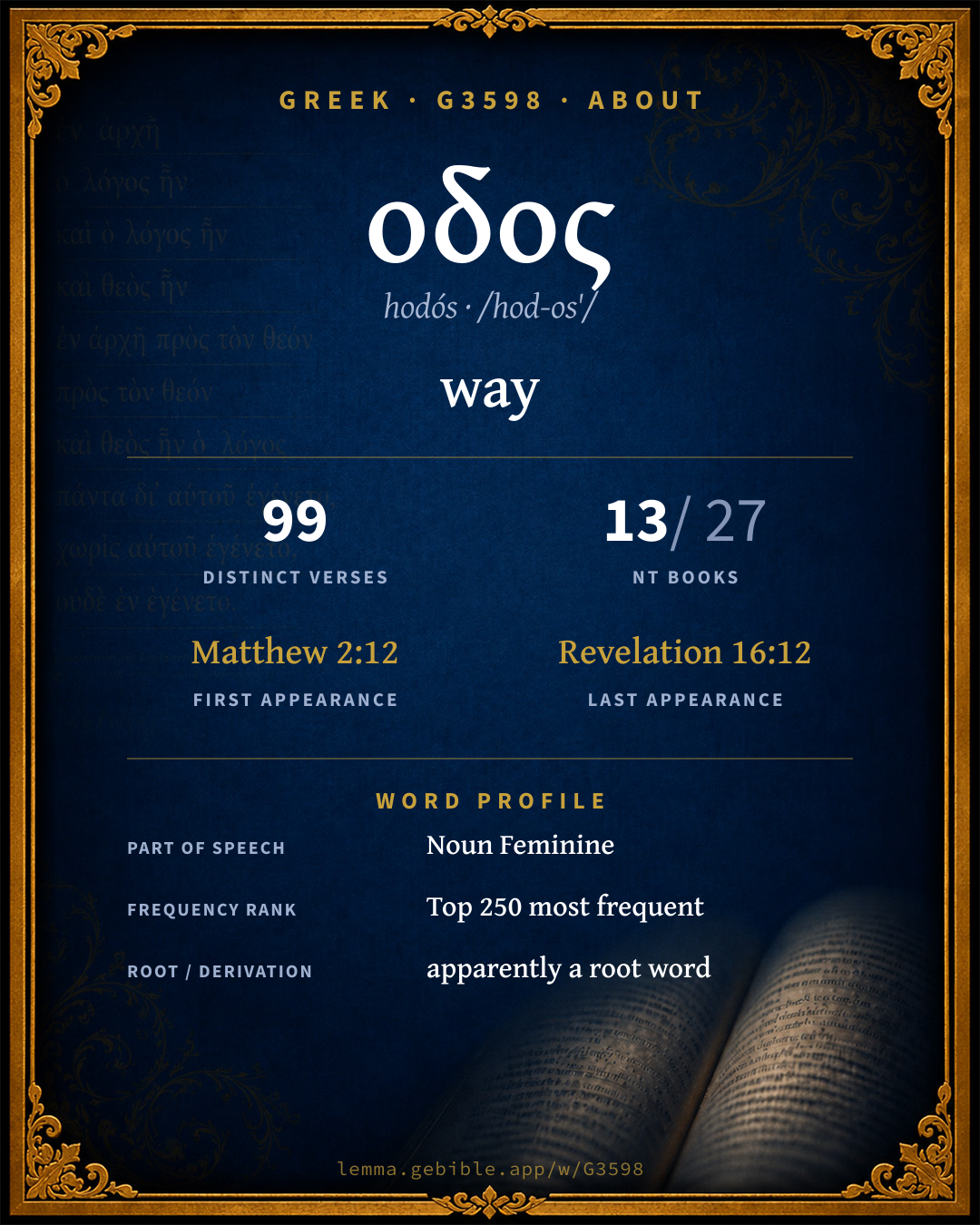
ὁδός
way
‘way’ is one of 2 main senses fuller range ↓
Full lexicon entry — Thayer's Greek Lexicon
From Thayer's Greek Lexicon
Where this word appears
See every Accusative-case word in the Greek New Testament →
Grammar key — what these labels mean
Part of speech
- Noun
- A naming word — a person, place, thing, or idea.
Case
- Accusative
- The case of the direct object and of extent.
- Dative
- The case of the indirect object, means, or location — “to / for / with / in.”
- Genitive
- The case of source, possession, or “of” — answers “whose / from what.”
- Nominative
- The case of the subject (and the predicate nominative).
Gender
- Feminine
- Grammatically feminine.
Number
- Singular
- One.
- Plural
- More than one.
Grammatical forms
- Noun, Accusative, Singular, Feminine 51 times (50%)
- Noun, Dative, Singular, Feminine 23 times (23%)
- Noun, Accusative, Plural, Feminine 8 times (8%)
- Noun, Genitive, Singular, Feminine 8 times (8%)
- Noun, Nominative, Singular, Feminine 5 times (5%)
- Noun, Dative, Plural, Feminine 3 times (3%)
- Noun, Nominative, Plural, Feminine 2 times (2%)
- Noun, Genitive, Plural, Feminine 1 time (1%)
Parsed forms decoded from the imported morphology (Robinson–Tischendorf, public domain), counted across 101 parsed occurrences — not distinct verses.
Every verse where G3598 appears — 99 distinct verses across 13 books. Click any verse to open its interlinear word-by-word view. Verse text shown in the World English Bible for context — . Each verse’s Greek form is shown with its reference; the English is not keyword-highlighted, since the data carries no word-level English alignment. Use “Compare translations” on any verse to read it across multiple English versions. This concordance covers the Greek New Testament; Septuagint (Greek Old Testament) occurrences of this word are not indexed here.
Matthew 21 verses
- Matthew 2:12 ὁδοῦ n gen sg fem Being warned in a dream that they shouldn't return to Herod, they went back to their own country another way.
- Matthew 3:3 ὁδὸν n acc sg fem For this is he who was spoken of by Isaiah the prophet, saying, "The voice of one crying in the wilderness, Make ready the way of the Lord, Make his paths straight."
- Matthew 4:15 ὁδὸν n acc sg fem "The land of Zebulun and the land of Naphtali, Toward the sea, beyond the Jordan, Galilee of the Gentiles,
- Matthew 5:25 ὁδῷ n dat sg fem Agree with your adversary quickly, while you are with him in the way; lest perhaps the prosecutor deliver you to the judge, and the judge deliver you to the officer, and you be cast into prison.
- Matthew 7:13 ὁδὸς n nom sg fem "Enter in by the narrow gate; for wide is the gate and broad is the way that leads to destruction, and many are those who enter in by it.
- Matthew 7:14 ὁδὸς n nom sg fem How narrow is the gate, and restricted is the way that leads to life! Few are those who find it.
- Matthew 8:28 ὁδοῦ n gen sg fem When he came to the other side, into the country of the Gergesenes, two people possessed by demons met him there, coming out of the tombs, exceedingly fierce, so that nobody could pass by that way.
- Matthew 10:5 ὁδὸν n acc sg fem Jesus sent these twelve out, and charged them, saying, "Don't go among the Gentiles, and don't enter into any city of the Samaritans.
- Matthew 10:10 ὁδὸν n acc sg fem Take no bag for your journey, neither two coats, nor shoes, nor staff: for the laborer is worthy of his food.
- Matthew 11:10 ὁδόν n acc sg fem For this is he, of whom it is written, 'Behold, I send my messenger before your face, who will prepare your way before you.'
- Matthew 13:4 ὁδόν n acc sg fem As he sowed, some seeds fell by the roadside, and the birds came and devoured them.
- Matthew 13:19 ὁδὸν n acc sg fem When anyone hears the word of the Kingdom, and doesn't understand it, the evil one comes, and snatches away that which has been sown in his heart. This is what was sown by the roadside.
- Matthew 15:32 ὁδῷ n dat sg fem Jesus summoned his disciples and said, "I have compassion on the multitude, because they continue with me now three days and have nothing to eat. I don't want to send them away fasting, or they might faint on the way."
- Matthew 20:17 ὁδῷ n dat sg fem As Jesus was going up to Jerusalem, he took the twelve disciples aside, and on the way he said to them,
- Matthew 20:30 ὁδόν n acc sg fem Behold, two blind men sitting by the road, when they heard that Jesus was passing by, cried out, "Lord, have mercy on us, you son of David!"
- Matthew 21:8 ὁδῷ ὁδῷ n dat sg fem n dat sg fem A very great multitude spread their clothes on the road. Others cut branches from the trees, and spread them on the road.
- Matthew 21:19 ὁδοῦ n gen sg fem Seeing a fig tree by the road, he came to it, and found nothing on it but leaves. He said to it, "Let there be no fruit from you forever!" Immediately the fig tree withered away.
- Matthew 21:32 ὁδῷ n dat sg fem For John came to you in the way of righteousness, and you didn't believe him, but the tax collectors and the prostitutes believed him. When you saw it, you didn't even repent afterward, that you might believe him.
- Matthew 22:9 ὁδῶν n gen pl fem Go therefore to the intersections of the highways, and as many as you may find, invite to the marriage feast.'
- Matthew 22:10 ὁδοὺς n acc pl fem Those servants went out into the highways, and gathered together as many as they found, both bad and good. The wedding was filled with guests.
- Matthew 22:16 ὁδὸν n acc sg fem They sent their disciples to him, along with the Herodians, saying, "Teacher, we know that you are honest, and teach the way of God in truth, no matter who you teach, for you aren't partial to anyone.
Mark 16 verses
- Mark 1:2 ὁδόν n acc sg fem As it is written in the prophets, "Behold, I send my messenger before your face, Who will prepare your way before you.
- Mark 1:3 ὁδὸν n acc sg fem The voice of one crying in the wilderness, 'Make ready the way of the Lord! Make his paths straight!'"
- Mark 2:23 ὁδὸν n acc sg fem It happened that he was going on the Sabbath day through the grain fields, and his disciples began, as they went, to pluck the ears of grain.
- Mark 4:4 ὁδόν n acc sg fem and it happened, as he sowed, some seed fell by the road, and the birds came and devoured it.
- Mark 4:15 ὁδὸν n acc sg fem These are the ones by the road, where the word is sown; and when they have heard, immediately Satan comes, and takes away the word which has been sown in them.
- Mark 6:8 ὁδὸν n acc sg fem He charged them that they should take nothing for their journey, except a staff only: no bread, no wallet, no money in their purse,
- Mark 8:3 ὁδῷ n dat sg fem If I send them away fasting to their home, they will faint on the way, for some of them have come a long way."
- Mark 8:27 ὁδῷ n dat sg fem Jesus went out, with his disciples, into the villages of Caesarea Philippi. On the way he asked his disciples, "Who do men say that I am?"
- Mark 9:33 ὁδῷ n dat sg fem He came to Capernaum, and when he was in the house he asked them, "What were you arguing among yourselves on the way?"
- Mark 9:34 ὁδῷ n dat sg fem But they were silent, for they had disputed one with another on the way about who was the greatest.
- Mark 10:17 ὁδὸν n acc sg fem As he was going out into the way, one ran to him, knelt before him, and asked him, "Good Teacher, what shall I do that I may inherit eternal life?"
- Mark 10:32 ὁδῷ n dat sg fem They were on the way, going up to Jerusalem; and Jesus was going in front of them, and they were amazed; and those who followed were afraid. He again took the twelve, and began to tell them the things that were going to happen to him.
- Mark 10:46 ὁδόν n acc sg fem They came to Jericho. As he went out from Jericho, with his disciples and a great multitude, the son of Timaeus, Bartimaeus, a blind beggar, was sitting by the road.
- Mark 10:52 ὁδῷ n dat sg fem Jesus said to him, "Go your way. Your faith has made you well." Immediately he received his sight, and followed Jesus in the way.
- Mark 11:8 ὁδόν n acc sg fem Many spread their garments on the way, and others were cutting down branches from the trees, and spreading them on the road.
- Mark 12:14 ὁδὸν n acc sg fem When they had come, they asked him, "Teacher, we know that you are honest, and don't defer to anyone; for you aren't partial to anyone, but truly teach the way of God. Is it lawful to pay taxes to Caesar, or not?
Luke 20 verses
- Luke 1:76 ὁδοὺς n acc pl fem And you, child, will be called a prophet of the Most High, For you will go before the face of the Lord to make ready his ways,
- Luke 1:79 ὁδὸν n acc sg fem To shine on those who sit in darkness and the shadow of death; To guide our feet into the way of peace."
- Luke 2:44 ὁδὸν n acc sg fem but supposing him to be in the company, they went a day's journey, and they looked for him among their relatives and acquaintances.
- Luke 3:4 ὁδὸν n acc sg fem As it is written in the book of the words of Isaiah the prophet, "The voice of one crying in the wilderness, 'Make ready the way of the Lord. Make his paths straight.
- Luke 3:5 ὁδοὺς n acc pl fem Every valley will be filled. Every mountain and hill will be brought low. The crooked will become straight, And the rough ways smooth.
- Luke 7:27 ὁδόν n acc sg fem This is he of whom it is written, 'Behold, I send my messenger before your face, Who will prepare your way before you.'
- Luke 8:5 ὁδόν n acc sg fem "The farmer went out to sow his seed. As he sowed, some fell along the road, and it was trampled under foot, and the birds of the sky devoured it.
- Luke 8:12 ὁδόν n acc sg fem Those along the road are those who hear, then the devil comes, and takes away the word from their heart, that they may not believe and be saved.
- Luke 9:3 ὁδόν n acc sg fem He said to them, "Take nothing for your journey--neither staffs, nor wallet, nor bread, nor money; neither have two coats apiece.
- Luke 9:57 ὁδῷ n dat sg fem As they went on the way, a certain man said to him, "I want to follow you wherever you go, Lord."
- Luke 10:4 ὁδὸν n acc sg fem Carry no purse, nor wallet, nor sandals. Greet no one on the way.
- Luke 10:31 ὁδῷ n dat sg fem By chance a certain priest was going down that way. When he saw him, he passed by on the other side.
- Luke 11:6 ὁδοῦ n gen sg fem for a friend of mine has come to me from a journey, and I have nothing to set before him,'
- Luke 12:58 ὁδῷ n dat sg fem For when you are going with your adversary before the magistrate, try diligently on the way to be released from him, lest perhaps he drag you to the judge, and the judge deliver you to the officer, and the officer throw you into prison.
- Luke 14:23 ὁδοὺς n acc pl fem "The lord said to the servant, 'Go out into the highways and hedges, and compel them to come in, that my house may be filled.
- Luke 18:35 ὁδὸν n acc sg fem It happened, as he came near Jericho, a certain blind man sat by the road, begging.
- Luke 19:36 ὁδῷ n dat sg fem As he went, they spread their cloaks in the way.
- Luke 20:21 ὁδὸν n acc sg fem They asked him, "Teacher, we know that you say and teach what is right, and aren't partial to anyone, but truly teach the way of God.
- Luke 24:32 ὁδῷ n dat sg fem They said one to another, "Weren't our hearts burning within us, while he spoke to us along the way, and while he opened the Scriptures to us?"
- Luke 24:35 ὁδῷ n dat sg fem They related the things that happened along the way, and how he was recognized by them in the breaking of the bread.
John 4 verses
- John 1:23 ὁδὸν n acc sg fem He said, "I am the voice of one crying in the wilderness, 'Make straight the way of the Lord,' as Isaiah the prophet said."
- John 14:4 ὁδόν n acc sg fem Where I go, you know, and you know the way."
- John 14:5 ὁδόν n acc sg fem Thomas says to him, "Lord, we don't know where you are going. How can we know the way?"
- John 14:6 ὁδὸς n nom sg fem Jesus said to him, "I am the way, the truth, and the life. No one comes to the Father, except through me.
Acts 20 verses
- Acts 1:12 ὁδόν n acc sg fem Then they returned to Jerusalem from the mountain called Olivet, which is near Jerusalem, a Sabbath day's journey away.
- Acts 2:28 ὁδοὺς n acc pl fem You made known to me the ways of life. You will make me full of gladness with your presence.'
- Acts 8:26 ὁδὸν n acc sg fem But an angel of the Lord spoke to Philip, saying, "Arise, and go toward the south to the way that goes down from Jerusalem to Gaza. This is a desert."
- Acts 8:36 ὁδόν n acc sg fem As they went on the way, they came to some water, and the eunuch said, "Behold, here is water. What is keeping me from being baptized?"
- Acts 8:39 ὁδὸν n acc sg fem When they came up out of the water, the Spirit of the Lord caught Philip away, and the eunuch didn't see him any more, for he went on his way rejoicing.
- Acts 9:2 ὁδοῦ n gen sg fem and asked for letters from him to the synagogues of Damascus, that if he found any who were of the Way, whether men or women, he might bring them bound to Jerusalem.
- Acts 9:17 ὁδῷ n dat sg fem Ananias departed, and entered into the house. Laying his hands on him, he said, "Brother Saul, the Lord, who appeared to you on the road by which you came, has sent me, that you may receive your sight, and be filled with the Holy Spirit."
- Acts 9:27 ὁδῷ n dat sg fem But Barnabas took him, and brought him to the apostles, and declared to them how he had seen the Lord in the way, and that he had spoken to him, and how at Damascus he had preached boldly in the name of Jesus.
- Acts 13:10 ὁδοὺς n acc pl fem and said, "Full of all deceit and all cunning, you son of the devil, you enemy of all righteousness, will you not cease to pervert the right ways of the Lord?
- Acts 14:16 ὁδοῖς n dat pl fem who in the generations gone by allowed all the nations to walk in their own ways.
- Acts 16:17 ὁδὸν n acc sg fem Following Paul and us, she cried out, "These men are servants of the Most High God, who proclaim to us the way of salvation!"
- Acts 18:25 ὁδὸν n acc sg fem This man had been instructed in the way of the Lord; and being fervent in spirit, he spoke and taught accurately the things concerning Jesus, although he knew only the baptism of John.
- Acts 18:26 ὁδὸν n acc sg fem He began to speak boldly in the synagogue. But when Priscilla and Aquila heard him, they took him aside, and explained to him the way of God more accurately.
- Acts 19:9 ὁδὸν n acc sg fem But when some were hardened and disobedient, speaking evil of the Way before the multitude, he departed from them, and separated the disciples, reasoning daily in the school of Tyrannus.
- Acts 19:23 ὁδοῦ n gen sg fem About that time there arose no small stir concerning the Way.
- Acts 22:4 ὁδὸν n acc sg fem I persecuted this Way to the death, binding and delivering into prisons both men and women.
- Acts 24:14 ὁδὸν n acc sg fem But this I confess to you, that after the Way, which they call a sect, so I serve the God of our fathers, believing all things which are according to the law, and which are written in the prophets;
- Acts 24:22 ὁδοῦ n gen sg fem But Felix, having more exact knowledge concerning the Way, deferred them, saying, "When Lysias, the commanding officer, comes down, I will decide your case."
- Acts 25:3 ὁδόν n acc sg fem asking a favor against him, that he would summon him to Jerusalem; plotting to kill him on the way.
- Acts 26:13 ὁδὸν n acc sg fem at noon, O King, I saw on the way a light from the sky, brighter than the sun, shining around me and those who traveled with me.
Romans 3 verses
- Romans 3:16 ὁδοῖς n dat pl fem Destruction and misery are in their ways.
- Romans 3:17 ὁδὸν n acc sg fem The way of peace, they haven't known."
- Romans 11:33 ὁδοὶ n nom pl fem Oh the depth of the riches both of the wisdom and the knowledge of God! How unsearchable are his judgments, and his ways past tracing out!
1 Corinthians 2 verses
- 1 Corinthians 4:17 ὁδούς n acc pl fem Because of this I have sent Timothy to you, who is my beloved and faithful child in the Lord, who will remind you of my ways which are in Christ, even as I teach everywhere in every assembly.
- 1 Corinthians 12:31 ὁδὸν n acc sg fem But earnestly desire the best gifts. Moreover, I show a most excellent way to you.
1 Thessalonians 1 verse
Hebrews 3 verses
- Hebrews 3:10 ὁδούς n acc pl fem Therefore I was displeased with that generation, And said, 'They always err in their heart, But they didn't know my ways;'
- Hebrews 9:8 ὁδὸν n acc sg fem The Holy Spirit is indicating this, that the way into the Holy Place wasn't yet revealed while the first tabernacle was still standing;
- Hebrews 10:20 ὁδὸν n acc sg fem by the way which he dedicated for us, a new and living way, through the veil, that is to say, his flesh;
James 3 verses
- James 1:8 ὁδοῖς n dat pl fem He is a double-minded man, unstable in all his ways.
- James 2:25 ὁδῷ n dat sg fem In like manner wasn't Rahab the prostitute also justified by works, in that she received the messengers, and sent them out another way?
- James 5:20 ὁδοῦ n gen sg fem let him know that he who turns a sinner from the error of his way will save a soul from death, and will cover a multitude of sins.
2 Peter 3 verses
- 2 Peter 2:2 ὁδὸς n nom sg fem Many will follow their immoral ways, and as a result, the way of the truth will be maligned.
- 2 Peter 2:15 ὁδὸν ὁδῷ n acc sg fem n dat sg fem forsaking the right way, they went astray, having followed the way of Balaam the son of Beor, who loved the wages of wrong-doing;
- 2 Peter 2:21 ὁδὸν n acc sg fem For it would be better for them not to have known the way of righteousness, than, after knowing it, to turn back from the holy commandment delivered to them.
Jude 1 verse
Revelation 2 verses
- Revelation 15:3 ὁδοί n nom pl fem They sang the song of Moses, the servant of God, and the song of the Lamb, saying, "Great and marvelous are your works, Lord God, the Almighty; Righteous and true are your ways, you King of the nations.
- Revelation 16:12 ὁδὸς n nom sg fem The sixth poured out his bowl on the great river, the Euphrates. Its water was dried up, that the way might be made ready for the kings that come from the sunrise.
About this entry
At a glance — auto-summarized from this page’s data, not written by a person. Every figure links to its source below. This summary describes the numbers; it doesn’t interpret them.
At its core, οδος (hodós) means “way.” It first appears in Matthew 2:12. It turns up in 99 verses across 13 books, a moderately common footprint. Ranging over 2 senses, it is not a single-sense word. It clusters with οδευω, οδηγος and οδοιπορεω under a shared root. Dig into 99-verse concordance and the renderings breakdown below.
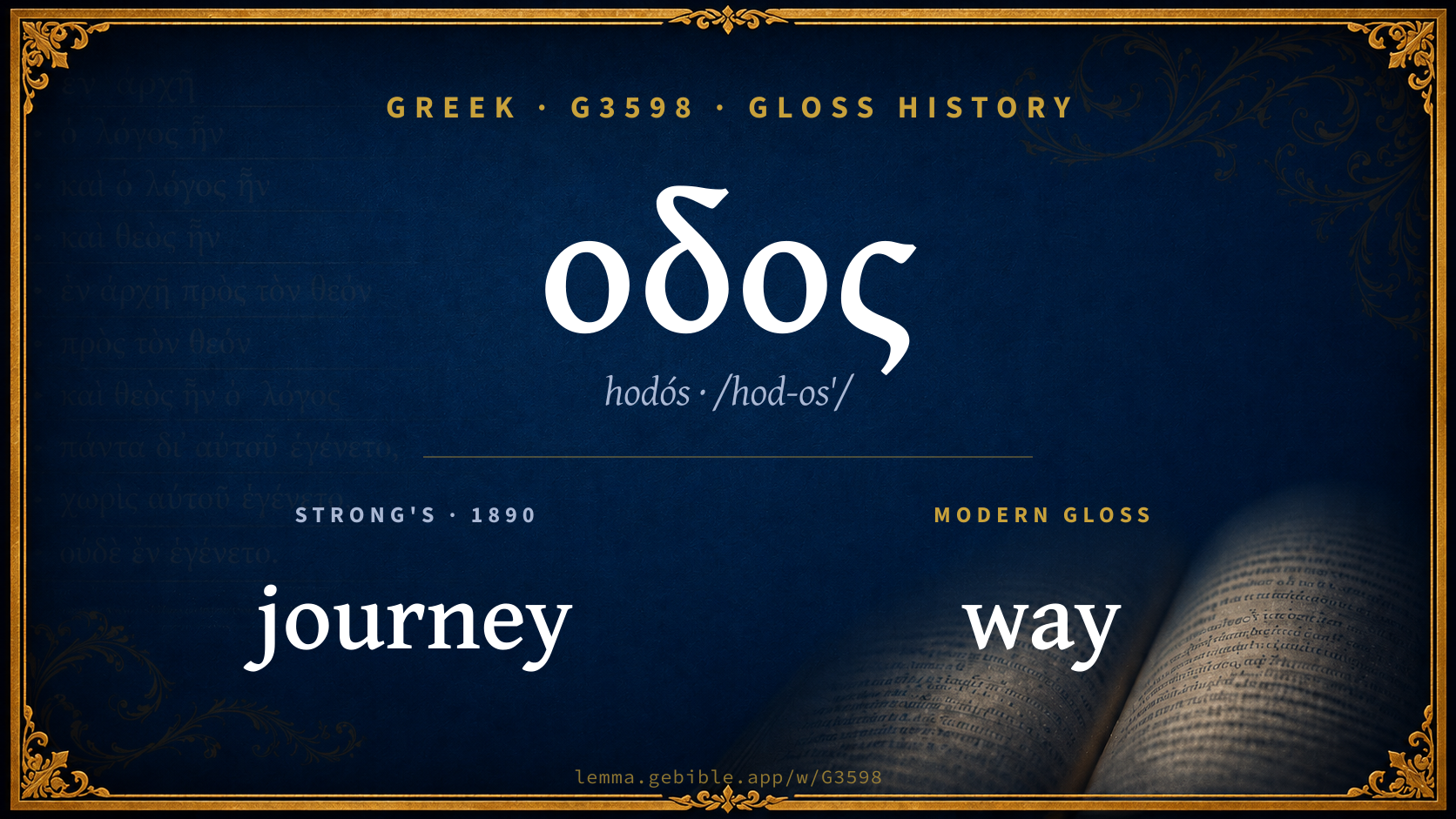
Gloss history
Strong's 1890 vs modern scholarship
About this word
Strong's G3598 catalogs a Greek word from the Greek New Testament.
These counts are not copied from any lexicon or concordance. They are computed here, from the morphology-tagged Greek New Testament. What Lemma adds →
- 99
- distinct verses
- The word appears in 99 distinct verses.
- 13 / 27
- NT books
- The word appears in 13 of 27 New Testament books.
- #163
- by frequency
- Top 250 most frequent Greek words (rank 163 of 5,347 Greek words by occurrence).
View all 99 occurrences in the concordance →
By section of the New Testament
By traditional corpus
Conventional, traditional groupings — biblical authorship is debated, so this is a traditional corpus grouping, not an authorship claim. Some books belong to more than one corpus (Luke is in both the Gospels and the Lukan corpus, and so on), so these shares overlap and need not total 100%. Each figure is a share of the word’s 99 distinct verses.
- Gospels 61 verses · 62%
- Lukan (Luke–Acts) 40 verses · 40%
- General (Catholic) Epistles 7 verses · 7%
- Johannine 6 verses · 6%
- Pauline corpus 6 verses · 6%
- Hebrews 3 verses · 3%
- Revelation 2 verses · 2%
How translations render this word
Counts come from each version’s own published word-to-Strong’s tagging or interlinear alignment — an approximate guide to how each version renders this word, not a word-level alignment the data otherwise carries. Because each total is that version’s own tagged count, the per-version totals vary from one another and need not match the appearance or distinct-verse counts above. These counts may also differ from a printed concordance because Lemma counts each distinctly tagged rendering and does not collapse phrase taggings into a single head-word total. This is a fixed set of word-tagged versions (KJV, ASV, BSB, ULT) and does not change with the reading translation you choose elsewhere. Each version’s license is shown beside its name below (and on Sources).
- King James Version: Way 70×, Ways 11×, Way side 7×
- American Standard Version: Way 63×, Ways 10×, Way side 9×
- Berean Standard Bible: Way 49×, Road 22×, Path 8×
- unfoldingWord Literal Text: Way 53×, Road 30×, Ways 7×
King James Version Public Domain
Renders G3598 across 99 tagged occurrences — most commonly:
Plus 2 renderings that appear only once — usually multi-word phrases or single function words the recovered tagging swept in, not distinct renderings. Not rendered by a distinct English word in 3 further occurrences.
American Standard Version Public Domain
Renders G3598 across 98 tagged occurrences — most commonly:
Plus 5 renderings that appear only once — usually multi-word phrases or single function words the recovered tagging swept in, not distinct renderings.
Berean Standard Bible Public Domain
Renders G3598 across 97 tagged occurrences — most commonly:
Plus 6 renderings that appear only once — usually multi-word phrases or single function words the recovered tagging swept in, not distinct renderings. Not rendered by a distinct English word in 4 further occurrences.
unfoldingWord Literal Text CC BY-SA 4.0
Renders G3598 across 110 tagged occurrences — most commonly:
Plus 6 renderings that appear only once — usually multi-word phrases or single function words the recovered tagging swept in, not distinct renderings.
Senses in Thayer's
The 2 senses Thayer's distinguishes for this word, in lexicon order (not ranked by frequency or importance). The full entry — with sub-senses — is in the Lexicon Entry tab.
- properly
- metaph.
Word origin
Origin: apparently a root word
Apparently a primary word; a road ; by implication a progress (the route act or distance); figuratively a mode or means : - journey (high-) way.
— Strong’s Exhaustive Concordance (1890), public domain.
Forms in the corpus
The 11 distinct written forms G3598 takes in the Greek New Testament, most frequent first — each parse links to that case’s occurrences in the concordance.
| Form | Parsing | Example | Uses |
|---|---|---|---|
| ὁδὸν hodòn | Noun, Accusative, Singular, Feminine | Matthew 3:3 | 35 |
| ὁδῷ hodō̂ | Noun, Dative, Singular, Feminine | Matthew 5:25 | 23 |
| ὁδόν hodón | Noun, Accusative, Singular, Feminine | Matthew 11:10 | 16 |
| ὁδοῦ hodoû | Noun, Genitive, Singular, Feminine | Matthew 2:12 | 8 |
| ὁδοὺς hodoùs | Noun, Accusative, Plural, Feminine | Matthew 22:10 | 6 |
| ὁδὸς hodòs | Noun, Nominative, Singular, Feminine | Matthew 7:13 | 5 |
| ὁδοῖς hodoîs | Noun, Dative, Plural, Feminine | Acts 14:16 | 3 |
| ὁδούς hodoús | Noun, Accusative, Plural, Feminine | 1 Corinthians 4:17 | 2 |
| ὁδοί hodoí | Noun, Nominative, Plural, Feminine | Revelation 15:3 | 1 |
| ὁδοὶ hodoì | Noun, Nominative, Plural, Feminine | Romans 11:33 | 1 |
| ὁδῶν hodō̂n | Noun, Genitive, Plural, Feminine | Matthew 22:9 | 1 |
Same root — word family
Other Thayer's entries built from the same root as G3598, grouped by Strong’s listed origin. These share a root / origin per the lexicon — not necessarily a shared meaning. Each links to that word’s own entry.
Derived from this word
Compare all same-root words → They share a root, not necessarily a meaning.
Septuagint usage
The same Greek word οδος appears 745 times in the Greek Old Testament (Septuagint), across 661 verses in 33 books.
- 745
- LXX occurrences
- Tagged occurrences of this Greek word in the Septuagint.
- 661
- verses
- Distinct Septuagint verses containing this word.
- 33 / 39
- OT books
- The word appears in 33 of the 39 Old Testament books.
Sample Septuagint occurrences
- Genesis 3:24 ὁδός
- Exodus 3:18 ὁδός
- Leviticus 26:22 ὁδός
- Numbers 9:10 ὁδός
- Deuteronomy 1:2 ὁδός
- Joshua 1:8 ὁδός
- Judges 2:17 ὁδός
- Ruth 1:7 ὁδός
- 1 Samuel 1:18 ὁδός
- 2 Samuel 2:24 ὁδός
- 1 Kings 1:49 ὁδός
- 2 Kings 2:23 ὁδός
Septuagint occurrences (same lexeme)
Every verse where the same Strong’s number (G3598) appears in the Greek Septuagint — showing the first 50 of 661. Verse text shown in the World English Bible for context; the Greek form is the matched word — the English is not keyword-highlighted.
- Genesis 3:24 ὁδός So he drove out the man; and he placed Cherubs at the east of the garden of Eden, and the flame of a sword which turned every way, to guard the way to the tree of life.
- Genesis 6:12 ὁδός God saw the earth, and saw that it was corrupt, for all flesh had corrupted their way on the earth.
- Genesis 16:7 ὁδός The angel of Yahweh found her by a fountain of water in the wilderness, by the fountain in the way to Shur.
- Genesis 18:5 ὁδός I will get a morsel of bread so you can refresh your heart. After that you may go your way, now that you have come to your servant." They said, "Very well, do as you have said."
- Genesis 18:19 ὁδός For I have known him, to the end that he may command his children and his household after him, that they may keep the way of Yahweh, to do righteousness and justice; to the end that Yahweh may bring on Abraham that which he has spoken of him."
- Genesis 19:2 ὁδός and he said, "See now, my lords, please turn aside into your servant's house, stay all night, wash your feet, and you will rise up early, and go on your way." They said, "No, but we will stay in the street all night."
- Genesis 24:21 ὁδός The man looked steadfastly at her, holding his peace, to know whether Yahweh had made his journey prosperous or not.
- Genesis 24:40 ὁδός He said to me, 'Yahweh, before whom I walk, will send his angel with you, and prosper your way. You shall take a wife for my son of my relatives, and of my father's house.
- Genesis 24:42 ὁδός I came this day to the spring, and said, 'Yahweh, the God of my master Abraham, if now you do prosper my way which I go.
- Genesis 24:48 ὁδός I bowed my head, and worshiped Yahweh, and blessed Yahweh, the God of my master Abraham, who had led me in the right way to take my master's brother's daughter for his son.
- Genesis 24:56 ὁδός He said to them, "Don't hinder me, seeing Yahweh has prospered my way. Send me away that I may go to my master."
- Genesis 28:15 ὁδός Behold, I am with you, and will keep you, wherever you go, and will bring you again into this land. For I will not leave you, until I have done that which I have spoken of to you."
- Genesis 28:20 ὁδός Jacob vowed a vow, saying, "If God will be with me, and will keep me in this way that I go, and will give me bread to eat, and clothing to put on,
- Genesis 30:36 ὁδός He set three days' journey between himself and Jacob, and Jacob fed the rest of Laban's flocks.
- Genesis 31:23 ὁδός He took his relatives with him, and pursued after him seven days' journey. He overtook him in the mountain of Gilead.
- Genesis 32:2 ὁδός When he saw them, Jacob said, "This is God's host." He called the name of that place Mahanaim.
- Genesis 33:14 ὁδός Please let my lord pass over before his servant: and I will lead on gently, according to the pace of the cattle that are before me and according to the pace of the children, until I come to my lord to Seir."
- Genesis 33:16 ὁδός So Esau returned that day on his way to Seir.
- Genesis 35:3 ὁδός Let us arise, and go up to Bethel. I will make there an altar to God, who answered me in the day of my distress, and was with me in the way which I went."
- Genesis 35:19 ὁδός Rachel died, and was buried in the way to Ephrath (the same is Bethlehem).
- Genesis 38:16 ὁδός He turned to her by the way, and said, "Please come, let me come in to you:" for he didn't know that she was his daughter-in-law. She said, "What will you give me, that you may come in to me?"
- Genesis 38:21 ὁδός Then he asked the men of her place, saying, "Where is the prostitute, that was at Enaim by the road?" They said, "There has been no prostitute here."
- Genesis 42:25 ὁδός Then Joseph commanded to fill their bags with grain, and to restore every man's money into his sack, and to give them food for the way. So it done to them.
- Genesis 42:38 ὁδός He said, "My son shall not go down with you; for his brother is dead, and he only is left. If harm happens to him by the way in which you go, then you will bring down my gray hairs with sorrow to Sheol."
- Genesis 44:29 ὁδός If you take this one also from me, and harm happens to him, you will bring down my gray hairs with sorrow to Sheol.'
- Genesis 45:21 ὁδός The sons of Israel did so. Joseph gave them wagons, according to the commandment of Pharaoh, and gave them provision for the way.
- Genesis 45:23 ὁδός To his father, he sent after this manner: ten donkeys loaded with the good things of Egypt, and ten female donkeys loaded with grain and bread and provision for his father by the way.
- Genesis 45:24 ὁδός So he sent his brothers away, and they departed. He said to them, "See that you don't quarrel on the way."
- Genesis 48:7 ὁδός As for me, when I came from Paddan, Rachel died by me in the land of Canaan in the way, when there was still some distance to come to Ephrath, and I buried her there in the way to Ephrath (the same is Bethlehem)."
- Genesis 49:17 ὁδός Dan will be a serpent in the way, An adder in the path, That bites the horse's heels, So that his rider falls backward.
- Exodus 3:18 ὁδός They will listen to your voice, and you shall come, you and the elders of Israel, to the king of Egypt, and you shall tell him, 'Yahweh, the God of the Hebrews, has met with us. Now please let us go three days' journey into the wilderness, that we may sacrifice to Yahweh, our God.'
- Exodus 4:24 ὁδός It happened on the way at a lodging place, that Yahweh met him and wanted to kill him.
- Exodus 5:3 ὁδός They said, "The God of the Hebrews has met with us. Please let us go three days' journey into the wilderness, and sacrifice to Yahweh, our God, lest he fall on us with pestilence, or with the sword."
- Exodus 8:23 ὁδός I will put a division between my people and your people: by tomorrow shall this sign be."'"
- Exodus 12:39 ὁδός They baked unleavened cakes of the dough which they brought forth out of Egypt; for it wasn't leavened, because they were thrust out of Egypt, and couldn't wait, neither had they prepared for themselves any food.
- Exodus 13:17 ὁδός It happened, when Pharaoh had let the people go, that God didn't lead them by the way of the land of the Philistines, although that was near; for God said, "Lest perhaps the people change their minds when they see war, and they return to Egypt;"
- Exodus 13:18 ὁδός but God led the people around by the way of the wilderness by the Red Sea; and the children of Israel went up armed out of the land of Egypt.
- Exodus 13:21 ὁδός Yahweh went before them by day in a pillar of cloud, to lead them on their way, and by night in a pillar of fire, to give them light, that they might go by day and by night:
- Exodus 18:8 ὁδός Moses told his father-in-law all that Yahweh had done to Pharaoh and to the Egyptians for Israel's sake, all the hardships that had come on them on the way, and how Yahweh delivered them.
- Exodus 18:20 ὁδός You shall teach them the statutes and the laws, and shall show them the way in which they must walk, and the work that they must do.
- Exodus 23:20 ὁδός "Behold, I send an angel before you, to keep you by the way, and to bring you into the place which I have prepared.
- Exodus 32:8 ὁδός They have turned aside quickly out of the way which I commanded them. They have made themselves a molten calf, and have worshiped it, and have sacrificed to it, and said, 'These are your gods, Israel, which brought you up out of the land of Egypt.'"
- Exodus 33:3 ὁδός to a land flowing with milk and honey: for I will not go up in the midst of you, for you are a stiff-necked people, lest I consume you in the way."
- Leviticus 26:22 ὁδός I will send the wild animals among you, which will rob you of your children, destroy your cattle, and make you few in number; and your roads will become desolate.
- Numbers 9:10 ὁδός "Say to the children of Israel, 'If any man of you or of your generations is unclean by reason of a dead body, or is on a journey far away, he shall still keep the Passover to Yahweh.
- Numbers 9:13 ὁδός But the man who is clean, and is not on a journey, and fails to keep the Passover, that soul shall be cut off from his people. Because he didn't offer the offering of Yahweh in its appointed season, that man shall bear his sin.
- Numbers 10:33 ὁδός They set forward from the Mount of Yahweh three days' journey; and the ark of the covenant of Yahweh went before them three days' journey, to seek out a resting-place for them.
- Numbers 11:31 ὁδός There went forth a wind from Yahweh, and brought quails from the sea, and let them fall by the camp, about a day's journey on this side, and a day's journey on the other side, round about the camp, and about two cubits above the surface of the earth.
- Numbers 14:25 ὁδός Now the Amalekite and the Canaanite dwell in the valley: tomorrow turn you, and get you into the wilderness by the way to the Red Sea.
- Numbers 20:17 ὁδός Please let us pass through your land: we will not pass through field or through vineyard, neither will we drink of the water of the wells: we will go along the king's highway; we will not turn aside to the right hand nor to the left, until we have passed your border.
These are occurrences of the same Greek lexeme (G3598) in the Septuagint — not a translation of any one Hebrew word. The store carries no word-level Hebrew↔Greek alignment, so no Hebrew original is asserted here. Counts come from the recovered LXX Strong's tagging — high-frequency vocabulary is well covered, while rare or late forms may be untagged — so they reflect tagged occurrences and may slightly undercount.