Revelation 16:12

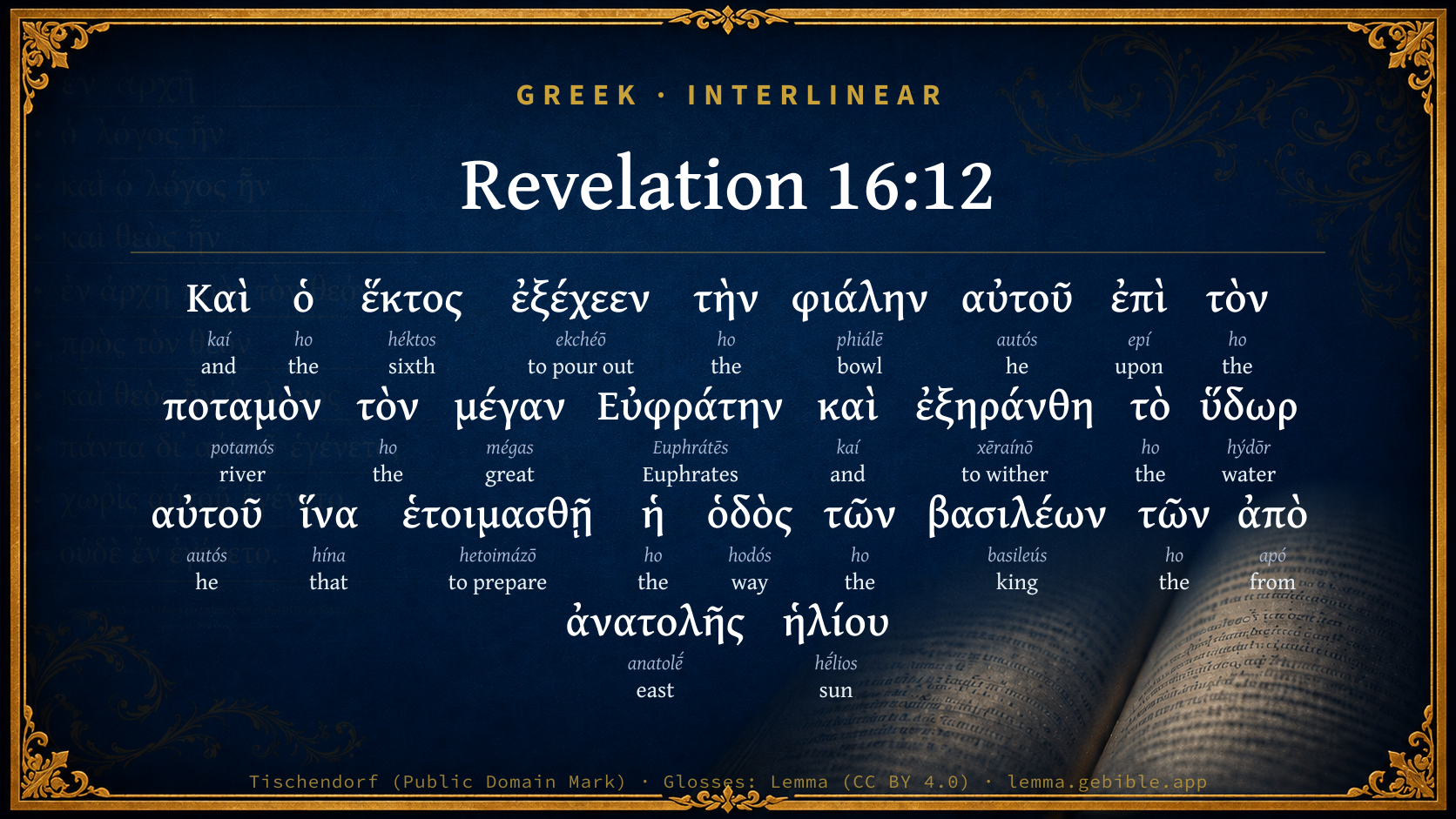
Greek (Tischendorf 8th ed.) Revelation 16:12 appears in the Greek New Testament. The text above is from the Tischendorf 8th edition. Each word links to its Strong’s number and a concise gloss. Click any word for its full Thayer’s Greek Lexicon entry.
Download image
Cite this verse

Revelation 16:12 (World English Bible). Public Domain. Lemma interlinear Bible study tool, https://lemma.gebible.app/v/revelation/16/12.

Show BibTeX & RIS
BibTeX
RIS
English Translation
The sixth poured out his bowl on the great river, the Euphrates. Its water was dried up, that the way might be made ready for the kings that come from the sunrise.
World English Bible · Public Domain
Download a study sheet

One document with this verse’s original text, its word-by-word gloss line, the meaning frame, cross-references with their text, attributed commentary, and full source and license credits — printable, and it pastes into notes with its structure intact.

This verse Autodidact and up

Study sheet (.html) Plain text (.txt)

A passage Seminary Student

Up to 50 verses in one chapter. A passage sheet keeps up to 6 commentary sources and 12 cross-references per verse, in the order this page ranks them, and says so on the sheet whenever that leaves anything out. Ask for a single verse and you get the Autodidact verse sheet above.

Everything on this page stays free to read, with no account — the sheet is a download of what is already on screen, not access to it.

Want to remove ads? Support Godless Engineer
Compare translations 3

The same verse in 3 English versions, stacked beneath the original-language interlinear above. Click any original word for its lexicon entry.

Each is an independent rendering of the whole verse — the interlinear is not word-aligned to these translations.

Highlighted words mark where these versions differ — a whole-verse word diff, not a word-by-word alignment.

  • World English Bible Public Domain
    The sixth poured out his bowl on the great river, the Euphrates. Its water was dried up, that the way might be made ready for the kings that come from the sunrise.
  • King James Version Public Domain
    And the sixth angel poured out his vial upon the great river Euphrates; and the water thereof was dried up, that the way of the kings of the east might be prepared.
  • unfoldingWord Literal Text CC BY-SA 4.0
    And the sixth poured out his bowl upon the great river, the Euphrates, and its water was dried up so that the way of the kings from the rising of the sun might be prepared.

unfoldingWord Literal Text — © unfoldingWord, licensed CC BY-SA 4.0. Word-aligned USFM3 via Door43 (git.door43.org/unfoldingWord/en_ult).

Versions to compare (up to 4)

3 of 4 selected

Show all 19 translations

Every available English version of this verse, each an independent rendering of the whole verse.

  • World English Bible Public Domain
    The sixth poured out his bowl on the great river, the Euphrates. Its water was dried up, that the way might be made ready for the kings that come from the sunrise.
  • Berean Standard Bible Public Domain
    And the sixth angel poured out his bowl on the great river Euphrates, and its water was dried up to prepare the way for the kings of the East.
  • Majority Standard Bible Public Domain
    And the sixth angel poured out his bowl on the great river Euphrates, and its water was dried up to prepare the way for the kings of the East.
  • King James Version Public Domain
    And the sixth angel poured out his vial upon the great river Euphrates; and the water thereof was dried up, that the way of the kings of the east might be prepared.
  • American Standard Version (1901) Public Domain
    And the sixth poured out his bowl upon the great river, the `river' Euphrates; and the water thereof was dried up, that the way might by made ready for the kings that `come' from the sunrising.
  • Revised Version (1885) Public Domain
    And the sixth poured out his bowl upon the great river, the river Euphrates; and the water thereof was dried up, that the way might be made ready for the kings that come from the sunrising.
  • Geneva Bible (1599) Public Domain
    And the sixth Angel powred out his viall vpon the great riuer Euphrates, and the water thereof dried vp, that the way of the Kings of the East should be prepared.
  • Douay-Rheims (1899) Public Domain
    And the sixth angel poured out his vial upon that great river Euphrates; and dried up the water thereof, that a way might be prepared for the kings from the rising of the sun.
  • Young's Literal Translation Public Domain
    And the sixth messenger did pour out his vial upon the great river, the Euphrates, and dried up was its water, that the way of the kings who are from the rising of the sun may be made ready;
  • Literal Standard Version CC BY-SA 4.0
    And the sixth messenger poured out his bowl on the great river, the Euphrates, and its water was dried up, that the way of the kings who are from the rising of the sun may be made ready;
  • Unlocked Literal Bible CC BY-SA 4.0
    The sixth angel poured out his bowl into the great river, the Euphrates. Its water was dried up in order to prepare the way for the kings that would come from the east.
  • unfoldingWord Literal Text CC BY-SA 4.0
    And the sixth poured out his bowl upon the great river, the Euphrates, and its water was dried up so that the way of the kings from the rising of the sun might be prepared.
  • Darby Bible Public Domain
    And the sixth poured out his bowl on the great river Euphrates; and its water was dried up, that the way of the kings from the rising of the sun might be prepared.
  • World Messianic Bible Public Domain
    The sixth poured out his bowl on the great river, the Euphrates. Its water was dried up, that the way might be prepared for the kings that come from the sunrise.
  • Webster's Bible Public Domain
    And the sixth angel poured out his vial upon the great river Euphrates; and the water of it was dried up, that the way of the kings of the east might be prepared.
  • Free Bible Version CC BY-SA 4.0
    The sixth angel poured out his bowl on the mighty River Euphrates, and its water was dried up, so that a way could be prepared for the kings that come from the east.
  • Bible in Basic English Public Domain
    And the sixth let what was in his vessel come out on the great river Euphrates; and it became dry, so that the way might be made ready for the kings from the east.
  • Text-Critical English NT CC BY 4.0
    The sixth poured out his bowl on the great river Euphrates, and its water was dried up to prepare the way for the kings of the east.
  • Tyndale New Testament (1534) Public Domain
    And the sixte angell poured out his vyall apon the gret ryver Euphrates and the water dryed vp that the wayes of the kyngss of the este shulde be prepared.

Literal Standard Version (2020), Covenant Press — licensed CC BY-SA 4.0. Text via the HelloAO Bible API (eBible.org). Unlocked Literal Bible (unfoldingWord) — licensed CC BY-SA 4.0. Text via the HelloAO Bible API (eBible.org). unfoldingWord Literal Text — © unfoldingWord, licensed CC BY-SA 4.0. Word-aligned USFM3 via Door43 (git.door43.org/unfoldingWord/en_ult). Free Bible Version, Dr. Jonathan Gallagher — licensed CC BY-SA 4.0. Text via the HelloAO Bible API (eBible.org).

Word by word

More ways to search: Search by grammar → Find every occurrence → Compare this word →

Practice this passage: Drill this verse → Learn its vocabulary →

Εὐφράτην
Euphrátēs
G2166
“Euphrates”
Noun, Accusative, Singular, Masculine
Part of Speech
Noun
Case
Accusative
Number
Singular
Gender
Masculine
Full Thayer's Definition

Origin: of foreign origin, cf G6578

TDNT: None

Euphrates = "the good and abounding river" 1. a large, famous river which rises in the mountains of Armenia Major, flows through Assyria, Syria, Mesopotamia and the city of Babylon, and empties into the Gulf of Persia
  1. Καὶ kaí G2532 “and” Conjunction
  2. ὁ ho G3588 “the” Article, Nominative, Singular, Masculine
  3. ἕκτος héktos G1623 “sixth” Adjective, Nominative, Singular, Masculine
  4. ἐξέχεεν ekchéō G1632 “to pour out” Verb, Aorist, Active, Indicative, 3rd person, Singular
  5. τὴν ho G3588 “the” Article, Accusative, Singular, Feminine
  6. φιάλην phiálē G5357 “bowl” Noun, Accusative, Singular, Feminine
  7. αὐτοῦ autós G846 “he” Personal pronoun, Genitive, Singular, Masculine
  8. ἐπὶ epí G1909 “upon” Preposition
  9. τὸν ho G3588 “the” Article, Accusative, Singular, Masculine
  10. ποταμὸν potamós G4215 “river” Noun, Accusative, Singular, Masculine
  11. τὸν ho G3588 “the” Article, Accusative, Singular, Masculine
  12. μέγαν mégas G3173 “great” Adjective, Accusative, Singular, Masculine
  13. καὶ kaí G2532 “and” Conjunction
  14. ἐξηράνθη xēraínō G3583 “to wither” Verb, Aorist, Passive, Indicative, 3rd person, Singular
  15. τὸ ho G3588 “the” Article, Nominative, Singular, Neuter
  16. ὕδωρ hýdōr G5204 “water” Noun, Nominative, Singular, Neuter
  17. αὐτοῦ autós G846 “he” Personal pronoun, Genitive, Singular, Masculine
  18. ἵνα hína G2443 “that” Conjunction
  19. ἑτοιμασθῇ hetoimázō G2090 “to prepare” Verb, Aorist, Passive, Subjunctive, 3rd person, Singular
  20. ἡ ho G3588 “the” Article, Nominative, Singular, Feminine
  21. ὁδὸς hodós G3598 “way” Noun, Nominative, Singular, Feminine
  22. τῶν ho G3588 “the” Article, Genitive, Plural, Masculine
  23. βασιλέων basileús G935 “king” Noun, Genitive, Plural, Masculine
  24. τῶν ho G3588 “the” Article, Genitive, Plural, Masculine
  25. ἀπὸ apó G575 “from” Preposition
  26. ἀνατολῆς anatolḗ G395 “east” Noun, Genitive, Singular, Feminine
  27. ἡλίου hḗlios G2246 “sun” Noun, Genitive, Singular, Masculine

About this verse

These counts appear in no published source. They are computed here, from the morphology-tagged text and Lemma’s own curated glosses. What Lemma adds →

28
words
19
distinct lemmas
Revelation
section

Notable vocabulary

The rarest word here is Εὐφράτην Euphrates G2166 — appearing just 2 times in the whole Greek New Testament.

Shared distinctive vocabulary

Εὐφράτην Euphrates G2166 occurs in 2 verses of the Greek New Testament. Also found in:

Repetition

Words recur within this verse:

Cross-references

15

Topical passages linked to Revelation 16:12 in the Treasury of Scripture Knowledge — connected by theme and wording, ordered by reader-vote popularity; previews shown in the World English Bible.

  • Revelation 9:14 saying to the sixth angel who had one trumpet, "Free the four angels who are bound at the great river Euphrates!"
  • Jeremiah 51:36 Therefore thus says Yahweh: Behold, I will plead your cause, and take vengeance for you; and I will dry up her sea, and make her fountain dry.
  • Isaiah 41:25 I have raised up one from the north, and he has come; from the rising of the sun one who calls on my name: and he shall come on rulers as on mortar, and as the potter treads clay.
  • Isaiah 44:27 who says to the deep, Be dry, and I will dry up your rivers;
  • Isaiah 11:15 Yahweh will utterly destroy the tongue of the Egyptian sea; and with his scorching wind will he wave his hand over the River, and will strike it into seven streams, and cause men to march over in sandals.
  • Isaiah 42:15 I will lay waste mountains and hills, and dry up all their herbs; and I will make the rivers islands, and will dry up the pools.
  • Jeremiah 50:38–40 A drought is on her waters, and they shall be dried up; for it is a land of engraved images, and they are mad over idols.
  • Isaiah 41:2–3 Who has raised up one from the east, whom he calls in righteousness to his foot? he gives nations before him, and makes him rule over kings; he gives them as the dust to his sword, as the driven stubble to his bow.
  • Isaiah 46:11 calling a ravenous bird from the east, the man of my counsel from a far country; yes, I have spoken, I will also bring it to pass; I have purposed, I will also do it.
  • Daniel 11:43–45 But he shall have power over the treasures of gold and of silver, and over all the precious things of Egypt; and the Libyans and the Ethiopians shall be at his steps.
  • Revelation 7:2 I saw another angel ascend from the sunrise, having the seal of the living God. He cried with a loud voice to the four angels to whom it was given to harm the earth and the sea,
  • Revelation 17:15 He said to me, "The waters which you saw, where the prostitute sits, are peoples, multitudes, nations, and languages.
  • Isaiah 8:7 now therefore, behold, the Lord brings up on them the waters of the River, strong and many, [even] the king of Assyria and all his glory: and it shall come up over all its channels, and go over all its banks;
  • Ezekiel 38:1–23 The word of Yahweh came to me, saying,
  • Revelation 11:14 The second woe is past. Behold, the third woe comes quickly.

Cross-references courtesy of OpenBible.info (CC BY 4.0).

Where the printed editions differ

1 variant

Places in this verse where the major printed Greek editions disagree on the wording in a way that affects the translation — a comparison of editions, not a manuscript-by-manuscript collation. The editions are the modern critical texts (Nestlé-Aland 28/27, SBL, Westcott-Hort, Tregelles, Tyndale House) and the traditional texts behind the KJV (the Textus Receptus and the Byzantine/Majority text). It is not a claim about which reading is original.

  1. Extra text
    ἄγγελος

    “angel”

    In TR Not in NA28NA27TynSBLWHTregByz

    ἄγγελος (angelos) 'angel' is only in traditional manuscripts (TR)

Textual data: Translators Amalgamated Greek New Testament (STEPBible TAGNT) · CC BY 4.0.

Commentary

Notes on Revelation 16:12 from classic Christian and Jewish commentators (each source and its license shown beneath its notes). The classic Christian expositions comment on the surrounding passage and are grouped to its opening verse, so a note may address several verses; the Jewish commentaries on the Tanakh (Rashi and others) are per-verse, so they appear only where the commentator wrote on this verse.

Lemma curates 59 commentaries, every one of them public domain or Creative Commons licensed, each selected and text-cleaned for this edition rather than reprinted as found. About our sources →

The Cambridge Bible for Schools and Colleges

gen. ed. J. J. S. Perowne

The Sixth Vial, Rev_16:12-16

12. Euphrates] Rev_9:14 sqq. Where Babylon confessedly stands for Rome, we should naturally understand the Euphrates to be used also in a symbolical sense, possibly as meaning the Tiber. But the Tiber is not a very “great river:” and the mention of “the kings of the east” (lit., the kings from the rising of the sun) as needing to pass the Euphrates seems to mark it as meant literally.

the water thereof was dried up] Referring to the way that the ancient Babylon was actually captured by Cyrus, by drawing off the water of the Euphrates into a reservoir, so as to make its bed passable for a few hours. Though not mentioned in Daniel 5, nor by Cyrus in his lately discovered account of the capture, there seems no doubt that this incident is historical: the details given in Hdt. I. 191 agree exactly with those of the predictions in Isa_44:27; Isa_45:3; Jer_50:38; Jer_50:44; Jer_51:30-32; Jer_51:36.

that the way &c.] Compare the prophecies of Cyrus’ advance in Isa_41:2; Isa_41:25. He is there spoken of as advancing on Babylon “from the East:” much more would any invader of Rome or the Roman Empire come from the East, if he had to cross the literal Euphrates.

the kings of the east] Rather, from the east. In Rev_17:16 we hear of the kings of the earth combining to attack Babylon, and the Euphrates may be dried up, only that the kings from the east may be able to advance to bear their part in the assault. But why do they specially need their “way to be prepared”? The Euphrates is a far less impassable frontier than the Alps or the Mediterranean: it was in fact in St John’s day the weak side of the empire. And probably in this fact we may see the key to the prophecy. In Dan_8:8; Dan_11:4 we have the division of Alexander’s empire described as “toward the four winds of heaven:” in Rev_11:5-6 the Egyptian and Asiatic kingdoms are designated as “the kings of the south and of the north.” It is implied therefore that the kings of Macedon are kings of the West: and it remains that the other great and permanent kingdom (of smaller ephemeral ones there were more than four) which arose from the dissolution of Alexander’s shall be “the kings of the east.” Now this designation obliges us to think of the Parthians, the longest-lived of all the Alexandrine kingdoms, and the only one surviving in St John’s day. This differed from the others, in respect that its royal dynasty was native, not Macedonian, but it was not the less a portion of Alexander’s empire, inheriting his traditions. (The veneer of Greek culture existing among the Arsacidae is well illustrated by the grim story of the performance of the Bacchae at the time of the death of Crassus: it is instructive also to look at the series of coins engraved in Smith’s Dictionary s.v. Arsacidae, where we see Hellenic types gradually giving way to Assyrian.) In Enoch liv. 9 we hear of “the chiefs of the east among the Parthians and Medes:” that passage throws no real light on this, except as shewing who “the kings of the east” were understood to be, by a person familiar with the same ideas as St John. Now in St John’s time (whether the earlier or later date be assigned to the vision) there were apprehensions of a Parthian invasion of the empire on behalf of a pseudo-Nero (Tac. Hist. I. ii. 3), i.e. a shadow of Antichrist: and it is likely that St John’s prophecy is expressed (as so many O. T. prophecies are) in terms of the present political situation. But it had no immediate fulfilment: the danger from Parthia under Domitian passed off, and soon afterwards its power was broken for ever by Trajan. But its place was taken in time by the Sassanian kingdom of Persia, which remained for three centuries the most formidable enemy of Rome. Then, as Parthia had been broken by Trajan and fell before Persia, so Persia, broken by Heraclius, fell before the Arabs, who endangered the existence, and actually appropriated great part, of the Eastern Empire. To them succeeded the Turks, before whom it fell.

Now while no event in this series can be called a definite or precise fulfilment of St John’s prophecy, we may hold that this habitual relation of “the kings of the east” to the Roman empire supplies a number of typical or partial fulfilments. A pseudo-Nero, made emperor by a Parthian conquest of Rome, and ruling (as might be expected) in Nero’s spirit, would have been almost a real Antichrist: and for such a revelation of Antichrist St John’s immediate readers were meant to be prepared. Again, in the conquests and persecutions of Sapor and Chosroes, of Omar, Mohammed, and Suleiman, it was intended that the Christians of the empire should see the approaches and threatenings of the kingdom of Antichrist. But the empire—whether Roman, Byzantine, or Austrian—continued to “withhold, that he may be revealed in his season”; and its modern representatives will continue to do so “until it be taken out of the way: and then shall that Wicked be revealed.”

It may be observed that Dan_11:40 sqq. seems to imply that the political situation in the East in the days of Antichrist will be not unlike that in the days of Antiochus: for while it is certain that the early part of that chapter applies to the latter, it is hard to regard the passage beginning at Dan_11:36 as adequately fulfilled in him. Humanly speaking, it does not seem that the changes now going on in the east are as capable of producing a conquering empire, as they are of producing an antichristian fanaticism: but qui vivra verra.

The Cambridge Bible for Schools and Colleges (gen. ed. J. J. S. Perowne; Cambridge University Press, 1878–1918) — public domain. Text from a community e-Sword module.

The Biblical Illustrator

Joseph S. Exell

Rev_16:12-16

The sixth angel poured out his vial upon the great river Euphrates … Three unclean spirits

The mission of the three spirits

The river Euphrates, the dividing stream (in old time) between Israel and Assyria, between Israel and Babylon--the dividing stream (in typical language) between the Israel of God and the foes of God, between the Church and the world, between the disciples of Jesus Christ and the opposing hosts and powers of evil--is dried up, by the outpouring of the sixth vial, that the last confederacy of infidelity and ungodliness may be tempted onward to its ruin.

These vials are vials of wrath. The longsuffering of ages is at length exhausted: the measure of earths iniquity is at last fun. The time is come for a decisive battle: the kings from the east, from the enemys side of the river, shall be encouraged to cross over, shall be permitted to pass over dryshod, that they may throw themselves, in all their proud superiority of strength and numbers, upon the camp of the saints and upon the beloved city. Such is the parable. Enough of palliatives and enough of compromises: enough of human expedients for harmonising the irreconcilable, for making truth speak the speech of compliment, and toning down revelation till human reason shall flatter herself that she invented it: not thus can the true life be lived, the reality of death faced, or a boundless eternity entered: not thus shall place ever be found for that new heaven and new earth, in which dwelleth righteousness, in which the tabernacle of God is with men. There must first be a war and a battle: the war of spiritual combatants, the battle of the great day of God Almighty. Thus we are enabled to contemplate, with awe but not with dismay, all that growing boldness and insolence of unbelief which seems likely to be characteristic of the last quarter of the nineteenth century. It is all working up to a consummation--a consummation foreordained of God--a consummation revealed by Him in prophecy. The three unclean spirits which gather the invading powers to the battle of the great day are said to issue from the mouth of the dragon, and from the mouth of the beast, and from the mouth of the false prophet. The reference is to the section of the three enemies, occupying the twelfth and two following chapters of this book.

1. The dragon is described to us in the twelfth chapter by figures and names, which leave no doubt of their meaning. He is expressly termed the devil and Satan--the old serpent, with evident reference to the history of mans fall--the deceiver of the whole world--the accuser of the brethren. He is described as a dragon--that fabulous monster of antiquity, with its huge coils of serpent-like scales--here painted with seven heads, ten horns upon one of them, and seven crowns--telling at once of manifold versatility, giant strength, and more than regal dominion. He is described further as casting down to the earth the third part of the stars of heaven--to express at once the audacity of his presumption, and the superhuman sweep of his success. He stands before the woman clothed with the sun and crowned with the stars--emblem of the Church of God now travailing in birth with the Saviour of prophecy and of expectation--stands, I say, watching for the Incarnation, and eager to devour the Divine Child at the moment of His birth. Frustrated by the final rescue which transfers the imperilled Saviour, by ascension, to the throne of God in heaven--and himself receiving a defeat in the war with the glorified Christ which hurls him back, wrathful and revengeful, upon an earth not yet regenerated--he turns all his fury first upon the Church, which escapes from him into the wilderness, cared for by God Himself, who has prepared there her temporary home and her heavenly supplies--cared for by God, but helped even by the earth, who, in a sense wonderfully true to history, has sometimes even protected and favoured her--first, I say, upon the Church herself, and then (by a slight modification of the metaphor) upon the individual Christian, represented as not yet sharing the full security of the Church as a whole, as having still to fight for his life, though the Church is guaranteed from the once threatened destruction.

2. The second enemy is depicted in the thirteenth chapter. A wild beast of hideous composite form--lion, bear, and leopard in one--is seen by the evangelist rising out of the sea. With one slight--very slight--difference his first appearance is that of the dragon himself. There are the seven heads and the ten horns upon one of them, only in this latter case the horns arc crowned, not the heads, and therefore the crowns are ten, not seven. The dragon gives him his power and his throne: he is to represent him: the dragon is a power out of sight: the beast is his impersonation and his express image. One peculiarity of this foe is a portentous vitality. He receives a mortal wound, but he lives again. The admiration of the beholders rises into adoration. They worship the dragon who gave him his authority, and they worship the beast who lives after dying. The second enemy is the world. There is no mistaking the symbolism. In the interpretation of Daniels vision the four beasts combined into the beast before us are expressly said to be kings: the beast is the world, as the dragon is the devil. The world, in its aspect of power--the aspect here presented--is a great reality. In St. Johns time it was the formidable--apart from revelation the irresistible, invincible--foe of the little Church of Jesus Christ. The time was to be when an apparently fatal wound was to be inflicted upon this antagonist--a wound, of which one illustration, if not the one fulfilment, was to be the nominal conversion of the Roman Empire to the faith which once it persecuted. Surely that wound was a mortal wound? Wait a while and you shall see the world rise from its bed of death--you shall see names changed, realities surviving--you shall see kings ruling in lust and rapine by the grace of God--you shall see the nominally Christian world wax wanton in turn against its imaged and sculptured Lord--you shall see Christian kings issuing their edicts of exile against Christian worshippers, and Papal Rome drawing from her scabbard the sword which Pagan Rome had for ever sheathed. The power of the world is superhuman in its vitality: the dragon--this accounts for it--gives the beast his throne and his authority, and that throne and that authority, call themselves what they may, are still adverse and antagonistic to the cause and the people of Jesus Christ.

3. There is a third enemy, called in the text, for the first time, the false prophet; but clearly marked, in later passages of the nineteenth and twentieth chapters, as identical with the beast from the earth of the thirteenth. His characteristics are peculiar. They combine might and meekness. He has two horns like a lamb, but he speaks like a dragon; he unites the seeming innocence of the lamb with the subtlety which beguiled Eve in the serpent. There is no doubt as to his origin--it is more patent than that of the second--he comes up out of the earth whatever his apparent influence with heaven and the unseen. In some sense he is the viceroy of the second enemy; he exercises all his power before him--the power which the dragon gave he guides to its destination. His work is to glorify in every way the beast which is the world. He makes earth worship the world. He magnifies, by every art and every persuasion, the miracle of the revival. He props miracle by miracle, can make fire come down from heaven by his incantations to deceive mankind into the idolatry of the beast which died and lives. He bids them make an image of the god-world, and then he puts life into the image and makes it speak. St. John lived in days when the beast was embodied in the empire, and when the image of the emperor was an object of worship. The suspected Christian was bidden for his life to sacrifice to that image. All this would make the figures of this part of the vision very real and very life-like to the Church of that time. Illustrative, not exhaustive, of them. The second beast, like the first--the third enemy, like the second, lives on until now. He is the wisdom, as the other is the power, of this world. He is that subtler, more penetrating influence of policy and diplomacy, of skill and scheming, of expediency and statecraft, of knowledge divorced from religion, of science falsely so called, of reason set against revelation, and creatureship exalted into rivalry with the Creator, without which the brute-force of wealth and numbers, of edicts and penalties, of arms and armies, would have no avail ever against intellect and enlightenment, would have lost it long ago in the face of popular growth and advancing freedom. It must be confessed that it is not easy to set before ourselves in a sharp, strong, telling way the distinctions and contrasts of the three enemies. They interlace and intertwine with each other--their general drift is the same--they are working to one end, and they are helping one another to reach it. Yet we must endeavour to see why they are distinguished, and to discover their special characteristics as influences upon the generation occupying the earth on the very eve of the great day. I saw three unclean spirits come out of the mouth of the dragon, and out of the mouth of the beast, and out of the mouth of the false prophet.

(1) We might hesitate long and anxiously about the first of these. We might think of many characteristics of the evil spirit in his fall and in his ruin, in his reign and in his warfare, as they are suggested to us in the hints and warnings of the Bible. But there is one quality which seems to underlie and motive all, and that is insubordination. It is the unwillingness to keep the rank and the station--the first estate, as St. Jude calls it--assigned by the Lord of all to the individual being created. It is the inability to curb and coerce the unruly workings of that pride of self, that lust of liberty, that passion for independence and exemption from jurisdiction, which begins by trying to escape from the omnipresence, and ends by making omnipotence itself its foe.

(2) And what of the inspiration from the beast which is the world? To it also we might assign many names, but we shall choose one among them and call it materialism. It is the pressure upon us, the influence over us, of this brute thing, the power of the present, the power of the seen, the power of sense and time, the power of the circumstance and the surrounding of the men that shall die and the world that passeth away; it is the inability to withstand the custom and the fashion, the force of numbers and the cry of voices and the command of the society which can compel or outlaw; it is the influence, in One shape, of clamorous appetite and eager ambition and unsatisfied getting; it is the influence, in another shape, of the meanest and vilest of philosophies, saying, The body is all--let it have its way; or, The body is all--there is no hereafter.

(3) Insubordination--materialism--what shall be the third spirit? Think of the characteristics of the lamb-like, serpent-like wonder-worker--of the ingenious subtle inventor that can draw fire from the sky and make images speak--that can assert itself under anothers name, impose its edicts with authority, and ostracise the poor Christian that would so much as buy or sell unmolested--think of all this, and you will not count the third influence misnamed if we call it intellectualism--the thing which struts and parades itself as thought, intelligence, an open mind, a refusal to see with others eyes, a repudiation of the received, a passion for the original--though its discoveries are oftentimes the mere echo of an echo from days of obsolete objection, of puerile, infantine bewilderment. (Dean Vaughan.)

The battle of that great day of God Almighty.

The final conflict

Is it possible, after all, that we have mistaken the character of the final triumphs of humanity and Christianity? Are they to be peaceful triumphs? or are they to be gained in the bloodiest grapple of the long-opposing forces which the pen of history ever had or ever shall have to record?

1. In the first place it lies level to the most superficial observation that this, our earth, was chosen of God as the theatre of a great judicial conflict. This world is not a pleasure-garden in Gods realm, in which white-footed angels may walk at the cool of day, fearing no thorns or flinty roughness, and inhaling only the fragrance of roses and spices. It is not a place of idle sauntering for any citizens of Gods empire, just giving grateful shade, and musical with birds and fountains. It is a rough battlefield on which Good and Evil are met to strive for the mastery. It would not be strange, then, at all if in a world so purposed and elected the conflict should ever be keener; the progress be not more and more pacific, but more and more troubled and stormy; the struggle should ever gather to itself on either side more masterful forces, and the final battle be more resolute and deadly, as it is to be more determinate than any that have gone before.

2. But let us descend for a little from the broad view to details of the engagement, and see how the strife goes in the individual heart--what the law of progress, and what the character of the most decisive victories. Leave out the more spiritual aspects of the conflict for a moment, and come in upon one who is wrestling with some evil habit. Here is a man trying to break away from the bands of intemperance. His first efforts are feeble and ineffectual. He doesnt understand the power of his adversary. All his measures are mild, all his efforts are languid. He tries gentleness and moderation long enough to see that they only play into the hands of the enemy. It begins to dawn upon him that nothing but a terrible final duel can lay his enemy prostrate. Now the grim appetite rises in its strength. The soul, too, seeks to put on power. It thinks of whatever may stimulate its prowess--property wasted, health blasted, name dishonoured, family comfort and peace desolated, life imperilled--and meets the dread hour. It has need of all the heroism it can summon up. It navel: knew till now what the contest must be, and more than once now, doing its best, it may be worsted. It must yet put forth a more desperate strength. The battle that wins for it deliverance, that breaks the tyrants sceptre, will be the fiercest battle of all the war. So it is with all the vices--with every evil habit. Is it not thus with the more spiritual struggles for the new spiritual life? The soul begins perhaps by entertaining graver thoughts. That is well, but that doesnt end it. It isnt even the beginning of the end. It reasons with its wild and lawless propensities. The headstrong rioters laugh at such proclamations. They are paper-bullets. It seeks realise an outward reformation. This is no more than cutting off the outposts of evil--shooting down a picket or two. It tries exercises, Bible-reading, praying, good-willing; but only to discern more clearly how immovable the heart. The heart is yet securely intrenched. The citadel has not been carried. The soul becomes more in earnest, and the forces waken and multiply on either side--the truth pleads, and conscience and fear and the Holy Ghost and the world pleads--and the flesh and the adversary. This will be another struggle from any that have gone before. It will be a striving unto blood. It will be a grapple for life or death. The soul, if it wins, comes out of it after all pale and spent, with scarce strength to raise the shout of victory. Is not this private and individual strife an epitome of the larger--the public--the universal and comprehensive struggle? Are not the final conflicts ever the most desperate? Is not the fact of hopeful progress declared, not by increasing pacification, but by the growing sternness and fierceness of the contest?

3. When these three combine against God and his people--Sadduceeism, with audacious head; absolutism, with a chained fellow-man beneath its heel; and false religion, binding and loosing human consciences with a lie--then will that last great battle be joined whose fortunes and whose fluctuations will issue in giving the kingdom to the saints of the most High God. There will yet be such a combination. There is yet to rock the perturbed earth the tumult of that battle-day. Evil is not to be quietly dispossessed of its seat in this fair province of God. It holds by immemorial possession. It shall please God to show the full prowess of truth. The mightiest rally of evil in its united strength will be permitted. Gog and Magog will be gathered to the war. The false prophet, the beast, and the old dragon will consolidate their divisions in one dread array. Christianity will advance her banner and sound her charge. Considering what she is called to encounter, considering the long historic past, considering all the prophetic intimations, it will not be strange if she is called to contend against carnal weaponry. That Armageddon of the Lord, on which evil, with all its myrmidons, is finally to fall down slain, will be, we believe, not figuratively, but in some part of it, and in the high places of the field, literally an aceldama. There will be the thunder of the captains, with confused noise and garments rolled in blood. (A. L. Stone.)

Behold, I come as a thief.--

The coming of Christ

How comes a thief? He comes secretly and unexpectedly; secretly, lest he be discerned, and then with all advantages of surprisal, that he may not be taken himself while he is taking others. So Christ is said to come to judgment. He comes suddenly and unexpectedly. When people will take no warning He watches the time of their destruction, so that here you have the goodness and the severity of God (Rom_11:22): first, His goodness is showed in that He will give warning in all dangers; but here is His severity also: when warning will not be taken, then He comes with judgment. Christ here says He will come as a thief in the night, and this His coming is by reason of our unfaithfulness. And His coming is sudden, unless to some of His children that He prepares by warning. When He came into the world at His first coming there were but a few waited for the consolation of Israel (Luk_2:25): the rest did not. When He comes to any man or nation in His judgments doth He find faith? No; He finds them blessing themselves that to-morrow shall be as to-day. All that have spiritual life, labour to be waking Christians and then watching Christians. What is the difference between men but that carnal men are sleepers and spiritual men are waking? And what is the difference of Christians that are good and that are not? The one is a watchful Christian and the other not so. Wherein is one better than another? As the one is more careful to avoid sin than another. To come, therefore, to some directions how to carry ourselves, and among others remember this: we should have this waking and watchful consideration that we have a soul immortal, and that we are for eternity; and whatever we do in the flesh that shall be ever with us; and how that shortly we are going to the tribunal seat. In all these respects we should labour to be watchful at all times, because that time in which we take liberty to ourselves may be the time of our surprisal. We should therefore watch at all times, in prosperity and adversity. We should watch against all the sins of our persons and the sins of the state we are in. Besides, if we use this course, we shall bring our souls to that awe as that they shall not dare to offend God, by reason they must come to be examined. And how will our souls be willing to be judged before Christ, when we are unwilling to set ourselves before ourselves? If we use this it will bring a holy awe upon our souls, because they know they must come to examination for every sin. But mark what follows: Blessed is he that watches and keeps his garments close lest he walk naked.

1. First, know we have no garments of our own. Now it is thus in spiritual things. We have no garments of our own since the fall; but before we had. We have none now but original corruption that spreads over the soul. Besides that, men living unto years have another nature worse than the leprosy, custom. Here is all the clothing we have of ourselves; but for any spiritual good we must fetch it from Christ (Rev_3:18).

2. Now the second thing is this, we having none of ourselves, therefore we must have garments; and when we have them we must keep them clean and close: Blessed is he that keeps his garments close. For the first must be garments for defence; so in spiritual things there must be garments to defend us from the wrath of God, else we lie as naked to Gods wrath as a man in a storm being naked lies open to the storm. We must have garments of amity and friendship now. Again, we must have garments for distinction. Now, garments do distinguish Christians at the day of judgment. Garments that are coverings must be all over of equal extent. They cover the whole man. So head, hands, and heart, all must be sanctified as well as justified. So that those that look upon a Christian should see nothing in him but somewhat of Christ, His words, His callings, His thoughts. And we must be clothed not only with garments, but armour, because we live in the midst of our enemies, by which we may perceive the necessity of the putting on of the one as well as the other. Now, as we must have garments and must keep them close, so also we must keep them from stains. The persons where these graces are may be defiled, but the graces are pure. We should, therefore, labour to keep our actions unspotted. The righteousness of Christ is an excellent garment, but it must be put on; and if we have Christ we have all. There is another thing intended in this Scripture. These are dangerous times, and there are spiritual cheaters abroad in the world. Therefore we should keep our profession close, and keep our truth and our judgments close, and get love into our affections; for we shall be set upon, and if we walk at large, then heretics and seducers will come between us and salvation, because our garments are not close. If a man will have any good by religion, he must cleave to religion. Lest they walk naked, and men see their shame. All shame arises from this, that we do not keep our garments close. So long as truth and Christ by truth have a place in the soul, so long we are safe. Now to give some directions how to keep our garments close.

(1) Labour for convincing knowledge, because all grace comes into the soul by the light thereof. Grow, therefore, in grace and in the knowledge of our Lord Jesus Christ; and often propound queries to our judgments about the Word and sacraments. Am I able to maintain this truth I have been brought up in? And do I find them true to my soul, &c.

(2) Those that will have good gardens will have flowers of every kind, so a Christian must have graces of every kind. We must put on whole Christ for justification and sanctification, and we must add grace to grace; and when we have put on every grace we must keep them clean, and not defile our profession. (R. Sibbes.)

The swift and sudden advent

These are words specially for the last days. With eighteen hundred years behind us now, we may take them home most solemnly to ourselves.

1. They warn.

2. They quicken.

3. They rouse.

4. They comfort.

I. The coming. It is the long-promised advent. Christ comes! He comes--

1. As Avenger.

2. As Judge.

3. As King.

4. As Bridegroom.

Like lightning; like a thief; like a snare. Like lightning to the world, but the Sun of morning to His Church; like a thief to the world, but like a Bridegroom to the Church; like a snare to the world, but like the cloud of glory to His own.

II. The watching. Not believing, nor hoping, nor waiting merely; but watching--as men do against some event, whether terrible or joyful, of which they know not the time. Watch, for ye know neither the day nor the hour of His arrival. Watch, for that day is great and glorious. Watch, for ye are naturally disposed to sit down and take your ease. Watch, for Satan tries to lull you asleep. Watch, for the world, with its riches and vanities and pleasures, is trying to throw you off your guard.

III. The keeping of the garments. Be like Nehemiah, who, when watching against the Ammonites, did not put off his clothes night nor day. Keep your garments all about you, that when the Lord comes He may find you not naked, but robed and ready.

IV. The blessedness. Blessed is the watcher; blessed is the keeper of his garments. Many are the blessed ones; here is one class specially for the last days.

1. It is blessed, for it cherishes our love.

2. It is blessed, for it is one of the ways of maintaining our intercourse.

3. It is blessed, for it is the posture through which He has appointed blessing to come, in His absence, to His waiting Church.

V. The warning. Lest ye walk naked, and men see your shame. Shame has three meanings

1. The shameful thing or object.

2. The feeling of shame produced by the consciousness of the shameful thing.

3. The exposure to shame and scorn from others. The first of these is specially referred to here. But all the three are connected. (H. Bonar, D. D.)

The necessity of vigilance

I. Behold! Here is a business infinitely more momentous than any other that can engage you.

II. I Come. Jesus the Son of Mary--Christ the Son of God. He whose hands were filled with mercies, and whose heart overflowed with love. He comes to see how we have requited His love--what benefit we have derived from His glorious incarnation and His great redemption--what use we have made of His Word, of His Sacraments, of His Church, of His ministers, of His Sabbaths, of His grace. I come, not I will come, but I come--the present tense, I am coming, I am on My way. Behold, I come as a thief: when all is repose, quietness, confidence, security. Such will, very generally, be the state of that generation of men who are living when the Lord descends at the last day. Behold, I come as a thief. Most who die, die suddenly. A year before, a month before, they never thought of dying. Many never give a serious thought to death a week before they die, and some not even a day.

1. Watch, while others sleep.

2. Pray, while others trifle.

3. Labour, while others are idle. (T. Nunns, M. A.)

Blessed is he that watcheth, and keepeth his garments.--

Garments--a Scriptural figure

It was customary in the temple at Jerusalem for certain of the Levites to keep watch or guard during stated hours of the night. An officer was appointed over them, whose business it was to go round, and see that these watchers were attentive to their duties. He carried a lighted torch in his hand, and, if he found any of the men asleep at their posts, the law permitted him, if it did not require of him, to set fire to their garments. The offender, thus marked, was brought up before the magistrate on the following day, with his garments either wholly consumed or partially scorched, and then received the punishment due to his negligence. Now, see the force of the text: Blessed is he that watcheth, and keepeth his garments. Blessed is the man who so takes heed to his Christian profession in this dark world, where it is necessary he should act as a watchman, because his enemy Satan goeth about to catch him asleep at his post. Blessed is the man who so minds his duties and his Masters interests that no mark of disgrace is put upon him, and that a charge of negligence cannot fairly be brought against him. Blessed is the man who gives such diligence to make his calling and election sure, that the garments in which he will have to appear, in the light of perfect day, when every mans work will be tried of what sort it is, may not prove his confusion.

I. First let us take the word garments as used literally, and as denoting only the clothing or covering which we wear upon our bodies. The Bible teaches us something about our garments in this plain and literal sense. Many seem to think that religion has nothing to do with the manner in which a love of dress and outward adornment is indulged; that every one is at liberty to choose and act for themselves in this matter. A Christian, however, does not think so. He has learnt that there is a sobriety and suitableness of attire which become godliness; and he makes it his aim to adorn, not himself, but the gospel he professes, even in this particular.

II. But let us now take the word garments in its figurative sense, and see what doctrinal truths it is employed to teach.

1. The perishable nature of all earthly things.

2. The sinfulness of our nature, and the worthlessness of our best deeds.

3. Again, the figure contained in the text is used also in the Bible in a more cheering and gracious signification. Garments of light, are spoken of; garments of praise; white garments; holy garments; shining garment. These beautifully significant figures were not all of them applied, in the first instance, to sinful creatures like ourselves; yet they truly betoken the state of Gods redeemed people at one period or other of their earthly pilgrimage. Collectively, they portray the believers sanctification.

4. But I must proceed to remark, lastly, that there is a sense given, in the Bible, to the figure in our text, which is especially glorious and worthy of remembrance. Garments of salvation are spoken of, beautiful garments, which are something more than mere garments of sanctification, though that is an immense blessing; garments in which the believer may appear before God with exceeding joy. (F. W. Naylor, M. A.)

.

Watch against old sins

Watch against old sins. Sitting on a flowery bank, a viper crawled forth and bit us. Great were the pain and the peril before the wound was healed. Shall we carelessly choose that very bank on which again to rest? Would it be wise to let the pale primrose and the fragrant violet tempt us where deadly reptiles may still make their nest? Let us watch against the delusion that there is no longer need to watch. After a severe struggle the victory was won over our reigning lusts, and we fancy that the peril is past. But let us watch. The rebellion has been put down; but though its armies have been scattered and its prince dethroned, many traitors lurk in secret places watching for opportunities to renew the struggle. The embankment is weak where it once gave way; and though the breach has been repaired it must be diligently watched. The flames have been put out, but the ashes are still smouldering; and, if the wind rises, the fire may burst forth anew. (Newman Hall.)

And he gathered them together unto a place called in the Hebrew tongue Armageddon.--

The eve of Armageddon

The hosts that have mustered behind the Euphrates were once Gods handiwork and Gods creatures. They have broken loose from that relationship. They have chosen them another leader--himself already emancipated from the yoke of the original blessedness. There is one power, one only, which God does not-shall we say it with reverence? perhaps cannot--exercise: the compulsion of the will--that coercion of the moral being, which some talk of as though it certainly would be applied if God were at once Almighty and all-loving, but which a deeper reflexion feels to be inconsistent alike with the definition of man and with the definition of salvation. Man without free will is man no more--and a salvation imposed by main force would be no salvation. There is a point in the affairs of nations--there is a point even in spiritual history--beyond which war is the one solution. Enmity--even between man and his Maker--may become hostility. As the end draws on, prophets and evangelists concur in anticipating a culmination, if not an incarnation, of evil, only to be dealt with by an intervention of God Himself to decide the long controversy, and to regenerate earth, as a prophet has written, by the spirit of judgment and by the spirit of burning. The prophetic figure for this catastrophe is that of a war and a battle. God would have the matter fought out. But how strikingly is the distinction here drawn between Gods part, and that which is not Gods part, in the impending conflict! An angel dries the Euphrates, but no angel stimulates to the crossing. That is the office of the unclean spirits; and they issue from the mouth of the three enemies--the dragon, the wild beast, and the false prophet. He gathered them together into a place called in the Hebrew tongue Armageddon. The gathering is ascribed, in the 14th verse, to the three spirits. The word is the same here--and the Greek idiom will bear the rendering they gathered. But the instinct of our English translators has well guided them to the transition: the parenthesis of verse 15 has broken the thread. The unclean spirits go forth to gather--Behold, I come as a thief--Blessed is he that watcheth, and keepeth his garments--And he gathered them together into the place which is called in the Hebrew tongue Armageddon. The spirits of evil do not choose the battle-field: they whisper, and buzz, and irritate--they suggest, and prompt, and incite; but there is a hand and a will above theirs, which leaves not to them the strategy or the combination. He gathered together, and He chose the ground. Thus is it in the Old Testament prophecies of the same last encounter. Thou shalt come up against My people, as a cloud to cover the land: it shall be in the latter days, and I will bring thee. Thou shalt come--and I will bring this is from Ezekiel. I will gather all nations … thither cause thy mighty ones to come down, O Lord. This is from Joel. The day of the Lord cometh For I will gather all nations to battle … Then shall the Lord go forth, and fight against those nations. This is from Zechariah. The spirits go forth, but it is God who gathers. He dries the Euphrates, and He fixes the Armageddon. We scarcely recognise, in that name of mystery, the familiar Megiddo--Armageddon, hill of Megiddo--on the southern skirt of that great plain of Esdraelon which was the scene of so many conflicts, for defeat or victory, in the earlier and later history of Israel. But does any one imagine that we are to seek, on the map of Palestine or of the world, a site or a place for the last great battle? It is well to look into the imagery: it is helpful toward the understanding of the thing signified; it is in the comparison of Scripture type and Scripture parable that we learn what God has written about this consummation of all things. Even in that last suggestion, of the attractiveness to a later enemy of a battle-field fatal to Josiah, we have something to learn as to the fascinations of that lying spirit which alone can make any man a fighter against God. But we are reading of spiritual things: the field of that war is not local--any more than its armour, whether of defence or attack, is carnal. Nay, the place itself is varied in various predictions. St. Jehu points us to the valley of Esdraelon and the hill of Megiddo; Joel makes the place of decision the valley of Jehoshaphat; and Zechariah gathers all nations against Jerusalem, speaks of a siege and capture of Jerusalem, and sets the feet of the Divine Deliverer upon the Mount of Olives before Jerusalem eastward. Such varieties should guard us against all temptations to limit or localise where the matter itself spoken of is not carnal but spiritual. As surely as the vulture scents its prey wheresoever there is death, so surely shall the destroying Angel find out sin, so surely shall delivering Angels find out Gods elect, so surely shall there be for every man a day of judgment, for every man a way of salvation: not here, nor there, particularly, shall the war of the end be waged or the battle of decision fought out: Armageddon is a type, not a locality, and the prophecy, like all prophecy, is not letter but spirit.

(1) We have before us, then, the two camps, distinct and separate, of the faithful and the foe. It is characteristic of the scene and of the time. A battle is impending, and there can be no battle without a choice of sides. Silently and half unconsciously the two camps are forming: every sinful thing done, every unkind word spoken, every heart-murmuring, every spirit-blasphemy, against the commandment or against the revelation or against the providence of God, is drifting the doer or the speaker or the thinker towards the camp of the foe: every act of good, every earnest effort, every struggle with a sin, every souls prayer and souls feeling after the invisible, every thought of love to Him who died for us, every longing yearning desire after a heaven of holiness and of service, is tending towards that camp of the saints of which a later chapter tells--safe whatever befalls, because God Himself is there.

(2) Behold I come as a thief. Blessed is he that watcheth. The absent Lord speaks--and says, I come. On the eve of the battle--while yet there may be a failing heart needing to be encouraged, or a rebel heart opening itselt to conviction--the voice sounds between the two camps--I come. Creep back, rebel heart, to thy allegiance--be strong, coward heart, be strong--behold, I come--come as a thief--mad blessed is he that watcheth! And what is watching? Is it a restless, hurrying, rushing activity, which counts every moment a sin that is not either excited devotion or bustling charity? Is it the refusal of every comfort and every enjoyment, lest a God who is looking out for our fall should take advantage of us and come because we are resting? Is it the eager calculating of times and seasons, the living much with what Isaiah calls stargazers and prognosticatore, men who can give a name out of this book to each dynasty and each potentate of modern history, and tell precisely at what point we stand on the bank of the stream of time in reference to the advent or the millennium? Is this the life to which Jesus Christ calls us, when He sends that voice, between the two camps, from the excellent glory, Blessed is he that watcheth? None of these things. To watch, in Christs sense, is to have the heart interested in truth, and the spirit alive to duty--to be able to say, in hours of resting, I sleep, but my soul waketh--to listen for the voice of God, even in the night hours, and to be always alert to answer, Speak, for Thy servant heareth. To watch, is to keep the heart with all diligence, lest it pollute, at the source, the very stream of the life--to guard against the first rising of sinful thought, ere it form itself into desire or have time to set up an idol--to have the door ever open between the soul and its God, that it may breathe the air of heaven, and weigh all things here with the very shekel of the sanctuary. (Dean Vaughan.)

Battle of Armageddon

Dream not of marching battalions and of mustering squadrons when you hear of Armageddon, dream not of a local battlefield. No; this is no common earthly battle; it is a spiritual battle; a war of principles; of righteousness against unrighteousness; of faith against unbelief; of Christ against Antichrist. This war has been waging ever since St. John received the revelation. In the latter days it will culminate in this one grand final conflict--the crisis of the world; the battle of the great day of God Almighty; the great decision between good and evil, sin and God, the world and Christ. The future of the Church used to be described as a shining river flowing full to the promised end, silently widening itself out into a bright tranquil summer sea. How different the predictions of Scripture, of Christ and His apostles. Rather is the future of the Church in their view that of a mighty river sweeping to a great Niagara. The bright tranquil summer sea is beyond, seen afar off, but first there is the terrible precipice; the tranquil sea is only reached through the war of falling, tossed, and troubled waters. I am sure that this is the prediction repeated again and again of Christ and His apostles: In the last days perilous times shall come; Evil men and seducers shall wax worse and worse, deceiving and being deceived. Do not these words most strikingly answer to those of the text? Are not these powers, and signs, and manifestations, and embodiments of the spirits of devils working miracles, which go forth to gather together the hosts of the world to the battle of the great day of God Almighty; to gather them together to the battlefield of Armageddon? And by what evil influences will these malignant spirits work their will and delude the world? It would seem from several passages, as well as the text, that it may be allowed to them to perform the appearance of lying miracles, with what will look like supernatural powers. But in the main these evil spirits will appeal, nay, are appealing, to that which is worst in the hearts of men--to an impatience of moral restraint, to a dislike of pure Christian morality, to the longing after independence, to the rising in the human heart against the childlike teachableness and submission of soul which the Christian faith requires of us, to the desire to have no superior, to be a law unto ourselves, a god to ourselves. And all this is carrying on at this very day, and every day more and more actively; so actively, so successfully, that we might almost despair of the good cause if we did not remember that two hosts are being gathered to the battle--the host of Christ as well as the host of Antichrist--and that the influence and energies which enlist soldiers for Christ are quite as powerful and more powerful than those which enlist soldiers against Christ. And if the adversaries of Christ were never more numerous, so never were the devoted soldiers of Christ more numerous. And just as in the English army the immediate prospect of war leads men to enlist, so in this spiritual war are Christians keen for the battle, and the growing opposition and the pressing danger only awaken in their hearts an enthusiasm for the cause of Christ which they would not feel in more quiet times. In prospect of the coming battle I will not despair. I address you as soldiers of Christ. I ask of you an enthusiasm for the person of Christ your Lord, a devoted faith and love for Christ. This is what the captain of an earthly host desires of his soldiers: if they have an enthusiasm for him, they will follow him anywhere, they will follow him to the death; and this enthusiasm Christ asks and is able to inspire. And in your dealings with others, who perhaps seem to be in the opposing army. I do not ask you to contend with them, to argue with them, still less to think evil of them (some of them may yet be standing shoulder to shoulder by your side before the battle is over); but I ask you by your life, much more than by your words, to let all see and know that you have a true devotion to Christ, that you love Him with your whole heart. This will draw them to your side--yes, all the truest souls among them; they all long in their hearts, half unknown to themselves, for such a noble love, for such an inspiring devotion. Let them see in you that such a love, such a devotion, is possible, is real, is all-powerful. And in your dealings with others, remember that the love of Christ is the magic influence which alone controls the human heart. (E. J. Rose, M. A.)

The Biblical Illustrator, edited by Joseph S. Exell (c. 1880s–1900s) — public domain. Text from a community e-Sword module.

Joseph Benson's Commentary

Rev 16:12-14. And the sixth angel poured out his vial upon the great river Euphrates — Affected also by the sixth trumpet; and the water thereof was dried up — And of all the rivers that flowed into it. The Turkish empire seems to be here intended, lying chiefly on this side the Euphrates. The Romish and Mohammedan affairs ran nearly parallel to each other for several ages. In the seventh age rose Mohammed himself, and a little before him Boniface III., with his universal bishopric. In the eleventh, both the Turks and Gregory VII. carried all before them. In the year 1300 Boniface appeared with his two swords at the newly-erected jubilee. In the self-same year arose the Ottoman Porte; yea, and on the same day. And here the vial poured out on the beast is immediately followed by that poured out on the Euphrates; that is, as appears, on the Mohammedan antichrist, as the former were on the Papacy. And as the sixth trumpet brought the Turks from beyond the Euphrates, from crossing which river they date their rise, this sixth vial dries up their waves, and exhausts their power, as the means and way to prepare and dispose the eastern kings and kingdoms to renounce their heathenish and Mohammedan errors, in order to their receiving and embracing Christianity. To nearly the same purpose Mr. Faber interprets the effects of this vial. “Under the sixth trumpet,” says he, “the four Turkish sultanies, the mystic waters of the Ottoman empire, issued from the river Euphrates: under the sixth vial the waters of the same Euphrates are to be dried up. We cannot, therefore, reasonably doubt that the symbolical Euphrates means, in both cases, the same power. Rivers typify nations; and when a particular river is specified, the nation immediately connected with that river is obviously intended. Such being the case, as the issuing forth of the four sultanies, those mystic waters of the Euphrates, which deluged the eastern empire, denotes the rise of the Turkish power, so the drying up of those waters must evidently denote its subversion.” As a prelude to this, if we advert to the present state of the Turkish power we shall be convinced that, for several years, it has gradually been upon the decline; and the approaching termination of the Ottoman empire is so manifest, that even those whose attention is solely directed to politics, are sufficiently aware that the time of its extinction cannot be far distant. Of late it has been preserved rather by the jealousy of the great European powers than by any physical strength of its own; and it doubtless will be preserved by the hand of Providence, until his own appointed season shall approach for preparing a way for the kings of the east, and for gathering together the kings of the Latin world to the battle of the great day of God Almighty — By the kings of the east are probably meant the kings or kingdoms lying east from the Euphrates, namely, in Persia, India, and perhaps also China, for the conversion of whom to the Christian faith, it seems the removal of the Mohammedan empire will prepare the way. But though this seems probable, there can be no certainty of it; nor can the matters here predicted be more than the subjects of conjecture. Whoever these kings or kingdoms may be, they appear, Bishop Newton thinks, to threaten the ruin and destruction of the kingdom of the beast; and, therefore, the agents and emissaries of Popery, (Rev 16:13-14,) of the dragon, the representative of the devil, and of the beast, the representative of the antichristian empire, and of the false prophet, the representative of the antichristian church, (that is, as some think, the Dominicans, Franciscans, and Jesuits,) as disagreeable, as loquacious, as sordid, as impudent as frogs, are employed to oppose them, and stir up the princes and potentates of their communion to make their united and last effort in a religious war. These three unclean spirits, it is said, are the spirits of devils working miracles — Namely, pretended miracles, to impose upon the weak and credulous; which go forth to the kings of the earth — Της οικουμενης ολης, of the whole Roman world, or empire, as the expression frequently means; to gather them to the battle of that great day of God Almighty. That is, they use all their evil arts and wicked policy to excite the princes and great men of the world to unite more firmly against all who aid and abet the cause of truth and righteousness, of God and religion.

Joseph Benson's Commentary on the Old and New Testaments (1811–1818) — public domain. Text from a community e-Sword module.

Whedon's Commentary on the Bible

Daniel D. Whedon

c. Sixth vial on the Euphrates, for the kings of the East, Rev_16:12.

12. Great river Euphrates—Viewed here not as a part of the framework of creation, but as a symbol of the populations (Rev_18:3) that sustain Babylon and the beast. Rev_9:14. This symbol is drawn from a signal passage in profane history. When Cyrus the Great came with his mighty armies from the east, with many a king and prince in command of the various sections of his hosts, to conquer old Babylon, he found “the great city” impregnable. At length, in a master-stroke of military genius, he set his men to work to turn the direction of the channel of the Euphrates, which ran through the city. When its channel was sufficiently dry he led his soldiers on its bottom into the city, and so conquered it. So, then, the Euphrates was literally dried up, that the way of the kings of the east might be prepared. Most beautifully does our seer appropriate this historic event to his symbolic purpose.

Cyrus is styled by God himself (Isa_45:1,) “mine anointed,” that is, my messiah, and so, if not exactly a type, is certainly an illustrative figure of our Messiah. One is from the east, and the other is from “the day-spring from on high.” Luk_1:78. One conquered the literal, and the other conquers the mystical, Babylon. Here as elsewhere John’s symbols are taken from sources within the biblical range. The meaning, then, is, that the population and powers of Babylon are wasted away, that the way of our Messiah, with his kings of the east leading his armies, might be prepared to the capture of the mystic Babylon. Alford objects, that to introduce an “auspicious event” like this here, where all is adverse, would be incongruous. But the event is very inauspicious to Babylon, and so is congruous with all the previous plagues.

Daniel D. Whedon (gen. ed.), Commentary on the Old and New Testaments (1874–1909) — public domain. Text from a community e-Sword module.

Tyndale Open Study Notes

Tyndale Open Resources

16:12 The Euphrates, the largest river in Mesopotamia, stood between Babylon and Israel and formed the eastern boundary of the Roman Empire. If it dried up, it would allow kings from the east to move their armies westward (cp. 9:13-16). From John’s perspective as an ancient Jewish writer, these armies would always be identified with Mesopotamia rather than with countries farther east such as China or India.

Tyndale Open Study Notes — © Tyndale Open Resources, licensed CC BY-SA 4.0. Text via the HelloAO Bible API.

Bengel's Gnomon

Johann Albrecht Bengel

Rev 16:12. Ἐπὶ) We render ἐπὶ upon, rather than in, because on account of the drying up of the waters no[180] mixture is here made, as in the case of the sea and the rivers, where the preposition εἰς was used. Marck.—ἐξήρανε, dried up) Thus Alex. Lat. It coheres with ἐξέχεε, and with συνήγαγεν, Rev 16:16. Most editions read, ἐξηράνθη, either from the rhythm ἑτοιμασθῆ, or from habit.[181] For ἐξηράνθη often occurs in the New Testament, and here also it has been readily caught at by the copyists.—αὐτοῦ, of it) and so of those rivers also, which flow into the Euphrates. The Turks at the present day live near that river. Or if Mahometanism, as some think, is shortly about to receive some injury, it may however possibly happen, that the sixth angel will pour out his vial somewhat later.

[180] “Nulla” seems to be required by the sense here, in Bengel’s Latin.—E.

[181] The margin of the larger Edition assigns no value to the reading ἐξήρανε; Edit. 2nd gives it a moderate value; the Vers. Germ., agreeing with the Gnomon, a sure value.—E. B.

Vulg. has “siccavit aquam (other MSS. aqua) ejus.” But Lachm. and Tisch., with the greatest number of oldest authorities, read ἐξηράνθη.—E.

Bengel's Gnomon of the New Testament — English translation (T&T Clark, Edinburgh, 1860) — public domain. Text from a community e-Sword module.

Meyer's Critical & Exegetical Commentary

Heinrich August Wilhelm Meyer

Rev_16:12-16. The sixth vial is poured upon the Euphrates, and causes it to dry up, in order that the kings of the East might pass through. Three unclean spirits, which in the form of frogs issue from the mouths of the dragon, and the two beasts serving the dragon, gather the inhabitants of the earth at Armagedon.

τὸν ποταμὸν τὸν μέγαν τὸν Εὐφράτην. In the sense of Rev_9:14 the starting-point is indicated, in a schematic way, for the kings coming from the East, for whom God himself makes the way by drying up the Euphrates. The correct estimate of this point is gained only by considering it in connection with the correct conception of the kings coming from the East. The problem in general is so to understand all the particular features of the representation (Rev_16:12-16), especially also the significant local designation (Rev_16:16), that this vial-vision correspond with the essential meaning of the other vials. Accordingly, as a whole, nothing else can be represented than a revelation of judgment pertaining to the inhabitants of the earth, according to the analogy of the plagues proceeding from the other vials. By a comparison with Rev_9:14 sqq., the suggestion is readily made, that the Eastern kings themselves may be regarded the executors of the plagues. So Ewald, who refers to the Parthian allies with whom the returning Nero[3715] would go up against Rome.[3716] But the kings of the East belong rather to the ΒΑΣΙΛΕῖς Τῆς ΟἸΚΟΥΜΈΝΗς ὍΛΗς (Rev_16:14), and appear as leaders of the inhabitants of the whole earth, and, accordingly, as instruments of the dragon and the beast (cf. Rev_16:13), who go up to war, not against Babylon, but rather against believers.[3717] The kings of the East are identical with the ten kings (Rev_17:12 sqq.) who give their power to the beast.[3718] Just as in Rev_11:7 the beast from the abyss was mentioned proleptically, which nevertheless does not enter definitely into the development before ch. 13, so here a statement is made concerning definite kings (ΤῶΝ ΒΑΣ. ΤῶΝ ἈΠῸ ἈΝ., Κ.Τ.Λ.), whose more specific relation to the beast[3719] does not become clear until from Rev_17:12 sqq., but whose fate is indicated first only in this passage (Rev_16:16), yet is not expressly stated until the actual end.[3720] For the plague of the sixth vial does not lie in the fact that those kings come,this is rather a proof of the apparently victorious defiance of the secular power,but that they assemble at Armagedon; i.e., a place where they shall be brought to naught with their insolent power.[3721] Bengel[3722] has already correctly acknowledged this by saying very appropriately, even though he very preposterously thinks of the inroads of the Turks: It is these very kings who blindly incur the plagues. While in Rev_16:12 the coming of the kings was so stated, that thereby the purpose of God leading those enemies to destructive judgment might be marked;[3723] on the other hand, in Rev_16:13 sq., it is emphasized as to how these Eastern and all kings of the earth in general are gathered together by the dragon to the conflict against believers. [See Note LXXIX., p. 425.] Immediately from the mouth of the dragon himself (ἘΚ Τ. ΣΤΟΜ.),[3724] and mediately from the dragon, from the mouths of the two beasts equipped by the same for the conflict against believers,[3725] three unclean spirits are sent forth, of those which serve the dragon, in order to bring together the kings of the earth.

ἈΚΆΘΑΡΤΑ. This formal attribute also[3726] designates the demoniacal nature of these spirits.[3727]

ὡς βάτραχοι. This addition is not to be referred to the mere ἀκάθαρτα, but designates, in the sense of the var. ὅμοια βατράχοις, the form in which those spirits appear. It is possible that this form of illustration depends upon an allusion to Exo_8:1 sqq.,[3728] although the batrachian form of the spirits bears no reference whatever to any peculiar pestilential nature of frogs, as the spirits are to be regarded only as such as, according to the wish of the dragon and of the two beasts, by their deceptive persuasion, move the kings to the expedition against Babylon. But what or who be meant by these three spirits, is a question originating from the same misunderstanding as that which, e.g., attempts in Rev_9:14 sqq. to find a supposed fulfilment of prophecy within the sphere of ecclesiastical or secular-historical facts. To the false question, necessarily, the most arbitrary answers are given. The three spirits are, according to Grot.: Divination by inspection of entrails, by the flight of birds, and the sibylline books, in which Maxentius trusted (for Rev_16:12-16 refer, according to Grot., Hammond, etc., to the rout of Maxentius by Constantine); according to Vitr., who explains the drying-up of the Euphrates by the circumstance that the kingdom of France, drained by its kings, could send no more money to the Pope, the spirits are to be understood as referring to the Jesuits; according to Calov.: The Jesuits, Capuchins, and Calvinists; according to others,[3729] The Jesuits, Macchiavellians, and Spinozists. Even Luther explains: The frogs are the sophists, like Faber, Eck, Emser, etc., who banter much against the gospel, and yet effect nothing, and remain frogs. But to the contemplation of the seer, the three spirits have the same reality as the dragon and his two beasts, from whose mouths the spirits actually proceeded.[3730]

εἱσὶ γὰρ πνεύματα δαιμονίων ποιοῦντα σημεῖα. The parenthesis which designates the unclean spirits expressly as spirits of demons explains their efficacy by the remembrance that they are spirits of demons which could perform miraculous signs. Just as the dwellers upon the earth are brought by the false prophet to the adoration of the beast,[3731] not without the working of miracles, so these three spirits also use their miraculous signs as a means whereby they attempt to bring together the kings of the earth.

ἃ ἐκπορεύεται ἐπι τ. βασιλ. τῆς οἰκουμ. ὅλης, συναγαγεῖν αὐτοὺς, κ.τ.λ. As the words ἃ ἐκπορ. referring back to what precedes the parenthesis, relatively carry still further the clause κ. εἷδον ἐκ τ. στομ., κ.τ.λ., they supply in this way the partic. ἐκπορεύομενα not written in Rev_16:13.

ἐπὶ τοὺς βασιλ. Cf. Rev_14:6; Mat_3:7.[3732] The kings of the whole earth, the rulers of all the inhabitants of the earth worshipping the beast,[3733] are those to whom the spirits here take their course. They be take themselves to the kings, to gather them together (συναγαγεῖν, inf., as Rev_12:17) to the battle of that great day of God Almighty. That this day is often not understood[3734] in its eschatological definitiveness, i.e.,[3735] as the future day of final judgment,[3736] is owing to the fact that the relation of the sixth (and seventh) vial to the actual end[3737] is not properly appreciated. As by the mention of definite kings, Rev_16:12 was comprehended already in the development of the proper final catastrophe, so Rev_16:14 also, by the reference to the conflict against the saints to be undertaken by all the kings of the world combined on the day of final judgment, alludes to a point which does not actually occur until in the last time of Rev_19:19.[3738] But it is just this which corresponds with the character of the penultimate plagues among those that are last,[3739] that here the demoniacal spirits come forth, who unite those kings together with their hosts of people in an attack to be completed at the actual end, which will then result, on that great day, by the judgment of Almighty God (Τ. ΘΕΟῦ Τ. ΠΑΝΤ.),[3740] in the complete ruin of the enemies.[3741] But as thus reference is made from the sphere of the vials to the actual end, the artistic plan of the Apoc. again stands forth, involving with it that the nearer the proper final judgment with its distinct acts occurs, the more definitely appears the connection between it and its various forms of preparations, which have come into view in series of visions that, although they are distinct, yet interpenetrate one another.

In this also the feeling is expressed, that the day of judgment is impending so closely, that the comfort which is introduced with such emphasis in Rev_16:15 is occasioned by the definite allusion to the same in Rev_16:14.[3742]

ἹΔΟῪ ἜΡΧΟΜΑΙ, Κ.Τ.Λ. The prophet speaks immediately as in the name of the Lord himself.[3743] With formal incorrectness, Hengstenberg says that Christ himself actually speaks.

Ώς ΚΛΈΠΤΗς, cf. Rev_3:3. On any day, at any hour, therefore, the Lord may come, and thus that great day of the Lord open. Upon this is based the admonition succeeding without express connection, which, first of all by proffering the blessed reward,[3744] encourages to watchfulness,[3745] and to the faithful keeping, by believers, of their garments,[3746] but then, also, on the other hand, does not refrain from threatening disgrace and punishment against the faithless.[3747] After the parenetic interlude, there follows in Rev_16:16 the conclusion belonging to Rev_16:14 : ΚΑῚ ΣΥΝΉΓΑΓΕΝ ΑὐΤΟΎς. As the subject we can regard neither the sixth-vial angel,[3748] nor God,[3749] nor the dragon,[3750] but only the ΠΝΕΎΜΑΤΑ ΤΡΊΑ ἈΚΑΘ. (Rev_16:13),[3751] since the ΣΥΝΉΓΑΓΕΝ, with the corresponding expression, designates that which was named in Rev_16:14, as the purpose of those spirits.[3752] The peculiar point of the entire section (Rev_16:12-16) lies in the significant naming of the place of assembling of the antichristian kings of the world: In Hebrew the place is called ἉΡΜΑΓΕΔΏΝ. The name is to be explained either etymologically, i.e., from the meaning of the Hebrew words contained therein, or historically, i.e., so that the Hebrew proper name, by its reference to some fact of the O. T. history, appears characteristically for the present case, which is accordingly transferred to that Armagedon. The etymological explanation is attempted by many of the older writers without a proper foundation in a linguistic respect.[3753] The most admissible is the interpretation of Drusius, who understands the words חרמה destruction, and נדהון army, so that the entire name means the slaughter of their army. This is more correct in a linguistic respect, and as a matter of fact, than when Rinck makes of it a compound of אַרמון (which he regards as meaning castle) and נָדֵר fortress, and thus finds the capital designated; just as Grot., who in other respects follows, in etymological explanation, the footsteps of Drusius, solves it as Mons Janiculus. But if John had had in mind the obscure verbal interpretation of the name Arm., he would scarcely have refrained from giving the Greek explanation to his readers in Asia Minor;[3754] on which account we are the rather directed to the historical interpretation by a significant prototype. This has been attempted in various ways by Tichon., Ribera, Coccejus, Vitr., Bengel, Eichhorn, Ewald, Züllig, Hofm., Hengstenb., Ebrard, Bleek, Volkm.,[3755] in combination with the etymological interpretation.[3756] The place at which, in the times of the judges, the Canaanite kings were slaughtered by the Israelites,[3757] and where King Josiah was defeated by the Egyptians,[3758] the LXX. call Μαγεδώ (Μαγεδδὠ). The allusion to one of the two events would be liable to no doubt whatever, if John had not named the locality meant by him as Ἀρμαγεδών (חַר מִגִדּו), i.e., Mount Megiddo, while the more express determinations in the O. T. read either ἐν τῷ πεδιώ Μαγ.[3759] or ἐπὶ ὕδατι Μαγ.[3760] But this additional circumstance, which also admits at least of a probable explanation,[3761] can in no way lead us astray as to the chief reference of the name Megiddo in the O. T. Yet the defeat of the people of God, and of his King Josiah, cannot be the prototype for this passage,[3762] as the subject here has respect to a defeat of antichristian enemies;[3763] but only the victory of Israel,[3764] as it is described in Jdg_5:19, won by Gods miraculous aid over the βασιλεῖς Χαναάν at Megiddo. By designating the place, therefore, where the antichristian kings assemble for battle against Christ and his Church, by that name, it is indicated that the fate of the antichristian kings shall be the same as that of the Canaanites formerly at Megiddo. With this thought, the designation Mount Megiddo appears also to correspond. For as the subject has to do not with an actual, but only with an ideal, geographical specification, in the designation Mount Meg., there can lie an intimation of the immovableness and victory of the Church of God.[3765] [See Note LXXX., p. 425.] This ideal character of the geographical designation prevents, however, the explanation that Armagedon is Rome,[3766] or the mountains of Judah, where the enemies are to gather until they are annihilated in the Valley of Jehoshaphat.[3767] Without any support whatever in the text is the view of Ew. ii., that since the numerical value of ארמנדון is the same as that of רומה חגדולח (viz., 304), by hieroglyphic art Rome the great is expressly designated. Concerning the number of a name,[3768] nothing whatever is said in this passage.[3769]

[3715] Cf. Rev_13:3.

[3716] In order to sustain Nero, attending antichrist, they come to destroy the city. Cf. also Eichh., Heinr., Volkm., Hilgenf.; Ebrard also belongs here, in so far as he identifies the kings of the East with the four angels (Rev_9:15), and regards their expedition directed first, at least, against Babylon, and then, of course, also against believers.

[3717] Cf. Rev_12:17, Rev_13:7, Rev_17:12 sqq., Rev_19:19.

[3718] De Wette.

[3719] Cf. Rev_16:13.

[3720] Cf. Rev_19:19.

[3721] See on Rev_16:16.

[3722] Cf. De Wette, Hengstenb.

[3723] Cf. Mic_4:12 sq.

[3724] Cf. Rev_9:17, Rev_11:5. Incorrectly, C. a Lap., etc.: At the command.

[3725] Rev_13:1; Rev_13:11.

[3726] Mat_10:1; Mar_1:26.

[3727] Rev_16:14 : πνεύμ. δαιμονίων. Cf. Rev_18:2.

[3728] Ew. ii.

[3729] Cf. Wolf.

[3730] Cf., besides, Rev_9:17 sq., also Rev_9:1-11.

[3731] Rev_13:12 sqq.

[3732] Winer, p. 380.

[3733] Rev_14:6; Rev_14:11, Rev_13:3 sq., 12.

[3734] So Beng., De Wette; cf. also Ew. i., who, however, like Eichh., refers only to the devastation of Rome.

[3735] Cf. Rev_16:15.

[3736] Mat_7:22; Luk_17:24; Luk_17:31; Heb_10:25; Jud_1:6. Cf. 1Th_5:21.

[3737] Cf. Beda: The ὴμερα is the entire time from the Lords passion. Hengstenb.: The day of God has a comprehensive character, which unites into one picture all the phases in it of the judgment of God against ungodly wickedness.

[3738] Cf. also Ew. ii. and Volkm.

[3739] Rev_15:1.

[3740] Cf. Rev_1:8, Rev_11:17, Rev_16:7.

[3741] Cf. Rev_16:16.

[3742] Cf. Rev_13:9 sqq., Rev_14:12 sqq.

[3743] Cf. Rev_22:7; Rev_22:12; Rev_22:20; De Wette.

[3744] Cf. Rev_14:3, Rev_19:9, Rev_22:7; Rev_22:14.

[3745] Rev_3:2 sq.

[3746] Cf. Rev_3:18, Rev_7:14.

[3747] Cf. Rev_3:18, also Rev_7:9; Rev_7:14

[3748] Beng.

[3749] Hengstenb., Ebrard.

[3750] Rev_16:13; Ew. ii.; Volkm.: The beast.

[3751] Ewald, Bleek, De Wette.

[3752] ἀ ἑκπορ. συναγαγεῖν. Observe here also the sing, with the ἃ.

[3753] According to Beda, Ἁρμαγ. is meant to be a holy city, i.e., the Church. He compares then Rev_20:9. Yet he regards also possible: insurrection against what precedes, a spherical mountain, so as to designate a place of the godless. Andr. interprets, διακοπή. It indicates the extermination (ἐκκόπτεσθαι) of enemies. C. a Lap. explains: The artifice of the congregation, because God, as it were, by an artifice will unite those kings with antichrist, so as to destroy all in one day. More to the same effect in the Crit. Sacr. Luther has the gloss: In German, doomed warriors, accursed equipment, or unsuccessful warriors, from Herem and Gad.

[3754] Cf. Rev_9:11; Beng., Hengstenb.

[3755] Cf. also De Wette, who, however, vacillates.

[3756] Vitr., Eichh., Züllig.

[3757] Jdg_5:19.

[3758] 2Ki_23:29 sqq.; 2Ch_35:22. Cf. Zec_12:11.

[3759] 2 Chron., l. c.

[3760] Judg., l. c.

[3761] See above.

[3762] It is said incorrectly (Hengstenb., Hofm., etc.), that the reference to the defeat of Josiah is rendered the more probable by the example of Zec_12:11; for if on the one hand the contents of Zech. l. c. are completely distinct from those of this passage, it is also to be observed that the LXX., of whom John is by no means independent, do not have there the name Μαγεδώ at all. They explain it as ἐν πεδίῳ ἐκκοπτομένου. With this the above-cited interpretation of Andreas is in remarkable agreement.Possible, and of interesting facility, is the explanation of Hitzig (cf. Hilgenf., p. 440): Ἀρμαγ. = ער מ״, i.e., the city M. Cf. also Kienlen. But it is not perceptible why John would not have abode by the mere name Μαγ., if he had not wished to give the idea of the mountain.

[3763] Against Ewald, Hengstenb.; also against Hofm., Schriftbew., II. 2, p. 639, who, however, makes the alteration, that in the beginning of the war the experience of the saints shall be that of the Israelites at Megiddo, but that finally the enemies shall be trodden down in the Valley of Jehoshaphat.

[3764] Beng., Ebrard, Klief.

[3765] Cf. Psa_121:1; Psa_125:2.

[3766] Ewald.

[3767] Züllig.

[3768] Cf. Rev_13:18.

[3769] Bleek already has declared against Ew.

NOTES BY THE AMERICAN EDITOR

LXXIX. Rev_16:12. τῶν βασιλέω τῶν ἀπὸ ἀνατολῆς

In entire harmony with Düsterdieck, Alford: In order to understand what we here read, we must carefully bear in mind the whole context. From what follows under this same vial, we learn that the kings of the whole earth are about to be gathered to the great battle against God, in which he shall be victorious, and they shall utterly perish. The time is now come for this gathering; and, by the drying-up of the Euphrates, the way of those kings who are to come from the East is made ready. To suppose the conversion of Eastern nations, or the gathering-together of Christian princes, to be meant, or to regard the words as relating to any auspicious event, is to introduce a totally incongruous feature into the series of vials which confessedly represent the seven last plagues.

NOTES BY THE AMERICAN EDITOR

LXXX. Rev_16:16. Ἁρμαγεδών

So also Gebhardt (p. 274): It is clear that by this name we are to understand Megiddo, which Jdg_5:19, 2Ki_23:29, 2Ch_35:20-24 (cf. Zec_12:10-11), mention as the great battlefield of the O. T. But a mere statement of locality cannot be intended, for then it would not be called Armageddon, but Megiddo or Magedon; nor would it be said that the locality was so called in the Hebrew. This addition, as well as the compound name, compels us to notice the verbal meaning, and yet not the etymological meaning of Magedon, which John, on account of its difficulty, would certainly have added in Greek (cf. Rev_9:11), but only that Armageddon in Hebrew means Hill of Megiddo. It is in the highest degree probable, that, in this designation, the seer refers to Zec_12:11 : in the Valley of Megiddo,valley, symbol of defeat; hill, of victory,and wishes us to understand that what the heathen once did against Josiah and his people at Megiddo would now find its counterpart in what they did against Jesus and his followers; but that as once, in the Valley of Megiddo, the theocracy was borne to the grave with Josiah, so, in Armageddon, the Hill of Megiddo, the Lord would avenge the crime of the heathen. The point of comparison here is rather with the battle of Jdg_5:19, as Ebrard shows, and Düsterdieck seems to intimate, than with that of 2Ki_23:29, as Gebhardt states. Thomson (Central Palestine and Phœnicia, p. 213) explains the adoption of the local name for that of the great prophetic conflict, by the fact that the Apostle John was a native of Galilee, well acquainted with the natural features and ancient history of the great plain of Esdraelon to which it belonged. So, too, Stanley (Sinai and Palestine, p. 330): If that mysterious book proceeded from the hands of a Galilæan fisherman, it is the more easy to understand why, with the scene of those many battles constantly before him, he should have drawn the figurative name of the final conflict between the hosts of good and evil from the place which is called, in the Hebrew tongue, Armageddon, i.e., the city or mountain of Megiddo. See also Alford.

Meyer — Critical and Exegetical Commentary on the New Testament — English translation by Peter Christie, edited by Frederick Crombie (T&T Clark, 1880) — public domain. Text from a community e-Sword module.

Expositor's Greek Testament

ed. W. Robertson Nicoll

Rev 16:12-16 . To facilitate the invasion of the empire (Rev 17:12 ; Rev 17:16 ) by the Parthians (Rev 9:14 f.) under Nero redivivus ( cf. Rev 19:19 ), as in 4 Esd. 13:43 47 to let the ten tribes return in safety from captivity, the Euphrates is to be dried up in the latter days, like the Jordan before Joshua or the Euphrates itself when Cyrus captured Babylon (Herod, i. 191).

The Expositor's Greek Testament, edited by W. Robertson Nicoll (1897–1910) — public domain. Text from a community e-Sword module.

Geneva Bible (1599)

Geneva Bible translators

The story of the sixth Angel, divided into his act, and the event thereof. The act is, that the Angel did cast out of his mouth the plague of a most glowing heat, wherewith even the greatest floods, and which most were wont to swell and overflow (as Euphrates) were dried up by the counsel of God in this verse. The event is, that the mere madness wherewith the wicked are enraged, that they may scorn the judgments of God, and abuse them furiously to serve their own turn, and to the executing of their own wicked outrage.

So the Church of the ungodly, and kingdom of the beast is said to be left naked, all the defenses whereof, in which they put their trust being taken away from it.

That is, that even they which dwell further off, may with more commodity make haste unto that sacrifice which the Lord hath appointed.

The bound of the spiritual Babylon, and to the fortresses of the same, Rev. 9:14.

Geneva Bible (1599) marginal notes — public domain. Text via Bolls.life.

Matthew Henry's Commentary

The sixth angel poured out his vial; and observe,

I. Where it fell - upon the great river Euphrates. Some take it literally, for the place where the Turkish power and empire began; and they think this is a prophecy of the destruction of the Turkish monarchy and of idolatry, which they suppose will be effected about the same time with that of the papacy, as another antichrist, and that thereby a way shall be made for the conveniency of the Jews, those princes of the east. Others take it for the river Tiber; for, as Rome is mystical Babylon, Tiber is mystical Euphrates. And when Rome shall be destroyed her river and merchandise must suffer with her.

II. What did this vial produce? 1. The drying up of the river, which furnished the city with wealth, provisions, and all sorts of accommodations. 2. A way is hereby prepared for the kings of the east. The idolatry of the church of Rome had been a great hindrance both to the conversion of the Jews, who have been long cured of their inclination to idols, and of the Gentiles, who are hardened in their idolatry by seeing that which so much symbolizes with it among those called Christians. It is therefore very probable that the downfall of popery, removing these obstructions, will open a way for both the Jews and other eastern nations to come into the church of Christ. And, if we suppose that Mahomedism shall fall at the same time, there will be still a more open communication between the western and eastern nations, which may facilitate the conversion of the Jews, and of the fulness of the Gentiles. And when this work of God appears, and is about to be accomplished, no wonder if it occasion another consequence, which is, 3. The last effort of the great dragon; he is resolved to have another push for it, that, if possible, he may retrieve the ruinous posture of his affairs in the world. He is now rallying his forces, recollecting all his spirits, to make one desperate sally before all be lost. This is occasioned by the pouring out of the sixth vial. Here observe, (1.) The instruments he makes use of to engage the powers of the earth in his cause and quarrel: Three unclean spirits like frogs come forth, one out of the mouth of the dragon, another out of the mouth of the beast, and a third out of the mouth of the false prophet. Hell, the secular power of antichrist, and the ecclesiastical power, would combine to send their several instruments, furnished with hellish malice, with worldly policy, and with religious falsehood and deceit; and these would muster up the devil's forces for a decisive battle. (2.) The means these instruments would use to engage the powers of earth in this war. They would work pretended miracles, the old stratagem of him whose coming is after the working of Satan, with all power, and signs, and lying wonders, and with all deceivableness of unrighteousness, Th2 2:9, Th2 2:10. Some think that a little before the fall of antichrist the popish pretence of power to work miracles will be revived and will very much amuse and deceive the world. (3.) The field of battle - a place called Armageddon; that is, say some, the mount of Megiddo, near to which, by a stream issuing thence, Barak overcame Sisera, and all the kings in alliance with him, Jdg 5:19. And in the valley of Megiddo Josiah was slain. This place had been famous for two events of a very different nature, the former very happy for the church of God, the latter very unhappy; but it shall now be the field of the last battle in which the church shall be engaged, and she shall be victorious. This battle required time to prepare for it, and therefore the further account of it is suspended till we come to the nineteenth chapter, Rev 19:19, Rev 19:20. (4.) The warning which God gives of this great and decisive trial, to engage his people to prepare for it, Rev 16:15. It would be sudden and unexpected, and therefore Christians should be clothed, and armed, and ready for it, that they might not be surprised and ashamed. When God's cause comes to be tried, and his battles to be fought, all his people shall be ready to stand up for his interest and be faithful and valiant in his service.

Matthew Henry's Commentary on the Whole Bible (1708–1710) — public domain (CC PDM 1.0). Text via the HelloAO Bible API.

Jamieson, Fausset & Brown

Robert Jamieson, A. R. Fausset & David Brown

angel--so Coptic and ANDREAS. A, B, C, Vulgate, and Syriac omit.

kings of the east--Greek, "the kings who are from the rising of the sun." Reference to the Euphrates similarly occurs in the sixth trumpet. The drying up of the Euphrates, I think, is to be taken figuratively, as Babylon itself, which is situated on it, is undoubtedly so, Rev 17:5. The waters of the Euphrates (compare Isa 8:7-8) are spiritual Babylon's, that is, the apostate Church's (of which Rome is the chief, though not exclusive representative) spiritual and temporal powers. The drying up of the waters of Babylon expresses the same thing as the ten kings stripping, eating, and burning the whore. The phrase, "way may be prepared for," is that applied to the Lord's coming (Isa 40:3; Mat 3:3; Luk 1:76). He shall come from the East (Mat 24:27; Eze 43:2, "the glory of the God of Israel came from the way of the East"): not alone, for His elect transfigured saints of Israel and the Gentiles shall accompany Him, who are "kings and priests unto God" (Rev 1:6). As the Antichristian ten kings accompany the beast, so the saints accompany as kings the King of kings to the last decisive conflict. DE BURGH and others take it of the Jews, who also were designed to be a kingdom of priests to God on earth. They shall, doubtless, become priest-kings in the flesh to the nations in the flesh at His coming. Abraham from the East (if Isa 41:2, Isa 41:8-9, refers to him, and not Cyrus) conquering the Chaldean kings is a type of Israel's victorious restoration to the priest-kingdom. Israel's exodus after the last Egyptian plagues typifies Israel's restoration after the spiritual Babylon, the apostate Church, has been smitten. Israel's promotion to the priest-kingdom after Pharaoh's downfall, and at the Lord's descent at Sinai to establish the theocracy, typifies the restored kingdom of Israel at the Lord's more glorious descent, when Antichrist shall be destroyed utterly. Thus, besides the transfigured saints, Israel secondarily may be meant by "the kings from the East" who shall accompany the "King of kings" returning "from the way of the East" to reign over His ancient people. As to the drying up again of the waters opposing His people's assuming the kingdom, compare Isa 10:26; Isa 11:11, Isa 11:15; Zac 10:9-11. The name Israel (Gen 32:28) implies a prince with God. Compare Mic 4:8 as to the return of the kingdom to Jerusalem. DURHAM, several centuries ago, interpreted the drying up of the Euphrates to mean the wasting away of the Turkish power, which has heretofore held Palestine, and so the way being prepared for Israel's restoration. But as Babylon refers to the apostate Church, not to Mohammedanism, the drying up of the Euphrates (answering to Cyrus' overthrow of literal Babylon by marching into it through the dry channel of the Euphrates) must answer to the draining off of the apostate Church's resources, the Roman and Greek corrupt Church having been heretofore one of the greatest barriers by its idolatries and persecutions in the way of Israel's restoration and conversion. The kings of the earth who are earthly (Rev 16:14), stand in contrast to the kings from the East who are heavenly.

Jamieson, Fausset & Brown — Commentary Critical and Explanatory on the Whole Bible (1871) — public domain (CC PDM 1.0). Text via the HelloAO Bible API.

Adam Clarke's Commentary

Verse 12. Upon the great river Euphrates] Probably meaning the people in the vicinity of this river; though some think that the Tiber is intended.

The water thereof was dried up] The people discomfited, and all impediments removed.

The kings of the east] There seems to be an allusion here to the ruin of Babylon by Cyrus, predicted by the Prophet Jeremiah, Jer 50:1-51:64. But what city or people is pointed out by this Babylon it is in vain to conjecture.

Adam Clarke's Commentary on the Bible (1810–1826) — public domain. Text from a community e-Sword/MySword module.

Ellicott's Commentary for English Readers

(12) And the sixth . . .—Better, The sixth (angel) poured out his vial on the great river Euphrates; and its water was dried that the way of the kings who are from the rising of the sun might be prepared. The symbolical meaning of the Euphrates has been touched upon before. (See Notes on Rev_9:14.) In the great age-long struggle between the kingdoms of Christ and the world the Euphrates represents the great separating boundary between the two kingdoms, as the literal Euphrates formed the barrier between Israel and the hostile northern and eastern kingdoms. It is the great impediment to war. It is true that there is a great interposed boundary of public opinion, which restrains evil from breaking forth in its ruder and more violent forms. Men may be hostile to spiritual religion, yet they scarcely like to shock public sentiment, or to incur the charge of depraving public morals; but there may come a time, after false principles have been taught, corrupt manners tolerated, and the light of better things darkened, when the public sentiment loses all sense of shame, and the decorums of life, which have acted as a breakwater against the tide of outrageous evil, are swept away: then is the Euphrates dried, and then may the hostile powers of evil, unrestrained by any considerations, unchecked by the popular conscience, cross boldly over and invade the whole sacred soil of human life. There have been times like this when shameless sin has walked forth, secure of public favour, to desecrate every sanctuary of purity and faith—when the most barbarous manners and the most unscrupulous violations of public faith and morals have been not only tolerated, but applauded. The “kings of the east” (or of the sun-rising) represent the forces of rude and open evil which have been long restrained. As the four barbarian and tyrant kings (Gen_14:1-24) from the East invaded the land of promise in Abraham’s days, so the leaders of open and violent hate of right, purity, and Christ, have the way of their advance prepared. But certain agencies go forth to bring about this uprising of rude revolt against every sanctity of life.

A Bible Commentary for English Readers, edited by Charles John Ellicott (1878–1897) — public domain. Text from a community e-Sword module.

John Gill's Exposition

And I saw three unclean spirits like frogs,.... Rome, the seat of antichrist, being destroyed, and the kingdom of the beast darkened, and brought into great contempt, Mahometanism greatly declining, the Gospel succeeding everywhere, the Jews being converted, and resettled in their own land, the devil bestirs himself more than ordinary; and dispatches his, and the emissaries of antichrist, to the kings of the whole earth, that can any ways be engaged on their side, and against the saints; and these are no other than the creatures of antichrist, such as cardinals, priests, and particularly Jesuits, as their original from the dragon, the beast, and the false prophet, show. Mr. Daubuz thinks these "three" are the "monks", the "religious knights", and "secular clergy": and these are called "spirits"; not because they are what are called familiar spirits, or devils themselves, for they are the spirits of devils, as in the next verse; but either because they pretend to be spiritual men, ecclesiastics, men in spiritual offices, and indeed are spiritual wickednesses in high places; or because of their agility, swiftness, and expeditiousness in going to and fro, Satan like, to do mischief: and they are said to be "unclean"; as the evil spirits and devils are, being so by nature, and delighting in uncleanness, and giving themselves up to work it with greediness: and they are "like frogs"; the allusion is to the plague of frogs in Egypt, Exo 8:5 and these antichristian emissaries are fitly compared to them, for their impurity, and pleasure they take in it, as frogs do in dirt and filth; and for their being talkative, impudent, and troublesome, like the noisy croaking frogs; so "rhetoricians" are by Cicero (a) compared to frogs; and as the frogs of Egypt got into the king's bedchamber, Exo 8:3 so these get into the private retirements of princes, into their cabinet councils, and stir them up to war and bloodshed: and as for the number, "three", this is only used to express a sufficient number of them, or to make the account square with the dragon, beast, and false prophet, from whom they proceed; and besides, this is omitted in the king's manuscript. Now John saw these, in a visionary way,

come out of the mouth of the dragon, and out of the mouth of the beast, and out of the mouth of the false prophet; by the dragon is meant the devil, Rev 12:9 not as acting in Rome Pagan, which has been long ago destroyed, rather as in the Pagan parts of the world, and as in the Turkish empire, now ruined; who, seeing his cause declining everywhere, bestirs himself to support and revive it, though this issues in the binding of him for a thousand years, Rev 20:2. By the beast is meant the first beast, in Rev 13:1 and so the Ethiopic version renders it; the antichristian civil state, now sadly shattered and weakened, by the pouring out of the fifth vial: and by "the false prophet" is meant, not Mahomet, or the supporters of his religion, but the second beast in Rev 13:11 or the antichristian ecclesiastic state, as appears from the description of this prophet in Rev 19:20 compared with that: so then these spirits manifestly appear to be the emissaries of antichrist, under a diabolical influence; his creatures, that are made, and sent forth by him, have their commissions and orders from him, to act for him in every shape, to support his interest, civil and religious, by lies, murders, and false doctrine; a further account is given of them in the next verse.

(a) Ad Atticum, l. 15. Ep. 16.

John Gill's Exposition of the Whole Bible (1746–1763) — public domain (CC PDM 1.0). Text via the HelloAO Bible API.

Trapp's Complete Commentary

John Trapp

12 And the sixth angel poured out his vial upon the great river Euphrates; and the water thereof was dried up, that the way of the kings of the east might be prepared.

Ver. 12. Upon the great river Euphrates] i.e. Upon whatsoever yet hindereth the destruction of spiritual Babylon and the coming in of the Jews, as the Turkish empire.

That the way of the kings] Christians, say some, who are kings in righteousness, and come from the East, or from Christ, "That dayspring from on high," Luk 1:78. Others understand this text of the Jews, who are most of them in the East, dispersed through Turkey, Tartary (the ten tribes especially), and China. {a} Junius saith, that which is called the "land of Sinim," Isa 49:12, may probably be meant of China; which if it be the meaning, there may be many of the Jews, whose conversion we daily expect and pray for. See Isa 11:15-16 Zec 10:10-11.

{a} Tartars of Tothar, a remnant or residue.

John Trapp, A Commentary or Exposition upon All the Books of the Old and New Testament (1647–1656) — public domain. Text from a community e-Sword module.

Albert Barnes' Notes on the Bible

And the sixth angel poured out his vial upon the great river Euphrates - On the situation of that river, and the symbolical meaning of this language, see the notes on Rev 9:14-21. The reference there was supposed to be to the Turkish power, and the analogy of interpretation would seem to require that it should be so understood here. There is every reason, therefore, to suppose that this passage has reference to something in the future history of the Turkish dominions, and to some bearing of the events which are to occur in that history on the ultimate downfall of the anti-Christian power referred to by the “beast.”

And the water thereof was dried up, that the way of the kings of the east might be prepared - That is, as the effect of pouring out the vial. There is an allusion here, undoubtedly, to the dividing of the waters of the Red Sea, so that the children of Israel might pass. See Exo 14:21-22. Compare the notes on Isa 11:15. In this description the Euphrates is represented as a barrier to prevent the passage of “the kings of the East,” on their way to the West for some purpose not yet specified; that is, applying the symbol of the Euphrates as being the seat of the Turkish power, the meaning is, that “that power” is such a hindrance, and that, in some way that hindrance is to be removed as if the waters of an unbridged and unfordable river were dried up so as to afford a safe and easy passage through. Still there are several inquiries as to the application of this, which is not easy, and, as it refers to what is still future, it may be impossible to answer. The language requires us to put upon it the following interpretation:

(a) The persons here referred to as “kings of the East,” were ready to make a movement toward the West, over the Euphrates, and would do this if this obstruction were not in their way. Who these “kings of the East” are is not said, and perhaps cannot be conjectured. The natural interpretation is, that they are the kings that reign in the East, or that preside over the countries of the eastern hemisphere. “Why” there was a proposed movement to the West is not said. It might have been for conquest, or it might have been that they were to bring their tribute to the spiritual Jerusalem, in accordance with what is so often said in the prophets, that under the gospel kings and princes would consecrate themselves and their wealth to God. See Psa 72:10-11; “The kings of Tarshish and of the isles shall bring presents: the kings of Sheba and Seba shall offer gifts. Yea, all kings shall fall down before him.” So also Isa 60:4-6, Isa 60:9,Isa 60:11; “Thy sons shall come from far - The forces of the Gentiles shall come unto thee - All they from Sheba shall come: they shall bring gold and incense - The isles shall wait for me, and the ships of Tarshish first, to bring thy sons from far, their silver and their gold with them - Thy gates shall be open continually; they shall not be shut day nor night; that men may bring unto thee the forces of the Gentiles, and that their kings may be brought.” All that is fairly implied in the language used here is, that the kings of the East would be converted to the true religion, or that they were, at the time referred to, in a state of readiness to be converted, if there were no hindrance or obstruction.

(b) There was some hindrance or obstruction to their conversion; that is, as explained, from the Turkish power: in other words, they would be converted to the true faith if it were not for the influence of that power.

(c) The destruction of that power, represented by the drying up of the Euphrates, would remove that obstruction, and the way would thus be “prepared” for their conversion to the true religion. We should most naturally, therefore, look, in the fulfillment of this, for some such decay of the Turkish power as would be followed by the conversion of the rulers of the East to the gospel.

Albert Barnes' Notes on the Bible (1834–1885) — public domain. Text from a community e-Sword/MySword module.

Haydock's Catholic Bible Commentary

River Euphrates. That is, a passage is laid open for the potentates of the East to lay their destructive hands upon the countries on this side the Euphrates. For they are the spirits of devils working signs, which are sent forth by the eastern princes, to oblige all to unite in arms against the great day of the Almighty God. (Pastorini)

George Leo Haydock (1774–1849), Haydock's Catholic Family Bible and Commentary, 1859 edition — public domain. Excludes Psalms (Douay-Rheims chapter numbering differs from Protestant) and Deuterocanonical books (Catholic canon only).

Matthew Poole's English Annotations

Upon the great river Euphrates; upon the Turkish empire: See Poole on "Rev 9:14".

And the water thereof was dried up; their force, power, and strength shall be destroyed.

That the way of the kings of the east might be prepared; that a way may be prepared for the conversion of the Jews. This I find to be the sense of the most learned and judicious interpreters of this mysterious book, amongst whom I count Mr. Mede, Dr. More, Pareus, Mr. Durham; &c. But it will be reasonable to say something further to show the probability of this sense. Euphrates was a great river that ran by Babylon, the depth of it was (as historians tell us) about two men’s height. When Cyrus and Darius came to conquer Babylon, they diverted this river, Jer 51:32,36. Here is an allusion to that history. The Turks first took up their habitation about this great river, as was said in our notes on Rev 9:14, where the providence of God restrained them for many years, till the sixth trumpet sounded. The Jews, who are observed to be in greatest numbers in the Eastern countries, having had a promise, Exo 19:6, to be a kingdom of priests, may well be called here the kings of the east. Two things hinder their embracing the Christian faith:

1. The image worship and idolatry of the papists.

2. The power of the Turks, with the success they have had against Christians.

But both these being taken away, by the fall of Babylon and the ruin of the Turks, the way seems to be prepared for the Jews’ receiving of the Christian faith. In a case where nothing can be certainly determined, this seemeth a very probable opinion. To which it contributes a little, that it is probable, that the sixth vial answereth the sixth trumpet; and that as they were the people first let loose by Euphrates, where they were bound, so they are the people to be destroyed under the notion of drying up the waters of Euphrates: and this seemeth to be a work of providence brought forth after the ruin of Rome, and the total breaking of the power and dominion of the papacy. Thus we have foretold the breaking both of pope and Turk, and all their upholders; but we must not imagine them so ruined, but that parties of both should be left in the world, which combining, made up the army to fight the devil’s last battle in Armageddon, of which we shall read, Rev 16:16.

Matthew Poole's English Annotations on the Holy Bible (1683–1685) — public domain. Text from a community e-Sword/MySword module.

The Pulpit Commentary

And the sixth angel poured out his vial upon the great river: Euphrates. Omit "angel" (see on previous verses). (On the Euphrates, see on Rev_9:14) This river also figures in the sixth trumpet vision, and possesses the same signification in both places. It is the natural direction from which enemies arise; and it derives this signification from the fact that the enemies of the Jews often came from that direction. The next sentence leaves no doubt that this is the meaning, and supports the view taken of Rev_9:14. It is to be noticed that, though the vial is poured out upon the Euphrates, it is not with the purpose of inflicting injury on the river, but upon the men who are thus laid open to the attacks of their enemies. And the water thereof was dried up, that the way of the kings of the east might be prepared. The Revised Version gives the sense more plainly, That the way might be made ready for the kings that come from the sunrising. The meaning is that a barrier that wards off hostile hosts is removed. The "kings of the cast" represent God"s judgments; those who are laid open to attack are the adherents of the beast. The imagery may be derived:

(1) From the fact (as explained in Rev_9:14, which see) that the enemies of the Jews generally came from beyond the Euphrates. This accounts for the employment of this figure in Revelation 9, and may reasonably be considered to contain the same allusion here. In this case the minor details do not agree; the idea is merely to convey the central fact of an advance of enemies.

(2) From the historical fact of the taking of Babylon by Cyrus, by means of a diversion of the waters of the Euphrates a circumstance referred to in Jer_51:31, Jer_51:32, etc.; Isa 13 44:27, 28. In this case the details are more in accordance with the general symbolism of the Apocalypse. Babylon would signify the kingdom of the beast (as in ver. 19). The kings of the east would still represent God"s judgments, which now assail the kingdom of Satan. Satan attempts to meet this assault by the three spirits, which gather kings from the whole world (ver. 14) to battle against the Almighty. The "kings of the east" are certainly the forces ranged on the side of God. Many writers see an allusion to Christ and the saints. The sun is a frequent figure of Christ in Scripture. (cf. Mal_4:4 Zec_3:8 and Zec_6:12 Luk_1:78; also Rev_7:2 Rev_12:1 Rev_22:16) "The kings of the east" may thus be identified with the armies of Rev_19:11-16.

Vers. 12-16. The sixth bowl.

In the prophetic parables of this book there is, as we have before remarked, a manifest moral progression, although the varied attempts to indicate in detail an exact historic progression, with dates assigned, has resulted, and must result, in repeated and disappointing failure. We should also note that at about this part of the book many of the historical interpreters stop short, and give considerable scope to conjecture. But while on their method we always find ourselves "at sea," if we adhere to the plan of exposition we have thus far adopted, no extreme difficulty will present itself, since all falls in with the general tenor of the Word of God. In this paragraph there are two distinct parts, in each of which the imagery is drawn from Old Testament history. We have here indicated:

1. A great providential preparation for the overthrow of huge and mighty forms of evil. We see in this paragraph that the sixth angel poured out his bowl upon the great river, the river Euphrates; and the water thereof was dried up, that the way might be made ready for the kings that come from the sunrising, i.e. from the east. In olden time there had been a great city, Babylon. It was doomed. It was to fall by means of "the man from the east". (Isa_41:2, 25 46:11) There was a river that ran through Babylon the river Euphrates. Long outside the city gates the invader waited. The bed of the river was dried up, through the river itself being turned into another channel. Thus the way of the man from the east was prepared, and he entered in and took the city. While in this paragraph we have a prophetic parable, in those events we have the historic parable on which the prophetic one is based. "Babylon the great" (what that is we have yet to see) is doomed. And as of old the way was prepared for the destruction of "great Babylon," so will there be preparations (perhaps prolonged ones) for the downfall of this mystic Babylon. We have here:

2. A great onrush of the hosts of evil for a mighty conflict, which will be totheir own downfall. The seer further descries a new outbreak, and apparently a simultaneous one, on the part of the three enemies of the Church already named the dragon, the first beast, the second beast (the latter here named "the false prophet"). Out of their mouth go forth "three unclean spirits, as it were frogs," i.e. loathsome and detestable; these, we are told, are the spirits of demons, doing wonders. (cf. Mt 24 2Th 2) The effect of these seducing agencies will be to gather together to their culmination the forces hostile to the Most High. This daring, aggregate attempt will be the final one, for it will be one that shall end in most utter defeat. Again we are thrown back for illustration on ancient incident and on familiar name. This final struggle is at Har-Magedon, or the mountain of Megiddo, "which more, perhaps, than any other spot, is celebrated in the history of Israel as a scene of judicial and decisive conflict." Here was there a decisive conflict between Deborah and Sisera. Here Josiah was slain. (2Ki_23:29; also cf. Zec_12:11) Here Ahaziah died of his wounds, But mainly, on the mountain of Megiddo, i.e. Mount Carmel, took place that decisive contrast between Jehovah and Baal, which forced conviction on the people, and ended in the destruction of the spurious prophets and priests. A notable name, indeed, for suggesting disaster and overthrow. And by no more significant symbolism could the truth be suggestedevil is hastening to its own defeat. We are not to think simply of literal warfare. The sacred seer gives us only "the outward sign, the corporeal type. Under Christianity we can only see the broad line which will finally separate the righteous and the wicked." Here, however, we meet (shall we say unexpectedly?) with a gracious word of monition, in ver. 15. As a writer strikingly says, "Suddenly the Spirit takes the reader aside, and whispers, "Behold, I come quickly, etc. Thus we gather that this final struggle is to precede the coming of our Lord Jesus Christ; and so we are taught

(1) that the issue of that struggle is clearly seen; and

(2) that, let it come when it may, our life work is perfectly clear.

In anticipation of his coming we are to watch; we are not to take off our garments as if preparing for repose, but we are to stand "with our loins girded about, and our lights burning." We are to be ready at a moment"s notice for any duty that may be required. Hence we have a theme as plain and practical as any other part of the Word of God supplies.

I WHATEVER MAY HAVE BEEN THE TROUBLES AND CONFLICTS OF THE CHURCH OF GOD IN THE PAST, SEVERER ONES ARE YET IN THE DISTANCE. Even if this were not indicated here, it would be clear from other parts of Scripture. The parable of the wheat and the tares would, indeed, involve all this. For if both are growing, that means that the good will get better, and the bad worse; thus antagonisms will become sharper, and conflicts fiercer and more daring.

II ALREADY TO CHRISTIAN FAITH AND HOPE THIS FINAL CONFLICT OF EVIL IS REPRESENTED as that great day of God Almighty." It will be a day in which the old word concerning human agency shall again be accomplished, "Howbeit he meaneth not so". (Isa_10:7) Man means one thing; God intends and fulfils another. The outcome of the whole will be as the prophet declares, "Then shall ye return, and discern between the righteous and the wicked, between him that serveth God and him that serveth him not.

III THE CRISIS HERE INDICATED WILL PRECEDE THE COMING OF THE SON OF GOD. (Ver. 15) We cannot doubt who the speaker is that says, "Behold, I come as a thief." "He is coming" is, indeed, the thesis of the entire Apocalypse. He will come:

1. To consume evil.

2. To complete his reign of righteousness, by consummating the kingdom of grace and ushering in the kingdom of glory.

3. To make his people glad in him. "When Christ, who is our Life, shall be manifested, then shall ye also be manifested with him in glory.

IV CERTAIN EVENTS MAY HERALD HIS APPROACH, BUT YET HIS ACTUAL COMING WILL BE "AS A THIEF." This is the repeated teaching of the Word of God. It will be at the last moment sudden. "As it was in the days of Noah, so also shall the coming of the Son of man be." There are obvious reasons for this. Did we know precisely the moment, such knowledge would instantly paralyze society. Our Lord intends that the break up of things should be instantaneous. A sudden stop will be put to the world"s machinery.

V IN VIEW OF THIS ISSUE CERTAIN IN FACT, THOUGH UNCERTAIN AS TO TIME WE ARE TO KEEP ON THE WATCH. We are to be ready for the last moment by being ready at every moment. It is not in perpetually rushing to the door and peeping out to see if the master is near, that a servant"s readiness for him consists; but in so attending to every duty that, let him come when he may, he finds the house in perfect order, awaiting his return.

VI CONSEQUENTLY, BEING ON THE WATCH MEANS STANDING READY TO DO ANY DUTY WHATEVER, THE MOMENT IT IS REQUIRED. When a soldier enlisted in the Roman army, he had, before the tribune, to take a triple oath, viz.:

(1) That he would do whatever he was called on to do.

(2) That he would be ready at any moment.

(3) That he would never leave the army without the commander"s consent. This triple oath was called sacramentum. Hence our word "sacrament the believer"s military oath of obedience to the great Commander. "Think not of rest; though dreams be sweet, Start up, and ply your heavenward feet. Is not God"s oath upon your head, Ne"er to sink back on slothful bed, Never again your loins untie, Nor let your torches waste and die, Till, when the shadows thickest fall, Ye hear your Master"s midnight call?

VII ON WHOMSOEVER IS STANDING IN THIS ATTITUDE OF SERVICE, THE MASTER"S BLESSING IS PRONOUNCED. "Blessed is he," etc.

1. He has the Lord"s approval now.

2. The "signs of the times," so portentous to the ungodly, are for him full of hope.

3. The coming of the Lord will usher him in to the blessedness and glory of a new and renovated state of being.

Then let each one inquire How am I standing at this moment in the sight of my Savior Judge? Am I so living that, if he were to come now, he could truthfully say, "Well done, good and faithful servant"?

Vers. 12-16. Armageddon.

It is the name of a place. It lies to the northwest of the Plain of Esdraelon, on the southern slopes of Carmel. It is mentioned on various occasions in the Bible (cf. infra). But these verses tell of a great event connected with it.

I WHAT WAS THIS? It is called "the battle of that great day of God Almighty" (ver. 14). Whether St. John had some literal battle taking place in his day present in his mind, we cannot certainly say. Not improbably he had. Most of the symbols of this book refer, we think, to events with which he was familiar. Thus is it with all prophecies, not least with this one. Such events form the basis of those wider facts which alone can fill up the prophet"s words. In this case it is the last great conflict with evil to which his words point, and of which we have not a few premonitions in the Scriptures. How far we are to understand what we read, here and elsewhere, literally, and how far figuratively, it is impossible to say, as the prediction is for the future, and is yet unfulfilled. But why it is called Armageddon may be because the Plain of Esdraelon was the battlefield of Palestine. And at Megiddo and Armageddon means the hill of Megiddo it was that King Josiah was defeated, and great sorrow had come upon God"s people. And it was the hope of the adversary of God that what had been done to Josiah should be done to Jesus (Hengstenberg). Also it was, like Marathon, Waterloo, etc., a name for a decisive conflict, and this last one should be such. But this Scripture will be of little avail to us if we think only of the past or of the unknown future. The conflict of good and evil is ever proceeding. And, in this soul and that, Armageddons decisive conflicts are continually being fought. See, in the conversion of Saul at Damascus, how the forces of evil were overthrown. There comes in most men"s lives a crisis in which the question Whose shall I be the Lord"s servant, or the servant of selfishness and sin? has to be settled. When all the clamour of passion and the might of temptation are resisted, and the heart goes over to the Lord"s side, that has been the spiritual fulfilment of this mysterious vision.

II WHAT CAME OF IT? This is given not here, but in Rev_19:17-21, where the utter discomfiture of Christ"s enemies is told of in the vivid, graphic way common in this book. Yes, the last great conflict shall be a triumphant one for Christ"s Church. Oftentimes now the Church, in this or that part of the battlefield, seems to be worsted; but, at the last, victory "all along the line" shall be the Lord"s, and, through him, hers also. And in those spiritual Armageddons which today are fought, and every day, there, too, victory is the Lord"s. Let the noble army of martyrs tall. Let all who have witnessed faithfully for him say, "If he who will be with his people in the last decisive battle be with us now, then all the unclean spirits of hell, all the devil"s might and power, bearing down against us shall leave us the victor still.

III WHAT LED TO IT? Two facts, and very suggestive ones, are named.

1. The drying up of Euphrates. (Ver. 12) That was an apparent providential preparation and prospering of the devil"s purpose. Such things do happen. Some have thought that the drying up of Euphrates means the conversion of the East, the coming to the Lord"s help against the mighty, of those remote lands. But what is told of here is part of the sixth vial of judgment; it is not a manifestation of grace, but of wrath. Therefore we understand by this symbol a seeming furtherance of evil designs by providential means. When Jonah went to flee from the presence of the Lord, there was a ship at Joppa ready for him. When men determine they will follow evil ways, how smooth the path becomes! Facilis descensus, etc. How many aids and abettors they meet with! A way being easy, an Euphrates dried up, a barrier removed, is no proof that God approves that way. Israel murmured for quails, and they had them, and died. These "kings of the east," who were part of the great aggregate of kings told of in ver. 14, like the rest, had been persuaded to this awful war by the "unclean spirits" (ver. 13). And lo, it seemed as if it were certainly the right and wise thing to do; for here was the great hindrance taken out of the way Euphrates was dried up. What an Euphrates against evil a Christian home, or religious surroundings, or God-fearing friends, or wholesome public opinion, may be! But God"s providence may take these away from you, and so that barrier against sin be put out of the way. But God does not mean you to sin on that account, nor will he excuse you if you do.

2. The power of the unclean spirits. They are said to have been "like frogs.

(1) Whom do they represent? See whence they issued.

(a) From the dragon; that is, the devil. Therefore the unclean spirit that thence came forth represents the malignant, wicked spirit that ever opposes itself against God.

(b) From "the beast;" that is, the world in its hostile manifestations against Christ"s Church. It was represented chiefly by Jerusalem and Rome in St. John"s day.

(c) From the false prophet, or the beast from the sea; (Rev_13:11) that is, the superstitions, lies, and manifold deceits of heathenism, whereby the people were beguiled and bound to the will of the godless world, which is emphatically called "the beast." Malignant hate, worldly power and policy, deceit, these are the three frog-like, unclean spirits.

(2) What do they do? They persuade the nations to war against Christ. They are a sort of hellish trinity: the spirit of the dragon as opposed to the Father; of the beast, as opposed to the Son; of the false prophet, as opposed to the Holy Ghost (Hengstenberg).

(3) And they are likened to "frogs, partly because of the Egyptian symbols which are prevalent in this chapter, and this was one of their plagues. Also because of their loathsomeness mud and mire their habitation, hideous in appearance, repulsive and abhorrent everywhere. Thus would St. John excite detestation of these spiritual evils, which he likens to these loathsome creatures.

(4) And these spirits are at work still, and do yet the same deadly work in leading human hearts to fight against God. Does not that old serpent, the devil, still stir up hard thoughts of God, and make God"s "Law" the very "strength of sin"? And the spirit of "the beast," the world, its manifold opposition to Christ, how conscious we all are of its working day by day! And that of the false prophet, that second beast, which gave his strength to the first how, in the subtle sophistries, the plausible philosophies of the day, the deceitful handling of Divine truths, the pandering to our lower likings, which so many of the popular teachings are chargeable with, do they not beguile and seduce many hearts into opposition to God and to his Christ? Without doubt they do. And, therefore, the lesson of the whole, which in ver. 6 the Lord himself solemnly interposes to teach his Church, is for us today as for them of old. "Behold," he says, "I come as a thief." Many there were, many now are, in open association with his people who are not really of his people. To such especially he addresses his warning word. The time of trial, of his judgment, will come thief like suddenly, unexpectedly, stealthily, surprisingly, with hostile intent to those who do not watch. For these will be as a man who has laid himself down to sleep, and has put off his clothes. And so the sudden coming of the thief finds him unclothed. All which means that we are never to allow ourselves to be separated from Christ. We are to abide in him whom we profess to have "put on," never to put off. The love, faith, and fear of him are to be our garments, the Christian state and condition, in which we are always to be. Now, he who does not watch puts off, if, indeed, he ever really put on, that state. And hence, when trial comes, he will be detected, exposed, and scorned, for the pretended, but not real, Christian, which he really is. Abide in Christ, then, is the word to us all, and we need fear no conflict, not even the fiercest, which our foe may wage. S.C.

"The great river, the Euphrates.

The details of the wonderful symbolism of this book must find their interpretation, if it be needful, at the hands of the expositor. For the purposes of homiletic teaching, selections only can be treated. Of the parts of this chapter which serve our purpose we select the pouring forth of the "sixth vial," or "bowl." The whole book has but one burden the conflict of the two kingdoms, light and darkness, Christ and Belial, good and evil in the world. It embraces the painfulness of the struggle to all men; the safety of the faithful under the Divine keeping; the judgment of God upon the evil ones, and the crushing of the kingdom of evil; and finally the perfect triumph of the Lamb, and of all who are in him or with him, and their perfect, undimmed, and eternal blessedness. These principles run, like a golden thread, through all the book. They belong to all time, and to all the varying conditions of the Church. To affix them to one period only is a grievous limitation that overlooks the world wide use of the book, and turns into a mere temporary history what is an embodiment of ever active principles. We can see no individual and no particular cluster of individuals represented to whom the words of the book must be limited in their application. There is a sequence in the order of events, but we can see no history and no chronology in any true or precise sense; but the reiteration of the same truth so deeply needed by the early Church, and so applicable to the Church in all ages and in all its varying conditions. With these views we proceed to interpret the present symbol the drying up of the river, the great river "Euphrates and the coming forth of "three unclean spirits, as it were frogs." What the latter are is told in language that approaches to the literal and realistic. "They are spirits of devils, working signs; which go forth unto the kings of the whole world, to gather them together unto the war of the great day of God, the Almighty." Our interpretation of these symbols leads us to see the final removal of all hindrances to the perfect development of the antagonistic spirit of evil and error. That the symbols have a cumulative, an increasing force, seems most obvious; this sign is "great and marvellous;" this is the preparation for "the war of the great day of God." The effectual conquest can only be made when all let and hindrance shall have been taken off the enemy. Error must fully develop itself. The utmost malignity of evil must be revealed. "The way" must be "made ready for the kings that come from the sunrising." Doubtless in the great human history all forms of error and evil shall present themselves to "the truth," and the truth shall vindicate itself in presence of all. Foul sin shall put forth its utmost vileness; but righteousness shall hold its own, and be finally triumphant. Thus is "revealed the lawless one, whom the Lord Jesus shall slay with the breath of his mouth, and bring to nought by the manifestation of his coming". (2Th_2:8) The enemies of "the Church of the living God that is, and must be, the living Church of God--shall be crushed. That they may be so crushed, let the way for their coming be opened. Comforting is this word of assuring, confident faith. The "little flock" need not fear, even though their enemies be let loose. The practical lessons are simple. The scene urges

I TO FIDELITY TO THE RIGHT, EVEN THOUGH EVIL GAIN POWER.

II TO FEARLESSNESS IN PRESENCE OF THE GREAT FORCES OF EVIL.

III TO A PATIENT ENDURANCE OF THE OPPRESSION OF EVIL.

IV TO ASSURANCE OF ULTIMATE VICTORY, FREEDOM, AND PEACE. R.G.

The Pulpit Commentary (1880–1919), ed. H.D.M. Spence-Jones & Joseph S. Exell — public domain. Text from a community e-Sword module.

John Wesley's Explanatory Notes

And the sixth poured out his phial upon the great river Euphrates - Affected also by the sixth trumpet. And the water of it - And of all the rivers that flow into it. Was dried up - The far greater part of the Turkish empire lies on this side the Euphrates. The Romish and Mahometan affairs ran nearly parallel to each other for several ages. In the seventh century was Mahomet himself; and, a little before him, Boniface III., with his universal bishopric. In the eleventh, both the Turks and Gregory VII. carried all before them. In the year 1300, Boniface appeared with his two swords at the newly-erected jubilee. In the self-same year arose the Ottoman Porte; yea, and on the same day. And here the phial, poured out on the throne of the beast, is immediately followed by that poured out on the Euphrates; that the way of the kings from the east might be prepared - Those who lie east from the Euphrates, in Persia, India, &c., who will rush blindfold upon the plagues which are ready for them, toward the Holy Land, which lies west of the Euphrates.

John Wesley, Explanatory Notes Upon the Whole Bible (1754–1765) — public domain. Text via the GEBible commentary corpus.

Scofield Reference Notes

C. I. Scofield

angel

(See Scofield "Heb 1:4").

The Scofield Reference Bible (1917 edition), notes by C. I. Scofield — public domain. Text from a community e-Sword module.

Burkitt's Expository Notes on the New Testament

William Burkitt

Observe here, 1. In the drying up of the river Euphrates, a manifest allusion to the manner of old Babylon’s destruction. The river Euphrates ran through old Babylon, and was a greater defence to it than its celebrated walls, which for thickness and height were the wonder of the world. Cyrus, when he took Babylon, cut many ditches, and let the river Euphrates run out, and so he and his soldiers entered the city, then fordable, and took it.

Now, as the drying up of Euphrates, then, was an immediate forerunner of the destruction of Babylon, in like manner the drying up of Euphrates, signify it what it will, shall be the immediate forerunner of the destruction of antichristian Babylon, whenever it shall be. The Romish Erpharates being dried up, the Romish Babylon will hasten amain towards its final ruin.

Quest. But what is meant by Eupharates here?

Ans. Probably the Turkish empire, according to Mr. Mede and Dr. More, the Turks first taking up their habitation about this great river: so that by Euphrates may be understood the people inhabiting about Euphrates; and by drying up its waters, the diminishing and lessening of their empire.

By the kings of the east, the Jews are said to be understood, who inhabit the eastern countries, to whom God made a promise, Exo 19:6 that they should be a kingdom of priests: so that here seems to be a prophecy of the Jews’ conversion to the Christian religion, which two things do chiefly hinder, namely the idolatry of Rome, and the power of Constantinople; the image-worship of the Papists, and the puissance of the Turks: but both these being taken away by the fall of Babylon, and the ruin of the Turks, the way then will seem prepared for the Jews’ receiving of the Christian faith.

Taking the words in this sense, the notes are these,

1. That the days will come wherein Christian princes and states shall pour out the wrath of God upon Popish idolatry and Turkish tyranny.

2. That the pouring out of the wrath of God upon both these grand enemies of God, will prepare and make ready the way for the Jews’ conversion to him.

William Burkitt's Expository Notes on the New Testament (1700–1703) — public domain. Text from a community e-Sword module.

The People's New Testament

B. W. Johnson

12. And the sixth angel poured out his vial upon the great river Euphrates; and the water thereof was dried up. The angel of the sixth trumpet is connected with the river Euphrates (9:14). There a movement is symbolized which ends in the overthrow of the Eastern Roman Empire, the old Roman world power. Here a movement is probably signified which will work to the same end in the case of the Roman dominion revived in the Papal world power. The river Euphrates was the seat of the great city which once oppressed Israel and carried God's people into captivity. It was taken by Cyrus, God's chosen agent, and the means employed was the drying up of the Euphrates. Cyrus turned the river, which ran through the city, unto new channels, dried up the old bed, then marched in this bed under the walls where they crossed the river on arches, and took the city. In some way the drying up of the Euphrates shall overthrow, or tend to overthrow, spiritual Babylon. Possibly this may be accomplished by the exhaustion of the resources of that power. The nations which once supplied them have been falling away. That the way might be made ready for the kings that come from the sunrising. In the infancy of the Christ, the wise men of the East, also called kings in the Psalms, came to offer homage to the kingly child. The prophecy implies that when this obstacle is removed, the way of the inhabitants shall be opened. The drying up of the Euphrates will, in some manner, open the way for those that are signified to come to Christ, as those of the old did to the manger.

B. W. Johnson's The People's New Testament with Notes (1889–1891) — public domain. Electronic text from the Christian Classics Ethereal Library (CCEL) ThML edition.

unfoldingWord translationNotes

Door43 World Missions Community

poured out his bowl

The word "bowl" refers to what is in it. See how you translated this in Revelation 16:2. AT: "poured out the wine from his bowl" or "poured out God's wrath from his bowl" (See: Metonymy)

the Euphrates. Its water was dried up

This can be stated in active form. AT: "the Euphrates. Its water dried up" or "the Euphrates, and caused its water to dry up" (See: Active or Passive)

looked like frogs

A frog is a small animal that lives near water. Jews considered them unclean animals.

dragon

This was a large, fierce reptile, like a lizard. For Jewish people, it was a symbol of evil and chaos. The dragon is also identified in verse 9 as "the devil or Satan." See how you translated this in Revelation 12:3. (See: Symbolic Language)

translationWords

angel

Euphrates River

king

demon

beast

false prophet

miracle

sign

world

unfoldingWord translationNotes — © Distant Shores Media and the Door43 World Missions Community, licensed CC BY-SA 4.0. Source: git.door43.org/Door43/en_tn.

Cambridge Greek Testament for Schools and Colleges

12–15. THE SIXTH VIAL

12. τῶν βασιλέων. Tyc.? (ap. Aug. Ap.[558] omits βασιλέων and translates eorum. Primas[559] and Commodian read venienti regi.

[558]? (ap. Aug. Ap.) Tyconius reproduced in the homilies in the Appendix to St Augustine.

[559] Primasius, edited by Haussleiter.

12. [τὸν] Εὐφράτην, Rev 9:14 sqq. Where Babylon confessedly stands for Rome, we should naturally understand the Euphrates to be used also in a symbolical sense, possibly as meaning the Tiber. But the Tiber is not a very “great river”: and the mention of “the kings of the east” (lit., “the kings from the rising of the sun”) as needing to pass the Euphrates seems to mark it as meant literally.

ἐξηράνθη τὸ ὕδωρ αὐτοῦ. Referring to the way that the ancient Babylon was actually captured by Cyrus, by drawing off the water of the Euphrates into a reservoir, so as to make its bed passable for a few hours. Though not mentioned in Daniel 5, nor by Cyrus in his lately discovered account of the capture, there seems no doubt that this incident is historical: the details given in Hdt. I. 191 agree exactly with those of the predictions in Isa 44:27; Isa 45:3; Jer 50:38; Jer 50:44; Jer 51:30-32; Jer 51:36.

ἵνα ἑτοιμασθῇ ἡ ὁδός. Compare the prophecies (Isa 41:2; Isa 41:25) of the advance of Cyrus. It may have been felt that his success and services did not exhaust their meaning. He is spoken of as advancing on Babylon “from the East”; much more would any invader of the apocalyptic Babylon come from the East, if he had to cross the literal Euphrates.

τῶν βασιλέων τῶν ἀπό ἀνατολῆς ἡλίου. See crit. notes. The reading of Primasius would imply a still more direct reference to Isaiah; that of Tyconius is probably based on the tradition that the ten tribes were still awaiting their return in the extreme east. The plural presents no difficulty; the Arsacidae all called themselves kings of kings: and if a more definite application were needed, we might think of the kings of Parthia and Armenia. In Rev 17:6 we hear of the kings of the earth combining to attack Babylon, and the Euphrates may be dried up only that the kings from the east may be able to advance to take their part in the assault. But why do they specially need their “way to be prepared”? The Euphrates is a far less impassable frontier than the Alps or the Mediterranean: it was in fact in St John’s day the weak side of the empire. And probably in this fact we may see the key to the prophecy. In Dan 8:8; Dan 11:4 we have the division of Alexander’s empire described as “toward the four winds of heaven”: in Rev 11:5-6 the Egyptian and Asiatic kingdoms are designated as “the kings of the south and of the north.” It is implied therefore that the kings of Macedon are kings of the West: and it remains that the other great and permanent kingdom (of smaller ephemeral ones there were more than four) which arose from the dissolution of Alexander’s shall be “the kings of the east.” Now this designation obliges us to think of the Parthians, the longest-lived of all the Alexandrine kingdoms, and the only one surviving in St John’s day. This differed from the others, in respect that its royal dynasty was native not Macedonian, but it was not the less a portion of Alexander’s empire, inheriting his traditions. (The veneer of Greek culture existing among the Arsacidae is well illustrated by the grim story of the performance of the Bacchae at the time of the death of Crassus: it is instructive also to look at the series of coins engraved in Smith’s Dictionary s.v. Arsacidae, where we see Hellenic types gradually giving way to Assyrian.) In Enoch liv. 9 we hear of “the chiefs of the east among the Parthians and Medes”: that passage throws no real light on this, except as shewing who “the kings of the east” were understood to be, by a person familiar with the same ideas as St John. Now in St John’s time (whether the earlier or later date be assigned to the vision) there were apprehensions of a Parthian invasion of the empire on behalf of a Pseudo-Nero (Tac. Hist. I. ii. 3), i.e. a shadow of Antichrist: and it is likely that St John’s prophecy is expressed (as so many O.T. prophecies are) in terms of the present political situation. But it had no immediate fulfilment: the danger from Parthia under Domitian passed off, and soon afterwards its power was broken for ever by Trajan. But its place was taken in time by the Sassanian kingdom of Persia, which remained for three centuries the most formidable enemy of Rome. Then, as Parthia had been broken by Trajan and fell before Persia, so Persia, broken by Heraclius, fell before the Arabs, who endangered the existence, and actually appropriated great part, of the Eastern Empire. To them succeeded the Turks, before whom it fell.

Now while no event in this series can be called a definite or precise fulfilment of St John’s prophecy, we may hold that this habitual relation of “the kings of the east” to the Roman empire supplies a number of typical or partial fulfilments. A pseudo-Nero, made emperor by a Parthian conquest of Rome, and ruling (as might he expected) in Nero’s spirit, would have been almost a real Antichrist; and for such a revelation of Antichrist St John’s immediate readers were meant to be prepared. Again, in the conquests and persecutions of Sapor and Chosroes, of Omar, Mohammed, and Suleiman, it was intended that the Christians of the empire should see the approaches and threatenings of the kingdom of Antichrist. But the empire—whether Roman, Byzantine, or Austrian—continued to “withhold, that he may be revealed in his season”; and its modern representatives will continue to do so “until it be taken out of the way: and then shall that Wicked be revealed.”

It may be observed that Dan 11:40 sqq. seems to imply that the political situation in the East in the days of Antichrist will be not unlike that in the days of Antiochus: for while it is certain that the early part of that chapter applies to the latter, it is hard to regard the passage beginning at Dan 11:36 as adequately fulfilled in him. Humanly speaking, it does not seem that the changes now going on in the east are as capable of producing a conquering empire, as they are of producing an antichristian fanaticism: but qui vivra verra.

Cambridge Greek Testament for Schools and Colleges (Cambridge University Press, 1896; 21 vols, various authors incl. Carr, Maclear, Plummer, Farrar, Lumby, Moule, M. R. James, Simcox) — public domain. Text from a community e-Sword module.

Alford’s Greek Testament

Henry Alford

12.] And the sixth poured out his vial upon the great river Euphrates: and its water was dried up, that the way of the kings which come from the rising of the sun might be prepared (notice, but not to be blindly led by it, the analogy of the sixth trumpet, also having reference to the river Euphrates. In order to understand what we here read, we must carefully bear in mind the context. From what follows under this same vial, we learn that the kings of the whole earth are about to be gathered together to the great battle against God, in which He shall be victorious, and they shall utterly perish. The time is now come for this gathering and by the drying up of the Euphrates, the way of those kings who are to come to it from the East is made ready. This is the only understanding of these words which will suit the context, or the requirements of this series of prophecies. For to suppose the conversion of Eastern nations, or the gathering together of Christian princes, to be meant, or to regard the words as relating to any auspicious event, is to introduce a totally incongruous feature into the series of vials, which confessedly represent the “seven last plagues.” Andreas explains it as above: and so Bleek, Ewald, De Wette, Düsterd., al.).

Henry Alford, The Greek Testament (1849–1861) — public domain. Text from a community e-Sword module.

Vincent's Word Studies in the New Testament

Marvin R. Vincent

Euphrates. See on ch. Rev 9:14.

Of the east [απο των ανατολων ηλιου] . Lit., as Rev., from the sunrising. See on Mt 2:2; and dayspring, Luk 1:78.

Marvin R. Vincent, Word Studies in the New Testament (1887–1900) — public domain. Text from a community e-Sword/MySword module.

Lesson kit

Teaching starters — assembled from the data on this page, not authored interpretation. Every prompt links to the verse data it draws on. Edit before teaching.

Revelation, in the Revelation, opens this verse with 28 words (19 distinct Greek lemmas). Its most distinctive word is Euphrátēs (“Euphrates”). A historical commentator’s framing appears above. Read the whole chapter for the surrounding context.

Discussion questions

  1. The word Euphrátēs carries the sense “Euphrates.” How does it shape the verse?
  2. How does Revelation 9:14, which shares the word «Euphrates», read alongside this verse?
  3. What does the repetition of “the” (8× in this one verse) do in this verse?
  4. These translations render this verse differently. What is at stake in choosing one wording over another?
  5. Compare how The Cambridge Bible for Schools and Colleges and The Biblical Illustrator read this verse. Where do they agree or differ?

Things to notice

Reading settings

Reading text

Shown beneath each verse's original-language words.

Old Testament
Old Testament edition

Read the OT as the Masoretic Hebrew (MT) or the Greek Septuagint (LXX).

English shown for the Greek Septuagint (in the Hebrew ↔ Greek comparison).

Comparing translations? Open the Compare panel on any verse page to stack up to four side by side.