

2 Peter 2:15
Greek (Tischendorf 8th ed.) 2 Peter 2:15 appears in the Greek New Testament. The text above is from the Tischendorf 8th edition. Each word links to its Strong’s number and a concise gloss. Click any word for its full Thayer’s Greek Lexicon entry.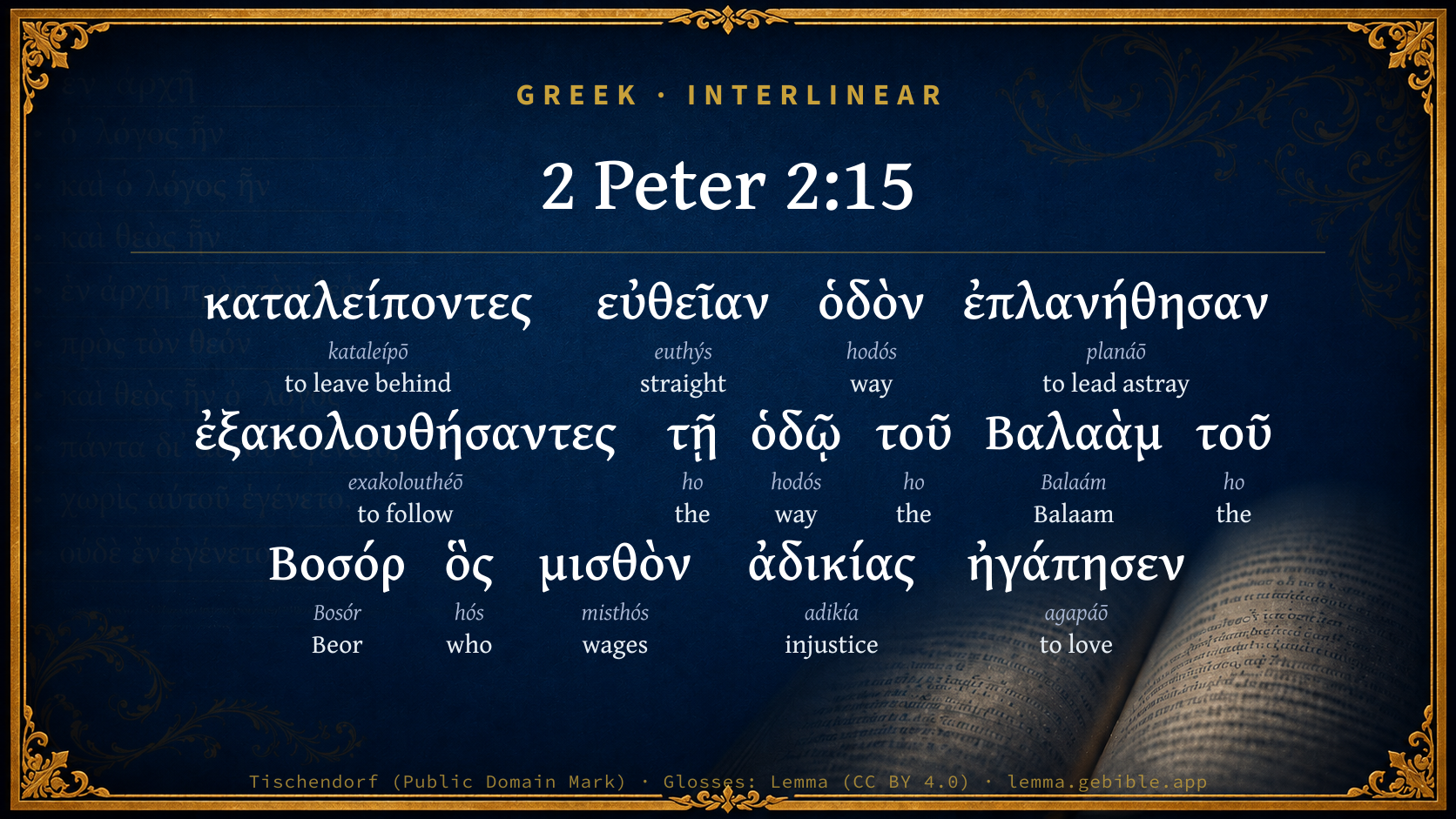
forsaking the right way, they went astray, having followed the way of Balaam the son of Beor, who loved the wages of wrong-doing;
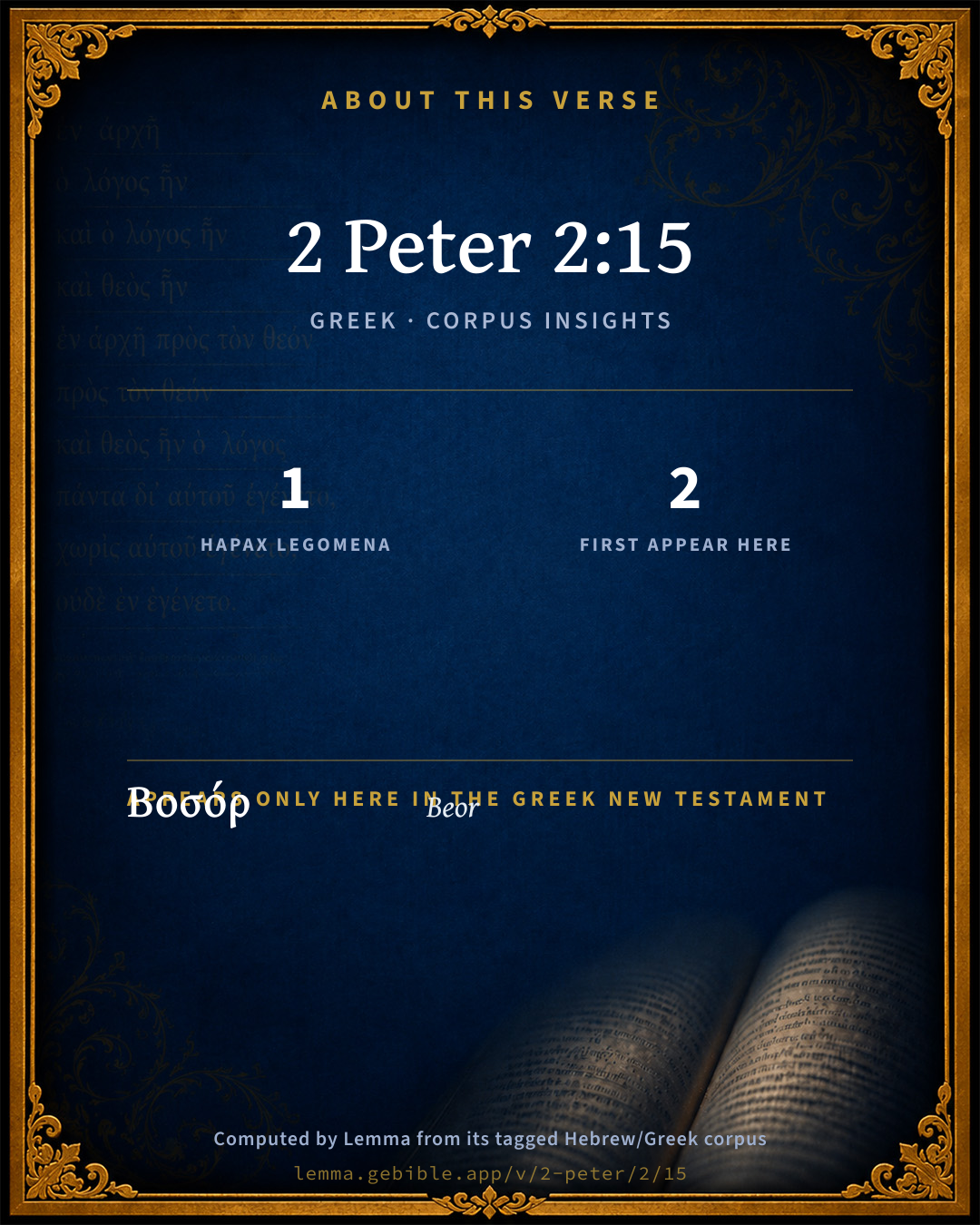
- 1 hapax legomenon — only here in the Greek New Testament
- 2 first appearances in the Greek New Testament
Download a study sheet
One document with this verse’s original text, its word-by-word gloss line, the meaning frame, cross-references with their text, attributed commentary, and full source and license credits — printable, and it pastes into notes with its structure intact.
This verse Autodidact and up
A passage Seminary Student
Up to 50 verses in one chapter. A passage sheet keeps up to 6 commentary sources and 12 cross-references per verse, in the order this page ranks them, and says so on the sheet whenever that leaves anything out. Ask for a single verse and you get the Autodidact verse sheet above.
Everything on this page stays free to read, with no account — the sheet is a download of what is already on screen, not access to it.
Compare translations 3
The same verse in 3 English versions, stacked beneath the original-language interlinear above. Click any original word for its lexicon entry.
Each is an independent rendering of the whole verse — the interlinear is not word-aligned to these translations.
Highlighted words mark where these versions differ — a whole-verse word diff, not a word-by-word alignment.
-
World English Bible Public Domain
forsaking the right way, they went astray, having followed the way of Balaam the son of Beor, who loved the wages of wrong-doing;
-
King James Version Public Domain
Which have forsaken the right way, and are gone astray, following the way of Balaam the son of Bosor, who loved the wages of unrighteousness;
-
unfoldingWord Literal Text CC BY-SA 4.0
Abandoning the straight way, they have gone astray, having followed the way of Balaam of Bosor, who loved the wages of unrighteousness.
unfoldingWord Literal Text — © unfoldingWord, licensed CC BY-SA 4.0. Word-aligned USFM3 via Door43 (git.door43.org/unfoldingWord/en_ult).
Show all 19 translations
Every available English version of this verse, each an independent rendering of the whole verse.
-
World English Bible Public Domain
forsaking the right way, they went astray, having followed the way of Balaam the son of Beor, who loved the wages of wrong-doing;
-
Berean Standard Bible Public Domain
They have left the straight way and wandered off to follow the way of Balaam son of Beor, who loved the wages of wickedness.
-
Majority Standard Bible Public Domain
They have left the straight way and wandered off to follow the way of Balaam son of Bosor, who loved the wages of wickedness.
-
King James Version Public Domain
Which have forsaken the right way, and are gone astray, following the way of Balaam the son of Bosor, who loved the wages of unrighteousness;
-
American Standard Version (1901) Public Domain
forsaking the right way, they went astray, having followed the way of Balaam the `son' of Beor, who loved the hire of wrong-doing;
-
Revised Version (1885) Public Domain
forsaking the right way, they went astray, having followed the way of Balaam the son of Beor, who loved the hire of wrong-doing;
-
Geneva Bible (1599) Public Domain
Which forsaking the right way, haue gone astray, folowing the way of Balaam, the sonne of Bosor, which loued the wages of vnrighteousnes.
-
Douay-Rheims (1899) Public Domain
Leaving the right way they have gone astray, having followed the way of Balaam of Bosor, who loved the wages of iniquity,
-
Young's Literal Translation Public Domain
having forsaken a right way, they did go astray, having followed in the way of Balaam the `son' of Bosor, who a reward of unrighteousness did love,
-
Literal Standard Version CC BY-SA 4.0
having forsaken a right way, they went astray, having followed in the way of Balaam the [son] of Bosor, who loved a reward of unrighteousness,
-
Unlocked Literal Bible CC BY-SA 4.0
They have abandoned the right way and have wandered off to follow the way of Balaam son of Beor, who loved to receive payment for unrighteousness.
-
unfoldingWord Literal Text CC BY-SA 4.0
Abandoning the straight way, they have gone astray, having followed the way of Balaam of Bosor, who loved the wages of unrighteousness.
-
Darby Bible Public Domain
having left [the] straight way they have gone astray, having followed in the path of Balaam [the son] of Bosor, who loved [the] reward of unrighteousness;
-
World Messianic Bible Public Domain
Forsaking the right way, they went astray, having followed the way of Balaam the son of Beor, who loved the wages of wrongdoing;
-
Webster's Bible Public Domain
Who have forsaken the right way, and gone astray, following the way of Balaam the son of Bosor, who loved the wages of unrighteousness;
-
Free Bible Version CC BY-SA 4.0
They have abandoned the right path and have gone astray, following the way of Balaam, the son of Beor, who loved to be paid for doing evil.
-
Bible in Basic English Public Domain
Turning out of the true way, they have gone wandering in error, after the way of Balaam, the son of Beor, who was pleased to take payment for wrongdoing;
-
Text-Critical English NT CC BY 4.0
They have abandoned the straight path and gone astray, following the way of Balaam, the son of Bosor, who loved the wages of unrighteousness.
-
Tyndale New Testament (1534) Public Domain
and have forsaken the right waye and are gone astraye folowinge the waye of Balam the sonne of Bosor which loved the rewarde of vnrightewesnes:
Literal Standard Version (2020), Covenant Press — licensed CC BY-SA 4.0. Text via the HelloAO Bible API (eBible.org). Unlocked Literal Bible (unfoldingWord) — licensed CC BY-SA 4.0. Text via the HelloAO Bible API (eBible.org). unfoldingWord Literal Text — © unfoldingWord, licensed CC BY-SA 4.0. Word-aligned USFM3 via Door43 (git.door43.org/unfoldingWord/en_ult). Free Bible Version, Dr. Jonathan Gallagher — licensed CC BY-SA 4.0. Text via the HelloAO Bible API (eBible.org).
Word by word
More ways to search: Search by grammar → Find every occurrence → Compare this word →
Practice this passage: Drill this verse → Learn its vocabulary →
- Appears 1× in the Greek New Testament
- First appears here
- Part of Speech
- Noun · Proper, indeclinable
Full Thayer's Definition
- καταλείποντες kataleípō G2641 “to leave behind” Verb, Present, Active, Participle, Nominative, Plural, Masculine
- εὐθεῖαν euthýs G2117 “straight” Adjective, Accusative, Singular, Feminine
- ὁδὸν hodós G3598 “way” Noun, Accusative, Singular, Feminine
- ἐπλανήθησαν planáō G4105 “to lead astray” Verb, Aorist, Passive, Indicative, 3rd person, Plural
- ἐξακολουθήσαντες exakolouthéō G1811 “to follow” Verb, Aorist, Active, Participle, Nominative, Plural, Masculine
- τῇ ho G3588 “the” Article, Dative, Singular, Feminine
- ὁδῷ hodós G3598 “way” Noun, Dative, Singular, Feminine
- τοῦ ho G3588 “the” Article, Genitive, Singular, Masculine
- Βαλαὰμ Balaám G903 “Balaam” Noun, Proper, indeclinable
- τοῦ ho G3588 “the” Article, Genitive, Singular, Masculine
- Βοσόρ Bosór G1007 “Beor” Noun, Proper, indeclinable
- ὃς hós G3739 “who” Relative pronoun, Nominative, Singular, Masculine
- μισθὸν misthós G3408 “wages” Noun, Accusative, Singular, Masculine
- ἀδικίας adikía G93 “injustice” Noun, Genitive, Singular, Feminine
- ἠγάπησεν agapáō G25 “to love” Verb, Aorist, Active, Indicative, 3rd person, Singular
About this verse
These counts appear in no published source. They are computed here, from the morphology-tagged text and Lemma’s own curated glosses. What Lemma adds →
- 15
- words
- 12
- distinct lemmas
- General Epistles
- section
Notable vocabulary
1 hapax legomenon — a word that appears only here in the entire Greek New Testament:
- Βοσόρ Beor G1007
First appearance in Scripture
These words make their first canonical appearance in the Greek New Testament here:
Shared distinctive vocabulary
ἐξακολουθήσαντες to follow G1811 occurs in 3 verses of the Greek New Testament. Also found in:
Cross-references
19Topical passages linked to 2 Peter 2:15 in the Treasury of Scripture Knowledge — connected by theme and wording, ordered by reader-vote popularity; previews shown in the World English Bible.
- Revelation 2:14 But I have a few things against you, because you have there some who hold the teaching of Balaam, who taught Balak to throw a stumbling block before the children of Israel, to eat things sacrificed to idols, and to commit sexual immorality.
- Jude 1:11 Woe to them! For they went in the way of Cain, and ran riotously in the error of Balaam for hire, and perished in Korah's rebellion.
- Deuteronomy 23:4–5 because they didn't meet you with bread and with water in the way, when you came forth out of Egypt, and because they hired against you Balaam the son of Beor from Pethor of Mesopotamia, to curse you.
- Numbers 22:5–7 He sent messengers to Balaam the son of Beor, to Pethor, which is by the River, to the land of the children of his people, to call him, saying, Behold, there is a people come out from Egypt: behold, they cover the surface of the earth, and they abide over against me.
- Numbers 31:16 Behold, these caused the children of Israel, through the counsel of Balaam, to commit trespass against Yahweh in the matter of Peor, and so the plague was among the congregation of Yahweh.
- Nehemiah 13:2 because they didn't meet the children of Israel with bread and with water, but hired Balaam against them, to curse them: however our God turned the curse into a blessing.
- Micah 6:5 My people, remember now what Balak king of Moab devised, And what Balaam the son of Beor answered him from Shittim to Gilgal, That you may know the righteous acts of Yahweh."
- Proverbs 28:4 Those who forsake the law praise the wicked; But those who keep the law contend with them.
- Acts 1:18 Now this man obtained a field with the reward for his wickedness, and falling headlong, his body burst open, and all his intestines gushed out.
- Acts 13:10 and said, "Full of all deceit and all cunning, you son of the devil, you enemy of all righteousness, will you not cease to pervert the right ways of the Lord?
- 2 Peter 2:13 receiving the wages of unrighteousness; people who count it pleasure to revel in the day-time, spots and blemishes, reveling in their deceit while they feast with you;
- Numbers 22:18–21 Balaam answered the servants of Balak, If Balak would give me his house full of silver and gold, I can't go beyond the word of Yahweh my God, to do less or more.
- Numbers 22:23 The donkey saw the angel of Yahweh standing in the way, with his sword drawn in his hand; and the donkey turned aside out of the way, and went into the field: and Balaam struck the donkey, to turn her into the way.
- Numbers 22:28 Yahweh opened the mouth of the donkey, and she said to Balaam, What have I done to you, that you have struck me these three times?
- 1 Samuel 12:23 Moreover as for me, far be it from me that I should sin against Yahweh in ceasing to pray for you: but I will instruct you in the good and the right way.
- 1 Kings 18:18 He answered, I have not troubled Israel; but you, and your father's house, in that you have forsaken the commandments of Yahweh, and you have followed the Baals.
- Ezekiel 9:10 As for me also, my eye shall not spare, neither will I have pity, but I will bring their way on their head.
- Hosea 14:8 Ephraim, what have I to do any more with idols? I answer, and will take care of him. I am like a green fir tree; From me your fruit is found."
- 1 Kings 19:10 He said, I have been very jealous for Yahweh, the God of hosts; for the children of Israel have forsaken your covenant, thrown down your altars, and slain your prophets with the sword: and I, even I only, am left; and they seek my life, to take it away.
Cross-references courtesy of OpenBible.info (CC BY 4.0).
Lesson kit
Teaching starters — assembled from the data on this page, not authored interpretation. Every prompt links to the verse data it draws on. Edit before teaching.
2 Peter, in the General Epistles, opens this verse with 15 words (12 distinct Greek lemmas). Its most distinctive word is Bosór (“Beor”). A historical commentator’s framing appears above. Read the whole chapter for the surrounding context.
Discussion questions
- What does “Beor” (Bosór) contribute to the verse as a whole?
- This verse holds 1 word here found nowhere else in the Greek New Testament. What might the rare word draw attention to?
- 2 words here appear for the first time in Scripture. What is being introduced at this debut?
- 2 Peter 1:16 shares the word «to follow» with this verse. How do the two illuminate each other?
- “way” occurs 2× in this one verse. What is the effect of the repetition?
- The translations on this page render this verse differently — a whole-verse word diff, not a word-by-word alignment. What might account for the different wordings?
- Reading how The Biblical Illustrator and Joseph Benson's Commentary read this verse, where do the two commentators agree and where do they part?
Things to notice
- 1 word in this verse appears nowhere else in the Greek New Testament.
- 2 words make their first canonical appearance in Scripture here.
- These translations choose different wording for 17 words in this verse.
- “way” occurs 2× in this single verse.
- 12 distinct Greek lemmas span 15 words in this verse.
Commentary
Notes on 2 Peter 2:15 from classic Christian and Jewish commentators (each source and its license shown beneath its notes). The classic Christian expositions comment on the surrounding passage and are grouped to its opening verse, so a note may address several verses; the Jewish commentaries on the Tanakh (Rashi and others) are per-verse, so they appear only where the commentator wrote on this verse.
Lemma curates 59 commentaries, every one of them public domain or Creative Commons licensed, each selected and text-cleaned for this edition rather than reprinted as found. About our sources →
The Biblical Illustrator
Joseph S. Exell
The Biblical Illustrator, edited by Joseph S. Exell (c. 1880s–1900s) — public domain. Text from a community e-Sword module.
Joseph Benson's Commentary
Joseph Benson's Commentary on the Old and New Testaments (1811–1818) — public domain. Text from a community e-Sword module.
The Pulpit Commentary
The Pulpit Commentary (1880–1919), ed. H.D.M. Spence-Jones & Joseph S. Exell — public domain. Text from a community e-Sword module.
Tyndale Open Study Notes
Tyndale Open Resources
Tyndale Open Study Notes — © Tyndale Open Resources, licensed CC BY-SA 4.0. Text via the HelloAO Bible API.
Bengel's Gnomon
Johann Albrecht Bengel
Bengel's Gnomon of the New Testament — English translation (T&T Clark, Edinburgh, 1860) — public domain. Text from a community e-Sword module.
Meyer's Critical & Exegetical Commentary
Heinrich August Wilhelm Meyer
Meyer — Critical and Exegetical Commentary on the New Testament — English translation by Peter Christie, edited by Frederick Crombie (T&T Clark, 1880) — public domain. Text from a community e-Sword module.
Expositor's Greek Testament
ed. W. Robertson Nicoll
The Expositor's Greek Testament, edited by W. Robertson Nicoll (1897–1910) — public domain. Text from a community e-Sword module.
Jamieson, Fausset & Brown
Robert Jamieson, A. R. Fausset & David Brown
Jamieson, Fausset & Brown — Commentary Critical and Explanatory on the Whole Bible (1871) — public domain (CC PDM 1.0). Text via the HelloAO Bible API.
Adam Clarke's Commentary
Adam Clarke's Commentary on the Bible (1810–1826) — public domain. Text from a community e-Sword/MySword module.
John Calvin's Commentaries
John Calvin's Commentaries (1540-1563) — public domain. Text from the Calvin Translation Society English edition (1840s-50s) via the Christian Classics Ethereal Library (ccel.org). Calvin's coverage is partial (roughly two-thirds of the Bible); uncommented books and verses are honest gaps, never fabricated. The 19th-century editor's footnotes and remarks are omitted so the notes are faithfully Calvin's own voice.
Ellicott's Commentary for English Readers
A Bible Commentary for English Readers, edited by Charles John Ellicott (1878–1897) — public domain. Text from a community e-Sword module.
The Cambridge Bible for Schools and Colleges
gen. ed. J. J. S. Perowne
The Cambridge Bible for Schools and Colleges (gen. ed. J. J. S. Perowne; Cambridge University Press, 1878–1918) — public domain. Text from a community e-Sword module.
John Gill's Exposition
John Gill's Exposition of the Whole Bible (1746–1763) — public domain (CC PDM 1.0). Text via the HelloAO Bible API.
Trapp's Complete Commentary
John Trapp
John Trapp, A Commentary or Exposition upon All the Books of the Old and New Testament (1647–1656) — public domain. Text from a community e-Sword module.
Albert Barnes' Notes on the Bible
Albert Barnes' Notes on the Bible (1834–1885) — public domain. Text from a community e-Sword/MySword module.
Haydock's Catholic Bible Commentary
George Leo Haydock (1774–1849), Haydock's Catholic Family Bible and Commentary, 1859 edition — public domain. Excludes Psalms (Douay-Rheims chapter numbering differs from Protestant) and Deuterocanonical books (Catholic canon only).
Matthew Poole's English Annotations
Matthew Poole's English Annotations on the Holy Bible (1683–1685) — public domain. Text from a community e-Sword/MySword module.
Whedon's Commentary on the Bible
Daniel D. Whedon
Daniel D. Whedon (gen. ed.), Commentary on the Old and New Testaments (1874–1909) — public domain. Text from a community e-Sword module.
John Wesley's Explanatory Notes
John Wesley, Explanatory Notes Upon the Whole Bible (1754–1765) — public domain. Text via the GEBible commentary corpus.
Scofield Reference Notes
C. I. Scofield
The Scofield Reference Bible (1917 edition), notes by C. I. Scofield — public domain. Text from a community e-Sword module.
Kretzmann's Popular Commentary
Paul E. Kretzmann
Paul E. Kretzmann, Popular Commentary of the Bible (1921–1924) — public domain. Text from a community e-Sword module.
Burkitt's Expository Notes on the New Testament
William Burkitt
William Burkitt's Expository Notes on the New Testament (1700–1703) — public domain. Text from a community e-Sword module.
The People's New Testament
B. W. Johnson
B. W. Johnson's The People's New Testament with Notes (1889–1891) — public domain. Electronic text from the Christian Classics Ethereal Library (CCEL) ThML edition.
unfoldingWord translationNotes
Door43 World Missions Community
unfoldingWord translationNotes — © Distant Shores Media and the Door43 World Missions Community, licensed CC BY-SA 4.0. Source: git.door43.org/Door43/en_tn.
Cambridge Greek Testament for Schools and Colleges
Cambridge Greek Testament for Schools and Colleges (Cambridge University Press, 1896; 21 vols, various authors incl. Carr, Maclear, Plummer, Farrar, Lumby, Moule, M. R. James, Simcox) — public domain. Text from a community e-Sword module.
Alford’s Greek Testament
Henry Alford
Henry Alford, The Greek Testament (1849–1861) — public domain. Text from a community e-Sword module.
Vincent's Word Studies in the New Testament
Marvin R. Vincent
Marvin R. Vincent, Word Studies in the New Testament (1887–1900) — public domain. Text from a community e-Sword/MySword module.