1 Thessalonians 3:11

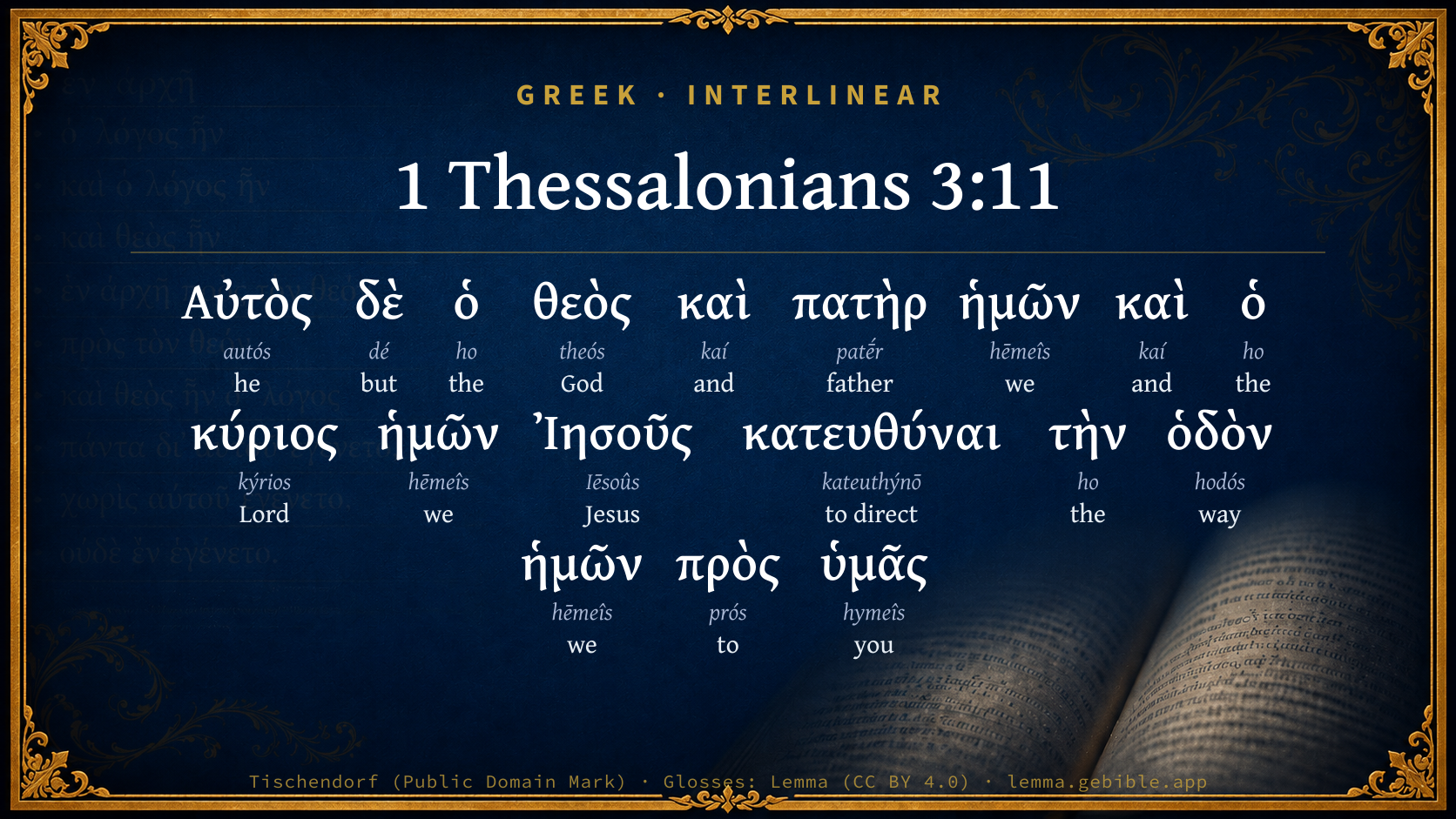
Greek (Tischendorf 8th ed.) 1 Thessalonians 3:11 appears in the Greek New Testament. The text above is from the Tischendorf 8th edition. Each word links to its Strong’s number and a concise gloss. Click any word for its full Thayer’s Greek Lexicon entry.
Download image
Cite this verse

1 Thessalonians 3:11 (World English Bible). Public Domain. Lemma interlinear Bible study tool, https://lemma.gebible.app/v/1-thessalonians/3/11.

Show BibTeX & RIS
BibTeX
RIS
English Translation
Now may our God and Father himself, and our Lord Jesus Christ, direct our way to you;
World English Bible · Public Domain
Download a study sheet

One document with this verse’s original text, its word-by-word gloss line, the meaning frame, cross-references with their text, attributed commentary, and full source and license credits — printable, and it pastes into notes with its structure intact.

This verse Autodidact and up

Study sheet (.html) Plain text (.txt)

A passage Seminary Student

Up to 50 verses in one chapter. A passage sheet keeps up to 6 commentary sources and 12 cross-references per verse, in the order this page ranks them, and says so on the sheet whenever that leaves anything out. Ask for a single verse and you get the Autodidact verse sheet above.

Everything on this page stays free to read, with no account — the sheet is a download of what is already on screen, not access to it.

Want to remove ads? Support Godless Engineer
Compare translations 3

The same verse in 3 English versions, stacked beneath the original-language interlinear above. Click any original word for its lexicon entry.

Each is an independent rendering of the whole verse — the interlinear is not word-aligned to these translations.

Highlighted words mark where these versions differ — a whole-verse word diff, not a word-by-word alignment.

  • World English Bible Public Domain
    Now may our God and Father himself, and our Lord Jesus Christ, direct our way to you;
  • King James Version Public Domain
    Now God himself and our Father, and our Lord Jesus Christ, direct our way unto you.
  • unfoldingWord Literal Text CC BY-SA 4.0
    But may our God and Father himself and our Lord Jesus direct our way to you.

unfoldingWord Literal Text — © unfoldingWord, licensed CC BY-SA 4.0. Word-aligned USFM3 via Door43 (git.door43.org/unfoldingWord/en_ult).

Versions to compare (up to 4)

3 of 4 selected

Show all 19 translations

Every available English version of this verse, each an independent rendering of the whole verse.

  • World English Bible Public Domain
    Now may our God and Father himself, and our Lord Jesus Christ, direct our way to you;
  • Berean Standard Bible Public Domain
    Now may our God and Father Himself, and our Lord Jesus, direct our way to you.
  • Majority Standard Bible Public Domain
    Now may our God and Father Himself, and our Lord Jesus Christ, direct our way to you.
  • King James Version Public Domain
    Now God himself and our Father, and our Lord Jesus Christ, direct our way unto you.
  • American Standard Version (1901) Public Domain
    Now may our God and Father himself, and our Lord Jesus, direct our way unto you:
  • Revised Version (1885) Public Domain
    Now may our God and Father himself, and our Lord Jesus, direct our way unto you:
  • Geneva Bible (1599) Public Domain
    Nowe God himselfe, euen our Father, and our Lord Iesus Christ, guide our iourney vnto you,
  • Douay-Rheims (1899) Public Domain
    Now God himself and our Father, and our Lord Jesus Christ, direct our way unto you.
  • Young's Literal Translation Public Domain
    And our God and Father Himself, and our Lord Jesus Christ, direct our way unto you,
  • Literal Standard Version CC BY-SA 4.0
    And our God and Father Himself, and our Lord Jesus Christ, direct our way to you,
  • Unlocked Literal Bible CC BY-SA 4.0
    May our God and Father himself, and our Lord Jesus, direct our way to you.
  • unfoldingWord Literal Text CC BY-SA 4.0
    But may our God and Father himself and our Lord Jesus direct our way to you.
  • Darby Bible Public Domain
    But our God and Father himself, and our Lord Jesus, direct our way to you.
  • World Messianic Bible Public Domain
    Now may our God and Father himself, and our Lord Yeshua the Messiah, direct our way to you.
  • Webster's Bible Public Domain
    Now God himself and our Father, and our Lord Jesus Christ, direct our way to you.
  • Free Bible Version CC BY-SA 4.0
    May God our Father and our Lord Jesus make it possible for us to come to see you soon.
  • Bible in Basic English Public Domain
    Now may our God and Father himself and our Lord Jesus make a way for us to come to you;
  • Text-Critical English NT CC BY 4.0
    Now may our God and Father himself and our Lord Jesus Christ direct our way to you.
  • Tyndale New Testament (1534) Public Domain
    God him silfe oure father and oure lorde Iesus Christ gyde oure iorney vnto you:

Literal Standard Version (2020), Covenant Press — licensed CC BY-SA 4.0. Text via the HelloAO Bible API (eBible.org). Unlocked Literal Bible (unfoldingWord) — licensed CC BY-SA 4.0. Text via the HelloAO Bible API (eBible.org). unfoldingWord Literal Text — © unfoldingWord, licensed CC BY-SA 4.0. Word-aligned USFM3 via Door43 (git.door43.org/unfoldingWord/en_ult). Free Bible Version, Dr. Jonathan Gallagher — licensed CC BY-SA 4.0. Text via the HelloAO Bible API (eBible.org).

Word by word

More ways to search: Search by grammar → Find every occurrence → Compare this word →

Practice this passage: Drill this verse → Learn its vocabulary →

κατευθύναι
kateuthýnō
G2720
“to direct”
Verb, Aorist, Active, Optative, 3rd person, Singular
Part of Speech
Verb
Tense
Aorist
Voice
Active
Mood
Optative
Person
3rd person
Number
Singular
Full Thayer's Definition

Origin: from G2596 and G2116

TDNT: None

1. to make straight, guide, direct a. of the removal of the hindrances to coming to one
  1. Αὐτὸς autós G846 “he” Personal pronoun, Nominative, Singular, Masculine
  2. δὲ dé G1161 “but” Conjunction
  3. ὁ ho G3588 “the” Article, Nominative, Singular, Masculine
  4. θεὸς theós G2316 “God” Noun, Nominative, Singular, Masculine
  5. καὶ kaí G2532 “and” Conjunction
  6. πατὴρ patḗr G3962 “father” Noun, Nominative, Singular, Masculine
  7. ἡμῶν hēmeîs G2249 “we” Personal pronoun, 1st person, Genitive, Plural
  8. καὶ kaí G2532 “and” Conjunction
  9. ὁ ho G3588 “the” Article, Nominative, Singular, Masculine
  10. κύριος kýrios G2962 “Lord” Noun, Nominative, Singular, Masculine
  11. ἡμῶν hēmeîs G2249 “we” Personal pronoun, 1st person, Genitive, Plural
  12. Ἰησοῦς Iēsoûs G2424 “Jesus” Noun, Nominative, Singular, Masculine
  13. τὴν ho G3588 “the” Article, Accusative, Singular, Feminine
  14. ὁδὸν hodós G3598 “way” Noun, Accusative, Singular, Feminine
  15. ἡμῶν hēmeîs G2249 “we” Personal pronoun, 1st person, Genitive, Plural
  16. πρὸς prós G4314 “to” Preposition
  17. ὑμᾶς hymeîs G5210 “you” Personal pronoun, 2nd person, Accusative, Plural

About this verse

These counts appear in no published source. They are computed here, from the morphology-tagged text and Lemma’s own curated glosses. What Lemma adds →

18
words
13
distinct lemmas
Pauline Epistles
section

Notable vocabulary

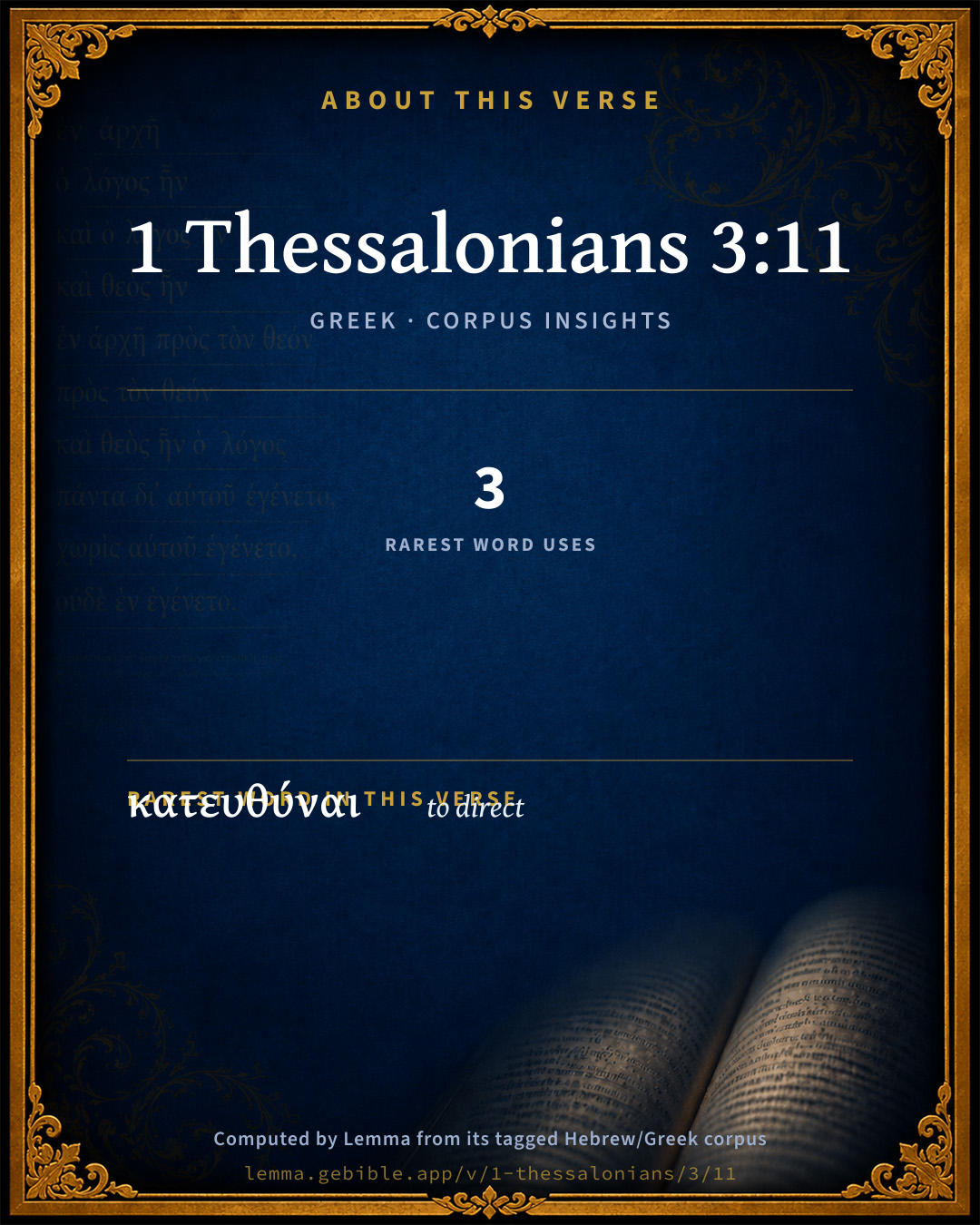
The rarest word here is κατευθύναι to direct G2720 — appearing just 3 times in the whole Greek New Testament.

Shared distinctive vocabulary

κατευθύναι to direct G2720 occurs in 3 verses of the Greek New Testament. Also found in:

Repetition

Words recur within this verse:

Cross-references

19

Topical passages linked to 1 Thessalonians 3:11 in the Treasury of Scripture Knowledge — connected by theme and wording, ordered by reader-vote popularity; previews shown in the World English Bible.

  • Proverbs 3:5–6 Trust in Yahweh with all your heart, And don't lean on your own understanding.
  • Matthew 6:32 For the Gentiles seek after all these things, for your heavenly Father knows that you need all these things.
  • 2 Thessalonians 2:16 Now our Lord Jesus Christ himself, and God our Father, who loved us and gave us eternal comfort and good hope through grace,
  • Matthew 6:26 See the birds of the sky, that they don't sow, neither do they reap, nor gather into barns. Your heavenly Father feeds them. Aren't you of much more value than they?
  • Luke 12:32 Don't be afraid, little flock, for it is your Father's good pleasure to give you the Kingdom.
  • 1 Thessalonians 3:13 to the end he may establish your hearts blameless in holiness before our God and Father, at the coming of our Lord Jesus with all his saints.
  • Malachi 1:6 "A son honors his father, and a servant his master. If I am a father, then where is my honor? And if I am a master, where is the respect due me? Says Yahweh of Hosts to you, priests, who despise my name. You say, 'How have we despised your name?'
  • Matthew 6:6 But you, when you pray, enter into your inner chamber, and having shut your door, pray to your Father who is in secret, and your Father who sees in secret will reward you openly.
  • Matthew 6:8–9 Therefore don't be like them, for your Father knows what things you need, before you ask him.
  • Mark 1:3 The voice of one crying in the wilderness, 'Make ready the way of the Lord! Make his paths straight!'"
  • Luke 12:30 For the nations of the world seek after all of these things, but your Father knows that you need these things.
  • 2 Thessalonians 3:5 May the Lord direct your hearts into the love of God, and into the patience of Christ.
  • 1 John 3:1 Behold, how great a love the Father has bestowed on us, that we should be called children of God! For this cause the world doesn't know us, because it didn't know him.
  • Ezra 8:21–23 Then I proclaimed a fast there, at the river Ahava, that we might humble ourselves before our God, to seek of him a straight way for us, and for our little ones, and for all our substance.
  • Isaiah 63:16 For you are our Father, though Abraham doesn't know us, and Israel does not acknowledge us: you, Yahweh, are our Father; our Redeemer from everlasting is your name.
  • Matthew 6:14 "For if you forgive men their trespasses, your heavenly Father will also forgive you.
  • Matthew 6:18 so that you are not seen by men to be fasting, but by your Father who is in secret, and your Father, who sees in secret, will reward you.
  • Romans 1:3 concerning his Son, who was born of the seed of David according to the flesh,
  • Galatians 1:4 who gave himself for our sins, that he might deliver us out of this present evil age, according to the will of our God and Father--

Cross-references courtesy of OpenBible.info (CC BY 4.0).

Where the printed editions differ

1 variant

Places in this verse where the major printed Greek editions disagree on the wording in a way that affects the translation — a comparison of editions, not a manuscript-by-manuscript collation. The editions are the modern critical texts (Nestlé-Aland 28/27, SBL, Westcott-Hort, Tregelles, Tyndale House) and the traditional texts behind the KJV (the Textus Receptus and the Byzantine/Majority text). It is not a claim about which reading is original.

  1. Extra text
    Χριστός

    “Christ”

    In TRByz Not in NA28NA27TynSBLWHTreg

    Χριστός (Christos) 'Christ' is only in traditional manuscripts (TR+Byz)

Textual data: Translators Amalgamated Greek New Testament (STEPBible TAGNT) · CC BY 4.0.

Commentary

Notes on 1 Thessalonians 3:11 from classic Christian and Jewish commentators (each source and its license shown beneath its notes). The classic Christian expositions comment on the surrounding passage and are grouped to its opening verse, so a note may address several verses; the Jewish commentaries on the Tanakh (Rashi and others) are per-verse, so they appear only where the commentator wrote on this verse.

Lemma curates 59 commentaries, every one of them public domain or Creative Commons licensed, each selected and text-cleaned for this edition rather than reprinted as found. About our sources →

Matthew Henry's Commentary

In these words we have the earnest prayer of the apostle. He desired to be instrumental in the further benefit of the Thessalonians; and the only way to be so while at a distance was by prayer for them, together with his writing or sending to them. He desired that their faith might be perfected, which he could not be the proper cause or author of; for he pretended not to dominion over their faith, nor to have the donation of it, and he therefore concludes with prayer for them. Observe,

I. Whom he prays to, namely, God and Christ. Prayer is a part of religious worship, and all religious worship is due unto God only. Prayer is here made to God, even the Father and our Father; and also to Christ, even our Lord Jesus Christ. Therefore Jesus Christ our Lord is God, even as God our Father is God. Prayer is to be offered to God as our Father. So Christ taught his disciples to pray; and so the Spirit of adoption prompts them to pray, to cry, Abba Father. Prayer is not only to be offered in the name of Christ, but offered up to Christ himself, as our Lord and our Saviour.

II. What he prays for, with respect to himself and his fellow-labourers, and on behalf of the Thessalonians.

1. He prays that himself and fellow-labourers might have a prosperous journey to them by the will of God, that their way might be directed to them, Th1 3:11. The taking of a journey to this or that place, one would think, is a thing depending so much on a man's own will, and lies so much in his own power, that Paul needed not by prayer to go to God about it. But the apostle knew that in God we live, and move, and have our being, that we depend upon God in all our motions and actions, as well as for the continuance of life and being, that divine Providence orders all our affairs and that it is owing thereto if we prosper therein, that God our Father directs and orders his children whither they shall go and what they shall do, that our Lord Jesus Christ in a particular manner directs the motions of his faithful ministers, those stars which he holds in his right hand. Let us acknowledge God in all our ways, and he will direct our paths.

2. He prays for the prosperity of the Thessalonians. Whether he should have an opportunity of coming to them or not, yet he earnestly prayed for the prosperity of their souls. And there are two things he desired for them, which we should desire for ourselves and friends: - (1.) That they might increase and abound in love (Th1 3:12), in love to one another and in love to all men. Note, Mutual love is required of all Christians, and not only that they love one another, but that they also have a charitable disposition of mind and due concern for the welfare of all men. Love is of God, and is the fulfilling of the gospel as well as of the law. Timothy brought good tidings of their faith, yet something was lacking therein; and of their charity, yet the apostle prays that this might increase and abound. Note, We have reason to desire to grow in every grace, and have need of the Spirit's influence in order to growth in grace; and the way to obtain this is by prayer. We are beholden to God not only for the stock put into our hands at first, but for the improvement of it also. And to our prayer we must add endeavour. To excite this in the Thessalonians the apostle again mentions his love, his abounding love, towards them. The more we are beloved, the more affectionate we should be. (2.) That they might be established unblamable in holiness, Th1 3:13. This spiritual benefit is mentioned as an effect of increasing and abounding love: To the end that he (the Lord) may establish your hearts. Note, The more we grow and abound in grace, and particularly in the grace of love, the more we are established and confirmed in it. Note also, Holiness is required of all those who would go to heaven, and therein we must be unblamable; that is, we must act in every thing so that we may not in the least contradict the profession we make of holiness. Our desire should be to have our hearts established in holiness before God, and be preserved safe, to the coming of the Lord Jesus Christ; and that we may be unblamable before God, even the Father, now, and be presented blameless before the throne of his glory, when the Lord Jesus shall come with all his saints. Note, [1.] The Lord Jesus will certainly come, and come in his glory. [2.] When he comes, his saints will come with him: They shall appear with him in glory. [3.] Then the excellency as well as the necessity of holiness will appear, because without this no hearts shall be established at that day, nor shall any one be unblamable, or avoid everlasting condemnation.

Matthew Henry's Commentary on the Whole Bible (1708–1710) — public domain (CC PDM 1.0). Text via the HelloAO Bible API.

The Cambridge Bible for Schools and Colleges

gen. ed. J. J. S. Perowne

11. Now God himself and our Father] Now may our God and Father Himself (comp. ch. 1Th_1:3), and our Lord Jesus (R. V.). For this title of Christ, see notes on ch. 1Th_2:15; 1Th_2:19. The copyists have added Christ.

Literally the verse begins, But may our God, &c. There is a transition, by way of contrast, from the thought of Paul’s own (human) wish and longing, that has been so fervently uttered, to the thought of God, Who alone can fulfil His servant’s desire. The prayers of ch. 1Th_5:23 and 2Th_2:16 begin in the same style.

direct our way unto you] Lit., make straight. This verb is rendered “guide our feet into the way of peace” in Luk_1:79; 2Th_3:5 gives the only remaining example of it in the N.T. It is frequent in the Septuagint; see, e.g., Psa_37:23, “The steps of a good man are ordered (Greek, directed) by the Lord; and He delighteth in his way.” Perhaps this verse of the Psalm was running in the Apostle’s mind.

It is notable that the Greek verb of the prayer is singular, though following a double subject; similarly in 2Th_2:16-17 (comp. the Salutation, ch. 1Th_1:1). For Christ is one with the Father in the prerogative of hearing and answering prayer. This belief was derived from our Lord’s own teaching: see Joh_5:17; Joh_5:19; Joh_10:30; Joh_10:38; Joh_14:13-14; Mat_28:18—“I and the Father are one … If ye shall ask Me (R. V.) anything in My name, I will do it,” &c.

The prayer of 1Th_3:11 has its goal in 1Th_3:13. “Our Lord Jesus” is He whose “coming” Paul and his readers are looking for. And He, together with the Father, is desired to “direct” the Apostle’s steps to Thessalonica, with the aim, ultimately, of furthering their preparation for His coming (comp. ch. 1Th_5:23; also 1Th_1:10).

The Cambridge Bible for Schools and Colleges (gen. ed. J. J. S. Perowne; Cambridge University Press, 1878–1918) — public domain. Text from a community e-Sword module.

The Biblical Illustrator

Joseph S. Exell

1Th_3:11-13

Now God Himself and our Father, and our Lord Jesus Christ, direct our way unto you

A comprehensive apostolic prayer

I.

This prayer recognizes the essential oneness of the Father and the Son.

1. Christ is invoked equally with the Father. The word Himself stands foremost in the sentence and refers to both persons, as if the writer said, May our God and Father, and our Lord Jesus Christ, Himself direct our way unto you. It should be also noted that the verb direct, belonging to both persons, is in the singular number. This fact was urged as an important point by Athanasius in the great Arian controversy. As the Son partakes equally with the Father in the honour of invocation, so also in excellency of nature. Divine properties are also ascribed to the Son in overruling by His providence the affairs of men. What things soever the Father doeth, these also doeth the Son likewise.

2. It is the privilege of the believer to realize a personal interest in the Father and in the Son. By an act of appropriating faith we can say, God our Father and our Lord Jesus Christ. Similar phrases occur no less than twenty-six times in these two Epistles. Blessed confidence! What a wealth of tenderness, satisfying assurance, and joyous triumph is involved in my God! my Saviour!

II. This is a prayer for providential guidance in securing a much desired interview. Direct our way unto you. Hitherto the way had been blocked up. The brethren there were as eager to welcome Paul as he was to be present; but Satan had hindered. Nevertheless, let God give the signal and all impediments would vanish. God should be recognized in the simplest affairs of life. It is not in man that walketh to direct his steps; and only those journeys are prosperous wherein God is pilot. There are crises in life when everything depends on being guided in the right way--e.g., in selecting a school or college, entering on the religious life, commencing business, contemplating marriage, or in change of residence. In these and all other matters acknowledge God, and He shall direct thy paths. Our prayer for guidance must ever be in submission to the Divine will. The apostles prayer was not answered immediately; five years elapsed before he again visited Macedonia. That path is safest and best in which Gods finger points. Let His call be our loadstar: His hand the cloud, to move or pause as He directs.

III. This is a prayer for the bestowal of an increased measure of the highest Christian affection.

1. Christian love is progressive and mutual. And the Lord make you to increase and abound in love one toward another. Love is the badge of the genuine Christian. He cannot have too much of it--the more the better. It grows with all other graces, and causes them to grow. There is no limit to its expansion but our finiteness. But love must be mutual one toward another. For this is the message, says St. John, that ye heard from the beginning, that ye should love one another; and, Seeing ye have purified your souls see that ye love one another, urges St. Peter.

2. Christian love is unselfish. And toward all men. The old law declared Thou shall love thy neighbour as thyself. And the New Testament reiterates the truth, that charity out of a pure heart, and of a good conscience, and of faith unfeigned is the fulfilling of the royal law.

3. Here we have Christian love practically exemplified. Even as we do towards you. Paul and his co-labourers had given unmistakable evidence of their love (1Th_2:8-9; 1Th_2:13; 1Th_3:3-5). Love is the soul of self-sacrifice. Ministers should exemplify in their own lives what they prescribe to others.

IV. This is a prayer for confirmation in a state of unblamable personal purity.

1. There is no stability in Christian graces apart from love. To the end he may stablish your hearts. If it were possible to possess every other grace but love, it would be like a varied summer landscape, beautiful but transient. Above all other graces we are exhorted to put on charity which is the bond of perfectness--a girdle which adorns and binds together all the rest. Love is the fulfilling of the law, the infallible test and evidence of stability.

2. An unblamable holiness is the legitimate and necessary outcome of love. To the end He may stablish, etc. Paul prays for an increase of love in order to the attainment of a higher personal purity. All defects in obedience issue from a defect in love. Our love of God makes us solicitous to know and obey Him, and fearful to offend Him. Our love of man makes us careful to preserve his honour, life and possessions, and in no way to impair his happiness. The whole law is love. There is no duty to which it does not incline; no sin from which it does not restrain.

3. Holiness screens the soul from Divine censure at the second advent (1Th_3:10). He who remains steadfast shall be blameless then. That holiness alone is genuine which will bear the scrutiny of Omniscience.

Lessons:

1. Recognize God in every event of life.

2. To attain purity pray for love.

3. Act in all things so as to secure the Divine approval. (G. Barlow.)

Pauls ejaculatory prayer

We have here an instance of a marked characteristic of Pauls Epistles--the tendency which the course of the argument ever has to break forth into prayer. In this respect they bear a striking resemblance to Davids Psalms.

I. To whom this prayer is addressed.

1. It is quite evident that the apostle regarded Christ as standing in the same relation to prayer as God the Father. The prayer is addressed to both, implying equality of power and unity of will, which imply a still higher unity--even unity of essence. While, then, our Lord is distinguished from the Father in personality, He is one with Him in Godhead, and therefore is He rightly addressed in the language of prayer.

2. Himself is emphatic, suggesting a contrast. Human agency had been frustrated. Satan had (1Th_2:18) so far prevailed. But now Paul turns to God with the confidence of filial reverence and love, and prays that He may remove obstacles and prosper his desire. His prayer was in the spirit of Jer_10:23, and Rom_1:9-10.

II. What he prayed for.

1. That they might increase, and by so increasing abound in love. To have this is to abound in true wealth which no outward reverses can lessen, which increases the more it is expended, which is always useful and can never be exhausted. It has prominence assigned it here, for it is the essence of Christian life, the bond of perfectness, the soul of the graces. As all beauty is cold and lifeless unless there be a soul speaking and breathing through it, so all the elements of moral beauty are worthless without love.

(1) This love is a Christian grace, for it turns first of all to Christ. It lives only in fellowship with Him, and He makes His people to increase in it.

(2) This love in its inner circle is one toward another. It is far in advance of friendship, which was so admired by the ancient heathen. The calumny that Christianity is inimical to friendship, and is a selfish care for the individual soul is refuted here. It broadened and transfigured friendship into love of the brethren.

(3) This love was toward all men. Christianity has broken down the barriers of race and creed, and struck barbarian out of the dictionary of mankind, substituting brother. It tells them of a Divine philanthropy (Tit_3:4), and bids them imitate it.

(4) This love was exemplified by Paul as we do toward you.

2. Love may be regarded as the end of Christian striving, for it brings men nearest heaven; but it is represented here as a means (1Th_3:13).

(1) Christian love going out towards others in blessing comes back laden with new blessings to the soul. The hearts of Christs people become in this way established. Where there is mutual and universal love there is of necessity a steady purpose and aim imparted to the whole life. The heart in this way becomes united (Psa_86:11). All its impulses go forth in the one direction of holiness unblamable before God, and is thus recompensed with the assurance of Divine love.

(2) Even amidst the imperfections and limitations of earth and time the believer has something of this. But the more advanced he is in the Divine life the more does he mourn over his unholiness in the sight of God. Hence the apostle carries our thoughts forward to the second coming (1Co_1:7-8). This is the pivot on which the whole Epistle turns. Very naturally and tenderly does Paul refer to this in order to draw away the thoughts of his friends from the trials, sorrows, and sins of their present lot. He would have them think of the lot of their future inheritance that they may be faithful unto the end. (J. Hutchison, D. D.)

Prayer about a journey

In these profoundly interesting words we have one of the most unfeigned and earnest prayers of the apostle. He desired to be directly instrumental in the farther spiritual benefit of the Thessalonians; and the only way to do so while at a distance was by prayer for them, together with his writing or sending to them.

I. The hearers of prayer. Prayer is made to God, even the Father and our Father, and also to Christ, even our Lord Jesus Christ; therefore Jesus Christ our Lord is God, even as God our Father is God. Prayer is to be offered to God as our Father (Mat_6:9): so Jesus taught His disciples, and so the Spirit prompts them to pray (Rom_8:15). And prayer is not only to be offered up to Christ as our Lord and Saviour, but in the name of Christ as the Lord our Righteousness.

II. The things prayed for. He prays that he might have a prosperous journey to them, by the will of God. The taking of a journey to this or that place, one would think, is a matter depending so much upon a mans own will, and lies so much in his own power, that Paul needed not by prayer to go to God about it; but the apostle knew that we depend upon God in all our motions and actions as well as for the continuance of life and being--that Divine Providence orders all our affairs, and that it is owing thereto if we prosper therein--that God our Father doth direct and order His children whither they shall go, and what they shall do--that our Lord Jesus Christ in a particular manner directs the motions of His faithful ministers, those stars which He holdeth in His right hand. He prayeth, too, for the prosperity of the Thessalonians, whether he should see them or not; and there are two things he desired for them, which we should desire for ourselves and our friends, namely--that they might increase and abound in love one toward another, and toward all men; and that they might be established unblamable in holiness. This last-mentioned spiritual benefit is the effect of increasing and abounding love. Our desire should therefore be--to have our hearts established in holiness; for then we shall be found blameless at the last advent of our Lord Jesus Christ. He will surely come, and come in His glory; and when He cometh, His saints will come with Him. And then the excellency, as well as the necessity of pure and perfect holiness, will appear, because without such a state no hearts shall be established at that day, nor shall any one be unblamable, or avoid everlasting condemnation. (R. Fergusson.)

Prayer to Christ

At the very moment of his conversion Saul of Tarsus surrendered himself by a prayer to Christ as the lawful Lord of his being. Lord, he cried, what wilt Thou have me to do? And when afterwards in the Temple our Lord bade St. Paul Make haste and get thee quickly out of Jerusalem, we find the apostle unfolding to Jesus his secret thoughts, fears, regrets, confessions; laying them out before Him, and waiting for an answer from Him (Act_22:19-20). Indeed, St. Paul constantly uses language which shows that he habitually thought of Jesus as of Divine Providence in a human form, watching over, befriending, consoling, guiding with infinite foresight and power, but also with the tenderness of human sympathy. In this sense Jesus is placed on a level with the Father in these, St. Pauls two earliest Epistles (text and 2Th_2:16-17), in one instance as directing the movements of the apostles life, in the other as building up the inward life of Christians. In other devotional expressions the name of Jesus stands alone (Php_2:19; 1Ti_1:12). Is not this the natural language of a soul which is constantly engaged in communion with Jesus, whether it be the communion of praise or the communion of prayer? Jesus is to Paul, not a deceased teacher or philanthropist, who has simply done his great work and then has left it as a legacy to the world; He is God, ever living and ever present, the Giver of temporal and spiritual blessings, the Guide and Friend of man in his outward and inward life. (Canon Liddon.)

Direction of the way and increase in love

I. Pauls great personal desire.

1. It was evidently more than a natural transcient longing such as would arise in any mind on the remembrance of dear friends who had been left, it was a fixed strong desire. We are away from you for a time, in presence, not in heart. I endeavoured to see your face with great desire, but Satan hindered. I therefore sent Timothy--my dearest and best fellow labourer, and the tidings he has brought has comforted me. But this is not enough. May God direct my way unto you. The inferences from this are--

(1) They must have been a very lovable people. For in this desire we can see more than apostolic function, or simple discharge of duty. Clearly here is that unpurchaseable thing--the whole hearts love on both sides.

(2) This is one of the marvels and triumphs of Christianity that it can thus mutually unite, refine, endear people to each other in any circumstances. What were the circumstances? They had scarcely a days peace in their connection. And yet how they hold on to each other. Is there any other department of life that can be likened to this? Say, that some merchant goes into a distant city, opens a large business, and supplies smaller traders. But unfortunate times comes on. Those who have bought cannot pay, and the merchant sees his capital sunk as in the sea. Would it be wonderful if he closed his stores and departed? Now see the contrast. Paul comes on his great business to Thessalonica--the city is in an uproar, and his friends are glad to get him away with life. And yet the strain Taken from you in presence, not in heart, I shall be back again soon. The religion of Christ is a plant which storms cannot break, which will grow fresh and green above the very snows, and in the dark, damp air of prisons, and will bear some of its best fruits when all other trees are barren.

2. The religious rule he puts it under; the subordination of it to the will of God. He seems to say, There is nothing more that I can do: Satan seems to hold the keys of the city, and he will not let me in if he can help it. People would advise me to give it up. But no, I hold a strange key, that has opened many a door for me, and perhaps it may fit the lock of that city gate. It is called the key of prayer, and it never rusts with me, for it never rests. I use it by night as well as day. Even while I thus write, I use it. Now God direct my way. The teaching is, have your human desire, hold it against all hostility and disappointment; but have it in subjection to the higher Will which knows all the circumstances of which we can only know a part. Says an old writer, Let God be our Pilot if we mean to make a good voyage of it. Let our hand be on the stern, our eye on the star. Let our course as the mariners be guided by the heavens.

II. Pauls great desire for the Church.

1. This desire is not dependent on the fulfilment of the other. He was aware that unless he had an express Divine assurance that the former was not to be calculated upon with certainty. If he is permitted to see them he will supply, by Gods help, what is lacking in their faith, and out of that will spring a fuller love. But if he is not allowed to see them, the Lord could do without his agency.

2. The love here mentioned is discriminated, but it is one thing. Love to God is one thing, with differentiations suited to the character of the individuals. Love in us--

(1) Has its fullest expression when its object is God.

(2) Next to that in excellence is love of Gods own children--our brethren. Very beautiful is this affection when founded on mutual knowledge and esteem, when each sees in the other the Masters image, and are all kindly affectioned one to another. Behold how good and peasant, etc.

(3) It has been said that this mutual love is apt to deteriorate in the very exercise of it, and to become exclusiveness. This is possible. Churches have so attended to the form of this great privilege and duty that they have allowed the spirit of it to evaporate. They have ceased to feel for the miseries about them. Well, we cannot say that the Scriptures have led us astray. For see how inseparably the two things are here joined. And toward all men. There is only that word between them, and that unites and never disjoins. It is Gods strong bridge over the river; Gods marriage service over the two affections, never to be severed more. And what God hath joined together, etc. Let no one say he loves the brotherhood if he despises one human creature. But on the other hand let no man say that he loves the race while he sees nothing to love in his fellow Christians. (A. Raleigh, D. D.)

The helplessness of mans self-guidance

A merchant, though he owns the ship, and hath stored it with goods, yet, because he hath no skill in the art of navigation, he suffereth the pilot to guide it. Certainly we shall shipwreck ourselves unless we give ourselves up to be guided by the Spirit of God according to His will. (T. Manton, D. D.)

Just as if a master, who had given his scholar charge to follow wheresoever he might lead, when he sees him forestalling, and desiring to learn all things of himself, should permit him to go utterly astray; and when he had proved him incompetent to acquire the knowledge, should thereupon at length introduce to him what he himself has to teach: so God also commanded man in the beginning to trace Him by the idea which the creation gives; but since they would not, He, after showing by the experiment that they are not sufficient for themselves, conducts them again unto Him by another way. (Chrysostom.)

The right and the wrong way of seeking Gods guidance

The Israelites usually asked council of God by the Ephod, the Greeks by their Oracles, the Persians by their Magi, the Egyptians by the Hierophante, the Indians by their Gymnosophistae, the ancient Gauls and Britains by their Druids, the Romans by their Augurs or Soothsayers. It was not lawful to propose any matter of moment in the Senate before their wizards had made observations from the sky. That which they did impiously and superstitiously, we ought to do in another sense--religiously, conscionably, i.e., not to embark ourselves into any action of great importance before we have observed from heaven, not the flight of birds, not the houses of planets, or their aspects or conjunctions, but the countenance of God, whether it shineth on our enterprises or not, whether He approves of our designs or not. (J. Spencer.)

Guidance honestly sought

I believe that wherever guidance is honestly and simply sought it is certainly given. As to our discernment of it I believe it depends upon the measure in which we are walking in the light. One indulged sin may so cloud the sky that it spreads a mist, so that to see what God is doing is impossible. But neither the casting of lots, the opening of the Bible at a venture, nor the sudden impression of a text, nor freedom in prayer over a matter, nor a dream, furnishes any reliable direction. The Lord rather opens and shuts, throws down the walls of difficulty, or hedges the way with thorns, for those who confidingly seek His guidance by prayer. They know that their concerns are in His hands, and fear to run before He sends, or to delay when He directs an advance. (J. Newton.)

God honoured by seeking His guidance

There is nothing so small but that we may honour God by asking His guidance of it, or insult Him by taking it into our own hands. (J. Ruskin.)

Gods guidance to be sought by prayer

As the sails of a ship carry it into the harbour, so prayer carries us to the throne and bosom of God. But as the sails cannot of themselves speed the progress of the vessel, unless filled with the favourable breeze, so the Holy Spirit must breathe upon our hearts, or our prayers will be motionless and lifeless. (A. Toplady, M. A.)

Divine guidance guaranteed

Do you feel that you have lost your way in life? Then God Himself will show you your way. Are you utterly helpless, worn out, body and soul? Then Gods eternal love is ready and willing to help and revive you. Are you wearied with doubts and terrors? Then Gods eternal light is ready to show you your way, and Gods eternal peace to give you peace. Do you feel yourself full of sins and faults? Then take heart; for Gods unchangeable will is to take away those sins and purge you from those faults. (G. Kingsley, M. A.)

The mysteriousness and methods of Gods guidance

In the daily events of our life we mistake the Divine for the human. You may cross a street, and not know the reason why, and in that very crossing you may be unconsciously obeying a Divine suggestion. You may hold over the letter box a letter, and suddenly you may say, Ill not send it by this post, and your not sending it may occasion you a blessing that you never thought of. You cannot account for these things. You say, I thought just at the last moment I would not do so; but that is a fools explanation of life. I rather believe that Gods angels are overhead, or just by our side, and that we do things by Divine impulse without always knowing what we are really doing. You say, Yes, but dont let us be superstitious. I answer, I am more afraid of people losing veneration than I am afraid of their becoming superstitious; and it is a poor life that does not begin in veneration and continue in worship to the end. (J. Parker, D. D.)

The Biblical Illustrator, edited by Joseph S. Exell (c. 1880s–1900s) — public domain. Text from a community e-Sword module.

The Preacher's Complete Homiletical Commentary

Joseph S. Exell (gen. ed.)

CRITICAL AND EXPLANATORY NOTES

1Th_3:11. Direct our way unto you.—Act_16:6-7 should be read. Satan might hinder (1Th_2:18); if God “makes straight” the way, progress will be easy.

1Th_3:12. The Lord make you abound in love.—The Lord may here be the Holy Spirit, as the three persons of the Trinity will be appealed to (cf. 1Th_3:13, as in 2Th_3:5). So the Holy Ghost is called the Lord (2Co_3:17). Love is the fruit of the Spirit (Gal_5:22), and His office is to establish in holiness (1Th_3:13; 1Pe_1:2) (Faussett).

MAIN HOMILETICS OF THE PARAGRAPH.—1Th_3:11-13

A Comprehensive Apostolic Prayer.

The prayers of the apostle Paul are among his sublimest utterances. The frequency with which they occur in his writings indicates the habitual devoutness of his mind. In both the epistles to the Thessalonians nearly every chapter is distinguished and sealed by a fervent outbreathing of his soul to God. In these verses he expresses, in the most comprehensive and suggestive terms, his dearest wishes for the welfare of the Church.

I. This prayer recognises the essential oneness of the Father and the Son.—

1. Christ is invoked equally with the Father. “Now God Himself and our Father, and our Lord Jesus Christ” (1Th_3:11). The word “Himself” stands foremost in the sentence and refers to both persons, as if the writer said, “May our God and Father, and our Lord Jesus Christ, Himself direct our way unto you.” It should be also noted that the verb “direct,” belonging to both persons, is in the singular number. This fact was urged as an important point by Athanasius in the great Arian controversy in the fourth century. As the Son partakes equally with the Father in the honour of invocation, so also in excellency of nature. Divine properties are also ascribed to the Son in overruling by His providence the affairs of men. “What things soever the Father doeth, these also doeth the Son likewise.”

2. It is the privilege of the believer to realise a personal interest in the Father and in the Son.—By an act of appropriating faith we can say, God our Father and our Lord Jesus Christ. Similiar phrases occur no less than twenty-six times in these two epistles. Blessed confidence! What a wealth of tenderness, of comfort, of satisfying assurance, and of joyous triumph is involved in the earnest, trustful cry of the soul—My God! my Saviour!

II. This is a prayer for providential guidance in securing a much desired interview.—“Direct our way unto you” (1Th_3:11). Hitherto the way to Thessalonica had been insuperably blocked up. The brethren there were as eager to welcome Paul as he was to be present with them; but Satan had hindered by interposing many obstacles. Nevertheless, let God give the signal and all impediments from men or devils would vanish. The road would at once become straight and plain. God should be recognised in the simplest affairs of life. “It is not in man that walketh to direct his steps;” and only those journeys are prosperous wherein God is pilot. There are crises in life when everything depends on being guided in the right way—e.g. in selecting a school or college, entering on the religious life, commencing business, contemplating marriage, or in change of residence. In these and all other matters acknowledge God, and He shall direct thy paths. Our prayer for guidance must ever be in submission to the divine will. The apostle’s prayer was not answered immediately; five years elapsed before he again visited Macedonia. That path is safest and best in which God’s finger points. Let His call be our loadstar; His hand the cloud, to move or pause as He directs.

III. This is a prayer for the bestowal of an increased measure of the highest Christian affection.—

1. Christian love is progressive and mutual. “And the Lord make you to increase and abound in love one toward another” (1Th_3:12). The apostle had before commended their labour of love, and Timothy had brought good tidings of their continued love. Now he prays they may increase and excel more and more. Love is the indispensable badge of the genuine Christian. He cannot have too much of it—the more the better. It grows with all other graces, and causes them to grow. There is no limit to its expansion but our finiteness. But love must be mutual in its exercise—“one toward another.” “For this is the message,” says St. John, “that ye heard from the beginning, that ye should love one another;” and, “Seeing ye have purified your souls in obeying the truth through the Spirit unto unfeigned love of the brethren, see that ye love one another,” urges St. Peter, “with a pure heart fervently.”

2. Christian love is unselfish.—“And toward all men.” The old Levitical law declared, “Thou shalt not avenge, nor bear any grudge against the children of thy people; but thou shalt love thy neighbour as thyself.” And the New Testament reiterates the truth, that charity out of a pure heart, and of a good conscience, and of faith unfeigned is the fulfilling of the royal law.

3. Here we have Christian love practically exemplified.—“Even as we do towards you.” Paul and his co-labourers had given unmistakable evidence of their sincere love for the Thessalonian converts in their self-denying labours, uncomplaining sufferings, and unceasing anxiety on their behalf (1Th_2:8-9; 1Th_2:13, 1Th_3:3-5). Love is the soul of self-sacrifice, prompts to labour, braves all suffering, and persists in doing good to others, even to those who least appreciate and most violently oppose the best endeavours. Ministers should exemplify in their own lives what they prescribe to others.

IV. This is a prayer for confirmation in a state of unblamable personal purity.—

1. There is no stability in Christian graces apart from love. “To the end he may establish your hearts” (1Th_3:13). If it were possible to possess every other grace but love, it would be like a varied summer landscape, very beautiful but transient, having in it no element of permanency. Above all other graces we are exhorted to “put on charity which is the bond of perfectness”—a girdle which adorns and binds together all the rest. Love is the fulfilling of the law, the infallible test and evidence of stability.

2. Unblamable holiness is the legitimate and necessary outcome of love.—“To the end He may stablish your hearts in holiness” (1Th_3:13). The apostle prays for an increase of love in order to the attainment of a higher personal purity. All defects in obedience issue from a defect in love. Our love of God makes us solicitous to know and obey Him and fearful to offend Him. Our love of man makes us careful to preserve his honour, life, and possessions, and in no way to impair his happiness. The whole of the law is love. There is no duty to God or man but love inclines unto, and no sin from which it does not restrain. To be unblamable in holiness, store the soul with love. When love fails, obedience and all holy duties fail.

3. Holiness screens the soul from divine censure at the second advent of Christ.—“Unblameable in holiness before God, even our Father, at the coming of our Lord Jesus Christ with all His saints” (1Th_3:13). Christ will come in glorious pomp attended by His holy ones—saints and angels. He who remains steadfast in holiness shall be held blameless then. Our outer life may be censured by men; but if God, even our Father, who stablishes our hearts in holiness, absolves and approves, it will be enough. That holiness alone is genuine which will bear the searching scrutiny of Omniscience.

Lessons.—

1. Recognise God in every event of life.

2. To attain the highest degree of personal purity pray for an increase of love.

3. Act in all things so as to secure the divine approval.

GERM NOTES ON THE VERSES

1Th_3:12-13. A Prayer for Growth in Personal Piety—

I. Acknowledges and invokes the divine source of all spiritual good.—“The Lord make you.”

II. Growth in piety is growth in Christian love.—“Increase and abound in love.”

III. Growth in piety is the establishment of the soul in unblamable holiness.—“To the end He may stablish your hearts unblameable in holiness.”

IV. Growth in piety is essential to gain the approval of God at the second advent of Christ.—“Before God, at the coming of our Lord Jesus Christ with all His saints.”

1Th_3:13. The Coming of Christ—

I. Will be an imposing spectacle.

II. Should be ardently longed for.

III. Demands on our part diligent moral preparedness.

The Preacher's Complete Homiletical Commentary (gen. ed. Joseph S. Exell; Funk & Wagnalls, c. 1892) — public domain (pre-1929). A full-Bible homiletical/sermon-outline anthology covering 65 of 66 books (2 John is absent from the source module). Text from a community e-Sword module.

Tyndale Open Study Notes

Tyndale Open Resources

3:11 Paul’s prayer to return to Thessalonica very soon (3:10) is directed both to the Father and the Lord Jesus, implying Jesus’ divinity.

Tyndale Open Study Notes — © Tyndale Open Resources, licensed CC BY-SA 4.0. Text via the HelloAO Bible API.

Bengel's Gnomon

Johann Albrecht Bengel

1Th 3:11. Αὐτὸς, Himself) Both epistles to the Thessalonians have almost all the several chapters singly sealed and distinguished by single breathings of prayer [each chapter sealed with its own prayer], ch. 1Th 5:23; 2Th 1:11; 2Th 2:16; 2Th 3:5; 2Th 3:16.—Ἰησοῦς, Jesus) Prayers and vows are also addressed to Jesus Christ; for the word κατευθύναι, direct, extends both to Him [as the subject] and to the Father: comp. 2Th 2:16-17.

Bengel's Gnomon of the New Testament — English translation (T&T Clark, Edinburgh, 1860) — public domain. Text from a community e-Sword module.

Meyer's Critical & Exegetical Commentary

Heinrich August Wilhelm Meyer

1Th_3:11. Αὐτός] is not a general introductory subject to which the special designations are annexed as an apposition: but He, God our Father, etc. (Luther, de Wette, Hofmann, Riggenbach. According to de Wette, whom Koch and Bisping follow, αὐτός serves for bringing forward the contrast with the petitioner). But the whole designation of the subject Αὐτὸς … Ἰησοῦς is most closely connected: But God Himself, our Father and our Lord Jesus. It has its contrast in reference to κατευθύνειν τὴν ὁδόν. Paul thinks on a κατευθύνειν τὴν ὁδόν, both on his (mans) side and on the side of God. The first does not conduct certainly to the end, as in reference to it the power of ἐγκόπτειν is given to the devil (comp. 1Th_2:18). Only when the κατευθύνειν is undertaken by God Himself and Christ is its success assured, for then the hindrances of the devil are without power. Thus Paul contrasts simply and naturally God and Christ to himself.

ἡμῶν] may be referred both to Θεός and to πατήρ (Hofmann, Riggenbach), so that God is called our (the Christians) God and our Father: but it is best to restrict it to πατήρ, so that God is first considered in His existence as God simply, and then afterwards in reference to us as our Father.

καὶ ὁ κύριος ἡμῶν Ἰησοῦς] This addition (comp. 2Th_2:16-17), particularly with the following κατευθύναι, which is to be understood as the third person singular optative aorist, not as the infinitive (see Winer, ed. 5, p. 383), might appear strange. But, according to the Pauline view (comp. Usteri, Lehrbegr. p. 301), Christ, exalted to the right hand of the Father, takes part in the government of the world, and orders everything for the promotion of His kingdom. And, inasmuch as His will is not different from the will of God, but identical with it, the verb in the singular is suitable.

κατευθύναι] make straight, plain, so in order that it can be trod. Without a figure: may cause it to be realized.

πρὸς ὑμᾶς] belongs not to τὴν ὁδὸν ἡμῶν, but to κατευθύναι.

Meyer — Critical and Exegetical Commentary on the New Testament — English translation by Peter Christie, edited by Frederick Crombie (T&T Clark, 1880) — public domain. Text from a community e-Sword module.

Expositor's Greek Testament

ed. W. Robertson Nicoll

1Th 3:11 . κατευθύναι (optative), as already (Act 16:8-10 ; Act 17:1 ). The singular ( cf. II., 2Th 2:16-17 ) implies that God and Jesus count as one in this connection. The verb is common ( e.g. , Ep. Arist., 18, etc.) in this sense of providence directing human actions.

The Expositor's Greek Testament, edited by W. Robertson Nicoll (1897–1910) — public domain. Text from a community e-Sword module.

Jamieson, Fausset & Brown

Robert Jamieson, A. R. Fausset & David Brown

Translate, "May God Himself, even our Father (there being but one article in the Greek, requires this translation, 'He who is at once God and our Father'), direct," &c. The "Himself" stands in contrast with "we" (Th1 2:18); we desired to come but could not through Satan's hindrance; but if God Himself direct our way (as we pray), none can hinder Him (Th2 2:16-17). It is a remarkable proof of the unity of the Father and Son, that in the Greek here, and in Th2 2:16-17, the verb is singular, implying that the subject, the Father and Son, are but one in essential Being, not in mere unity of will. Almost all the chapters in both Epistles to the Thessalonians are sealed, each with its own prayer (Th1 5:23; Th2 1:11; Th2 2:16; Th2 3:5, Th2 3:16) [BENGEL]. Paul does not think the prosperous issue of a journey an unfit subject for prayer (Rom 1:10; Rom 15:32) [EDMUNDS]. His prayer, though the answer was deferred, in about five years afterwards was fulfilled in his return to Macedonia.

Jamieson, Fausset & Brown — Commentary Critical and Explanatory on the Whole Bible (1871) — public domain (CC PDM 1.0). Text via the HelloAO Bible API.

Adam Clarke's Commentary

Verse 11. Now God himself and our Father] That is: God who is our Father, who has adopted us into the heavenly family, and called us his sons and daughters.

Direct our way] As he was employed in God's work he dared not consult his own inclinations, he looked for continual directions from God, where, when, and how to do his Master's work.

Adam Clarke's Commentary on the Bible (1810–1826) — public domain. Text from a community e-Sword/MySword module.

John Calvin's Commentaries

11 Now God himself. He now prays that the Lord, having removed Satan’s obstructions, may open a door for himself, and be, as it were, the leader and director of his way to the Thessalonians. By this he intimates, that we cannot move a step with success, otherwise than under God’s guidance, but that when he holds out his hand, it is to no purpose that Satan employs every effort to change the direction of our course. We must take notice that he assigns the same office to God and to Christ, as, unquestionably, the Father confers no blessing upon us except through Christ’s hand. When, however, he thus speaks of both in the same terms, he teaches that Christ has divinity and power in common with the Father.

John Calvin's Commentaries (1540-1563) — public domain. Text from the Calvin Translation Society English edition (1840s-50s) via the Christian Classics Ethereal Library (ccel.org). Calvin's coverage is partial (roughly two-thirds of the Bible); uncommented books and verses are honest gaps, never fabricated. The 19th-century editor's footnotes and remarks are omitted so the notes are faithfully Calvin's own voice.

Ellicott's Commentary for English Readers

(11) God himself and our Father.—Better, our God and Father Himself. If we are to find any special person with whom the word “Himself” is intended to enforce a contrast, the contrast is probably not so much with the baffled efforts of St. Paul, as with Satan, who had hindered the journey. But the word is probably added without such specific reference: “May God Himself direct us; for in that case who could hinder?”

And our Lord . . .—An important theological passage. From the use of the singular in the verb “direct” (which of course the English cannot express), some divines argue in favour of the Catholic doctrine of “homoüsion,” or substantial unity of the Son with the Father: it must not, however, be too strongly pressed, or it might otherwise lead to the false notion of a personal unity between Them. Nevertheless, we may admit that the prayer (or, rather, wish) implies the equality of the two Persons, and that it would have been inconceivable for a Catholic Christian to have used the verb in the plural. (See 2Th_2:17.)

A Bible Commentary for English Readers, edited by Charles John Ellicott (1878–1897) — public domain. Text from a community e-Sword module.

John Gill's Exposition

Now God himself, and our Father,.... The Oriental versions leave out the copulative "and", and read, "God himself, our Father" the first person in the Trinity, who is God himself, truly and properly so; and who is a God that hears prayer; and who is omnipotent, and able to do more than the saints can ask or think; and omniscient, and knows their persons and cases, and what is proper for them, and how and when to help and supply them; and he is also the God of all grace, the author and giver of it, and who is able to make it abound, and increase it, and so a very proper object of prayer: and who is likewise the Father of Christ, and of all the saints, not only by creation, in which sense he is the Father of all men, but by adopting grace; and which is mentioned to encourage freedom and boldness in prayer, which children may use with a father, and to raise an expectation of succeeding and receiving an answer; for if earthly parents hear their children, and give good things to them, how much more will not our heavenly Father give his Holy Spirit, and all other good gifts, unto his children? And this shows that the apostle prayed to God in the manner Christ directed, Mat 6:9

and our Lord Jesus Christ: who is equally the object of prayer with God his Father and ours; who is sometimes distinctly prayed unto, as in Act 7:59 and often in conjunction with his Father, as in all those places in the epistles, where grace and peace are wished for from them both; see Rom 1:7, and sometimes he is set before the Father, as in Th2 2:16 to show the entire equality between them, and that he is equally addressed as he, being truly and properly God, who knows all things, and is the Almighty, and whose grace is sufficient for us, and therefore rightly applied unto, as here: the petition put up to them both is, that they would

direct our way unto you: a journey is not to be taken without the will of God, without seeking to know it, without submission to it, and dependence on it; nor is there any prosperous one, but by it; see Jam 4:13. Men may devise their own ways, but God directs their goings; especially a good man's steps are ordered by the Lord, and particularly ministers; who, as they are often directed to subjects and matter, in a very providential way, so to places, and are ordered both where and when to go; see Act 16:6. The apostle was aware, that there were obstacles in his way of coming to Thessalonica, for he had attempted it once and again, but Satan, and his emissaries, hindered; and therefore he desires that God and Christ would remove them out of the way, and make his way straight and plain, as the word signifies, that he might once more see their faces.

John Gill's Exposition of the Whole Bible (1746–1763) — public domain (CC PDM 1.0). Text via the HelloAO Bible API.

Trapp's Complete Commentary

John Trapp

11 Now God himself and our Father, and our Lord Jesus Christ, direct our way unto you.

Ver. 11. Now God himself. &c.] At the very mentioning of prayer, he falls a praying. Good affections soon kindle in a gracious heart.

Direct our way unto you] "A man’s heart deviseth his way, but the Lord directeth his steps," Pro 16:9. Let God be our pilot, if we mean to make a good voyage of it. Let our hand be on the stern, our eye on the star; let our course as the mariner’s, be guided by the heavens.

John Trapp, A Commentary or Exposition upon All the Books of the Old and New Testament (1647–1656) — public domain. Text from a community e-Sword module.

Albert Barnes' Notes on the Bible

Now God himself - This is evidently a prayer. He earnestly sought of God that he might be permitted to visit them, and that he would so prepare the way that he might do it.

And our Father - Even our Father. The reference is particularly to the “Father,” the First Person of the Trinity. It does not refer to the divine nature in general, or to God as such, but to God as the Father of the Lord Jesus. It is a distinct prayer offered to him that he would direct his way to them. It is right therefore to offer prayer to God as the First Person of the Trinity.

And our Lord Jesus Christ - This also is a prayer, as much as the former was, for it can be understood in no other way. What can be its meaning, unless the apostle believed that the Lord Jesus had power to direct his way to them, and that it was proper for him to express this wish to him; that is, to pray to him? If this be so, then it is right to pray to the Lord Jesus, or to worship him; see the Joh 20:28 note; Act 1:24 note. Would Paul have prayed to an angel to direct his way to the church at Thessalonica?

Direct our way unto you - Margin, “guide.” The Greek word - κατευθύνω kateuthunō - means, to guide straight toward or upon anything. It is rendered “guide,” in Luk 1:79, and “direct” here and in 2Th 3:5. It does not elsewhere occur in the New Testament. The idea is that or conducting one straight to a place, and not by a round-about course. Here the petition is, that God would remove all obstacles so that he could come directly to them.

Albert Barnes' Notes on the Bible (1834–1885) — public domain. Text from a community e-Sword/MySword module.

Matthew Poole's English Annotations

Here his prayer is expressed. The person to whom he prays is God himself, personally considered as God the Father, and relatively, when he styles him our Father: so ought believers to address themselves to God, not absolutely, but as to their Father. So Christ taught his disciples to pray: Our Father; and so the Spirit of adoption doth prompt the saints to pray: we come to God with greater freedom and confidence when we can come to him as a Father. And he prays also to Christ, whom he styles our Lord Jesus Christ. Whence we may have an argument that Christ is God, else he could not be the object of Divine worship: not that we are to present our prayers distinctly to the Son without considering his union with the Father, nor to the Father distinctly from the Son, but to the Father in and by the Lord Jesus Christ; for so only we can consider him as our Father in prayer. And he speaks of Christ also in his relation to his people: our Lord Jesus Christ. And the thing he prays for is, that God would direct his way unto them; that the hinderances of Satan, whatsoever they were, might be removed, and the providence of God open him a way to come to them: the word direct signifies in the Greek to make straight, and, 2Th 3:5, is applied to the heart: The Lord direct your hearts, & c., which is setting the heart straight towards God; answering to the Hebrew word Jashar, which signifies to be upright, and is often used in the Old Testament. The French read it, address our way. And hence we learn our duty by the apostle’s practice to pray to have our way in all cases directed by God.

Matthew Poole's English Annotations on the Holy Bible (1683–1685) — public domain. Text from a community e-Sword/MySword module.

Whedon's Commentary on the Bible

Daniel D. Whedon

11. How—And now the prayer flows forth. It is three prayers in one: first, for a divinely directed way unto them; second, a perfecting of love; and, third, an unblameable fitness for the coming of Christ. The first is impliedly in order to the second, and both expressly in order to the third. May God himself accomplish what I have in vain attempted, namely, direct, etc. It is a striking fact that both here and in 2Th_2:16-17, the verb is singular in the Greek with God and Christ for the nominative; a striking proof of the apostle’s assumption of their oneness.

Unto you—Not simply in order to gratify our affection, but in order to your Christian confirmation and perfection.

Daniel D. Whedon (gen. ed.), Commentary on the Old and New Testaments (1874–1909) — public domain. Text from a community e-Sword module.

The Pulpit Commentary

Now God himself and our Father; or, as we would express it according to the English idiom, God himself, our Father, omitting the conjunction. And our Lord Jesus Christ. Some suppose that the three Divine Persons of the sacred Trinity are here expressly named: God the Holy Ghost, and the Father, and the Lord Jesus Christ; but the words in the original will not bear this sense: "God himself and our Father" is the same Divine Person. Direct. It is to be observed that the verb "direct" is in the Greek in the singular, thus denoting a unity between God our Father and the Lord Jesus Christ. At all events, we have an express prayer directed to Christ, thus necessarily implying his Divine nature. Our way unto you.

Further prayer for his personal return to Thessalonica.

The apostle had hitherto been hindered by Satan from carrying out his intention. "But may God himself and our Father, and our Lord Jesus Christ, direct our way unto you.

I THE APOSTLE RECOGNIZED A DIVINE HAND IN ALL THAT CONCERNED HIS PERSONAL LIFE. His way to Thessalonica seemed hitherto blocked up, but he felt that, it depended, not upon Satan, nor upon his wicked instruments, but upon the will of God himself, whether he should ever take that way. This implies:

1. Our journeys are not in our own power. Man may plan his own ways, but God directs his goings; for "a good man"s steps are ordered by the Lord.

2. Our journeys are not to be undertaken without Gods will. (Jam_4:13, Jam_4:14; Rom_1:10) It is for him to order us where and when to go.

3. It is in his power only to remove the obstacles to our journeys.

II THE APOSTLE RECOGNIZED THIS PROVIDENTIAL GUIDANCE AS EQUALLY EXERCISED BY THE FATHER AND THE SON.

1. He prays here to both Father and Son. The same prayer is addressed to both without distinction, for the verb is in the singular number. Must not Jesus, therefore, be a Divine Person?

2. Father and Son are here regarded as possessing one indivisible will, as exercising a joint agency in the guidance of men, and as possessing an equality of power to this end. Athanasius saw this fact clearly in the grammatical peculiarity of the passage.

3. The apostle exercises an appropriating faith in both Father and Son, for he speaks of "our God and Father," and our Lord Jesus Christ. He was, therefore, all the more disposed to trust submissively to the directing hand of God. T.C.

Vers. 11-13.

St. Paul"s prayer for his converts.

I GOD HIMSELF IS THE ONLY GIVER OF ALL GOOD THINGS.

1. He can give the apostle and his converts the great joy of another meeting. The Thessalonians might be zealous in their religious duties; St. Paul might pray exceedingly, above measure; but it is God himself, not any creature, from whom all goodness flows. The word aujtov ("himself") is emphatic. He only can save; he only is the Giver of joy. He is our God, therefore he is able; he is our Father, therefore he is willing to help us. His is the kingdom and the power and the glory, and he loves us with a Father"s love. The apostle adds the Savior"s Name: "God our Father, and our Lord Jesus Christ." He addresses Christ in the language of direct prayer. He uses, too, a verb in the singular number. There can be no satisfactory explanation of this, save that furnished by our Lord"s own words, "I and my Father are one." From him only, the Triune God, cometh every blessing. He can bring St. Paul again to the Thessalonians. He will, if it is good for him and for them.

2. He can increase in them the great grace of charity. Love is the chiefest of all graces; it expels all manner of sin little by little from the heart which it fills; it consumes selfishness little by little with its heavenly fire. It must abound in the Christian"s heart, for it is the best of all treasures; it must be fervent, intense, for lukewarmness is hateful to the Lord. It must be wide in its range; for that love which rests on some men because they are agreeable, and excludes others because they do not please, is merely human; not of God mere natural affection; not the precious grace of holy love. God loved the world; the measure of his love is the gift of his Son. His saints in their poor way must imitate him. He only can make them abound in love; for love is of God, and every one that loveth is born of God and knoweth God. Love is the best gift of the good Spirit of God. We must covet earnestly that great grace, and seek it from him of whose only gift it cometh.

II GOD CAN FULFILL THE GOOD WORK WHICH HE BEGAN.

1. Holiness comes from him. Without holiness no man shall see the Lord; and it is God the Holy Ghost who sanctifieth the elect people of God. He can cleanse the thoughts of the heart by his Divine inspiration. He can make the soul that was unclean pure and blameless. We must listen to his voice speaking in our hearts. He checks us when we are tempted to sin; he calls us ever onwards to holiness, to self-consecration, to closer union with Christ. It is our part to recognize his awful presence, to shrink with godly fear from grieving the indwelling Spirit, to make silence in our hearts to listen to his voice, to pray with ever-deepening earnestness, "Speak, Lord; for thy servant heareth.

2. He can enable us to persevere. The psalmist says, "O God, my heart is fixed, my heart is fixed." That fixedness, that establishment of the heart in holiness, cometh from God; it is his gift. "Thou wilt keep him in perfect peace, whose mind is stayed on thee, because he trusteth in thee." We need to be rooted and grounded in love, to be strengthened with all might by his Spirit in the inner man. Then we shall persevere unto the end; then we shall be found unblamable in holiness at the coming of our Lord Jesus Christ with all his saints. St. Paul ever looked forward to that second coming; it filled the whole range of his hopes. So ought Christians now to live, "looking for and hasting unto the coming of the day of God.

LESSONS.

1. St. Paul prays that God would direct his way to Thessalonica. We may pray for the great blessing of intercourse with those whom we love; but it must be "in the Lord," in humble submission to his will.

2. But above all things we should pray for their continued growth in grace and holiness, in preparation for the coming of the Lord. B.C.C.

The Pulpit Commentary (1880–1919), ed. H.D.M. Spence-Jones & Joseph S. Exell — public domain. Text from a community e-Sword module.

John Wesley's Explanatory Notes

Direct our way - This prayer is addressed to Christ, as well as to the Father.

John Wesley, Explanatory Notes Upon the Whole Bible (1754–1765) — public domain. Text via the GEBible commentary corpus.

Burkitt's Expository Notes on the New Testament

William Burkitt

Observe here, 1. An implicit acknowledgment that our journeys intended, and visits designed, to be given to our friends, are not in our power, but under the direction of God: we cannot visit a friend when we please, but when God will give us leave; we are not at our own disposal, but God’s.

Accordingly here, St. Paul begs of God to direct his way unto them, that all obstacles and impediments being removed, the providence of God might direct him, as in a right line unto them, as the original word imports.

Observe, 2. The persons whom he directs his prayers to, for this mercy: to God and Christ.

Where note, That Christ is invocated as well as the Father, he is therefore God as well as the Father; because this invocation of him by all persons, proves him omniscient, searching the hearts of men, and also omnipresent, being with his people in all places; and consequently proves our Lord Jesus Christ to be truly and undeniably God.

William Burkitt's Expository Notes on the New Testament (1700–1703) — public domain. Text from a community e-Sword module.

Godbey's Commentary on the New Testament

William B. Godbey

ARGUMENT 5

SANCTIFICATION GOD’S WILL

11-13. “To establish your hearts blameless in holiness before God even our Father, at the coming of our Lord Jesus Christ with all his saints. Amen.” Paul is no low-standard preacher. He here holds high the banner of entire sanctification, inspired by the coming of the Lord with all his saints. Benjamin Abbott, than whom the world has not seen a more powerful preacher since the apostolic age, was a terrible reprobate, fist-fighter, chicken-fighter, blasphemer, etc., till he had passed his fortieth year. Bishop Asbury’s pioneer circuit-rider produced such a popular sensation in Maryland as to stir the people throughout the whole country, as they had never heard anything but dead preaching. Through sheer curiosity, Abbott rides twelve miles to hear him; finds the house and the yard full of spellbound auditors, the preacher greatly excited, voice roaring, and tears flowing, and the people crying all around him. It was an utter novelty to Mr. Abbott, as he had never before attended a Holy Ghost meeting. Conviction takes hold of him like a nightmare, he thought he was sick, went home, and told his wife that he was going to die. Next morning he goes out to mow his meadow; but his body is so weak he can hardly stand on his feet, much less wield the scythe. Meanwhile a soliloquy in his own breast: “Why am I torturing my body to mow this meadow when I will be dead and in hell before night?” At this he drops his scythe, and makes for the woods, where he wallows in awful agony, thinking he is dying. As the sun is going down, it seems that the bottom of heaven drops out, filling and flooding him with an unearthly rapture. He goes home shouting aloud, and tells his wife God has wonderfully saved his soul. She was a member of the Church, and thought she was a Christian. So she is much encouraged by her husband’s conversion, and the next morning sends him to see her pastor, that he might tell him his experience, and make arrangements to join the Church. The pastor receives him gladly, and, having listened patiently to his recital of his wonderful experience, groans and sighs, and tells him that he is under a powerful delusion of the devil. This, to Mr. Abbott, was like a thunderbolt from a cloudless sky, filling him with gloom bordering on utter despair. As he goes home almost dead with trouble, an inward voice says, “Go out in the woods and ask God about it.” So again, in the lonely forest, he falls prostrate, and turns the vexed problem over to God. Again the heavens open, and a cataract pours on him even greater than that of the preceding day. He goes home shouting aloud, and tells his wife that her preacher has not a bit of religion. When Bishop Asbury’s circuit-rider comes around again, having heard of Mr. Abbott’s wonderful conversion, he visits him at his home, and hears him relate his Pauline experience. Then he says: “Brother, your conversion is all right, blessed and glorious; but God has for you a vastly greater and grander experience —entire sanctification.” This astonished Mr. Abbott unutterably, as he thought he had all he could possibly receive. The preacher proceeds to tell him about sanctification, and explain it to him; meanwhile his heart begins to reach out after it. So he says, “Well, I want this, too.” Pursuant to the directions of the circuit-rider, they fall on their knees, and proceed to pray for his sanctification. An hour has flown; their importunate prayers take hold of the Arm that shakes the world. Abbott falls prostrate on the floor, unable to move hand or foot. Satan tells him he is dying. He cries out, “O God, remove thy hand, or I die!” The physical disability passes off, his strength returns, and he gets up. Still the conversation is on sanctification, and he says, “I want it, and must have it.” The preacher says: “You were right at it awhile ago, and would have received it, if you had not asked God to remove his hand. Now, if you want it, you must pray through, letting God have his way.” Then he says, “I will have it, or die.” Again they get on their knees to pray for his sanctification. Erelong the agony supervenes, the power comes, he falls

prostrate, unable to move hand or foot. But profiting by his former mistake, this time he sticks to the track, lying prostrate. After about two hours, he rises and testifies, “that he knows God has sanctified him.” I relate this wonderful experience of this noted pioneer Methodist preacher, as a striking corroboration of the Pauline ministry in the Thessalonian Church. After a conversion sky-blue, glorious, and exceedingly fruitful, not only of spiritual joy, hut efficient evangelistic work, Paul notifies them that their faith is deficient, and that they must be blameless in holiness as a qualification to meet their “coming Lord with all his saints.”

William B. Godbey, Commentary on the New Testament (1896–1900) — public domain. Text from a community e-Sword module.

McGarvey & Pendleton's Commentaries

J. W. McGarvey

Now may our God and Father himself, and our Lord Jesus, direct our way unto you :

J. W. McGarvey (with Philip Y. Pendleton), Commentaries on the New Testament (The Fourfold Gospel, 1914; Acts; and the epistles) — public domain. Text from a community e-Sword/MySword module.

The People's New Testament

B. W. Johnson

11. Now God himself. An appeal that he may be permitted to return to them. The prayer was granted in due time (Acts 20:1, 2), though not for three or four years.

B. W. Johnson's The People's New Testament with Notes (1889–1891) — public domain. Electronic text from the Christian Classics Ethereal Library (CCEL) ThML edition.

unfoldingWord translationNotes

Door43 World Missions Community

General Information:

In these verses, the word "our" does not always refer to the same group of people. Please see the translation notes for specifics.

May our God ... our Lord Jesus

Paul includes the Thessalonian believers with his ministry team. (See: Inclusive "We")

May our God

"We pray that our God"

direct our way to you

Paul speaks as if he wants God to show him and his companions the route to take to visit the Thessalonian Christians. He means that he wants God to make it possible for them to do so. (See: Metaphor)

direct our way to you

The word "our" refers to Paul, Silvanus, and Timothy but not the Thessalonian believers. (See: Exclusive and Inclusive "We")

Father himself

Here "himself" refers back to "Father" for emphasis. (See: Reflexive Pronouns)

increase and abound in love

Paul speaks of love as an object that one could obtain more of. (See: Metaphor)

strengthen your hearts, so that they will be

Here "heart" is a metonym for one's beliefs and convictions. AT: "strenghten you, so that you will be" (See: Metonymy)

at the coming of our Lord Jesus

"when Jesus comes back to earth"

with all his saints

"with all those who belong to him"

translationWords

God

God the Father

lord

Jesus

love

heart

blameless

holy

unfoldingWord translationNotes — © Distant Shores Media and the Door43 World Missions Community, licensed CC BY-SA 4.0. Source: git.door43.org/Door43/en_tn.

Cambridge Greek Testament for Schools and Colleges

11. χριστος supplements ο κυριος ημων Ιησους in DcGKL: a characteristic Western and Syrian addition; see note on 1Th 2:19 above.

11. Αὐτὸς δὲ ὁ θεὸς καὶ πατὴρ ἡμῶν καὶ ὁ κύριος ἡμῶν Ἰησοῦς κατευθύναι τὴν ὁδὸν ἡμῶν κ.τ.λ. Now may our God and Father Himself, and our Lord Jesus, direct our way unto you. The Apostles appeal to “God Himself and Christ” to clear their way to Thessalonica, hitherto obstructed by Satan (1Th 2:18; cf. 2Th 3:3; 2Th 3:5). So many prayers, however, in these two Epistles begin with the formula Αὐτὸς δὲ ὁ θεός or ὁ κύριος, which is peculiar to them (1Th 5:23; 2Th 2:16; 2Th 3:16), that one hesitates to lay stress on the αὐτός here: this may mean only, as Lightfoot puts it, that “After all said and done, it is for God Himself to direct our path.” From “our God and Father” (see 1Th 1:3, and note) the Apostles crave the help which, in this sovereign and gracious character, He is surely bound to give (cf. 2Th 2:16; Mat 6:8 f.; Luk 11:13; Joh 17:11). Κατευθύνω, to make straight—a classical verb, found only here and in 2Th 3:5, Luk 1:79, in the N.T.; a common O.T. word (see e.g. Psa 5:8; Psa 118:5, LXX): it is the opposite of ἐνκόπτω, 1Th 2:18 (see note).

The association of “our Lord Jesus” with “God the Father” in acts of prayer and thanksgiving is a very noticeable feature of these two Letters; it affords impressive evidence, coming from the oldest N.T. writings, of the deity of Jesus Christ as this was conceived by the first Christians; the two are so identified that they count as one (cf. the words of Jesus in Joh 10:30, ἐγὼ καὶ ὁ πατὴρ ἕν ἐσμεν), blending in the singular optative predicate, κατευθύναι: see also 2Th 2:16 f., and note. The petition of 1Th 3:12 is addressed to “the Lord” solely.

Cambridge Greek Testament for Schools and Colleges (Cambridge University Press, 1896; 21 vols, various authors incl. Carr, Maclear, Plummer, Farrar, Lumby, Moule, M. R. James, Simcox) — public domain. Text from a community e-Sword module.

Alford’s Greek Testament

Henry Alford

11-13.] Good wishes, with respect to this his earnest desire, and to their continued progress in love and holiness.

11. αὐτός] Not as De W. in contrast with the δεόμενοι just spoken of,—but as Chrys., αὐτὸς δὲ ὁ θεὸς ἐκκόψαι τοὺς πειρασμοὺς τοὺς πανταχοῦ περιέλκοντας ἡμᾶς, ὥστε ὀρθὴν ἐλθεῖν πρὸς ὑμᾶς,—i.e. it exalts the absolute power of God and the Lord Jesus,—if He expedites the way, it will be accomplished, αὐτός then is in contrast with ourselves, who have once and again tried to come to you, but have been hindered by Satan. Lünem. remarks that ὁ θεός is best taken absolute, and ἡμῶν referred to πατήρ only. More majesty is thus given to the αὐτὸς ὁ θεός, although αὐτός refers to the whole. Cf. 2Th 2:16, 2Th 2:17.

κατευθύναι] not infinitive, but third person singular optative aorist. It certainly cannot be passed without remark, that the two nominatives should thus be followed, here and in 2Th 2:16, 2Th 2:17, by a singular verb. It would be hardly possible that this should be so, unless some reason existed in the subjects of the verb. Mere unity of will between the Father and the Son (Lünem.) would not be enough, unless absolute unity were also in the writer’s mind. Athanasius therefore seems to be right in drawing from this construction an argument for the unity of the Father and the Son.

πρὸς ὑμᾶς more naturally belongs to κατευθύναι than to τὴν ὁδὸν ἡμῶν, in which case it should be τὴν ὁδ. ἡμ. τὴν πρὸς ὑμ.

Henry Alford, The Greek Testament (1849–1861) — public domain. Text from a community e-Sword module.

International Critical Commentary

11. αὐτὸς δὲ ὁ θεός κτλ. Since δε introduces a new epistolary division, and is not of itself adversative, it is unnecessary to seek a contrast with the immediately preceding (v. 10) or with the remoter words: “and Satan hindered us” (2:18). Indeed the prayer “to see your face” (v. 10) is not contrasted with but is resumed by the prayer that God and Christ “may open up and direct our way to you de medio eorum qui moram fecerunt verbo nostro” (Ephr.). While it is striking that in Paul’s expressions of religious feeling, in superscriptions, thanksgivings, prayers, etc., the name of the Lord Jesus Christ stands next to the name of the Father (see on θεῷ πατρι, 1:1), usually after but sometimes before (II 2:16, Gal 1:1), it is even more striking that both names should be unitedly governed by a verb in the singular (αὐτὸ … κατευθύνα; cf. II 2:16 f.). The estimate of the lordship of Christ, explicit in Colossians, is latent not only in 1Co 8:6 but here, a consideration that forbids (cf. Dob.) the taking of the ungrammatical step of denying that αὐτό here includes both God and Christ as the objects of prayer.

Lillie, however, finds in δε the idea both of transition and of slight opposition: “After all our own ineffectual attempts and ceaseless longings, may he himself, the hearer of our prayers (v. 10), direct our way unto you, and then will all Satan’s hindrances be vain. (So Pelt, Schott, Lün.).” Chracteristic of the prayers of I and II is the αὐτὸς δε (θεό 5:23, II 2:16; κύριο 4:16, II 2:16, 3:16; cf. 2Co 8:19 א) instead of the simple ὁ δε (θεό Rom 15:13). These phrases (cf. also αὐτὸς ὁ υἱό 1Co 15:28; αὐτὸ τὸ πνεῦμ Rom 8:16, Rom 8:26; αὐτὸς ὁ Σατανᾶ 2Co 11:14) are, except Rev 21:3 (αὐτὸς ὁ θεό), found in N. T. only in Paul. The αὐτό is either reflexive or an emphatic “he” (cf. Moult I, 91). On ὁ κύριος ἡμῶν Ἰησοῦ (D omits Ἰησοῦ; GFKL add Χριστό), see on 2:19. κατευθύνει, rare in the N.T. (II 3:5, Luk 1:79) but common in Lxx, means “make straight,” “make straight for” (cf. 1 Reg. 6:12), and “guide,” “direct,” “prosper.” κατευθύνειν ὁδό (or διαβήματ) is likewise frequent in Lxx (Psa 5:9, Judith 12:8, etc.). On the πρό, cf. 1Ch 29:18, 2Ch 20:23, Sir. 49:3. In Paul, apart from μὴ γένοιτ (fourteen times), the optative of wishing with the third person is found only in our letters (vv. 11-12, 5:23, II 2:17, 3:5, 16), Rom 15:13 (followed by εἰς το with infin.), and 15:5 (followed by ἵν); see further Phm 1:20 and BMT 176.

International Critical Commentary — older volumes (1896–1929), various authors — public domain. Text from a community e-Sword module.

Vincent's Word Studies in the New Testament

Marvin R. Vincent

Direct [κατευθυναι] . Lit. make straight. Only in Paul and Luke. See on Luk 1:79, and comp. 2Th 3:5. Frequent in LXX

Marvin R. Vincent, Word Studies in the New Testament (1887–1900) — public domain. Text from a community e-Sword/MySword module.

Lesson kit

Teaching starters — assembled from the data on this page, not authored interpretation. Every prompt links to the verse data it draws on. Edit before teaching.

1 Thessalonians, in the Pauline Epistles, opens this verse with 18 words (13 distinct Greek lemmas). Its most distinctive word is kateuthýnō (“to direct”). A historical commentator’s framing appears above. Read the whole chapter for the surrounding context.

Discussion questions

  1. What does “to direct” (kateuthýnō) contribute to the verse as a whole?
  2. Luke 1:79 shares the word «to direct» with this verse. How do the two illuminate each other?
  3. “the” occurs 3× in this one verse. What is the effect of the repetition?
  4. The translations on this page render this verse differently — a whole-verse word diff, not a word-by-word alignment. What might account for the different wordings?
  5. Reading how Matthew Henry's Commentary and The Cambridge Bible for Schools and Colleges read this verse, where do the two commentators agree and where do they part?

Things to notice

Reading settings

Reading text

Shown beneath each verse's original-language words.

Old Testament
Old Testament edition

Read the OT as the Masoretic Hebrew (MT) or the Greek Septuagint (LXX).

English shown for the Greek Septuagint (in the Hebrew ↔ Greek comparison).

Comparing translations? Open the Compare panel on any verse page to stack up to four side by side.