
Acts 13:10

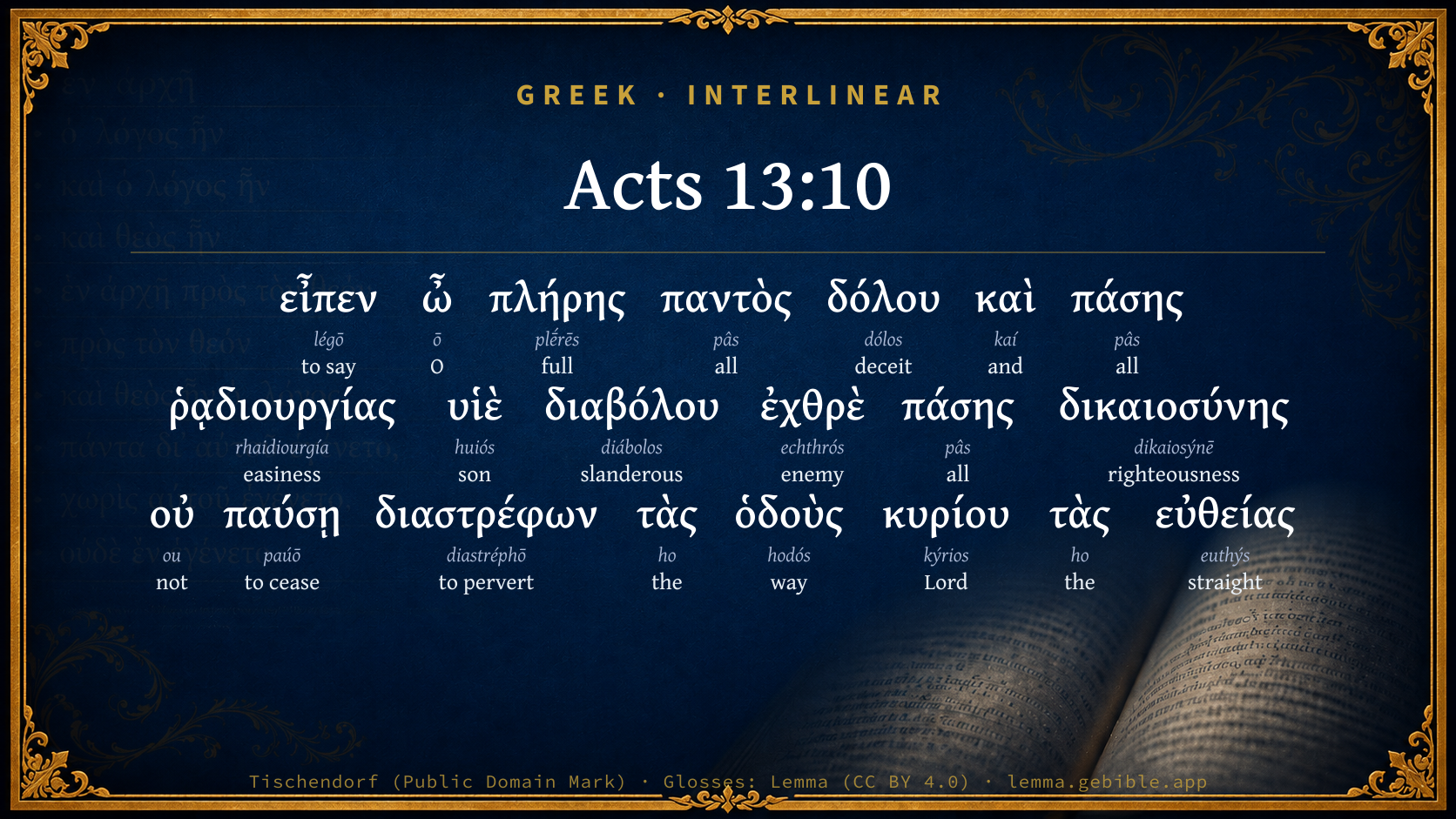
Greek (Tischendorf 8th ed.) Acts 13:10 appears in the Greek New Testament. The text above is from the Tischendorf 8th edition. Each word links to its Strong’s number and a concise gloss. Click any word for its full Thayer’s Greek Lexicon entry.
Download image
Cite this verse

Acts 13:10 (World English Bible). Public Domain. Lemma interlinear Bible study tool, https://lemma.gebible.app/v/acts/13/10.

Show BibTeX & RIS
BibTeX
RIS
English Translation
and said, "Full of all deceit and all cunning, you son of the devil, you enemy of all righteousness, will you not cease to pervert the right ways of the Lord?
World English Bible · Public Domain
Highlights
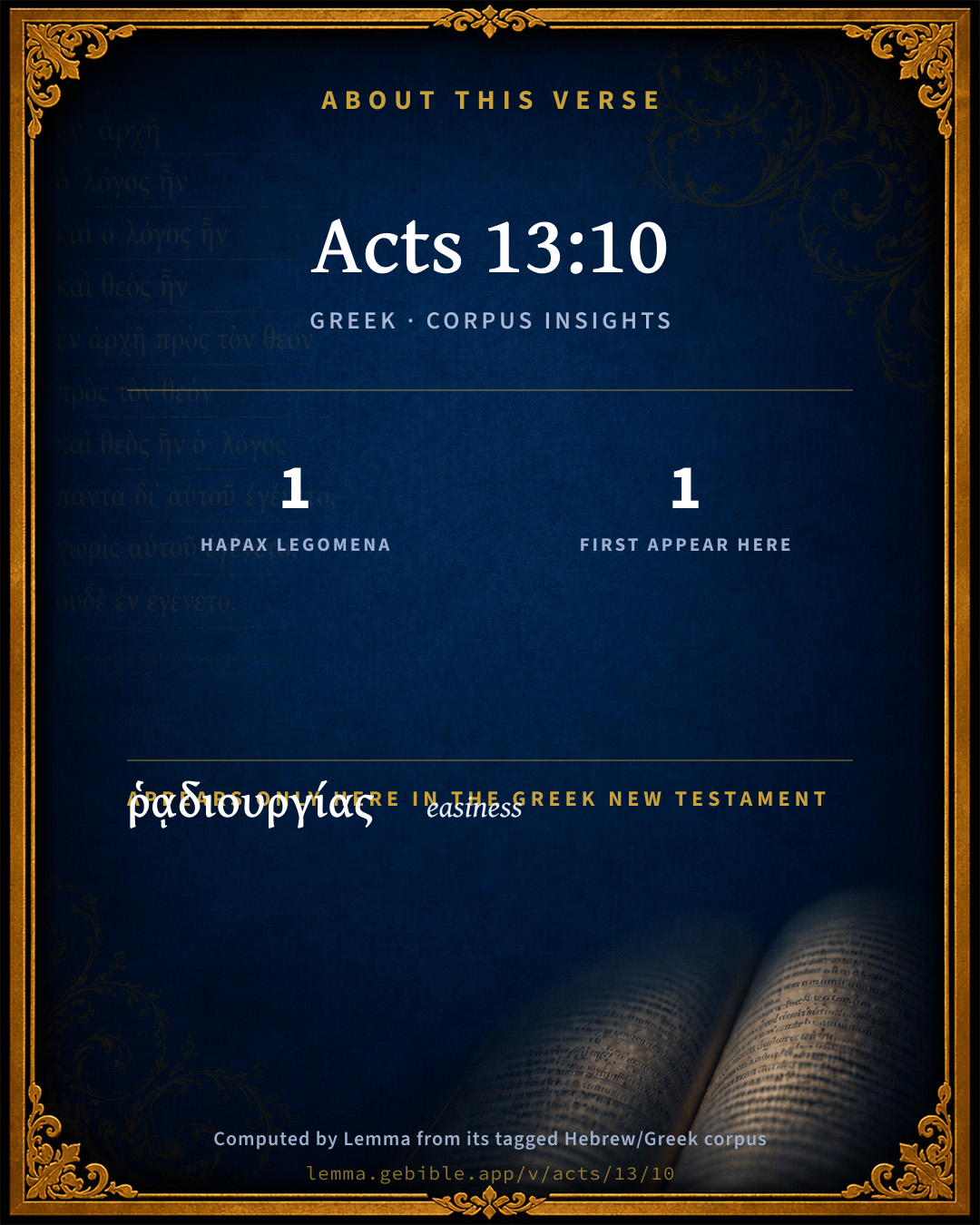
  • 1 hapax legomenon — only here in the Greek New Testament
  • 1 first appearance in the Greek New Testament
Full analysis ↓
Download a study sheet

One document with this verse’s original text, its word-by-word gloss line, the meaning frame, cross-references with their text, attributed commentary, and full source and license credits — printable, and it pastes into notes with its structure intact.

This verse Autodidact and up

Study sheet (.html) Plain text (.txt)

A passage Seminary Student

Up to 50 verses in one chapter. A passage sheet keeps up to 6 commentary sources and 12 cross-references per verse, in the order this page ranks them, and says so on the sheet whenever that leaves anything out. Ask for a single verse and you get the Autodidact verse sheet above.

Everything on this page stays free to read, with no account — the sheet is a download of what is already on screen, not access to it.

Want to remove ads? Support Godless Engineer
Compare translations 3

The same verse in 3 English versions, stacked beneath the original-language interlinear above. Click any original word for its lexicon entry.

Each is an independent rendering of the whole verse — the interlinear is not word-aligned to these translations.

Highlighted words mark where these versions differ — a whole-verse word diff, not a word-by-word alignment.

  • World English Bible Public Domain
    and said, "Full of all deceit and all cunning, you son of the devil, you enemy of all righteousness, will you not cease to pervert the right ways of the Lord?
  • King James Version Public Domain
    And said, O full of all subtilty and all mischief, thou child of the devil, thou enemy of all righteousness, wilt thou not cease to pervert the right ways of the Lord?
  • unfoldingWord Literal Text CC BY-SA 4.0
    said, “O full of all deceit and all trickery, son of the devil, enemy of all righteousness, will you not stop turning aside the straight paths of the Lord?

unfoldingWord Literal Text — © unfoldingWord, licensed CC BY-SA 4.0. Word-aligned USFM3 via Door43 (git.door43.org/unfoldingWord/en_ult).

Versions to compare (up to 4)

3 of 4 selected

Show all 19 translations

Every available English version of this verse, each an independent rendering of the whole verse.

  • World English Bible Public Domain
    and said, "Full of all deceit and all cunning, you son of the devil, you enemy of all righteousness, will you not cease to pervert the right ways of the Lord?
  • Berean Standard Bible Public Domain
    and said, “O child of the devil and enemy of all righteousness, you are full of all kinds of deceit and trickery! Will you never stop perverting the straight ways of the Lord?
  • Majority Standard Bible Public Domain
    and said, “O child of the devil and enemy of all righteousness, you are full of all kinds of deceit and trickery! Will you never stop perverting the straight ways of the Lord?
  • King James Version Public Domain
    And said, O full of all subtilty and all mischief, thou child of the devil, thou enemy of all righteousness, wilt thou not cease to pervert the right ways of the Lord?
  • American Standard Version (1901) Public Domain
    and said, O full of all guile and all villany, thou son of the devil, thou enemy of all righteousness, wilt thou not cease to pervert the right ways of the Lord?
  • Revised Version (1885) Public Domain
    and said, O full of all guile and all villany, thou son of the devil, thou enemy of all righteousness, wilt thou not cease to pervert the right ways of the Lord?
  • Geneva Bible (1599) Public Domain
    And sayde, O full of all subtiltie and all mischiefe, the childe of the deuill, and enemie of all righteousnesse, wilt thou not cease to peruert the straight waies of the Lord?
  • Douay-Rheims (1899) Public Domain
    Said: O full of all guile, and of all deceit, child of the devil, enemy of all justice, thou ceasest not to pervert the right ways of the Lord.
  • Young's Literal Translation Public Domain
    said, `O full of all guile, and all profligacy, son of a devil, enemy of all righteousness, wilt thou not cease perverting the right ways of the Lord?
  • Literal Standard Version CC BY-SA 4.0
    said, “O full of all guile, and all recklessness, son of a devil, enemy of all righteousness, will you not cease perverting the right ways of the LORD?
  • Unlocked Literal Bible CC BY-SA 4.0
    and said, “You son of the devil, you are full of all kinds of deceit and wickedness. You are an enemy of every kind of righteousness. You will never stop twisting the straight paths of the Lord, will you?
  • unfoldingWord Literal Text CC BY-SA 4.0
    said, “O full of all deceit and all trickery, son of the devil, enemy of all righteousness, will you not stop turning aside the straight paths of the Lord?
  • Darby Bible Public Domain
    said, O full of all deceit and all craft: son of [the] devil, enemy of all righteousness; wilt thou not cease perverting the right paths of [the] Lord?
  • World Messianic Bible Public Domain
    and said, “You son of the devil, full of all deceit and all cunning, you enemy of all righteousness, will you not cease to pervert the right ways of the Lord?
  • Webster's Bible Public Domain
    And said, O full of all subtilty, and all mischief, thou child of the devil, thou enemy of all righteousness, wilt thou not cease to pervert the right ways of the Lord?
  • Free Bible Version CC BY-SA 4.0
    “You are full of deception and all kinds of evil, you son of the devil, you enemy of all that is right! Will you never give up perverting the Lord's true ways?
  • Bible in Basic English Public Domain
    O you, who are full of false tricks and evil ways, a son of the Evil One, hating all righteousness, will you for ever be turning people from the right ways of the Lord?
  • Text-Critical English NT CC BY 4.0
    and said, “O son of the devil, full of all deceit and all trickery, enemy of all righteousness, will yoʋ not cease perverting the straight paths of the Lord?
  • Tyndale New Testament (1534) Public Domain
    and sayde: O full of all sutteltie and disseytfulnes the chylde of the devyll and the enemye of all righteousnes thou ceasest not to pervert the strayght wayes of the Lorde.

Literal Standard Version (2020), Covenant Press — licensed CC BY-SA 4.0. Text via the HelloAO Bible API (eBible.org). Unlocked Literal Bible (unfoldingWord) — licensed CC BY-SA 4.0. Text via the HelloAO Bible API (eBible.org). unfoldingWord Literal Text — © unfoldingWord, licensed CC BY-SA 4.0. Word-aligned USFM3 via Door43 (git.door43.org/unfoldingWord/en_ult). Free Bible Version, Dr. Jonathan Gallagher — licensed CC BY-SA 4.0. Text via the HelloAO Bible API (eBible.org).

Word by word

More ways to search: Search by grammar → Find every occurrence → Compare this word →

Practice this passage: Drill this verse → Learn its vocabulary →

ῥᾳδιουργίας
rhaidiourgía
G4468
“easiness”
Noun, Genitive, Singular, Feminine
Part of Speech
Noun
Case
Genitive
Number
Singular
Gender
Feminine
Full Thayer's Definition

Origin: from the same as G4467

TDNT: 22:13,0

1. ease in doing, faculty 2. levity or easiness in thinking or acting a. love of a lazy effeminate life 3. unscrupulous, cunning, mischief
  1. εἶπεν légō G3004 “to say” Verb, Aorist, Active, Indicative, 3rd person, Singular
  2. ὦ ō G5599 “O” Interjection
  3. πλήρης plḗrēs G4134 “full” Adjective, Nominative, Singular, Masculine
  4. παντὸς pâs G3956 “all” Adjective, Genitive, Singular, Masculine
  5. δόλου dólos G1388 “deceit” Noun, Genitive, Singular, Masculine
  6. καὶ kaí G2532 “and” Conjunction
  7. πάσης pâs G3956 “all” Adjective, Genitive, Singular, Feminine
  8. υἱὲ huiós G5207 “son” Noun, Vocative, Singular, Masculine
  9. διαβόλου diábolos G1228 “slanderous” Adjective, Genitive, Singular, Masculine
  10. ἐχθρὲ echthrós G2190 “enemy” Adjective, Vocative, Singular, Masculine
  11. πάσης pâs G3956 “all” Adjective, Genitive, Singular, Feminine
  12. δικαιοσύνης dikaiosýnē G1343 “righteousness” Noun, Genitive, Singular, Feminine
  13. οὐ ou G3756 “not” Particle, Negative
  14. παύσῃ paúō G3973 “to cease” Verb, Future, Middle deponent, Indicative, 2nd person, Singular
  15. διαστρέφων diastréphō G1294 “to pervert” Verb, Present, Active, Participle, Nominative, Singular, Masculine
  16. τὰς ho G3588 “the” Article, Accusative, Plural, Feminine
  17. ὁδοὺς hodós G3598 “way” Noun, Accusative, Plural, Feminine
  18. κυρίου kýrios G2962 “Lord” Noun, Genitive, Singular, Masculine
  19. τὰς ho G3588 “the” Article, Accusative, Plural, Feminine
  20. εὐθείας euthýs G2117 “straight” Adjective, Accusative, Plural, Feminine

About this verse

These counts appear in no published source. They are computed here, from the morphology-tagged text and Lemma’s own curated glosses. What Lemma adds →

21
words
18
distinct lemmas
Acts
section

Notable vocabulary

1 hapax legomenon — a word that appears only here in the entire Greek New Testament:

  • ῥᾳδιουργίας easiness G4468

First appearance in Scripture

This word makes its first canonical appearance in the Greek New Testament here:

  • ῥᾳδιουργίας easiness G4468

Shared distinctive vocabulary

διαστρέφων to pervert G1294 occurs in 7 verses of the Greek New Testament. Also found in:
Repetition

Words recur within this verse:

  • παντὸς all G3956 ×3
  • τὰς the G3588 ×2

Cross-references

22

Topical passages linked to Acts 13:10 in the Treasury of Scripture Knowledge — connected by theme and wording, ordered by reader-vote popularity; previews shown in the World English Bible.

  • John 8:44 You are of your Father, the devil, and you want to do the desires of your father. He was a murderer from the beginning, and doesn't stand in the truth, because there is no truth in him. When he speaks a lie, he speaks on his own; for he is a liar, and the father of it.
  • Matthew 13:38 the field is the world; and the good seed, these are the children of the Kingdom; and the darnel are the children of the evil one.
  • 2 Corinthians 11:3 But I am afraid that somehow, as the serpent deceived Eve in his craftiness, so your minds might be corrupted from the simplicity that is in Christ.
  • Hosea 14:9 Who is wise, that he may understand these things? Who is prudent, that he may know them? For the ways of Yahweh are right, And the righteous walk in them; But the rebellious stumble in them.
  • Galatians 1:7 and there isn't another gospel. Only there are some who trouble you, and want to pervert the Gospel of Christ.
  • Luke 11:52 Woe to you lawyers! For you took away the key of knowledge. You didn't enter in yourselves, and those who were entering in, you hindered."
  • 1 John 3:8 He who sins is of the devil, for the devil has been sinning from the beginning. To this end the Son of God was revealed, that he might destroy the works of the devil.
  • Acts 8:20–23 But Peter said to him, "May your silver perish with you, because you thought you could obtain the gift of God with money!
  • Matthew 3:7 But when he saw many of the Pharisees and Sadducees coming for his baptism, he said to them, "You offspring of vipers, who warned you to flee from the wrath to come?
  • Matthew 15:19 For out of the heart come forth evil thoughts, murders, adulteries, sexual sins, thefts, false testimony, and blasphemies.
  • Matthew 23:13 "Woe to you, scribes and Pharisees, hypocrites! For you devour widows' houses, and as a pretense you make long prayers. Therefore you will receive greater condemnation.
  • Matthew 23:25–33 "Woe to you, scribes and Pharisees, hypocrites! For you clean the outside of the cup and of the platter, but within they are full of extortion and unrighteousness.
  • Acts 18:25–26 This man had been instructed in the way of the Lord; and being fervent in spirit, he spoke and taught accurately the things concerning Jesus, although he knew only the baptism of John.
  • Acts 20:30 Men will arise from among your own selves, speaking perverse things, to draw away the disciples after them.
  • 2 Peter 2:15 forsaking the right way, they went astray, having followed the way of Balaam the son of Beor, who loved the wages of wrong-doing;
  • Genesis 3:15 I will put enmity between you and the woman, and between your offspring and her offspring. He will bruise your head, and you will bruise his heel."
  • Genesis 18:19 For I have known him, to the end that he may command his children and his household after him, that they may keep the way of Yahweh, to do righteousness and justice; to the end that Yahweh may bring on Abraham that which he has spoken of him."
  • 2 Chronicles 17:6 His heart was lifted up in the ways of Yahweh: and furthermore he took away the high places and the Asherim out of Judah.
  • Ecclesiastes 9:3 This is an evil in all that is done under the sun, that there is one event to all: yes also, the heart of the sons of men is full of evil, and madness is in their heart while they live, and after that they go to the dead.
  • Jeremiah 23:36 The burden of Yahweh shall you mention no more: for every man's own word shall be his burden; for you have perverted the words of the living God, of Yahweh of Hosts our God.
  • Luke 11:39 The Lord said to him, "Now you Pharisees cleanse the outside of the cup and of the platter, but your inward part is full of extortion and wickedness.
  • John 1:23 He said, "I am the voice of one crying in the wilderness, 'Make straight the way of the Lord,' as Isaiah the prophet said."

Cross-references courtesy of OpenBible.info (CC BY 4.0).

Commentary

Notes on Acts 13:10 from classic Christian and Jewish commentators (each source and its license shown beneath its notes). The classic Christian expositions comment on the surrounding passage and are grouped to its opening verse, so a note may address several verses; the Jewish commentaries on the Tanakh (Rashi and others) are per-verse, so they appear only where the commentator wrote on this verse.

Lemma curates 59 commentaries, every one of them public domain or Creative Commons licensed, each selected and text-cleaned for this edition rather than reprinted as found. About our sources →

Tyndale Open Study Notes

Tyndale Open Resources

13:10-11 Paul, who became the chief spokesman, rebuked the sorcerer’s fraudulent claims, exposed his deceit, and pronounced divine judgment (cp. 8:20-24). The sorcerer was instantly struck blind, a condition that lasted for some time, giving a strong demonstration of the truthfulness and superiority of the apostolic message over the bogus claims of the sorcerer.

Tyndale Open Study Notes — © Tyndale Open Resources, licensed CC BY-SA 4.0. Text via the HelloAO Bible API.

Bengel's Gnomon

Johann Albrecht Bengel

Act 13:10. Ὦ) The interjection, O, properly coheres with the substantives, Son (Child) and enemy: but as these signify the severest rebuke, the Ætiology (reason assigned) is prefixed, full, etc.—δόλου, of subtilty) Hereby he is stigmatised as a false prophet.—ῥᾳδιουργίας, craft [versutia]) Hereby he is stigmatised as a sorcerer.—υἱὲ διαβόλου, son of the devil) This too is applicable to a sorcerer, and such a man as is not only himself bad, but also forbids others from becoming better.—ἐχθρὲ πάσης δικαιοσύνης, enemy of all righteousness) This also applies to a false prophet: a true prophet teaches righteousness, and that in Christ.—οὐ παύσῃ, thou wilt not cease, or wilt thou not cease) Now at least it had been time to have ceased from the wickedness which he had even heretofore practised. Not to cease is devilish. Many read this with an interrogation.—τὰς εὐθείας, the right ways) Rectitude and simplicity are characteristic of Divine doctrine.

Bengel's Gnomon of the New Testament — English translation (T&T Clark, Edinburgh, 1860) — public domain. Text from a community e-Sword module.

Meyer's Critical & Exegetical Commentary

Heinrich August Wilhelm Meyer

Act_13:10. Ῥᾳδιουργίας] knavery, roguery. Polyb. xii. 10. 5, iv. 29. 4; Plut. Cat. m. 16. Comp. ῥᾳδιούργημα, Act_18:14.

υἱὲ διαβόλου] i.e. a man whose condition of mind proceeds from the influence of the devil (the arch-enemy of the kingdom of the Messiah). Comp. on Joh_8:44. An indignant contrast to the name Barjesus. διαβόλου is treated as a proper name, therefore without the article; 1Pe_5:8; Rev_20:2.

πάσης δικαιοσύνης] of all, that is right, Act_10:35.

διαστρέφων τὰς ὁδοὺς κυρ. τ. εὐθείας] Wilt thou not cease to pervert the straight (leading directly to the goal) ways of the Lord (to give them a perverted direction)? i.e. applying this general reproach to the present case: Wilt thou, by thy opposition to us, and by thy endeavour to turn the proconsul from the faith (Act_13:8), persist in so working that Gods measures (Rom_11:33; Rev_15:3), instead of attaining their aim according to the divine intention, may be frustrated? The straight way of God aimed here at the winning of Sergius for the salvation in Christ, by means of Barnabas and Paul; but Elymas set himself in opposition to this, and was engaged in diverting from its mark this straight way which God had entered on, so that the divinely-desired conversion of Sergius was to remain unrealized. De Wette takes it incorrectly: to set forth erroneously the ways in which men should walk before God. On διαστρέφων, comp. in fact, Pro_10:10; Isa_59:8; Mic_3:9; and notice that the διαστρέφειν κ.τ.λ. was really that which the sorcerer strove to do, although without attaining the desired success. Observe, also, the thrice repeated emphatic παντός … πάσης … πάσης, and that Κυρίου is not to be referred to Christ, but to God (whom the son of the devil resists), as is proved from Act_13:11.

Meyer — Critical and Exegetical Commentary on the New Testament — English translation by Peter Christie, edited by Frederick Crombie (T&T Clark, 1880) — public domain. Text from a community e-Sword module.

Expositor's Greek Testament

ed. W. Robertson Nicoll

Act 13:10 . πλήρης : for an interesting parallel in Plato cf. Wetstein, in loco , Plato, Legg. , 908 D. ῥᾳδιουργίας : only here in N.T., cf. Act 18:14 , hellenistic, R.V. “villainy,” A.V. “mischief” (so Genevan), but other E. V. “deceit”; the idea of deceit, however, is more properly contained in δόλου R.V., “guile”. ῥᾳδ ., lit [258] , ease in doing, so easiness, laziness, and hence fraud, wickedness, cf. πανουργία , frequently used, although not necessarily so, in a bad sense. υἱὲ διαβόλου , Joh 8:44 , the expression may be used in marked and indignant contrast to the name “Son of Jesus,” cf. Act 3:25 , Act 4:36 . But without any reference to Act 13:6 the expression would describe him as the natural enemy of the messengers of God. On the phrase and its use here see Deissmann, Bibelstudien , p. 163. Note the thrice παντὸς πάσης πάσης , “ter repetitur emphatice” Wetstein. διαστρέφων , cf. LXX, Pro 10:9 , and Isa 59:8 , Mic 3:9 . τὰς ὁδοὺς … τὰς εὐθείας : similar expressions frequent in LXX, so of the ways of the Lord in contrast to the ways of men, Eze 33:17 , Sir 39:24 , Song of the Three Children, Act 13:3 .

[258] literal, literally.

The Expositor's Greek Testament, edited by W. Robertson Nicoll (1897–1910) — public domain. Text from a community e-Sword module.

Geneva Bible (1599)

Geneva Bible translators

He noteth out such a fault, as whoso hath it, runneth headlong and with great desire to all kinds of wickedness with the least motion in the world.

The sorcerer which was stricken of Paul with a corporal punishment (although extraordinarily) showeth an example to lawful magistrates, how they ought to punish them which wickedly and obstinately hinder the course of the Gospel.

Geneva Bible (1599) marginal notes — public domain. Text via Bolls.life.

Jamieson, Fausset & Brown

Robert Jamieson, A. R. Fausset & David Brown

full of all subtlety--referring to his magic arts.

and all malice--The word signifies "readiness for anything," knavish dexterity.

thou child of the devil . . . enemy of all righteousness--These were not words of passion, for immediately before uttering them, it is said he was "filled with the Holy Ghost" [CHRYSOSTOM].

wilt thou not cease to pervert the right ways of the Lord--referring to his having to that hour made a trade of leading his fellow creatures astray.

Jamieson, Fausset & Brown — Commentary Critical and Explanatory on the Whole Bible (1871) — public domain (CC PDM 1.0). Text via the HelloAO Bible API.

Adam Clarke's Commentary

Verse 10. O full of all subtilty] δολου, Deceit, pretending to supernatural powers without possessing any, and having only cunning and deceit as their substitutes.

And-mischief] ραδιουργιας, from ραδιος, easy, and εργον, a work; one who is ready at his work; a word which excellently well defines a juggler, one who is expert at sleight of hand; though it is often employed to signify an abandoned and accomplished villain.

Child of the devil] υιε διαβολου, Son of the devil, possessing his nature; filled with his cunning; and, in consequence, practising deceit.

Enemy of all righteousness] εχθρεπασης δικαιοσυνης; Opposed in thy heart to all that is just, true, and good.

Wilt thou not cease to pervert, c.] ου παυση διαστρεφων. Wilt thou not cease perverting? He had probably laboured in this bad work from the beginning of Paul's ministry in the place and God in his mercy had borne with him; and no doubt the apostle had warned him, for thus much seems implied in the reproof. What a terrible character is given of this bad man! He no doubt passed among the people for what we call a clever fellow; and he was so clever as to hide himself under a pretty dense mask; but God, who searches the heart, plucked it off, and tells him, and those who were perverted by him, what an accomplished deceiver and knave he was.

The right ways of the Lord] τας οδους κυριου τας ευθειας, The ways of the Lord, the straight ways. This saying is very emphatical. The ways of Elymas were crooked and perverse; the ways of the Lord, the doctrine taught by him, plain and straight. What is here said of the conduct and teaching of Elymas, for he was a false prophet, is true of all false doctrine: it is complex, devious, and tortuous: while the doctrine of God is simple, plain, and straight; directing in the way, the sure way, that leads to present peace and everlasting happiness. From the phraseology which the apostle employs in this terrible address to Elymas, we may learn, as well as from his name Bar-Jesus, that he was by birth and education a Jew. On this account he was the greater enemy to Christianity; and on this same account he was the less excusable.

Adam Clarke's Commentary on the Bible (1810–1826) — public domain. Text from a community e-Sword/MySword module.

John Calvin's Commentaries

10. O thou full of deceit. It was not without a cause that Paul was thus hot and angry; for he had no hope to do any good if he should deal after some moderate and mild sort. We must always begin with doctrine, and those are also to be admonished, exhorted, and pricked forward, who do not as yet appear to be altogether obstinate. Neither doth Paul so vehemently inveigh against the sorcerer at the first dash; but when he seeth him maliciously and manifestly fight against the doctrine of godliness, he handleth him like a bond-slave of Satan. Thus must we deal with the desperate enemies of the gospel, in whom appeareth open contumacy and wicked contempt of God, especially when they stop the way before others, And lest any man should think that Paul was out of measure angry, Luke saith plainly that the inspiration of the Spirit was his guide. Wherefore this heat of zeal is not only not to be reprehended, but it ought to make the profane condemners of God sore afraid, who fear not to rebel against his word; forasmuch as this judgment is given upon them all not by mortal man, but by the Holy Ghost, by the mouth of Paul.

As touching the words, this place refuteth their error who think that Paul took his name of the deputy, as if he had set up some token of victory. There may many reasons be brought, and those strong enough, on the contrary; but this one place is sufficient, where Luke showeth that at such time as the deputy was not brought to the faith he had two names. And it is not to be doubted but that he retained his own name amongst the Jews; and we know that this was a usual thing, that those who were citizens of Rome should borrow some Italian name. Luke joineth subtlety with deceit, which is contrary to sincerity; to wit, whilst crafty men transform their wit hither and thither, so that they have in them no simplicity; though the Greek word which Luke useth signifieth ready boldness to do hurt; but the former signification agreeth better. By the son of the devil is meant a reprobate and desperate man. Such are all those which resist maliciously, and as it were of set purpose, that which is just and right; therefore Paul addeth, that he is a great enemy of all righteousness.

Dost thou not cease to pervert? He calleth all that means whereby the Lord bringeth us unto himself the ways of the Lord. He testifieth that this is plain and straight; and he accuseth the sorcerer for making the same crooked, full of turnings, and doubtful, with his boughts and turns. Whence may be gathered a profitable doctrine, that it cometh to pass through the subtlety of Satan that we do not readily, with straight course, go unto the Lord. For he showeth us in his word a plain way, and such as is not thorny. Wherefore we must take good heed of seducers, which trouble the way with their ditches or thorns, or else make the same hard and unpleasant.

And it shall be convenient to repeat here that which I touched before, that the servants of Christ must not be blamed if they do sore inveigh against the professed enemies of sound doctrine, unless we will accuse the Holy Ghost of intemperance. Neither am I ignorant how easily men may fall in this point; for which cause godly teachers must take so much the more heed, first, that they favor not the affections of the flesh too much under the color of zeal; secondly, that they break not out with headlong and unseasonable heat where there is yet place for moderation; thirdly, that they give not themselves over to foolish and uncomely railing, but only that they express the unseemliness of the thing by gravity and weight of words. Such was the vehemency of holy zeal and of the Spirit in the prophets, which if dainty and soft men judge troublesome and raging, they consider not how dear and precious God’s truth is to him.

Now there riseth not one Elymas to subvert the faith but many, and those which are far more wicked. For we see with what sacrilegious boldness they despoil God of all honor; with what filthy corruptions they profane all religion; how cruelly they throw miserable souls headlong into eternal destruction; how unseemly they mock Christ; how filthily they disfigure all the whole worship of God; with what cruel reproaches they rend the holy truth of God; with what barbarous tyranny they lay waste the Church of God; so that you would say that they tread God under foot. And yet there be many crabbed philosophers who would have these furious giants flattered and clawed by the back. But forasmuch as it doth evidently appear that such did never taste what that meaneth, “The zeal of thine house hath eaten me up,” (Psalm 69:9,) let us, bidding adieu to their coldness, or rather sluggishness, be most hot, as becometh us, in maintaining the glory of God.

John Calvin's Commentaries (1540-1563) — public domain. Text from the Calvin Translation Society English edition (1840s-50s) via the Christian Classics Ethereal Library (ccel.org). Calvin's coverage is partial (roughly two-thirds of the Bible); uncommented books and verses are honest gaps, never fabricated. The 19th-century editor's footnotes and remarks are omitted so the notes are faithfully Calvin's own voice.

Ellicott's Commentary for English Readers

(10) Full of all subtilty and all mischief.—The Greek of the second noun is found here only in the New Testament. Its primary meaning expresses simply “ease in working;” but this passed through the several stages of “versatility,” “shiftiness,” and “trickery.” A kindred word is translated in Act_18:14 as “lewdness.”

Thou child of the devil.—There is, perhaps, an intentional contrast between the meaning of the name Bar-jesus (= son of the Lord who saves) and the character of the man, which led him to oppose righteousness in every form, and to turn “the straight paths of God’s making” into the crooked ones of man’s subtlety. There is a manifest reference to the words in which Isaiah describes the true preparation of the way of the Lord as consisting in making the crooked straight (Isa_40:4).

A Bible Commentary for English Readers, edited by Charles John Ellicott (1878–1897) — public domain. Text from a community e-Sword module.

The Cambridge Bible for Schools and Colleges

gen. ed. J. J. S. Perowne

10. enemy of all righteousness] We may judge from this expression that St Paul recognized an earnest zeal for truth in the enquiries of the proconsul, and that his wrath against Elymas was not only for what he was doing at the present time, but for his long-continued leading astray of those who were desirous to know the ways of the Lord.

The Cambridge Bible for Schools and Colleges (gen. ed. J. J. S. Perowne; Cambridge University Press, 1878–1918) — public domain. Text from a community e-Sword module.

John Gill's Exposition

And said, O full of all subtlety and all mischief,.... Which may have regard both to his general character as a sorcerer, and a false prophet; in acting up to which he used much deceit and cunning among the people, and did much mischief to them; to which there was a promptness and readiness in him, as the word used signifies; and also to the sophistry he used, and the mischief he endeavoured to do in seeking to turn the deputy from the faith. The minds of carnal men are vain and empty, and destitute of all that is good, and full of all that is evil: their character is,

filled with all unrighteousness, Rom 1:29. They have many of them a great deal of wit, but it is wicked wit, and they employ it in an evil and mischievous way, both to the hurt of themselves and others; they are like the old serpent, whose seed they are, who was more subtle than any beast of the field; they are wiser in their generation than the children of light; they are wise to do evil, though they have no knowledge of what is spiritually good; they are able to form very cunning and artful schemes, to commit sin, and do mischief; for all their craft and subtlety are used in such a way; nor can they sleep, or be easy in their minds, unless they are doing mischief.

Thou child of the devil; perhaps alluding to his name, that instead of Bar-Jesus, the son of a saviour, he should have been called Bar-Satan, the son of Satan, or Ben-Belial, a son of Belial. The phrase , "the firstborn of Satan", is used by the Jews, sometimes in a good sense, for one that is acute, sharp, and subtle, and that abides by his doctrine, and does his work (s): but here a child of the devil is used in an ill sense, for being like him in wicked cunning and subtlety; in like sense as the other phrase was used by Polycarp, whom Marcion the heretic met, and said unto him, know us; to whom Polycarp replied, I know thee, the firstborn of Satan (t): thou enemy of all righteousness; a wicked man is an enemy to all righteousness in every branch of it, in whatsoever light it may be considered: he is an enemy, yea, enmity itself against God the righteous being, and who is the fountain of all righteousness; he is an enemy to Jesus Christ the righteous, who is the Lord our righteousness; he is an enemy to that righteousness which he has wrought out; he is an enemy to all righteous persons, and hates their holy and righteous conversation; he is an enemy to the law, and cannot be subject to it, which is the rule of righteousness; and he is an enemy to the Gospel, which reveals the righteousness of God from faith to faith, and teaches men to live soberly, righteously, and godly; in short he is an enemy to all righteousness, moral and evangelical.

Wilt thou not cease to pervert the right ways of the Lord? the doctrines and ordinances of Christ, in which he has directed his people to walk; which this man, through his sophistry and wickedness, in which he was industrious and indefatigable, endeavoured to render intricate and obscure, when they were plain, and straight, and easy. "For the ways of the Lord are right, and the just shall walk in them", Hos 14:9 they are right, and it is becoming such to walk in them; they are plain to them that have a true knowledge of them, even wayfaring men, though fools shall not err in them; they are entirely consistent with the righteousness and holiness of God, and lead right on to eternal glory and happiness. Christ himself is the true way to eternal life, which is plainly pointed, and clearly directed to in the word of God, and by the ministers of the Gospel, who show unto men the way of salvation; the path of truth is fully described, and such things said of it as are very inviting to walk in it; and good men cannot but choose and delight to walk in it, when led into it by the Spirit of truth: Wisdom's ways are ways of pleasantness, and all her paths of peace; even all the paths of duty and worship, the ways of righteousness and holiness; but wicked men seek to pervert these ways, to give a false account of them, to set them in a wrong light, and represent them not only as rough and troublesome, but as dangerous, and leading to ruin; and do all they can to hinder persons from entering into them, and to cause those to stumble who are in them; nor will they cease acting this wicked part; they are continually at work to make the ways of Christ odious, to set people against them, to discourage from walking in them by their opposition to them, the false glosses they put upon them, and by their scoffs and jeers at those that walk in them, and by their violent persecutions of them, when it is in their power.

(s) T. Hieros. Yebamot, fol. 3. 1. & T. Rab. Yebamot, fol. 16, 1. & Juchasin, fol. 14. 1. & 55. 1. (t) Irenaeus adv. Haeres. l. 3. c. 3.

John Gill's Exposition of the Whole Bible (1746–1763) — public domain (CC PDM 1.0). Text via the HelloAO Bible API.

Trapp's Complete Commentary

John Trapp

10 And said, O full of all subtilty and all mischief, thou child of the devil, thou enemy of all righteousness, wilt thou not cease to pervert the right ways of the Lord?

Ver. 10. O full of all subtilty and all mischief] Gr. ραδιουργια, maleficiency, thou that by long dealing hast gotten a dexterity in evil doing. This was plain dealing, such as Master Philpot, martyr, used to Morgan, and other popelings that set upon him; such as Maris, the blind bishop of Bithynia, used to Julian the Apostate. For when Julian had said to him, Behold, thou art blind; thinkest thou that the Galilean thy God careth for thee? Maris replied, O tu impie Apostata! gratias ago Deo meo, qui me caecum reddidit, ne vultum tuum videam ita ad impietatem prolapsum: O thou wicked apostate! I bless my Lord Christ who hath made me blind, that I might not see thy cursed countenance. When Servetus condemned Zuinglius for his harsh handling of him, he answers, In aliis mansuetus ero; in blasphemiis in Christum non ita: In other things I will use mildness, but not in dealing with those that blaspheme Christ. {a} Mihi sane Auxentius erit diabolus quamdiu Arianus, said Hilary, I shall think Auxentias to be no better than a devil so long as he continues an Arian.

Enemy of all righteousness] The adulterer is an enemy to chastity, the drunkard to sobriety, &c., but he that hindereth others from heaven is an enemy to all righteousness.

To pervert the right ways] To dig them up, to ditch them over (διαστρεφων), so as they are not passable. The conversion of great men is of great consequence. Hence Paul was so loth to lose the proconsul.

{a} Epist. in Servet.

John Trapp, A Commentary or Exposition upon All the Books of the Old and New Testament (1647–1656) — public domain. Text from a community e-Sword module.

Albert Barnes' Notes on the Bible

O full of all subtilty and all mischief - The word “subtilty” denotes “deceit and fraud,” and implies that he was practicing an imposition, and that he knew it. The word rendered “mischief” ῥᾳδιουργίας radiourgias denotes properly “facility of acting,” and then “sleight of hand; sly;, cunning arts, by which one imposes on another, and deceives him with a fraudulent intention.” It is not used elsewhere in the New Testament. The art of Elymas consisted probably in sleight of hand, legerdemain, or trick, aided by skill in the abstruse sciences, by which the ignorant might be easily imposed on. See the notes on Act 8:9.

Child of the devil - Under his influence; practicing his arts; promoting his designs by deceit and imposture, so that he may be called your father. See the notes on Joh 8:44. Satan is represented here as the author of deceit and the father of lies.

Enemy of all righteousness - Practicing deceit and iniquity, and thus opposed to righteousness and honesty. A man who lives by wickedness will, of course, be the foe of every form of integrity. A man who lives by fraud will be opposed to the truth; a panderer to the vices of people will hate the rules of chastity and purity; a manufacturer or vendor of ardent spirits will be the enemy of temperance societies.

Wilt thou not cease to pervert - In what way he had opposed Paul and Barnabas is not known. It may have been either by misrepresenting their doctrines, or by representing them as apostate Jews thus retarding or hindering the progress of the gospel. The expression “wilt thou not cease.” implies that he had been engaged sedulously in doing this, probably from the commencement of their work in the city.

The right ways of the Lord - The straight paths or doctrines of the Christian religion, in opposition to the crooked and perverse arts of deceivers and impostors. Straight paths denote “integrity, sincerity, truth,” Jer 31:9; Heb 12:13; compare Isa 40:3-4; Isa 42:16; Luk 3:5. Crooked ways denote “the ways of the sinner, the deceiver, the impostor,” Deu 32:5; Psa 125:1-5; Pro 2:15; Isa 59:8; Phi 2:15.

Albert Barnes' Notes on the Bible (1834–1885) — public domain. Text from a community e-Sword/MySword module.

Haydock's Catholic Bible Commentary

Son of the devil. Sharp language, when grounded on truth, may be used against those who hinder the conversion of others. St. John Chrysostom says, he was struck with this blindness only for a time, to make him enter into himself, and be converted. (Witham)

George Leo Haydock (1774–1849), Haydock's Catholic Family Bible and Commentary, 1859 edition — public domain. Excludes Psalms (Douay-Rheims chapter numbering differs from Protestant) and Deuterocanonical books (Catholic canon only).

Matthew Poole's English Annotations

Mischief; radiourgia signifies a facility or readiness in doing mischief, and that such who are given to sorcery are easily drawn to commit any kind of sin whatsoever.

Thou child of the devil; because he did his work who is the destroyer, in hindering what he could the salvation of Sergius Paulus and his family.

To pervert the right ways of the Lord; to make the way of God crooked, which is straight; and rugged, when indeed it is smooth: that is, to lay what rubs he could to keep any from coming unto, or continuing in, the ways of God.

Matthew Poole's English Annotations on the Holy Bible (1683–1685) — public domain. Text from a community e-Sword/MySword module.

Whedon's Commentary on the Bible

Daniel D. Whedon

10. Full of all subtilty—As the apostle was filled with the Holy Ghost.

Child of the devil—A striking contrast with, perhaps an allusion to, his name Bar-jesus.

Right ways—Literally, straight ways.

Of the Lord—Of Jehovah-Jesus. The straight ways of the Lord are God’s straight course in Jesus, saving the world through him. These straight ways Elymas distorted, made crooked, by his sophistical mis-constructions and perversions.

Daniel D. Whedon (gen. ed.), Commentary on the Old and New Testaments (1874–1909) — public domain. Text from a community e-Sword module.

The Pulpit Commentary

All guile and all villainy for all subtlety and all mischief, A.V.; son for child, A.V. The word rJadiourgia, reckless conduct, villainy, wickedness, is only found here in the New Testament. The kindred form (rJadiourghma) occurs in Act_18:14. Thou son of the devil (Joh_8:38, Joh_8:44; 1Jn_3:10) Elymas showed himself a child of the devil in his endeavors to resist the truth of the gospel, and substitute his own falsehoods and imposture. Compare the severity of Peter"s language in rebuking Simon Magas. (Act_8:20-23) Probably, too, he accused (diebalen) Paul and Barnabas, and traduced their motives before the proconsul, when he saw his own influence being undermined, and his gains likely to be stopped.

The Pulpit Commentary (1880–1919), ed. H.D.M. Spence-Jones & Joseph S. Exell — public domain. Text from a community e-Sword module.

John Wesley's Explanatory Notes

O full of all guile - As a false prophet, and all mischief - As a magician. Thou son of the devil - A title well suited to a magician; and one who not only was himself unrighteous, but laboured to keep others from all goodness. Wilt thou not cease to pervert the right ways of the Lord? - Even now thou hast heard the truth of the Gospel.

John Wesley, Explanatory Notes Upon the Whole Bible (1754–1765) — public domain. Text via the GEBible commentary corpus.

MacLaren's Expositions of Holy Scripture

Alexander MacLaren

Acts

TO THE REGIONS BEYOND

Act 13:1 - Act 13:13.

We stand in this passage at the beginning of a great step forward. Philip and Peter had each played a part in the gradual expansion of the church beyond the limits of Judaism; but it was from the church at Antioch that the messengers went forth who completed the process. Both its locality and its composition made that natural.

I. The solemn designation of the missionaries is the first point in the narrative.

The church at Antioch was not left without signs of Christ’s grace and presence. It had its band of ‘prophets and teachers.’ As might be expected, four of the five named are Hellenists,-that is, Jews born in Gentile lands, and speaking Gentile languages. Barnabas was a Cypriote, Simeon’s byname of Niger {‘Black’} was probably given because of his dark complexion, which was probably caused by his birth in warmer lands. He may have been a North African, as Lucius of Cyrene was. Saul was from Tarsus, and only Manaen remains to represent the pure Palestinian Jew. His had been a strange course, from being foster-brother of the Herod who killed John to becoming a teacher in the church at Antioch. Barnabas was the leader of the little group, and the younger Pharisee from Tarsus, who had all along been Barnabas’s protege, brought up the rear.

The order observed in the list is a little window which shows a great deal. The first and last names all the world knows; the other three are never heard of again. Immortality falls on the two, oblivion swallows up the three. But it matters little whether our names are sounded in men’s ears, if they are in the Lamb’s book of life.

These five brethren were waiting on the Lord by fasting and prayer. Apparently they had reason to expect some divine communication, for which they were thus preparing themselves. Light will come to those who thus seek it. They were commanded to set apart two of their number for ‘the work whereunto I have called them.’ That work is not specified, and yet the two, like carrier pigeons on being let loose, make straight for their line of flight, and know exactly whither they are to go.

If we strictly interpret Luke’s words {‘I have called them’}, a previous intimation from the Spirit had revealed to them the sphere of their work. In that case, the separation was only the recognition by the brethren of the divine appointment. The inward call must come first, and no ecclesiastical designation can do more than confirm that. But the solemn designation by the Church identifies those who remain behind with the work of those who go forth; it throws responsibility for sympathy and support on the former, and it ministers strength and the sense of companionship to the latter, besides checking that tendency to isolation which accompanies earnestness. To go forth on even Christian service, unrecognised by the brethren, is not good for even a Paul.

But although Luke speaks of the Church sending them away, he takes care immediately to add that it was the Holy Ghost who ‘sent them forth.’ Ramsay suggests that ‘sent them away’ is not the meaning of the phrase in Act 13:3, but that it should be rendered ‘gave them leave to depart.’ In any case, a clear distinction is drawn between the action of the Church and that of the Spirit, which constituted Paul’s real commission as an Apostle. He himself says that he was an Apostle, ‘not from men, neither through man.’

II. The events in the first stage of the journey are next summarily presented.

Note the local colouring in ‘went down to Seleucia,’ the seaport of Antioch, at the mouth of the river. The missionaries were naturally led to begin at Cyprus, as Barnabas’s birthplace, and that of some of the founders of the church at Antioch.

So, for the first time, the Gospel went to sea, the precursor of so many voyages. It was an ‘epoch-making moment’ when that ship dropped down with the tide and put out to sea. Salamis was the nearest port on the south-eastern coast of Cyprus, and there they landed,- Barnabas, no doubt, familiar with all he saw; Saul probably a stranger to it all. Their plan of action was that to which Paul adhered in all his after work,-to carry the Gospel to the Jew first, a proceeding for which the manner of worship in the synagogues gave facilities. No doubt, many such were scattered through Cyprus, and Barnabas would be well known in most.

They thus traversed the island from east to west. It is noteworthy that only now is John Mark’s name brought in as their attendant. He had come with them from Antioch, but Luke will not mention him, when he is telling of the sending forth of the other two, because Mark was not sent by the Spirit, but only chosen by his uncle, and his subsequent defection did not affect the completeness of their embassy. His entirely subordinate place is made obvious by the point at which he appears.

Nothing of moment happened on the tour till Paphos was reached. That was the capital, the residence of the pro-consul, and the seat of the foul worship of Venus. There the first antagonist was met. It is not Sergius Paulus, pro-consul though he was, who is the central figure of interest to Luke, but the sorcerer who was attached to his train. His character is drawn in Luke’s description, and in Paul’s fiery exclamation. Each has three clauses, which fall ‘like the beats of a hammer.’ ‘Sorcerer, false prophet, Jew,’ make a climax of wickedness. That a Jew should descend to dabble in the black art of magic, and play tricks on the credulity of ignorant people by his knowledge of some simple secrets of chemistry; that he should pretend to prophetic gifts which in his heart he knew to be fraud, and should be recreant to his ancestral faith, proved him to deserve the penetrating sentence which Paul passed on him. He was a trickster, and knew that he was: his inspiration came from an evil source; he had come to hate righteousness of every sort.

Paul was not flinging bitter words at random, or yielding to passion, but was laying the black heart bare to the man’s own eyes, that the seeing himself as God saw him might startle him into penitence. ‘The corruption of the best is the worst.’ The bitterest enemies of God’s ways are those who have cast aside their early faith. A Jew who had stooped to be a juggler was indeed causing God’s ‘name to be blasphemed among the Gentiles.’

He and Paul each recognised in the other his most formidable foe. Elymas instinctively felt that the pro-consul must be kept from listening to the teaching of these two fellow-countrymen, and ‘sought to pervert him from the faith,’ therein perverting {the same word is used in both cases} ‘the right ways of the Lord’; that is, opposing the divine purpose. He was a specimen of a class who attained influence in that epoch of unrest, when the more cultivated and nobler part of Roman society had lost faith in the old gods, and was turning wistfully and with widespread expectation to the mysterious East for enlightenment.

So, like a ship which plunges into the storm as soon as it clears the pier-head, the missionaries felt the first dash of the spray and blast of the wind directly they began their work. Since this was their first encounter with a foe which they would often have to meet, the duel assumes importance, and we understand not only the fulness of the narrative, but the miracle which assured Paul and Barnabas of Christ’s help, and was meant to diffuse its encouragement along the line of their future work. For Elymas it was chastisement, which might lead him to cease to pervert the ways of the Lord, and himself begin to walk in them. Perhaps, after a season, he did see ‘the better Sun.’

Saul’s part in the incident is noteworthy. We observe the vivid touch, he ‘fastened his eyes on him.’ There must have been something very piercing in the fixed gaze of these flashing eyes. But Luke takes pains to prevent our thinking that Paul spoke from his own insight or was moved by human passion. He was ‘filled with the Holy Ghost,’ and, as His organ, poured out the scorching words that revealed the cowering apostate to himself, and announced the merciful punishment that was to fall. We need to be very sure that we are similarly filled before venturing to imitate the Apostle’s tone.

III. The shifting of the scene to the mainland presents some noteworthy points.

It is singular that there is no preaching mentioned as having been attempted in Perga, or anywhere along the coast, but that the two evangelists seem to have gone at once across the great mountain range of Taurus to Antioch of Pisidia.

A striking suggestion is made by Ramsay to the effect that the reason was a sudden attack of the malarial fever which is endemic in the low-lying coast plains, and for which the natural remedy is to get up among the mountains. If so, the journey to Antioch of Pisidia may not have been in the programme to which John Mark had agreed, and his return to Jerusalem may have been due to this departure from the original intention. Be that as it may, he stands for us as a beacon, warning against hasty entrance on great undertakings of which we have not counted the cost, no less than against cowardly flight from work, as soon as it begins to involve more danger or discomfort than we had reckoned on.

John Mark was willing to go a-missionarying as long as he was in Cyprus, where he was somebody and much at home, by his relationship to Barnabas; but when Perga and the climb over Taurus into strange lands came to be called for, his zeal and courage oozed out at his finger-ends, and he skulked back to his mother’s house at Jerusalem. No wonder that Paul ‘thought not good to take with them him who withdrew from them.’ But even such faint hearts as Mark’s may take courage from the fact that he nobly retrieved his youthful error, and won back Paul’s confidence, and proved himself ‘profitable to him for the ministry.’

Alexander MacLaren, Expositions of Holy Scripture (1904–1910) — public domain. Text from a community e-Sword module.

McGarvey & Pendleton's Commentaries

J. W. McGarvey

See notes one verse 8

J. W. McGarvey (with Philip Y. Pendleton), Commentaries on the New Testament (The Fourfold Gospel, 1914; Acts; and the epistles) — public domain. Text from a community e-Sword/MySword module.

The People's New Testament

B. W. Johnson

10–12. Child of the devil. Under his influence. The right ways of the Lord. God's plan of salvation in Christ.

The hand of the Lord is upon thee. In judgment. Thou shalt be blind. He was fighting against the light. Hence physical blindness for a season. A mist and a darkness. As though a cloud had gathered about him.

Then the deputy … believed. The language implies that he became a Christian. The “believers” were those who accepted Christ.

B. W. Johnson's The People's New Testament with Notes (1889–1891) — public domain. Electronic text from the Christian Classics Ethereal Library (CCEL) ThML edition.

Cambridge Greek Testament for Schools and Colleges

10. ἐχθρὲ πάσης δικαιοσύνης, enemy of all righteousness. We may judge from this expression that St Paul recognised an earnest zeal for truth in the inquiries of the proconsul, and that his wrath against Elymas was not only because of what he did at the time, but for the tendency of all his teachings. He had led astray for a long time one who was desirous to understand the ways of the Lord. That there were such anxious inquirers among the Greeks and Romans we can see from the case of Cornelius and his friends. These were sure to seek to Jews for guidance, and in Elymas and such as he they found false guides.

Cambridge Greek Testament for Schools and Colleges (Cambridge University Press, 1896; 21 vols, various authors incl. Carr, Maclear, Plummer, Farrar, Lumby, Moule, M. R. James, Simcox) — public domain. Text from a community e-Sword module.

Alford’s Greek Testament

Henry Alford

10. υἱὲ διαβ.] Meyer supposes an indignant allusion to the name Bar-jesus. This is possible, though hardly probable (see below). διαβ., which usually has the article, is elsewhere found without it only in (1Pe 5:8) Rev 12:9, 22. See Moulton’s Winer, p. 155, note 1.

πάς. δικ., of all that is right.

διαστρ. κ.τ.λ.] The οὐ παύσῃ evidently makes this apply, not to Elymas’s conduct on this occasion merely, but to his whole life of imposture and perversion of others. The especial sin was, that of laying hold of the nascent enquiry after God in the minds of men, and wresting it to a wrong direction.

κυρίου, here and ver. 11, is Jehovah. If, as some suppose, the reading of the name Bar-jesus is Bar-jehu, the repetition may be allusive: as in the other case might the ἐχθρὲ πάς. δικαιοσύνης to the name Jesus. But Meyer supposes the various readings in the forms of the name (Barsuma, Barjesuban) to have arisen from a desire to reverence the Name Jesus.

τυφλὸς μὴ βλέπων] so μνήσθητι μὴ ἐπιλάθῃ, Deu 9:7.

Henry Alford, The Greek Testament (1849–1861) — public domain. Text from a community e-Sword module.

Vincent's Word Studies in the New Testament

Marvin R. Vincent

Mischief [ραδιουργιας] . Only here in New Testament. Originally, ease or facility in doing; hence readiness in turning the hand to anything, bad or good; and so recklessness, unscrupulousness, wickedness. A kindred word (rJadiourghma, lewdness, Rev., villainy) occurs at ch. 18 14.

Right ways. Or straight, possibly with an allusion to Elymas' crooked ways.

Marvin R. Vincent, Word Studies in the New Testament (1887–1900) — public domain. Text from a community e-Sword/MySword module.

Lesson kit

Teaching starters — assembled from the data on this page, not authored interpretation. Every prompt links to the verse data it draws on. Edit before teaching.

Acts, in the Acts, opens this verse with 21 words (18 distinct Greek lemmas). Its most distinctive word is rhaidiourgía (“easiness”). A historical commentator’s framing appears above. Read the whole chapter for the surrounding context.

Discussion questions

  1. What does “easiness” (rhaidiourgía) contribute to the verse as a whole?
  2. This verse holds 1 word here found nowhere else in the Greek New Testament. What might the rare word draw attention to?
  3. The word “easiness” first appears here in Scripture. What is being introduced at this debut?
  4. Matthew 17:17 shares the word «to pervert» with this verse. How do the two illuminate each other?
  5. “all” occurs 3× in this one verse. What is the effect of the repetition?
  6. These translations render this verse differently; the difference is in the English rendering, not the original. What questions does that raise?
  7. Reading how Tyndale Open Study Notes and Bengel's Gnomon read this verse, where do the two commentators agree and where do they part?

Things to notice

  • 1 word in this verse appears nowhere else in the Greek New Testament.
  • 1 word makes its first canonical appearance in Scripture here.
  • These translations choose different wording for 20 words in this verse.
  • “all” occurs 3× in this single verse.
  • 18 distinct Greek lemmas span 21 words in this verse.

Reading settings

Reading text

Shown beneath each verse's original-language words.

Old Testament
Old Testament edition

Read the OT as the Masoretic Hebrew (MT) or the Greek Septuagint (LXX).

English shown for the Greek Septuagint (in the Hebrew ↔ Greek comparison).

Comparing translations? Open the Compare panel on any verse page to stack up to four side by side.