
Jude 1:11

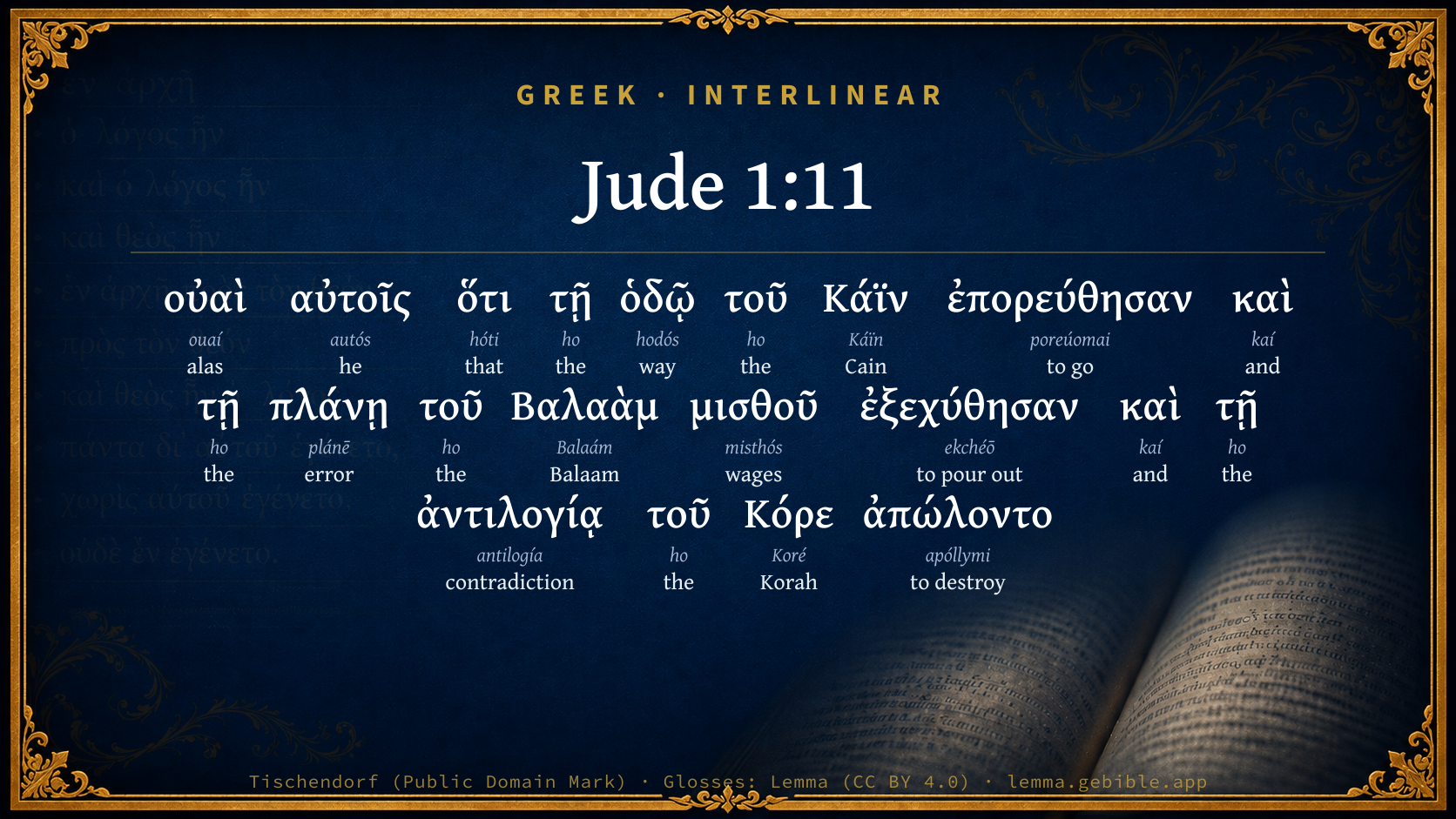
Greek (Tischendorf 8th ed.) Jude 1:11 appears in the Greek New Testament. The text above is from the Tischendorf 8th edition. Each word links to its Strong’s number and a concise gloss. Click any word for its full Thayer’s Greek Lexicon entry.
Download image
Cite this verse

Jude 1:11 (World English Bible). Public Domain. Lemma interlinear Bible study tool, https://lemma.gebible.app/v/jude/1/11.

Show BibTeX & RIS
BibTeX
RIS
English Translation
Woe to them! For they went in the way of Cain, and ran riotously in the error of Balaam for hire, and perished in Korah's rebellion.
World English Bible · Public Domain
Highlights
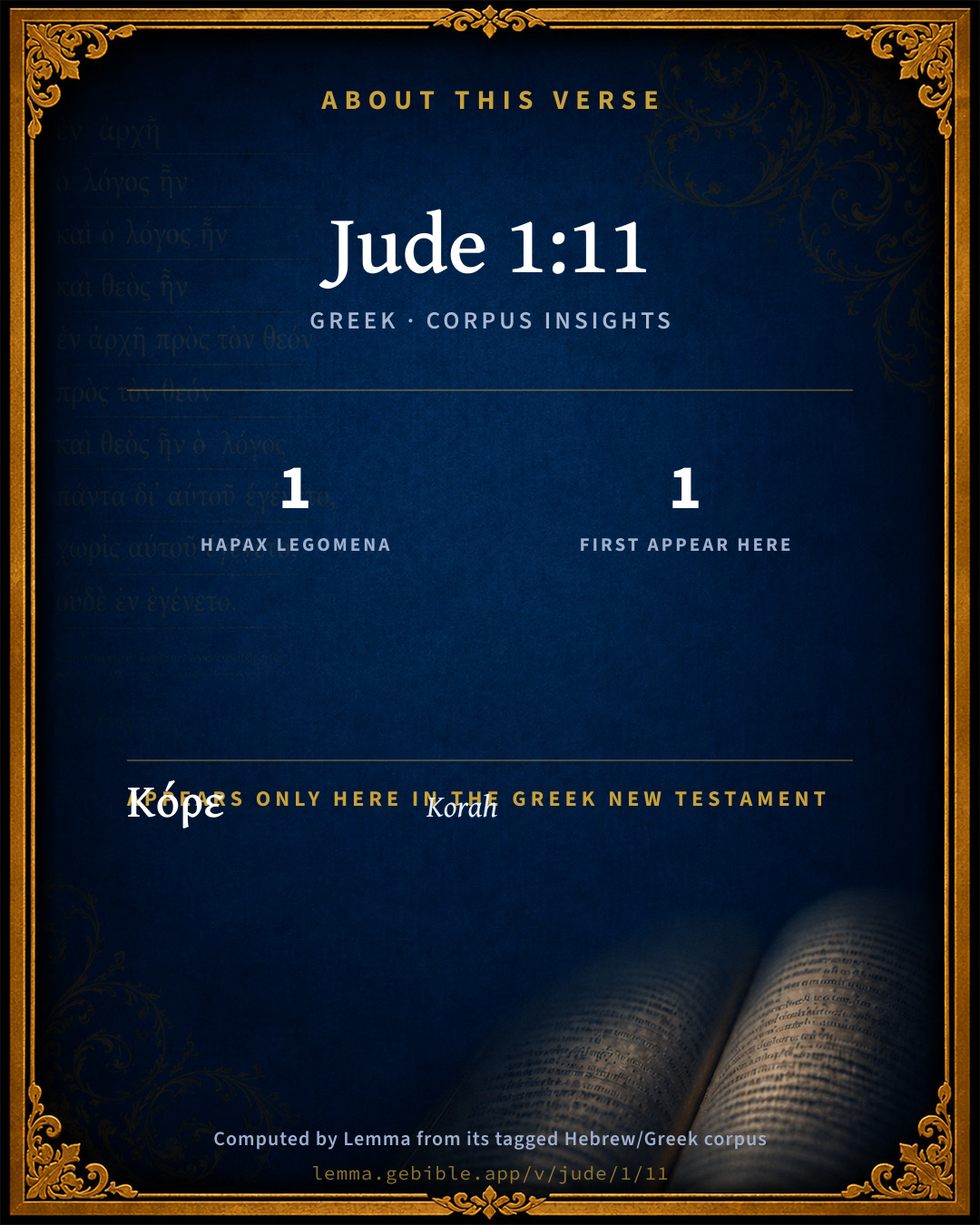
  • 1 hapax legomenon — only here in the Greek New Testament
  • 1 first appearance in the Greek New Testament
Full analysis ↓
Download a study sheet

One document with this verse’s original text, its word-by-word gloss line, the meaning frame, cross-references with their text, attributed commentary, and full source and license credits — printable, and it pastes into notes with its structure intact.

This verse Autodidact and up

Study sheet (.html) Plain text (.txt)

A passage Seminary Student

Up to 50 verses in one chapter. A passage sheet keeps up to 6 commentary sources and 12 cross-references per verse, in the order this page ranks them, and says so on the sheet whenever that leaves anything out. Ask for a single verse and you get the Autodidact verse sheet above.

Everything on this page stays free to read, with no account — the sheet is a download of what is already on screen, not access to it.

Want to remove ads? Support Godless Engineer
Compare translations 3

The same verse in 3 English versions, stacked beneath the original-language interlinear above. Click any original word for its lexicon entry.

Each is an independent rendering of the whole verse — the interlinear is not word-aligned to these translations.

Highlighted words mark where these versions differ — a whole-verse word diff, not a word-by-word alignment.

  • World English Bible Public Domain
    Woe to them! For they went in the way of Cain, and ran riotously in the error of Balaam for hire, and perished in Korah's rebellion.
  • King James Version Public Domain
    Woe unto them! for they have gone in the way of Cain, and ran greedily after the error of Balaam for reward, and perished in the gainsaying of Core.
  • unfoldingWord Literal Text CC BY-SA 4.0
    Woe to them! For they have gone in the way of Cain and have abandoned themselves to the error of Balaam wages, and in the rebellion of Korah they perished.

unfoldingWord Literal Text — © unfoldingWord, licensed CC BY-SA 4.0. Word-aligned USFM3 via Door43 (git.door43.org/unfoldingWord/en_ult).

Versions to compare (up to 4)

3 of 4 selected

Show all 19 translations

Every available English version of this verse, each an independent rendering of the whole verse.

  • World English Bible Public Domain
    Woe to them! For they went in the way of Cain, and ran riotously in the error of Balaam for hire, and perished in Korah's rebellion.
  • Berean Standard Bible Public Domain
    Woe to them! They have traveled the path of Cain; they have rushed headlong into the error of Balaam; they have perished in Korah’s rebellion.
  • Majority Standard Bible Public Domain
    Woe to them! They have traveled the path of Cain; they have rushed headlong into the error of Balaam; they have perished in Korah’s rebellion.
  • King James Version Public Domain
    Woe unto them! for they have gone in the way of Cain, and ran greedily after the error of Balaam for reward, and perished in the gainsaying of Core.
  • American Standard Version (1901) Public Domain
    Woe unto them! For they went in the way of Cain, and ran riotously in the error of Balaam for hire, and perished in the gainsaying of Korah.
  • Revised Version (1885) Public Domain
    Woe unto them! for they went in the way of Cain, and ran riotously in the error of Balaam for hire, and perished in the gainsaying of Korah.
  • Geneva Bible (1599) Public Domain
    Wo be vnto them: for they haue followed the way of Cain, and are cast away by the deceit of Balaams wages, and perish in the gainsaying of Core.
  • Douay-Rheims (1899) Public Domain
    Woe unto them, for they have gone in the way of Cain: and after the error of Balaam they have for reward poured out themselves, and have perished in the contradiction of Core.
  • Young's Literal Translation Public Domain
    wo to them! because in the way of Cain they did go on, and to the deceit of Balaam for reward they did rush, and in the gainsaying of Korah they did perish.
  • Literal Standard Version CC BY-SA 4.0
    woe to them! Because they went on in the way of Cain, and they rushed to the deceit of Balaam for reward, and in the controversy of Korah they perished.
  • Unlocked Literal Bible CC BY-SA 4.0
    Woe to them! For they have walked in the way of Cain and have plunged into Balaam's error for profit. They have perished in Korah's rebellion.
  • unfoldingWord Literal Text CC BY-SA 4.0
    Woe to them! For they have gone in the way of Cain and have abandoned themselves to the error of Balaam wages, and in the rebellion of Korah they perished.
  • Darby Bible Public Domain
    Woe to them! because they have gone in the way of Cain, and given themselves up to the error of Balaam for reward, and perished in the gainsaying of Core.
  • World Messianic Bible Public Domain
    Woe to them! For they went in the way of Cain, and ran riotously in the error of Balaam for hire, and perished in Korah’s rebellion.
  • Webster's Bible Public Domain
    Woe to them! for they have gone in the way of Cain, and run greedily after the error of Balaam for reward, and perished in the gainsaying of Core.
  • Free Bible Version CC BY-SA 4.0
    They're in terrible trouble! For they have followed Cain's way. Like Balaam and his delusion, they have abandoned themselves to the profit motive. Like Korah and his rebellion, they have destroyed themselves.
  • Bible in Basic English Public Domain
    A curse on them! They have gone in the way of Cain, running uncontrolled into the error of Balaam for reward, and have come to destruction by saying evil against the Lord, like Korah.
  • Text-Critical English NT CC BY 4.0
    Woe to them! For they went in the way of Cain, they rushed for reward to the error of Balaam, and they perished in the rebellion of Korah.
  • Tyndale New Testament (1534) Public Domain
    Wo be vnto them for they have folowed the waye of Cayn and are vtterly geven to the erroure of Balam for lukers sake and perysshe in the treason of Core.

Literal Standard Version (2020), Covenant Press — licensed CC BY-SA 4.0. Text via the HelloAO Bible API (eBible.org). Unlocked Literal Bible (unfoldingWord) — licensed CC BY-SA 4.0. Text via the HelloAO Bible API (eBible.org). unfoldingWord Literal Text — © unfoldingWord, licensed CC BY-SA 4.0. Word-aligned USFM3 via Door43 (git.door43.org/unfoldingWord/en_ult). Free Bible Version, Dr. Jonathan Gallagher — licensed CC BY-SA 4.0. Text via the HelloAO Bible API (eBible.org).

Word by word

More ways to search: Search by grammar → Find every occurrence → Compare this word →

Practice this passage: Drill this verse → Learn its vocabulary →

Κόρε
Koré
G2879
“Korah”
Noun, Proper, indeclinable
Part of Speech
Noun · Proper, indeclinable
Full Thayer's Definition

Origin: of hebrew origin H7141

TDNT: None

Korah = "baldness" 1. a man who, with others, rebelled against Moses
  1. οὐαὶ ouaí G3759 “alas” Interjection
  2. αὐτοῖς autós G846 “he” Personal pronoun, Dative, Plural, Masculine
  3. ὅτι hóti G3754 “that” Conjunction
  4. τῇ ho G3588 “the” Article, Dative, Singular, Feminine
  5. ὁδῷ hodós G3598 “way” Noun, Dative, Singular, Feminine
  6. τοῦ ho G3588 “the” Article, Genitive, Singular, Masculine
  7. Κάϊν Káïn G2535 “Cain” Noun, Proper, indeclinable
  8. ἐπορεύθησαν poreúomai G4198 “to go” Verb, Aorist, Passive deponent, Indicative, 3rd person, Plural
  9. καὶ kaí G2532 “and” Conjunction
  10. τῇ ho G3588 “the” Article, Dative, Singular, Feminine
  11. πλάνῃ plánē G4106 “error” Noun, Dative, Singular, Feminine
  12. τοῦ ho G3588 “the” Article, Genitive, Singular, Masculine
  13. Βαλαὰμ Balaám G903 “Balaam” Noun, Proper, indeclinable
  14. μισθοῦ misthós G3408 “wages” Noun, Genitive, Singular, Masculine
  15. ἐξεχύθησαν ekchéō G1632 “to pour out” Verb, Aorist, Passive, Indicative, 3rd person, Plural
  16. καὶ kaí G2532 “and” Conjunction
  17. τῇ ho G3588 “the” Article, Dative, Singular, Feminine
  18. ἀντιλογίᾳ antilogía G485 “contradiction” Noun, Dative, Singular, Feminine
  19. τοῦ ho G3588 “the” Article, Genitive, Singular, Masculine
  20. ἀπώλοντο apóllymi G622 “to destroy” Verb, Aorist, Middle, Indicative, 3rd person, Plural

About this verse

These counts appear in no published source. They are computed here, from the morphology-tagged text and Lemma’s own curated glosses. What Lemma adds →

21
words
15
distinct lemmas
General Epistles
section

Notable vocabulary

1 hapax legomenon — a word that appears only here in the entire Greek New Testament:

First appearance in Scripture

This word makes its first canonical appearance in the Greek New Testament here:

Shared distinctive vocabulary

Κάϊν Cain G2535 occurs in 3 verses of the Greek New Testament. Also found in:
Repetition

Words recur within this verse:

Cross-references

20

Topical passages linked to Jude 1:11 in the Treasury of Scripture Knowledge — connected by theme and wording, ordered by reader-vote popularity; previews shown in the World English Bible.

  • 2 Peter 2:15 forsaking the right way, they went astray, having followed the way of Balaam the son of Beor, who loved the wages of wrong-doing;
  • 1 John 3:12 unlike Cain, who was of the evil one, and killed his brother. Why did he kill him? Because his works were evil, and his brother's righteous.
  • Revelation 2:14 But I have a few things against you, because you have there some who hold the teaching of Balaam, who taught Balak to throw a stumbling block before the children of Israel, to eat things sacrificed to idols, and to commit sexual immorality.
  • Genesis 4:3–14 As time passed, it happened that Cain brought an offering to Yahweh from the fruit of the ground.
  • Hebrews 11:4 By faith, Abel offered to God a more excellent sacrifice than Cain, through which he had testimony given to him that he was righteous, God bearing witness with respect to his gifts; and through it he, being dead, still speaks.
  • Numbers 16:1–35 Now Korah, the son of Izhar, the son of Kohath, the son of Levi, with Dathan and Abiram, the sons of Eliab, and On, the son of Peleth, sons of Reuben, took [men]:
  • Numbers 26:9–10 The sons of Eliab: Nemuel, and Dathan, and Abiram. These are that Dathan and Abiram, who were called of the congregation, who strove against Moses and against Aaron in the company of Korah, when they strove against Yahweh,
  • Numbers 31:16 Behold, these caused the children of Israel, through the counsel of Balaam, to commit trespass against Yahweh in the matter of Peor, and so the plague was among the congregation of Yahweh.
  • Deuteronomy 23:4 because they didn't meet you with bread and with water in the way, when you came forth out of Egypt, and because they hired against you Balaam the son of Beor from Pethor of Mesopotamia, to curse you.
  • Joshua 24:9–11 Then Balak the son of Zippor, king of Moab, arose and fought against Israel: and he sent and called Balaam the son of Beor to curse you;
  • Micah 6:5 My people, remember now what Balak king of Moab devised, And what Balaam the son of Beor answered him from Shittim to Gilgal, That you may know the righteous acts of Yahweh."
  • Isaiah 3:9 The look of their faces testify against them. They parade their sin like Sodom. They don't hide it. Woe to their soul! For they have brought disaster upon themselves.
  • Isaiah 3:11 Woe to the wicked! Disaster is upon them; For the deeds of his hands will be paid back to him.
  • Matthew 11:21 "Woe to you, Chorazin! Woe to you, Bethsaida! For if the mighty works had been done in Tyre and Sidon which were done in you, they would have repented long ago in sackcloth and ashes.
  • Matthew 23:13–16 "Woe to you, scribes and Pharisees, hypocrites! For you devour widows' houses, and as a pretense you make long prayers. Therefore you will receive greater condemnation.
  • Numbers 22:1–24 The children of Israel traveled, and encamped in the plains of Moab beyond the Jordan at Jericho.
  • Jeremiah 13:27 I have seen your abominations, even your adulteries, and your neighing, the lewdness of your prostitution, on the hills in the field. Woe to you, Jerusalem! you will not be made clean; how long shall it yet be?
  • Ezekiel 13:3 Thus says the Lord Yahweh, Woe to the foolish prophets, who follow their own spirit, and have seen nothing!
  • Zechariah 11:17 Woe to the worthless shepherd who leaves the flock! The sword will be on his arm, and on his right eye. His arm will be completely withered, and his right eye will be totally blinded!"
  • Luke 11:42–47 But woe to you Pharisees! For you tithe mint and rue and every herb, but you bypass justice and the love of God. You ought to have done these, and not to have left the other undone.

Cross-references courtesy of OpenBible.info (CC BY 4.0).

Commentary

Notes on Jude 1:11 from classic Christian and Jewish commentators (each source and its license shown beneath its notes). The classic Christian expositions comment on the surrounding passage and are grouped to its opening verse, so a note may address several verses; the Jewish commentaries on the Tanakh (Rashi and others) are per-verse, so they appear only where the commentator wrote on this verse.

Lemma curates 59 commentaries, every one of them public domain or Creative Commons licensed, each selected and text-cleaned for this edition rather than reprinted as found. About our sources →

The Biblical Illustrator

Joseph S. Exell

Jud_1:11

They have gone in the way of Cain,… Balaam … Core.

Responsibility for irreligious speculations and sinful practices

The woe itself was undoubtedly to be proportioned to the extent of their criminality. One decided way of measuring the extent of their criminality was to be found in the evil effects of their speculations and practices. Murderers, in the legal sense of the word, they were not. It is on the consequences of their evil speculations and practices that they were so designated. By the unsoundness of doctrine and by the criminality of their practice, they had diffused around them a fatal taint. Licentiousness of principle and licentiousness of conduct entail a remediless woe both upon the body and the soul. It is true the plea might be offered that the fatal consequences had arisen, as it were, incidentally, without their being formally planned. But, according to the decision of the apostle, this circumstance alters not the case. On the contrary, that men are responsible for the effects of their conduct, even though they are directly pursuing other ends, he shows us, by referring to the remarkable history of Balaam. It might not be alleged that even Balaam, perverse as he was, had set himself out of rooted hatred to the Israelites, to plot their destruction. Still, however, for determining the measure of his guilt, it must be marked that his resolution was to enjoy the gratification of his covetousness at any expense. And thus it was exactly in regard to the persons whom St. Jude reprehends. They might be following some scheme of personal aggrandisement. It might only be in pursuing this scheme that they ceased to inculcate the doctrines of Christian self-denial and purity. Besides, to justify the woe pronounced, the apostle takes away every excuse for their conduct by showing that their resistance, both to the authority of religion and to the well-being of the Church, was parallel with the gainsaying of Core. Core knew perfectly the origin of the lawgivers authority--knew the meaning of the Mosaic ordinance and its sanctions, and the utility of obeying it--and yet he gainsayed the whole. How easily the application of all this might be made to the irreligious and ungodly of our own time! It applies to the bold speculators who, whatever be their general professions of regard for religion, undermine by false reasonings the foundations of Christianity. It applies to the band of the ambitious who, like Core, would destroy the peace of mankind in rendering themselves celebrated. It applies to the hordes of the covetous who, greedy for filthy lucre as Balaam, care not what a curse they inflict on others, if so be they may enrich themselves with the reward of iniquity. Let me request you, for the sake of illustration, to observe that serious responsibility which men of literary eminence have often incurred by directing their writings against the cause of religion and godliness. When genius degrades itself into the auxiliary of scepticism and licentiousness, it entails on the person who has successfully used it, the corresponding measures of criminality. Think on the mischievous effects which may flow even from a single copy of a profane and immoral writing. But shall the well-gifted sceptics whose genius has been employed to promote over the young and inexperienced the ascendancy of evil principle, escape responsibility for that long train of ills, the origin of which is traceable to their daring speculations? There is blood in their hands. They have destroyed souls. Suffer me, however, to warn you, lest we allow the view of their wickedness to absorb every apprehension of our culpability, and thus remain satisfied with expressing our displeasure at the evils which they have perpetrated, instead of examining our own hearts to learn how far we stand in need of the reproof. In our commonest intercourse we exercise an influence over one another which may operate for good or for evil. We may become the means either of promoting spiritual excellence and happiness, or of vitiating and so destroying the very life of the soul, in those with whom we associate. The consequences of our character and conduct in these respects, therefore, enter justly as items into the sum of our responsibility. The blessing or the woe must fall down on us, according as these consequences are beneficial or the reverse. Let me finish the discourse, however, with the pleasing thought, how much good may be done by us in the intercourse of our mutual relationships. Instead of destroying or even weakening the principle of Divine life in our brethren, we may become the effectual means of increasing its power and enlarging the sphere of its exercise. While the influence of irreligion and vice would tend to seal the ruin, the lessons and the example of pious and godly men are advancing the salvation of others. (W. Muir, D. D.)

The successors of Cain, Balaam, and Core

I. Like the first murderer, these heretics were fired with malice against the real and faithful followers of Christ. While we are often warned that the world is opposed to the true people of God, it may at the same time be said that no class of men regard them with feelings of such bitter disaffection as those who are false and heretical professors of religion. To the instinctive hostility of nature they add the sullen rancour of religious animosity.

II. To run after the error of Balaam is to teach doctrines calculated to foster the depraved affections of the heart--doctrines pleasing to flesh and blood, for personal and pecuniary ends. Such was the case with the seducers in the text, and such is the case with false teachers in every age. Having neither the knowledge nor the love of the truth in them, their main concern must necessarily be to turn their teaching to account in the way of advancing their temporal interests. With this view they study to accommodate their doctrines to the prejudices and private likings of human nature, being well aware that, without some dilutions and transmutations of the truth, they will not be so successful in their object. But of all the varied forms of error, the most attractive is that which has the twofold effect of soothing the conscience, and at the same time giving some scope and licence to sin.

III. The apostle declares that these seducers were also animated by the spirit, and destined to suffer the doom of that ambitious and mischievous rebel, core. Those who deny the only Lord God as they did, and who make light of the law of heaven, need not be expected to be very submissive to any authority established among men; and hence heretics have in every age been found to be seditious subjects and dangerous members of civil society. The very same qualities of character by which they are led to spurn at the will of the Supreme, will necessarily dispose them to resist and despise all other dominion. (A. E. Gilvray, D. D.)

False teachers

This short Epistle is chiefly directed against false teachers who were endeavouring to introduce pestilent doctrines into the Church, and to lead away its members from truth and godliness. It appears as though the apostle here tracked them through three different stages of guilt--the way of Cain, the error of Balaam, and the gainsaying of Core.

I. The way of cain. The apostle is not to be supposed here as referring to the atrocious act of slaying his brother. Whensoever reason is set up above revelation, whether the one be altogether rejected to make way for the other, or its statements reduced and modified that they may not exceed the other, then is there an imitation of the way of Cain. And if there be what approaches at least very closely to a rejection of Scripture, may it not be contended that men have taken the first step in a course, of which utter destruction is the probable termination? It was not at once that Cain became a murderer; but when he had adopted his deistical creed, he had brought himself into the position of one whom Satan might attack with incalculable advantage, and we marvel not that, when fierce jealousy was excited, he raised his hand against his brother. And thus with those who follow him in setting up reason as a standard, by which all proof should be measured; they have no security, no defence against the setting light by all their better convictions, till they have confounded all moral distinctions and persuaded themselves into the most unlawful practices.

II. The error of balaam. It is evident that covetousness was a ruling passion with these troublers of the Church; the apostle expressly says that it was for reward that they ran greedily after the error of Balaam, so that their imitation of the prophet, who wished to curse Israel but was constrained to bless, must have been in the love of the wages of unrighteousness. Balaam knew what was right; Balaam knew the future consequence of what was wrong; but, swayed by present interest, he determined on doing the wrong, and sought only that, whilst doing it, he might by some equivocation keep his conscience at ease; he was not ignorant, he was not insensible, but he was bent on securing a present advantage, and his whole concern was that in doing this he might not fly openly in the face of an explicit command. And is this a rare or unusual case? What! does not the world swarm with men who are thoroughly conscious that they can gain what they wish only through disobeying God, who are not moved by this consciousness to the resisting the desire, but who look about to subterfuges and palliations, that they may secure what they long for, and yet have some apology to cloak the disobedience? Is it unusual to find an individual who, with his moral eyesight in a great degree opened to the nature and consequence of his conduct, resolves on persisting in that conduct in hope of obtaining a favourite object, but who all the while attempts some process of self-deceit, that he may hide the offence he knows he is committing?

III. The gainsaying of core. This appears to be given as the final stage of depravity, the reaching which is the reaching destruction: they perished in the gainsaying of Core. It was a gainsaying which was directed alike against the throne and the altar. And the two are commonly combined. We say not that an irreligious man must be also a disloyal; but we affirm that a disloyal is almost always an irreligious. We know not how it can be otherwise. We know not how a good Christian can fail to be a good subject, submitting himself to every ordinance of man for the Lords sake. For our own part we will never believe that loyalty is merely an acquired principle, drilled into men by education and fostered by custom. We are persuaded, on the contrary, that we are born with a reverence of authority, that God placed it in us as a part of that moral cordage by which He would have society knit together. Whether or no they admire his personal character, whether or no they approve the acts of his government, most men, we are convinced, tacitly acknowledge the sacredness of a king, and are moved by awe of the office to manifest devotion to him who holds it. We regard the enthusiasm thus simultaneously called forth as expressive of a kind of irrepressible consciousness that a king is, in some sense, the vicegerent of Deity, as proving what we might almost call an innate persuasion that there is a majesty in him who wears a crown, which it is a species of sacrilege to refuse to acknowledge. The unbidding acclamations of a peasantry pass with us as echoes of a voice which is speaking irresistibly in their breasts, proclaiming that it is by God that princes reign, and that whom He delegates the world should honour. And if we may thus contend that loyalty is a natural sentiment, we aggravate most grievously the sin of disobedience to all those precepts of Scripture that set themselves against the gainsaying of authority. And who shall marvel that the gainsaying of Core, inasmuch as it proved an utter contempt of all instituted authority, both in civil and spiritual things, provoked signally the anger of God? It is given as the description of the last stage of enormity. The man who could join this gainsaying must have thrown off all fear of his Maker; for how otherwise could he take part in a league whose professed object it was to strip of power the persons of Divine appointment and to give to the meanest of the people that right of officiating with which one order could prove themselves exclusively entrusted? Thus it was with these seducers in the days of St. Jude. They had gone in the way of Cain, and run after the error of Balaam; but there was a great obstacle to their schemes; the authority of the apostles or of their appointed successors was held in reverence in the Church, and was directly opposed to their proceedings. Sooner or later they would have to undertake the overthrow of this authority, and thus add imitation of Core to that of Cain and of Balaam. But God would at length interpose, and, having suffered them to fill up the measure of their iniquities, would visit them with the weight of His indignation. They should work their own ruin. And thus would it come to pass that they who had to describe their career would have to follow up the announcement that they had gone in the way of Cain, and run greedily after the error of Balaam for reward, by an account at once of a crime and its punishment--and they perished in the gainsaying of Core. (H. Melvill, B. D.)

The way of Cain

I. The way of cain is the way of sinners in general.

1. A way of ignorance. He murdered his brother because he hated him; he hated him because his sacrifice was accepted of the Lord, whilst his own was rejected; his sacrifice was rejected because he offered the wrong offering upon the altar; he gave the wrong offering because he was ignorant of his own state before God, and ignorant of Gods requirements. He was willing to worship, but it must be a worship dictated by his taste, and not one in obedience to Gods will. Cains religion is now the most respectable and popular religion of the day. It involves no abasement in the dust; no humiliating confession of sinnership; no absolute dependence out of self. It flatters mans pride, exalts his reason, and just suits the carnal heart that wants a religion to make his respectability complete. Cains religion is the curse of the day. It chloroforms men into insensibility and indifference. Had they none there would perhaps be more hope for them, for when sinners were appealed to they would feel they were addressed, but as it is they put themselves down as part of the religious world, and perhaps a better name could hardly be found to describe them, for they have a religious worldliness, or if you prefer the title a worldly religiousness.

2. A way of worldliness. Hardened and despairing he goes out from the presence of the Lord, builds a city, and seeks to drown remorse in pleasure. He and his descendants busy themselves in trying to make this world a pleasant place of residence, and with the sound of the harp and the organ the guilty man tries to drown the voice of his brothers blood. This is the way of Cain. This is just what the vast majority of mankind is doing. It is trying in the business and pleasures of the city to find its all--forget its God--and drown unpleasant thoughts. But remember, your burying yourself in this worlds pleasures does not remove the brand of Cain from off your brow.

3. The way to hell. No scripture sheds one gleam of hope upon the way of Cain. Direct reference is only made twice to him in the New Testament, and in both instances he is held up as a warning, and nothing else. The first you will find in the first Epistle of John, the third chapter and twelfth verse--Not as Cain who was of that wicked one; and the second is found in our text and the verses following. Thus you see no hope is even hinted at. The end of the way of Cain is blackness of darkness for ever.

II. One particular in cains way which is the way of many professors. I mean his indifference about his murdered brother. Where is Abel thy brother? These were the words that arrested Cains attention. May they arrest yours! I am glad to see you here this evening, but where is your brother? Christian young men, where have you left your brethren this evening? Where are those who are related to you by ties of blood? Where are those bound to you by friendship? Where are those who are your brethren in daily labour--those who work with you in the office, shop, warehouse, or docks? Where is he? You are here singing Gods praises and listening to Gods Word, but where did you leave him? Alas, in the way of Cain, I hear some of you reply, I know not. Stop, sir! that answer will never do. Not know! I think I see Cain as he utters the words. A burning blush crimsons his brow, and his downcast eyes and quivering face all give the lie to the assertion. He did know. Christian, such a miserable falsehood as Cains is unworthy of you. You feel it as you try to tell it. You ought to know. Come, be bold, speak out the truth, though it condemns you. Then I will answer for you? Like Cain, you have left your brother in his blood. His soul is dead if his body lives. Indifference about souls is the crying sin of the Church. (A. G. Brown.)

The religion of nature and of culture

Adam begat a son in his own likeness--not Gods--that was gone--but his own--and his own bore the imprint of the evil one, to whose subtle agency he had sinfully succumbed. Thus the first man born into the world was not only the child of Adam, but also, in some sense, the child of the devil, and demonstrably our brother, though it be not either politic or pleasant flatly to affirm it. Cain was not the abnormal monster that he is commonly supposed to be, but a representative man, a religious man, a polite and accomplished man, and in many respects a model man, with the exception of a single rash and unfortunate deed, perpetrated in a fit of passion. And yet, as the way of Cain is so severely deprecated in Gods Word, let us study the way-marks that we may learn to beware of it.

1. It was a religion without an atonement. He regarded himself as Gods creature; he recognised Gods claims upon his gratitude; and accordingly he reared an altar dedicated to the Deity, and laid upon it votive offerings such as were not only aesthetically beautiful, but seemed to be ethically appropriate and sufficient. Hard by Cains altar stands another, a simpler, ruder structure, on which no flowers breathe their fragrance, nor ripened fruits are found. It is only blood-besprinkled, and a slain lamb lies upon it. Strange offering this to a God of love, and stranger still is the attitude of Abel, as he stands beside his altar, with his head bowed as if in profoundest penitence. By faith Abel offered a more excellent sacrifice than Cain, for his faith humbly grasped the great doctrine of the atonement. It was the lack of any conscious need of an atonement that broadly distinguished the way of Cain, and there be hundreds of thousands that to-day do follow him. Far be it from me to disparage any of the rich and generous fruits of the earth, that spring from germs indigenous in the soil of the human soul. Though fallen, there is much left of beauty and of native nobleness. There are such things as truth and honesty, and generosity, and natural affection, and broad philanthropy. There are such things outside the Church that go to show that human nature is not utterly depraved, nor is a world hopelessly cursed that holds the roots from which spring such fruits. And yet it is of infinite moment for us to remember that the offering to heaven of these alone will not suffice to make sure of heaven. For unfallen man these would be quite enough, but for guilty man there is needed an atonement.

2. The way of Cain was a heart without love. Religion does indeed address itself to our intelligence, and challenges the severest scrutiny of its character and claims, and yet it constantly recognises the sadly significant fact that the radical difficulty in the way of mans salvation is not so much in his head as his heart. Cains offering was costly and beautiful, but there was no heart in it, and no love back of it, and therefore it was that God sternly rejected both him and it. If love had been the animating motive, then the moment he discovered its defective character, he would with eager haste have sought to remedy the defect. Instead of that his brow was clouded, his countenance fallen, and his bosom wroth. The slumbering demon within him was roused. The carnal enmity of his depraved nature flamed out, and like an exasperated serpent he was ready to strike with a mortal blow. We stand aghast in the presence of this first dread tragedy--that strikes us most just because it was the first. Cain is only the leader of a long and infamous historic line. And wherefore slew he him? the Scripture asks, and then it answers the question of its own propounding. Because his own works were evil and his brothers righteous. And every age has borne witness to the prevalence of the very same spirit, and for the very same reason. True, the age of bodily butchery is now happily past, and the followers of Christ are no longer thrown to lions, immured in dungeons, or stretched upon the rack. The world has grown too decent for that, and the devil too shrewdly politic. And yet it is just as true to-day as ever that they who will live godly--meaning thereby uncompromising and fearless Christians--shall suffer persecution. There is still the old antipathy and enmity to the worshippers at the blood-besprinkled altar.

3. Another distinguishing feature of this still much trodden way is the substitution of culture for cleansing--culture of the mind for cleansing by the blood of Christ. God has abandoned me, thought the proto-murderer, but hope has not. The earth has indeed been cursed, but it shall yet be made a tolerable place to dwell in. I will fertilise it by toilsome tillage, and embellish it with choicest art. I will drown its wail of woe by concourse of melody and notes of linked sweetness long drawn out. By the power of cultivation I will redeem the world from the power of the curse. Accordingly Cain built a city that was doubtless a marvel of architectural beauty, while in his immediate family were to be found artificers in brass and iron, and the fast-flying fingers of cunning performers on the harp and the organ. Had he lived in our day he would doubtless have been a patron of the arts, a school director, a member of the city government, a founder or fosterer of great enterprises having for their object the instruction of the ignorant and the mitigation of human misery. Having no hope of heaven to lure him on, he was determined to make the most of earth. Now, far be it from me to despise or even to disparage such things. We hail them as the outcome of that enlightened enterprise or broad philanthropy which distinguishes all Christian lands. We rejoice in them not only for the sake of man, whose elevation and comfort they are adapted to promote, but for Gods sake, to whose glory they are destined to be so largely tributary. And yet all these mere human agencies are powerless to effect redemption. All this magnificent engineering of modern civilisation is, when taken by itself, as impotent to rescue man from sin and guilt as the rudest barbarism that ever degraded humanity. Knowledge is power indeed, but whether the power shall be beneficent or baneful will depend entirely on the principle that controls it. A rifle is a thing of power, but a dreadful thing in the hands of a bloodthirsty Modoc. So knowledge is power, and yet mere knowledge without religious principle doth only make men clever devils. Nay, verily, what the world wants is not so much culture as cleansing. Then culture comes indeed, but in its purest, noblest forms. Then there are gathered the richest fruits of the highest Christian civilisation--fruits indeed that are fruits of the ground, and yet not fruits of the ground alone, but the outcome of the blood, for the ground has been enriched by the blood of the Cross. (P. S. Henson, D. D.)

The way of Cain

The way of Cain is that course of life which Cain took up to himself in following the lusts of his own heart against the will of God. It is described in Gen_4:1-26, of which way there be seven steps or degrees, but every one out of the right way.

1. The first step was hypocrisy: he worshipped God by offering sacrifice as Abel did, but his heart was not a believing heart as Abels was; his worship was outward and ceremonious, but not in spirit and truth, for his heart was an evil heart of unbelief.

2. The second his hatred of his own and natural brother, prosecuting him with his wrath and indignation.

3. The third his murder, whereby he slew his righteous brother.

4. The fourth his lying unto God, saying he knew not where his brother was.

5. The fifth his desperation, after that God had convicted him and pronounced sentence against him.

6. The sixth his security and carelessness; he regardeth not his sin nor the conscience of it, but busieth himself in building a city and calleth it after the name of his child, that, seeing his name was not written in heaven, he might yet preserve his name and memory in the earth.

7. The seventh and last, which was the highest step of his way, was his profaneness; for from thenceforth he cast off and contemned all the care and practice of Gods worship, which appeareth (Gen_4:26). (W.Perkins.)

Covetousness

Covetousness is the root of all evil, the spawn of all sins, a common factor for most villainies of the world: the east wind that blasteth all the trees of virtue. And verily, if men would but consider three things: first, how uncertain; secondly, how unprofitable; thirdly, how hurtful these earthly things are which we so covet, our desire after them will soon be quenched. (S. Otes.)

The sin and punishment of rebellion

I. As relating to the fact of korah and his company.

1. The nature of the faction which was raised by them.

(1) The design that was laid for that, and all other circumstances of the story, we must have resort to the account that is given of it (Num_16:1-50.), where we shall find that the bottom of the design was the sharing of the government among themselves. They intend to lay aside Moses, but this they knew to be a very difficult task, considering what wonders God had wrought by him in their deliverance out of Egypt, what wisdom he had hitherto showed in the conduct of them, what care for their preservation, what integrity in the management of his power, what reverence the people did bear towards him, and what solemn vows and promises they had made of obedience to him. But ambitious and factious men are never discouraged by such an appearance of difficulties. Groundless suspicions and unreasonable fears and jealousies will pass for arguments and demonstrations. Then they who can invent the most popular lies against the government are accounted the men of integrity, and they who most diligently spread the most infamous reports are the men of honesty, because they are farthest from being flatterers of the court.

(2) The persons who were engaged in it. At first they were only some discontented Levites who murmured against Moses and Aaron, because they were not preferred to the priesthood, and of these Korah was the chief. Korah, being active and busy in his discontents, had the opportunity of drawing in some of the sons of Reuben, for they pitched their tents near each other, both on the south side of the tabernacle of the congregation; and these were discontented on the account of their tribe having lost the privilege of primogeniture. Thus whatever the pretences are, how fair and popular soever in the opposition men make to authority, ambition and private discontents are the true beginners of them; but these must be covered over with the deepest dissimulation, nothing must be talked of but a mighty zeal for religion and the public interest.

(3) The colours and pretences under which these persons sought to justify the proceedings of the faction.

(a) The asserting the rights and liberties of the people in opposition to the government of Moses. There were, then, two great principles among them by which they thought to defend them selves.

(i) That liberty and a right to power is so inherent in the people that it can not be taken from them. What means, then, this outery for liberty? Is it that they would have no government at all among them, but that every one might have done what he pleased himself? If any man can imagine himself in such a state of confusion, which some improperly call a state of nature, let him consider whether the contentment he could take in his own liberty and power to defend himself would balance the fears he would have of the injury which others in the same state might be able to do him. It follows, then, that what liberty is inconsistent with all government must never be pleaded against one sort of it. But is there, then, so great a degree of liberty in one mode of government more than another that it should be thought reasonable to disturb government merely to alter the form of it? Would it have been so much better for the people of Israel to have been governed by the two hundred and fifty men here mentioned than by Moses? Would not they have required the same subjection and obedience to themselves, though their commands had been much more unreasonable than his? What security can there be that every one of these shall not be worse in all respects than him whom they were so willing to lay aside? So that the folly of these popular pretences is as great as the sin in being persuaded by them.

(ii) Another principle which tends to the subverting government under a pretence of liberty is that, in case of usurpation upon the rights of the people, they may resume the exercise of power and punish the supreme magistrate himself if he be guilty of it. Than which there can be no principle imagined more destructive to civil societies and repugnant to the very nature of government. For it destroys all the obligations of oaths and compacts.

(b) Another pretence of this rebellion of Korah was the freeing themselves from the encroachments upon their spiritual privileges which were made by the usarpations of Aaron and the priesthood. This served for a very popular pretence, for they knew no reason that one tribe should engross so much of the wealth of the nation to themselves, and have nothing to do but to attend the service of God for it. This hath always been the quarrel at religion by those who seldom pretend to it but with a design to destroy it.

II. The judgment which was inflicted upon them for it. They had provoked heaven by their sin, and disturbed the earth by their faction; and the earth, as if it were moved with indignation against them, trembled and shook, and then with a horrid noise it rends asunder and opens its mouth to swallow those in its bowels who were unfit to live upon the face of it. They had been dividing the people, and the earth, to their amazement and ruin, divides itself under their feet. By which we see God interprets striving against the authority appointed by Him to be a striving against Himself. This was the first formed sedition that we read of against Moses. The people had been murmuring before, but they wanted heads to manage them. Now all things concur to a most dangerous rebellion upon the most popular pretences of religion and liberty, and now God takes the first opportunity of declaring His hatred of such actions, that others might hear and fear and do no more so presumptuously. (Abp. Stillingfleet.)

The Biblical Illustrator, edited by Joseph S. Exell (c. 1880s–1900s) — public domain. Text from a community e-Sword module.

Scofield Reference Notes

C. I. Scofield

Cain

Cain (cf) Gen 4:1 type of the religious natural man, who believes in a God, and in "religion," but after his own will, and who rejects redemption by blood. Compelled as a teacher of religion to explain atonement, the apostate teacher explains it away.

error of Balaam

Balaam, the "error" of Balaam must be distinguished from his "way" (See Scofield "2Pe 2:15") and his "doctrine" See Scofield "Rev 2:14".

The "error" of Balaam was that, reasoning from natural morality and seeing the evil in Israel, he supposed a righteous God must curse them. He was blind to the higher morality of the Cross, through which God maintains and enforces the authority and awful sanctions of His law, so that He can be just and the justifier of a believing sinner. The "reward" of Jud 1:11 may not be money, but popularity, or applause.

Core

See Numbers 16. The sin of Korah was denial of the authority of Moses as God’s chosen spokesman, and intrusion into the priest’s office.

gainsaying antilogia = against the Word.

The Scofield Reference Bible (1917 edition), notes by C. I. Scofield — public domain. Text from a community e-Sword module.

Tyndale Open Study Notes

Tyndale Open Resources

1:11 Debir or Kiriath-sepher (“City of the Book”): This major Anakite town of the hill country (Josh 11:21) is not firmly identified but is traditionally understood as being either southwest or east of Hebron.

1:11 Cain: See Gen 4:1-16. • Balaam: See study note on 2 Pet 2:15. • Korah: See Num 16:1-35.

Tyndale Open Study Notes — © Tyndale Open Resources, licensed CC BY-SA 4.0. Text via the HelloAO Bible API.

Bengel's Gnomon

Johann Albrecht Bengel

Jud 1:11. Οὐαὶ, woe!) Jude alone of the apostles, and he in this passage only, threatens a woe, from a threefold reason, which follows immediately. To the same purport, Peter calls them accursed children![4]—ΤΟῦ ΚΆΪΝ, of Cain) the murderer of his brother.—τοῦ Βαλαὰμ, of Balaam) the false prophet.—μισθοῦ) for reward.—ἐξεχύθησαν) they have been poured forth, like a torrent without a bank.—ἀντιλογίᾳ, in the gain saying) מריבה, Septuagint, ἈΝΤΙΛΟΓΊΑ.—ΤΟῦ ΚΟΡῈ, of Korah) thrusting himself into the priesthood.

[4] Accursed children—literally, sons of cursing, maledictionis filios.—T.

Bengel's Gnomon of the New Testament — English translation (T&T Clark, Edinburgh, 1860) — public domain. Text from a community e-Sword module.

Meyer's Critical & Exegetical Commentary

Heinrich August Wilhelm Meyer

Jud_1:11. The author interrupts his description of these ungodly men by a denunciation on them, which he grounds by characterizing them after the example of the ungodly in the O. T. (comp. 2Pe_2:15 ff.).

οὐαὶ αὐτοῖς] The same denunciation frequently occurs in the discourses of Jesus: at once a threatening and a strong disapproval (de Wette). With this οὐαί Jude indicates the judgment into which the Antinomians have fallen; it refers back to Jud_1:5-7; Wiesinger incorrectly understands it only as a mere exclamation of pain and abhorrence.[30] This denunciation of woe does not occur with an apostle; frequently in the O. T.

ὅτι τῇ ὁδῷ τοῦ Κάϊν ἐπορεύθησαν] On the phrase: τῇ ὁδῷ τινος πορεύεσθαι, comp. Act_14:16. (Act_9:31 : πορ. τῷ φόβῳ τ. κυρίου.) τῇ ὁδῷ is to be understood locally (see Meyer on the above passages), not instrumentally (Schott), which does not suit ἐπορεύθησαν.

ἐπορεύθησαν; preterite (Luther and others translate it as the present), because Jude represents the judgment threatened in οὐαὶ αὐτοῖς as fulfilled (de Wette-Brückner). Schott incorrectly explains it: they have set out, set forth. Many expositors find the similarity with Cain to consist in this, that whereas he murdered his brother, these by seduction of the brethren are guilty of spiritual murder; so Oecumenius, Estius, Grotius (Cain fratri vitam caducam ademit; illi fratribus adimunt aeternam), Calovius, Hornejus, Schott, and others. But this conversion into the spiritual is arbitrary, especially as the desire of seduction in these men is not specially brought forward by Jude. Other expositors, adhering to the murder committed by Cain, think on the persecuting zeal of these false teachers against believers; so Nicolas de Lyra: sequuntur mores et studia latronis ex invidia et avaritia persequentes sincerioris theologiae studiosos. As the later Jews regarded Cain as a symbol of moral scepticism, so Schneckenburger supposes that Jude would here reproach his opponents with this scepticism; but there is also no indication of this in the context. De Wette stops at the idea that Cain is named as the archetype of all wicked men; so also Arnaud[31] and Hofmann; but this is too general. Brückner finds the point of resemblance in this, that as Cain out of envy, on account of the favour shown to Abel, resisting the commandment and warning of God, slew his brother, so these false teachers resisted God, and that from envy of the favour shown to believers. But in the context there is no indication of the definite statement from envy. It is more in correspondence with the context to find the tertium compar. in this, that Cain in spite of the warning of God followed his own wicked lusts; Fronmüller: The point of comparison is acting on the selfish impulses of nature, in contempt of the warnings of God.

καὶ τῇ πλάνῃ τοῦ Βαλαὰμ μισθοῦ ἐξεχύθησαν] πλάνη, as a sinful moral error, denotes generally a vicious life averted from the truth; comp. Jam_5:20; 2Pe_2:18 (Eze_33:16, LXX. translation of פֶּשַׁע). ἐκχεῖσθαι in the middle, literally, to issue forth out of something, construed with εἴς τι; figuratively, to rush into something, to give oneself up with all his might to something (Clemens Alexandrinus, p. 491, 3; ΕἸς ἩΔΟΝῊΝ ἘΚΧΥΘΈΝΤΕς; several proof passages in Wahl, Elsner, Wetstein); it is less suitable to explain the verb according to Psa_73:2, where the LXX. have ἘΞΕΧΎΘΗ as a translation of שֻׁפְּכוּ = to slip (Grotius: errare). The dative τῇ πλάνῃ is = εἰς τὴν πλάνην; Schott incorrectly explains it as dativus instrumentalis, since ἐξεχύθησαν requires a statement for the completion of the idea. The genitive μισθοῦ is, with Winer, p. 194 [E. T. 258], to be translated: for reward (see Grotius in loco); so that the meaning is: they gave themselves up for a reward (i.e. for the sake of earthly advantage, thus from covetousness; Luther: for the sake of enjoyment) to the sin of Balaam; thus most interpreters, also Brückner, Wiesinger, Hofmann. De Wette, on the contrary, after the example of Erasmus, Vatablus, and others, explains ΒΑΛΑΆΜ as a genitive dependent on ΤΟῦ ΜΙΣΘΟῦ; the dative Τῇ ΠΛΆΝῌ, as = by means of the error; and ἘΞΕΧΎΘΗΣΑΝ as an intransitive verb = to commit excesses, to give vent to. Accordingly, he translates the passage as follows: By (by means of) the error (seduction) of the reward of Balaam, they have poured themselves out (in vice). So also Hornejus: deceptione mercedis, qua deceptus fuit Balaam, effusi sunt.[32] But this construction is extremely harsh, the ideas πλάνη and ἘΞΕΧΎΘΗΣΑΝ are arbitrarily interpreted, and the whole sentence, so interpreted, would be withdrawn from the analogy of the other two with which it is co-ordinate.[33] Schott construes the genitive with ΠΛΆΝῌ, whilst he designates it as an additional, and, as it were, a parenthetically added genitive for the sake of precision, and for this he supplies a ΠΛΆΝῌ: the error of Balaam, which was an error determined by gain. This construction, it is true, affords a suitable sense, but it is not linguistically justified: it is entirely erroneous to take ΜΙΣΘΟῦ as in apposition to ΒΑΛΑΆΜ = Ὃς ΜΙΣΘῸΝ ἨΓΆΠΗΣΕΝ, 2Pe_2:15 (Fronmüller, Steinfass).

De Wette, chiefly from Rev_2:14, finds the point of resemblance in this, that Balaam as a false prophet and a seducer to unchastity and idolatry, and contrary to the will of God, went to Balak, and that he is also particularly considered as covetous and mercenary. But there is no indication that the men of whom Jude speaks enticed others to idolatry. Hofmann observes that this clause calls the sin of those described as a devilish conduct against the people of God, the prospect of a rich reward being too alluring to Balaam to prevent him entering into the desires of Balak to destroy the people of God; but in this explanation also a reference is introduced not indicated by the context. That Jude had primarily in view the covetousness of Balaam, ΜΙΣΘΟῦ shows; blinded by covetousness, Balaam resisted the will of God; his resistance was his ΠΛΆΝΗ, in which, and in the motive to it, the Antinomians resembled him (Brückner, Wiesinger); whether Jude had also in view the seduction to unchastity (comp. Num_31:16; Fronmüller), is at least doubtful; and it is still more doubtful to find the point of resemblance in this, that the Antinomians had in view a material gain to be obtained by the ruin of the church of God (Schott).

καὶ τῇ ἀντιλογίᾳ τοῦ Κορὲ ἀπώλοντο] ἈΝΤΙΛΟΓΊΑ, contradiction; here, seditious resistance. ἀπώλοντο does not mean that they lost themselves in the ἈΝΤΙΛ. of Korah, but that they perished; accordingly, Τῇ ἈΝΤΙΛΟΓΊᾼ is the instrumental dative. The point of resemblance is not, with Nicolas de Lyra, to be sought in this, that the opponents of Jude formed propter ambitionem honoris et gloriae sectas erroneas; or, with Hornejus, that they assumed the munus Apostolorum ecclesiae doctorum; or, with Hofmann, that they, as Korah (whose resistance consisted in his unwillingness to recognise as valid the law of the priesthood of Aaron, on which the whole religious constitution of Israel rested), desired to assert a liberty not restricted; but it consists in the proud resistance to God and His ordinances, which the Antinomians despise. By Schotts explanation: that they opposed to the true holiness a holiness of their own invention, namely, the holiness alleged to be obtained by disorderly excess, a foreign reference is introduced.[34] The gradation of the ideas ὁδός, πλάνη, ἀντιλογία, in respect of definiteness, is not to be denied; but there is also a gradation of thought, for although the point about which Cain, Balaam, and Korah are named is one and the same, namely, resistance to God, yet this appears in the most distinct manner in the case of Korah.

[30] Hofmann correctly observes: οὐαί has evil in view, whether it be in the tone of compassion which bewails it (Mat_23:15), or of indignation which imprecates it (Mat_11:21). As not the first but the second is the case here, Hofmann should not have rejected the explanation of de Wette.

[31] Arnaud: J. compare seulement, dune manière très générale, ses adversaires à Cain, sous le rapport de la méchanceté.

[32] Calvin: dixit (Ap.), instar Bileam mercede fuisse deceptos, quia pietatis doctrinam turpis lucri gratia adulterant; sed metaphora, qua utitur, aliquanto plus exprimit; dixit enim effusos esse, quia scilicet instar aquae diffluentis projecta sit eorum intemperies.

[33] The parallelism of the three clauses requires that τῇ πλάνῃ ἐξεχύθησυν should remain together, accordingly the genitive is equivalent to ἀντὶ μισθοῦ (Stier).

[34] Ritschl finds the point of resemblance between the Antinomians and the three named in this, that they, as these, undertook to worship God in a manner rejected by Him. But it is erroneous that the Korahites exhibited their assumption of the priesthood by the presentation of an offering rejected by God; it is incorrect that by ὁδός is indicated the religious conduct of Cain; and it is incorrect that the utterance of the curse willed by Balaam is to be considered as a religious transaction. Moreover, in the description of the Antinomians there is no trace indicating that their view was directed to a particular kind of worship.

Meyer — Critical and Exegetical Commentary on the New Testament — English translation by Peter Christie, edited by Frederick Crombie (T&T Clark, 1880) — public domain. Text from a community e-Sword module.

Expositor's Greek Testament

ed. W. Robertson Nicoll

Jud 1:11 . οὐαὶ αὐτοῖς , ὅτι τῇ ὁδῷ τοῦ Καὶν ἐπορεύθησαν . For the use of the aorist see note on Jud 1:4 . παρεισεδύησαν : for the phrase cf. Blass, Gr. p. 119, and 2Pe 2:15 , ἐξακολουθήσαντες τῇ ὁδῷ τοῦ Βαλαάμ . The phrase οὐαί , so common in Enoch, especially in cc. 94 to 100, and in the Gospels and Apocalypse, occurs in the epistles only here and in 1Co 9:16 . The woe is grounded on the fate which awaits those who walk in the steps of Cain, Balaam and Korah. In 2 Peter Balaam is the only one referred to of the three leaders of wickedness here named by Jude. Cain, with Philo, is the type of selfishness ( [791] . 1 p. 206), πᾶς φίλαυτος ἐπίκλησιν Καὶν εὕρηκεν (quoted by Schneckenb. p. 221); he is named as a type of jealous hate in 1Jn 3:2 ; 1Jn 3:12 . ἵνα ἀγαπῶμεν ἀλλήλους . οὐ καθὼς Καὶν ἐκ τοῦ πονηροῦ ἦν καὶ ἔσφαξεν τὸν ἀδελφὸν αὐτοῦ · καὶ χάριν τίνος ἔσφαξεν αὐτὸν ; ὅτι τὰ ἔργα αὐτοῦ πονηρὰ ἦν , τὰ δὲ τοῦ ἀδελφοῦ αὐτοῦ δίκαια , of unbelief in Heb 11:4 , πίστει πλείονα θυσίαν Ἄβελ παρὰ Καὶν προσήνεγκεν τῷ Θεῷ , cf. Philo, De Agric. 1 M. 300 f., and Targ. Jer. on Gen 4:7 , cited by Schneckenburger, in which Cain is represented as saying “non est judicium, nec judex, nec est aliud saeculum, nee dabitur merces bona justis, nec ultio sumetur de improbis,” etc. There seems no reason why we should not regard Cain here as symbolising the absence both of faith and of love, cf. 1Jn 3:23 . Euthym. Zig. gives an allegorical explanation, καὶ αὐτοὶ ἀδελφοκτόνοι εἰσί , διʼ ὧν διδάσκουσι τὰς τῶν ἀπατωμένων ψυχὰς ἀποκτείνοντες . Cain and Korah are said to have been objects of special reverence with a section of the Ophite heresy, which appears to have been a development of the Nicolaitans (Epiphan. Pan. i. 3, 37, 1, οἱ Ὀφῖται τὰς προφάσεις εἰλήφασιν ἀπὸ τῆς Νικολάου καὶ Γνωστικῶν καὶ τῶν πρὸ τούτων αἱρέσεων ). They held that the Creator was evil, that the serpent represented the divine Wisdom, that Cain and his successors were champions of right (Epiphan. ib. 38, 1, οἱ Καιανοί φασι τὸν Καὶν ἐκ τῆς ἰσχυροτέρας Δυνάμεως ὑπάρχειν καὶ τῆς ἄνωθεν αὐθεντίας , and boast themselves to be of kin to Cain, καὶ τῶν Σοδομιτῶν καὶ Ἠσαῦ καὶ Κορέ , see too Iren. i. 51, Clem. Str. vii. § 108.)

[791] Codex Ruber (sæc. ix.), at the British Museum; it derives its name from the colour of the ink.

τῇ πλάνῃ τοῦ Βαλαὰμ μισθοῦ ἐξεχύθησαν . Every word in this clause is open to question. The passive of ἐκχέω , to “pour out,” is used to express either the onward sweeping movement of a great crowd, or the surrender to an overpowering motive on the part of an individual = effusi sunt , [792] as in Sir 37:29 , μὴ ἐκχυθῇς ἐπʼ ἐδεσμάτων , Test. Reub. 1, πορνεία ἐν ᾖ ἐξεχύθην , Clem. Al. Str. ii. p. 491, εἰς ἡδονήν , τράγων δικήν , ἐκχυθέντες καθηδυπαθοῦσιν , Plut. V. Ant. 21, εἰς τὸν ἡδυπαθῆ καὶ ἀκόλαστον βίον ἐκκεχυμένος . Such an interpretation seems not quite consistent with μισθοῦ , which implies cool self-interest. That covetousness, αἰσχροκέρδεια , was a common motive with false teachers is often implied or asserted by St. Paul and St. Peter in the passages quoted below: and this, we know, was the case with Balaam; but would it be correct to say either of him or of his followers, here condemned by St. Jude, that they ran greedily into (or “in”) error for reward? Perhaps we should understand it rather of a headstrong will breaking down all obstacles, refusing to listen to reason or expostulation, as Balaam holds to his purpose in spite of the divine opposition manifested in such diverse ways. Then comes the difficulty, how are we to understand the dative πλάνῃ , and what is the reference in the word? Should we take πλάνῃ as equivalent to εἰς πλάνην (Winer, p. 268)? This is the interpretation given by Lucifer p. 219, “vae illis quoniam in seductionem B. mercede effusi sunt,” but it is a rare use of the dative, and it seems more natural to explain πλάνῃ by the preceding ὁδῷ (dative of the means or manner), which is used in the same collocation in 2Pe 2:15 . What then are we to understand by “they were hurried along on the line of Balaam’s error”? What was his error? From Num 22:1-41 ; Num 25:1-3 ; Num 31:16 , Neh 13:2 , Μωαβῖται ἐμισθώσαντο ἐπʼ αὐτὸν τὸν Βαλαὰμ καταράσασθαι , Jos. Ant. iv. 6, 6, we learn that B [793] was induced by Balak’s bribe to act against his own convictions and eventually to tempt Israel to fornication. This then is the error or seduction by which he leads them astray. [794] In rabbinical literature Balaam is a sort of type of false teachers (Pirke Aboth, Jud 1:19 , with Taylor’s n.). Some suppose the name Nicolaitan (Rev 2:6 ) to be formed from the Greek equivalent to Balaam = “corrupter of the people”; see however the passages quoted from Clem. Al. in the Introduction on Early Heresies. In Rev 2:14 we read of some in Pergamum that held the teaching of Balaam, ὃς ἐδίδασκεν τῷ Βαλὰκ βαλεῖν σκάνδαλον ἐνώπιον τῶν υἱῶν Ἰσραήλ , φαγεῖν εἰδωλόθυτα καὶ πορνεῦσαι . There is no hint to suggest that the innovators, of whom Jude speaks, favoured idolatry, but they may have prided themselves on their enlightenment in disregarding the rule of the Apostolic Council as to the use of meats offered to idols ( cf. 1Co 8 ), and perhaps in burning incense in honour of the Emperor, see Ramsay, Expositor for 1904, p. 409, and July, pp. 43 60. On the other hand, Jude continually charges them with moral laxity, and we may suppose that this was combined with claims to prophetic power, and with the covetousness which is often ascribed to the false teachers of the early Church, as in 1Th 2:3 f., where Paul asserts of his own ministry that it was οὐκ ἐκ πλάνης οὐδὲ ἐξ ἀκαθαρσίας οὐδὲ ἐν δόλῳ … οὔτε γὰρ ἐν λόγῳ κολακείας ἐγενήθημεν , οὔτε ἐν προφάσει πλεονεξίας , οὔτε ζητοῦντες ἐξ ἀνθρώπων δόξαν , 1Ti 3:8-9 . διακόνους μὴ διλόγους , μὴ οἴνῳ πολλῷ προσέχοντας , μὴ αἰσχροκερδεῖς , ἔχοντας τὸ μυστήριον τῆς πίστεως ἐν καθαρᾷ συνειδήσει , Tit 1:7 ; Tit 1:11 διδάσκοντες ἃ μὴ δεῖ κέρδους χάριν , 1Pe 5:2 . For the gen. μισθοῦ cf. Winer, p. 258, Plat. Rep. ix. 575 B, μισθοῦ ἐπικουροῦσιν , 1Co 7:23 , τιμὴς ἠγοράσθητε .

[792] I do not think the marginal reading in the R.V., “cast themselves away,” is tenable.

[793]. Codex Vaticanus (sæc. iv.), published in photographic facsimile in 1889 under the care of the Abbate Cozza-Luzi.

[794] Zahn understand πλάνη in an active, not a passive sense, as the ruling principle of the πλάνος Balaam, not as the error into which others fell through his seductions. I do not think Jude discriminated between these meanings: πλάνη covers both.

On the whole I understand the passage thus: Balaam went wrong because he allowed himself to hanker after gain and so lost his communion with God. He not only went wrong himself, but he abused his great influence and his reputation as a prophet, to lead astray the Israelites by drawing them away from the holy worship of Jehovah to the impure worship of Baal Peor. So these false teachers use their prophetical gifts for purposes of self-aggrandisement, and endeavour to make their services attractive by excluding from religion all that is strenuous and difficult, and opening the door to every kind of indulgence. See the notes and comments on the parallel passages of 2 Peter in my edition of that Epistle.

τῇ ἀντιλογίᾳ τοῦ Κορὲ ἀπώλοντο . For Rorah’s sin see Num 16:1 f. and compare, for the same rebellious spirit in the Christian Church, 3Jn 1:9-10 (of Diotrephes), Tit 1:10-11 . εἰσὶ πολλοὶ ἀνυπότακτοι … οὓς δεῖ ἐπιστομίζειν , Tit 1:16 ; Tit 3:10-11 , 1Ti 1:20 (among those who have made shipwreck of the faith mention is made of Hymenaeus and Alexander) οὓς παρέδωκα τῷ Σατανᾷ ἵνα παιδευθῶσιν μὴ βλασφημεῖν , 1Ti 6:3-6 ; 2Ti 2:16-18 , ὁ λόγος αὐτῶν ὡς γάγγραινα νομὴν ἕξει , ὧν ἐστιν Ὑμέναιος καὶ φίλητος , οἵτινες περὶ τὴν ἀλήθειαν ἠστόχησαν , 2Ti 2:25 ; 2Ti 4:14 , where the opposition of Alexander the coppersmith is noted; but especially 2Ti 3:1-9 , which presents a close parallel to our passage, referring to a similar resistance to Moses in the case of the apocryphal Jannes and Jambres. For ἀντιλογία see Heb 12:3 , ἀναλογίσασθε τὸν τοιαύτην ὑπομεμενηκότα ὑπὸ τῶν ἁμαρτωλῶν εἰς ἑαυτὸν ἀντιλογίαν It is used as a translation of Meribah in Num 20:13 al. and (in relation to Korah) in Protev. Jac. 9. μνήσθητι ὅσα ἐποίησεν ὁ Θεὸς τοῖς Δαθάν , Κωρέ , καὶ Ἀβειράμ , πῶς ἐδιχάσθη ἡ γῆ καὶ κατέπιεν αὐτοὺς διὰ τὴν ἀντιλογίαν αὐτῶν .

Rampf draws attention to the climax contained in these examples. The sin of Cain is marked by the words ἐπορεύθησαν ὁδῷ , that of Balaam the gentile prophet by ἐξεχύθησαν πλάνῃ , that of the Levite Korah by ἀπώλοντο ἀντιλογίᾳ .

The Expositor's Greek Testament, edited by W. Robertson Nicoll (1897–1910) — public domain. Text from a community e-Sword module.

Geneva Bible (1599)

Geneva Bible translators

He foretelleth their destruction, because they resemble or show forth Cain’s shameless malice, Balaam’s filthy covetousness, and to be short, Korah’s seditious and ambitious head.

Geneva Bible (1599) marginal notes — public domain. Text via Bolls.life.

Jamieson, Fausset & Brown

Robert Jamieson, A. R. Fausset & David Brown

Woe--See on Pe2 2:14, "cursed children."

Cain--the murderer: the root of whose sin was hatred and envy of the godly, as it is the sin of these seducers.

ran greedily--literally, "have been poured forth" like a torrent that has burst its banks. Reckless of what it costs, the loss of God's favor and heaven, on they rush after gain like Balaam.

perished in the gainsaying of Core--(compare Note, see on Jde 1:12). When we read of Korah perishing by gainsaying, we read virtually also of these perishing in like manner through the same: for the same seed bears the same harvest.

Jamieson, Fausset & Brown — Commentary Critical and Explanatory on the Whole Bible (1871) — public domain (CC PDM 1.0). Text via the HelloAO Bible API.

Adam Clarke's Commentary

Verse 11. They have gone in the way of Cain] They are haters of their brethren, and they that are such are murderers; and by their false doctrine they corrupt and destroy the souls of the people.

The error of Balaam] For the sake of gain they corrupt the word of God and refine away its meaning, and let it down so as to suit the passions of the profligate. This was literally true of the Nicolaitans, who taught most impure doctrines, and followed the most lascivious practices.

Gainsaying of Core.] See the account of the rebellion of Korah, Dathan, and Abiram, and their company, in Num. 22. It appears that these persons opposed the authority of the apostles of our Lord, as Korah and his associates did that of Moses and Aaron; and St. Jude predicts them a similar punishment. In this verse he accuses them of murder, covetousness, and rebellion against the authority of God.

Adam Clarke's Commentary on the Bible (1810–1826) — public domain. Text from a community e-Sword/MySword module.

John Calvin's Commentaries

11. Woe unto them. It is a wonder that he inveighs against them so severely, when he had just said that it was not permitted to an angel to bring a railing accusation against Satan. But it was not his purpose to lay down a general rule. He only shewed briefly, by the example of Michael, how intolerable was their madness when they insolently reproached what God honored. It was certainly lawful for Michael to fulminate against Satan his final curse; and we see how vehemently the prophets threatened the ungodly; but when Michael forbore extreme severity (otherwise lawful), what madness was it to observe no moderation towards those excelling in glory? But when he pronounced woe on them, he did not so much imprecate evil on them, but rather reminded them what sort of end awaited them; and he did so, lest they should carry others with them to perdition.

He says that they were the imitators of Cain, who being ungrateful to God and perverting his worship through an ungodly and wicked heart, forfeited his birthright. He says that they were deceived like Balaam by a reward, because they adulterated the doctrine of true religion for the sake of filthy lucre. But the metaphor he uses, expresses something more; for he says that they overflowed, even because their excess was like overflowing water. He says in the third place, that they imitated the contradiction of Core, because they disturbed the order and quietness of the church.

John Calvin's Commentaries (1540-1563) — public domain. Text from the Calvin Translation Society English edition (1840s-50s) via the Christian Classics Ethereal Library (ccel.org). Calvin's coverage is partial (roughly two-thirds of the Bible); uncommented books and verses are honest gaps, never fabricated. The 19th-century editor's footnotes and remarks are omitted so the notes are faithfully Calvin's own voice.

Ellicott's Commentary for English Readers

(11) Three examples of similar wickedness: Cain, Balaam, Korah.

Woe unto them!—An echo of Christ’s denunciations in the first three Gospels, whereby the description of these evil-doers takes for the moment a denunciatory form. The past tenses immediately following are owing to the writer’s placing himself in thought at the moment when these men reap the consequences of their sins: their punishment is so certain, that he regards it as having come.

In the way of Cain.—The first great criminal; the first to outrage the laws of nature. Explanations to the effect that these libertines followed Cain by murdering men’s souls by their corrupt doctrine, or by persecuting believers, and other suggestions still more curious, are needlessly far-fetched. Joh_8:44, and 1Jn_3:15, are not strictly apposite: these ungodly men may have hated and persecuted the righteous, but St. Jude does not tell us so. Sensuality is always selfish, but by no means always ill-natured or malignant.

Ran greedily after the error of Balaam for reward.—The Greek for “ran greedily” literally means “they were poured out in streams;” the Greek for “error” may also mean “deception.” Hence three renderings are possible: (1) as the Authorised version; (2) “they ran greedily after the deception of Balaam’s reward;” (3) “they were undone by the deception of Balaam’s reward.” The first is best. “Reward” in the Greek is the genitive of price. Comp. “the rewards of divination” (Num_22:7); “they hired against thee Balaam” (Deu_23:4; Neh_13:2). Here, again, far-fetched explanations may be avoided. The allusion lies on the surface—running counter to God’s will from interested motives. Possibly, there may also be some allusion to Balaam’s causing the Israelites to be seduced into licentiousness (Rev_2:14).

Perished in the gainsaying of Core—i.e., through gainsaying like that of Korah; referring to his speaking against Moses in the revolutionary opposition which he headed. These libertines, like Korah; treated sacred ordinances with contempt.

The triplet in this verse, like that in Jud_1:8, is parallel to the three examples of God’s vengeance, Jud_1:5-7. Cain, like the inhabitants of Sodom and Gomorrha, outraged the laws of nature; Balaam, like the impure angels, despised the sovereignty of God; Korah, like those who disbelieved the report of the spies, spoke evil of dignities.

A Bible Commentary for English Readers, edited by Charles John Ellicott (1878–1897) — public domain. Text from a community e-Sword module.

The Cambridge Bible for Schools and Colleges

gen. ed. J. J. S. Perowne

11. Woe unto them! for they have gone in the way of Cain …] We ask naturally what was the point of comparison. Probably in the case of those who were in the writer’s thoughts, as in most others, “lust” was “hard by hate,” and the false teachers were murderous and malignant, as well as sensual. The reference to Cain in 1Jn_3:12 indicates that his name was used to point a moral as to the issue of the “evil works” in the spirit of hatred and of murder. Possibly, however, here also the writer may have had in his thoughts some of the Rabbinic legends which represented Cain as the offspring, not of Adam, but of Sammael, the Evil Spirit, and Eve, and as the parent of other evil spirits (Eisenmenger’s Entdeckt. Judenthum, i. 832, ii. 428), and therefore as connected with the idea of foul and unnatural impurity.

ran greedily after the error of Balaam for reward] See notes on 2Pe_2:15. Here, as there, the main thought connected with the name of Balaam is that of the sin of uncleanness into which the Israelites were led by him.

and perished in the gainsaying of Core] i.e. by a gainsaying which was in its nature identical with that of Korah in Numbers 16. Completing the parallel thus suggested it is obvious that as the false teachers answer to Korah and his company, so the true apostles and prophets of the Church of Christ are thought of as occupying a position like that of Aaron or Moses. The Greek word for “gainsaying” is the LXX. equivalent for the “Meribah” of Num_20:13; Num_20:24. A strange Rabbinic legend, while it placed the souls of Korah, Dathan, and Abiram in Gehenna, represented them as not tormented there (Eisenmenger, Entdeckt. Judenthum, ii. 342).

The Cambridge Bible for Schools and Colleges (gen. ed. J. J. S. Perowne; Cambridge University Press, 1878–1918) — public domain. Text from a community e-Sword module.

John Gill's Exposition

Woe unto them,.... This may be considered as a commiseration of their case, or as a denunciation of deserved punishment, or as a prediction of what would befall them. The Arabic version prefaces these words with an address to the saints, "O my beloved": that what was about to be said might be attended to, as a caution and instruction to them,

For they have gone in the way of Cain; which was a way of envy, for Cain envied the acceptance of his brother's gift, and that notice which the Lord took of him; so these men envied the gifts bestowed on Christ's faithful ministers, and the success that attended their labours, and the honour that was put upon them by Christ, and that was given them by the churches; which shows, that they were destitute of grace, and particularly of the grace of charity, or love, which envies not, and that they were in an unregenerate estate, and upon the brink of ruin and destruction. Moreover, the way of Cain was a way of hatred, and murder of his brother, which his envy led him to; so these men hated the brethren, persecuted them unto death, as well as were guilty of the murder of the souls of men, by their false doctrine: to which may be added, as another of Cain's ways, in consequence of the former, absence from the presence of God, or the place of his worship; so these men separated themselves, and went out from the churches, forsook the assembling together with them, and so might expect Cain's punishment, to be driven from the face of God; yea, to be bid go as cursed into everlasting burnings:

and ran greedily after the error of Balaam for reward; Balaam's error, which he himself was guilty of, was covetousness, or an immoderate love of money, Pe2 2:15; which, as it is the root of all evil, is the bane of religion, and the source of heresy, and what the false teachers were greatly addicted to; and where it prevails, it is insatiable, and not to be checked and stopped, as in these men; and is a damnable sin, and excludes from the kingdom of heaven, as well as is dishonourable to religion; hence such particular notice is taken of it, lest it be found in a minister of the word: this character exactly agrees with the followers of Simon Magus. The error which Balaam led others into, was both idolatry and adultery, Rev 2:14, which these false teachers were both guilty of themselves, and taught others, and indulged them therein; and which both teachers and people ran greedily after. Balaam is one of the four private persons, who, according to the Jews, shall have no part or portion in the world to come (w),

And perished in the gainsaying of Core: the same with Korah, Num 16:1. The Septuagint there call him Core, and so does Philo the Jew (x), as the apostle does here, and by Josephus he is called (y) "Cores": now the gainsaying or contradiction of these men was like Korah's; as his was against Moses, the ruler of the people, so theirs was against magistracy, Jde 1:8; which was gainsaying God's own ordinance, and a contradiction of that which is for the good of men; the ground of which contradiction was love of liberty, and their own lusts; and, generally speaking, men perish in their factions and rebellions against good and lawful magistrates: also, as Korah gainsayed Aaron, the priest of the Lord, so these men contradicted and opposed the ministers of Christ, whom they would have thrust out in order to put in themselves, and whose persons they reviled, and contradicted their doctrines, which to do is of dangerous consequence; and they might be said to perish in his gainsaying, as a type and example of their destruction, which would be swift and sudden, as his was; and to denote the certainty of it. So the Jews (z) say of Korah and his company, that they shall never ascend, or rise up and stand in judgment, and that they shall have no part or portion in the world to come (a),

(w) Misn. Sanhedrin, c. 11. sect. 2. (x) De Profugis, p. 471. (y) Antiqu. l. 4. c. 2. sect. 2. (z) Misn. Sanhedrin, ib. sect. 2. Yalkut Simeoni, par. 2. fol. 89. 3. Sanhed. ib. sect. 3. (a) T. Hieros. Sanhedrin, fol. 29. 3.

John Gill's Exposition of the Whole Bible (1746–1763) — public domain (CC PDM 1.0). Text via the HelloAO Bible API.

Albert Barnes' Notes on the Bible

Woe unto them! - See Mat 11:21.

For they have gone in the way of Cain - Gen 4:5-12. That is, they have evinced disobedience and rebellion as he did; they have shown that they are proud, corrupt, and wicked. The apostle does not specify the points in which they had imitated the example of Cain, but it was probably in such things as these - pride, haughtiness, the hatred of religion, restlessness under the restraints of virtue, envy that others were more favored, and a spirit of hatred of the brethren (compare 1Jo 3:15) which would lead to murder.

And ran greedily after the error of Balaam for reward - The word rendered “ran greedily” - (ἐξεχύθησαν exechuthēsan,) from ἐκχέω ekcheō - means to pour out; and then, when spoken of persons, that they are “poured out,” or that they “rush tumultuously” on an object, that is, that they give themselves up to anything. The idea here is, that all restraint was relaxed, and that they rushed on tumultuously to any course of life that promised gain. See the notes at 2Pe 2:15.

And perished - They perish, or they will perish. The result is so certain, that the apostle speaks of it as if it were already done. The thought, seems to have lain in his mind in this manner: he thinks of them as having the same character as Korah, and then at once thinks of them as destroyed in the same manner, or as if it were already done. They are “identified” with him in their character and doom. The word rendered “perish” (ἀπόλλυμι apollumi) is often used to denote future punishment, Mat 10:28, Mat 10:39; Mat 18:14; Mar 1:24; Luk 13:3, Luk 13:5; Joh 3:15-16; Joh 10:28; 2Th 2:10; 2Pe 3:9.

In the gainsaying of Core - Of Korah, Num. 16:1-30. The word “gainsaying” here means properly contradiction, or speaking against; then controversy, question, strife; then contumely, reproach, or rebellion. The idea here seems to be, that they were guilty of insubordination; of possessing a restless and dissatisfied spirit; of a desire to rule, etc.

Albert Barnes' Notes on the Bible (1834–1885) — public domain. Text from a community e-Sword/MySword module.

Haydock's Catholic Bible Commentary

They have imitated, or gone in the way of Cain, who murdered his brother; and they have a mortal hatred against the faithful. They have imitated Balaam [8] and his covetousness, (see 2 Peter ii. 15.) and Core [Korah], (Numbers xvi.) who with others opposed Moses; and as these sinners perished, so will they. (Witham) --- Way, &c. Heretics follow the way of Cain, by murdering the souls of their brethren; the way of Balaam by putting a scandal before the people of God, for their own private ends; and the way of Core or Korah, by their opposition to the church governors of divine appointment. (Challoner)

===============================

[BIBLIOGRAPHY]

decepti sunt simili avaritia & spe mercedis.

George Leo Haydock (1774–1849), Haydock's Catholic Family Bible and Commentary, 1859 edition — public domain. Excludes Psalms (Douay-Rheims chapter numbering differs from Protestant) and Deuterocanonical books (Catholic canon only).

Matthew Poole's English Annotations

Woe unto them! This is either a lamenting the misery that was to come upon them, or a foretelling it come, not a wishing that it might: see Mat 11:21; 1Co 9:16.

For they have gone in the way of Cain; followed his manners, and fallen under his punishment. Their likeness to Cain, both as to their actions and the event of them, seems to be implied in this and the following clause, as well as it is plainly in the last. Cain hated his brother, and slew him; they hate their brethren, and by their pernicious doctrines and deceits, murder their souls, and probably stir up persecution against their persons.

And ran greedily after the error of Balaam for reward; covetousness, to which being excessively addicted, or, as the Greek implies, poured out, they did for the sake of filthy lucre corrupt the doctrine of Christ: see 2Pe 2:15.

And perished in the gainsaying of Core: Korah, (whom he here names alone, as being the ringleader of the rebellion, in which others joined with him, Num 16:1), affecting the priesthood, rose up seditiously against Moses and Aaron, and perished in the attempt. These imitate him in their rebellion against Christ himself, the state and order of whose church they seditiously disturb, as well as that of the civil state, in despising dominion, and speaking evil of dignities, and that to their own destruction.

Matthew Poole's English Annotations on the Holy Bible (1683–1685) — public domain. Text from a community e-Sword/MySword module.

Whedon's Commentary on the Bible

Daniel D. Whedon

11. The three types united in these men are Cain, Balaam, and Korah. The character, career, and final destiny of the three may be thus presented:

Cain—godlessness, fraternal murder, life under divine curse;

Balaam— licentiousness, bribetaking, slaughter in battle;

Korah—ambition, schismatic sedition, sudden consignment to lower hades.

Woe unto them—The menace of their final destiny is, like Cain, to be God-cursed; like Balaam, fated to slaughter; like Korah, bound for hades. The three verbs are in climax. Ran greedily, is, literally, they were poured out in that direction, like a stream or torrent. The climax then is, they went, they were poured, they perished. They imitated Cain in taking a mad career; like Balaam, they rushed headlong into licentious infamy for gain; like Korah, they rebelled against all holy authority and went down to the depths of death.

The comparison to Cain here, as in 1Jn_3:12-15, does not affirm that these men were addicted to assassination, but indicates that murderous hatred of the brethren which John typifies in these same characters by the character of Cain. In regard to Balaam, consult our note on Rev_2:14. The contradiction of Korah, expressed in Jud_1:8 by despise dominion, and speak evil of dignities, expresses the churchly turbulence and sedition of these men. Fraternal hate, mercenary licentiousness, and rebellion against the Christian body and government, are mainly the crimes charged.

Daniel D. Whedon (gen. ed.), Commentary on the Old and New Testaments (1874–1909) — public domain. Text from a community e-Sword module.

The Pulpit Commentary

As in 2Pe_2:15, the darkest passages in the Old Testament history are again appealed to. While Peter, however, refers only to a single instance, Jude introduces three, and prefaces the whole by a Woe! such as the Gospels repeatedly attribute to Christ himself. Woe unto them! for they have gone in the way of Cain; rather, they went in the way of Cain. The phrase is the familiar one for a habitual course of conduct. (Psa_1:1 Act_9:31 Act_14:16, etc.) But what is the point of the comparison? Cain is supposed to be introduced as the type of murderous envy, of the persecuting spirit, or of those who live by the impulse of nature, regardless of God or man. In Joh_3:12 he is the type of all that is opposed to the sense of brotherhood, the murderer of the brother whose righteous works are an offence to him; but in the present passage he is introduced rather as the first and, in some respects, the most pronounced example of wickedness which the Old Testament offers a wickedness defying God and destroying man. And ran greedily after the error of Balaam for reward. The "error" in view is a life diverted from righteousness and truth. The verb rendered "ran greedily," or "ran riotously," is a very strong one, meaning they "were poured out," and expressing, therefore, the baneful absoluteness of their surrender to the error in question. Otherwise the construction of the sentence is so far from obvious that various renderings are proposed: e.g., " They gave themselves wholly up to the error of Balaam for the sake of a reward;" "By the seduction of Balaam"s reward they committed excess of wickedness;" "They went to excess by Balaam"s error, which was one determined by gain." The first of these is adopted, with some modification, by the Revised Version, and comes nearest the idea, which is that of men losing themselves in riotous excess for the sake of worldly advantage. The point of the analogy between Balaam and them, therefore, is, not his enticing Israel to idolatry or to immorality, as some understand it, but the covetous spirit which the Old Testament and the New alike attribute to the prophet of Pethor, to which also the Book of Numbers carries back the entire debasement of his character and perversion of his gifts. And perished in the gainsaying of Core. The term which is very fitly rendered "gainsaying" by the English Version here ("contradiction" in the Rhemish Version; "treason" in Tyndale, Cranmer, and the Genevan) denotes properly an opposition expressing itself in words. It is, therefore, aptly applied to the rebellion of Korah and his company, who "gathered themselves together against Moses and against Aaron, and said unto them, Ye take too much upon you," etc. (Num_16:3) The analogy between the two cases, consequently, is limited by some to the assertion of an unregulated liberty, the assumption of a self-invented holiness, or the adoption of a worship which was alien to God. It lies in the broader idea of a contemptuous and determined assertion of self against divinely appointed ordinances.

Three examples of similar ungodliness.

Another triplet, answering to the triplet of Sodom, the evil angels, the unbelieving Israelites. In both triplets there was an outrage against nature, a contempt for Divine sovereignty, a revolt against dignities.

I A DENUNCIATION OF JUDGMENT. "Woe unto them!

1. Wickedness has its end in woes. The end of it is "death.

2. The most fearful woes are those which are spiritual in their nature. No outward calamity is so terrible as the wrath of God, no worldly misfortune so great as a seared conscience.

3. The woe does not come without warning. God foretells the ruin that it may be averted, as in the notable case of the Ninevites.

4. Ministers ought to exhibit the terrors of the Law as well as the sweet promises of the gospel.

II THE GROUNDS OF THIS DENUNCIATION OF JUDGMENT. There is a threefold variety in godless transgression.

1. There is an outrage against the laws of nature. "For they went in the way of Cain.

(1) That was a way of hypocrisy. Cain offered a sacrifice, but in a faithless spirit.

(2) It was a way of envy. "The spirit that dwelleth in us lusteth to envy." In the case of Cain it was "the inlet to murder." Who is able to stand before envy? It is its own punishment.

(3) It was a way of selfishness and hatred. Hatred led to the murder of Abel, and selfishness was stamped upon the interrogative answer to God"s question: "Am I my brother"s keeper?

(4) It was a way of violence and cruelty. "He who cared not how he served God regarded not how he used his brother. Cain begins with sacrifice and ends with murder." Those who plead for most liberty are apt to be most selfish and cruel.

2. There is a religious opposition to God from interested motives. "And ran riotously in the error of Balaam for hire.

(1) Their guide Balsam.

(a) He was a false prophet; he is called both a prophet (2Pe_2:16) and a soothsayer. (Jos_13:22)

(b) The devil uses the ablest instruments to serve his ends.

(c) God often endows wicked persons with high gifts. Great, accordingly, is their responsibility.

(2) The error of Balsam.

(a) This does not refer to his being deceived in the expectation of reward for his wicked work.

(b) It refers rather to his deviation from God"s will and commandment in the whole history of his relations with Balak. "His way was perverse before the Lord." He made the Israelites to err from the way of righteousness by teaching Balak to cast a stumbling-block before them to eat things sacrificed to idols, and to commit fornication. (Rev_2:14)

(c) It was a deviation in doctrine that led to a deviation from holiness. Thus false teachers are usually evil-workers. (Php_3:2) Their "minds are defiled, they are reprobate to every good work." "Truth reforms as well as informs.

(3) The motive of Balaam"s conduct. "For hire.

(a) There was profanity in such conduct. Covetousness is idolatry; but it is something like blasphemy in a religious guide. The guide to heaven ought to be above the base love of lucre.

(b) There was hypocrisy in such conduct. There was an apparent concern for God"s honour and the good of man; but under all was the eager lust for reward.

(4) The impetuous and eager pace of seducers. "They ran riotously.

(a) They are not checked by God"s judgments.

(b) The desire for gain hurries men forward to many an act of wickedness and sin. He that maketh haste to be rich shall not be innocent". (Pro_28:20)

(c) Sinners pursuing a downward course know not where they may stop.

(d) There is a Divine hand to punish the greatest sinners.

(e) How sad that the saints of God should not run as eagerly in the way of God as sinners in the way of wickedness and folly! They ought, surely, to "press toward the mark for the prize of the high calling of God.

3. There is a contempt for sacred ordinances which brings its own retribution. "And perished in the gainsaying of Korah.

(1) The history of Korah. He was a Levite of the tribe of Levi, and cousin-german of Moses. He was, therefore, employed in an honourable department of the ecclesiastical service to wait upon the sons of Aaron in the service of the house of the Lord.

(2) His insurrection. "The gainsaying of Korah." He opposed the exclusive privileges of Moses and Aaron, saying that they "took too much upon them," and he claimed the privileges of the priesthood for himself and others. "And seek ye the priesthood also?" says Moses. The conduct of Korah finds its counterpart in the seducers of Jude"s day, who despised ecclesiastical ordinances, and set at naught the order of the Church. Their conduct showed

(a) contempt for Divine order and appointment;

(b) discontent with their existing privileges;

(c) envy at the rulers of the Church;

(d) ingratitude to God for his privileges.

(3) His punishment. "Perished in the gainsaying of Korah." The facts of Korah"s destruction are familiar to all. They suggest:

(a) That seducers ordinarily involve others in their own destruction. So it was with Korah. Two hundred and fifty in the congregation, and men of renown were drawn into the conspiracy. "He would neither be alone in woe nor in wickedness.

(b) God opposes those who oppose his ordinances. "An evil man seeketh only rebellion, therefore a cruel messenger shall be sent against him". (Pro_24:22)

(c) We are bound to accept thankfully the privileges which God has provided for us. T.C.

The Pulpit Commentary (1880–1919), ed. H.D.M. Spence-Jones & Joseph S. Exell — public domain. Text from a community e-Sword module.

John Wesley's Explanatory Notes

Woe unto them - Of all the apostles St. Jude alone, and that in this single place, denounces a woe. St. Peter, to the same effect, pronounces them "cursed children." For they have gone in the way of Cain - The murderer. And ran greedily - Literally, have been poured out, like a torrent without banks. After the error of Balaam - The covetous false prophet. And perished in the gainsaying of Korah - Vengeance has overtaken them as it did Korah, rising up against those whom God had sent.

John Wesley, Explanatory Notes Upon the Whole Bible (1754–1765) — public domain. Text via the GEBible commentary corpus.

Burkitt's Expository Notes on the New Testament

William Burkitt

Our apostle goes on charging these seducers with several crimes; particularly with the malice and envy of Cain, with the sordid covetousness of Balaam, with the sedition and gainsaying of Core: they hate their brethren, and so are murderers like Cain; they have adulterated the truth for base gain, and so have followed the example of Balaam, who loved the wages of unrighteousness; and as Corah, Dathan, and Abiram, rose up against Moses and Aaron, so they seditiously opposed both magistracy and ministry.

Learn hence, 1. That the practice of wicked men now, and from the beginning, is still the same.

2. That Satan entices his slaves to divers sins; to the malice of Cain, to the covetousness of Balaam, to the sedition of Core.

3. That such as sin now may read their destruction in the destruction of those that sinned before them, Woe unto them! they have gone in the way of Cain, and perished, & c.

William Burkitt's Expository Notes on the New Testament (1700–1703) — public domain. Text from a community e-Sword module.

Godbey's Commentary on the New Testament

William B. Godbey

11. “Woe unto them because they have gone off in the way of Cain.” Cain was a very religious man, the great patriarch of anti-holiness, bloodless religion. Doubtless his offering was much more costly than was Abel’s. It only lacked the blood. Hence it was destitute of salvation. For a time the antediluvians were divided between the holiness followers of Abel and Seth, and the anti-holiness followers of Cain, the latter predominating over the former till Noah and family stood alone favored of God, with the ark in which to ride up from the doom of the wicked world. Jesus says, “As it was in the days of Noah... so shall it be when the Son of man cometh.”

Mat 24:38-39. As the antediluvians waxed worse and worse till the flood, when Noah escaped in the ark, so the world will grow worse till the Lord comes and takes up the faithful few in the cloud from the awful Tribulation symbolized by the flood. Cain’s bloodless religion is sweeping Christendom today, while Abel’s bleeding Lamb has but here and there a devotee. “In the delusion of Balaam, they rushed forth for reward.”

Balaam coveted Balak’s gold, and did his best to get it by cursing Israel. Jesus condemns a hireling ministry. Oh, the preachers this day who curse Israel (the holy people) to get the gold of the rich, carnal members! But, like the case of Balaam, God turns all their curses into blessings to His true people. Glory to His name! God’s true people are this day ejected, ostracized, anathematized and decapitated, but God makes it all a blessing to them, as He turned all the curses of Balaam into showers of blessing, poured down from heaven on Israel. “And they perished in the gainsaying of Korah.” Remember the rebellion raised by Korah, Dathan and Abiram in Israel against Moses, Aaron and Miriam for professing the second blessing. They charged them with usurping authority over Israel, testifying, “We are all holy,” whereas they claimed to be “holy” in a sense above the rank and file of Israel. Moses immediately committed the controversy to God, who, taking the matter into hand, commanded the people to depart from these men, leaving Korah, Dathan and Abiram and their adherents to themselves, when behold the earth opened a great chasm and swallowed them up, closing on them, burying them out of sight. This was the mournful fate of the people who publicly opposed the second work of grace, claimed by Moses, Aaron and Miriam, conferring on them leadership in Israel. Beware; history repeats itself.

William B. Godbey, Commentary on the New Testament (1896–1900) — public domain. Text from a community e-Sword module.

The People's New Testament

B. W. Johnson

11–13. Woe unto them! The denunciation of woes, common in the Lord's ministry, is only found here in all the rest of the New Testament. Gone in the way of Cain. Living selfish lives, full of hate. After the error of Balaam. Like Balaam trying to make a gain of godliness. See notes on 2 Pet. 2:15. Perished in the gainsaying of Core. Like Balaam they are false prophets. Like Korah, who profanely thrust himself into the priesthood and perished, they intrude irreverently into holy places.

B. W. Johnson's The People's New Testament with Notes (1889–1891) — public domain. Electronic text from the Christian Classics Ethereal Library (CCEL) ThML edition.

Cambridge Greek Testament for Schools and Colleges

11. Of the three examples of sin punished which Jude uses 2 Peter only adopts one, Balaam. Cain is perhaps chosen as an instance of one who defied the simplest and most obvious laws of God by murder, or else as having consulted only his own natural instincts in choosing an offering for God. Balaam is chosen as having prostituted the prophetic gift for gain (and the false teachers made money one of their objects). Korah rebelled against divinely appointed authority.

The phrase used of Balaam is not lucid. πλάνῃ is susceptible of two meanings, active, in the sense of deceiving others, and passive, in the sense of being deceived. ἐξεχύθησαν is used of indulging unrestrainedly in pleasure: Sir 37:29 μὴ ἐκχυθῇς ἐπʼ ἐδεσμάτων. The whole sentence may be paraphrased: they have let themselves go in the deceiving course of Balaam, for gain. We learn what is meant by the deceit of Balaam from Rev 2:14 “thou hast there some that hold the doctrine of Balaam, who taught Balak to put a stumbling block before the children of Israel, to eat things sacrificed to idols and to commit fornication.” The laxity of the false teachers is here again in Jude’s mind.

Cambridge Greek Testament for Schools and Colleges (Cambridge University Press, 1896; 21 vols, various authors incl. Carr, Maclear, Plummer, Farrar, Lumby, Moule, M. R. James, Simcox) — public domain. Text from a community e-Sword module.

Alford’s Greek Testament

Henry Alford

11.] The description is interrupted by a denunciation on them for having followed in the steps of former ungodly men. Woe unto them (see reff.: from which it appears that Bengel is not exact, when he says “uno hoc loco unus hic apostolus uœ intentat”): for they went by the way (the dat. is probably one of rule, cf. reff., rather than one following ἐν understood. The aorists ἐπορεύθησαν, &c. are probably proleptic, as looking back on their course; as those in Joh_17,—ἐγώ σε ἐδόξασα ἐπὶ τῆς γῆς, &c. In an English version we are almost compelled to render these by our perfect, “they have gone,” &c.) of Cain (how? Œc. answers, διὰ τῆς ἀδελφοκτονίας, by perverse doctrine, or even according to his interpretation of ἐνυπνιαζόμενοι above, by abusing that process by which men might be born into the world: Grot., “Cain fratri vitam caducam ademit: illi fratribus adimunt æternam.” But these explanations do not seem to fit the context, where as yet no indication has been given of their seducing power. Some (e. g. Lyra) have answered, from their persecuting the believers: but neither does this appear in the context: others, as De Wette and Arnaud, have regarded Cain simply as a representative of all bad men: Schneckenb., as that of all unbelievers, according to Jewish tradition (“respondit Cain … non est judicium nec judex, nec est aliud sæculum,” &c. Targ. Hieros. ad Gen 4:7: see also Philo, “quod deterius,” &c., p. 155 ff., De agriculturâ, p. 169. De Wette). The most probable answer is that given by Stier and Huther, that the point of comparison is that selfish regard and envy which was at the root of Cain’s sin), and rushed after (ἐκχυθῆναι, “effundi in,” as Tacitus, Ann. i. 54, “Mæcenate effuso in amorem Bathylli:” so Polyb. xxxii. 11. 4, οἱ δʼ εἰς ἑταίρας ἐξεκέχυντο: Strom. ii. 20 (118), p. 491 P., εἰς ἡδονὴν ἐκχυθέντες) the error of Balaam for reward (such, and not as De Wette, “they were poured out (ruined) by the deception of the reward of Balaam.” So also Horneius, “deceptione mercedis qua deceptus fuit Balaam, effusi sunt.” For this latter disturbs the parallelism of the three clauses, in which we have τῇ ὁδῷ τοῦ Κάϊν, … τῇ πλάνῃ τοῦ Βαλαάμ, … τῇ ἀντιλογίᾳ τοῦ Κορέ, strictly correlative. De Wette’s reasons for his view are (1) that the ordinary rendering severs the purpose, “for reward,” from the error of Balaam: 2) that “for reward” does not suit ἐξεχύθησαν, which implies recklessness. But it may be answered to 1) that this by no means follows: for under the μισθοῦ may be well implied, “as Balaam did,” or we may take μισθοῦ—ἐξεχύθησαν as one idea, “they ran-greedily-for reward,” and τῇ πλάνῃ τοῦ B., after the error of Baalam, i. e. as Balaam did in his πλάνη: and to 2) that although ἐκχυθῆναι implies recklessness, yet it may be reckless pursuit of some favourite end, as in “alienari in libidinem.” As to the construction, πλάνῃ may be either the normal dative, as τῇ ὁδῷ above, or the dat. of direction, = εἰς τὴν πλάνην: and the gen. μισθοῦ is the usual one of price, as in 1Co 7:23, τιμῆς ἠγοράσθητε), and perished in the gainsaying (ἀντιλογίᾳ, either the instrumental dative, “perished by gainsaying, as Korah,” or the dative with ἐν implied, “perished in,” i. e. as included in, “the gainsaying of Korah,” i. e. when we read of Korah and his company perishing in their gainsaying, we read of these too, as perishing after the same example. This latter seems preferable, on account of the parallelism with the other two clauses) of Korah (the common point being, that they like Korah despised God’s ordinances. ἀντιλογίᾳ, because Korah and his company ἀντέλεγον τῷ Μωϋσεῖ. See reff., and cf. τὸ ὕδωρ τῆς ἀντιλογίας, Num 20:13 (24), 27:14; Deu 32:51, Deu 32:33:8; Psa 80:7, Psa 105:32).

12,

Henry Alford, The Greek Testament (1849–1861) — public domain. Text from a community e-Sword module.

International Critical Commentary

11. οὐαὶ αὐτουῖς. Outside of the Gospels this phrase is used only in 1Co 9:16 and in the Apocalypse. It is rare in later writers, but occurs in a Fragment of Clement of Alexandria (Dindorf, vol. iii. p. 492), οὐαὶ δὲ τοῖς ἔχουσι καὶ ἐν ὐποκρισει λαμβάνουσι, which is quoted in the Didache.

Jude’s fourth instance is Cain, who is not introduced by Peter, and whose mention here has caused difficulty. De Wette and Arnaud thought that Cain here was a type of all wicked men. Schneckenburger, Spitta, von Soden, and Kühl (the last with some hesitation) appeal to the Jerusalem Targum on Gen 4:7, where Cain is represented as the first sceptic and sophist, and as saying, “Non est iudicium nec iudex, nec est aliud saeculum, nec dabitur merces bona iustis, nec ultio sumetur de improbis, neque per miserationem creatus est mundus, neque per miserationem gubernatur.” The Targum is later than Jude; but the same idea is found in Philo, from whom it is possibly derived. See references in Siegfried. This explanation would give tolerable sense, but is much too artificial. The name Cain, standing as it does without qualification, must mean Cain the murderer. See Wisd. 10:3 (a passage which was probably in Jude’s mind as he wrote ver. 7), where Cain is “the unrighteous man who fell away from her (Wisdom) in his anger, and perished himself in the rage wherewith he slew his brother.” Hence Grotius, Oecumenius, and others rightly account for his introduction here by supposing Jude to mean that the false teachers murder men’s souls. “Cain,” says Grotius. “fratri uitam caducam ademit; illi fratribus adimunt aeternam.” The same language has often been used in later times. We have before noticed the fiery zeal of Jude, and his tendency to exaggerate; see vers. 3, 7, 23.

The fifth instance is Balaam, who appears in 2 Peter also. Jude devotes less space to him, and again darkens the picture. Peter charges Balaam only with covetousness; Jude says that for the sake of money (μισθοῦ, genitive of price) the false teachers fling themselves into the πλάνη of Balaam—that is to say, into the sin of Baal Peor (Num. 25., 31:8; Rev 2:14). Hence the verb ἐξεχύθησαν, which, like the Latin effundi in, is used of those who pour themselves out, fling themselves into sensual indulgence. Jude does not press the charge of greed and extortion so strongly as 2 Peter; he barely alludes to it here and in ver. 16; in his eyes the covetousness of the false teachers is as nothing in comparison with their uncleanness.

The sixth instance is Korah, who is not mentioned in 2 Peter.

Korah “gainsaid” Moses and Aaron (Num_16.) because Moses by God’s command had restricted the priesthood to the family of Aaron. He despised not God’s ordinances generally (as Huther, Ritschl, Alford, Kühl think), but this particular ordinance. Jude must mean that those of whom he is speaking defied the authorities of the Church, and claimed the right to make rules for themselves. So he speaks of them just below as ἀφόβως ἑαυτοὺς ποιμαίνοντες, in other words as making themselves their own presbyters; cf. 1Pe 5:2. Here we find support for the explanation of δόξαι given on 2Pe 2:10. The “dignities” whom these false teachers blaspheme were the rulers of the Church. We notice in this verse that Jude possesses a certain copia uerborum, three different nouns, ὁδός, πλάνη, ἀντιλογία, are coupled with three different verbs, πορευθῆναι, ἐκξυθῆναι, ἀπολέσθαι. It is clear that he was a better writer than 2 Peter, and in particular that he dislikes needless iteration. See on this point Introduction to 2 Peter, p. 225 sq.

International Critical Commentary — older volumes (1896–1929), various authors — public domain. Text from a community e-Sword module.

Vincent's Word Studies in the New Testament

Marvin R. Vincent

Woe [ουαι] . Often used by our Lord, but never elsewhere except here and in Revelation. The expression in 1Co 9:16 is different. There the word is not used as an imprecation, but almost as a noun : "Woe is unto me" So Hos 9:12 (Sept.).

Ran greedily [εξεχυθησαν] . Lit., were poured out. Rev., ran riotously. A strong expression, indicating a reckless, abandoned devotion of the energies, like the Latin effundi. So Tacitus says of Maecenas, "he was given up to love for Bathyllus;" lit., poured out into love.

After. Better, as Rev., in; as, "in the way of Cain." The error was their sphere of action. Similarly, In the gainsaying [τη αντιλογια] . In the practice of gainsaying like Korah's. 'Antilogia is from ajnti, against, and legw, to speak. Hence, literally, contradiction. Gainsay is a literal translation, being compounded of the Anglo - Saxon gegn, which reappears in the German gegen, against, and say.

Korah. Who spake against Moses (Num 16:3). The water which Moses brought from the rock at Kadesh was called the water of Meribah (Strife), or, in Septuagint, Greek, the water of contradiction.

Marvin R. Vincent, Word Studies in the New Testament (1887–1900) — public domain. Text from a community e-Sword/MySword module.

Lesson kit

Teaching starters — assembled from the data on this page, not authored interpretation. Every prompt links to the verse data it draws on. Edit before teaching.

Jude, in the General Epistles, opens this verse with 21 words (15 distinct Greek lemmas). Its most distinctive word is Koré (“Korah”). A historical commentator’s framing appears above. Read the whole chapter for the surrounding context.

Discussion questions

  1. What does “Korah” (Koré) contribute to the verse as a whole?
  2. 1 word here appears nowhere else in the Greek New Testament. Why might the author reach for such rare wording?
  3. This is the first place “Korah” appears in Scripture (first appears here). What does its debut here establish?
  4. How does Hebrews 11:4, which shares the word «Cain», read alongside this verse?
  5. What does the repetition of “the” (6× in this one verse) do in this verse?
  6. These translations render this verse differently. What is at stake in choosing one wording over another?
  7. Compare how The Biblical Illustrator and Scofield Reference Notes read this verse. Where do they agree or differ?

Things to notice

  • 1 word in this verse appears nowhere else in the Greek New Testament.
  • 1 word makes its first canonical appearance in Scripture here.
  • These translations choose different wording for 17 words in this verse.
  • “the” occurs 6× in this single verse.
  • 15 distinct Greek lemmas span 21 words in this verse.

Reading settings

Reading text

Shown beneath each verse's original-language words.

Old Testament
Old Testament edition

Read the OT as the Masoretic Hebrew (MT) or the Greek Septuagint (LXX).

English shown for the Greek Septuagint (in the Hebrew ↔ Greek comparison).

Comparing translations? Open the Compare panel on any verse page to stack up to four side by side.