
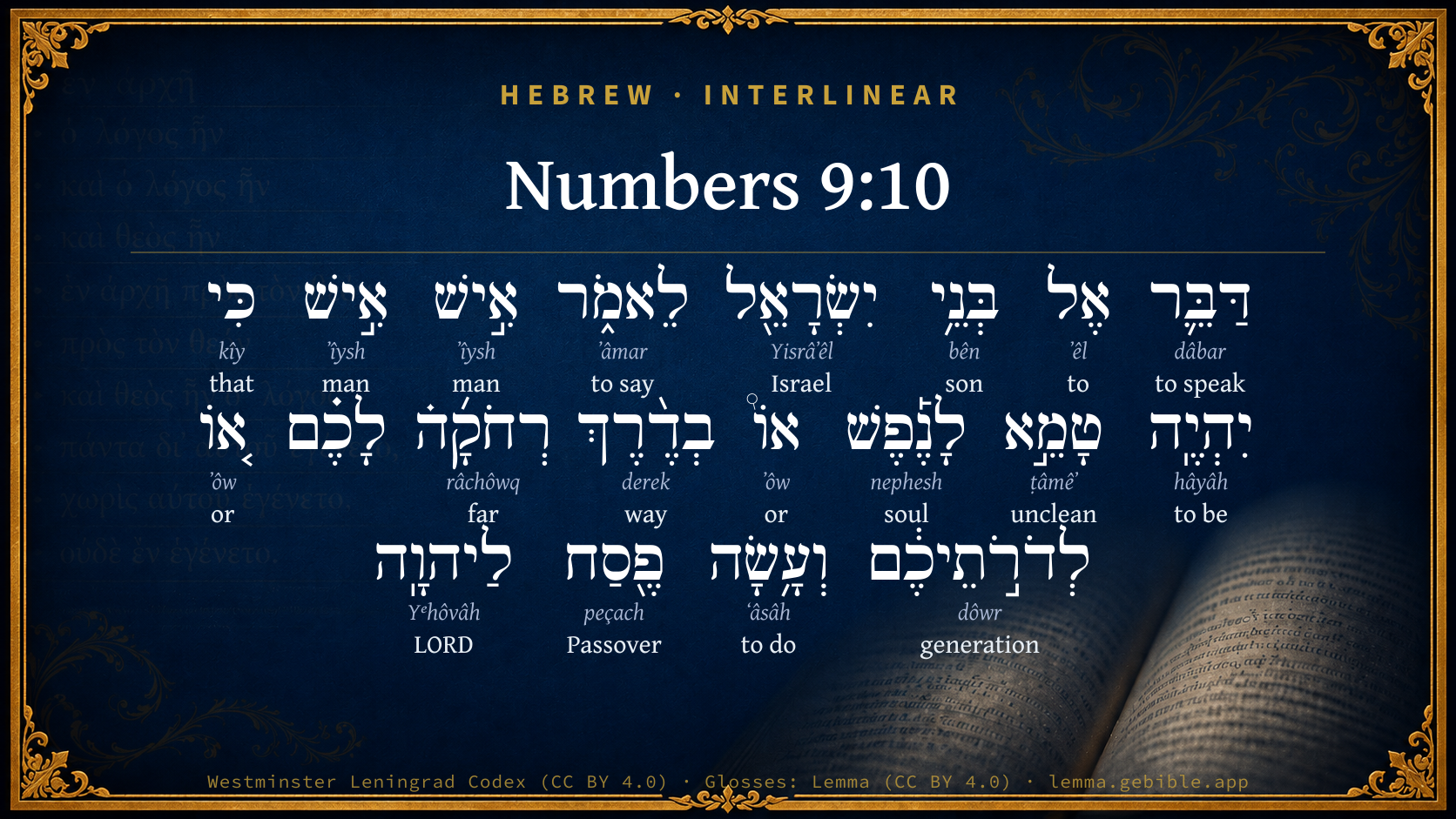
Numbers 9:10

Hebrew (Westminster Leningrad Codex) Numbers 9:10 appears in the Hebrew Old Testament. The text above is from the Westminster Leningrad Codex. Each word links to its Strong’s number, a concise gloss, and parsing drawn from the Open Scriptures Hebrew Bible morphology. Click any word for its full Brown-Driver-Briggs (BDB) entry.
Download image
Cite this verse

Numbers 9:10 (World English Bible). Public Domain. Lemma interlinear Bible study tool, https://lemma.gebible.app/v/numbers/9/10.

Show BibTeX & RIS
BibTeX
RIS
English Translation
"Say to the children of Israel, 'If any man of you or of your generations is unclean by reason of a dead body, or is on a journey far away, he shall still keep the Passover to Yahweh.
World English Bible · Public Domain
Download a study sheet

One document with this verse’s original text, its word-by-word gloss line, the meaning frame, cross-references with their text, attributed commentary, and full source and license credits — printable, and it pastes into notes with its structure intact.

This verse Autodidact and up

Study sheet (.html) Plain text (.txt)

A passage Seminary Student

Up to 50 verses in one chapter. A passage sheet keeps up to 6 commentary sources and 12 cross-references per verse, in the order this page ranks them, and says so on the sheet whenever that leaves anything out. Ask for a single verse and you get the Autodidact verse sheet above.

Everything on this page stays free to read, with no account — the sheet is a download of what is already on screen, not access to it.

Want to remove ads? Support Godless Engineer
Compare translations 3

The same verse in 3 English versions, stacked beneath the original-language interlinear above. Click any original word for its lexicon entry.

Each is an independent rendering of the whole verse — the interlinear is not word-aligned to these translations.

Highlighted words mark where these versions differ — a whole-verse word diff, not a word-by-word alignment.

  • World English Bible Public Domain
    "Say to the children of Israel, 'If any man of you or of your generations is unclean by reason of a dead body, or is on a journey far away, he shall still keep the Passover to Yahweh.
  • King James Version Public Domain
    Speak unto the children of Israel, saying, If any man of you or of your posterity shall be unclean by reason of a dead body, or be in a journey afar off, yet he shall keep the passover unto the LORD.
  • unfoldingWord Literal Text CC BY-SA 4.0
    “Speak to the sons of Israel, saying, ‘A man, a man, when he is unclean to a person or is on a distant way, for you or for your generations, then he will do the Passover to Yahweh.

unfoldingWord Literal Text — © unfoldingWord, licensed CC BY-SA 4.0. Word-aligned USFM3 via Door43 (git.door43.org/unfoldingWord/en_ult).

Versions to compare (up to 4)

3 of 4 selected

Show all 18 translations

Every available English version of this verse, each an independent rendering of the whole verse.

  • World English Bible Public Domain
    "Say to the children of Israel, 'If any man of you or of your generations is unclean by reason of a dead body, or is on a journey far away, he shall still keep the Passover to Yahweh.
  • Berean Standard Bible Public Domain
    “Tell the Israelites: ‘When any one of you or your descendants is unclean because of a dead body, or is away on a journey, he may still observe the Passover to the LORD.
  • Majority Standard Bible Public Domain
    “Tell the Israelites: ‘When any one of you or your descendants is unclean because of a dead body, or is away on a journey, he may still observe the Passover to the LORD.
  • King James Version Public Domain
    Speak unto the children of Israel, saying, If any man of you or of your posterity shall be unclean by reason of a dead body, or be in a journey afar off, yet he shall keep the passover unto the LORD.
  • American Standard Version (1901) Public Domain
    Speak unto the children of Israel, saying, If any man of you or of your generations shall be unclean by reason of a dead body, or be on a journey afar off, yet he shall keep the passover unto Jehovah.
  • Revised Version (1885) Public Domain
    Speak unto the children of Israel, saying, If any man of you or of your generations shall be unclean by reason of a dead body, or be in a journey afar off, yet he shall keep the passover unto the LORD:
  • Geneva Bible (1599) Public Domain
    Speake vnto the children of Israel, and say, If any amog you, or of your posteritie shalbe vncleane by ye reason of a corps, or be in a log iourney, he shall keepe the Passeouer vnto ye Lord.
  • Douay-Rheims (1899) Public Domain
    Say to the children of Israel: The man that shall be unclean by occasion of one that is dead, or shall be in a journey afar off in your nation, let him make the phase to the Lord.
  • Young's Literal Translation Public Domain
    `Speak unto the sons of Israel, saying, Though any man is unclean by a body or in a distant journey (of you or of your generations), yet he hath prepared a passover to Jehovah;
  • Literal Standard Version CC BY-SA 4.0
    “Speak to the sons of Israel, saying, Though any man is unclean by a body or in a distant journey (of you or of your generations), he has still prepared a Passover to YHWH;
  • Unlocked Literal Bible CC BY-SA 4.0
    “Speak to the people of Israel. Say, 'If any of you or your descendants are unclean because of a dead body, or are on a long journey, he may still keep the Passover to Yahweh.'
  • unfoldingWord Literal Text CC BY-SA 4.0
    “Speak to the sons of Israel, saying, ‘A man, a man, when he is unclean to a person or is on a distant way, for you or for your generations, then he will do the Passover to Yahweh.
  • Darby Bible Public Domain
    Speak unto the children of Israel, saying, If any one of you or of your generations be unclean by reason of a dead body or be on a journey afar off, yet he shall hold the passover to Jehovah.
  • World Messianic Bible Public Domain
    “Say to the children of Israel, ‘If any man of you or of your generations is unclean by reason of a dead body, or is on a journey far away, he shall still keep the Passover to the LORD.
  • Webster's Bible Public Domain
    Speak to the children of Israel, saying, If any man of you or of your posterity shall be unclean by reason of a dead body, or be in a journey afar off, yet he shall keep the passover to the LORD.
  • Free Bible Version CC BY-SA 4.0
    “Tell the Israelites: ‘If you or your descendants are unclean because of a dead body, or are away traveling, you can still keep the Lord's Passover.
  • Bible in Basic English Public Domain
    Say to the children of Israel, If any one of you or of your families is unclean because of a dead body, or is on a journey far away, still he is to keep the Passover to the Lord:
  • JPS Tanakh (1917) Public Domain
    'Speak unto the children of Israel, saying: If any man of you or of your generations shall be unclean by reason of a dead body, or be in a journey afar off, yet he shall keep the passover unto the LORD;

Literal Standard Version (2020), Covenant Press — licensed CC BY-SA 4.0. Text via the HelloAO Bible API (eBible.org). Unlocked Literal Bible (unfoldingWord) — licensed CC BY-SA 4.0. Text via the HelloAO Bible API (eBible.org). unfoldingWord Literal Text — © unfoldingWord, licensed CC BY-SA 4.0. Word-aligned USFM3 via Door43 (git.door43.org/unfoldingWord/en_ult). Free Bible Version, Dr. Jonathan Gallagher — licensed CC BY-SA 4.0. Text via the HelloAO Bible API (eBible.org).

Word by word

More ways to search: Search by grammar → Find every occurrence → Compare this word →

Practice this passage: Drill this verse → Learn its vocabulary →

פֶ֖סַח
peçach
H6453
“Passover”
Noun, Common, Masculine, Singular, Absolute
Part of Speech
Noun
Type
Common
Gender
Masculine
Number
Singular
State
Absolute
Full BDB Definition

Origin: from H6452

TWOT: 1786a

passover - sacrifice of passover - animal victim of the passover - festival of the passover
  1. דַּבֵּ֛ר dâbar H1696 “speak” Verb, Piel, Imperative, 2nd Person, Masculine, Singular
  2. אֶל ʼêl H413 “to” Preposition
  3. בְּנֵ֥י bên H1121 “sons of” Noun, Common, Masculine, Plural, Construct
  4. יִשְׂרָאֵ֖ל Yisrâʼêl H3478 “Israel” Noun, Proper
  5. לֵאמֹ֑ר ʼâmar H559 “to say” Preposition + Verb, Qal, Infinitive Construct
  6. אִ֣ישׁ ʼîysh H376 “man” Noun, Common, Masculine, Singular, Absolute
  7. אִ֣ישׁ ʼîysh H376 “man” Noun, Common, Masculine, Singular, Absolute
  8. כִּי kîy H3588 “that” Conjunction
  9. יִהְיֶֽה hâyâh H1961 “to be” Verb, Qal, Imperfect, 3rd Person, Masculine, Singular
  10. טָמֵ֣א ṭâmêʼ H2931 “unclean” Adjective, Adjective, Masculine, Singular, Absolute
  11. לָנֶ֡פֶשׁ nephesh H5315 “to/for · soul” Preposition + Noun, Common, Both, Singular, Absolute
  12. אוֹ֩ ʼôw H176 “or” Conjunction
  13. בְדֶ֨רֶךְ derek H1870 “in/at · way” Preposition + Noun, Common, Both, Singular, Absolute
  14. רְחֹקָ֜הׄ râchôwq H7350 “far” Adjective, Adjective, Feminine, Singular, Absolute
  15. א֚וֹ ʼôw H176 “or” Conjunction
  16. לְדֹרֹ֣תֵיכֶ֔ם dôwr H1755 “to/for · generations · your” Preposition + Noun, Common, Masculine, Plural, Construct + Suffix, Personal, 2nd Person, Masculine, Plural
  17. וְעָ֥שָׂה ʻâsâh H6213 “and · to do” Conjunction + Verb, Qal, Sequential Perfect, 3rd Person, Masculine, Singular
  18. לַיהוָֽה Yᵉhôvâh H3068 “to/for · LORD” Preposition + Noun, Proper

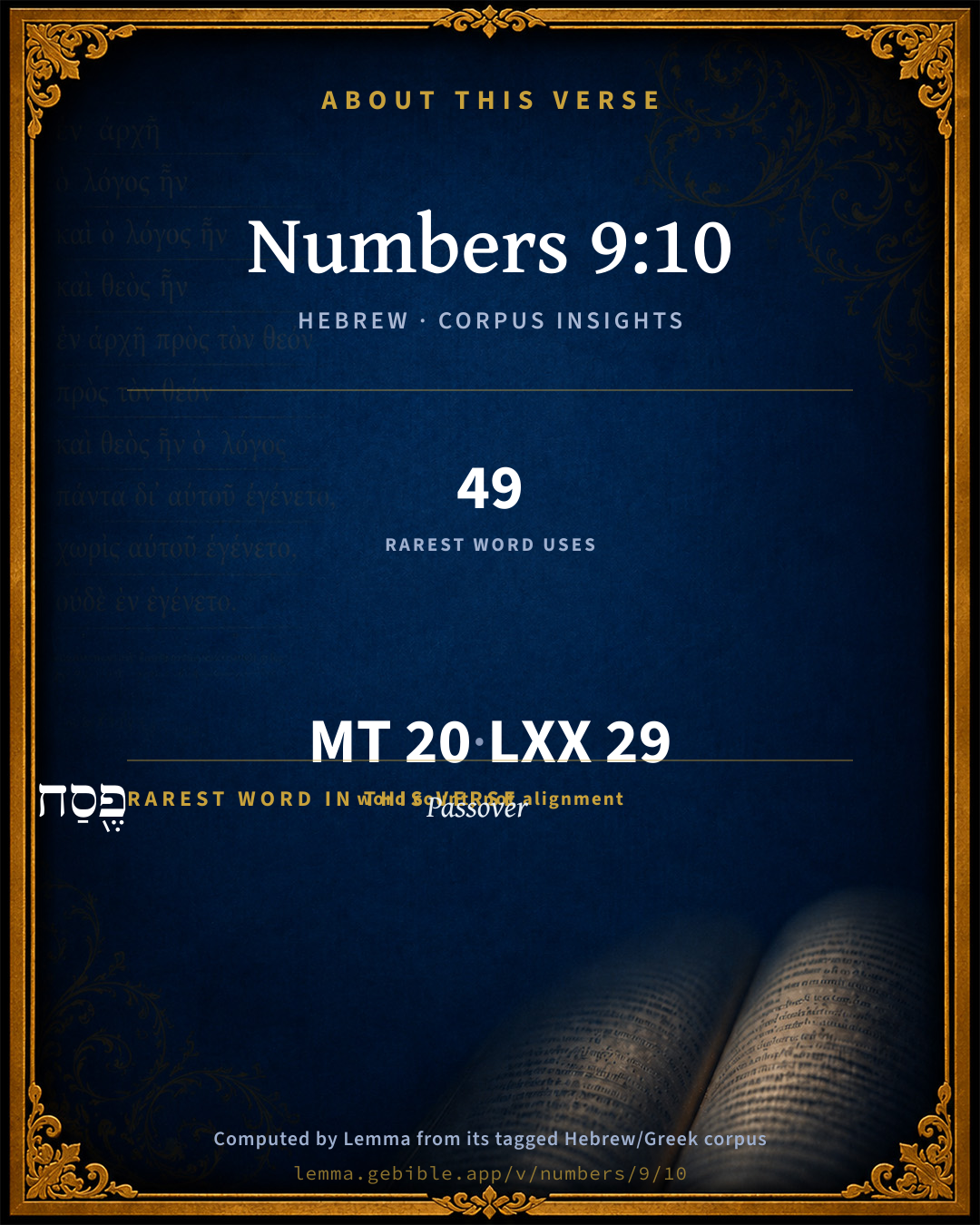
About this verse

These counts appear in no published source. They are computed here, from the morphology-tagged text and Lemma’s own curated glosses. What Lemma adds →

20
words
17
distinct lemmas
Pentateuch
section

Shared distinctive vocabulary

פֶ֖סַח Passover H6453 occurs in 46 verses of the Hebrew Bible. Also found in:

Grammatical profile

  • 4 verbs
  • 9 nouns
  • 2 adjectives
  • 2 prepositions
  • 3 conjunctions

Verb forms

  • דַּבֵּ֛ר Piel · Imperative
  • לֵאמֹ֑ר Qal · Infinitive Construct
  • יִהְיֶֽה Qal · Imperfect
  • וְעָ֥שָׂה Qal · Sequential Perfect

Repetition

Words recur within this verse — often emphatic in Hebrew:

  • אִ֣ישׁ man H376 ×2
  • אוֹ֩ or H176 ×2

Hebrew & Septuagint length

In English translation the verse runs 38 words from the Hebrew and 39 from the Septuagint (LXX English) — closely comparable.

A rough comparison of the two English renderings, which tokenize alike — not a word-level alignment.

Word counts can differ between the Hebrew and the Greek without any difference in meaning — e.g. the Hebrew direct-object marker אֵת has no separate Greek word, and Greek often adds the article ὁ.

In the original languages it is 20 Hebrew tokens and 29 Greek tokens — but the two are counted differently (Hebrew bundles its prefixes and suffixes into one token; the Greek is in lemma form), so that isn’t a like-for-like length.

Cross-references

9

Topical passages linked to Numbers 9:10 in the Treasury of Scripture Knowledge — connected by theme and wording, ordered by reader-vote popularity; previews shown in the World English Bible.

  • Numbers 9:6–7 There were certain men, who were unclean because of the dead body of a man, so that they could not keep the Passover on that day, and they came before Moses and before Aaron on that day.
  • Matthew 5:24 leave your gift there before the altar, and go your way. First be reconciled to your brother, and then come and offer your gift.
  • Romans 15:8–19 Now I say that Christ has been made a minister of the circumcision for the truth of God, that he might confirm the promises given to the fathers,
  • Romans 16:25–26
  • 1 Corinthians 6:9–11 Or don't you know that the unrighteous will not inherit the Kingdom of God? Don't be deceived. Neither the sexually immoral, nor idolaters, nor adulterers, nor male prostitutes, nor homosexuals,
  • 1 Corinthians 11:28 But let a man examine himself, and so let him eat of the bread, and drink of the cup.
  • Ephesians 2:1–2 You were made alive when you were dead in transgressions and sins,
  • Ephesians 2:12–13 that you were at that time separate from Christ, alienated from the commonwealth of Israel, and strangers from the covenants of the promise, having no hope and without God in the world.
  • Ephesians 3:6–9 that the Gentiles are fellow heirs, and fellow members of the body, and fellow partakers of his promise in Christ Jesus through the Gospel,

Cross-references courtesy of OpenBible.info (CC BY 4.0).

Hebrew and Greek witnesses Masoretic Hebrew ↔ Greek Septuagint

The same verse in the two great witnesses to the Old Testament, shown verse-for-verse.

These are two independent witnesses, not word-aligned to each other, and the Septuagint is shown in lemma (dictionary) form.

Hebrew Numbers 9:10 Masoretic · Westminster Leningrad Codex

דַּבֵּ֛ר אֶל בְּנֵ֥י יִשְׂרָאֵ֖ל לֵאמֹ֑ר אִ֣ישׁ אִ֣ישׁ כִּי יִהְיֶֽה טָמֵ֣א לָנֶ֡פֶשׁ אוֹ֩ בְדֶ֨רֶךְ רְחֹקָ֜הׄ לָכֶ֗ם א֚וֹ לְדֹרֹ֣תֵיכֶ֔ם וְעָ֥שָׂה פֶ֖סַח לַיהוָֽה

"Say to the children of Israel, 'If any man of you or of your generations is unclean by reason of a dead body, or is on a journey far away, he shall still keep the Passover to Yahweh.

World English Bible · Public Domain

Greek LXX Numbers 9:10 Septuagint · lemma form

λαλέω ὁ υἱός ἰσραήλ λέγω ἄνθρωπος ἄνθρωπος ὅς ἐάν γίγνομαι ἀκάθαρτος ἐπί ψυχή ἄνθρωπος ἤ ἐν ὁδός μακράν σύ ἤ ἐν ὁ γενεά σύ καί ποιέω ὁ πασχα κύριος

Speak to the children of Israel, saying, Whatever man shall be unclean by reason of a dead body, or on a journey far off, among you, or among your posterity; he shall then keep the passover to the Lord,

LXX2012 (modern English Septuagint) · Public Domain

On this verse, Haydock's Catholic Bible Commentary discusses the Septuagint’s reading. Read the note in Commentary ↓

Hebrew: Westminster Leningrad Codex (CC BY 4.0). Greek: Septuagint (public domain); English from LXX2012 (modern English Septuagint) (Public Domain). How the Septuagint differs from the Hebrew →

Targum (Aramaic paraphrase)

2

The Targum is the ancient Jewish Aramaic paraphrase of the Hebrew Scriptures — an interpretive translation, not the Hebrew text itself. Onkelos (literal) and Pseudo-Jonathan (expansive) render the Torah, and Jonathan the Prophets. Coverage is partial: where no permissively-licensed English translation exists for a verse, only the Aramaic is shown. This is verse-level text, not a word-by-word alignment to the Hebrew.

  1. Targum Onkelos Torah (Genesis–Deuteronomy)
    מַלֵל עִם בְּנֵי יִשְׂרָאֵל לְמֵימָר גְבַר גְבַר אֲרֵי יְהֵי מְסָאָב לִטְמֵי נַפְשָׁא דֶאֱנָשָׁא אוֹ בְאָרְחָא רְחִיקָא לְכוֹן אוֹ לְדָרֵיכוֹן וְיַעְבֵּד פִּסְחָא קֳדָם יְיָ

    (no public-domain English translation for this verse)

    Targum Onkelos — Aramaic: “Onkelos Genesis” (public domain); “Onkelos Exodus” (public domain); “Onkelos Leviticus” (public domain); “Onkelos Numbers” (public domain); “Onkelos Deuteronomy” (public domain). English: “Sefaria Community Translation” (CC0 1.0 (public-domain dedication)); “J.W. Etheridge. The Targums of Onkelos and Jonathan Ben Uzziel on the Pentateuch. London: Longmans, Green, 1862” (public domain). Text via Sefaria.

  2. Targum Pseudo-Jonathan Torah (Genesis–Deuteronomy)
    מַלֵיל עִם בְּנֵי יִשְרָאֵל לְמֵימָר גְבַר טְלֵי אוֹ גְבַר סִיב אֲרוּם יְהֵי מְסָאָב לִטְמֵי בַּר נַשׁ דְמִית אוֹ דַיֵב אוֹ סְגִיר דִמְרָחֵק בְּאוֹרַח עַלְמָא בְּקִרְיוּת לֵילְיָא וַהֲוָה בַּר מִן סְקוּף מַשְׁכְּנָא לְכוֹן גַרְמֵיכוֹן אוֹ לְדָרֵיכוֹן וְיִדְחֵי לְמֶעֱבַד פִּסְחָא קֳדָם יְיָ

    Speak with the sons of Israel, saying: A man, whether young or old, when unclean by defilement from the dead, or an issue, or the leprosy, or who is hindered in the way of the world by the accidents of the night, or who shall be at a distance from the threshold of his house: if such things happen to you, or to your generations, then may he defer to perform the Pascha before the Lord.

    Targum Pseudo-Jonathan — Aramaic: “Targum Jonathan on Genesis” (public domain); “Targum Jonathan on Exodus” (public domain); “Targum Jonathan on Leviticus” (public domain); “Targum Jonathan on Numbers” (public domain); “Targum Jonathan on Deuteronomy” (public domain). English: “The Targum of Jonathan ben Uzziel, trans. J. W. Etheridge, London, 1862” (public domain). Text via Sefaria.

Commentary

Notes on Numbers 9:10 from classic Christian and Jewish commentators (each source and its license shown beneath its notes). The classic Christian expositions comment on the surrounding passage and are grouped to its opening verse, so a note may address several verses; the Jewish commentaries on the Tanakh (Rashi and others) are per-verse, so they appear only where the commentator wrote on this verse.

Lemma curates 59 commentaries, every one of them public domain or Creative Commons licensed, each selected and text-cleaned for this edition rather than reprinted as found. About our sources →

Trapp's Complete Commentary

John Trapp

Num 9:10 Speak unto the children of Israel, saying, If any man of you or of your posterity shall be unclean by reason of a dead body, or [be] in a journey afar off, yet he shall keep the passover unto the LORD.

Ver. 10. Or be in a journey afar off.] This rendered a man unfit to partake; because either his head would be so taken up about his business then, or his mind so set upon home, that he would have little leisure or liberty to prepare for the passover.

John Trapp, A Commentary or Exposition upon All the Books of the Old and New Testament (1647–1656) — public domain. Text from a community e-Sword module.

Joseph Benson's Commentary

Num 9:10. Unclean — or on a journey — Under these two circumstances the Hebrews think that other hinderances of like nature are comprehended; as if one be hindered by a disease, or by any other such kind of uncleanness; which may seem probable both from the nature of the thing, and the reason of the law, which is the same in other cases.

Joseph Benson's Commentary on the Old and New Testaments (1811–1818) — public domain. Text from a community e-Sword module.

Geneva Bible (1599)

Geneva Bible translators

And cannot come where the Tabernacle is, when others keep it.

Geneva Bible (1599) marginal notes — public domain. Text via Bolls.life.

Ellicott's Commentary for English Readers

(10) In a journey afar off.—Or, on a distant journey. This is one of the ten passages in the Pentateuch in which one or more words are marked with certain dots, known as puncta extraordinaria. In this case these dots stand over the word rehokah, distant. The Rabbinical explanation is that the word is either spurious, as not being found in Num_9:13, or is not to be interpreted in its literal signification, but in a qualified sense.

A Bible Commentary for English Readers, edited by Charles John Ellicott (1878–1897) — public domain. Text from a community e-Sword module.

The Cambridge Bible for Schools and Colleges

gen. ed. J. J. S. Perowne

10. Provision is made both for accidental uncleanness, and also for absence on a journey. This is evidently intended to be exhaustive, and was understood in later days to include all good reasons which might prevent anyone from keeping the festival. Cf. 2Ch_30:2; 2Ch_30:15.

of your generations] i.e. of future generations.

The Cambridge Bible for Schools and Colleges (gen. ed. J. J. S. Perowne; Cambridge University Press, 1878–1918) — public domain. Text from a community e-Sword module.

John Gill's Exposition

The fourteenth day of the second month at even they shall keep it,.... The mouth Ijar, as the Targum of Jonathan, which answers to part of our April and part of May; so that there was a month allowed for those that were defiled to cleanse themselves; and for those on a journey to return home and prepare for the passover, which was not to be totally omitted, nor deferred any longer; and it was to be kept on the same day of the month, and at the same time of the day the first passover was observed; still the more to keep in mind the saving of their firstborn; and their deliverance out of Egypt at that time: an instance of keeping such a passover we have in Ch2 30:1, &c.

and eat it with unleavened bread and bitter herbs; in the same manner as the first passover was eaten, Exo 12:8; only no mention is made of keeping the feast of unleavened bread seven days, which some think those were not obliged unto at this time, only to keep the feast of the passover.

John Gill's Exposition of the Whole Bible (1746–1763) — public domain (CC PDM 1.0). Text via the HelloAO Bible API.

Haydock's Catholic Bible Commentary

Unclean, in what manner soever. (Philo) --- Nation; or at a great distance, whether in the country or out of it. The Rabbins say 15 miles, or leagues, (Calmet) which make 45 miles. (Haydock) --- Septuagint, all such were bound to observe the passover in the second month, as the whole people did under Ezechias; (2 Paralipomenon xxx.) though the Rabbins falsely pretend, that when the greater part of the people were under this predicament, the law did not oblige, and they might eat the paschal lamb in the month of Nisan. Women were not bound to make the second Phase, Exodus xii. 19. (Calmet) --- This festival was never transferred beyond the second month. (Menochius)

George Leo Haydock (1774–1849), Haydock's Catholic Family Bible and Commentary, 1859 edition — public domain. Excludes Psalms (Douay-Rheims chapter numbering differs from Protestant) and Deuterocanonical books (Catholic canon only).

Matthew Poole's English Annotations

Under these two instances the Hebrews think that other hinderances of like nature are comprehended; as if one be hindered by a disease, or by any other such kind of uncleanness; which may seem probable both from the nature of the thing, and the reason of the law, which is the same in other cases, and from the application of this rule to other cases, 2Ch 30.

Afar off; in some remote country, whence he can not return sooner.

Matthew Poole's English Annotations on the Holy Bible (1683–1685) — public domain. Text from a community e-Sword/MySword module.

Whedon's Commentary on the Bible

Daniel D. Whedon

10. Afar off — According to the Hebrew doctors this must be at least fifteen miles from the camp, or afterward fifteen miles beyond the boundary of the Holy Land. For in Deu_12:5-6; Deu_16:2, we are told that the passover cannot be lawfully kept in a foreign land.

Daniel D. Whedon (gen. ed.), Commentary on the Old and New Testaments (1874–1909) — public domain. Text from a community e-Sword module.

The Pulpit Commentary

If any man of you or of your posterity. The particular case of these men is made the occasion for a general provision for all succeeding times. Shall be unclean by reason of a dead body, or be in a journey. It is somewhat strange that these two cases only were provided for: a man otherwise unclean, (as, e.g., in the case described Lev_15:13) even if actually recovered, was unable to take advantage of the little passover. Probably the real reason of it is to be found in this, that both the far journey and" the burial of the dead would presumably be works of charity. Afar off. This word, hqjro, is one of ten in the Pentateuch distinguished in the Hebrew Bibles with puncta extraordinaria, for some unknown and probably trifling reasons. The Rabbins ruled that it meant a distance of fifteen miles or more from the temple at sunrise of the fourteenth of Abib.

The Pulpit Commentary (1880–1919), ed. H.D.M. Spence-Jones & Joseph S. Exell — public domain. Text from a community e-Sword module.

John Wesley's Explanatory Notes

Unclean or in a journey - Under these two instances the Hebrews think that other hindrances of like nature are comprehended; as if one be hindered by a disease, or by any other such kind of uncleanness; which may seem probable both from the nature of the thing, and the reason of the law which is the same in other cases.

John Wesley, Explanatory Notes Upon the Whole Bible (1754–1765) — public domain. Text via the GEBible commentary corpus.

Rashi

Rabbi Shlomo Yitzchaki (Rashi)

או בדרך רחקה [IF ANY MAN … SHALL BE UNCLEAN BY REASON OF A DEAD,] OR BE ON A DISTANT JOURNEY — There is a dot on it (on the ה of the word רחקה which letter is therefore regarded as non-existent; cf. Rashi on Genesis 18:9 and Note thereon), in order to tell that what Scripture means by בדרך רחקה is that it (the journey) need not really be a distant one, but that his sacrifice is postponed even though he was merely outside the threshold of the forecourt during the whole time that the ceremony of slaughtering the Passover sacrifice tasted. (Pesachim 93b, cf. Sifrei Bamidbar 69:2). — On the “Second Passover” one may have with him unleavened and leavened bread together in his house, and there is no festival in connection with it, and the eating of leaven is forbidden only together with it (the Passover Sacrifice) — i.e. while the sacrifice is being eaten (cf. Pesachim 95a).

Rashi on the Tanakh — English translations: “The Judaica Press complete Tanach with Rashi, translated by A. J. Rosenberg” (CC BY 4.0); “Pentateuch with Rashi's commentary by M. Rosenbaum and A.M. Silbermann, 1929-1934” (public domain); “The Metsudah Tanach series, Lakewood, N.J” (CC BY 4.0); and “The Book of Joshua, Metsudah Publications, 1997” (CC BY 4.0). Text via Sefaria.

Ramban (Nachmanides)

Rabbi Moshe ben Nachman (Ramban / Nachmanides)

B’DERECH R’CHOKAH’ Rashi commented [that the meaning of this expression — literally “on a distant way” — is] “that he was outside the threshold of the Sanctuary Court during the whole time prescribed for slaughtering [the Passover-offering].” According to this opinion, this interpretation is hinted at by the dot [on the letter hei in the word r’chokah (distant) in the Torah, thus indicating that the journey does not really have to be a distant one, for even if he is only outside the threshold of the Sanctuary Court during the time of slaughtering of the Passover-offering, it is considered “a distant way”, as explained further on].But I am surprised at him [Rashi]! Why did he adopt the opinion of Rabbi Eliezer, when it would have been correct to accept the opinion of Rabbi Akiba [that a distant way means] beyond Modiin [a city fifteen miles from Jerusalem; and the verse would thus be referring to someone who cannot reach the Sanctuary Court in time to bring the Passover-offering].. The difference is important. The punishment of excision for neglecting to bring the Passover-offering is stated primarily with reference to the first Passover-offering. A person who was on a distant way on the fourteenth of Nisan [or in a state of impurity] must bring the second Passover-offering, on the fourteenth of Iyar; but if he did not bring the second Passover-offering, even wilfully, he is not liable to punishment, since at the time of the first Passover-offering, when the main duty arose, he was unable to bring the offering. However, a person who was not on a distant way on the fourteenth of Nisan and did not bring the Passover-offering, may nonetheless bring the second Passover-offering on the fourteenth of Iyar; but if he wilfully did not bring it then on the fourteenth of Iyar he is subject to the punishment of excision. See further in my translation of “The Commandments,” Vol. I, pp. 67-69. And such is the opinion of the Amoraim in the Gemara means literally: the Interpreters. This name is given to the Rabbis of the Gemara, as distinguished from the Tannaim, the Rabbis mentioned in the Mishnah or Beraitha. The Gemara is the text containing the collected discussions of the Amoraim on the Mishnah. The Mishnah and Gemara together are known as the the Talmud. See also Vol. II, p. 132, Note 204, and Vol. III, p. 192. Note 44. [of Tractate Pesachim], where Ula said, [a distant way is if he is at such a distance from Jerusalem that] he cannot come in, in time for the slaughtering [of the Passover-offering]. of the afternoon of the fourteenth day of Nisan (Exodus 12:6, see also Ramban there). Now since prior to that time there is no obligation to bring the offering yet, and Ula is of the opinion that a person on a distant way is “one who cannot come into the Sanctuary Court in time for the slaughtering of the Passover-offering,” it follows perforce that the term a distant way cannot mean in reality far away, since prior to the beginning of that afternoon there was no obligation to bring it yet. Hence even if the distance was actually not far but that person for some reason was not in the Sanctuary Court he is also considered as having been on a distant way. The case, however, would be different if he were to hold like Rav Yehudah, who says that a person on a distant way is “one who cannot come in, in time for the eating of the Passover-offering,” which is on the following night. In that case a person on a distant way would be one, who from the beginning of the afternoon cannot reach Jerusalem at night, in time for the eating of the Passover-offering, since he is actually on a far distant way. This is indeed the plain meaning of Scripture, that a person who is situated at the beginning of the afternoon in a place from which he cannot reach the Sanctuary Court [on foot] by the time of the slaughtering, is considered as being on a distant way, and therefore he is free [from the obligation of bringing the Passover-offering]. It is possible that [according to Rabbi Akiba] the reason for the dot [on the letter hei in the word r’chokah (distant) in the Torah] is to indicate that it is too distant for him to bring the Passover-offering, even though it is not actually distant [since fifteen-miles — walking-distance — is the required distance]; therefore when He repeated it He stated, But the man that is clean, and is not on ‘a journey,’ [and forbeareth to bring the Passover-lamb], and did not mention “distant.” journey,” it would have implied that even if he was beyond a distance of fifteen miles and fails to bring the Passover-offering, he is liable to the punishment of excision. But this is not the law, for if he were beyond fifteen miles the punishment does not apply. See Note 83 above.Now Scripture commanded that a person who was impure or on a distant way should bring the second [Passover-offering], but the same law, for the same reason, applies to anyone who did not bring the first Passover-offering, even wilfully, namely that he is obliged to bring the second Passover-offering, in accordance with the words of our Rabbis. Scripture, however, mentioned only [those who were impure or on a distant way in order] to say that they are allowed to bring the second Passover-offering, and to forbid an impure person to bring the first Passover-offering. However, one who was on a [distant] way is free from bringing the first Passover-offering, and may bring the second one, but if he wants to fulfill his duty on the first Passover and he told someone [in Jerusalem to include him in a group, and] to slaughter the offering for him [as well], it is acceptable [for him]. For we accept [as the correct interpretation of the law] that the [meaning of the verse is not that he must bring it only on the second Passover, but that the] Merciful One dealt kindly with him [and allowed him if he prefers to bring the second Passover-offering], but if he did bring [the first one] — he is deserving of a blessing [and he has acted rightly]. It is also possible that the reason why Scripture mentioned “distant” [is because it is referring to a journey which is actually far away, and only then must he bring the second Passover-offering], but if he is on a “near” journey [i.e., within fifteen miles — this distance being considered the beginning of what is technically already “a far way”], he may bring the second Passover-offering, or the first one, by [telling them] to slaughter it and sprinkle it for him as well [in the afternoon of the fourteenth day of Nisan], and then coming [into the city of Jerusalem] and eating the Passover-offering at night.

Ramban (Nachmanides) on the Tanakh — English translation: “Commentary on the Torah by Ramban (Nachmanides). Translated and annotated by Charles B. Chavel. New York, Shilo Pub. House, 1971-1976” (CC BY 4.0). Text via Sefaria.

Lesson kit

Teaching starters — assembled from the data on this page, not authored interpretation. Every prompt links to the verse data it draws on. Edit before teaching.

Numbers, in the Pentateuch, opens this verse with 20 words (17 distinct Hebrew lemmas). Its most distinctive word is peçach (“Passover”). A historical commentator’s framing appears above. Read the whole chapter for the surrounding context.

Discussion questions

  1. The word peçach carries the sense “Passover.” How does it shape the verse?
  2. Exodus 12:11 shares the word «Passover» with this verse. How do the two illuminate each other?
  3. “man” occurs 2× in this one verse. What is the effect of the repetition?
  4. These translations render this verse differently; the difference is in the English rendering, not the original. What questions does that raise?
  5. The verb «דַּבֵּ֛ר» is Piel Imperative. How does its form color the action?
  6. Reading how Trapp's Complete Commentary and Joseph Benson's Commentary read this verse, where do the two commentators agree and where do they part?

Things to notice

Reading settings

Reading text

Shown beneath each verse's original-language words.

Old Testament
Old Testament edition

Read the OT as the Masoretic Hebrew (MT) or the Greek Septuagint (LXX).

English shown for the Greek Septuagint (in the Hebrew ↔ Greek comparison).

Comparing translations? Open the Compare panel on any verse page to stack up to four side by side.