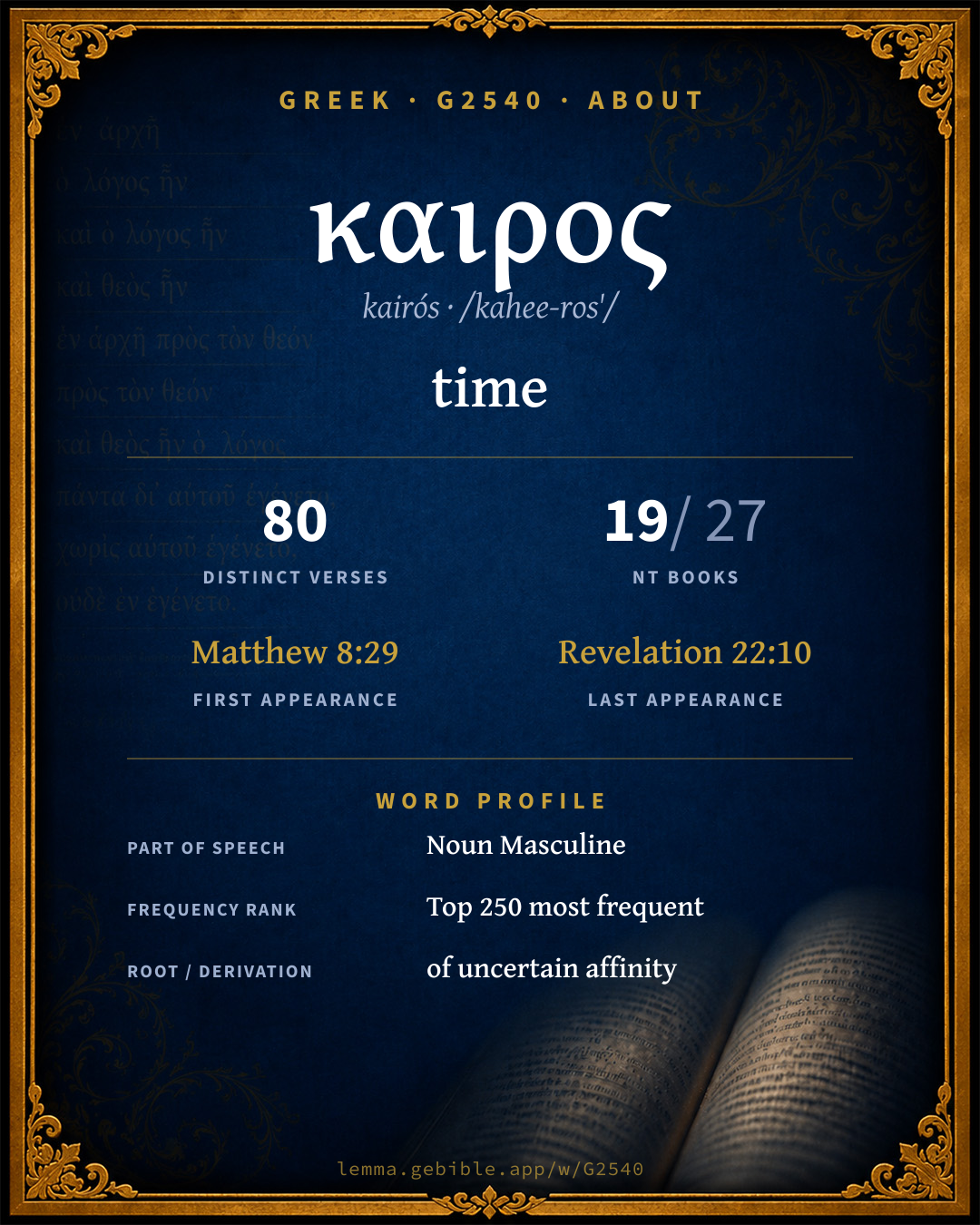
καιρός
time
‘time’ is one of 2 main senses fuller range ↓
Full lexicon entry — Thayer's Greek Lexicon
From Thayer's Greek Lexicon
Where this word appears
See every Dative-case word in the Greek New Testament →
Grammar key — what these labels mean
Part of speech
- Noun
- A naming word — a person, place, thing, or idea.
Case
- Dative
- The case of the indirect object, means, or location — “to / for / with / in.”
- Accusative
- The case of the direct object and of extent.
- Nominative
- The case of the subject (and the predicate nominative).
- Genitive
- The case of source, possession, or “of” — answers “whose / from what.”
Gender
- Masculine
- Grammatically masculine.
Number
- Singular
- One.
- Plural
- More than one.
Grammatical forms
- Noun, Dative, Singular, Masculine 24 times (28%)
- Noun, Accusative, Singular, Masculine 21 times (25%)
- Noun, Nominative, Singular, Masculine 17 times (20%)
- Noun, Genitive, Singular, Masculine 7 times (8%)
- Noun, Accusative, Plural, Masculine 5 times (6%)
- Noun, Dative, Plural, Masculine 5 times (6%)
- Noun, Genitive, Plural, Masculine 3 times (4%)
- Noun, Nominative, Plural, Masculine 3 times (4%)
Parsed forms decoded from the imported morphology (Robinson–Tischendorf, public domain), counted across 85 parsed occurrences — not distinct verses.
Every verse where G2540 appears — 80 distinct verses across 19 books. Click any verse to open its interlinear word-by-word view. Verse text shown in the World English Bible for context — . Each verse’s Greek form is shown with its reference; the English is not keyword-highlighted, since the data carries no word-level English alignment. Use “Compare translations” on any verse to read it across multiple English versions. This concordance covers the Greek New Testament; Septuagint (Greek Old Testament) occurrences of this word are not indexed here.
Matthew 10 verses
- Matthew 8:29 καιροῦ n gen sg masc Behold, they cried out, saying, "What do we have to do with you, Jesus, Son of God? Have you come here to torment us before the time?"
- Matthew 11:25 καιρῷ n dat sg masc At that time, Jesus answered, "I thank you, Father, Lord of heaven and earth, that you hid these things from the wise and understanding, and revealed them to infants.
- Matthew 12:1 καιρῷ n dat sg masc At that time, Jesus went on the Sabbath day through the grain fields. His disciples were hungry and began to pluck heads of grain and to eat.
- Matthew 13:30 καιρῷ n dat sg masc Let both grow together until the harvest, and in the harvest time I will tell the reapers, "First, gather up the darnel, and bind them in bundles to burn them; but gather the wheat into my barn."'"
- Matthew 14:1 καιρῷ n dat sg masc At that time, Herod the tetrarch heard the report concerning Jesus,
- Matthew 16:3 καιρῶν n gen pl masc In the morning, 'It will be foul weather today, for the sky is red and threatening.' Hypocrites! You know how to discern the appearance of the sky, but you can't discern the signs of the times!
- Matthew 21:34 καιρὸς n nom sg masc When the season for the fruit drew near, he sent his servants to the farmers, to receive his fruit.
- Matthew 21:41 καιροῖς n dat pl masc They told him, "He will miserably destroy those miserable men, and will lease out the vineyard to other farmers, who will give him the fruit in its season."
- Matthew 24:45 καιρῷ n dat sg masc "Who then is the faithful and wise servant, whom his lord has set over his household, to give them their food in due season?
- Matthew 26:18 καιρός n nom sg masc He said, "Go into the city to a certain person, and tell him, 'The Teacher says, "My time is at hand. I will keep the Passover at your house with my disciples."'"
Mark 5 verses
- Mark 1:15 καιρὸς n nom sg masc and saying, "The time is fulfilled, and the Kingdom of God is at hand! Repent, and believe in the Gospel."
- Mark 10:30 καιρῷ n dat sg masc but he will receive one hundred times more now in this time, houses, brothers, sisters, mothers, children, and land, with persecutions; and in the age to come eternal life.
- Mark 11:13 καιρὸς n nom sg masc Seeing a fig tree afar off having leaves, he came to see if perhaps he might find anything on it. When he came to it, he found nothing but leaves, for it was not the season for figs.
- Mark 12:2 καιρῷ n dat sg masc When it was time, he sent a servant to the farmer to get from the farmer his share of the fruit of the vineyard.
- Mark 13:33 καιρός n nom sg masc Watch, keep alert, and pray; for you don't know when the time is.
Luke 12 verses
- Luke 1:20 καιρὸν n acc sg masc Behold, you will be silent and not able to speak, until the day that these things will happen, because you didn't believe my words, which will be fulfilled in their proper time."
- Luke 4:13 καιροῦ n gen sg masc When the devil had completed every temptation, he departed from him until another time.
- Luke 8:13 καιρὸν καιρῷ n acc sg masc n dat sg masc Those on the rock are they who, when they hear, receive the word with joy; but these have no root, who believe for a while, then fall away in time of temptation.
- Luke 12:42 καιρῷ n dat sg masc The Lord said, "Who then is the faithful and wise steward, whom his lord will set over his household, to give them their portion of food at the right times?
- Luke 12:56 καιρὸν n acc sg masc You hypocrites! You know how to interpret the appearance of the earth and the sky, but how is it that you don't interpret this time?
- Luke 13:1 καιρῷ n dat sg masc Now there were some present at the same time who told him about the Galileans, whose blood Pilate had mixed with their sacrifices.
- Luke 18:30 καιρῷ n dat sg masc who will not receive many times more in this time, and in the world to come, eternal life."
- Luke 19:44 καιρὸν n acc sg masc and will dash you and your children within you to the ground. They will not leave in you one stone on another, because you didn't know the time of your visitation."
- Luke 20:10 καιρῷ n dat sg masc At the proper season, he sent a servant to the farmers to collect his share of the fruit of the vineyard. But the farmers beat him, and sent him away empty.
- Luke 21:8 καιρὸς n nom sg masc He said, "Watch out that you don't get led astray, for many will come in my name, saying, 'I AM,' and, 'The time is at hand.' Therefore don't follow them.
- Luke 21:24 καιροὶ n nom pl masc They will fall by the edge of the sword, and will be led captive into all the nations. Jerusalem will be trampled down by the Gentiles, until the times of the Gentiles are fulfilled.
- Luke 21:36 καιρῷ n dat sg masc Therefore be watchful all the time, asking that you may be counted worthy to escape all these things that will happen, and to stand before the Son of Man."
John 2 verses
Acts 9 verses
- Acts 1:7 καιροὺς n acc pl masc He said to them, "It isn't for you to know times or seasons which the Father has set within His own authority.
- Acts 3:19 καιροὶ n nom pl masc "Repent therefore, and turn again, that your sins may be blotted out, so that there may come times of refreshing from the presence of the Lord,
- Acts 7:20 καιρῷ n dat sg masc At that time Moses was born, and was exceedingly handsome. He was nourished three months in his father's house.
- Acts 12:1 καιρὸν n acc sg masc Now about that time, Herod the king stretched out his hands to oppress some of the assembly.
- Acts 13:11 καιροῦ n gen sg masc Now, behold, the hand of the Lord is on you, and you will be blind, not seeing the sun for a season!" Immediately there fell on him a mist and darkness. He went around seeking someone to lead him by the hand.
- Acts 14:17 καιροὺς n acc pl masc Yet he didn't leave himself without witness, in that he did good and gave you rains from the sky and fruitful seasons, filling our hearts with food and gladness."
- Acts 17:26 καιροὺς n acc pl masc He made from one blood every nation of men to dwell on all the surface of the earth, having determined appointed seasons, and the boundaries of their dwellings,
- Acts 19:23 καιρὸν n acc sg masc About that time there arose no small stir concerning the Way.
- Acts 24:25 καιρὸν n acc sg masc As he reasoned about righteousness, self-control, and the judgment to come, Felix was terrified, and answered, "Go your way for this time, and when it is convenient for me, I will summon you."
Romans 6 verses
- Romans 3:26 καιρῷ n dat sg masc to demonstrate his righteousness at this present time; that he might himself be just, and the justifier of him who has faith in Jesus.
- Romans 5:6 καιρὸν n acc sg masc For while we were yet weak, at the right time Christ died for the ungodly.
- Romans 8:18 καιροῦ n gen sg masc For I consider that the sufferings of this present time are not worthy to be compared with the glory which will be revealed toward us.
- Romans 9:9 καιρὸν n acc sg masc For this is a word of promise, "At the appointed time I will come, and Sarah will have a son."
- Romans 11:5 καιρῷ n dat sg masc Even so then at this present time also there is a remnant according to the election of grace.
- Romans 13:11 καιρόν n acc sg masc Do this, knowing the time, that it is already time for you to awaken out of sleep, for salvation is now nearer to us than when we first believed.
1 Corinthians 3 verses
- 1 Corinthians 4:5 καιροῦ n gen sg masc Therefore judge nothing before the time, until the Lord comes, who will both bring to light the hidden things of darkness, and reveal the counsels of the hearts. Then each man will get his praise from God.
- 1 Corinthians 7:5 καιρὸν n acc sg masc Don't deprive one another, unless it is by consent for a season, that you may give yourselves to fasting and prayer, and may be together again, that Satan doesn't tempt you because of your lack of self-control.
- 1 Corinthians 7:29 καιρὸς n nom sg masc But I say this, brothers: the time is short, that from now on, both those who have wives may be as though they had none;
2 Corinthians 2 verses
- 2 Corinthians 6:2 καιρῷ καιρὸς n dat sg masc n nom sg masc for he says, "At an acceptable time I listened to you, In a day of salvation I helped you." Behold, now is the acceptable time. Behold, now is the day of salvation.
- 2 Corinthians 8:13 καιρῷ n dat sg masc For this is not that others may be eased and you distressed,
Galatians 3 verses
- Galatians 4:10 καιροὺς n acc pl masc You observe days, months, seasons, and years.
- Galatians 6:9 καιρῷ n dat sg masc Let us not be weary in doing good, for we will reap in due season, if we don't give up.
- Galatians 6:10 καιρὸν n acc sg masc So then, as we have opportunity, let's do what is good toward all men, and especially toward those who are of the household of the faith.
Ephesians 4 verses
- Ephesians 1:10 καιρῶν n gen pl masc to an administration of the fullness of the times, to sum up all things in Christ, the things in the heavens, and the things on the earth, in him;
- Ephesians 2:12 καιρῷ n dat sg masc that you were at that time separate from Christ, alienated from the commonwealth of Israel, and strangers from the covenants of the promise, having no hope and without God in the world.
- Ephesians 5:16 καιρόν n acc sg masc redeeming the time, because the days are evil.
- Ephesians 6:18 καιρῷ n dat sg masc with all prayer and requests, praying at all times in the Spirit, and being watchful to this end in all perseverance and requests for all the saints:
Colossians 1 verse
1 Thessalonians 2 verses
- 1 Thessalonians 2:17 καιρὸν n acc sg masc But we, brothers, being bereaved of you for a short season, in presence, not in heart, tried even harder to see your face with great desire,
- 1 Thessalonians 5:1 καιρῶν n gen pl masc But concerning the times and the seasons, brothers, you have no need that anything be written to you.
2 Thessalonians 1 verse
1 Timothy 3 verses
- 1 Timothy 2:6 καιροῖς n dat pl masc who gave himself as a ransom for all; the testimony in its own times;
- 1 Timothy 4:1 καιροῖς n dat pl masc But the Spirit says expressly that in later times some will fall away from the faith, paying attention to seducing spirits and doctrines of demons,
- 1 Timothy 6:15 καιροῖς n dat pl masc which in its own times he will show, who is the blessed and only Ruler, the King of kings, and Lord of lords;
2 Timothy 3 verses
- 2 Timothy 3:1 καιροὶ n nom pl masc But know this, that in the last days, grievous times will come.
- 2 Timothy 4:3 καιρὸς n nom sg masc For the time will come when they will not listen to the sound doctrine, but, having itching ears, will heap up for themselves teachers after their own lusts;
- 2 Timothy 4:6 καιρὸς n nom sg masc For I am already being offered, and the time of my departure has come.
Titus 1 verse
Hebrews 4 verses
- Hebrews 9:9 καιρὸν n acc sg masc which is a symbol of the present age, where gifts and sacrifices are offered that are incapable, concerning the conscience, of making the worshipper perfect;
- Hebrews 9:10 καιροῦ n gen sg masc being only (with meats and drinks and various washings) fleshly ordinances, imposed until a time of reformation.
- Hebrews 11:11 καιρὸν n acc sg masc By faith, even Sarah herself received power to conceive, and she bore a child when she was past age, since she counted him faithful who had promised.
- Hebrews 11:15 καιρὸν n acc sg masc If indeed they had been thinking of that country from which they went out, they would have had enough time to return.
1 Peter 4 verses
- 1 Peter 1:5 καιρῷ n dat sg masc who by the power of God are guarded through faith for a salvation ready to be revealed in the last time.
- 1 Peter 1:11 καιρὸν n acc sg masc searching for who or what kind of time the Spirit of Christ, which was in them, pointed to, when he predicted the sufferings of Christ, and the glories that would follow them.
- 1 Peter 4:17 καιρὸς n nom sg masc For the time has come for judgment to begin at the house of God. If it begins first with us, what will happen to those who don't obey the Gospel of God?
- 1 Peter 5:6 καιρῷ n dat sg masc Humble yourselves therefore under the mighty hand of God, that he may exalt you in due time;
Revelation 5 verses
- Revelation 1:3 καιρὸς n nom sg masc Blessed is he who reads and those who hear the words of the prophecy, and keep the things that are written in it, for the time is at hand.
- Revelation 11:18 καιρὸς n nom sg masc The nations were angry, and your wrath came, as did the time for the dead to be judged, and to give your bondservants the prophets, their reward, as well as to the saints, and those who fear your name, to the small and the great; and to destroy those who destroy the earth."
- Revelation 12:12 καιρὸν n acc sg masc Therefore rejoice, heavens, and you who dwell in them. Woe to the earth and to the sea, because the devil has gone down to you, having great wrath, knowing that he has but a short time."
- Revelation 12:14 καιρὸν καιροὺς καιροῦ n acc sg masc n acc pl masc n gen sg masc Two wings of the great eagle were given to the woman, that she might fly into the wilderness to her place, so that she might be nourished for a time, and times, and half a time, from the face of the serpent.
- Revelation 22:10 καιρὸς n nom sg masc He said to me, "Don't seal up the words of the prophecy of this book, for the time is at hand.
About this entry
At a glance — auto-summarized from this page’s data, not written by a person. Every figure links to its source below. This summary describes the numbers; it doesn’t interpret them.
At its core, καιρος (kairós) means “time.” It first appears in Matthew 8:29. It turns up in 80 verses across 19 books, a moderately common footprint. Ranging over 2 senses, it is not a single-sense word. Dig into 80-verse concordance and the renderings breakdown below.
Gloss history
Strong's 1890 vs modern scholarship

About this word
Strong's G2540 catalogs a Greek word from the Greek New Testament.
These counts are not copied from any lexicon or concordance. They are computed here, from the morphology-tagged Greek New Testament. What Lemma adds →
- 80
- distinct verses
- The word appears in 80 distinct verses.
- 19 / 27
- NT books
- The word appears in 19 of 27 New Testament books.
- #200
- by frequency
- Top 250 most frequent Greek words (rank 200 of 5,347 Greek words by occurrence).
View all 80 occurrences in the concordance →
By section of the New Testament
By traditional corpus
Conventional, traditional groupings — biblical authorship is debated, so this is a traditional corpus grouping, not an authorship claim. Some books belong to more than one corpus (Luke is in both the Gospels and the Lukan corpus, and so on), so these shares overlap and need not total 100%. Each figure is a share of the word’s 80 distinct verses.
- Gospels 29 verses · 36%
- Pauline corpus 29 verses · 36%
- Lukan (Luke–Acts) 21 verses · 26%
- Johannine 7 verses · 9%
- Revelation 5 verses · 6%
- Hebrews 4 verses · 5%
- General (Catholic) Epistles 4 verses · 5%
How translations render this word
Counts come from each version’s own published word-to-Strong’s tagging or interlinear alignment — an approximate guide to how each version renders this word, not a word-level alignment the data otherwise carries. Because each total is that version’s own tagged count, the per-version totals vary from one another and need not match the appearance or distinct-verse counts above. These counts may also differ from a printed concordance because Lemma counts each distinctly tagged rendering and does not collapse phrase taggings into a single head-word total. This is a fixed set of word-tagged versions (KJV, ASV, BSB, ULT) and does not change with the reading translation you choose elsewhere. Each version’s license is shown beside its name below (and on Sources).
- King James Version: Time 51×, Times 11×, Season 6×
- American Standard Version: Time 37×, Season 15×, Seasons 7×
- Berean Standard Bible: Time 44×, Times 9×, Appointed time 4×
- unfoldingWord Literal Text: Time 64×, Times 10×, Seasons 5×
King James Version Public Domain
Renders G2540 across 82 tagged occurrences — most commonly:
Plus 6 renderings that appear only once — usually multi-word phrases or single function words the recovered tagging swept in, not distinct renderings. Not rendered by a distinct English word in 4 further occurrences.
American Standard Version Public Domain
Renders G2540 across 82 tagged occurrences — most commonly:
Plus 14 renderings that appear only once — usually multi-word phrases or single function words the recovered tagging swept in, not distinct renderings.
Berean Standard Bible Public Domain
Renders G2540 across 82 tagged occurrences — most commonly:
Plus 7 renderings that appear only once — usually multi-word phrases or single function words the recovered tagging swept in, not distinct renderings. Not rendered by a distinct English word in 3 further occurrences.
unfoldingWord Literal Text CC BY-SA 4.0
Renders G2540 across 96 tagged occurrences — most commonly:
Plus 8 renderings that appear only once — usually multi-word phrases or single function words the recovered tagging swept in, not distinct renderings.
Senses in Thayer's
The 2 senses Thayer's distinguishes for this word, in lexicon order (not ranked by frequency or importance). The full entry — with sub-senses — is in the Lexicon Entry tab.
- due measure
- a measure of time, a larger or smaller portion of time, hence:
Word origin
Origin: of uncertain affinity
Of uncertain affinity; an occasion that is set or proper time : - X always opportunity (convenient due) season (due short while) time a while. Compare G5550 .
— Strong’s Exhaustive Concordance (1890), public domain.
Forms in the corpus
The 10 distinct written forms G2540 takes in the Greek New Testament, most frequent first — each parse links to that case’s occurrences in the concordance.
| Form | Parsing | Example | Uses |
|---|---|---|---|
| καιρῷ kairō̂ | Noun, Dative, Singular, Masculine | Matthew 11:25 | 24 |
| καιρὸν kairòn | Noun, Accusative, Singular, Masculine | Luke 1:20 | 19 |
| καιρὸς kairòs | Noun, Nominative, Singular, Masculine | Matthew 21:34 | 15 |
| καιροῦ kairoû | Noun, Genitive, Singular, Masculine | Matthew 8:29 | 7 |
| καιροὺς kairoùs | Noun, Accusative, Plural, Masculine | Acts 1:7 | 5 |
| καιροῖς kairoîs | Noun, Dative, Plural, Masculine | Matthew 21:41 | 5 |
| καιροὶ kairoì | Noun, Nominative, Plural, Masculine | Luke 21:24 | 3 |
| καιρῶν kairō̂n | Noun, Genitive, Plural, Masculine | Matthew 16:3 | 3 |
| καιρόν kairón | Noun, Accusative, Singular, Masculine | Romans 13:11 | 2 |
| καιρός kairós | Noun, Nominative, Singular, Masculine | Matthew 26:18 | 2 |
Septuagint usage
The same Greek word καιρος appears 297 times in the Greek Old Testament (Septuagint), across 253 verses in 32 books.
- 297
- LXX occurrences
- Tagged occurrences of this Greek word in the Septuagint.
- 253
- verses
- Distinct Septuagint verses containing this word.
- 32 / 39
- OT books
- The word appears in 32 of the 39 Old Testament books.
Sample Septuagint occurrences
- Genesis 1:14 καιρός
- Exodus 8:28 καιρός
- Leviticus 15:25 καιρός
- Numbers 9:3 καιρός
- Deuteronomy 1:9 καιρός
- Joshua 5:2 καιρός
- Judges 4:4 καιρός
- 1 Samuel 1:20 καιρός
- 2 Samuel 11:1 καιρός
- 1 Kings 11:4 καιρός
- 2 Kings 4:16 καιρός
- 1 Chronicles 9:25 καιρός
Septuagint occurrences (same lexeme)
Every verse where the same Strong’s number (G2540) appears in the Greek Septuagint — showing the first 50 of 253. Verse text shown in the World English Bible for context; the Greek form is the matched word — the English is not keyword-highlighted.
- Genesis 1:14 καιρός God said, "Let there be lights in the expanse of sky to divide the day from the night; and let them be for signs, and for seasons, and for days and years;
- Genesis 6:13 καιρός God said to Noah, "The end of all flesh has come before me, for the earth is filled with violence through them. Behold, I will destroy them with the earth.
- Genesis 17:21 καιρός But my covenant I establish with Isaac, whom Sarah will bear to you at this set time in the next year."
- Genesis 17:23 καιρός Abraham took Ishmael his son, all who were born in his house, and all who were bought with his money; every male among the men of Abraham's house, and circumcised the flesh of their foreskin in the same day, as God had said to him.
- Genesis 17:26 καιρός In the same day both Abraham and Ishmael, his son, were circumcised.
- Genesis 18:10 καιρός He said, "I will certainly return to you when the season comes round. Behold, Sarah your wife will have a son." Sarah heard in the tent door, which was behind him.
- Genesis 18:14 καιρός Is anything too hard for Yahweh? At the set time I will return to you, when the season comes round, and Sarah will have a son."
- Genesis 21:2 καιρός Sarah conceived, and bore Abraham a son in his old age, at the set time of which God had spoken to him.
- Genesis 21:22 καιρός It happened at that time, that Abimelech and Phicol the captain of his host spoke to Abraham, saying, "God is with you in all that you do.
- Genesis 29:34 καιρός She conceived again, and bare a son. Said, "Now this time will my husband be joined to me, because I have borne him three sons." Therefore was his name called Levi.
- Genesis 30:20 καιρός Leah said, "God has endowed me with a good dowry. Now my husband will live with me, because I have borne him six sons." She named him Zebulun.
- Genesis 30:41 καιρός It happened, whenever the stronger of the flock conceived, that Jacob laid the rods before the eyes of the flock in the gutters, that they might conceive among the rods;
- Genesis 38:1 καιρός It happened at that time, that Judah went down from his brothers, and visited a certain Adullamite, whose name was Hirah.
- Exodus 8:28 καιρός Pharaoh said, "I will let you go, that you may sacrifice to Yahweh your God in the wilderness, only you shall not go very far away. Pray for me."
- Exodus 9:4 καιρός Yahweh will make a distinction between the cattle of Israel and the cattle of Egypt; and there shall nothing die of all that belongs to the children of Israel."'"
- Exodus 9:14 καιρός For this time I will send all my plagues against your heart, against your officials, and against your people; that you may know that there is none like me in all the earth.
- Exodus 13:10 καιρός You shall therefore keep this ordinance in its season from year to year.
- Exodus 23:14 καιρός "You shall observe a feast to me three times a year.
- Exodus 23:15 καιρός You shall observe the feast of unleavened bread. Seven days you shall eat unleavened bread, as I commanded you, at the time appointed in the month Abib (for in it you came out from Egypt), and no one shall appear before me empty.
- Exodus 23:17 καιρός Three times in the year all your males shall appear before the Lord Yahweh.
- Exodus 34:18 καιρός "You shall keep the feast of unleavened bread. Seven days you shall eat unleavened bread, as I commanded you, at the time appointed in the month Abib; for in the month Abib you came out from Egypt.
- Exodus 34:23 καιρός Three times in the year all your males shall appear before the Lord Yahweh, the God of Israel.
- Exodus 34:24 καιρός For I will drive out nations before you and enlarge your borders; neither shall any man desire your land when you go up to appear before Yahweh, your God, three times in the year.
- Leviticus 15:25 καιρός "'If a woman has a discharge of her blood many days not in the time of her period, or if she has a discharge beyond the time of her period; all the days of the discharge of her uncleanness shall be as in the days of her period: she is unclean.
- Leviticus 23:4 καιρός "'These are the set feasts of Yahweh, even holy convocations, which you shall proclaim in their appointed season.
- Leviticus 26:4 καιρός then I will give you your rains in their season, and the land shall yield its increase, and the trees of the field shall yield their fruit.
- Numbers 9:3 καιρός On the fourteenth day of this month, at evening, you shall keep it in its appointed season-- according to all its statutes, and according to all its ordinances, you shall keep it."
- Numbers 9:7 καιρός Those men said to him, "We are unclean because of the dead body of a man. Why are we kept back, that we may not offer the offering of Yahweh in its appointed season among the children of Israel?"
- Numbers 9:13 καιρός But the man who is clean, and is not on a journey, and fails to keep the Passover, that soul shall be cut off from his people. Because he didn't offer the offering of Yahweh in its appointed season, that man shall bear his sin.
- Numbers 14:9 καιρός Only don't rebel against Yahweh, neither fear the people of the land; for they are bread for us: their defense is removed from over them, and Yahweh is with us: don't fear them.
- Numbers 22:4 καιρός Moab said to the elders of Midian, Now will this multitude lick up all that is round about us, as the ox licks up the grass of the field. Balak the son of Zippor was king of Moab at that time.
- Numbers 23:23 καιρός Surely there is no enchantment with Jacob; Neither is there any divination with Israel: Now shall it be said of Jacob and of Israel, What has God done!
- Deuteronomy 1:9 καιρός I spoke to you at that time, saying, I am not able to bear you myself alone:
- Deuteronomy 1:16 καιρός I charged your judges at that time, saying, Hear [the causes] between your brothers, and judge righteously between a man and his brother, and the foreigner who is living with him.
- Deuteronomy 1:18 καιρός I commanded you at that time all the things which you should do.
- Deuteronomy 2:34 καιρός We took all his cities at that time, and utterly destroyed every inhabited city, with the women and the little ones; we left none remaining:
- Deuteronomy 3:4 καιρός We took all his cities at that time; there was not a city which we didn't take from them; sixty cities, all the region of Argob, the kingdom of Og in Bashan.
- Deuteronomy 3:8 καιρός We took the land at that time out of the hand of the two kings of the Amorites who were beyond the Jordan, from the valley of the Arnon to Mount Hermon;
- Deuteronomy 3:12 καιρός This land we took in possession at that time: from Aroer, which is by the valley of the Arnon, and half the hill-country of Gilead, and the cities of it, gave I to the Reubenites and to the Gadites:
- Deuteronomy 3:18 καιρός I commanded you at that time, saying, Yahweh your God has given you this land to possess it: you shall pass over armed before your brothers the children of Israel, all the men of valor.
- Deuteronomy 3:21 καιρός I commanded Joshua at that time, saying, Your eyes have seen all that Yahweh your God has done to these two kings: so shall Yahweh do to all the kingdoms where you go over.
- Deuteronomy 3:23 καιρός I begged Yahweh at that time, saying,
- Deuteronomy 4:14 καιρός Yahweh commanded me at that time to teach you statutes and ordinances, that you might do them in the land where you go over to possess it.
- Deuteronomy 5:5 καιρός (I stood between Yahweh and you at that time, to show you the word of Yahweh: for you were afraid because of the fire, and didn't go up onto the mountain;) saying,
- Deuteronomy 9:19 καιρός For I was afraid of the anger and hot displeasure, with which Yahweh was angry against you to destroy you. But Yahweh listened to me that time also.
- Deuteronomy 9:20 καιρός Yahweh was very angry with Aaron to destroy him: and I prayed for Aaron also at the same time.
- Deuteronomy 10:1 καιρός At that time Yahweh said to me, Hew you two tables of stone like the first, and come up to me onto the mountain, and make an ark of wood.
- Deuteronomy 10:8 καιρός At that time Yahweh set apart the tribe of Levi, to bear the ark of the covenant of Yahweh, to stand before Yahweh to minister to him, and to bless in his name, to this day.
- Deuteronomy 10:10 καιρός I stayed on the mountain, as at the first time, forty days and forty nights: and Yahweh listened to me that time also; Yahweh would not destroy you.
- Deuteronomy 16:6 καιρός but at the place which Yahweh your God shall choose, to cause his name to dwell in, there you shall sacrifice the Passover at even, at the going down of the sun, at the season that you came forth out of Egypt.
These are occurrences of the same Greek lexeme (G2540) in the Septuagint — not a translation of any one Hebrew word. The store carries no word-level Hebrew↔Greek alignment, so no Hebrew original is asserted here. Counts come from the recovered LXX Strong's tagging — high-frequency vocabulary is well covered, while rare or late forms may be untagged — so they reflect tagged occurrences and may slightly undercount.