1 Timothy 6:15

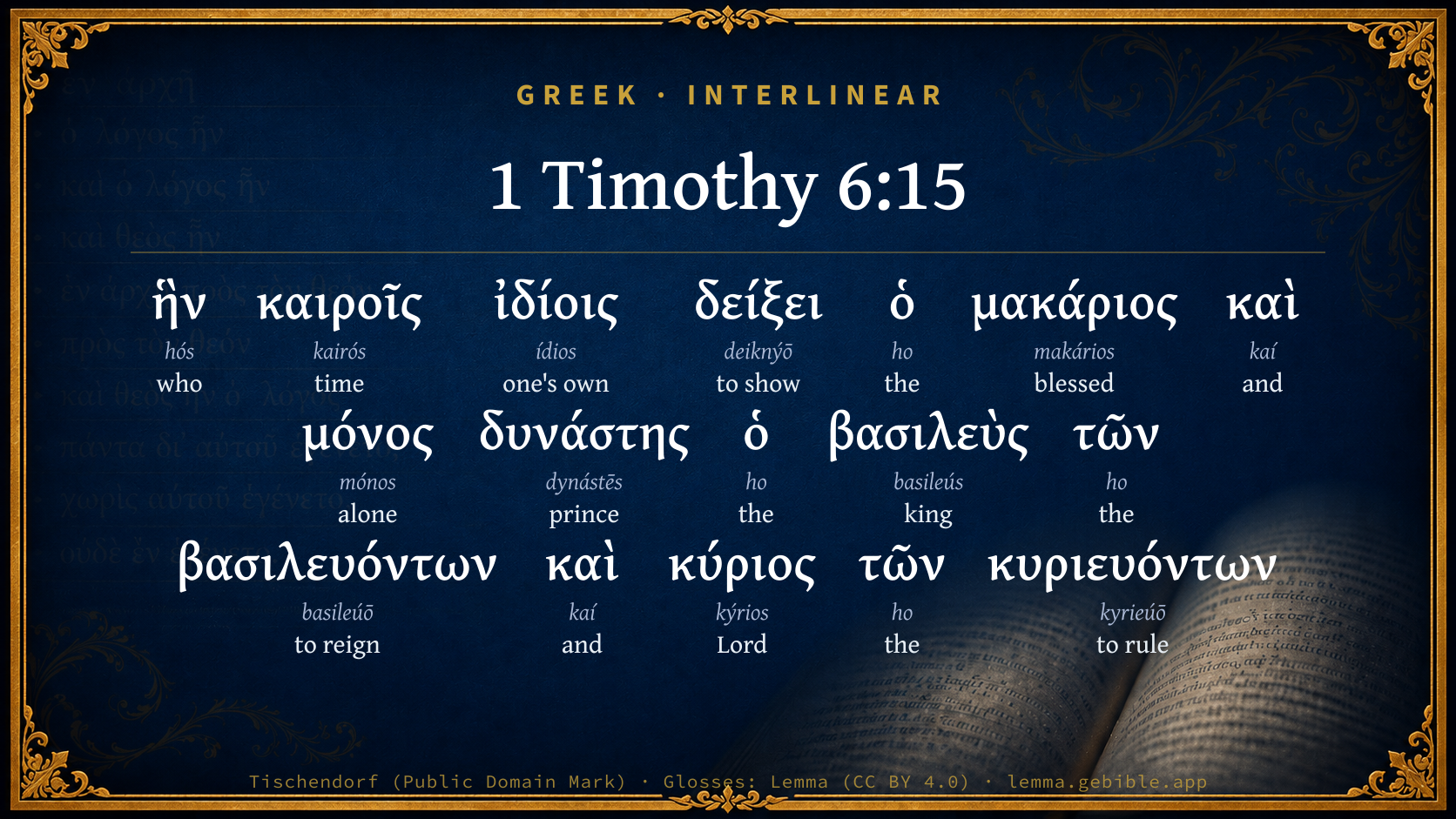
Greek (Tischendorf 8th ed.) 1 Timothy 6:15 appears in the Greek New Testament. The text above is from the Tischendorf 8th edition. Each word links to its Strong’s number and a concise gloss. Click any word for its full Thayer’s Greek Lexicon entry.
Download image
Cite this verse

1 Timothy 6:15 (World English Bible). Public Domain. Lemma interlinear Bible study tool, https://lemma.gebible.app/v/1-timothy/6/15.

Show BibTeX & RIS
BibTeX
RIS
English Translation
which in its own times he will show, who is the blessed and only Ruler, the King of kings, and Lord of lords;
World English Bible · Public Domain
Download a study sheet

One document with this verse’s original text, its word-by-word gloss line, the meaning frame, cross-references with their text, attributed commentary, and full source and license credits — printable, and it pastes into notes with its structure intact.

This verse Autodidact and up

Study sheet (.html) Plain text (.txt)

A passage Seminary Student

Up to 50 verses in one chapter. A passage sheet keeps up to 6 commentary sources and 12 cross-references per verse, in the order this page ranks them, and says so on the sheet whenever that leaves anything out. Ask for a single verse and you get the Autodidact verse sheet above.

Everything on this page stays free to read, with no account — the sheet is a download of what is already on screen, not access to it.

Want to remove ads? Support Godless Engineer
Compare translations 3

The same verse in 3 English versions, stacked beneath the original-language interlinear above. Click any original word for its lexicon entry.

Each is an independent rendering of the whole verse — the interlinear is not word-aligned to these translations.

Highlighted words mark where these versions differ — a whole-verse word diff, not a word-by-word alignment.

  • World English Bible Public Domain
    which in its own times he will show, who is the blessed and only Ruler, the King of kings, and Lord of lords;
  • King James Version Public Domain
    Which in his times he shall shew, who is the blessed and only Potentate, the King of kings, and Lord of lords;
  • unfoldingWord Literal Text CC BY-SA 4.0
    which in its own times the blessed and only Sovereign, the King of the ones reigning and Lord of the ones ruling, will reveal,

unfoldingWord Literal Text — © unfoldingWord, licensed CC BY-SA 4.0. Word-aligned USFM3 via Door43 (git.door43.org/unfoldingWord/en_ult).

Versions to compare (up to 4)

3 of 4 selected

Show all 19 translations

Every available English version of this verse, each an independent rendering of the whole verse.

  • World English Bible Public Domain
    which in its own times he will show, who is the blessed and only Ruler, the King of kings, and Lord of lords;
  • Berean Standard Bible Public Domain
    which the blessed and only Sovereign One—the King of kings and Lord of lords—will bring about in His own time.
  • Majority Standard Bible Public Domain
    which the blessed and only Sovereign One—the King of kings and Lord of lords—will bring about in His own time.
  • King James Version Public Domain
    Which in his times he shall shew, who is the blessed and only Potentate, the King of kings, and Lord of lords;
  • American Standard Version (1901) Public Domain
    which in its own times he shall show, who is the blessed and only Potentate, the King of kings, and Lord of lords;
  • Revised Version (1885) Public Domain
    which in its own times he shall shew, who is the blessed and only Potentate, the King of kings, and Lord of lords;
  • Geneva Bible (1599) Public Domain
    Which in due time hee shall shewe, that is blessed and Prince onely, the King of Kings and Lord of Lordes,
  • Douay-Rheims (1899) Public Domain
    Which in his times he shall shew who is the Blessed and only Mighty, the King of kings, and Lord of lords;
  • Young's Literal Translation Public Domain
    which in His own times He shall shew -- the blessed and only potentate, the King of the kings and Lord of the lords,
  • Literal Standard Version CC BY-SA 4.0
    which He will show in His own times—the blessed and only sovereign, the King of the kings and Lord of the lords,
  • Unlocked Literal Bible CC BY-SA 4.0
    God will reveal Christ's appearing at the right time—God, the blessed and only Sovereign, the King who reigns and the Lord who rules.
  • unfoldingWord Literal Text CC BY-SA 4.0
    which in its own times the blessed and only Sovereign, the King of the ones reigning and Lord of the ones ruling, will reveal,
  • Darby Bible Public Domain
    which in its own time the blessed and only Ruler shall shew, the King of those that reign, and Lord of those that exercise lordship;
  • World Messianic Bible Public Domain
    which at the right time he will show, who is the blessed and only Ruler, the King of kings and Lord of lords.
  • Webster's Bible Public Domain
    Which in his times he will show who is the blessed and only Potentate, the King of kings, and Lord of lords;
  • Free Bible Version CC BY-SA 4.0
    At the right time Jesus will be revealed—he who is the blessed and only Sovereign, the King of kings, and Lord of lords.
  • Bible in Basic English Public Domain
    Which at the right time he will make clear, who is the eternal and only Ruler, King of kings, and Lord of lords;
  • Text-Critical English NT CC BY 4.0
    which God will reveal in his own time. He is the blessed and only Sovereign, the King of kings and Lord of lords,
  • Tyndale New Testament (1534) Public Domain
    which aperynge (when the tyme ys come) he shall shewe that is blessed and myghty only kynge of kynges and lorde of lordes

Literal Standard Version (2020), Covenant Press — licensed CC BY-SA 4.0. Text via the HelloAO Bible API (eBible.org). Unlocked Literal Bible (unfoldingWord) — licensed CC BY-SA 4.0. Text via the HelloAO Bible API (eBible.org). unfoldingWord Literal Text — © unfoldingWord, licensed CC BY-SA 4.0. Word-aligned USFM3 via Door43 (git.door43.org/unfoldingWord/en_ult). Free Bible Version, Dr. Jonathan Gallagher — licensed CC BY-SA 4.0. Text via the HelloAO Bible API (eBible.org).

Word by word

More ways to search: Search by grammar → Find every occurrence → Compare this word →

Practice this passage: Drill this verse → Learn its vocabulary →

δυνάστης
dynástēs
G1413
“prince”
Noun, Nominative, Singular, Masculine
Part of Speech
Noun
Case
Nominative
Number
Singular
Gender
Masculine
Full Thayer's Definition

Origin: from G1410

TDNT: 06:44,2

1. a prince, a potentate 2. a courtier, high officer, royal minister of great authority
  1. ἣν hós G3739 “who” Relative pronoun, Accusative, Singular, Feminine
  2. καιροῖς kairós G2540 “time” Noun, Dative, Plural, Masculine
  3. ἰδίοις ídios G2398 “one's own” Adjective, Dative, Plural, Masculine
  4. δείξει deiknýō G1166 “to show” Verb, Future, Active, Indicative, 3rd person, Singular
  5. ὁ ho G3588 “the” Article, Nominative, Singular, Masculine
  6. μακάριος makários G3107 “blessed” Adjective, Nominative, Singular, Masculine
  7. καὶ kaí G2532 “and” Conjunction
  8. μόνος mónos G3441 “alone” Adjective, Nominative, Singular, Masculine
  9. ὁ ho G3588 “the” Article, Nominative, Singular, Masculine
  10. βασιλεὺς basileús G935 “king” Noun, Nominative, Singular, Masculine
  11. τῶν ho G3588 “the” Article, Genitive, Plural, Masculine
  12. βασιλευόντων basileúō G936 “to reign” Verb, Present, Active, Participle, Genitive, Plural, Masculine
  13. καὶ kaí G2532 “and” Conjunction
  14. κύριος kýrios G2962 “Lord” Noun, Nominative, Singular, Masculine
  15. τῶν ho G3588 “the” Article, Genitive, Plural, Masculine
  16. κυριευόντων kyrieúō G2961 “to rule” Verb, Present, Active, Participle, Genitive, Plural, Masculine

About this verse

These counts appear in no published source. They are computed here, from the morphology-tagged text and Lemma’s own curated glosses. What Lemma adds →

17
words
13
distinct lemmas
Pauline Epistles
section

Notable vocabulary

The rarest word here is δυνάστης prince G1413 — appearing just 3 times in the whole Greek New Testament.

Shared distinctive vocabulary

δυνάστης prince G1413 occurs in 3 verses of the Greek New Testament. Also found in:

Repetition

Words recur within this verse:

Cross-references

14

Topical passages linked to 1 Timothy 6:15 in the Treasury of Scripture Knowledge — connected by theme and wording, ordered by reader-vote popularity; previews shown in the World English Bible.

  • Revelation 19:16 He has on his garment and on his thigh a name written, "KING OF KINGS, AND LORD OF LORDS."
  • Revelation 17:14 These will war against the Lamb, and the Lamb will overcome them, for he is Lord of lords, and King of kings. They also will overcome who are with him, called and chosen and faithful."
  • 1 Timothy 1:17 Now to the King eternal, immortal, invisible, to God who alone is wise, be honor and glory forever and ever. Amen.
  • Psalms 47:2 For Yahweh Most High is awesome. He is a great King over all the earth.
  • Jeremiah 10:10 But Yahweh is the true God; he is the living God, and an everlasting King: at his wrath the earth trembles, and the nations are not able to abide his indignation.
  • 1 Timothy 1:11 according to the Gospel of the glory of the blessed God, which was committed to my trust.
  • Psalms 83:18 That they may know that you alone, whose name is Yahweh, Are the Most High over all the earth.
  • Jeremiah 46:18 As I live, says the King, whose name is Yahweh of Hosts, surely like Tabor among the mountains, and like Carmel by the sea, so shall he come.
  • Daniel 2:44–47 In the days of those kings shall the God of heaven set up a kingdom which shall never be destroyed, nor shall the sovereignty of it be left to another people; but it shall break in pieces and consume all these kingdoms, and it shall stand forever.
  • Daniel 4:34 At the end of the days I, Nebuchadnezzar, lifted up my eyes to heaven, and my understanding returned to me, and I blessed the Most High, and I praised and honored him who lives forever; for his dominion is an everlasting dominion, and his kingdom from generation to generation.
  • Proverbs 8:15 By me kings reign, And princes decree justice.
  • Ezra 7:12 Artaxerxes, king of kings, to Ezra the priest, the scribe of the law of the God of heaven, perfect and so forth.
  • Matthew 6:13 Bring us not into temptation, but deliver us from the evil one. For yours is the Kingdom, the power, and the glory forever. Amen.'
  • 1 Timothy 2:6 who gave himself as a ransom for all; the testimony in its own times;

Cross-references courtesy of OpenBible.info (CC BY 4.0).

Commentary

Notes on 1 Timothy 6:15 from classic Christian and Jewish commentators (each source and its license shown beneath its notes). The classic Christian expositions comment on the surrounding passage and are grouped to its opening verse, so a note may address several verses; the Jewish commentaries on the Tanakh (Rashi and others) are per-verse, so they appear only where the commentator wrote on this verse.

Lemma curates 59 commentaries, every one of them public domain or Creative Commons licensed, each selected and text-cleaned for this edition rather than reprinted as found. About our sources →

Tyndale Open Study Notes

Tyndale Open Resources

6:15-16 At just the right time (cp. 2:6), God will complete the salvation promised to us before the world began (2 Tim 1:9; Titus 1:2), which Christ enacted in his first appearance (1 Tim 2:6; Titus 1:3). The saving work of Christ is positioned within God’s sovereign and eternal purposes. This thought leads naturally into worship of God our Savior (cp. 1 Tim 1:17). • This material might be quoted from a baptismal confession (see study note on 6:12).

Tyndale Open Study Notes — © Tyndale Open Resources, licensed CC BY-SA 4.0. Text via the HelloAO Bible API.

Bengel's Gnomon

Johann Albrecht Bengel

1Ti 6:15. Καιροῖς ἰδίοις, in His own fitting times) The plural number is to be noticed, which does not much abridge (does not confine within very narrow limits) the shortness of the times: His own, viz. of which the reason (the regulating principle), power, knowledge, and revelation, is in His own hand. So ἴδιος, ch. 1Ti 2:6; 2Ti 1:9; Tit 1:3. A divine reservation.—δείξει, He shall show) To be shown is an expression used of what formerly existed. God will show Him (Act 3:20), of whom a most magnificent panegyric follows, involving in it the glory of Christ itself [as well as that of God the Father].—ὁ μακάριος καὶ μόνος δυνάστης, the blessed and only Potentate) These are two predicates:[52] the first, with the addition also of only, is treated of in 1Ti 6:16 [“who only hath immortality”]; for the word μακάριος and ἀκήρατος[53] have the same derivation, and signify immortal; and hence honour (1Ti 6:16) is due to Him: the second is treated of presently after in this verse, and hence power everlasting (1Ti 6:16) is due to Him. This is the reason why men in power, and death threatened by them, should not be feared in the confession of the Gospel. So eternal power is mentioned at Rom 1:20.—τῶν βασιλευότων—ΚΥΡΙΕΥΌΝΤΩΝ, of those reigning—of those ruling) Spiritually and politically.

[52] Who is the blessed and only Potentate. ὁ δυνάστης is not the subject of δείξει, but a predicate of its subject.—ED.

[53] Bengel derives μακάριος from μὴ, and κήρ, death; and so ἀκήρατος from α privative, and κὴρ, death. The derivation of ἀκήρατος is rather from α and κεράννυμι: and μακάριος is of dubious etymon. Some give χαίρω (?).—ED.

Bengel's Gnomon of the New Testament — English translation (T&T Clark, Edinburgh, 1860) — public domain. Text from a community e-Sword module.

Meyer's Critical & Exegetical Commentary

Heinrich August Wilhelm Meyer

1Ti_6:15-16. The apostle concludes with a doxology, which is attached to the previous words by means of the relative clause ἣν … δείξει κ.τ.λ.

ἣν καιροῖς ἰδίοις δείξει] On καιροῖς ἰδ., comp. 1Ti_2:6; Tit_1:3; also Gal_6:9.

δείξει] Bengel: ostendi dicitur, quod jam ante erat, Act_3:20. The verb does not mean effect; nor is it, with Heydenreich, to be translated: which He will show in its majesty, will cause to follow and present in visible glory, but simply: which He will make visible, cause to appear. The expression is used by the apostle in reference to Christs present hiddenness. The hope of the near return of Christ did not lead the apostle to fix arbitrarily the hour when that would take place.

Instead of the simple Θεός, there follows, as subject to δείξει, a series of designations for God, by which Paul represents God as the blessed, the only potentate, the immortal, the invisiblein one word, the absolute (comp. with this 1Ti_1:17). This he does not simply for the purpose of giving to his words a more solemn conclusion (de Wette), but to satisfy the inward impulse of naming the chief features of the idea of God as rooted in the Christian consciousnessspecially in opposition to the fictions of the heretics (according to Wiesinger, in antithetic reference to the striving after earthly riches, rebuked in the preceding verses).

ὁ μακάριος] comp. 1Ti_1:11; μακάριος is to be taken as an adjective, as is clear from the omission of the article before μόνος.

Καὶ μόνος δυνάσγης] To God alone as the Almighty is the predicate δυνάστης due in the absolute sense; hence the addition of μόνος. The supreme power contained in δυνάστης (comp. 2Ma_12:15; 3Ma_5:51) is made still more prominent by the next words: ὁ βασιλεὺς τῶν βασιλευόντων κ.τ.λ.; comp. 1Ti_1:17; Rev_17:14; Deu_10:17; Psa_136:3.1Ti_6:16. ὁ μόνος ἔχων ἀθανασίαν] comp. 1Ti_1:17. Ἀθανασία is synonymous with ἀφθαρσία, 1Co_15:53; Justin Martyr (Quaest. et Respons. ad Orthod. 61): μόνος ἔχων τὴν ἀθανασίαν λέγεται ὁ Θεός, ὅτι οὐκ ἐκ θελήματος ἄλλου ταύτην ἔχει, καθάπερ οἱ λοιποὶ πάντες ἀθάνατοι, ἀλλʼ ἐκ τῆς οἰκείας οὐσίας.

φῶς οἰκῶν ἀπρόσιτον] This idea that God, who is Himself called light (1Jn_1:5), dwells in light, is found nowhere else in the N. T.; but we may compare with it Psa_104:2; Eze_1:26 ff. Chrysostom remarks on this: οὐκοῦν καὶ τόπῳ ἐμπεριείληπται; ἄπαγε· οὐχ ἵνα τοῦτο νοήσωμεν, ἀλλʼ ἵνα τὸ ἀκατάληπτον τῆς θείας φύσεως παραστήση, φῶς αὐτὸν οἰκεῖν εἶπεν ἀπρόσιτον, οὕτω θεολογήσας, ὡς ἦν αὐτῷ δυνατόν.

The verb οἰκεῖν is found only here in the N. T. with an accusative; the construction is often found in the classics, also 2Ma_5:17; 2Ma_6:2.

ἀπρόσιτος is ἅπ. λεγ. in Holy Scripture. This participial clause does not serve as a reason for the one previous (Hofmann: by dwelling in light unapproachable), but adds to it a new definition of the divine nature.

To the idea that God is surrounded by an unapproachable majesty of light, there is attached the corresponding thought: ὃν εἶδεν οὐδεὶς ἀνθρώπων, οὐδὲ ἰδεῖν δύναται; on which comp. Joh_1:18; 1Jn_4:12; Mat_11:27. The following two sentences may serve as explanation: Theophilus (ad Autol. p. 71): τὸ εἶδος τοῦ Θεοῦ … μὴ δυνάμενον ὀφθαλμοῖς σαρκίνοις ὁραθῆναι; and Dionysius Areop. (De Divin. Nom. ch. i. p. 376, I. ed. Corder): πάσαις διανοίαις ἀδιανόητόν ἐστι τὸ ὑπὲρ διάνοιαν ἕν.[208]

ᾧ τιμὴ καὶ κράτος αἰώνιον] comp. 1Ti_1:17.

[208] There is no good ground for deriving, with Hofmann, all these names for God from His relations to other potentates who meet with trouble, whom death does not permit to abide, who are not unapproachable and invisible. And there is as little ground for saying that this doxology was added, because the apostle intended to describe God who will grant to see the appearance of Jesus as judge with reward or punishment, to describe Him as a potentate who is infinitely more and higher than all earthly kings and lords, and did so because Timothy was in danger of injuring his position as a Christian, and his calling as a teacher for the sake of gain (!).

Meyer — Critical and Exegetical Commentary on the New Testament — English translation by Peter Christie, edited by Frederick Crombie (T&T Clark, 1880) — public domain. Text from a community e-Sword module.

Expositor's Greek Testament

ed. W. Robertson Nicoll

1Ti 6:15 . καιροῖς ἰδίοις : See note on 1Ti 2:6 . In due season may refer primarily either to the appropriateness of the occasion of the ἐπιφάνεια or to the supreme will of the δυνάστης . The wording of the discouragement given by Jesus, in Act 1:7 , to those who would pry into the future makes it natural to suppose that this latter notion chiefly was in St. Paul’s mind here ( καιροὺς οὓς ὁ πατὴρ ἔθετο ἐν τῇ ἰδίᾳ ἐξουσίᾳ ). We may perhaps put it thus: A devout mind recognises the providential ordering of past events as having taken place at the time best fitted for them, and shrinks from the presumption of guessing the appropriate time for future events. Thus there is no presumption in saying “When the fulness of the time came, God sent forth his Son”; and when the time is ripe, He will send Him again (Act 3:20 ).

δείξει : Ell. well explains the force of this verb from Joh 2:18 , τί σημεῖον δεικνύεις ἡμῖν ; The last ἐπιφάνεια will be the final proof offered by God to the human race.

The terms of this magnificent characterisation of God are an expansion of the epithets in the doxology in 1Ti 1:17 q.v .

μακάριος : See on 1Ti 1:11 . Philo ( de Sacrific. Abelis et Caini , p. 147) has the remarkable parallel, περὶ θεοῦ τοῦ ἀγεννήτου , καὶ ἀφθάρτου , καὶ ἀτρέπτου , καὶ ἁγίου , καὶ μόνου μακαρίου .

δυνάστης is found as a title of God in the Apocrypha. See reff., esp. 2Ma 3:24 , ὁ … δυνάστης ἐπιφανίαν μεγάλην ἐποίησεν . It occurs in the ordinary sense, Luk 1:52 , Act 8:27 . The choice of the phrase μόνος δυν . here was perhaps suggested by the thought of His absolute and irresponsible power in arranging the times and seasons for the affairs of men. It is unnecessary to seek any special polemical object in μόνος , as exclusive of dualism. As has been already suggested (on 1Ti 1:17 ), the predications of glory to God that occur in these epistles are probably repeated from eucharistic prayers uttered by St. Paul in the discharge of his prophetic liturgical functions.

ὁ βασιλεύς , κ . τ . λ .: The Vulg. renders rather inconsistently, Rex regum et Dominus dominantium . So also in Rev 19:16 . It is not quite obvious why the phrase is varied from the usual βασιλεὺς βασιλέων ( 2Ma 13:4 ; Rev 17:14 ; Rev 19:16 ) and Κύριος [ τῶν ] Κυρίων (Deu 10:17 ; Psa 136:3 ; Enoch ix. 4). Perhaps the participle gives new vigour to a phrase that had lost its freshness.

The Expositor's Greek Testament, edited by W. Robertson Nicoll (1897–1910) — public domain. Text from a community e-Sword module.

Geneva Bible (1599)

Geneva Bible translators

He heapeth many words together, to one purpose: whereby he voucheth the power of God, which if we stick fast unto, we shall not be moved out of our standings.

Geneva Bible (1599) marginal notes — public domain. Text via Bolls.life.

Jamieson, Fausset & Brown

Robert Jamieson, A. R. Fausset & David Brown

in his times--Greek, "His own [fitting] times" (Act 1:7). The plural implies successive stages in the manifestation of the kingdom of God, each having its own appropriate time, the regulating principle and knowledge of which rests with the Father (Ti1 2:6; Ti2 1:9; Tit 1:3; Heb 1:1).

he shall show--"display": an expression appropriate in reference to His "APPEARING," which is stronger than His "coming," and implies its visibility; "manifest": make visible (compare Act 3:20): "He" is the Father (Ti1 6:16).

blessed--in Himself: so about to be the source of blessing to His people at Christ appearing, whence flows their "blessed hope" (Ti1 1:11; Tit 2:13).

only-- (Joh 17:3; Rom 16:27; Rev 15:4).

King of kings--elsewhere applied also to Jesus (Rev 1:5; Rev 17:14; Rev 19:16).

Jamieson, Fausset & Brown — Commentary Critical and Explanatory on the Whole Bible (1871) — public domain (CC PDM 1.0). Text via the HelloAO Bible API.

Adam Clarke's Commentary

Verse 15. Which in his times he shall show] Jesus will appear in the most proper time; the time which the infinite God in his wisdom has appointed for the second coming of his Son.

The blessed and only Potentate] δυναστης, Potentate, is applied to secular governors; but none of these can be styled ὁ μακαριος και μονος, the happy and only One; ὁ Βασιλευς των βασιλευοντων, the King of kings, or the King over all kings; and Κυριος των κυριευοντων, the Lord over all lords or rulers. These are titles which could not be given to any mortals. This is made more specific by the verse following.

Ver. 15. Ὁ μακαριος και μονος Δυναστης, ὁ Βασιλευς των βασιλευοντων, και Κυριος των κυριευοντων.

The supreme Being is also styled the King of kings, and the Blessed, by AESCHYLUS in his tragedy of the Supplicants:-

Αναξ ανακτων, μακαρων

Μακαρτατε, και τελεων

Τελειοτατον κρατος.

Ver 520. Ed. Porson.

"O King of kings! most Blessed of the blessed! most Perfect of the perfect!"

Adam Clarke's Commentary on the Bible (1810–1826) — public domain. Text from a community e-Sword/MySword module.

John Calvin's Commentaries

15 Which in his seasons he will show We are commonly hasty in our wishes, and not far from prescribing a day and hour to God, as if we should say, that he must not delay to perform anything that he has promised; and for that reason the Apostle takes an early opportunity of restraining excessive haste, by expecting the coming of Christ. For that is the meaning of the words, “which in his seasons he will show.” When men know that the proper time for anything is not fully come, they wait for it more patiently. How comes it that we are so patient in bearing with the order of nature, but because we are restrained by this consideration, that we shall act unreasonably, if we struggle against it with our desires? Thus we know, that the revelation of Christ has its appointed time, for which we must wait patiently.

The blessed and only Prince Those splendid titles are here employed in exalting the princely authority of God, in order that the brilliancy of the princes of this world may not dazzle our eyes. And such instruction was, at that time, especially necessary; for by how much all kingdoms were then great and powerful, by so much were the majesty and glory of God thrown into the shade. For all that governed the kingdoms of the world not only were deadly enemies of the kingdom of God, but proudly mocked at God, and trampled his sacred name under their feet; and the greater the haughtiness with which they despised true religion, the more happy did they imagine themselves to be. From such an aspect of things who would not have concluded that God was miserably vanquished and oppressed? We see to what a pitch of insolence Cicero rises against the Jews on account of their humbled condition, in his oration for Flaccus.

When good men see that the wicked are puffed up with prosperity, they are sometimes cast down; and therefore Paul, for the purpose of withdrawing the eyes of the godly from that transitory splendor, ascribes to God alone “blessedness, principality, and kingly power.” When he calls God the only prince, he does not overthrow civil government, as if there ought to be no magistrates or kings in the world, but means that it is He alone who reigns from himself and from his own power. This is evident from what follows, which he adds by way of exposition, —

King of kings, and Lord of lords The sum of it is, that all the governments of the world are subject to his dominion, depend upon him, and stand or fall at his bidding, but that the authority of God is beyond all comparison, because all the rest are nothing as compared with his glory, and while they fade and quickly perish, his authority will endure for ever.

John Calvin's Commentaries (1540-1563) — public domain. Text from the Calvin Translation Society English edition (1840s-50s) via the Christian Classics Ethereal Library (ccel.org). Calvin's coverage is partial (roughly two-thirds of the Bible); uncommented books and verses are honest gaps, never fabricated. The 19th-century editor's footnotes and remarks are omitted so the notes are faithfully Calvin's own voice.

Ellicott's Commentary for English Readers

(15) Which in his times he shall shew.—More accurately rendered, which in his own seasons. Here the language of fervid expectation is qualified by words which imply that in St. Paul’s mind then there was no certainty about the period of the “coming of the Lord.” It depended on the unknown and mysterious counsels of the Most High. The impression left upon our minds by the words of this and the preceding verse is that St. Paul had given up all hope of living himself to see the dawn of that awful day, but he deemed it more than probable that his son in the faith would live to witness it. Hence his words to him: “Keep the commandment without spot until the Epiphany of our Lord Jesus Christ.”

Who is the blessed and only Potentate.—The stately and rhythmical doxology with which the solemn charge to Timothy is closed was not improbably taken from a hymn loved by the Ephesian Christians, and often sung in their churches; the words, then, were, likely enough, familiar to Timothy and his people, though now receiving a new and deeper meaning than before. Well might Timothy, as example to the flock of Ephesus, keep “the commandment without spot, unrebukeable”—fearlessly, even though danger and death were presented before him as the sure reward of his faithfulness—for He who in His own times should reveal (show) the Lord Jesus returning to earth in glory, was inconceivably greater and grander than any earthly potentate, king, or lord, before whose little throne Timothy might have to stand and be judged for his faithfulness to the “only Potentate, the King of kings, and Lord of lords.”

Of the first of these sublime titles, God is termed “the blessed,” or the happy, because He is the source of all blessedness and happiness; and the “only Potentate,” in solemn assertion that the Christian’s God was One, and that to none save to Him could this appellation “only Potentate” be applied. Possibly already in Ephesus the teachers of Gnosticism had begun their unhappy work—with their fables of the mighty æons, and their strange Eastern conception of one God the source of good, and another the source of evil.

The King of kings, and Lord of lords.—God is king over those men style kings, and lord over all men call lords here.

A Bible Commentary for English Readers, edited by Charles John Ellicott (1878–1897) — public domain. Text from a community e-Sword module.

The Cambridge Bible for Schools and Colleges

gen. ed. J. J. S. Perowne

15. in his times] R.V. in its own times, apparently because sometimes it must be so, e.g. 1Ti_2:6; and this would point to a set meaning and quasi-adverbial use. But in Tit_1:2 inconsistently ‘his own seasons.’

the blessed and only Potentate] The ‘only,’ without being polemical, states the grand truth positively, which is the antidote to the questionings of the heretical negations. See note on 1Ti_6:13.

King of kings, and Lord of lords] A title given to our Lord, Rev_17:14, as the Lamb; clearly here to God the Father—an addition to the many similar proofs of the Unity of the Godhead. Cf. Pearson, On the Creed, Art. 1.

The Cambridge Bible for Schools and Colleges (gen. ed. J. J. S. Perowne; Cambridge University Press, 1878–1918) — public domain. Text from a community e-Sword module.

John Gill's Exposition

Which in his times he shall show,.... For though the time of Christ's appearing is unknown, yet the thing itself is certain; God will bring it about, and make it manifest in his own time, in the time that is fixed and appointed by him; and which is only known unto him, and which he keeps in his own power, and has reserved in his own breast:

who is the blessed; the Syriac version reads, "the blessed God"; who is blessed in himself, in his Son and Spirit, in the perfections of his nature; who is God all-sufficient, has enough in himself for himself, and for all his creatures; who is the fountain and the author of all blessedness, temporal, spiritual, and eternal, which any of them are, or shall be possessed of:

and only Potentate; or Governor of the whole world, which can be said of none but himself: he is the Governor among the nations, and over all the nations of the earth; his kingdom rules over all other kingdoms; and he has his power and government from himself, whereas all other potentates have their power from him, as follows:

the King of kings, and Lord of lords; from whom they receive their sceptres, crowns, and kingdoms; by whom they reign, and are continued in their power; for he sets up kings, and removes kings at his pleasure, and to him they must be accountable for all their administrations another day; and at present they are under his influence, and at his control; he has their hearts, and their counsels, as well as kingdoms, in his hands, and under his overruling providence; and causes all to answer his wise and eternal purposes. These titles are used by the Jews, who style him, , "Lord of all lords, King over all kings" (s). The same name is given to Christ, Rev 19:16 which shows him to be equal with the Father.

(s) Zohar in Numb. fol. 100. 2.

John Gill's Exposition of the Whole Bible (1746–1763) — public domain (CC PDM 1.0). Text via the HelloAO Bible API.

Trapp's Complete Commentary

John Trapp

15 Which in his times he shall shew, who is the blessed and only Potentate, the King of kings, and Lord of lords;

Ver. 15. Which in his times he shall show] Let no man therefore ask, Where is the promise of his coming? Though he be slow, yet he is sure; and his time is the best time: wait, Jas 5:7.

The blessed and only potentate] A lively and lofty description of God, whom yet none can possibly describe. One being asked, what God was, answered, Si scirem, Deus essem.

John Trapp, A Commentary or Exposition upon All the Books of the Old and New Testament (1647–1656) — public domain. Text from a community e-Sword module.

Albert Barnes' Notes on the Bible

Which in his times he shall show - Which God will reveal at such times as he shall deem best. It is implied here that the time is unknown to people; see the notes on Act 1:7.

Who is the blessed and only Potentate - God, who is the ruler over all. The word used here - δυνάστης dunastēs - means one who is “mighty” Luk 1:22, then a prince or ruler; compare Act 8:27. It is applied here to God as the mighty ruler over the universe.

The King of kings - Who claims dominion over all the kings of the earth. In Rev 7:14, the same appellation is applied to the Lord Jesus, ascribing to him universal dominion.

Lord of lords - The idea here is, that all the sovereigns of the earth are under his sway; that none of them can prevent the accomplishment of his purposes; and that he can direct the winding up of human affairs when he pleases.

Albert Barnes' Notes on the Bible (1834–1885) — public domain. Text from a community e-Sword/MySword module.

Matthew Poole's English Annotations

Which in his times he shall show; on Which Christ coming the second time, God in his time, his proper seasons, (so it is in the Greek), will show. Or: Which appearing of our Lord Jesus God in his time will show; for some Greek copies read the article in the feminine termination, to distinguish the order of the Trinity’s working; as the first coming of Christ is made to be from the Father’s sending, so is also the second coming.

Who is the blessed and only Potentate: God is said to be the only Potentate, because he only hath power in and from himself, by him kings reign; and he is called the blessed Potentate, because he is the fountain of all felicity and happiness.

The King of kings, and Lord of lords; that is, the most mighty King and Lord, to whom all other princes are subjects, all other lords are vassals, Rev 17:14; 19:16. These terms seem here to be applied to the Father, though they agree also to the Son and the Spirit. They are applied to Christ, Rev 17:14; 19:16.

Matthew Poole's English Annotations on the Holy Bible (1683–1685) — public domain. Text from a community e-Sword/MySword module.

Whedon's Commentary on the Bible

Daniel D. Whedon

15. In his own times—An obvious allusion to Act_1:7, (where see notes,) and clearly indicating that St. Paul fully recognised that the judgment advent is to be at an unknown time.

Shall show—Shall exhibit the sublime spectacle of Christ’s epiphany. And now we are told, in St. Paul’s most vivid style, who is this He that shall show the final forthcoming of Christ.

Only Potentate—The sole dynast; for what earthly sovereign can be named as real potentate in the comparison?

King of kings—A sublime title, given by St. John to Christ himself, Rev_19:16. Philo has the phrase King of kings and God of gods. We trace the phrase back to David, Psa_136:3, and even to Moses, Deu_10:17.

Daniel D. Whedon (gen. ed.), Commentary on the Old and New Testaments (1874–1909) — public domain. Text from a community e-Sword module.

The Pulpit Commentary

Its own for his, A.V This correction seems to be manifestly right. The same phrase is rendered in 1Ti_2:6 and Tit_1:3 "in due time," in the A.V; but in the R.V 2:6 is "its own times," and in Tit_1:3 "his own seasons. Inrw Gal_6:9 kai ijdiw is also rendered "in due season," in both the A.V and the R.V Such a phrase as ejn kairoiv ijdioiv must be taken everywhere in the same sense. It clearly means at the fitting or proper time, and corresponds to the plhrwma tou cronou, "the fullness of time," in Gal_4:4. The two ideas are combined insontai Luk_1:20 (plhrwqh eijv ton kairon aujtwn) and 21:24 (comp. Eph_1:10) Shall show (deixei). Deiknuein ejpifaneian, "to show an appearing," is a somewhat unusual phrase, and is more classical than scriptural. The verb and the object are not of cognate sense (as "to display a display," or "to manifest a manifestation"), but the invisible God, God the Father, will, it is said, display the Epiphany of our Lord Jesus Christ. The wonder displayed and manifested to the world is the appearing of Christ in his glory. The Author of that manifestation is God. The blessed; oJ makariov (not eujloghtov, as in, Mar_14:61) is only here and in 1Ti_1:11 (where see note) applied to God in Scripture. The blessed and only Potentate. The phrase is a remarkable one. Dunasthv (Potentate), which is only found elsewhere in the New Testament in Luk_1:52 and Act_8:27, is applied to God here only. It is, however, so applied in RAPC 2Ma 3:24 12:15 15:23, where we have Pashv ejxousiav dunasthv Gon megan tou kosmou dunasthn, and Dunasta twn oujranwn; in all which places, as here, the phrase is used to signify, by way of contrast, the superiority of the power of God over all earthly power. In the first of the above-cited passages the language is singularly like that here used by St. Paul. For it is said that oJ pashv ejxousiav dunasthv, "the Prince (or Potentate) of all power made a great apparition," or "appearing" (ejpifoneian megalhn ejpoihsen), for the overthrow of the blasphemer and persecutor Heliodorus. St. Paul must have had this in his mind, and compared the effect of "the appearing of our Lord Jesus Christ," in overthrowing the Neros of the earth with the overthrow of Heliodorus. (comp. 1Th_1:7-10) King of kings, and Lord of lords, etc. (compare the slightly different phrase in Rom 17:14 and 19:16, applied to the Son). So in Psa_136:2, Psa_136:3, God is spoken of as "God of gods, and Lord of lords."

The Pulpit Commentary (1880–1919), ed. H.D.M. Spence-Jones & Joseph S. Exell — public domain. Text from a community e-Sword module.

John Wesley's Explanatory Notes

Which - Appearing. In his own times - The power, the knowledge, and the Revelation of which, remain in his eternal mind.

John Wesley, Explanatory Notes Upon the Whole Bible (1754–1765) — public domain. Text via the GEBible commentary corpus.

Fairbairn on Ezekiel, Jonah & the Pastoral Epistles

Patrick Fairbairn

Vers. 15, 16. These verses begin with a more particular description of the expected appearance of Christ in its relation to God, and then run out into a doxology, celebrating the incomparable greatness and glory of God. This Baur and others would regard as a protest against the semi-polytheism or dualism of the Gnostics—an entirely fanciful and unnatural view. The object seems rather to have been to fortify the mind of Timothy to a consistent and persevering adherence to the Christian faith and life amid the scorn or opposition of worldly powers of the stamp of Pontius Pilate, by placing distinctly before him the sole supremacy, the peerless eminence, and infinite sufficiency of Him who has decreed the future manifestation in glory of Christ, as He had done that of His past humiliation. This affords a reason perfectly cognate to many others introduced by the apostle in this epistle (1Ti 1:18-19, 1Ti 2:5-7, 1Ti 3:15-16, 1Ti 5:21, etc.), and in proper keeping with the connection. Which (namely, appearance) in His own seasons He shall show, [who is] the blessed and only Potentate, the King of kings and Lord of lords, who only has immortality, dwelling in light that is unapproachable, whom no man hath seen nor can see: to whom be honour and power everlasting. Amen. In regard to what is said at the outset about the appearing of Christ, that it is to take place in God’s own seasons, there is plainly indicated a certain indefiniteness, as in regard to a matter which belongs to the secret things of God, not therefore to be pronounced upon by the superficiality and littleness of human foresight (Bengel: brevitatem temporis non valde coarctuans). The words remind us—perhaps were purposely designed to remind us—of the address given by our Lord before His ascension to the disciples on this very subject: “It is not for you to know the times or the seasons, which the Father hath put in His own power” (Act 1:6),—the seasons, namely, which concern the greater movements of Christ’s kingdom, and especially, as here, His advent in glory. Nay, our Lord Himself had previously told them, that as regards the precise period when He should come to manifest Himself in the glory of that kingdom, even He did not know it in His humiliation (Mar 13:32), doubtless because He did not wish to know it; the knowledge would have been unsuited to that transient and provisional state of things. God is here designated the blessed, as at 1Ti 1:11—the antithesis of everything that can be called sorrow or vexation; also the only Potentate (μόνος δυνάστης)—alone in the universe possessed of independent right, absolute sovereignty. The epithet King of kings and Lord of lords is, with a slight variation in the form, directly applied to Christ in Rev 17:14, Rev 19:16; for in this, as in all divine prerogatives, “all that the Father hath is His.” But it is plainly God the Father that is here the subject of discourse, as some parts of the description are not properly applicable to Christ as the God-man. When it is said of God that He only has immortality, the meaning plainly is, He alone has it of Himself—it is in Him as its fountainhead. Joh 5:26, which declares the Father to have life in Himself—life in the full and absolute sense—is substantially parallel. Further, He is represented as dwelling in an atmosphere of light—light that from its excessive splendour and intense brilliancy is incapable of being approached or looked upon by the eye of man: compare Joh 1:18; 1Jn 1:5; Psa 104:2. The whole of this sublime representation concludes, and is most appropriately wound up, with an ascription of honour and power to God, as alone entitled to receive the homage and adoration of His intelligent creatures.

Patrick Fairbairn — An Exposition of Ezekiel (1851), Jonah (1849), and The Pastoral Epistles (1874) — public domain. Text from a community e-Sword module.

The People's New Testament

B. W. Johnson

15. Which in his time he shall show. In his own times. Man knows not the day or hour. The Blessed and only potentate. All power in heaven and earth had been placed in Jesus Christ's hands (Matt. 28:18; Rev. 17:14; 19:16).

B. W. Johnson's The People's New Testament with Notes (1889–1891) — public domain. Electronic text from the Christian Classics Ethereal Library (CCEL) ThML edition.

unfoldingWord translationNotes

Door43 World Missions Community

God will reveal Christ's appearing

It is implied that God will reveal Jesus. AT: "God will reveal Jesus" (See: Assumed Knowledge and Implicit Information)

at the right time

"at the proper time"

the blessed and only Sovereign

"the One worthy of praise who rules over the world"

Only he has immortality

"Only he has the power to live forever"

dwells in inapproachable light

"dwells in a light so bright that no one can approach him"

translationWords

bless

power

king

reign

lord

rule

honor

eternity

amen

unfoldingWord translationNotes — © Distant Shores Media and the Door43 World Missions Community, licensed CC BY-SA 4.0. Source: git.door43.org/Door43/en_tn.

Cambridge Greek Testament for Schools and Colleges

15. ἣν καιροῖς ἰδίοις δείξει, which He will display in His own seasons; see on 1Ti 2:6, and Act 1:7, καιροὺς οὖς ὁ πατὴρ ἕθετο ἐν τῇ ἰδίᾳ ἐξουσίᾳ.

The epithets which follow are descriptive of the Eternal Father, and it is not improbable that they and the doxology of 1Ti 6:16 are taken from some liturgical (perhaps even Jewish) formula which had already become stereotyped by use.

μακάριος. see on 1Ti 1:11.

καὶ μόνος δυνάστης. We have μόνῳ θεῷ in the doxology in 1Ti 1:17, which should be compared all through with this verse. It does not seem necessary to suppose any special controversial reference to the aeons of Gnostic theology, or to heathen polytheism. The Unity and Sovereignty of God were first principles of the Hebrew religion, and they would fitly be mentioned in an early Christian doxology. Cp. Philo de sacrificiis Abelis et Caini 30, περὶ θεοῦ τοῦ ἀγεννήτου καὶ ἀφθάρτου καὶ ἀτρέπτου καὶ ἁγίου καὶ μόνου μακαρίου. δυνάστης is not used elsewhere by St Paul; it is frequently applied to men in the LXX. and in Luk 1:52; Act 8:27, and to God, as here, in Sir 46:5; Sir 46:16 and 2Ma 12:15; 2Ma 3:24 (ὁ … δυνάστης ἐπιφανείαν μεγάλην ἐποίησεν). We have the phrase μόνος ἐστὶ δυνάστης in Orac. Sibyll. III. 718.

ὁ βασιλεὺς τῶν βασιλευὀντων κ.τ.λ. We have κύριος τῶν κυρίων καὶ βασιλεὺς τῶν βασιλέων in Dan 4:34 LXX. (cp. Rev 17:14; Rev 19:16); and the same phrase (reading βασιλευόντων) in the Book of Enoch (ix. 4). King of kings was a title commonly assumed by Eastern monarchs; the early Christian writers apply it to God alone. Jehovah is named κύριος τῶν κυρίων in Deu 10:17; Psa 136:3.

Cambridge Greek Testament for Schools and Colleges (Cambridge University Press, 1896; 21 vols, various authors incl. Carr, Maclear, Plummer, Farrar, Lumby, Moule, M. R. James, Simcox) — public domain. Text from a community e-Sword module.

International Critical Commentary

15. καιροῖς ἰδίοις] cf. Tit 1:3 note. This description of God is full of O.T. reminiscences and is perhaps based on some doxology in use in the synagogue. The stress is laid on the supremacy of God over earthly rulers (ἵνα μὴ δεδοίκῃ τοῦς ἐνταῦθα βασιλεῖς, Chrys.): on His sole possession of life 12, 13, and on His superhuman Majesty. These qualities were brought out in the O.T. in contrast to the heathen gods, here also in contrast to earthly kings, especially to the growing cult of the Roman Emperors. Dibelius quotes the Acts of the Scillitan Martyrs, “jura per genium domini nostri imperatoris,” “Cognosco dominum meum, regem regum et imperatorem omnium gentium.” The Greek metaphysical conception of God may also influence the description (cf. 1:11 note).

μακάριος] cf. 1:11; μόνος δυνάστης, cf. 1:17, 2 Mac 1:24 ὁ μόνος βασιλεύς: 2 Mac 12:15 τὸν μέγαν τοῦ κόσμου δυνάστην, Ecclus 46:5 τὸν ὕψιστον δυνάστην.

ὁ β. τῶν β. κ.τ.λ.] Deu 10:17, Dan 4:34, Rev 17:14, Rev 19:16, Enoch 9:4; Cf. sup. 1:17 note. There is perhaps an implied contrast with Pontius Pilate, the temporary, the unjust, delegate; cf. Martyr. Polyc. 21 of Polycarp’s martyrdom, ἀνθυπατεύοντος Στατίου Κοδράστον, βασιλεύοντος δὲ εἰς τοὺς αἰῶνας Ἰησοῦ Χριστοῦ.

International Critical Commentary — older volumes (1896–1929), various authors — public domain. Text from a community e-Sword module.

Vincent's Word Studies in the New Testament

Marvin R. Vincent

In his times [καιροις ιδιοις] . Better, his own seasons, or its own seasons. wither the seasons proper to the appearing, or the seasons which God shall see fit to select. See on ch. 1ti 2:6 Potentate [δυναστης] . Only here of God. Very often in LXX See Sir. 46 5; q 2 Macc. 12 15, etc. In Class. applied to Zeus (Soph. Antig. 608). In Aesch. Agam. 6, the stars are called lamproi dunastai bright rulers, as the regulators of the seasons.

Of kings [των βασιλευοντων] . Lit. of those who rule as kings. Only here for the noun, basilewn. Basileuv bsilewn king of kings, Rev 17:14; Rev 19:16.

Of lords [κυριευοντων] . Lit. of those who Lord it. Only here for the noun kuriwn. See kuriov kuriwn Lord of lords, Rev 19:16; comp. LXX, Deu 10:17; Psa 135:3. Probably liturgical.

Marvin R. Vincent, Word Studies in the New Testament (1887–1900) — public domain. Text from a community e-Sword/MySword module.

Lesson kit

Teaching starters — assembled from the data on this page, not authored interpretation. Every prompt links to the verse data it draws on. Edit before teaching.

1 Timothy, in the Pauline Epistles, opens this verse with 17 words (13 distinct Greek lemmas). Its most distinctive word is dynástēs (“prince”). A historical commentator’s framing appears above. Read the whole chapter for the surrounding context.

Discussion questions

  1. How does “prince” (dynástēs) shape what this verse is saying?
  2. How does Luke 1:52, which shares the word «prince», read alongside this verse?
  3. What does the repetition of “the” (4× in this one verse) do in this verse?
  4. These translations render this verse differently. What is at stake in choosing one wording over another?
  5. Compare how Tyndale Open Study Notes and Bengel's Gnomon read this verse. Where do they agree or differ?

Things to notice

Reading settings

Reading text

Shown beneath each verse's original-language words.

Old Testament
Old Testament edition

Read the OT as the Masoretic Hebrew (MT) or the Greek Septuagint (LXX).

English shown for the Greek Septuagint (in the Hebrew ↔ Greek comparison).

Comparing translations? Open the Compare panel on any verse page to stack up to four side by side.