Titus 1:3

Greek (Tischendorf 8th ed.) Titus 1:3 appears in the Greek New Testament. The text above is from the Tischendorf 8th edition. Each word links to its Strong’s number and a concise gloss. Click any word for its full Thayer’s Greek Lexicon entry.
Download image
Cite this verse

Titus 1:3 (World English Bible). Public Domain. Lemma interlinear Bible study tool, https://lemma.gebible.app/v/titus/1/3.

Show BibTeX & RIS
BibTeX
RIS
English Translation
but in his own time revealed his word in the message with which I was entrusted according to the commandment of God our Savior;
World English Bible · Public Domain
Download a study sheet

One document with this verse’s original text, its word-by-word gloss line, the meaning frame, cross-references with their text, attributed commentary, and full source and license credits — printable, and it pastes into notes with its structure intact.

This verse Autodidact and up

Study sheet (.html) Plain text (.txt)

A passage Seminary Student

Up to 50 verses in one chapter. A passage sheet keeps up to 6 commentary sources and 12 cross-references per verse, in the order this page ranks them, and says so on the sheet whenever that leaves anything out. Ask for a single verse and you get the Autodidact verse sheet above.

Everything on this page stays free to read, with no account — the sheet is a download of what is already on screen, not access to it.

Want to remove ads? Support Godless Engineer
Compare translations 3

The same verse in 3 English versions, stacked beneath the original-language interlinear above. Click any original word for its lexicon entry.

Each is an independent rendering of the whole verse — the interlinear is not word-aligned to these translations.

Highlighted words mark where these versions differ — a whole-verse word diff, not a word-by-word alignment.

  • World English Bible Public Domain
    but in his own time revealed his word in the message with which I was entrusted according to the commandment of God our Savior;
  • King James Version Public Domain
    But hath in due times manifested his word through preaching, which is committed unto me according to the commandment of God our Saviour;
  • unfoldingWord Literal Text CC BY-SA 4.0
    But at the right time, he revealed his word by the proclamation, the one I was entrusted with by the command of God our Savior.

unfoldingWord Literal Text — © unfoldingWord, licensed CC BY-SA 4.0. Word-aligned USFM3 via Door43 (git.door43.org/unfoldingWord/en_ult).

Versions to compare (up to 4)

3 of 4 selected

Show all 19 translations

Every available English version of this verse, each an independent rendering of the whole verse.

  • World English Bible Public Domain
    but in his own time revealed his word in the message with which I was entrusted according to the commandment of God our Savior;
  • Berean Standard Bible Public Domain
    In His own time He has made His word evident in the proclamation entrusted to me by the command of God our Savior.
  • Majority Standard Bible Public Domain
    In His own time He has made His word evident in the proclamation entrusted to me by the command of God our Savior.
  • King James Version Public Domain
    But hath in due times manifested his word through preaching, which is committed unto me according to the commandment of God our Saviour;
  • American Standard Version (1901) Public Domain
    but in his own seasons manifested his word in the message, wherewith I was intrusted according to the commandment of God our Saviour;
  • Revised Version (1885) Public Domain
    but in his own seasons manifested his word in the message, wherewith I was intrusted according to the commandment of God our Saviour;
  • Geneva Bible (1599) Public Domain
    But hath made his worde manifest in due time through the preaching, which is committed vnto me, according to the commandement of God our Sauiour:
  • Douay-Rheims (1899) Public Domain
    But hath in due times manifested his word in preaching, which is committed to me according to the commandment of God our Savior:
  • Young's Literal Translation Public Domain
    (and He manifested in proper times His word,) in preaching, which I was entrusted with, according to a charge of God our Saviour,
  • Literal Standard Version CC BY-SA 4.0
    (and He revealed His word in [His] own times), in preaching, which I was entrusted with, according to a charge of God our Savior,
  • Unlocked Literal Bible CC BY-SA 4.0
    At the right time, he revealed his word by the message that he trusted me to deliver. I was to do this by the command of God our savior.
  • unfoldingWord Literal Text CC BY-SA 4.0
    But at the right time, he revealed his word by the proclamation, the one I was entrusted with by the command of God our Savior.
  • Darby Bible Public Domain
    but has manifested in its own due season his word, in [the] proclamation with which *I* have been entrusted, according to [the] commandment of our Saviour God;
  • World Messianic Bible Public Domain
    but in his own time revealed his word in the message with which I was entrusted according to the commandment of God our Savior,
  • Webster's Bible Public Domain
    But hath in due times manifested his word through preaching, which is committed to me according to the commandment of God our Savior;
  • Free Bible Version CC BY-SA 4.0
    but which at the proper time he revealed through his word in the message which I was entrusted to give, following the command of God our Savior.
  • Bible in Basic English Public Domain
    Who, in his time, made clear his word in the good news, of which, by the order of God our Saviour, I became a preacher;
  • Text-Critical English NT CC BY 4.0
    in his own time he revealed his word through the preaching with which I was entrusted by the command of God our Savior;
  • Tyndale New Testament (1534) Public Domain
    but hath opened his worde at the tyme apoynted thorow preachynge which preachynge is committed vnto me by the commaundement of god oure saveoure.

Literal Standard Version (2020), Covenant Press — licensed CC BY-SA 4.0. Text via the HelloAO Bible API (eBible.org). Unlocked Literal Bible (unfoldingWord) — licensed CC BY-SA 4.0. Text via the HelloAO Bible API (eBible.org). unfoldingWord Literal Text — © unfoldingWord, licensed CC BY-SA 4.0. Word-aligned USFM3 via Door43 (git.door43.org/unfoldingWord/en_ult). Free Bible Version, Dr. Jonathan Gallagher — licensed CC BY-SA 4.0. Text via the HelloAO Bible API (eBible.org).

Word by word

More ways to search: Search by grammar → Find every occurrence → Compare this word →

Practice this passage: Drill this verse → Learn its vocabulary →

ἐπιταγὴν
epitagḗ
G2003
“command”
Noun, Accusative, Singular, Feminine
Part of Speech
Noun
Case
Accusative
Number
Singular
Gender
Feminine
Full Thayer's Definition

Origin: from G2004

TDNT: 08:36,1

1. an injunction, mandate, command
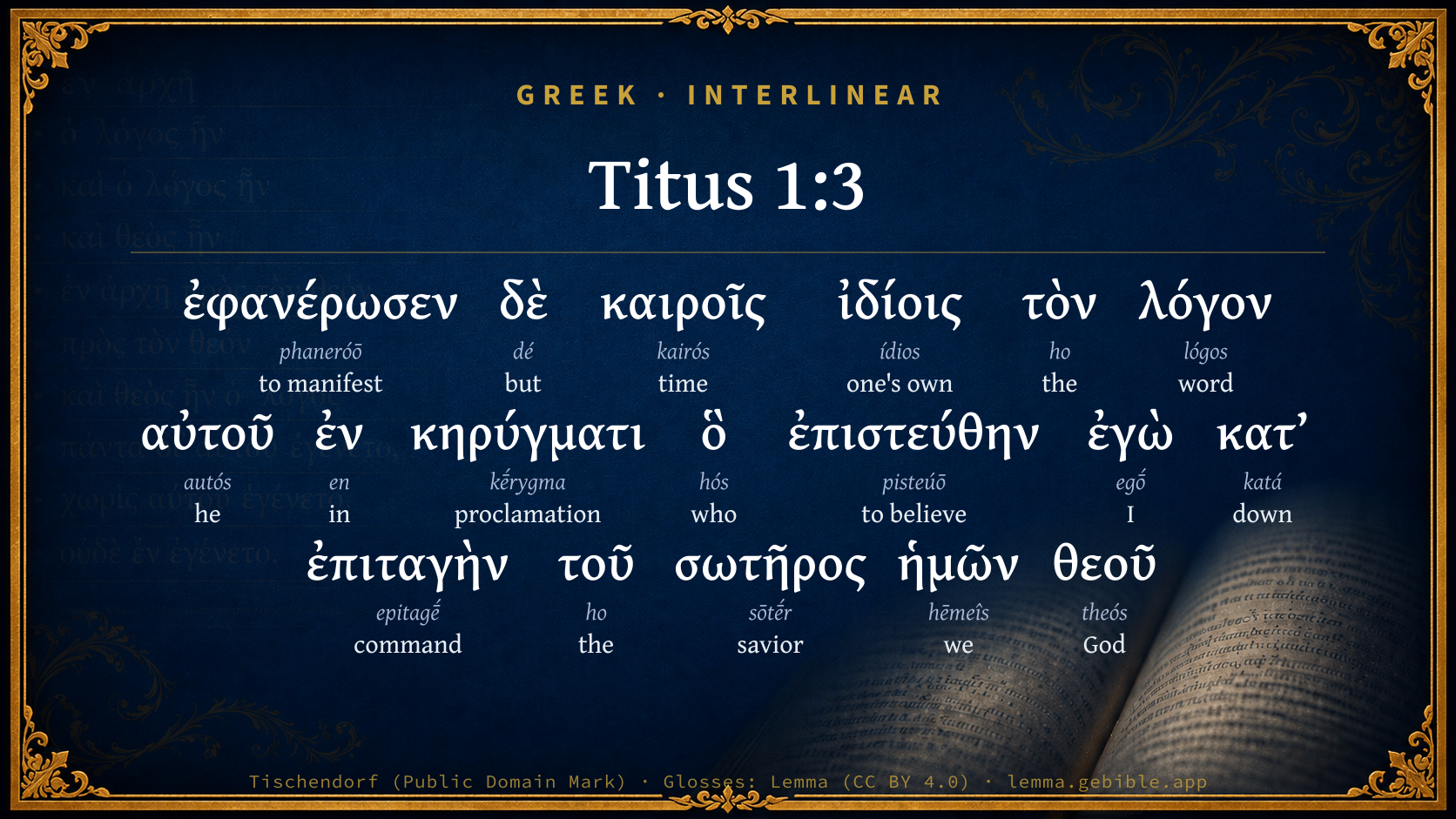
  1. ἐφανέρωσεν phaneróō G5319 “to manifest” Verb, Aorist, Active, Indicative, 3rd person, Singular
  2. δὲ dé G1161 “but” Conjunction
  3. καιροῖς kairós G2540 “time” Noun, Dative, Plural, Masculine
  4. ἰδίοις ídios G2398 “one's own” Adjective, Dative, Plural, Masculine
  5. τὸν ho G3588 “the” Article, Accusative, Singular, Masculine
  6. λόγον lógos G3056 “word” Noun, Accusative, Singular, Masculine
  7. αὐτοῦ autós G846 “he” Personal pronoun, Genitive, Singular, Masculine
  8. ἐν en G1722 “in” Preposition
  9. κηρύγματι kḗrygma G2782 “proclamation” Noun, Dative, Singular, Neuter
  10. ὃ hós G3739 “who” Relative pronoun, Accusative, Singular, Neuter
  11. ἐπιστεύθην pisteúō G4100 “to believe” Verb, Aorist, Passive, Indicative, 1st person, Singular
  12. ἐγὼ egṓ G1473 “I” Personal pronoun, 1st person, Nominative, Singular
  13. κατ’ katá G2596 “down” Preposition
  14. τοῦ ho G3588 “the” Article, Genitive, Singular, Masculine
  15. σωτῆρος sōtḗr G4990 “savior” Noun, Genitive, Singular, Masculine
  16. ἡμῶν hēmeîs G2249 “we” Personal pronoun, 1st person, Genitive, Plural
  17. θεοῦ theós G2316 “God” Noun, Genitive, Singular, Masculine

About this verse

These counts appear in no published source. They are computed here, from the morphology-tagged text and Lemma’s own curated glosses. What Lemma adds →

18
words
17
distinct lemmas
Pauline Epistles
section

Notable vocabulary

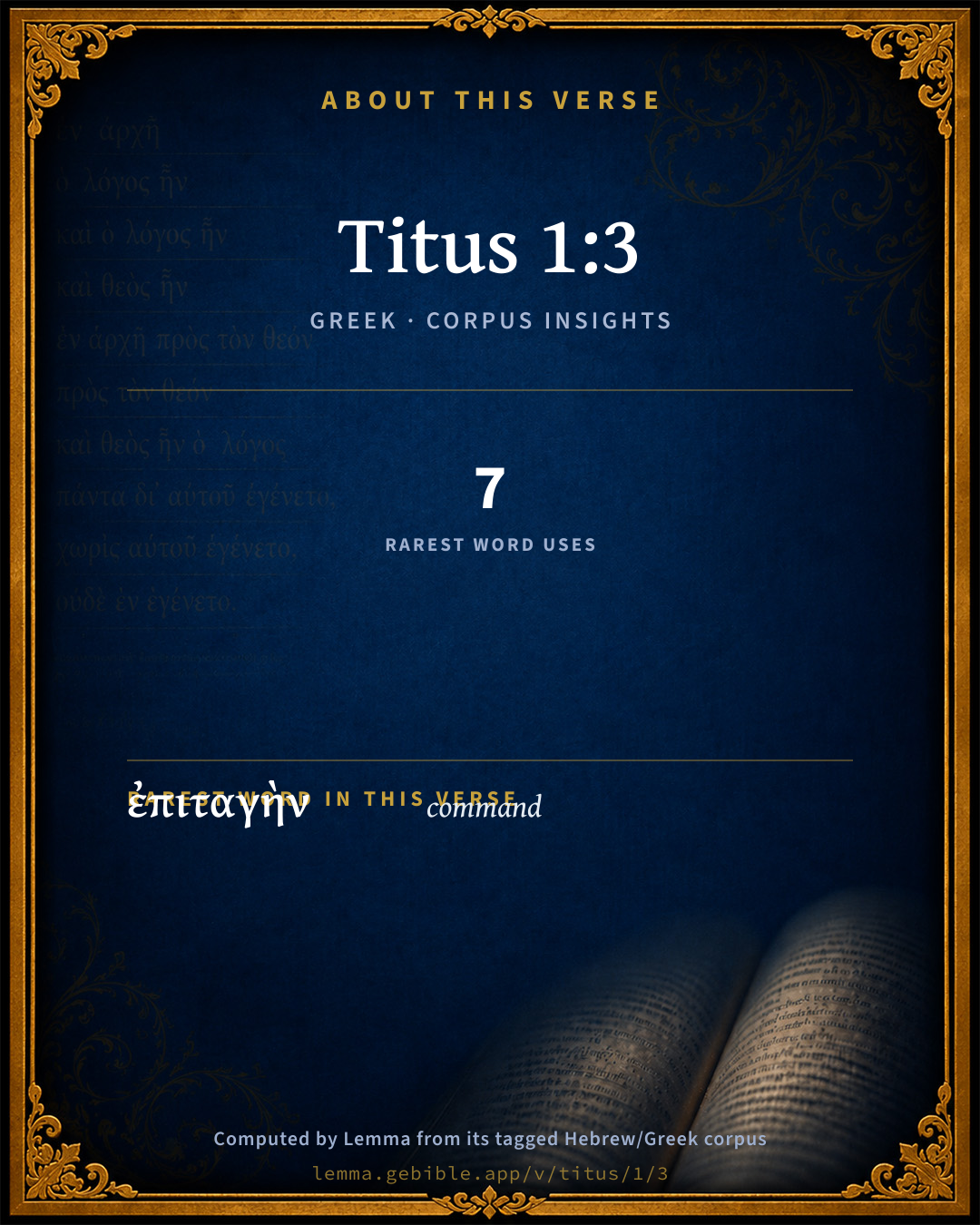
The rarest word here is ἐπιταγὴν command G2003 — appearing just 7 times in the whole Greek New Testament.

Shared distinctive vocabulary

ἐπιταγὴν command G2003 occurs in 7 verses of the Greek New Testament. Also found in:

Repetition

A word recurs within this verse:

Cross-references

35

Topical passages linked to Titus 1:3 in the Treasury of Scripture Knowledge — connected by theme and wording, ordered by reader-vote popularity; previews shown in the World English Bible.

  • 1 Timothy 1:11 according to the Gospel of the glory of the blessed God, which was committed to my trust.
  • 1 Timothy 1:1 Paul, an apostle of Christ Jesus according to the commandment of God our Savior, and Christ Jesus our hope;
  • Titus 3:4–6 But when the kindness of God our Savior and his love toward mankind appeared,
  • Titus 2:10 not stealing, but showing all good fidelity; that they may adorn the doctrine of God, our Savior, in all things.
  • Titus 2:13 looking for the blessed hope and appearing of the glory of our great God and Savior, Jesus Christ;
  • Isaiah 45:15 Most assuredly you are a God who hid yourself, God of Israel, the Savior.'
  • Isaiah 45:21 Declare you, and bring [it] forth; yes, let them take counsel together: who has shown this from ancient time? who has declared it of old? Haven't I, Yahweh? and there is no God else besides me, a just God and a Savior; there is no one besides me.
  • Habakkuk 2:3 For the vision is yet for the appointed time, and it hurries toward the end, and won't prove false. Though it takes time, wait for it; because it will surely come. It won't delay.
  • Mark 13:10 The Gospel must first be preached to all the nations.
  • Mark 16:15 He said to them, "Go into all the world, and preach the Gospel to the whole creation.
  • Acts 10:36 The word which he sent to the children of Israel, preaching good news of peace by Jesus Christ--he is Lord of all--
  • Romans 10:14–15 How then will they call on him in whom they have not believed? How will they believe in him whom they have not heard? How will they hear without a preacher?
  • 1 Corinthians 9:17 For if I do this of my own will, I have a reward. But if not of my own will, I have a stewardship entrusted to me.
  • Galatians 4:4 But when the fullness of the time came, God sent out his Son, born to a woman, born under the law,
  • Ephesians 2:17 He came and preached peace to you who were far off and to those who were near.
  • Colossians 1:6 which has come to you; even as it is in all the world and is bearing fruit and growing, as it does in you also, since the day you heard and knew the grace of God in truth;
  • Colossians 1:23 if it is so that you continue in the faith, grounded and steadfast, and not moved away from the hope of the Gospel which you heard, which is being proclaimed in all creation under heaven; of which I, Paul, was made a servant.
  • 1 Thessalonians 2:4 But even as we have been approved by God to be entrusted with the Gospel, so we speak; not as pleasing men, but God, who tests our hearts.
  • 1 Timothy 2:3 For this is good and acceptable in the sight of God our Savior;
  • 1 Timothy 2:5–7 For there is one God, and one mediator between God and men, the man Christ Jesus,
  • 1 Timothy 4:10 For to this end we both labor and suffer reproach, because we have set our trust in the living God, who is the Savior of all men, especially of those who believe.
  • 2 Timothy 1:10–11 but has now been revealed by the appearing of our Savior, Christ Jesus, who abolished death, and brought life and immortality to light through the Gospel.
  • Isaiah 12:2 Behold, God is my salvation. I will trust, and will not be afraid; for Yah, Yahweh, is my strength and song; and he has become my salvation."
  • Daniel 8:23 In the latter time of their kingdom, when the transgressors are come to the full, a king of fierce face, and understanding dark sentences, shall stand up.
  • Daniel 9:24–10:1 Seventy weeks are decreed on your people and on your holy city, to finish disobedience, and to make an end of sins, and to make reconciliation for iniquity, and to bring in everlasting righteousness, and to seal up vision and prophecy, and to anoint the most holy.
  • Daniel 11:27 As for both these kings, their hearts shall be to do mischief, and they shall speak lies at one table: but it shall not prosper; for yet the end shall be at the time appointed.
  • Luke 1:47 My spirit has rejoiced in God my Savior,
  • Acts 17:26 He made from one blood every nation of men to dwell on all the surface of the earth, having determined appointed seasons, and the boundaries of their dwellings,
  • Romans 5:6 For while we were yet weak, at the right time Christ died for the ungodly.
  • Romans 15:19 in the power of signs and wonders, in the power of God's Spirit; so that from Jerusalem, and around as far as to Illyricum, I have fully preached the Gospel of Christ;
  • Romans 16:26
  • Ephesians 3:5–8 which in other generations was not made known to the children of men, as it has now been revealed to his holy apostles and prophets in the Spirit;
  • Philippians 1:13 so that it became evident to the whole praetorian guard, and to all the rest, that my bonds are in Christ;
  • Ephesians 1:10 to an administration of the fullness of the times, to sum up all things in Christ, the things in the heavens, and the things on the earth, in him;
  • Revelation 14:16 He who sat on the cloud thrust his sickle on the earth, and the earth was reaped.

Cross-references courtesy of OpenBible.info (CC BY 4.0).

Commentary

Notes on Titus 1:3 from classic Christian and Jewish commentators (each source and its license shown beneath its notes). The classic Christian expositions comment on the surrounding passage and are grouped to its opening verse, so a note may address several verses; the Jewish commentaries on the Tanakh (Rashi and others) are per-verse, so they appear only where the commentator wrote on this verse.

Lemma curates 59 commentaries, every one of them public domain or Creative Commons licensed, each selected and text-cleaned for this edition rather than reprinted as found. About our sources →

The Biblical Illustrator

Joseph S. Exell

Tit_1:3

But hath in due times manifested His Word through preaching

A timely revelation

I.

A timely revelation--the purpose of salvation through Christ Jesus.

II. A sacred trust--to preach the unsearchable riches of Christ.

III. A divine commission--to preach according to the commandment of God. (F. Wagstaff.)

Salvation revealed

I. That salvation is more clearly revealed than in former ages appeareth in that all the time of the law was but the infancy and nonage of the Church, which then was as a child under tutors and governors; and as a child was initiated in rudiments and elements of Christian religion, and endued with a small measure of knowledge and faith, because the time was not come wherein the mysteries of Christ were unfolded.

II. The Lord (who doth not only by His wisdom order His greatest works, but every circumstance of them) effecteth all His promises and purposes in the due season of them.

III. The manifestation of salvation is to be sought for in the preaching of the Word. Which point is plain, in that the preaching of the Word is an ordinance of God.

1. To make Christ known, in whose name alone salvation is to be had.

2. To beget and confirm faith in the heart, by which alone, as by an hand, we apprehend and apply Him with His merits to our salvation. (T. Taylor, D. D.)

Gods Word manifested through preaching

I. The manifestation of gods word. This was gradually made to men--to all nations, both Jews and Gentiles--in general, and to particular places.

II. The instrumentality employed for that manifestation. We should imitate the simplicity, zeal and affection displayed in the apostles preaching. (W. Lucy.)

Preaching in Gods name

An American gentleman once went to hear Whitefield for the first lime, in consequence of the report he heard of his preaching powers. The day was rainy, the congregation comparatively thin, and the beginning of the sermon rather heavy. Our American friend began to say to himself, This man is no great wonder, after all. He looked round, and saw the congregation as little interested as himself. One old man in front of the pulpit had fallen asleep. But all at once Whitefield stopped short. His countenance changed. And then he suddenly broke forth in an altered tone: If I had come to speak to you in my own name, you might well rest your elbows on your knees, and your heads on your hands, and sleep; and once in a while look up, and say, What is this babbler talking of? But I have not come to you in my own name. No! I have come to you in the name of the Lord of Hosts (here he brought down his hand and foot with a force that made the building ring), and I must, and will be heard. The congregation started. The old man woke up at once. Ay, ay! cried Whitefield, fixing his eyes on him, I have waked you up, have I? I meant to do it. I am not come here to preach to stocks and stones. I have come to you in the name of the Lord God of Bests, and I must, and will, have an audience. The hearers were stripped of their apathy at once. Every word of the sermon was attended to. And the American gentleman never forgot it. (J. G. Ryle.)

The best ally in Christian work

Frederick the Great was once in company with a number of French wits, and there was a brave Scotchman also at the table, who was the ambassador of England. Frederick the Great was then contemplating a war, in which he would be dependent upon English subsidies, and by and by the ambassador, as he listened to the king and these French wits making fun of religion, and speaking of its certain and sudden decay, said, By the help of God England will stand by Prussia in the war. Frederick turned round and said, rather sneeringly, By the help of God! I did not know that you bad an ally of that name. But the Scotchman turned round to the king, and said, May it please your majesty, that is the only ally England has to whom England does not send subsidies. Now, let me say, that we as a Christian Church and as a missionary society have an ally of that name. Our ally is the Lord of Hosts, and it is because His name has been upon our banners that we have succeeded in the past. (T. H. Hunt.)

Which is committed unto me, according to the commandment of God our Saviour

The Christian ministry

I. Every minister called by God is one of Christs committees, unto whom He betrusteth now after His departure the care and oversight of His spouse, who is dearer unto Him than His own life, appeareth in that they are called stewards of this great house, having received the keys to open the kingdom of heaven, and to distribute to the necessity of their fellow servants; chosen vessels, as Paul, not to contain, but to carry the pearl and the treasure of the kingdom; feeders, as Peter, husband men, to whom the vineyard is let out till His return.

1. The honour of a minister is faithfulness in the diligent and careful discharging himself of that trust committed unto him; the principal part of which repose standeth in the faithful dispensing of Christs legacies to His Church, according to His own testament; which as it is his duty enjoined (1Co_4:2), so is it his crown, his joy, his glory, that by his faithful pains he hath procured the welfare of his people, and bringeth with it a great recompense of reward; for if he that showeth himself a good and faithful servant in little things, shall be ruler over much; what may he expect that is faithful in the greatest?

2. The ministry is no calling of ease, but a matter of great charge; nor contemptible, as many contemptuous persons think it too base a calling for their children; but honourable, near unto God, a calling committing unto men great matters, which not only the angels themselves have dispensed sundry times, but even the Lord of the angels, Jesus Christ Himself, all the while lie ministered upon earth; the honour of which calling is such, as those who are employed in the duties of it, are called not only angels, but coworkers with Christ in the salvation of men.

II. Whosoever would find comfort in themselves, or clear and justify their callings to others, or do good in that place of the body wherein they are set, must be able to prove that they are not intruders, but pressed by this calling and commandment of god: that as Paul performed every duty in the Church by virtue of his extraordinary calling, so they by virtue of their ordinary. For can any man think that a small advantage to himself, which our apostle doth so dwell upon in his own person, and that in every epistle, making his calling known to be committed unto him, not of men, nor by men, but by Jesus Christ? (See Gal_1:1; Gal_2:7; Eph_3:2; 1Th_2:4)

1. Let no man presume to take upon him any office in the Church uncalled; no man taketh this honour to himself. Christ Himself must he appointed of His Father.

2. Let none content himself with the calling of man separated from Gods calling; for this was the guise of the false apostles against whom our apostle opposeth himself and calling almost everywhere, who were called of men, but not of God.

3. In all other callings let men be assured they have Gods warrant, both in the lawfulness of the callings themselves, and in their holy exercise of them; passing through them daily in the exercise of faith and repentance, not forgetting daily to sanctify them by the Word and prayer.

III. Ministers may and ought to be more or less in the commendation of their calling, as the nature and necessity of the people to whom they write or speak do require.

1. As the apostle here magnifieth his authority in that he is a servant of God.

2. An apostle of Jesus Christ,

3. That he received his apostleship by commission and commandment of Christ Himself; and

4. All this while hath by sundry other arguments amplified the excellency of his calling: the reason of all which is not so much to persuade Titus, who was before sufficiently persuaded of it; but partly for the Cretians sake, that they might the rather entertain this doctrine so commended in the person of the bringer; and partly because many in this isle lifted up themselves against him and Titus, as men thrusting in their sickles into other mens fields too busily; or else if they had a calling, yet taking too much upon them, both in correcting disorders and establishing such novelties among them as best liked them; so as here being to deal against false apostles, perverse people, and erroneous doctrines he is more prolix and lofty in his title; otherwise, where he met not with such strong opposition, he is more sparing in his titles, as in the Epistles to the Colossians, Thessalonians, etc. (T. Taylor, D. D.)

The Biblical Illustrator, edited by Joseph S. Exell (c. 1880s–1900s) — public domain. Text from a community e-Sword module.

Tyndale Open Study Notes

Tyndale Open Resources

1:3 at just the right time: The initiative is entirely with God, who carries out his plan on his own timetable by his own will (see 3:5; 1 Tim 2:6; 2 Tim 1:10). • God our Savior: In Titus 1:4, Jesus is also called “our Savior,” identifying Jesus with God (see 2:10, 13; 3:4, 6).

Tyndale Open Study Notes — © Tyndale Open Resources, licensed CC BY-SA 4.0. Text via the HelloAO Bible API.

Bengel's Gnomon

Johann Albrecht Bengel

Tit 1:3. Καιροῖς) χρόνοι were longer than these.

Bengel's Gnomon of the New Testament — English translation (T&T Clark, Edinburgh, 1860) — public domain. Text from a community e-Sword module.

Meyer's Critical & Exegetical Commentary

Heinrich August Wilhelm Meyer

Tit_1:3. Ἐφανέρωσε δὲ καιροῖς ἰδίοις τὸν λόγον αὑτοῦ] ἐφανέρωσε forms an antithesis to ἐπηγγείλατο. True, the promise is a revelation, but only a revelation in which the point under consideration still remains hidden. The object of ἐφανέρωσε is not the same as that to which ἐπηγγ. relates, viz. ἥν, i.e. τὴν ζωὴν αἰώνιον; Beza: quam promiserat Deus … manifestam autem fecit … The object is τὸν λόγον αὑτοῦ, which is not to be taken as in apposition to ἥν (or as Heinrichs even thinks, to ἐλπίδα ζωῆς), though it is strange that ἐφαν. should begin a new sentence. This is one of the cases whereas Buttmann, p. 328, remarksa relative sentence passes almost imperceptibly into a principal sentence, without such continuation changing the actual principal sentence into one subordinate.

τὸν λόγον αὑτοῦ] is, of course, not a name for Christ (scholiasts in Matthaei), but the gospel, which contains the ἀποκάλυψις μυστηρίου, Rom_16:26, or, as is said here, τῆς ζωῆς αἰωνίου.

καιροῖς ἰδίοις] comp. 1Ti_2:6. How this φανέρωσις of the divine word took place, is told in the next words: ἐν κηρύγματι ὃ ἐπιστεύθην ἐγώ] κήρυγμα (see 2Ti_4:17) is not quite the general preaching of the gospel by the apostles (Matthies, Wiesinger), the thought being limited by the words following; κήρυγμα is to be taken as forming one thought with what follows: the preaching entrusted to me. Paul had some reason for describing his preaching as the means by which this revelation was made, since he recognised the depth of the divine decree as no other apostle had recognised it, and by him it was proclaimed to all peoples (see 2Ti_4:17).

ὃ ἐπιστεύθην ἐγώ] see 1Co_9:17; Gal_2:7; 1Th_2:4; 1Ti_1:11.

To define and emphasize the thought that the κήρυγμα was not according to his own pleasure, Paul adds: κατʼ ἐπιταγὴν τοῦ σωτῆρος ἡμῶν Θεοῦ] comp. 1Ti_1:1. Hofmann construes differently, connecting together κατὰ πίστιν and ἐπʼ ἐλπίδι as well as ἐν κηρύγματι, and then joining κατʼ ἐπιταγήν immediately with ἀπόστολος. But this construction not only makes τὸν λόγον αὑτοῦ (which, according to Hofmann, is in apposition to ἥν) quite superfluous, but separates ideas closely attached to each other, κήρυγμα and λόγος, ἐπιστεύθην and κατʼ ἐπιταγήν.

Meyer — Critical and Exegetical Commentary on the New Testament — English translation by Peter Christie, edited by Frederick Crombie (T&T Clark, 1880) — public domain. Text from a community e-Sword module.

Expositor's Greek Testament

ed. W. Robertson Nicoll

Tit 1:3 . ἐφανέρωσεν τόν λόγον : For φανερόω see note on 1Ti 3:16 . We must observe that no N.T. writer speaks of a manifestation of the gift of eternal life (1Jn 1:2 refers to the personal Incarnate Life). God’s message concerning it, which is the revelation of a divine secret purpose, is manifested. See Col 4:4 in addition to the last reff. given on ἐπηγγείλατο . περὶ ἧς may be supplied bef. ἐφανέρωσεν (von Soden).

καιροῖς ἰδίοις . See on 1Ti 2:6 ; 1Ti 6:15 . The rendering his own seasons suits the context here.

τὸν λόγον αὐτοῦ ἐν κηρύγματι : Note the distinction here indicated between the substance of the revelation ( λόγος ) given by God, and the form of it as expressible ( κήρυγμα ) by the human preacher. It is parallel to the use of λόγος and λαλία in Joh 8:43 .

ὃ ἐπιστεύθην ἐγώ has τὸ εὐαγγέλιον κ . τ . λ . as its antecedent in 1Ti 1:11 , where see note.

κατʼ ἐπιταγὴν τοῦ σωτῆρος ἡμῶν θεοῦ : See note on 1Ti 1:1 . There the order is θεοῦ σωτῆρος ἡμῶν . Here θεοῦ is epexegetical of σωτῆρος ἡμῶν , as Χριστοῦ Ἰησοῦ is in chap. Tit 2:13 . κατʼ ἐπιταγὴν is to be taken with ὃ ἐπιστεύθην ἐγώ , which is another way of expressing the notion of ἀπόστολος . On σωτήρ as a title of God, see notes on 1Ti 1:1 ; 1Ti 2:4 .

The Expositor's Greek Testament, edited by W. Robertson Nicoll (1897–1910) — public domain. Text from a community e-Sword module.

International Critical Commentary

3. ἐφανέρωσε δέ] The relative sentence is broken off and a direct sentence substituted; cf. 1Ti 6:12 and Blass, G. G., § 79:11. Possibly the relative sentence is continued down to ἰδίοις, “which he promised and declared at the right moment,” τὸν λόγον being in loose apposition to the whole sentence; cf. τὸ μαρτύριον, 1Ti 2:6.

τὸν λόγον αὐτοῦ] cf. 3:8 note.

καιροῖς ἰδίοις] The thought of the Incarnation taking place at the right moment in the world’s history is a favourite one with St. Paul (Gal 4:4, Rom 5:6 κατὰ καιρόν, Eph 1:10, Act 17:26), springing from apocalyptic expectations, summed up by the Lord (Mar 1:15 πεπλήρωται ὁ καιρός), and expanded by himself in his philosophy of history, Ro 1-3; perhaps consciously meeting the objection τί νῦν καὶ οὐ πρότερον; cf. Ep. Diogn. c. I, τί δήποτε καινὸν τοῦτο γένος . . . εἰσῆλθεν εἰς τὸν βίον νῦν καὶ οὐ πρότερον. The nearest analogy to the phrase is also Pauline, καιρῷ ἰδίῳ, Gal 6:9; the exact phrase is peculiar in N.T. to P.E. (1Ti 2:6, 1Ti 6:15 only); both words are ambiguous: (1) is ἰδίοις = “at its right moment”; cf. Tob 14:4 (א) πάντα συμβήσεται τοῖς καιροῖς αὐτῶν, Lev 23:4, Lev 26:4, Psa 1:3, Gal 6:9; Justin M. c. Tryph. c. 131, πάντα προλαμβάνοντος τρὸ τῶν ἰδίων καιρῶν τοῦ θεοῦ: or “at His own time,” ὄτε ἐδοκίμασε, Thdt.; so Psa 74:3 ὄταν λάβω καιρόν, Act 1:7 καιροὺς οὓς ὁ πατὴρ ἔθετο ἐν τῇ ἰδίᾳ ἐξουσίᾳ, The context, with its stress on God’s action, makes the latter probable here and in 1Ti 6:15, the former in 1Ti 2:6; but the two thoughts lie close together, and were perhaps not kept distinct. (2) Is the plural only an idiomatic usage, practically equivalent to the singular? cf. Jer 50:26 (=27:26 LXX) οἱ καιροὶ αὐτῆς = ὁ καιρὸς ἐκδικήσεως, ibid. 31; so χρόνοι, Luk 20:9, Luk 20:23:8; γάμοι, Luk 12:36; or is the plural to be pressed? In the former case the reference would be to the whole life of the Lord (cf. Heb 1:1); in the latter, to the various points in the life, the birth (Gal 4:4), the death (Rom 5:6), and to the subsequent apostolic preaching (1Ti 2:6, 1Ti 3:16). The contrast with χρόνοι αἰωνίοι and the analogy of Rom 16:26 favours the latter view.

For the preparation for Christ in History, cf. Lux Mundi, c. 4, and Clem. Alex. Strom. vi. 44, εως κατὰ καιρὸν ἥκει τὸ κήρυγμα νῦν, οὕτως κατὰ καιρὸν ἐδόθη νόμος μὲν καὶ προφῆται βαρβάροις, φιλοσοφία δὲ Ἕλλησι.

κατʼ ἐπιταγήν] connected primarily with ἐπιστέυθην (cf. 1Ti_1:l note), but Rom 16:26 suggests a further connection with ἐφανέρωσε. The command to St. Paul to preach the gospel is part of the command of the eternal God to manifest the Christ; cf. 1Ti 2:7.

τοῦ σωτῆρος ἡμῶν] of all of us Christians, but with the specializing thought “of you and me”; cf. κατὰ κοινὴν πίστιν.

International Critical Commentary — older volumes (1896–1929), various authors — public domain. Text from a community e-Sword module.

Geneva Bible (1599)

Geneva Bible translators

This truth is no other where to be sought, but in the preaching of the Apostle.

This word (Savior) doth not only signify a preserver of life, but also a giver of life.

Geneva Bible (1599) marginal notes — public domain. Text via Bolls.life.

Jamieson, Fausset & Brown

Robert Jamieson, A. R. Fausset & David Brown

in due times--Greek, "in its own seasons," the seasons appropriate to it, and fixed by God for it (Act 1:7).

manifested--implying that the "promise," Tit 1:2, had lain hidden in His eternal purpose heretofore (compare Col 1:26; Ti2 1:9-10).

his word--equivalent to "eternal life" (Tit 1:2; Joh 5:24; Joh 6:63; Joh 17:3, Joh 17:17).

through preaching--Greek, "in preaching," of rather as ALFORD (see on Ti2 4:17), "in the (Gospel) proclamation (the thing preached, the Gospel) with which I was entrusted."

according to--in pursuance of (compare Ti1 1:1).

of God our Saviour--rather as Greek, "of our Saviour God." God is predicated of our Saviour (compare Jde 1:25; Luk 1:47). Also Psa 24:5; Isa 12:2; Isa 45:15, Isa 45:21, Septuagint. Applied to Jesus, Tit 1:4; Tit 2:13; Tit 3:6; Ti2 1:10.

Jamieson, Fausset & Brown — Commentary Critical and Explanatory on the Whole Bible (1871) — public domain (CC PDM 1.0). Text via the HelloAO Bible API.

Adam Clarke's Commentary

Verse 3. But hath in due times] καιροις ιδιοις. In its own times. See 2Ti 2:6; Ga 4:4; Eph 1:10; Eph 2:7. God caused the Gospel to be published in that time in which it could be published with the greatest effect. It is impossible that God should prematurely hasten, or causelessly delay, the accomplishment of any of his works. Jesus was manifested precisely at the time in which that manifestation could best promote the glory of God and the salvation of man.

Manifested his word] τονλογοναυτου. His doctrine-the doctrine of eternal life, by the incarnation, passion, death, and resurrection of Jesus Christ.

Which is committed unto me] That is, to preach it among the Gentiles.

According to the commandment of God our Saviour] This evidently refers to the commission which he had received from Christ. See Ac 9:15: "He is a chosen vessel unto me, to bear my name before the Gentiles." For, "I have appeared unto thee for this purpose, to make thee a minister and a witness both of these things which thou hast seen, and of those things in the which I will appear unto thee; delivering thee from the people and from the Gentiles, unto whom now I send thee; to open their eyes, to turn them from darkness to light," c, Ac 26:16, c. This is the commandment and according to it he became the apostle of the Gentiles.

God our Saviour.-As the commission was given by Jesus Christ alone, the person whom he terms here God our Saviour must be Jesus Christ only; and this is another proof that St. Paul believed Jesus Christ to be GOD. This eternal life God had promised in a comparatively obscure way before the foundation of the world, the Jewish dispensation; but now under the Gospel, he had made it manifest-produced it with all its brightness, illustrations, and proofs.

Adam Clarke's Commentary on the Bible (1810–1826) — public domain. Text from a community e-Sword/MySword module.

John Calvin's Commentaries

3. But hath manifested There was indeed some manifestation of this kind, when God in ancient times spake by his prophets; but because Christ publicly, displayed by his coming those thing which they had obscurely predicted, and the Gentiles were afterwards admitted into the fellowship of the covenant, in this sense Paul says that what had formerly been exhibited in part “hath now been manifested.”

In his own times This has the same meaning as “the fullness of times.” (Galatians 4:4.) He reminds us that the time when it pleased the Lord to do this — must have been the most seasonable time for doing it; and he mentions this for the purpose of meeting the rashness of men, who have always the hardihood to inquire why it was not sooner, or why it is to-day rather than to-morrow. In order therefore that our curiosity may not exceed proper bounds, he shews that the “times” are placed in the hand, and at the disposal, of God, in such a manner that we ought to think that he does everything in the proper order and at the most seasonable time.

His word. Or, by his word; for it is not uncommon with Greek writers to supply the preposition by. Or, he calls Christ the Word; if it be not thought preferable to supply something for the sake of completing the sentence. Were it not that the second exposition is a little forced, in other respects I should give it the preference. Thus John says,

“What we have heard, what we have seen with our eyes, what our hands have handled of the Word of life; and the life was manifested.” (1 John 1:1, 2.)

I therefore prefer what is a simple meaning, that God hath manifested the word concerning the life by the preaching of the gospel.

The preaching, of which he speaks, is the gospel proclaimed, as the chief thing which we hear in it is — that Christ is given to us, and that in him there is life.

Which hath been committed to me. Because all are not indiscriminately fit for so important an office, and no man ought to thrust himself into it, he asserts his calling, according to his custom. Here we ought to learn — what we have often remarked on other occasions — that the honor is not due to any man, till he has proved that God has ordained him, for even the ministers of Satan proudly boast that God has called them, but there is no truth in their words. Now Paul states nothing but what is known and proved, when he mentions his calling.

Besides, from this passage we learn for what purpose they were made apostles. It was for the sake of publishing the gospel, as he says elsewhere,

“Woe to me if I preach not the gospel, for a dispensation is committed unto me.” (1 Corinthians 9:16, 17.)

Accordingly, they who enact dumb show, in the midst of idleness and luxury, are excessively impudent in boasting that they are the successors of the apostles.

Of God our Savior He applies the same epithet to the Father and to Christ, so that each of them is our Savior, but for a different reason; for the Father is called our Savior, because he redeemed us by the death of his Son, that he might make us heirs of eternal life; and the Son, because he shed his blood as the pledge and the price of our salvation. Thus the Son hath brought salvation to us from the Father, and the Father hath bestowed it through the Son.

John Calvin's Commentaries (1540-1563) — public domain. Text from the Calvin Translation Society English edition (1840s-50s) via the Christian Classics Ethereal Library (ccel.org). Calvin's coverage is partial (roughly two-thirds of the Bible); uncommented books and verses are honest gaps, never fabricated. The 19th-century editor's footnotes and remarks are omitted so the notes are faithfully Calvin's own voice.

Ellicott's Commentary for English Readers

(3) But hath in due times.—Or better, but hath in his own seasons—that is, in the fitting seasons, those fixed by Him for the manifestation.

Manifested his word.—That is, His gospel. (See Rom_16:25.)

Through preaching.—Or, in the preaching. Paul does not shrink from calling his preaching the vehicle in which the Word or the gospel of God was to be publicly manifested, because he was conscious that he was divinely instructed in the secrets of the eternal counsels.

Which is committed unto me.—Literally, with which I was entrusted.

According to the commandment of God our Saviour.—The commandment came to St. Paul direct from God; we have several intimations of this. Amongst others, on the Damascus road, when the Lord appeared to him; in the Temple at Jerusalem; in the ship, during the memorable voyage which ended with shipwreck; in the visions mentioned in 2Co_12:1-9. St. Paul dwells with emphasis on the thought that he was entrusted with the preaching of the gospel according to the commandment of God. The work was not undertaken by him, from any will or wish of his own. “God our Saviour” in this place, as in 1Ti_1:1, must be understood as “God the Father.” The First Person of the blessed Trinity fitly possesses the title of “our Saviour,” because through the death of His dear Son He redeemed us from death and made us heirs of eternal life. The Second Person of the Trinity is likewise a possessor of the title, because He shed His blood as the price of our redemption. The epithet of “Saviour”—the title just given to the Father, in the very next verse ascribed to the “Son”—is one of the many indications we possess of St. Paul’s belief that the Son was equal to the Father as touching His Godhead.

A Bible Commentary for English Readers, edited by Charles John Ellicott (1878–1897) — public domain. Text from a community e-Sword module.

The Cambridge Bible for Schools and Colleges

gen. ed. J. J. S. Perowne

3. but hath in due times] See note on 1Ti_6:15 : and compare Gal_6:9. The phrase may well be thought the Hellenistic equivalent of the more classical form with preposition and substantive alone, Joh_5:4; Rom_5:6 ‘in due season Christ died,’ in accordance with the growing use of idios, which occurs fifteen times in the Pastoral Epistles.

manifested his word] Bp Wordsworth follows Jerome in understanding this directly of Christ ‘manifested His Word’; but such an usage has no proper support in St Paul. ‘To understand with modern interpreters “the Gospel,” he says, is a feeble tautology.’ But Col_1:26 gives us ‘to fulfil (i.e. to preach fully) the word of God, even the mystery which hath been hid … now manifested … which is Christ in you, the hope of glory, whom we proclaim.’ Compare also Rom_16:25 quoted above. So Vulg. and Theod. Mops. Lat. ‘manifestavit verbum suum.’

through preaching] Rather, as R.V. margin, in the proclamation, to define the mode of manifestation—a historic creed, ‘declaring God’s mind not by dark intimations merely or distant promises but in great facts.’ For such a ‘proclamation,’ the earliest written ‘Gospel,’ see 1Co_15:1-8. Cf. also 1Ti_3:16 and the note.

which is committed unto me] More exactly as R.V., wherewith I was intrusted, as in 1Ti_1:2.

according to the commandment] Better, as in 1Ti_1:1, where see note, by authority from. And therefore Titus is to ‘reprove with all authority,’ ch. Tit_2:15.

of God our Saviour] The same phrase with the same force as in 1Ti_1:1 (see note), and again in this Epistle Tit_2:10, Tit_3:4. The reference is to God the Father, compare the Prayer for Peace and deliverance in the Prayer-Book, ‘that Thou art our Saviour and mighty Deliverer,’ while in the next verse the same title is given to God the Son. But observe the order here, as in 1Ti_2:3, our Saviour God; the closing emphasis on the word ‘God’ expresses still more forcibly than ‘God our Saviour’ the thought explained in Tit_1:1.

The Cambridge Bible for Schools and Colleges (gen. ed. J. J. S. Perowne; Cambridge University Press, 1878–1918) — public domain. Text from a community e-Sword module.

John Gill's Exposition

But hath in due times manifested his word,.... Either Christ, his essential Word; or the word of truth, the Gospel of salvation; or rather his word of promise of eternal life in Christ Jesus:

through preaching; through the ministry of the word by the apostles; in which Christ is revealed in the glory of his person, and the fulness of his grace, and in the efficacy of his blood, righteousness, and sacrifice; and in which the Gospel, that was ordained before the world was, and is the fellowship of the mystery which was hid in God, is published; and in which the promise of eternal life, which lay in God's heart, in the covenant of grace, and in the hands of Christ, and which with Christ, and his Gospel, were hid under the dark types, shadows, and sacrifices of the law, is clearly made known: "in due times"; appointed by God, agreed between the Father and the Son, and suitable to the state, case, and condition of men; when the law of Moses, and the light of nature, legal sacrifices, and moral power, had been sufficiently tried, the one in the Jewish, the other in the Gentile world; and after that the Son of God was become incarnate, which was in the fulness of time; and when he had suffered for the ungodly, which was in due time; see Ti1 2:6.

Which is committed unto me; that is, which preaching or ministry of the word, the Gospel, and the dispensation of it, which, as a trust, was deposited in the hands of the apostle, and of which he was a faithful steward: according to the commandment of God our Saviour; either God the Father, so called, Tit 3:4 compared with Tit 1:6 and who is the Saviour of all men in a providential way, and of all the elect in a way of special grace, by his Son Jesus Christ; and by whom the apostle was appointed and separated to the preaching of the Gospel; and by whom this was committed to his trust: or rather the Lord Jesus Christ, who is truly and properly God, the great God, and our Saviour, Tit 2:13 and who is the only Saviour of lost sinners; and he it was that personally appeared to Paul, and made him a minister of the word, committed the Gospel to him, and gave him a commandment, and orders to preach it among the Gentiles, Act 26:15.

John Gill's Exposition of the Whole Bible (1746–1763) — public domain (CC PDM 1.0). Text via the HelloAO Bible API.

Trapp's Complete Commentary

John Trapp

3 But hath in due times manifested his word through preaching, which is committed unto me according to the commandment of God our Saviour;

Ver. 3. Manifested his word] As when he said plainly, "He that believeth in the Son hath eternal life."

John Trapp, A Commentary or Exposition upon All the Books of the Old and New Testament (1647–1656) — public domain. Text from a community e-Sword module.

Albert Barnes' Notes on the Bible

But hath in due times - At the proper time; the time which he had intended; the best time: see the notes at 1Ti 2:6; compare the notes at Mat 2:2.

Manifested his word through preaching - See the notes at 2Ti 2:10. The meaning here is, that he has made known his eternal purpose through the preaching of the gospel; compare the notes at Rom 10:14-15.

Which is committed unto me - Not exclusively, but in common with others; see the notes at 2Ti 1:11.

According to the commandment of God our Saviour - Paul always claimed to be divinely commissioned, and affirmed that he was engaged in the work of preaching by the authority of God; see Gal 1:1-12; 1Co 1:1; Rom 1:1-4.

Albert Barnes' Notes on the Bible (1834–1885) — public domain. Text from a community e-Sword/MySword module.

Haydock's Catholic Bible Commentary

Manifested his word. St. Jerome understands the word incarnate; others, the word of God preached, which St. Paul says, was committed to him, &c. See St. John Chrysostom, p. 383. (Witham)

George Leo Haydock (1774–1849), Haydock's Catholic Family Bible and Commentary, 1859 edition — public domain. Excludes Psalms (Douay-Rheims chapter numbering differs from Protestant) and Deuterocanonical books (Catholic canon only).

Matthew Poole's English Annotations

But hath in due times; in proper time, (saith the Greek), in such time as God had eternally purposed, and as seemed good to the Divine wisdom.

Manifested his word through preaching; he hath by setting up the ordinance of preaching, or publishing the gospel, by men sent by him, manifested this promise of eternal life, which lay much obscured under the veil of temporal promises under the Old Testament.

Which is committed unto me according to the commandment of God our Saviour; which office of preaching, or which word, was committed to me, by the will of God, or immediate command of God: as to which, see Act 26:17,18.

Matthew Poole's English Annotations on the Holy Bible (1683–1685) — public domain. Text from a community e-Sword/MySword module.

Whedon's Commentary on the Bible

Daniel D. Whedon

3. But—Contrastive between the ideal and the manifested promise.

In due times—In its own times; the times divinely held to be suitable for such manifestation.

His word—We might have expected it as referring to promise, as manifested; but St. Paul uses the term his word to identify the promise with the gospel word.

Preaching—Literally, proclamation.

Committed unto me—Note 1Ti_1:12-17.

According to—The third κατα in the paragraph. Paul’s apostleship accords with “elect faith;” which accords with “godliness;” the preaching of which accords with the divine order. And the passage ends, as it began, at Paul’s personality, showing that the whole is the import of the word apostle, so that at this point he makes transition to Titus.

Daniel D. Whedon (gen. ed.), Commentary on the Old and New Testaments (1874–1909) — public domain. Text from a community e-Sword module.

The Pulpit Commentary

In his own seasons for hath due times, A.V; in the message for through preaching, A.V; wherewith I was entrusted for which is committed unto me, A.V In his own seasons. The margin, its own seasons, is preferable. (see 1Ti_2:7, note) The phrase is equivalent to "the fullness of the time". (Gal_4:4) Manifested his Word. There is a change of construction. "The relative sentence passes almost imperceptibly into a primary sentence" (Buttmann in Huther); "his Word" becomes the object of the verb "made manifest," instead of "eternal life," as one would have expected. His Word is the whole revelation of the gospel, including the Person and work of Jesus Christ. Compare St. Peter"s address to Cornelius. (Act_10:36) This "Word," which lay in the mind of God through the ages, and was only dimly expressed in the promises given from time to time, (1Pe_1:10-12) was now made manifest," and proclaimed openly in that preaching of the gospel of God"s grace which was entrusted to St. Paul. This same idea is frequently expressed, (Rom_16:25 Eph_1:9, 10 3:3-11 2Ti_1:9-11 1Pe_1:20) In the message. Surely a poor and a false rendering. En khrugmati means "by the open proclamation" which St. Paul, as God"s herald, khrux , was commanded to make. But this is better expressed by the word which is appropriated to the proclamation of the gospel, viz. "preaching." So, as above quoted, Rom_16:25 2Ti_1:11, and elsewhere frequently. According to the commandment (kat epitagh); Rom_16:26 1Ti_1:1. (comp. Gal_1:1) God our Savior. (1Ti_1:1 1Ti_2:3 Tit_2:10 Tit_3:4 Jud_1:25; and also Luk_1:47) Elsewhere in the New Testament the term Savior" (Swthr) is always applied to our Lord Jesus Christ.

The Divine proclamation.

"But hath in due times manifested tits Word through preaching... according to the commandment of God our Savior." The entire dispensation of Divine mercy from the earliest ages is a manifestations, or a "showing forth." This takes place in God"s own way and in God"s own time. We who are Christians now wait for "the manifestation of the sons of God.

I THERE IS ALWAYS A DUE TIME. The clock of time is set to the order of Divine events. Generations give place to the age, and the age to the day, and the day to the hour. "Father, the hour is come." This was the fullness of time. Then the Romans had prepared the roads for the ambassadors of Christ to travel; and the Greeks had provided a perfect language for the written record of the revelation; and the dispersed Jews had circulated the Old Testament Scriptures, and had settled in foreign lands and planted synagogues; and Philosophy had confessed her failures in the opinion of her leaders, that there must be a Divine Deliverer, if deliverance comes at all; so that when men by wisdom knew not God, it pleased God in such a fullness of time to send forth his Son.

II THERE WILL ALWAYS BE THE PREACHER. Truth, like the gospel, needs a loving heart and a living voice and a living experience to utter its sweet enchantments. It has pleased God by the foolishness of preaching to save such as believe. That is to say, what the world calls foolishness. But men will always listen to and love the human voice when charged with truth and tenderness and pity. The press is doing a noble work, but it will not supplant the pulpit. Style changes, and methods change; but God "fashioneth their hearts alike." Dickens spoke his own works, and thousands flocked to hear. Carlyle and Emerson both acknowledge the mighty and immortal power of speech. A preaching which has intellect, conscience, and heart in it, and which is filled with the Spirit of Christ and the cross, will never become effete. It is God"s own way, and his ways are higher than our ways. W.M.S.

The Pulpit Commentary (1880–1919), ed. H.D.M. Spence-Jones & Joseph S. Exell — public domain. Text from a community e-Sword module.

John Wesley's Explanatory Notes

And he hath in his own times - At sundry times; and his own times are fittest for his own work. What creature dares ask, "Why no sooner?" Manifested his word - Containing that promise, and the whole "truth which is after godliness." Through the preaching wherewith I am intrusted according to the commandment of God our saviour - And who dares exercise this office on any less authority?

John Wesley, Explanatory Notes Upon the Whole Bible (1754–1765) — public domain. Text via the GEBible commentary corpus.

Fairbairn on Ezekiel, Jonah & the Pastoral Epistles

Patrick Fairbairn

Ver. 3. The structure of the sentence here has a somewhat irregular appearance; but it is better to leave it so, and give a natural interpretation of the words as they stand, than for the sake of a formal correctness to put a strain upon the meaning. It would have seemed to us, perhaps, the most orderly and consecutive way of speaking to say, “the eternal life which God promised before eternal times, but in its own seasons manifested through the word; “and it is much in this way that Beza (quam promiserat Deus ante tempora seculorum, manifestam autem fecit praestitutis temporibus suis, [videlicet] sermonem illum suum) and others have explained the passage; while some again, including Calvin, by the word understand Christ Himself: from primeval time God had promised eternal life, but since the gospel era He manifested His Word. Such explanations are manifestly of too artificial a cast. But taking the expression His word in its ordinary sense, and as the object of the manifesting which distinguishes the gospel from all preceding times, we are to regard the apostle as here introducing an independent sentence—contrasting the manifestation now, in its own seasons (see at 1Ti 2:6), with the period of promise preceding, but not precisely of the eternal life, which was the subject of the promise—for it still is in great part future—and, therefore, instead of saying which, or which life He manifested, he says, manifested His word, in which everything pertaining to the nature of the life, and the means of attaining it, is brought clearly to light. (See, for other instances, Winer, § 63, 1) By the addition in preaching coupled with the word, the preaching with which Paul was entrusted, it is plainly intimated that the word meant is the gospel,—the word emphatically, as declaring God’s mind, not by dark intimations merely, or distant promises, but in great facts and blessed assurances as to the present and eternal good of His people. In regard to the expression, according to the commandment of our Saviour God, see at 1Ti 1:1, where it also occurs with only a slight variation in the order of the last words.

Ver. 4. In the address itself to Titus there is nothing calling for much remark. He is called, like Timothy, a true child, and that according, or rather in respect, to the common faith. He may have been, and very probably was, a convert of the apostle’s; but that is nowhere distinctly stated, nor does the language here necessarily imply it (see at 1Ti 1:2). The designation child is indicative partly of endearment, and partly of comparative youth, in relation to the apostle. The received text has grace, mercy, peace, as at 1Ti 1:2, 2Ti 2:2, with A, K, L, Philox., Theodoret; but the reading grace and peace, the same that is found in all the other epistles of St. Paul, except the two to Timothy, has the support of א, C, D, F, Ital., Vulg., Syr., Pesh., Copt, Chrysos., etc. The latter must therefore be regarded as the preferable reading, and is now generally followed. The other was probably adopted to assimilate the text to the other two Pastoral epistles.

Patrick Fairbairn — An Exposition of Ezekiel (1851), Jonah (1849), and The Pastoral Epistles (1874) — public domain. Text from a community e-Sword module.

Scofield Reference Notes

C. I. Scofield

Saviour

(See Scofield "Rom 1:16").

The Scofield Reference Bible (1917 edition), notes by C. I. Scofield — public domain. Text from a community e-Sword module.

The People's New Testament

B. W. Johnson

3. Manifested. God has manifested the eternal life promised by his word in the gospel.

B. W. Johnson's The People's New Testament with Notes (1889–1891) — public domain. Electronic text from the Christian Classics Ethereal Library (CCEL) ThML edition.

Cambridge Greek Testament for Schools and Colleges

3. ἐφανέρωσεν δέ. We should expect but which (sc. the ζωή) He manifested; but the construction suddenly changes and the object of ἐφανέρωσεν is τὸν λόγον αὐτοῦ, the contrast being between the promise of life before times eternal, and the manifestation of the Divine Word in the fulness of time (cp. Eph 1:10).

For φανερόω see on 1Ti 3:16.

καιροῖς ἰδίοις, in its own, sc. appropriate, seasons. See the note on the same phrase at 1Ti 2:6 (cp. 1Ti 6:15). Here we render in its own seasons rather than (as at 1Ti 6:15) ‘in His own seasons’; because the point is not the freedom of the Divine choice, but the ‘seasonableness’ of the Divine Advent.

τὸν λόγον αὐτοῦ. His word, sc. the saving message of the Gospel, and not the Incarnate Logos, as appears by the defining ἐν κηρύγματι which follows. See Additional Note on 1Ti 4:5.

ἐν κηρύγματι, in the message, sc. the content of the message, not the act of proclaiming it. See on 1Ti 2:7 for Paul’s office as κῆρυξ.

δ ἐπιστεύθην ἐγώ. St Paul continually repeats this thought, that the preaching of the Gospel is not a self-chosen occupation, but that he has been entrusted with it. See Gal 2:7; 1Ti 1:11; 2Ti 1:11.

κατʼ ἐπιταγὴν τοῦ σωτῆρος ἡμῶν θεοῦ, according to the commandment of God our Saviour, i.e. God the Father. See for this interesting phrase on 1Ti 1:1.

Cambridge Greek Testament for Schools and Colleges (Cambridge University Press, 1896; 21 vols, various authors incl. Carr, Maclear, Plummer, Farrar, Lumby, Moule, M. R. James, Simcox) — public domain. Text from a community e-Sword module.

Alford’s Greek Testament

Henry Alford

3.] but (contrast to the eternal and hidden purpose, and to the promise, just mentioned) manifested in its own seasons (not, ‘His own seasons’ (Ellic. al.), cf. ref. Gal.:—the times belonging to it, τουτέστι, τοῖς ἁρμόζουσι, τοῖς ὠφελημένοις, Thl.,—fixed by Him for the manifestation) His word (we naturally expect the same object as before, viz. ζωὴν αἰώνιον: but we have instead, τὸν λόγον αὐτοῦ,—not to be taken in apposition with ἥν, as Heinrichs:—i.e. the Gospel, see Rom 16:25) in (as the element or vehicle of its manifestation) the proclamation (see 2Ti 4:17) with which (on the construction, see reff.) I was entrusted according to (in pursuance of, reff.) the command of our Saviour God:

Henry Alford, The Greek Testament (1849–1861) — public domain. Text from a community e-Sword module.

Vincent's Word Studies in the New Testament

Marvin R. Vincent

In due times [καιροις ιδιοις] . Better, in his (or its) own seasons. See on 1Ti 2:6.

Through preaching [εν κηρυγματι] . Rather, in a proclamation. See on 2Ti 4:17.

Which is committed unto me [ο επιστευθην εγω] . Betters wherewith I was intrusted. See on 1Ti 1:11.

Marvin R. Vincent, Word Studies in the New Testament (1887–1900) — public domain. Text from a community e-Sword/MySword module.

Lesson kit

Teaching starters — assembled from the data on this page, not authored interpretation. Every prompt links to the verse data it draws on. Edit before teaching.

Titus, in the Pauline Epistles, opens this verse with 18 words (17 distinct Greek lemmas). Its most distinctive word is epitagḗ (“command”). A historical commentator’s framing appears above. Read the whole chapter for the surrounding context.

Discussion questions

  1. What does “command” (epitagḗ) contribute to the verse as a whole?
  2. How does Romans 16:26, which shares the word «command», read alongside this verse?
  3. What does the repetition of “the” (2× in this one verse) do in this verse?
  4. These translations render this verse differently. What is at stake in choosing one wording over another?
  5. Compare how The Biblical Illustrator and Tyndale Open Study Notes read this verse. Where do they agree or differ?

Things to notice

Reading settings

Reading text

Shown beneath each verse's original-language words.

Old Testament
Old Testament edition

Read the OT as the Masoretic Hebrew (MT) or the Greek Septuagint (LXX).

English shown for the Greek Septuagint (in the Hebrew ↔ Greek comparison).

Comparing translations? Open the Compare panel on any verse page to stack up to four side by side.