Galatians 4:10

Greek (Tischendorf 8th ed.) Galatians 4:10 appears in the Greek New Testament. The text above is from the Tischendorf 8th edition. Each word links to its Strong’s number and a concise gloss. Click any word for its full Thayer’s Greek Lexicon entry.
Download image
Cite this verse

Galatians 4:10 (World English Bible). Public Domain. Lemma interlinear Bible study tool, https://lemma.gebible.app/v/galatians/4/10.

Show BibTeX & RIS
BibTeX
RIS
English Translation
You observe days, months, seasons, and years.
World English Bible · Public Domain
Download a study sheet

One document with this verse’s original text, its word-by-word gloss line, the meaning frame, cross-references with their text, attributed commentary, and full source and license credits — printable, and it pastes into notes with its structure intact.

This verse Autodidact and up

Study sheet (.html) Plain text (.txt)

A passage Seminary Student

Up to 50 verses in one chapter. A passage sheet keeps up to 6 commentary sources and 12 cross-references per verse, in the order this page ranks them, and says so on the sheet whenever that leaves anything out. Ask for a single verse and you get the Autodidact verse sheet above.

Everything on this page stays free to read, with no account — the sheet is a download of what is already on screen, not access to it.

Want to remove ads? Support Godless Engineer
Compare translations 3

The same verse in 3 English versions, stacked beneath the original-language interlinear above. Click any original word for its lexicon entry.

Each is an independent rendering of the whole verse — the interlinear is not word-aligned to these translations.

Highlighted words mark where these versions differ — a whole-verse word diff, not a word-by-word alignment.

  • World English Bible Public Domain
    You observe days, months, seasons, and years.
  • King James Version Public Domain
    Ye observe days, and months, and times, and years.
  • unfoldingWord Literal Text CC BY-SA 4.0
    You observe days and months and seasons and years!

unfoldingWord Literal Text — © unfoldingWord, licensed CC BY-SA 4.0. Word-aligned USFM3 via Door43 (git.door43.org/unfoldingWord/en_ult).

Versions to compare (up to 4)

3 of 4 selected

Show all 19 translations

Every available English version of this verse, each an independent rendering of the whole verse.

  • World English Bible Public Domain
    You observe days, months, seasons, and years.
  • Berean Standard Bible Public Domain
    You are observing special days and months and seasons and years!
  • Majority Standard Bible Public Domain
    You are observing special days and months and seasons and years!
  • King James Version Public Domain
    Ye observe days, and months, and times, and years.
  • American Standard Version (1901) Public Domain
    Ye observe days, and months, and seasons, and years.
  • Revised Version (1885) Public Domain
    Ye observe days, and months, and seasons, and years.
  • Geneva Bible (1599) Public Domain
    Ye obserue dayes, and moneths, and times and yeeres.
  • Douay-Rheims (1899) Public Domain
    You observe days, and months, and times, and years.
  • Young's Literal Translation Public Domain
    days ye observe, and months, and times, and years!
  • Literal Standard Version CC BY-SA 4.0
    You observe days, and months, and times, and years!
  • Unlocked Literal Bible CC BY-SA 4.0
    You observe days and new moons and seasons and years!
  • unfoldingWord Literal Text CC BY-SA 4.0
    You observe days and months and seasons and years!
  • Darby Bible Public Domain
    Ye observe days and months and times and years.
  • World Messianic Bible Public Domain
    You observe days, months, seasons, and years.
  • Webster's Bible Public Domain
    Ye observe days, and months, and times, and years.
  • Free Bible Version CC BY-SA 4.0
    You're observing special days and months, seasons and years.
  • Bible in Basic English Public Domain
    You keep days, and months, and fixed times, and years.
  • Text-Critical English NT CC BY 4.0
    You observe days, months, seasons, and years!
  • Tyndale New Testament (1534) Public Domain
    Ye observe dayes and monethes and tymes and yeares.

Literal Standard Version (2020), Covenant Press — licensed CC BY-SA 4.0. Text via the HelloAO Bible API (eBible.org). Unlocked Literal Bible (unfoldingWord) — licensed CC BY-SA 4.0. Text via the HelloAO Bible API (eBible.org). unfoldingWord Literal Text — © unfoldingWord, licensed CC BY-SA 4.0. Word-aligned USFM3 via Door43 (git.door43.org/unfoldingWord/en_ult). Free Bible Version, Dr. Jonathan Gallagher — licensed CC BY-SA 4.0. Text via the HelloAO Bible API (eBible.org).

Word by word

More ways to search: Search by grammar → Find every occurrence → Compare this word →

Practice this passage: Drill this verse → Learn its vocabulary →

παρατηρεῖσθε
paratēréō
G3906
“to watch carefully”
Verb, Present, Middle, Indicative, 2nd person, Plural
Part of Speech
Verb
Tense
Present
Voice
Middle
Mood
Indicative
Person
2nd person
Number
Plural
Full Thayer's Definition

Origin: from G3844 and G5083

TDNT: 10:26,1

1. to stand beside and watch, to watch assiduously, observe carefully a. to watch, attend to with the eyes b. of auguries, to see what he is going to do c. in a bad sense, to watch insidiously d. to watch one's self e. to observe, keep scrupulously 1. to neglect nothing requisite to the religious observance of
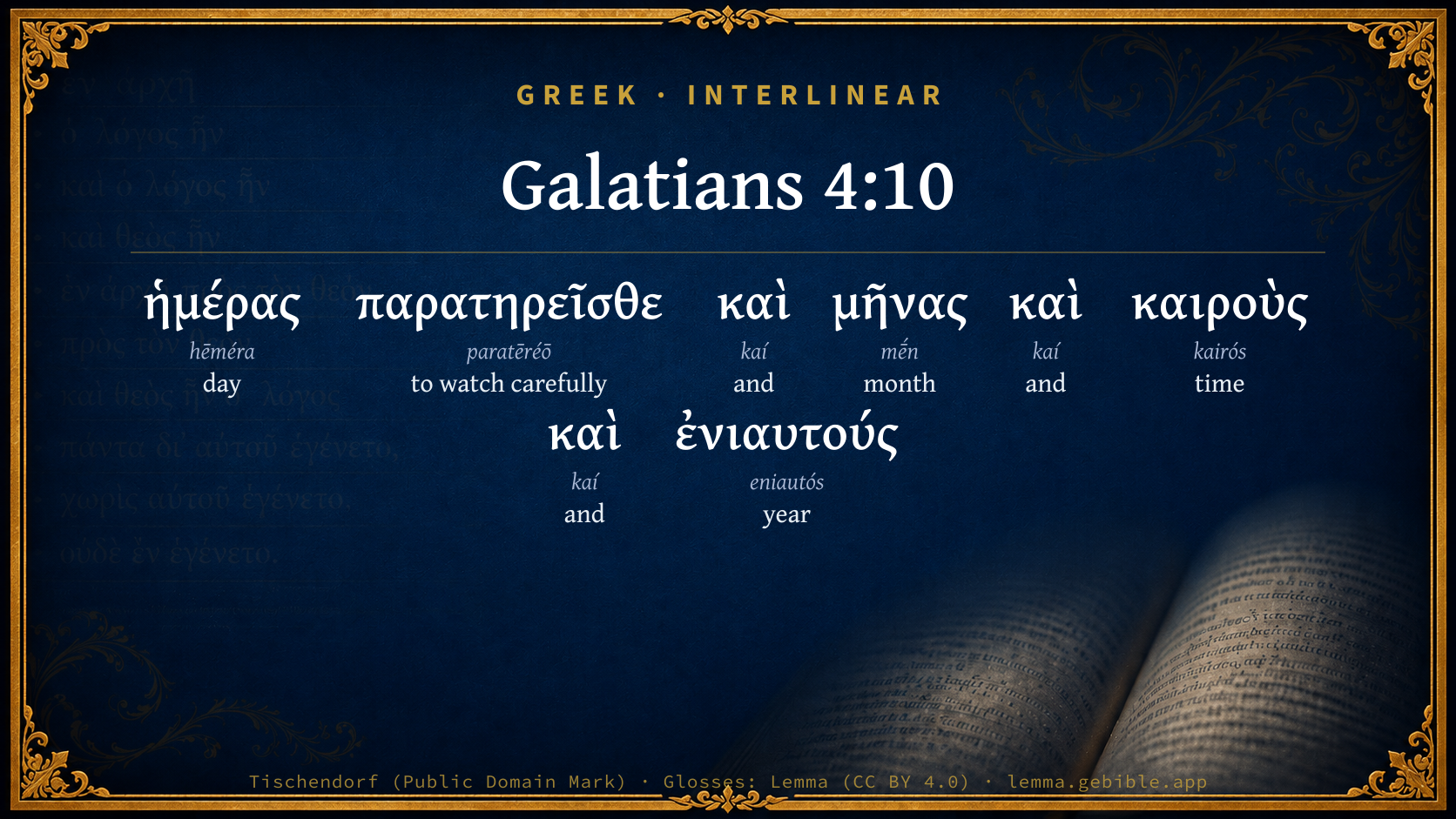
  1. ἡμέρας hēméra G2250 “day” Noun, Accusative, Plural, Feminine
  2. καὶ kaí G2532 “and” Conjunction
  3. μῆνας mḗn G3376 “month” Noun, Accusative, Plural, Masculine
  4. καὶ kaí G2532 “and” Conjunction
  5. καιροὺς kairós G2540 “time” Noun, Accusative, Plural, Masculine
  6. καὶ kaí G2532 “and” Conjunction
  7. ἐνιαυτούς eniautós G1763 “year” Noun, Accusative, Plural, Masculine

About this verse

These counts appear in no published source. They are computed here, from the morphology-tagged text and Lemma’s own curated glosses. What Lemma adds →

8
words
6
distinct lemmas
Pauline Epistles
section

Notable vocabulary

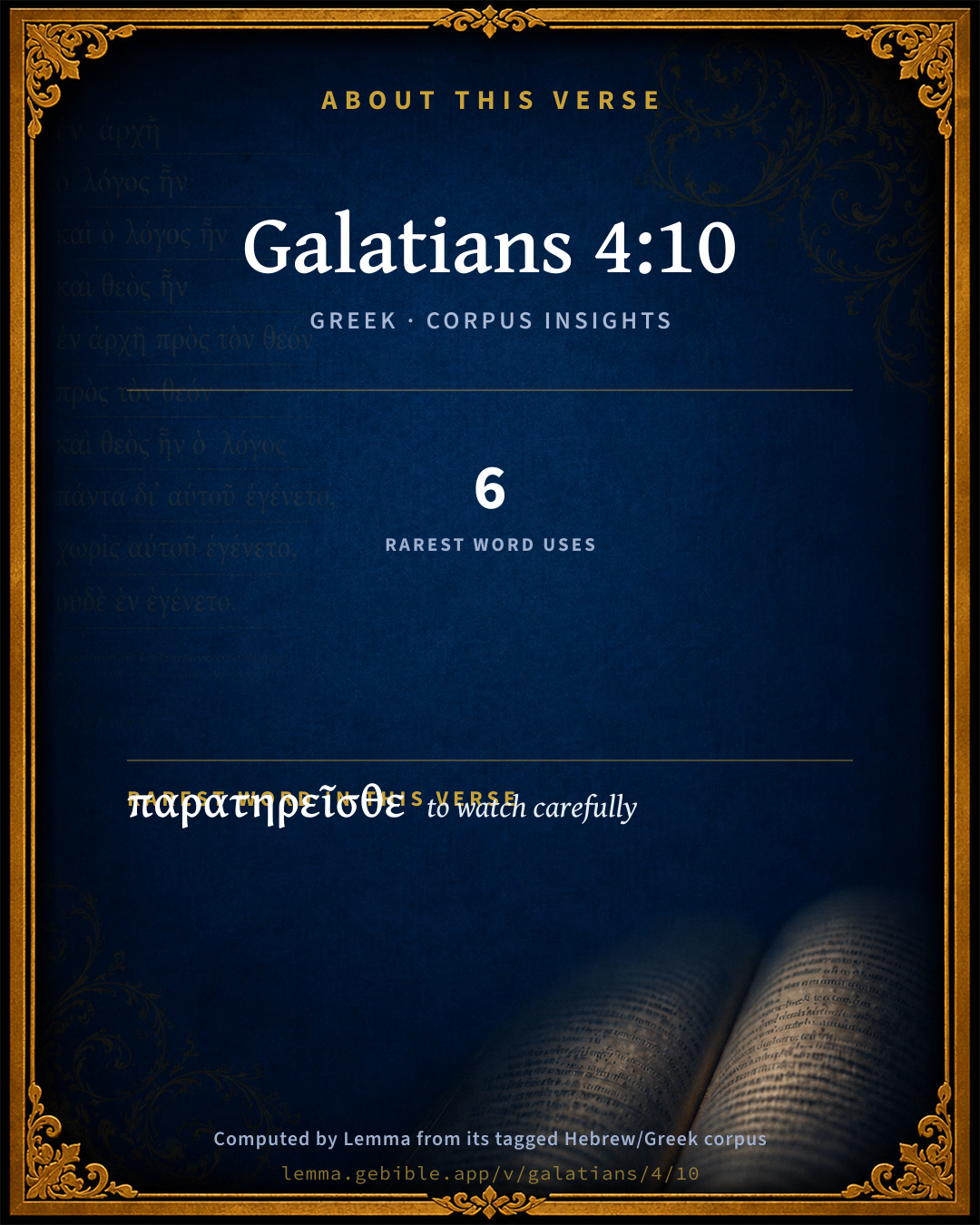
The rarest word here is παρατηρεῖσθε to watch carefully G3906 — appearing just 6 times in the whole Greek New Testament.

Shared distinctive vocabulary

παρατηρεῖσθε to watch carefully G3906 occurs in 6 verses of the Greek New Testament. Also found in:

Repetition

A word recurs within this verse:

Cross-references

5

Topical passages linked to Galatians 4:10 in the Treasury of Scripture Knowledge — connected by theme and wording, ordered by reader-vote popularity; previews shown in the World English Bible.

  • Colossians 2:16–17 Let no man therefore judge you in eating, or in drinking, or with respect to a feast day or a new moon or a Sabbath day,
  • Romans 14:5 One man esteems one day as more important. Another esteems every day alike. Let each man be fully assured in his own mind.
  • Leviticus 23:1–44 Yahweh spoke to Moses, saying,
  • Leviticus 25:13 "'In this Year of Jubilee each of you shall return to his property.
  • Numbers 28:1–29 Yahweh spoke to Moses, saying,

Cross-references courtesy of OpenBible.info (CC BY 4.0).

Commentary

Notes on Galatians 4:10 from classic Christian and Jewish commentators (each source and its license shown beneath its notes). The classic Christian expositions comment on the surrounding passage and are grouped to its opening verse, so a note may address several verses; the Jewish commentaries on the Tanakh (Rashi and others) are per-verse, so they appear only where the commentator wrote on this verse.

Lemma curates 59 commentaries, every one of them public domain or Creative Commons licensed, each selected and text-cleaned for this edition rather than reprinted as found. About our sources →

The Biblical Illustrator

Joseph S. Exell

Gal_4:10

To observe days and months

The observance of days and seasons

I.

Natural. When days are observed according to the course of the sun and moon. Thus night follows day, and every year hath four seasons.

II. Civil. When set times are observed in husbandry, for household affairs, for matters of the commonwealth, and for business.

III. Ecclesiastics. When set days are observed for orders sake, as days of thanksgiving, and days of humiliation.

IV. Superstitious.

1. Jewish: when made compulsory on the conscience.

2. Heathen: when good and bad success are dependent on them. From this last the Sabbath is excluded because

(1) it is the Lords day, and

(2) a moral commandment.

Apply against--

1. Romish festivals.

2. Lucky or unlucky periods. (W. Perkins.)

St. Paul is not here dealing with the Sabbath

The apostle is dealing with some of the difficulties which had arisen out of their former heathenism. The Galatian had worshipped them which by nature were no gods, the powers of nature and celestial objects, which indicate and influence the changes of seasons, months, and days, and were returning to these weak and beggarly elements. They were in danger not only of taking up with the Judaistic doctrine of justification by works, but also of relapsing into the heathen custom of calculating lucky and unlucky days and auspicious seasons by methods of astrology. Against this the apostle enters his protest. There is no evidence that he had any idea of the Jewish Sabbath in his mind. (W. Spiers, M. A.)

Christian festivals not prohibited

If it be objected that we are accustomed to observe certain days--as, e.g., the Lords Day, the Preparation, the Passover, or Pentecost, I have to answer that, to the perfect Christian--who is ever in his thoughts, words, and deeds, serving Christ--all his days are the Lords, and he is always keeping the Lords Day. He, also, who is unceasingly preparing himself for the true life, such an one is always keeping the Preparation day. Again, he who considers that Christ our Passover was sacrificed for us, and that it is of his duty to keep the feast by eating of the flesh of the Word, never ceases to keep the Paschal feast. And, finally, he who can truly say: We are risen with Christ, and He hath exalted us, and made us sit with Him in heavenly places in Christ is always living in the season of Pentecost. But the majority of believers are not of this advanced class; but from being either unable or unwilling to keep every day in this manner, they require some sensible memorial to prevent spiritual things from passing altogether from their minds. (Origen.)

Superstition respecting days

The superstitious belief in good and evil days has prevailed in all ages and countries. No season of the year, no month, no week, has been free from them. From Egypt unlucky days have received the name of Egyptian days. The Romans had their dies atri, which were pointed out on the calendar with a black character denoting a day of bad luck, and their dies albi, pointed out with a white character denoting good luck. In commenting on the text Augustine says: Those whom the apostle blames are those who say I will not set forward on my journey because it is the next day after such a time or because the moon is so; or Ill set forward that I may have luck, because such is just now the position of the stars. I will not traffic this month because a star presides, or I will because it does. Lodge (1596) tells us of those who would not eat their dinner before they have lookt in their almanacke. Aubrey, the antiquarian, later on, in dealing with the same subject, says: I shall take particular notice here of November 3rd, both because tis my own birthday, and for the remarkable accidents that have happened thereupon. Constantius, son of Constantine the Great, died on this day, Exveteri calendaris penes me. Thomas Montacute, Earl of Salisbury, that famous commander under Henries IV., V., and VI., died this day from a cannon shot received at Orleans. So also did Cardinal Borrhomes, and Sir John Perot, Lord deputy of Ireland, son to Henry VIII., and extremely like him; grief of the fatality of the day killed him. Stow in his annals says, November 3rd, 1099, the sea broke in on Scotland and England, drowning divers towns, and much people and cattle, submerging the lands once belonging to Earl Godwin in Kent, now called Godwin Sands, My father died in 1643, and within a year and a half of his decease such changes came upon my marsh lands in Kent by the influence of the sea that it was never worth one farthing to me; so that I often think this day being my birthday hath the same influence upon me that it had five hundred and eighty years since upon Earl Godwin and others. The Parliament so fatal to Romes concerns here in Henry VIII.s time began on November 3rd. The 3rd of November, 1640, began that Parliament so direfully fatal to England and its King. After the Reformation the unlucky day seems to have been Friday; fishermen and sailors would not go forth on that day, or servants take a place. No one on that day would get married, or begin a journey, or open a house of business on that day A similar superstition prevails among the Brahmins. In Japan a particular table is employed by travellers, which, it is said, has been observed to hold true by a continued experience of many ages, and wherein are set down all the unfortunate days of every month. A copy of this table is printed in all their road books. The Siamese observe the feasts of the new and full moon, and think the days that from the change precede the full are more fortunate than those that follow it. Their almanacks are marked with lucky and unlucky days. Neither prince nor any one who has means of applying to the astrologers will undertake anything without consulting them The Mexicans predicted the good or bad fortunes of infants from the sign under which they were born, and the happiness or misfortune of marriages, the success of wars; and of nearly everything from the day on which they were undertaken Nor are these notions confined to heathen countries. The newspapers frequently bring to light the credulity of Englishmen. Such an extravagant cast of mind, truly says The Spectator, engages multitudes of people not only in needless terrors but in supernumerary duties, and arises from that fear and ignorance which are natural to the soul of man. Wise men concern themselves to retrench the evils of life by the reasonings of philosophy; fools seek to multiply them by the sentiments of superstition. Gods providence overrules all things. We should do our part faithfully, and leave the event with Him.

The advantages of a fixed Sabbath

There are two distinct grounds on which works in religion are appraised at a low or rather worthless valuation in the Bible, and either rejected or denounced accordingly. The first is when they are offered as the price of our justification in the sight of God; as an equivalent upon which the Lawgiver is challenged for the honour and the regard that are due to righteousness; then does the Bible utterly hold at nought the most laborious, and, perhaps, when looked to in another view, the most holy and estimable of all human performances. The other ground on which works are computed at a low valuation in the Bible, is where, either in themselves they are devoid of tree moral excellence, or serve not in their tendencies to refine and to strengthen the principles of our moral nature. But let a good work be delivered of both these ingredients--let there be neither an arrogated merit nor an inherent meanness in it--free of all pettiness and abject timidity--And we say of works like unto this, that, so far from the gospel lifting a voice of hostility or casting a look of discountenance towards them, the very aim of the gospel is to raise and to multiply them over the face of a new moral creation. Now, in the text there is a certain scrupulous observation referred to by the apostle, which his converts adhered to as a duty, but which he charges them with as if it were a delinquency. They observed days and months and times and years, annexing a religious importance to the stated acts and exercises of stated periods; and we have no doubt, labouring under distress of conscience, at any misgiving from the prescribed and wonted regularity. It is likely enough, that both of those ingredients which go to vilify a work, and to render it null and worthless, entered into this outward formality of the Galatians--that it gave them a feeling of security as to their meritorious acceptance with God, which nought but the Redeemers merits ought to inspire; and that it further degraded the character of man, by reducing morality to the level of mechanism, and substituting for the obedience of a rightly strung and rightly actuated heart, an obedience like that of a galley-slave who plies at his unvaried oar, and moves in the one and unvaried circuit that is assigned to him. But there is another side to this question, which must not be left out of sight; for, though it be true that man was not made for the Sabbath, yet let it never be forgotten that the Sabbath was made for man. Man was not made to move in a precise orbit of times and seasons; yet times and seasons may be arranged, so as to subserve his use, and be the ministers of good both to his natural and moral economy. Were the keeping of the Sabbath a mere servitude of the body, which left the heart no better than before, it would be a frivolous ceremonial and ought to be exploded. But if it be true that he who sanctifies the Sabbath sanctifies his own soul, then does the Sabbath assume a spiritual importance, because an expedient of spiritual cultivation° It is not that the virtue of man consists in these things, but that these things are devices of best and surest efficacy for upholding the virtue of man. If it be true of man, that he can attain a loftier communion with his God, at those hours when the din and urgency of the world are away from him; and that a season of reading, and contemplation, and prayer acts as a restorative to the embers of his decaying sacredness; and that the voice of a minister, when prompted by the Spirit from on high, and aided by the sympathies of all who are around him, can often send the elevation of heaven into his soul; and that it is on those evenings of deep and lengthened tranquility which the footstep of intruding companion-ship does not violate, when the nurture and admonition of the Lord can descend more abundantly on the hearts of His children, and when the calm and the unction of a holy influence may be most felt in His dwelling-place--then Sabbath, which, from one end to the other of it, teems with these very opportunities, instead of ranking with the holidays of idle superstition, will be dear as piety itself to every enlightened Christian; and to it, in the most emphatic sense of the term, will he award the obeisance of a Divine and spiritual festival. And on this principle, too, may the Sabbath be rescued from that contempt which the text, in denouncing the observation of days and of times, would appear to cast on it. It is true, that it is a periodic festival, and that man was not made for periods. But this does not hinder that periods may be made for man. Does sacredness so keep at all times its undisturbed place and pre-eminence, amid the turmoil of those many secularities by which you are surrounded, that any one set and specific time is not needed, on which, at a distance from the besetting world, you might relume that lamp of heaven in the soul which was ready to expire? Or if the time were left to your own discretion, are such your longings after a spiritual atmosphere, that you would be ever sure to make your escape to it, when like to be lulled or overborne in an atmosphere of earthliness? It is true you may lift up your hearts to God when you please--and even amid the thickening occupations of the market and the counting-house, is it possible that many a secret aspiration may arise to Him. But how often is it that you would so please; and tell us, on your experience of the past what, if all days were alike, would be the fervour or the frequency of such aspirations? To whom much is given, of them much will be required; and on this principle your Sabbaths, these precious gifts of God to man, will have to be accounted for. And oh, forget not, that if these have been nauseated in time, heaven, if you eer were admitted there, would be nauseated through all eternity. Sabbath is that station on the territory of human life, from which we can descry with most advantage and delight the beauties of the promised land; and it is there, as if at the gate of the upper sanctuary, where we can command one of the nearest approaches whereof our nature is capable, to the contemplations and the doings of the saints in blessedness. (T. Chalmers, D. D.)

The Biblical Illustrator, edited by Joseph S. Exell (c. 1880s–1900s) — public domain. Text from a community e-Sword module.

Tyndale Open Study Notes

Tyndale Open Resources

4:10-11 Circumcision was not the Galatians’ only attempt to follow the law; it was one example of a whole way of thinking. They had also begun celebrating the Jewish festivals, thinking that it would make them more acceptable to God. To Paul, it was another indication that they did not understand, or had turned their backs on, the Good News of God’s grace through Christ.

Tyndale Open Study Notes — © Tyndale Open Resources, licensed CC BY-SA 4.0. Text via the HelloAO Bible API.

Bengel's Gnomon

Johann Albrecht Bengel

Gal 4:10. Ἡμέρας) days: Rom 14:5, i.e. Sabbaths, Col 2:16, note. The time of the Sabbath was held the most sacred of all. Therefore the order of gradation is to be observed, comp. 1Ch 23:31; 2Ch 31:3: σάββατα, νουμηνίας, ἑορτὰς, Sabbaths, new moons, feast days, in an affirmative sentence; but in a prohibition, the order is inverted, as in the passage quoted from Colossians above.—παρατηρεῖσθε) you observe, as if there were anything beside[37] faith.—καὶ καιροὺς, and times) longer than months, shorter than a year, i.e. feasts מעדים, which the LXX. frequently translate καιροὺς.—ἐνιαυτοὺς, years) anniversary solemnities, for example, the commencement of the year with the month Tisri; for it cannot be said that the sabbatical years, which had been fixed for the land of Canaan, were observed by the Galatians, although this epistle was written about the time of the sabbatical year, which ended (Dion. era) A.D. 48; see Ord. Temp. (arrangement of dates), p. 281, 423 [Ed. ii. p. 242, 364].

[37] The παρὰ in the compound verb is evidently understood by Beng. in this sense, as often παρὰ is used elsewhere, sc. of something added incidentally, besides what is really essential. So ὁ νόμος παρεισῆλθεν, the law entered stealthily, and as something superadded incidentally, Rom 5:20.—ED.

Bengel's Gnomon of the New Testament — English translation (T&T Clark, Edinburgh, 1860) — public domain. Text from a community e-Sword module.

Meyer's Critical & Exegetical Commentary

Heinrich August Wilhelm Meyer

Gal_4:10. Facts which vouch the ἐπιστρέφετε πάλιν κ.τ.λ. just expressed.

The interrogative view, which Griesbach, Koppe, Lachmann, Tischendorf, Hilgenfeld, following Battier (Bibl. Brem. VI. p. 104), take, has been again abandoned by Usteri, Schott, and Wieseler; and Hofmann prefers the sense of sorrowful exclamation. But the continuance of the reproachful interrogative form (Gal_4:9) corresponds better to the increasing pitch of surprise and amazement, and makes Gal_4:11 come in with greater weight.

παρατηρεῖσθε] Do ye already so far realize your θέλετε? Ye take care, sedulo vobis observatis, namely, to neglect nothing which is prescribed in the law for certain days and seasons. Comp. Joseph. Antt. iii. 5. Galatians 5 : παρατηρεῖν τὰς ἑβδομάδας; also Dio Cass. liii. 10 (of the observance of a law). The idea superstitiose (Winer, Bretschneider, Olshausen, and others) is not implied in παρα, nor the praeter fidem which Bengel finds in it.

ἡμέρας] Sabbaths, fast and feast days. Comp. Rom_14:5-6

μῆνας] is usually referred to the new moons. But these, the feast-days at the beginning of each month, come under the previous category of ἡμέρας. In keeping with the other points, παρατηρεῖσθαι μῆνας must be the observance of certain months as pre-eminently sacred months. Thus the seventh month (Tisri), as the proper sabbatical month, was specially sacred (see Ewald, Alterth. p. 469 f.; Keil, Archäol. I. p. 368 ff.); and the fourth, fifth, seventh, and tenth months were distinguished by special fasts.

καιρούς] מוֹעֲדִים, Lev_23:4. The holy festal seasons, such as those of the Passover, Pentecost, and the Feast of Tabernacles, are meant; quibus hoc aut illud fas erat aut nefas, Erasmus.

ἐνιαυτούς] applies to the sabbatical years (see, as to these, Ewald, p. 488 ff.; Keil, p. 371 ff.), which occurred every seventh year, but not to the jubilee years, which had, at least after the time of Solomon, fallen into abeyance (Ewald, p. 501). But that the Galatians were at that time in some way actually celebrating a sabbatical year (Wieseler), cannot be certainly inferred from ἐνιαυτ., which has in reality its due warrant as belonging to the consistency and completeness of the theory. On the whole passage, comp. Col_2:16, and Philo, de septenar. p. 286.

From our passage, moreover, we see how far, and within what limits, the Galatians had already been led astray.[190] They had not yet adopted circumcision, but were only in danger of being brought to it (Gal_5:2-3; Gal_5:12, Gal_6:12-13). Nothing at all is said in the epistle as to any distinction of meats (comp. Col. l.c), except so far as it was implied in the observance of days, etc. Usteri (comp. Rückert) is of opinion that Paul did not mention circumcision and the distinction of meats, because he desired to represent the present religious attitude of his readers as analogous to their heathen condition. But, according to the comprehensive idea of the στοιχεῖα τοῦ κόσμου, even the mention of circumcision and the distinctions of meats would have been in no way inappropriate to the πάλιν ἄνωθεν. Olshausen quite arbitrarily asserts that the usages mentioned stand by synecdoche for all.

[190] De Wette very arbitrarily considers that the present tense denotes, not the reality then present, but only the necessary consequence of the ἐπιετρ. and δουλ. θέλετε, conceived as being already present.

Meyer — Critical and Exegetical Commentary on the New Testament — English translation by Peter Christie, edited by Frederick Crombie (T&T Clark, 1880) — public domain. Text from a community e-Sword module.

Expositor's Greek Testament

ed. W. Robertson Nicoll

Gal 4:10 . The observance of Sabbaths and new moons, of feasts and fasts, of sabbatical and jubilee years, was clearly enjoined by the ceremonial Law; and Paul admitted the obligations of that Law for himself and for all the Circumcision. He continued to frequent the Sabbath-worship of the synagogue, attended the feasts, bound himself under voluntary vows. What he condemns is the adoption of these practices by baptised Gentiles: for this imputed to them an inherent sacredness incompatible with the true freedom of the Spirit.

The Expositor's Greek Testament, edited by W. Robertson Nicoll (1897–1910) — public domain. Text from a community e-Sword module.

Jamieson, Fausset & Brown

Robert Jamieson, A. R. Fausset & David Brown

To regard the observance of certain days as in itself meritorious as a work, is alien to the free spirit of Christianity. This is not incompatible with observing the Sabbath or the Christian Lord's day as obligatory, though not as a work (which was the Jewish and Gentile error in the observance of days), but as a holy mean appointed by the Lord for attaining the great end, holiness. The whole life alike belongs to the Lord in the Gospel view, just as the whole world, and not the Jews only, belong to Him. But as in Paradise, so now one portion of time is needed wherein to draw off the soul more entirely from secular business to God (Col 2:16). "Sabbaths, new moons, and set feasts" (Ch1 23:31; Ch2 31:3), answer to "days, months, times." "Months," however, may refer to the first and seventh months, which were sacred on account of the number of feasts in them.

times--Greek, "seasons," namely, those of the three great feasts, the Passover, Pentecost, and Tabernacles.

years--The sabbatical year was about the time of writing this Epistle, A.D. 48 [BENGEL].

Jamieson, Fausset & Brown — Commentary Critical and Explanatory on the Whole Bible (1871) — public domain (CC PDM 1.0). Text via the HelloAO Bible API.

Adam Clarke's Commentary

Verse 10. Ye observe days] Ye superstitiously regard the Sabbaths and particular days of your own appointment;

And months] New moons; times-festivals, such as those of tabernacles, dedication, passover, &c.

Years.] Annual atonements, sabbatical years, and jubilees.

Adam Clarke's Commentary on the Bible (1810–1826) — public domain. Text from a community e-Sword/MySword module.

John Calvin's Commentaries

10. Ye observe days. He adduces as an instance one description of “elements,” the observance of days. No condemnation is here given to the observance of dates in the arrangements of civil society. The order of nature out of which this arises, is fixed and constant. How are months and years computed, but by the revolution of the sun and moon? What distinguishes summer from winter, or spring from harvest, but the appointment of God, — an appointment which was promised to continue to the end of the world? (Genesis 8:22.) The civil observation of days contributes not only to agriculture and to matters of politics, and ordinary life, but is even extended to the government of the church. Of what nature, then, was the observation which Paul reproves? It was that which would bind the conscience, by religious considerations, as if it were necessary to the worship of God, and which, as he expresses it in the Epistle to the Romans, would make a distinction between one day and another. (Romans 14:5.)

When certain days are represented as holy in themselves, when one day is distinguished from another on religious grounds, when holy days are reckoned a part of divine worship, then days are improperly observed. The Jewish Sabbath, new moons, and other festivals, were earnestly pressed by the false apostles, because they had been appointed by the law. When we, in the present age, intake a distinction of days, we do not represent them as necessary, and thus lay a snare for the conscience; we do not reckon one day to be more holy than another; we do not make days to be the same thing with religion and the worship of God; but merely attend to the preservation of order and harmony. The observance of days among us is a free service, and void of all superstition.

John Calvin's Commentaries (1540-1563) — public domain. Text from the Calvin Translation Society English edition (1840s-50s) via the Christian Classics Ethereal Library (ccel.org). Calvin's coverage is partial (roughly two-thirds of the Bible); uncommented books and verses are honest gaps, never fabricated. The 19th-century editor's footnotes and remarks are omitted so the notes are faithfully Calvin's own voice.

Ellicott's Commentary for English Readers

(10) Ye observe.—A compound word, signifying not only “to observe,” but “to observe scrupulously.” The word is used by Josephus in his paraphrase of the fourth commandment: “Remember the sabbath day to keep it holy” (Ant. iii. 5, § 5).

Days—i.e., in the first instance and especially, the Jewish sabbaths; but other fasts or festivals which occupied a single day may be included.

Months.—The description mounts in an ascending scale—days, months, seasons, years. The “months,” however, mean really “the first day of the month,” the “new moon.” (See Lev_23:24; Num_28:11; Psa_81:3.)

Times.—Seasons: such as the Passover, Pentecost, and the Feast of Tabernacles.

Years.—Such as the sabbatical year and the year of jubilee. The Apostle is giving a list which is intended to be exhaustive of all Jewish observances, so that it would not necessarily follow that the Galatians had actually kept the year of jubilee, or even that it was kept literally by the Jews at this time.

As to the bearing of this passage on the general question of the observance of seasons, it is to be noticed that the reference is here to the adoption by the Galatians of the Jewish seasons as a mark of the extent to which they were prepared to take on themselves the burden of the Mosaic law. It does not necessarily follow that the observance of Christian seasons is condemned. At the same time, it is quite clear that St. Paul places all such matters under the head of “elements” or “rudiments.” They belong to the lowest section of Christian practice, and the more advanced a Christian is the less he needs to be bound by them. This, again, is qualified by the consideration that it is dangerous for any one individual to assume his own advanced condition, and to think himself able to dispense with the safeguards which his brother-Christians require. It is safest to follow the general rule of the Church, so long as it is done intelligently—i.e., with a consciousness of the reason and expediency of what is done, and not in a spirit of mere mechanical routine. The comparison between the literal and the spiritual observance of seasons, and the superiority of the latter as the more excellent way, is well brought out by Origen in some comments upon this passage: “If it be objected to us on this subject that we are accustomed to observe certain days—as, for example, the Lord’s Day, the Preparation, the Passover, or Pentecost—I have to answer that, to the perfect Christian—who is ever in his thoughts, words, and deeds serving his natural Lord, God the Word—all his days are the Lord’s, and he is always keeping the Lord’s Day. He, also, who is unceasingly preparing himself for the true life, and abstaining from the pleasures of this life which lead astray so many, such a one is always keeping the Preparation Day. Again, he who considers that ‘Christ our Passover was sacrificed for us,’ and that it is his duty to keep the feast by eating of the flesh of the Word, never ceases to keep the Paschal Feast. And, finally, he who can truly say: ‘We are risen with Christ,’ and ‘He hath exalted us, and made us sit with Him in heavenly places in Christ,’ is always living in the season of Pentecost . . . But the majority of those who are accounted believers are not of this advanced class; but from being either unable or unwilling to keep every day in this manner, they require some sensible memorial to prevent spiritual things from passing away altogether from their minds” (Against Celsus, viii. 22, 23).

A Bible Commentary for English Readers, edited by Charles John Ellicott (1878–1897) — public domain. Text from a community e-Sword module.

The Cambridge Bible for Schools and Colleges

gen. ed. J. J. S. Perowne

10. Perhaps this verse should be read interrogatively, ‘Do ye observe &c.?’ or the construction may be carried on from the preceding verse, ‘How is it that ye are turning, … that ye are observing &c.?’

Ye observe] The whole meaning of the verse depends on the sense attached to this word. It is compounded of a verb which means to observe and a preposition which implies that either the purpose or the method of observation is bad. The simple verb and corresponding noun are commonly used in N. T. in a good sense, e.g. “He that hath my commandments and keepeth them, he it is that loveth me”. Joh_14:21, ‘Circumcision is nothing, and uncircumcision is nothing; but the keeping of the commandments of God.” 1Co_7:19. But the compound is never so used. Mar_3:2; Luk_6:7; Luk_16:1; Luk_20:20; Act_9:24. Comp. for the noun, Luk_17:20. St Paul is not condemning the observance of ‘days and months and times and years’ but their mis-observance. Jewish Christians might continue to keep them as hallowed customs of divine origin, but not as grounds of justification. These were not to be sharers with Christ in the great work of salvation. Bondage to these rudiments forfeited the liberty of the Gospel. Gentile believers were never bound to such observances, and if they yielded to the Judaizing teachers and submitted to the yoke of the Jewish ceremonial, they were no longer partakers of the liberty of Christ.

Compare Col_2:16, where not the simple observance is condemned, but the slavery which is involved in its being required for salvation, and the dishonour which is done to Christ by adding to His perfect righteousness. See note on ch. Gal_5:2.

days] ‘sabbaths and fasts’. There is clearly no exemption here from the obligation of the observance of ‘the seventh day’. ‘The law of the Sabbath, i.e. of one weekly day of holy rest in God (the seventh in the Jewish, the first in the Christian Church) is as old as the Creation, it is founded on the moral and physical constitution of man, it was instituted in Paradise, incorporated in the Decalogue on Mount Sinai, put on a new foundation by the Resurrection of Christ, and is an absolute necessity for public worship and the welfare of man’. Dr Schaff. What St Paul condemns is the observance of the day in a legal spirit, in compliance with the minute and childish prohibitions of the Rabbinic system and as a matter of merit with God.

months] As marked by the ‘new moons’. Comp. Isa_1:13; Num_28:11 &c., or possibly the ‘seventh month’, Lev_23:24 foll.

times] Better, seasons, the great annual festivals, which lasted several days, as the Passover, the Feast of Tabernacles, &c.

years] Every seventh year was a sabbatical year and every fiftieth year a Jubilee. See Lev_25:2-17.

The Cambridge Bible for Schools and Colleges (gen. ed. J. J. S. Perowne; Cambridge University Press, 1878–1918) — public domain. Text from a community e-Sword module.

John Gill's Exposition

Ye observe days, and months, and times, and years. Lest the apostle should be thought to suggest, without foundation, the inclination of these people to be in bondage to the ceremonies of the law, he gives this as an instance of it; which is to be understood, not of a civil observation of times, divided into days, months, and years, for which the luminaries of the heavens were made, and into summer and winter, seedtime and harvest, which is not only lawful, but absolutely necessary; but of a religious observation of days, &c. not of the lucky and unlucky days, or of any of the festivals of the Gentiles, but of Jewish ones. By "days" are meant their seventh day sabbaths; for since they are distinguished from months and years, they must mean such days as returned weekly; and what else can they be but their weekly sabbaths? These were peculiar to the Israelites, and not binding on others; and being typical of Christ, the true rest of his people, and he being come, are now ceased. By "months" are designed their new moons, or the beginning of their months upon the appearance of a new moon, which were kept by blowing trumpets, offering sacrifices, hearing the word of God, abstaining from work, and holding religious feasts; and were typical of that light, knowledge, and grace, the church receives from Christ, the sun of righteousness; and he, the substance, being come, these shadows disappeared. By "times" are intended the three times in the year, when the Jewish males appeared before the Lord at Jerusalem, to keep the three feasts of tabernacles, passover, and pentecost, for the observance of which there was now no reason; not of the feast of tabernacles, since the word was made flesh, and tabernacled among us; nor of the passover, since Christ, our passover, is sacrificed for us; nor of pentecost, or the feast of weeks, or of the first fruits of the harvest, since the Spirit of God was poured down in a plenteous manner on that day upon the apostles; and when the firstfruits of a glorious harvest were brought in to the Lord, in the conversion of three thousand souls. And by "years" are to be understood their sabbatical years; every seventh year the land had a rest, and remained untilled; there were no ploughing and sowing, and there was a general release of debtors; and every fiftieth year was a jubilee to the Lord, when liberty to servants, debtors, &c. was proclaimed throughout the land: all which were typical of rest, payment of debts, and spiritual liberty by Christ; and which having their accomplishment in him, were no longer to be observed; wherefore these Galatians are blamed for so doing; and the more, because they were taught to observe them, in order to obtain eternal life and salvation by them.

Ye observe days, and months, and times, and years. Lest the apostle should be thought to suggest, without foundation, the inclination of these people to be in bondage to the ceremonies of the law, he gives this as an instance of it; which is to be understood, not of a civil observation of times, divided into days, months, and years, for which the luminaries of the heavens were made, and into summer and winter, seedtime and harvest, which is not only lawful, but absolutely necessary; but of a religious observation of days, &c. not of the lucky and unlucky days, or of any of the festivals of the Gentiles, but of Jewish ones. By "days" are meant their seventh day sabbaths; for since they are distinguished from months and years, they must mean such days as returned weekly; and what else can they be but their weekly sabbaths? These were peculiar to the Israelites, and not binding on others; and being typical of Christ, the true rest of his people, and he being come, are now ceased. By "months" are designed their new moons, or the beginning of their months upon the appearance of a new moon, which were kept by blowing trumpets, offering sacrifices, hearing the word of God, abstaining from work, and holding religious feasts; and were typical of that light, knowledge, and grace, the church receives from Christ, the sun of righteousness; and he, the substance, being come, these shadows disappeared. By "times" are intended the three times in the year, when the Jewish males appeared before the Lord at Jerusalem, to keep the three feasts of tabernacles, passover, and pentecost, for the observance of which there was now no reason; not of the feast of tabernacles, since the word was made flesh, and tabernacled among us; nor of the passover, since Christ, our passover, is sacrificed for us; nor of pentecost, or the feast of weeks, or of the first fruits of the harvest, since the Spirit of God was poured down in a plenteous manner on that day upon the apostles; and when the firstfruits of a glorious harvest were brought in to the Lord, in the conversion of three thousand souls. And by "years" are to be understood their sabbatical years; every seventh year the land had a rest, and remained untilled; there were no ploughing and sowing, and there was a general release of debtors; and every fiftieth year was a jubilee to the Lord, when liberty to servants, debtors, &c. was proclaimed throughout the land: all which were typical of rest, payment of debts, and spiritual liberty by Christ; and which having their accomplishment in him, were no longer to be observed; wherefore these Galatians are blamed for so doing; and the more, because they were taught to observe them, in order to obtain eternal life and salvation by them.

Galatians 4:11

gal 4:11

gal 4:11

gal 4:11I am afraid of you,.... Which shows the danger he apprehended they were in, by taking such large steps from Christianity to Judaism, and expresses the godly jealousy of the apostle over them; intimates he had some hope of them, and in the whole declares his great love and affection for them; for love is a thing full of care and fear:

lest I have bestowed upon you labour in vain; in preaching the Gospel among them with so much diligence and constancy, though so many afflictions and pressures lay upon him. Faithful ministers of the word are laborious ones; and such an one was the apostle; and who indeed laboured more abundantly than the rest in all places wherever he came; and such will be concerned, as he was, lest their labours should be in vain, not to themselves, but to the souls of others, whose everlasting good and welfare they are seeking. But how is it that the apostle should fear that his labour in preaching the Gospel would be in vain, and become of no effect through their observance of days, months, times, and years? because that hereby the pure spiritual and evangelic worship of God was corrupted, they bringing into it that which God had removed, and so became guilty of will worship; their Christian liberty was infringed, and they brought into bondage, a deliverance from which the Gospel proclaims; the doctrine of free grace in pardon, justification, and salvation, was made void, they observing these things in order to procure them thereby; and it was virtually and tacitly saying, that Christ was not come in the flesh, which is the main article of the Gospel; for since these things had respect to him, and were to continue no longer than till his coming, to keep on the observation of them, was declaring that he was not come; which is in effect to set aside the whole Gospel, and the ministration of it; so that the apostle might justly fear, that by such a proceeding all his labour, and the pains he had took to preach the Gospel, and salvation by Christ unto them, would be in vain.

John Gill's Exposition of the Whole Bible (1746–1763) — public domain (CC PDM 1.0). Text via the HelloAO Bible API.

Trapp's Complete Commentary

John Trapp

10 Ye observe days, and months, and times, and years.

Ver. 10. Ye observe days] The Christian Church knows no holy days, besides that honourable Lord’s day, Isa 57:14; Rev 1:10, and such holy feasts, as upon special occasions the Church shall see fit to celebrate, as Novemb. 5, &c. (Guy Fawkes Day and the gunpowder plot)

John Trapp, A Commentary or Exposition upon All the Books of the Old and New Testament (1647–1656) — public domain. Text from a community e-Sword module.

Albert Barnes' Notes on the Bible

Ye observe - The object of this verse is to specify some of the things to which they had become enslaved.

Days - The days here referred to are doubtless the days of the Jewish festivals. They had numerous days of such observances, and in addition to those specified in the Old Testament, the Jews had added many others as days commemorative of the destruction and rebuilding of the temple, and of other important events in their history. It is not a fair interpretation of this to suppose that the apostle refers to the Sabbath, properly so called, for this was a part of the Decalogue; and was observed by the Saviour himself, and by the apostles also. It is a fair interpretation to apply it to all those days which are not commanded to be kept holy in the Scriptures; and hence, the passage is as applicable to the observance of saints’ days, and days in honor of particular events in sacred history, as to the days observed by the Galatians. There is as real servitude in the observance of the numerous festivals, and fasts in the papal communion and in some Protestant churches, as there was in the observance of the days in the Jewish ecclesiastical calendar, and for anything that I can see, such observances are as inconsistent now with the freedom of the gospel as they were in the time of Paul. We should observe as seasons of holy time what it can be proved God has commanded us, and no more.

And months - The festivals of the new moon, kept by the Jews. Num 10:10; Num 28:11-14. On this festival, in addition to the daily sacrifice, two bullocks, a ram, and seven sheep of a year old were offered in sacrifice. The appearance of the new-moon was announced by the sound of trumpets. See Jahn, Archae. 352.

And times - Stated times; festivals returning periodically, as the Passover, the Feast of Pentecost, and the Feast of Tabernacles. See Jahn, Archae. chap. 3. 346-360.

And years - The sabbatical year, or the year of jubilee. See Jahn as above.

Albert Barnes' Notes on the Bible (1834–1885) — public domain. Text from a community e-Sword/MySword module.

Haydock's Catholic Bible Commentary

You observe [1] days, &c. These false teachers were for obliging all Christians to observe all the Jewish feasts, fasts, ceremonies, &c. Some of the later reformers find here an occasion to blame the fasts and holydays kept by Catholics. St. Jerome, in his commentary on these words, tells us that some had made the like objection in his time: his answer might reasonably stop their rashness; to wit, that Christians keep indeed the sabbath on Sunday, (not the Jewish sabbath on Saturdays) that they keep also divers holydays, and days on which great saints suffered martyrdom, (let our adversaries take notice of this) but that both the days are different, and the motives of keeping them. See St. Jerome, tom. iv. p. 271. (Witham) --- This text cannot mean to condemn the feasts appointed to be kept holy in the Catholic Church. For on the festivals dedicated to our Lord, St. Augustine writeth thus: "We dedicate and consecrate the memory of God’s benefits with solemnities on solemn appointed days, lest in process of time they might creep into ungrateful and unkind oblivion." And of the martyrs thus: "Christians people celebrate the memories of martyrs with religious solemnity, both to move themselves to an imitation of their virtues, and that they may be partakers of their merits, and helped by their prayers." (Cont. Faust. lib. xx. chap. 21.) And of other saints thus: "keep ye and celebrate with sobriety the nativities of saints, that we may imitate them that are gone before us, and that they may rejoice in us, who pray for us." (In Ps. .xxxviii. Conc. 2. in fine.)

===============================

[BIBLIOGRAPHY]

St. Jerome on this verse, p. 271, dicat aliquis, nos simile crimen in[]urrimus....observantes diem dominicam....Pascha festivitatem, & Pentecostes []ætitiam, & pro varietate regionum, diversa in honore martyrum tempora consti[]uta, &c.

George Leo Haydock (1774–1849), Haydock's Catholic Family Bible and Commentary, 1859 edition — public domain. Excludes Psalms (Douay-Rheims chapter numbering differs from Protestant) and Deuterocanonical books (Catholic canon only).

Matthew Poole's English Annotations

If we had any evidence that these Galatians were relapsed to their Gentile superstitions, these terms might be understood of such days, &c. as they kept in honour to their idols. But the apostle, throughout the whole Epistle, not reflecting upon them for any such gross apostacy (as returning to the vanities of the heathen in which they formerly lived); but only for Judaizing, and using the ceremonies of the Jewish law, as necessary to be observed, besides their believing in Christ, for their justification; it is much more probable that he meaneth by days the Jewish festivals, such as their new moons, &c.; by months, the first and the seventh month, when they religiously fasted; by times, their more solemn times, such as were their feasts of first-fruits, tabernacles, &c.; and by years, their years of jubilee, the seventh and the fiftieth year. His meaning is, that they took themselves to be under a religious obligation to observe these times as still commanded by God.

Matthew Poole's English Annotations on the Holy Bible (1683–1685) — public domain. Text from a community e-Sword/MySword module.

Whedon's Commentary on the Bible

Daniel D. Whedon

10. Observe days—The sabbaths of Judaism, the ritual days of paganism. That the heathen also observe days we have a striking illustration from the fact that the days of our Christian week bear each the name of a pagan divinity, as, indeed, do some of our months.

Months—The feasts of new moons.

Times—Seasons, as passover, pentecost, etc.

Years—The sabbatic, or seventh year; the jubilee, every fiftieth year. Wieseler reckons that the then passing year was a sabbatic. But the jubilee was then truly no longer observed. Paul enumerates all these, not as being actually kept, but because the Galatians were making up with puerile system their whole ritual calendar. It seems, perhaps, strange that Paul does not name circumcision as one of the beggarly elements. But against that he warns them in Gal_4:2; in words implying that they had not yet gone so far as that.

Daniel D. Whedon (gen. ed.), Commentary on the Old and New Testaments (1874–1909) — public domain. Text from a community e-Sword module.

The Pulpit Commentary

Ye observe days, and months, and times, and years (hJmerav parathreisqe, kai mhnav kaiv kaiv); days ye are intent on observing, and months, and seasons, and years. In the compound verb parathrein, the prepositional prefix, which often denotes "amiss," seems rather, from the sense of "at one"s side," to give the verb the shade of close, intent observation. This may be shown by the circumstances to be of an insidious character; thus the active parathre in Mar_3:2; Luk_6:7 Luk_14:1; Act_9:24, and the middle parathroumai, with no apparent difference of sense, in Luk_20:20. Josephus uses the verb of "keeping the sabbath days" ("Ant.," 3:5, 8), and the noun parathrhsiv twn nomimwn, for "observance of the things which are according to the laws" ("Ant.," 8:3, 9). The accumulation of nouns with the reiterated "and," furnishing another example of the deinothv of St. Paul"s style, betokens a scornfully impatient mimesis. These reactionaries were full of festival-observing pedantry "new moons," "festivals," "holy years," being always on their lips. The meaning of the first three of the nouns is partially suggested byav, Col_2:16, "Let no man judge you in respect of a feast day, or a new moon, or a sabbath day (eJorthv noumhni sabbatwn);" in which passage, we may observe, there is a similar tone of half-mocking mimesis; where the same ideas are apparently presented, but in a reverse order. Comp. also 2Ch_8:13, Offering according to the commandment of Moses, on the sabbaths, and on the new moons, and on the solemn feasts, three times in the year, even in the feast of unleavened bread, and in the feast of weeks, and in the feast of tabernacles." The "days," then, in the present passage, we may suppose, are the sabbath days, together perhaps with the two fast days every week which the Jewish tradition prescribed. (Luk_18:12) The "months" point to the new moons, the observance of which might occasion to these Gentiles considerable scope for discussion in adjusting themselves to the Jewish calendar, different no doubt from the calendar they had been hitherto used to. The "seasons" would be the annual festivals and fasts of the Jews, not only the three prescribed by the Levitical Law, but also certain others added by tradition, as the Feasts of Purim and of Dedication. So far we appear to be on tolerably sure ground. The fourth item, "years," may refer either to the sabbatical year, (Lev_25:2-7) which at any rate latterly the Jews had got to pay much attention to; (RAPC 1Ma 6:49, 53; Josephus, "Ant.," 14:10, 6; also 14:16, 2; Tacitus, "Hist.," 5:4) or possibly the jubilee years, one such fiftieth year, it might be, falling about this time due. Bengel ("Gnomon") supposes that a sabbatical year might be being held A.D. 48, to which date he assigns this Epistle; while Wieseler ("Chronicles Synops.," p. 204, etc., referred to by Bishop Lightfoot) offers a similar conjecture for the year A.D. 54 autumn to A.D. 55 autumn. Very striking is the impatience which the apostle manifests in overhearing as it were the eager discussions occupying the attention of these foolish Galatian Judaizers. Their interest, he perceived, was absorbed by matters which were properly for them things of no concern at all, but which, with ostentatious zeal as such persons do, they were making their concern. The cause of their doing so lay, we may believe, in the feeling which was growing up in their minds that such like outward observances would of themselves make their life acceptable to God; this general sentiment habiting itself, in the choice of the particular form of outward ceremonies to be adopted, in the observance of the celebrations given by God to his people for the season of their nonage. The principle itself was no doubt repugnant to the apostle"s mind, even apart from the Judaizing form which it was assuming, and which threatened a defection from Christ. Curious regard to such matters he evidently on its own account regards with scorn and impatience. But therewith also the old venerable religion, localized at Jerusalem as its chief seat, would under the impulse of such sentiments be sure to perilously attract their minds away from the "reformation", (diorqwsiv Heb_9:10) to which it had now been subjected; and they were in danger of losing, nay, had in great degree at least already lost, the zest which they once had fell in embracing the exceeding great and precious gifts which Christ had brought to them. What was there here but the "evil heart of unbelief" spoken of in Heb_3:12, "in departing from the living God," now manifesting himself to his people in his Son? It is this animus characterizing the behaviour of the Galatian Churchmen which marks its essential difference as compared with that observance of "days" and "meats" which in Ro 14. the apostle treats as a matter, relative to which Christians were to live in mutual tolerance. As long as a Christian continued to feel his relation to the Lord Jesus, (Rom_14:6-9) it mattered not much if he thought it desirable to observe the Jewish sabbath or to abstain from eating animal food. He might, indeed, make himself thereby chargeable with spiritual unwisdom; the apostle clearly thought he would; but if he still held fast by Christ as the sole and all-sufficing Source to him of righteousness before God and of spiritual life, he was to be received and welcomed as a brother, without being vexed by interference with these foolish tenets of his. It became different when his care for such really indifferent externals took his heart away from a satisfied adherence to the Lord; then his ceremonialism or asceticism became rank and even fatal heresy. And this was what the apostle was fearing on behalf of his once so greatly cherished disciples in Galatia.

The observance of days.

The apostle now gives a specimen of this bondage. "Days ye are observing, and months, and seasons, and years." The days were the Jewish sabbaths, with other times of religious observance; the months were the new moons, always exactly observed; the seasons were annual festivals, as Passover, Pentecost, and Feast of Tabernacles; and the years were the sabbatical year and the year of jubilee.

I THE GROUNDS OF THE APOSTLE"S CONDEMNATION OF HOLY DAYS.

1. Not that they were not of Divine appointment. God expressly appointed them all. The Judaists, after all, had more to say for themselves than the Roman Catholics for their fasts and festivals, which were not appointed by God.

2. Not that Jewish converts were wrong in observing them; for he himself observed some of them, and there was a liberty allowed in this transition period of the gospel. "One man esteemeth one day above another: another esteemeth every day alike. Let every man be fully persuaded in his own. (Rom_14:5) Thus the Jewish converts were in the habit of "keeping the days unto the Lord.

3. He condemns the Galatians, as Gentiles, for observing days which, as Jewish, had no relation to them, and most of which, as Jewish, applied only to the conditions of society in the Holy Land. The Galatians are accordingly condemned:

(1) Because they attached importance to ecclesiastical days, "like children who were in bondage to the elements of the world," suited, it might be, to the infancy of the Church, but no longer applicable to a state of spiritual manhood. Similarly in Col_2:16 he says, "Let no man judge you in meat or in drink, or in respect of a holy day, or of the new moon, or of the sabbath days.

(2) Because they regarded the observance of these days as essential to salvation. This was a still more fatal error.

II THE CONDEMNATION IN PRINCIPLE STILL ABIDES IN CHRISTIANITY,

1. It cannot apply to the observance of the Lords day, because

(1) the apostle has not such a day in his thoughts at all when he censured their observance of days;

(2) because, so far as we know, the Lord"s day was a fully accepted observance in the Church from the very first, both by Jews and Gentiles;

(3) because a day of rest existed before the establishment of the Jewish economy, and could not, therefore, be affected by the downfall of Judaism.

1. It cannot apply to the case of individuals voluntarily observing days of fasting and thanksgiving for their own spiritual edification, while they do not attempt to make them obligatory on others.

2. It cannot apply to the right of the Church, by its own authority, to appoint such days of fasting or thanksgiving as public emergencies may suggest as necessary to the highest interests of man. This idea excludes the thought of any special holiness attaching to the day itself.

3. But it does condemn the appointment by the Church of stated and permanent days which take their place, as a religious service, with all the regularity of the weekly sabbath itself. The apostle displaces all the Jewish days of observance without exception as belonging "to the rudiments of the world," and allows to the Gentiles no day of regularly appointed worship but the Christian sabbath. The tendency of holy days is, not to spiritualize the week, but rather to secularize the sabbath. This, at least, is manifest in Roman Catholic countries.

Vers. 10, 11.

Observing seasons.

St. Paul considers the observing of days, and months, and seasons, and years as so gross an instance of relapse to the weak and beggarly rudiments that he fears on that account that he may have bestowed labour in vain on the Galatians. So grave a judgment on the observance of seasons may startle us if we do not consider what the apostle really is condemning.

I THERE IS A RIGHT REGARD FOR SEASONS. The sabbath was made for man, and it is therefore good for man that he should make use of the one day in the week that is set apart for rest and worship. Clearly if other seasons, such as Christmas, Easter, the coming of the new year, the harvest, etc., can be utilized profitably, the recognition of them may be justified on good grounds.

1. The profitable arrangement of time. There is a time for everything. Christ did not utter his parables of judgment at the wedding least in Cana. We need time for worship. Though we should ever live in the spirit of prayer, we must still have distinct seasons of undistracted devotion if our religious life is to be deep and vigorous. It often happens, moreover, that what can be done at any time is not done at all. As it is well to set aside a definite portion of one"s income for charitable purposes, lest too little or even none should be left after satisfying innumerable personal claims though really if we love our neighbour as ourselves we shall count nothing wholly our own so, while God demands all our time, and while any season is suitable for devotion, some time must be set aside for worship, or the busy work of life will absorb the whole.

2. The exigencies of public worship. The social requirements of worship make set seasons necessary when all the worshippers can mutually agree to assemble themselves together. The same principle requires definite places of worship.

3. The influence of association. We are all more or less affected by sentiment. Birthdays, wedding-days, and death-days, days of joy and days of sorrow, are chronicled in our almanacs, and the recurrence of them naturally raises sympathetic emotions. The same applies to the great Christian anniversaries, and the power of association may help us to profit by the lessons of the Incarnation at Christmas and of the Resurrection at Easter.

II THERE IS A DANGEROUS OBSERVANCE OF SEASONS.

1. Regarding the mere observance of the seasons as a virtue on its own account. The means receives the credit due only to the end. Mere "sabbath-keeping" is no good thing. The question is, "What good do we do or gain through use of the privileges of the day?

2. The idea that the holy season sanctifies what would be otherwise common.

3. Making the sanctity of the day an excuse for neglecting duty. This was the fault of hypocritical Pharisees in the time of our Lord. Charity was sinned against that the sabbath might be respected.

4. Treating the religious observance of the holy season as an excuse for irreligion at other seasons. How many in Roman Catholic countries seem to think that attendance at Mass in the morning gives an indulgence for attendance at the theatre in the evening! How many Protestants seem to think that cessation from business on Sunday shows so much respect for religion that all the work of the week may be carried on in utter worldliness! Surely it is best not to put up the shutters on the first day of the week, if this act is only a piece of hypocrisy intended to cover the sin of using false weights and measures and selling adulterated goods on the other six days.

In conclusion, let us remember that each man must draw the line between the harmless use and the dangerous observance of seasons for himself. It depends much on natural constitution and on early habits. If some Christians seem rather over-observant of days, those who with St. Paul regard all days, the sabbath included, as in themselves equally holy, are not to judge their weaker brethren, but to reverence their devotion and to be charitable to their failing. W.F.A. (Rom_14:5, Rom_14:6)

The Pulpit Commentary (1880–1919), ed. H.D.M. Spence-Jones & Joseph S. Exell — public domain. Text from a community e-Sword module.

John Wesley's Explanatory Notes

Ye observe days - Jewish sabbaths. And months - New moons. And times - As that of the passover, pentecost, and the feast of tabernacles. And years - Annual solemnities. it does not mean sabbatic years. These were not to be observed out of the land of Canaan.

John Wesley, Explanatory Notes Upon the Whole Bible (1754–1765) — public domain. Text via the GEBible commentary corpus.

Luther on Galatians

Martin Luther

VERSE 10. Ye observe days, and months, and times, and years.

The Apostle Paul knew what the false apostles were teaching the Galatians: The observance of days, and months, and times, and years. The Jews had been obliged to keep holy the Sabbath Day, the new moons, the feast of the passover, the feast of tabernacles, and other feasts. The false apostles constrained the Galatians to observe these Jewish feasts under threat of damnation. Paul hastens to tell the Galatians that they were exchanging their Christian liberty for the weak and beggarly elements of the world.

Martin Luther — Commentary on the Epistle to the Galatians (1535), English translation by Theodore Graebner (Zondervan, 1939) — public domain (U.S. copyright not renewed). Text from a community e-Sword module.

Burkitt's Expository Notes on the New Testament

William Burkitt

St. Paul here gives instances to the Galatians, wherein it did appear, that they brought themselves under an unnecessary bondage to the rites of the ceremonial law; he tells them plainly, that they kept the ceremonial sabbaths, feasts and fasts, as if that law was obligatory, and still binding: "Ye observe days, that is, the Jewish sabbath days, and new moons; and months, as the feast of the first month, and of the seventh month; and times, that is, the times of their solemn festivals for going up to Jerusalem, as the Passover, Pentecost, and feast of tabernacles; and years, as the sabbatical years, and years of Jubilee. This, says the apostle, makes me afraid of you, that I have preached the gospel, and the doctrine of free justification by faith, in vain to you; because you leave the doctrine I taught you, and put your confidence in observing those legal ceremonial rites."

Learn hence, 1. That the work of the ministry is a laborious work; I have bestowed upon you labour, says St. Paul. A minister’s life is not a life of ease, but of much toil and pains, a labouring unto faintness and weariness, as the word here used doth import and signify.

Learn, 2. That the most laborious ministers and lively preachers may sometimes see so little fruit of their labours and endeavours, that they may have just cause to fear that few are savingly converted by their ministry: St. Paul here was afraid lest he had laboured in vain among the Galatians.

Learn, 3. That in order to the success of our ministry, we must not content ourselves with a reproof of sin in general, but must descend to particulars, and give instances of those several and distinct sins which our people are guilty of, and ought to fall under our reproof for. Thus the apostle here gives particular instances of the sins formerly reproved, in their observing days, and months, and times, and years. Generals, we say, do not affect; but particular reproofs are more piercing, and more convincing; When we say to the sinner, as Nathan to David, Thou art the man; this, if anything, will stick close to the conscience.

William Burkitt's Expository Notes on the New Testament (1700–1703) — public domain. Text from a community e-Sword module.

McGarvey & Pendleton's Commentaries

J. W. McGarvey

Ye observe days, and months, and seasons, and years.

J. W. McGarvey (with Philip Y. Pendleton), Commentaries on the New Testament (The Fourfold Gospel, 1914; Acts; and the epistles) — public domain. Text from a community e-Sword/MySword module.

The People's New Testament

B. W. Johnson

10–11. Ye observe days. These are specifications of how they were “turning back” to the Jewish law. Compare Col. 2:16. The days are the Jewish Sabbaths. The months are the new moons; the times are the Jewish festivals; the years are the Sabbatical years. In observing these there was legal bondage to an obsolete system.

B. W. Johnson's The People's New Testament with Notes (1889–1891) — public domain. Electronic text from the Christian Classics Ethereal Library (CCEL) ThML edition.

unfoldingWord translationNotes

Door43 World Missions Community

You observe days and new moons and seasons and years

Paul is speaking of their being careful to celebrate certain times, thinking that doing that will make them right with God. AT: "You carefully celebrate days and new moons and seasons and years"

may have been for nothing

"may have been useless" or "has not had any effect effect"

translationWords

fear

labor

unfoldingWord translationNotes — © Distant Shores Media and the Door43 World Missions Community, licensed CC BY-SA 4.0. Source: git.door43.org/Door43/en_tn.

Cambridge Greek Testament for Schools and Colleges

10. Epexegetic of the way in which they are already showing their slavery to pre-Christian customs. Only the observance of times is mentioned here; in Col 2:16 this is preceded by that of foods. Notice also that here the times ascend from days to years; there they descend from yearly feasts to days.

ἡμέρας. Presumably Jewish sabbaths. On the question how far the observance of Sundays comes under St Paul’s condemnation here and in Col 2:16 see note there.

παρατηρεῖσθε. παρατ. properly does not signify “keep,” or “spend in proper fashion,” but “mark” or “watch,” so that they do not slip by unobserved. So in Sus. Gal 4:15 (Th.) ἐν τῷ παρατηρεῖν αὐτοὺς ἡμέραν εὔθετον, i.e. watching for a favourable day. The word is very suitably used of the painful observance of the exact moment of the beginning and end of sacred days practised by Jews, and presumably by many heathen. Josephus, however (Ant. III. 5. 5 [§ 91]), giving the substance of the fourth commandment, seems to use it less strictly, ὁ δὲ τέταρτος παρατηρεῖν τὰς ἑβδομάδας ἀναπαυομένους ἀπὸ παντὸς ἔργου. The use of the middle voice appears to strengthen the thought of the personal effort of observing.

καὶ μῆνας. The observance of the New Moon.

καὶ καιροὺς. Hardly with reference to the heathen care for lucky days, but to Jewish feasts. See Lev 23:4 αὗται αἱ ἑορταὶ τῷ κυρίῳ, καὶ αὗται, ἁγίας καλέσατε αὐτὰς ἐν τοῖς καιροῖς αὐτῶν. So also probably Gen 1:14.

καὶ ἐνιαυτούς. ἐνι here only in St Paul’s writings. The reference seems to be to the Sabbatical years, hardly to the feast of the New Year with its closely subsequent Day of Atonement, and to the importance of this for welfare in the ensuing twelve months.

Cambridge Greek Testament for Schools and Colleges (Cambridge University Press, 1896; 21 vols, various authors incl. Carr, Maclear, Plummer, Farrar, Lumby, Moule, M. R. James, Simcox) — public domain. Text from a community e-Sword module.

Alford’s Greek Testament

Henry Alford

10.] The affirmative form seems best, as (see Ellic.) supplying a verification of the charge just brought against them interrogatively: explaining τίς τῆς δουλείας τρόπος, Thdrt. Wishing to shew to them in its most contemptible light the unworthiness of their decadence, he puts the observation of days in the forefront of his appeal, as one of those things which they already practised. Circumcision he does not mention, because they were not yet drawn into it, but only in danger of being so (ch. 5:2, al.):—nor abstinence from meats, to which we do not hear that they were even tempted.

ἡμέρας, emphatic, as the first mentioned, and also as a more general predication of the habit, under which the rest fall. The days would be sabbaths, new moons, and feast days: see Col 2:16, where these are specified.

παρατηρ.] There does not seem to be any meaning of superstitious or inordinate observance (as Olsh., Winer, &c.), but merely a statement of the fact: see ref. Joseph., where, remarkable enough, the word is applied to the very commandment (the fourth) here in question. “When παρά is ethical, i.e. when the verb is used in a bad sense, e.g. ἐνεδρεύειν κ. παρατηρεῖν, Polyb. xvii. 3. 2, the idea conveyed is that of hostile observation.” Ellicott.

μῆνας] hardly new moons, which were days: but perhaps the seventh month, or any others which were distinguished by great feasts.

καιρούς] any festal seasons: so Lev 23:4, αὗται αἱ ἑορταὶ τῷ κυρίῳ κληταὶ ἅγιαι, ἃς καλέσετε αὐτὰς ἐν τοῖς καιροῖς αὐτῶν.

ἐνιαυτούς] can hardly apply to the sabbatical or jubilee years, on account of their rare occurrence, unless indeed with Wieseler, Chron. der Apost. Zeitalt. p. 286 note, we are to suppose that they were then celebrating one: perhaps those observations may be intended which especially regarded the year, as the new year. But this is not likely (see above on μῆνας): and I should much rather suppose, that each of these words is not minutely to be pressed, but all taken together as a rhetorical description of those who observed times and seasons. Notice how utterly such a verse is at variance with any and every theory of a Christian sabbath, cutting at the root, as it does, of all obligatory observance of times as such: see notes on Rom 14:5, Rom 14:6; Col 2:16. “These periodical solemnities of the law shewed, by the fact of their periodical repetition, the imperfection of the dispensation to which they belonged: typifying each feature of Christ’s work, which, as one great and perfect whole, has been performed once for all and for ever,—and were material representations of those spiritual truths which the spiritual Israel learn in union with Christ as a risen Lord. To observe periods then, now in the fulness of time, is to deny the perfection of the Christian dispensation, the complete and finished nature of Christ’s work: to forsake Him as the great spiritual teacher of His brethren, and to return to carnal pædagogues: to throw aside sonship in all its fulness, and the spirit of adoption: and to return to childhood and the rule of tutors and governors.” Bagge: who however elsewhere maintains the perpetual obligation of the Sabbath.

Henry Alford, The Greek Testament (1849–1861) — public domain. Text from a community e-Sword module.

International Critical Commentary

10. ἡμέρας παρατηρεῖσθε καὶ μῆνας καὶ καιροὺς καὶ ἐνιαυτούς. “Ye are observing days and months and seasons and years.” That the days, etc., referred to are those which the Jewish law required to be observed is made certain by the unquestioned character of the influence to which the Galatians were yielding. See esp. v. 21. Compared with 5:1ff., in which it appears that the question of adopting circumcision was still pending, and 5:3, which indicates that the Galatians had not yet been asked to adopt the whole law, this sentence indicates that the judaisers had pursued the adroit course of presenting to them at first a part only of the requirements of the Jewish law and had begun with those things that would be least repulsive. Having secured the adoption of the festivals, and perhaps the fast-days, of the Jewish cycle, they were now urging circumcision. Whether, however, the feasts and fasts were all that the Galatians had adopted as yet, is not made clear, since the apostle may have mentioned these only as examples of their subjection to the law. But the silence of the letter about any statute of the law except circumcision, which they had not yet adopted, and the fasts and feasts, which they had, there being, for example, no mention in connection with the situation in Galatia of the law of foods, leaves no positive ground for supposing that any points except these had been raised.

On παρατηρεῖσθε, “ye observe, keep religiously,” cf. Jos. Ant. 3. 91 (5:5): παρατηρεῖν τὰς ἐβδομάδας. 14. 264 (10:25), παρατηρεῖν τὴν τῶν σαββάτων ἡμέραν. Contra Ap. 2. 282 (39, Whiston 40): οὐδὲ ἓν ἔθνος ἔνθα…πολλὰ τῶν εἰς βρῶσιν ἡμἴν οὐ νενομισμένων παρατετήρηται. Nowhere in the Lxx does the word appear with this meaning, and in non-biblical writers instances have been observed only in Dion Cassius, 38. 13, τὰ ἐκ τοῦ οὐρανοῦ γιγνόμενα παρατηρεῖν. It occurs here only in N. T. in this sense, τηρεῖν being used in Mat 19:17, Joh 8:51, Act 15:5, etc.; φυλάσσειν in Mat 19:20, Luk 11:28, Act 7:53, Rom 2:26, Gal 6:13, etc.

Ἡμέρας probably refers primarily to the sabbath days, but includes also the feasts, which are observed each on a single day.

Μῆνας, strictly “months,” may be used by metonymy for monthly recurring events (cf. Isa 66:23). If used in the strict sense, the word probably refers to the seventh month (see Num., chap. 29), for, though there were feasts in other months, no other month was so occupied with celebrations that it itself could be said to be observed. But it is more likely that the reference is to the celebration of the appearance of the new moon which marked the beginning of the month, this being in a sense an observance of the month. See Num 10:10, Num 10:28:11; cf. 1Ch 23:31, Col 2:18.

Καιρούς, in itself indefinite as to either length or frequency of celebration, probably here refers to a class of celebrations not limited to a single day, thus to the great feasts, Passover, Tabernacles, etc. (see 2Ch 8:13, ἐν τοῖς σαββάτοις καὶ ἐν τοῖς μησὶν καὶ ἐν ταῖς ἐορταῖς, τρεῖς καιροὺς τοῦ ἐνιαυτοῦ, ἐν τῇ ἐορτῇ τῶν ἀζύμων, ἑν τῆ ἐορτῇ τῶν ἐβδομάδων, ἐν τῇ ἐορτῇ τῶν σκηνῶν), or to these and the fasts of the fourth and fifth and seventh and tenth months. See Zec 8:19.

Ἐνιαυτούς, “years,” may refer to the year of Jubilee or the sabbatical year. So Ell. Ltft. et al., esp. Barton (JBL. XXXIII, 118 ff.), who, referring it to the sabbatical year, founds on this interpretation an argument for the dating of the epistle in the year 54 or 55 A. D., this in turn carrying with it the conclusion that the letter was written to churches in North Galatia, so called. The doubt of Benzinger (Encyc. Bib. II 1514) whether these year-long celebrations were ever actually observed is perhaps scarcely justified in view of 1 Mac. 6:49-53; Jos. Ant. 13. 234 (8:1), 14. 475 (16:2); Bell. 1. 60 (2:4). But in view of the fact which the epistle clearly shows, that the Galatians had not yet undertaken to keep the whole law, not even having at all generally accepted circumcision (cf. on 4:1, 5:3), it must be regarded as very improbable that among the requirements of the law already adopted was a custom economically so burdensome and socially so difficult as the sabbatical year. It is, therefore, much more probable that, as he speaks of the observance of the new moon as an observance of months, so by the observance of years he means the celebration of the beginning of the year, probably on the first of the month Tishri. Against this view Barton urges it as a fatal objection that since the Talmud includes New Year’s Day among the great festivals and calls these by a word equivalent to καιροί, therefore Paul’s ἐνιαυτούς, if it refers to New Year’s Day, has already been included in καιρούς (see Barton, op. cit., p. 120). But it is quite unsafe to argue that because the Talmud includes New Year’s Day among the great feasts, therefore Paul included it in the καιροί. Moreover, non-exclusiveness of his terms is in itself not improbable. Formal exactness in such matters is not characteristic of Paul. It is, indeed, most likely that, as used here, μῆνας is included in ἡμέρας, and ἐνιαυτούς in καιρούς or ἡμέρας, the four terms without mutual exclusiveness covering all kinds of celebrations of days and periods observed by the Jews.

10. A supplementary argument based on an allegorical use of the story of the two sons of Abraham, and intended to induce the Galatians to see that they are joining the wrong branch of the family (4:21-31)

Before leaving the subject of the seed of Abraham it occurs to the apostle, apparently as an after-thought, that he might make his thought clearer and more persuasive by an allegorical interpretation of the story of Abraham and his two sons, Ishmael and Isaac, the one born in course of nature only, the other in fulfilment of divine promise. The two mothers he interprets as representing the two covenants, that of law and that of promise, and the two communities, that of the lineal descendants of Abraham, and that of those who walked in the footsteps of his faith. In the antagonism between the two sons, or their descendants, he finds a parallel to the persecution to which the Gentile Christians have been subjected at the hands of the Jewish Christians, and cites scripture to show that the former are rejected of God. The argument is in effect this: Would you be, as the judaisers have been exhorting you to be, sons of Abraham? Be so, but observe that of the Abrahamic family there are two branches, the slave and the free. We, brethren, whose relation to Abraham is spiritual, not physical, we are the sons not of the slave, but of the free.

21Tell me, ye that wish to be under law, do ye not hear the law? 22For it is written that Abraham had two sons, one by the maid servant, and one by the freewoman. 23But the son of the maid servant was born according to the flesh; the son of the freewoman through promise. 24Which things are allegorical utterances. For these women are two covenants, one proceeding from Mount Sinai, bringing forth children unto bondage, which is Hagar 25(now Hagar is Mount Sinai in Arabia) and corresponds to the Jerusalem that now is. For she is in bondage with her children. 26But the Jerusalem above is free, which is our mother. 27For it is written, Rejoice thou barren woman that bearest not, break forth and shout, thou that travailest not. For more are the children of the desolate than of her that hath the husband. 28And ye, brethren, like Isaac, are children of promise. 29But as then he that was born according to the flesh persecuted him that was born according to the Spirit, so also now. 30But what saith the scripture? Cast out the maid servant and her son. For the son of the maid servant shall not inherit with the son of the freewoman. 31Therefore, brethren, we are children, not of a maid servant, but of the free-woman.

International Critical Commentary — older volumes (1896–1929), various authors — public domain. Text from a community e-Sword module.

Vincent's Word Studies in the New Testament

Marvin R. Vincent

Ye observe [παρατηρεισθε] . See on Mr 3:2, and Joh 18:12, and comp. Joseph. Ant 3:5, 5, parathrein tav eJbdomadav to watch the weeks. The word denotes careful, scrupulous observance, an intent watching lest any of the prescribed seasons should be overlooked. A merely legal or ritual religion always develops such scrupulousness. Days. Sabbaths, fast - days, feast - days, new moons. Comp. Rom 14:5, 6; Col 2:16.

Months. Sacred months. Comp. Isa 66:23. In the preexilic time the months were mostly not named but numbered first, second, third, etc., and this usage appears also in the post - exilic writings of the O. T. Only four months had special names : the first, Abib, the ear month, which marked the beginning of harvest (Exo 13:4; Exo 23:15; Exo 34:18) : the second, Sif or Z? the flower month (1Ki 6:1, 37) : the seventh, Ethanum, the month of streaming rivers fed by the autumnal rains (1Ki 8:2) : the eighth, Bul, the month of rain (1Ki 6:38). In the post - exilic time names for all the months came into use, the most of which appear in the Palmyrene inscriptions and among the Syrians. According to the Talmud, the returning Jews brought these names from Babylon. The names of all are found in a month table discovered at Nineveh. N?n corresponds to Abib (Neh 2:1; Est 3:7), answering to the latter part of March and April. Jjar answered to Ziv (Targ. 2Ch 30:2), our May. Tisri to Ethanim, the seventh month of the ecclesiastical, and the first of the civil year, corresponding to October. Marcheschwan (see Joseph. Ant 1:3, 3) answered to Bul and November. Tisri, being the seventh or sabbatical month, was peculiarly sacred, and the fourth [σιςαν, υνε] , fifth (Ab, August), and tenth (Tebeth, January) were distinguished by special fasts. Times [καιρους] . Better, seasons. See on Mt 12:1; Eph 1:10, and comp. Lev 23:4. The holy, festal seasons, as Passover Pentecost, Feast of Tabernacles. See 2Ch 8:13.

Years [ενιαυτους] . Sabbatical years, occurring every seventh year. Not years of Jubilee, which had ceased to be celebrated after the time of Solomon.

Marvin R. Vincent, Word Studies in the New Testament (1887–1900) — public domain. Text from a community e-Sword/MySword module.

Lesson kit

Teaching starters — assembled from the data on this page, not authored interpretation. Every prompt links to the verse data it draws on. Edit before teaching.

Galatians, in the Pauline Epistles, opens this verse with 8 words (6 distinct Greek lemmas). Its most distinctive word is paratēréō (“to watch carefully”). A historical commentator’s framing appears above. Read the whole chapter for the surrounding context.

Discussion questions

  1. What does “to watch carefully” (paratēréō) contribute to the verse as a whole?
  2. How does Mark 3:2, which shares the word «to watch carefully», read alongside this verse?
  3. What does the repetition of “and” (3× in this one verse) do in this verse?
  4. The translations on this page render this verse differently — a whole-verse word diff, not a word-by-word alignment. What might account for the different wordings?
  5. Compare how The Biblical Illustrator and Tyndale Open Study Notes read this verse. Where do they agree or differ?

Things to notice

  • These translations choose different wording for 3 words in this verse.
  • “and” occurs 3× in this single verse.
  • 6 distinct Greek lemmas span 8 words in this verse.

Reading settings

Reading text

Shown beneath each verse's original-language words.

Old Testament
Old Testament edition

Read the OT as the Masoretic Hebrew (MT) or the Greek Septuagint (LXX).

English shown for the Greek Septuagint (in the Hebrew ↔ Greek comparison).

Comparing translations? Open the Compare panel on any verse page to stack up to four side by side.