

Ephesians 2:12
Greek (Tischendorf 8th ed.) Ephesians 2:12 appears in the Greek New Testament. The text above is from the Tischendorf 8th edition. Each word links to its Strong’s number and a concise gloss. Click any word for its full Thayer’s Greek Lexicon entry.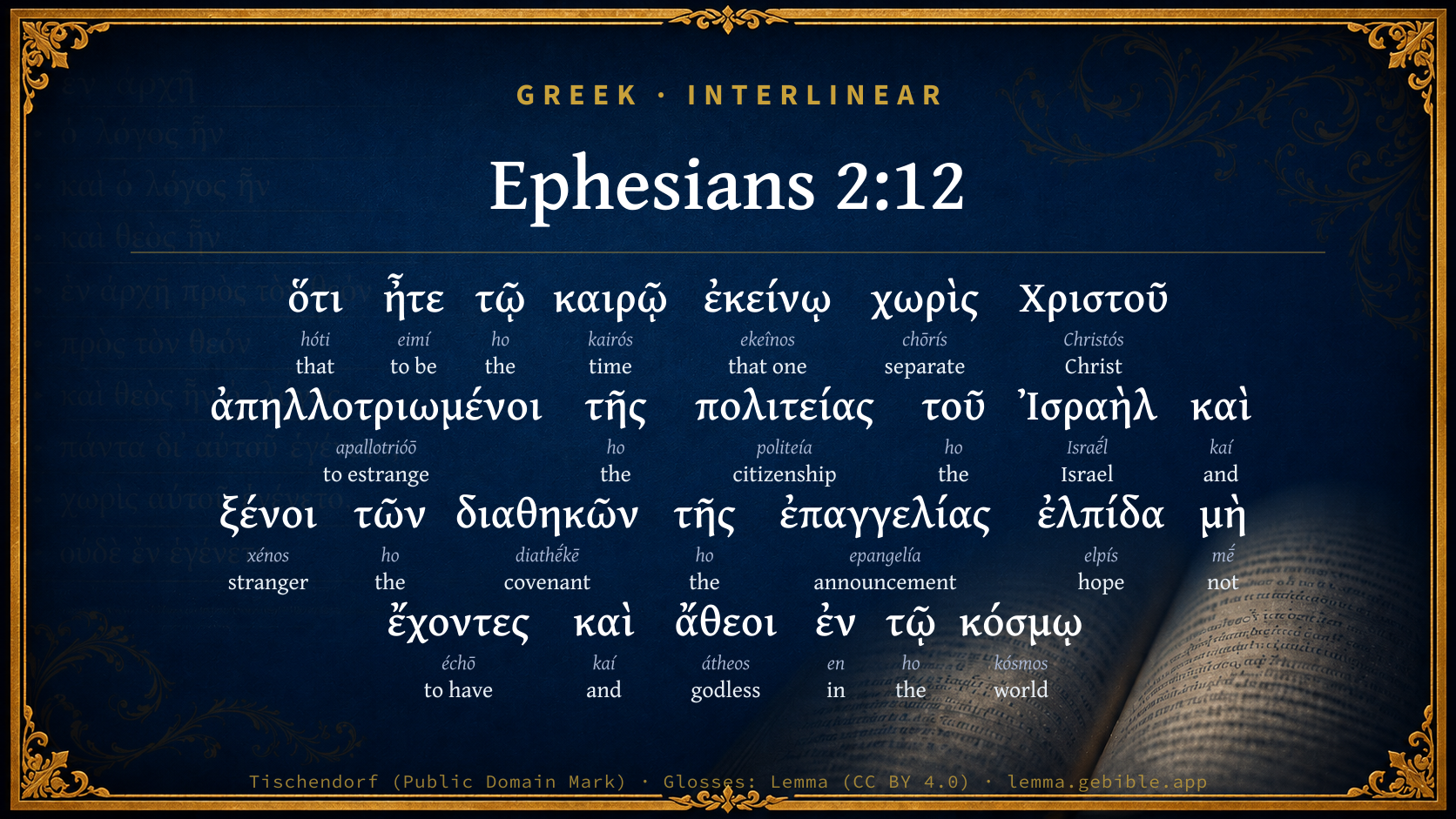
that you were at that time separate from Christ, alienated from the commonwealth of Israel, and strangers from the covenants of the promise, having no hope and without God in the world.
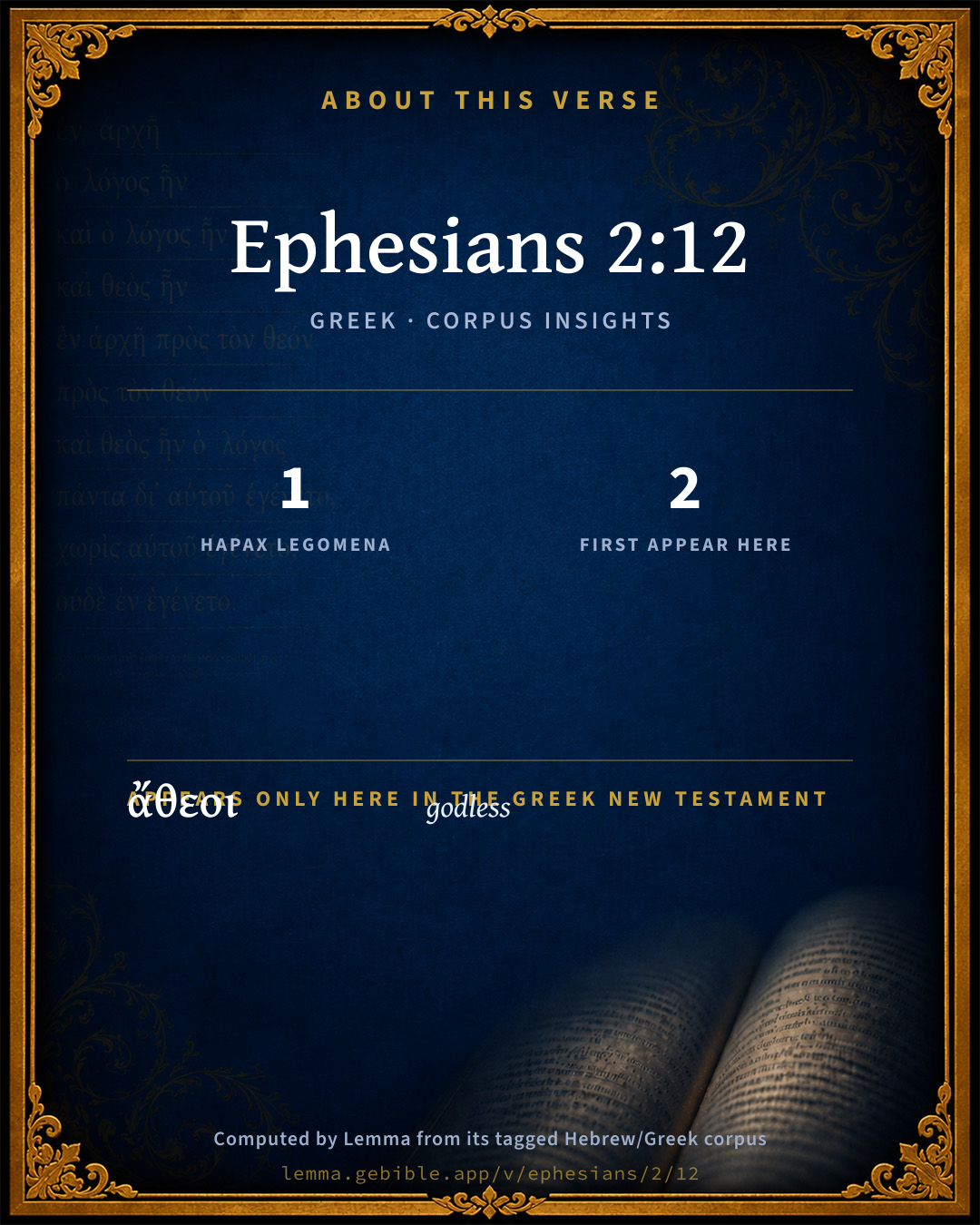
- 1 hapax legomenon — only here in the Greek New Testament
- 2 first appearances in the Greek New Testament
Download a study sheet
One document with this verse’s original text, its word-by-word gloss line, the meaning frame, cross-references with their text, attributed commentary, and full source and license credits — printable, and it pastes into notes with its structure intact.
This verse Autodidact and up
A passage Seminary Student
Up to 50 verses in one chapter. A passage sheet keeps up to 6 commentary sources and 12 cross-references per verse, in the order this page ranks them, and says so on the sheet whenever that leaves anything out. Ask for a single verse and you get the Autodidact verse sheet above.
Everything on this page stays free to read, with no account — the sheet is a download of what is already on screen, not access to it.
Compare translations 3
The same verse in 3 English versions, stacked beneath the original-language interlinear above. Click any original word for its lexicon entry.
Each is an independent rendering of the whole verse — the interlinear is not word-aligned to these translations.
Highlighted words mark where these versions differ — a whole-verse word diff, not a word-by-word alignment.
-
World English Bible Public Domain
that you were at that time separate from Christ, alienated from the commonwealth of Israel, and strangers from the covenants of the promise, having no hope and without God in the world.
-
King James Version Public Domain
That at that time ye were without Christ, being aliens from the commonwealth of Israel, and strangers from the covenants of promise, having no hope, and without God in the world:
-
unfoldingWord Literal Text CC BY-SA 4.0
For at that time you were apart from Christ, excluded from the community of Israel, and strangers to the covenants of the promise, having no hope and without God in the world.
unfoldingWord Literal Text — © unfoldingWord, licensed CC BY-SA 4.0. Word-aligned USFM3 via Door43 (git.door43.org/unfoldingWord/en_ult).
Show all 19 translations
Every available English version of this verse, each an independent rendering of the whole verse.
-
World English Bible Public Domain
that you were at that time separate from Christ, alienated from the commonwealth of Israel, and strangers from the covenants of the promise, having no hope and without God in the world.
-
Berean Standard Bible Public Domain
remember that at that time you were separate from Christ, alienated from the commonwealth of Israel, and strangers to the covenants of the promise, without hope and without God in the world.
-
Majority Standard Bible Public Domain
remember that at that time you were separate from Christ, alienated from the commonwealth of Israel, and strangers to the covenants of the promise, without hope and without God in the world.
-
King James Version Public Domain
That at that time ye were without Christ, being aliens from the commonwealth of Israel, and strangers from the covenants of promise, having no hope, and without God in the world:
-
American Standard Version (1901) Public Domain
that ye were at that time separate from Christ, alienated from the commonwealth of Israel, and strangers from the covenants of the promise, having no hope and without God in the world.
-
Revised Version (1885) Public Domain
that ye were at that time separate from Christ, alienated from the commonwealth of Israel, and strangers from the covenants of the promise, having no hope and without God in the world.
-
Geneva Bible (1599) Public Domain
That ye were, I say, at that time without Christ, and were alients from the common wealth of Israel, and were strangers from the couenants of promise, and had no hope, and were without God in the world.
-
Douay-Rheims (1899) Public Domain
That you were at that time without Christ, being aliens from the conversation of Israel, and strangers to the testament, having no hope of the promise, and without God in this world.
-
Young's Literal Translation Public Domain
that ye were at that time apart from Christ, having been alienated from the commonwealth of Israel, and strangers to the covenants of the promise, having no hope, and without God, in the world;
-
Literal Standard Version CC BY-SA 4.0
that you were at that time apart from Christ, having been alienated from the commonwealth of Israel, and strangers to the covenants of the promise, having no hope, and without God in the world;
-
Unlocked Literal Bible CC BY-SA 4.0
For at that time you were separated from Christ, foreigners to the people of Israel, strangers to the covenants of the promise, having no hope and without God in the world.
-
unfoldingWord Literal Text CC BY-SA 4.0
For at that time you were apart from Christ, excluded from the community of Israel, and strangers to the covenants of the promise, having no hope and without God in the world.
-
Darby Bible Public Domain
that ye were at that time without Christ, aliens from the commonwealth of Israel, and strangers to the covenants of promise, having no hope, and without God in the world:
-
World Messianic Bible Public Domain
that you were at that time separate from Messiah, alienated from the commonwealth of Israel, and strangers from the covenants of the promise, having no hope and without God in the world.
-
Webster's Bible Public Domain
That at that time ye were without Christ, being aliens from the commonwealth of Israel, and strangers from the covenants of promise, having no hope, and without God in the world:
-
Free Bible Version CC BY-SA 4.0
that once you had no relationship to Christ. You were barred as foreigners from being citizens of Israel, strangers to the agreement God had promised. You had no hope and you lived in the world without God.
-
Bible in Basic English Public Domain
That you were at that time without Christ, being cut off from any part in Israel's rights as a nation, having no part in God's agreement, having no hope, and without God in the world.
-
Text-Critical English NT CC BY 4.0
remember that you were apart from Christ at that time, excluded from the citizenship of Israel and strangers to the covenants of the promise, having no hope and without God in the world.
-
Tyndale New Testament (1534) Public Domain
Remember I saye that ye were at that tyme with oute Christ and were reputed aliantes from the comen welth of Israel and were straugers from the testamentes of promes and had no hope and were with out god in this worlde.
Literal Standard Version (2020), Covenant Press — licensed CC BY-SA 4.0. Text via the HelloAO Bible API (eBible.org). Unlocked Literal Bible (unfoldingWord) — licensed CC BY-SA 4.0. Text via the HelloAO Bible API (eBible.org). unfoldingWord Literal Text — © unfoldingWord, licensed CC BY-SA 4.0. Word-aligned USFM3 via Door43 (git.door43.org/unfoldingWord/en_ult). Free Bible Version, Dr. Jonathan Gallagher — licensed CC BY-SA 4.0. Text via the HelloAO Bible API (eBible.org).
Word by word
More ways to search: Search by grammar → Find every occurrence → Compare this word →
Practice this passage: Drill this verse → Learn its vocabulary →
- Appears 1× in the Greek New Testament
- First appears here
- Part of Speech
- Adjective
- Case
- Nominative
- Number
- Plural
- Gender
- Masculine
Full Thayer's Definition
- ὅτι hóti G3754 “that” Conjunction
- ἦτε eimí G1510 “to be” Verb, Imperfect, Active, Indicative, 2nd person, Plural
- τῷ ho G3588 “the” Article, Dative, Singular, Masculine
- καιρῷ kairós G2540 “time” Noun, Dative, Singular, Masculine
- ἐκείνῳ ekeînos G1565 “that one” Demonstrative pronoun, Dative, Singular, Masculine
- χωρὶς chōrís G5565 “separate” Adverb
- Χριστοῦ Christós G5547 “Christ” Noun, Genitive, Singular, Masculine
- ἀπηλλοτριωμένοι apallotrióō G526 “to estrange” Verb, Perfect, Passive, Participle, Nominative, Plural, Masculine
- τῆς ho G3588 “the” Article, Genitive, Singular, Feminine
- πολιτείας politeía G4174 “citizenship” Noun, Genitive, Singular, Feminine
- τοῦ ho G3588 “the” Article, Genitive, Singular, Masculine
- Ἰσραὴλ Israḗl G2474 “Israel” Noun, Proper, indeclinable
- καὶ kaí G2532 “and” Conjunction
- ξένοι xénos G3581 “stranger” Adjective, Nominative, Plural, Masculine
- τῶν ho G3588 “the” Article, Genitive, Plural, Feminine
- διαθηκῶν diathḗkē G1242 “covenant” Noun, Genitive, Plural, Feminine
- τῆς ho G3588 “the” Article, Genitive, Singular, Feminine
- ἐπαγγελίας epangelía G1860 “announcement” Noun, Genitive, Singular, Feminine
- ἐλπίδα elpís G1680 “hope” Noun, Accusative, Singular, Feminine
- μὴ mḗ G3361 “not” Particle, Negative
- ἔχοντες échō G2192 “to have” Verb, Present, Active, Participle, Nominative, Plural, Masculine
- καὶ kaí G2532 “and” Conjunction
- ἄθεοι átheos G112 “godless” Adjective, Nominative, Plural, Masculine
- ἐν en G1722 “in” Preposition
- τῷ ho G3588 “the” Article, Dative, Singular, Masculine
- κόσμῳ kósmos G2889 “world” Noun, Dative, Singular, Masculine
About this verse
These counts appear in no published source. They are computed here, from the morphology-tagged text and Lemma’s own curated glosses. What Lemma adds →
- 26
- words
- 20
- distinct lemmas
- Pauline Epistles
- section
Notable vocabulary
1 hapax legomenon — a word that appears only here in the entire Greek New Testament:
- ἄθεοι godless G112
First appearance in Scripture
These words make their first canonical appearance in the Greek New Testament here:
Shared distinctive vocabulary
πολιτείας citizenship G4174 occurs in 2 verses of the Greek New Testament. Also found in:
Cross-references
45Topical passages linked to Ephesians 2:12 in the Treasury of Scripture Knowledge — connected by theme and wording, ordered by reader-vote popularity; previews shown in the World English Bible.
- Galatians 4:8 However at that time, not knowing God, you were in bondage to those who by nature are not gods.
- Colossians 1:21 You, being in past times alienated and enemies in your mind in your evil works,
- 1 Peter 1:3 Blessed be the God and Father of our Lord Jesus Christ, who according to his great mercy became our father again to a living hope through the resurrection of Jesus Christ from the dead,
- Jeremiah 31:31–34 Behold, the days come, says Yahweh, that I will make a new covenant with the house of Israel, and with the house of Judah:
- Ephesians 4:18 being darkened in their understanding, alienated from the life of God, because of the ignorance that is in them, because of the hardening of their hearts;
- 1 Thessalonians 4:13 But we don't want you to be ignorant, brothers, concerning those who have fallen asleep, so that you don't grieve like the rest, who have no hope.
- Ezekiel 37:26 Moreover I will make a covenant of peace with them; it shall be an everlasting covenant with them; and I will place them, and multiply them, and will set my sanctuary in the midst of them forevermore.
- John 15:5 I am the vine. You are the branches. He who remains in me, and I in him, the same bears much fruit, for apart from me you can do nothing.
- Hebrews 6:18 that by two immutable things, in which it is impossible for God to lie, we may have a strong encouragement, who have fled for refuge to take hold of the hope set before us.
- Genesis 17:7–9 I will establish my covenant between me and you and your seed after you throughout their generations for an everlasting covenant, to be a God to you and to your seed after you.
- Galatians 3:16–17 Now the promises were spoken to Abraham and to his seed. He doesn't say, "To seeds," as of many, but as of one, "To your seed," which is Christ.
- 1 Thessalonians 4:5 not in the passion of lust, even as the Gentiles who don't know God;
- 2 Chronicles 15:3 Now for a long season Israel was without the true God, and without a teaching priest, and without law:
- John 10:16 I have other sheep, which are not of this fold. I must bring them also, and they will hear my voice. They will become one flock with one shepherd.
- Romans 9:8 That is, it is not the children of the flesh who are children of God, but the children of the promise are counted as a seed.
- 1 Peter 3:15 But sanctify the Lord God in your hearts; and always be ready to give an answer to everyone who asks you a reason concerning the hope that is in you, with humility and fear:
- Genesis 15:18 In that day Yahweh made a covenant with Abram, saying, "To your seed have I given this land, from the river of Egypt to the great river, the river Euphrates:
- Psalms 89:3–18 "I have made a covenant with my chosen one, I have sworn to David, my servant,
- Jeremiah 17:13 Yahweh, the hope of Israel, all who forsake you shall be disappointed. Those who depart from me shall be written in the earth, because they have forsaken Yahweh, the spring of living waters.
- Acts 3:25 You are the children of the prophets, and of the covenant which God made with our fathers, saying to Abraham, 'In your seed will all the families of the earth be blessed.'
- Acts 28:20 For this cause therefore I asked to see you and to speak with you. For because of the hope of Israel I am bound with this chain."
- Romans 9:4–5 who are Israelites; whose is the adoption, the glory, the covenants, the giving of the law, the service, and the promises;
- 1 Corinthians 10:19–20 What am I saying then? That a thing sacrificed to idols is anything, or that an idol is anything?
- Exodus 24:3–11 Moses came and told the people all the words of Yahweh, and all the ordinances; and all the people answered with one voice, and said, "All the words which Yahweh has spoken will we do."
- Numbers 18:19 All the heave-offerings of the holy things, which the children of Israel offer to Yahweh, have I given you, and your sons and your daughters with you, as a portion forever: it is a covenant of salt forever before Yahweh to you and to your seed with you.
- Ezra 4:3 But Zerubbabel, and Jeshua, and the rest of the heads of fathers' [houses] of Israel, said to them, You have nothing to do with us in building a house to our God; but we ourselves together will build to Yahweh, the God of Israel, as king Cyrus the king of Persia has commanded us.
- Isaiah 44:6 Thus says Yahweh, the King of Israel, and his Redeemer, Yahweh of Hosts: I am the first, and I am the last; and besides me there is no God.
- Isaiah 45:20 Assemble yourselves and come; draw near together, you who have escaped from the nations: they have no knowledge who carry the wood of their engraved image, and pray to a god that can't save.
- Jeremiah 14:8 You hope of Israel, the Savior of it in the time of trouble, why should you be as a foreigner in the land, and as a wayfaring man who turns aside to stay for a night?
- Jeremiah 33:20–26 Thus says Yahweh: If you can break my covenant of the day, and my covenant of the night, so that there shall not be day and night in their season;
- Ezekiel 13:9 My hand shall be against the prophets who see false visions, and who divine lies: they shall not be in the council of my people, neither shall they be written in the writing of the house of Israel, neither shall they enter into the land of Israel; and you shall know that I am the Lord Yahweh.
- Hosea 3:4 For the children of Israel shall abide many days without king, and without prince, and without sacrifice, and without sacred stone, and without ephod or idols.
- Luke 1:72 To show mercy towards our fathers, To remember his holy covenant,
- John 4:22 You worship that which you don't know. We worship that which we know; for salvation is from the Jews.
- Acts 14:15–16 "Men, why are you doing these things? We also are men of like passions with you, and bring you good news, that you should turn from these vain things to the living God, who made the sky and the earth and the sea, and all that is in them;
- Romans 1:28–32 Even as they refused to have God in their knowledge, God gave them up to a reprobate mind, to do those things which are not fitting;
- 1 Corinthians 8:4–6 Therefore concerning the eating of things sacrificed to idols, we know that no idol is anything in the world, and that there is no other God but one.
- Colossians 1:5 because of the hope which is laid up for you in the heavens, of which you heard before in the word of the truth of the Gospel,
- Colossians 1:27 to whom God was pleased to make known what are the riches of the glory of this mystery among the Gentiles, which is Christ in you, the hope of glory;
- 2 Thessalonians 2:16 Now our Lord Jesus Christ himself, and God our Father, who loved us and gave us eternal comfort and good hope through grace,
- 1 Timothy 1:1 Paul, an apostle of Christ Jesus according to the commandment of God our Savior, and Christ Jesus our hope;
- Hebrews 11:34 quenched the power of fire, escaped the edge of the sword, from weakness were made strong, grew mighty in war, and turned to flight armies of aliens.
- 1 Peter 1:21 who through him are believers in God, who raised him from the dead, and gave him glory; so that your faith and hope might be in God.
- 1 John 3:3 Everyone who has this hope set on him purifies himself, even as he is pure.
- Isaiah 61:5 Strangers shall stand and feed your flocks, and foreigners shall be your plowmen and your vine-dressers.
Cross-references courtesy of OpenBible.info (CC BY 4.0).
Lesson kit
Teaching starters — assembled from the data on this page, not authored interpretation. Every prompt links to the verse data it draws on. Edit before teaching.
Ephesians, in the Pauline Epistles, opens this verse with 26 words (20 distinct Greek lemmas). Its most distinctive word is átheos (“godless”). A historical commentator’s framing appears above. Read the whole chapter for the surrounding context.
Discussion questions
- What does “godless” (átheos) contribute to the verse as a whole?
- 1 word here appears nowhere else in the Greek New Testament. Why might the author reach for such rare wording?
- 2 words make their first appearance in Scripture here. What does this debut establish?
- How does Acts 22:28, which shares the word «citizenship», read alongside this verse?
- What does the repetition of “the” (6× in this one verse) do in this verse?
- These translations render this verse differently; the difference is in the English rendering, not the original. What questions does that raise?
- Compare how The Cambridge Bible for Schools and Colleges and The Biblical Illustrator read this verse. Where do they agree or differ?
Things to notice
- 1 word in this verse appears nowhere else in the Greek New Testament.
- 2 words make their first canonical appearance in Scripture here.
- These translations choose different wording for 9 words in this verse.
- “the” occurs 6× in this single verse.
- 20 distinct Greek lemmas span 26 words in this verse.
Commentary
Notes on Ephesians 2:12 from classic Christian and Jewish commentators (each source and its license shown beneath its notes). The classic Christian expositions comment on the surrounding passage and are grouped to its opening verse, so a note may address several verses; the Jewish commentaries on the Tanakh (Rashi and others) are per-verse, so they appear only where the commentator wrote on this verse.
Lemma curates 59 commentaries, every one of them public domain or Creative Commons licensed, each selected and text-cleaned for this edition rather than reprinted as found. About our sources →
The Cambridge Bible for Schools and Colleges
gen. ed. J. J. S. Perowne
The Cambridge Bible for Schools and Colleges (gen. ed. J. J. S. Perowne; Cambridge University Press, 1878–1918) — public domain. Text from a community e-Sword module.
The Biblical Illustrator
Joseph S. Exell
The Biblical Illustrator, edited by Joseph S. Exell (c. 1880s–1900s) — public domain. Text from a community e-Sword module.
Tyndale Open Study Notes
Tyndale Open Resources
Tyndale Open Study Notes — © Tyndale Open Resources, licensed CC BY-SA 4.0. Text via the HelloAO Bible API.
Bengel's Gnomon
Johann Albrecht Bengel
Bengel's Gnomon of the New Testament — English translation (T&T Clark, Edinburgh, 1860) — public domain. Text from a community e-Sword module.
Meyer's Critical & Exegetical Commentary
Heinrich August Wilhelm Meyer
Meyer — Critical and Exegetical Commentary on the New Testament — English translation by Peter Christie, edited by Frederick Crombie (T&T Clark, 1880) — public domain. Text from a community e-Sword module.
Expositor's Greek Testament
ed. W. Robertson Nicoll
The Expositor's Greek Testament, edited by W. Robertson Nicoll (1897–1910) — public domain. Text from a community e-Sword module.
Hodge's Commentary on Romans, Ephesians & First Corinthians
Charles Hodge
Charles Hodge — Commentary on Romans (1835), First Corinthians (1857), and Ephesians (1856) — public domain. Text from a community e-Sword module.
Geneva Bible (1599)
Geneva Bible translators
Geneva Bible (1599) marginal notes — public domain. Text via Bolls.life.
Jamieson, Fausset & Brown
Robert Jamieson, A. R. Fausset & David Brown
Jamieson, Fausset & Brown — Commentary Critical and Explanatory on the Whole Bible (1871) — public domain (CC PDM 1.0). Text via the HelloAO Bible API.
Adam Clarke's Commentary
Adam Clarke's Commentary on the Bible (1810–1826) — public domain. Text from a community e-Sword/MySword module.
John Calvin's Commentaries
John Calvin's Commentaries (1540-1563) — public domain. Text from the Calvin Translation Society English edition (1840s-50s) via the Christian Classics Ethereal Library (ccel.org). Calvin's coverage is partial (roughly two-thirds of the Bible); uncommented books and verses are honest gaps, never fabricated. The 19th-century editor's footnotes and remarks are omitted so the notes are faithfully Calvin's own voice.
Ellicott's Commentary for English Readers
A Bible Commentary for English Readers, edited by Charles John Ellicott (1878–1897) — public domain. Text from a community e-Sword module.
John Gill's Exposition
John Gill's Exposition of the Whole Bible (1746–1763) — public domain (CC PDM 1.0). Text via the HelloAO Bible API.
Trapp's Complete Commentary
John Trapp
John Trapp, A Commentary or Exposition upon All the Books of the Old and New Testament (1647–1656) — public domain. Text from a community e-Sword module.
Albert Barnes' Notes on the Bible
Albert Barnes' Notes on the Bible (1834–1885) — public domain. Text from a community e-Sword/MySword module.
Matthew Poole's English Annotations
Matthew Poole's English Annotations on the Holy Bible (1683–1685) — public domain. Text from a community e-Sword/MySword module.
Whedon's Commentary on the Bible
Daniel D. Whedon
Daniel D. Whedon (gen. ed.), Commentary on the Old and New Testaments (1874–1909) — public domain. Text from a community e-Sword module.
The Pulpit Commentary
The Pulpit Commentary (1880–1919), ed. H.D.M. Spence-Jones & Joseph S. Exell — public domain. Text from a community e-Sword module.
John Wesley's Explanatory Notes
John Wesley, Explanatory Notes Upon the Whole Bible (1754–1765) — public domain. Text via the GEBible commentary corpus.
Scofield Reference Notes
C. I. Scofield
The Scofield Reference Bible (1917 edition), notes by C. I. Scofield — public domain. Text from a community e-Sword module.
The People's New Testament
B. W. Johnson
B. W. Johnson's The People's New Testament with Notes (1889–1891) — public domain. Electronic text from the Christian Classics Ethereal Library (CCEL) ThML edition.
Cambridge Greek Testament for Schools and Colleges
Cambridge Greek Testament for Schools and Colleges (Cambridge University Press, 1896; 21 vols, various authors incl. Carr, Maclear, Plummer, Farrar, Lumby, Moule, M. R. James, Simcox) — public domain. Text from a community e-Sword module.
Alford’s Greek Testament
Henry Alford
Henry Alford, The Greek Testament (1849–1861) — public domain. Text from a community e-Sword module.
International Critical Commentary
International Critical Commentary — older volumes (1896–1929), various authors — public domain. Text from a community e-Sword module.
Vincent's Word Studies in the New Testament
Marvin R. Vincent
Marvin R. Vincent, Word Studies in the New Testament (1887–1900) — public domain. Text from a community e-Sword/MySword module.