
Exodus 23:14

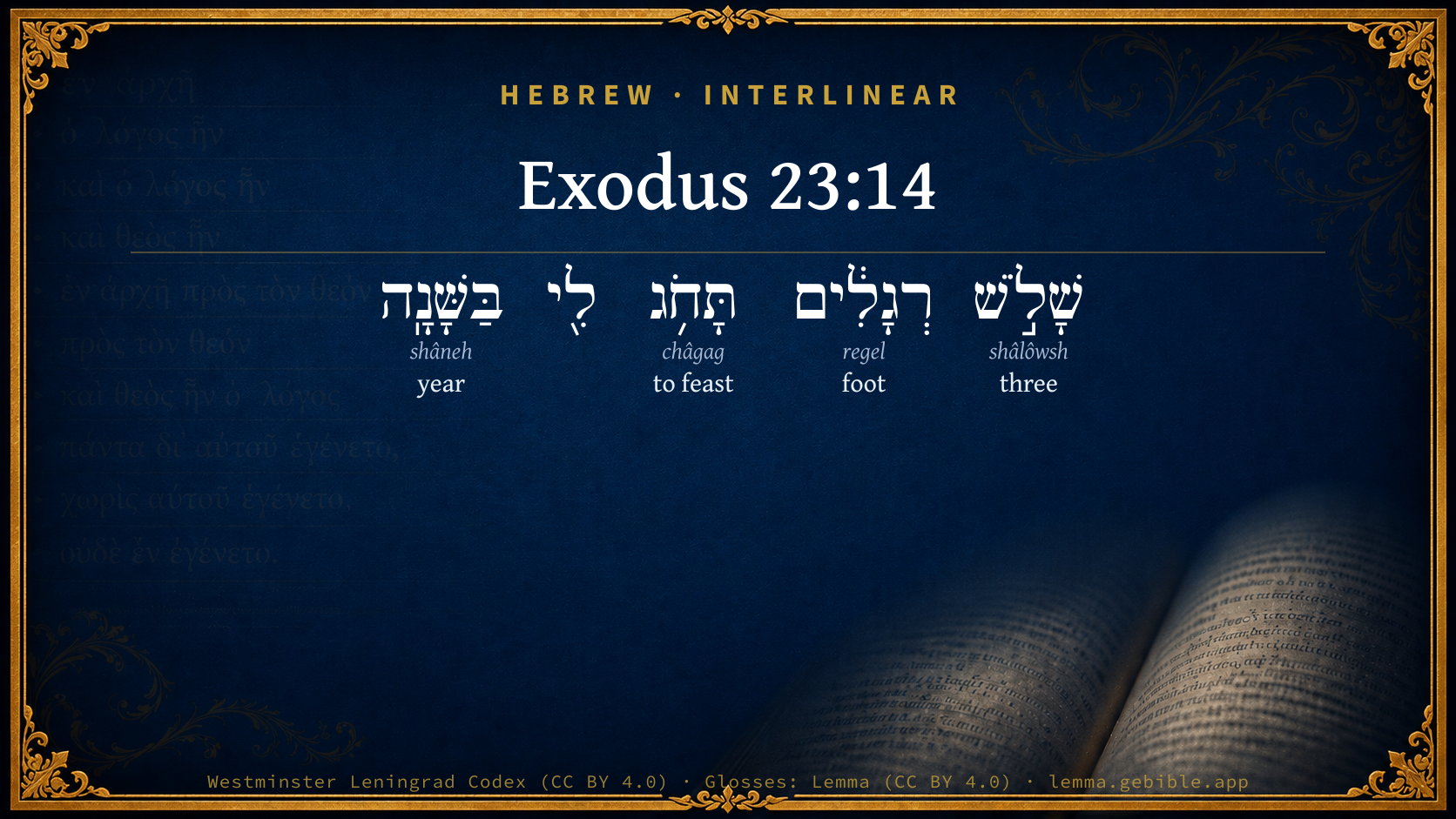
Hebrew (Westminster Leningrad Codex) Exodus 23:14 appears in the Hebrew Old Testament. The text above is from the Westminster Leningrad Codex. Each word links to its Strong’s number, a concise gloss, and parsing drawn from the Open Scriptures Hebrew Bible morphology. Click any word for its full Brown-Driver-Briggs (BDB) entry.
Download image
Cite this verse

Exodus 23:14 (World English Bible). Public Domain. Lemma interlinear Bible study tool, https://lemma.gebible.app/v/exodus/23/14.

Show BibTeX & RIS
BibTeX
RIS
English Translation
"You shall observe a feast to me three times a year.
World English Bible · Public Domain
Download a study sheet

One document with this verse’s original text, its word-by-word gloss line, the meaning frame, cross-references with their text, attributed commentary, and full source and license credits — printable, and it pastes into notes with its structure intact.

This verse Autodidact and up

Study sheet (.html) Plain text (.txt)

A passage Seminary Student

Up to 50 verses in one chapter. A passage sheet keeps up to 6 commentary sources and 12 cross-references per verse, in the order this page ranks them, and says so on the sheet whenever that leaves anything out. Ask for a single verse and you get the Autodidact verse sheet above.

Everything on this page stays free to read, with no account — the sheet is a download of what is already on screen, not access to it.

Want to remove ads? Support Godless Engineer
Compare translations 3

The same verse in 3 English versions, stacked beneath the original-language interlinear above. Click any original word for its lexicon entry.

Each is an independent rendering of the whole verse — the interlinear is not word-aligned to these translations.

Highlighted words mark where these versions differ — a whole-verse word diff, not a word-by-word alignment.

  • World English Bible Public Domain
    "You shall observe a feast to me three times a year.
  • King James Version Public Domain
    Three times thou shalt keep a feast unto me in the year.
  • unfoldingWord Literal Text CC BY-SA 4.0
    You shall celebrate me three times every year.

unfoldingWord Literal Text — © unfoldingWord, licensed CC BY-SA 4.0. Word-aligned USFM3 via Door43 (git.door43.org/unfoldingWord/en_ult).

Versions to compare (up to 4)

3 of 4 selected

Show all 18 translations

Every available English version of this verse, each an independent rendering of the whole verse.

  • World English Bible Public Domain
    "You shall observe a feast to me three times a year.
  • Berean Standard Bible Public Domain
    Three times a year you are to celebrate a feast to Me.
  • Majority Standard Bible Public Domain
    Three times a year you are to celebrate a feast to Me.
  • King James Version Public Domain
    Three times thou shalt keep a feast unto me in the year.
  • American Standard Version (1901) Public Domain
    Three times thou shalt keep a feast unto me in the year.
  • Revised Version (1885) Public Domain
    Three times thou shalt keep a feast unto me in the year.
  • Geneva Bible (1599) Public Domain
    Three times thou shalt keepe a feast vnto me in the yeere.
  • Douay-Rheims (1899) Public Domain
    Three times every year you shall celebrate feasts to me.
  • Young's Literal Translation Public Domain
    `Three times thou dost keep a feast to Me in a year;
  • Literal Standard Version CC BY-SA 4.0
    You keep a celebration to Me three times in a year:
  • Unlocked Literal Bible CC BY-SA 4.0
    You must travel to hold a festival for me three times every year.
  • unfoldingWord Literal Text CC BY-SA 4.0
    You shall celebrate me three times every year.
  • Darby Bible Public Domain
    Thrice in the year thou shalt celebrate a feast to me.
  • World Messianic Bible Public Domain
    “You shall observe a feast to me three times a year.
  • Webster's Bible Public Domain
    Three times thou shalt keep a feast to me in the year.
  • Free Bible Version CC BY-SA 4.0
    Three times every year you are to celebrate a feast dedicated to me.
  • Bible in Basic English Public Domain
    Three times in the year you are to keep a feast to me.
  • JPS Tanakh (1917) Public Domain
    Three times thou shalt keep a feast unto Me in the year.

Literal Standard Version (2020), Covenant Press — licensed CC BY-SA 4.0. Text via the HelloAO Bible API (eBible.org). Unlocked Literal Bible (unfoldingWord) — licensed CC BY-SA 4.0. Text via the HelloAO Bible API (eBible.org). unfoldingWord Literal Text — © unfoldingWord, licensed CC BY-SA 4.0. Word-aligned USFM3 via Door43 (git.door43.org/unfoldingWord/en_ult). Free Bible Version, Dr. Jonathan Gallagher — licensed CC BY-SA 4.0. Text via the HelloAO Bible API (eBible.org).

Word by word

More ways to search: Search by grammar → Find every occurrence → Compare this word →

Practice this passage: Drill this verse → Learn its vocabulary →

תָּחֹ֥ג
châgag
H2287
“to feast”
Verb, Qal, Imperfect, 2nd Person, Masculine, Singular
Part of Speech
Verb
Stem
Qal
Form
Imperfect
Person
2nd Person
Gender
Masculine
Number
Singular
Full BDB Definition

Origin: a primitive root [compare H2283 , H2328 ]

TWOT: 602

to hold a feast, hold a festival, make pilgrimage, keep a pilgrim-feast, celebrate, dance, stagger - (Qal) - to keep a pilgrim-feast - to reel
  1. שָׁלֹ֣שׁ shâlôwsh H7969 “three” Adjective, Cardinal number, Feminine, Singular, Absolute
  2. רְגָלִ֔ים regel H7272 “feet” Noun, Common, Feminine, Plural, Absolute
  3. בַּשָּׁנָֽה shâneh H8141 “in/at the · year” Preposition, Determined + Noun, Common, Feminine, Singular, Absolute

About this verse

These counts appear in no published source. They are computed here, from the morphology-tagged text and Lemma’s own curated glosses. What Lemma adds →

5
words
4
distinct lemmas
Pentateuch
section

Notable vocabulary

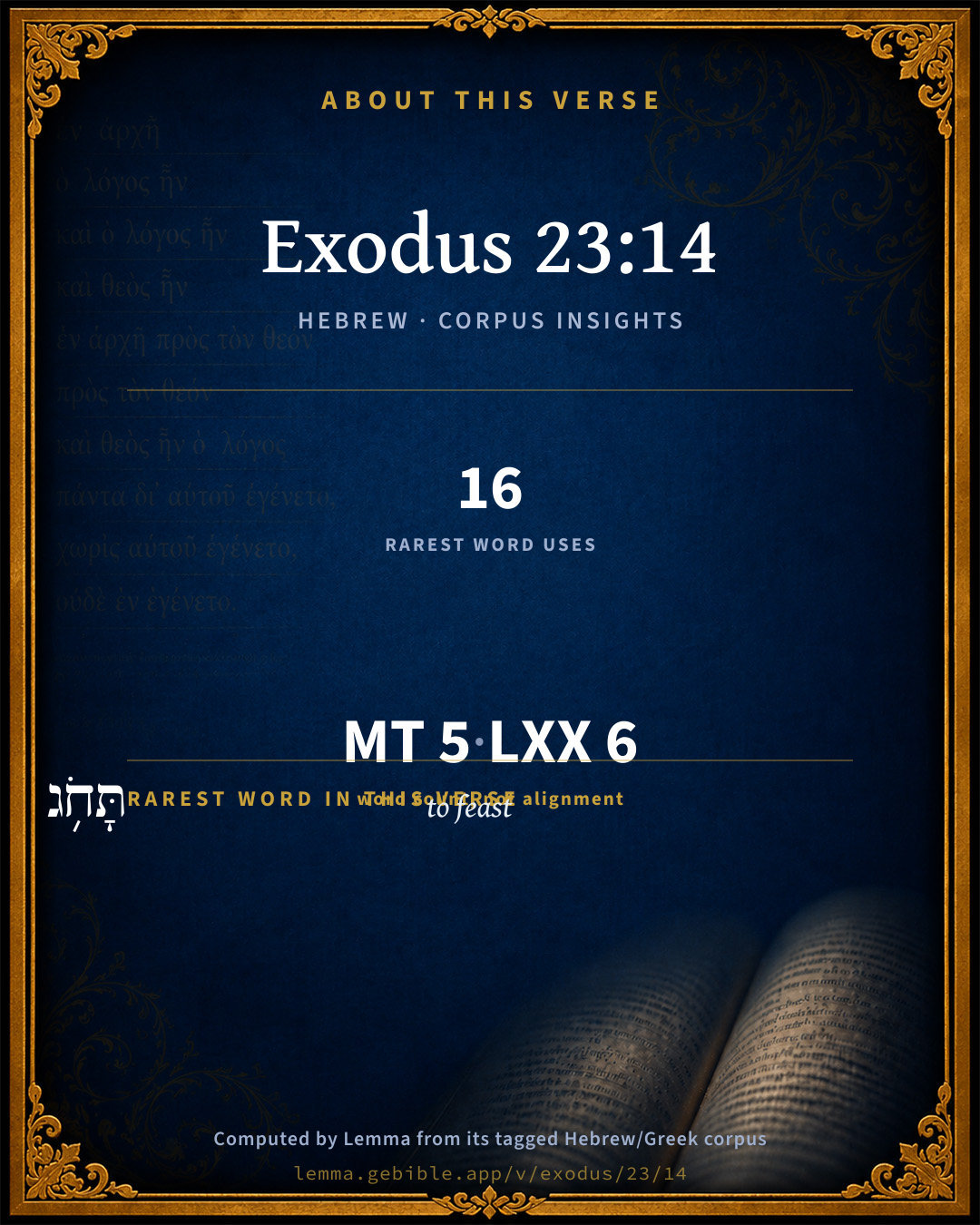
The rarest word here is תָּחֹ֥ג to feast H2287 — appearing just 16 times in the whole Hebrew Bible.

Shared distinctive vocabulary

תָּחֹ֥ג to feast H2287 occurs in 14 verses of the Hebrew Bible. Also found in:

Grammatical profile

  • 1 verb
  • 2 nouns
  • 1 adjective
  • 1 preposition

Verb forms

  • תָּחֹ֥ג Qal · Imperfect

Hebrew & Septuagint length

In English translation the verse runs 11 words from the Hebrew and 11 from the Septuagint (LXX English) — the same length.

A rough comparison of the two English renderings, which tokenize alike — not a word-level alignment.

Word counts can differ between the Hebrew and the Greek without any difference in meaning — e.g. the Hebrew direct-object marker אֵת has no separate Greek word, and Greek often adds the article ὁ.

In the original languages it is 5 Hebrew tokens and 6 Greek tokens — but the two are counted differently (Hebrew bundles its prefixes and suffixes into one token; the Greek is in lemma form), so that isn’t a like-for-like length.

Cross-references

6

Topical passages linked to Exodus 23:14 in the Treasury of Scripture Knowledge — connected by theme and wording, ordered by reader-vote popularity; previews shown in the World English Bible.

  • Deuteronomy 16:16 Three times in a year shall all your males appear before Yahweh your God in the place which he shall choose: in the feast of unleavened bread, and in the feast of weeks, and in the feast of tents; and they shall not appear before Yahweh empty:
  • Exodus 23:17 Three times in the year all your males shall appear before the Lord Yahweh.
  • Exodus 34:22–24 You shall observe the feast of weeks with the first fruits of wheat harvest, and the feast of harvest at the year's end.
  • Leviticus 23:5 In the first month, on the fourteenth day of the month in the evening, is Yahweh's Passover.
  • Leviticus 23:16 even to the next day after the seventh Sabbath you shall number fifty days; and you shall offer a new meal offering to Yahweh.
  • Leviticus 23:34 "Speak to the children of Israel, and say, 'On the fifteenth day of this seventh month is the feast of tents for seven days to Yahweh.

Cross-references courtesy of OpenBible.info (CC BY 4.0).

Hebrew and Greek witnesses Masoretic Hebrew ↔ Greek Septuagint

The same verse in the two great witnesses to the Old Testament, shown verse-for-verse.

These are two independent witnesses, not word-aligned to each other, and the Septuagint is shown in lemma (dictionary) form.

Hebrew Exodus 23:14 Masoretic · Westminster Leningrad Codex

שָׁלֹ֣שׁ רְגָלִ֔ים תָּחֹ֥ג לִ֖י בַּשָּׁנָֽה

"You shall observe a feast to me three times a year.

World English Bible · Public Domain

Greek LXX Exodus 23:14 Septuagint · lemma form

τρεῖς καιρός ὁ ἐνιαυτός ἑορτάζω ἐγώ

Keep you⌃ a feast to me three times in the year.

LXX2012 (modern English Septuagint) · Public Domain

Hebrew: Westminster Leningrad Codex (CC BY 4.0). Greek: Septuagint (public domain); English from LXX2012 (modern English Septuagint) (Public Domain). How the Septuagint differs from the Hebrew →

Targum (Aramaic paraphrase)

2

The Targum is the ancient Jewish Aramaic paraphrase of the Hebrew Scriptures — an interpretive translation, not the Hebrew text itself. Onkelos (literal) and Pseudo-Jonathan (expansive) render the Torah, and Jonathan the Prophets. Coverage is partial: where no permissively-licensed English translation exists for a verse, only the Aramaic is shown. This is verse-level text, not a word-by-word alignment to the Hebrew.

  1. Targum Onkelos Torah (Genesis–Deuteronomy)
    תְּלַת זִמְנִין תֵּחוֹג קֳדָמַי בְּשַׁתָּא:

    (no public-domain English translation for this verse)

    Targum Onkelos — Aramaic: “Onkelos Genesis” (public domain); “Onkelos Exodus” (public domain); “Onkelos Leviticus” (public domain); “Onkelos Numbers” (public domain); “Onkelos Deuteronomy” (public domain). English: “Sefaria Community Translation” (CC0 1.0 (public-domain dedication)); “J.W. Etheridge. The Targums of Onkelos and Jonathan Ben Uzziel on the Pentateuch. London: Longmans, Green, 1862” (public domain). Text via Sefaria.

  2. Targum Pseudo-Jonathan Torah (Genesis–Deuteronomy)
    תְּלָתָא זִמְנִין תְּחַגּוּן קֳדָמַי בְּשַׁתָּא

    Three times in the year thou shalt keep festival before Me.

    Targum Pseudo-Jonathan — Aramaic: “Targum Jonathan on Genesis” (public domain); “Targum Jonathan on Exodus” (public domain); “Targum Jonathan on Leviticus” (public domain); “Targum Jonathan on Numbers” (public domain); “Targum Jonathan on Deuteronomy” (public domain). English: “The Targum of Jonathan ben Uzziel, trans. J. W. Etheridge, London, 1862” (public domain). Text via Sefaria.

Commentary

Notes on Exodus 23:14 from classic Christian and Jewish commentators (each source and its license shown beneath its notes). The classic Christian expositions comment on the surrounding passage and are grouped to its opening verse, so a note may address several verses; the Jewish commentaries on the Tanakh (Rashi and others) are per-verse, so they appear only where the commentator wrote on this verse.

Lemma curates 59 commentaries, every one of them public domain or Creative Commons licensed, each selected and text-cleaned for this edition rather than reprinted as found. About our sources →

Trapp's Complete Commentary

John Trapp

Exo 23:14 Three times thou shalt keep a feast unto me in the year.

Ver. 14. Three times.] See Deu 16:16. The Hebrew hath it three feet, because the most went up to those three feasts every year afoot, saith Aben Ezra.

John Trapp, A Commentary or Exposition upon All the Books of the Old and New Testament (1647–1656) — public domain. Text from a community e-Sword module.

Joseph Benson's Commentary

Exo 23:14. The passover, pentecost, and feast of tabernacles, in spring, summer, and autumn, were the three times appointed for their attendance; not in winter, because travelling was then uncomfortable; nor in the midst of their harvest.

Joseph Benson's Commentary on the Old and New Testaments (1811–1818) — public domain. Text from a community e-Sword module.

The Preacher's Complete Homiletical Commentary

Joseph S. Exell (gen. ed.)

CRITICAL NOTES.—

Exo_23:19. Thou shalt not seethe, &c.]—This command, taken in connection with the preceding one, justifies the explanation of ancient commentators that it was given to banish a pagan rite, in the offering up as an harvest thanks-offering of a kid seethed in its mothers milk. With the milk of this oblation the fields, gardens, and orchards were sprinkled, in the belief that favour of the deities for a good harvest in the coming year would be thus secured. This commandment may, however, also imply a prohibition against cruelty and outrage of nature. Rabbinism took occasion to adduce from this commandment injunctions of an extensive culinary kind, according to which every Jew was strictly prohibited, not only from using milk, butter, or cheese with meat, but he is obliged to keep separate sets of kitchen utensils for each of those two classes of food.

MAIN HOMILETICS OF THE PARAGRAPH.—Exo_23:14-19

PILGRIMAGE FEASTS

The three feasts referred to in this passage are—The Feast of the Passover, the Feast of Pentecost, and the Feast of Tabernacles or ingathering; and may be regarded as the pilgrimage feasts. We do not consider them to be of patriarchal origin. They evidently refer not to a pastoral but to an agricultural state of society. The offerings are such as an agricultural people might be expected to present. They are indicative of the fact that the people were not mere keepers of sheep, but tillers of the land. Our religious feasts must be appropriate to our conditions. Our religious offerings must be characteristic of our state, and proportioned to our means. God requires from us only that which we are able to give. Let each give according to that which he has received from the great Giver.

I. Religious feasts are memorials. The feasts of this world very often are made only for empty laughter, and too frequently the laughter is turned into mourning. Many of those who give feasts give them in order to minister to the desire of display, or for the purpose of gaining some advantage. For this reason our blessed Lord tells the givers of feasts to call in the poor, the maimed, the halt, and the blind. But the feasts appointed to be observed by God are memorials. These three feasts are—

1. Memorials of God’s past dealings. The word Passover indicates the nature of the feast of unleavened bread. It is a memorial, not of the fact that the children of Israel passed through the Red Sea; but of the fact that the destroying angel passed over the abodes of the Israelites. It is a memorial of a wonderful Divine deliverance. Of all the feasts of the Jewish economy, this is the one great feast which has been brought into prominence by the observance of the feast of the Lord’s Supper. “Christ our Passover is sacrificed for us.” This great memorial feast of the Jews was typical and prophetical. It pointed onwards through the intervening centuries to the greater feast of the Lord’s Supper. The one feast celebrated the deliverance of the natural Israel, while the other celebrates the deliverance of the spiritual Israel. The one feast has become absorbed and lost in a greater feast; but the other feast will be perpetually celebrated. We shall pass away from drinking the symbolical wine of earth to the glorious privilege of drinking the new wine in our Father’s kingdom. The one feast was local, but the other was intended to be universal. It is a significant fact that the feast of the Lord’s Supper has been so widely observed. Churches that have departed from the faith and lapsed into idolatry have stuck to this Christian ordinance. And we may consider it prophetical of the destined universality of Christ’s kingdom.

2. Memorials of our dependence upon God’s care. While the feast of unleavened bread brings into prominence the lesson that God is a deliverer to His people, the feasts of harvest and of ingathering bring into prominence the lesson that God is a provider and a sustainer. They make impressive, and teach by appropriate symbolism, the utterance of the great singer of the Israelitish Church—“He maketh peace in thy borders, He filleth thee with the finest of the wheat.” They have a manifest tendency to raise the heart in adoring gratitude to “God, who gives rain from heaven and fruitful seasons, and fills our hearts with food and gladness.” Let us never forget that it is God who makes the earth fruitful. While some keep their feasts in honour of “natural causes,” the “uniformity of Nature’s laws,” and a “fortuitous concourse of atoms,” let us keep our feasts to celebrate the goodness of Him who is the first cause of all so-called natural causes, the Giver and Enforcer of Nature’s laws, and the Glorious Designer who causes the atoms to consort together, so as to produce the useful and the beautiful.

3. Memorials of our present condition. Not only and merely in the sense of being dependent creatures, but that while in this world we are but pilgrims. The feast of ingathering was the feast of tabernacles. During this festival, the Jews were to dwell in tents or booths. It was a reminder of their wilderness life. Even in our feasts let there be the chastening thought that here we have no continuing city. Our feasts are but temporary as were the booths in which the Israelites dwelt. The only perpetual feast is that which shall be celebrated in heaven. This earth is not our rest.

II. Religious feasts are not to interfere with the duties of life. The wisdom of Divine arrangements is seen in the appointment of these feasts. The Passover was observed in the month Abib—the month of the ears of corn; the Feast of Pentecost, after the corn had all been safely gathered; and the Feast of Tabernacles, after the vines and fruit-trees had been stripped, so that no feast interfered with those times when work was most pressing. Diligence in business is, or may be, religious worship. God may be honoured by the work of this life. Those are divine who do lowliest acts in a divine spirit. The Jew was religious, not only when he brought the first-fruits of his labours as an offering to God, but when he ploughed, and sowed, and reaped, that he might have first-fruits to place upon God’s altar.

III. Stated religious feasts are helpful to a religious spirit. “Three times thou shalt keep a feast unto Me in the year.” “Three times in the year all thy males shall appear before the Lord God.” There are some who object to set times, and say that set times develop mere empty formalism, and that we ought always to be in a religious spirit. The Divine Legislator did not follow this method. And while the gospel sets us free from the trammels of the law, it nevertheless shows the propriety of stated religious observances. And we are “not to forsake the assembling of ourselves together.” The more loyal a man is, the more he will rejoice in stated seasons for the expression of his loyalty. The more spiritual a man is, the more thankful will he be for opportunities of public worship, to break up the course of his earthly life, and to develop his spiritual nature.

IV. Religious feasts must promote the social and benevolent instincts of our nature. All are to appear together before the Lord God. The separateness brought about by daily pursuits is to be broken up. There is to be a commingling of feeling and sentiment. This is an Old Testament provision which is greatly needed in these times. Cold isolation pervades the business, the social, and the religious worlds. We do not appear together before the Lord God. None are to appear empty before the Lord. The grasping spirit of selfishness must not be allowed to move on without being disturbed. The best way to uproot selfishness and to develop benevolence is to give unto God’s cause.

V. The offerings at religious feasts must be—

Exo_23:1. Pure. No leavened bread is to be eaten. Nothing that savours of corruption. We must seek for purity of motive in our religious feasts. They must be free from heathen luxury, or heathen magical arts. “Thou shalt not seethe a kid in his mother’s milk.” Arabs boil the flesh of kids in sour milk. A delicacy for the feast. Or to scatter the milk on the field for the production of a good harvest.

2. Of the best. The best of the first-fruits. The best in the Old Testament, and surely the best in the New Testament. Such offerings are productive of prosperity. The very effort to secure a surplus will promote care and develop provident habits. Nothing that is given to God can be lost.—W. Burrows, B.A.

SUGGESTIVE COMMENTS ON THE VERSES

GOD’S PROVISION FOR HIS PEOPLE’S ENJOYMENT.—Exo_23:14-16

We remark—

I. That seasons for rejoicing were commanded. Let those who think that the old dispensation was gloomy remember that there was Divine injunction for joy and feasting three times a year.

II. That these seasons for rejoicing were conveniently appointed. Not in winter, but—

1. In spring, Passover.

2. Summer, first-fruits.

3. Autumn, ingathering.

III. That these seasons for rejoicing had a religious basis.

1. The feasts were “unto God.”

2. Were in remembrance of Divine services which made rejoicing possible.

IV. That these seasons for rejoicing were connected with religious acts, Exo_23:17 to Exo_19:1. Personal dedication.

2. Sacrifices.

V. That seasons of rejoicing must not engender slovenliness and uncleanness, Exo_23:18.

VI. That seasons of rejoicing must not be desecrated by unnatural or superstitious ceremonies, “Thou shalt not seethe a kid in his mother’s milk;” an outrage on nature and connected with witchcraft. In conclusion—

If Judaism was a religion of joy, much more so is Christianity. The latter—i. was inaugurated as “glad tidings of great joy.” ii. Its leading fact and doctrines are grounds of joy (1Jn_1:1-4). iii. Its great central and fundamental principle is an occasion of joy (Rom_5:11). iv. The “fruits of the Spirit are joy.” v. It provides an eternity of joy. vi. But remember the joy of the Lord is your strength, and it is only “in the Lord” that we can rejoice evermore (Php_4:4).

—J. W. Burn.

ILLUSTRATIONS

BY

REV. WILLIAM ADAMSON

Mosaic Morals! Exo_23:1-19. A modern jurist, Hennequin, says: “Good right had Moses to challenge the Israelites, what nation hath statutes like yours? a worship so exalted—laws so equitable—a code so complex?” A Frenchman and an infidel, he observes that, compared with all the legislations of antiquity, none so thoroughly embodies the principles of everlasting righteousness. Lycurgus wrote, not for a people, but for an army: It was a barrack which he erected, not a commonwealth. Solon, on the other hand, could not resist the surrounding effeminate influences of Athens. It is in Moses alone that we find a regard for the right, austere and incorruptible; a morality distinct from policy, and rising above regard for times and peoples.

“But what could Moses’ law have done

Had it not been divinely sent?

The power was from the Lord alone,

And Moses but the instrument.”

—Newton.

Festival Functions! Exo_23:14-17. The Israelites were to be peculiar people. They existed not for themselves, but they had a function to fulfil towards all mankind. In order to fulfil this function, it was needful that they should be for a time a people separate and self-contained, singular in their usages, and sequestered in their dwellings. In order to fix them down to one spot, they had their local worship. It was a law that all the men amongst them should rendezvous at the central shrine three times a year. Thus foreign settlements and distant journeys were made impossible more or less. The Hebrew home must be within a short and easy radius round the Temple; and if he went abroad, he carried this tether, and was pulled back again by the Passover or some other feast.

“Where’er I roam, whatever realms I see,

My heart untravelled fondly turns to thee;

Still to Mount Sion turns with ceaseless strain,

And drags at each remove a lengthening chain.”

—Goldsmith.

Humanity and Heathenism! Exo_23:19. Various explanations have been given of this precept. It may have been intended, like Lev_22:28, to enforce humane feelings towards animals. But probably the forbidden dish was connected with idolatry. Thomson says that the Arabs are fond of it, highly seasoned with onions and spices. The Arabs call it “Lehn immû.” The Jews will not eat it, because they say that it is an unnatural and barbarous dish. It is also a gross and unwholesome dish, calculated to kindle up animal and ferocious passions. It is associated with immoderate feasting, and was connected with idolatrous sacrifices. As the Abyssinians are fond of slicing the shoulders and hips of living animals, and as other civilised and semi-civilised heathen are addicted to boiling and roasting animals alive, there may have been a similar practice extant among them in the time of Moses of shearing the kid, and seething it alive. M‘Cheyne, when in Poland, offered a Jewish boy some bread-and-butter. Though he looked eagerly at it, he laid it aside for some hours, remarking that he had just eaten flesh, and if he had immediately tasted butter, it would have been a violation of Exo_23:19.

“Verily, they are all thine; freely mayest thou serve thee of them all;

They are thine by gift for thy needs, to be used in all gratitude and kindness.”

—Tupper.

The Preacher's Complete Homiletical Commentary (gen. ed. Joseph S. Exell; Funk & Wagnalls, c. 1892) — public domain (pre-1929). A full-Bible homiletical/sermon-outline anthology covering 65 of 66 books (2 John is absent from the source module). Text from a community e-Sword module.

Keil & Delitzsch

C. F. Keil & F. Delitzsch

The Fundamental Rights of Israel in its Religious and Theocratical Relation to Jehovah. - As the observance of the Sabbath and sabbatical year is not instituted in Exo 23:10-12, so Exo 23:14-19 do not contain either the original or earliest appointment of the feasts, or a complete law concerning the yearly feasts. They simply command the observance of three feasts during the year, and the appearance of the people three times in the year before the Lord; that is to say, the holding of three national assemblies to keep a feast before the Lord, or three annual pilgrimages to the sanctuary of Jehovah. The leading points are clearly set forth in Exo 23:14 and Exo 23:17, to which the other verses are subordinate. These leading points are משׁפּטים or rights, conferred upon the people of Israel in their relation to Jehovah; for keeping a feast to the Lord, and appearing before Him, were both of them privileges bestowed by Jehovah upon His covenant people. Even in itself the festal rejoicing was a blessing in the midst of this life of labour, toil, and trouble; but when accompanied with the right of appearing before the Lord their God and Redeemer, to whom they were indebted for everything they had and were, it was one that no other nation enjoyed. For though they had their joyous festivals, these festivals bore the same relation to those of Israel, as the dead and worthless gods of the heathen to the living and almighty God of Israel.

Of the three feasts at which Israel was to appear before Jehovah, the feast of Mazzoth, or unleavened bread, is referred to as already instituted, by the words "as I have commanded thee," and "at the appointed time of the earing month," which point back to chs. 12 and 13; and all that is added here is, "ye shall not appear before My face empty." "Not empty:" i.e., not with empty hands, but with sacrificial gifts, answering to the blessing given by the Lord (Deu 16:16-17). These gifts were devoted partly to the general sacrifices of the feast, and partly to the burnt and peace-offerings which were brought by different individuals to the feasts, and applied to the sacrificial meals (Num 28 and 29). This command, which related to all the feasts, and therefore is mentioned at the very outset in connection with the feast of unleavened bread, did indeed impose a duty upon Israel, but such a duty as became a source of blessing to all who performed it. The gifts demanded by God were the tribute, it is true, which the Israelites paid to their God-King, just as all Eastern nations are required to bring presents when appearing in the presence of their kings; but they were only gifts from God's own blessing, a portion of that which He had bestowed in rich abundance, and they were offered to God in such a way that the offerer was thereby more and more confirmed in the rights of covenant fellowship. The other two festivals are mentioned here for the first time, and the details are more particularly determined afterwards in Lev 23:15., and Num 28:26. One was called the feast of Harvest, "of the first-fruits of thy labours which thou hast sown in the field," i.e., of thy field-labour. According to the subsequent arrangements, the first of the field-produce was to be offered to God, not the first grains of the ripe corn, but the first loaves of bread of white or wheaten flour made from the new corn (Lev 23:17.). In Exo 34:22 it is called the "feast of Weeks," because, according to Lev 23:15-16; Deu 16:9, it was to be kept seven weeks after the feast of Mazzoth; and the "feast of the first-fruits of wheat harvest," because the loaves of first-fruits to be offered were to be made of wheaten flour. The other of these feasts, i.e., the third in the year, is called "the feast of Ingathering, at the end of the year, in the gathering in of thy labours out of the field." This general and indefinite allusion to time was quite sufficient for the preliminary institution of the feast. In the more minute directions respecting the feasts given in Lev 23:34; Num 29:12, it is fixed for the fifteenth day of the seventh month, and placed on an equality with the feast of Mazzoth as a seven days' festival. השּׁנה בּצאת does not mean after the close of the year, finito anno, any more than the corresponding expression in Exo 34:22, השּׁנה תּקוּפת, signifies at the turning of the year. The year referred to here was the so-called civil year, which began with the preparation of the ground for the harvest-sowing, and ended when all the fruits of the field and garden had been gathered in. No particular day was fixed for its commencement, nor was there any new year's festival; and even after the beginning of the earing month had been fixed upon for the commencement of the year (Exo 12:2), this still remained in force, so far as all civil matters connected with the sowing and harvest were concerned; though there is no evidence that a double reckoning was carried on at the same time, or that a civil reckoning existed side by side with the religious. בּאספּך does not mean, "when thou hast gathered," postquam collegisti; for בּ does not stand for אחר, nor has the infinitive the force of the preterite. On the contrary, the expression "at thy gathering in," i.e., when thou gatherest in, is kept indefinite both here and in Lev 23:39, where the month and days in which this feast was to be kept are distinctly pointed out; and also in Deu 16:13, in order that the time for the feast might not be made absolutely dependent upon the complete termination of the gathering in, although as a rule it would be almost over. The gathering in of "thy labours out of the field" is not to be restricted to the vintage and gathering of fruits: this is evident not only from the expression "out of the field," which points to field-produce, but also from the clause in Deu 16:13, "gathering of the floor and wine-press," which shows clearly that the words refer to the gathering in of the whole of the year's produce of corn, fruit, oil, and wine.

Keil & Delitzsch — Biblical Commentary on the Old Testament (1861–1891) — public domain (CC PDM 1.0). Text via the HelloAO Bible API. (Old Testament only.)

Tyndale Open Study Notes

Tyndale Open Resources

23:14-17 God’s command was that every man in Israel must appear before . . . the Lord (23:17), that is, at the Tabernacle, three times each year. While all the people were camped around the Tabernacle in the wilderness, this requirement did not create any problems. Later, when the people were dispersed throughout the land at a distance from the Tabernacle (later the Temple), it was more difficult. The stipulation seems to have been intended to keep the people from building local worship centers, which would splinter them as a people and allow for pagan influences on the worship of Yahweh. Sadly, these stipulations were not carefully carried out (see, e.g., 2 Kgs 23:21-23).

Tyndale Open Study Notes — © Tyndale Open Resources, licensed CC BY-SA 4.0. Text via the HelloAO Bible API.

Jamieson, Fausset & Brown

Robert Jamieson, A. R. Fausset & David Brown

Three times . . . keep a feast . . . in the year--This was the institution of the great religious festivals--"The feast of unleavened bread," or the passover--"the feast of harvest," or pentecost--"the feast of ingathering," or the feast of tabernacles, which was a memorial of the dwelling in booths in the wilderness, and which was observed in the seventh month (Exo 12:2). All the males were enjoined to repair to the tabernacle and afterwards the temple, and the women frequently went. The institution of this national custom was of the greatest importance in many ways: by keeping up a national sense of religion and a public uniformity in worship, by creating a bond of unity, and also by promoting internal commerce among the people. Though the absence of all the males at these three festivals left the country defenseless, a special promise was given of divine protection, and no incursion of enemies was ever permitted to happen on those occasions.

Jamieson, Fausset & Brown — Commentary Critical and Explanatory on the Whole Bible (1871) — public domain (CC PDM 1.0). Text via the HelloAO Bible API.

Adam Clarke's Commentary

Verse 14. Three times thou shalt keep a feast unto me in the year.] The three feasts here referred to were,

1. The feast of the PASSOVER;

2. The feast of PENTECOST;

3. The feast of TABERNACLES.

1. The feast of the Passover was celebrated to keep in remembrance the wonderful deliverance of the Hebrews from Egypt.

2. The feast of Pentecost, called also the feast of harvest and the feast of weeks, Ex 34:22, was celebrated fifty days after the Passover to commemorate the giving of the law on Mount Sinai, which took place fifty days after, and hence called by the Greeks Pentecost.

3. The feast of Tabernacles, called also the feast of the ingathering, was celebrated about the 15th of the month Tisri to commemorate the Israelites' dwelling in tents for forty years, during their stay in the wilderness. See Clarke on Le 23:34.

"God, out of his great wisdom," says Calmet, "appointed several festivals among the Jews for many reasons:

1. To perpetuate the memory of those great events, and the wonders he had wrought for the people; for example, the Sabbath brought to remembrance the creation of the world; the Passover, the departure out of Egypt; the Pentecost, the giving of the law; the feast of Tabernacles, the sojourning of their fathers in the wilderness, c.

2. To keep them faithful to their religion by appropriate ceremonies, and the splendour of Divine service.

3. To procure them lawful pleasures, and necessary rest.

4. To give them instruction for in their religious assemblies the law of God was always read and explained.

5. To consolidate their social union, by renewing the acquaintance of their tribes and families; for on these occasions they come together from different parts of the land to the holy city."

Besides the feasts mentioned above, the Jews had,

1. The feast of the Sabbath, which was a weekly feast.

2. The feast of the Sabbatical Year, which was a septennial feast.

3. The feast of Trumpets, which was celebrated on the first day of what was called their civil year, which was ushered in by the blowing of a trumpet; Le 23:24, &c.

4. The feast of the New Moon, which was celebrated on the first day the moon appeared after her change.

5. The feast of Expiation, which was celebrated annually on the tenth day of Tisri or September, on which a general atonement was made for all the sins, negligences, and ignorances, throughout the year.

6. The feast of Lots or Purim, to commemorate the preservation of the Jews from the general massacre projected by Haman. See the book of Esther.

7. The feast of the Dedication, or rather the Restoration of the temple, which had been profaned by Antiochus Epiphanes. This was also called the feast of Lights.

Besides these, the Jews have had several other feasts, such as the feast of Branches, to commemorate the taking of Jericho.

The feast of Collections, on the 10th of September, on which they make contributions for the service of the temple and synagogue.

The feast for the death of Nicanor. 1Mac 7:48, &c.

The feast for the discovery of the sacred fire, 2Mac 1:18, &c.

The feast of the carrying of wood to the temple, called Xylophoria, mentioned by Josephus. - WAR, b. ii. c. 17.

Adam Clarke's Commentary on the Bible (1810–1826) — public domain. Text from a community e-Sword/MySword module.

Ellicott's Commentary for English Readers

(14-17) The first great festival—the Passover festival—had been already instituted (Exo_12:3-20; Exo_13:3-10). It pleased the Divine Legislator at this time to add to that festival two others, and to make all three equally obligatory. There is some reason to suppose that, in germ, the “feast of harvest” and the “feast of ingathering” already existed. All nations, from the earliest time to which history reaches back, had festival seasons of a religious character; and no seasons are more suitable for such festivities than the conclusion of the grain-harvest, and the final completion of the entire harvest of the year. At any rate, whatever the previous practice, these three festival-seasons were now laid down as essential parts of the Law, and continued—supplemented by two others—the national festivals so long as Israel was a nation. In other countries such seasons were more common. Herodotus says that the Egyptians had six great yearly festival-times (ii. 59); and in Greece and Rome there was never a month without some notable religious festivity. Such institutions exerted a political as well as a religious influence, and helped towards national unity. This was more especially the case when, as in the present instance, they were expressly made gatherings of the whole nation to a single centre. What the great Greek panegyries, Olympic, Pythian, &c., were to Hellas, that the three great annual gatherings to the place where God had fixed His name were to Israel—a means of drawing closer the national bond, and counteracting those separatist tendencies which a nation split into tribes almost necessarily developed.

A Bible Commentary for English Readers, edited by Charles John Ellicott (1878–1897) — public domain. Text from a community e-Sword module.

The Cambridge Bible for Schools and Colleges

gen. ed. J. J. S. Perowne

14. times] Heb. regâlîm, lit. feet, i.e. foot-beats, fig. for ‘times’; so besides only Num_22:28; Num_22:32-33 (also E). In v. 17 the more ordinary Heb. word is used (pe‘âmîm).

keep a pilgrimage] The word (ḥag) means a feast accompanied by a pilgrimage (see on Exo_10:9): there were only three of these in the Jewish year. Ḥag is to be carefully distinguished from the wider term mô‘çd (rendered variously in RV. set feast, appointed feast, solemn [i.e., like the Lat. solemnis, stated, recurring] feast, solemn assembly, solemnity: see e.g. Lev_23:2; Lev_23:4; Lev_23:37; Lev_23:44, Hos_2:11; Hos_9:5; Hos_12:9, Isa_1:14; Isa_33:20, Lam_1:4; Lam_1:15; Lam_2:6-7, Eze_36:38; Eze_44:24; Eze_45:17; Eze_46:9; Eze_46:11), which means properly a fixed time or season, and is applied to any fixed sacred season (including e.g. the Day of Atonement and New Year’s Day), whether observed by a pilgrimage or not (see esp. Leviticus 23, which, as vv. 2, 4 shew, is a Calendar of such mô‘ãdim).

14–17. The three annual pilgrimages, at which every male was to appear before God at a sanctuary. These pilgrimages were festivals which marked originally stages in the agricultural operations of the year: they were the occasions of thanksgiving to Jehovah, the Owner of the land, for the gifts of the soil—the festivals of Maẓẓoth and Harvest celebrating the beginning and close of harvest, and the feast Ingathering the completion of the vintage and olive-gathering. In later times a historical significance was attached to them, and they were regarded as commemorative of events connected with the Exodus; in the case of Maẓẓoth and Ingathering this character is attached to them in the OT. itself, in the case of the feast of Harvest (or of weeks), it is first met with in the post-Bibl. literature (see on v. 16a). The present passage, with the nearly verbal parallel in Exo_34:18; Exo_34:22 f., contains the earliest legislation on the subject: the festivals are already recognized institutions; and the Israelite is merely commanded to observe them. The later codes prescribe the ritual with which, as time went on, they gradually came to be celebrated: see Deu_16:1-17; Leviticus 23 (H, expanded in parts from P); Numbers 28-29 (P); and (for Maẓẓoth) Exo_12:14-20 (also P).

14–19. Further ceremonial regulations (cf. Exo_20:24-26, Exo_22:29-31).

The Cambridge Bible for Schools and Colleges (gen. ed. J. J. S. Perowne; Cambridge University Press, 1878–1918) — public domain. Text from a community e-Sword module.

John Gill's Exposition

And the feast of harvest,.... This is the second feast, the feast of wheat harvest, between which and barley harvest were fifty days; or between the firstfruits of the one and the first fruits of the other were seven weeks, as Aben Ezra observes, and was sometimes called the feast of weeks; at which feast were to be brought:

the first fruits of thy labours, which thou hast sown in the field; the two wave loaves or cakes, made of the first new wheat, which was the effect of their labour in tilling the field, and sowing it with wheat, and reaping it:

and the feast of ingathering, which is in the end of the year, when thou hast gathered in thy labours out of the field; this is the third feast in the year to be kept, and was kept at the close of the year, at the revolution of it, when a new year began that is, according to the old account, which made Tisri the month in which this feast was kept, the first month of the year; whereas, according to the new count, it was the seventh month from the month Abib, now made the first of the months upon the Israelites coming out of Egypt in that month: this is the same feast with the feast of tabernacles, but here called the feast of ingathering, because at this time of the year all the fruits of the earth were gathered in; the corn, and wine, and oil, and all other fruits, on account of which there was great rejoicing, as there ought to be.

John Gill's Exposition of the Whole Bible (1746–1763) — public domain (CC PDM 1.0). Text via the HelloAO Bible API.

Albert Barnes' Notes on the Bible

This is the first mention of the three great Yearly Festivals. The feast of Unleavened bread, in its connection with the Paschal Lamb, is spoken of in Exo. 12; 13: but the two others are here first named. The whole three are spoken of as if they were familiarly known to the people. The points that are especially enjoined are that every male Israelite should attend them at the sanctuary (compare Exo 34:23), and that he should take with him an offering for Yahweh, presenting himself before his King with his tribute in his hand. That this condition belonged to all the feasts, though it is here stated only in regard to the Passover, cannot be doubted. See Deu 16:16.

Exo 23:15-16

On the Feast of Unleavened Bread, or the Passover, see Exo. 12:1-20, Exo 12:43-50; Exo 13:3-16; Exo 34:18-20; Lev 23:4-14. On the Feast of the Firstfruits of Harvest, called also the Feast of Weeks, and the Feast of Pentecost, see Exo 34:22; Lev 23:15-21. On the Feast of Ingathering, called also the Feast of Tabernacles, see Lev 23:34-36, Lev 23:39-43.

Exo 23:16

In the end of the year - Compare Exo 34:22. The year here spoken of must have been the civil or agrarian year, which began after harvest, when the ground was prepared for sowing. Compare Lev 23:39; Deu 16:13-15. The sacred year began in spring, with the month Abib, or Nisan. See Exo 12:2 note, and Lev 25:9.

When thou hast gathered - Rather, when thou gatherest in.

Albert Barnes' Notes on the Bible (1834–1885) — public domain. Text from a community e-Sword/MySword module.

Haydock's Catholic Bible Commentary

Three. Women are not here mentioned; but they are, Deuteronomy xxxi. 12. Children under 13 were exempted from the obligation, according to the Caraites. Men from 20 to 60, not lawfully hindered, were bound to appear, Leviticus xxvii. 3.

George Leo Haydock (1774–1849), Haydock's Catholic Family Bible and Commentary, 1859 edition — public domain. Excludes Psalms (Douay-Rheims chapter numbering differs from Protestant) and Deuterocanonical books (Catholic canon only).

Whedon's Commentary on the Bible

Daniel D. Whedon

14-16. Three times… a feast unto me in the year — These three great annual festivals, ordained for Israel, are here called the feast of unleavened bread, the feast of harvest, and the feast of ingathering. They are more fully described in other passages, but when the entire arrangement for the three is considered as a whole, it exhibits a magnificent scheme of national festivity, naturally and beautifully connected, and wisely adapted to serve as a great national bond. “Whoever has a thorough knowledge of these festivals,” says the learned Ewald, “will be persuaded that they have not arisen by slow degrees from the blind impulse of external nature, nor from the history of the people, but are the product of a lofty genius.” These festivals were arranged on a system of sevens, as if growing out of sabbatic ideas. The feast of unleavened bread is more commonly known as the passover, instituted at the Exodus, and described in Exo_12:1-28; Exo_12:43-51; Exo_13:3-10, where see notes. It was to be a feast of seven days’ duration, and to commence on the fifteenth day of the first month, (Abib,) that is, after twice seven days from the beginning of the year. This occurred at the time when the firstfruits of the barley harvest could be waved as an offering before Jehovah. Lev_23:10-12.

The feast of harvest was observed seven weeks after the offering of the wave-sheaf of the passover, that is, on the fiftieth day thereafter, (Lev_23:15-21,) whence it obtained also the names of “Pentecost,” (Act_2:1,) and “the feast of weeks.” Exo_34:22; Deu_16:10. This was the time of the wheat harvest, so that passover and Pentecost enclosed the harvest season, which in Palestine extends from March-April into June-July. The feast of in-gathering is more commonly known as “the feast of tabernacles,” (Leviticus xxiii, 34-41; Deu_16:13-15,) and occurred in the end of the year, that is, of the agrarian year, “after thou hast gathered in thy corn and thy wine.” Deu_16:13. This end, or going forth, (צאת,) of the year, (in Exo_34:22, called the תקופה, circle of the year,) occurred in the seventh month, (September-October,) which was observed as the sabbatic month. Its first day was signalled by the blowing of trumpets, (Lev_23:24; Num_29:1;) the tenth, was the great day of atonement, (Lev_16:29-34; Lev_23:27-32;) after which, on the fifteenth, (the day following the twice seventh from the feast of trumpets, which opened the sabbatic month,) the feast of tabernacles commenced and continued seven days, and the eighth was also consecrated as a sabbath. Lev_23:39. The sounding of the trumpet on the tenth day of the seventh month of the fiftieth year (the one following seven times seven years) was the proclamation of the year of jubilee, and of “liberty throughout all the land unto all the inhabitants thereof.” Lev_25:10. Thus all the great Hebrew festivals were linked by a system of sevens, and form one complete plan.

Daniel D. Whedon (gen. ed.), Commentary on the Old and New Testaments (1874–1909) — public domain. Text from a community e-Sword module.

The Pulpit Commentary

Vers. 14-17. Law of Festivals. "The sanctification of days and times," says Richard Hooker, "is a token of that thankfulness and a part of that public honour which we owe to God for admirable benefits, whereof it doth not suffice that we keep a secret calendar, taking thereby our private occasions as we list ourselves to think how much God hath done for all men; but the days which are chosen out to serve as public memorials of such his mercies ought to be clothed with those outward robes of holiness whereby their difference from other days may be made sensible" (Eccles. Pol. 5:70, All ancient religions had solemn festival seasons, when particular mercies of God were specially commemorated, and when men, meeting together in large numbers, mutually cheered and excited each other to a warmer devotion and a more hearty pouring forth of thanks than human weakness made possible at other times. In Egypt such festivals were frequent, and held a high place in the religion (Heb 2:58-64:). Abraham"s family had probably had observances of the kind in their Mesopotamian home. God"s providence saw good now to give supernatural sanction to the natural piety which had been accustomed thus to express itself. Three great feasts were appointed, of which the most remarkable features were

1. That they were at once agricultural and historical connected with theregularly recurrent course of the seasons, and connected also with great events in the life of the nation;

2. That they could be kept only at one spot, that namely where thetabernacle was at the time located;

3. That they were to be attended by the whole male population.

The three festivals are here called

1. The Feast of Unleavened Bread (ver. 15), the early spring festival, at the beginning of barley harvest in the month Abib (Nisan), commemorative of the going forth from Egypt;

2. The Feast of Harvest (elsewhere called "of weeks") at the beginning of summer, when the wheat crop had been reaped, commemorative of the giving of the law; and

3. The Feast of Ingathering (ver 16) in Tisri, at the close of the vintage, when all the crops of every kind had been gathered in, commemorative of the sojourn in the wilderness. The first of the three, the feast of unleavened bread, had been already instituted; (Exo_13:3-10) the two others are now for the first time sketched out, their details being kept back to be fined in subsequently. (Lev_23:15-21, and Lev_23:34-36) Here the legislator is content to lay it down that the great feasts will be three, and that all the males are to attend them.

Vers. 14-17. Festival times.

I FESTIVALS ARE COMMEMORATIONS. The joyful occurrences of our own lives we by a natural instinct commemorate yearly, as the day comes round when they happened to us. Our birth-day, our wedding-day, are thus made domestic festivals. Similarly, a nation commemorates the Day of its Independence, or the three glorious days of its Revolution, or the day on which its armies gained a great and crowning victory. It is reasonable that the practice thus established should be followed also in the Church of God, and the days on which great spiritual blessings or deliverances were granted to it kept in remembrance by some appropriate and peculiar observance. The Jews kept three great festivals, to which afterwards two others were added, all of them more or less commemorative. The Passover commemorated the passing over of the houses of the Israelites by the destroying angel and the hasty flight out of Egypt; the feast of Pentecost commemorated, according to Jewish tradition, the giving of the law; tabernacles recalled and perpetuated the dwelling in tents in the wilderness; Purim, the deliverance kern the malice of Haman; the Dedication, that from Antiochus Epiphanes. And Christian festivals are of a similar character. Advent commemorates the approach, and Christmas the birth, of Christ, Epiphany his manifestation to the Gentiles, Easter his resurrection from the dead, Ascension-day his ascent into heaven, Whitsuntide the coming of the Holy Ghost. "Saints" days," as they are called, commemorate the entrance into final bliss of those whose names they bear. All the greater, and almost all the lesser, festivals of the Christian Church are commemorations, days appointed for perpetuating the remembrance of events dear to the Christian heart and deeply interwoven with the Christian life. It follows that

II FESTIVALS ARE TIMES OF SPIRITUAL JOY". There are some to whom religion seems altogether a melancholy thing. Religious persons they suppose to be dwellers in perpetual sadness, gloomy, ascetic, dull, cheerless, miserable. But this is altogether a mistake. Holy joy is continually required of men as a duty in the Bible. "Rejoice evermore," says the great apostle of the Gentiles; (1Th_5:16) and again, "Rejoice with them that do rejoice". (Rom_12:15) "O be joyful in the Lord," is a constant cry of the Psalmist. Our Lord bade us "rejoice and he exceeding glad," even when we are persecuted, and assured us that "our joy no man taketh from us." There may be a sobriety in Christian joy which distinguishes it from the fitful, feverish, and excited joy of the world; but it is joy true joy nevertheless. And for this joy no times are so fitting as festival times. "This is the day which the Lord hath made," said holy David; let us rejoice and be glad in it." "Offices and duties of religious joy," as Hooker notes, "are that wherein the hallowing of festival times consisteth" (Eccl. Pol. 5:70, The set services of religion on festival days take a tone of gladness beyond the common; and the "psalms and hymns and spiritual songs" suited for such occasions are of a still more jubilant type. Then especially do the precepts hold in the Lord," "Serve the Lord with gladness," "Show yourselves joyful unto the Lord sing, rejoice, and give thanks.

III FESTIVALS SHOULD BE TIMES OF THANKSGIVING. Nothing is more remarkable in man than his deadness, and dulness, and apathy in respect to all that God has done for him. Warm gratitude, lively thankfulness, real heartfelt devotion, are rare, even in the best of us. Festivals are designed to stir and quicken our feelings, to rouse us from our deadness, to induce us to shake off our apathy, and both with heart and voice glorify God, who hath done so great things for us. Festivals bring before us vividly the special Divine mercy which they commemorate, and at the same time present to our view the beneficent side, so to speak, of the Divine nature, and lead- us to contemplate it. God is essentially love; "he declares his Almighty power most chiefly in showing mercy and pity" (Collect for Eleventh Sunday after Trinity). Festivals remind us of this. We lose the advantage of them wholly if we do not stir ourselves, on occasion of them, to some real outpouring of love and thanks to him who granted us the blessing of the time, as well as every other blessing, and every "good and perfect gift" of which we have the enjoyment.

IV FESTIVALS SHOULD BE TIMES OF BOUNTY. When the soul of a man is glad, and penetrated with the sense of God"s goodness and mercy towards it, the heart naturally opens itself to a consideration of other men"s needs and necessities. Being glad itself, it would fain make others glad. Hence, in the old world, great occasions of joy were always occasions of largess. The Israelites were commanded to remember the stranger, the fatherless, and the widow at the time of their festivals; (Deu_16:14) and the practice was to "send portions" to them. (Neh_8:10 Est_9:22) We shall do well to imitate their liberality, and to make, not Christmas only, but each festival season a time of "sending portions" to the poor and needy.

HOMILIES BY G.A. GOODHART Vers. 14-17. A threefold cord is not quickly broken.

To forget is far easier than to remember. Festivals are like posts to which we can fasten the cords of memory, so that, securely fastened, we may not drift down the stream of Lethe. To forget facts is to ignore the duties to which facts prompt us. We must leave undone what we ought to do, unless we take measures to keep us in remembrance. The great fact which the Israelites needed to remember was the relation of dependence in which they stood to God. He had freed them from slavery, he had provided them with food, he had given them, besides, the means of enjoyment wine and oil above all that they could ask or think. By means of the three great annual festivals threefold security was given against forgetfulness of this fact. To keep the festivals was to realise the relation, and to strengthen it by practical acknowledgment. Consider

I THE FEAST OF FREEDOM. In this connection (ver. 15) the unleavened bread is the point emphasised to be eaten for seven days, a full week, at the commencement of the sacred year. As a reminder it suggested

1. Past slavery. The tyrannous oppression of Egypt; hopeless condition ere God looked upon them; life but a synonym for bare existence; even sustenance depending upon the caprice of others.

2. Past deliverance. The paschal night; unleavened bread the accompaniment of the first paschal feast; food a very secondary consideration when freedom was in question.

3. Present duties. God had delivered them from slavery that they might serve him as his free people; an inner slavery worse than the outer; a purification needed in the heart even more important than that in the home. The leaven of malice and wickedness must be sought out and put away; so long as they retained that, freedom was but a nominal privilege.

II THE FEAST OF FIRST-FRUITS. Linked on to the second day of unleavened bread. God would have his children look forward; and so he makes the first blessing a seed in which are enwrapped others. Freed by God, the people could appropriate, as his children, the promise made to children Gen_1:29, as modified by the fall. (Gen_3:19) The gift of food was God"s gift, but their cooperation was needed for its fruition; it was to be the fruit , not the creation of their labours. Familiarity breeds forgetfulness as often as it breeds contempt. A reminder needed that human labour can, at most, work up God"s raw material. The cerealia, or corn plants, well called "a standing miracle." Apparently a cultivated grass, yet no known grass can be improved into corn by cultivation. Corn can be degraded by artificial means into a worthless perennial; as it is, it is an annual, exhausting itself in seeding, needing man"s labour to its perfection and preservation. To get his food, man is constantly reminded that he must be a fellow-worker with God.

III THE FEAST OF INGATHERING. As the year rolls on, it exhibits more and more of God"s goodness and bounty. It calls for ever fresh acknowledgment of that love which gives "liberally and upbraideth not." Freedom a great gift, the capacity to work for one"s own livelihood; so, too, food, the means through which that capacity may find exercise; further, God gives all the fruits of the earth in their season, so that man through his labour may find not merely health but happiness. Naturally this was the most joyful of all the festivals the blossoms which glorified the stem springing from the root of freedom. To rejoice in the Lord is the final outcome of that faith which enables us to realise our sonship.

Conclusion. These festivals have more than a historical interest. They teach the same truths as of old, but for Christians their meaning is intensified. Unleavened bread is associated with Calvary, freedom from the tyranny of sin. (1Co_5:7, 1Co_5:8) Linked to this is our first-fruits festival; Christ, the first-fruits, (1Co_15:20) made our food through the gift of the Spirit at Pentecost. The feast of ingathering is not yet, but we may rejoice in it by anticipation. (1Pe_1:6) The final festival is described for us by St. John in the Revelation (vii. 9-17). Blessed are they who, with robes washed white, shall share the joy of that feast of Ingathering. G.

The Pulpit Commentary (1880–1919), ed. H.D.M. Spence-Jones & Joseph S. Exell — public domain. Text from a community e-Sword module.

John Wesley's Explanatory Notes

The Passover, Pentecost, and feast of Tabernacles, in spring, summer, and autumn, were the three times appointed for their attendance; not in winter, because travelling was then uncomfortable; nor in the midst of their harvest.

John Wesley, Explanatory Notes Upon the Whole Bible (1754–1765) — public domain. Text via the GEBible commentary corpus.

Scofield Reference Notes

C. I. Scofield

Three times

Cf. Lev 23:4-44. Exodus for the wilderness; Leviticus for the land.

The Scofield Reference Bible (1917 edition), notes by C. I. Scofield — public domain. Text from a community e-Sword module.

unfoldingWord translationNotes

Door43 World Missions Community

General Information:

Yahweh continues telling Moses his laws for the people of Israel.

Aviv

This is the name of the first month of the Hebrew calendar. Aviv is during the last part of March and the first part of April on Western calendars. See how you translated this in Exodus 13:4. (See: Hebrew Months and How to Translate Names)

not appear before me empty-handed

Here understatement is used to emphasize that the Israelites must bring a suitable offering to Yahweh. AT: "come to me without a proper offering" or "always bring an offering to me" (See: Double Negatives)

translationWords

festival

command

unleavened bread

unfoldingWord translationNotes — © Distant Shores Media and the Door43 World Missions Community, licensed CC BY-SA 4.0. Source: git.door43.org/Door43/en_tn.

Rashi

Rabbi Shlomo Yitzchaki (Rashi)

רגלים means TIMES. Similar is, (Numbers 22:28) “that thou hast smitten me these three times (רגלים‎)”.

Rashi on the Tanakh — English translations: “The Judaica Press complete Tanach with Rashi, translated by A. J. Rosenberg” (CC BY 4.0); “Pentateuch with Rashi's commentary by M. Rosenbaum and A.M. Silbermann, 1929-1934” (public domain); “The Metsudah Tanach series, Lakewood, N.J” (CC BY 4.0); and “The Book of Joshua, Metsudah Publications, 1997” (CC BY 4.0). Text via Sefaria.

Lesson kit

Teaching starters — assembled from the data on this page, not authored interpretation. Every prompt links to the verse data it draws on. Edit before teaching.

Exodus, in the Pentateuch, opens this verse with 5 words (4 distinct Hebrew lemmas). Its most distinctive word is châgag (“to feast”). A historical commentator’s framing appears above. Read the whole chapter for the surrounding context.

Discussion questions

  1. What does “to feast” (châgag) contribute to the verse as a whole?
  2. Exodus 5:1 shares the word «to feast» with this verse. How do the two illuminate each other?
  3. These translations render this verse differently; the difference is in the English rendering, not the original. What questions does that raise?
  4. The verb «תָּחֹ֥ג» is Qal Imperfect. How does its form color the action?
  5. Reading how Trapp's Complete Commentary and Joseph Benson's Commentary read this verse, where do the two commentators agree and where do they part?

Things to notice

Reading settings

Reading text

Shown beneath each verse's original-language words.

Old Testament
Old Testament edition

Read the OT as the Masoretic Hebrew (MT) or the Greek Septuagint (LXX).

English shown for the Greek Septuagint (in the Hebrew ↔ Greek comparison).

Comparing translations? Open the Compare panel on any verse page to stack up to four side by side.