
1 Peter 1:11

Greek (Tischendorf 8th ed.) 1 Peter 1:11 appears in the Greek New Testament. The text above is from the Tischendorf 8th edition. Each word links to its Strong’s number and a concise gloss. Click any word for its full Thayer’s Greek Lexicon entry.
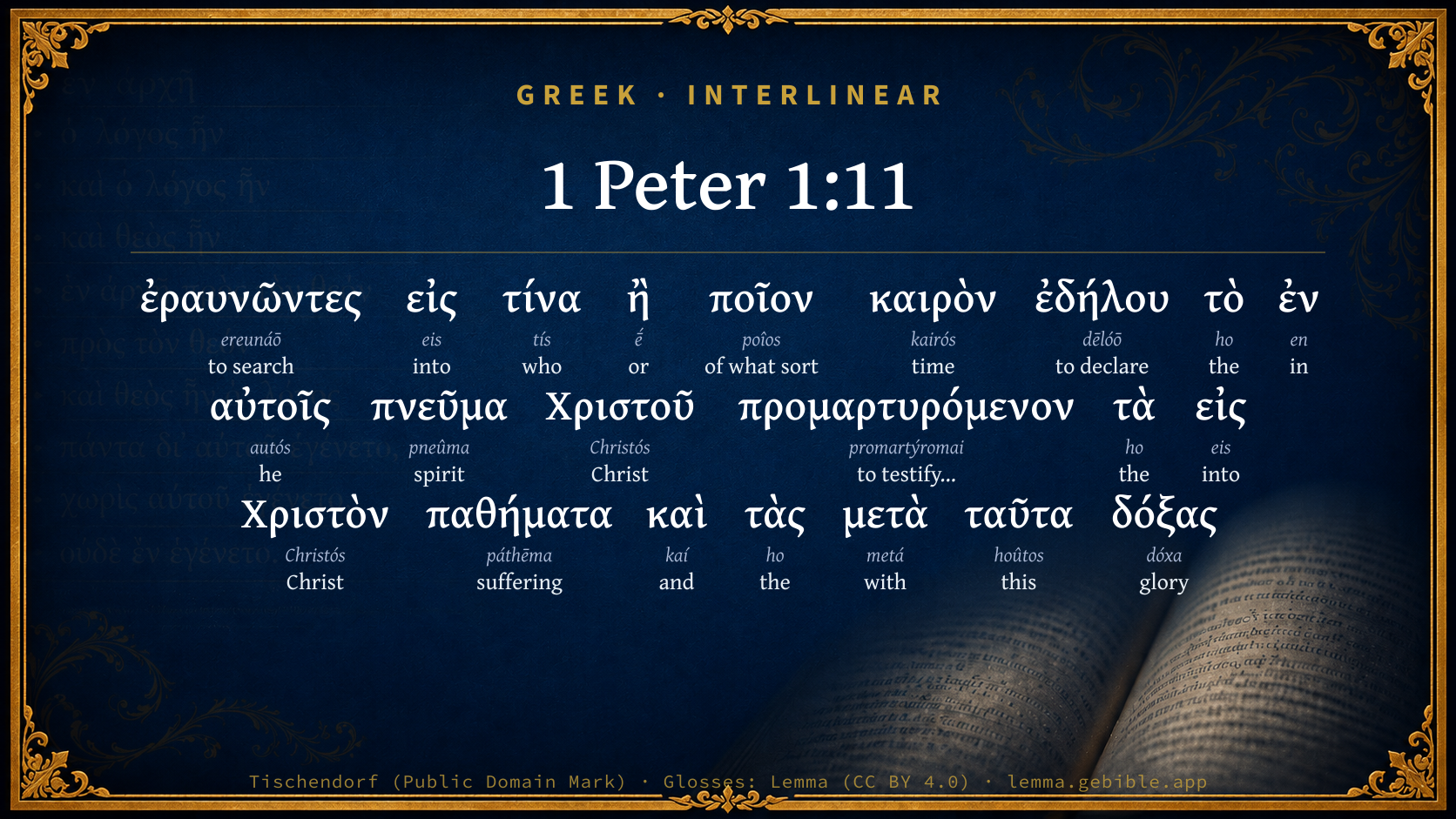
Download image
Cite this verse

1 Peter 1:11 (World English Bible). Public Domain. Lemma interlinear Bible study tool, https://lemma.gebible.app/v/1-peter/1/11.

Show BibTeX & RIS
BibTeX
RIS
English Translation
searching for who or what kind of time the Spirit of Christ, which was in them, pointed to, when he predicted the sufferings of Christ, and the glories that would follow them.
World English Bible · Public Domain
Highlights
  • 1 hapax legomenon — only here in the Greek New Testament
  • 1 first appearance in the Greek New Testament
Full analysis ↓
Download a study sheet

One document with this verse’s original text, its word-by-word gloss line, the meaning frame, cross-references with their text, attributed commentary, and full source and license credits — printable, and it pastes into notes with its structure intact.

This verse Autodidact and up

Study sheet (.html) Plain text (.txt)

A passage Seminary Student

Up to 50 verses in one chapter. A passage sheet keeps up to 6 commentary sources and 12 cross-references per verse, in the order this page ranks them, and says so on the sheet whenever that leaves anything out. Ask for a single verse and you get the Autodidact verse sheet above.

Everything on this page stays free to read, with no account — the sheet is a download of what is already on screen, not access to it.

Want to remove ads? Support Godless Engineer
Compare translations 3

The same verse in 3 English versions, stacked beneath the original-language interlinear above. Click any original word for its lexicon entry.

Each is an independent rendering of the whole verse — the interlinear is not word-aligned to these translations.

Highlighted words mark where these versions differ — a whole-verse word diff, not a word-by-word alignment.

  • World English Bible Public Domain
    searching for who or what kind of time the Spirit of Christ, which was in them, pointed to, when he predicted the sufferings of Christ, and the glories that would follow them.
  • King James Version Public Domain
    Searching what, or what manner of time the Spirit of Christ which was in them did signify, when it testified beforehand the sufferings of Christ, and the glory that should follow.
  • unfoldingWord Literal Text CC BY-SA 4.0
    inquiring into whom or what time the Spirit of Christ in them was revealing, testifying beforehand the sufferings of Christ and the glories after these things.

unfoldingWord Literal Text — © unfoldingWord, licensed CC BY-SA 4.0. Word-aligned USFM3 via Door43 (git.door43.org/unfoldingWord/en_ult).

Versions to compare (up to 4)

3 of 4 selected

Show all 19 translations

Every available English version of this verse, each an independent rendering of the whole verse.

  • World English Bible Public Domain
    searching for who or what kind of time the Spirit of Christ, which was in them, pointed to, when he predicted the sufferings of Christ, and the glories that would follow them.
  • Berean Standard Bible Public Domain
    trying to determine the time and setting to which the Spirit of Christ in them was pointing when He predicted the sufferings of Christ and the glories to follow.
  • Majority Standard Bible Public Domain
    trying to determine the time and setting to which the Spirit of Christ in them was pointing when He predicted the sufferings of Christ and the glories to follow.
  • King James Version Public Domain
    Searching what, or what manner of time the Spirit of Christ which was in them did signify, when it testified beforehand the sufferings of Christ, and the glory that should follow.
  • American Standard Version (1901) Public Domain
    searching what `time' or what manner of time the Spirit of Christ which was in them did point unto, when it testified beforehand the sufferings of Christ, and the glories that should follow them.
  • Revised Version (1885) Public Domain
    searching what time or what manner of time the Spirit of Christ which was in them did point unto, when it testified beforehand the sufferings of Christ, and the glories that should follow them.
  • Geneva Bible (1599) Public Domain
    Searching when or what time the Spirite which testified before of Christ which was in them, shoulde declare the sufferings that should come vnto Christ, and the glorie that shoulde follow.
  • Douay-Rheims (1899) Public Domain
    Searching what or what manner of time the Spirit of Christ in them did signify: when it foretold those sufferings that are in Christ, and the glories that should follow:
  • Young's Literal Translation Public Domain
    searching in regard to what or what manner of time the Spirit of Christ that was in them was manifesting, testifying beforehand the sufferings of Christ and the glory after these,
  • Literal Standard Version CC BY-SA 4.0
    searching in regard to what or what manner of time the Spirit of Christ that was in them was signifying, testifying beforehand of the sufferings of Christ and the glory after these,
  • Unlocked Literal Bible CC BY-SA 4.0
    They searched to know about whom and when the Spirit of Christ in them was speaking to them. This was happening as he was telling them in advance about the sufferings of Christ and the glorious things after that.
  • unfoldingWord Literal Text CC BY-SA 4.0
    inquiring into whom or what time the Spirit of Christ in them was revealing, testifying beforehand the sufferings of Christ and the glories after these things.
  • Darby Bible Public Domain
    searching what, or what manner of time, the Spirit of Christ which [was] in them pointed out, testifying before of the sufferings which [belonged] to Christ, and the glories after these.
  • World Messianic Bible Public Domain
    searching for who or what kind of time the Spirit of Messiah which was in them pointed to when he predicted the sufferings of Messiah and the glories that would follow them.
  • Webster's Bible Public Domain
    Searching what, or what manner of time the Spirit of Christ which was in them did signify, when it testified beforehand the sufferings of Christ, and the glory that should follow.
  • Free Bible Version CC BY-SA 4.0
    They tried to find out when and how this would take place, for the Spirit of Christ inside them spoke clearly about Christ's sufferings and glory to come.
  • Bible in Basic English Public Domain
    Attempting to see what sort of time the Spirit of Christ which was in them was pointing to, when it gave witness to the pains which Christ would undergo and the glories which would come after them.
  • Text-Critical English NT CC BY 4.0
    inquiring about the time and circumstances that the Spirit of Christ within them was indicating when he testified in advance to the sufferings of Christ and the glories that would follow.
  • Tyndale New Testament (1534) Public Domain
    searchinge when or at what tyme the sprete of Christ which was in them shuld signifie which sprete testified before the passions that shuld come vnto Christ and the glory that shuld folowe after:

Literal Standard Version (2020), Covenant Press — licensed CC BY-SA 4.0. Text via the HelloAO Bible API (eBible.org). Unlocked Literal Bible (unfoldingWord) — licensed CC BY-SA 4.0. Text via the HelloAO Bible API (eBible.org). unfoldingWord Literal Text — © unfoldingWord, licensed CC BY-SA 4.0. Word-aligned USFM3 via Door43 (git.door43.org/unfoldingWord/en_ult). Free Bible Version, Dr. Jonathan Gallagher — licensed CC BY-SA 4.0. Text via the HelloAO Bible API (eBible.org).

Word by word

More ways to search: Search by grammar → Find every occurrence → Compare this word →

Practice this passage: Drill this verse → Learn its vocabulary →

προμαρτυρόμενον
promartýromai
G4303
“to testify beforehand”
Verb, Present, Middle or Passive deponent, Participle, Nominative, Singular, Neuter
Part of Speech
Verb
Tense
Present
Voice
Middle or Passive deponent
Mood
Participle
Case
Nominative
Number
Singular
Gender
Neuter
Full Thayer's Definition

Origin: from G4253 and G3143

TDNT: 12:30,6

1. antetestor 2. to testify beforehand a. to make known, predict
  1. ἐραυνῶντες ereunáō G2045 “to search” Verb, Present, Active, Participle, Nominative, Plural, Masculine
  2. εἰς eis G1519 “into” Preposition
  3. τίνα tís G5101 “who” Interrogative pronoun, Accusative, Singular, Masculine
  4. ἢ ḗ G2228 “or” Particle
  5. ποῖον poîos G4169 “of what sort” Interrogative pronoun, Accusative, Singular, Masculine
  6. καιρὸν kairós G2540 “time” Noun, Accusative, Singular, Masculine
  7. ἐδήλου dēlóō G1213 “to declare” Verb, Imperfect, Active, Indicative, 3rd person, Singular
  8. τὸ ho G3588 “the” Article, Nominative, Singular, Neuter
  9. ἐν en G1722 “in” Preposition
  10. αὐτοῖς autós G846 “he” Personal pronoun, Dative, Plural, Masculine
  11. πνεῦμα pneûma G4151 “spirit” Noun, Nominative, Singular, Neuter
  12. Χριστοῦ Christós G5547 “Christ” Noun, Genitive, Singular, Masculine
  13. τὰ ho G3588 “the” Article, Accusative, Plural, Neuter
  14. εἰς eis G1519 “into” Preposition
  15. Χριστὸν Christós G5547 “Christ” Noun, Accusative, Singular, Masculine
  16. παθήματα páthēma G3804 “suffering” Noun, Accusative, Plural, Neuter
  17. καὶ kaí G2532 “and” Conjunction
  18. τὰς ho G3588 “the” Article, Accusative, Plural, Feminine
  19. μετὰ metá G3326 “with” Preposition
  20. ταῦτα hoûtos G3778 “this” Demonstrative pronoun, Accusative, Plural, Neuter
  21. δόξας dóxa G1391 “glory” Noun, Accusative, Plural, Feminine

About this verse

These counts appear in no published source. They are computed here, from the morphology-tagged text and Lemma’s own curated glosses. What Lemma adds →

22
words
18
distinct lemmas
General Epistles
section

Notable vocabulary

1 hapax legomenon — a word that appears only here in the entire Greek New Testament:

  • προμαρτυρόμενον to testify beforehand G4303

First appearance in Scripture

This word makes its first canonical appearance in the Greek New Testament here:

  • προμαρτυρόμενον to testify beforehand G4303

Shared distinctive vocabulary

ἐραυνῶντες to search G2045 occurs in 6 verses of the Greek New Testament. Also found in:
Repetition

Words recur within this verse:

  • εἰς into G1519 ×2
  • Χριστοῦ Christ G5547 ×2
  • τὸ the G3588 ×3

Cross-references

27

Topical passages linked to 1 Peter 1:11 in the Treasury of Scripture Knowledge — connected by theme and wording, ordered by reader-vote popularity; previews shown in the World English Bible.

  • Isaiah 52:13–14 Behold, my servant shall deal wisely, he shall be exalted and lifted up, and shall be very high.
  • Luke 24:25–27 He said to them, "Foolish men, and slow of heart to believe in all that the prophets have spoken!
  • 2 Peter 1:21 For no prophecy ever came by the will of man: but holy men of God spoke, being moved by the Holy Spirit.
  • Romans 8:9 But you are not in the flesh but in the Spirit, if it is so that the Spirit of God dwells in you. But if any man doesn't have the Spirit of Christ, he is not his.
  • Isaiah 53:1–12 Who has believed our message? and to whom has the arm of Yahweh been revealed?
  • Zechariah 14:9 Yahweh will be King over all the earth. In that day Yahweh will be one, and his name one.
  • Acts 26:22–23 Having therefore obtained the help that is from God, I stand to this day testifying both to small and great, saying nothing but what the prophets and Moses said would happen,
  • Genesis 3:15 I will put enmity between you and the woman, and between your offspring and her offspring. He will bruise your head, and you will bruise his heel."
  • Genesis 49:10 The scepter will not depart from Judah, Nor the ruler's staff from between his feet, Until he comes to whom it belongs. To him will the obedience of the peoples be.
  • Luke 24:44 He said to them, "This is what I told you, while I was still with you, that all things which are written in the law of Moses, the prophets, and the psalms, concerning me must be fulfilled."
  • John 12:41 Isaiah said these things when he saw his glory, and spoke of him.
  • Galatians 4:6 And because you are children, God sent out the Spirit of his Son into your hearts, crying, "Abba, Father!"
  • 1 Peter 3:18–19 Because Christ also suffered for sins once, the righteous for the unrighteous, that he might bring you to God; being put to death in the flesh, but made alive in the spirit;
  • Psalms 110:1–6 Yahweh says to my Lord, "Sit at my right hand, Until I make your enemies your footstool for your feet."
  • Isaiah 9:6–7 For to us a child is born, to us a son is given; and the government shall be on his shoulder: and his name shall be called Wonderful, Counselor, Mighty God, Everlasting Father, Prince of Peace.
  • Isaiah 49:6 yes, he says, It is too light a thing that you should be my servant to raise up the tribes of Jacob, and to restore the preserved of Israel: I will also give you for a light to the Gentiles, that you may be my salvation to the end of the earth.
  • Daniel 2:34–35 You saw until a stone was cut out without hands, which struck the image on its feet that were of iron and clay, and broke them in pieces.
  • Daniel 2:44 In the days of those kings shall the God of heaven set up a kingdom which shall never be destroyed, nor shall the sovereignty of it be left to another people; but it shall break in pieces and consume all these kingdoms, and it shall stand forever.
  • Daniel 9:24–26 Seventy weeks are decreed on your people and on your holy city, to finish disobedience, and to make an end of sins, and to make reconciliation for iniquity, and to bring in everlasting righteousness, and to seal up vision and prophecy, and to anoint the most holy.
  • Zechariah 8:18–21 The word of Yahweh of Hosts came to me.
  • Zechariah 13:7 "Awake, sword, against my shepherd, And against the man who is close to me," says Yahweh of Hosts. Strike the shepherd, and the sheep will be scattered; And I will turn my hand against the little ones.
  • Revelation 19:10 I fell down before his feet to worship him. He said to me, "Look! Don't do it! I am a fellow bondservant with you and with your brothers who hold the testimony of Jesus. Worship God, for the testimony of Jesus is the Spirit of Prophecy."
  • Psalms 22:1–31 My God, my God, why have you forsaken me? Why are you so far from helping me, and from the words of my groaning?
  • Psalms 69:1–21 Save me, God, For the waters have come up to my neck!
  • Psalms 69:30–36 I will praise the name of God with a song, And will magnify him with thanksgiving.
  • Psalms 88:1–18 Yahweh, the God of my salvation, I have cried day and night before you.
  • Daniel 7:13–14 I saw in the night-visions, and, behold, there came with the clouds of the sky one like a son of man, and he came even to the ancient of days, and they brought him near before him.

Cross-references courtesy of OpenBible.info (CC BY 4.0).

Commentary

Notes on 1 Peter 1:11 from classic Christian and Jewish commentators (each source and its license shown beneath its notes). The classic Christian expositions comment on the surrounding passage and are grouped to its opening verse, so a note may address several verses; the Jewish commentaries on the Tanakh (Rashi and others) are per-verse, so they appear only where the commentator wrote on this verse.

Lemma curates 59 commentaries, every one of them public domain or Creative Commons licensed, each selected and text-cleaned for this edition rather than reprinted as found. About our sources →

Tyndale Open Study Notes

Tyndale Open Resources

1:11 They wondered: Much was revealed about the future to the Old Testament prophets, but they did not know precisely when or how the salvation they predicted would come about. • The Greek translated what time could also mean what person. The prophets knew that a Messiah would come and that he would suffer before he was glorified, but they did not know who that Messiah would be.

Tyndale Open Study Notes — © Tyndale Open Resources, licensed CC BY-SA 4.0. Text via the HelloAO Bible API.

Bengel's Gnomon

Johann Albrecht Bengel

1Pe 1:11. Εἰς τίνα ἢ ποῖον, to what, or what manner of) The disjunctive particle expresses the great eagerness of the prophets: (to know) whether those things were about to happen in their time or afterwards: 1Pe 1:12. What (τίνα) denotes the time absolutely, so to speak, an era marked out by its own numbers: what manner of (ποῖον) speaks of the time to be known from various events. Dan 9:2.—Πνεῦμα Χριστοῦ, the Spirit of Christ) testifying of Christ; Rev 19:10. The Spirit of God, Gen 1:2, is called the Spirit of Messias in the work entitled Baal Hatturim.—τὰ—παθήματα, the sufferings) Hence comes salvation.—τὰ εἰς Χριστὸν παθήματα) the sufferings about to happen to Christ.—μετὰ ταῦτα) after these sufferings.—δόξας, glories) In the plural. The glory of His resurrection; the glory of His ascension; the glory of the last judgment and of the kingdom of heaven.

Bengel's Gnomon of the New Testament — English translation (T&T Clark, Edinburgh, 1860) — public domain. Text from a community e-Sword module.

Meyer's Critical & Exegetical Commentary

Heinrich August Wilhelm Meyer

1Pe_1:11 stands in close grammatical connection with the preceding, ἐρευνῶντες being conjoined with the verba finita of 1Pe_1:10; what follows states the object of the ἐρευνᾷν.

εἰς τίνα ἢ ποῖον καιρόν] τίνα refers to the time itself, ποῖον to its character.[70] Steinmeyer (appealing without justification to Rom_4:13) explains ἤ incorrectly: vel potius; vel, ut rectius dicam.

ἐδήλου] not: referred to (Luth. or significaret, Vulg.), but: revealed, as Heb_9:8; Heb_12:17, etc. Vorstius supplies: gratiam illam exstituram, de qua et ipsi vaticinabantur; this is incorrect. εἰς … καιρόν is conjoined rather directlythough not as its real object, but as a secondary determinationwith ἐδήλου. An object is not to be supplied (neither ταῦτα nor τὴν χάριν ταύτην, Steiger), as ἐδήλου is in intimate union with the participle προμαρτυρόμενον (de Wette, Brückner, Wiesinger, Schott), by which at once the act of δηλοῦν and its object are exactly determined (de Wette).

τὸ ἐν αὐτοῖς πνεῦμα Χριστοῦ] By this the revealing subject is mentioned: the prophets only expressed what the Spirit within them communicated to them; the τὸ ἐν αὐτοῖς is to be taken as a special act of ἐδήλου (Wiesinger), cf. besides, Mat_22:43 and 2Pe_1:21.[71]

This Spirit is characterized as the ΤῸ ΠΝΕῦΜΑ ΤΟῦ ΧΡΙΣΤΟῦ, not in that it bears witness of Christ (Bengel: Spiritus Christi: testans de Christo; thus also Grotius, Augustine, Jachmann), for ΧΡΙΣΤΟῦ is the subjective and not the objective genitive, but because it is the Spirit which Christ has and gives (Wiesinger); see Rom_8:8. The expression is to be explained from the apostles conviction of the pre-existence of Christ, and is here used in reference strictly to the ΠΡΟΜΑΡΤΥΡΌΜΕΝΟΝ ΤᾺ ΕἸς ΧΡΙΣΤῸΝ ΠΑΘΉΜΑΤΑ Κ.Τ.Λ. directly conjoined with it. Barnabas, chap. 1 Peter 5 : prophetae ab ipso habentes donum in illum prophetarunt.

[70] Bengel: in quod vel quale tempus; quod innuit tempus per se, quasi dicas aeram suis numeris notatam: quale dicit tempus ex eventibus variis noscendum.

[71] Hofmann is indeed not mistaken in saying that τὸ ἐν αὐτοῖς πν. Χρ. is a designation of the Spirit working prophetic knowledge in the prophets, and not of a constant indwelling of it,only it must be observed that the expression here employed says nothing as to how or in what manner the Spirit dwelt in the prophets.

REMARK.

By far the greater number of the interpreters rightly see in the term here applied to the Spirit a testimony to the real pre-existence of Christ. Not so de Wette, who finds in it merely the expression of the view that the work of redemption is the same in both the O. and N. T., and that the Spirit of God at work in the former is identical with the Spirit of Christ; and Weiss (pp. 247249), who explains the name thus: that the Spirit which was at work in the prophets was the same as that which Christ received at His baptism, and since then has possessed; similarly Schmid also (bibl. Theol. p. 163), the Spirit of God which in after time worked in the person of Christ.

Weiss seeks to prove, indeed, that Christ had in the pre-existent Messianic Spirit an ideal, or in a certain sense a real pre-existence,but in this way reflex ideas are attributed to the apostles, which certainly lay far from their mind. Besides, Weiss himself admits that in 1Co_10:4; 1Co_10:9, reference is made to the pre-existent Christ; but it cannot be concluded from Act_2:36 that Peter did not believe it. Schott, too, in his interpretation, does not abstain from introducing many results of modern thought, when he designates τὸ πν. Χρ. here as the Spirit of the Mediator continually approaching the consummation of salvation(!), but as yet supernaturally concealed in God. Steinmeyer does not touch the question of the pre-existence of Christ; he finds an adequate explanation of the expression in the remark of Bengel, although he takes Χριστοῦ as a subject. gen.

προμαρτυρόμενον] This verb. compos. occurs nowhere else in the N. T., and in none of the classical writers; the simplex means properly: to call to witness; then, to swear to, to attest; προμαρτύρεσθαι is therefore: to attest beforehand.[72]

The object of ἐδήλου … προμαρτ. is ΤᾺ ΕἸς ΧΡΙΣΤῸΝ ΠΑΘΉΜΑΤΑ ΚΑῚ ΤᾺς ΜΕΤᾺ ΤΑῦΤΑ ΔΌΞΑς] On this Luther remarks, that it can be understood of both kinds of suffering, of those which Christ Himself bore, as well as of those which we endure. The majority of interpreters conceive the reference to be to the former: Oecumenius, Theophyl., Erasmus, Grotius, Aretius, Piscator (cf. Luk_24:26), Vorstius, Hensler, Stolz, Hottinger, Knapp, Steiger, de Wette, Brückner, Steinmeyer, Wiesinger, Weiss, Luthardt, Schott, Fronmüller, Hofmann, etc.; but not so Calvin: non tractat Petr. quod Christo sit proprium, sed de universali ecclesiae statu disserit; Bolten and Clericus explain it of the sufferings of the Christians; the same position is taken up in the first edition of this commentary. Since the main tendency of the paragraph, 1Pe_1:10-12, is to give special prominence to the glorious nature of the believers ΣΩΤΗΡΊΑ, the latter view is favoured by the connection of thought. But, on the other hand, there is nothing opposed to the assumption, that the apostle here mentions the facts on which the σωτηρία is founded, as the substance of the testimony of the Spirit of God in the prophets. The expression ΤᾺ ΕἸς ΧΡΙΣΤῸΝ ΠΑΘΉΜΑΤΑ too, which must be interpreted on the analogy of Τῆς ΕἸς ὙΜᾶς ΧΆΡΙΤΟς, goes to show that by it are to be understood the sufferings which were ordained or appointed to Christ (Wiesinger).

On the plural τὰς … δόξας, Bengel says: Plurale: gloria resurrectionis, gloria ascensionis, gloria judicii extremi et regni coelestis; thus also Grotius, de Wette, Steiger, Wiesinger, Weiss, Schott. But it might be more correct to explain the plural in this way, that as the one suffering of Christ comprehends in it a plurality of sufferings, so does His ΔΌΞΑ a plurality of glories. Hofmann: by ΠΑΘΉΜΑΤΑ is to be understood the manifold afflictions in which the one suffering of Christ consisted, while the manifold glorifyings which go to make up His glory are included under ΔΌΞΑΙ.[73] Besides, it must be noted that the suffering of Christ is always designated by the plural παθήματα (with the exception of in Heb_2:9, where we have: τὸ πάθημα τοῦ θανάτου), but His glory always by the singular δόξα.

As the παθήματα and δόξαι, of Christ are the object of ἐδήλου προμαρτυρόμενον, so by καιρός, to which the ἐρευνᾷν of the prophets was directed, the time is referred to when this salvation would actually be accomplished. For this reason, then, ἐξηρεύνησαν, 1Pe_1:10, cannot again be repeated in ἐρευνῶντες (Wiesinger, Schott), as if the εἰς τίνα … καιρόν referred directly to the appearance of the σωτηρία; the apostles thought is rather this, that in their search as to the time of the sufferings, etc. of Christ, the prophets had before their eyes, as that with respect to which they sought to obtain knowledge, the σωτηρία of which believers were to be made partakers.

[72] Schott justly remarks that δηλοῦν and προμαρτύρεσθαι are not identical with προφητεύειν, but that they denote the action of the Spirit, by means of which He communicated to the prophets the prophecies after which they were to inquire. But he is evidently mistaken when he asserts that this identification takes place in the above interpretation.Nor is Schott warranted in supposing that in προμαρ. the apostle emphatically shows that the manner of communication was a revelation in the form of speech, and not an inward vision.

[73] Hofmanns opinion, that Peter had chiefly in his mind the passages in Isa_49:6-7; Isa_52:15, arises from the fact that he applies ὑμᾶς specially to the Gentiles.

REMARK.

Definite corroboration of the ideas here expressed is to be found in the Book of Daniel, chap. Dan_12:4; Dan_12:9-10; Dan_12:13. The fundamental presupposition is, that the when of the fulfilment was unknown to the prophets; according to 1Pe_1:12, all that was revealed to them was, that it would take place only in the times to come. De Wette asserts too much when he says, that searching as to the time cannot be predicated of the genuine prophets of ancient Judaism, but of Daniel only, who pondered over the seventy years of Jeremiah. But although the words of Daniel may have given occasion for the apostles statement, still that statement is not incapable of justification. If the apostles searched as to the time when the promises of Christ would receive accomplishment, why should it not be presupposed that similarly the prophets, too, inquired into that which the πνεῦμα Χριστοῦ testified beforehand to them, more especially as to the καιρός of its fulfilment?

Meyer — Critical and Exegetical Commentary on the New Testament — English translation by Peter Christie, edited by Frederick Crombie (T&T Clark, 1880) — public domain. Text from a community e-Sword module.

Expositor's Greek Testament

ed. W. Robertson Nicoll

1Pe 1:11 . The construction of εἰς τ . κ . π . καιρόν and of προμαρτ . is doubtful. ἐραυνῶντες takes up ἐξεζήτησαν κ . τ . λ . (10); the run of the sentence seems to naturally connect τὰ … δόξας with προμαρτ . and εἰς … καιρόν with ἐδήλου . So Vulgate in quod vel quale tempus significare … spiritus … praenuntians … passiones . But if εἰς … καιρὸν be unfit to be a direct object and προμαρτ ., perhaps, to have one of this kind. τὰ … δόξας must be governed by ἐδήλου . It is possible also to dissociate τίνα from καιρὸν and to render in reference to whom and what time the Spirit signified …; cf. Eph 5:22 , ἐγὼ δὲ λέγω εἰς Χριστόν , Act 2:25 . If τίνα be taken with καιρόν , the two words correspond to the two questions of the disciples, When ?… and what shall be the sign ? (Mar 13:4 ). Failing to discover at what time , the prophets asked at what kind of time ; their answer received a certain endorsement in the eschatological discourse of Jesus (Mar 13:5 ff. and parallels). ἐδήλου , cf. Heb 9:8 , τοῦτο δηλοῦντος τοῦ Πνεύματος . The word implies discernment on the part of the student (Heb 12:27 , τὸ δὲ ἔτι ἅπαξ δηλοῖ …). What time … did point unto of R.V. is unjustifiable; a simple accusative is required, i.e. , either (1.) ποῖον κ . or (2.) τίνα ἢ π . κ . ( εἰς being deleted as dittography of - ες ) or (3.) τὰ … δόξας . τὸ πνεῦμα [ Χριστοῦ ], the full phrase is a natural one for a Christian to employ Christ being here the proper name = Jesus Christ and not the title. κύριος in the O.T. was commonly interpreted as referring to Our Lord; and XC. is a frequent v.l. for [144] [145] . Hence Barnabas ( v.q .), οἱ προφῆται ἀπʼ αὐτοῦ ἔχον τὴν χάριν εἰς αὐτὸν ἐπροφήτευσαν . προμαρτυρόμενον only occurs here. If μαρτύρομαι (the proper sense) determine the meaning of the compound render “ protesting (calling God to witness) beforehand ”. It usage justify confusion with μαρτυρεῖν , be witness [ of ] render testifying beforehand or ( publicly .) τὰεἰς Χν παθήματα , the doctrine that the Messiah must suffer and so enter into His glory was stated by the prophets ( e.g. Isa 3 .) but neglected by the Jews of the first century (Joh 12:34 ). Believers were reminded of it by the risen Lord Himself (Luk 24:26 ; Luk 24:46 ) and put it in the forefront of their demonstratio evangelica (Act 3:18 ; Act 17:3 ; Act 26:23 ). The phrase corresponds exactly to the original חבלי של״ : εἰς standing for the ל (periphrasis for construct. state). τὰς μετὰ ταῦτα δόξας , the plural glories implies some comprehension of the later doctrine, e.g. , John, which recognised that the glory of Jesus was partially manifested during His earthly life; although the definition subsequent reflects the primitive simplicity and if it be pressed the glories must be explained as referring to the resurrection ascension triumph over angels as well as the glorious session (Joh 8:21 f.). οἷς ἀπεκαλύφθη , so St. Peter argues that Joel prophesied the last things ( cf. Sir 48:24 ) and that David foresaw and spoke concerning the resurrection (Act 2:17 ; Act 2:31 ; cf. Act 3:24 ). Compare Dan 9:2 ; Dan 12:4 , etc., for examples of partial revelations of this kind proper to apocalyptic writers. Heb. l.c. supr. credits the Patriarchs with the same insight. οὐχ ἑαυτοῖς ὑμῖν δέ , negative and positive presentation of the past for emphasis is common in this Epistle. διηκόνουν αὐτά , “they were supplying, conveying the revelations granted to them primary the prophecy and the revealed solution of it alike,” cf. 1Pe 4:10 , εἰς ἑαυτοὺς αὐτὸ διακονοῦντες . The context shows, if the word διακονεῖν does not itself connote it, that herein they were stewards of God’s manifold grace channels of communication. For Acc. with διακον . cf , 2Co 3:3 , ἐπιστολὴ Χριστοῦ διακονηθεῖσα ὑφʼ ἡμῶν , 2Co 8:19 , τῇ χάριτι ταύτῃ τῇ διακονουμένῃ ὑφʼ ἡμῶν , from which it may be inferred that δ . connotes what the context here suggests, cf. ἃ νῦν ἀνηγγέλη , have been at the present dispensation declared ; ἀ . is taken from the great proof text relating to the calling of the Gentiles, οἷς οὐκ ἀνηγγέλη ἀκούουσιν , Isa 52:15 cited Rom 15:21 . “But St. Peter probably meant more by the word … the phrase includes not only the announcement of the historical facts of the Gospel, but, yet more, their implicit teachings as to the counsels of God and the hopes revealed for men” (Hort). διὰ τῶν εὐαγγ . ὑμας , God spake through the evangelists ( cf. Isa 61:1 , apud Rom 10:15 ) as through the prophets, Mat 1:22 ; Mat 2:15 , etc. Both are simply God’s messengers. For accusative after εὐαγγ . cf. use of בשר = gladden with good tidings (Isa 61:1 ). So πτωχοὶ εὐαγγελίζονται (Mat 11:5 ; Luk 7:22 ) is substituted for the original πτωχοῖς εὐαγγελίζεσθαι (Luk 4:18 = Isa 61:1 ) if the prophecy which Jesus appropriated and which forms the basis of the Christian use of the word. πνεύματι κ . τ . λ . The evangelists preached by the Spirit , as Stephen spoke (Act 6:10 ), τῷ πνεῦματι ᾧ ἐλάλει . In Sir 48:24 , if the Greek and Hebrew texts are trustworthy, πνεύματι the simple Dative ( πνεύματι μεγάλῳ εἶδεν τὰ ἔσχατα i.e. Isaiah) corresponds to ברוח : cf. insertion of ἐν here in v. l . The visible descent of the Holy Spirit is contrasted with the indwelling Spirit which inspired the prophets. The Holy Spirit was given, when Jesus was glorified, as never before, οὐκ ἐκ μέτρου (Joh 3:34 ). Vulgate renders by ablative absolute. εἰς ἃ … παρακύψαι , after expanding the first part of Jesus’ saying (and its context ye see ) St. Peter at last reaches the second in its secondary form. He combines with it as its proper Scripture, the prophecy of Enoch (ix. 1) καὶ ἀκούσαντες οἱ τέσσαρες μεγάλοι ἀρχάγγελοι … παρέ κυψαν ἐπὶ τὴν γῆν ἐκ τῶν ἁγίων τοῦ αὐρανοῦ . St. Paul spiritualises the idea “to me … this grace was given to preach to the Gentiles … in order that now might be made known to the principalities and the authorities in heavenly places by means of the Church the very-varied wisdom of God” (Eph 3:8 ff.). St. Peter reproduces faithfully the simplicity of the original and represents this longing as still unsatisfied since the Church is not yet perfect or complete. It thus becomes part of the sympathetic groaning and travailing of the whole creation (Rom 8:22 f.). In Rom 8:21 St. Peter states on the same authority that Christ preached to the spirits in prison; adding that when he ascended all angels were subjected to Him. The apparent contradiction is due to the discrepancy between the ideal and its gradual realisation and not to an imperfect coordination of these conceptions of the universal sovereignty of God. See 1Co 15:25 f., Heb 2:7 f., not yet do we see … παρακύψαι has lost its suggestion of peeping through its use in the LXX for שקף look forth though it is not employed by them in the places where God is said to look down from heaven (Psa 14:2 , etc.). The patristic commentators seem to hold by the Evangelist rather than the Apostle in respect to the saying, as they refer exclusively for illustration to the O.T. figures, Moses (Heb 11:26 ), Isaiah (Joh 12:41 ). Oecumenius notes that Daniel is called by the angel a man of longings (Dan 9:25 ). That the angels of Peter are due to Enoch and secondary seems to be borne out by the Targum of Ecc 1:8 , “In all the words that are prepared (about) to come to pass in the world the ancient prophets wearied themselves and could not find their ends”.

[144] Codex Mosquensis (sæc. ix.), edited by Matthæi in 1782.

[145] Codex Ephraemi (sæc. v.), the Paris palimpsest, edited by Tischendorf in 1843.

The Expositor's Greek Testament, edited by W. Robertson Nicoll (1897–1910) — public domain. Text from a community e-Sword module.

Cambridge Greek Testament for Schools and Colleges

11. εἰς τίνα ἢ ποῖον καιρὸν, searching (to discover) what or what manner of season was pointed to (εἰς). If God withheld from them the precise time when His promises were to be fulfilled, they desired at least to know whether it was to be in the immediate or only in the distant future.

πνεῦμα Χριστοῦ can hardly mean “the Spirit which spake of Christ,” taking Χριστοῦ as an objective genitive. Nor is it likely to mean merely the Spirit which in after days dwelt in Christ. It might mean the Spirit belonging to or proceeding from Christ Himself. Certainly the Holy Spirit is described as πνεῦμα Χριστοῦ, Rom 8:9; πνεῦμα Ἰ. Χ., Php 1:19; πνεῦμα Ἰησοῦ, Act 16:7; πνεῦμα τοῦ υἱοῦ, Gal 4:6. In Joh 1:9-10, the Logos is described as having been all along in the world; a light was coming into the world to lighten every man. So Justin Martyr, Apol. i. 36, describes the prophets as moved by the divine Logos and sometimes speaking in the person of Christ, ἀπὸ προσώπου τοῦ Χριστοῦ; and Clem. Al. adv. Haer. IV. 7. 2, says: Qui adventum Christi prophetaverunt revelationem acceperunt ab ipso Filio.

According to this interpretation Christ is described as inspiring the prophets by His Spirit to predict the sufferings destined for Himself.

But (see Hort, p. 52) we must remember that Χριστὸς, with or without the article, was not originally a proper name, but a title, “Messiah,” “the Lord’s Anointed,” and, although Jesus Christ was the Messiah, the nation, the kings, and the prophets were also the Lord’s anointed; cf. Psa 105:15, “Touch not mine anointed (τῶν χριστῶν μου) and do my prophets no harm.” Similarly in language which our Lord afterwards applied to Himself the prophet in describing his own mission, Isa 61:1 ff., says, “The Spirit of the Lord is upon me because He anointed me” (ἔχρισέν με). In this sense the prophets shared in the Messiahship of their Divine Master, and the Spirit which spake by them was the Spirit of the Lord’s anointed, πνεῦμα Χριστοῦ.

ἐδήλου προμαρτυρόμενον should probably be coupled together. δηλοῦν does not necessarily mean “to make plain.” The prophets were only able to discover part of what was meant. The word is used of making a communication to a person (1Co 1:11; Col 1:8), or of signifying or implying something indirectly (Heb 9:8; Heb 12:27).

μαρτύρεσθαι means literally “to call to witness,” so “to protest” as in the presence of witnesses; cf. Gal 5:3; Eph 4:17, μαρτύρομαι ἐν Κυρίῳ. So here the sense seems to be that the Spirit which spake by the prophets asseverated in God’s name, “Thus saith the Lord.”

τὰ εἰς Χριστὸν παθήματα does not merely mean “the sufferings of Christ,” cf. 1Pe 5:1, but “sufferings destined for the Messiah,” cf. τῆς εἰς ὑμᾶς χάριτος just above; cf. εἰς ὑμᾶς, 1Pe 1:4; or “pointing to” Christ, cf. Act 2:25, Δαυεὶδ λέγει εἰς αὐτόν. The sufferings described by the Prophets (e.g. Psalms 22, and esp. Isaiah 53.) only received their fulfilment in Christ.

In one sense the sufferings of O.T. saints were unconsciously on Christ’s behalf, and as it were “passed on” to Him (cf. Moses bearing the reproach of Christ, Heb 11:26), just as Christians now “fill up what is lacking in the sufferings of Christ,” Col 1:24, but it may be doubted whether St Peter intended to include that thought.

Cambridge Greek Testament for Schools and Colleges (Cambridge University Press, 1896; 21 vols, various authors incl. Carr, Maclear, Plummer, Farrar, Lumby, Moule, M. R. James, Simcox) — public domain. Text from a community e-Sword module.

Jamieson, Fausset & Brown

Robert Jamieson, A. R. Fausset & David Brown

what--Greek, "In reference to what, or what manner of time." What expresses the time absolutely: what was to be the era of Messiah's coming; what manner of time; what events and features should characterize the time of His coming. The "or" implies that some of the prophets, if they could not as individuals discover the exact time, searched into its characteristic features and events. The Greek for "time" is the season, the epoch, the fit time in God's purposes.

Spirit of Christ . . . in them-- (Act 16:7, in oldest manuscripts, "the Spirit of Jesus"; Rev 19:10). So JUSTIN MARTYR says, "Jesus was He who appeared and communed with Moses, Abraham, and the other patriarchs." CLEMENT OF ALEXANDRIA calls Him "the Prophet of prophets, and Lord of all the prophetical spirit."

did signify--"did give intimation."

of--Greek, "the sufferers (appointed) unto Christ," or foretold in regard to Christ. "Christ," the anointed Mediator, whose sufferings are the price of our "salvation" (Pe1 1:9-10), and who is the channel of "the grace that should come unto you."

the glory--Greek, "glories," namely, of His resurrection, of His ascension, of His judgment and coming kingdom, the necessary consequence of the sufferings.

that should follow--Greek, "after these (sufferings)," Pe1 3:18-22; Pe1 5:1. Since "the Spirit of Christ" is the Spirit of God, Christ is God. It is only because the Son of God was to become our Christ that He manifested Himself and the Father through Him in the Old Testament, and by the Holy Spirit, eternally proceeding from the Father and Himself, spake in the prophets.

Jamieson, Fausset & Brown — Commentary Critical and Explanatory on the Whole Bible (1871) — public domain (CC PDM 1.0). Text via the HelloAO Bible API.

Adam Clarke's Commentary

Verse 11. The glory that should follow.] Not only the glory of his resurrection, ascension, exaltation, and the effusion of his Spirit; but that grand manifestation of God's infinite love to the world in causing the Gospel of his Son to be everywhere preached, and the glorious moral changes which should take place in the world under that preaching, and the final glorification of all them who had here received the report, and continued faithful unto death. And we may add to this the ineffable glorification of the human nature of Jesus Christ, which, throughout eternity, will be the glorious Head of his glorified body, the Church.

Adam Clarke's Commentary on the Bible (1810–1826) — public domain. Text from a community e-Sword/MySword module.

John Calvin's Commentaries

11. And what they inquired is pointed out when he adds, Searching what, or what manner of time There was a difference between the law and the gospel, a veil as it were being interposed, that they might not see those things nearer which are now set before our eyes. Nor was it indeed proper, while Christ the Sun of righteousness was yet absent, that the full light should shine as at mid-day. And though it was their duty to confine themselves within their prescribed limits, yet it was no superstition to sigh with a desire of having a nearer sight. For when they wished that redemption should be hastened, and desired daily to see it, there was nothing in such a wish to prevent them patiently to wait as long as it pleased the Lord to defer the time. Moreover, to seek as to prophecies the particular time, seems to me unprofitable; for what is spoken of here is not what the prophets taught, but what they wished. Where the Latin interpreters render, “of future grace,” it is literally, “of the grace which is to you.” But as the meaning remains the same, I was not disposed to make any change.

It is more worthy of observation, that he does not say that the prophets searched according to their own understanding as to the time when Christ’s kingdom would come, but that they applied their minds to the revelation of the Spirit. Thus they have taught us by their example a sobriety in learning, for they did not go beyond what the Spirit taught them. And doubtless there will be no limits to man’s curiosity, except the Spirit of God presides over their minds, so that they may not desire anything else than to speak from him. And further, the spiritual kingdom is a higher subject than what the human mind can succeed in investigating, except the Spirit be the guide. May we also therefore submit to his guidance.

The Spirit of Christ which was in them First, “who was in them,” and secondly, “testifying,” that is, giving a testimony, by which expression he intimates that the prophets were endued with the Spirit of knowledge, and indeed in no common manner, as those who have been teachers and witnesses to us, and that yet they were not partakers of that light which is exhibited to us. At the same time, a high praise is given to their doctrine, for it was the testimony of the Holy Spirit; the preachers and ministers were men, but he was the teacher. Nor does he declare without reason that the Spirit of Christ then ruled; and he makes the Spirit, sent from heaven, to preside over the teachers of the Gospel, for he shews that the Gospel comes from God, and that the ancient prophecies were dictated by Christ.

The sufferings of Christ That they might bear submissively their afflictions, he reminds them that they had been long ago foretold by the Spirit. But he includes much more than this, for he teaches us, that the Church of Christ has been from the beginning so constituted, that the cross has been the way to victory, and death a passage to life, and that this had been clearly testified. There is, therefore, no reason why afflictions should above measure depress us, as though we were miserable under them, since the Spirit of God pronounces us blessed.

The order is to be noticed; he mentions sufferings first, and then adds the glories which are to follow. For he intimates that this order cannot be changed or subverted; afflictions must precede glory. So there is to be understood a twofold truth in these words, — that Christians must suffer many troubles before they enjoy glory, — and that afflictions are not evils, because they have glory annexed to them. Since God has ordained this connection, it does not behove us to separate the one from the other. And it is no common consolation, that our condition, such as we find it to be, has been foretold so many ages ago.

Hence we learn, that it is not in vain that a happy end is promised to us; secondly, we hence know that we are not afflicted by chance, but through the infallible providence of God; and lastly, that prophecies are like mirrors to set forth to us in tribulations the image of celestial glory.

Peter, indeed, says, that the Spirit had testified of the coming afflictions of Christ; but he does not separate Christ from his body. This, then, is not to be confined to the person of Christ, but a beginning is to be made with the head, so that the members may in due order follow, as Paul also teaches us, that we must be conformed to him who is the first-born among his brethren. In short, Peter does not speak of what is peculiar to Christ, but of the universal state of the Church. But it is much fitted to confirm our faith, when he sets forth our afflictions as viewed in Christ, for we thereby see better the connection of death and life between us and him. And, doubtless, this is the privilege and manner of the holy union, that he suffers daily in his members, that after his sufferings shall be completed in us, glory also may have its completion. See more on this subject in the third chapter of the Epistle to the Colossians, and in the fourth of the first Epistle to Timothy.

John Calvin's Commentaries (1540-1563) — public domain. Text from the Calvin Translation Society English edition (1840s-50s) via the Christian Classics Ethereal Library (ccel.org). Calvin's coverage is partial (roughly two-thirds of the Bible); uncommented books and verses are honest gaps, never fabricated. The 19th-century editor's footnotes and remarks are omitted so the notes are faithfully Calvin's own voice.

Ellicott's Commentary for English Readers

(11) Searching.—This further explains the “inquired and searched” above; it particularises the object of the inquiry. They knew that they spoke “concerning a salvation,” but they did not know the details. The present passage is perhaps the most striking in the whole New Testament in regard to the doctrine of prophetic inspiration. Assuming that the prophets did not speak simply of their own human calculation, but somehow under the influence of the Divine Spirit, we are brought to face the question, how far their utterances were their own, and how far suggested to them from on high. The doctrine of Montanism, which has not altogether died out of the Church yet, asserts that from first to last prophecy is superhuman; that every word and letter is forced upon the man by a power not his own, which leaves him no choice. God, and God alone, is responsible for every syllable. The human will and intelligence need not even concur in the message they deliver, nor even be conscious that they are delivering it. Thus Montanus makes God to say through him: “Lo, man is as a lyre, and I am as that which strikes the chords: the man is unconscious, and I alone wake.” On the other hand, some of the early opponents of Montanism went so far as to say that the inspired writers had a clear and immediate perception, a complete insight into the mysteries which they foretold,—that Isaiah, for instance, saw, as plainly as we do, Mary and Jesus in his prophecy of Immanuel. Our present verses show a doctrine between the two. The prophets find themselves impelled to say words which they are conscious of choosing and using, but which they feel to have a deeper meaning than they themselves were conscious of intending. It is clear to them (1Pe_1:12) that what they meant primarily as applying to present circumstances, was in reality being overruled by the Spirit to apply more fully to the future. But what that future was they struggled, and half in vain, to know. We may apply to them what Keble says of the Greek poets:—

“As little children lisp, and tell of Heaven,

So thoughts beyond their thoughts to those high bards were given.”

What, or what manner of time.—If this be right, it must mean, “what exact or approximate date.” But the simplest translation would be, to whom, or what period, the Spirit of Christ in them was pointing. This would give new significance to the sentence. They were aware that they were speaking of a Messiah; but who the man should be who would hold that office, or at what period of their history he would arise, this was what they longed to know. They foresaw a Christ, but they could not foresee Jesus; they could give to their Christ no definite position in future history. (Comp. Mat_22:42; Luk_3:15; Luk_23:35; Joh_3:28; Joh_7:26; Joh_7:41; Act_2:36, and often.)

The Spirit of Christ which was in them.—They are conscious of a power within them which is not themselves, “moving” them. And this power is described as “the Spirit of Christ.” Now, observe that a change has come over St. Peter’s way of speaking. Hitherto, he has always said, “Jesus Christ,” his object being to keep constantly before the eyes of these Hebrews the truth which he was the first man to enunciate, viz., “Thou art the Christ” (Mat_16:16), that Jesus was the person who fulfilled all that was expected of the Messiah. “Christ” is not once used by St. Peter (as it is often by St. Paul) as a proper name: it always marks the office, not the person. Therefore we may not prove by this expression two doctrines, however true they may be in themselves, which are commonly sought to be supported by it, viz., the preexistence of our Lord, and the procession of the Holy Ghost from Him as well as from the Father. In spite of a well-quoted passage in Barnabas (1 Peter 5), “The prophets had the gift from Him, and prophesied of Him,” it cannot here mean, “the Holy Ghost given them by our Lord Himself.” Besides, it is theologically incorrect to say that Christ as the Anointed had any pre-existence, except as an indefinite hope in the minds of the Hebrews. The Son, the unincarnate Word, pre-existed, but it is Apollinarianism to say that Jesus had any existence before the Incarnation,—still more Christ, since it may be doubted whether the Incarnate Word became “Christ” until His baptism. That, at least, appears to be St. Peter’s doctrine (Act_10:38). “The Spirit of Messiah,” then, at any rate when applied to the ages before Christ came, must have a different meaning. Probably not exactly “the Spirit that was to anoint and be in the Messiah,” but rather, “the Messiah-spirit” or “the Messianic spirit.” The prophets wondered who the man was, and where he would live, to whom this Messianic inspiration which they felt within was pointing. St. Peter himself, we repeat, was the first person who fully knew the answer.

When it testified beforehand.—A much more solemn word in the original than it looks in the English, and used by no other writer than St. Peter. It does not mean simply, “when it bore witness beforehand;” but “testifying” means an appeal to Heaven to mark and record the words so spoken: “when with a solemn appeal it announced beforehand.” Was he not thinking of the awful appeal in Dan_12:7?

The sufferings of Christ.—This unduly contracts the fulness of the Greek, which reads, the sufferings for Christ (just as we had before “the grace for you”), i.e., “these sufferings in reserve for Messiah.” The Old Testament passages which may be supposed to be chiefly indicated are Isaiah 53 and (still more) Dan_9:24-26. If it be asked how St. Peter knew that the prophets had these longings and doubts, we answer, that it was not only a probable guess, but the result of a study of Daniel, who records again and again the prophetic agony of his search into the future. Beware of treating the title “Christ” as a proper name. Eight out of the ten times that St. Peter uses the word by itself, i.e., without “Jesus” or “the Lord,” it is in direct connection with suffering (here, and in 1Pe_1:19; 1Pe_2:21; 1Pe_3:18; 1Pe_4:1; 1Pe_4:13-14; 1Pe_5:1). Conversely, he never speaks of the sufferings of Jesus Christ. That is to say, he loves to dwell upon the Passion of our Lord, not in its personal but its official aspect. The striking point is that the Messiah should have suffered thus. It was especially necessary to show this in any effort to retain the faith of the Hebrews. Comp. Luk_24:26-46 (Peter present); Act_3:18 (Peter speaking); Act_17:3 (to Hebrews); Act_26:23. And we can see a reason for the insistence in St. Peter’s history. The very same day, apparently, when he had announced his belief that Jesus was the Messiah, he took Him to task for speaking of sufferings and shame. He never could forget the reprimand, like a sword-cut, which he received. The whole Epistle may be said to be an expansion of what Jesus said in answer (Mat_16:23-27). Some commentators include in this phrase of “the sufferings in reserve for Messiah,” the thought of the sufferings of the Church as well; but it seems far-fetched, especially when we see the true meaning of the word “Christ.” Finally, we may add, that some would join very closely together the words for “signify” and “testifying beforehand,” which would give us this sense: “examining, in reserve for whom, or for what period, the Spirit, with its solemn appeal beforehand, was pointing out these sufferings in reserve for Messiah.” This is possible, and keeps the same sense, but it unnecessarily complicates the sentence.

And the glory that should follow.—Literally, and the glories after them. The plural “glories” corresponds to the plural “sufferings,”—the one as multiform as the other; resurrection, ascension, reassumption of the divine glory (Joh_17:5), triumphs of Church history, restitution of all things. The sufferings and subsequent glories of the Christ form, of course, together the whole of the gospel.

A Bible Commentary for English Readers, edited by Charles John Ellicott (1878–1897) — public domain. Text from a community e-Sword module.

The Cambridge Bible for Schools and Colleges

gen. ed. J. J. S. Perowne

11. searching what, or what manner of time] The two words have each a distinct force, the first indicating the wish of men to fix the date of the coming of the Lord absolutely, the second to determine the note or character of the season of its approach. Of that craving we find examples in the question “wilt thou at this time restore the kingdom to Israel?” which was met by our Lord with the answer “It is not for you to know the times and the seasons” (Act_1:6-7), in the over-heated expectations which St Paul checks in 2Th_2:1-12, in the hopes that were met by the mocking scorn which St Peter himself rebukes in 2Pe_3:3-8.

the Spirit of Christ which was in them] It will hardly be questioned that the name thus given to the Spirit, as compared with Rom_8:9 and Gal_4:6, primarily suggests the thought of prophets who were living and working in the Christian Church rather than of those of the older Church of Israel.

when it testified beforehand the sufferings] To the English readers these words naturally seem decisive in favour of the current interpretation, and against that which is here suggested. But they seem so only because they are a mistranslation of the original. When St Peter wishes to speak of the “sufferings of Christ,” he uses a different construction (chap. 1Pe_4:13, 1Pe_5:1), as St Paul does (2Co_1:5). Here the phrase, as has been noticed above, is different. St Peter speaks of the sufferings (which pass on) unto Christ. The thought is identical with that of St Paul’s, expressed in terms so analogous that it is a marvel that their bearing on this passage should have escaped the notice of commentators. “As the sufferings of Christ abound toward us,” St Paul says (2Co_1:5), “so also does our consolation.” He thinks of the communion between Christ and His people as involving their participation in His sufferings. Is it not obvious that St Peter presents in almost identical phraseology the converse of that thought, and that the “sufferings” spoken of are those which the disciples were enduring for Christ, and which he thinks of as shared by Him, flowing over to Him? That predictions of such sufferings, sometimes general, sometimes personal, entered largely into the teaching of the prophets of the New Testament we see from Act_11:28; Act_20:23; Act_21:11; 2Ti_2:3; 2Ti_2:12. That they dwelt also upon the “glories” that should come after the sufferings lies almost in the very nature of the case. Visions of Paradise and the third heaven, as in 2Co_12:1-5, of the throne and the rainbow and the sea of glass, and the heavenly Jerusalem, like those of St John, were, we may well believe, as indeed 1Co_2:9-10 sufficiently indicates, almost the common heritage of the prophets of the Apostolic Church.

The Cambridge Bible for Schools and Colleges (gen. ed. J. J. S. Perowne; Cambridge University Press, 1878–1918) — public domain. Text from a community e-Sword module.

John Gill's Exposition

Searching what, or what manner of time,.... The prophets made a very diligent inquiry into the exact time when Christ should come to work out the salvation of his people; to whom it was made known that his coming should be before the sceptre, or tribe of Judah, and all civil government in it, ceased; and before the second temple was destroyed, into which the Messiah, the messenger of the covenant, was to come, as the Lord and proprietor of it; and that it should be seventy weeks, or 490 years, from a date given in Dan 9:24 as it was revealed to the Prophet Daniel; who particularly inquired, and diligently searched into this matter, and was eminently a man of desires this way, as he is styled, Dan 9:23 and they not only searched into the exact time, but into the manner and quality of the time when the Saviour should come; and foretold that it would be, with respect to the nations of the world, a time of profound peace; with respect to the Jews, that it would be a time of great blindness, ignorance, unbelief, and hardness of heart; that such would be that generation, or age, for wickedness and barbarity, as could not be declared and expressed; and that few would believe the report of the Gospel; and that the Messiah would be rejected of men, and be wounded, bruised, and put to death; and with respect to the Gentiles, that the Gospel would be preached to them, and that they should seek to Christ, be gathered to him, and hope and trust in him; and that the followers of the Messiah should be persecuted, and greatly distressed, and yet comforted and sustained; and this should be the face of the times, and the state of things, when the salvation should be revealed: and all this, and much more,

the Spirit of Christ in them did signify; or "make manifest": from whence it appears, that Christ then existed, as he did before there were any prophets, and even from everlasting, being the eternal God; and that the Spirit is from him, as well as from the Father; and as here, so he is often by the Jews (a) called , "the Spirit of the Messiah", or "Christ"; and that the Spirit is truly God, since he could declare beforehand the exact time of Christ's coming, and the finality of the age in which he came, as well as bear a previous testimony to his sufferings and glory; as also, that he was in the prophets, and they were inspired by him, and spake as he moved and directed them:

when, it testified before hand the sufferings of Christ, and the glory that should follow. The "sufferings of Christ" are what the Jews call (b) , "the sorrows of the Messiah". These are particularly testified of in Psa 22:1. The glory, or "glories", as it may be rendered, design his resurrection from the dead, his ascension to heaven, his session at the right hand of God, and having all power, authority, and judgment committed to him; and which are eminently and distinctly prophesied of in Psa 16:10.

(a) Zohar in Gen. fol. 19. 3. & passim. (b) T. Bab. Sabbat, fol. 118. 1. & passim.

John Gill's Exposition of the Whole Bible (1746–1763) — public domain (CC PDM 1.0). Text via the HelloAO Bible API.

Trapp's Complete Commentary

John Trapp

11 Searching what, or what manner of time the Spirit of Christ which was in them did signify, when it testified beforehand the sufferings of Christ, and the glory that should follow.

Ver. 11. Searching what, &c.] ερευνωντες, with greatest sagacity and industry, as hunters seek for game, and as men seek for gold in the very mines of the earth.

The sufferings of Christ, &c.] Macarius was utterly out in saying that the prophets knew that Christ should be born for man’s redemption, but that they knew nothing of his death and sufferings. Isaiah writes of them more like an evangelist than a prophet, and is therefore called the "evangelical prophet."

John Trapp, A Commentary or Exposition upon All the Books of the Old and New Testament (1647–1656) — public domain. Text from a community e-Sword module.

Albert Barnes' Notes on the Bible

Searching what - That is, examining their own predictions with care, to ascertain what they meant. They studied them as we do the predictions which others have made; and though the prophets were the medium through which the truth was made known, yet their own predictions became a subject of careful investigation to themselves. The expression used here in the original, rendered “what,” (εἰς τίνα eis tina,) literally, “unto what,” may mean, so far as the Greek is concerned, either “what time,” or “what people,” or “what person;” that is, with reference to what person the prophecies were really uttered. The latter, it seems to me, is the correct interpretation, meaning that they inquired in regard to him, who he would be, what would be his character, and what would be the nature of the work which he would perform. There can be no doubt that they understood that their predictions related to the Messiah; but still it is not improper to suppose that it was with them an interesting inquiry what sort of a person he would be, and what would be the nature of the work which he would perform.

This interpretation of the phrase εἰς τίνα eis tina, (unto what or whom) it should be observed, however, is not that which is commonly given of the passage. Bloomfield, Rosenmuller, Doddridge, Whitby, Benson, and Grotius suppose it to refer to time, meaning that they inquired at what time, or when these things would occur. Macknight thinks it refers “to people,” (λαον laon,) meaning that they diligently inquired what people would put him to death. But the most obvious interpretation is that which I have suggested above, meaning that they made particular inquiry to whom their prophecies related - what was his rank and character, and what was to be the nature of his work. What would be a more natural inquiry for them than this? What would be more important? And how interesting is the thought that when Isaiah, for example, had given utterance to the sublime predictions which we now have of the Messiah, in his prophecies, he sat himself down with the spirit of a little child, to learn by prayer and study, what was fully implied in the amazing words which the Spirit had taught him to record! How much of mystery might seem still to hang around the subject And how intent would such a mind be to know what was the full import of those words!

Or what manner of time - This phrase, in Greek, (ποῖον καιρὸν poion kairon,) would properly relate, not to the exact time when these things would occur, but to the character or condition of the age when they would take place; perhaps referring to the state of the world at that period, the preparation to receive the gospel, and the probable manner in which the great message would be received. Perhaps, however, the inquiry in their minds pertained to the time when the predictions would be fulfilled, as well as to the condition of the world when the event takes place. The meaning of the Greek phrase would not exclude this latter sense. There are not unfrequent indications of time in the prophets, (compare Dan 9:24 ff) and these indications were of so clear a character, that when the Saviour actually appeared there was a general expectation that the event would then occur. See the notes at Mat 2:9.

The Spirit of Christ which was in them - This does not prove that they knew that this was the Spirit of Christ, but is only a declaration of Peter that it was actually so. It is not probable that the prophets distinctly understood that the Spirit of inspiration, by which they were led to foretell future events, was especially the Spirit of Christ. They understood that they were inspired; but there is no intimation, with which I am acquainted, in their writings, that they regarded themselves as inspired by the Messiah. It was not improper, however, for Peter to say that the Spirit by which they were influenced was in fact the Spirit of Christ, so called because that Spirit which suggested these future events to them was given as the great Medium of all revealed truth to the world. Compare Heb 1:3; Joh 1:9; Joh 14:16, Joh 14:26; Joh 16:7; Isa 49:6. It is clear from this passage:

(1)That Christ must have had an existence before his incarnation; and,

(2)That he must have understood then what would occur to him when he should become incarnate; that is, it must have been arranged or determined beforehand,

Did signify - Meant to intimate or manifest to them, ἐδήλου edēlou or what was implied in the communications made to them.

When it testified beforehand the sufferings of Christ - As Isaiah, Isa 53:1-12; Daniel, Dan 9:25-27. They saw clearly that the Messiah was to suffer; and doubtless this was the common doctrine of the prophets, and the common expectation of the pious part of the Jewish nation. Yet it is not necessary to suppose that they had clear apprehensions of his sufferings, or were able to reconcile all that was said on that subject with what was said of his glory and his triumphs. There was much about those sufferings which they wished to learn, as there is much still which we desire to know. We have no reason to suppose that there were any views of the sufferings of the Messiah communicated to the prophets except what we now have in the Old Testament; and to see the force of what Peter says, we ought to imagine what would be our views of him if all that we have known of Christ as history were obliterated, and we had only the knowledge which we could derive from the Old Testament. As has been already intimated, it is probable that they studied their own predictions, just as we would study them if we had not the advantage of applying to them the facts which have actually occurred.

And the glory that should follow - That is, they saw that there would be glory which would be the result of his sufferings, but they did not clearly see what it would be. They had some knowledge that he would be raised from the dead, (Psa 16:8-11; Compare Act 2:25-28) they knew that he would “see of the travail of his soul, and would be satisfied,” Isa 53:11 they had some large views of the effects of the gospel on the nations of the earth, Isa. 11; Isa 25:7-8; 60; 66. But there were many things respecting his glorification which it cannot be supposed they clearly understood; and it is reasonable to presume that they made the comparatively few and obscure intimations in their own writings in relation to this, the subject of profound and prayerful inquiry.

Albert Barnes' Notes on the Bible (1834–1885) — public domain. Text from a community e-Sword/MySword module.

Haydock's Catholic Bible Commentary

Searching into what time, or manner of time. The ancient prophets with longing and ardent desires, obtained to know of the Holy Ghost, the spirit of Christ, the time and the glory that followed those sufferings, by Christ’s resurrection and ascension. All these were revealed to them, and they saw that they ministered things to you, not to themselves; that is, that these things they were ministers of, in prophesying about them, were not to happen in their time, but are not come to pass, as they have been preached to you. (Witham)

George Leo Haydock (1774–1849), Haydock's Catholic Family Bible and Commentary, 1859 edition — public domain. Excludes Psalms (Douay-Rheims chapter numbering differs from Protestant) and Deuterocanonical books (Catholic canon only).

Matthew Poole's English Annotations

Searching what? Whether near or farther off, or what particular part of time. This may relate particularly to Daniel’s weeks, Dan 9:1-27.

What manner of time; whether peaceable or troublesome, when the people were free or when in bondage; what were the qualities of the time, or signs by which it might be known, Jacob foretells Christ’s coming, when the sceptre was departed from Judah, Gen 49:10; Isaiah, in a time of universal peace, Isa 2:4; 11:6. This diligent inquiring after the time of Christ’s coming showed their earnest longing for it.

The Spirit of Christ; so styled, as being of the Son, no less than of the Father, both by eternal procession and temporal mission, Joh 14:16,26; 15:26. This shows, that not only Christ had a being under the Old Testament before his coming in the flesh, (for if Christ were not, there could be no Spirit of Christ), but likewise that Christ is God, because of his inspiring the prophets with the knowledge of future things, which none but God can do.

When it testified beforehand the sufferings of Christ; what the prophets did foretell concerning Christ, was not their own conjecture, but what the Spirit did dictate to them.

And the glory that should follow; Greek, glories, in the plural number, i.e. the manifold glory which was to follow upon his many sufferings, the glory of his resurrection, ascension, sitting at the right hand of God, sending the Spirit, &c. Christ’s suffering and glory are often joined together, Psa 22:6; 110:1-7; Isa 53:3,10-12; Lu 24:26; Phi 2:8,9; Heb 2:9,10; to show that there is the same way (and no other) for the salvation of the members, as for the glory of the Head, viz. by sufferings.

Matthew Poole's English Annotations on the Holy Bible (1683–1685) — public domain. Text from a community e-Sword/MySword module.

Whedon's Commentary on the Bible

Daniel D. Whedon

11. Searching—A special point of inquiry related to the time of the advent; what, referring to the date; and what manner, to events preceding and accompanying it, and characterizing the period. The case of Daniel furnishes a notable illustration. Dan_7:16-28; Dan_9:22-27; Dan_12:8.

The Spirit of Christ—The Holy Spirit who inspired them. 2Pe_1:21. As he is the Spirit of God, it follows that Christ is God. In his office of revealing the truths relating to Christ, he testified to the prophets of the coming redemption.

Sufferings—The term includes not only the fact, but the occasion of it as well, as in consequence of sin, and in voluntarily bearing its penalty. See Isa_53:4-7. The Jews lost sight of the Messiah as a sufferer in their hope of him as a triumphing king, forgetting that through suffering he was to attain his crown. Yet this was the central point to which the institutions and teachings of the Old Testament converged.

Glory—Better, glories; meaning, in his victory over death, in his resurrection, his ascension to heaven, his sending the Holy Spirit, and whatever belongs to him in his glorious exaltation to the mediatorial throne, including the conversion, sanctification, and glorification of believers. These, equally with his sufferings, were distinct subjects of prophecy; and the sufferings are represented as introducing the glories.

Daniel D. Whedon (gen. ed.), Commentary on the Old and New Testaments (1874–1909) — public domain. Text from a community e-Sword module.

The Pulpit Commentary

Searching what, or what manner of time the Spirit of Christ which was in them did signify; or, as the Revised Version, did point unto. The Authorized Version neglects the preposition eijv. The apostle says that the Spirit of Christ dwelt in the prophets. The words pneuma Cristou cannot mean "the Spirit which bears witness of Christ," as Bengel and others. The Holy Spirit is the Spirit of Christ (see Rom_8:9; Gal_4:6) He is not only sent from the Father by the Son, but he proceedeth from the Father and the Son. This important statement involves also the pre-existence and the Divinity of Christ. (comp. Joh_8:56, Joh_8:58; 1Co_10:4 Jud_1:5, in the best-supported reading) The prophets felt within them the working of the Spirit. They knew that the mysterious voice which filled their souls was his voice. Its utterances were not always clear; they were sometimes obscure and mystical, but the heart of the prophets was stirred to the utmost; they sought with earnest prayer and devout thought into the purposes of God announced in the revelation. Especially they asked, as the apostles asked the Lord on the Mount of Olives, "When shall these things be, and what shall be the sign of thy coming?" At what time would the Messiah be revealed?

What would be the distinctive character, the marks, the signs, of that time? "Prophetae ab ipso habentes donum in ilium prophetarunt" ("Ep. Barnab.," 100. 5). When it testified beforehand the sufferings of Christ, and the glory that should follow; rather, the sufferings for Christ (destined for Christ), and the glories after these. Compare St. Peter"s speech, (Act_3:18) "Those things which God before had showed by the mouth of all his prophets, that Christ should suffer, he hath so fulfilled." So St. Paul, in his speech before King Agrippa, (Act_26:22, Act_26:23) asserts that he had said "none other things than those which the prophets and Moses did say should come: that Christ should suffer, and that he should be the first that should rise from the dead." The doctrine of a suffering Messiah was a stumbling-block to the Jews. The apostles could not understand it till after the Savior"s resurrection; Peter himself had recoiled from it with horror, and had been rebuked by the Lord; (Mat_16:22, Mat_16:23) now, taught by the Spirit, he understands the foreshadowings of the sufferings of Christ, which the Spirit of Christ had testified to the prophets. The Lord himself had expounded, on the day of his resurrection, the things concerning himself, beginning at Moses and all the prophets: "Ought not Christ," he said, "to have suffered these things, and to enter into his glory?". (Luk_24:26) Some think that St. Peter is referring mainly to the prophets of the New Testament, and that the words, "the sufferings of Christ," are to be understood mystically of Christ suffering in his Church, as "the afflictions of Christ" in Col_1:24. But the context does not require this explanation, and the parallel passages quoted above seem to preclude it.

Sufferings and glory.

Peter did, indeed, in the course of his Master"s ministry, see something of Christ"s proper and Divine glory. He was with him on the Mount of Transfiguration, and bore testimony to what he there saw and heard of the majesty of the Son of man. But Peter had disapproved of Christ"s humiliation and sufferings. When Jesus foretold the ignominy and woe that were awaiting him, he exclaimed, "That be far from thee!" And when the hour of suffering came, Peter drew his sword to defend his Master. Yet, immediately after the Lord"s ascension, Peter, enlightened by the Spirit, proceeded to preach that Christ"s sufferings were a fulfillment of Old Testament predictions, and a condition of the participation by mankind in spiritual blessings. And in this Epistle he taught that the sufferings of Christ and the glory alike were necessary parts of the Divine plan of redemption.

I THE SUFFERINGS OF CHRIST. It was involved in Christ"s taking our nature that he should suffer; as Son of man he accepted the human lot. But there were pains and griefs peculiar to himself; he was the "Man of sorrows.

1. His mental sufferings. These were many and sore, and only partially comprehensible by us. They arose from the contact of the Holy One with sin and sinners; the misunderstanding of his character and mission even by his own beloved and trained disciples; his rejection by his countrymen, who should have been foremost in welcoming him. They arose from the unique burden which he bore for us, the unique sacrifice which with tears and blood he presented as our High Priest.

2. His bodily sufferings. Jesus shared throughout his humiliation the sinless infirmities of those whose lot he accepted with the view of securing their salvation. But the reference in this and similar passages is unquestionably to those pathetic and awful experiences which our Savior deigned to undergo during the last hours of his life, when his form was bruised and pierced, when his blood was shed for us.

3. The moral aspects of Christ"s sufferings. He endured them, in expression and proof of his obedience to the Father; in the maintenance of his hostile attitude towards sin; in compassion to the human race he came to save; in achieving the redemption which it was his aim and mission to effect. The humiliation, the cross of our Savior, were endured for the highest purpose; they give no countenance to the ascetic notion that pain is in itself a good; but they show us how it may he the means, under the moral government of God, of good of the very highest order.

II THE GLORY OF CHRIST FOLLOWING UPON HIS SUFFERINGS.

1. This glory was partly personal to our Lord himself. So viewed, the reference is to his resurrection and ascension. The glory which he had before the world was, by the events which swiftly followed the Crucifixion was enhanced.

2. Glory accrued to Jesus in the establishment of his Church. The Holy Spirit descended, and the signs which accompanied the Word were the incidents of a triumphal progress. The Conqueror, the King, appeared, and a kingdom was set up excelling in majesty and splendor all the powers of the world, and even the empire itself.

3. The world itself became the scene of the Savior"s glory. A new moral principle was introduced into our humanity; it was seen that weakness and suffering might lead to moral dominion. The very conception of glory itself was glorified through the cross. Spiritual glory was shown to excel all beside.

III THE CONNECTION BETWEEN CHRIST"S SUFFERINGS AND GLORY.

1. It was a connection predicted in Old Testament Scripture, e.g. in passages in Isaiah and in Daniel.

2. It was a connection foreseen and expected by Christ himself. It is noticeable that, in announcing beforehand the events about to happen to himself, Jesus associated his crucifixion and resurrection as parts of one purposed whole.

3. Though the sufferings and the glory were in striking contrast, the i0rmer were the means to which the latter was the end. The one made the other possible, and indeed brought it about. The crown of thorns blossomed into a crown of empire and of majesty J.R.T.

The Pulpit Commentary (1880–1919), ed. H.D.M. Spence-Jones & Joseph S. Exell — public domain. Text from a community e-Sword module.

John Wesley's Explanatory Notes

Searching what time - What particular period. And what manner of time - By what marks to be distinguished. The glories that were to follow - His sufferings; namely, the glory of his resurrection, ascension, exaltation, and the effusion of his Spirit; the glory of the last judgment, and of his eternal kingdom; and also the glories of his grace in the hearts and lives of Christians.

John Wesley, Explanatory Notes Upon the Whole Bible (1754–1765) — public domain. Text via the GEBible commentary corpus.

The People's New Testament

B. W. Johnson

11. When it testified … the sufferings. They spoke of the sufferings of Christ (see Isaiah, chapter 53) but could not understand these predictions any better than the Jews of Christ's time. See Luke 24:25, 26.

B. W. Johnson's The People's New Testament with Notes (1889–1891) — public domain. Electronic text from the Christian Classics Ethereal Library (CCEL) ThML edition.

unfoldingWord translationNotes

Door43 World Missions Community

Connecting Statement:

Peter continues talking about the prophets' search for salvation.

They searched to know

"They tried to determine"

the Spirit of Christ

This is a reference to the Holy Spirit.

It was revealed to them

This can be stated in active form. AT: "God revealed to the prophets" (See: Active or Passive)

into which angels long to look

"that angels want to understand"

translationWords

know

Holy Spirit

Christ

suffer

glory

reveal

prophet

servant

good news

heaven

angel

unfoldingWord translationNotes — © Distant Shores Media and the Door43 World Missions Community, licensed CC BY-SA 4.0. Source: git.door43.org/Door43/en_tn.

Alford’s Greek Testament

Henry Alford

11.] searching (the part. takes up again the two verbs, with a view to mark more definitely the object of their search, now about to be described) at (towards, with reference to) what or what sort of (τίνα as identifying, ποῖον as describing. “Quod innuit tempus per se, quasi dicas æram suis numeris notatam: quale dicit tempus ex eventibus variis noscendum.” Bengel. And Justiniani: “Non modo quod … sed etiam quale … pacisne an belli tempore, servitutis an libertatis, quo denique reipublicæ statu.… Et quidem David, ‘Orietur,’ ait, ‘in diebus ejus justitia, et abundantia pacis:’ et in eandem sententiam Esaias, ‘Conflabunt gladios suos in vomeres,’ &c. &c.”) season was declaring (signifying, revealing) the Spirit of Christ which was in them (the Spirit of Christ, i. e. Christ’s Spirit, gen. subj.: the Spirit which Christ has and gives, being He who reveals all things relating to Christ and the purposes of the Father: see Mat 11:27: Joh 16:14, Joh 16:15, which passages, though in their normal sense they apply to N. T. revelations, yet in their declarative and abstract truth regard the Spirit’s office in all ages. Cf. also Act 16:7. “Prophetæ ab ipso habentes donum in illum prophetarunt,” Ep. Barnab. c. 5, p. 735), testifying beforehand the sufferings regarding (spoken of with reference to; or, as before, ‘destined for’) Christ (it is disputed, whether χριστόν be meant of Christ individually, or of Christ mystically, including His Church. The former view is taken by Œc., Thl., Erasm., Grot., Aret., Piscator, Vorst, Bengel, Steiger, De Wette, al.: the latter by Luther, Calvin, Huther, Wiesinger. Our answer may be thus given. The expression is not indeed strictly parallel with that in Col 1:24, ἀνταναπληρῶ τὰ ὑστερήματα τῶν θλίψεων τοῦ χριστοῦ: see note there: but still the two are so far analogous that they may throw light one on the other. In both, as in ch. 2:21; 3:18; 4:1, 13; 5:1, and in many other places where Christ’s sufferings are spoken of, χριστός is used without Ἰησοῦς, not thereby precluding the personal designation of our Lord, but still carrying into prominence the official and mediatorial: and on this latter account, if the context seem to require it, including also the wider mystical sense in which Christ’s sufferings are those of the whole aggregate of His spiritual body. The question for us then is, Does the context here require this latter extended meaning? And to this we must answer decidedly in the negative. The ἃ νῦν ἀνηγγέλη ὑμῖν διὰ τῶν εὐαγγελισαμένων ὑμᾶς, are the contents of the gospel history, the sufferings and triumphs of Christ. And it was of these as appointed for (εἰς) Him as means of bringing in the grace which was appointed for (εἰς) you, that the prophets testified beforehand), and the glories after these (sufferings) (on these δόξαι, see ch. 3:18, 22; 5:1. “Gloriam resurrectionis: gloriam adscensionis: gloriam judicii novissimi et regni cœlestis.” Bengel.

If it be asked, what prophets are meant, we may reply, the prophets generally. Of one of them, who did prophesy of the sufferings of Christ, and the glories after them, viz. Daniel, we have it related, that he “understood by books the number of the years” destined for the desolations of Jerusalem: and our Lord declared that many Prophets and kings desired to see the things which his disciples saw, and saw them not):

Henry Alford, The Greek Testament (1849–1861) — public domain. Text from a community e-Sword module.

Vincent's Word Studies in the New Testament

Marvin R. Vincent

Did signify [εδηλου] . Imperfect tense : better, was declaring, all along through the prophetic age, in successive prophets. See the same verb in 1Co 3:13; 2Pe 1:14.

When it testified beforehand [προμαρτυρομενον] . Only here in New Testament.

Of Christ [εις χριστον] . Lit., unto Christ. So Rev., in margin. The sufferings destined for Christ, as in ver. 10 he speaks of the grace, eijv uJmav, unto you; i e., destined to come unto you. Peter was especially concerned to show that the sufferings of Christ were in fulfilment of prophecy, because it was a subject of dispute with the Jews whether the Christ was to suffer (Act 3:18; Act 26:22, 23).

The glory [τας δοξας] . Rev., correctly, the glories. The plural is used to indicate the successive steps of his glorification; the glory of his resurrection and ascension, of the last judgment, and of the kingdom of heaven.

Marvin R. Vincent, Word Studies in the New Testament (1887–1900) — public domain. Text from a community e-Sword/MySword module.

Lesson kit

Teaching starters — assembled from the data on this page, not authored interpretation. Every prompt links to the verse data it draws on. Edit before teaching.

1 Peter, in the General Epistles, opens this verse with 22 words (18 distinct Greek lemmas). Its most distinctive word is promartýromai (“to testify beforehand”). A historical commentator’s framing appears above. Read the whole chapter for the surrounding context.

Discussion questions

  1. How does “to testify beforehand” (promartýromai) shape what this verse is saying?
  2. This verse holds 1 word here found nowhere else in the Greek New Testament. What might the rare word draw attention to?
  3. The word “to testify beforehand” first appears here in Scripture. What is being introduced at this debut?
  4. John 5:39 shares the word «to search» with this verse. How do the two illuminate each other?
  5. “into” occurs 2× in this one verse. What is the effect of the repetition?
  6. The translations on this page render this verse differently — a whole-verse word diff, not a word-by-word alignment. What might account for the different wordings?
  7. Reading how Tyndale Open Study Notes and Bengel's Gnomon read this verse, where do the two commentators agree and where do they part?

Things to notice

  • 1 word in this verse appears nowhere else in the Greek New Testament.
  • 1 word makes its first canonical appearance in Scripture here.
  • These translations choose different wording for 24 words in this verse.
  • “into” occurs 2× in this single verse.
  • 18 distinct Greek lemmas span 22 words in this verse.

Reading settings

Reading text

Shown beneath each verse's original-language words.

Old Testament
Old Testament edition

Read the OT as the Masoretic Hebrew (MT) or the Greek Septuagint (LXX).

English shown for the Greek Septuagint (in the Hebrew ↔ Greek comparison).

Comparing translations? Open the Compare panel on any verse page to stack up to four side by side.