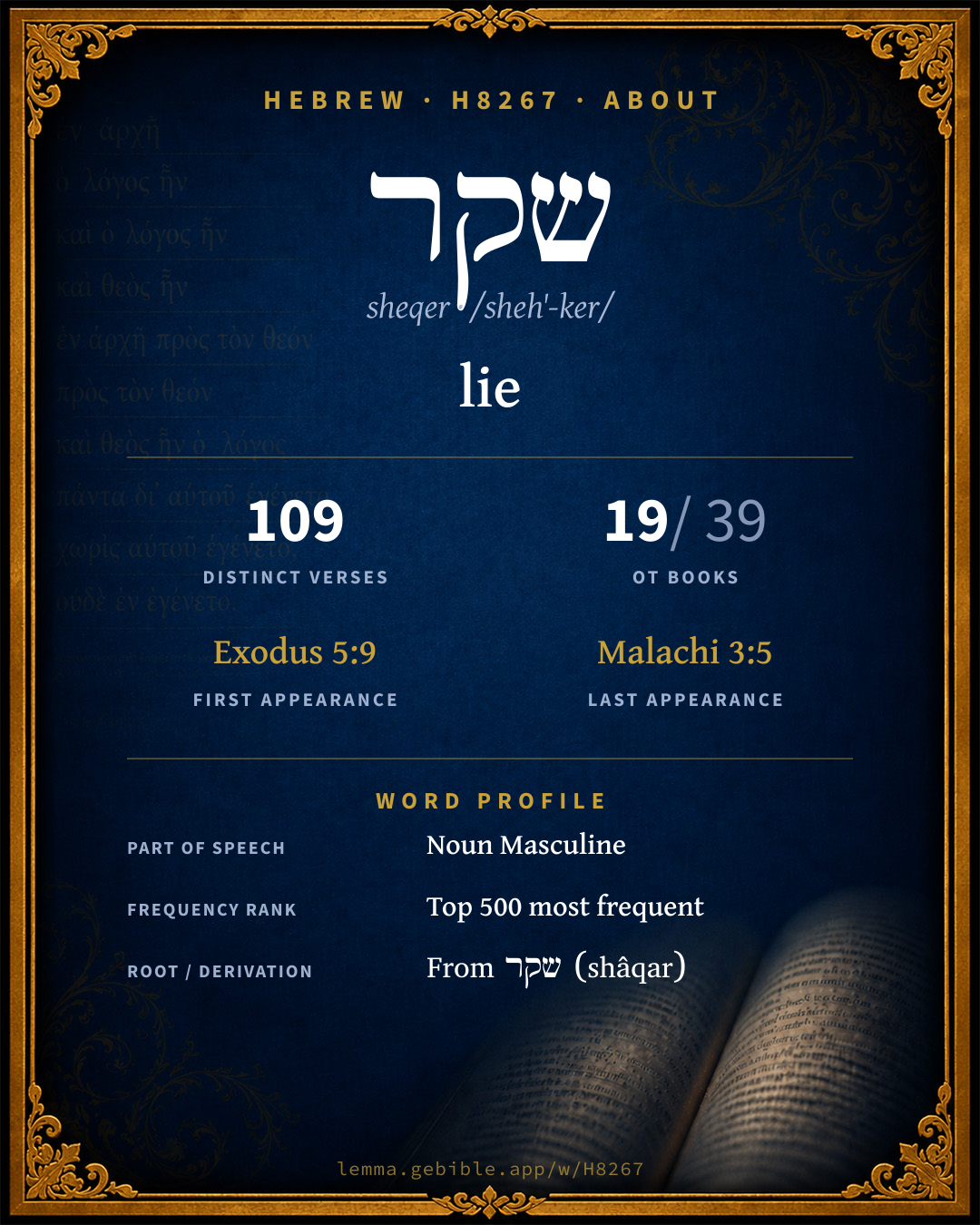
שֶׁ֫קֶר
lie
also: deception, disappointment, falsehood fuller range ↓
Full lexicon entry — Brown-Driver-Briggs (BDB)
From Brown-Driver-Briggs (BDB)
Where this word appears
See every Absolute-state word in the Hebrew Bible →
Grammar key — what these labels mean
Part of speech
- Noun
- A naming word — a person, place, thing, or idea.
Noun type
- Common
- A common noun — a general class of person, place, or thing (“king,” “city,” “water”), not a specific name.
State
- Absolute
- The independent form of a noun, not bound to a following word.
- Construct
- A noun bound to a following noun in a possessive / “of” relationship (the construct chain).
Gender
- Masculine
- Grammatically masculine.
Number
- Singular
- One.
- Plural
- More than one (in Hebrew, generally three or more).
Grammatical forms
- Noun, Common, Masculine, Singular, Absolute 107 times (95%)
- Noun, Common, Masculine, Plural, Absolute 4 times (4%)
- Noun, Common, Masculine, Singular, Construct 1 time (1%)
- Noun, Common, Masculine, Plural, Construct 1 time (1%)
Parsed forms decoded from the imported morphology (morphhb / Westminster Leningrad Codex — WLC text public domain, morphhb tagging CC BY 4.0), counted across 113 parsed occurrences — not distinct verses.
Every verse where H8267 appears — 109 distinct verses across 19 books. Click any verse to open its interlinear word-by-word view. Verse text shown in the World English Bible for context — . Each verse’s Hebrew form is shown with its reference; the English is not keyword-highlighted, since the data carries no word-level English alignment. Use “Compare translations” on any verse to read it across multiple English versions. This concordance covers the Hebrew Bible; Septuagint (Greek Old Testament) occurrences are not indexed here.
Exodus 3 verses
- Exodus 5:9 שָֽׁקֶר n c ms Let heavier work be laid on the men, that they may labor therein; and don't let them pay any attention to lying words."
- Exodus 20:16 שָֽׁקֶר n c ms "You shall not give false testimony against your neighbor.
- Exodus 23:7 שֶׁ֖קֶר n c ms "Keep far from a false charge, and don't kill the innocent and righteous: for I will not justify the wicked.
Leviticus 3 verses
- Leviticus 6:3 שָׁ֑קֶר n c ms or has found that which was lost, and dealt falsely therein, and swearing to a lie; in any of all these things that a man does, sinning therein;
- Leviticus 6:5 לַ/שֶּׁקֶר֒ prep det + n c ms or any thing about which he has sworn falsely; he shall restore it even in full, and shall add a fifth part more to it. To him to whom it belongs he shall give it, in the day of his being found guilty.
- Leviticus 19:12 לַ/שָּׁ֑קֶר prep det + n c ms "'You shall not swear by my name falsely, and profane the name of your God. I am Yahweh.
Deuteronomy 1 verse
1 Samuel 1 verse
2 Samuel 1 verse
1 Kings 2 verses
- 1 Kings 22:22 שֶׁ֔קֶר n c ms Yahweh said to him, 'How?' He said, 'I will go forth, and will be a lying spirit in the mouth of all his prophets.' He said, 'You shall entice him, and shall prevail also: go forth, and do so.'
- 1 Kings 22:23 שֶׁ֔קֶר n c ms Now therefore, behold, Yahweh has put a lying spirit in the mouth of all these your prophets; and Yahweh has spoken evil concerning you.
2 Kings 1 verse
2 Chronicles 2 verses
- 2 Chronicles 18:21 שֶׁ֔קֶר n c ms He said, 'I will go forth, and will be a lying spirit in the mouth of all his prophets.' He said, 'You shall entice him, and shall prevail also: go forth, and do so.'
- 2 Chronicles 18:22 שֶׁ֔קֶר n c ms Now therefore, behold, Yahweh has put a lying spirit in the mouth of these your prophets; and Yahweh has spoken evil concerning you.
Job 2 verses
Psalms 22 verses
- Psalms 7:14 שָֽׁקֶר n c ms Behold, he travails with iniquity; Yes, he has conceived mischief, And brought forth falsehood.
- Psalms 27:12 שֶׁ֝֗קֶר n c ms Don't deliver me over to the desire of my adversaries, For false witnesses have risen up against me, Such as breathe out cruelty.
- Psalms 31:18 שָׁ֥קֶר n c ms Let the lying lips be mute, Which speak against the righteous insolently, with pride and contempt.
- Psalms 33:17 שֶׁ֣קֶר n c ms A horse is a vain thing for safety, Neither does he deliver any by his great power.
- Psalms 35:19 שֶׁ֑קֶר n c ms Don't let those who are my enemies wrongfully rejoice over me; Neither let them wink with the eye who hate me without a cause.
- Psalms 38:19 שָֽׁקֶר n c ms But my enemies are vigorous and many. Those who hate me without reason are numerous.
- Psalms 52:3 שֶׁ֓קֶר n c ms You love evil more than good, Lying rather than speaking the truth. Selah.
- Psalms 63:11 שָֽׁקֶר n c ms But the king shall rejoice in God. Everyone who swears by him will praise him, For the mouth of those who speak lies shall be silenced.
- Psalms 69:4 שֶׁ֑קֶר n c ms Those who hate me without a cause are more than the hairs of my head. Those who want to cut me off, being my enemies wrongfully, are mighty. I have to restore what I didn't take away.
- Psalms 101:7 שְׁקָרִ֑ים n c mp He who practices deceit won't dwell within my house. He who speaks falsehood won't be established before my eyes.
- Psalms 109:2 שָֽׁקֶר n c ms For they have opened the mouth of the wicked and the mouth of deceit against me. They have spoken to me with a lying tongue.
- Psalms 119:29 שֶׁ֭קֶר n c ms Keep me from the way of deceit. Grant me your law graciously!
- Psalms 119:69 שֶׁ֣קֶר n c ms The proud have smeared a lie upon me. With my whole heart, I will keep your precepts.
- Psalms 119:78 שֶׁ֣קֶר n c ms Let the proud be disappointed, for they have overthrown me wrongfully. I will meditate on your precepts.
- Psalms 119:86 שֶׁ֖קֶר n c ms All of your commandments are faithful. They persecute me wrongfully. Help me!
- Psalms 119:104 שָֽׁקֶר n c ms Through your precepts, I get understanding; Therefore I hate every false way.
- Psalms 119:118 שֶׁ֝֗קֶר n c ms You reject all those who stray from your statutes, For their deceit is in vain.
- Psalms 119:128 שֶׁ֣קֶר n c ms Therefore I consider all of your precepts to be right. I hate every false way.
- Psalms 119:163 שֶׁ֣קֶר n c ms I hate and abhor falsehood. I love your law.
- Psalms 120:2 שֶׁ֑קֶר n c ms Deliver my soul, Yahweh, from lying lips, From a deceitful tongue.
- Psalms 144:8 שָֽׁקֶר n c ms Whose mouths speak deceit, Whose right hand is a right hand of falsehood.
- Psalms 144:11 שָֽׁקֶר n c ms Rescue me, and deliver me out of the hands of foreigners, Whose mouths speak deceit, Whose right hand is a right hand of falsehood.
Proverbs 20 verses
- Proverbs 6:17 שָׁ֑קֶר n c ms Haughty eyes, a lying tongue, Hands that shed innocent blood;
- Proverbs 6:19 שָׁ֑קֶר n c ms A false witness who utters lies, And he who sows discord among brothers.
- Proverbs 10:18 שָׁ֑קֶר n c ms He who hides hatred has lying lips. He who utters a slander is a fool.
- Proverbs 11:18 שָׁ֑קֶר n c ms Wicked people earn deceitful wages, But one who sows righteousness reaps a sure reward.
- Proverbs 12:17 שְׁקָרִ֣ים n c mp He who is truthful testifies honestly, But a false witness lies.
- Proverbs 12:19 שָֽׁקֶר n c ms Truth's lips will be established forever, But a lying tongue is only momentary.
- Proverbs 12:22 שָׁ֑קֶר n c ms Lying lips are an abomination to Yahweh, But those who do the truth are his delight.
- Proverbs 13:5 שֶׁ֭קֶר n c ms A righteous man hates lies, But a wicked man brings shame and disgrace.
- Proverbs 14:5 שָֽׁקֶר n c ms A truthful witness will not lie, But a false witness pours out lies.
- Proverbs 17:4 שֶׁ֥קֶר n c ms An evil-doer heeds wicked lips. A liar gives ear to a mischievous tongue.
- Proverbs 17:7 שָֽׁקֶר n c ms Arrogant speech isn't fitting for a fool, Much less do lying lips fit a prince.
- Proverbs 19:5 שְׁ֭קָרִים n c mp A false witness shall not be unpunished. He who pours out lies shall not go free.
- Proverbs 19:9 שְׁ֭קָרִים n c mp A false witness shall not be unpunished. He who utters lies shall perish.
- Proverbs 20:17 שָׁ֑קֶר n c ms Fraudulent food is sweet to a man, But afterwards his mouth is filled with gravel.
- Proverbs 21:6 שָׁ֑קֶר n c ms Getting treasures by a lying tongue Is a fleeting vapor for those who seek death.
- Proverbs 25:14 שָֽׁקֶר n c ms As clouds and wind without rain, So is he who boasts of gifts deceptively.
- Proverbs 25:18 שָֽׁקֶר n c ms A man who gives false testimony against his neighbor Is like a club, a sword, or a sharp arrow.
- Proverbs 26:28 שֶׁ֭קֶר n c ms A lying tongue hates those it hurts; And a flattering mouth works ruin.
- Proverbs 29:12 שָׁ֑קֶר n c ms If a ruler listens to lies, All of his officials are wicked.
- Proverbs 31:30 שֶׁ֣קֶר n c ms Charm is deceitful, and beauty is vain; But a woman who fears Yahweh, she shall be praised.
Isaiah 7 verses
- Isaiah 9:15 שֶּׁ֖קֶר n c ms The elder and the honorable man, he is the head; and the prophet who teaches lies, he is the tail.
- Isaiah 28:15 וּ/בַ/שֶּׁ֥קֶר conj + prep det + n c ms Because you have said, We have made a covenant with death, and with Sheol are we at agreement; when the overflowing scourge shall pass through, it shall not come to us; for we have made lies our refuge, and under falsehood have we hid ourselves:
- Isaiah 32:7 שֶׁ֔קֶר n c ms The instruments of the churl are evil: he devises wicked devices to destroy the humble with lying words, even when the needy speaks right.
- Isaiah 44:20 שֶׁ֖קֶר n c ms He feeds on ashes; a deceived heart has turned him aside; and he can't deliver his soul, nor say, Is there not a lie in my right hand?
- Isaiah 57:4 שָֽׁקֶר n c ms Against whom do you sport yourselves? against whom make you a wide mouth, and put out the tongue? Aren't you children of disobedience, a seed of falsehood,
- Isaiah 59:3 שֶׁ֔קֶר n c ms For your hands are defiled with blood, and your fingers with iniquity; your lips have spoken lies, your tongue mutters wickedness.
- Isaiah 59:13 שָֽׁקֶר n c ms transgressing and denying Yahweh, and turning away from following our God, speaking oppression and revolt, conceiving and uttering from the heart words of falsehood.
Jeremiah 34 verses
- Jeremiah 3:10 בְּ/שֶׁ֖קֶר prep + n c ms Yet for all this her treacherous sister Judah has not returned to me with her whole heart, but only in pretense, says Yahweh.
- Jeremiah 3:23 לַ/שֶּׁ֛קֶר prep det + n c ms Truly in vain is [the help that is looked for] from the hills, the tumult on the mountains: truly in Yahweh our God is the salvation of Israel.
- Jeremiah 5:2 לַ/שֶּׁ֖קֶר prep det + n c ms Though they say, As Yahweh lives; surely they swear falsely.
- Jeremiah 5:31 בַ/שֶּׁ֗קֶר prep det + n c ms the prophets prophesy falsely, and the priests bear rule by their means; and my people love to have it so: and what will you do in the end of it?
- Jeremiah 6:13 שָּֽׁקֶר n c ms For from the least of them even to the greatest of them everyone is given to covetousness; and from the prophet even to the priest everyone deals falsely.
- Jeremiah 7:4 הַ/שֶּׁ֖קֶר ptcl def.art + n c ms Don't you trust in lying words, saying, The temple of Yahweh, the temple of Yahweh, the temple of Yahweh, are these.
- Jeremiah 7:8 הַ/שָּׁ֑קֶר ptcl def.art + n c ms Behold, you trust in lying words, that can't profit.
- Jeremiah 7:9 לַ/שֶּׁ֖קֶר prep det + n c ms Will you steal, murder, and commit adultery, and swear falsely, and burn incense to Baal, and walk after other gods that you have not known,
- Jeremiah 8:8 לַ/שֶּׁ֣קֶר שֶׁ֥קֶר prep det + n c ms n c ms cs How do you say, We are wise, and the law of Yahweh is with us? But, behold, the false pen of the scribes has worked falsely.
- Jeremiah 8:10 שָּֽׁקֶר n c ms Therefore will I give their wives to others, and their fields to those who shall possess them: for everyone from the least even to the greatest is given to covetousness; from the prophet even to the priest every one deals falsely.
- Jeremiah 9:3 שֶׁ֔קֶר n c ms They bend their tongue, [as it were] their bow, for falsehood; and they are grown strong in the land, but not for truth: for they proceed from evil to evil, and they don't know me, says Yahweh.
- Jeremiah 9:5 שֶׁ֖קֶר n c ms They will deceive everyone his neighbor, and will not speak the truth: they have taught their tongue to speak lies; they weary themselves to commit iniquity.
- Jeremiah 10:14 שֶׁ֥קֶר n c ms Every man is become brutish [and is] without knowledge; every goldsmith is disappointed by his engraved image; for his molten image is falsehood, and there is no breath in them.
- Jeremiah 13:25 בַּ/שָּֽׁקֶר prep det + n c ms This is your lot, the portion measured to you from me, says Yahweh; because you have forgotten me, and trusted in falsehood.
- Jeremiah 14:14 שֶׁ֚קֶר שֶׁ֜קֶר n c ms n c ms Then Yahweh said to me, The prophets prophesy lies in my name; I didn't send them, neither have I commanded them, neither spoke I to them: they prophesy to you a lying vision, and divination, and a thing of nothing, and the deceit of their own heart.
- Jeremiah 16:19 שֶׁ֨קֶר֙ n c ms Yahweh, my strength, and my stronghold, and my refuge in the day of affliction, to you shall the nations come from the ends of the earth, and shall say, Our fathers have inherited nothing but lies, [even] vanity and things in which there is no profit.
- Jeremiah 20:6 בַּ/שָּֽׁקֶר prep det + n c ms You, Pashhur, and all who dwell in your house shall go into captivity; and you shall come to Babylon, and there you shall die, and there shall you be buried, you, and all your friends, to whom you have prophesied falsely.
- Jeremiah 23:14 בַּ/שֶּׁ֨קֶר֙ prep det + n c ms In the prophets of Jerusalem also I have seen a horrible thing: they commit adultery, and walk in lies; and they strengthen the hands of evil-doers, so that none does return from his wickedness: they are all of them become to me as Sodom, and the inhabitants of it as Gomorrah.
- Jeremiah 23:25 שֶׁ֖קֶר n c ms I have heard what the prophets have said, who prophesy lies in my name, saying, I have dreamed, I have dreamed.
- Jeremiah 23:26 הַ/שָּׁ֑קֶר ptcl def.art + n c ms How long shall this be in the heart of the prophets who prophesy lies, even the prophets of the deceit of their own heart?
- Jeremiah 23:32 שֶׁ֨קֶר֙ בְּ/שִׁקְרֵי/הֶ֖ם n c ms prep + n c mp cs + sfx pers 3mp Behold, I am against those who prophesy lying dreams, says Yahweh, and do tell them, and cause my people to err by their lies, and by their vain boasting: yet I didn't send them, nor commanded them; neither do they profit this people at all, says Yahweh.
- Jeremiah 27:10 שֶׁ֔קֶר n c ms for they prophesy a lie to you, to remove you far from your land, and that I should drive you out, and you should perish.
- Jeremiah 27:14 שֶׁ֔קֶר n c ms Don't listen to the words of the prophets who speak to you, saying, You shall not serve the king of Babylon; for they prophesy a lie to you.
- Jeremiah 27:15 לַ/שָּׁ֑קֶר prep det + n c ms For I have not sent them, says Yahweh, but they prophesy falsely in my name; that I may drive you out, and that you may perish, you, and the prophets who prophesy to you.
- Jeremiah 27:16 שֶׁ֔קֶר n c ms Also I spoke to the priests and to all this people, saying, Thus says Yahweh: Don't listen to the words of your prophets who prophesy to you, saying, Behold, the vessels of Yahweh's house shall now shortly be brought again from Babylon; for they prophesy a lie to you.
- Jeremiah 28:15 שָֽׁקֶר n c ms Then said the prophet Jeremiah to Hananiah the prophet, Hear now, Hananiah: Yahweh has not sent you; but you make this people to trust in a lie.
- Jeremiah 29:9 בְ/שֶׁ֔קֶר prep + n c ms For they prophesy falsely to you in my name: I have not sent them, says Yahweh.
- Jeremiah 29:21 שָׁ֑קֶר n c ms Thus says Yahweh of Hosts, the God of Israel, concerning Ahab the son of Kolaiah, and concerning Zedekiah the son of Maaseiah, who prophesy a lie to you in my name: Behold, I will deliver them into the hand of Nebuchadrezzar king of Babylon; and he shall kill them before your eyes;
- Jeremiah 29:23 שֶׁ֔קֶר n c ms because they have worked folly in Israel, and have committed adultery with their neighbors' wives, and have spoken words in my name falsely, which I didn't command them; and I am he who knows, and am witness, says Yahweh.
- Jeremiah 29:31 שָֽׁקֶר n c ms Send to all them of the captivity, saying, Thus says Yahweh concerning Shemaiah the Nehelamite: Because Shemaiah has prophesied to you, and I didn't send him, and he has caused you to trust in a lie;
- Jeremiah 37:14 שֶׁ֗קֶר n c ms Then said Jeremiah, It is false; I am not falling away to the Chaldeans. But he didn't listen to him; so Irijah laid hold on Jeremiah, and brought him to the princes.
- Jeremiah 40:16 שֶׁ֛קֶר n c ms But Gedaliah the son of Ahikam said to Johanan the son of Kareah, You shall not do this thing; for you speak falsely of Ishmael.
- Jeremiah 43:2 שֶׁ֚קֶר n c ms then spoke Azariah the son of Hoshaiah, and Johanan the son of Kareah, and all the proud men, saying to Jeremiah, You speak falsely: Yahweh our God has not sent you to say, You shall not go into Egypt to sojourn there;
- Jeremiah 51:17 שֶׁ֥קֶר n c ms Every man is become brutish [and is] without knowledge; every goldsmith is disappointed by his image; for his molten image is falsehood, and there is no breath in them.
Ezekiel 1 verse
Hosea 1 verse
Micah 2 verses
- Micah 2:11 וָ/שֶׁ֣קֶר conj + n c ms If a man walking in a spirit of falsehood lies: 'I will prophesy to you of wine and of strong drink;' He would be the prophet of this people.
- Micah 6:12 שָׁ֑קֶר n c ms Her rich men are full of violence, Her inhabitants speak lies, And their tongue is deceitful in their speech.
Habakkuk 1 verse
Zechariah 4 verses
- Zechariah 5:4 לַ/שָּׁ֑קֶר prep det + n c ms I will cause it to go out," says Yahweh of Hosts, "and it will enter into the house of the thief, and into the house of him who swears falsely by my name; and it will remain in the midst of his house, and will destroy it with its timber and its stones."
- Zechariah 8:17 שֶׁ֖קֶר n c ms and let none of you devise evil in your hearts against his neighbor, and love no false oath: for all these are things that I hate," says Yahweh.
- Zechariah 10:2 שֶׁ֔קֶר n c ms For the teraphim have spoken vanity, and the diviners have seen a lie; And they have told false dreams. They comfort in vain. Therefore they go their way like sheep. They are oppressed, because there is no shepherd.
- Zechariah 13:3 שֶׁ֥קֶר n c ms It will happen that, when anyone still prophesies, then his father and his mother who bore him will tell him, 'You must die, because you speak lies in the name of Yahweh;' and his father and his mother who bore him will stab him when he prophesies.
Malachi 1 verse
About this entry
At a glance — auto-summarized from this page’s data, not written by a person. Every figure links to its source below. This summary describes the numbers; it doesn’t interpret them.
The Hebrew noun שקר centers on the idea of “lie.” Where the King James Version says “lies,” newer translations reach for “falsehood” (unfoldingWord Literal Text); the renderings breakdown has the detail. It appears 109 verses across 19 books of the Hebrew Bible, among its common vocabulary. The word gravitates to Jeremiah (31%), then Psalms and Proverbs. Alongside “lie” the lexicon also lists “deception”, “disappointment”, and “falsehood” — part of its full sense range. Dig into 109-verse concordance and the renderings breakdown below.
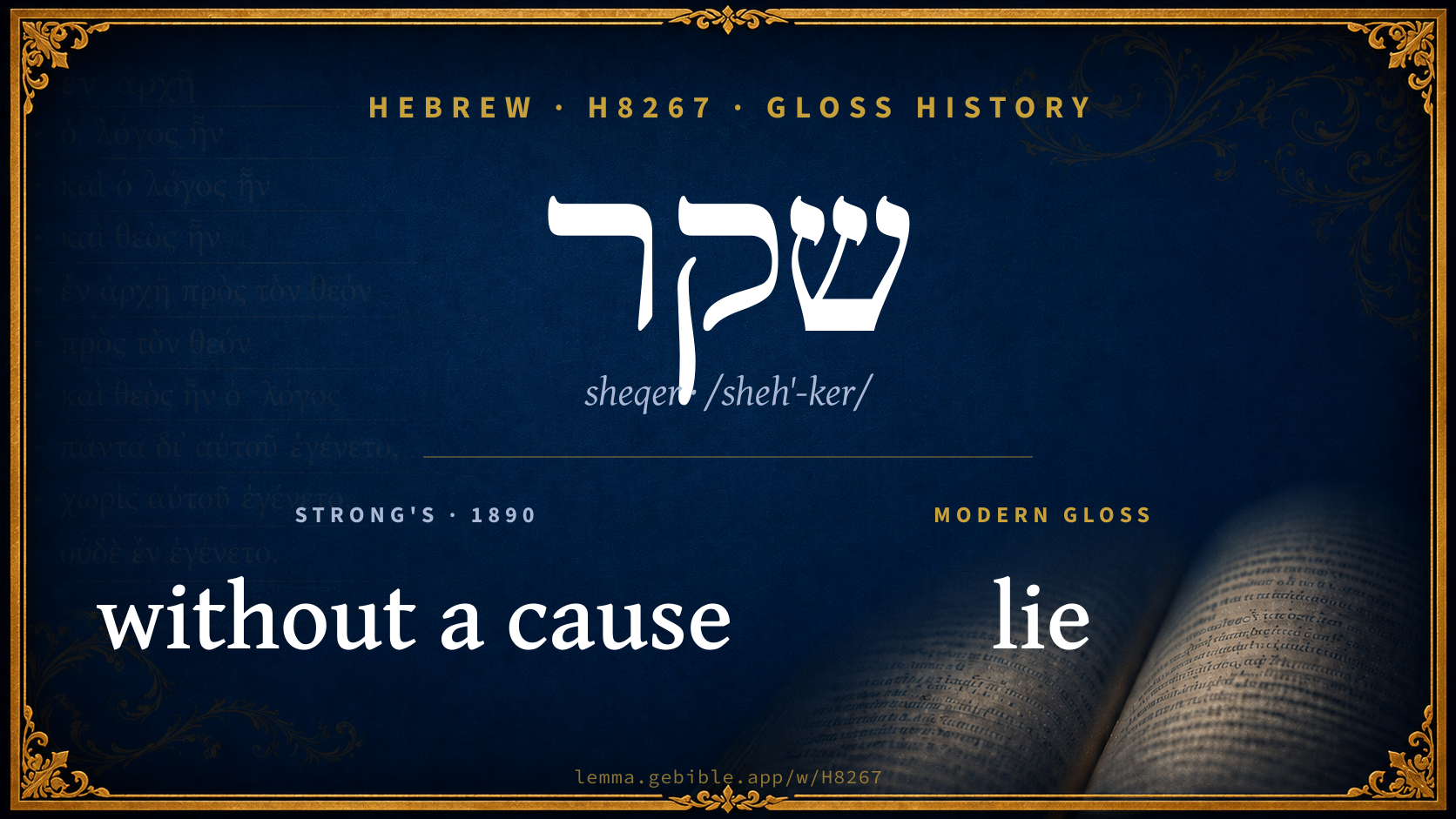
Gloss history
Strong's 1890 vs modern scholarship
About this word
Strong's H8267 catalogs a Hebrew word from the Hebrew Old Testament.
These counts are not copied from any lexicon or concordance. They are computed here, from the morphology-tagged Hebrew Old Testament. What Lemma adds →
- 109
- distinct verses
- The word appears in 109 distinct verses.
- 19 / 39
- OT books
- The word appears in 19 of 39 Old Testament books.
- #386
- by frequency
- Top 500 most frequent Hebrew words (rank 386 of 8,640 Hebrew words by occurrence).
View all 109 occurrences in the concordance →
By section of the Old Testament
By traditional corpus
Conventional, traditional groupings — biblical authorship is debated, so this is a traditional corpus grouping, not an authorship claim. Each share is this word’s portion of its verses in that division of the Hebrew canon. Each figure is a share of the word’s 109 distinct verses.
- Prophets (Nevi'im) 56 verses · 51%
- Writings (Ketuvim) 46 verses · 42%
- Torah (Pentateuch) 7 verses · 6%
How translations render this word
Counts come from each version’s own published word-to-Strong’s tagging or interlinear alignment — an approximate guide to how each version renders this word, not a word-level alignment the data otherwise carries. Because each total is that version’s own tagged count, the per-version totals vary from one another and need not match the appearance or distinct-verse counts above. These counts may also differ from a printed concordance because Lemma counts each distinctly tagged rendering and does not collapse phrase taggings into a single head-word total. This is a fixed set of word-tagged versions (KJV, ASV, BSB, ULT) and does not change with the reading translation you choose elsewhere. Each version’s license is shown beside its name below (and on Sources).
- King James Version: Lies 18×, Lying 15×, Falsely 13×
- American Standard Version: Falsely 18×, Lies 14×, Falsehood 12×
- Berean Standard Bible: Lies 19×, False 12×, Lying 12×
- unfoldingWord Literal Text: Falsehood 49×, Lie 11×, Lies 7×
King James Version Public Domain
Renders H8267 across 111 tagged occurrences — most commonly:
Plus 22 renderings that appear only once — usually multi-word phrases or single function words the recovered tagging swept in, not distinct renderings. Not rendered by a distinct English word in 2 further occurrences.
American Standard Version Public Domain
Renders H8267 across 112 tagged occurrences — most commonly:
Plus 27 renderings that appear only once — usually multi-word phrases or single function words the recovered tagging swept in, not distinct renderings.
Berean Standard Bible Public Domain
Renders H8267 across 104 tagged occurrences — most commonly:
Plus other, less common renderings. Plus 18 renderings that appear only once — usually multi-word phrases or single function words the recovered tagging swept in, not distinct renderings. Not rendered by a distinct English word in 9 further occurrences.
unfoldingWord Literal Text CC BY-SA 4.0
Renders H8267 across 106 tagged occurrences — most commonly:
Plus 12 renderings that appear only once — usually multi-word phrases or single function words the recovered tagging swept in, not distinct renderings.
Senses in the full BDB
What do BDB’s symbols mean?
BDB uses these scholarly abbreviations:
| Symbol | Meaning |
|---|---|
| 𝔊 | the Septuagint (the ancient Greek translation, LXX) |
| 𝔙 | the Vulgate (the Latin translation) |
| 𝔖 | the Syriac version (the Peshitta) |
| 𝔗 | the Targum (the Aramaic translation) |
| ψ | the Psalms |
| √ | root (the underlying root or stem) |
| ‖ | parallel passage (a synonymous or contrasted parallel) |
| † | the dagger: every passage where the word occurs is cited |
The 5 senses and sub-senses the full Brown-Driver-Briggs lexicon distinguishes for this word, in lexicon order (not ranked by frequency), with BDB’s own verbatim wording and sub-sense lettering. Shown in Hebrew script with BDB’s own scholarly abbreviations. The condensed entry is in the Lexicon Entry tab. See also the Forms in the corpus table below.
- 1. deception,what deceives, disappoints, and betrays one: a molten image Je 10:14 = 51:17; gift Pr 25:14; grace of person 31:30, etc.; אֹ֫רַח שׁ׳ ψ 119:104, 128; דֶּ֫רֶךְ שׁ׳ v 29; בטח בשׁ׳ Je 13:25; נחל שׁ׳ 16:19, cf. also ψ 7:15; 33:17; 119:118; Is 28:15; לַשֶּׁקֶר for disappointment, in vain 1 S 25:21; Je 3:23. e.g. Jeremiah 10:14
- 2. deceit, fraud, wrong: (ל)שׁ׳ עשׂה do or practise fraud, wrong Ho 7:1; Je 6:13; 8:9, 10; c. בְ, 2 S 18:13; פְּעֻלַּת שׁ׳ Pr 11:18; לֶ֫חֶם שׁ׳ Pr 20:17 food got by fraud; זֶ֫רַע שׁ׳ Is 57:4; עֵט שׁ׳ Je 8:8; ילד שׁ׳ ψ 7:15 (‖ עמל); דרךְ לשׁון קשׁת שׁ׳ Je 9:2; בְּשׁ׳ 3:10 (‖ בגד), adv. שׁקר fraudulently, wrongfully ψ 35:19; 38:20; 69:5; 119:78, 86. e.g. Hosea 7:1
- 3. injurious falsehood, in testimony, especially in courts: עֵד שֶׁקֶר Ex 20:16 (E) Dt 19:18 ψ 27:12 Pr 6:19; 14:5; 25:18; עֵד שׁקרים 12:17; 19:5, 9; ענה שׁ׳ Dt 19:18 testify falsehood; שְׁבֻעַת שׁ׳ Zc 8:17 false oath; נשׁבע לשׁ׳ swear falsely Je 5:2 + 5 times; נשׁבע על שׁ׳ Lv 5:22; דבּר שׁ׳ Mi 6:12 + (v. [דָּבַר], דָּבָר); אִמְרֵי שׁ׳ Is 32:7; שׁ׳ שׂפת(י) ψ 31:19; 120:2; Pr 10:18; 17:7; טפל שׁ׳ Jb 13:4 ψ 119:69, cf. v 163; abs. false! 2 K 9:12 Je 37:14. e.g. Exodus 20:13
- 4. falsity, of false or self-deceived prophets: נבּא שׁ׳ prophesy falsely Je 14:14; 23:25, 26; 29:21; + ל pers. 27:10, 14, 16; נ׳ לַשּׁ׳ v 15; נ׳ בשׁ׳ 5:31; 20:6; 29:9; מוֹרֶה שׁ׳ Is 9:14 Hb 2:18; חזה שׁ׳ Zc 10:2; חֲזוֹן שׁ׳ Je 14:14, etc., (+ 12 times); רוּחַ שׁ׳ v. p. 925 b. e.g. Jeremiah 14:14
- 5. lie, falsehood, in gen.: דבר שּׁ׳ ψ 101:7 (‖ רְמִיָּה); דְּבַר שׁ׳ Pr 13:5; of מִלִּים Jb 36:4; לְשׁוֹן שׁ׳ false tongue Pr 6:17; 12:19; 21:6; 26:28; ψ 109:2; of lips Pr 12:22; אִישׁ שׁ׳ 17:4 liar. e.g. Psalms 101:7
Senses from the full Brown-Driver-Briggs lexicon (Brown, Driver, Briggs; Oxford 1906 — public domain), digitized via Sefaria, supplemented by the OpenScriptures HebrewLexicon (CC BY 4.0). Full attribution on Sources.
Word origin
n.m. deception, disappointment, falsehood;—שׁ׳ Ex 23:7 + 64 times; שָׁ֑קֶר Ex 5:9 + 42 times; pl. שְׁקָרִים ψ 101:7 + 3 times; sf. שִׁקְרֵיהֶם Je 23:32;—
— Brown-Driver-Briggs (Oxford 1906, public domain), digitized via Sefaria, supplemented by the OpenScriptures HebrewLexicon (CC BY 4.0). See Sources.
Derived from שקר (shâqar) (H8266) — to deal falsely.
Jastrow Dictionary
A second Hebrew/Aramaic lexicon for comparison, covering Aramaic and post-biblical (Talmudic, Targumic, Midrashic) usage that the biblical-Hebrew BDB does not. Matched by lemma rather than by Strong’s number, so a lemma may carry more than one Jastrow headword (shown separately below), and the entries cover usage well beyond the Bible.
שָׂקַר
- , v. סָקר II
שָׁקַר
- (b. h.) to be false. Gen. R. s. 85, beg. שָׁקַרְתָּ יהודה thou hast been false, O Judah; Yalk. ib. 144; Yalk. Mal. 589.
- 1. same, same, to lie; to defraud.—מה לי לשַׁקּר what reason should I have for making a false statement?, i.e. a person’s statement is to be credited, when he gains nothing by it, since he might have obtained the same advantage in another way. Kidd. 64ᵇ אמרינן מה לי לשקר וכ׳ we apply the principle that we believe him, because he gains nothing by falsehood: for, why should he have said so? In order to release her from leviratical marriage after his death? If so, he might have said to her: I release thee by a divorce. Ib. מה לי לש׳ כי עדים דמי a person’s statement accepted on the ground that he had no reason for lying, has the same legal value as the statement of witnesses; מה לי לש׳ כי חזקה דמי it has only the same value as a presumption (חֲזָקָה). Keth. 27ᵇ מה לי לש׳ אי בעי וכ׳ we must believe him, for, if he had wanted, he might have said &c. Ib. מה לי לש׳ במקום עדים וכ׳ we do not apply the principle of mah li l’shaḳḳer, when the person’s statement is contradicted by witnesses (by well-known facts); B. Mets. 81ᵇ; a. fr.—Y. Snh. XI, 30ᶜ top (expl. כחש לו, I Kings XIII, 18) שי׳ בו (not ביה) he played him false; Cant. R. to II, 5 שי׳ לו; ib. ומה שי׳ לו שהאכילהו וכ׳ and wherein did he play him false? In that he gave him the bread of deceit to eat (made him the recipient of treacherous hospitality). Num. R. s. 2018; Tanḥ. Balak 12 מְשַׁקֵּר במשקלות, v. מִשְׁקָל; a. fr. e.g. 1 Kings 13:18
- 2. to prove false; to contradict, refute. Macc. 5ᵃ (ref. to Deut. XIX, 18) עד שתְּשַׁקֵּר גופה וכ׳ until thou disprovest the body of the testimony (provest an alibi of the witnesses). e.g. Deuteronomy 19:18
- to be refuted, be proved to be a liar. Y. ib. I, beg. 31ᵃ [read:] עדים שנזדממו וחזרו ונִשְׁתַּקְּרוּ if witnesses against whom an alibi had been proved were also proved to have told a falsehood (as to the fact to which they testified).
שְׁקַר I
- Targ. Mal. II, 10 (ed. Wil. Pa.). Targ. Josh. XXII, 16; 22; 31; a. e.—Yeb. 55ᵇ, v. שַׁקָּרָא.
- same. Targ. O. Gen. XXI, 23 (Y. Pe.). Targ. Ps. XLIV, 18; a. fr.—Gitt. 57ᵃ שַׁקּוּרֵי מְשַׁקְּרִיתוּ you tell a falsehood. Taan. 9ᵇ כי היכי דמְשַׁקְּרֵי … משקרי וכ׳ as the Babylonians are deceivers, so their rains are, v. מִטְרָא. R. Hash. 22ᵇ לא משקרי וכ׳, v. גְּלֵי; a. fr.
שַׁקָּר
- (preced.) liar.—Pl. שַׁקָּרִים, שַׁקָּרִין. Sot. 42ᵃ; Yalk. Hos. 524, v. שַׁקְרָן.
שֶׁקֶר
- preced.) lie, falsehood, vanity. Y. Snh. XI, 30ᶜ top מי שהאכיל … לחם ש׳ he that offered to his friend bread of falsehood (treacherous hospitality, v. שָׁקַר), opp. לחם אמת true hospitality. Shebu. 21ᵃ שבועת ש׳ נשבע להחליף a false oath is, if one swears to what is the opposite of true (that something happened which has not happened &c.), (modified) נשבע ומחליף he swears (vows that he will or will not do a certain thing), and does the opposite. Macc. 3ᵃ עדות ש׳ העדתי I have given false testimony. Lev. R. s. 6 המשביע … לש׳ וכ׳ he who lets his neighbor swear in vain (when he knows that he has no claim), shall finally leave his house empty-handed; R. A. says על ש׳ וכ׳ if he lets him swear to what he knows to be a lie; R. J. says, even if he lets him swear to a truth. Sabb. 104ᵃ, v. קְרֵב; a. v. fr.—Y. Macc. I, beg. 31ᵃ עדים שנזדממו … ש׳ ש׳ when witnesses have been convicted of an alibi, R. J. says, we draw an analogy between sheḳer (Ex. XX, 16) and sheḳer (Deut. XIX, 18), i.e. they must suffer corporal punishment in addition to pecuniary penalty.—Pl. שְׁקָרִים. Gen. R. s. 8 אל יברא שכולו ש׳ let man not be created, for he will be full of falsehoods; a. e. e.g. Exodus 20:16
שְׁקַר
- Targ. I Sam. XII, 3 ממון דש׳ (h. text כפר). Ib. XV, 29. Targ. O. Ex. XX, 7 (h. text שוא). Targ. ib. 13; a. fr.—Sabb. 104ᵃ (v. קְרֵב) ש׳ שכיח וכ׳ lie is frequent, truth rare. Ib. קושטא קאי ש׳ וכ׳ truth stands firm, falsehood does not. B. Bath. 82ᵃ, a. fr. מחזי כש׳ it looks like a lie. Lev. R. s. 26; Midr. Sam. ch. XXIV; Yalk. ib. 139 עלמא דש׳, v. עַלְמָא. Ib. מלין דש׳ words of falsehood; Lev. R. l. c. מלין שַׁקָּרִין. Succ. 46ᵇ לא … דאתי לאגמוריה ש׳ one should not say to a child, I shall give thee something, and not give it, because he may teach him falsehood; a. fr.—Pl. שִׁקְרִין, שִׁי׳. Targ. Ps. CI, 7. Targ. Jer. XXIII, 32; a. e.—[Y. Snh. VI, 23ᵇ bot., v. next w.]
A Dictionary of the Targumim, the Talmud Babli and Yerushalmi, and the Midrashic Literature (Marcus Jastrow; London, Luzac, 1903) — Public Domain. Digitized via Sefaria. Digitized via Sefaria. Full attribution on Sources.
Forms in the corpus
The 38 distinct written forms H8267 takes in the Hebrew Bible, most frequent first — each parse links to that state’s occurrences in the concordance. Hebrew forms include their vowel points and cantillation, so a single lemma takes many written forms.
Septuagint verse parallels
This word appears in 92 verses that also exist in the Greek Old Testament (Septuagint), out of the 109 Hebrew verses it occurs in. You can read those verses in Greek by switching the Old Testament edition to the Septuagint.
Read these verses in the Septuagint
- Exodus 5:9
- Leviticus 6:3
- Deuteronomy 19:18
- 1 Samuel 25:21
- 2 Samuel 18:13
- 1 Kings 22:22
- 2 Kings 9:12
- 2 Chronicles 18:21
- Job 13:4
- Psalms 7:14
- Proverbs 6:17
- Isaiah 9:15
This is a verse-level parallel only — the same verses exist in both the Hebrew and Greek Old Testaments. No word-level Hebrew↔Greek correspondence is claimed: the data carries no such alignment, so no Greek word is shown as this Hebrew word’s translation. Coverage is not total — the Septuagint omits the deuterocanon and renumbers the Psalms, so some Hebrew verses have no direct Greek parallel.