
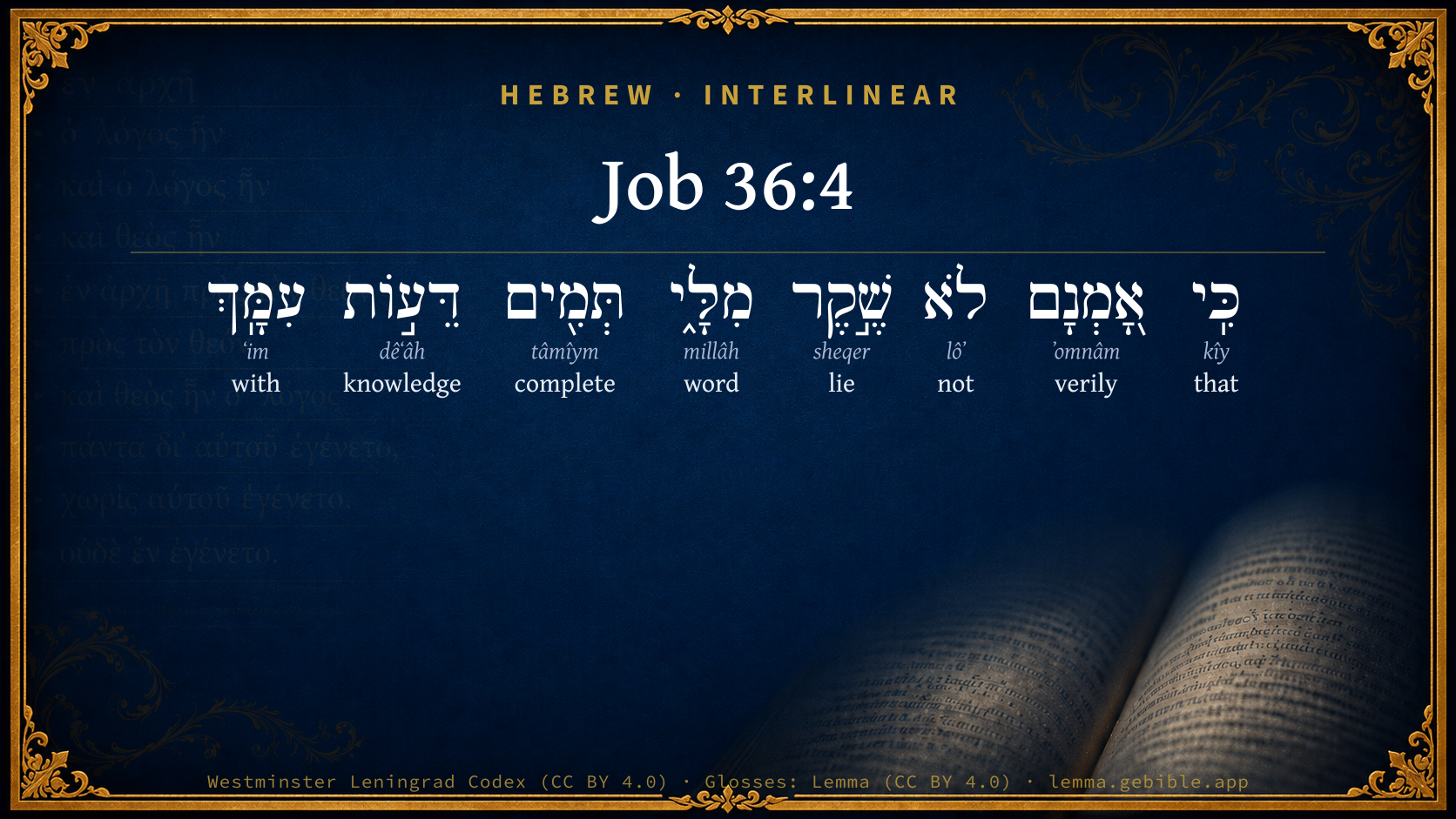
Job 36:4

Hebrew (Westminster Leningrad Codex) Job 36:4 appears in the Hebrew Old Testament. The text above is from the Westminster Leningrad Codex. Each word links to its Strong’s number, a concise gloss, and parsing drawn from the Open Scriptures Hebrew Bible morphology. Click any word for its full Brown-Driver-Briggs (BDB) entry.
Download image
Cite this verse

Job 36:4 (World English Bible). Public Domain. Lemma interlinear Bible study tool, https://lemma.gebible.app/v/job/36/4.

Show BibTeX & RIS
BibTeX
RIS
English Translation
For truly my words are not false. One who is perfect in knowledge is with you.
World English Bible · Public Domain
Download a study sheet

One document with this verse’s original text, its word-by-word gloss line, the meaning frame, cross-references with their text, attributed commentary, and full source and license credits — printable, and it pastes into notes with its structure intact.

This verse Autodidact and up

Study sheet (.html) Plain text (.txt)

A passage Seminary Student

Up to 50 verses in one chapter. A passage sheet keeps up to 6 commentary sources and 12 cross-references per verse, in the order this page ranks them, and says so on the sheet whenever that leaves anything out. Ask for a single verse and you get the Autodidact verse sheet above.

Everything on this page stays free to read, with no account — the sheet is a download of what is already on screen, not access to it.

Want to remove ads? Support Godless Engineer
Compare translations 3

The same verse in 3 English versions, stacked beneath the original-language interlinear above. Click any original word for its lexicon entry.

Each is an independent rendering of the whole verse — the interlinear is not word-aligned to these translations.

Highlighted words mark where these versions differ — a whole-verse word diff, not a word-by-word alignment.

  • World English Bible Public Domain
    For truly my words are not false. One who is perfect in knowledge is with you.
  • King James Version Public Domain
    For truly my words shall not be false: he that is perfect in knowledge is with thee.
  • unfoldingWord Literal Text CC BY-SA 4.0
    For truly my words not false; the complete in knowledge with you.

unfoldingWord Literal Text — © unfoldingWord, licensed CC BY-SA 4.0. Word-aligned USFM3 via Door43 (git.door43.org/unfoldingWord/en_ult).

Versions to compare (up to 4)

3 of 4 selected

Show all 18 translations

Every available English version of this verse, each an independent rendering of the whole verse.

  • World English Bible Public Domain
    For truly my words are not false. One who is perfect in knowledge is with you.
  • Berean Standard Bible Public Domain
    For truly my words are free of falsehood; one perfect in knowledge is with you.
  • Majority Standard Bible Public Domain
    For truly my words are free of falsehood; one perfect in knowledge is with you.
  • King James Version Public Domain
    For truly my words shall not be false: he that is perfect in knowledge is with thee.
  • American Standard Version (1901) Public Domain
    For truly my words are not false: One that is perfect in knowledge is with thee.
  • Revised Version (1885) Public Domain
    For truly my words are not false: one that is perfect in knowledge is with thee.
  • Geneva Bible (1599) Public Domain
    For truely my wordes shall not be false, and he that is perfect in knowledge, speaketh with thee.
  • Douay-Rheims (1899) Public Domain
    For indeed my words are without a lie, and perfect knowledge shall be proved to thee.
  • Young's Literal Translation Public Domain
    For, truly, my words `are' not false, The perfect in knowledge `is' with thee.
  • Literal Standard Version CC BY-SA 4.0
    For my words [are] truly not false, || The perfect in knowledge [is] with you.
  • Unlocked Literal Bible CC BY-SA 4.0
    For indeed, my words will not be false; someone who is mature in knowledge is with you.
  • unfoldingWord Literal Text CC BY-SA 4.0
    For truly my words not false; the complete in knowledge with you.
  • Darby Bible Public Domain
    For truly my words shall be no falsehood: one perfect in knowledge is with thee.
  • World Messianic Bible Public Domain
    For truly my words are not false. One who is perfect in knowledge is with you.
  • Webster's Bible Public Domain
    For truly my words shall not be false: he that is perfect in knowledge is with thee.
  • Free Bible Version CC BY-SA 4.0
    I assure you that what I'm saying are not lies, for I am a man whose knowledge is of the highest order.
  • Bible in Basic English Public Domain
    For truly my words are not false; one who has all knowledge is talking with you.
  • JPS Tanakh (1917) Public Domain
    For truly my words are not false; one that is upright in mind is with thee.

Literal Standard Version (2020), Covenant Press — licensed CC BY-SA 4.0. Text via the HelloAO Bible API (eBible.org). Unlocked Literal Bible (unfoldingWord) — licensed CC BY-SA 4.0. Text via the HelloAO Bible API (eBible.org). unfoldingWord Literal Text — © unfoldingWord, licensed CC BY-SA 4.0. Word-aligned USFM3 via Door43 (git.door43.org/unfoldingWord/en_ult). Free Bible Version, Dr. Jonathan Gallagher — licensed CC BY-SA 4.0. Text via the HelloAO Bible API (eBible.org).

Word by word

More ways to search: Search by grammar → Find every occurrence → Compare this word →

Practice this passage: Drill this verse → Learn its vocabulary →

About this verse

These counts appear in no published source. They are computed here, from the morphology-tagged text and Lemma’s own curated glosses. What Lemma adds →

8
words
8
distinct lemmas
Wisdom
section

Notable vocabulary

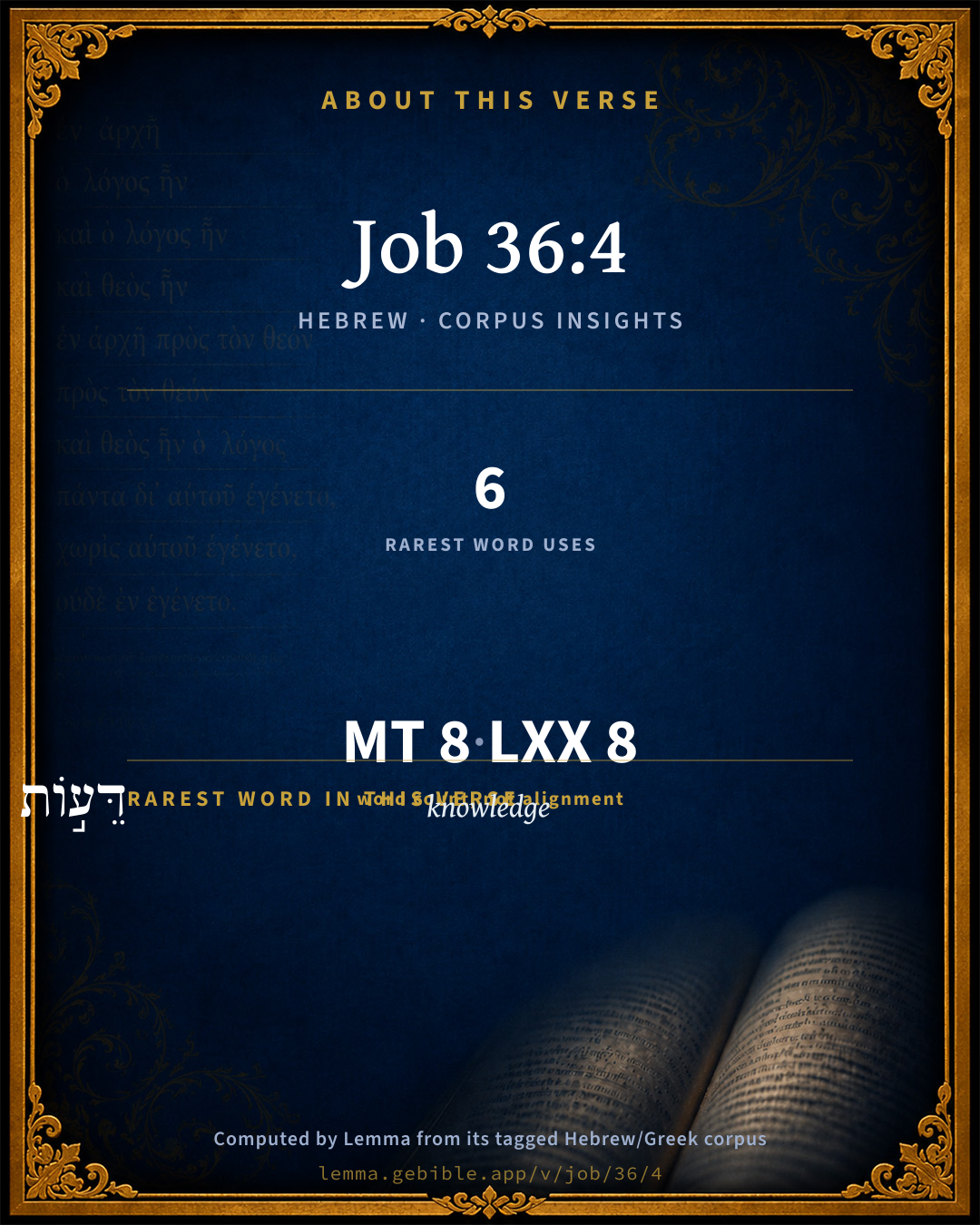
The rarest word here is דֵּע֣וֹת knowledge H1844 — appearing just 6 times in the whole Hebrew Bible.

Shared distinctive vocabulary

דֵּע֣וֹת knowledge H1844 occurs in 6 verses of the Hebrew Bible. Also found in:

Grammatical profile

  • 3 nouns
  • 1 adjective
  • 1 preposition
  • 1 conjunction
  • 1 adverb
  • 1 particle

Hebrew & Septuagint length

In English translation the verse runs 16 words from the Hebrew and 14 from the Septuagint (LXX English) — closely comparable.

A rough comparison of the two English renderings, which tokenize alike — not a word-level alignment.

Word counts can differ between the Hebrew and the Greek without any difference in meaning — e.g. the Hebrew direct-object marker אֵת has no separate Greek word, and Greek often adds the article ὁ.

In the original languages it is 8 Hebrew tokens and 8 Greek tokens — but the two are counted differently (Hebrew bundles its prefixes and suffixes into one token; the Greek is in lemma form), so that isn’t a like-for-like length.

Cross-references

16

Topical passages linked to Job 36:4 in the Treasury of Scripture Knowledge — connected by theme and wording, ordered by reader-vote popularity; previews shown in the World English Bible.

  • Job 37:16 Do you know the workings of the clouds, The wondrous works of him who is perfect in knowledge?
  • Proverbs 8:7–8 For my mouth speaks truth. Wickedness is an abomination to my lips.
  • Psalms 49:3 My mouth will speak words of wisdom. My heart shall utter understanding.
  • 1 Corinthians 14:20 Brothers, don't be children in thoughts, yet in malice be babies, but in thoughts be mature.
  • 2 Timothy 3:16–17 Every writing inspired by God is profitable for teaching, for reproof, for correction, and for instruction which is in righteousness,
  • Job 13:4 But you are forgers of lies. You are all physicians of no value.
  • Job 13:7 Will you speak unrighteously for God, And talk deceitfully for him?
  • Job 21:27 "Behold, I know your thoughts, The devices with which you would wrong me.
  • Job 21:34 So how can you comfort me with nonsense, Seeing that in your answers there remains only falsehood?"
  • Job 22:6–30 For you have taken pledges from your brother for nothing, And stripped the naked of their clothing.
  • Job 33:3 My words shall utter the uprightness of my heart; That which my lips know they shall speak sincerely.
  • Proverbs 22:20–21 Haven't I written to you thirty excellent things Of counsel and knowledge,
  • Luke 1:3 it seemed good to me also, having traced the course of all things accurately from the first, to write to you in order, most excellent Theophilus;
  • Acts 24:22 But Felix, having more exact knowledge concerning the Way, deferred them, saying, "When Lysias, the commanding officer, comes down, I will decide your case."
  • 2 Corinthians 2:17 For we are not as so many, peddling the word of God. But as of sincerity, but as of God, in the sight of God, we speak in Christ.
  • Colossians 4:12 Epaphras, who is one of you, a servant of Christ, salutes you, always striving for you in his prayers, that you may stand perfect and complete in all the will of God.

Cross-references courtesy of OpenBible.info (CC BY 4.0).

Hebrew and Greek witnesses Masoretic Hebrew ↔ Greek Septuagint

The same verse in the two great witnesses to the Old Testament, shown verse-for-verse.

These are two independent witnesses, not word-aligned to each other, and the Septuagint is shown in lemma (dictionary) form.

Hebrew Job 36:4 Masoretic · Westminster Leningrad Codex

כִּֽי אָ֭מְנָם לֹא שֶׁ֣קֶר מִלָּ֑י תְּמִ֖ים דֵּע֣וֹת עִמָּֽךְ

For truly my words are not false. One who is perfect in knowledge is with you.

World English Bible · Public Domain

Greek LXX Job 36:4 Septuagint · lemma form

ἐπί ἀλήθεια καί οὐ ἄδικος ῥῆμα ἀδίκως συνἵημι

I will speak just things truly, and you shall not unjustly receive unjust words.

LXX2012 (modern English Septuagint) · Public Domain

Hebrew: Westminster Leningrad Codex (CC BY 4.0). Greek: Septuagint (public domain); English from LXX2012 (modern English Septuagint) (Public Domain). How the Septuagint differs from the Hebrew →

Commentary

Notes on Job 36:4 from classic Christian and Jewish commentators (each source and its license shown beneath its notes). The classic Christian expositions comment on the surrounding passage and are grouped to its opening verse, so a note may address several verses; the Jewish commentaries on the Tanakh (Rashi and others) are per-verse, so they appear only where the commentator wrote on this verse.

Lemma curates 59 commentaries, every one of them public domain or Creative Commons licensed, each selected and text-cleaned for this edition rather than reprinted as found. About our sources →

Trapp's Complete Commentary

John Trapp

Job 36:4 For truly my words [shall] not [be] false: he that is perfect in knowledge [is] with thee.

Ver. 4. For truly my words shall not be false] I shall deal truly and plainly with thee; my discourse shall be simple and solid, having no better ornament but that of truth; which is like our first parents, most beautiful when naked: it was sin covered them, it is treachery hides this. Aperta veritas clausos etiam oculos ferit, saith one.

He that is perfect in knowledge is with thee] Integer sententiis (Vatab.); meaning himself, who fully understood the business between them, and would faithfully deliver it. There are that hold God to be hereby meant. A pious sense, but not so proper.

John Trapp, A Commentary or Exposition upon All the Books of the Old and New Testament (1647–1656) — public domain. Text from a community e-Sword module.

Tyndale Open Study Notes

Tyndale Open Resources

36:4 I am a man of great knowledge (literally one who is perfect in knowledge is with you): Elihu was probably claiming to be completely sincere or saying that his logic was flawless.

Tyndale Open Study Notes — © Tyndale Open Resources, licensed CC BY-SA 4.0. Text via the HelloAO Bible API.

Geneva Bible (1599)

Geneva Bible translators

Thou shalt perceive that I am a faithful instructor, and that I speak to thee in the name of God.

Geneva Bible (1599) marginal notes — public domain. Text via Bolls.life.

Jamieson, Fausset & Brown

Robert Jamieson, A. R. Fausset & David Brown

I will not "speak wickedly for God," as the friends (Job 13:4, Job 13:7-8) --that is, vindicate God by unsound arguments.

he that is perfect, &c.--Rather, as the parallelism requires, "a man of integrity in sentiments is with thee" (is he with whom thou hast to do). Elihu means himself, as opposed to the dishonest reasonings of the friends (Job 21:34).

Jamieson, Fausset & Brown — Commentary Critical and Explanatory on the Whole Bible (1871) — public domain (CC PDM 1.0). Text via the HelloAO Bible API.

Adam Clarke's Commentary

Verse 4. My words shall not be false] My words shall be truth without falsity.

He that is perfect in knowledge is with thee.] "The perfection of knowledge is with thee." Thou art a sensible, well-informed man, and will be able to judge of what I say.

Adam Clarke's Commentary on the Bible (1810–1826) — public domain. Text from a community e-Sword/MySword module.

Ellicott's Commentary for English Readers

(4) He that is perfect in knowledge.—We may presume that he meant God; but in the Authorised Version it looks very much as though he meant himself. (Comp. Job_37:16.) So apparently Vulg., “perfecta scientia probabitur tibi.”

A Bible Commentary for English Readers, edited by Charles John Ellicott (1878–1897) — public domain. Text from a community e-Sword module.

The Cambridge Bible for Schools and Colleges

gen. ed. J. J. S. Perowne

4. The speaker makes a higher claim than to sincerity here; he claims the character of absolute truth for his teaching—he is perfect in knowledge. In a slightly different form the phrase “perfect in knowledge” is applied to God, ch. Job_37:16; cf. 1Sa_2:3.

The Cambridge Bible for Schools and Colleges (gen. ed. J. J. S. Perowne; Cambridge University Press, 1878–1918) — public domain. Text from a community e-Sword module.

John Gill's Exposition

For truly my words shall not be false,.... But strictly true; he would take the utmost care to say nothing but the truth, with the greatest impartiality and sincerity, so that what was said might be depended upon; truth spoken briefly, clearly, and on so important a subject as the righteousness of God, deserved attention;

he that is perfect in knowledge is with thee; meaning either God, whose knowledge is perfect, who knows all persons and things; knows himself, his nature, persons, and perfections; his thoughts, counsels, and purposes; all his creatures, angels and men; the hearts of all men, their thoughts, words, and works; he, the omniscient and omnipresent God was with Job, from whose presence there is no fleeing; and therefore it became him to be careful of his thoughts, words, and actions; that he did not entertain any unbecoming thoughts of God, and say anything unworthy of him, or do anything that tended to his dishonour; since he was present with him, and nothing could escape his notice: or else Elihu means himself; suggesting, that he who undertook to speak for God and plead his cause, and clear him from the charge of unrighteousness, was no novice, but one that thoroughly understood the point in hand; and though no man is perfect in knowledge in an absolute sense, yet may be in comparison of others; or however may be upright and sincere in his knowledge; which sense the word used often has; and so it may signify, that as he was a sincere searcher after knowledge, and had through divine goodness attained to a competent share of it, even of sound and not superficial knowledge, he should be honest and upright in the communication of it; and this he might choose to observe the more, to excite the attention of Job to what he had to say; though it may be the truest reading of the words is, "perfect knowledge" or "perfection of knowledge is with thee" (k), that is, in his own apprehension, so Jarchi; and may be understood either ironically, or rather really, insinuating that Job was a man of such consummate wisdom and knowledge, that he would easily see the force of his reasonings, and the justness of them, and acquiesce in them; and having thus prefaced his discourse, he next enters upon his subject.

(k) "scientiae perfectae tecum"; so some in Bar Tzemach.

John Gill's Exposition of the Whole Bible (1746–1763) — public domain (CC PDM 1.0). Text via the HelloAO Bible API.

Albert Barnes' Notes on the Bible

For truly my words shall not be false - This is designed to conciliate attention. It is a professed purpose to state nothing but truth. Even in order to vindicate the ways of God he would state nothing but what would bear the most rigid examination. Job had charged on his friends a purpose “to speak wickedly for God;” to make use of unsound arguments in vindicating his cause, (see the notes at Job 13:7-8), and Elihu now says that “he” will make use of no such reasoning, but that all that he says shall be founded in strict truth.

He that is perfect in knowledge is with thee - This refers undoubtedly to Elihu himself, and is a claim to a clear understanding of the subject. He did not doubt that he was right, and that he had some views which were worthy of their attention. The main idea is, that he was of “sound” knowledge; that his views were not sophistical and captious; that they were founded in truth, and were worthy, therefore. of their profound attention.

Albert Barnes' Notes on the Bible (1834–1885) — public domain. Text from a community e-Sword/MySword module.

Haydock's Catholic Bible Commentary

Lie. Every orator will promise to speak the truth, and will do so sometimes to gain credit. (Worthington) --- Shall be. Hebrew, "is with thee." Thou art not devoid of sense, and thou wilt (Calmet) surely approve my reasons, which are suggested by the God of all knowledge. (Haydock)

George Leo Haydock (1774–1849), Haydock's Catholic Family Bible and Commentary, 1859 edition — public domain. Excludes Psalms (Douay-Rheims chapter numbering differs from Protestant) and Deuterocanonical books (Catholic canon only).

Matthew Poole's English Annotations

I will not speak any thing against my own conscience, nor against truth, either to flatter God, or to vex thee, as thou supposest thy other friends have done, Job 13:7, and elsewhere.

He that is perfect in knowledge is with thee. This is meant either,

1. Of God. Thou hast to do with a God of perfect knowledge, by whom all Shy words and actions. are weighed; and therefore hast need to be more wary and circumspect in thy expressions and behaviour. Or rather,

2. Of himself, as the former part of the verse is. And he speaketh of himself in the third person, for modesty’s sake. He speaks not of absolute, but of comparative perfection. And whatsoever perfection of knowledge he had, he doth not ascribe it to himself, but to God’s Spirit, Job 32:8. And the meaning may be this, Thou hast not to do with a novice, but with one who hath accurately considered, and through God’s grace doth fully understand, these matters; therefore hearken to me. But the word rendered

perfect signifieth also sincere, or upright, or right. And this may seem best to agree with the former clause, wherein he saith that he would not speak what he knew to be false; and now he adds, that he was and would be upright in the use of his knowledge, or in the delivery of his opinion in this matter, and not be biassed by any passion or prejudice, either to speak otherwise than he thought, or to judge otherwise than he should.

Matthew Poole's English Annotations on the Holy Bible (1683–1685) — public domain. Text from a community e-Sword/MySword module.

Whedon's Commentary on the Bible

Daniel D. Whedon

4. Perfect in knowledge — Literally, knowledges. In the theodicy which he proposes to Job he claims faultlessness and clearness of perception. (Delitzsch.) The use of the same phrase in Job_37:16, of Deity, leads some to ascribe this attributive here also to God.

Daniel D. Whedon (gen. ed.), Commentary on the Old and New Testaments (1874–1909) — public domain. Text from a community e-Sword module.

The Pulpit Commentary

For truly my words shall not be false: he that is perfect in knowledge is with thee. The words sound arrogant; but perhaps Elihu does not mean any more than W pledge himself to speak truthfully, and to say only what he has perfect knowledge of. It is clear that he speaks of himself, net of God (Stanley Loathes). in the second clause of the verse, as in the first.

The Pulpit Commentary (1880–1919), ed. H.D.M. Spence-Jones & Joseph S. Exell — public domain. Text from a community e-Sword module.

John Wesley's Explanatory Notes

He, &c. - Thou hast to do with a God of perfect knowledge, by whom all thy words and actions are weighed.

John Wesley, Explanatory Notes Upon the Whole Bible (1754–1765) — public domain. Text via the GEBible commentary corpus.

unfoldingWord translationNotes

Door43 World Missions Community

my words will not be false

"what I say will not be false"

someone who is mature in knowledge is with you

The word "someone" refers to Elihu himself. He speaks of being very knowledgeable as if it were being mature in knowledge. AT: "I, who am with you, am very knowledgeable" (See: Metaphor)

See

"Look" or "Listen" or "Pay attention to what I am about to tell you"

he is mighty in strength of understanding

The phrase "mighty in strength" forms a doublet that means "very strong." Elihu speaks of God understanding everything perfectly as if his understanding were very strong. AT: "he is very strong in understanding" or "he understands everything completely" (See: Doublet and Metaphor)

translationWords

word

might

strength

understand

unfoldingWord translationNotes — © Distant Shores Media and the Door43 World Missions Community, licensed CC BY-SA 4.0. Source: git.door43.org/Door43/en_tn.

Rashi

Rabbi Shlomo Yitzchaki (Rashi)

you have perfect knowledge Behold, I will now begin to speak with you since you think that your knowledge is perfect.

Rashi on the Tanakh — English translations: “The Judaica Press complete Tanach with Rashi, translated by A. J. Rosenberg” (CC BY 4.0); “Pentateuch with Rashi's commentary by M. Rosenbaum and A.M. Silbermann, 1929-1934” (public domain); “The Metsudah Tanach series, Lakewood, N.J” (CC BY 4.0); and “The Book of Joshua, Metsudah Publications, 1997” (CC BY 4.0). Text via Sefaria.

Lesson kit

Teaching starters — assembled from the data on this page, not authored interpretation. Every prompt links to the verse data it draws on. Edit before teaching.

Job, in the Wisdom, opens this verse with 8 words (8 distinct Hebrew lemmas). Its most distinctive word is dêʻâh (“knowledge”). A historical commentator’s framing appears above. Read the whole chapter for the surrounding context.

Discussion questions

  1. The word dêʻâh carries the sense “knowledge.” How does it shape the verse?
  2. 1 Samuel 2:3 shares the word «knowledge» with this verse. How do the two illuminate each other?
  3. These translations render this verse differently; the difference is in the English rendering, not the original. What questions does that raise?
  4. Reading how Trapp's Complete Commentary and Tyndale Open Study Notes read this verse, where do the two commentators agree and where do they part?

Things to notice

Reading settings

Reading text

Shown beneath each verse's original-language words.

Old Testament
Old Testament edition

Read the OT as the Masoretic Hebrew (MT) or the Greek Septuagint (LXX).

English shown for the Greek Septuagint (in the Hebrew ↔ Greek comparison).

Comparing translations? Open the Compare panel on any verse page to stack up to four side by side.