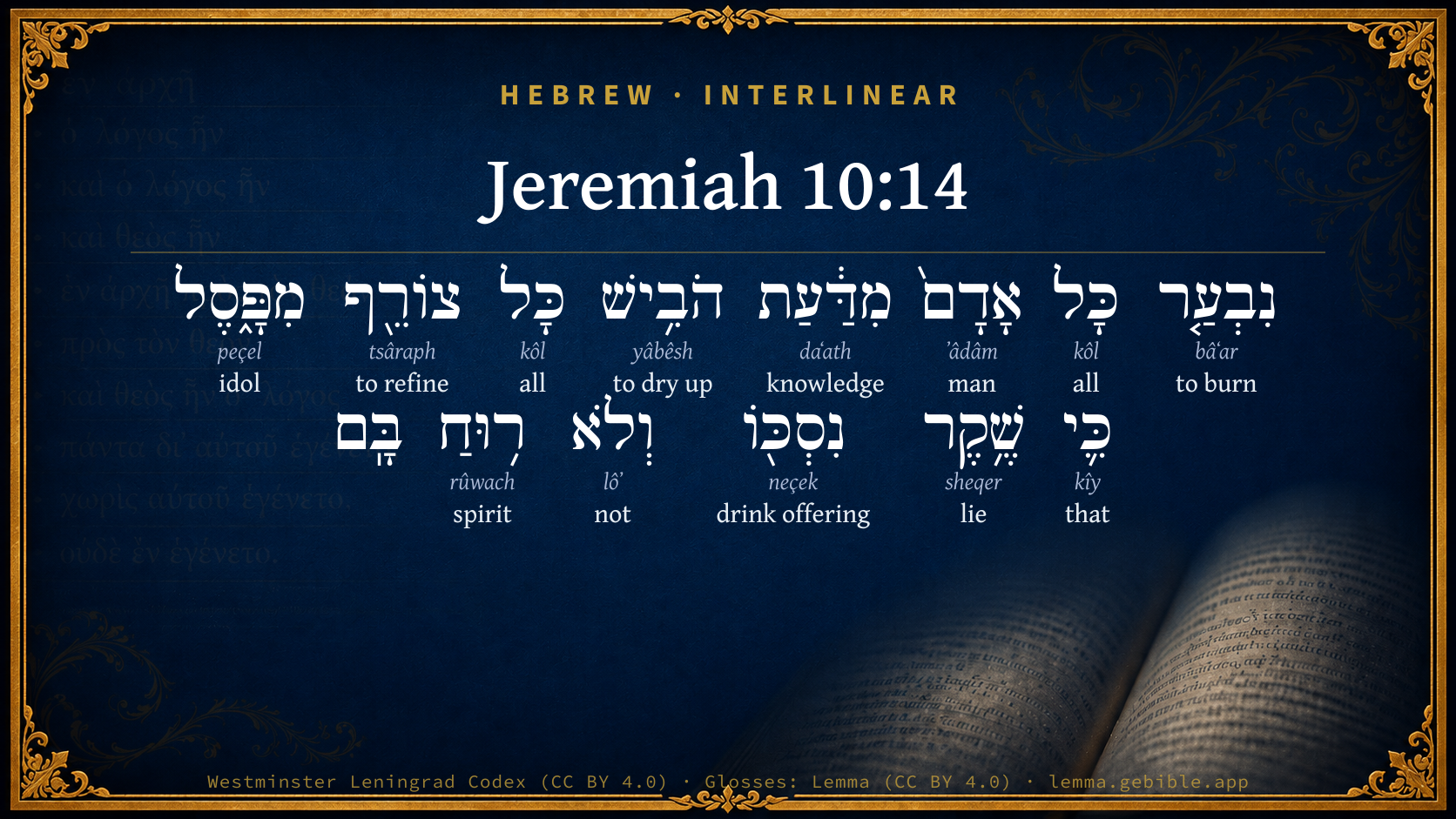
Jeremiah 10:14

Hebrew (Westminster Leningrad Codex) Jeremiah 10:14 appears in the Hebrew Old Testament. The text above is from the Westminster Leningrad Codex. Each word links to its Strong’s number, a concise gloss, and parsing drawn from the Open Scriptures Hebrew Bible morphology. Click any word for its full Brown-Driver-Briggs (BDB) entry.
Download image
Cite this verse

Jeremiah 10:14 (World English Bible). Public Domain. Lemma interlinear Bible study tool, https://lemma.gebible.app/v/jeremiah/10/14.

Show BibTeX & RIS
BibTeX
RIS
English Translation
Every man is become brutish [and is] without knowledge; every goldsmith is disappointed by his engraved image; for his molten image is falsehood, and there is no breath in them.
World English Bible · Public Domain
Download a study sheet

One document with this verse’s original text, its word-by-word gloss line, the meaning frame, cross-references with their text, attributed commentary, and full source and license credits — printable, and it pastes into notes with its structure intact.

This verse Autodidact and up

Study sheet (.html) Plain text (.txt)

A passage Seminary Student

Up to 50 verses in one chapter. A passage sheet keeps up to 6 commentary sources and 12 cross-references per verse, in the order this page ranks them, and says so on the sheet whenever that leaves anything out. Ask for a single verse and you get the Autodidact verse sheet above.

Everything on this page stays free to read, with no account — the sheet is a download of what is already on screen, not access to it.

Want to remove ads? Support Godless Engineer
Compare translations 3

The same verse in 3 English versions, stacked beneath the original-language interlinear above. Click any original word for its lexicon entry.

Each is an independent rendering of the whole verse — the interlinear is not word-aligned to these translations.

Highlighted words mark where these versions differ — a whole-verse word diff, not a word-by-word alignment.

  • World English Bible Public Domain
    Every man is become brutish [and is] without knowledge; every goldsmith is disappointed by his engraved image; for his molten image is falsehood, and there is no breath in them.
  • King James Version Public Domain
    Every man is brutish in his knowledge: every founder is confounded by the graven image: for his molten image is falsehood, and there is no breath in them.
  • unfoldingWord Literal Text CC BY-SA 4.0
    Every man is stupid; without knowledge. Every metalworker is put to shame from his idols, for his molten images are falsehood, and no breath in them.

unfoldingWord Literal Text — © unfoldingWord, licensed CC BY-SA 4.0. Word-aligned USFM3 via Door43 (git.door43.org/unfoldingWord/en_ult).

Versions to compare (up to 4)

3 of 4 selected

Show all 18 translations

Every available English version of this verse, each an independent rendering of the whole verse.

  • World English Bible Public Domain
    Every man is become brutish [and is] without knowledge; every goldsmith is disappointed by his engraved image; for his molten image is falsehood, and there is no breath in them.
  • Berean Standard Bible Public Domain
    Every man is senseless and devoid of knowledge; every goldsmith is put to shame by his idols. For his molten images are a fraud, and there is no breath in them.
  • Majority Standard Bible Public Domain
    Every man is senseless and devoid of knowledge; every goldsmith is put to shame by his idols. For his molten images are a fraud, and there is no breath in them.
  • King James Version Public Domain
    Every man is brutish in his knowledge: every founder is confounded by the graven image: for his molten image is falsehood, and there is no breath in them.
  • American Standard Version (1901) Public Domain
    Every man is become brutish `and is' without knowledge; every goldsmith is put to shame by his graven image; for his molten image is falsehood, and there is no breath in them.
  • Revised Version (1885) Public Domain
    Every man is become brutish and is without knowledge; every goldsmith is put to shame by his graven image: for his molten image is falsehood, and there is no breath in them.
  • Geneva Bible (1599) Public Domain
    Euery man is a beast by his owne knowledge: euery founder is confounded by the grauen image: for his melting is but falsehood, and there is no breath therein.
  • Douay-Rheims (1899) Public Domain
    Every man is become a fool for knowledge every artist is confounded in his graven idol: for what he hath cast is false, and there is no spirit in them.
  • Young's Literal Translation Public Domain
    Brutish is every man by knowledge, Put to shame is every refiner by a graven image, For false `is' his molten image. And there is no breath in them.
  • Literal Standard Version CC BY-SA 4.0
    Every man is brutish by knowledge, || Every refiner is put to shame by a carved image, || For his molten image [is] false. And there is no breath in them.
  • Unlocked Literal Bible CC BY-SA 4.0
    Every man has become ignorant, without knowledge. Every metalworker is put to shame by his idols. For his cast images are frauds; there is no life in them.
  • unfoldingWord Literal Text CC BY-SA 4.0
    Every man is stupid; without knowledge. Every metalworker is put to shame from his idols, for his molten images are falsehood, and no breath in them.
  • Darby Bible Public Domain
    Every man is become brutish, bereft of knowledge; every founder is put to shame by the graven image, for his molten image is falsehood, and there is no breath in them.
  • World Messianic Bible Public Domain
    Every man has become brutish and without knowledge. Every goldsmith is disappointed by his engraved image; for his molten image is falsehood, and there is no breath in them.
  • Webster's Bible Public Domain
    Every man is brutish in his knowledge: every founder is confounded by the graven image: for his molten image is falsehood, and there is no breath in them.
  • Free Bible Version CC BY-SA 4.0
    Everyone is stupid; they don't know anything. Every metalworker is embarrassed by the idols they make. For their images made of molten metal are fraudulent—they're not alive!
  • Bible in Basic English Public Domain
    Then every man becomes like a beast without knowledge; every gold-worker is put to shame by the image he has made: for his metal image is deceit, and there is no breath in them.
  • JPS Tanakh (1917) Public Domain
    Every man is proved to be brutish, without knowledge, every goldsmith is put to shame by the graven image, his molten image is falsehood, and there is no breath in them.

Literal Standard Version (2020), Covenant Press — licensed CC BY-SA 4.0. Text via the HelloAO Bible API (eBible.org). Unlocked Literal Bible (unfoldingWord) — licensed CC BY-SA 4.0. Text via the HelloAO Bible API (eBible.org). unfoldingWord Literal Text — © unfoldingWord, licensed CC BY-SA 4.0. Word-aligned USFM3 via Door43 (git.door43.org/unfoldingWord/en_ult). Free Bible Version, Dr. Jonathan Gallagher — licensed CC BY-SA 4.0. Text via the HelloAO Bible API (eBible.org).

Word by word

More ways to search: Search by grammar → Find every occurrence → Compare this word →

Practice this passage: Drill this verse → Learn its vocabulary →

מִפָּ֑סֶל
peçel
H6459
“from · idol”
Preposition + Noun, Common, Masculine, Singular, Absolute
Part of Speech
Preposition + Noun
Type
Common
Gender
Masculine
Number
Singular
State
Absolute
Full BDB Definition

Origin: from H6458

TWOT: 1788a

idol, image
  1. נִבְעַ֤ר bâʻar H1197 “to burn” Verb, Niphal, Perfect, 3rd Person, Masculine, Singular
  2. כָּל kôl H3605 “all of” Noun, Common, Masculine, Singular, Construct
  3. אָדָם֙ ʼâdâm H120 “man” Noun, Common, Masculine, Singular, Absolute
  4. מִדַּ֔עַת daʻath H1847 “from · knowledge” Preposition + Noun, Common, Feminine, Singular, Absolute
  5. הֹבִ֥ישׁ yâbêsh H3001 “to dry up” Verb, Hiphil, Perfect, 3rd Person, Masculine, Singular
  6. כָּל kôl H3605 “all of” Noun, Common, Masculine, Singular, Construct
  7. צוֹרֵ֖ף tsâraph H6884 “refining” Verb, Qal, Participle Active, Masculine, Singular, Absolute
  8. כִּ֛י kîy H3588 “that” Conjunction
  9. שֶׁ֥קֶר sheqer H8267 “lie” Noun, Common, Masculine, Singular, Absolute
  10. נִסְכּ֖וֹ neçek H5262 “drink offering · his” Noun, Common, Masculine, Singular, Construct + Suffix, Personal, 3rd Person, Masculine, Singular
  11. וְלֹא lôʼ H3808 “and · not” Conjunction + Particle, Negative
  12. ר֥וּחַ rûwach H7307 “spirit” Noun, Common, Both, Singular, Absolute

About this verse

These counts appear in no published source. They are computed here, from the morphology-tagged text and Lemma’s own curated glosses. What Lemma adds →

14
words
12
distinct lemmas
Prophets
section

Shared distinctive vocabulary

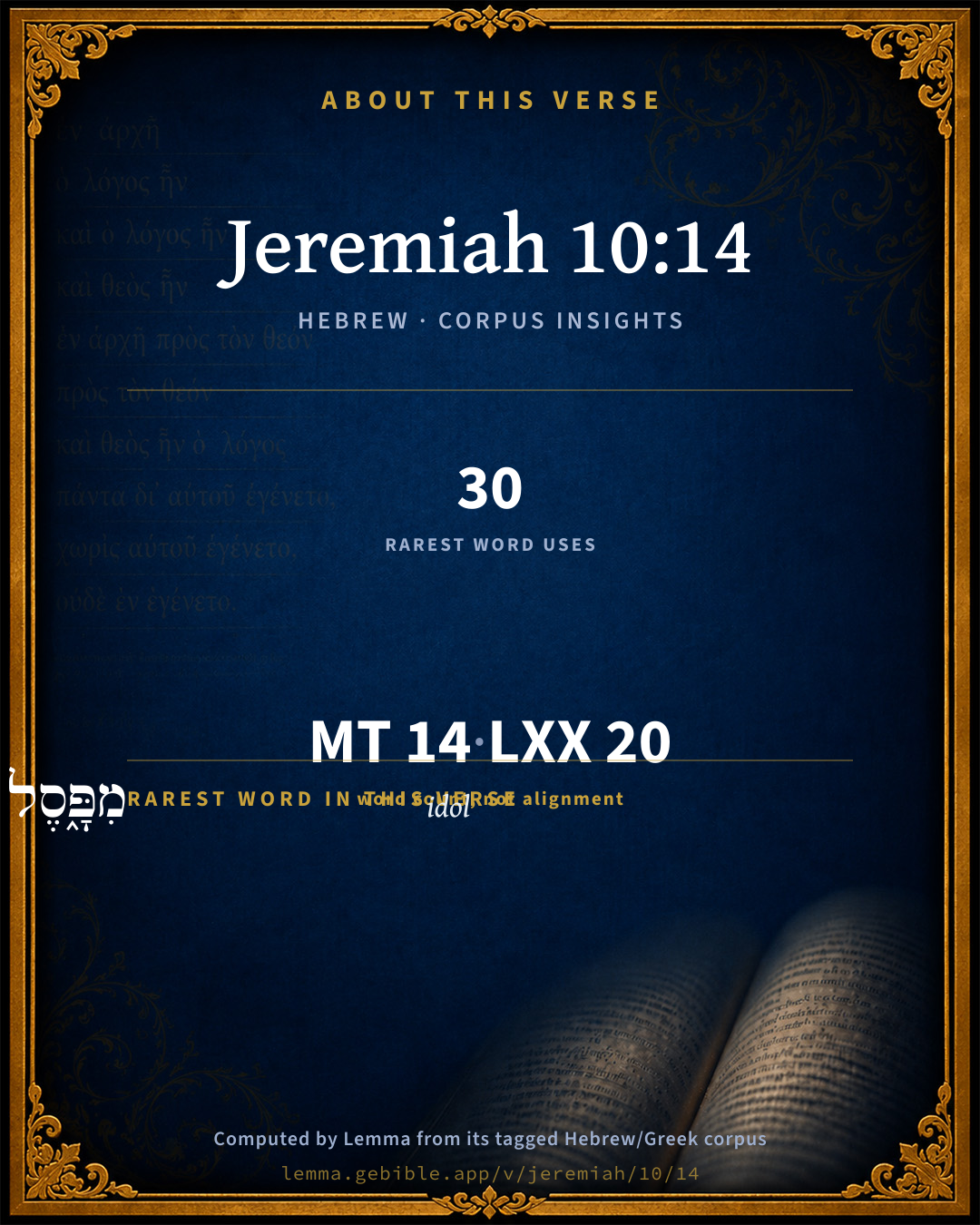
מִפָּ֑סֶל idol H6459 occurs in 30 verses of the Hebrew Bible. Also found in:

Grammatical profile

  • 3 verbs
  • 8 nouns
  • 1 preposition
  • 1 conjunction
  • 1 particle

Verb forms

  • נִבְעַ֤ר Niphal · Perfect
  • הֹבִ֥ישׁ Hiphil · Perfect
  • צוֹרֵ֖ף Qal · Participle Active

Repetition

A word recurs within this verse — often emphatic in Hebrew:

Hebrew & Septuagint length

In the original languages it is 14 Hebrew tokens and 20 Greek tokens — but the two are counted differently (Hebrew bundles its prefixes and suffixes into one token; the Greek is in lemma form), so that isn’t a like-for-like length.

Cross-references

16

Topical passages linked to Jeremiah 10:14 in the Treasury of Scripture Knowledge — connected by theme and wording, ordered by reader-vote popularity; previews shown in the World English Bible.

  • Psalms 135:16–18 They have mouths, but they can't speak; They have eyes, but they can't see;
  • Psalms 115:4–8 Their idols are silver and gold, The work of men's hands.
  • Isaiah 46:7–8 They bear it on the shoulder, they carry it, and set it in its place, and it stands, from its place it shall not move: yes, one may cry to it, yet it can not answer, nor save him out of his trouble.
  • Habakkuk 2:18–19 "What value does the engraved image have, that its maker has engraved it; the molten image, even the teacher of lies, that he who fashions its form trusts in it, to make mute idols?
  • Isaiah 44:18–20 They don't know, neither do they consider: for he has shut their eyes, that they can't see; and their hearts, that they can't understand.
  • Romans 1:22–23 Professing themselves to be wise, they became fools,
  • Jeremiah 51:17–18 Every man is become brutish [and is] without knowledge; every goldsmith is disappointed by his image; for his molten image is falsehood, and there is no breath in them.
  • Isaiah 42:17 They shall be turned back, they shall be utterly disappointed, who trust in engraved images, who tell molten images, You are our gods.
  • Jeremiah 10:8 But they are together brutish and foolish: the instruction of idols! it is but a stock.
  • Isaiah 45:16 They shall be disappointed, yes, confounded, all of them; they shall go into confusion together who are makers of idols.
  • Psalms 97:7 Let all them be shamed who serve engraved images, Who boast in their idols. Worship him, all you gods!
  • Isaiah 44:11 Behold, all his fellows shall be disappointed; and the workmen, they are of men: let them all be gathered together, let them stand up; they shall fear, they shall be put to shame together.
  • Psalms 14:2 Yahweh looked down from heaven on the children of men, To see if there were any who did understand, Who did seek after God.
  • Psalms 92:6 A senseless man doesn't know, Neither does a fool understand this:
  • Psalms 94:8 Consider, you senseless among the people; You fools, when will you be wise?
  • Proverbs 30:2 "Surely I am the most ignorant man, And don't have a man's understanding.

Cross-references courtesy of OpenBible.info (CC BY 4.0).

Hebrew and Greek witnesses Masoretic Hebrew ↔ Greek Septuagint

The same verse in the two great witnesses to the Old Testament, shown verse-for-verse.

These are two independent witnesses, not word-aligned to each other, and the Septuagint is shown in lemma (dictionary) form.

Hebrew Jeremiah 10:14 Masoretic · Westminster Leningrad Codex

נִבְעַ֤ר כָּל אָדָם֙ מִדַּ֔עַת הֹבִ֥ישׁ כָּל צוֹרֵ֖ף מִפָּ֑סֶל כִּ֛י שֶׁ֥קֶר נִסְכּ֖וֹ וְלֹא ר֥וּחַ בָּֽם

Every man is become brutish [and is] without knowledge; every goldsmith is disappointed by his engraved image; for his molten image is falsehood, and there is no breath in them.

World English Bible · Public Domain

Greek LXX Structure differs

In the Septuagint, Jeremiah is about an eighth shorter than the Hebrew and arranges its material differently — the Oracles Against the Nations (Hebrew chapters 46–51) appear in the middle of the Greek book, after 25:13. Because the chapter and verse boundaries do not line up, a verse-for-verse comparison with the Hebrew is not shown.

A verse-for-verse comparison isn’t shown here because the chapters and verses don’t line up. Switch to the LXX edition with the MT / LXX toggle above to read the Greek directly.

Hebrew: Westminster Leningrad Codex (CC BY 4.0). Greek: Septuagint (public domain); English from a public-domain English Septuagint. How the Septuagint differs from the Hebrew →

Targum (Aramaic paraphrase)

1

The Targum is the ancient Jewish Aramaic paraphrase of the Hebrew Scriptures — an interpretive translation, not the Hebrew text itself. Onkelos (literal) and Pseudo-Jonathan (expansive) render the Torah, and Jonathan the Prophets. Coverage is partial: where no permissively-licensed English translation exists for a verse, only the Aramaic is shown. This is verse-level text, not a word-by-word alignment to the Hebrew.

  1. Targum Jonathan Prophets (Joshua–Malachi)
    אִתַּבָּרוּ כָל פַּלְחֵי כּוֹכְבַיָא מִלְמִידַע חָכְמָא בְּהִית כָּל קִינִי מִלְמֶעֱבַּד צְלֵם אֲרֵי שִׁקְרָא אַתְּכוּנוּן וְלָא רוּחָא בְהֵין:

    (no public-domain English translation for this verse)

    Targum Jonathan — Aramaic: “Mikraot Gedolot” (public domain). English: “Sefaria Community Translation” (CC0 1.0 (public-domain dedication)); “London "Chaldee Paraphrase," 1871” (public domain). Text via Sefaria.

Commentary

Notes on Jeremiah 10:14 from classic Christian and Jewish commentators (each source and its license shown beneath its notes). The classic Christian expositions comment on the surrounding passage and are grouped to its opening verse, so a note may address several verses; the Jewish commentaries on the Tanakh (Rashi and others) are per-verse, so they appear only where the commentator wrote on this verse.

Lemma curates 59 commentaries, every one of them public domain or Creative Commons licensed, each selected and text-cleaned for this edition rather than reprinted as found. About our sources →

Trapp's Complete Commentary

John Trapp

Jer 10:14 Every man is brutish in [his] knowledge: every founder is confounded by the graven image: for his molten image [is] falsehood, and [there is] no breath in them.

Ver. 14. Every man is brutish in his knowledge.] Or, Every man is become more brutish than to know. That was therefore a hyperbolical praise given by Philostratus to Apollonius, Non doctus sed natus sapiens, that he was not taught, but born a wise man. See Job 11:12 Rom 1:22. {See Trapp on "Job 11:12"} {See Trapp on "Rom 1:22"} Every man is become brutish for want of knowledge (so the words may be rendered), the heathen idol makers especially; Brutescit homo prae scientia, so Vatablus. Every man is brutish, in comparison of knowledge, viz., of God’s knowledge, while he goeth about to search into the causes of rain, lightning, wind, &c., which God only understandeth.

John Trapp, A Commentary or Exposition upon All the Books of the Old and New Testament (1647–1656) — public domain. Text from a community e-Sword module.

Joseph Benson's Commentary

Jer 10:14-15. Every man is brutish in his knowledge — This is spoken of the makers of idols, whose skilfulness as workmen made them foolish enough to attempt to make gods, and who afterward acted still more foolishly in worshipping them, when they knew they were but the work of their own hands. The founder is confounded by the graven image — Or, ashamed, as הבישׁsignifies. For it can afford no help, nor do any good, to those who worship it; and therefore is a disgrace to the workman who pretends to make it a god, that could hear the prayers offered to it, and send help to its worshippers. His molten image is falsehood — That is, those are no less deceived who expect help from a molten image, than they who expect it from a false, lying man. They are the work of errors — The making of them is owing to men’s erroneous notions of the nature of God. In the time of their visitation they shall perish — The time will come when God will execute vengeance upon idolaters, and utterly destroy their idols.

Joseph Benson's Commentary on the Old and New Testaments (1811–1818) — public domain. Text from a community e-Sword module.

Geneva Bible (1599)

Geneva Bible translators

The more that man thinketh to do anything well by his own wisdom, and not as God instructeth him, the more doth he prove himself to be a vile beast.

Geneva Bible (1599) marginal notes — public domain. Text via Bolls.life.

Jamieson, Fausset & Brown

Robert Jamieson, A. R. Fausset & David Brown

in his knowledge--"is rendered brutish by his skill," namely, in idol-making (Jer 10:8-9). Thus the parallel, "confounded by the graven image," corresponds (so Jer 51:17). Others not so well translate, "without knowledge," namely, of God (see Isa 42:17; Isa 45:16; Hos 4:6).

Jamieson, Fausset & Brown — Commentary Critical and Explanatory on the Whole Bible (1871) — public domain (CC PDM 1.0). Text via the HelloAO Bible API.

Adam Clarke's Commentary

Verse 14. Every man is brutish] נבער nibar, is a boor, acts as a brute, who may suppose that a stock of a tree, formed like a man, may be an intellectual being; and therefore shuns the form as though it had life. See Isa 44:10-11. Of which verses, by the way, Dr. Blayney gives the following version to correct that of Bishop Lowth: -

Isa 44:10. Who hath formed a god?

Or set up a graven image that profiteth not?

Isa 44:11. Behold, all that are connected with it shall be

ashamed,

And the artificers, they above all men!

They shall assemble all of them; they shall stand

forth;

They shall fear; they shall be ashamed at the same

time.

"That is, while they stand before the image they have set up, and worship it with a religious dread, the glaring absurdity of their conduct shall lead to their shame and disgrace."

With due deference to this learned man, I think this interpretation too refined.

Adam Clarke's Commentary on the Bible (1810–1826) — public domain. Text from a community e-Sword/MySword module.

John Calvin's Commentaries

Some too refinedly explain the beginning of this verse — that their own subtlety or wisdom, which they arrogate, infatuates men, according to what Paul says, that men become vain in their minds, when they form an idea of God according to their own imagination. (Romans 1:21.) But the Prophet speaks more plainly, for he says, that all artificers were foolish The word lrnowledge is not to be taken here for knowledge of truth, but for the knowledge of artificers, whether carpenters or blacksmiths, or those who either melted or grayed or formed gods of wood, stone, and silver, as we may learn from the second clause of the verse. There is no difficulty as to what is meant, if we duly consider the words of the Prophet; he expresses the same thing in two ways; foolish, he says, are all our artificers; then he specifies one sort, every founder or melter, etc. We hence see that the Prophet does not use the word knowledge according to its strict meaning, but extends it to skill in workmanship.

But when he says that the artizans were foolish, he connects with them, no doubt, all the worshippers of false gods; but he reprobates their knowledge, who applied whatever skill and knowledge they had to so vain a purpose. Bellold, he says, the worker in gold, and every other artificer, think that they are very ingenious when they elegantly form an idol; they spend all their wits on so vain a thing; what is this but folly? But they think that they make a god by their own hands; yet they cannot change the nature of gold and silver. It is the form only that they add; but this form contains no life. Hence he subjoins, There is no spirit in them He had said before, that they who formed the graven image would be ashamed, or convicted of folly; for he had called them foolish and brutish. Now, בער, bor, in Hiphil, means to be foolish; but the noun means a brute animal. Hence he reproachfully compares these illustrious artizans, who gained repute by the elegant forms they gave to their gods, to asses, and oxen, and other brute animals. Some render נסך, nusak, “covering;” but it signifies, I doubt not, a molten image; for he repeats what he had said, that the founders would be ashamed of the graven image In short, He says, that the molten image was falsehood, for there was in, them no spirit He changes the number, but the meaning is evident.

We have seen before that idols were said to be the teaching of vanities; for they were extremely deceived, and became wholly foolish, who ascribed the glory of God to wood and stone. The heathens might say, that they had never thought such a thing; but facies proved that they were liars and made only vain pretences; for why did they place confidence in their idols? — why did they bow down before them? — why did they address to them prayers and supplications? They then believed that God was present in the visible form. Now the Prophet says, that this was the teaching of vanities; because they who made a figure or image of God thought that he was like to gold and silver, and that he had some affinity to dead elements, destitute of reason and understanding. For the same purpose he now adds, that the molten image is falsehood; why? because the truth of God is turned into falsehood, as Paul says, (Romans 1:25.)

It is, therefore, a monstrous absurdity when men imagine that wood or stone is an image of God; for there is no similarity, nor can such a thing enter into man’s mind without a grievous and an atrocious indignity being offered to God. The reason also is to be noticed, For there is no spirit in them God, so to speak, is the life of all things living; now, to call a dead thing an image of God, a thing in which there is no mind nor life, is it not to turn light into darkness? This reason, then, ought to be remembered by us; and it is a sufficient refutation of all such errors, when the Prophet says, that there is no spirit in idols, that is, in wood, stone, gold, and silver, and that they are therefore a He; for God will not have himself to be compared to dead things, without mind and life. He then adds —

John Calvin's Commentaries (1540-1563) — public domain. Text from the Calvin Translation Society English edition (1840s-50s) via the Christian Classics Ethereal Library (ccel.org). Calvin's coverage is partial (roughly two-thirds of the Bible); uncommented books and verses are honest gaps, never fabricated. The 19th-century editor's footnotes and remarks are omitted so the notes are faithfully Calvin's own voice.

Ellicott's Commentary for English Readers

(14) Brutish in his knowledge.—Literally, from knowing, i.e., too brutish to know, or, as some take it, brutish without knowledge, overwhelmed and astounded, so that the power of knowing fails.

Every founder.—The smelter, or worker in molten metal.

A Bible Commentary for English Readers, edited by Charles John Ellicott (1878–1897) — public domain. Text from a community e-Sword module.

The Cambridge Bible for Schools and Colleges

gen. ed. J. J. S. Perowne

14. is become brutish and is without knowledge] or, as mg. is too brutish to know. MT. is open to either rendering, that of R.V. text being preferable.

is put to shame] by the contrast between Jehovah’s power over the forces of nature and the impotency of the idol.

The Cambridge Bible for Schools and Colleges (gen. ed. J. J. S. Perowne; Cambridge University Press, 1878–1918) — public domain. Text from a community e-Sword module.

John Gill's Exposition

Every man is brutish in his knowledge,.... Or science of making an idol, whether it be of wood, or of gold, or silver, or brass; he is no better than a brute, if he thinks, when he has made it, he has made a god: or, "because of knowledge" (w); for want of it; being without the knowledge of God and divine things, he is like the beasts that perish, Psa 49:20,

every founder is confounded by the graven image; or put to shame on account of it; since, after all his art, and care, and trouble, in melting and refining, and casting it into a form, it is no more than a piece of gold, or silver, or brass, and has no deity, nor anything like it, in it:

for his molten image is falsehood; it is a lie, when it is said to be a god; and it deceives those who worship it, and place any confidence in it. Kimchi renders it, "his covering" (x). The covering of the idol with gold and silver, with blue and purple, as in Jer 10:4, is all a piece of deceit, to impose upon the people, and lead them into idolatry:

and there is no breath in them; they are mere stocks and stones, lifeless and inanimate creatures; they have neither life themselves, nor can they give it to others.

(w) "propter scientiam", Pagninus, Montanus; "a scientia", Calvin, Grotius, Schmidt. (x) "tectio, sive obductio ejus", Vatablus.

John Gill's Exposition of the Whole Bible (1746–1763) — public domain (CC PDM 1.0). Text via the HelloAO Bible API.

Albert Barnes' Notes on the Bible

In his knowledge - Rather, “without knowledge; i. e., on comparing his powerless idols with the terrific grandeur of a tropical thunderstorm the man who can still worship them instead of the Creator is destitute of knowledge.

Every founder ... - Or, “every goldsmith is put to shame etc.” He has exhausted his skill on what remains an image.

Albert Barnes' Notes on the Bible (1834–1885) — public domain. Text from a community e-Sword/MySword module.

Haydock's Catholic Bible Commentary

Knowledge. If it were real, he would see the vanity of idols, ver. 8. (Calmet)

George Leo Haydock (1774–1849), Haydock's Catholic Family Bible and Commentary, 1859 edition — public domain. Excludes Psalms (Douay-Rheims chapter numbering differs from Protestant) and Deuterocanonical books (Catholic canon only).

Matthew Poole's English Annotations

Every man is brutish in his knowledge: some limit it to the makers of these idols, that can employ their arts and wits to no better purpose than to frame such stocks into gods; this suits the next expression. Men are bewitched and besotted by these things, so as to see no more into their folly than if they were brutes; and the reason that it hath taken such root may be, because of men’s so much admiring the art of carving and painting, or rather through their ignorance: q.d. It is for want of knowledge and understanding that men are thus brutish, Isa 44:18.

Every founder is confounded by the graven image; either it shall turn to his reproach; or rather, he shall see his folly, and shall be ashamed of it when he shall discover it, that ever he should make such a thing, and trust in it, and expose it to be adored by others.

His molten image is falsehood; it is not that which it pretends to be, but a deceitful thing, a lie; they turn the truth of God into a lie, Rom 1:25.

There is no breath in them; they have nothing of life in them; nay, that very vegetative life that once was in their stocks is now lost; much less are they spirits sent down from heaven.

Matthew Poole's English Annotations on the Holy Bible (1683–1685) — public domain. Text from a community e-Sword/MySword module.

Whedon's Commentary on the Bible

Daniel D. Whedon

14. Every man is brutish — In the presence of such exhibitions of God only the brutish and besotted can find satisfaction in idols.

Daniel D. Whedon (gen. ed.), Commentary on the Old and New Testaments (1874–1909) — public domain. Text from a community e-Sword module.

The Pulpit Commentary

Before these natural miracles, all men, except those who have been enlightened by revelation, are without knowledge (so, and not in his knowledge, we ought to render); i.e. without insight into their origin and meaning. (compare the overwhelming series of questions in the sublime theophany in Job, Jer_28:3-9) Every founder is confounded by, etc.; rather, every goldsmith is brought to shame by the graven image ; for how can the work which has needed all the resources of his skill deliver him?

The Pulpit Commentary (1880–1919), ed. H.D.M. Spence-Jones & Joseph S. Exell — public domain. Text from a community e-Sword module.

John Wesley's Explanatory Notes

Every man - Every idolator.

John Wesley, Explanatory Notes Upon the Whole Bible (1754–1765) — public domain. Text via the GEBible commentary corpus.

unfoldingWord translationNotes

Door43 World Missions Community

has become ignorant

"is lacking knowledge" or "does not know"

Every metalworker is put to shame by his idols

This can be stated in active form. AT: "Every metalworker's idols put him to shame" or "As for every metalworker, his idols shame him" (See: Active or Passive)

they will perish at the time of their punishment

This speaks of the final destruction of the idols. AT: "there will be a time when God will destroy them" (See: Personification)

the portion of Jacob

Here "Jacob" represents the people of Israel. God being their "portion" is an idiom that means that they worship him. AT: "the portion of Israel" or "whom the people of Israel worship" (See: Metonymy and Idiom)

the molder of all things

"the creator of all things" or "the one who created all things"

Israel is the tribe of his inheritance

This speaks of Israel belonging to Yahweh as if it were something that Yahweh gained through inheritance. AT: "The tribe of Israel belongs to him" (See: Metaphor)

translationWords

know

shame

image

works

mock

perish

punish

Jacob

tribe

inherit

Yahweh of hosts

name

unfoldingWord translationNotes — © Distant Shores Media and the Door43 World Missions Community, licensed CC BY-SA 4.0. Source: git.door43.org/Door43/en_tn.

Rashi

Rabbi Shlomo Yitzchaki (Rashi)

brutish Heb. נבער. Comp. (Psalms 92:7) “a brutish (בער) man”; also here (infra 10:21), “the shepherds have become brutish (נבערו).”

his molten images Heb. נסכו. An expression of מסכה, a molten image.

Rashi on the Tanakh — English translations: “The Judaica Press complete Tanach with Rashi, translated by A. J. Rosenberg” (CC BY 4.0); “Pentateuch with Rashi's commentary by M. Rosenbaum and A.M. Silbermann, 1929-1934” (public domain); “The Metsudah Tanach series, Lakewood, N.J” (CC BY 4.0); and “The Book of Joshua, Metsudah Publications, 1997” (CC BY 4.0). Text via Sefaria.

Lesson kit

Teaching starters — assembled from the data on this page, not authored interpretation. Every prompt links to the verse data it draws on. Edit before teaching.

Jeremiah, in the Prophets, opens this verse with 14 words (12 distinct Hebrew lemmas). Its most distinctive word is peçel (“idol”). A historical commentator’s framing appears above. Read the whole chapter for the surrounding context.

Discussion questions

  1. What does “idol” (peçel) contribute to the verse as a whole?
  2. How does Exodus 20:4, which shares the word «idol», read alongside this verse?
  3. What does the repetition of “all” (2× in this one verse) do in this verse?
  4. These translations render this verse differently; the difference is in the English rendering, not the original. What questions does that raise?
  5. «נִבְעַ֤ר» is a Niphal Perfect verb. How does that grammatical form shape the action described?
  6. Compare how Trapp's Complete Commentary and Joseph Benson's Commentary read this verse. Where do they agree or differ?

Things to notice

Reading settings

Reading text

Shown beneath each verse's original-language words.

Old Testament
Old Testament edition

Read the OT as the Masoretic Hebrew (MT) or the Greek Septuagint (LXX).

English shown for the Greek Septuagint (in the Hebrew ↔ Greek comparison).

Comparing translations? Open the Compare panel on any verse page to stack up to four side by side.