Micah 2:11

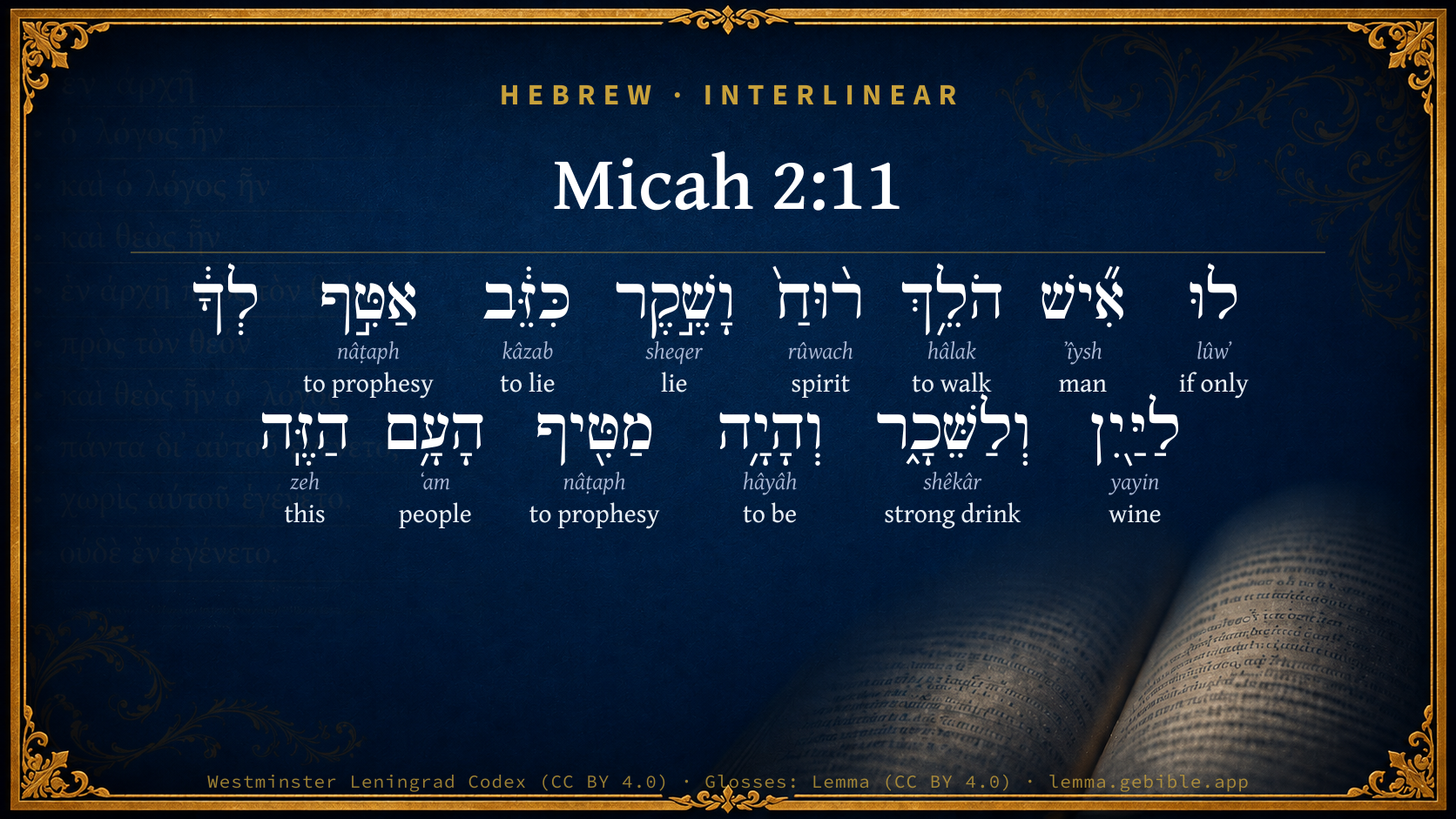
Hebrew (Westminster Leningrad Codex) Micah 2:11 appears in the Hebrew Old Testament. The text above is from the Westminster Leningrad Codex. Each word links to its Strong’s number, a concise gloss, and parsing drawn from the Open Scriptures Hebrew Bible morphology. Click any word for its full Brown-Driver-Briggs (BDB) entry.
Download image
Cite this verse

Micah 2:11 (World English Bible). Public Domain. Lemma interlinear Bible study tool, https://lemma.gebible.app/v/micah/2/11.

Show BibTeX & RIS
BibTeX
RIS
English Translation
If a man walking in a spirit of falsehood lies: 'I will prophesy to you of wine and of strong drink;' He would be the prophet of this people.
World English Bible · Public Domain
Download a study sheet

One document with this verse’s original text, its word-by-word gloss line, the meaning frame, cross-references with their text, attributed commentary, and full source and license credits — printable, and it pastes into notes with its structure intact.

This verse Autodidact and up

Study sheet (.html) Plain text (.txt)

A passage Seminary Student

Up to 50 verses in one chapter. A passage sheet keeps up to 6 commentary sources and 12 cross-references per verse, in the order this page ranks them, and says so on the sheet whenever that leaves anything out. Ask for a single verse and you get the Autodidact verse sheet above.

Everything on this page stays free to read, with no account — the sheet is a download of what is already on screen, not access to it.

Want to remove ads? Support Godless Engineer
Compare translations 3

The same verse in 3 English versions, stacked beneath the original-language interlinear above. Click any original word for its lexicon entry.

Each is an independent rendering of the whole verse — the interlinear is not word-aligned to these translations.

Highlighted words mark where these versions differ — a whole-verse word diff, not a word-by-word alignment.

  • World English Bible Public Domain
    If a man walking in a spirit of falsehood lies: 'I will prophesy to you of wine and of strong drink;' He would be the prophet of this people.
  • King James Version Public Domain
    If a man walking in the spirit and falsehood do lie, saying, I will prophesy unto thee of wine and of strong drink; he shall even be the prophet of this people.
  • unfoldingWord Literal Text CC BY-SA 4.0
    If a man walking wind and falsehood lied, "I will drip to you of wine and of beer," he would be the dripper of this people.

unfoldingWord Literal Text — © unfoldingWord, licensed CC BY-SA 4.0. Word-aligned USFM3 via Door43 (git.door43.org/unfoldingWord/en_ult).

Versions to compare (up to 4)

3 of 4 selected

Show all 18 translations

Every available English version of this verse, each an independent rendering of the whole verse.

  • World English Bible Public Domain
    If a man walking in a spirit of falsehood lies: 'I will prophesy to you of wine and of strong drink;' He would be the prophet of this people.
  • Berean Standard Bible Public Domain
    If a man of wind were to come and say falsely, “I will preach to you of wine and strong drink,” he would be just the preacher for this people!
  • Majority Standard Bible Public Domain
    If a man of wind were to come and say falsely, “I will preach to you of wine and strong drink,” he would be just the preacher for this people!
  • King James Version Public Domain
    If a man walking in the spirit and falsehood do lie, saying, I will prophesy unto thee of wine and of strong drink; he shall even be the prophet of this people.
  • American Standard Version (1901) Public Domain
    If a man walking in a spirit of falsehood do lie, `saying', I will prophesy unto thee of wine and of strong drink; he shall even be the prophet of this people.
  • Revised Version (1885) Public Domain
    If a man walking in wind and falsehood do lie, saying, I will prophesy unto thee of wine and of strong drink; he shall even be the prophet of this people.
  • Geneva Bible (1599) Public Domain
    If a man walke in the Spirit, and would lie falsely, saying, I wil prophecie vnto thee of wine, and of strong drinke, he shall euen be the prophet of this people.
  • Douay-Rheims (1899) Public Domain
    Would God I were not a man that hath the spirit, and that I rather spoke a lie: I will let drop to thee of wine, and of drunkenness: and it shall be this people upon whom it shall drop.
  • Young's Literal Translation Public Domain
    If one is going `with' the wind, And `with' falsehood hath lied: `I prophesy to thee of wine, and of strong drink,' He hath been the prophet of this people!
  • Literal Standard Version CC BY-SA 4.0
    If one is going [with] the wind, || And [with] falsehood has lied: I prophesy to you of wine, and of strong drink, || He has been the prophet of this people!
  • Unlocked Literal Bible CC BY-SA 4.0
    If someone comes to you in a spirit of falsehood and lies and says, “I will prophesy to you about wine and strong drink,” he would be considered to be a prophet for this people.
  • unfoldingWord Literal Text CC BY-SA 4.0
    If a man walking wind and falsehood lied, "I will drip to you of wine and of beer," he would be the dripper of this people.
  • Darby Bible Public Domain
    If a man walking in wind and falsehood do lie, [saying,] I will prophesy unto thee of wine and of strong drink, he shall be the prophet of this people.
  • World Messianic Bible Public Domain
    If a man walking in a spirit of falsehood lies, saying, “I will prophesy to you of wine and of strong drink,” he would be the prophet of this people.
  • Webster's Bible Public Domain
    If a man walking in the spirit and falsehood doth lie, saying, I will prophesy to thee of wine and of strong drink; he shall even be the prophet of this people.
  • Free Bible Version CC BY-SA 4.0
    If a false prophet should come to you and lie, saying, “I'll preach to you about the virtues of wine and alcohol,” he would be the perfect prophet for your kind of people.
  • Bible in Basic English Public Domain
    If a man came with a false spirit of deceit, saying, I will be a prophet to you of wine and strong drink: he would be the sort of prophet for this people.
  • JPS Tanakh (1917) Public Domain
    If a man walking in wind and falsehood do lie: 'I will preach unto thee of wine and of strong drink'; he shall even be the preacher of this people.

Literal Standard Version (2020), Covenant Press — licensed CC BY-SA 4.0. Text via the HelloAO Bible API (eBible.org). Unlocked Literal Bible (unfoldingWord) — licensed CC BY-SA 4.0. Text via the HelloAO Bible API (eBible.org). unfoldingWord Literal Text — © unfoldingWord, licensed CC BY-SA 4.0. Word-aligned USFM3 via Door43 (git.door43.org/unfoldingWord/en_ult). Free Bible Version, Dr. Jonathan Gallagher — licensed CC BY-SA 4.0. Text via the HelloAO Bible API (eBible.org).

Word by word

More ways to search: Search by grammar → Find every occurrence → Compare this word →

Practice this passage: Drill this verse → Learn its vocabulary →

כִּזֵּ֔ב
kâzab
H3576
“to lie”
Verb, Piel, Perfect, 3rd Person, Masculine, Singular
Part of Speech
Verb
Stem
Piel
Form
Perfect
Person
3rd Person
Gender
Masculine
Number
Singular
Full BDB Definition

Origin: a primitive root

TWOT: 970

to lie, tell a lie, be a liar, be found a liar, be in vain, fail - (Qal) liar (participle) - (Niphal) to be proven to be lying - (Piel) - to lie, tell a lie, tell a lie with, deceive - to disappoint, fail - (Hiphil) to make a liar, prove to be a liar
  1. לוּ lûwʼ H3863 “if only” Conjunction
  2. אִ֞ישׁ ʼîysh H376 “man” Noun, Common, Masculine, Singular, Absolute
  3. הֹלֵ֥ךְ hâlak H1980 “walking” Verb, Qal, Participle Active, Masculine, Singular, Construct
  4. ר֨וּחַ֙ rûwach H7307 “spirit” Noun, Common, Both, Singular, Absolute
  5. וָשֶׁ֣קֶר sheqer H8267 “and · lie” Conjunction + Noun, Common, Masculine, Singular, Absolute
  6. אַטִּ֣ף nâṭaph H5197 “to prophesy” Verb, Hiphil, Imperfect, 1st Person, Common, Singular
  7. לַיַּ֖יִן yayin H3196 “to/for the · wine” Preposition, Determined + Noun, Common, Masculine, Singular, Absolute
  8. וְלַשֵּׁכָ֑ר shêkâr H7941 “and · to/for the · strong drink” Conjunction + Preposition, Determined + Noun, Common, Masculine, Singular, Absolute
  9. וְהָיָ֥ה hâyâh H1961 “and · to be” Conjunction + Verb, Qal, Sequential Perfect, 3rd Person, Masculine, Singular
  10. מַטִּ֖יף nâṭaph H5197 “prophesying” Verb, Hiphil, Participle Active, Masculine, Singular, Construct
  11. הָעָ֥ם ʻam H5971 “the · people” Particle, Definite Article + Noun, Common, Masculine, Singular, Absolute
  12. הַזֶּֽה zeh H2088 “the · this” Particle, Definite Article + Pronoun, Demonstrative, Masculine, Singular

About this verse

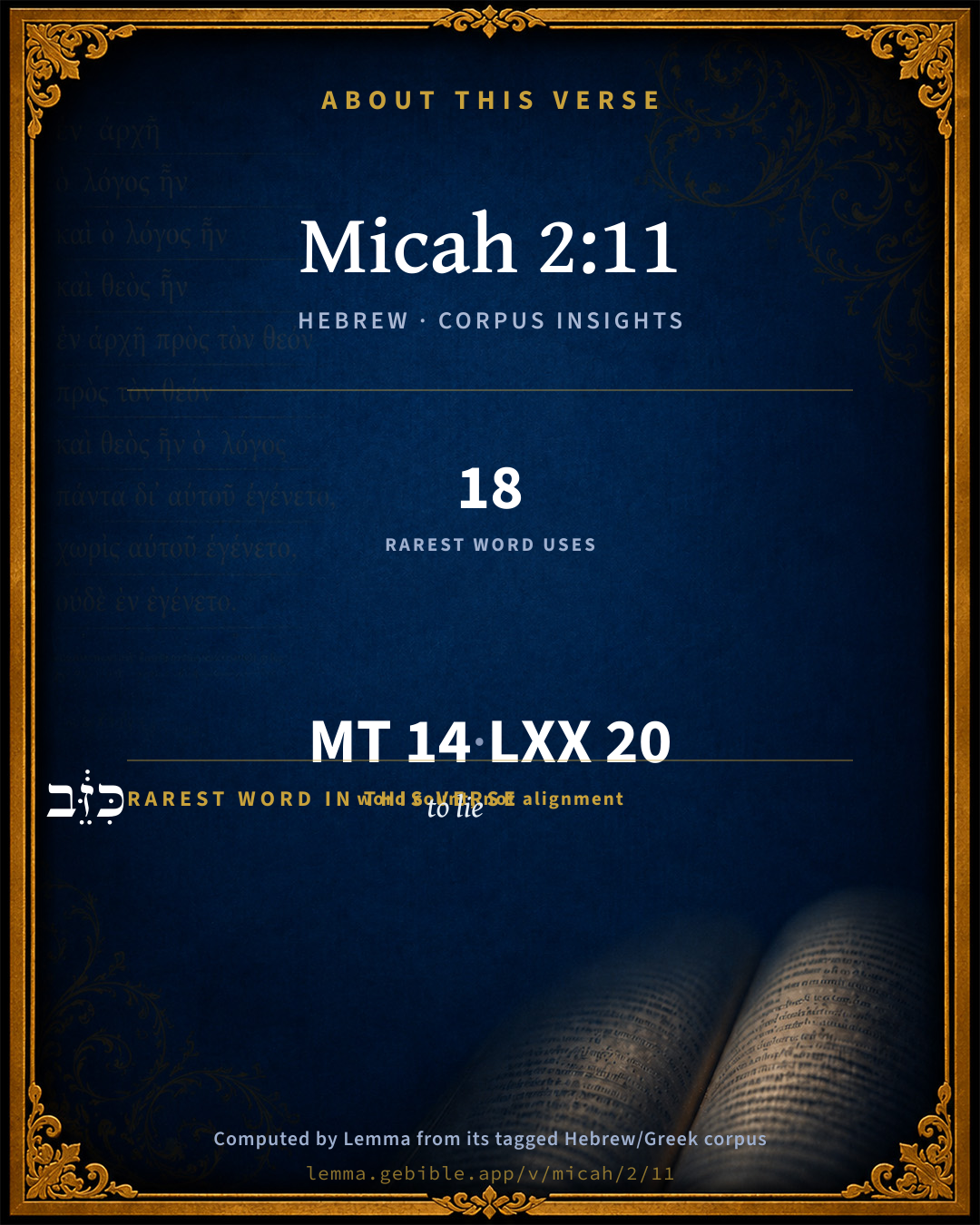
These counts appear in no published source. They are computed here, from the morphology-tagged text and Lemma’s own curated glosses. What Lemma adds →

14
words
12
distinct lemmas
Prophets
section

Notable vocabulary

The rarest word here is כִּזֵּ֔ב to lie H3576 — appearing just 18 times in the whole Hebrew Bible.

Shared distinctive vocabulary

כִּזֵּ֔ב to lie H3576 occurs in 18 verses of the Hebrew Bible. Also found in:

Grammatical profile

  • 5 verbs
  • 6 nouns
  • 1 pronoun
  • 1 preposition
  • 1 conjunction

Verb forms

  • הֹלֵ֥ךְ Qal · Participle Active
  • כִּזֵּ֔ב Piel · Perfect
  • אַטִּ֣ף Hiphil · Imperfect
  • וְהָיָ֥ה Qal · Sequential Perfect
  • מַטִּ֖יף Hiphil · Participle Active

Repetition

A word recurs within this verse — often emphatic in Hebrew:

  • אַטִּ֣ף to prophesy H5197 ×2

Hebrew & Septuagint length

In English translation the verse runs 29 words from the Hebrew and 36 from the Septuagint (LXX English) — closely comparable.

A rough comparison of the two English renderings, which tokenize alike — not a word-level alignment.

Word counts can differ between the Hebrew and the Greek without any difference in meaning — e.g. the Hebrew direct-object marker אֵת has no separate Greek word, and Greek often adds the article ὁ.

In the original languages it is 14 Hebrew tokens and 20 Greek tokens — but the two are counted differently (Hebrew bundles its prefixes and suffixes into one token; the Greek is in lemma form), so that isn’t a like-for-like length.

Cross-references

30

Topical passages linked to Micah 2:11 in the Treasury of Scripture Knowledge — connected by theme and wording, ordered by reader-vote popularity; previews shown in the World English Bible.

  • Jeremiah 5:31 the prophets prophesy falsely, and the priests bear rule by their means; and my people love to have it so: and what will you do in the end of it?
  • Isaiah 30:10–11 who tell the seers, "Don't see;" and to the prophets, "Don't prophesy to us right things, speak to us smooth things, prophesy deceits,
  • 2 Corinthians 11:13–15 For such men are false apostles, deceitful workers, masquerading as Christ's apostles.
  • Jeremiah 23:17 They say continually to those who despise me, Yahweh has said, You shall have peace; and to everyone who walks in the stubbornness of his own heart they say, No evil shall come on you.
  • 1 Kings 22:6 Then the king of Israel gathered the prophets together, about four hundred men, and said to them, Shall I go against Ramoth-gilead to battle, or shall I forbear? They said, Go up; for the Lord will deliver it into the hand of the king.
  • 2 Chronicles 18:19–22 Yahweh said, Who shall entice Ahab king of Israel, that he may go up and fall at Ramoth-gilead? One spoke saying after this manner, and another saying after that manner.
  • Jeremiah 8:10–11 Therefore will I give their wives to others, and their fields to those who shall possess them: for everyone from the least even to the greatest is given to covetousness; from the prophet even to the priest every one deals falsely.
  • Jeremiah 14:14 Then Yahweh said to me, The prophets prophesy lies in my name; I didn't send them, neither have I commanded them, neither spoke I to them: they prophesy to you a lying vision, and divination, and a thing of nothing, and the deceit of their own heart.
  • Jeremiah 23:14 In the prophets of Jerusalem also I have seen a horrible thing: they commit adultery, and walk in lies; and they strengthen the hands of evil-doers, so that none does return from his wickedness: they are all of them become to me as Sodom, and the inhabitants of it as Gomorrah.
  • Jeremiah 23:25 I have heard what the prophets have said, who prophesy lies in my name, saying, I have dreamed, I have dreamed.
  • Jeremiah 23:32 Behold, I am against those who prophesy lying dreams, says Yahweh, and do tell them, and cause my people to err by their lies, and by their vain boasting: yet I didn't send them, nor commanded them; neither do they profit this people at all, says Yahweh.
  • Jeremiah 28:15 Then said the prophet Jeremiah to Hananiah the prophet, Hear now, Hananiah: Yahweh has not sent you; but you make this people to trust in a lie.
  • Romans 16:18 For those who are such don't serve our Lord, Jesus Christ, but their own belly; and by their smooth and flattering speech, they deceive the hearts of the innocent.
  • 2 Thessalonians 2:8–11 Then the lawless one will be revealed, whom the Lord will kill with the breath of his mouth, and bring to nothing by the brightness of his coming;
  • 1 John 4:1 Beloved, don't believe every spirit, but test the spirits, whether they are of God, because many false prophets have gone out into the world.
  • 1 Kings 13:18 He said to him, I also am a prophet as you are; and an angel spoke to me by the word of Yahweh, saying, Bring him back with you into your house, that he may eat bread and drink water. [But] he lied to him.
  • 1 Kings 22:21–23 There came forth a spirit, and stood before Yahweh, and said, I will entice him.
  • Isaiah 9:15 The elder and the honorable man, he is the head; and the prophet who teaches lies, he is the tail.
  • Jeremiah 6:13–14 For from the least of them even to the greatest of them everyone is given to covetousness; and from the prophet even to the priest everyone deals falsely.
  • Jeremiah 27:14–15 Don't listen to the words of the prophets who speak to you, saying, You shall not serve the king of Babylon; for they prophesy a lie to you.
  • Jeremiah 28:2–3 Thus speaks Yahweh of Hosts, the God of Israel, saying, I have broken the yoke of the king of Babylon.
  • Jeremiah 29:21–23 Thus says Yahweh of Hosts, the God of Israel, concerning Ahab the son of Kolaiah, and concerning Zedekiah the son of Maaseiah, who prophesy a lie to you in my name: Behold, I will deliver them into the hand of Nebuchadrezzar king of Babylon; and he shall kill them before your eyes;
  • Ezekiel 13:3–14 Thus says the Lord Yahweh, Woe to the foolish prophets, who follow their own spirit, and have seen nothing!
  • Ezekiel 13:22 Because with lies you have grieved the heart of the righteous, whom I have not made sad; and strengthened the hands of the wicked, that he should not return from his wicked way, and be saved alive:
  • Micah 3:5 Thus says Yahweh concerning the prophets who lead my people astray; for those who feed their teeth, they proclaim, "Peace!" and whoever doesn't provide for their mouths, they prepare war against him:
  • Micah 3:11 Her leaders judge for bribes, And her priests teach for a price, And her prophets of it tell forturnes for money: Yet they lean on Yahweh, and say, Isn't Yahweh in the midst of us? No disaster will come on us.
  • Philippians 3:19 whose end is destruction, whose god is the belly, and whose glory is in their shame, who think about earthly things.
  • 2 Peter 2:1–3 But there also arose false prophets among the people, as among you also there will be false teachers, who will secretly bring in destructive heresies, denying even the Master who bought them, bringing on themselves swift destruction.
  • 2 Peter 2:13–19 receiving the wages of unrighteousness; people who count it pleasure to revel in the day-time, spots and blemishes, reveling in their deceit while they feast with you;
  • Revelation 16:13–14 I saw coming out of the mouth of the dragon, and out of the mouth of the beast, and out of the mouth of the false prophet, three unclean spirits, something like frogs;

Cross-references courtesy of OpenBible.info (CC BY 4.0).

Hebrew and Greek witnesses Masoretic Hebrew ↔ Greek Septuagint

The same verse in the two great witnesses to the Old Testament, shown verse-for-verse.

These are two independent witnesses, not word-aligned to each other, and the Septuagint is shown in lemma (dictionary) form.

Hebrew Micah 2:11 Masoretic · Westminster Leningrad Codex

לוּ אִ֞ישׁ הֹלֵ֥ךְ ר֨וּחַ֙ וָשֶׁ֣קֶר כִּזֵּ֔ב אַטִּ֣ף לְךָ֔ לַיַּ֖יִן וְלַשֵּׁכָ֑ר וְהָיָ֥ה מַטִּ֖יף הָעָ֥ם הַזֶּֽה

If a man walking in a spirit of falsehood lies: 'I will prophesy to you of wine and of strong drink;' He would be the prophet of this people.

World English Bible · Public Domain

Greek LXX Micah 2:11 Septuagint · lemma form

καταδιώκω οὐδείς διώκω πνεῦμα ἵστημι ψεῦδος σταλάζω σύ εἰς οἶνος καί μέθυσμα καί εἰμί ἐκ ὁ σταγών ὁ λαός οὗτος

you⌃ have fled, no one pursuing you: your spirit has framed falsehood, it has dropped on you for wine and strong drink. But it shall come to pass, that out of the dropping of this people,

LXX2012 (modern English Septuagint) · Public Domain

On this verse, The Pulpit Commentary discusses the Septuagint’s reading. Read the note in Commentary ↓

Hebrew: Westminster Leningrad Codex (CC BY 4.0). Greek: Septuagint (public domain); English from LXX2012 (modern English Septuagint) (Public Domain). How the Septuagint differs from the Hebrew →

Targum (Aramaic paraphrase)

1

The Targum is the ancient Jewish Aramaic paraphrase of the Hebrew Scriptures — an interpretive translation, not the Hebrew text itself. Onkelos (literal) and Pseudo-Jonathan (expansive) render the Torah, and Jonathan the Prophets. Coverage is partial: where no permissively-licensed English translation exists for a verse, only the Aramaic is shown. This is verse-level text, not a word-by-word alignment to the Hebrew.

  1. Targum Jonathan Prophets (Joshua–Malachi)
    עַל דְטָעוּ בָּתַר נְבִיֵי שִׁקְרָא דְמִתְנַבָּן לְהוֹן רוּחַ דִי שְׁקַר וּמַלְפִין לְהוֹן לַחֲמָר וּלְרַוְיוּ וִיהֵי כְּמָא דַאֲלִיפוּ לְמִטְעֵי בָּתַר נְבִיֵי שִׁקְרָא כֵּן יִגְלוּן לְאַרְעָא שִׁקְרָא עִם דָרָא הָדֵין:

    (no public-domain English translation for this verse)

    Targum Jonathan — Aramaic: “Mikraot Gedolot” (public domain). English: “Sefaria Community Translation” (CC0 1.0 (public-domain dedication)); “London "Chaldee Paraphrase," 1871” (public domain). Text via Sefaria.

Commentary

Notes on Micah 2:11 from classic Christian and Jewish commentators (each source and its license shown beneath its notes). The classic Christian expositions comment on the surrounding passage and are grouped to its opening verse, so a note may address several verses; the Jewish commentaries on the Tanakh (Rashi and others) are per-verse, so they appear only where the commentator wrote on this verse.

Lemma curates 59 commentaries, every one of them public domain or Creative Commons licensed, each selected and text-cleaned for this edition rather than reprinted as found. About our sources →

The Cambridge Bible for Schools and Colleges

gen. ed. J. J. S. Perowne

11. If a man walking in the spirit and falsehood, &c.] Who is the popular prophet? He who walks in a spirit of falsehood (Micah’s phrase is perhaps a hendiadys), and promises material blessings of the most palpable kind (represented by ‘wine and strong drink’). It was not merely his reference to temporal goods which made such a man a ‘false prophet,’ but his assurance of the divinely ordained connexion between righteousness and prosperity. For ‘in the spirit and falsehood,’ it is simpler to render, after wind and falsehood. (Dathe thinks Mic_2:11 is misplaced, and should come after Mic_2:6.)

The Cambridge Bible for Schools and Colleges (gen. ed. J. J. S. Perowne; Cambridge University Press, 1878–1918) — public domain. Text from a community e-Sword module.

Trapp's Complete Commentary

John Trapp

Mic 2:11 If a man walking in the spirit and falsehood do lie, [saying], I will prophesy unto thee of wine and of strong drink; he shall even be the prophet of this people.

Ver. 11. If a man, walking in the spirit, &c.] Si vir ventosus, so Junius rendereth it, if a windy and false man lie, saying, &c. Let a man but feed them with vain hopes and frothy fancies; let him but make fair weather before them when the storm of God’s wrath is ready to break out upon them; let him promise them plenty of all things, and prophesy to them of wine and strong drink, as the Popish priests in Gerson’s time publicly preached to the people, that if any one would hear a mass he should not on that day be struck blind, nor die suddenly, nor want sufficient sustenance, &c. These call themselves the spirituality, or men of the Spirit (as Hosea hath it), as if all others to them were carnal, and destitute of the Spirit. They also, after the manner of those false prophets of old, take to themselves big swollen titles, and as they increase in their pretended holiness, so they proceed in their titles from Padre benedicto to Padre Angels, then Archangels, Cherubino, and lastly Serephino, which is the top of perfection. But what is all this more than a light flask, or a pillar of smoke, which the higher it mounteth the sooner it vanisheth? And what are all such vain boasters but gloriae animalia, popularis aurae mancipia vilia, animals of reknown, cheap slaves of the breeze of popularity, as Jerome calls Crates the philosopher? may it not fitly be said of them, as Hos 9:7, "The prophet is a fool, the spiritual man is mad," and as Eze 13:3. Surely these are "foolish prophets, that follow their own spirit, and have seen nothing. O Israel, thy prophets are like the foxes in the deserts," &c. "A wonderful and horrible thing is committed in the land. The prophets prophesy falsely, and the priests bear rule by their means, and my people love to have it so: and what will ye do in the end thereof?" Jer 5:31. All will be naught, no doubt. There is not a more dangerous creature than a parasitical prophet. Ezekiel calleth them the devil’s dirt daubers, Eze 13:10, his upholsterers, for they sew pillows, &c. And these are prophets for this people, fit lettuce for such lips, dignum patella operculum, a singular plague of God upon the men of this world, who deserve to be deceived; for what reason? they have desired it, and it best pleaseth their vitiated palates. Most people, having first flattered themselves, are well content to be soothed up by others; and I cannot but accord him that saith, If there were judges ordained for flattery they would have no doings, there being so very few that will complain that they are flattered.

John Trapp, A Commentary or Exposition upon All the Books of the Old and New Testament (1647–1656) — public domain. Text from a community e-Sword module.

Albert Barnes' Notes on the Bible

If a man walking in the spirit and falsehood - Literally, “in spirit” (not My Spirit) “and falsehood,” that is, in a lying spirit; such as they, whose woe Ezekiel pronounces Eze 13:3, “Woe unto the foolish prophets who walk after their own spirit and what they have not seen Eze 13:2, Eze 13:17; prophets out of their own hearts, who prophesied a vision of falsehood, and a destruction and nothingness; prophesied falsehood; yea, prophets of the deceit of their hearts.” These, like the true prophets, “walked in spirit;” as Isaiah speaks of “walking in righteousness” Isa 33:15. Their habitual converse was m a spirit, but of falsehood. If such an one do lie, saying, “I will prophesy unto thee of wine and strong drink.” Man’s conscience must needs have some plea in speaking falsely of God. The false prophets had to please the rich men, to embolden them in their self-indulgence, to tell them that God would not punish. They doubtless spoke of God’s temporal promises to His people, the land “flowing with milk and honey.” His promises of abundant harvest and vintage, and assured them, that God would not withdraw these, that He was not so precise about His law. Micah tells them in plain words, what it all came to; it was a prophesying of “wine and strong drink.”

He shall even be the prophet of this people - Literally “and shall be bedewing this people.” He uses the same words, which scorners of Israel and Judah employed in forbidding to prophesy. They said, “drop not;” forbidding God’s word as a wearisome dropping. It wore away their patience, not their hearts of stone. He tells them, who might speak to them without wearying, of whose words they would never tire, who might do habitually what they forbade to God, - one who, in the Name of God, set them at ease in their sensual indulgences. This is the secret of the success of everything opposed to God and Christ. Man wants a God. God has made it a necessity of our nature to crave after Him. Spiritual, like natural, hunger, debarred from or loathing wholesome food, must be stilled, stifled, with what will appease its gnawings. Our natural intellect longs for Him; for it cannot understand itself without Him. Our restlessness longs for Him; to rest upon.

Our helplessness longs for Him, to escape from the unbearable pressure of our unknown futurity. Our imagination craves for Him; for, being made for the Infinite, it cannot be content with the finite. Aching affections long for Him; for no creature can soothe them. Our dissatisfied conscience longs for Him, to teach it and make it one with itself. But man does not want to be responsible, nor to owe duty; still less to be liable to penalties for disobeying. The Christian, not the natural man, longs that his whole being should tend to God. The natural man wishes to be well-rid of what sets him ill at ease, not to belong to God. And the horrible subtlety of false teaching, in each age or country, is to meet its own favorite requirements, without calling for self-sacrifice or self-oblation, to give it a god such as it would have, such as might content it. : “The people willeth to be deceived, be it deceived,” is a true proverb. “Men turn away their ears from the truth” 2Ti 4:4 which they dislike; and so are turned unto fables which they like. They who “receive not the love of the truth, - believe a lie” 2Th 2:11-12. If men “will not retain God in their knowledge, God giveth them over to an undistinguishing mind” Rom 1:28. They who would not receive our Lord, coming in His Father’s Name, have ever since, as He said, “received them who came in their own” Joh 5:43. Men teach their teachers how they wish to be mistaught, and receive the echo of their wishes as the Voice of God.

Albert Barnes' Notes on the Bible (1834–1885) — public domain. Text from a community e-Sword/MySword module.

The Biblical Illustrator

Joseph S. Exell

Mic_2:11

If a man walking in the spirit and falsehood do lie,. . .he shall even be the prophet of this people

Israels popular preacher

This is Micahs idea of the kind of prophet (or, as we should say, pulpit) the men of Israel would willingly and unanimously accept.

The sketch is marked by two things which always tend to make a preacher generally acceptable to thoughtless men in every age.

I. By emptiness of mind. He has nothing in his mind but wind, vain conceits, vapid notions--no deep thought, no rich store of information, no well-digested belief or profound conviction.

II. By ministering to please. I will prophesy unto thee of wine and of strong drink. These prophets would accommodate themselves to their tastes and habits, and sanction their indulgences. They would not disturb their consciences nor strike against their prejudices, but talk to them in such a way as to leave them satisfied with themselves. (Homilist.)

The Biblical Illustrator, edited by Joseph S. Exell (c. 1880s–1900s) — public domain. Text from a community e-Sword module.

Joseph Benson's Commentary

Mic 2:11. If a man walking in the spirit and falsehood — If a man falsely pretending to have the spirit of prophecy, do lie — Speak things very false, and utter pretended predictions of events that shall never take place. Saying, I will prophesy unto thee of wine and strong drink — I will discourse to you of sensual enjoyments: or, I will give you assurance of peace, prosperity, and plenty. You shall live long, eat, drink, and be merry. He shall even be the prophet of this people — Such as they like and choose, a man perfectly to their minds. Some render the clause, I will prophesy unto thee for wine and strong drink, understanding Micah (who here speaks in his own person) as telling them, if he were one who would prophesy lies unto them, and bring them pleasing tidings, however false, for the sake of having his belly filled with wine and strong drink; that then they would extol him, and look upon him as a choice prophet; for that such a one only as spoke smooth things unto them, with whatever selfish views it was apparent he did it, was a prophet to their liking; and that, therefore, if he had been a false prophet, he should have prophesied so as to get wine and strong drink of them instead of reproaches.

Joseph Benson's Commentary on the Old and New Testaments (1811–1818) — public domain. Text from a community e-Sword module.

Whedon's Commentary on the Bible

Daniel D. Whedon

11. In Mic_2:6-7 the listeners had expressed their unwillingness to accept the kind of preaching Micah was giving them. The opposition did not silence the prophet, it only stimulated him to new efforts; he pointed out that the present demanded the message he was delivering, and reiterated the announcement of judgment. Mic_2:11 presents the close of the threat; in it the prophet gives a description of the kind of prophet the people would like to hear, one who has always a message of peace and prosperity, and who at all times heaps flattery upon the self-righteous sinners.

In the spirit and falsehood — R.V., “in a spirit of falsehood.” A.V. gives a literal rendering of the original, except that before “spirit” the definite article should not be used. But “a spirit,” standing by itself, is not equivalent to “a false spirit,” and the context makes it impossible to think of the Spirit of God. Hence it is better to follow R.V. margin and read “in wind and falsehood.” “Wind” is a picture of the vain and worthless things after which such a false prophet chases; “falsehood” has reference to the purpose for which he delivers his message; he purposes to deceive the people in order that he may serve his own personal interests.

Lie — In seeking to deliver an acceptable message, he announces peace and prosperity when the message of Jehovah is one of calamity and judgment.

Wine and… strong drink — To be understood in a wider sense of all “earthly blessings and sensual enjoyments.” This is what they like, and the prophet knows that any man who preaches such a gospel will be received with open arms.

Return of a purified remnant, 12, 13.

Daniel D. Whedon (gen. ed.), Commentary on the Old and New Testaments (1874–1909) — public domain. Text from a community e-Sword module.

The Preacher's Complete Homiletical Commentary

Joseph S. Exell (gen. ed.)

CRITICAL NOTES.]

Mic_2:11. Spirit] Lit. walk in the wind, sig. what is vain or worthless (Isa_26:18; Isa_41:29); some, “the man of spirit, i.e. claiming inspiration.” Prophesy] Soothe you in gluttony and drunkenness; he would be listened to because he flattered you.

Mic_2:12.] A sudden transition from judgment to joy. The remnant of Israel after sifting shall be gathered together, multiplied, and governed by Jehovah as their king. Bozrah] Rich in pastures and flocks.

Mic_2:13. Breaker] “A traditional Messianic expression,” will break a way for them in every hindrance and enemy. Cyrus delivering from Babylon is an eminent type of Christ redeeming from sin. Gate] of the city of captivity. Before] them, as in going up out of Egypt (Exo_13:21; Deu_1:30; Deu_1:33), to lead the way. “The fulfilment of this prophecy commenced with the gathering together of Israel to its God and King by the preaching of the Gospel, and will be completed at some future time when the Lord shall redeem Israel, which is now pining in dispersion, out of the fetters of its unbelief and life of sin” [Keil].

HOMILETICS

THE MINISTRY OF FALSE TEACHERS.—Mic_2:11

Predictions of judgment were unwelcome to corrupt men. They opposed the true, but would listen to false prophets who flattered them in sin and declared lies. The ministry of such is here described.

I. It is lying in its nature. Falsehood and lies. It misrepresents God and his Word, the gospel and its claims. It is not purity, light, and power, but false and misleading. It ignores or sacrifices truth, and springs not from the Spirit of God, but the spirit of man. They pretend inspiration, but walk in delusion and believe a lie. “Woe unto the foolish prophets that follow their own spirit and have seen nothing.”

II. It is sensual in its purpose. Its great design is to minister to the sensual enjoyments of the people. “I will prophesy unto thee of wine and of strong drink.” The false prophets pleased the rich and emboldened the self-indulgence of all by promising abundant harvests and rich vintage. The promises of God are often emphasized, but the conditions of those promises are forgotten. Congregations are assured that without exception and without penitence they will be free from judgment and sure of salvation. False teachers pander to vitiated tastes, sanction sinful customs, and disturb not the consciences of the people. But true ministers strike the prejudices, condemn the carnal gratifications, and seek to save the souls of men. They handle not the Word of God deceitfully, but by manifestation of the truth commend themselves to every man’s conscience in the sight of God.

III. It is pleasing to the people in its method. Unwelcome truths would not be heard, but a prophet of lies would be popular. “He shall even be the prophet of this people.” Spiritual appetites crave for food, conscience is dissatisfied, and the heart restless. Men want rest and God. If any come in God’s name to set them at ease in sensual pleasures, him will they receive with joy (Jer_5:31). All they desire is freedom from reproof and licence to sin. “They teach their teachers how they wish to be mistaught,” says a writer, “and receive the echo of their wishes as the voice of God.” “The prophets prophesy falsely, and the priests bear rule by their means; and my people love to have it so; and what will ye do in the end thereof?”

IV. It is disappointing in its results. It is “walking in the spirit,” or “walking with the wind,” as the margin gives.

1. There is no nutriment for the soul. It is a ministry empty and unsubstantial as the wind, mixed with error and falsehood, not “sound speech that cannot be condemned.”

2. There is no efficacy in the word. It is not truth spoken in tenderness, love, and concern for the hearers. None are enlightened in mind, quickened in conscience, and converted from sin. The words are mere echoes of the wind, devoid of results in heart and life, barren to God and man. “Ephraim feedeth on wind, and followeth after the east wind; he daily increaseth lies and desolation.”

THE GLORIOUS FUTURE OF ISRAEL.—Mic_2:12-13

There is now a sudden transition from threatening to promise. Mercy is the end of all punishment to the penitent. A remnant shall be delivered and gathered together, increased and governed by Jehovah their Shepherd and King.

I. Israel shall be delivered. The captivity threatened will come; but, as of old, they shall be delivered from it. Babylon, no more than Egypt, can detain them in slavery. Iron gates and massive walls will give way before the Breaker’s power. An entrance will be made into the city. The Conqueror will go in, and the captives go out through it into liberty and joy. The prison shall open and set them free. This deliverance from earthly Babylon is a type and pledge of redemption from spiritual bondage, by Christ Jesus. Men are bound in ignorance, prejudice, and sin. Christ gives light and redemption to the soul, and opens the prison to them that are bound. “He redeemed them from the hand of the enemy.”

II. Israel shall be united again. “I will surely assemble Jacob.” They shall be gathered together in tenderness and care, in families and social privileges. God will bring his people from the greatest distance, and gather them into his fold. Public calamities and vicissitudes of fortunes hide not his face nor obliterate his covenant. Under the law believers could foresee, and under the gospel we may enjoy, this promise.

1. This gathering is certain. I will surely gather.

2. It is constant. The repetition indicates the progressive and persistent nature of the work.

3. It is extensive. Though God’s people are a remnant, yet all shall be gathered, and not one forgotten. “All of thee.”

III. Israel shall be increased. Not a small number, but “the multitude of men.” God can turn remnants into multitudes, and multiply his people as a flock. In the Church it shall be said, “The place is too strait for me: give place to me that I may dwell,” &c. (Isa_49:20). At last angels will gather the elect from the four winds into that “great multitude which no man could number, of all nations, and people, and tongues.”

IV. Israel shall be defended. They will not be united and left to themselves or to others. God will possess them and rule them by his love.

1. They will be secured as a flock. “As the flock in the midst of the fold,” in perfect peace and safety.

2. They will be guided as a people. “Their king shall pass before them.” As in olden time, his presence shall go with them and make an easy passage through death and the grave to eternal life.

3. They will be governed as a nation. “The Lord on (at) the head of them.” As a captain and conqueror to lead and rule them; to overcome all opposition, to “break in pieces the gates of brass, and cut in sunder the bars of iron.”

HOMILETIC HINTS AND SUGGESTIONS

The Breaker. Notice—

1. The object in view. To set free.

2. The opposition to God’s work.

3. The destruction of this opposition. Complete and utter ruin—Breaker.

The words present Christ as—

1. The Redeemer.

2. The Guide.

3. The Defender of his people. “A magnificent transition from Cyrus to Christ, as in Isa_40:1-5. The Prophet sees the conqueror Cyrus breaking into Babylon, smiting asunder the bars which kept Israel captive, as in a prison; and how they went forth, after the issuing of his decree, in joy and triumph to their own land. And from this prophetical view of Cyrus and his victory, and its blessed consequences, he passes on by a rapid prophetic flight to speak of the Divine Cyrus, Jesus Christ, and of his triumph over death and the grave [Wordsworth]. There is no passing on, nor going forth, without Christ our King, who is both King and Lord [Jerome].

Broken up. “The three verbs—they break through, they march through, they go out—describe in a pictorial manner progress which cannot be stopped by any human power [Hengstenberg].

ILLUSTRATIONS TO CHAPTER 2

Mic_2:11. The horrible subtlety of false teaching in each age or country is to meet its own favourite requirements, without calling for self-sacrifice or self-oblation, to give it a god, such as it would have, such as might content it. “The people willeth to be deceived, be it deceived,” is a true proverb [Pusey].

Mic_2:12-13. As the flock. Now the sheep are scattered in all lands; but the shepherd shall search them out and bring them into the fold, where they shall be (a) constantly supplied, and (b) eternally safe from beasts of prey. Breaker. The image is not of conquest, but deliverance. They break through, not to enter in, but to pass through the gate, and go forth. The wall of the city is ordinarily broken through in order to make an entrance, or to secure to a conqueror the power of entering in at any time, or by age and decay. But here the object is expressed to go forth. Plainly they were confined before, as in a prison; and the gate of the prison was burst open to set them free (Cf. Isa_43:6; Isa_48:20; Isa_52:11-12 [Pusey].

The Preacher's Complete Homiletical Commentary (gen. ed. Joseph S. Exell; Funk & Wagnalls, c. 1892) — public domain (pre-1929). A full-Bible homiletical/sermon-outline anthology covering 65 of 66 books (2 John is absent from the source module). Text from a community e-Sword module.

Tyndale Open Study Notes

Tyndale Open Resources

2:11 a prophet full of lies: These evil people loved to hear deceptions from their favorite good-time prophets (cp. Jer 28:8-9). False prophets proclaimed assurance that Israel and Judah could escape from judgment. When judgment came, they had no comfort to give.

Tyndale Open Study Notes — © Tyndale Open Resources, licensed CC BY-SA 4.0. Text via the HelloAO Bible API.

Geneva Bible (1599)

Geneva Bible translators

He showeth what prophets they delight in, that is, in flatterers, which tell them pleasant tales, and speak of their commodities.

That is, show himself to be a Prophet.

Geneva Bible (1599) marginal notes — public domain. Text via Bolls.life.

Jamieson, Fausset & Brown

Robert Jamieson, A. R. Fausset & David Brown

walking in the spirit--The Hebrew means also "wind." "If a man professing to have the 'spirit' of inspiration (Eze 13:3; so 'man of the spirit,' that is, one claiming inspiration, Hos 9:7), but really walking in 'wind' (prophecy void of nutriment for the soul, and unsubstantial as the wind) and falsehood, do lie, saying (that which ye like to hear), I will prophesy," &c., even such a one, however false his prophecies, since he flatters your wishes, shall be your prophet (compare Mic 2:6; Jer 5:31).

prophesy . . . of wine--that is, of an abundant supply of wine.

Jamieson, Fausset & Brown — Commentary Critical and Explanatory on the Whole Bible (1871) — public domain (CC PDM 1.0). Text via the HelloAO Bible API.

Adam Clarke's Commentary

Verse 11. If a man walking in the spirit and falsehood] The meaning is: If a man who professes to be Divinely inspired do lie, by prophesying of plenty, &c., then such a person shall be received as a true prophet by this people. It not unfrequently happens that the Christless worldling, who has got into the priest's office for a maintenance, and who leaves the people undisturbed in their unregenerate state, is better received than the faithful pastor, who proclaims the justice of the Lord, and the necessity of repentance and forsaking sin, in order to their being made partakers of that holiness without which no man shall see God.

Adam Clarke's Commentary on the Bible (1810–1826) — public domain. Text from a community e-Sword/MySword module.

John Calvin's Commentaries

The Prophet points out here another vice by which the people were infected — that they wished to be soothed with flatteries: for all the ungodly think that they are in a manner exempt from God’s judgment, when they hear no reproof; yea they think themselves happy, when they get flatterers, who are indulgent to their vices. This is now the disease which the Prophet discovers as prevailing among the people. Jerome sought out a meaning quite different here, as in the former verses; but I will not stop to refute him, for it is enough to give the real meaning of the Prophet. But as before he rendered women, princes, and thus perverted entirely the meaning, so he says here, I would I were a vain Prophet, that is, walking in vanity, and mendacious; as though Micah said “I wish I were false in denouncing on you the calamities of which I speak; for I would rather announce to you something joyful and favorable: but I cannot do this, for the Lord commands what is different.” But there is nothing of this kind in the words of the Prophet. Let us then return to the text.

If a man walks in the spirit, and deceitfully lies, etc. Almost all interpreters agree in this, — that to walk in the spirit, is to announce any thing proudly and presumptuously; and they take spirit for wind or for deceits. But I doubt not, but that to walk in the spirit was then a common mode of speaking, to set forth the exercise of the prophetic office. When therefore any one was a Prophet, or one who discharged that office, or sustained the character of a teacher, he professed himself to have been sent from above. The Prophets were indeed formerly called the men of the spirit, and for this reason, because they adduced nothing from themselves or from their own heads; but only delivered faithfully, as from hand to hand, what they had received from God. To walk in the spirit then means, in my view, the same thing as to profess the office of a teacher. When therefore any one professed the office of a teacher, what was he to do? “If I,” says Micah, “being endued with the Spirit, and called to teach, wished to ingratiate myself with you, and preached that there would be an abundant increase of wine and strong drink, all would applaud me; for if any one promises these things, he becomes the prophet of this people.”

In short, Micah intimates that the Israelites rejected all sound doctrine, for they sought nothing but flatteries, and wished to be cherished in their vices; yea, they desired to be deceived by false adulation to their own ruin. It hence appears that they were not the people they wished to be deemed, that is, the people of God: for the first condition in God’s covenant was, — that he should rule among his people. Inasmuch then as these men would not endure to be governed by Divine power, and wished to have full and unbridled liberty, it was the same as though they had banished God far from them. Hence, by this proof, the Prophet shows that they had wholly departed from God, and had no intercourse with him. If there be then any man walking in the spirit, let him, he says, keep far from the truth; for he will not otherwise be borne by this people. — How so? Because they will not have honest and faithful teachers. What is then to be done? Let flatterers come, and promise them plenty of wine and strong drink, and they will be their best teachers, and be received with great applause: in short, the suitable teachers of that people were the ungodly; the people could no longer bear the true Prophets; their desire was to have flatterers who were indulgent to all their corruptions.

John Calvin's Commentaries (1540-1563) — public domain. Text from the Calvin Translation Society English edition (1840s-50s) via the Christian Classics Ethereal Library (ccel.org). Calvin's coverage is partial (roughly two-thirds of the Bible); uncommented books and verses are honest gaps, never fabricated. The 19th-century editor's footnotes and remarks are omitted so the notes are faithfully Calvin's own voice.

Ellicott's Commentary for English Readers

(11) If a man walking in the spirit and falsehood—i.e., in a lying spirit, speaking smooth and pleasant things, such as the people loved to hear, after the fashion of Zedekiah, the son of Chenaanah—he will be a fit prophet for this people. So also Jeremiah spake: “The prophets prophesy falsely. . . . and my people love to have it so; and what will ye do in the end thereof?” (Jer_5:31).

A Bible Commentary for English Readers, edited by Charles John Ellicott (1878–1897) — public domain. Text from a community e-Sword module.

John Gill's Exposition

If a man walking in the spirit and falsehood do lie,.... Who pretends to be a prophet, and a spiritual man, and to be under the inspiration and influence of the Spirit of God, but utters nothing but lies and falsehoods; or who is actuated by a spirit of falsehood and lying; or, as in the margin, "walks with the wind, and lies falsely" (u); is full of wind and vanity; "after the wind" (w); and follows the dictates of his vain mind, and coins lies, and speaks false things:

saying, I will prophesy unto thee of wine and of strong drink; or "drop a word unto thee" (x); that there will be good times, and nothing but good eating and drinking; and that men need not fear such dismal things befalling them as the prophets of the Lord spoke of; but may be cheerful and merry, and drink wine and strong drink, and not be afraid of their evil tidings: or, for wine and strong drink (y), so Kimchi; and the meaning is, that if they would give him a cup of wine, or a draught of strong drink, he would prophesy good things to them; the reverse of what is before said, as that they should continue in their land, and not depart from it; that this should be their rest, and they should remain therein, and not be destroyed in it, or cast out of it:

he shall even be the prophet of this people; a "dropper" (z) to them; see Mic 2:6; such an one shall be acceptable to them; they will caress him, and prefer him to the true prophets of the Lord; which is mentioned to show the temper of the people, and how easily they were imposed upon, and their disrespect to the prophets of the Lord, as in Mic 2:6; to which subject the prophet here returns, as Kimchi observes.

(u) "qui ambulat cum vento et falsitate mentiatur", Piscator; "ambulantem cum vento et fasitate mendacem", Cocceius. (w) So Hillerus in Burkius. (x) "stillabo tibi", Pagninus, Montanus, Junius & Tremellius, Piscator, Burkius. (y) "pro vino", Pagninus, Montanus, Junius & Tremellius, Piscator, Drusius. (z) "stillator", Junius & Tremellius, Piscator, Drusius, Cocceius.

John Gill's Exposition of the Whole Bible (1746–1763) — public domain (CC PDM 1.0). Text via the HelloAO Bible API.

Haydock's Catholic Bible Commentary

Would God, &c. The prophet could have wished, out of his love to his people, that he might be deceived in denouncing to them these evils that were to fall upon them: but by conforming himself to the will of God, he declares to them that he is sent to prophesy, literally to let drop upon them, the wine of God’s indignation, with which they should be made drunk; that is, stupified and cast down. (Challoner) --- Protestants, "If a man, walking in the spirit of falsehood, do lie, saying, I will prophesy unto thee of wine and strong drink, he shall even be a prophet of this people." But I cannot thus deceive you. (Haydock)

George Leo Haydock (1774–1849), Haydock's Catholic Family Bible and Commentary, 1859 edition — public domain. Excludes Psalms (Douay-Rheims chapter numbering differs from Protestant) and Deuterocanonical books (Catholic canon only).

Matthew Poole's English Annotations

This people were weary of true’ prophets, and silenced them, Mic 2:6, but they were fondly taken with the false prophets, and what these promised them; and these, as here described, are by a dreadful judgment on this people permitted, or left to deceive them.

If a man walking in the Spirit and falsehood; a prophet that pretends to walk in the Spirit, i.e. to have the Spirit of prophecy, and on that pretence takes the boldness to promise pleasing things in God’s name, whereas he never received such promises of good from God.

Do lie, against God, and to the people.

I will prophesy unto thee of wine and of strong drink: Micah, and his real-contented brethren, foretell scarcity, war, dismal calamities, and an Assyrian captivity of all for ever; I tell you these are idle dreams, you shall have plenty, and good days, and may eat, drink, and be merry; such times of evil you shall never see.

He shall even be the prophet, by a just and dreadful judgment from God, as well as by an unhappy and fatal choice of the people, 1Ki 22:6,10-12, with 1Ki 22:34; Eze 13:3,10.

Of this people; doomed to unparalleled misery by God for their sins, and pulling it upon themselves by their obstinate impenitence and blindness.

Matthew Poole's English Annotations on the Holy Bible (1683–1685) — public domain. Text from a community e-Sword/MySword module.

The Pulpit Commentary

Such prophets as speak unwelcome truths are not popular with the grandees; they like only these who pander to their vices and prophesy lies. This was their crowning sin. If a man walking in the spirit and falsehood do lie. "The spirit and falsehood" may be a hendiadys for "a spirit of falsehood," or "a lying spirit," as 1Ki_22:22. (comp. Eze_13:2, Eze_13:3, Eze_13:17) But it is better to render, If a man walking after (conversant with) the wind and falsehood do lie. Wind is symbolical of all that is vain and worthless, as Isa_26:18 Isa_41:29. The Septuagint introduces a gloss from Lev_26:17, Katediwcyhte oudenokontov , "Ye fled, no one pursuing you," and translates the above clause, pneuma esthse qeudov : "spiritus statuit mendacium, i.e. finem posuit mendacii" (St. Jerome); Vulgate, Utinam non essem vir habens spiritum et mendacium potius loquerer. I will prophesy unto thee, etc. These are the words of a false prophet, "Prophesy," "drop," as ver. 6. Of vine and of strong drink. Concerning temporal blessings, dwelling on God"s promises of material prosperity (Lev_26:4, etc.; Deu_28:4, Deu_28:11) in order to encourage the grandees in self-indulgence. He shall even be the prophet of this people. Such a one is the only prophet to whom the great men, the representatives of "this people," will listen.

Israel"s popular preacher.

"If a man walking in the spirit and falsehood do lie, saying, I will prophesy unto thee of wine and of strong drink; he shall even be the prophet of this people" Henderson"s translation of this verse is worth quoting: "If any one conservant with mind and falsehood lie, saying, I will prophesy to thee of wine and strong drink, even he shall be the prophet of this people." This is Micah"s idea as to the kind of prophet, or, as we should say, pulpit, the men of Israel would willingly and unanimously accept. Now, if we look a little into the sketch here of this popular preacher, we shall find that he was marked by two things which always tend to make a preacher generally acceptable to thoughtless men in every age.

I BY EMPTINESS OF MIND. "If a man walking in the spirit and falsehood do lie," or, as in the margin, "walk with the wind, and lie falsely." He has nothing in his mind but wind, vain conceits, vapid notions; no deep thought, no rich store of information, no well digested belief or profound conviction. He walks with the wind. His movements are the swellings of wind, his voice the echoes of wind. Now, the kind of preacher that the Israelites desired is the kind of preacher that is in general request almost everywhere. What thoughtful man of any extensive acquaintance with the religious world does not know that, as a rule, the less brain, intelligence, conviction, a preacher has if he possesses the gift of passion, voice, and utterance the more attractive he will be to the people in general? He is the man who attracts the crowd. The causes of this are obvious. The more empty a man is, the more fluent he is. The pauses in speech necessitated by thoughtfulness are never pleasing to the thoughtless; they like the rattling flow. The empty mind has generally a glib tongue. Again, the more empty a man is, the more dogmatic. The thoughtful man can only suggest and hint, and cautiously and reverentially submit his doctrines. For, as a thinker, he has touched difficulties and mysteries at every point; he can only speak with modesty. This, to the people, is more or less distasteful; they want dogmatism, positiveness, assurance, amounting to audacity. This the empty man can give. The more empty a man is, the more somnific. The people do not like mental effort in their pews; what they want is gentle titillation and spiritual dreaminess. This the empty man can and does supply.

II BY MINISTERING TO PLEASE. "I will prophesy unto thee of wine and of strong drink." These prophets would accommodate themselves to their hearers" tastes and habits, and sanction their indulgences. They would not disturb their consciences nor strike against their prejudices, but talk to them in such a way as to leave them satisfied with themselves. The preacher who can do this, who can enunciate his discourses in such a way as to avoid interference with the tastes, habits, and pleasures of the people, will always be popular. Oh, it is sad to think of the thousands of sermons that are preached every year by our clergy and our ministers which interfere in no measure with the sinful delights of the people, which leave them in the full indulgence of their wine, strong drink, and other carnal gratifications!

CONCLUSION. Such a preacher as this popular preacher is, for many reasons, the greatest curse to his race. I see but little hope for the progress of Christianity or for the spiritual reformation of mankind, until the pulpits of Christendom are closed forever against such men. Oh, haste the time when none shall assume the solemn office of preacher but those who, by the manifestation of the truth, "commend themselves to every man"s conscience in the sight of God"! (2Co_4:2)

"I venerate the man whose heart is true, Whose hands are pure, whose doctrine and whose life, Coincident, exhibit lucid proof That he is honest in the sacred cause To such I render more than mere respect, Whose actions say that they respect themselves. (Cowper.) D.T.

The Pulpit Commentary (1880–1919), ed. H.D.M. Spence-Jones & Joseph S. Exell — public domain. Text from a community e-Sword module.

John Wesley's Explanatory Notes

Walking - If a man pretend to have the spirit of prophesy. Saying - You shall have plenty of days, and may eat, drink, and be merry. He shall even be the prophet - Such they like and chuse.

John Wesley, Explanatory Notes Upon the Whole Bible (1754–1765) — public domain. Text via the GEBible commentary corpus.

Rashi

Rabbi Shlomo Yitzchaki (Rashi)

If a man walking in wind—If they (the people) would find a man walking in wind, a false man prophesying to them that they become drunk with wine and strong drink, he would be an acceptable prophet to this people.

Rashi on the Tanakh — English translations: “The Judaica Press complete Tanach with Rashi, translated by A. J. Rosenberg” (CC BY 4.0); “Pentateuch with Rashi's commentary by M. Rosenbaum and A.M. Silbermann, 1929-1934” (public domain); “The Metsudah Tanach series, Lakewood, N.J” (CC BY 4.0); and “The Book of Joshua, Metsudah Publications, 1997” (CC BY 4.0). Text via Sefaria.

Lesson kit

Teaching starters — assembled from the data on this page, not authored interpretation. Every prompt links to the verse data it draws on. Edit before teaching.

Micah, in the Prophets, opens this verse with 14 words (12 distinct Hebrew lemmas). Its most distinctive word is kâzab (“to lie”). A historical commentator’s framing appears above. Read the whole chapter for the surrounding context.

Discussion questions

  1. What does “to lie” (kâzab) contribute to the verse as a whole?
  2. Numbers 23:19 shares the word «to lie» with this verse. How do the two illuminate each other?
  3. “to prophesy” occurs 2× in this one verse. What is the effect of the repetition?
  4. The translations on this page render this verse differently — a whole-verse word diff, not a word-by-word alignment. What might account for the different wordings?
  5. The verb «הֹלֵ֥ךְ» is Qal Participle Active. How does its form color the action?
  6. Reading how The Cambridge Bible for Schools and Colleges and Trapp's Complete Commentary read this verse, where do the two commentators agree and where do they part?

Things to notice

Reading settings

Reading text

Shown beneath each verse's original-language words.

Old Testament
Old Testament edition

Read the OT as the Masoretic Hebrew (MT) or the Greek Septuagint (LXX).

English shown for the Greek Septuagint (in the Hebrew ↔ Greek comparison).

Comparing translations? Open the Compare panel on any verse page to stack up to four side by side.