Isaiah 57:4

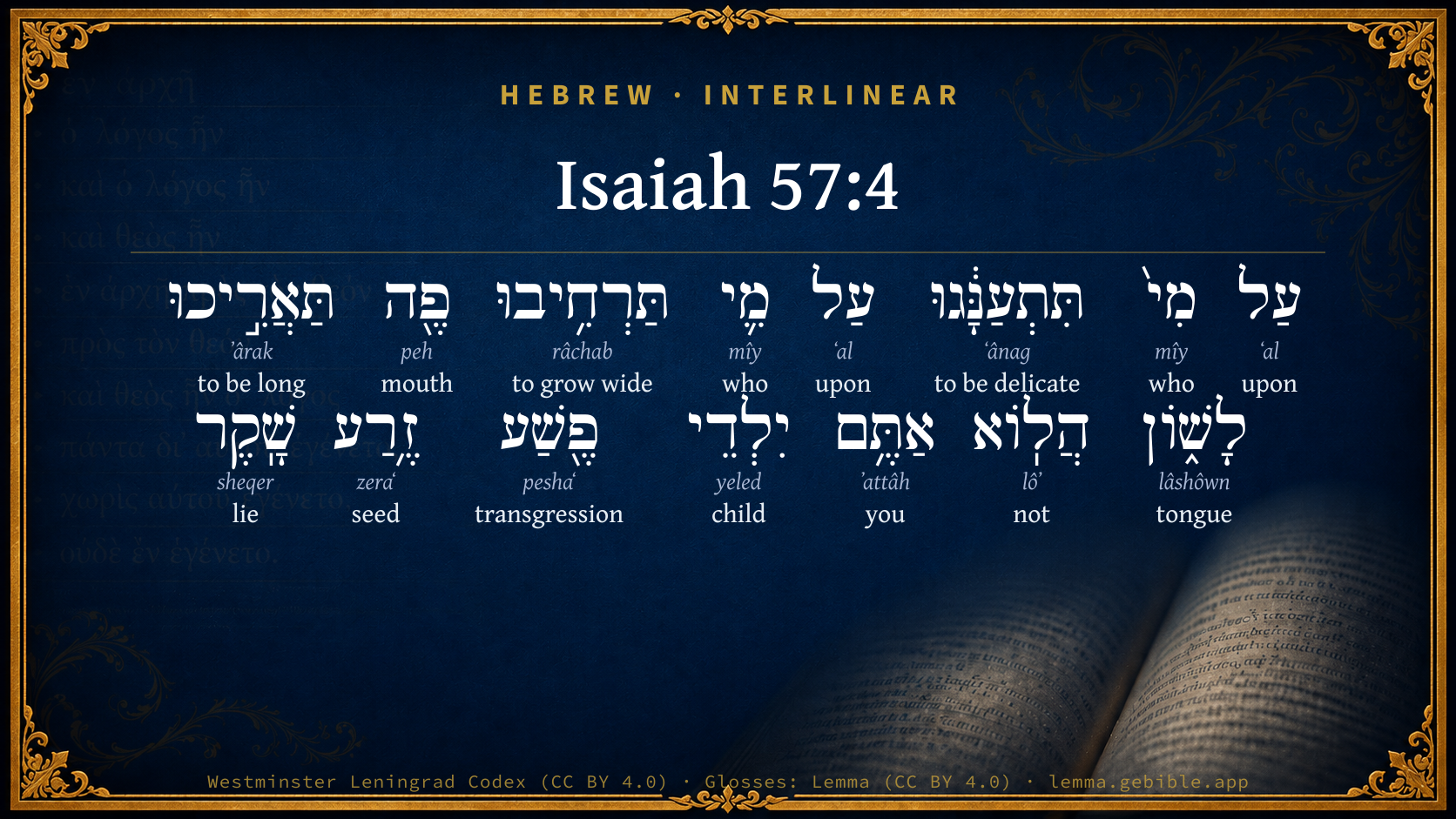
Hebrew (Westminster Leningrad Codex) Isaiah 57:4 appears in the Hebrew Old Testament. The text above is from the Westminster Leningrad Codex. Each word links to its Strong’s number, a concise gloss, and parsing drawn from the Open Scriptures Hebrew Bible morphology. Click any word for its full Brown-Driver-Briggs (BDB) entry.
Download image
Cite this verse

Isaiah 57:4 (World English Bible). Public Domain. Lemma interlinear Bible study tool, https://lemma.gebible.app/v/isaiah/57/4.

Show BibTeX & RIS
BibTeX
RIS
English Translation
Against whom do you sport yourselves? against whom make you a wide mouth, and put out the tongue? Aren't you children of disobedience, a seed of falsehood,
World English Bible · Public Domain
Download a study sheet

One document with this verse’s original text, its word-by-word gloss line, the meaning frame, cross-references with their text, attributed commentary, and full source and license credits — printable, and it pastes into notes with its structure intact.

This verse Autodidact and up

Study sheet (.html) Plain text (.txt)

A passage Seminary Student

Up to 50 verses in one chapter. A passage sheet keeps up to 6 commentary sources and 12 cross-references per verse, in the order this page ranks them, and says so on the sheet whenever that leaves anything out. Ask for a single verse and you get the Autodidact verse sheet above.

Everything on this page stays free to read, with no account — the sheet is a download of what is already on screen, not access to it.

Want to remove ads? Support Godless Engineer
Compare translations 3

The same verse in 3 English versions, stacked beneath the original-language interlinear above. Click any original word for its lexicon entry.

Each is an independent rendering of the whole verse — the interlinear is not word-aligned to these translations.

Highlighted words mark where these versions differ — a whole-verse word diff, not a word-by-word alignment.

  • World English Bible Public Domain
    Against whom do you sport yourselves? against whom make you a wide mouth, and put out the tongue? Aren't you children of disobedience, a seed of falsehood,
  • King James Version Public Domain
    Against whom do ye sport yourselves? against whom make ye a wide mouth, and draw out the tongue? are ye not children of transgression, a seed of falsehood.
  • unfoldingWord Literal Text CC BY-SA 4.0
    Against whom do you delight yourselves? Against whom do you make wide the mouth, do you make long the tongue? you not children of transgression, seed of falsehood,

unfoldingWord Literal Text — © unfoldingWord, licensed CC BY-SA 4.0. Word-aligned USFM3 via Door43 (git.door43.org/unfoldingWord/en_ult).

Versions to compare (up to 4)

3 of 4 selected

Show all 18 translations

Every available English version of this verse, each an independent rendering of the whole verse.

  • World English Bible Public Domain
    Against whom do you sport yourselves? against whom make you a wide mouth, and put out the tongue? Aren't you children of disobedience, a seed of falsehood,
  • Berean Standard Bible Public Domain
    Whom are you mocking? At whom do you snarl and stick out your tongue? Are you not children of transgression, offspring of deceit,
  • Majority Standard Bible Public Domain
    Whom are you mocking? At whom do you sneer and stick out your tongue? Are you not children of transgression, offspring of deceit,
  • King James Version Public Domain
    Against whom do ye sport yourselves? against whom make ye a wide mouth, and draw out the tongue? are ye not children of transgression, a seed of falsehood.
  • American Standard Version (1901) Public Domain
    Against whom do ye sport yourselves? against whom make ye a wide mouth, and put out the tongue? are ye not children of transgression, a seed of falsehood,
  • Revised Version (1885) Public Domain
    Against whom do ye sport yourselves? against whom make ye a wide mouth, and draw out the tongue? are ye not children of transgression, a seed of falsehood,
  • Geneva Bible (1599) Public Domain
    On whome haue ye iested? vpon whome haue ye gaped and thrust out your tongue? are not ye rebellious children, and a false seede?
  • Douay-Rheims (1899) Public Domain
    Upon whom have you jested? upon whom have you opened your mouth wide, and put out your tongue? are not you wicked children, a false seed,
  • Young's Literal Translation Public Domain
    Against whom do ye sport yourselves? Against whom enlarge ye the mouth? Prolong ye the tongue? Are not ye children of transgression? a false seed?
  • Literal Standard Version CC BY-SA 4.0
    Against whom do you sport yourselves? Against whom do you enlarge the mouth || [And] prolong the tongue? Are you not children of transgression? A false seed?
  • Unlocked Literal Bible CC BY-SA 4.0
    Whom are you merrily mocking? Against whom are you opening the mouth and sticking out the tongue? Are you not children of rebellion, children of deceit?
  • unfoldingWord Literal Text CC BY-SA 4.0
    Against whom do you delight yourselves? Against whom do you make wide the mouth, do you make long the tongue? you not children of transgression, seed of falsehood,
  • Darby Bible Public Domain
    Against whom do ye sport yourselves? Against whom do ye make a wide mouth, [and] draw out the tongue? Are ye not children of transgression, a seed of falsehood,
  • World Messianic Bible Public Domain
    Whom do you mock? Against whom do you make a wide mouth and stick out your tongue? Aren’t you children of disobedience and offspring of falsehood,
  • Webster's Bible Public Domain
    Against whom do ye sport yourselves? against whom make ye a wide mouth, and thrust out the tongue? are ye not children of transgression, a seed of falsehood,
  • Free Bible Version CC BY-SA 4.0
    Who are you making fun of when you make sneering faces and stick out your tongues? Aren't you the children of sin and lies?
  • Bible in Basic English Public Domain
    Of whom do you make sport? against whom is your mouth open wide and your tongue put out? are you not uncontrolled children, a false seed,
  • JPS Tanakh (1917) Public Domain
    Against whom do ye sport yourselves? Against whom make ye a wide mouth, and draw out the tongue? Are ye not children of transgression, a seed of falsehood,

Literal Standard Version (2020), Covenant Press — licensed CC BY-SA 4.0. Text via the HelloAO Bible API (eBible.org). Unlocked Literal Bible (unfoldingWord) — licensed CC BY-SA 4.0. Text via the HelloAO Bible API (eBible.org). unfoldingWord Literal Text — © unfoldingWord, licensed CC BY-SA 4.0. Word-aligned USFM3 via Door43 (git.door43.org/unfoldingWord/en_ult). Free Bible Version, Dr. Jonathan Gallagher — licensed CC BY-SA 4.0. Text via the HelloAO Bible API (eBible.org).

Word by word

More ways to search: Search by grammar → Find every occurrence → Compare this word →

Practice this passage: Drill this verse → Learn its vocabulary →

תִּתְעַנָּ֔גוּ
ʻânag
H6026
“to be delicate”
Verb, Hithpael, Imperfect, 2nd Person, Masculine, Plural
Part of Speech
Verb
Stem
Hithpael
Form
Imperfect
Person
2nd Person
Gender
Masculine
Number
Plural
Full BDB Definition

Origin: a primitive root

TWOT: 1648

to be soft, be delicate, be dainty - (Pual) to be delicate - (Hithpael) - to be of dainty habit, be pampered - to be happy about, take exquisite delight - to make merry over, make sport of
  1. עַל ʻal H5921 “upon” Preposition
  2. מִי֙ mîy H4310 “who” Particle, Interrogative
  3. עַל ʻal H5921 “upon” Preposition
  4. מִ֛י mîy H4310 “who” Particle, Interrogative
  5. תַּרְחִ֥יבוּ râchab H7337 “to grow wide” Verb, Hiphil, Imperfect, 2nd Person, Masculine, Plural
  6. פֶ֖ה peh H6310 “mouth” Noun, Common, Masculine, Singular, Absolute
  7. תַּאֲרִ֣יכוּ ʼârak H748 “to be long” Verb, Hiphil, Imperfect, 2nd Person, Masculine, Plural
  8. לָשׁ֑וֹן lâshôwn H3956 “tongue” Noun, Common, Both, Singular, Absolute
  9. הֲלֽוֹא lôʼ H3808 “not” Particle, Interrogative + Particle, Negative
  10. אַתֶּ֥ם ʼattâh H859 “you” Pronoun, Personal, 2nd Person, Masculine, Plural
  11. יִלְדֵי yeled H3206 “children of” Noun, Common, Masculine, Plural, Construct
  12. פֶ֖שַׁע peshaʻ H6588 “transgression” Noun, Common, Masculine, Singular, Absolute
  13. זֶ֥רַע zeraʻ H2233 “seed of” Noun, Common, Masculine, Singular, Construct
  14. שָֽׁקֶר sheqer H8267 “lie” Noun, Common, Masculine, Singular, Absolute

About this verse

These counts appear in no published source. They are computed here, from the morphology-tagged text and Lemma’s own curated glosses. What Lemma adds →

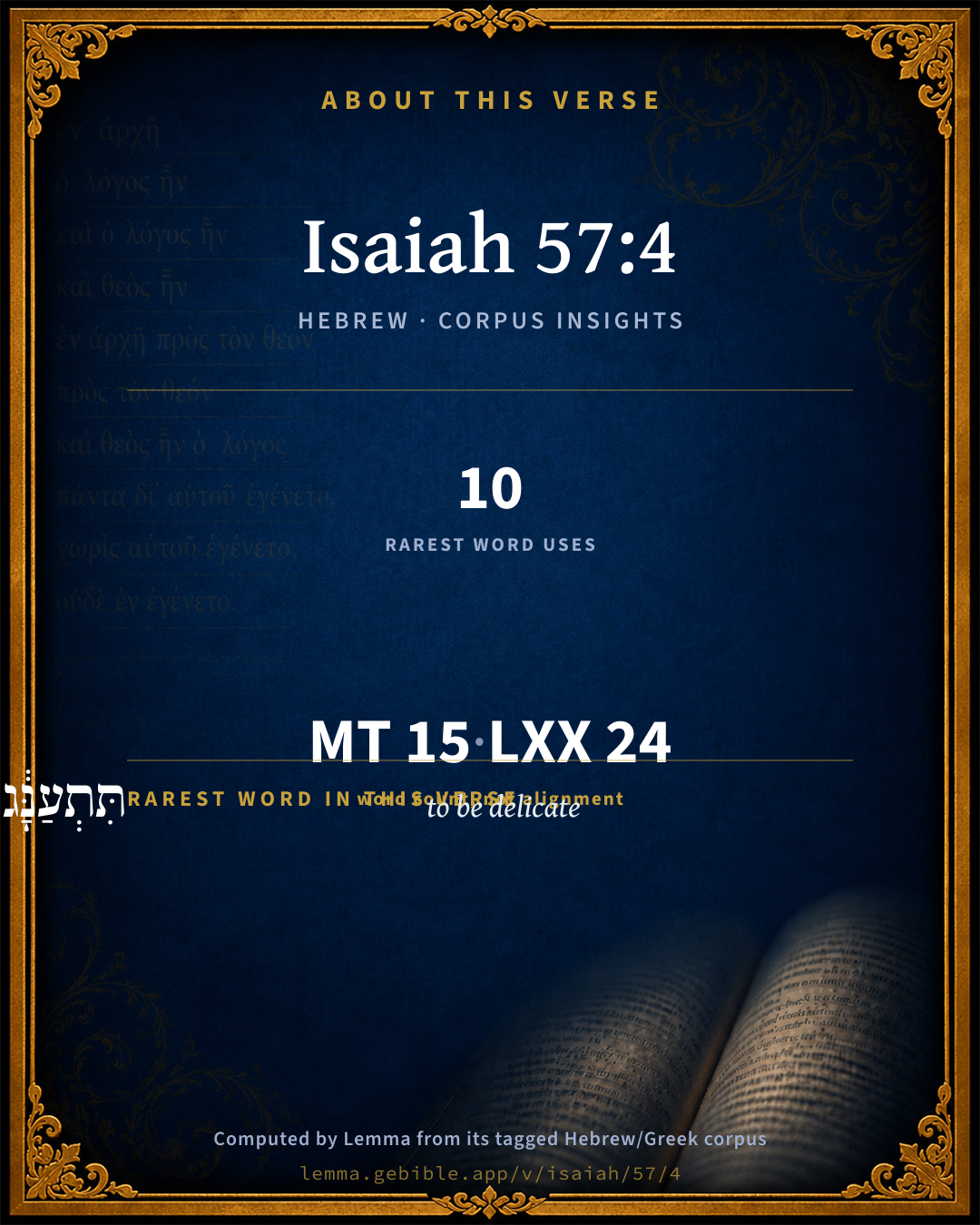
15
words
13
distinct lemmas
Prophets
section

Notable vocabulary

The rarest word here is תִּתְעַנָּ֔גוּ to be delicate H6026 — appearing just 10 times in the whole Hebrew Bible.

Shared distinctive vocabulary

תִּתְעַנָּ֔גוּ to be delicate H6026 occurs in 10 verses of the Hebrew Bible. Also found in:

Grammatical profile

  • 3 verbs
  • 6 nouns
  • 1 pronoun
  • 2 prepositions
  • 3 particles

Verb forms

  • תִּתְעַנָּ֔גוּ Hithpael · Imperfect
  • תַּרְחִ֥יבוּ Hiphil · Imperfect
  • תַּאֲרִ֣יכוּ Hiphil · Imperfect

Repetition

Words recur within this verse — often emphatic in Hebrew:

Hebrew & Septuagint length

In English translation the verse runs 27 words from the Hebrew and 30 from the Septuagint (LXX English) — closely comparable.

A rough comparison of the two English renderings, which tokenize alike — not a word-level alignment.

Word counts can differ between the Hebrew and the Greek without any difference in meaning — e.g. the Hebrew direct-object marker אֵת has no separate Greek word, and Greek often adds the article ὁ.

In the original languages it is 15 Hebrew tokens and 24 Greek tokens — but the two are counted differently (Hebrew bundles its prefixes and suffixes into one token; the Greek is in lemma form), so that isn’t a like-for-like length.

Cross-references

29

Topical passages linked to Isaiah 57:4 in the Treasury of Scripture Knowledge — connected by theme and wording, ordered by reader-vote popularity; previews shown in the World English Bible.

  • 2 Peter 2:13 receiving the wages of unrighteousness; people who count it pleasure to revel in the day-time, spots and blemishes, reveling in their deceit while they feast with you;
  • Exodus 9:17 as you still exalt yourself against my people, that you won't let them go.
  • Psalms 35:21 Yes, they opened their mouth wide against me. They said, "Aha! Aha! Our eye has seen it!"
  • Isaiah 1:4 Ah sinful nation, A people loaded with iniquity, A seed of evil-doers, Children who deal corruptly! They have forsaken Yahweh. They have despised the Holy One of Israel. They are estranged and backward.
  • Exodus 16:7–8 and in the morning, then you shall see the glory of Yahweh; because he hears your murmurings against Yahweh. Who are we, that you murmur against us?"
  • Numbers 16:11 Therefore you and all your company are gathered together against Yahweh: and Aaron, what is he who you murmur against him?
  • Joshua 10:21 that all the people returned to the camp to Joshua at Makkedah in peace: none moved his tongue against any of the children of Israel.
  • Judges 16:25–27 It happened, when their hearts were merry, that they said, Call for Samson, that he may make us sport. They called for Samson out of the prison-house; and he made sport before them. They set him between the pillars:
  • Job 16:9–10 He has torn me in his wrath, and persecuted me; He has gnashed on me with his teeth: My adversary sharpens his eyes on me.
  • Psalms 22:7 All those who see me mock me. They insult me with their lips. They shake their heads, saying,
  • Psalms 22:13 They open their mouths wide against me, Lions tearing prey and roaring.
  • Psalms 22:17 I can count all of my bones. They look and stare at me.
  • Psalms 69:12 Those who sit in the gate talk about me. I am the song of the drunkards.
  • Isaiah 10:15 Shall the axe boast itself against him who hews therewith? Shall the saw magnify itself against him who wields it? as if a rod should wield those who lift it up, [or] as if a staff should lift up [him who is] not wood.
  • Isaiah 30:1 Woe to the rebellious children, says Yahweh, who take counsel, but not of me; and who make a league, but not of my Spirit, that they may add sin to sin,
  • Isaiah 30:9 For it is a rebellious people, lying children, children who will not hear the law of Yahweh;
  • Isaiah 37:23 Whom have you defied and blasphemed? and against whom have you exalted your voice and lifted up your eyes on high? [even] against the Holy One of Israel.
  • Isaiah 37:29 Because of your raging against me, and because your arrogance is come up into my ears, therefore will I put my hook in your nose, and my bridle in your lips, and I will turn you back by the way by which you came.
  • Lamentations 2:15–16 All that pass by clap their hands at you; They hiss and wag their head at the daughter of Jerusalem, [saying], Is this the city that men called The perfection of beauty, The joy of the whole earth?
  • Ezekiel 2:4 The children are impudent and stiff-hearted: I do sent you to them; and you shall tell them, Thus says the Lord Yahweh.
  • Hosea 10:9 "Israel, you have sinned from the days of Gibeah. There they remained. The battle against the children of iniquity doesn't overtake them in Gibeah.
  • Matthew 13:38 the field is the world; and the good seed, these are the children of the Kingdom; and the darnel are the children of the evil one.
  • Matthew 27:29 They braided a crown of thorns and put it on his head, and a reed in his right hand; and they kneeled down before him, and mocked him, saying, "Hail, King of the Jews!"
  • Matthew 27:39–44 Those who passed by blasphemed him, wagging their heads,
  • Luke 10:16 Whoever listens to you listens to me, and whoever rejects you rejects me. Whoever rejects me rejects him who sent me."
  • Acts 9:4 He fell on the earth, and heard a voice saying to him, "Saul, Saul, why do you persecute me?"
  • Ephesians 2:2–3 in which you once walked according to the course of this world, according to the prince of the powers of the air, the spirit who now works in the children of disobedience;
  • Ephesians 5:6 Let no one deceive you with empty words. For because of these things, the wrath of God comes on the children of disobedience.
  • Colossians 3:6 for which things' sake the wrath of God comes on the children of disobedience.

Cross-references courtesy of OpenBible.info (CC BY 4.0).

Hebrew and Greek witnesses Masoretic Hebrew ↔ Greek Septuagint

The same verse in the two great witnesses to the Old Testament, shown verse-for-verse.

These are two independent witnesses, not word-aligned to each other, and the Septuagint is shown in lemma (dictionary) form.

Hebrew Isaiah 57:4 Masoretic · Westminster Leningrad Codex

עַל מִי֙ תִּתְעַנָּ֔גוּ עַל מִ֛י תַּרְחִ֥יבוּ פֶ֖ה תַּאֲרִ֣יכוּ לָשׁ֑וֹן הֲלֽוֹא אַתֶּ֥ם יִלְדֵי פֶ֖שַׁע זֶ֥רַע שָֽׁקֶר

Against whom do you sport yourselves? against whom make you a wide mouth, and put out the tongue? Aren't you children of disobedience, a seed of falsehood,

World English Bible · Public Domain

Greek LXX Isaiah 57:4 Septuagint · lemma form

ἐν τίς ἐντρυφάω καί ἐπί τίς ἀναοἴγω ὁ στόμα σύ καί ἐπί τίς χαλάω ὁ γλῶσσα σύ οὐ σύ εἰμί τέκνον ἀπώλεια σπέρμα ἄνομος

Wherein have you⌃ been rioting? and against whom have you⌃ opened your mouth, and against whom have you⌃ loosed your tongue? are you⌃ not children of perdition? a lawless seed?

LXX2012 (modern English Septuagint) · Public Domain

On this verse, John Gill's Exposition discusses the Septuagint’s reading. Read the note in Commentary ↓

Hebrew: Westminster Leningrad Codex (CC BY 4.0). Greek: Septuagint (public domain); English from LXX2012 (modern English Septuagint) (Public Domain). How the Septuagint differs from the Hebrew →

Targum (Aramaic paraphrase)

1

The Targum is the ancient Jewish Aramaic paraphrase of the Hebrew Scriptures — an interpretive translation, not the Hebrew text itself. Onkelos (literal) and Pseudo-Jonathan (expansive) render the Torah, and Jonathan the Prophets. Coverage is partial: where no permissively-licensed English translation exists for a verse, only the Aramaic is shown. This is verse-level text, not a word-by-word alignment to the Hebrew.

  1. Targum Jonathan Prophets (Joshua–Malachi)
    עַל מַן אַתּוּן מִתְפַּנְקִין וְקָדָם מַן תִּפְתְּחוּן פּוּמְכוֹן תִּסְגוּן לְמַלָלָא רַבְרְבָן הֲלָא אַתּוּן יַלְדֵי מְרוֹד זַרְעָא שִׁקְרָא:

    Of whom do ye make your sport? and before whom do ye open your mouth? do ye continue speaking great things? are ye not rebellious children, a lying seed?

    Targum Jonathan — Aramaic: “Mikraot Gedolot” (public domain). English: “Sefaria Community Translation” (CC0 1.0 (public-domain dedication)); “London "Chaldee Paraphrase," 1871” (public domain). Text via Sefaria.

Commentary

Notes on Isaiah 57:4 from classic Christian and Jewish commentators (each source and its license shown beneath its notes). The classic Christian expositions comment on the surrounding passage and are grouped to its opening verse, so a note may address several verses; the Jewish commentaries on the Tanakh (Rashi and others) are per-verse, so they appear only where the commentator wrote on this verse.

Lemma curates 59 commentaries, every one of them public domain or Creative Commons licensed, each selected and text-cleaned for this edition rather than reprinted as found. About our sources →

Trapp's Complete Commentary

John Trapp

Isa 57:4 Against whom do ye sport yourselves? against whom make ye a wide mouth, [and] draw out the tongue? [are] ye not children of transgression, a seed of falsehood,

Ver. 4. Against whom do ye sport yourselves?] You that are the wits, the merry Greeks of the times, that, instead of "trembling at God’s word," and humbling before him, hold it a goodly thing to gibe and jeer at it, to mock and scoff at those that preach it. {2Ch 36:16 Isa 5:18-19; Isa 22:13; Isa 28:14; Isa 28:22} These were their game stocks, and the matter of their mad mirth. Neither is it any otherwise to this day; for the world ever was, and will be still, beside itself in point of salvation. {a} Not the sinful Sodomites only, but Lot’s sons-in-law, who should have learned better, laughed him to scorn for his good counsel. {Gen 19:14} Ridetur cum suo Iehova. Lot is counted but a lob, and bid to keep his breath to cool his broth. Erasmus is blamed for his dry scoffs at Capito and other reformers; but Parsons, the Jesuit, is able to put Rabshakeh, Thersites, and Lucian himself to school for railing, deriding, and scurrilous language.

Against whom make yea wide mouth, and draw out the tongue?] By such base gestures did they show their contempt of the prophets, as they thought; but indeed, and as it was construed, of God himself. See Exo 16:8 Num 16:11 Luk 10:16 1Th 4:8. Look how unskilful hunters, shooting at wild beasts, do sometimes kill a man; so profane persons, shooting at God’s ministers, hit him. If we be served in like sort as those of old were - if we be for "signs and for wonders in Israel," as Isaiah and his fellows were {Isa 8:18} - if in mockage they imitate our language, as they did good Jeremiah’s, crying at him, "The burden of the Lord, the burden of the Lord" {Jer 23:38} - if they blow their noses at us, as they did at our Saviour, {εμυκτηριζον, Luk 16:14} taunt and reproach us, as they did Paul, {Act 17:32} set us upon a stage {b} to be laughed and hooted at, as they did those worthies of whom the world was not worthy {Heb 10:33 1Co 4:9} - let us not strange or startle at the matter, as if some new thing had befallen us; but "rejoice, and be exceeding glad; for so persecuted they the prophets that were before us" {Mat 5:12 1Pe 4:14} {See Trapp on "1Pe 4:14"}

{a} Mundus antiquum obtinet ridendo verbum Dei.

{b} Yεατριζομενοι, in theatrum producti pro spectaculo.

John Trapp, A Commentary or Exposition upon All the Books of the Old and New Testament (1647–1656) — public domain. Text from a community e-Sword module.

Tyndale Open Study Notes

Tyndale Open Resources

57:4 mock . . . sticking out your tongues: The wicked oppressed the righteous by their insults (57:1-2; see also 28:9, 14).

Tyndale Open Study Notes — © Tyndale Open Resources, licensed CC BY-SA 4.0. Text via the HelloAO Bible API.

Jamieson, Fausset & Brown

Robert Jamieson, A. R. Fausset & David Brown

sport yourselves--make a mock (Isa 66:5). Are ye aware of the glory of Him whom you mock, by mocking His servants ("the righteous," Isa 57:1)? (Ch2 36:16).

make . . . wide month-- (Psa 22:7, Psa 22:13; Psa 35:21; Lam 2:16).

children of transgression, &c.--not merely children of transgressors, and a seed of false parents, but of transgression and falsehood itself, utterly unfaithful to God.

Jamieson, Fausset & Brown — Commentary Critical and Explanatory on the Whole Bible (1871) — public domain (CC PDM 1.0). Text via the HelloAO Bible API.

Ellicott's Commentary for English Readers

(4) Against whom do ye sport yourselves?—The question, as in Isa_37:23, is one of indignant scorn, the implied answer being that the mockers were deriding the servants of Jehovah. (Comp. Wisdom 2), and, in so doing, mocking Jehovah himself. The “wide mouth,” and the “drawn-out tongue,” are the natural symbols of derision.

A Bible Commentary for English Readers, edited by Charles John Ellicott (1878–1897) — public domain. Text from a community e-Sword module.

The Cambridge Bible for Schools and Colleges

gen. ed. J. J. S. Perowne

4. On the contemptuous attitude of the Samaritans towards the Jews, see Neh_4:1-4, and comp. ch. Isa_66:5.

sport yourselves] Lit. “take your delight” (ch. Isa_55:2, Isa_58:14, Isa_66:11); only here used of malevolent satisfaction.

make a wide mouth] Psa_35:21.

are ye not &c.] Are you not yourselves the proper objects of derision and abhorrence?

5 ff. Description of the varied idolatries to which they were devoted.

Inflaming yourselves with idols] Rather, as R.V., Ye that inflame yourselves among the oaks (or “terebinths,” the same word in ch. Isa_1:29, Isa_61:3). The A.V. follows the chief ancient Versions in taking the last word to be the plural of that for “god”; but it is never used expressly of an idol or false god (not even in Exo_15:11 or Dan_11:36). The reference is, if not to the actual primitive tree-worship (traces of which are still found in Palestine), at least to that modification of it in which the sacred tree became a place of sacrifice and the scene of the licentious rites indicated by the expression “inflame yourselves.” Comp. Hos_4:13.

under every green (i.e. evergreen) tree] Cf. Deu_12:2; Jer_2:20; Jer_3:6; Eze_6:13; 1Ki_14:23; 2Ki_17:10 &c.

slaying the children (Eze_16:21)] i.e. sacrificing them either to Jehovah or some false deity (Baal or Molech). On the subject of human sacrifice in Israel consult the notes in Davidson’s Ezekiel (Camb. Bible for Schools, &c.), pp. 107 f., 143. Cf. Jer_7:31; Jer_19:5; Eze_20:25; Eze_23:39; 2Ki_3:27; 2Ki_16:3; 2Ki_21:6; Mic_6:7; Lev_18:21; Deu_12:31, &c., and 2Ki_17:31.

in the valleys (or wadis, dry watercourses) under the clifts of the rocks] Probably weird and desolate places were chosen by preference for these revolting rites, although this is the only passage where such a thing is suggested.

The Cambridge Bible for Schools and Colleges (gen. ed. J. J. S. Perowne; Cambridge University Press, 1878–1918) — public domain. Text from a community e-Sword module.

John Gill's Exposition

Against whom do ye sport yourselves?.... Is it against the ministers of the Gospel, the prophets of the Lord, the true and faithful witnesses, over whose dead bodies you triumph? know that it is not so much against them, as against the Lord himself, whose ministers, prophets, and witnesses they are; see Th1 4:8, "against whom make ye a wide mouth, and draw out the tongue?" gestures used by way of scorn and derision; see Psa 22:7. So the Papists open their mouths, and draw out their tongues, in gibes and jeers, reproaches and calumnies, against the true Christians, calling and despising them as heretics and schismatics; which abuse and ill usage of them will be resented another day. The Targum is,

"before whom do ye open your mouth, and multiply to speak things?''

as antichrist is said to have a mouth open, speaking great things and blasphemy against God, his name, his tabernacle, and them that dwell in heaven, Rev 13:5,

are ye not children of transgression; given up to all manner of sin and wickedness; or children of the wicked one, as the Targum, either of Satan, or of the man of sin; or, as the Septuagint and Arabic versions render it, "children of perdition"; of the same character, complexion, and religion, as the son of perdition is: "a seed of falsehood"; or a lie, given to lying; to believe a lie, and to speak lies in hypocrisy; professing a false religion; embracing false doctrines; a spurious breed, and not the sons of the true church of Christ.

John Gill's Exposition of the Whole Bible (1746–1763) — public domain (CC PDM 1.0). Text via the HelloAO Bible API.

Albert Barnes' Notes on the Bible

Against whom do ye sport yourselves? - The word here rendered ‘sport’ (ענג ‛ānag) means properly “to live delicately and tenderly”; then “to rejoice, to take pleasure or delight.” Here, however, it is evidently used in the sense of to sport oneself over anyone, that is, to deride; and the idea is, probably, that they made a sport or mockery of God, and of the institutions of religion. The prophet asks, with deep indignation and emotion, against whom they did this. Were they aware of the majesty and glory of that Being whom they thus derided?

Against whom make yea wide mouth? - That is, in derision or contempt Psa 35:21 : ‘Yea, they opened their mouth wide against me.’

And draw out the tongue? - Lowth, ‘Loll the tongue;’ or, as we would say, ‘run out the tongue.’ Perhaps it was done with a rapid motion, as in mockery of the true prophets when they delivered the message of God (compare 2Ch 36:16). Contempt was sometimes shown also by protruding the lips Psa 22:7 : ‘They shoot out the lip;’ and also by gaping upon a person Psa 22:13; ‘They gaped upon me with their mouths.’

Are ye not children of transgression? - That is, in view of the fact that you make a sport of sacred things, and deride the laws and the prophets of God.

A seed of false-hood - A generation that is unfaithful to God and to his cause.

Albert Barnes' Notes on the Bible (1834–1885) — public domain. Text from a community e-Sword/MySword module.

Haydock's Catholic Bible Commentary

Tongue, in contempt. Saints, and particularly Jesus Christ, have been exposed to ridicule.

George Leo Haydock (1774–1849), Haydock's Catholic Family Bible and Commentary, 1859 edition — public domain. Excludes Psalms (Douay-Rheims chapter numbering differs from Protestant) and Deuterocanonical books (Catholic canon only).

Matthew Poole's English Annotations

Against whom do ye sport yourselves? consider whom it is that you mock and scoff when you deride God’s prophets, as they did, Isa 28:14,22, and know that it is not so much men that you abuse as God, whose cause they plead, and in whose name they speak.

Make a wide mouth, and draw out the tongue: these are the known and common gestures of mockers, of which see Job 16:10; Psa 22:7; 35:21.

Are ye not children of transgression, a seed of falsehood? either an adulterous brood, as was said before; or a generation of liars, whose practices grossly contradict your principles and professions, who deal deceitfully and perfidiously both with God and with men.

Matthew Poole's English Annotations on the Holy Bible (1683–1685) — public domain. Text from a community e-Sword/MySword module.

The Pulpit Commentary

Against whom do ye sport yourselves? The idolatrous Israelites here addressed, no doubt, made a mock of the few righteous who were still living among them, and vexed their souls, as his fellow-towns-men did the soul of "just Lot". (2Pe_2:7) They "made wide the mouth" at them, and "drew out the tongue" in derision. (comp. Psa_22:7 Psa_35:21) The prophet asks, "Against whom do ye do this? Is it not rather against God, whose servants these men are, than against them?" Are ye not children of transgression? rather, are ye not, yourselves, children of apostasy? and therefore more truly objects of scorn than they? A seed of falsehood. Idols were viewed by Isaiah as "lies". (Isa_45:20; cf. Rom_1:25 Rev_22:15) Idolaters were therefore "a seed of falsehood men who put their trust in a lie.

Insult of good men is insult of God.

"The righteous dies, and is at rest; but ye, what will ye make at last of your derision of the righteous, and of the follies and idolatries wherein ye trust? Nothing." Matthew Henry says, "Mocking the messengers of the Lord was Jerusalem"s measure-filling sin; for what was done to them God took as done to himself. When they were reproved for their sins, and threatened with the judgments of God, they ridiculed the Word of God with the rudest and most indecent gestures and expressions of disdain. They sported themselves and made themselves merry with that which should have made them serious, and under which they should have humbled themselves. They made wry mouths at the prophets, and drew out the tongue, contrary to all the laws of good breeding; nor did they treat God"s servants with the common civility with which they would have treated a gentleman"s servant that had been sent to them on an errand." Illustrations may be found in the treatment of Isaiah; (see Isa_28:7-15) of Jeremiah; and, above all, by the insults offered to the Lord Jesus by the men of Jerusalem. The "wide mouth" and the "drawn-out tongue," are the natural symbols of derision. (Psa_35:21) We may note some of the conditions under which the messengers of God are likely to be insulted and misunderstood.

I WHEN THEY DO NOT COME IN THE REGULAR AND RECOGNIZED ORDER. God has his order of ministrants in every age, and his ordinary messages to men may be expected to come through them: patriarchs in one age, priests in another, prophets in yet another, clergy in still another. And all due honour should be put on the Divine order for the particular time. But God has always held the right of sending messengers outside the order, as he sends comets into our solar system, and there is as real a law for the sending of seemingly erratic messengers as of the seemingly erratic comets. But there is always the disposition in those who belong to the order, and the attaches of the order, to reject the outside man. Compare our Lord"s disciples saying to the Master," We found one teaching in thy Name, and we forbade him, because he followeth not with us." The questions concerning any apparent messenger from God, which we ought to ask, are these Will his work bear the test of God"s revealed Word? And does God seal his work with his Divine benediction? To reject any man"s work which can stand this dual test is to insult God, whose messenger he certainly is.

II WHEN THERE ARE ODDITIES IN THE MAN HIMSELF OR IN THE MANNER OF DELIVERING HIS MESSAGE. Just as we have established the notion that there must be an "order" through whom Divine messages alone can come, so we have convinced ourselves that there are particular styles and methods in which alone Divine messages do come. So if a message is not to pattern, we think we are right in rejecting it. The personal peculiarities of a messenger may touch the humorous faculty, and so close men"s minds and hearts against the reception of the message. But this is to insult the messenger, and in him the God who chose him and sent him with the message. We have not to ask what a man is; but we have to ask Is he of God? If he is, we must hear him.

III WHEN THE MESSENGER MAKES SEVERE DEMANDS. Illustrate from Jonah at Nineveh. No doubt there were many who scorned him on this ground. Also see the demand of Savonarola which led to the great burning in the market-place of Florence. Many of the wilder spirits of Florence did jeer at him. Men in every age have preferred the prophets who prophesied smooth and soft things; and they have always been disposed to reject the prophets who had to do the nobler and more necessary work of prophesying rough things and hard things. Exactly what our over-civilized generation needs is some prophet of God, who will tell us strongly, plainly, sternly, what God would have us do. But of this we may be quite sure, even in this enlightened nineteenth century, such a prophet and teacher would have a hard time of it.

IV WHEN THE MESSAGE GOES AGAINST THE FASHION OF THE AGE. For there are fashions in thinking and religion, as well as in manners and dress. And none of us like to be out of the thinking or religious fashion. But Fashions may become slavery to us, and degrade us as slavery always does. Let a man of God come and show us the evils into which fashions mental and religious have brought us, and we hate the man; we cry out against him, we are all alarm, because we have deluded ourselves with the notion that fashion is synonymous with truth. Urge that we are bound to test every public witness, and decide for ourselves whether he is of God. If he is, then to neglect his message is to sin against God, and to insult him is to insult God. R.T.

The Pulpit Commentary (1880–1919), ed. H.D.M. Spence-Jones & Joseph S. Exell — public domain. Text from a community e-Sword module.

John Wesley's Explanatory Notes

Against whom - Consider whom it is that you mock and scoff, when you deride God's prophets. A seed - A generation of liars, whose practices contradict your professions, who deal deceitfully both with God and men.

John Wesley, Explanatory Notes Upon the Whole Bible (1754–1765) — public domain. Text via the GEBible commentary corpus.

J. A. Alexander on Isaiah

Joseph Addison Alexander

“At whom do you amuse yourselves? At whom do you enlarge the mouth, prolong the tongue? Are you not children of rebellion (or apostasy), a seed of falsehood?” This retorts the impious contempt of the apostates on themselves. There is no need, however, of supposing that they had cast these very same reproaches on the godly. The meaning is not necessarily that they were what they falsely charged their brethren with being. All that is certainly implied is, that they were unworthy to treat them with contempt. The opening or stretching of the mouth in mockery is mentioned in Psa 22:7; Psa 22:13; Psa 35:21; Lam 2:16, and in Isa 58:9 below. The lolling of the tongue as a derisive gesture is referred to by Persius in poetry and Livy in prose. The form of expostulation is similar to that in Isa 37:23. Here, as in the preceding verse, some regard seed and children as mere idiomatic pleonasms, or at most, as rhetorical embellishments. Of those who understand them strictly, some suppose the qualities of falsehood and apostasy to be predicated of the parents, others of the children. Both are probably included; they were worthy of their parentage, and diligently filled up the measure of their fathers’ iniquity. (See Isa 1:4). By ‘a seed of falsehood’ we may understand a spurious brood, and at the same time one itself perfidious and addicted to a false religion.

Joseph Addison Alexander, The Prophecies of Isaiah (1846–1847; New York: Scribner, 1870–1878) — public domain. Text from a community e-Sword module.

Rashi

Rabbi Shlomo Yitzchaki (Rashi)

On whom will you [rely to] enjoy yourselves Since you have turned away from following Me, on whom will you rely to enjoy yourselves with good. Had you merited, you would then enjoy yourselves with the Lord, but now, on whom will you rely to enjoy yourselves?

against whom do you open your mouth wide when you scorned and mocked His prophets.

Rashi on the Tanakh — English translations: “The Judaica Press complete Tanach with Rashi, translated by A. J. Rosenberg” (CC BY 4.0); “Pentateuch with Rashi's commentary by M. Rosenbaum and A.M. Silbermann, 1929-1934” (public domain); “The Metsudah Tanach series, Lakewood, N.J” (CC BY 4.0); and “The Book of Joshua, Metsudah Publications, 1997” (CC BY 4.0). Text via Sefaria.

Ibn Ezra

Rabbi Abraham ibn Ezra

Against whom do you sport yourselves, to ask what good he has done unto us.

Ibn Ezra on the Tanakh — English translations: “Sefaria Community Translation” (CC0 1.0 (public-domain dedication)); “Yalkut, Sifsei Chachomim Chumash, Metsudah Publications, 2009” (CC BY 4.0); and “Commentary of Ibn Ezra on Isaiah - trans. by M. Friedlander, 1873” (public domain). Text via Sefaria.

Lesson kit

Teaching starters — assembled from the data on this page, not authored interpretation. Every prompt links to the verse data it draws on. Edit before teaching.

Isaiah, in the Prophets, opens this verse with 15 words (13 distinct Hebrew lemmas). Its most distinctive word is ʻânag (“to be delicate”). A historical commentator’s framing appears above. Read the whole chapter for the surrounding context.

Discussion questions

  1. What does “to be delicate” (ʻânag) contribute to the verse as a whole?
  2. How does Deuteronomy 28:56, which shares the word «to be delicate», read alongside this verse?
  3. What does the repetition of “upon” (2× in this one verse) do in this verse?
  4. These translations render this verse differently. What is at stake in choosing one wording over another?
  5. «תִּתְעַנָּ֔גוּ» is a Hithpael Imperfect verb. How does that grammatical form shape the action described?
  6. Compare how Trapp's Complete Commentary and Tyndale Open Study Notes read this verse. Where do they agree or differ?

Things to notice

Reading settings

Reading text

Shown beneath each verse's original-language words.

Old Testament
Old Testament edition

Read the OT as the Masoretic Hebrew (MT) or the Greek Septuagint (LXX).

English shown for the Greek Septuagint (in the Hebrew ↔ Greek comparison).

Comparing translations? Open the Compare panel on any verse page to stack up to four side by side.