
Proverbs 17:4

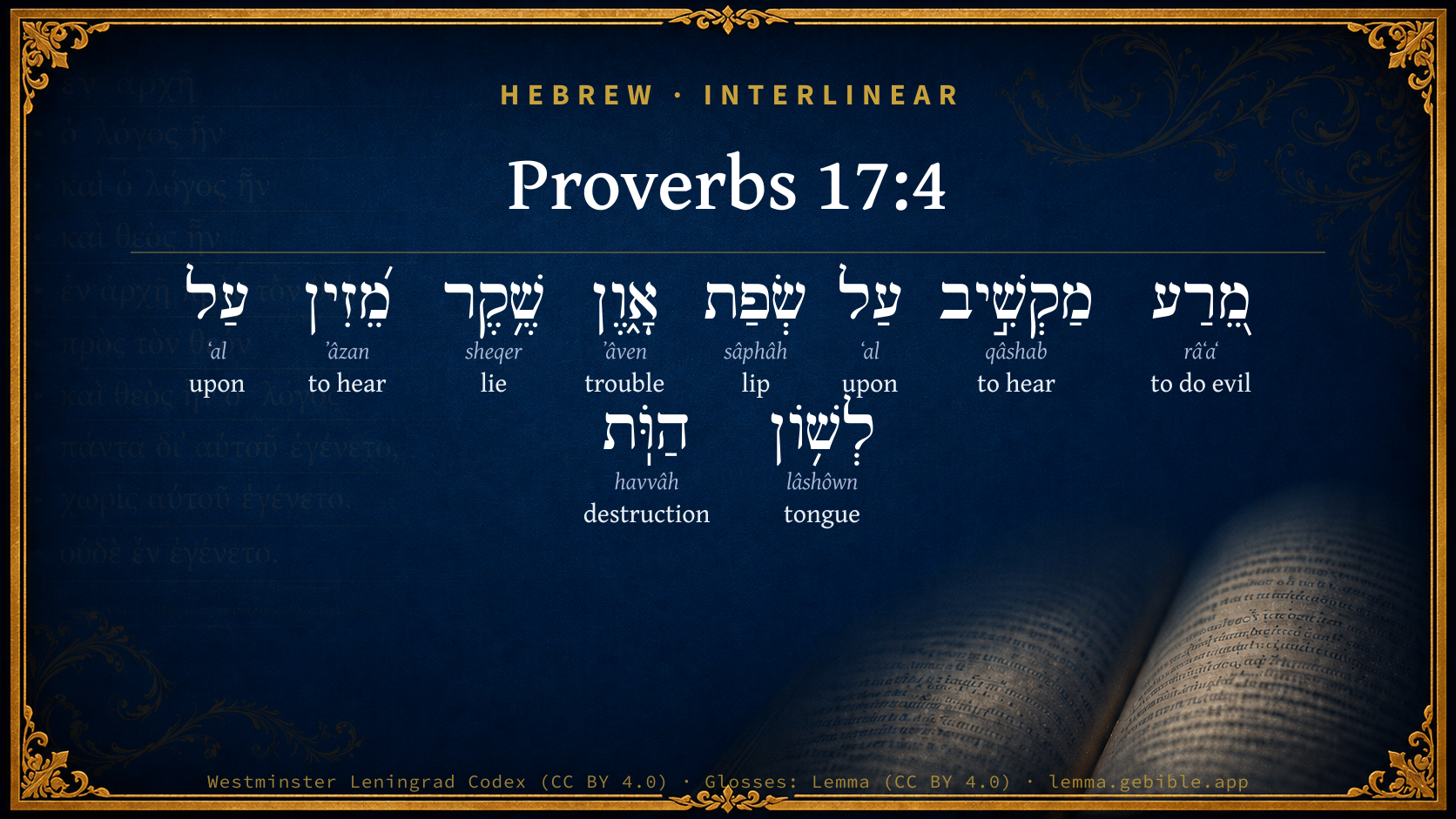
Hebrew (Westminster Leningrad Codex) Proverbs 17:4 appears in the Hebrew Old Testament. The text above is from the Westminster Leningrad Codex. Each word links to its Strong’s number, a concise gloss, and parsing drawn from the Open Scriptures Hebrew Bible morphology. Click any word for its full Brown-Driver-Briggs (BDB) entry.
Download image
Cite this verse

Proverbs 17:4 (World English Bible). Public Domain. Lemma interlinear Bible study tool, https://lemma.gebible.app/v/proverbs/17/4.

Show BibTeX & RIS
BibTeX
RIS
English Translation
An evil-doer heeds wicked lips. A liar gives ear to a mischievous tongue.
World English Bible · Public Domain
Download a study sheet

One document with this verse’s original text, its word-by-word gloss line, the meaning frame, cross-references with their text, attributed commentary, and full source and license credits — printable, and it pastes into notes with its structure intact.

This verse Autodidact and up

Study sheet (.html) Plain text (.txt)

A passage Seminary Student

Up to 50 verses in one chapter. A passage sheet keeps up to 6 commentary sources and 12 cross-references per verse, in the order this page ranks them, and says so on the sheet whenever that leaves anything out. Ask for a single verse and you get the Autodidact verse sheet above.

Everything on this page stays free to read, with no account — the sheet is a download of what is already on screen, not access to it.

Want to remove ads? Support Godless Engineer
Compare translations 3

The same verse in 3 English versions, stacked beneath the original-language interlinear above. Click any original word for its lexicon entry.

Each is an independent rendering of the whole verse — the interlinear is not word-aligned to these translations.

Highlighted words mark where these versions differ — a whole-verse word diff, not a word-by-word alignment.

  • World English Bible Public Domain
    An evil-doer heeds wicked lips. A liar gives ear to a mischievous tongue.
  • King James Version Public Domain
    A wicked doer giveth heed to false lips; and a liar giveth ear to a naughty tongue.
  • unfoldingWord Literal Text CC BY-SA 4.0
    The evildoer listens attentively to the lips of iniquity; a liar gives ear to a tongue of destruction.

unfoldingWord Literal Text — © unfoldingWord, licensed CC BY-SA 4.0. Word-aligned USFM3 via Door43 (git.door43.org/unfoldingWord/en_ult).

Versions to compare (up to 4)

3 of 4 selected

Show all 18 translations

Every available English version of this verse, each an independent rendering of the whole verse.

  • World English Bible Public Domain
    An evil-doer heeds wicked lips. A liar gives ear to a mischievous tongue.
  • Berean Standard Bible Public Domain
    A wicked man listens to evil lips; a liar gives ear to a destructive tongue.
  • Majority Standard Bible Public Domain
    A wicked man listens to evil lips; a liar gives ear to a destructive tongue.
  • King James Version Public Domain
    A wicked doer giveth heed to false lips; and a liar giveth ear to a naughty tongue.
  • American Standard Version (1901) Public Domain
    An evil-doer giveth heed to wicked lips; `And' a liar giveth ear to a mischievous tongue.
  • Revised Version (1885) Public Domain
    An evil-doer giveth heed to wicked lips; and a liar giveth ear to a mischievous tongue.
  • Geneva Bible (1599) Public Domain
    The wicked giueth heed to false lippes, and a lyer hearkeneth to the naughtie tongue.
  • Douay-Rheims (1899) Public Domain
    The evil man obeyeth an unjust tongue: and the deceitful hearkeneth to lying lips.
  • Young's Literal Translation Public Domain
    An evil doer is attentive to lips of vanity, Falsehood is giving ear to a mischievous tongue.
  • Literal Standard Version CC BY-SA 4.0
    An evildoer is attentive to lips of vanity, || Falsehood is giving ear to a mischievous tongue.
  • Unlocked Literal Bible CC BY-SA 4.0
    The evildoer pays attention to wicked lips; a liar gives ear to a destructive tongue.
  • unfoldingWord Literal Text CC BY-SA 4.0
    The evildoer listens attentively to the lips of iniquity; a liar gives ear to a tongue of destruction.
  • Darby Bible Public Domain
    The evil-doer giveth heed to iniquitous lips; the liar giveth ear to a mischievous tongue.
  • World Messianic Bible Public Domain
    An evildoer heeds wicked lips. A liar gives ear to a mischievous tongue.
  • Webster's Bible Public Domain
    A wicked doer giveth heed to false lips: and a liar giveth ear to a naughty tongue.
  • Free Bible Version CC BY-SA 4.0
    Evil people listen to spiteful talk, and liars pay attention to malicious words.
  • Bible in Basic English Public Domain
    A wrongdoer gives attention to evil lips, and a man of deceit gives ear to a damaging tongue.
  • JPS Tanakh (1917) Public Domain
    A evil-doer giveth heed to wicked lips; and a liar giveth ear to a mischievous tongue.

Literal Standard Version (2020), Covenant Press — licensed CC BY-SA 4.0. Text via the HelloAO Bible API (eBible.org). Unlocked Literal Bible (unfoldingWord) — licensed CC BY-SA 4.0. Text via the HelloAO Bible API (eBible.org). unfoldingWord Literal Text — © unfoldingWord, licensed CC BY-SA 4.0. Word-aligned USFM3 via Door43 (git.door43.org/unfoldingWord/en_ult). Free Bible Version, Dr. Jonathan Gallagher — licensed CC BY-SA 4.0. Text via the HelloAO Bible API (eBible.org).

Word by word

More ways to search: Search by grammar → Find every occurrence → Compare this word →

Practice this passage: Drill this verse → Learn its vocabulary →

About this verse

These counts appear in no published source. They are computed here, from the morphology-tagged text and Lemma’s own curated glosses. What Lemma adds →

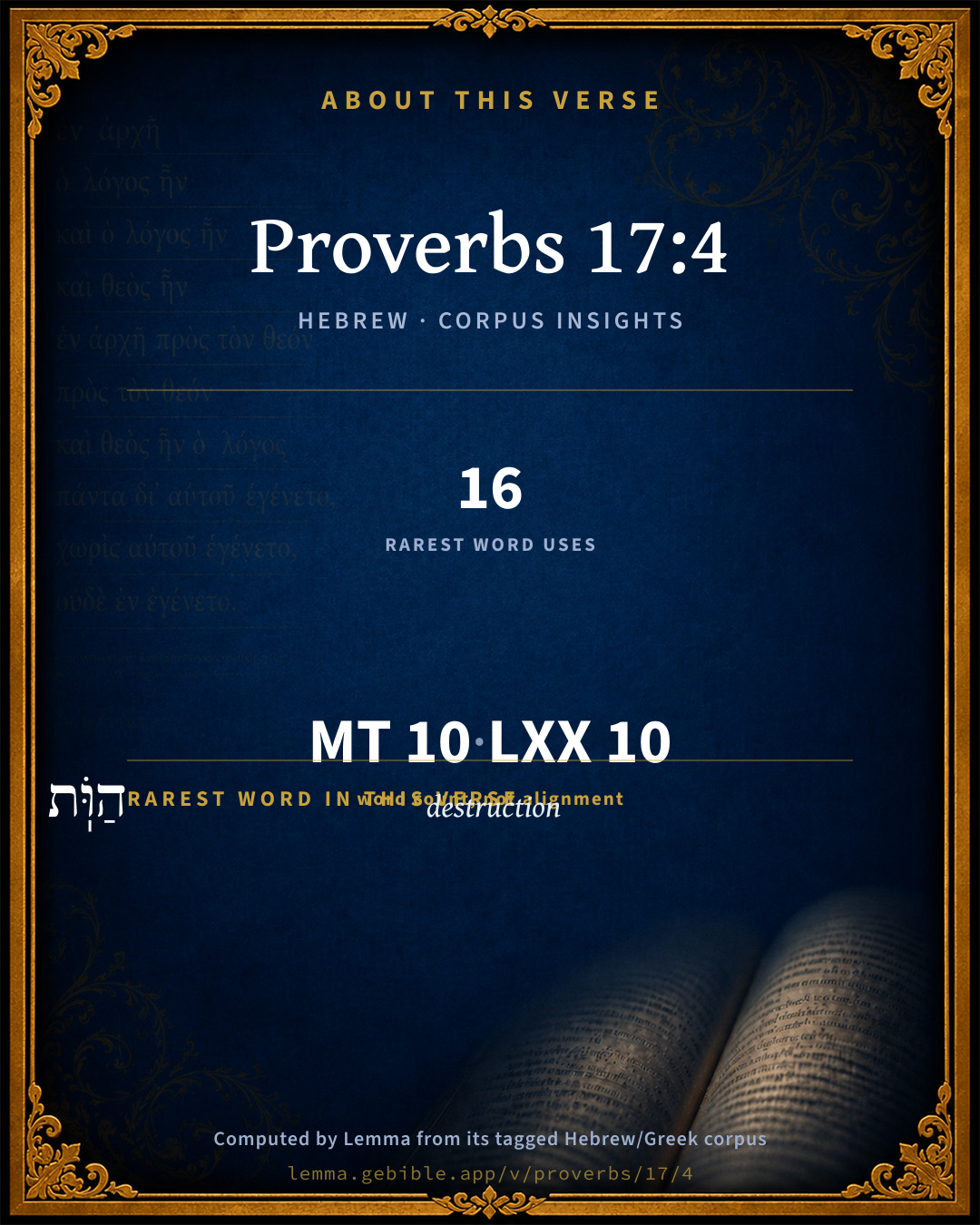
10
words
9
distinct lemmas
Wisdom
section

Notable vocabulary

The rarest word here is הַוֺּֽת destruction H1942 — appearing just 16 times in the whole Hebrew Bible.

Shared distinctive vocabulary

הַוֺּֽת destruction H1942 occurs in 16 verses of the Hebrew Bible. Also found in:

Grammatical profile

  • 3 verbs
  • 5 nouns
  • 2 prepositions

Verb forms

  • מֵ֭רַע Hiphil · Participle Active
  • מַקְשִׁ֣יב Hiphil · Participle Active
  • מֵ֝זִין Hiphil · Participle Active

Repetition

A word recurs within this verse — often emphatic in Hebrew:

Hebrew & Septuagint length

In English translation the verse runs 13 words from the Hebrew and 18 from the Septuagint (LXX English) — closely comparable.

A rough comparison of the two English renderings, which tokenize alike — not a word-level alignment.

Word counts can differ between the Hebrew and the Greek without any difference in meaning — e.g. the Hebrew direct-object marker אֵת has no separate Greek word, and Greek often adds the article ὁ.

In the original languages it is 10 Hebrew tokens and 10 Greek tokens — but the two are counted differently (Hebrew bundles its prefixes and suffixes into one token; the Greek is in lemma form), so that isn’t a like-for-like length.

Cross-references

7

Topical passages linked to Proverbs 17:4 in the Treasury of Scripture Knowledge — connected by theme and wording, ordered by reader-vote popularity; previews shown in the World English Bible.

  • 2 Timothy 4:3–4 For the time will come when they will not listen to the sound doctrine, but, having itching ears, will heap up for themselves teachers after their own lusts;
  • Proverbs 28:4 Those who forsake the law praise the wicked; But those who keep the law contend with them.
  • 1 John 4:5 They are of the world. Therefore they speak of the world, and the world hears them.
  • Isaiah 30:10 who tell the seers, "Don't see;" and to the prophets, "Don't prophesy to us right things, speak to us smooth things, prophesy deceits,
  • Jeremiah 5:31 the prophets prophesy falsely, and the priests bear rule by their means; and my people love to have it so: and what will you do in the end of it?
  • 1 Kings 22:6–28 Then the king of Israel gathered the prophets together, about four hundred men, and said to them, Shall I go against Ramoth-gilead to battle, or shall I forbear? They said, Go up; for the Lord will deliver it into the hand of the king.
  • Revelation 13:3–8 One of his heads looked like it had been wounded fatally. His fatal wound was healed, and the whole earth marveled at the beast.

Cross-references courtesy of OpenBible.info (CC BY 4.0).

Hebrew and Greek witnesses Masoretic Hebrew ↔ Greek Septuagint

The same verse in the two great witnesses to the Old Testament, shown verse-for-verse.

These are two independent witnesses, not word-aligned to each other, and the Septuagint is shown in lemma (dictionary) form.

Hebrew Proverbs 17:4 Masoretic · Westminster Leningrad Codex

מֵ֭רַע מַקְשִׁ֣יב עַל שְׂפַת אָ֑וֶן שֶׁ֥קֶר מֵ֝זִין עַל לְשׁ֥וֹן הַוֺּֽת

An evil-doer heeds wicked lips. A liar gives ear to a mischievous tongue.

World English Bible · Public Domain

Greek LXX Proverbs 17:4 Septuagint · lemma form

κακός ὑποἀκούω γλῶσσα παράνομος δίκαιος δέ οὐ προςἔχω χεῖλος ψευδής

A bad man hearkens to the tongue of transgressors: but a righteous man attends not to false lips.

LXX2012 (modern English Septuagint) · Public Domain

On this verse, The Pulpit Commentary discusses the Septuagint’s reading. Read the note in Commentary ↓

Hebrew: Westminster Leningrad Codex (CC BY 4.0). Greek: Septuagint (public domain); English from LXX2012 (modern English Septuagint) (Public Domain). How the Septuagint differs from the Hebrew →

Commentary

Notes on Proverbs 17:4 from classic Christian and Jewish commentators (each source and its license shown beneath its notes). The classic Christian expositions comment on the surrounding passage and are grouped to its opening verse, so a note may address several verses; the Jewish commentaries on the Tanakh (Rashi and others) are per-verse, so they appear only where the commentator wrote on this verse.

Lemma curates 59 commentaries, every one of them public domain or Creative Commons licensed, each selected and text-cleaned for this edition rather than reprinted as found. About our sources →

Trapp's Complete Commentary

John Trapp

Pro 17:4 A wicked doer giveth heed to false lips; [and] a liar giveth ear to a naughty tongue.

Ver. 4. A wicked doer giveth heed to false lips.] It is an ill sign of a vicious nature to be apt to believe scandalous reports of godly men. If men loved not lies, they wonld not listen to them. Some are of the opinion that Solomon having said, "God trieth the hearts," doth in this and the two next following verses instance some particular sins so accounted by God, which yet pass among men for no sins, or peccadilloes at the utmost, seeing no man seems to receive wrong by them - such as these are, to listen to lying lips, to mock the poor, to rejoice at another man’s calamity, and the like. Lo, they that do thus, though to themselves and others they may seem to have done nothing amiss, yet God that tries the hearts will call them to account for these malicious miscarriages.

John Trapp, A Commentary or Exposition upon All the Books of the Old and New Testament (1647–1656) — public domain. Text from a community e-Sword module.

The Biblical Illustrator

Joseph S. Exell

Pro_17:4

A wicked doer giveth heed to false lips; and a liar giveth ear to a naughty tongue.

The conversational likings of bad men

Mens characters may be known by the conversations they most relish. The text enables us to see the kind of conversation that bad men like.

I. They like flattery. A wicked doer giveth heed to false lips. The flatterer is a man of false lips. The more corrupt men are, the more blindly credulous to everything that makes them appear better than they are. He who compliments them palliates their offences, gives them credit for virtues they possess not, is their favourite companion, and they ever give heed to his lips. One of the best things recorded of George

III. is, that one of his first acts after his ascension to the throne was to issue an order prohibiting any of the clergy who should be called to preach before him from paying him any compliment in their discourses. His Majesty was led to this from the fulsome adulation which Dr. Thomas Wilson, Prebendary of Westminster, thought proper to deliver in the Chapel Royal, and for which, instead of thanks, he received from his royal auditor a pointed reprimand, his Majesty observing that he came to chapel to hear the praise of God, not his own.

II. They like calumny. The liar is also the wicked doer. The naughty tongue, whilst it speaks flatteries and falsehoods of all kinds, speaks calumnies also. And the worse the man is the more welcome to his depraved heart are the reports of bad things concerning others.

1. Calumny gratifies the pride of evil men. It helps them to cherish the thought that they are not worse than others, perhaps better.

2. Calumny gratifies the malignity of evil men. The worse a man is the more malevolence he has in him; the more gratified he is at hearing bad things concerning other men. If, said Bishop Hall, I cannot stop other mens mouths from speaking ill, I will either open my mouth to reprove it or else I will stop mine ears from hearing it, and let him see in my face that he hath no room in my heart. (D. Thomas, D. D.)

The Biblical Illustrator, edited by Joseph S. Exell (c. 1880s–1900s) — public domain. Text from a community e-Sword module.

Joseph Benson's Commentary

Pro 17:4. A wicked doer — A malicious and mischievous man, whose practice and delight it is to bring trouble upon others; giveth heed to false lips — Hebrew, שׂפת און, the lip of iniquity, to any wicked counsels or speeches; to false accusations and calumnies, which give him occasion and encouragement to do mischief. And a liar giveth ear to a naughty tongue — He who accustoms himself to speak what is false and wicked, delights in the like speeches of others. This proverb contains a comparison between an evil-doer and an evil-speaker, and shows their agreement in the same sinful practice of being eager to hear false and wicked speeches.

Joseph Benson's Commentary on the Old and New Testaments (1811–1818) — public domain. Text from a community e-Sword module.

The Preacher's Complete Homiletical Commentary

Joseph S. Exell (gen. ed.)

CRITICAL NOTES.—

Pro_17:4. A liar. literally, a lie, falsehood.

MAIN HOMILETICS OF Pro_17:4

THE EVIL SPEAKER AND THE LISTENER

I. That which men give heed to reveals their character. If a man will listen to another whom he knows to be false—if he permits him to be continually pouring into his ear that which he knows to be untrue—he is a liar himself. He could not make himself a receiver of lies if he were not of a kindred spirit with the liar. We classify animals according to the food which they eat, and we can classify men when we know upon what mental and moral food they love to feed. He who gives heed to falsehood and lying lips is a false man himself.

II. Delight in wicked speech leads to wicked actions. Those who use ungodly language never stop there. There is but a step between wicked words and wicked deeds. Neither do those who begin by giving heed to men whose speech is prompted by him who is the father of lies (Joh_8:44) stop with the mere listening. The listening, as we have seen, implies a certain degree of sympathy with the listener; this sympathy leads to imitation, and he who gives heed to false lips not only becomes himself a man of wicked speech but a “wicked doer.”

III. The liar and he who listens to him divide the responsibility of the sin between them. These two characters help to increase each other’s guilt by strengthening each other in their ungodliness. The liar is encouraged to go on in his lying by those who give heed to his lies; if there were none willing to listen to him he would soon cease to sin in this direction. So that the receiver of falsehood will have to share the punishment of him who propagates it. Then the liar increases the wickedness of the wicked doer by his false words, which help to make his heart yet more ungodly and his doings yet more wicked. Thus ungodly men exert a reciprocal influence upon each other for evil.

OUTLINES AND SUGGESTIVE COMMENTS

Wicked men have a great treasure of evil in their hearts, and yet have not enough to satisfy their own corrupt dispositions. They are like covetous men, in whom their large possessions only increase their lust of having, and therefore they carry on a trade with other wicked men, who are able to add to their store of iniquity, by flattering and counselling them in sin.—Lawson.

“A liar” is of essential use to the evil-doer. He can suborn him. He can get him to bear witness in his favour—to perjure himself to get him off, when in danger of being convicted. Such characters, too, it may be noticed, are fond of the lies of false teachers. They keep their ear greedily open to these. They are soothed, and flattered, and encouraged by them in their evil courses. They cannot but like the doctrine that allays their fears; that palliates sin; that makes light of future punishment; that tells them of a God all mercy; that assures them of ultimate universal salvation. Thus it was of old; and thus it is still (Isa_30:9-11). Wardlaw.

A man most mischievous himself yields most mischievously to the mischief of other sinners. “A lie” is the most weakly credulous. This is often noticed among the earthly. The biter is often most bitten, the tyrant most tortured. The cunning is often most caught, and what is singularly the fact, the sceptic is often the most believing. It is not a complete proverb, though, for earth, because it is not universal. It is spiritually, as with all these other texts, that the truth has no exception. The greatest harm-doer is Satan, and so the greatest harm is done to Satan. He is the father of lies, and has been the most lied to. He was more deceived in Eden than his victim, and on Calvary than the men who crucified our Lord. And all his followers take from the world equal mischief with that which they inflict upon it.—Miller.

The Preacher's Complete Homiletical Commentary (gen. ed. Joseph S. Exell; Funk & Wagnalls, c. 1892) — public domain (pre-1929). A full-Bible homiletical/sermon-outline anthology covering 65 of 66 books (2 John is absent from the source module). Text from a community e-Sword module.

Tyndale Open Study Notes

Tyndale Open Resources

17:4 Lies (6:16-19; 14:5, 25; 25:18), gossip (11:13; 18:8), and slander (10:18) distort reality for malicious purposes.

Tyndale Open Study Notes — © Tyndale Open Resources, licensed CC BY-SA 4.0. Text via the HelloAO Bible API.

Matthew Henry's Commentary

Note, 1. Those that design to do ill support themselves by falsehood and lying: A wicked doer gives ear, with a great deal of pleasure, to false lips, that will justify him in the ill he does, to those that aim to make public disturbances, catch greedily at libels, and false stories, that defame the government and the administration. 2. Those that take the liberty to tell lies take a pleasure in hearing them told: A liar gives heed to a malicious backbiting tongue, that he may have something to graft his lies upon, and with which to give them some colour of truth and so to support them. Sinners will strengthen one another's hands; and those show that they are bad themselves who court the acquaintance and need the assistance of those that are bad.

Matthew Henry's Commentary on the Whole Bible (1708–1710) — public domain (CC PDM 1.0). Text via the HelloAO Bible API.

Jamieson, Fausset & Brown

Robert Jamieson, A. R. Fausset & David Brown

Wicked doers and speakers alike delight in calumny.

Jamieson, Fausset & Brown — Commentary Critical and Explanatory on the Whole Bible (1871) — public domain (CC PDM 1.0). Text via the HelloAO Bible API.

Adam Clarke's Commentary

Verse 4. A wicked doer giveth heed] An evil heart is disposed and ever ready to receive evil; and liars delight in lies.

Adam Clarke's Commentary on the Bible (1810–1826) — public domain. Text from a community e-Sword/MySword module.

The Cambridge Bible for Schools and Colleges

gen. ed. J. J. S. Perowne

4. false] Rather, wicked, R.V., in a wider sense.

The Cambridge Bible for Schools and Colleges (gen. ed. J. J. S. Perowne; Cambridge University Press, 1878–1918) — public domain. Text from a community e-Sword module.

John Gill's Exposition

A wicked doer giveth heed to false lips,.... A man of an ill spirit, of a mischievous disposition, that delights in doing wickedness; he carefully attends to such as speak falsehood; he listens to lies and calumnies, loves to hear ill reports of persons, and takes pleasure in spreading them to the hurt of their characters; and men of bad hearts and lives give heed to seducing spirits, to false teachers, to inch as speak lies in hypocrisy, who sooth and harden them in their wickedness;

and a liar giveth ear to a naughty tongue: or, "to a tongue of destruction" (a); a culumniating, backbiting tongue, which destroys the good name and reputation of men; and he that is given to lying is made up of lying, or is a lie itself, as the word signifies; who roves and makes a lie, as antichrist and his followers; such an one hearkens diligently to everything that may detract from the character of those especially he bears an ill will to: or it may be better rendered, "he that hearkens to a lie gives heed to a naughty tongue" (b); for a lying tongue is a naughty one, evil in itself, pernicious in its effects and consequences.

(a) "perniciosae linguae", Tigurine version; "linguae confractionum calamitatum, injuriarum", Vatablus; "ad linguam exiliorum", Michaelis. (b) So Michaelis.

John Gill's Exposition of the Whole Bible (1746–1763) — public domain (CC PDM 1.0). Text via the HelloAO Bible API.

Albert Barnes' Notes on the Bible

The two clauses describe two phases of the mutual affinities of evil. The evil-doer delights in lies, the liar in bad words.

Albert Barnes' Notes on the Bible (1834–1885) — public domain. Text from a community e-Sword/MySword module.

Haydock's Catholic Bible Commentary

Lips. They mutually deceive one another, as well as others.

George Leo Haydock (1774–1849), Haydock's Catholic Family Bible and Commentary, 1859 edition — public domain. Excludes Psalms (Douay-Rheims chapter numbering differs from Protestant) and Deuterocanonical books (Catholic canon only).

Matthew Poole's English Annotations

A wicked doer, or, a malicious or mischievous man, whose practice and delight it is to bring trouble to others,

giveth heed to false lips, Heb. to lips of iniquity, to any wicked counsels or speeches, to false accusations and calumnies, which give him occasion and encouragement to do mischief.

A liar giveth ear to a naughty tongue; he who accustometh himself to false and wicked speaking delighteth in the like speeches of other men. This proverb contains a comparison between an evil-doer and an evil-speaker, and showeth their agreement in the same sinful practice of being greedy to hear false and wicked speeches.

Matthew Poole's English Annotations on the Holy Bible (1683–1685) — public domain. Text from a community e-Sword/MySword module.

Whedon's Commentary on the Bible

Daniel D. Whedon

4. Wicked doer… giveth heed to false lips — He is an evil doer, a bad man, who gives heed to an iniquitous lip — corrupt speech; and he is a false man, whatever he feigns, that listens with pleasure to a pestilent tongue. That is, a bad man may be known by the pleasure he takes in the wicked utterances of others. When Murrell, “the land pirate,” wished to test a man whom he casually met, to ascertain whether he would make a suitable tool for his rapacious purposes, his usual course was to tell stories involving shrewd mischief, wickedness, and crime, beginning with the less aggravated. If he found his auditor took evident pleasure in these, he proceeded to tell tales of robbery and murder. If the man showed abhorrence of the wickedness, he dropped him as unsuited to his purpose:

but if he evinced sympathy with the criminal rather than with the victim, he deemed him fit for his use. This was a wicked man’s way of proving the heart, and was temporarily successful: but he was finally caught in his own trap. That prurient taste which revels in police reports, and tales of licentiousness and murder, is a sure mark of a depraved mind, and of a strong bias to evil.

Daniel D. Whedon (gen. ed.), Commentary on the Old and New Testaments (1874–1909) — public domain. Text from a community e-Sword module.

The Pulpit Commentary

A wicked doer giveth heed to false (evil) lips. A bad man delights in and hearkens to evil words; he takes pleasure in those who counsel wickedness, because they are after his own heart. Like mates with like. And a liar giveth ear to a naughty (mischievous) tongue. One who is himself mendacious listens with avidity to any tale that may injure a neighbour. however monstrous and improbable it may be. Septuagint, "A wicked man listens to the tongue of transgressors; but a just man heedeth not false lips." The Greek adds here, or in some manuscripts, after ver. 6, a paragraph which is not found in the Hebrew, Syriac, or Latin: "To him who is faithful the whole world wealth belongs; but the unfaithful is not worth an obole." On this the Fathers have frequently commented (see Corn. a Lapide, in loc.).

The Pulpit Commentary (1880–1919), ed. H.D.M. Spence-Jones & Joseph S. Exell — public domain. Text from a community e-Sword module.

John Wesley's Explanatory Notes

False lips - To false accusations and calumnies, which give him occasion and encouragement to do mischief.

John Wesley, Explanatory Notes Upon the Whole Bible (1754–1765) — public domain. Text via the GEBible commentary corpus.

Bridges on Proverbs

Charles Bridges

Here is a black, but true picture of human nature. The wicked doer is not content with the stirring impulse of his native lust. But such is his craving appetite for sin, that he seeks foreign stimulants to give it increasing activity.†1 Amnon thus stimulated his own lust, by giving heed to the false lips of his friend.†2 Ahab, to secure his desired object, eagerly listened to the counsels of his murderous wife.†3 The Jews gave delighted ears to the false prophets, who flattered them in their wickedness.†4 Active and intense was the malice of the ungodly, in suborning false witness for our Lord’s condemnation.’†5 Yet ’there would not be so many open mouths, if there were not as many willing ears to entertain them.’†6 But be it remembered, that the listening ears share the responsibility of the naughty tongue; as all are involved in the treason, that are directly or indirectly acquainted with the plot.

Gladly does the liar give ear to that, which countenances his own wickedness.†7 If he did not "love a lie," he would not listen to it. But thus he shrinks from the condemning light of truth into his own atmosphere of darkness. (Joh 3:20 .) How unlike is this spirit to the true "charity" of the Gospel, which "rejoiceth not in iniquity, but rejoiceth in the truth!" (1Co 13:6 .) ’If then’ — saith good Bishop Hall,†8 ’I cannot stop other men’s mouths from speaking ill, I will either open my mouth to reprove it; or else I will stop mine ears from hearing it, and let him see in my face, that he hath no room in my heart.’ (Psa 15:3 .) Let the guilty talker think, — how certainly will this "reproach taken up against his neighbour" exclude from the heaven of light and love! Oh! my God, fill my heart and tongue with thine own gracious Spirit!

Footnotes:

†1 Pro 4:16-17. Psa 64:5-6 .

†2 2Sa 13:5-6 .

†3 1Ki 21:4-7 .

†4 Isa 30:9-11. Jer 5:30-31 . Mic 2:11 . 1Jn 4:5 .

†5 Mat 26:59-60.

†6 Bp. Hall’s Works, viii. 7.

†7 Pro 28:4.

†8 Works, ut supra.

Charles Bridges, An Exposition of the Book of Proverbs (1846) — public domain. Text from a community e-Sword module.

Kretzmann's Popular Commentary

Paul E. Kretzmann

v. 4. A wicked doer giveth heed to false lips, literally, "Wickedness attends to lips of violence," for lies, deceit, and violence agree with the sentiments of a wicked heart; and a liar giveth ear to a naughty tongue, finding his pleasure in evil talk, which agrees with his own base thoughts and encourages him in his wickedness.

Paul E. Kretzmann, Popular Commentary of the Bible (1921–1924) — public domain. Text from a community e-Sword module.

Rashi

Rabbi Shlomo Yitzchaki (Rashi)

An evildoer A wicked man.

hearkens to a language of violence and lies He accepts slander and false testimony.

lends an ear Heb. מזין like מאזין He who lies lends an ear to destructive speech.

Rashi on the Tanakh — English translations: “The Judaica Press complete Tanach with Rashi, translated by A. J. Rosenberg” (CC BY 4.0); “Pentateuch with Rashi's commentary by M. Rosenbaum and A.M. Silbermann, 1929-1934” (public domain); “The Metsudah Tanach series, Lakewood, N.J” (CC BY 4.0); and “The Book of Joshua, Metsudah Publications, 1997” (CC BY 4.0). Text via Sefaria.

Lesson kit

Teaching starters — assembled from the data on this page, not authored interpretation. Every prompt links to the verse data it draws on. Edit before teaching.

Proverbs, in the Wisdom, opens this verse with 10 words (9 distinct Hebrew lemmas). Its most distinctive word is havvâh (“destruction”). A historical commentator’s framing appears above. Read the whole chapter for the surrounding context.

Discussion questions

  1. How does “destruction” (havvâh) shape what this verse is saying?
  2. How does Job 6:2, which shares the word «destruction», read alongside this verse?
  3. What does the repetition of “upon” (2× in this one verse) do in this verse?
  4. The translations on this page render this verse differently — a whole-verse word diff, not a word-by-word alignment. What might account for the different wordings?
  5. «מֵ֭רַע» is a Hiphil Participle Active verb. How does that grammatical form shape the action described?
  6. Compare how Trapp's Complete Commentary and The Biblical Illustrator read this verse. Where do they agree or differ?

Things to notice

Reading settings

Reading text

Shown beneath each verse's original-language words.

Old Testament
Old Testament edition

Read the OT as the Masoretic Hebrew (MT) or the Greek Septuagint (LXX).

English shown for the Greek Septuagint (in the Hebrew ↔ Greek comparison).

Comparing translations? Open the Compare panel on any verse page to stack up to four side by side.