Jeremiah 27:14

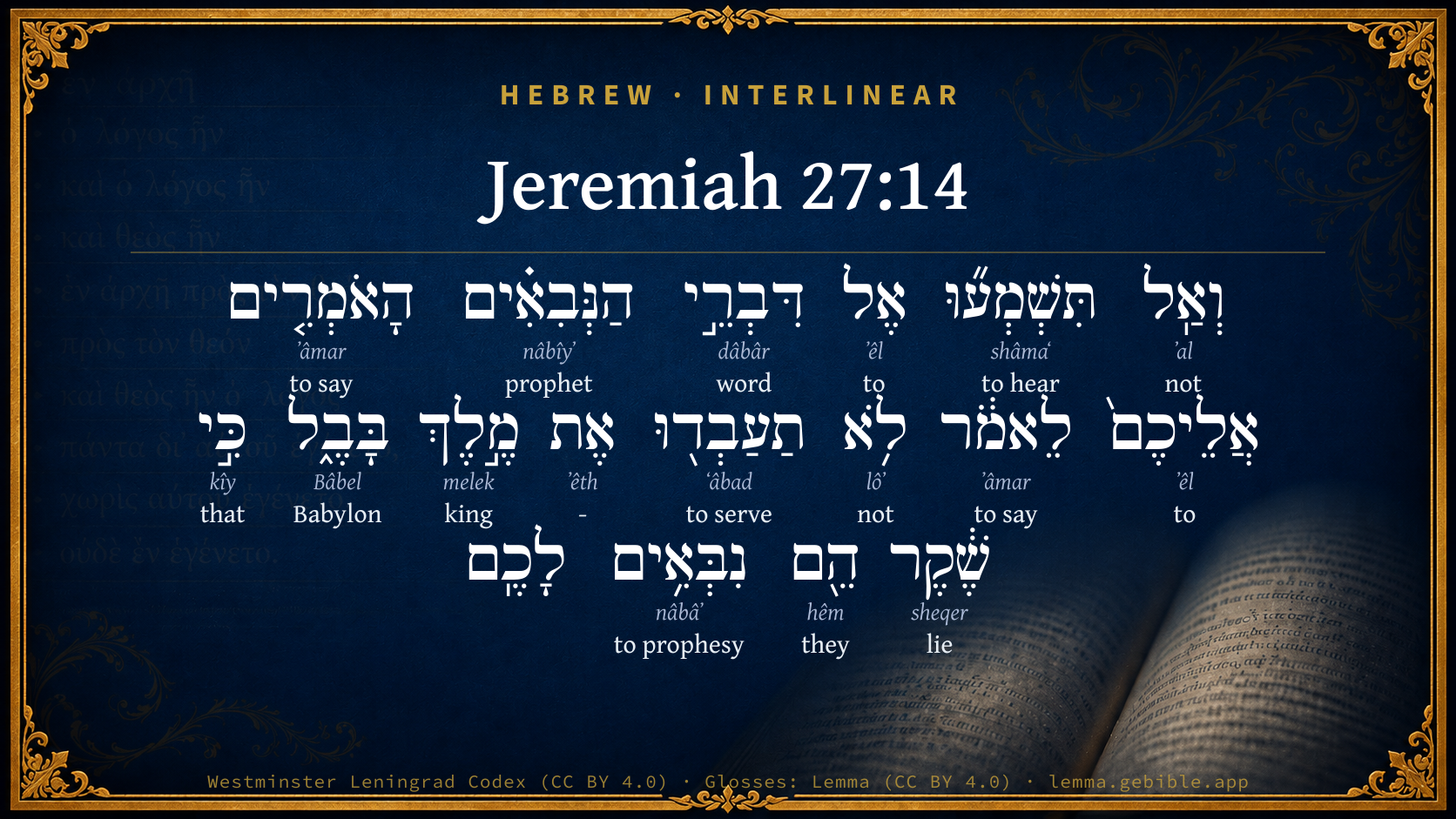
Hebrew (Westminster Leningrad Codex) Jeremiah 27:14 appears in the Hebrew Old Testament. The text above is from the Westminster Leningrad Codex. Each word links to its Strong’s number, a concise gloss, and parsing drawn from the Open Scriptures Hebrew Bible morphology. Click any word for its full Brown-Driver-Briggs (BDB) entry.
Download image
Cite this verse

Jeremiah 27:14 (World English Bible). Public Domain. Lemma interlinear Bible study tool, https://lemma.gebible.app/v/jeremiah/27/14.

Show BibTeX & RIS
BibTeX
RIS
English Translation
Don't listen to the words of the prophets who speak to you, saying, You shall not serve the king of Babylon; for they prophesy a lie to you.
World English Bible · Public Domain
Download a study sheet

One document with this verse’s original text, its word-by-word gloss line, the meaning frame, cross-references with their text, attributed commentary, and full source and license credits — printable, and it pastes into notes with its structure intact.

This verse Autodidact and up

Study sheet (.html) Plain text (.txt)

A passage Seminary Student

Up to 50 verses in one chapter. A passage sheet keeps up to 6 commentary sources and 12 cross-references per verse, in the order this page ranks them, and says so on the sheet whenever that leaves anything out. Ask for a single verse and you get the Autodidact verse sheet above.

Everything on this page stays free to read, with no account — the sheet is a download of what is already on screen, not access to it.

Want to remove ads? Support Godless Engineer
Compare translations 3

The same verse in 3 English versions, stacked beneath the original-language interlinear above. Click any original word for its lexicon entry.

Each is an independent rendering of the whole verse — the interlinear is not word-aligned to these translations.

Highlighted words mark where these versions differ — a whole-verse word diff, not a word-by-word alignment.

  • World English Bible Public Domain
    Don't listen to the words of the prophets who speak to you, saying, You shall not serve the king of Babylon; for they prophesy a lie to you.
  • King James Version Public Domain
    Therefore hearken not unto the words of the prophets that speak unto you, saying, Ye shall not serve the king of Babylon: for they prophesy a lie unto you.
  • unfoldingWord Literal Text CC BY-SA 4.0
    And do not listen to the words of the prophets who are speaking to you, saying, ‘You shall not serve the king of Babylon,’ for they are prophesying falsehood to you.

unfoldingWord Literal Text — © unfoldingWord, licensed CC BY-SA 4.0. Word-aligned USFM3 via Door43 (git.door43.org/unfoldingWord/en_ult).

Versions to compare (up to 4)

3 of 4 selected

Show all 18 translations

Every available English version of this verse, each an independent rendering of the whole verse.

  • World English Bible Public Domain
    Don't listen to the words of the prophets who speak to you, saying, You shall not serve the king of Babylon; for they prophesy a lie to you.
  • Berean Standard Bible Public Domain
    Do not listen to the words of the prophets who say, ‘You must not serve the king of Babylon,’ for they are prophesying to you a lie.
  • Majority Standard Bible Public Domain
    Do not listen to the words of the prophets who say, ‘You must not serve the king of Babylon,’ for they are prophesying to you a lie.
  • King James Version Public Domain
    Therefore hearken not unto the words of the prophets that speak unto you, saying, Ye shall not serve the king of Babylon: for they prophesy a lie unto you.
  • American Standard Version (1901) Public Domain
    And hearken not unto the words of the prophets that speak unto you, saying, Ye shall not serve the king of Babylon; for they prophesy a lie unto you.
  • Revised Version (1885) Public Domain
    And hearken not unto the words of the prophets that speak unto you, saying, Ye shall not serve the king of Babylon: for they prophesy a lie unto you.
  • Geneva Bible (1599) Public Domain
    Therefore heare not the words of the prophets, that speake vnto you, saying, Ye shall not serue the King of Babel: for they prophecie a lie vnto you.
  • Douay-Rheims (1899) Public Domain
    Hearken not to the words of the prophets that say to you: You shall not serve the king of Babylon: for they tell you a lie.
  • Young's Literal Translation Public Domain
    `And ye do not hearken unto the words of the prophets who are speaking unto you, saying, Ye do not serve the king of Babylon, -- for falsehood they are prophesying to you.
  • Literal Standard Version CC BY-SA 4.0
    And you do not listen to the words of the prophets who are speaking to you, saying, You do not serve the king of Babylon—for they are prophesying falsehood to you.
  • Unlocked Literal Bible CC BY-SA 4.0
    Do not listen to the words of the prophets who speak to you and say, 'Do not serve the king of Babylon,' for they are prophesying lies to you.
  • unfoldingWord Literal Text CC BY-SA 4.0
    And do not listen to the words of the prophets who are speaking to you, saying, ‘You shall not serve the king of Babylon,’ for they are prophesying falsehood to you.
  • Darby Bible Public Domain
    And hearken not unto the words of the prophets that speak unto you, saying, Ye shall not serve the king of Babylon; for they prophesy falsehood unto you.
  • World Messianic Bible Public Domain
    Don’t listen to the words of the prophets who speak to you, saying, ‘You shall not serve the king of Babylon;’ for they prophesy a lie to you.
  • Webster's Bible Public Domain
    Therefore hearken not to the words of the prophets that speak to you, saying, Ye shall not serve the king of Babylon; for they prophesy a lie to you.
  • Free Bible Version CC BY-SA 4.0
    Don't listen to messages from prophets who say, “You won't serve the king of Babylon,” for they are prophesying a lie to you.
  • Bible in Basic English Public Domain
    And you are not to give ear to the prophets who say to you, You will not become servants of the king of Babylon: for what they say is not true.
  • JPS Tanakh (1917) Public Domain
    And hearken not unto the words of the prophets that speak unto you, saying: Ye shall not serve the king of Babylon, for they prophesy a lie unto you.

Literal Standard Version (2020), Covenant Press — licensed CC BY-SA 4.0. Text via the HelloAO Bible API (eBible.org). Unlocked Literal Bible (unfoldingWord) — licensed CC BY-SA 4.0. Text via the HelloAO Bible API (eBible.org). unfoldingWord Literal Text — © unfoldingWord, licensed CC BY-SA 4.0. Word-aligned USFM3 via Door43 (git.door43.org/unfoldingWord/en_ult). Free Bible Version, Dr. Jonathan Gallagher — licensed CC BY-SA 4.0. Text via the HelloAO Bible API (eBible.org).

Word by word

More ways to search: Search by grammar → Find every occurrence → Compare this word →

Practice this passage: Drill this verse → Learn its vocabulary →

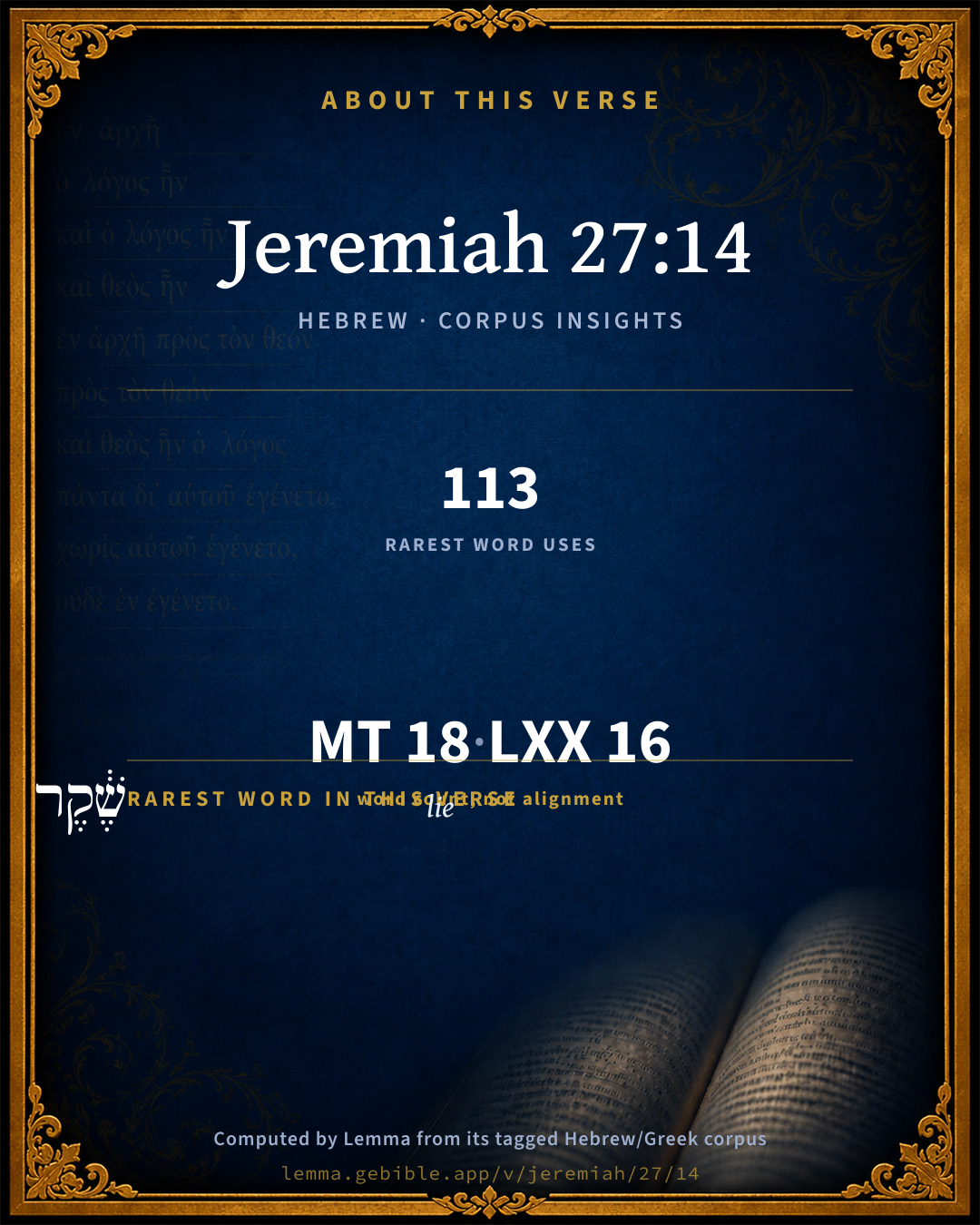
שֶׁ֔קֶר
sheqer
H8267
“lie”
Noun, Common, Masculine, Singular, Absolute
Part of Speech
Noun
Type
Common
Gender
Masculine
Number
Singular
State
Absolute
Full BDB Definition

Origin: from H8266

TWOT: 2461a

lie, deception, disappointment, falsehood - deception (what deceives or disappoints or betrays one) - deceit, fraud, wrong - fraudulently, wrongfully (as adverb) - falsehood (injurious in testimony) - testify falsehood, false oath, swear falsely - falsity (of false or self-deceived prophets) - lie, falsehood (in general) - false tongue - in vain
  1. וְאַֽל ʼal H408 “and · not” Conjunction + Particle, Negative
  2. תִּשְׁמְע֞וּ shâmaʻ H8085 “to hear” Verb, Qal, Jussive, 2nd Person, Masculine, Plural
  3. אֶל ʼêl H413 “to” Preposition
  4. דִּבְרֵ֣י dâbâr H1697 “words of” Noun, Common, Masculine, Plural, Construct
  5. הַנְּבִאִ֗ים nâbîyʼ H5030 “the · prophets” Particle, Definite Article + Noun, Common, Masculine, Plural, Absolute
  6. הָאֹמְרִ֤ים ʼâmar H559 “the · saying” Particle, Definite Article + Verb, Qal, Participle Active, Masculine, Plural, Absolute
  7. אֲלֵיכֶם֙ ʼêl H413 “to · you” Preposition + Suffix, Personal, 2nd Person, Masculine, Plural
  8. לֵאמֹ֔ר ʼâmar H559 “to say” Preposition + Verb, Qal, Infinitive Construct
  9. לֹ֥א lôʼ H3808 “not” Particle, Negative
  10. תַעַבְד֖וּ ʻâbad H5647 “to serve” Verb, Qal, Imperfect, 2nd Person, Masculine, Plural
  11. אֶת ʼêth H853 “-” Particle, Direct Object
  12. מֶ֣לֶךְ melek H4428 “king of” Noun, Common, Masculine, Singular, Construct
  13. בָּבֶ֑ל Bâbel H894 “Babylon” Noun, Proper
  14. כִּ֣י kîy H3588 “that” Conjunction
  15. הֵ֖ם hêm H1992 “they” Pronoun, Personal, 3rd Person, Masculine, Plural
  16. נִבְּאִ֥ים nâbâʼ H5012 “prophesying” Verb, Niphal, Participle Active, Masculine, Plural, Absolute

About this verse

These counts appear in no published source. They are computed here, from the morphology-tagged text and Lemma’s own curated glosses. What Lemma adds →

18
words
15
distinct lemmas
Prophets
section

Grammatical profile

  • 5 verbs
  • 5 nouns
  • 1 pronoun
  • 3 prepositions
  • 1 conjunction
  • 3 particles

Verb forms

  • תִּשְׁמְע֞וּ Qal · Jussive
  • הָאֹמְרִ֤ים Qal · Participle Active
  • לֵאמֹ֔ר Qal · Infinitive Construct
  • תַעַבְד֖וּ Qal · Imperfect
  • נִבְּאִ֥ים Niphal · Participle Active

Repetition

Words recur within this verse — often emphatic in Hebrew:

  • הָאֹמְרִ֤ים to say H559 ×2
  • אֶל to H413 ×2

Hebrew & Septuagint length

In the original languages it is 18 Hebrew tokens and 16 Greek tokens — but the two are counted differently (Hebrew bundles its prefixes and suffixes into one token; the Greek is in lemma form), so that isn’t a like-for-like length.

Cross-references

16

Topical passages linked to Jeremiah 27:14 in the Treasury of Scripture Knowledge — connected by theme and wording, ordered by reader-vote popularity; previews shown in the World English Bible.

  • Jeremiah 14:14 Then Yahweh said to me, The prophets prophesy lies in my name; I didn't send them, neither have I commanded them, neither spoke I to them: they prophesy to you a lying vision, and divination, and a thing of nothing, and the deceit of their own heart.
  • Jeremiah 23:21 I sent not these prophets, yet they ran: I didn't speak to them, yet they prophesied.
  • Jeremiah 29:8–9 For thus says Yahweh of hosts, the God of Israel: Don't let your prophets who are in the midst of you, and your diviners, deceive you; neither listen you to your dreams which you cause to be dreamed.
  • 2 Corinthians 11:13–15 For such men are false apostles, deceitful workers, masquerading as Christ's apostles.
  • 1 Kings 22:22–23 Yahweh said to him, 'How?' He said, 'I will go forth, and will be a lying spirit in the mouth of all his prophets.' He said, 'You shall entice him, and shall prevail also: go forth, and do so.'
  • Isaiah 28:10–13 For it is precept on precept, precept on precept; line on line, line on line; here a little, there a little.
  • Jeremiah 23:25 I have heard what the prophets have said, who prophesy lies in my name, saying, I have dreamed, I have dreamed.
  • Jeremiah 27:9–10 But as for you, don't you listen to your prophets, nor to your diviners, nor to your dreams, nor to your soothsayers, nor to your sorcerers, who speak to you, saying, You shall not serve the king of Babylon:
  • Jeremiah 28:15 Then said the prophet Jeremiah to Hananiah the prophet, Hear now, Hananiah: Yahweh has not sent you; but you make this people to trust in a lie.
  • Ezekiel 13:6–15 They have seen falsehood and lying divination, who say, Yahweh says; but Yahweh has not sent them: and they have made men to hope that the word would be confirmed.
  • Ezekiel 13:22–23 Because with lies you have grieved the heart of the righteous, whom I have not made sad; and strengthened the hands of the wicked, that he should not return from his wicked way, and be saved alive:
  • Micah 2:11 If a man walking in a spirit of falsehood lies: 'I will prophesy to you of wine and of strong drink;' He would be the prophet of this people.
  • Matthew 7:15 "Beware of false prophets, who come to you in sheep's clothing, but inwardly are ravening wolves.
  • Philippians 3:2 Beware of the dogs, beware of the evil workers, beware of the false circumcision.
  • 2 Peter 2:1–3 But there also arose false prophets among the people, as among you also there will be false teachers, who will secretly bring in destructive heresies, denying even the Master who bought them, bringing on themselves swift destruction.
  • 1 John 4:1 Beloved, don't believe every spirit, but test the spirits, whether they are of God, because many false prophets have gone out into the world.

Cross-references courtesy of OpenBible.info (CC BY 4.0).

Hebrew and Greek witnesses Masoretic Hebrew ↔ Greek Septuagint

The same verse in the two great witnesses to the Old Testament, shown verse-for-verse.

These are two independent witnesses, not word-aligned to each other, and the Septuagint is shown in lemma (dictionary) form.

Hebrew Jeremiah 27:14 Masoretic · Westminster Leningrad Codex

וְאַֽל תִּשְׁמְע֞וּ אֶל דִּבְרֵ֣י הַנְּבִאִ֗ים הָאֹמְרִ֤ים אֲלֵיכֶם֙ לֵאמֹ֔ר לֹ֥א תַעַבְד֖וּ אֶת מֶ֣לֶךְ בָּבֶ֑ל כִּ֣י שֶׁ֔קֶר הֵ֖ם נִבְּאִ֥ים לָכֶֽם

Don't listen to the words of the prophets who speak to you, saying, You shall not serve the king of Babylon; for they prophesy a lie to you.

World English Bible · Public Domain

Greek LXX Structure differs

In the Septuagint, Jeremiah is about an eighth shorter than the Hebrew and arranges its material differently — the Oracles Against the Nations (Hebrew chapters 46–51) appear in the middle of the Greek book, after 25:13. Because the chapter and verse boundaries do not line up, a verse-for-verse comparison with the Hebrew is not shown.

A verse-for-verse comparison isn’t shown here because the chapters and verses don’t line up. Switch to the LXX edition with the MT / LXX toggle above to read the Greek directly.

Hebrew: Westminster Leningrad Codex (CC BY 4.0). Greek: Septuagint (public domain); English from a public-domain English Septuagint. How the Septuagint differs from the Hebrew →

Targum (Aramaic paraphrase)

1

The Targum is the ancient Jewish Aramaic paraphrase of the Hebrew Scriptures — an interpretive translation, not the Hebrew text itself. Onkelos (literal) and Pseudo-Jonathan (expansive) render the Torah, and Jonathan the Prophets. Coverage is partial: where no permissively-licensed English translation exists for a verse, only the Aramaic is shown. This is verse-level text, not a word-by-word alignment to the Hebrew.

  1. Targum Jonathan Prophets (Joshua–Malachi)
    וְלָא תְקַבְּלוּן לְפִתְגָמֵי נְבִיֵי שִׁקְרָא דְאָמְרִין לְכוֹן לְמֵימָר לָא תִפְלְחוּן יַת מַלְכָּא דְבָבֶל אֲרֵי שִׁקְרָא אִינוּן מִתְנַבָּן לְכוֹן:

    (no public-domain English translation for this verse)

    Targum Jonathan — Aramaic: “Mikraot Gedolot” (public domain). English: “Sefaria Community Translation” (CC0 1.0 (public-domain dedication)); “London "Chaldee Paraphrase," 1871” (public domain). Text via Sefaria.

Commentary

Notes on Jeremiah 27:14 from classic Christian and Jewish commentators (each source and its license shown beneath its notes). The classic Christian expositions comment on the surrounding passage and are grouped to its opening verse, so a note may address several verses; the Jewish commentaries on the Tanakh (Rashi and others) are per-verse, so they appear only where the commentator wrote on this verse.

Lemma curates 59 commentaries, every one of them public domain or Creative Commons licensed, each selected and text-cleaned for this edition rather than reprinted as found. About our sources →

Trapp's Complete Commentary

John Trapp

Jer 27:14 Therefore hearken not unto the words of the prophets that speak unto you, saying, Ye shall not serve the king of Babylon: for they prophesy a lie unto you.

Ver. 14. Therefore hearken not unto the words of the prophets.] Quanta opus opera, saith Oecolampadius. What a business it is to beat men off from false prophets and seducers! But let the end and the evils they lead to be remembered. Cavete a Melampyge.

John Trapp, A Commentary or Exposition upon All the Books of the Old and New Testament (1647–1656) — public domain. Text from a community e-Sword module.

Jamieson, Fausset & Brown

Robert Jamieson, A. R. Fausset & David Brown

lie-- (Jer 14:14).

Jamieson, Fausset & Brown — Commentary Critical and Explanatory on the Whole Bible (1871) — public domain (CC PDM 1.0). Text via the HelloAO Bible API.

John Calvin's Commentaries

He repeats the same words which we have met with before; there is therefore no need of dwelling long on them here. Yet the repetition was not superfluous; for he had a hard contest with the false prophets, who had attained great authority. As Jeremiah alone made an onset on the whole multitude, the greater part of them might have objected and said, that in matters of such perplexity there was nothing certain or clear. As therefore it was not easy to convince the Jews who were disposed to believe the false prophets, it was necessary to say the same thing often, as we shall also see hereafter. He adds, —

John Calvin's Commentaries (1540-1563) — public domain. Text from the Calvin Translation Society English edition (1840s-50s) via the Christian Classics Ethereal Library (ccel.org). Calvin's coverage is partial (roughly two-thirds of the Bible); uncommented books and verses are honest gaps, never fabricated. The 19th-century editor's footnotes and remarks are omitted so the notes are faithfully Calvin's own voice.

John Gill's Exposition

Therefore hearken not unto the words of the prophets,.... The false prophets, as the Targum; such bad kings always had about them, to whom they listened, and which often proved of bad consequence to them:

that speak unto you, saying; as follows:

ye shall not serve the king of Babylon; ye ought not to do it, but cast off his yoke; to which if ye do not willingly submit, he will never be able to force you to it:

for they prophesy a lie unto you; and therefore should not be hearkened to, particularly when they promise safety from the king of Babylon.

John Gill's Exposition of the Whole Bible (1746–1763) — public domain (CC PDM 1.0). Text via the HelloAO Bible API.

Matthew Poole's English Annotations

We shall find throughout all the Jewish story that wicked princes never wanted false prophets, ecclesiastical ministers who would entitle God to what they spake in humour to their governors. Such ministers they would have, and usually they proved fatal to them: so did Ahab’s prophets, that encouraged him to go up to Ramoth-gilead, and Zedekiah’s prophets, who persuaded him not to submit to the king of Babylon. Jeremiah persuades Zedekiah not to hearken to them; that is, not to believe them, nor follow their advice; and he giveth him a good reason, because what they said was false.

Matthew Poole's English Annotations on the Holy Bible (1683–1685) — public domain. Text from a community e-Sword/MySword module.

unfoldingWord translationNotes

Door43 World Missions Community

General Information:

Yahweh continues to speak through Jeremiah to the king and people of Judah.

Do not listen to the words

Yahweh is warning the people about all the false prophets that he did not send and that are lying to them.

For I have not sent them out

"For I have not sent them"

this is Yahweh's declaration

Yahweh speaks of himself by name to express the certainty of what he is declaring. See how you translated this in Jeremiah 1:8. AT: "this is what Yahweh has declared" or "this is what I, Yahweh, have declared" (See: First, Second, or Third Person)

they are prophesying deceit in my name

The phrase "in my name" represents speaking with Yahweh's power and authority or as his representative. Here these prophets claim that they received their message from Yahweh, but that had not. The abstract noun "deceit" can be translated as the verb "deceiving." AT: "they say they are speaking for me when they prophesy, but they are deceiving you" (See: Metonymy and Abstract Nouns)

I will drive you out

"I will force you to leave your home country"

translationWords

servant

Yahweh

perish

unfoldingWord translationNotes — © Distant Shores Media and the Door43 World Missions Community, licensed CC BY-SA 4.0. Source: git.door43.org/Door43/en_tn.

Lesson kit

Teaching starters — assembled from the data on this page, not authored interpretation. Every prompt links to the verse data it draws on. Edit before teaching.

Jeremiah, in the Prophets, opens this verse with 18 words (15 distinct Hebrew lemmas). Its most distinctive word is sheqer (“lie”). A historical commentator’s framing appears above. Read the whole chapter for the surrounding context.

Discussion questions

  1. How does “lie” (sheqer) shape what this verse is saying?
  2. How does Jeremiah 14:14, which shares this passage’s theme, read alongside this verse?
  3. What does the repetition of “to say” (2× in this one verse) do in this verse?
  4. The translations on this page render this verse differently — a whole-verse word diff, not a word-by-word alignment. What might account for the different wordings?
  5. «תִּשְׁמְע֞וּ» is a Qal Jussive verb. How does that grammatical form shape the action described?
  6. Compare how Trapp's Complete Commentary and Jamieson, Fausset & Brown read this verse. Where do they agree or differ?

Things to notice

Reading settings

Reading text

Shown beneath each verse's original-language words.

Old Testament
Old Testament edition

Read the OT as the Masoretic Hebrew (MT) or the Greek Septuagint (LXX).

English shown for the Greek Septuagint (in the Hebrew ↔ Greek comparison).

Comparing translations? Open the Compare panel on any verse page to stack up to four side by side.