Jeremiah 40:16

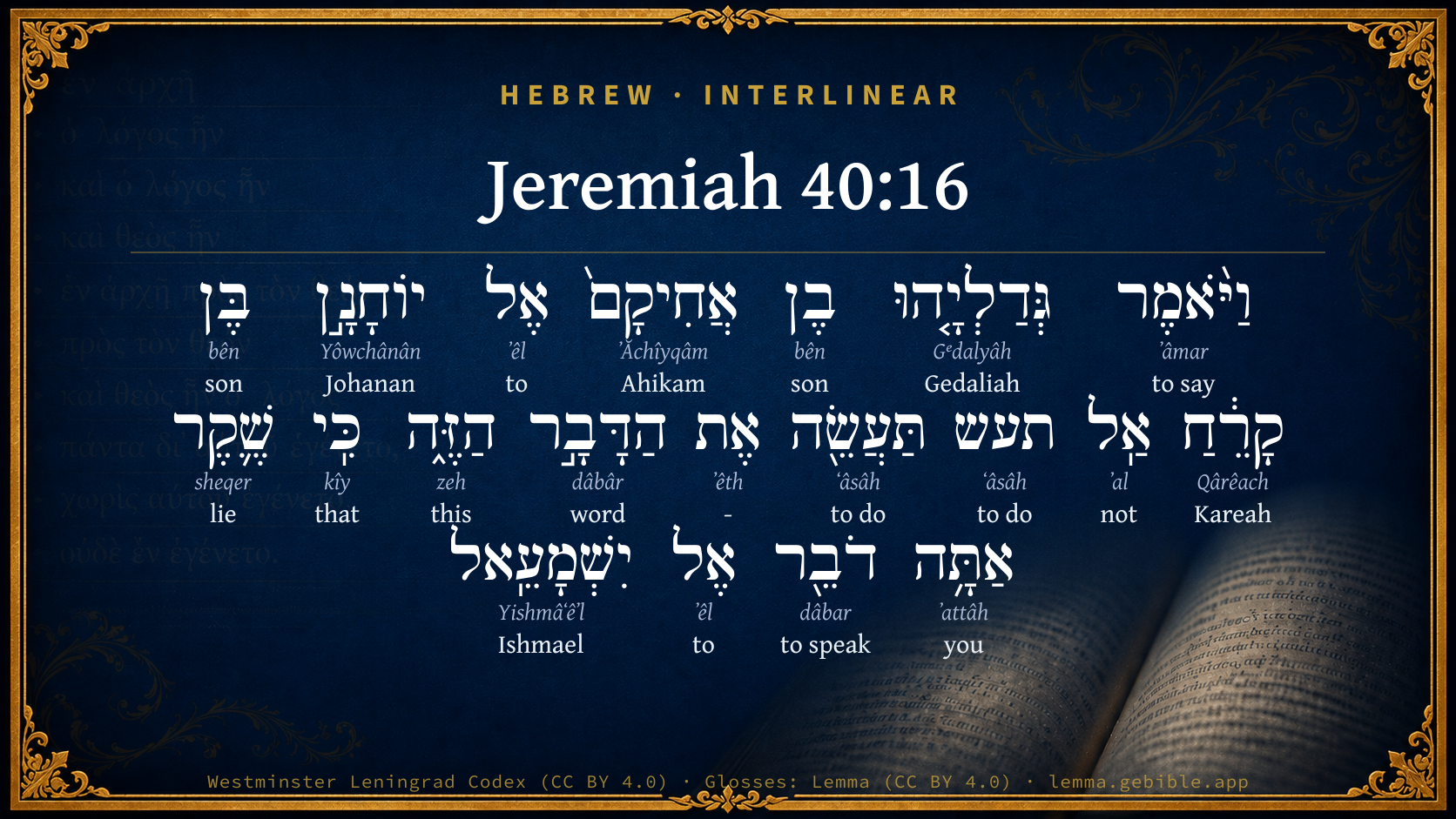
Hebrew (Westminster Leningrad Codex) Jeremiah 40:16 appears in the Hebrew Old Testament. The text above is from the Westminster Leningrad Codex. Each word links to its Strong’s number, a concise gloss, and parsing drawn from the Open Scriptures Hebrew Bible morphology. Click any word for its full Brown-Driver-Briggs (BDB) entry.
Download image
Cite this verse

Jeremiah 40:16 (World English Bible). Public Domain. Lemma interlinear Bible study tool, https://lemma.gebible.app/v/jeremiah/40/16.

Show BibTeX & RIS
BibTeX
RIS
English Translation
But Gedaliah the son of Ahikam said to Johanan the son of Kareah, You shall not do this thing; for you speak falsely of Ishmael.
World English Bible · Public Domain
Download a study sheet

One document with this verse’s original text, its word-by-word gloss line, the meaning frame, cross-references with their text, attributed commentary, and full source and license credits — printable, and it pastes into notes with its structure intact.

This verse Autodidact and up

Study sheet (.html) Plain text (.txt)

A passage Seminary Student

Up to 50 verses in one chapter. A passage sheet keeps up to 6 commentary sources and 12 cross-references per verse, in the order this page ranks them, and says so on the sheet whenever that leaves anything out. Ask for a single verse and you get the Autodidact verse sheet above.

Everything on this page stays free to read, with no account — the sheet is a download of what is already on screen, not access to it.

Want to remove ads? Support Godless Engineer
Compare translations 3

The same verse in 3 English versions, stacked beneath the original-language interlinear above. Click any original word for its lexicon entry.

Each is an independent rendering of the whole verse — the interlinear is not word-aligned to these translations.

Highlighted words mark where these versions differ — a whole-verse word diff, not a word-by-word alignment.

  • World English Bible Public Domain
    But Gedaliah the son of Ahikam said to Johanan the son of Kareah, You shall not do this thing; for you speak falsely of Ishmael.
  • King James Version Public Domain
    But Gedaliah the son of Ahikam said unto Johanan the son of Kareah, Thou shalt not do this thing: for thou speakest falsely of Ishmael.
  • unfoldingWord Literal Text CC BY-SA 4.0
    But Gedaliah son of Ahikam said to Johanan son of Kareah, “Do not do this thing, for you are telling lies about Ishmael.”

unfoldingWord Literal Text — © unfoldingWord, licensed CC BY-SA 4.0. Word-aligned USFM3 via Door43 (git.door43.org/unfoldingWord/en_ult).

Versions to compare (up to 4)

3 of 4 selected

Show all 18 translations

Every available English version of this verse, each an independent rendering of the whole verse.

  • World English Bible Public Domain
    But Gedaliah the son of Ahikam said to Johanan the son of Kareah, You shall not do this thing; for you speak falsely of Ishmael.
  • Berean Standard Bible Public Domain
    But Gedaliah son of Ahikam said to Johanan son of Kareah, “Do not do such a thing! What you are saying about Ishmael is a lie.”
  • Majority Standard Bible Public Domain
    But Gedaliah son of Ahikam said to Johanan son of Kareah, “Do not do such a thing! What you are saying about Ishmael is a lie.”
  • King James Version Public Domain
    But Gedaliah the son of Ahikam said unto Johanan the son of Kareah, Thou shalt not do this thing: for thou speakest falsely of Ishmael.
  • American Standard Version (1901) Public Domain
    But Gedaliah the son of Ahikam said unto Johanan the son of Kareah, Thou shalt not do this thing; for thou speakest falsely of Ishmael.
  • Revised Version (1885) Public Domain
    But Gedaliah the son of Ahikam said unto Johanan the son of Kareah, Thou shalt not do this thing: for thou speakest falsely of Ishmael.
  • Geneva Bible (1599) Public Domain
    But Gedaliah the sonne of Ahikam said vnto Iohanan the sonne of Kareah, Thou shalt not doe this thing: for thou speakest falsely of Ishmael.
  • Douay-Rheims (1899) Public Domain
    And Codolias the son of Ahicam said to Johanan the son of Cares: Do not this thing: for what thou sayst of Ismahel is false.
  • Young's Literal Translation Public Domain
    And Gedaliah son of Ahikam saith unto Johanan son of Kareah, `Thou dost not do this thing, for falsehood thou art speaking concerning Ishmael.'
  • Literal Standard Version CC BY-SA 4.0
    And Gedaliah son of Ahikam says to Johanan son of Kareah, “You do not do this thing, for you are speaking falsehood concerning Ishmael.”
  • Unlocked Literal Bible CC BY-SA 4.0
    But Gedaliah son of Ahikam said to Johanan son of Kareah, “Do not do this thing, for you are telling lies about Ishmael.”
  • unfoldingWord Literal Text CC BY-SA 4.0
    But Gedaliah son of Ahikam said to Johanan son of Kareah, “Do not do this thing, for you are telling lies about Ishmael.”
  • Darby Bible Public Domain
    But Gedaliah the son of Ahikam said unto Johanan the son of Kareah, Thou shalt not do this thing; for thou speakest falsely of Ishmael.
  • World Messianic Bible Public Domain
    But Gedaliah the son of Ahikam said to Yochanan the son of Kareah, “You shall not do this thing, for you speak falsely of Ishmael.”
  • Webster's Bible Public Domain
    But Gedaliah the son of Ahikam said to Johanan the son of Kareah, Thou shalt not do this thing: for thou speakest falsely of Ishmael.
  • Free Bible Version CC BY-SA 4.0
    But Gedaliah said to Johanan, “Don't do it! What you're saying about Ishmael isn't true.”
  • Bible in Basic English Public Domain
    But Gedaliah, the son of Ahikam, said to Johanan, the son of Kareah, You are not to do this: for what you say about Ishmael is false.
  • JPS Tanakh (1917) Public Domain
    But Gedaliah the son of Ahikam said unto Johanan the son of Kareah: 'Thou shalt not do this thing; for thou speakest falsely of Ishmael.'

Literal Standard Version (2020), Covenant Press — licensed CC BY-SA 4.0. Text via the HelloAO Bible API (eBible.org). Unlocked Literal Bible (unfoldingWord) — licensed CC BY-SA 4.0. Text via the HelloAO Bible API (eBible.org). unfoldingWord Literal Text — © unfoldingWord, licensed CC BY-SA 4.0. Word-aligned USFM3 via Door43 (git.door43.org/unfoldingWord/en_ult). Free Bible Version, Dr. Jonathan Gallagher — licensed CC BY-SA 4.0. Text via the HelloAO Bible API (eBible.org).

Word by word

More ways to search: Search by grammar → Find every occurrence → Compare this word →

Practice this passage: Drill this verse → Learn its vocabulary →

קָרֵ֔חַ
Qârêach
H7143
“Kareah”
Noun, Proper
Part of Speech
Noun
Type
Proper
Full BDB Definition

Origin: from H7139

TWOT: None

Kareah = "bald" - father of Johanan and Jonathan who supported Gedaliah's authority and avenged his murder
  1. וַיֹּ֨אמֶר ʼâmar H559 “and · to say” Conjunction + Verb, Qal, Sequential Imperfect, 3rd Person, Masculine, Singular
  2. גְּדַלְיָ֤הוּ Gᵉdalyâh H1436 “Gedaliah” Noun, Proper
  3. בֶן bên H1121 “son of” Noun, Common, Masculine, Singular, Construct
  4. אֲחִיקָם֙ ʼĂchîyqâm H296 “Ahikam” Noun, Proper
  5. אֶל ʼêl H413 “to” Preposition
  6. יוֹחָנָ֣ן Yôwchânân H3110 “Johanan” Noun, Proper
  7. בֶּן bên H1121 “son of” Noun, Common, Masculine, Singular, Construct
  8. אַֽל ʼal H408 “not” Particle, Negative
  9. תעש ʻâsâh H6213 “to do” Verb, Qal, Jussive, 2nd Person, Masculine, Singular
  10. תַּעֲשֵׂ֖ה ʻâsâh H6213 “to do” Verb, Qal, Jussive, 2nd Person, Masculine, Singular
  11. אֶת ʼêth H853 “-” Particle, Direct Object
  12. הַדָּבָ֣ר dâbâr H1697 “the · word” Particle, Definite Article + Noun, Common, Masculine, Singular, Absolute
  13. הַזֶּ֑ה zeh H2088 “the · this” Particle, Definite Article + Pronoun, Demonstrative, Masculine, Singular
  14. כִּֽי kîy H3588 “that” Conjunction
  15. שֶׁ֛קֶר sheqer H8267 “lie” Noun, Common, Masculine, Singular, Absolute
  16. אַתָּ֥ה ʼattâh H859 “you” Pronoun, Personal, 2nd Person, Masculine, Singular
  17. דֹבֵ֖ר dâbar H1696 “speaking” Verb, Qal, Participle Active, Masculine, Singular, Absolute
  18. אֶל ʼêl H413 “to” Preposition
  19. יִשְׁמָעֵֽאל Yishmâʻêʼl H3458 “Ishmael” Noun, Proper

About this verse

These counts appear in no published source. They are computed here, from the morphology-tagged text and Lemma’s own curated glosses. What Lemma adds →

20
words
17
distinct lemmas
Prophets
section

Notable vocabulary

The rarest word here is קָרֵ֔חַ Kareah H7143 — appearing just 14 times in the whole Hebrew Bible.

Shared distinctive vocabulary

קָרֵ֔חַ Kareah H7143 occurs in 14 verses of the Hebrew Bible. Also found in:

Grammatical profile

  • 4 verbs
  • 9 nouns
  • 2 pronouns
  • 2 prepositions
  • 1 conjunction
  • 2 particles

Verb forms

  • וַיֹּ֨אמֶר Qal · Sequential Imperfect
  • תעש Qal · Jussive
  • תַּעֲשֵׂ֖ה Qal · Jussive
  • דֹבֵ֖ר Qal · Participle Active

Repetition

Words recur within this verse — often emphatic in Hebrew:

Cross-references

3

Topical passages linked to Jeremiah 40:16 in the Treasury of Scripture Knowledge — connected by theme and wording, ordered by reader-vote popularity; previews shown in the World English Bible.

  • Jeremiah 41:2 Then arose Ishmael the son of Nethaniah, and the ten men who were with him, and struck Gedaliah the son of Ahikam the son of Shaphan with the sword, and killed him, whom the king of Babylon had made governor over the land.
  • Matthew 10:16–17 "Behold, I send you out as sheep in the midst of wolves. Therefore be wise as serpents, and harmless as doves.
  • Romans 3:8 Why not (as we are slanderously reported, and as some affirm that we say), "Let us do evil, that good may come?" Those who say so are justly condemned.

Cross-references courtesy of OpenBible.info (CC BY 4.0).

Hebrew and Greek witnesses Masoretic Hebrew ↔ Greek Septuagint

The same verse in the two great witnesses to the Old Testament, shown verse-for-verse.

These are two independent witnesses, not word-aligned to each other, and the Septuagint is shown in lemma (dictionary) form.

Hebrew Jeremiah 40:16 Masoretic · Westminster Leningrad Codex

וַיֹּ֨אמֶר גְּדַלְיָ֤הוּ בֶן אֲחִיקָם֙ אֶל יוֹחָנָ֣ן בֶּן קָרֵ֔חַ אַֽל תעש תַּעֲשֵׂ֖ה אֶת הַדָּבָ֣ר הַזֶּ֑ה כִּֽי שֶׁ֛קֶר אַתָּ֥ה דֹבֵ֖ר אֶל יִשְׁמָעֵֽאל

But Gedaliah the son of Ahikam said to Johanan the son of Kareah, You shall not do this thing; for you speak falsely of Ishmael.

World English Bible · Public Domain

Greek LXX Structure differs

In the Septuagint, Jeremiah is about an eighth shorter than the Hebrew and arranges its material differently — the Oracles Against the Nations (Hebrew chapters 46–51) appear in the middle of the Greek book, after 25:13. Because the chapter and verse boundaries do not line up, a verse-for-verse comparison with the Hebrew is not shown.

A verse-for-verse comparison isn’t shown here because the chapters and verses don’t line up. Switch to the LXX edition with the MT / LXX toggle above to read the Greek directly.

Hebrew: Westminster Leningrad Codex (CC BY 4.0). Greek: Septuagint (public domain); English from a public-domain English Septuagint. How the Septuagint differs from the Hebrew →

Targum (Aramaic paraphrase)

1

The Targum is the ancient Jewish Aramaic paraphrase of the Hebrew Scriptures — an interpretive translation, not the Hebrew text itself. Onkelos (literal) and Pseudo-Jonathan (expansive) render the Torah, and Jonathan the Prophets. Coverage is partial: where no permissively-licensed English translation exists for a verse, only the Aramaic is shown. This is verse-level text, not a word-by-word alignment to the Hebrew.

  1. Targum Jonathan Prophets (Joshua–Malachi)
    וַאֲמַר גְדַלְיָהוּ בַּר אֲחִיקָם לְיוֹחָנָן בַּר קָרֵחַ לָא תַעֲבֵּיד יַת פִּתְגָמָא הָדֵין אֲרֵי שִׁקְרָא אַתְּ מְמַלֵל עַל יִשְׁמָעֵאל:

    (no public-domain English translation for this verse)

    Targum Jonathan — Aramaic: “Mikraot Gedolot” (public domain). English: “Sefaria Community Translation” (CC0 1.0 (public-domain dedication)); “London "Chaldee Paraphrase," 1871” (public domain). Text via Sefaria.

Commentary

Notes on Jeremiah 40:16 from classic Christian and Jewish commentators (each source and its license shown beneath its notes). The classic Christian expositions comment on the surrounding passage and are grouped to its opening verse, so a note may address several verses; the Jewish commentaries on the Tanakh (Rashi and others) are per-verse, so they appear only where the commentator wrote on this verse.

Lemma curates 59 commentaries, every one of them public domain or Creative Commons licensed, each selected and text-cleaned for this edition rather than reprinted as found. About our sources →

Trapp's Complete Commentary

John Trapp

Jer 40:16 But Gedaliah the son of Ahikam said unto Johanan the son of Kareah, Thou shalt not do this thing: for thou speakest falsely of Ishmael.

Ver. 16. Thou shalt not do this thing.] This just man would not have any man die indicta causa, before his cause had been heard, were he never so wicked.

For thou speakest falsely of Ishmael.] So Gedaliah thought, but it proved otherwise. Ishmael is pleaded for, but without cause. Queen Elizabeth complained that in truth she had oft found treason; so shall all princes, who therefore had need to be very cautious, and yet not overly credulous. King’s craft is not easily learned.

John Trapp, A Commentary or Exposition upon All the Books of the Old and New Testament (1647–1656) — public domain. Text from a community e-Sword module.

Tyndale Open Study Notes

Tyndale Open Resources

40:16 Gedaliah’s response betrayed his naiveté and the lack of trust in advisers that infected the whole chaotic situation.

Tyndale Open Study Notes — © Tyndale Open Resources, licensed CC BY-SA 4.0. Text via the HelloAO Bible API.

Geneva Bible (1599)

Geneva Bible translators

Thus the godly, which think no harm to others, are soonest deceived, and never lack such as conspire their destruction.

Geneva Bible (1599) marginal notes — public domain. Text via Bolls.life.

Jamieson, Fausset & Brown

Robert Jamieson, A. R. Fausset & David Brown

thou speakest falsely--a mystery of providence that God should permit the righteous, in spite of warning, thus to rush into the trap laid for them! Isa 57:1 suggests a solution.

Next: Jeremiah Chapter 41

Jamieson, Fausset & Brown — Commentary Critical and Explanatory on the Whole Bible (1871) — public domain (CC PDM 1.0). Text via the HelloAO Bible API.

Adam Clarke's Commentary

Verse 16. Thou shalt not do this thing] He cannot be so base.

Thou speakest falsely of Ishmael.] He thought it quite possible that the man who was capable of becoming an assassin was capable of telling a lie; and therefore he would not credit what he said. Had he been a little more distrustful, he would have saved his own life. The next chapter shows that Johanan's information was too true. So noble Gedaliah lost his life by not believing that evil of others of which he himself was incapable.

Adam Clarke's Commentary on the Bible (1810–1826) — public domain. Text from a community e-Sword/MySword module.

John Calvin's Commentaries

We here see that the holy man was blinded, so that he not only disregarded the counsel given to him, but also rejected the help offered to him. It is again a thing worthy of praise, that he was unwilling that Ishmael should be rashly killed, the cause being not known; but he ought to have carefully inquired, and the thing being found out, he might have defended himself, and put to death a wicked man and a public pest. He was armed with the sword; and he might have justly punished Ishmael, if he had only been attentive to the matter, that is, if he had taken the trouble to ascertain the fact. As then he had been endued with authority, for Nebuchadnezzar had set him over the land, he was to be blamed in this, that he abstained from taking’ vengeance, (for he was not a private man,)but he did not believe that there was so great a treachery in Ishmael, whom he thought to be an honest and upright man, and friendly to him. Nevertheless, there is a medium between simplicity on the one hand, and cruelty on the other. Had he immediately become incensed against Ishmael, it would have been blamable cruelty; for we ought not to be carried away headlong to condemn innocent men; for if we indiscriminately receive all sorts of calumnies, no man can remain innocent. But as I have said, Gedaliah might have so acted as not to wrong Ishmael by believing every idle report, and yet he might have taken care of himself. He might have done this, had he inquired, and having known the case, determined accordingly; but he willfully closed his eyes, and thus committed a great mistake.

But we hence see, that when in other things he was not without judgment and foresight, he was in this instance, as it were, destitute of a sound mind; for it was God’s purpose to open a way for his judgment, so that he might destroy the remnant of the people. And at the same time we see how difficult it is not to do wrong, when we desire to be just, tolerant, and unsuspicious. We are, in short, taught, how difficult a thing it is, and how rare is the virtue to exercise moderation. Ishmael might have been immediately convicted of perfidy and wickedness; this was what Gedaliah was unwilling to do; and why? because he was unwilling to suspect anything wrong in a man whom he thought to be sincere and faithful. Well, but at the same time he did wrong to John, the son of Kareah, and to the other leaders of the forces. They came to him, not one man or two men, but the chiefs who had been set over the soldiers by King Zedekiah. These came to him, so that their charge was probable. What did Gedaliah say? Thou speakest falsely, he said. he reproachfully repelled John, the son of Kareah, who yet was well disposed towards him, and wished to save him from his danger. We hence clearly see that the best of men never so act, but that under the color of equity and humanity they often fall into sloth and neglect; and that when they wish to be humane towards one, they act unkindly and reproachfully towards many. So it is ever necessary to flee to God, that he may rule us by the spirit of discretion. Now follows the murder of Gedaliah.

John Calvin's Commentaries (1540-1563) — public domain. Text from the Calvin Translation Society English edition (1840s-50s) via the Christian Classics Ethereal Library (ccel.org). Calvin's coverage is partial (roughly two-thirds of the Bible); uncommented books and verses are honest gaps, never fabricated. The 19th-century editor's footnotes and remarks are omitted so the notes are faithfully Calvin's own voice.

The Cambridge Bible for Schools and Colleges

gen. ed. J. J. S. Perowne

Ch. Jer_40:1-6. Jeremiah is released and returns to Gedaliah

Du., Co. and Erbt agree in the view that there were different legendary accounts in connexion with Jeremiah’s fortunes immediately subsequent to the capture of the city and that this section represents one of them. It is certainly difficult, in the absence of further information, to reconcile satisfactorily Jer_39:11-14 with the present passage. It is, however, possible that, in the absence of his protector Gedaliah from Jerusalem, he was again put in fetters through ignorance of his right to immunity and only set free after reaching Ramah, when the mistake was rectified by the intervention of Gedaliah or otherwise. In any case Jer_40:1 is a later addition, as no utterance from the Lord follows. The captain of the guard’s words in Jer_40:2-3 are obviously unsuited to the speaker, although they are such as a Hebrew writer would put into Nebuzaradan’s mouth. Cp. 2Ki_18:25.

The section may be summarized thus.

Jer_40:1-6. Jeremiah is taken in chains to Ramah. There Nebuzaradan, after declaring that Jerusalem’s fall was a just consequence of the people’s sins, gives the prophet his choice between going with him to Babylon, and dwelling with Gedaliah or elsewhere as he may choose. Jeremiah decides on going to Gedaliah at Mizpah.

The Cambridge Bible for Schools and Colleges (gen. ed. J. J. S. Perowne; Cambridge University Press, 1878–1918) — public domain. Text from a community e-Sword module.

John Gill's Exposition

But Gedaliah the son of Ahikam said unto Johanan the son of Kareah,.... In answer to his request, and the motion made by him:

thou shalt not do this thing; or, "do not do this thing" (z); dissuading him from it, as being unlawful to take away a man's life in such a secret manner, without any legal process against him; though it seems to carry more in it, that he laid his commands upon him not to do it, and threatened him if he did:

for thou speakest falsely of Ishmael; or "a lie" (a); a falsehood, a mere calumny; which was not using Johanan well, neither kindly nor genteelly, who had expressed such a concern for him, and for the public good. The event related in the following chapter shows that the information was good, and that it was no lie or calumny that was told; and it would have been well for Gedaliah, and the people of the Jews, had he given credit to it; but the time was not come for the Jewish commonwealth to be restored; and things were thus suffered to be, for the further punishment of the sins of that people.

(z) "noli facere hoc verbum", V. L. "ne facias verbum hoc", Pagninus, Montanus, Schmidt. (a) "mendacium", Schmidt; "falsum", Pagninus, Montanus.

Next: Jeremiah Chapter 41

John Gill's Exposition of the Whole Bible (1746–1763) — public domain (CC PDM 1.0). Text via the HelloAO Bible API.

Haydock's Catholic Bible Commentary

Do not. He did right in forbidding this assassination, which could never be authorized, even to prevent a similar crime. Godolias should have taken precautions: but he was too open, (Calmet) like Eumenes. (Grotius)

George Leo Haydock (1774–1849), Haydock's Catholic Family Bible and Commentary, 1859 edition — public domain. Excludes Psalms (Douay-Rheims chapter numbering differs from Protestant) and Deuterocanonical books (Catholic canon only).

Matthew Poole's English Annotations

Thus God dementates those whom he designeth to destroy. Gedaliah in this showeth an excellent temper, not to be over-credulous and suspicious, Charity thinks no ill, but not that prudence which became a chief magistrate. He ought to have been watchful against one against whom he had received such an information, which we shall in the next chapter find he was not, but was slain by him.

Matthew Poole's English Annotations on the Holy Bible (1683–1685) — public domain. Text from a community e-Sword/MySword module.

Whedon's Commentary on the Bible

Daniel D. Whedon

16. Thou shalt not do this thing — Unwilling to believe treachery in others, he will not resort to it himself.

Daniel D. Whedon (gen. ed.), Commentary on the Old and New Testaments (1874–1909) — public domain. Text from a community e-Sword module.

The Pulpit Commentary

Trusting a traitor.

I IN SPITE OF CAUTIONS. Gedaliah was told that Ishmael meditated his death. Told, not by one man, but by all who had opportunity of knowing the traitor"s designs. Was it, then, blameworthy in him to neglect the information? We cannot tell. It may have been that he knew of jealousies which made him think that the rest of the captains were slandering Ishmael. Slanderers, be it remembered, are quite as numerous as traitors. The fault of Gedaliah, if fault it was, was that of a generous heart. It is one of the weapons of a traitor to put on the semblance of a true man. Then probably Gedaliah was further influenced by the proposition to kill Ishmael. If the informers had merely urged him to guard himself, they might have been better attended to. But those were days when, if people wanted to get rid of a troublesome man, they had little scruple in taking the most effectual way.

II AN INSTANCE OF RASH JUDGMENT. Gedaliah in one breath judged the traitor to be a true man and the speaker of truth to be a slanderer. In this world of uncertainties there is no need to refuse any accusation. Only let the accusation be accompanied with evidence. Trumped up evidence soon shows its faults and contradictions. If Gedaliah had bid Ishmael meet the accusation, he might have prevented the serious migration spoken of at the end of the next chapter, he had to take care of himself not only for his own sake, but as the representative of Babylon. Y.

HOMILIES BY A.F. MUIR Ver. 16 Jer_41:4. The murder of Gedaliah; or, noble credulity.

No sooner was the new government in a fair way of being settled and prosperous, than untoward circumstances occurred. Ishmael, son of Nethaniah, son of Elishama, a connection of the royal house, inspired, perhaps, with a jealous feeling towards Gedaliah, began to plot with the King of Ammon against him. Under cover of paying his respects to the new governor, he visited him at Mizpah, and partook of his hospitality. Although warned by Johanan the son of Kareah that Ishmael entertained hostile designs against him, Gedaliah refused to credit the information, and indignantly forbade his informant carrying out his proposal to assassinate Ishmael. The latter, finding thus a clear way for his schemes, took advantage of the trustfulness of Gedaliah to accomplish his murderous purpose and to deceive his leading supporters. This done, crime followed upon crime with startling rapidity, until Jehanan overtook the miscreant at the "great waters that are in Gibeon," and delivered the prisoners whom he was carrying off. In this tragic incident we see

I HOW THE VIRTUE OF ONE POSITION MAY BE THE VICE OF ANOTHER. A trusting, ingenuous man like Gedaliah was out of place in more senses than one as governor of such a people. In any circumstances it is necessary that the utmost precaution should be taken with respect to the person of a ruler, as there are always evil disposed persons who may take advantage of an opportunity, and accidents and misfortunes are continually possible. The off hand openness, therefore, which is so admirable in the private citizen, upon whose life so little depends, is highly reprehensible in one occupying so responsible a position. When it is remembered that the people over whom Gedaliah ruled were wholly undisciplined, and had but recently been exposed to the most demoralizing influences, his rashness will be even more apparent. It is well when a ruler can combine the trustful ingenuousness of the private citizen with the sagacity and watchfulness his responsibilities impose upon him. Life is full of such misplaced virtues. The poor man open-handed and lavish as when he was wealthy; the rich man meanly careful as when he had everything to acquire, etc.

II HOW MUCH IS REQUIRED TO JUSTIFY A WRONG ACTION It was a case, apparently, on Johanan"s showing, of self-protection. Ishmael contemplated murder and treachery; what more natural than that he should be killed? Yet this consideration had no weight with Gedaliah. His informant might be mistaken, and was, perhaps, interested. It was foreign to his disposition to be suspicious; and he could not brook the idea of assassination. If the governor was wrong in neglecting the most ordinary precautions, he was certainly right in this. The instinct of the true man is ever averse to underhand actions, even although their object be to avert contingent or certain evils. It is never right to do evil that good may come or evil may be averted. The weapons which God"s children have to wield are ever those of truth and honour; and these are sufficient if they be sagaciously handled.

III HOW GREAT A CRIME AND CALAMITY MAY BE DIVENELY PERMITTED.

1. Jeremiah, for the most part, resided with Gedaliah, and yet no warning appears to have been given him of the catastrophe. How was this? Had it not as profound a bearing on the future of God"s people as the march of Nebuchadnezzar"s armies? It is a great mystery, and there are many like it. How appalling the wickedness of our Saviour"s crucifixion.! Yet are the fruits of it a world"s salvation.

2. The dictates of common sense and worldly experience, had they been attended to, might have proved sufficient. God"s interpositions are not always to wait upon human folly. It is our duty to make the best of the means and information at our disposal This is especially incumbent with regard to the warnings and instructions of the gospel. The rich man, eager for an evangel from Hades to his careless, sinful brethren, is assured, "If they hear not Moses and the prophets, neither will they be persuaded, though one rose from the dead". (Luk_16:31) We may wait long if we expect to be converted by a miracle. The commandment is binding now: "Believe on the Lord Jesus Christ, and thou shalt be saved. M.

The Pulpit Commentary (1880–1919), ed. H.D.M. Spence-Jones & Joseph S. Exell — public domain. Text from a community e-Sword module.

Lesson kit

Teaching starters — assembled from the data on this page, not authored interpretation. Every prompt links to the verse data it draws on. Edit before teaching.

Jeremiah, in the Prophets, opens this verse with 20 words (17 distinct Hebrew lemmas). Its most distinctive word is Qârêach (“Kareah”). A historical commentator’s framing appears above. Read the whole chapter for the surrounding context.

Discussion questions

  1. What does “Kareah” (Qârêach) contribute to the verse as a whole?
  2. 2 Kings 25:23 shares the word «Kareah» with this verse. How do the two illuminate each other?
  3. “son” occurs 2× in this one verse. What is the effect of the repetition?
  4. These translations render this verse differently; the difference is in the English rendering, not the original. What questions does that raise?
  5. The verb «וַיֹּ֨אמֶר» is Qal Sequential Imperfect. How does its form color the action?
  6. Reading how Trapp's Complete Commentary and Tyndale Open Study Notes read this verse, where do the two commentators agree and where do they part?

Things to notice

Reading settings

Reading text

Shown beneath each verse's original-language words.

Old Testament
Old Testament edition

Read the OT as the Masoretic Hebrew (MT) or the Greek Septuagint (LXX).

English shown for the Greek Septuagint (in the Hebrew ↔ Greek comparison).

Comparing translations? Open the Compare panel on any verse page to stack up to four side by side.