
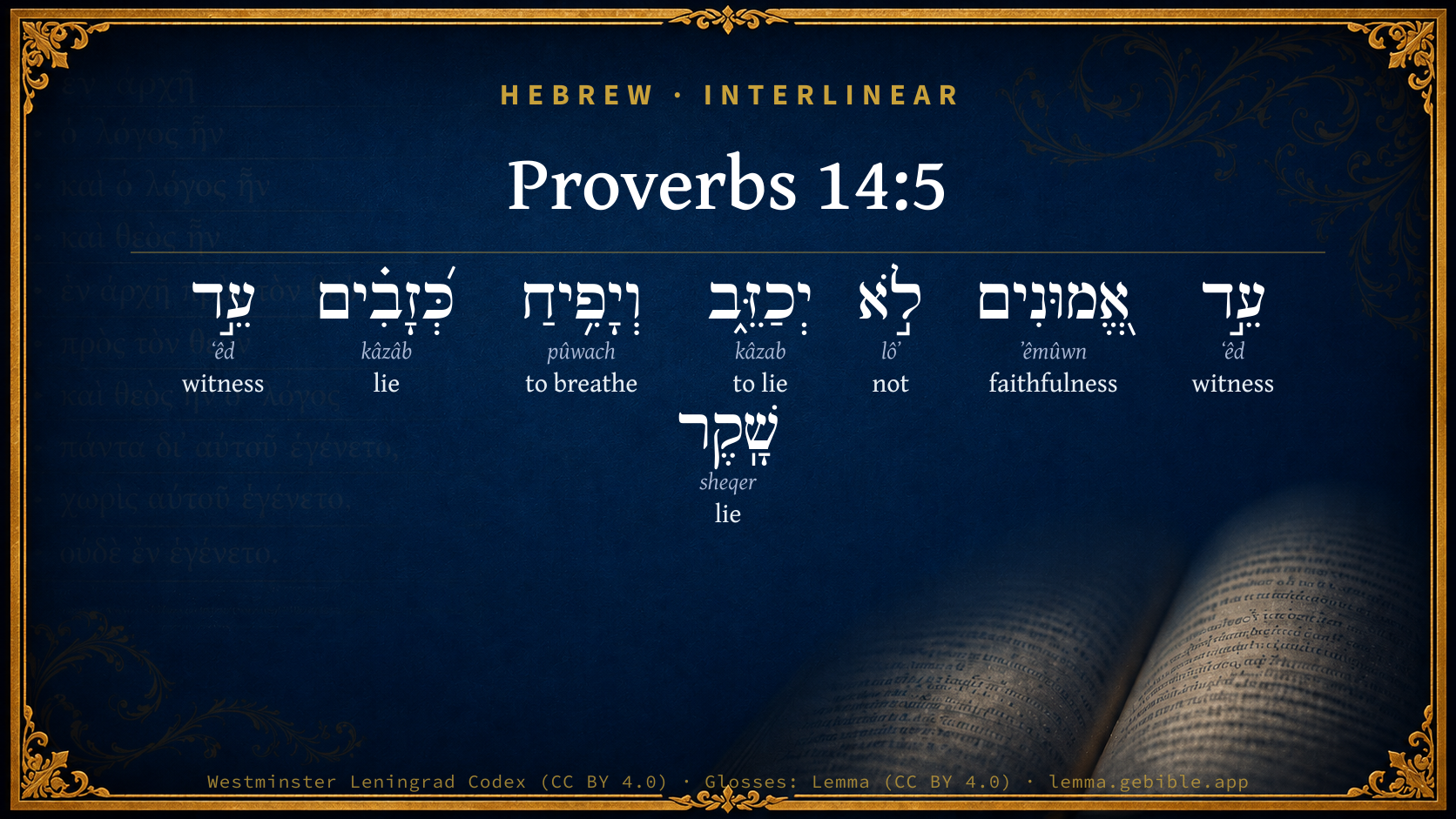
Proverbs 14:5

Hebrew (Westminster Leningrad Codex) Proverbs 14:5 appears in the Hebrew Old Testament. The text above is from the Westminster Leningrad Codex. Each word links to its Strong’s number, a concise gloss, and parsing drawn from the Open Scriptures Hebrew Bible morphology. Click any word for its full Brown-Driver-Briggs (BDB) entry.
Download image
Cite this verse

Proverbs 14:5 (World English Bible). Public Domain. Lemma interlinear Bible study tool, https://lemma.gebible.app/v/proverbs/14/5.

Show BibTeX & RIS
BibTeX
RIS
English Translation
A truthful witness will not lie, But a false witness pours out lies.
World English Bible · Public Domain
Download a study sheet

One document with this verse’s original text, its word-by-word gloss line, the meaning frame, cross-references with their text, attributed commentary, and full source and license credits — printable, and it pastes into notes with its structure intact.

This verse Autodidact and up

Study sheet (.html) Plain text (.txt)

A passage Seminary Student

Up to 50 verses in one chapter. A passage sheet keeps up to 6 commentary sources and 12 cross-references per verse, in the order this page ranks them, and says so on the sheet whenever that leaves anything out. Ask for a single verse and you get the Autodidact verse sheet above.

Everything on this page stays free to read, with no account — the sheet is a download of what is already on screen, not access to it.

Want to remove ads? Support Godless Engineer
Compare translations 3

The same verse in 3 English versions, stacked beneath the original-language interlinear above. Click any original word for its lexicon entry.

Each is an independent rendering of the whole verse — the interlinear is not word-aligned to these translations.

Highlighted words mark where these versions differ — a whole-verse word diff, not a word-by-word alignment.

  • World English Bible Public Domain
    A truthful witness will not lie, But a false witness pours out lies.
  • King James Version Public Domain
    A faithful witness will not lie: but a false witness will utter lies.
  • unfoldingWord Literal Text CC BY-SA 4.0
    A witness of faithfulness will not lie, but a witness of falsehood breathes out lies.

unfoldingWord Literal Text — © unfoldingWord, licensed CC BY-SA 4.0. Word-aligned USFM3 via Door43 (git.door43.org/unfoldingWord/en_ult).

Versions to compare (up to 4)

3 of 4 selected

Show all 18 translations

Every available English version of this verse, each an independent rendering of the whole verse.

  • World English Bible Public Domain
    A truthful witness will not lie, But a false witness pours out lies.
  • Berean Standard Bible Public Domain
    An honest witness does not deceive, but a dishonest witness pours forth lies.
  • Majority Standard Bible Public Domain
    An honest witness does not deceive, but a dishonest witness pours forth lies.
  • King James Version Public Domain
    A faithful witness will not lie: but a false witness will utter lies.
  • American Standard Version (1901) Public Domain
    A faithful witness will not lie; But a false witness uttereth lies.
  • Revised Version (1885) Public Domain
    A faithful witness will not lie: but a false witness uttereth lies.
  • Geneva Bible (1599) Public Domain
    A faithfull witnes will not lye: but a false record will speake lyes.
  • Douay-Rheims (1899) Public Domain
    A faithful witness will not lie: but a deceitful witness uttereth a lie.
  • Young's Literal Translation Public Domain
    A faithful witness lieth not, And a false witness breatheth out lies.
  • Literal Standard Version CC BY-SA 4.0
    A faithful witness does not lie, || And a false witness breathes out lies.
  • Unlocked Literal Bible CC BY-SA 4.0
    A faithful witness does not lie, but a false witness breathes out lies.
  • unfoldingWord Literal Text CC BY-SA 4.0
    A witness of faithfulness will not lie, but a witness of falsehood breathes out lies.
  • Darby Bible Public Domain
    A faithful witness will not lie; but a false witness uttereth lies.
  • World Messianic Bible Public Domain
    A truthful witness will not lie, but a false witness pours out lies.
  • Webster's Bible Public Domain
    A faithful witness will not lie: but a false witness will utter lies.
  • Free Bible Version CC BY-SA 4.0
    A trustworthy witness doesn't lie, but a false witness is deceptive.
  • Bible in Basic English Public Domain
    A true witness does not say what is false, but a false witness is breathing out deceit.
  • JPS Tanakh (1917) Public Domain
    A faithful witness will not lie; but a false witness breatheth forth lies.

Literal Standard Version (2020), Covenant Press — licensed CC BY-SA 4.0. Text via the HelloAO Bible API (eBible.org). Unlocked Literal Bible (unfoldingWord) — licensed CC BY-SA 4.0. Text via the HelloAO Bible API (eBible.org). unfoldingWord Literal Text — © unfoldingWord, licensed CC BY-SA 4.0. Word-aligned USFM3 via Door43 (git.door43.org/unfoldingWord/en_ult). Free Bible Version, Dr. Jonathan Gallagher — licensed CC BY-SA 4.0. Text via the HelloAO Bible API (eBible.org).

Word by word

More ways to search: Search by grammar → Find every occurrence → Compare this word →

Practice this passage: Drill this verse → Learn its vocabulary →

About this verse

These counts appear in no published source. They are computed here, from the morphology-tagged text and Lemma’s own curated glosses. What Lemma adds →

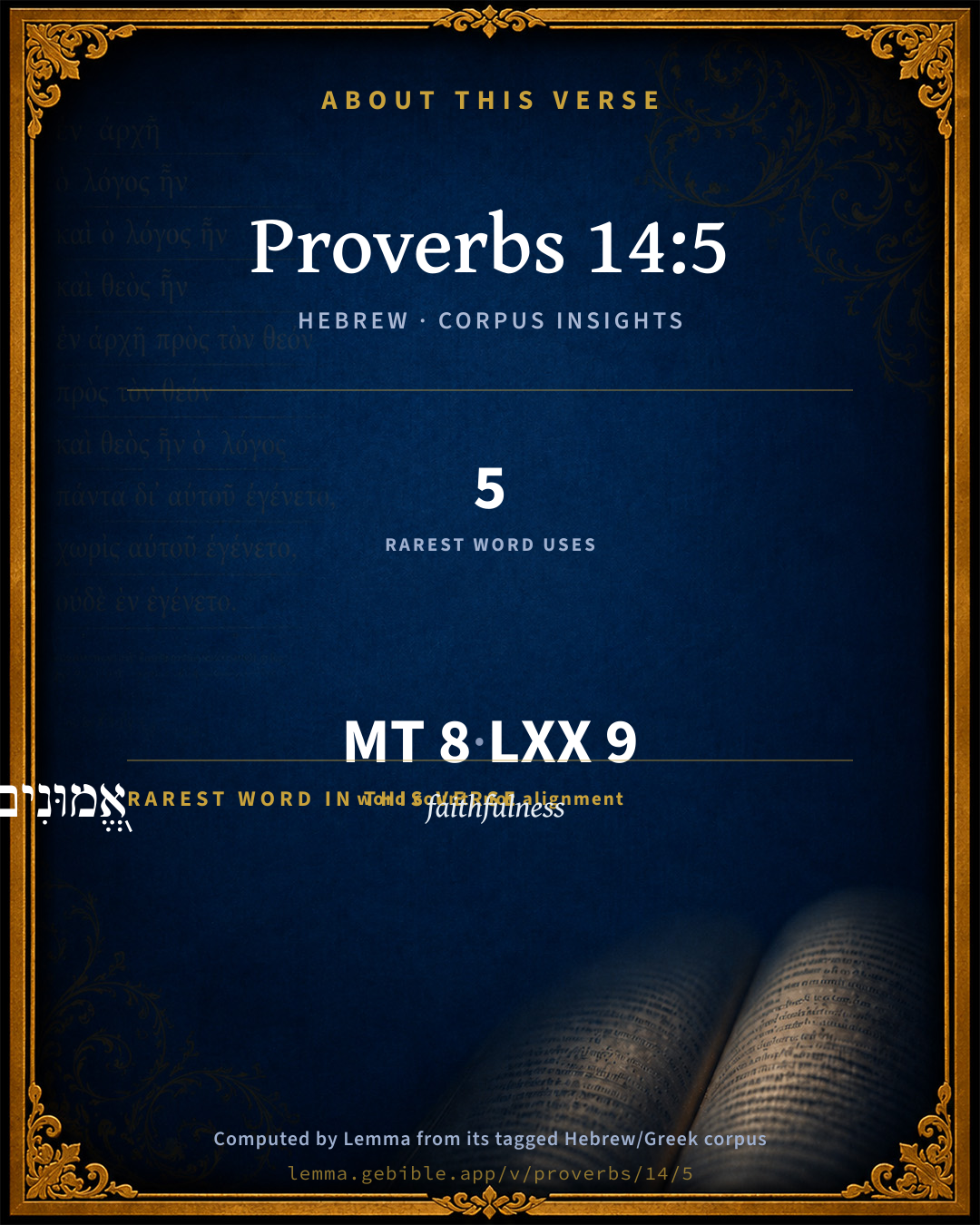
8
words
7
distinct lemmas
Wisdom
section

Notable vocabulary

The rarest word here is אֱ֭מוּנִים faithfulness H529 — appearing just 5 times in the whole Hebrew Bible.

Shared distinctive vocabulary

אֱ֭מוּנִים faithfulness H529 occurs in 5 verses of the Hebrew Bible. Also found in:

Grammatical profile

  • 2 verbs
  • 5 nouns
  • 1 particle

Verb forms

  • יְכַזֵּ֑ב Piel · Imperfect
  • וְיָפִ֥יחַ Hiphil · Imperfect

Repetition

A word recurs within this verse — often emphatic in Hebrew:

  • עֵ֣ד witness H5707 ×2

Hebrew & Septuagint length

In English translation the verse runs 13 words from the Hebrew and 12 from the Septuagint (LXX English) — closely comparable.

A rough comparison of the two English renderings, which tokenize alike — not a word-level alignment.

Word counts can differ between the Hebrew and the Greek without any difference in meaning — e.g. the Hebrew direct-object marker אֵת has no separate Greek word, and Greek often adds the article ὁ.

In the original languages it is 8 Hebrew tokens and 9 Greek tokens — but the two are counted differently (Hebrew bundles its prefixes and suffixes into one token; the Greek is in lemma form), so that isn’t a like-for-like length.

Cross-references

10

Topical passages linked to Proverbs 14:5 in the Treasury of Scripture Knowledge — connected by theme and wording, ordered by reader-vote popularity; previews shown in the World English Bible.

  • Exodus 23:1 "You shall not spread a false report. Don't join your hand with the wicked to be a malicious witness.
  • Proverbs 6:19 A false witness who utters lies, And he who sows discord among brothers.
  • Proverbs 19:5 A false witness shall not be unpunished. He who pours out lies shall not go free.
  • Proverbs 12:17 He who is truthful testifies honestly, But a false witness lies.
  • Proverbs 14:25 A truthful witness saves souls, But a false witness is deceitful.
  • 1 Kings 22:12–14 All the prophets prophesied so, saying, Go up to Ramoth-gilead, and prosper; for Yahweh will deliver it into the hand of the king.
  • Proverbs 13:5 A righteous man hates lies, But a wicked man brings shame and disgrace.
  • Proverbs 19:9 A false witness shall not be unpunished. He who utters lies shall perish.
  • Exodus 20:16 "You shall not give false testimony against your neighbor.
  • 1 Kings 21:13 The two men, the base fellows, came in and sat before him: and the base fellows bore witness against him, even against Naboth, in the presence of the people, saying, Naboth did curse God and the king. Then they carried him forth out of the city, and stoned him to death with stones.

Cross-references courtesy of OpenBible.info (CC BY 4.0).

Hebrew and Greek witnesses Masoretic Hebrew ↔ Greek Septuagint

The same verse in the two great witnesses to the Old Testament, shown verse-for-verse.

These are two independent witnesses, not word-aligned to each other, and the Septuagint is shown in lemma (dictionary) form.

Hebrew Proverbs 14:5 Masoretic · Westminster Leningrad Codex

עֵ֣ד אֱ֭מוּנִים לֹ֣א יְכַזֵּ֑ב וְיָפִ֥יחַ כְּ֝זָבִ֗ים עֵ֣ד שָֽׁקֶר

A truthful witness will not lie, But a false witness pours out lies.

World English Bible · Public Domain

Greek LXX Proverbs 14:5 Septuagint · lemma form

μάρτυς πιστός οὐ ψεύδω ἐκκαίω δέ ψευδής μάρτυς ἄδικος

A faithful witness does not lie; but an unjust witness kindles falsehoods.

LXX2012 (modern English Septuagint) · Public Domain

On this verse, The Cambridge Bible for Schools and Colleges discusses the Septuagint’s reading. Read the note in Commentary ↓

Hebrew: Westminster Leningrad Codex (CC BY 4.0). Greek: Septuagint (public domain); English from LXX2012 (modern English Septuagint) (Public Domain). How the Septuagint differs from the Hebrew →

Commentary

Notes on Proverbs 14:5 from classic Christian and Jewish commentators (each source and its license shown beneath its notes). The classic Christian expositions comment on the surrounding passage and are grouped to its opening verse, so a note may address several verses; the Jewish commentaries on the Tanakh (Rashi and others) are per-verse, so they appear only where the commentator wrote on this verse.

Lemma curates 59 commentaries, every one of them public domain or Creative Commons licensed, each selected and text-cleaned for this edition rather than reprinted as found. About our sources →

Trapp's Complete Commentary

John Trapp

Pro 14:5 A faithful witness will not lie: but a false witness will utter lies.

Ver. 5. A faithful witness will not lie.] Nec prece nec precio, he cannot lend an oath for a need before a magistrate. Nay, he will not lie upon any condition. {See Trapp on "Pro 13:5"}

But a false witness will utter lies.] Or, He that telleth lies will be a false witness - he that makes light of a lie will not stick at perjury. That was a foul blur to the Romans of old, if true, that Mirrhanes the Persian general chargeth upon them, Romanis promittere promptum est, promissis autem quanqum iuramento firmatis minime stare; { a} the Romans will presently promise anything, but perform no promise though confirmed with an oath. Of the Romists at this day it is written by an Italian, no stranger to the court of Rome, that their proverb is, Mercatorum est, non regum, stare iuramentis; It is for merchants, not for princes, to stand to what they have sworn. Fides cum hereticis non est servanda is their position, and their practice is accordingly. They play with oaths as the monkey doth with his collar, which he doth slip on for his master’s pleasure, and slip off again for his own. Pascenius scoffs King James for the invention of the oath of allegiance.

{a} Procop., lib. i. de bello Persico.

John Trapp, A Commentary or Exposition upon All the Books of the Old and New Testament (1647–1656) — public domain. Text from a community e-Sword module.

The Biblical Illustrator

Joseph S. Exell

Pro_14:5

A faithful witness will not lie.

A true witness

Truth is beautiful, as well as safe and mighty. In the incident related below a boy twelve years old, with only truth as a weapon, conquered a smart and shrewd lawyer, who was fighting for a bad cause. Truth is the highest thing that man may keep, and the noblest child or man is he that keeps the truth ever between his lips. Walter was the important witness in a lawsuit. One of the lawyers, after cross-questioning him severely, said, Your father has been talking to you and telling you how to testify, hasnt he? Yes, said the boy. Now, said the lawyer, just tell us how your father told you to testify. Well, said the boy modestly, father told me that the lawyers would try and tangle me in my testimony; but if I would just be careful and tell the truth, I could tell the same thing every time. The lawyer didnt try to tangle that boy any more. (The Fireside News.)

Falsehood and flaw

What a flaw is in steel, what a foreign substance is in any texture, that a falsehood is to the character, a source of weakness, a point where under strain it may break. (Newman Smyth.)

The Biblical Illustrator, edited by Joseph S. Exell (c. 1880s–1900s) — public domain. Text from a community e-Sword module.

Keil & Delitzsch

C. F. Keil & F. Delitzsch

Striking if also accidental is the frequency of the א and ב in Pro 14:4. This is continued in Pro 14:5, where the collector gives two proverbs, the first of which commences with a word beginning with א, and the second with one beginning with ב:

5 A faithful witness does not speak untruth;

But a lying witness breathes out falsehoods.

The right vocalization and sequence of the accents is בּקּשׁ לץ חכמה (ק with Tsere and the servile Mahpach, חכמה with Munach, because the following Athnach-word has not two syllables before the tone). As in 5a עד אמוּנים, so in 5b עד שׁקר is the subject. Different is the relation of subject and predicate in the second line of the parallel proverbs, Pro 14:25, Pro 19:5. With 5a cf. ציר אמוּנים, Pro 13:17; and regarding יפיח (one who breathes out), vid., at Pro 6:19; Pro 12:17.

Keil & Delitzsch — Biblical Commentary on the Old Testament (1861–1891) — public domain (CC PDM 1.0). Text via the HelloAO Bible API. (Old Testament only.)

Tyndale Open Study Notes

Tyndale Open Resources

14:5 Honest speech and lies both flow from deep within a person’s character. Cp. 12:17.

Tyndale Open Study Notes — © Tyndale Open Resources, licensed CC BY-SA 4.0. Text via the HelloAO Bible API.

Matthew Henry's Commentary

In the administration of justice much depends upon the witnesses, and therefore it is necessary to the common good that witnesses be principled as they ought to be; for, 1. A witness that is conscientious will not dare to give in a testimony that is in the least untrue, nor, for good-will or ill-will, represent a thing otherwise than according to the best of his knowledge, whoever is pleased or displeased, and then judgment runs down like a river. 2. But a witness that will be bribed, and biassed, and browbeaten, will utter lies (and not stick nor startle at it), with as much readiness and assurance as if what he said were all true.

Matthew Henry's Commentary on the Whole Bible (1708–1710) — public domain (CC PDM 1.0). Text via the HelloAO Bible API.

Jamieson, Fausset & Brown

Robert Jamieson, A. R. Fausset & David Brown

A faithful witness, &c.--one tested to be such.

utter lies--or, "breathe out lies"--that is, habitually lies (Pro 6:19; compare Act 9:1). Or the sense is, that habitual truthfulness, or lying, will be evinced in witness-bearing.

Jamieson, Fausset & Brown — Commentary Critical and Explanatory on the Whole Bible (1871) — public domain (CC PDM 1.0). Text via the HelloAO Bible API.

The Cambridge Bible for Schools and Colleges

gen. ed. J. J. S. Perowne

5. will utter] uttereth, R.V., “Heb. breatheth out” marg.; ἐκκαίει ψευδῆ, LXX., in the sense of kindleth, bloweth into flame.

The Cambridge Bible for Schools and Colleges (gen. ed. J. J. S. Perowne; Cambridge University Press, 1878–1918) — public domain. Text from a community e-Sword module.

John Gill's Exposition

A faithful witness will not lie,.... For that would be contrary to his character as faithful; and as he will not witness to a falsehood upon oath in a court of judicature, so neither will he tell a lie in common conversation. This may be applied to Gospel ministers, who are witnesses of Christ; the Gospel they preach is a testimony concerning him, and they bear a faithful witness to the truth; nor will they, knowingly and willingly, deliver out a falsehood, or a doctrinal lie, since "no lie is of the truth", Jo1 2:21; the character of a faithful witness is given to Christ, Rev 1:5; who is a "witness" of his father's love and grace, of his mind and will, and of the doctrines of the Gospel relating to himself, and the method of salvation by him; and he is "faithful" to him that appointed him; nor can he nor will he lie, for he is "truth" itself;

but a false witness will utter lies; or "blow" (e) them out, and spread them abroad in great plenty; he will not stick to tell them, and, having no conscience, will utter them as fast as he can, with all boldness and confidence; for one that fears not to bear testimony to a falsehood upon oath, will not scruple to lie in common talk. Or the words, "nay" be rendered, "he that uttereth lies will be a false witness"; he that accustoms himself to lying, in his conversation with men in private company, will become a false witness upon occasion in a public court of judicature: such an one is not to be depended on; lesser sins lead to greater, lying to perjury. So false teachers, and the followers of the man of sin, speak lies in hypocrisy, doctrinal ones, which they are given up to believe; and such as do so are false witnesses, deceivers, and antichrist.

(e) "efflabit", Montanus; "efflat", Junius & Tremellius, Piscator.

John Gill's Exposition of the Whole Bible (1746–1763) — public domain (CC PDM 1.0). Text via the HelloAO Bible API.

Matthew Poole's English Annotations

Will not lie, to wit, in common discourse and conversation, whereby he showeth his love to truth, and giveth assurance that when he is called to be a witness, he will be true and faithful.

But a false witness will utter lies; or, as the words lie in the Hebrew, and or but he that

will utter lies (that accustometh himself to lying) is or will be a false witness, when occasion requires it. Having debauched his conscience by daily lying, he is thereby prepared and disposed to false witness-bearing. Compare Pro 12:17.

Matthew Poole's English Annotations on the Holy Bible (1683–1685) — public domain. Text from a community e-Sword/MySword module.

Whedon's Commentary on the Bible

Daniel D. Whedon

5. A false witness will utter lies — Better, he that breathes forth falsehood is a lying witness; that is, a man to whom falsehood is habitual will be apt to testify falsely when called as a witness. Hence the rule of courts of excluding the testimony of one who is not “a man of common veracity.” Compare Pro_12:17; Exo_20:16; Exo_23:1. Miller insists, contrary to the common opinion, that עד שׁקר, (‘hedh sheker,) means a deceived witness.

Daniel D. Whedon (gen. ed.), Commentary on the Old and New Testaments (1874–1909) — public domain. Text from a community e-Sword module.

The Pulpit Commentary

A repetition of Pro_12:17. (see also Pro_6:19) A faithful witness cannot be induced to swerve from the truth by threat or bribe. Will utter; Hebrew, breatheth forth. A false witness with no compulsion, as it were naturally, puts forth lies. (comp. ver. 25; Pro_19:5) Septuagint, "An unrighteous witness kindleth (ekkaiei ) falsehood."

The Pulpit Commentary (1880–1919), ed. H.D.M. Spence-Jones & Joseph S. Exell — public domain. Text from a community e-Sword module.

Bridges on Proverbs

Charles Bridges

This might seem to be a truism, unworthy of inspiration. But a closer inspection brings out a valuable maxim of practical wisdom. A faithful witness is moved neither by entreaties nor bribes, neither by promises nor threats, to swerve from truth. He is the man to trust. He will not lie. But a false witness has lost all principle of truth. He will utter lies, without any inducement but his own interest or pleasure. Flee from his very breath. (Pro 25:19 .)

The faithful witness answers God’s requirements. (Psa 51:6 .) He is therefore his delight. (Joh 1:47 .) He is the citizen of the heavenly Zion (Psa 15:2 ; Isa 33:15 ), and the ornament of godliness. (Php 4:8 .) In the Sacred Office he will not lie. His spirit is firm and independent. His message is full and transparent truth. (1Th 2:3-4 .) But the false witness is a true child of "the father of lies." (Joh 8:44 . 1Ki 21:13 .) Awful indeed is his utterance in common life (Pro 25:18 ); more awful in the profession of the gospel (Act 5:1-4 ); awful beyond conception in the Sanctuary. (Jer 5:31 .) A minister of God in his commission! a minister of Satan in his work! (2Co 11:13-15 ) delivering a lying message; "subverting the gospel of Christ" (Gal 1:7 ), to the destruction of his people, to the double destruction of his own soul.

Thus "the good and the corrupt tree," each brings forth its own fruit. (Mat 7:17-18 .) Let us remember, that our principles, good and evil, are exemplified in the most trivial transactions, and gather strength from the slightest, as well as from the most important, exercise. (Luk 16:10 .)

Charles Bridges, An Exposition of the Book of Proverbs (1846) — public domain. Text from a community e-Sword module.

Kretzmann's Popular Commentary

Paul E. Kretzmann

v. 5. A faithful witness will not lie, he will not utter falsehoods to bolster up a weak case; but a false witness will utter lies, will habitually make use of them in gaining his ends. Pro 12:17; Pro 6:19.

Paul E. Kretzmann, Popular Commentary of the Bible (1921–1924) — public domain. Text from a community e-Sword module.

unfoldingWord translationNotes

Door43 World Missions Community

breathes out lies

This figure of speech uses "breathes" to refer to lying constantly. AT: "constantly lies" (See: Idiom) See how you translated this phrase in Proverbs 6:19.

and there is none

"and wisdom is not there" or "but he will not find wisdom"

comes easy to

"is easily found by" or "acquires without difficulty"

the one who is discerning

"the one who is wise" or "a person who has understanding"

translationWords

faithful

testimony

corrupt witness

mock

wise

know

unfoldingWord translationNotes — © Distant Shores Media and the Door43 World Missions Community, licensed CC BY-SA 4.0. Source: git.door43.org/Door43/en_tn.

Rashi

Rabbi Shlomo Yitzchaki (Rashi)

but he who speaks lies and always speaks lies, is a false witness.

Rashi on the Tanakh — English translations: “The Judaica Press complete Tanach with Rashi, translated by A. J. Rosenberg” (CC BY 4.0); “Pentateuch with Rashi's commentary by M. Rosenbaum and A.M. Silbermann, 1929-1934” (public domain); “The Metsudah Tanach series, Lakewood, N.J” (CC BY 4.0); and “The Book of Joshua, Metsudah Publications, 1997” (CC BY 4.0). Text via Sefaria.

Lesson kit

Teaching starters — assembled from the data on this page, not authored interpretation. Every prompt links to the verse data it draws on. Edit before teaching.

Proverbs, in the Wisdom, opens this verse with 8 words (7 distinct Hebrew lemmas). Its most distinctive word is ʼêmûwn (“faithfulness”). A historical commentator’s framing appears above. Read the whole chapter for the surrounding context.

Discussion questions

  1. What does “faithfulness” (ʼêmûwn) contribute to the verse as a whole?
  2. How does Deuteronomy 32:20, which shares the word «faithfulness», read alongside this verse?
  3. What does the repetition of “witness” (2× in this one verse) do in this verse?
  4. These translations render this verse differently. What is at stake in choosing one wording over another?
  5. «יְכַזֵּ֑ב» is a Piel Imperfect verb. How does that grammatical form shape the action described?
  6. Compare how Trapp's Complete Commentary and The Biblical Illustrator read this verse. Where do they agree or differ?

Things to notice

Reading settings

Reading text

Shown beneath each verse's original-language words.

Old Testament
Old Testament edition

Read the OT as the Masoretic Hebrew (MT) or the Greek Septuagint (LXX).

English shown for the Greek Septuagint (in the Hebrew ↔ Greek comparison).

Comparing translations? Open the Compare panel on any verse page to stack up to four side by side.