
Jeremiah 29:31

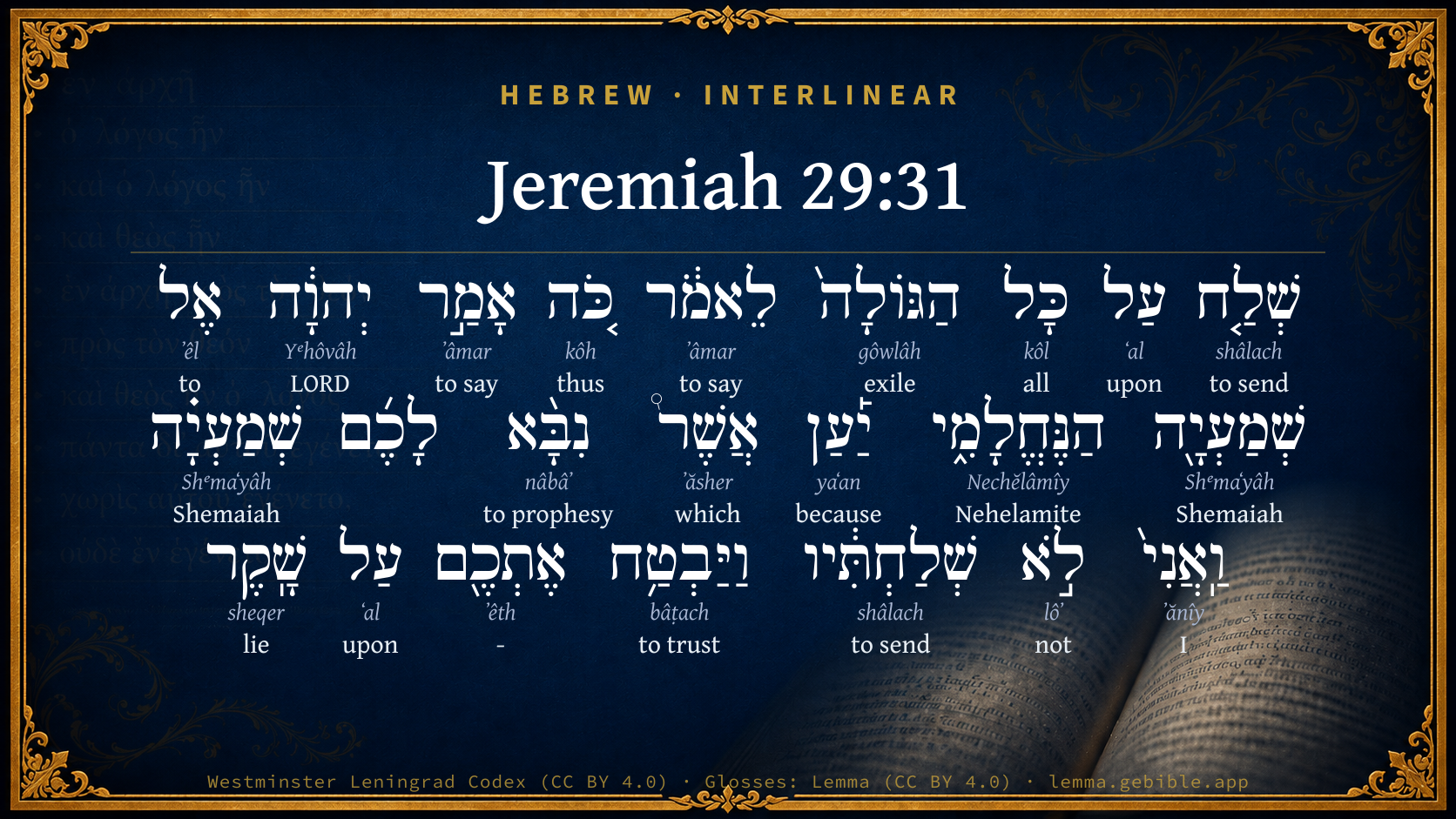
Hebrew (Westminster Leningrad Codex) Jeremiah 29:31 appears in the Hebrew Old Testament. The text above is from the Westminster Leningrad Codex. Each word links to its Strong’s number, a concise gloss, and parsing drawn from the Open Scriptures Hebrew Bible morphology. Click any word for its full Brown-Driver-Briggs (BDB) entry.
Download image
Cite this verse

Jeremiah 29:31 (World English Bible). Public Domain. Lemma interlinear Bible study tool, https://lemma.gebible.app/v/jeremiah/29/31.

Show BibTeX & RIS
BibTeX
RIS
English Translation
Send to all them of the captivity, saying, Thus says Yahweh concerning Shemaiah the Nehelamite: Because Shemaiah has prophesied to you, and I didn't send him, and he has caused you to trust in a lie;
World English Bible · Public Domain
Download a study sheet

One document with this verse’s original text, its word-by-word gloss line, the meaning frame, cross-references with their text, attributed commentary, and full source and license credits — printable, and it pastes into notes with its structure intact.

This verse Autodidact and up

Study sheet (.html) Plain text (.txt)

A passage Seminary Student

Up to 50 verses in one chapter. A passage sheet keeps up to 6 commentary sources and 12 cross-references per verse, in the order this page ranks them, and says so on the sheet whenever that leaves anything out. Ask for a single verse and you get the Autodidact verse sheet above.

Everything on this page stays free to read, with no account — the sheet is a download of what is already on screen, not access to it.

Want to remove ads? Support Godless Engineer
Compare translations 3

The same verse in 3 English versions, stacked beneath the original-language interlinear above. Click any original word for its lexicon entry.

Each is an independent rendering of the whole verse — the interlinear is not word-aligned to these translations.

Highlighted words mark where these versions differ — a whole-verse word diff, not a word-by-word alignment.

  • World English Bible Public Domain
    Send to all them of the captivity, saying, Thus says Yahweh concerning Shemaiah the Nehelamite: Because Shemaiah has prophesied to you, and I didn't send him, and he has caused you to trust in a lie;
  • King James Version Public Domain
    Send to all them of the captivity, saying, Thus saith the LORD concerning Shemaiah the Nehelamite; Because that Shemaiah hath prophesied unto you, and I sent him not, and he caused you to trust in a lie:
  • unfoldingWord Literal Text CC BY-SA 4.0
    “Send word to all the exiles and say, ‘Yahweh says this about Shemaiah the Nehelamite: Because Shemaiah has prophesied to you when I myself did not send him, and he has led you to believe lies,

unfoldingWord Literal Text — © unfoldingWord, licensed CC BY-SA 4.0. Word-aligned USFM3 via Door43 (git.door43.org/unfoldingWord/en_ult).

Versions to compare (up to 4)

3 of 4 selected

Show all 18 translations

Every available English version of this verse, each an independent rendering of the whole verse.

  • World English Bible Public Domain
    Send to all them of the captivity, saying, Thus says Yahweh concerning Shemaiah the Nehelamite: Because Shemaiah has prophesied to you, and I didn't send him, and he has caused you to trust in a lie;
  • Berean Standard Bible Public Domain
    “Send a message telling all the exiles what the LORD says concerning Shemaiah the Nehelamite. Because Shemaiah has prophesied to you—though I did not send him—and has made you trust in a lie,
  • Majority Standard Bible Public Domain
    “Send a message telling all the exiles what the LORD says concerning Shemaiah the Nehelamite. Because Shemaiah has prophesied to you—though I did not send him—and has made you trust in a lie,
  • King James Version Public Domain
    Send to all them of the captivity, saying, Thus saith the LORD concerning Shemaiah the Nehelamite; Because that Shemaiah hath prophesied unto you, and I sent him not, and he caused you to trust in a lie:
  • American Standard Version (1901) Public Domain
    Send to all them of the captivity, saying, Thus saith Jehovah concerning Shemaiah the Nehelamite: Because that Shemaiah hath prophesied unto you, and I sent him not, and he hath caused you to trust in a lie;
  • Revised Version (1885) Public Domain
    Send to all them of the captivity, saying, Thus saith the LORD concerning Shemaiah the Nehelamite: Because that Shemaiah hath prophesied unto you, and I sent him not, and he hath caused you to trust in a lie;
  • Geneva Bible (1599) Public Domain
    Send to all them of the captiuitie, saying, Thus saith the Lord of Shemaiah the Nehelamite, Because that Shemaiah hath prophecied vnto you, and I sent him not, and hee caused you to trust in a lye,
  • Douay-Rheims (1899) Public Domain
    Send to all them of the captivity, saying: Thus saith the Lord to Semeias the Nehelamite: Because Semeias hath prophesied to you, and I sent him not: and hath caused you to trust in a lie:
  • Young's Literal Translation Public Domain
    `Send unto all the removal, saying, Thus said Jehovah concerning Shemaiah the Nehelamite, Because that Shemaiah prophesied to you, and I -- I have not sent him, and he doth cause you to trust on falsehood,
  • Literal Standard Version CC BY-SA 4.0
    “Send to all the expulsion, saying, Thus said YHWH concerning Shemaiah the Nehelamite: Because that Shemaiah prophesied to you, and I have not sent him, and he causes you to trust on falsehood,
  • Unlocked Literal Bible CC BY-SA 4.0
    “Send word to all the exiles and say, 'Yahweh says this about Shemaiah the Nehelamite: Because Shemaiah has prophesied to you when I myself did not send him, and he has led you to believe lies,
  • unfoldingWord Literal Text CC BY-SA 4.0
    “Send word to all the exiles and say, ‘Yahweh says this about Shemaiah the Nehelamite: Because Shemaiah has prophesied to you when I myself did not send him, and he has led you to believe lies,
  • Darby Bible Public Domain
    Send to all them of the captivity, saying, Thus saith Jehovah concerning Shemaiah the Nehelamite: Because that Shemaiah hath prophesied unto you, and I sent him not, and he hath caused you to trust in falsehood;
  • World Messianic Bible Public Domain
    “Send to all of the captives, saying, ‘The LORD says concerning Shemaiah the Nehelamite: “Because Shemaiah has prophesied to you, and I didn’t send him, and he has caused you to trust in a lie,”
  • Webster's Bible Public Domain
    Send to all them of the captivity, saying, Thus saith the LORD concerning Shemaiah the Nehelamite; Because Shemaiah hath prophesied to you, and I sent him not, and he caused you to trust in a lie:
  • Free Bible Version CC BY-SA 4.0
    Send this message to all the exiles: This is what the Lord says about Shemaiah the Nehelamite. Since Shemaiah has prophesied to you, even though I didn't send him, and has convinced you to believe in a lie,
  • Bible in Basic English Public Domain
    Send to all those who have been taken away, saying, This is what the Lord has said about Shemaiah the Nehelamite: Because Shemaiah has been acting as a prophet to you, and I did not send him, and has made you put your faith in what is false;
  • JPS Tanakh (1917) Public Domain
    Send to all them of the captivity, saying: Thus saith the LORD concerning Shemaiah the Nehelamite: Because that Shemaiah hath prophesied unto you, and I sent him not, and he hath caused you to trust in a lie;

Literal Standard Version (2020), Covenant Press — licensed CC BY-SA 4.0. Text via the HelloAO Bible API (eBible.org). Unlocked Literal Bible (unfoldingWord) — licensed CC BY-SA 4.0. Text via the HelloAO Bible API (eBible.org). unfoldingWord Literal Text — © unfoldingWord, licensed CC BY-SA 4.0. Word-aligned USFM3 via Door43 (git.door43.org/unfoldingWord/en_ult). Free Bible Version, Dr. Jonathan Gallagher — licensed CC BY-SA 4.0. Text via the HelloAO Bible API (eBible.org).

Word by word

More ways to search: Search by grammar → Find every occurrence → Compare this word →

Practice this passage: Drill this verse → Learn its vocabulary →

הַנֶּחֱלָמִ֑י
Nechĕlâmîy
H5161
“the · Nehelamite”
Particle, Definite Article + Noun, Gentilic, Masculine, Singular, Absolute
Part of Speech
Particle + Noun
Type
Gentilic
Gender
Masculine
Number
Singular
State
Absolute
Full BDB Definition

Origin: apparently a patronymic from an unused name (apparently pass. participle of H2492 )

TWOT: None

Nehelamite = "he of the dream" - the designation of a false prophet Shemaiah taken into captivity to Babylon; name is formed from his native place or his progenitor
  1. שְׁלַ֤ח shâlach H7971 “send” Verb, Qal, Imperative, 2nd Person, Masculine, Singular
  2. עַל ʻal H5921 “upon” Preposition
  3. כָּל kôl H3605 “all of” Noun, Common, Masculine, Singular, Construct
  4. הַגּוֹלָה֙ gôwlâh H1473 “the · exile” Particle, Definite Article + Noun, Common, Feminine, Singular, Absolute
  5. לֵאמֹ֔ר ʼâmar H559 “to say” Preposition + Verb, Qal, Infinitive Construct
  6. כֹּ֚ה kôh H3541 “thus” Adverb
  7. אָמַ֣ר ʼâmar H559 “to say” Verb, Qal, Perfect, 3rd Person, Masculine, Singular
  8. יְהוָ֔ה Yᵉhôvâh H3068 “LORD” Noun, Proper
  9. אֶל ʼêl H413 “to” Preposition
  10. שְׁמַעְיָ֖ה Shᵉmaʻyâh H8098 “Shemaiah” Noun, Proper
  11. יַ֡עַן yaʻan H3282 “because” Conjunction
  12. אֲשֶׁר֩ ʼăsher H834 “which” Particle, Relative
  13. נִבָּ֨א nâbâʼ H5012 “to prophesy” Verb, Niphal, Perfect, 3rd Person, Masculine, Singular
  14. שְׁמַעְיָ֗ה Shᵉmaʻyâh H8098 “Shemaiah” Noun, Proper
  15. וַֽאֲנִי֙ ʼănîy H589 “and · I” Conjunction + Pronoun, Personal, 1st Person, Common, Singular
  16. לֹ֣א lôʼ H3808 “not” Particle, Negative
  17. שְׁלַחְתִּ֔יו shâlach H7971 “to send · him” Verb, Qal, Perfect, 1st Person, Common, Singular + Suffix, Personal, 3rd Person, Masculine, Singular
  18. וַיַּבְטַ֥ח bâṭach H982 “and · to trust” Conjunction + Verb, Hiphil, Sequential Imperfect, 3rd Person, Masculine, Singular
  19. אֶתְכֶ֖ם ʼêth H853 “- · you” Particle, Direct Object + Suffix, Personal, 2nd Person, Masculine, Plural
  20. עַל ʻal H5921 “upon” Preposition
  21. שָֽׁקֶר sheqer H8267 “lie” Noun, Common, Masculine, Singular, Absolute

About this verse

These counts appear in no published source. They are computed here, from the morphology-tagged text and Lemma’s own curated glosses. What Lemma adds →

23
words
18
distinct lemmas
Prophets
section

Notable vocabulary

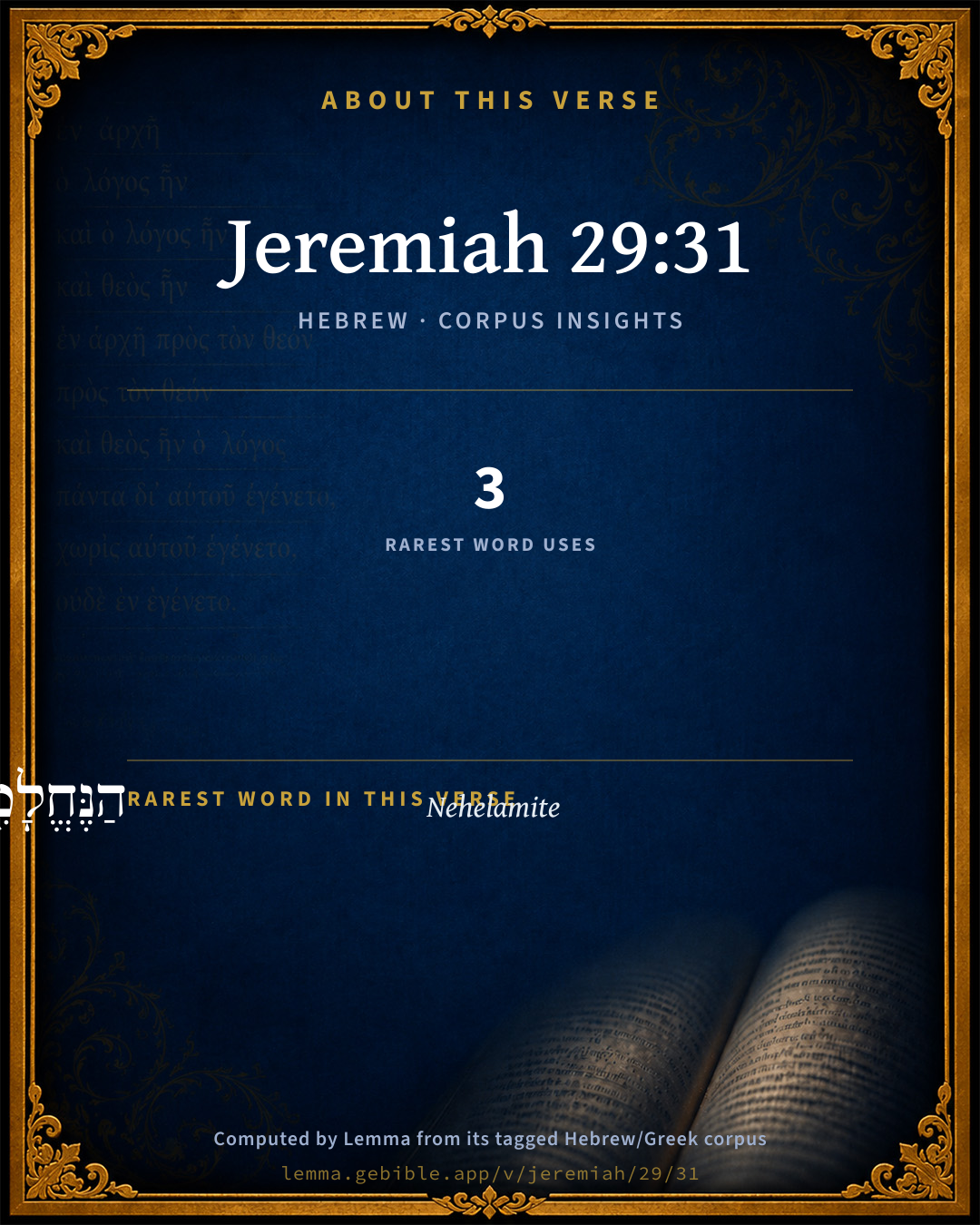
The rarest word here is הַנֶּחֱלָמִ֑י Nehelamite H5161 — appearing just 3 times in the whole Hebrew Bible.

Shared distinctive vocabulary

הַנֶּחֱלָמִ֑י Nehelamite H5161 occurs in 3 verses of the Hebrew Bible. Also found in:

Grammatical profile

  • 6 verbs
  • 7 nouns
  • 1 pronoun
  • 4 prepositions
  • 1 conjunction
  • 1 adverb
  • 3 particles

Verb forms

  • שְׁלַ֤ח Qal · Imperative
  • לֵאמֹ֔ר Qal · Infinitive Construct
  • אָמַ֣ר Qal · Perfect
  • נִבָּ֨א Niphal · Perfect
  • שְׁלַחְתִּ֔יו Qal · Perfect
  • וַיַּבְטַ֥ח Hiphil · Sequential Imperfect

Repetition

Words recur within this verse — often emphatic in Hebrew:

  • שְׁלַ֤ח to send H7971 ×2
  • עַל upon H5921 ×2
  • לֵאמֹ֔ר to say H559 ×2
  • שְׁמַעְיָ֖ה Shemaiah H8098 ×2

Cross-references

8

Topical passages linked to Jeremiah 29:31 in the Treasury of Scripture Knowledge — connected by theme and wording, ordered by reader-vote popularity; previews shown in the World English Bible.

  • Jeremiah 29:9 For they prophesy falsely to you in my name: I have not sent them, says Yahweh.
  • Jeremiah 14:14–15 Then Yahweh said to me, The prophets prophesy lies in my name; I didn't send them, neither have I commanded them, neither spoke I to them: they prophesy to you a lying vision, and divination, and a thing of nothing, and the deceit of their own heart.
  • Jeremiah 29:23–24 because they have worked folly in Israel, and have committed adultery with their neighbors' wives, and have spoken words in my name falsely, which I didn't command them; and I am he who knows, and am witness, says Yahweh.
  • Ezekiel 13:8–16 Therefore thus says the Lord Yahweh: Because you have spoken falsehood, and seen lies, therefore, behold, I am against you, says the Lord Yahweh.
  • Ezekiel 13:22–23 Because with lies you have grieved the heart of the righteous, whom I have not made sad; and strengthened the hands of the wicked, that he should not return from his wicked way, and be saved alive:
  • Jeremiah 23:21 I sent not these prophets, yet they ran: I didn't speak to them, yet they prophesied.
  • Jeremiah 28:15–17 Then said the prophet Jeremiah to Hananiah the prophet, Hear now, Hananiah: Yahweh has not sent you; but you make this people to trust in a lie.
  • 2 Peter 2:1 But there also arose false prophets among the people, as among you also there will be false teachers, who will secretly bring in destructive heresies, denying even the Master who bought them, bringing on themselves swift destruction.

Cross-references courtesy of OpenBible.info (CC BY 4.0).

Hebrew and Greek witnesses Masoretic Hebrew ↔ Greek Septuagint

The same verse in the two great witnesses to the Old Testament, shown verse-for-verse.

These are two independent witnesses, not word-aligned to each other, and the Septuagint is shown in lemma (dictionary) form.

Hebrew Jeremiah 29:31 Masoretic · Westminster Leningrad Codex

שְׁלַ֤ח עַל כָּל הַגּוֹלָה֙ לֵאמֹ֔ר כֹּ֚ה אָמַ֣ר יְהוָ֔ה אֶל שְׁמַעְיָ֖ה הַנֶּחֱלָמִ֑י יַ֡עַן אֲשֶׁר֩ נִבָּ֨א לָכֶ֜ם שְׁמַעְיָ֗ה וַֽאֲנִי֙ לֹ֣א שְׁלַחְתִּ֔יו וַיַּבְטַ֥ח אֶתְכֶ֖ם עַל שָֽׁקֶר

Send to all them of the captivity, saying, Thus says Yahweh concerning Shemaiah the Nehelamite: Because Shemaiah has prophesied to you, and I didn't send him, and he has caused you to trust in a lie;

World English Bible · Public Domain

Greek LXX Structure differs

In the Septuagint, Jeremiah is about an eighth shorter than the Hebrew and arranges its material differently — the Oracles Against the Nations (Hebrew chapters 46–51) appear in the middle of the Greek book, after 25:13. Because the chapter and verse boundaries do not line up, a verse-for-verse comparison with the Hebrew is not shown.

A verse-for-verse comparison isn’t shown here because the chapters and verses don’t line up. Switch to the LXX edition with the MT / LXX toggle above to read the Greek directly.

Hebrew: Westminster Leningrad Codex (CC BY 4.0). Greek: Septuagint (public domain); English from a public-domain English Septuagint. How the Septuagint differs from the Hebrew →

Targum (Aramaic paraphrase)

1

The Targum is the ancient Jewish Aramaic paraphrase of the Hebrew Scriptures — an interpretive translation, not the Hebrew text itself. Onkelos (literal) and Pseudo-Jonathan (expansive) render the Torah, and Jonathan the Prophets. Coverage is partial: where no permissively-licensed English translation exists for a verse, only the Aramaic is shown. This is verse-level text, not a word-by-word alignment to the Hebrew.

  1. Targum Jonathan Prophets (Joshua–Malachi)
    שְׁלַח לְוַת כָּל בְּנֵי גָלוּתָא לְמֵימַר כִּדְנַן אֲמַר יְיָ עַל שְׁמַעְיָה דְמִן חֲלַם חֲלַף דְאִתְנַבֵּי לְכוֹן שְׁמַעְיָה וַאֲנָא לָא שְׁלַחְתֵּיהּ וְאַרְחֵיץ יַתְכוֹן עַל שִׁקְרָא:

    (no public-domain English translation for this verse)

    Targum Jonathan — Aramaic: “Mikraot Gedolot” (public domain). English: “Sefaria Community Translation” (CC0 1.0 (public-domain dedication)); “London "Chaldee Paraphrase," 1871” (public domain). Text via Sefaria.

Commentary

Notes on Jeremiah 29:31 from classic Christian and Jewish commentators (each source and its license shown beneath its notes). The classic Christian expositions comment on the surrounding passage and are grouped to its opening verse, so a note may address several verses; the Jewish commentaries on the Tanakh (Rashi and others) are per-verse, so they appear only where the commentator wrote on this verse.

Lemma curates 59 commentaries, every one of them public domain or Creative Commons licensed, each selected and text-cleaned for this edition rather than reprinted as found. About our sources →

Trapp's Complete Commentary

John Trapp

Jer 29:31 Send to all them of the captivity, saying, Thus saith the LORD concerning Shemaiah the Nehelamite; Because that Shemaiah hath prophesied unto you, and I sent him not, and he caused you to trust in a lie:

Ver. 31. Send to all them of the captivity.] Send the second time; let not so good a cause be deserted. Vincet aliquando pertinax bonitas, Truth will take place at length.

Because Shemaiah hath prophesied unto you.] He hath rewarded evil thereby to himself, and to his seed after him; his posterity shall rue for it, saith Jeremiah, who was irrefracti plane animi orator, a man of an invincible courage, and might better have been called Doctor resolutus, than was afterwards Bacon the Carmelite.

John Trapp, A Commentary or Exposition upon All the Books of the Old and New Testament (1647–1656) — public domain. Text from a community e-Sword module.

John Calvin's Commentaries

Jeremiah distinctly declares that this impostor would not escape unpunished, because he had dared falsely to pretend the name of God, and avowedly opposed Jeremiah. Here, then, the Prophet makes no long discourse, but on the contrary simply declares by the power of the Spirit what would take place. He speaks in God’s name, for he had been sent as a herald to proclaim this judgment. This, then, is the reason why he is so brief; for there was to be no dispute, though the impostor on the other hand was carrying himself very high, and hesitated not to overthrow the revealed truth of God, which had been confirmed by many witnesses.

The sum of what is stated is, that Shemaiah would not see the favor of God, and that none of his seed would remain alive. It was a curse under the Law, as it is well known, that one should have no seed left. (Deuteronomy 28:18.) Jeremiah then denounces on Shemaiah this punishment, that no one of his seed would remain alive, but that he would die childless; and then he excludes him from the enjoyment of the benefit which the Lord had determined to bestow on his people. He wished to return after two years to his own country; Jeremiah commanded the people patiently to endure their exile to the end of seventy years, which was the time of their deliverance. As, then, Shemaiah despised the lawful time, he was deprived of the favor of seeing that event.

Added then is the reason; first, because he had abused the name of God; he prophesied and I had not sent him, said the Lord; the second reason was, that he deceived the people with a vain hope; falsehood of itself is worthy of a heavy punishment; but when it was pernicious to God’s people, it became still more heinous, and therefore worthy of a twofold punishment.

Now we see that Jeremiah esteemed as nothing that he was condemned by Shemaiah; for he retained his own dignity; though the impostor attempted to subvert his authority, yet the Prophet speaks as though he was wholly unstained and not hurt nor affected by any calumny. The same magnanimity of mind is what all faithful teachers ought to possess, so as to look down, as from on high, on all deceivers, and their chatterings, and curses, and to go on in their course, however insolently the despisers of God may rise up against them, and tear and overwhelm them with reproaches. Let then all those who seek to serve God and his Church follow this example of the Prophet, so that they may not be discouraged in their minds when they find that they have to contend with dishonest men.

But Jeremiah is bidden to write to all the captives, for Shemaiah was not worthy of being reproved; but God had a regard for the public safety of the exiles, and reminded them of what would take place. It is indeed probable that this prophecy was without any fruit, until it was known by the event itself that Jeremiah had not without reason thus prophesied. Until, then, Shemaiah died, and died without any to succeed him, the people disregarded what had been predicted; but at length they were constrained to acknowledge that Jeremiah had not spoken his own thought, but had been furnished with a message from God; for God really fulfilled what he had predicted by the mouth of his Prophet.

The two reasons follow, why God resolved to punish Shemaiah: the first is, that he had seized on the prophetic office without a call; and hence we conclude, according to what has already appeared, that this office which had been instituted by God, was perverted, when any one intruded into it without a commission. Let us then know that no one ought to be deemed a legitimate teacher, except he can really shew that he has been called from above. I have in several places stated that two things belonged to a call; the inward call was the chief thing when the state of the Church was in disorder, that is, when the priests neglected the duty of teaching, and wholly departed from what their office required. When, therefore, the Church became disordered, God applied an extraordinary remedy by raising up prophets. But when the Church is rightly and regularly formed, no one can boast that he is a pastor or a minister, except he is also called by the suffrages of men. But as I have spoken on this subject more at large on the twenty-third chapter, I only slightly refer to it now.

As to the present passage in which God condemns Shemaiah for having thrust in himself without being called, what is meant is, that he brought forward his own dreams, having been furnished with no commission; for the prophetic office was then special. Then Shemaiah is here rejected as an impostor, because he had only brought forward prophecies suggested by his own brains, which yet he falsely pretended to have been from God; and it was a most atrocious crime, as it was a sacrilege to abuse, as Shemaiah did, the name of God. But the atrocity of his sin the Prophet still further sets forth, by saying that his prophecies were pernicious and fatal to the people. We hence conclude how solicitous God was for the safety of his people, in thus avenging the falsehoods which were calculated to lead them to ruin; and Jeremiah shews that Shemaiah’s teaching was ruinous, because he inebriated the people with false confidence; he made you, he says, to trust in falsehood; for he promised them a quick return, when it was God’s will, that the Jews should patiently bear their exile till the end of the seventy years.

John Calvin's Commentaries (1540-1563) — public domain. Text from the Calvin Translation Society English edition (1840s-50s) via the Christian Classics Ethereal Library (ccel.org). Calvin's coverage is partial (roughly two-thirds of the Bible); uncommented books and verses are honest gaps, never fabricated. The 19th-century editor's footnotes and remarks are omitted so the notes are faithfully Calvin's own voice.

Ellicott's Commentary for English Readers

(31) Send to all them of the captivity.—The words imply something in the nature of another epistle to the exiles, sent, probably, like the previous one, by the hands of envoys from one government to the other. We have no record of the fulfilment of the prediction but its insertion implies its fulfilment. This frequent intercourse between Jerusalem and Babylon is noticeable (1) as confirming the literal interpretation of the journey to Euphrates in Jer_13:4, and (2) as accounting for the special instructions given to Nebuzaradan by Nebuchadnezzar in Jer_39:11.

A Bible Commentary for English Readers, edited by Charles John Ellicott (1878–1897) — public domain. Text from a community e-Sword module.

The Cambridge Bible for Schools and Colleges

gen. ed. J. J. S. Perowne

31. hath prophesied] the first explicit statement that Shemaiah was a prophet.

The Cambridge Bible for Schools and Colleges (gen. ed. J. J. S. Perowne; Cambridge University Press, 1878–1918) — public domain. Text from a community e-Sword module.

John Gill's Exposition

Send to all them of the captivity,.... Another letter; not to Shemaiah, but to the people, that they might all know that he was a false prophet; and how his lies were resented by the Lord; and what punishment should be inflicted on him and his, on account of them:

saying, thus saith the Lord concerning Shemaiah the Nehelamite; the letter, though written by the prophet, must be sent in the name of the Lord, declaring what he would do with the person mentioned, and the reason of it; which follows:

because that Shemaiah hath prophesied unto you, and I sent him not,

and he caused you to trust in a lie; that they should in a very little time return from their captivity to Jerusalem.

John Gill's Exposition of the Whole Bible (1746–1763) — public domain (CC PDM 1.0). Text via the HelloAO Bible API.

Matthew Poole's English Annotations

This is the great mischief of false teachers, they are the causes of people’s trusting in lies; and from hence the sins of false prophets are ordinarily aggravated.

Matthew Poole's English Annotations on the Holy Bible (1683–1685) — public domain. Text from a community e-Sword/MySword module.

Lesson kit

Teaching starters — assembled from the data on this page, not authored interpretation. Every prompt links to the verse data it draws on. Edit before teaching.

Jeremiah, in the Prophets, opens this verse with 23 words (18 distinct Hebrew lemmas). Its most distinctive word is Nechĕlâmîy (“Nehelamite”). A historical commentator’s framing appears above. Read the whole chapter for the surrounding context.

Discussion questions

  1. The word Nechĕlâmîy carries the sense “Nehelamite.” How does it shape the verse?
  2. Jeremiah 29:24 shares the word «Nehelamite» with this verse. How do the two illuminate each other?
  3. “to send” occurs 2× in this one verse. What is the effect of the repetition?
  4. The translations on this page render this verse differently — a whole-verse word diff, not a word-by-word alignment. What might account for the different wordings?
  5. The verb «שְׁלַ֤ח» is Qal Imperative. How does its form color the action?
  6. Reading how Trapp's Complete Commentary and John Calvin's Commentaries read this verse, where do the two commentators agree and where do they part?

Things to notice

Reading settings

Reading text

Shown beneath each verse's original-language words.

Old Testament
Old Testament edition

Read the OT as the Masoretic Hebrew (MT) or the Greek Septuagint (LXX).

English shown for the Greek Septuagint (in the Hebrew ↔ Greek comparison).

Comparing translations? Open the Compare panel on any verse page to stack up to four side by side.