
Jeremiah 27:16

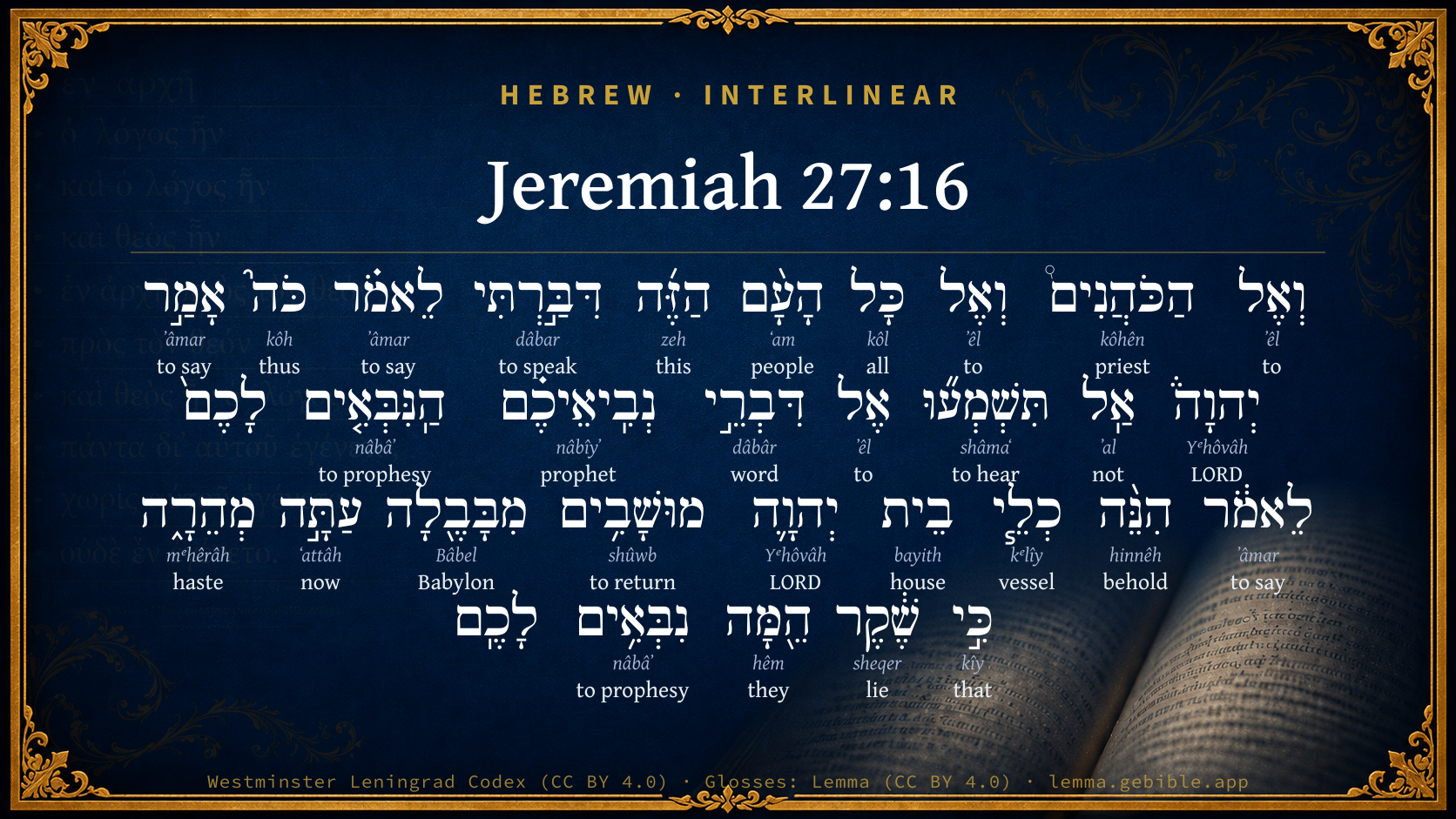
Hebrew (Westminster Leningrad Codex) Jeremiah 27:16 appears in the Hebrew Old Testament. The text above is from the Westminster Leningrad Codex. Each word links to its Strong’s number, a concise gloss, and parsing drawn from the Open Scriptures Hebrew Bible morphology. Click any word for its full Brown-Driver-Briggs (BDB) entry.
Download image
Cite this verse

Jeremiah 27:16 (World English Bible). Public Domain. Lemma interlinear Bible study tool, https://lemma.gebible.app/v/jeremiah/27/16.

Show BibTeX & RIS
BibTeX
RIS
English Translation
Also I spoke to the priests and to all this people, saying, Thus says Yahweh: Don't listen to the words of your prophets who prophesy to you, saying, Behold, the vessels of Yahweh's house shall now shortly be brought again from Babylon; for they prophesy a lie to you.
World English Bible · Public Domain
Download a study sheet

One document with this verse’s original text, its word-by-word gloss line, the meaning frame, cross-references with their text, attributed commentary, and full source and license credits — printable, and it pastes into notes with its structure intact.

This verse Autodidact and up

Study sheet (.html) Plain text (.txt)

A passage Seminary Student

Up to 50 verses in one chapter. A passage sheet keeps up to 6 commentary sources and 12 cross-references per verse, in the order this page ranks them, and says so on the sheet whenever that leaves anything out. Ask for a single verse and you get the Autodidact verse sheet above.

Everything on this page stays free to read, with no account — the sheet is a download of what is already on screen, not access to it.

Want to remove ads? Support Godless Engineer
Compare translations 3

The same verse in 3 English versions, stacked beneath the original-language interlinear above. Click any original word for its lexicon entry.

Each is an independent rendering of the whole verse — the interlinear is not word-aligned to these translations.

Highlighted words mark where these versions differ — a whole-verse word diff, not a word-by-word alignment.

  • World English Bible Public Domain
    Also I spoke to the priests and to all this people, saying, Thus says Yahweh: Don't listen to the words of your prophets who prophesy to you, saying, Behold, the vessels of Yahweh's house shall now shortly be brought again from Babylon; for they prophesy a lie to you.
  • King James Version Public Domain
    Also I spake to the priests and to all this people, saying, Thus saith the LORD; Hearken not to the words of your prophets that prophesy unto you, saying, Behold, the vessels of the LORD's house shall now shortly be brought again from Babylon: for they prophesy a lie unto you.
  • unfoldingWord Literal Text CC BY-SA 4.0
    And to the priests and to all this people I spoke, saying, “Thus says Yahweh: Do not listen to the words of your prophets who are prophesying to you, saying, ‘Behold, the vessels of the house of Yahweh are being brought back from Babylon now, quickly,’ for they are prophesying falsehood to you.

unfoldingWord Literal Text — © unfoldingWord, licensed CC BY-SA 4.0. Word-aligned USFM3 via Door43 (git.door43.org/unfoldingWord/en_ult).

Versions to compare (up to 4)

3 of 4 selected

Show all 18 translations

Every available English version of this verse, each an independent rendering of the whole verse.

  • World English Bible Public Domain
    Also I spoke to the priests and to all this people, saying, Thus says Yahweh: Don't listen to the words of your prophets who prophesy to you, saying, Behold, the vessels of Yahweh's house shall now shortly be brought again from Babylon; for they prophesy a lie to you.
  • Berean Standard Bible Public Domain
    Then I said to the priests and to all this people, “This is what the LORD says: Do not listen to the words of your prophets who prophesy to you, saying, ‘Look, very soon now the articles from the house of the LORD will be brought back from Babylon.’ They are prophesying to you a lie.
  • Majority Standard Bible Public Domain
    Then I said to the priests and to all this people, “This is what the LORD says: Do not listen to the words of your prophets who prophesy to you, saying, ‘Look, very soon now the articles from the house of the LORD will be brought back from Babylon.’ They are prophesying to you a lie.
  • King James Version Public Domain
    Also I spake to the priests and to all this people, saying, Thus saith the LORD; Hearken not to the words of your prophets that prophesy unto you, saying, Behold, the vessels of the LORD's house shall now shortly be brought again from Babylon: for they prophesy a lie unto you.
  • American Standard Version (1901) Public Domain
    Also I spake to the priests and to all this people, saying, Thus saith Jehovah: Hearken not to the words of your prophets that prophesy unto you, saying, Behold, the vessels of Jehovah's house shall now shortly be brought again from Babylon; for they prophesy a lie unto you.
  • Revised Version (1885) Public Domain
    Also I spake to the priests and to all this people, saying, Thus saith the LORD: Hearken not to the words of your prophets that prophesy unto you, saying, Behold, the vessels of the LORD’S house shall now shortly be brought again from Babylon: for they prophesy a lie unto you.
  • Geneva Bible (1599) Public Domain
    Also I spake to the Priests, and to all this people, saying, Thus saith the Lord, Heare not the wordes of your prophets that prophecie vnto you, saying, Behold, the vessels of the house of the Lord shall nowe shortly be brought againe from Babel, for they prophecie a lie vnto you.
  • Douay-Rheims (1899) Public Domain
    I spoke also to the priests, and to this people, saying: Thus saith the Lord: Hearken not to the words of your prophets, that prophesy to you, saying: Behold the vessels of the Lord shall now in a short time be brought again from Babylon: for they prophesy a lie unto you.
  • Young's Literal Translation Public Domain
    And unto the priests, and unto all this people, I have spoken, saying, `Thus said Jehovah, Ye do not hearken unto the words of your prophets, who are prophesying to you, saying, Lo, the vessels of the house of Jehovah are brought back from Babylon now in haste, for falsehood they are prophesying to you.
  • Literal Standard Version CC BY-SA 4.0
    And to the priests, and to all this people, I have spoken, saying, “Thus said YHWH: You do not listen to the words of your prophets, who are prophesying to you, saying, Behold, the vessels of the house of YHWH are now brought back from Babylon in haste, for they are prophesying falsehood to you.
  • Unlocked Literal Bible CC BY-SA 4.0
    I proclaimed this to the priests and all the people and said, “Yahweh says this: Do not listen to the words of your prophets who prophesy to you and say, 'Look! The objects belonging to Yahweh's house are being returned from Babylon now!' They are prophesying lies to you.
  • unfoldingWord Literal Text CC BY-SA 4.0
    And to the priests and to all this people I spoke, saying, “Thus says Yahweh: Do not listen to the words of your prophets who are prophesying to you, saying, ‘Behold, the vessels of the house of Yahweh are being brought back from Babylon now, quickly,’ for they are prophesying falsehood to you.
  • Darby Bible Public Domain
    And I spoke to the priests and to all this people, saying, Thus saith Jehovah: Hearken not to the words of your prophets that prophesy unto you, saying, Behold, the vessels of Jehovah's house shall now shortly be brought again from Babylon; for they prophesy falsehood unto you.
  • World Messianic Bible Public Domain
    Also I spoke to the priests and to all this people, saying, the LORD says, “Don’t listen to the words of your prophets who prophesy to you, saying, ‘Behold, the vessels of the LORD’s house will now shortly be brought again from Babylon;’ for they prophesy a lie to you.
  • Webster's Bible Public Domain
    Also I spoke to the priests and to all this people, saying, Thus saith the LORD; Hearken not to the words of your prophets that prophesy to you, saying, Behold, the vessels of the LORD'S house shall now shortly be brought again from Babylon: for they prophesy a lie to you.
  • Free Bible Version CC BY-SA 4.0
    Then I told the priests and all the people, This is what the Lord says: Don't listen to the words of your prophets who prophesy to you, saying, “Look! The objects from the Lord's Temple will shortly be returned from Babylon.” They are prophesying a lie to you.
  • Bible in Basic English Public Domain
    And I said to the priests and to all the people, This is what the Lord has said: Give no attention to the words of your prophets who say to you, See, in a very little time now the vessels of the Lord's house will come back again from Babylon: for what they say to you is false.
  • JPS Tanakh (1917) Public Domain
    Also I spoke to the priests and to all this people, saying: 'Thus saith the LORD: Hearken not to the words of your prophets that prophesy unto you, saying: Behold, the vessels of the LORD'S house shall now shortly be brought back from Babylon; for they prophesy a lie unto you.

Literal Standard Version (2020), Covenant Press — licensed CC BY-SA 4.0. Text via the HelloAO Bible API (eBible.org). Unlocked Literal Bible (unfoldingWord) — licensed CC BY-SA 4.0. Text via the HelloAO Bible API (eBible.org). unfoldingWord Literal Text — © unfoldingWord, licensed CC BY-SA 4.0. Word-aligned USFM3 via Door43 (git.door43.org/unfoldingWord/en_ult). Free Bible Version, Dr. Jonathan Gallagher — licensed CC BY-SA 4.0. Text via the HelloAO Bible API (eBible.org).

Word by word

More ways to search: Search by grammar → Find every occurrence → Compare this word →

Practice this passage: Drill this verse → Learn its vocabulary →

מְהֵרָ֑ה
mᵉhêrâh
H4120
“haste”
Noun, Common, Feminine, Singular, Absolute
Part of Speech
Noun
Type
Common
Gender
Feminine
Number
Singular
State
Absolute
Full BDB Definition

Origin: from H4118

TWOT: 1152d

haste, speed - hastily, speedily (as adverb) - in haste (with preposition)
  1. וְאֶל ʼêl H413 “and · to” Conjunction + Preposition
  2. הַכֹּהֲנִים֩ kôhên H3548 “the · priests” Particle, Definite Article + Noun, Common, Masculine, Plural, Absolute
  3. וְאֶל ʼêl H413 “and · to” Conjunction + Preposition
  4. כָּל kôl H3605 “all of” Noun, Common, Masculine, Singular, Construct
  5. הָעָ֨ם ʻam H5971 “the · people” Particle, Definite Article + Noun, Common, Masculine, Singular, Absolute
  6. הַזֶּ֜ה zeh H2088 “the · this” Particle, Definite Article + Pronoun, Demonstrative, Masculine, Singular
  7. דִּבַּ֣רְתִּי dâbar H1696 “to speak” Verb, Piel, Perfect, 1st Person, Common, Singular
  8. לֵאמֹ֗ר ʼâmar H559 “to say” Preposition + Verb, Qal, Infinitive Construct
  9. כֹּה֮ kôh H3541 “thus” Adverb
  10. אָמַ֣ר ʼâmar H559 “to say” Verb, Qal, Perfect, 3rd Person, Masculine, Singular
  11. יְהוָה֒ Yᵉhôvâh H3068 “LORD” Noun, Proper
  12. אַֽל ʼal H408 “not” Particle, Negative
  13. תִּשְׁמְע֞וּ shâmaʻ H8085 “to hear” Verb, Qal, Jussive, 2nd Person, Masculine, Plural
  14. אֶל ʼêl H413 “to” Preposition
  15. דִּבְרֵ֣י dâbâr H1697 “words of” Noun, Common, Masculine, Plural, Construct
  16. נְבִֽיאֵיכֶ֗ם nâbîyʼ H5030 “prophets · your” Noun, Common, Masculine, Plural, Construct + Suffix, Personal, 2nd Person, Masculine, Plural
  17. הַֽנִּבְּאִ֤ים nâbâʼ H5012 “the · prophesying” Particle, Definite Article + Verb, Niphal, Participle Active, Masculine, Plural, Absolute
  18. לֵאמֹ֔ר ʼâmar H559 “to say” Preposition + Verb, Qal, Infinitive Construct
  19. הִנֵּ֨ה hinnêh H2009 “behold” Particle, Demonstrative
  20. כְלֵ֧י kᵉlîy H3627 “vessels of” Noun, Common, Masculine, Plural, Construct
  21. בֵית bayith H1004 “house of” Noun, Common, Masculine, Singular, Construct
  22. יְהוָ֛ה Yᵉhôvâh H3068 “LORD” Noun, Proper
  23. מוּשָׁבִ֥ים shûwb H7725 “returned” Verb, Hophal, Participle Passive, Masculine, Plural, Absolute
  24. מִבָּבֶ֖לָה Bâbel H894 “from · Babylon · toward” Preposition + Noun, Proper + Suffix, Demonstrative
  25. עַתָּ֣ה ʻattâh H6258 “now” Adverb
  26. כִּ֣י kîy H3588 “that” Conjunction
  27. שֶׁ֔קֶר sheqer H8267 “lie” Noun, Common, Masculine, Singular, Absolute
  28. הֵ֖מָּה hêm H1992 “they” Pronoun, Personal, 3rd Person, Masculine, Plural
  29. נִבְּאִ֥ים nâbâʼ H5012 “prophesying” Verb, Niphal, Participle Active, Masculine, Plural, Absolute

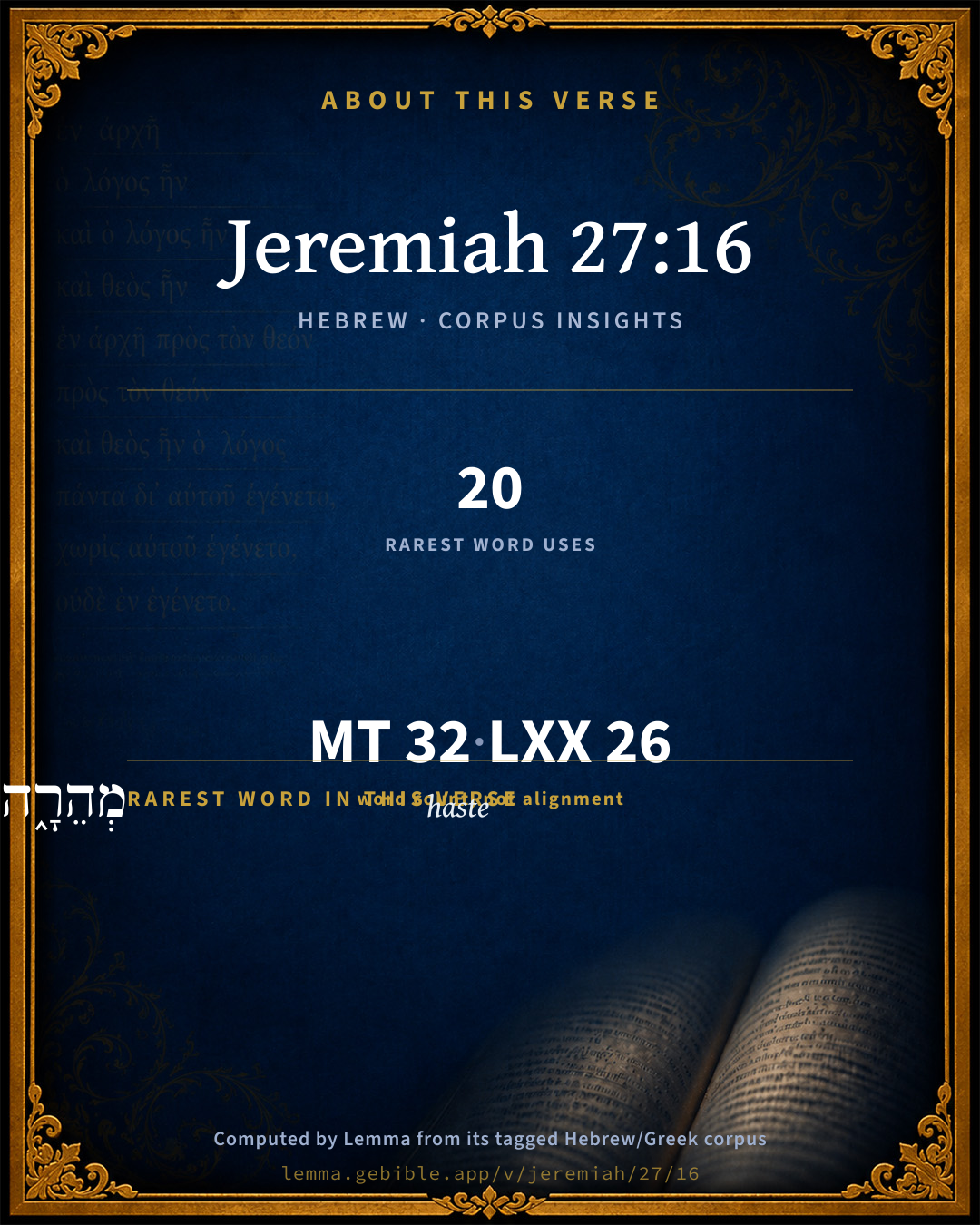
About this verse

These counts appear in no published source. They are computed here, from the morphology-tagged text and Lemma’s own curated glosses. What Lemma adds →

32
words
24
distinct lemmas
Prophets
section

Notable vocabulary

The rarest word here is מְהֵרָ֑ה haste H4120 — appearing just 20 times in the whole Hebrew Bible.

Shared distinctive vocabulary

מְהֵרָ֑ה haste H4120 occurs in 20 verses of the Hebrew Bible. Also found in:

Grammatical profile

  • 8 verbs
  • 12 nouns
  • 2 pronouns
  • 5 prepositions
  • 1 conjunction
  • 2 adverbs
  • 2 particles

Verb forms

  • דִּבַּ֣רְתִּי Piel · Perfect
  • לֵאמֹ֗ר Qal · Infinitive Construct
  • אָמַ֣ר Qal · Perfect
  • תִּשְׁמְע֞וּ Qal · Jussive
  • הַֽנִּבְּאִ֤ים Niphal · Participle Active
  • לֵאמֹ֔ר Qal · Infinitive Construct
  • מוּשָׁבִ֥ים Hophal · Participle Passive
  • נִבְּאִ֥ים Niphal · Participle Active

Repetition

Words recur within this verse — often emphatic in Hebrew:

  • לֵאמֹ֗ר to say H559 ×3
  • יְהוָה֒ LORD H3068 ×2
  • הַֽנִּבְּאִ֤ים to prophesy H5012 ×2
  • וְאֶל to H413 ×3

Hebrew & Septuagint length

In the original languages it is 32 Hebrew tokens and 26 Greek tokens — but the two are counted differently (Hebrew bundles its prefixes and suffixes into one token; the Greek is in lemma form), so that isn’t a like-for-like length.

Cross-references

7

Topical passages linked to Jeremiah 27:16 in the Treasury of Scripture Knowledge — connected by theme and wording, ordered by reader-vote popularity; previews shown in the World English Bible.

  • 2 Kings 24:13 He carried out there all the treasures of the house of Yahweh, and the treasures of the king's house, and cut in pieces all the vessels of gold, which Solomon king of Israel had made in the temple of Yahweh, as Yahweh had said.
  • Jeremiah 28:3 Within two full years will I bring again into this place all the vessels of Yahweh's house, that Nebuchadnezzar king of Babylon took away from this place, and carried to Babylon:
  • Jeremiah 27:10 for they prophesy a lie to you, to remove you far from your land, and that I should drive you out, and you should perish.
  • Daniel 1:2 The Lord gave Jehoiakim king of Judah into his hand, with part of the vessels of the house of God; and he carried them into the land of Shinar to the house of his god: and he brought the vessels into the treasure-house of his god.
  • Jeremiah 27:14 Don't listen to the words of the prophets who speak to you, saying, You shall not serve the king of Babylon; for they prophesy a lie to you.
  • 2 Chronicles 36:7–10 Nebuchadnezzar also carried of the vessels of the house of Yahweh to Babylon, and put them in his temple at Babylon.
  • Isaiah 9:15 The elder and the honorable man, he is the head; and the prophet who teaches lies, he is the tail.

Cross-references courtesy of OpenBible.info (CC BY 4.0).

Hebrew and Greek witnesses Masoretic Hebrew ↔ Greek Septuagint

The same verse in the two great witnesses to the Old Testament, shown verse-for-verse.

These are two independent witnesses, not word-aligned to each other, and the Septuagint is shown in lemma (dictionary) form.

Hebrew Jeremiah 27:16 Masoretic · Westminster Leningrad Codex

וְאֶל הַכֹּהֲנִים֩ וְאֶל כָּל הָעָ֨ם הַזֶּ֜ה דִּבַּ֣רְתִּי לֵאמֹ֗ר כֹּה֮ אָמַ֣ר יְהוָה֒ אַֽל תִּשְׁמְע֞וּ אֶל דִּבְרֵ֣י נְבִֽיאֵיכֶ֗ם הַֽנִּבְּאִ֤ים לָכֶם֙ לֵאמֹ֔ר הִנֵּ֨ה כְלֵ֧י בֵית יְהוָ֛ה מוּשָׁבִ֥ים מִבָּבֶ֖לָה עַתָּ֣ה מְהֵרָ֑ה כִּ֣י שֶׁ֔קֶר הֵ֖מָּה נִבְּאִ֥ים לָכֶֽם

Also I spoke to the priests and to all this people, saying, Thus says Yahweh: Don't listen to the words of your prophets who prophesy to you, saying, Behold, the vessels of Yahweh's house shall now shortly be brought again from Babylon; for they prophesy a lie to you.

World English Bible · Public Domain

Greek LXX Structure differs

In the Septuagint, Jeremiah is about an eighth shorter than the Hebrew and arranges its material differently — the Oracles Against the Nations (Hebrew chapters 46–51) appear in the middle of the Greek book, after 25:13. Because the chapter and verse boundaries do not line up, a verse-for-verse comparison with the Hebrew is not shown.

A verse-for-verse comparison isn’t shown here because the chapters and verses don’t line up. Switch to the LXX edition with the MT / LXX toggle above to read the Greek directly.

On this verse, Keil & Delitzsch discusses the Septuagint’s reading. Read the note in Commentary ↓

Hebrew: Westminster Leningrad Codex (CC BY 4.0). Greek: Septuagint (public domain); English from a public-domain English Septuagint. How the Septuagint differs from the Hebrew →

Targum (Aramaic paraphrase)

1

The Targum is the ancient Jewish Aramaic paraphrase of the Hebrew Scriptures — an interpretive translation, not the Hebrew text itself. Onkelos (literal) and Pseudo-Jonathan (expansive) render the Torah, and Jonathan the Prophets. Coverage is partial: where no permissively-licensed English translation exists for a verse, only the Aramaic is shown. This is verse-level text, not a word-by-word alignment to the Hebrew.

  1. Targum Jonathan Prophets (Joshua–Malachi)
    וּלְכַהֲנַיָא וּלְכָל עַמָא הָדֵין מַלְלֵית לְמֵימָר כִּדְנַן אֲמַר יְיָ לָא תְקַבְּלוּן לְפִתְגְמֵי נְבִיֵיכוֹן דְשִׁקְרָא דְמִתְנַבָּן לְכוֹן לְמֵימַר הָא מָנֵי בֵית מַקְדְשָׁא דַייָ מִתּוֹתָבִין מִבָּבֶל כְעַן בִּפְרִיעַ אֲרֵי שִׁקְרָא אִינוּן מִתְנַבָּן לְכוֹן:

    (no public-domain English translation for this verse)

    Targum Jonathan — Aramaic: “Mikraot Gedolot” (public domain). English: “Sefaria Community Translation” (CC0 1.0 (public-domain dedication)); “London "Chaldee Paraphrase," 1871” (public domain). Text via Sefaria.

Commentary

Notes on Jeremiah 27:16 from classic Christian and Jewish commentators (each source and its license shown beneath its notes). The classic Christian expositions comment on the surrounding passage and are grouped to its opening verse, so a note may address several verses; the Jewish commentaries on the Tanakh (Rashi and others) are per-verse, so they appear only where the commentator wrote on this verse.

Lemma curates 59 commentaries, every one of them public domain or Creative Commons licensed, each selected and text-cleaned for this edition rather than reprinted as found. About our sources →

Trapp's Complete Commentary

John Trapp

Jer 27:16 Also I spake to the priests and to all this people, saying, Thus saith the LORD; Hearken not to the words of your prophets that prophesy unto you, saying, Behold, the vessels of the LORD’S house shall now shortly be brought again from Babylon: for they prophesy a lie unto you.

Ver. 16. Behold, the vessels of the Lord’s house, &c.] Notorious impudence! but it hath ever been the lot of the Church to be pestered with such frontless dissolute fellows, who dare affirm things flat opposite to the truth, and flatter men in their sin to their utter ruin. Those who are of God can do nothing against the truth, but for the truth. {2Co 13:8}

John Trapp, A Commentary or Exposition upon All the Books of the Old and New Testament (1647–1656) — public domain. Text from a community e-Sword module.

Joseph Benson's Commentary

Jer 27:16-18. Also I spake to the priests and to all this people — The prophet, being God’s true servant, spared none, but gave faithful warning to all sorts of persons, to take heed of being deceived by the false prophets, who undertook to foretel that the vessels of the temple, carried away in the time of Jehoiakim and his son Jeconiah, (of which we read 2Ch 36:7; 2Ch 36:10,) should be brought back again to Jerusalem in a short time: see Jer 28:3. Hearken not unto them — Believe them not, but acquiesce in God’s providence with respect to you, and be content to be subject to the king of Babylon, that so your lives may be given you for a prey. Wherefore should this city be laid waste? — If you do not comply with God’s will in this instance, your city will certainly be destroyed, and why should you pull down such a judgment upon your own heads? But if they be prophets, &c. — If they be true prophets, and have any power with God, instead of foretelling the bringing back of the vessels carried away, let them apply to him in prayer to prevent the carrying away of the vessels that yet remain, whether in the house of the Lord, or in the king’s house, or in Jerusalem, which can be done no other way than by pleading with God to turn away his wrath, and not proceed in inflicting those sore judgments which he is most certainly bringing upon you.

Joseph Benson's Commentary on the Old and New Testaments (1811–1818) — public domain. Text from a community e-Sword module.

Keil & Delitzsch

C. F. Keil & F. Delitzsch

The priests and all the people are warned to give no belief to the false prophesyings of a speedy restoration of the vessels carried off to Babylon. - Jer 27:16. "Thus hath Jahveh said: Hearken not to the sayings of your prophets that prophesy unto you: Behold, the vessels of Jahveh's house shall now shortly be brought again from Babylon; for they prophesy a lie unto you. Jer 27:17. Hearken not unto them; serve the king of Babylon and live; wherefore should this city become a desert? Jer 27:18. But if they be prophets, and if the word of Jahveh be with them, let them now make intercession to Jahveh of hosts, that the vessels which are left in the house of Jahveh, and in the king's house, and in Jerusalem, go not to Babylon. Jer 27:19. For thus saith Jahveh of hosts concerning the pillars and the [brazen] sea and the frames, and concerning the other vessels that are left in this city, Jer 27:20. Which Nebuchadnezzar king of Babylon took not away when he carried away captive Jechoniah the son of Jehoiakim king of Judah from Jerusalem to Babylon, with all the nobles of Judah and Jerusalem. Jer 27:21. For thus saith Jahveh of hosts, the God of Israel, concerning the vessels that are left in the house of Jahveh, and in the house of the king of Judah, and in Jerusalem: Jer 27:22. To Babylon shall they be brought, and there shall they remain until the day that I visit them, saith Jahveh, and carry them up, and bring them back to this place."

Here Jeremiah gives King Zedekiah warning that the prophecies of a speedy end to Chaldean bondage are lies, and that confidence in such lies will hurry on the ruin of the state. He at the same time disabuses the priests of the hope raised by the false prophets, that the vessels of the temple and of the palace that had been carried off at the time Jechoniah was taken to Babylon will very soon be restored; and assures them that such statements can only procure the destruction of the city, since their tendency is to seduce king and people to rebellion, and rebellion against the king of Babylon means the destruction of Jerusalem - a prophecy that was but too soon fulfilled. The vessels of the temple, Jer 27:16, are the golden vessels Solomon caused to be made (Kg1 7:48.), which Nebuchadnezzar had carried to Babylon, Kg2 24:13. מבּבלה, from towards Babylon, i.e., from Babylon, whither they had been taken; cf. Ew. 216, b. "Now shortly," lit., hastily or speedily, i.e., ere long, cf. Jer 28:3, where the prophet Hananiah foretells the restoration of them within two years, in opposition to Jeremiah's affirmation that the exile will last seventy years.

(Note: These words are not given in lxx, and so Mov. and Hitz. pronounce them spurious. Haev., on the other hand, and with greater justice, says (Introd. ii. 2), that the lxx omitted the words, because, according to an Alexandrian legend, the temple furniture was really very soon restored, even in Zedekiah's time, cf. Baruch 1:8ff.; so that the false prophets were in the right. The passage cited from Baruch does not indeed give a very rigorous proof of this. It alleges that the silver vessels which Zedekiah had caused to be made after Jechoniah's exile had been brought back by Baruch. But considering the innumerable arbitrary interferences of the lxx with the text of Jeremiah, the omission of the words in question cannot justify the slightest critical suspicion of their genuineness.)

To show more clearly the irreconcilableness of his own position with that of the false prophets, Jeremiah further tells what true prophets, who have the word of Jahveh, would do. They would betake themselves in intercession to the Lord, seeking to avert yet further calamity or punishment, as all the prophets sent by God, including Jeremiah himself, did, cf. Jer 7:16. They should endeavour by intercession to prevent the vessels that are still left in Jerusalem from being taken away. The extraordinary expression לבלתּי באוּ has probably come from the omission of Jod from the verb, which should be read יבאוּ. As it stands, it can only be imperative, which is certainly not suitable. לבלתּי is usually construed with the infinitive, but occasionally also with the temp. fin.; with the imperf., which is what the sense here demands, in Exo 20:20; with the perf., Jer 23:14. - Of the temple furniture still remaining, he mentions in Jer 27:19 as most valuable the two golden pillars, Jachin and Boaz, Kg1 7:15., the brazen sea, Kg1 7:23., and המּכונות, the artistic waggon frames for the basins in which to wash the sacrificial flesh, Kg1 7:27.; and he declares they too shall be carried to Babylon, as happened at the destruction of Jerusalem, Kg2 25:13. (בּגלותו for בּהגלותו.)

(Note: The statement in Jer 27:19-22 is wide and diffuse; it is therefore condensed in the lxx, but at the same time mutilated. From the fact Mov., with Hitz. agreeing thereto, concludes that the Hebr. text has been expanded by means of glosses. Graf has already shown in reply to this, that the hand of a later glossator interpolating materials from Jer 52:17; Kg2 24:13 and Kg2 24:1 is not betrayed in the extended account of the furniture remaining, and of the occasion on which it was left behind. He goes on to show that it is rather the editorial hand of Baruch than the hand of the glossator that is to be presumed from the fact that, in consequence of the narrative part of Jer 27:20, Jer 27:19 is repeated in Jer 27:21; and from the further fact that it is impossible here to discriminate the interpolated from the original matter. Graf has also so conclusively proved the worthlessness of the distinguishing marks of the glossator adduced by Mov. and Hitz., that we adopt in full his argument. Such marks are (we are told), (1) the scriptio plena of מכונות here, as contrasted with Jer 52:17; Kg2 25:13; Ch2 4:14, and of יכוניה, as against Ch2 24:1; Ch2 28:4; Ch2 29:2; and yet the interpolations in Jer 27:19 and Jer 27:20 are said to have been taken directly from Jer 52:17 and Jer 24:1. (2) The expression חרים, which is alleged not to have come into use till the exile. But the fact of its standing here and in Jer 39:6 is enough to show it to have been earlier in use; cf. also Kg1 21:8, Kg1 21:11; and since it is not used in Jer 24:1 and Jer 29:2, it is certain that it has not been got from there. (3) The "slip-shod" וירושׁלים, Jer 27:21, for ובירושׁלים, Jer 27:18, which is, however, occasioned simply by the preceding accusative of place, 'בית יהוה וגו (Jer 27:18 also בּבית יהוה).)

Keil & Delitzsch — Biblical Commentary on the Old Testament (1861–1891) — public domain (CC PDM 1.0). Text via the HelloAO Bible API. (Old Testament only.)

Tyndale Open Study Notes

Tyndale Open Resources

27:16 The gold articles and other treasures had been taken from the Temple in 597 BC.

Tyndale Open Study Notes — © Tyndale Open Resources, licensed CC BY-SA 4.0. Text via the HelloAO Bible API.

Geneva Bible (1599)

Geneva Bible translators

Which were taken when Jeconiah was led captive into Babel.

Geneva Bible (1599) marginal notes — public domain. Text via Bolls.life.

Jamieson, Fausset & Brown

Robert Jamieson, A. R. Fausset & David Brown

The "vessels" had been carried away to Babylon in the reign of Jeconiah (Kg2 24:13); also previously in that of Jehoiakim (Ch2 36:5-7).

Jamieson, Fausset & Brown — Commentary Critical and Explanatory on the Whole Bible (1871) — public domain (CC PDM 1.0). Text via the HelloAO Bible API.

Adam Clarke's Commentary

Verse 16. The vessels of the Lord's house] Which had been carried away by Nebuchadnezzar under the reigns of Jehoiakim and Jeconiah, 2Ch 36:7-10.

Shall now shortly be brought again] This is a lie. They shall not be restored till I bring them up, Jer 27:22, which was after the captivity, when they were sent back by Cyrus, the Lord inclining his heart to do it, Ezr 1:7; Ezr 7:19.

Adam Clarke's Commentary on the Bible (1810–1826) — public domain. Text from a community e-Sword/MySword module.

John Calvin's Commentaries

Jeremiah, as we have seen, did not deal privately with the king alone, for he did not separate him from the people; but as he had directed his words chiefly to him, he therefore expresses now what might have seemed obscure, that though he had begun with the king, he yet included all the Jews. It was indeed necessary to begin with the king, for we know that earthly kings think much of their own dignity, and that the whole people are dependent on their will. Hence Hosea condemned them, because they rendered a too willing obedience to royal edicts, and worshipped God according to what it pleased the king and his counsellors to dictate. (Hosea 5:11: Micah 6:16.) As then the royal name served to dazzle the eyes of the simple, Jeremiah was bidden to address first the king himself; but he now shews that the priests and the people were included.

It was indeed like something monstrous, that the priests, whom God had designed to be the interpreters of his Law, should have become so stupid as thoughtlessly to receive, together with the common people, what they had heard from the false prophets. This surely was by no means compatible with that high encomium by which they are honored by Malachi, that the priest’s lips should keep knowledge, and that from him the Law is to be sought, because he is the messenger of the God of hosts. (Malachi 2:7.) As then they were the guardians of the Law and of knowledge, as they were messengers from God himself to the people, how was it that their stupidity was so monstrous, that they did not distinguish between truth and falsehood, but were led astray, together with the most ignorant, by what the false prophets delivered!

This ought to be carefully noticed, that we may not at this day be too much disturbed, when we see the pastoral office assumed by ignorant asses, and that those who are called, and wish to be thought ministers, are so inexperienced in Scripture that they are deficient as to the first elements of religion. And we see the very thing happening at this day especially under the Papacy, as existed among the ancient people; for the Papal bishops are for the most part extremely stupid and presumptuous. There are to be found many husbandmen and artisans, who know nothing of learning, but have only heard what is obscure and indistinct, and yet they can speak better on the general principles of faith than these haughty prelates in all their splendor. How is this? even because the just reward for their sloth is rendered to them. They are verily ignorant of what should qualify them to be bishops, and yet they glory in the name! Yea, though they do not think that Episcopacy consists in anything but in revenues, and also in vain symbols, such as to be mitred, to wear an episcopal ring, and to exhibit other like trumperies, they yet suppose themselves to be a sort of half-gods. Hence it is, that God exposes them to the utmost reproach. The same was the case with the priests under the Law, as Jeremiah now shews; for they were not ashamed of their ignorance, but encouraged the people to believe the false prophets; so at this day do the bishops; they scud forth their monks and such like brawlers, who run here and there to deceive the ignorant people, and they secure a hearing to them. And what is the burden of their message? to bid men to attend to the holy Catholic Church; and what is the Catholic Church? The Synod which the Pope assembles, where the mitred bishops sit; for what purpose? That they may know what pleases these brawlers, to whom is committed the office of disputing. We hence see that all things under the Papacy are at this day in great disorder; and yet this horrible disorder differs nothing from that of old. And it is, as I have said, what ought to be particularly noticed, that our faith may not fail, when we see all things in a confusion and hardly any order remaining.

Now also is added a clearer explanation, — that the Jews were warned, lest they should receive the false prophecy respecting the restoration of the vessels of the Temple; for in order to render the people secure as to the future, the false prophets boasted in this manner, “The splendor of the Temple shall shortly be restored; for the vessels, which Nebuchadnezzar has taken away, shall return together with the captives, and everything decayed shall be repaired.” But Jeremiah said, that what they promised was false; “Believe them not,” he says, “when they say to you, Behold, the vessels of Jehovah’s house shall be brought back, (or restored, that is, shall return hither;) for the king of Babylon shall either be constrained to restore what he has taken away, or he will of his own accord restore it.” And they also added, Now soon, in order that the shortness of time might be all additional chain to captivate the minds of the people; for had a long time been mentioned, the prophecy would have been less plausible and by no means acceptable to them; but they said, “Almost within a day the vessels of the Temple shall be brought back here.” And Jeremiah also, as we have already seen, and shall presently see again, did not deprive the people of every hope, but had assigned seventy years for their exile. Now these prophets, in order to dissipate this fear, said, — “Shortly shall the vessels be restored;” but he declared that they prophesied falsely to them. It follows —

John Calvin's Commentaries (1540-1563) — public domain. Text from the Calvin Translation Society English edition (1840s-50s) via the Christian Classics Ethereal Library (ccel.org). Calvin's coverage is partial (roughly two-thirds of the Bible); uncommented books and verses are honest gaps, never fabricated. The 19th-century editor's footnotes and remarks are omitted so the notes are faithfully Calvin's own voice.

Ellicott's Commentary for English Readers

(16) Behold the vessels of the Lord’s house . . .—The importance attached to this specific prediction, on which apparently the false prophets staked their credit, can easily be understood. The vessels referred to are those which had been carried off by Nebuchadnezzar in his first invasion, and before the accession of Zedekiah (2Ki_24:13; 2Ch_36:7). The people mourned over the absence of what they had so prized among the treasures of the Temple, and the prophets accordingly soothed them with predictions that they would before long be brought back. In marked contrast to these prophecies of their restoration “shortly,” we find them brought out for use at Belshazzar’s feast, towards the close of the Babylonian exile (Dan_1:2; Dan_5:2), and restored to the Jews by Cyrus, after the capture of Babylon (Ezr_1:7). In the apocryphal book of Baruch (1:8) we find a tradition that some of them (silver, not gold) were restored in the reign of Zedekiah, but this can hardly be regarded as historical. It is noticeable that the restoration is connected, in that narrative, with the agency of Baruch himself, and it is scarcely probable that he would have brought about a fulfilment of the prediction of the false prophets, who were his Master’s enemies.

A Bible Commentary for English Readers, edited by Charles John Ellicott (1878–1897) — public domain. Text from a community e-Sword module.

The Cambridge Bible for Schools and Colleges

gen. ed. J. J. S. Perowne

16. the priests] who took the side of the false prophets against Jeremiah. See Jer_26:8 ff.

16–22. The same message is addressed to the priests and the people concerning the false prophets. More than half the contents of this part of the ch. are lacking in LXX, the main difference between them and MT. being that the latter includes the promise of the restoration of the sacred vessels to Jerusalem. Co. grants the LXX a relative originality, considering that the process of amplification is shewn in their Version in an earlier stage than that which is presented by the Hebrew.

The Cambridge Bible for Schools and Colleges (gen. ed. J. J. S. Perowne; Cambridge University Press, 1878–1918) — public domain. Text from a community e-Sword module.

John Gill's Exposition

Also I spake to the priests, and to all this people, saying,.... From the court he went to the temple, and spoke to the priests that were ministering there, and to all the people that were assembled for divine worship; either at the ordinary time of it, or at some one of the solemn feasts: this was a proper time and place to meet with the people and the priests; which latter especially had a concern in what he had to say concerning the vessels of the temple:

thus saith the Lord, hearken not to the words of your prophets that prophesy unto you: your false prophets, as the Targum:

saying; as follows:

behold, the vessels of the Lord's house shall now shortly be brought again from Babylon; which were carried thither, both in the times of Jehoiakim, and of Jeconiah, Ch2 36:7; these the false prophets gave out would in a short time be returned; that the king of Babylon, either willingly and of his own accord, or being pressed or forced to it, would send them back; so little reason had they to fear an invasion from him, or captivity by him:

for they prophesy a lie unto you; that which is false, and will never be accomplished, at least in any short time.

John Gill's Exposition of the Whole Bible (1746–1763) — public domain (CC PDM 1.0). Text via the HelloAO Bible API.

Haydock's Catholic Bible Commentary

Time. Hananias specified two years, (chap. xxviii. 3.) which proved false. Some "silver vessels," (Baruch i. 8.) and not those of gold, it seems, (Calmet) or not all, (Haydock) were restored at the request of Saraias, chap. li. 59.

George Leo Haydock (1774–1849), Haydock's Catholic Family Bible and Commentary, 1859 edition — public domain. Excludes Psalms (Douay-Rheims chapter numbering differs from Protestant) and Deuterocanonical books (Catholic canon only).

Matthew Poole's English Annotations

The prophet, like God’s faithful servant, spared none, but faithfully gave warning to all sorts, to take heed of the false prophets that undertook to foretell that the vessels of the temple carried away in the time of Jehoiakim, and his son Jehoiachin or Jeconiah, of which we read 2Ch 36:7,10, should be brought back again to Jerusalem in a short time.

Matthew Poole's English Annotations on the Holy Bible (1683–1685) — public domain. Text from a community e-Sword/MySword module.

Whedon's Commentary on the Bible

Daniel D. Whedon

16. Vessels of the Lord’s house — Made by Solomon (1Ki_7:48-50) and carried to Babylon by Nebuchadnezzar. 2Ki_24:13. They were valuable, not only because of their intrinsic worth, being made of gold, but especially because of their representative character, being devoted to religions uses, so that for them to fall into the possession of a heathen power, and be carried away to a heathen land, was as when the ark of God was captured by the Philistines.

Now shortly — Speedily.

From Babylon — Literally, from Babylon-ward.

Daniel D. Whedon (gen. ed.), Commentary on the Old and New Testaments (1874–1909) — public domain. Text from a community e-Sword module.

The Pulpit Commentary

Vers. 16-22. The warning to the priests and to the rest of the people. The last four verses of this section appear in a much shortened form in the Septuagint, and it must be admitted that the description is singularly lengthy. It is, therefore, quite conceivable that this is one of the cases in which the Hebrew text has been disfigured by willful interpolation. On the other hand, it is also possible that the description was filled out by an editor, e.g. by Baruch, conscientiously for the benefit of later readers.

The vessels of the Lord"s house; i.e. the golden vessels which Solomon had made, and which Nebuchadnezzar had taken away. (1Ki_7:48-50 2Ki_24:13) Now shortly. These words are wanting in the Septuagint, and, considering that the Greek is also without the prediction in ver. 22, that the vessels of the temple and of the palace should be brought back in the day of visitation, (which seems inconsistent with Jer_52:17) the question arises whether the words "now shortly" here are not due to a hasty copyist.

The Pulpit Commentary (1880–1919), ed. H.D.M. Spence-Jones & Joseph S. Exell — public domain. Text from a community e-Sword module.

unfoldingWord translationNotes

Door43 World Missions Community

General Information:

Jeremiah continues to speak the words of Yahweh.

The objects belonging to Yahweh's house are being returned from Babylon now!

This can be translated in active form. AT: "People are bringing back all the gold items that they took from Yahweh's temple!" (See: Active or Passive)

Why should this city become a ruin?

Yahweh uses a question to warn the people. AT: "You can keep this city from becoming a ruin if you do what Yahweh wants you to do." (See: Rhetorical Question)

If they are prophets, and if the word of Yahweh has truly come to them, let them beg

This is a hypothetical situation that Yahweh knows is not true. AT: "If they were prophets, and if the word of Yahweh had truly come to them, they would beg" or "Because they are not prophets and the word of Yahweh has not truly come to them, they will not beg" (See: Hypothetical Situations)

if the word of Yahweh has truly come to them

The phrase "word of Yahweh" refers to messages from God. AT: "if Yahweh has truly given them messages" or "if Yahweh truly spoke messages to them"

the word of Yahweh ... beg Yahweh of hosts not

Yahweh is speaking of himself in third person. AT: "my word ... be me, Yahweh of hosts, not" (See: First, Second, or Third Person)

the house of the king of Judah

The word "house" has a range of possible meanings. In this case it refers to the royal palace where the king lived. AT: "the palace of the king of Judah"

translationWords

preach

priest

prophet

house of God

word of God

beg

Yahweh of hosts

Jerusalem

unfoldingWord translationNotes — © Distant Shores Media and the Door43 World Missions Community, licensed CC BY-SA 4.0. Source: git.door43.org/Door43/en_tn.

Rashi

Rabbi Shlomo Yitzchaki (Rashi)

“Behold the vessels of the house of the Lord” That were exiled with Jeconiah.

Rashi on the Tanakh — English translations: “The Judaica Press complete Tanach with Rashi, translated by A. J. Rosenberg” (CC BY 4.0); “Pentateuch with Rashi's commentary by M. Rosenbaum and A.M. Silbermann, 1929-1934” (public domain); “The Metsudah Tanach series, Lakewood, N.J” (CC BY 4.0); and “The Book of Joshua, Metsudah Publications, 1997” (CC BY 4.0). Text via Sefaria.

Lesson kit

Teaching starters — assembled from the data on this page, not authored interpretation. Every prompt links to the verse data it draws on. Edit before teaching.

Jeremiah, in the Prophets, opens this verse with 32 words (24 distinct Hebrew lemmas). Its most distinctive word is mᵉhêrâh (“haste”). A historical commentator’s framing appears above. Read the whole chapter for the surrounding context.

Discussion questions

  1. What does “haste” (mᵉhêrâh) contribute to the verse as a whole?
  2. How does Numbers 16:46, which shares the word «haste», read alongside this verse?
  3. What does the repetition of “to say” (3× in this one verse) do in this verse?
  4. These translations render this verse differently. What is at stake in choosing one wording over another?
  5. «דִּבַּ֣רְתִּי» is a Piel Perfect verb. How does that grammatical form shape the action described?
  6. Compare how Trapp's Complete Commentary and Joseph Benson's Commentary read this verse. Where do they agree or differ?

Things to notice

Reading settings

Reading text

Shown beneath each verse's original-language words.

Old Testament
Old Testament edition

Read the OT as the Masoretic Hebrew (MT) or the Greek Septuagint (LXX).

English shown for the Greek Septuagint (in the Hebrew ↔ Greek comparison).

Comparing translations? Open the Compare panel on any verse page to stack up to four side by side.