
Psalms 119:78

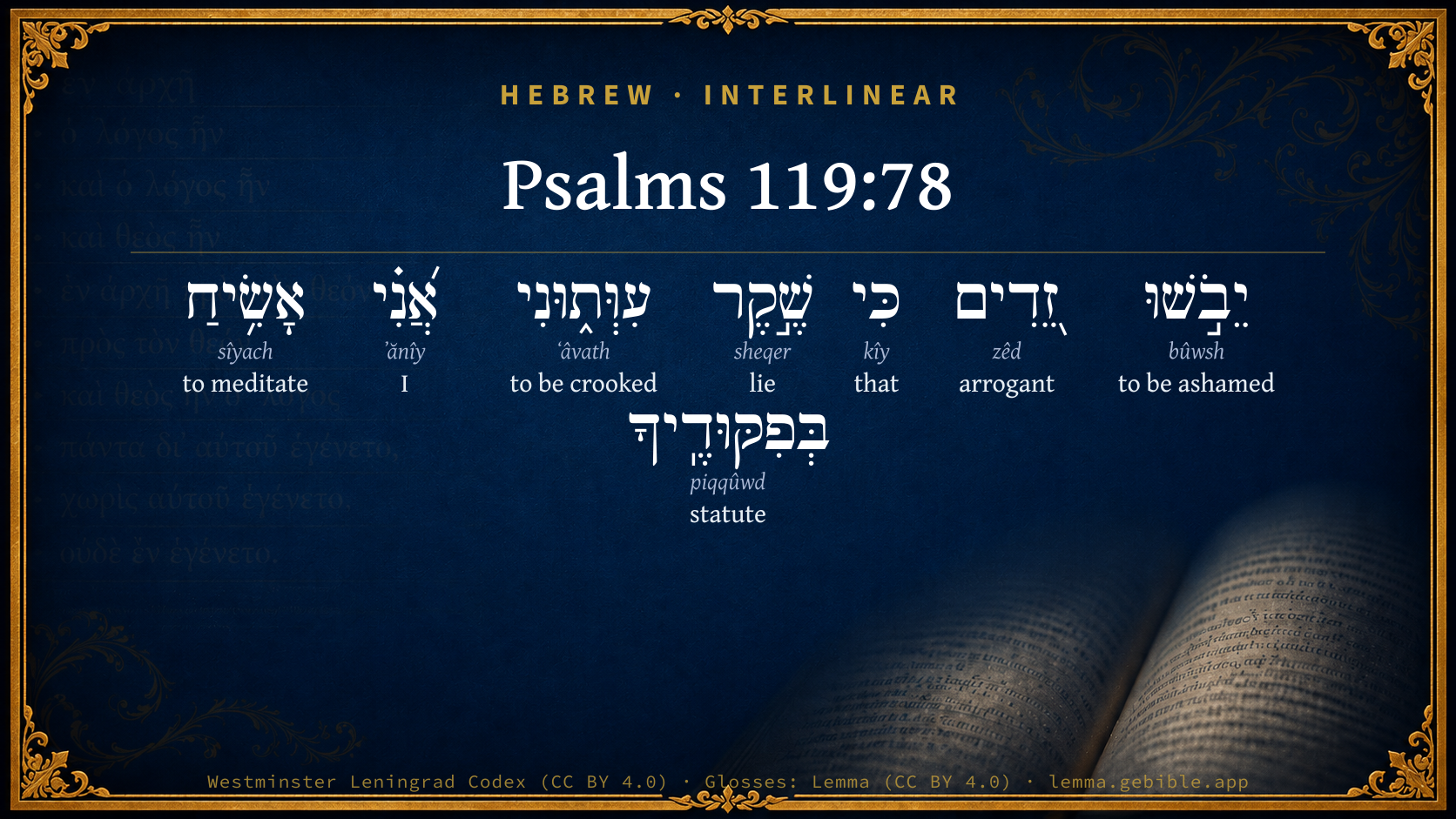
Hebrew (Westminster Leningrad Codex) Psalms 119:78 appears in the Hebrew Old Testament. The text above is from the Westminster Leningrad Codex. Each word links to its Strong’s number, a concise gloss, and parsing drawn from the Open Scriptures Hebrew Bible morphology. Click any word for its full Brown-Driver-Briggs (BDB) entry.
Download image
Cite this verse

Psalms 119:78 (World English Bible). Public Domain. Lemma interlinear Bible study tool, https://lemma.gebible.app/v/psalms/119/78.

Show BibTeX & RIS
BibTeX
RIS
English Translation
Let the proud be disappointed, for they have overthrown me wrongfully. I will meditate on your precepts.
World English Bible · Public Domain
Download a study sheet

One document with this verse’s original text, its word-by-word gloss line, the meaning frame, cross-references with their text, attributed commentary, and full source and license credits — printable, and it pastes into notes with its structure intact.

This verse Autodidact and up

Study sheet (.html) Plain text (.txt)

A passage Seminary Student

Up to 50 verses in one chapter. A passage sheet keeps up to 6 commentary sources and 12 cross-references per verse, in the order this page ranks them, and says so on the sheet whenever that leaves anything out. Ask for a single verse and you get the Autodidact verse sheet above.

Everything on this page stays free to read, with no account — the sheet is a download of what is already on screen, not access to it.

Want to remove ads? Support Godless Engineer
Compare translations 3

The same verse in 3 English versions, stacked beneath the original-language interlinear above. Click any original word for its lexicon entry.

Each is an independent rendering of the whole verse — the interlinear is not word-aligned to these translations.

Highlighted words mark where these versions differ — a whole-verse word diff, not a word-by-word alignment.

  • World English Bible Public Domain
    Let the proud be disappointed, for they have overthrown me wrongfully. I will meditate on your precepts.
  • King James Version Public Domain
    Let the proud be ashamed; for they dealt perversely with me without a cause: but I will meditate in thy precepts.
  • unfoldingWord Literal Text CC BY-SA 4.0
    Let the proud have shame, for they have slandered me a lie; I, I will meditate on your precepts.

unfoldingWord Literal Text — © unfoldingWord, licensed CC BY-SA 4.0. Word-aligned USFM3 via Door43 (git.door43.org/unfoldingWord/en_ult).

Versions to compare (up to 4)

3 of 4 selected

Show all 17 translations

Every available English version of this verse, each an independent rendering of the whole verse.

  • World English Bible Public Domain
    Let the proud be disappointed, for they have overthrown me wrongfully. I will meditate on your precepts.
  • Berean Standard Bible Public Domain
    May the arrogant be put to shame for subverting me with a lie; I will meditate on Your precepts.
  • Majority Standard Bible Public Domain
    May the arrogant be put to shame for subverting me with a lie; I will meditate on Your precepts.
  • King James Version Public Domain
    Let the proud be ashamed; for they dealt perversely with me without a cause: but I will meditate in thy precepts.
  • American Standard Version (1901) Public Domain
    Let the proud be put to shame; For they have overthrown me wrongfully: `But' I will meditate on thy precepts.
  • Revised Version (1885) Public Domain
    Let the proud be ashamed; for they have overthrown me wrongfully: but I will meditate in thy precepts.
  • Geneva Bible (1599) Public Domain
    Let the proude be ashamed: for they haue dealt wickedly and falsely with me: but I meditate in thy precepts.
  • Young's Literal Translation Public Domain
    Ashamed are the proud, For `with' falsehood they dealt perversely with me. I meditate in Thy precepts.
  • Literal Standard Version CC BY-SA 4.0
    The proud are ashamed, || For [with] falsehood they dealt perversely with me. I meditate on Your precepts.
  • Unlocked Literal Bible CC BY-SA 4.0
    Let the proud be put to shame, for they have slandered me; but I will meditate on your instructions.
  • unfoldingWord Literal Text CC BY-SA 4.0
    Let the proud have shame, for they have slandered me a lie; I, I will meditate on your precepts.
  • Darby Bible Public Domain
    Let the proud be ashamed; for they have acted perversely towards me with falsehood: as for me, I meditate in thy precepts.
  • World Messianic Bible Public Domain
    Let the proud be disappointed, for they have overthrown me wrongfully. I will meditate on your precepts.
  • Webster's Bible Public Domain
    Let the proud be ashamed; for they dealt perversely with me without a cause: but I will meditate in thy precepts.
  • Free Bible Version CC BY-SA 4.0
    Bring down those proud people who wronged me with their lies. I will spend time thinking about your instructions.
  • Bible in Basic English Public Domain
    Let the men of pride be shamed; because they have falsely given decision against me; but I will give thought to your orders.
  • JPS Tanakh (1917) Public Domain
    Let the proud be put to shame, for they have distorted my cause with falsehood; but I will meditate in Thy precepts.

Literal Standard Version (2020), Covenant Press — licensed CC BY-SA 4.0. Text via the HelloAO Bible API (eBible.org). Unlocked Literal Bible (unfoldingWord) — licensed CC BY-SA 4.0. Text via the HelloAO Bible API (eBible.org). unfoldingWord Literal Text — © unfoldingWord, licensed CC BY-SA 4.0. Word-aligned USFM3 via Door43 (git.door43.org/unfoldingWord/en_ult). Free Bible Version, Dr. Jonathan Gallagher — licensed CC BY-SA 4.0. Text via the HelloAO Bible API (eBible.org).

Word by word

More ways to search: Search by grammar → Find every occurrence → Compare this word →

Practice this passage: Drill this verse → Learn its vocabulary →

עִוְּת֑וּנִי
ʻâvath
H5791
“to be crooked · me”
Verb, Piel, Perfect, 3rd Person, Common, Plural + Suffix, Personal, 1st Person, Common, Singular
Part of Speech
Verb
Stem
Piel
Form
Perfect
Person
3rd Person
Gender
Common
Number
Plural
Full BDB Definition

Origin: a primitive root

TWOT: 1591

to be bent, be crooked, bend, make crooked, pervert - (Piel) - to make crooked, falsify, pervert, subvert - to bend, make crooked - (Pual) thing bent (participle) - (Hithpael) to bend oneself
  1. יֵבֹ֣שׁוּ bûwsh H954 “to be ashamed” Verb, Qal, Imperfect, 3rd Person, Masculine, Plural
  2. זֵ֭דִים zêd H2086 “arrogant” Adjective, Adjective, Masculine, Plural, Absolute
  3. כִּי kîy H3588 “that” Conjunction
  4. שֶׁ֣קֶר sheqer H8267 “lie” Noun, Common, Masculine, Singular, Absolute
  5. אֲ֝נִ֗י ʼănîy H589 “I” Pronoun, Personal, 1st Person, Common, Singular
  6. אָשִׂ֥יחַ sîyach H7878 “to meditate” Verb, Qal, Imperfect, 1st Person, Common, Singular
  7. בְּפִקּוּדֶֽיךָ piqqûwd H6490 “in/at · statutes · your” Preposition + Noun, Common, Masculine, Plural, Construct + Suffix, Personal, 2nd Person, Masculine, Singular

About this verse

These counts appear in no published source. They are computed here, from the morphology-tagged text and Lemma’s own curated glosses. What Lemma adds →

8
words
8
distinct lemmas
Wisdom
section

Notable vocabulary

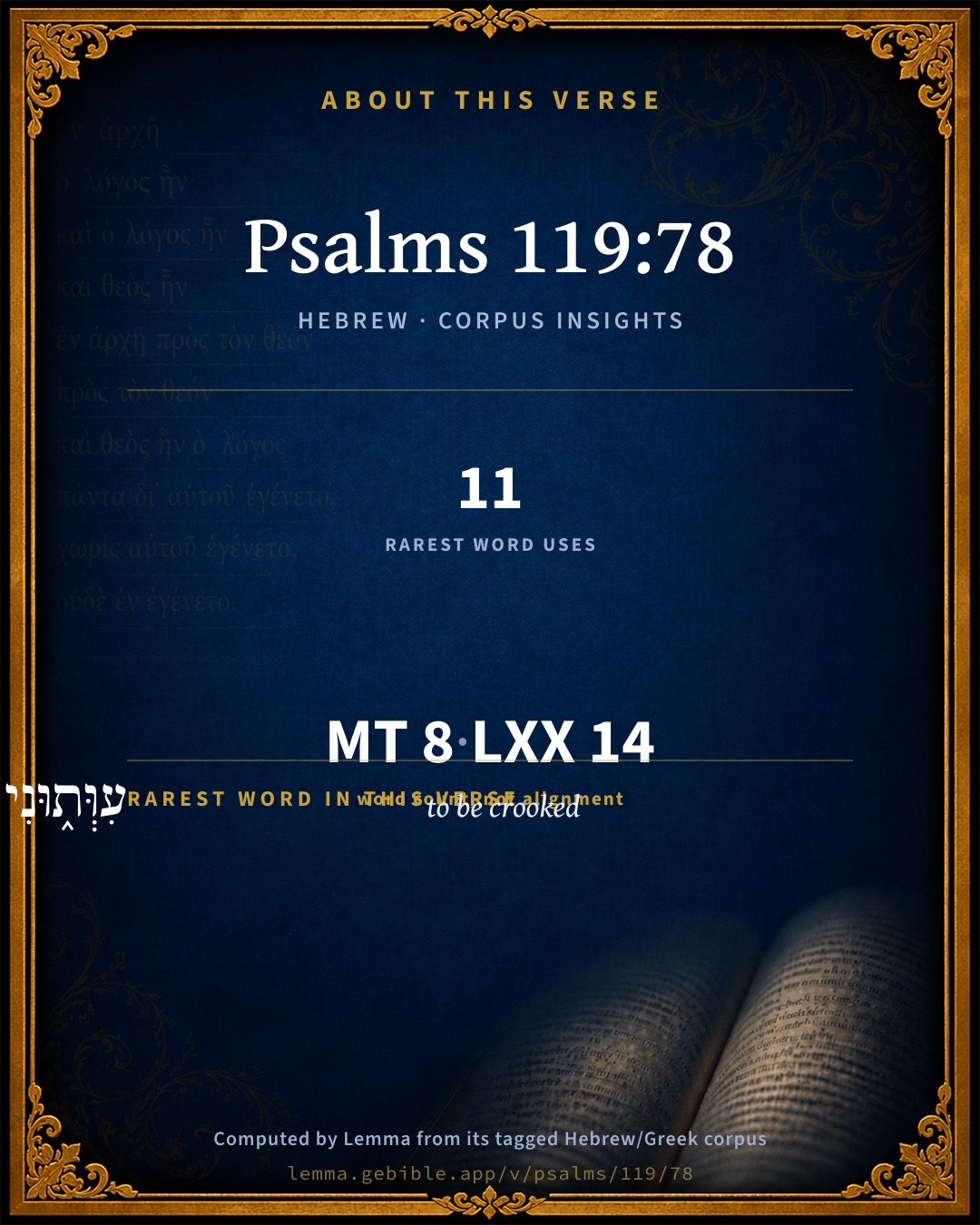
The rarest word here is עִוְּת֑וּנִי to be crooked H5791 — appearing just 11 times in the whole Hebrew Bible.

Shared distinctive vocabulary

עִוְּת֑וּנִי to be crooked H5791 occurs in 10 verses of the Hebrew Bible. Also found in:

Grammatical profile

  • 3 verbs
  • 2 nouns
  • 1 adjective
  • 1 pronoun
  • 1 conjunction

Verb forms

  • יֵבֹ֣שׁוּ Qal · Imperfect
  • עִוְּת֑וּנִי Piel · Perfect
  • אָשִׂ֥יחַ Qal · Imperfect

Hebrew & Septuagint length

In English translation the verse runs 17 words from the Hebrew and 18 from the Septuagint (LXX English) — closely comparable.

A rough comparison of the two English renderings, which tokenize alike — not a word-level alignment.

Word counts can differ between the Hebrew and the Greek without any difference in meaning — e.g. the Hebrew direct-object marker אֵת has no separate Greek word, and Greek often adds the article ὁ.

In the original languages it is 8 Hebrew tokens and 14 Greek tokens — but the two are counted differently (Hebrew bundles its prefixes and suffixes into one token; the Greek is in lemma form), so that isn’t a like-for-like length.

Cross-references

17

Topical passages linked to Psalms 119:78 in the Treasury of Scripture Knowledge — connected by theme and wording, ordered by reader-vote popularity; previews shown in the World English Bible.

  • Psalms 25:3 Yes, no one who waits for you shall be shamed. They shall be shamed who deal treacherously without cause.
  • Psalms 119:23 Though princes sit and slander me, Your servant will meditate on your statutes.
  • Psalms 119:51 The arrogant mock me excessively, But I don't swerve from your law.
  • John 15:25 But this happened so that the word may be fulfilled which was written in their law, 'They hated me without a cause.'
  • 1 Peter 2:20 For what glory is it if, when you sin, you patiently endure beating? But if, when you do well, you patiently endure suffering, this is commendable with God.
  • 1 Samuel 24:10–12 Behold, this day your eyes have seen how that Yahweh had delivered you today into my hand in the cave: and some bade me kill you; but [my eye] spared you; and I said, I will not put forth my hand against my lord; for he is Yahweh's anointed.
  • 1 Samuel 24:17 He said to David, You are more righteous than I; for you have rendered to me good, whereas I have rendered to you evil.
  • 1 Samuel 26:18 He said, Why does my lord pursue after his servant? for what have I done? or what evil is in my hand?
  • Psalms 1:2 But his delight is in Yahweh's law; On his law he meditates day and night.
  • Psalms 7:3–5 Yahweh, my God, if I have done this, If there is iniquity in my hands,
  • Psalms 35:7 For without cause they have hidden their net in a pit for me. Without cause they have dug a pit for my soul.
  • Psalms 35:26 Let them be disappointed and confounded together who rejoice at my calamity. Let them be clothed with shame and dishonor who magnify themselves against me.
  • Psalms 69:4 Those who hate me without a cause are more than the hairs of my head. Those who want to cut me off, being my enemies wrongfully, are mighty. I have to restore what I didn't take away.
  • Psalms 109:3 They have also surrounded me with words of hatred, And fought against me without a cause.
  • Psalms 119:21 You have rebuked the proud who are cursed, Who wander from your commandments.
  • Psalms 119:85–86 The proud have dug pits for me, Contrary to your law.
  • Jeremiah 50:32 The proud one shall stumble and fall, and none shall raise him up; and I will kindle a fire in his cities, and it shall devour all who are round about him.

Cross-references courtesy of OpenBible.info (CC BY 4.0).

Hebrew and Greek witnesses Masoretic Hebrew ↔ Greek Septuagint

The same verse in the two great witnesses to the Old Testament, shown verse-for-verse.

You’re reading Greek Psalm 118 (Hebrew Psalm 119). The Septuagint counts the superscription, so verse numbers can differ from the Hebrew — chapter-level alignment, not verse-by-verse. Numbering follows Rahlfs.

These are two independent witnesses, not word-aligned to each other, and the Septuagint is shown in lemma (dictionary) form.

Hebrew Psalms 119:78 Masoretic · Westminster Leningrad Codex

יֵבֹ֣שׁוּ זֵ֭דִים כִּי שֶׁ֣קֶר עִוְּת֑וּנִי אֲ֝נִ֗י אָשִׂ֥יחַ בְּפִקּוּדֶֽיךָ

Let the proud be disappointed, for they have overthrown me wrongfully. I will meditate on your precepts.

World English Bible · Public Domain

Greek LXX Greek Psalm 118:78 Septuagint · lemma form

αἰσχύνω ὑπερήφανος ὅτι ἀδίκως ἀνομέω εἰς ἐγώ ἐγώ δέ ἀδολεσχέω ἐν ὁ ἐντολή σύ

Let the proud be ashamed; for they transgressed against me unjustly: but I will meditate in your commandments.

LXX2012 (modern English Septuagint) · Public Domain

On this verse, The Treasury of David discusses the Septuagint’s reading. Read the note in Commentary ↓

Hebrew: Westminster Leningrad Codex (CC BY 4.0). Greek: Septuagint (public domain); English from LXX2012 (modern English Septuagint) (Public Domain). How the Septuagint differs from the Hebrew →

Commentary

Notes on Psalms 119:78 from classic Christian and Jewish commentators (each source and its license shown beneath its notes). The classic Christian expositions comment on the surrounding passage and are grouped to its opening verse, so a note may address several verses; the Jewish commentaries on the Tanakh (Rashi and others) are per-verse, so they appear only where the commentator wrote on this verse.

Lemma curates 59 commentaries, every one of them public domain or Creative Commons licensed, each selected and text-cleaned for this edition rather than reprinted as found. About our sources →

Trapp's Complete Commentary

John Trapp

Psa 119:78 Let the proud be ashamed; for they dealt perversely with me without a cause: [but] I will meditate in thy precepts.

Ver. 78. Let the proud be ashamed] Theoderet thinks that David here prayeth not against, but for, his enemies, quando quidem confusio et ignominia salutem procreat. But that is not likely.

For they dealt perversely with me] Writhing my words and deeds to a wrong sense; or, they would pervert me.

But I will meditate in thy precepts] Or, I will speak of them, and so stop their mouths, and save myself from them.

John Trapp, A Commentary or Exposition upon All the Books of the Old and New Testament (1647–1656) — public domain. Text from a community e-Sword module.

Joseph Benson's Commentary

Psa 119:78-79. Let the proud be ashamed — Confound all the proud contemners of thy law; let them be brought either to repentance or to shame; for they have dealt perversely with me, either by their calumnies, putting false and perverse constructions on my words and actions, or endeavouring to overthrow and destroy me, by turning me out of the way of my duty; but I will meditate in thy precepts — All their wicked attempts shall never drive me from the study, and love, and practice of thy precepts. Let those that fear thee, &c. — Let all pious men, who have a due regard for thy testimonies, be convinced of this, and turn their hearts and affections to me, which have been alienated from me, either by the artifices and calumnies of my adversaries, or by my sore and long distresses, causing them to think that I had deceived them with false pretences, or that God, for my sins, had utterly forsaken me. And those that have known thy testimonies — That is, that have loved and practised them. The sense of this verse is much the same with that of the seventy-fourth; that good men, seeing what God had done for him, should turn themselves to him, take encouragement from him, and recognise the righteousness of God in protecting his friends.

Joseph Benson's Commentary on the Old and New Testaments (1811–1818) — public domain. Text from a community e-Sword module.

J. A. Alexander on Psalms

Joseph Addison Alexander

78. (Psa 119:78) Shamed be the proud, for falsely have they wronged me; I will muse of thy precepts. Falsely, literally falsehood, i.e. in or by it. Wronged, literally bent, perverted. With the last clause compare Psa 119:27; Psa 119:48.

Joseph Addison Alexander, The Psalms Translated and Explained (1850) — public domain. Text from a community e-Sword module.

Matthew Henry's Commentary

Here David shows,

I. How little he valued the will - will of sinners. There were those that dealt perversely with him, that were peevish and ill-conditioned towards him, that sought advantages against him, and misconstrued all he said and did. Even those that deal most fairly may meet with those that deal perversely. But David regarded it not, for, 1. He knew it was without cause, and that for his love they were his adversaries. The causeless reproach, like the curse causeless, may be easily slighted; it does not hurt us, and therefore should not move us. 2. He could pray, in faith, that they might be ashamed of it; God's dealing favourably with him might make them ashamed to think that they had dealt perversely with him. "Let them be ashamed, that is, let them be brought either to repentance or to ruin." 3. He could go on in the way of his duty, and find comfort in that. "However they deal with me, I will meditate in thy precepts, and entertain myself with them."

II. How much he valued the good-will of saints, and how desirous he was to stand right in their opinion, and keep up his interest in them and communion with them: Let those that fear thee turn to me. He does not mean so much that they might side with him, and take up arms in his cause, as that they might love him, and pray for him, and associate with him. Good men desire the friendship and society of those that are good. Some think it intimates that when David had been guilty of that foul sin in the murder of Uriah, though he was a king, those that feared God grew strange to him and turned from him, for they were ashamed of him; this troubled him, and therefore he prays, Lord, let them turn to me again. He desires especially the company of those that were not only honest, but intelligent, that have known thy testimonies, have good heads as well as good hearts, and whose conversation will be edifying. It is desirable to have an intimacy with such.

Matthew Henry's Commentary on the Whole Bible (1708–1710) — public domain (CC PDM 1.0). Text via the HelloAO Bible API.

Adam Clarke's Commentary

Verse 78. Let the proud be ashamed] To reduce a proud man to shame, is to humble him indeed. Let them be confounded. Without cause - without any colourable pretext, have they persecuted me.

Adam Clarke's Commentary on the Bible (1810–1826) — public domain. Text from a community e-Sword/MySword module.

John Calvin's Commentaries

78. Let the proud be put to shame. We have already often had occasion to remark, that, in the Hebrew language, the future tense is frequently used in the sense of the optative mood, as here, — They shall be put to shame, for, Let them be put to shame. Still it would not be unsuitable to explain the meaning thus’ As the proud have dealt mischievously with me, and molested me without a cause, the Lord will give them their reward. But as almost all interpreters are agreed that this is a prayer, in the translation of the verse I am unwilling to depart from the generally received explanation, especially as the language is expressly addressed to God himself. It is important to attend to the reason why the Psalmist hopes that God will be an enemy to his enemies; namely, because they wickedly and maliciously assaulted him. The word שקר, sheker, which I have rendered falsely, is by some translated, without a cause; but they seem only to hit upon the one half of the prophet’s meaning; for this word, in my opinion, is to be referred to the stratagems and artifices by which the wicked endeavored to destroy David. Whence we gather, that whenever we are wrongfully persecuted by wicked men, we are invited to have recourse directly to God for protection. At the same time, we are taught that we have no reason to be abashed at their insolence; for, whatever power they may arrogate to themselves, He will beat down their loftiness, and lay it low, to their shame; so that, being confounded, they will serve as an example, to teach others that nothing is more ridiculous than to sing the song of triumph before the victory is gained. The verb אשיח, asiach, in the second clause of the verse, may be rendered, I will speak of, as well as I will meditate upon; implying, that, when he had obtained the victory, he would proclaim the goodness of God, which he had experienced. To speak of God’s statutes, is equivalent to declaring out of the law, how faithfully he guards his saints, how securely he delivers them, and how righteously he avenges their wrongs.

John Calvin's Commentaries (1540-1563) — public domain. Text from the Calvin Translation Society English edition (1840s-50s) via the Christian Classics Ethereal Library (ccel.org). Calvin's coverage is partial (roughly two-thirds of the Bible); uncommented books and verses are honest gaps, never fabricated. The 19th-century editor's footnotes and remarks are omitted so the notes are faithfully Calvin's own voice.

Ellicott's Commentary for English Readers

(78) Dealt.—Better, wronged me; literally, bent me.

A Bible Commentary for English Readers, edited by Charles John Ellicott (1878–1897) — public domain. Text from a community e-Sword module.

The Cambridge Bible for Schools and Colleges

gen. ed. J. J. S. Perowne

78. for they dealt perversely with me without a cause] Better, for they have subverted me by falsehood. Cp. Lam_3:36.

The Cambridge Bible for Schools and Colleges (gen. ed. J. J. S. Perowne; Cambridge University Press, 1878–1918) — public domain. Text from a community e-Sword module.

John Gill's Exposition

Mine eyes fail for thy word,.... Either with looking for the Messiah, the essential Word, that was to be, and afterwards was made flesh, and dwelt among men; or for the fulfilment of the word of promise, on which he was made to hope; but that being deferred; and he believing in hope against hope, and looking out continually till it was accomplished, his eyes grew weary, and failed him, and he was just ready to give up all expectation of it; see Psa 77:8;

saying, when wilt thou comfort me? The people of God are sometimes very disconsolate, and need comforting, through the prevalence of sin, the power of Satan's temptations, the hidings of God's face, and a variety of afflictions; when they apply to God for comfort, who only can comfort them, and who has his set times to do it; but they are apt to think it long, and inquire, as David here, when it will be.

John Gill's Exposition of the Whole Bible (1746–1763) — public domain (CC PDM 1.0). Text via the HelloAO Bible API.

Albert Barnes' Notes on the Bible

Let the proud be ashamed - Referring here to his enemies, who appear to have been in the higher ranks of life, or to have been those who prided themselves on their wealth, their station, or their influence. See the notes at Psa 119:51. The psalmist asks here that they might be confounded or put to shame; that is, that they might fail of accomplishing their purposes in regard to him. See Psa 25:2-3, notes; Job 6:20, note.

For they dealt perversely with me - They were not honest; they deceived me; they took advantage of me; they were not true to their professions of friendship. Compare the notes at Isa 59:3; notes at Job 8:3; notes at Job 34:12.

Without a cause - Hebrew, “by a lie.” That is, They have been guilty of falsehood in their charges or accusations against me. I have given them no occasion for such treatment, and their conduct is based on an entire misrepresentation. See the notes at Joh 15:25.

But I will meditate in thy precepts - See the notes at Psa 1:2. I will not be diverted from thee, from thy law, from thy service, by all that man can do to me; by all the false charges which the enemies of religion may bring against me; by all the contempt or persecution that I may suffer for my attachment to thee. See Psa 119:23, note; Psa 119:69, note.

Albert Barnes' Notes on the Bible (1834–1885) — public domain. Text from a community e-Sword/MySword module.

Matthew Poole's English Annotations

They dealt perversely with me, Heb. they have perverted me; either by their calumnies, whereby they have put false and perverse constructions upon all my words and actions; or by endeavouring to overthrow and destroy me, or to turn me out of the way of thy precepts. But all their wicked attempts against me shall never drive me from the study, and love, and practice of thy precepts.

Matthew Poole's English Annotations on the Holy Bible (1683–1685) — public domain. Text from a community e-Sword/MySword module.

The Treasury of David

Charles H. Spurgeon

Ver. 78. Let the proud be ashamed. He begged that the judgments of God might no longer fall upon himself, but upon his cruel adversaries. God will not suffer those who hope in his word to be put to shame, for he reserves that reward for haughty spirits: they shall yet be overtaken with confusion, and become the subjects of contempt, while God's afflicted ones shall again lift up their heads. Shame is for the proud, for it is a shameful thing to be proud. Shame is not for the holy, for there is nothing in holiness to be ashamed of.

For they dealt perversely with me without a cause. Their malice was wanton, he had not provoked them. Falsehood was employed to forge an accusation against him; they had to bend his actions out of their true shape before they could assail his character. Evidently the Psalmist keenly felt the malice of his foes. His consciousness of innocence with regard to them created a burning sense of injustice, and he appealed to the righteous Lord to take his part and clothe his false accusers with shame. Probably he mentioned them as "the proud, " because he knew that the Lord always takes vengeance on proud men, and vindicates the cause of those whom they oppress. Sometimes he mentions the proud, and sometimes the wicked, but he always means the same persons; the words are interchangeable: he who is proud is sure to be wicked, and proud persecutors are the worst of wicked men.

But I will meditate in thy precepts. He would leave the proud in God's hands, and give himself up to holy studies and contemplations. To obey the divine precepts we have need to know them, and think much of them. Hence this persecuted saint felt that meditation must be his chief employment. He would study the law of God and not the law of retaliation. The proud are not worth a thought. The worst injury they can do us is to take us away from our devotions; let us baffle them by keeping all the closer to our God when they are most malicious in their onslaughts.

In a similar position to this we have met with the proud in other octaves, and shall meet them yet again. They are evidently a great plague to the Psalmist, but he rises above them.

Ver. 78. Let the proud be ashamed, etc. Here is the just recompense of his pride. He would fain have honour and preeminence, but God will not give them unto him: he flies shame and contempt, but God shall pour them upon him. "For they dealt perversely with me without a cause." David complains of the wicked and false dealing of his enemies against him; and his prayer is written to uphold us in the like temptation. For Satan is alway like himself, hating them whom the Lord loveth. He can scarce be worse, lie can never be better; and therefore with restless malice stirs he up all his cursed instruments in whom he reigns, to persecute those who are loved and protected of the Lord. "But I will meditate in thy precepts." David's enemies fought against him with the weapons of the flesh, wickedness and falsehood: lie withstands them by the armour of the Spirit; not meeting wickedness with wickedness, and falsehood with falsehood. For if we fight against Satan with Satan's weapons he will soon overcome us; but if we put upon us the complete armour of God to resist him, he shall flee from us. William Cowper.

Ver. 78. Let the proud be ashamed. That is, that they may not prosper or succeed in their attempts; for men are ashamed when they are disappointed. All their endeavours for the extirpation of God's people are vain and fruitless, and those things which they have subtilly devised, have not that effect which they propounded unto themselves. "For they dealt perversely with me without a cause." The Septuagint have it aoikwv unjustly. Ainsworth readeth, "With falsehood they have depraved me." It implies two things: first, that they pretended a cause; but, secondly, David avouches his innocency to God; and so, without any guilt of his, they accused, defamed, condemned his actions, as is usual in such cases. When the proud are troublesome and injurious to God's people the saints may boldly commend their cause to God...The Lord may be appealed unto upon a double account; partly, as he is an enemy to the proud, and as a friend to the humble (Jas 4:6 Ps 138:6); partly, as he is the portion of the afflicted and oppressed (Ps 140:12). When Satan stirreth up his instruments to hate those whom the Lord loveth, the Lord will stir up his power to help and defend them. Is not this a revengeful prayer? Answer, No. First. Because those who pray it are seeking their own deliverance, that they may more freely serve God by consequence. Indeed, by God's showing mercy to his people, the pride of wicked ones is suppressed (Ps 119:134); but mercy is the main object of the prayer.

Secondly. As it concerneth his enemies, he expresses it in mild terms that they may "be ashamed"; that is, disappointed, in their counsels, hopes, machinations, and endeavours. And therefore it is not against the persons of his enemies, but their plots and enterprises. In such cases shame and disappointment may even do them good, They think to bring in the total suppression of God's people, but that would harden them in their sins; therefore God's people desire that he would not let their innocency be trampled upon, but disappoint their adversaries, that the proud may be ashamed in the failing of their attempts.

Thirdly. The prayers of the righteous for the overthrow of the wicked, are a kind of prophecies; so that, in praying, David doth in effect foretell, that such as dealt perversely should soon be ashamed, since a good cause will not always be oppressed: "But he shall appear to your joy, and they shall be ashamed" (Isa 66:5).

Fourthly. Saints have a liberty to imprecate vengeance, but such as must be used sparingly and with great caution: "Let them be confounded and consumed that are adversaries to my soul" (Ps 71:13). Malicious enemies may be expressly prayed against. Thomas Manton.

Ver. 78. Let the proud be ashamed. This suggests a word to the wicked. Take heed that by your implacable hatred to the truth and church of God you do not engage her prayers against you. These imprecatory prayers of the saints, when shot at the right mark, and duly put up, are murdering pieces, and strike dead where they light. "Shall not God avenge his own elect, which cry day and night unto him, though he bear long with them? I tell you that he will avenge them speedily." Lu 18:7-8. They are not empty words as the imprecations of the wicked poured into the air, and there vanishing with their breath but are received into heaven, and shalt be sent back with thunder and lightning upon the pates of the wicked. David's prayer unravelled Ahithopel's fine spun policy, and twisted his halter for him. The prayers of the saints are more to be feared as once a great person said and felt than an army of twenty thousand men in the field. Esther's fast hastened Haman's ruin, and Hezekiah's against Sennacherib brought his huge host to the slaughter, and fetched an angel from heaven to do the execution in one night upon them. William Gumall.

Ver. 78. The proud. The wicked, especially the persecutors of God's people, are usually characterized by this term in this psalm, "the proud" (Ps 119:51, 69, 122). Pride puts wicked men upon being troublesome and injurious to the people of God. But why are the persecutors and the injurious called "the proud"? 1. Because wicked men shake off the yoke of God, and will not be subject to their Maker, and therefore desist not from troubling his people: "Who is the Lord, that I should obey his voice to let Israel go"? (Ex 5:2). What was in his tongue, is in all men's hearts; they contemn God and his laws. Every sin hath a degree of pride, and a deprecation of God included in it, (2Sa 12:9). 2. Because they are drunk with worldly felicity, and never think of changes. "Our soul is exceedingly filled with the scorning of those that are at ease, and with the contempt of the proud" (Ps 123:4). When men go on prosperously, they are apt wrongfully to trouble others, and then to flout at them in their misery, and to despise the person and cause of God's people, which is a sure effect of great arrogancy and pride. They think they may do what they please: "They have no changes; therefore they fear not God, "and put forth their hands against such as be at peace with them (Ps 60:19-20): whilst they go on prosperously and undisturbed, they cannot abstain from violence and oppression. 3. Because they affect a life of pomp, and ease, and carnal greatness, and so despise the affliction, and meanness, and simplicity of God's people. The false church hath usually the advantage of worldly power and external glory; and the true church is known by the Divine power, gifts and graces, and the lustre of holiness. 4. They are called "proud, "because of their insolent carriage towards the Lord's people; partly in their laws and injunctions, requiring them to give them more honour, respect, and obedience, than in conscience can be afforded them; as Haman would have Mordecai to devote himself to him after the manner of the Persians (Es 3:5). Condensed from Manton.

Ver. 78. When any of you, says Caesarius, "is singing the verse of the Psalm where it is said, Let the proud be put to shame, let him be earnest to avoid pride, that he may escape everlasting shame." William Kay.

Ver. 78. But I will meditate in thy precepts. He repeateth the same thing often, and surely if the world could not contain the books that might be written of Christ, and yet for our infirmity the Lord hath comprised them in such a few books, and yet one thing in them is often repeated, it showeth that the matter is weighty, and of us duly and often to be considered. And again we are taught that this is a thing that none do so carefully look unto as they ought. And he showeth that as his enemies sought by evil means to hurt him; so he sought to keep a good conscience, that so they might not hurt him. Then we must not set policy against policy nor cretizare rum Cretensibus;but let us always tend to the word, and keep within the bounds of that, and fight with the weapons that it lendeth us...If we would give over ourselves to God and his word, and admit nothing but that which agreeth to the word, then should we be made wiser than our enemies. Richard Greenham.

Ver. 78. I will meditate in thy precepts. The verb tyva, asiach, in the second clause of the verse, may be rendered, "I will speak of, "as well as, "I will reiterate upon"; implying, that, when he had obtained the victory, he would proclaim the goodness of God, which he had experienced. To speak of God's statutes, is equivalent to declaring out of the law how faithfully he guards his saints, how securely he delivers them, and how righteously he avenges their wrongs. John Calvin.

Ver. 78. Meditate. Truths lie hid in the heart without efficacy or power, till improved by deep, serious, and pressing thoughts...A sudden carrying a candle through a room, giveth us not so full a survey of the object, as when you stand a while beholding it. A steady contemplation is a great advantage. Thomas Manton.

Ver. 78.

1. A hard thing to make the proud ashamed.

2. A cruel thing "they dealt perversely with me, "etc.

3. A wise thing "but I will meditate, "etc.

Psalms 119:79*

Charles H. Spurgeon's The Treasury of David (1869–1885) — public domain. Psalms only. Text from a community e-Sword/MySword module.

The Pulpit Commentary

Let the proud be ashamed; i.e. put them to shame. (comp. Psa_35:4, 26 40:14 70:2 83:17, etc.) For they dealt perversely with me without a cause; rather, for with lies they subvert me (comp. ver. 69). But I will meditate in thy precepts. Repeated from ver. 15.

The Pulpit Commentary (1880–1919), ed. H.D.M. Spence-Jones & Joseph S. Exell — public domain. Text from a community e-Sword module.

Rashi

Rabbi Shlomo Yitzchaki (Rashi)

for they condemned me falsely For no reason they condemned me. (I found:) I say that this deals with the embarrassment [of David] when they would say to him, “If one is intimate with a married woman, with what [method] is his death penalty?” when he [David] had not sinned.

Rashi on the Tanakh — English translations: “The Judaica Press complete Tanach with Rashi, translated by A. J. Rosenberg” (CC BY 4.0); “Pentateuch with Rashi's commentary by M. Rosenbaum and A.M. Silbermann, 1929-1934” (public domain); “The Metsudah Tanach series, Lakewood, N.J” (CC BY 4.0); and “The Book of Joshua, Metsudah Publications, 1997” (CC BY 4.0). Text via Sefaria.

Lesson kit

Teaching starters — assembled from the data on this page, not authored interpretation. Every prompt links to the verse data it draws on. Edit before teaching.

Psalms, in the Wisdom, opens this verse with 8 words (8 distinct Hebrew lemmas). Its most distinctive word is ʻâvath (“to be crooked”). A historical commentator’s framing appears above. Read the whole chapter for the surrounding context.

Discussion questions

  1. How does “to be crooked” (ʻâvath) shape what this verse is saying?
  2. Job 8:3 shares the word «to be crooked» with this verse. How do the two illuminate each other?
  3. These translations render this verse differently; the difference is in the English rendering, not the original. What questions does that raise?
  4. The verb «יֵבֹ֣שׁוּ» is Qal Imperfect. How does its form color the action?
  5. Reading how Trapp's Complete Commentary and Joseph Benson's Commentary read this verse, where do the two commentators agree and where do they part?

Things to notice

Reading settings

Reading text

Shown beneath each verse's original-language words.

Old Testament
Old Testament edition

Read the OT as the Masoretic Hebrew (MT) or the Greek Septuagint (LXX).

English shown for the Greek Septuagint (in the Hebrew ↔ Greek comparison).

Comparing translations? Open the Compare panel on any verse page to stack up to four side by side.