Micah 6:12

Hebrew (Westminster Leningrad Codex) Micah 6:12 appears in the Hebrew Old Testament. The text above is from the Westminster Leningrad Codex. Each word links to its Strong’s number, a concise gloss, and parsing drawn from the Open Scriptures Hebrew Bible morphology. Click any word for its full Brown-Driver-Briggs (BDB) entry.
Download image
Cite this verse

Micah 6:12 (World English Bible). Public Domain. Lemma interlinear Bible study tool, https://lemma.gebible.app/v/micah/6/12.

Show BibTeX & RIS
BibTeX
RIS
English Translation
Her rich men are full of violence, Her inhabitants speak lies, And their tongue is deceitful in their speech.
World English Bible · Public Domain
Download a study sheet

One document with this verse’s original text, its word-by-word gloss line, the meaning frame, cross-references with their text, attributed commentary, and full source and license credits — printable, and it pastes into notes with its structure intact.

This verse Autodidact and up

Study sheet (.html) Plain text (.txt)

A passage Seminary Student

Up to 50 verses in one chapter. A passage sheet keeps up to 6 commentary sources and 12 cross-references per verse, in the order this page ranks them, and says so on the sheet whenever that leaves anything out. Ask for a single verse and you get the Autodidact verse sheet above.

Everything on this page stays free to read, with no account — the sheet is a download of what is already on screen, not access to it.

Want to remove ads? Support Godless Engineer
Compare translations 3

The same verse in 3 English versions, stacked beneath the original-language interlinear above. Click any original word for its lexicon entry.

Each is an independent rendering of the whole verse — the interlinear is not word-aligned to these translations.

Highlighted words mark where these versions differ — a whole-verse word diff, not a word-by-word alignment.

  • World English Bible Public Domain
    Her rich men are full of violence, Her inhabitants speak lies, And their tongue is deceitful in their speech.
  • King James Version Public Domain
    For the rich men thereof are full of violence, and the inhabitants thereof have spoken lies, and their tongue is deceitful in their mouth.
  • unfoldingWord Literal Text CC BY-SA 4.0
    Whose rich men are full of violence, and her inhabitants have spoken falsehood, and their tongue in their mouth deceitful.

unfoldingWord Literal Text — © unfoldingWord, licensed CC BY-SA 4.0. Word-aligned USFM3 via Door43 (git.door43.org/unfoldingWord/en_ult).

Versions to compare (up to 4)

3 of 4 selected

Show all 18 translations

Every available English version of this verse, each an independent rendering of the whole verse.

  • World English Bible Public Domain
    Her rich men are full of violence, Her inhabitants speak lies, And their tongue is deceitful in their speech.
  • Berean Standard Bible Public Domain
    For the wealthy of the city are full of violence, and its residents speak lies; their tongues are deceitful in their mouths.
  • Majority Standard Bible Public Domain
    For the wealthy of the city are full of violence, and its residents speak lies; their tongues are deceitful in their mouths.
  • King James Version Public Domain
    For the rich men thereof are full of violence, and the inhabitants thereof have spoken lies, and their tongue is deceitful in their mouth.
  • American Standard Version (1901) Public Domain
    For the rich men thereof are full of violence, and the inhabitants thereof have spoken lies, and their tongue is deceitful in their mouth.
  • Revised Version (1885) Public Domain
    For the rich men thereof are full of violence, and the inhabitants thereof have spoken lies, and their tongue is deceitful in their mouth.
  • Geneva Bible (1599) Public Domain
    For the rich men thereof are full of crueltie, and the inhabitants thereof haue spoken lyes, and their tongue is deceitfull in their mouth.
  • Douay-Rheims (1899) Public Domain
    As yet there is a fire in the house of the wicked, the treasures of iniquity, and a scant measure full of wrath.
  • Young's Literal Translation Public Domain
    Whose rich ones have been full of violence, And its inhabitants have spoken falsehood, And their tongue `is' deceitful in their mouth.
  • Literal Standard Version CC BY-SA 4.0
    Whose rich ones have been full of violence, || And its inhabitants have spoken falsehood, || And their tongue [is] deceitful in their mouth.
  • Unlocked Literal Bible CC BY-SA 4.0
    The rich men are full of violence, the inhabitants have spoken lies, and their tongue in their mouth is deceitful.
  • unfoldingWord Literal Text CC BY-SA 4.0
    Whose rich men are full of violence, and her inhabitants have spoken falsehood, and their tongue in their mouth deceitful.
  • Darby Bible Public Domain
    For her rich men are full of violence, and her inhabitants speak lies, and their tongue is deceitful in their mouth.
  • World Messianic Bible Public Domain
    Her rich men are full of violence, her inhabitants speak lies, and their tongue is deceitful in their speech.
  • Webster's Bible Public Domain
    For the rich men thereof are full of violence, and the inhabitants thereof have spoken lies, and their tongue is deceitful in their mouth.
  • Free Bible Version CC BY-SA 4.0
    Your rich people make money by using violence; they tell lies and practice deceit.
  • Bible in Basic English Public Domain
    For its men of wealth are cruel, and its people have said what is not true, and their tongue is false in their mouth.
  • JPS Tanakh (1917) Public Domain
    For the rich men thereof are full of violence, and the inhabitants thereof have spoken lies, and their tongue is deceitful in their mouth.

Literal Standard Version (2020), Covenant Press — licensed CC BY-SA 4.0. Text via the HelloAO Bible API (eBible.org). Unlocked Literal Bible (unfoldingWord) — licensed CC BY-SA 4.0. Text via the HelloAO Bible API (eBible.org). unfoldingWord Literal Text — © unfoldingWord, licensed CC BY-SA 4.0. Word-aligned USFM3 via Door43 (git.door43.org/unfoldingWord/en_ult). Free Bible Version, Dr. Jonathan Gallagher — licensed CC BY-SA 4.0. Text via the HelloAO Bible API (eBible.org).

Word by word

More ways to search: Search by grammar → Find every occurrence → Compare this word →

Practice this passage: Drill this verse → Learn its vocabulary →

רְמִיָּ֥ה
rᵉmîyâh
H7423
“deceit”
Noun, Common, Feminine, Singular, Absolute
Part of Speech
Noun
Type
Common
Gender
Feminine
Number
Singular
State
Absolute
Full BDB Definition

Origin: from H7411

TWOT: 2169a

laxness, slackness, slackening, deceit, treachery
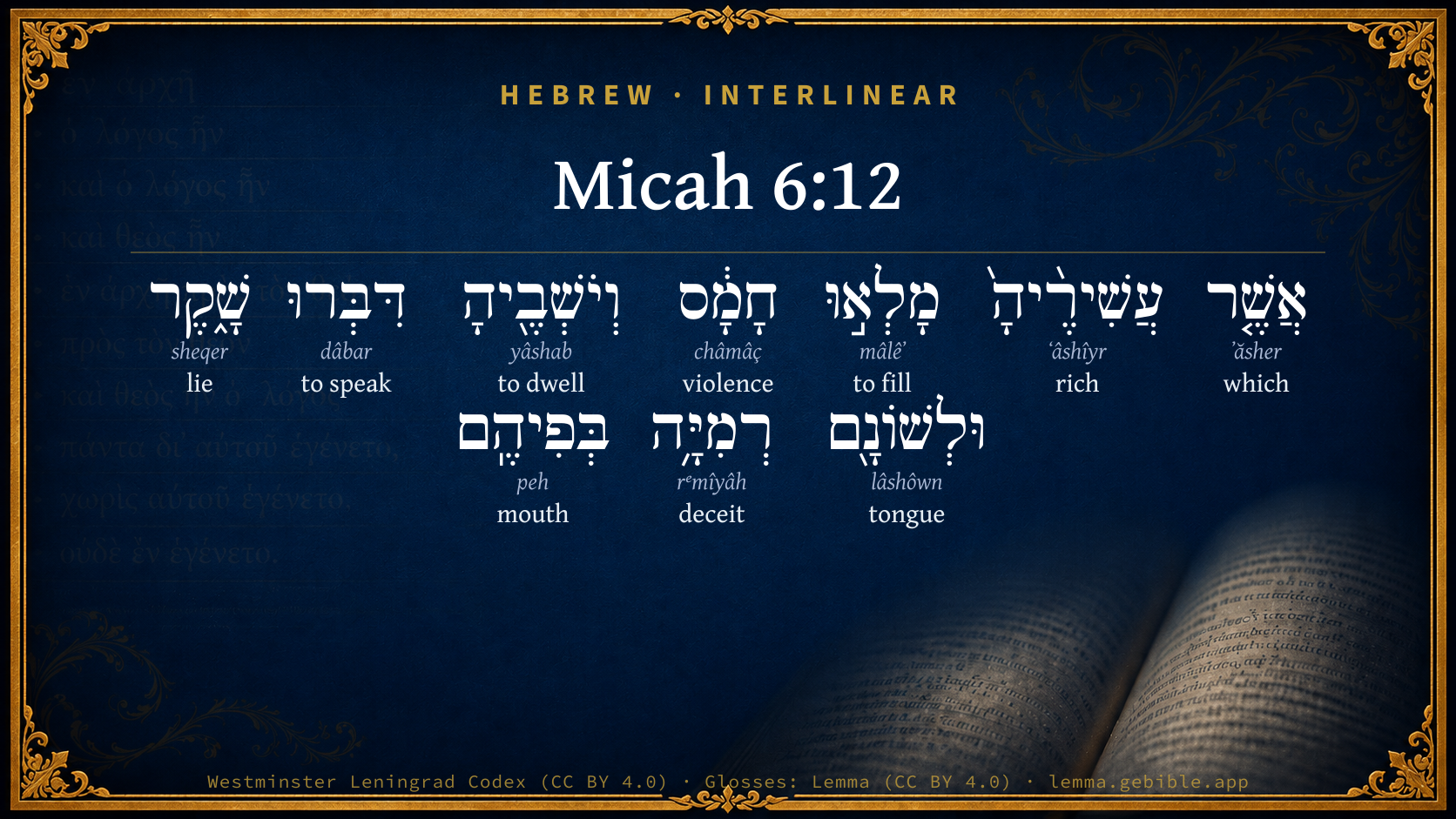
  1. אֲשֶׁ֤ר ʼăsher H834 “which” Particle, Relative
  2. עֲשִׁירֶ֨יהָ֙ ʻâshîyr H6223 “rich · her” Adjective, Adjective, Masculine, Plural, Construct + Suffix, Personal, 3rd Person, Feminine, Singular
  3. מָלְא֣וּ mâlêʼ H4390 “to fill” Verb, Qal, Perfect, 3rd Person, Common, Plural
  4. חָמָ֔ס châmâç H2555 “violence” Noun, Common, Masculine, Singular, Absolute
  5. וְיֹשְׁבֶ֖יהָ yâshab H3427 “and · dwelling · her” Conjunction + Verb, Qal, Participle Active, Masculine, Plural, Construct + Suffix, Personal, 3rd Person, Feminine, Singular
  6. דִּבְּרוּ dâbar H1696 “to speak” Verb, Piel, Perfect, 3rd Person, Common, Plural
  7. שָׁ֑קֶר sheqer H8267 “lie” Noun, Common, Masculine, Singular, Absolute
  8. וּלְשׁוֹנָ֖ם lâshôwn H3956 “and · tongue · their” Conjunction + Noun, Common, Both, Singular, Construct + Suffix, Personal, 3rd Person, Masculine, Plural
  9. בְּפִיהֶֽם peh H6310 “in/at · mouth · their” Preposition + Noun, Common, Masculine, Singular, Construct + Suffix, Personal, 3rd Person, Masculine, Plural

About this verse

These counts appear in no published source. They are computed here, from the morphology-tagged text and Lemma’s own curated glosses. What Lemma adds →

10
words
10
distinct lemmas
Prophets
section

Notable vocabulary

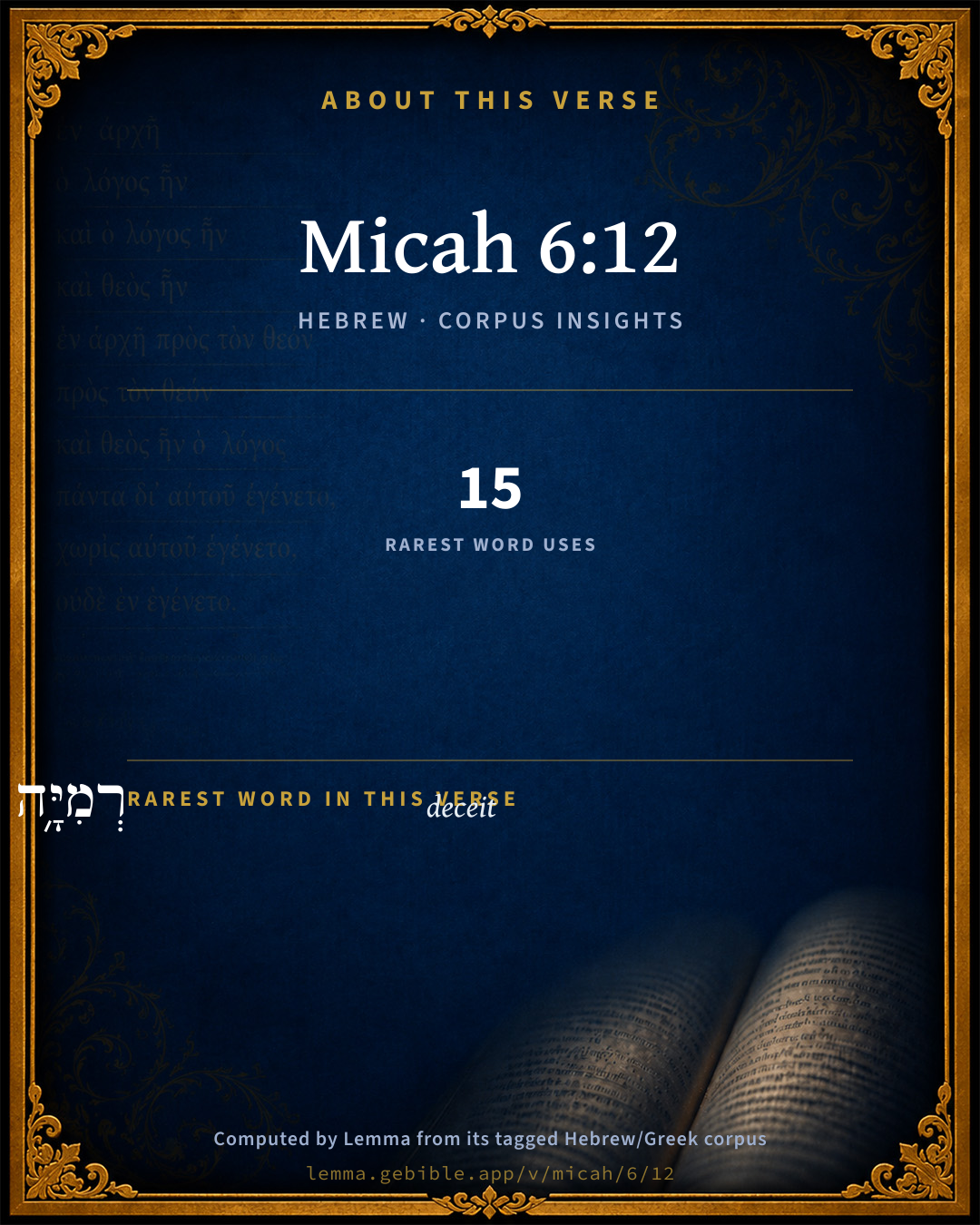
The rarest word here is רְמִיָּ֥ה deceit H7423 — appearing just 15 times in the whole Hebrew Bible.

Shared distinctive vocabulary

רְמִיָּ֥ה deceit H7423 occurs in 15 verses of the Hebrew Bible. Also found in:

Grammatical profile

  • 3 verbs
  • 5 nouns
  • 1 adjective
  • 1 particle

Verb forms

  • מָלְא֣וּ Qal · Perfect
  • וְיֹשְׁבֶ֖יהָ Qal · Participle Active
  • דִּבְּרוּ Piel · Perfect

Hebrew & Septuagint length

In English translation the verse runs 19 words from the Hebrew and 26 from the Septuagint (LXX English) — closely comparable.

A rough comparison of the two English renderings, which tokenize alike — not a word-level alignment.

Word counts can differ between the Hebrew and the Greek without any difference in meaning — e.g. the Hebrew direct-object marker אֵת has no separate Greek word, and Greek often adds the article ὁ.

Cross-references

22

Topical passages linked to Micah 6:12 in the Treasury of Scripture Knowledge — connected by theme and wording, ordered by reader-vote popularity; previews shown in the World English Bible.

  • Isaiah 1:23 Your princes are rebellious, and companions of thieves. Everyone loves bribes, and follows after rewards. They don't judge the fatherless, Neither does the cause of the widow come to them.
  • Jeremiah 9:8 Their tongue is a deadly arrow; it speaks deceit: one speaks peaceably to his neighbor with his mouth, but in his heart he lays wait for him.
  • Hosea 7:13 Woe to them! For they have wandered from me. Destruction to them! For they have trespassed against me. Though I would redeem them, Yet they have spoken lies against me.
  • Isaiah 3:8 For Jerusalem is ruined, and Judah is fallen; Because their tongue and their doings are against Yahweh, To provoke the eyes of his glory.
  • Isaiah 5:7 For the vineyard of Yahweh of Hosts is the house of Israel, And the men of Judah his pleasant plant: And he looked for justice, but, behold, oppression; For righteousness, but, behold, a cry of distress.
  • Jeremiah 9:2–6 Oh that I had in the wilderness a lodging-place of wayfaring men; that I might leave my people, and go from them! for they are all adulterers, an assembly of treacherous men.
  • Micah 2:1–2 Woe to those who devise iniquity And work evil on their beds! When the morning is light, they practice it, Because it is in the power of their hand.
  • Zephaniah 3:3 Her princes in the midst of her are roaring lions. Her judges are evening wolves. They leave nothing until the next day.
  • Romans 3:13 "Their throat is an open tomb. With their tongues they have used deceit." "The poison of vipers is under their lips;"
  • Isaiah 59:3–15 For your hands are defiled with blood, and your fingers with iniquity; your lips have spoken lies, your tongue mutters wickedness.
  • Jeremiah 5:5–6 I will get me to the great men, and will speak to them; for they know the way of Yahweh, and the law of their God. But these with one accord have broken the yoke, and burst the bonds.
  • Jeremiah 5:26–29 For among my people are found wicked men: they watch, as fowlers lie in wait; they set a trap, they catch men.
  • Jeremiah 6:6–7 For thus has Yahweh of Hosts said, Hew you down trees, and cast up a mound against Jerusalem: this is the city to be visited; she is wholly oppression in the midst of her.
  • Ezekiel 22:6–13 Behold, the princes of Israel, everyone according to his power, have been in you to shed blood.
  • Ezekiel 22:25–29 There is a conspiracy of her prophets in the midst of it, like a roaring lion ravening the prey: they have devoured souls; they take treasure and precious things; they have made her widows many in the midst of it.
  • Hosea 4:1–2 Hear the word of Yahweh, you children of Israel; For Yahweh has a charge against the inhabitants of the land: "Indeed there is no truth, Nor goodness, Nor knowledge of God in the land.
  • Hosea 7:1 When I would heal Israel, Then the iniquity of Ephraim is uncovered, Also the wickedness of Samaria; For they commit falsehood, And the thief enters in, And the gang of robbers ravages outside.
  • Amos 5:11–12 Forasmuch therefore as you trample on the poor, And take taxes from him of wheat: You have built houses of hewn stone, But you will not dwell in them. You have planted pleasant vineyards, But you shall not drink their wine.
  • Amos 6:1–3 Woe to those who are at ease in Zion, And to those who are secure on the mountain of Samaria, The notable men of the chief of the nations, To whom the house of Israel come!
  • Micah 3:1–3 I said, "Please listen, you heads of Jacob, And rulers of the house of Israel: Isn't it for you to know justice?
  • Micah 3:9–11 Please listen to this, you heads of the house of Jacob, And rulers of the house of Israel, Who abhor justice, And pervert all equity.
  • Micah 7:2–6 The godly man has perished out of the earth, And there is no one upright among men. They all lie in wait for blood; Every man hunts his brother with a net.

Cross-references courtesy of OpenBible.info (CC BY 4.0).

Hebrew and Greek witnesses Masoretic Hebrew ↔ Greek Septuagint

The same verse in the two great witnesses to the Old Testament, shown verse-for-verse.

These are two independent witnesses, not word-aligned to each other, and the Septuagint is shown in lemma (dictionary) form.

Hebrew Micah 6:12 Masoretic · Westminster Leningrad Codex

אֲשֶׁ֤ר עֲשִׁירֶ֨יהָ֙ מָלְא֣וּ חָמָ֔ס וְיֹשְׁבֶ֖יהָ דִּבְּרוּ שָׁ֑קֶר וּלְשׁוֹנָ֖ם רְמִיָּ֥ה בְּפִיהֶֽם

Her rich men are full of violence, Her inhabitants speak lies, And their tongue is deceitful in their speech.

World English Bible · Public Domain

Greek LXX Micah 6:12 Septuagint · lemma form

ἐκ ὅς ὁ πλοῦτος αὐτός ἀσέβεια πίμπλημι καί ὁ καταοἰκέω αὐτός λαλέω ψευδής καί ὁ γλῶσσα αὐτός ὑψόω ἐν ὁ στόμα αὐτός

whereby they have accumulated their ungodly wealth, and they that dwell in the city have uttered falsehoods, and their tongue has been exalted in their mouth?

LXX2012 (modern English Septuagint) · Public Domain

Hebrew: Westminster Leningrad Codex (CC BY 4.0). Greek: Septuagint (public domain); English from LXX2012 (modern English Septuagint) (Public Domain). How the Septuagint differs from the Hebrew →

Targum (Aramaic paraphrase)

1

The Targum is the ancient Jewish Aramaic paraphrase of the Hebrew Scriptures — an interpretive translation, not the Hebrew text itself. Onkelos (literal) and Pseudo-Jonathan (expansive) render the Torah, and Jonathan the Prophets. Coverage is partial: where no permissively-licensed English translation exists for a verse, only the Aramaic is shown. This is verse-level text, not a word-by-word alignment to the Hebrew.

  1. Targum Jonathan Prophets (Joshua–Malachi)
    דְעַתִּירָאָה מָלָן אוֹצְרֵיהוֹן חֲטוֹף וְיָתְבָהָא מְמַלְלִין שְׁקָר וְלִישַׁנְהוֹן נִכְלִין בְּפוּמְהוֹן:

    (no public-domain English translation for this verse)

    Targum Jonathan — Aramaic: “Mikraot Gedolot” (public domain). English: “Sefaria Community Translation” (CC0 1.0 (public-domain dedication)); “London "Chaldee Paraphrase," 1871” (public domain). Text via Sefaria.

Commentary

Notes on Micah 6:12 from classic Christian and Jewish commentators (each source and its license shown beneath its notes). The classic Christian expositions comment on the surrounding passage and are grouped to its opening verse, so a note may address several verses; the Jewish commentaries on the Tanakh (Rashi and others) are per-verse, so they appear only where the commentator wrote on this verse.

Lemma curates 59 commentaries, every one of them public domain or Creative Commons licensed, each selected and text-cleaned for this edition rather than reprinted as found. About our sources →

Trapp's Complete Commentary

John Trapp

Mic 6:12 For the rich men thereof are full of violence, and the inhabitants thereof have spoken lies, and their tongue [is] deceitful in their mouth.

Ver. 12. For the rich men thereof are full of violence] After that they have once enriched themselves by fraud and false dealing, they take the boldness openly to oppress, and to exercise regiment without righteousness, which is no better than robbery with authority; of which before, Mic 2:1-13; Mic 3:1-12 Thus wicked men wax worse and worse, 2Ti 3:13, "till wrath come upon them to the utmost," 1Th 2:16.

And the inhabitants thereof have spoken lies] Not the rich men only are in fault; but as the Cretians, so these are always liars, loud and lewd liars; their tongue is deceitful in their mouth, so that they no sooner open their mouths but swarms of lies issue out; they are mendaciorum loquacissimi, they have taught their tongues to speak lies, Jer 9:5, they are now become artists at it; yea, they take fast hold of deceit, Jer 8:5, so that they cannot be got off, without striving. This is lamentable, and yet common; especially in trading and trafficking. But oh when shall that golden age return, that the argument may again proceed, Sacerdos est, non fallet: Christianus est, non mentietur. He is a minister, and will not deceive you: He is a Christian, and will not lie! See Isa 63:8.

John Trapp, A Commentary or Exposition upon All the Books of the Old and New Testament (1647–1656) — public domain. Text from a community e-Sword module.

The Biblical Illustrator

Joseph S. Exell

Mic_6:12

For the rich men thereof are full of violence

Trying the impossible

The folly of expecting real prosperity by committing acts of injustice, or pursuing courses of sin, is here forcibly represented by comparing it to the absurdity of attempting to run horses upon a rock, or to plough the rock with oxen.

The strength of the representation is increased by its interrogative form. Our subject is, trying the impossible. Men are constantly doing this--

I. When they attempt to destroy an enemy by physical force.

II. When they attempt to make society morally good by mere secular instruction. Dishonesty, uneducated, may commit petty thefts; but educated, it will legally swindle a nation. Knowledge, alas! is all in vain.

III. When they attempt to get happiness from without. True happiness springs from within, not from without; rises from holy loves, hopes, aspirations, and aims. In one word, love is the well of water that springs into everlasting life.

IV. When they attempt to save souls by ministering to their selfishness. The man who tries to save souls by constant appeals to the selfishness of human nature acts more absurdly than he who attempts to gallop horses upon the sharp peaks of rugged rocks.

V. When they attempt to convert heathens abroad before converting the heathen at home. (Homilist.)

The Biblical Illustrator, edited by Joseph S. Exell (c. 1880s–1900s) — public domain. Text from a community e-Sword module.

Geneva Bible (1599)

Geneva Bible translators

That is, of Jerusalem.

Geneva Bible (1599) marginal notes — public domain. Text via Bolls.life.

Jamieson, Fausset & Brown

Robert Jamieson, A. R. Fausset & David Brown

For--rather, "Inasmuch as"; the conclusion "therefore," &c. following in Mic 6:13.

thereof--of Jerusalem.

Jamieson, Fausset & Brown — Commentary Critical and Explanatory on the Whole Bible (1871) — public domain (CC PDM 1.0). Text via the HelloAO Bible API.

Adam Clarke's Commentary

Verse 12. For the rich men thereof are full of violence] This shows that they did not love mercy.

The inhabitants thereof have spoken lies] This shows that they did not humble themselves to walk with God.

Adam Clarke's Commentary on the Bible (1810–1826) — public domain. Text from a community e-Sword/MySword module.

John Calvin's Commentaries

The Prophet means that the people were so given to avarice and plunder, that all the riches they had heaped together had been got by iniquitous robberies or by wicked gain. He now addresses the citizens of Jerusalem: for though iniquity then prevailed through the whole of Judea, there was yet a reason why he should distinctly accuse the inhabitants of Jerusalem; for they must have led the way by their example, and they were also worse in wickedness than the rest of the people: they were at least more obstinate, as they daily heard God’s Prophets.

Hence he says, her rich men gather not their wealth except by violence. It is indeed certain, that the rich were not then alone guilty before God; but this evil has too much prevailed, that the more liberty any one possesses, the more he employs it to do wrong. Those indeed who have not the power refrain, not because they are not inclined to do harm, but because they are as it were restrained; for poverty is often a bridle to men. As then the rich could spread their snares, as they had power to oppress the poor, the Prophet addresses his words to them, not that the rest were without fault or guilt, but because iniquity was more conspicuous in the rich, and that, because their wealthy as I have already said, gave them more power.

He afterwards extends his address to all the inhabitants, They all, he says, speak falsehood, that is, they have no sincerity, no uprightness; they are wholly given to frauds and deceits. And their tongue is false in their mouth This mode of speaking seems apparently absurd; for where can the tongue be except in the mouth? It appears then a sort of redundancy, when he says that their tongue was deceitful in their mouth. But it is an emphatical mode of speaking, by which the Hebrews mean, that men have falsehoods in readiness as soon as they open their mouth. It is then the same as though the Prophet had said, that no pure word and free from guile could come from them, for as soon as they opened their mouth, falsehoods instantly came forth; their tongue was fraudulent, so that none could expect from these men any truth or faithfulness. — How so? Because as soon as they began to speak, they instantly discovered some guile, there was ever in readiness some falsehood to circumvent the simple.

We now then see that not a few men were summoned before God’s tribunal, but that all without exception were condemned; as though the Prophet had said, that there was no more any integrity in the city, and that corruptions prevailed everywhere, for all were intent on deceiving one another. It follows —

John Calvin's Commentaries (1540-1563) — public domain. Text from the Calvin Translation Society English edition (1840s-50s) via the Christian Classics Ethereal Library (ccel.org). Calvin's coverage is partial (roughly two-thirds of the Bible); uncommented books and verses are honest gaps, never fabricated. The 19th-century editor's footnotes and remarks are omitted so the notes are faithfully Calvin's own voice.

Ellicott's Commentary for English Readers

(12) The rich men thereof—i.e., of the city. The sins of spoliation and fraud were practised by men who had not even the pitiable excuse of poverty and distress.

A Bible Commentary for English Readers, edited by Charles John Ellicott (1878–1897) — public domain. Text from a community e-Sword module.

John Gill's Exposition

For the rich men thereof are full of violence,.... That is, the rich men of the city, to whom the voice of the Lord cried, Mic 6:9. Jerusalem or Samaria, or any or all the cities of Israel and Judah; the rich men of these cities, who had enough of the world, and were under no temptation to do an ill thing, to get money; and yet their hands and their houses, and their treasuries, as the Targum, were full of goods gotten by violent measures, by the oppression of the poor and needy:

and the inhabitants thereof have spoken lies; the rest of the inhabitants, who were not so rich as others, and who had it not in the power of their hands to oppress as others had; yet used deceitful and fraudulent methods to cheat their neighbours in buying and selling; and, to do this, did not stick to tell downright deliberate lies:

and their tongue is deceitful in their mouth; say one thing, and mean another; deceive their neighbours with their tongues in trade and commerce; averting things for truth they know to be false.

John Gill's Exposition of the Whole Bible (1746–1763) — public domain (CC PDM 1.0). Text via the HelloAO Bible API.

Albert Barnes' Notes on the Bible

For the rich men thereof - that is, “of the city, Mic 6:9 are full of violence.” It bad been little, had thieves and robbers lived by violence, but now, (as Isaiah at the same time upbraids them,) “her princes were become companions of thieves” Isa 1:23. Not the poor out of distress, but the rich, out of wantonness and exceeding covetousness and love of luxury, not only did wrong but were filled, not so much with riches, as with violence. Violence is the very meat and drink wherewith they are filled, yea, and wherewith they shall be filled, when it is returned upon their heads.

And the inhabitants thereof have spoken lies - Fraud is itself lying, and lying is its inseparable companion. Jerome: “Lying followeth the gathering together of riches, and the hard custom to lay up riches hath a deceitful tongue.” The sin, he saith, is spread throughout all her inhabitants; that is, all of them, as their custom, have spoken lies, and, even when they speak not, the lie is ready; “their tongue is deceitful (literally, deceit) in their mouth.” It is deceit, nothing but deceit, and that, deceit which should “overthrow” and ruin others. One intent on gain has the lie ever ready to be uttered, even when he speaks not. It lurks concealed, until it is needed.

Albert Barnes' Notes on the Bible (1834–1885) — public domain. Text from a community e-Sword/MySword module.

Matthew Poole's English Annotations

For: this is given as an evidence of the truth of the charge, and of the justness of the resolution God had declared to punish them.

The rich men; who of all men had least temptation to deal unjustly; they were so well provided for, that without a trade they might live, and in trading they should have been content with honest gain; they should have been examples of charity and bounty, but these are the men deepest in this guilt.

Thereof; of Jerusalem, Samaria, and of every traded city in the land.

Full of violence; full of principles, practices, and fruits of violence and rapine, their minds inclined to cheatings and dishonesty, their practices managed with fraud and falsehood, and their riches heaped up through violence.

The inhabitants: the disease is universal, not some few rich men, but they that dwell in the city, are wholly oppression; or perhaps thus, who come to dwell among them, soon catch the disease, and learn these ways.

Thereof; of all the cities of the land of Canaan.

Have spoken lies; have accustomed themselves to speak falsehood, there is no truth in their affirmations or negations.

Their tongue is deceitful in their mouth; there is not a man of plain-heartedness, integrity, and honesty among them. So David complains of his times, Psa 12:1,2.

Matthew Poole's English Annotations on the Holy Bible (1683–1685) — public domain. Text from a community e-Sword/MySword module.

The Pulpit Commentary

The rich men thereof; i.e. of the city mentioned in ver. 9. They have just been charged with injustice and fraud, now they are denounced for practising every kind of violence. And not only the rich, but all the inhabitants fall under censure for lying and deceit. Their tongue is deceitful; literally, deceit; they cannot open their mouth without speaking dangerous and destructive lies.

The Pulpit Commentary (1880–1919), ed. H.D.M. Spence-Jones & Joseph S. Exell — public domain. Text from a community e-Sword module.

John Wesley's Explanatory Notes

Thereof - Of Jerusalem and Samaria.

John Wesley, Explanatory Notes Upon the Whole Bible (1754–1765) — public domain. Text via the GEBible commentary corpus.

Lesson kit

Teaching starters — assembled from the data on this page, not authored interpretation. Every prompt links to the verse data it draws on. Edit before teaching.

Micah, in the Prophets, opens this verse with 10 words (10 distinct Hebrew lemmas). Its most distinctive word is rᵉmîyâh (“deceit”). A historical commentator’s framing appears above. Read the whole chapter for the surrounding context.

Discussion questions

  1. What does “deceit” (rᵉmîyâh) contribute to the verse as a whole?
  2. How does Job 13:7, which shares the word «deceit», read alongside this verse?
  3. The translations on this page render this verse differently — a whole-verse word diff, not a word-by-word alignment. What might account for the different wordings?
  4. «מָלְא֣וּ» is a Qal Perfect verb. How does that grammatical form shape the action described?
  5. Compare how Trapp's Complete Commentary and The Biblical Illustrator read this verse. Where do they agree or differ?

Things to notice

Reading settings

Reading text

Shown beneath each verse's original-language words.

Old Testament
Old Testament edition

Read the OT as the Masoretic Hebrew (MT) or the Greek Septuagint (LXX).

English shown for the Greek Septuagint (in the Hebrew ↔ Greek comparison).

Comparing translations? Open the Compare panel on any verse page to stack up to four side by side.