Jeremiah 13:25

Hebrew (Westminster Leningrad Codex) Jeremiah 13:25 appears in the Hebrew Old Testament. The text above is from the Westminster Leningrad Codex. Each word links to its Strong’s number, a concise gloss, and parsing drawn from the Open Scriptures Hebrew Bible morphology. Click any word for its full Brown-Driver-Briggs (BDB) entry.
Download image
Cite this verse

Jeremiah 13:25 (World English Bible). Public Domain. Lemma interlinear Bible study tool, https://lemma.gebible.app/v/jeremiah/13/25.

Show BibTeX & RIS
BibTeX
RIS
English Translation
This is your lot, the portion measured to you from me, says Yahweh; because you have forgotten me, and trusted in falsehood.
World English Bible · Public Domain
Download a study sheet

One document with this verse’s original text, its word-by-word gloss line, the meaning frame, cross-references with their text, attributed commentary, and full source and license credits — printable, and it pastes into notes with its structure intact.

This verse Autodidact and up

Study sheet (.html) Plain text (.txt)

A passage Seminary Student

Up to 50 verses in one chapter. A passage sheet keeps up to 6 commentary sources and 12 cross-references per verse, in the order this page ranks them, and says so on the sheet whenever that leaves anything out. Ask for a single verse and you get the Autodidact verse sheet above.

Everything on this page stays free to read, with no account — the sheet is a download of what is already on screen, not access to it.

Want to remove ads? Support Godless Engineer
Compare translations 3

The same verse in 3 English versions, stacked beneath the original-language interlinear above. Click any original word for its lexicon entry.

Each is an independent rendering of the whole verse — the interlinear is not word-aligned to these translations.

Highlighted words mark where these versions differ — a whole-verse word diff, not a word-by-word alignment.

  • World English Bible Public Domain
    This is your lot, the portion measured to you from me, says Yahweh; because you have forgotten me, and trusted in falsehood.
  • King James Version Public Domain
    This is thy lot, the portion of thy measures from me, saith the LORD; because thou hast forgotten me, and trusted in falsehood.
  • unfoldingWord Literal Text CC BY-SA 4.0
    This your lot, the portion of your measures from me”—the declaration of Yahweh— “because you have forgotten me and trusted in a lie.

unfoldingWord Literal Text — © unfoldingWord, licensed CC BY-SA 4.0. Word-aligned USFM3 via Door43 (git.door43.org/unfoldingWord/en_ult).

Versions to compare (up to 4)

3 of 4 selected

Show all 18 translations

Every available English version of this verse, each an independent rendering of the whole verse.

  • World English Bible Public Domain
    This is your lot, the portion measured to you from me, says Yahweh; because you have forgotten me, and trusted in falsehood.
  • Berean Standard Bible Public Domain
    This is your lot, the portion I have measured to you,” declares the LORD, “because you have forgotten Me and trusted in falsehood.
  • Majority Standard Bible Public Domain
    This is your lot, the portion I have measured to you,” declares the LORD, “because you have forgotten Me and trusted in falsehood.
  • King James Version Public Domain
    This is thy lot, the portion of thy measures from me, saith the LORD; because thou hast forgotten me, and trusted in falsehood.
  • American Standard Version (1901) Public Domain
    This is thy lot, the portion measured unto thee from me, saith Jehovah; because thou hast forgotten me, and trusted in falsehood.
  • Revised Version (1885) Public Domain
    This is thy lot, the portion measured unto thee from me, saith the LORD; because thou hast forgotten me, and trusted in falsehood.
  • Geneva Bible (1599) Public Domain
    This is thy portion, and ye part of thy measures from me, sayth the Lord, because thou hast forgotten me and trusted in lyes.
  • Douay-Rheims (1899) Public Domain
    This is thy lot, and the portion of thy measure from me, saith the Lord, because thou hast forgotten me, and hast trusted in falsehood.
  • Young's Literal Translation Public Domain
    This `is' thy lot, the portion of thy measures from Me -- an affirmation of Jehovah, Because thou hast forgotten me, And dost trust in falsehood.
  • Literal Standard Version CC BY-SA 4.0
    This [is] your lot, the portion of your measures from Me,” || A declaration of YHWH, || “Because you have forgotten Me, || And trust in falsehood.
  • Unlocked Literal Bible CC BY-SA 4.0
    This is what I have given to you, the portion I have decreed for you—this is Yahweh's declaration— because you have forgotten me and trusted in deceit.
  • unfoldingWord Literal Text CC BY-SA 4.0
    This your lot, the portion of your measures from me”—the declaration of Yahweh— “because you have forgotten me and trusted in a lie.
  • Darby Bible Public Domain
    This shall be thy lot, thy measured portion from me, saith Jehovah; because thou hast forgotten me, and confided in falsehood.
  • World Messianic Bible Public Domain
    This is your lot, the portion measured to you from me,” says the LORD, “because you have forgotten me, and trusted in falsehood.”
  • Webster's Bible Public Domain
    This is thy lot, the portion of thy measures from me, saith the LORD; because thou hast forgotten me, and trusted in falsehood.
  • Free Bible Version CC BY-SA 4.0
    This is what's going to happen to you; this is what I have decided to do to you, declares the Lord, because you have forgotten me and believed in lies.
  • Bible in Basic English Public Domain
    This is your fate, the part measured out to you by me, says the Lord, because you have put me out of your memory and put your faith in what is false.
  • JPS Tanakh (1917) Public Domain
    This is thy lot, the portion measured unto thee from Me, saith the LORD; because thou hast forgotten Me, and trusted in falsehood.

Literal Standard Version (2020), Covenant Press — licensed CC BY-SA 4.0. Text via the HelloAO Bible API (eBible.org). Unlocked Literal Bible (unfoldingWord) — licensed CC BY-SA 4.0. Text via the HelloAO Bible API (eBible.org). unfoldingWord Literal Text — © unfoldingWord, licensed CC BY-SA 4.0. Word-aligned USFM3 via Door43 (git.door43.org/unfoldingWord/en_ult). Free Bible Version, Dr. Jonathan Gallagher — licensed CC BY-SA 4.0. Text via the HelloAO Bible API (eBible.org).

Word by word

More ways to search: Search by grammar → Find every occurrence → Compare this word →

Practice this passage: Drill this verse → Learn its vocabulary →

מִדַּ֛יִךְ
mad
H4055
“measures · your”
Noun, Common, Masculine, Plural, Construct + Suffix, Personal, 2nd Person, Feminine, Singular
Part of Speech
Noun
Type
Common
Gender
Masculine
Number
Plural
State
Construct
Full BDB Definition

Origin: from H4058

TWOT: 1146a

measure, cloth garment - measure - cloth, carpet - garment (outer)
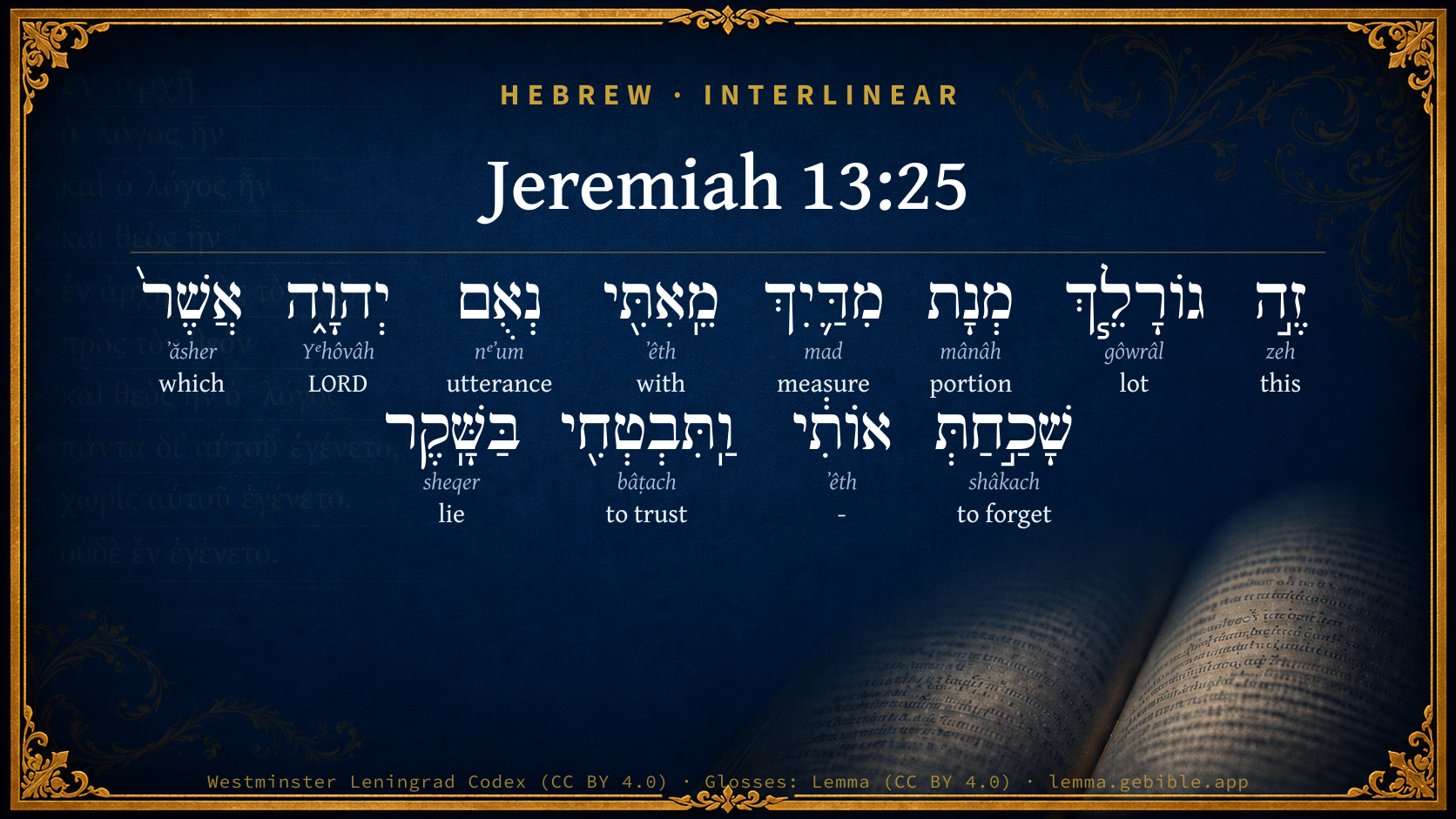
  1. זֶ֣ה zeh H2088 “this” Pronoun, Demonstrative, Masculine, Singular
  2. גוֹרָלֵ֧ךְ gôwrâl H1486 “lot · your” Noun, Common, Masculine, Singular, Construct + Suffix, Personal, 2nd Person, Feminine, Singular
  3. מְנָת mânâh H4490 “portion of” Noun, Common, Feminine, Singular, Construct
  4. מֵֽאִתִּ֖י ʼêth H854 “from · with · me” Preposition + Preposition + Suffix, Personal, 1st Person, Common, Singular
  5. נְאֻם nᵉʼum H5002 “utterance of” Noun, Common, Masculine, Singular, Construct
  6. יְהוָ֑ה Yᵉhôvâh H3068 “LORD” Noun, Proper
  7. אֲשֶׁר֙ ʼăsher H834 “which” Particle, Relative
  8. שָׁכַ֣חַתְּ shâkach H7911 “to forget” Verb, Qal, Perfect, 2nd Person, Feminine, Singular
  9. אוֹתִ֔י ʼêth H853 “- · me” Particle, Direct Object + Suffix, Personal, 1st Person, Common, Singular
  10. וַֽתִּבְטְחִ֖י bâṭach H982 “and · to trust” Conjunction + Verb, Qal, Sequential Imperfect, 2nd Person, Feminine, Singular
  11. בַּשָּֽׁקֶר sheqer H8267 “in/at the · lie” Preposition, Determined + Noun, Common, Masculine, Singular, Absolute

About this verse

These counts appear in no published source. They are computed here, from the morphology-tagged text and Lemma’s own curated glosses. What Lemma adds →

12
words
12
distinct lemmas
Prophets
section

Notable vocabulary

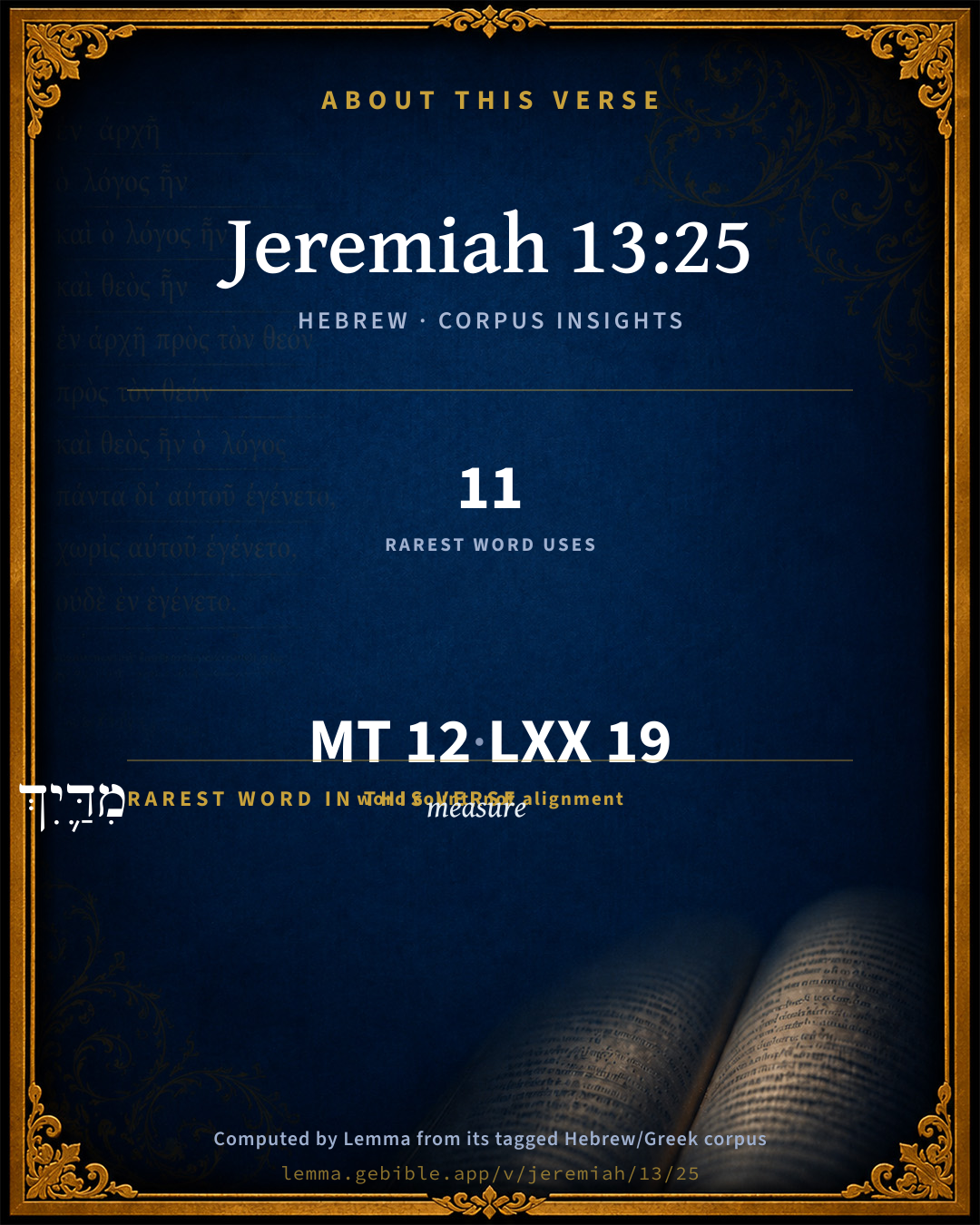
The rarest word here is מִדַּ֛יִךְ measure H4055 — appearing just 11 times in the whole Hebrew Bible.

Shared distinctive vocabulary

מִדַּ֛יִךְ measure H4055 occurs in 11 verses of the Hebrew Bible. Also found in:

Grammatical profile

  • 2 verbs
  • 6 nouns
  • 1 pronoun
  • 1 preposition
  • 2 particles

Verb forms

  • שָׁכַ֣חַתְּ Qal · Perfect
  • וַֽתִּבְטְחִ֖י Qal · Sequential Imperfect

Hebrew & Septuagint length

In the original languages it is 12 Hebrew tokens and 19 Greek tokens — but the two are counted differently (Hebrew bundles its prefixes and suffixes into one token; the Greek is in lemma form), so that isn’t a like-for-like length.

Cross-references

15

Topical passages linked to Jeremiah 13:25 in the Treasury of Scripture Knowledge — connected by theme and wording, ordered by reader-vote popularity; previews shown in the World English Bible.

  • Job 20:29 This is the portion of a wicked man from God, The heritage appointed to him by God."
  • Psalms 9:17 The wicked shall be turned back to Sheol, Even all the nations that forget God.
  • Psalms 11:6 On the wicked he will rain blazing coals; Fire, sulfur, and scorching wind shall be the portion of their cup.
  • Jeremiah 2:32 Can a virgin forget her ornaments, or a bride her attire? yet my people have forgotten me days without number.
  • Matthew 24:51 and will cut him in pieces, and appoint his portion with the hypocrites; there is where the weeping and grinding of teeth will be.
  • Isaiah 28:15 Because you have said, We have made a covenant with death, and with Sheol are we at agreement; when the overflowing scourge shall pass through, it shall not come to us; for we have made lies our refuge, and under falsehood have we hid ourselves:
  • Jeremiah 2:13 For my people have committed two evils: they have forsaken me, the spring of living waters, and hewed them out cisterns, broken cisterns, that can hold no water.
  • Jeremiah 7:4–8 Don't you trust in lying words, saying, The temple of Yahweh, the temple of Yahweh, the temple of Yahweh, are these.
  • Deuteronomy 32:16–18 They moved him to jealousy with strange [gods]; With abominations provoked they him to anger.
  • Deuteronomy 32:37–38 He will say, Where are their gods, The rock in which they took refuge;
  • Psalms 106:21–22 They forgot God, their Savior, Who had done great things in Egypt,
  • Isaiah 17:4 It shall happen in that day, that the glory of Jacob shall be made thin, and the fatness of his flesh shall wax lean.
  • Jeremiah 10:14 Every man is become brutish [and is] without knowledge; every goldsmith is disappointed by his engraved image; for his molten image is falsehood, and there is no breath in them.
  • Micah 3:11 Her leaders judge for bribes, And her priests teach for a price, And her prophets of it tell forturnes for money: Yet they lean on Yahweh, and say, Isn't Yahweh in the midst of us? No disaster will come on us.
  • Habakkuk 2:18–19 "What value does the engraved image have, that its maker has engraved it; the molten image, even the teacher of lies, that he who fashions its form trusts in it, to make mute idols?

Cross-references courtesy of OpenBible.info (CC BY 4.0).

Hebrew and Greek witnesses Masoretic Hebrew ↔ Greek Septuagint

The same verse in the two great witnesses to the Old Testament, shown verse-for-verse.

These are two independent witnesses, not word-aligned to each other, and the Septuagint is shown in lemma (dictionary) form.

Hebrew Jeremiah 13:25 Masoretic · Westminster Leningrad Codex

זֶ֣ה גוֹרָלֵ֧ךְ מְנָת מִדַּ֛יִךְ מֵֽאִתִּ֖י נְאֻם יְהוָ֑ה אֲשֶׁר֙ שָׁכַ֣חַתְּ אוֹתִ֔י וַֽתִּבְטְחִ֖י בַּשָּֽׁקֶר

This is your lot, the portion measured to you from me, says Yahweh; because you have forgotten me, and trusted in falsehood.

World English Bible · Public Domain

Greek LXX Structure differs

In the Septuagint, Jeremiah is about an eighth shorter than the Hebrew and arranges its material differently — the Oracles Against the Nations (Hebrew chapters 46–51) appear in the middle of the Greek book, after 25:13. Because the chapter and verse boundaries do not line up, a verse-for-verse comparison with the Hebrew is not shown.

A verse-for-verse comparison isn’t shown here because the chapters and verses don’t line up. Switch to the LXX edition with the MT / LXX toggle above to read the Greek directly.

Hebrew: Westminster Leningrad Codex (CC BY 4.0). Greek: Septuagint (public domain); English from a public-domain English Septuagint. How the Septuagint differs from the Hebrew →

Targum (Aramaic paraphrase)

1

The Targum is the ancient Jewish Aramaic paraphrase of the Hebrew Scriptures — an interpretive translation, not the Hebrew text itself. Onkelos (literal) and Pseudo-Jonathan (expansive) render the Torah, and Jonathan the Prophets. Coverage is partial: where no permissively-licensed English translation exists for a verse, only the Aramaic is shown. This is verse-level text, not a word-by-word alignment to the Hebrew.

  1. Targum Jonathan Prophets (Joshua–Malachi)
    דֵין עִדְבִיךְ וְחוּלַק אַחְסַנְתִּיךְ מִן קָדָמַי אֲמַר יְיָ דִשְׁבַקְתְּ פּוּלְחָנִי וְאִתְרַחֵיצְתְּ עַל שִׁקְרָא:

    (no public-domain English translation for this verse)

    Targum Jonathan — Aramaic: “Mikraot Gedolot” (public domain). English: “Sefaria Community Translation” (CC0 1.0 (public-domain dedication)); “London "Chaldee Paraphrase," 1871” (public domain). Text via Sefaria.

Commentary

Notes on Jeremiah 13:25 from classic Christian and Jewish commentators (each source and its license shown beneath its notes). The classic Christian expositions comment on the surrounding passage and are grouped to its opening verse, so a note may address several verses; the Jewish commentaries on the Tanakh (Rashi and others) are per-verse, so they appear only where the commentator wrote on this verse.

Lemma curates 59 commentaries, every one of them public domain or Creative Commons licensed, each selected and text-cleaned for this edition rather than reprinted as found. About our sources →

Trapp's Complete Commentary

John Trapp

Jer 13:25 This [is] thy lot, the portion of thy measures from me, saith the LORD; because thou hast forgotten me, and trusted in falsehood.

Ver. 25. This is thy lot.] Look for no better, since thou, by going after lying vanities, forsakest thine own mercies, being miserable by thine own election.

Because thou hast forgotten me.]

“ Esque oblita mei; vitiorumque oblita caeno. ”

John Trapp, A Commentary or Exposition upon All the Books of the Old and New Testament (1647–1656) — public domain. Text from a community e-Sword module.

Keil & Delitzsch

C. F. Keil & F. Delitzsch

In Jer 13:25 the discourse draws to a conclusion in such a way that, after a repetition of the manner in which Jerusalem prepares for herself the doom announced, we have again, in brief and condensed shape, the disgrace that is to befall her. This shall be thy lot. Hitz. renders מנת מדּיך: portion of thy garment, that is allotted for the swelling folds of thy garment (cf. Ruth. Jer 3:15; Kg2 4:39), on the ground that מד never means mensura, but garment only. This is, however, no conclusive argument; since so many words admit of two plural forms, so that מדּים might be formed from מדּה; and since so many are found in the singular in the forms of both genders, so that, alongside of מדּה, מד might also be used in the sense of mensura; especially as both the signiff. measure and garment are derived from the same root meaning of מדד. We therefore adhere to the usual rendering, portio mensurae tuae, the share portioned out to thee. אשׁר, causal, because. Trusted in falsehood, i.e., both in delusive promises (Jer 7:4, Jer 7:8) and in the help of beingless gods (Jer 16:19). - In the וגם־אני lies the force of reciprocation: because thou hast forgotten me, etc., I too have taken means to make retribution on your unthankfulness (Calv.). The threatening of this verse is word for word from Nah 3:5. - For her lewd idolatry Jerusalem shall be carried off like a harlot amid mockery and disgrace. In Jer 13:27 the language is cumulative, to lay as great stress as possible on Jerusalem's idolatrous ongoings. Thy lewd neighing, i.e., thy ardent longing for and running after strange gods; cf. Jer 5:8; Jer 2:24. זמּה, as in Eze 16:27; Eze 22:9, etc., of the crime of uncleanness, see on Lev 18:17. The three words are accusatives dependent on ראיתי, though separated from it by the specification of place, and therefore summed up again in "thine abominations." The addition: in the field, after "upon the hills," is meant to make more prominent the publicity of the idolatrous work. The concluding sentence: thou shalt not become clean for how long a time yet, is not to be regarded as contradictory of Jer 13:23, which affirms that the people is beyond the reach of reformation; Jer 13:23 is not a hyperbolical statement, reduced within its true limits here. What is said in Jer 13:23 is true of the present generation, which cleaves immoveably to wickedness. It does not exclude the possibility of a future reform on the part of the people, a purification of it from idolatry. Only this cannot be attained for a long time, until after sore and long-lasting, purifying judgments. Cf. Jer 12:14., Jer 3:18.

Keil & Delitzsch — Biblical Commentary on the Old Testament (1861–1891) — public domain (CC PDM 1.0). Text via the HelloAO Bible API. (Old Testament only.)

Tyndale Open Study Notes

Tyndale Open Resources

13:25 The people of Judah could not escape their assigned punishment. They had forgotten God and had turned to false gods.

Tyndale Open Study Notes — © Tyndale Open Resources, licensed CC BY-SA 4.0. Text via the HelloAO Bible API.

Jamieson, Fausset & Brown

Robert Jamieson, A. R. Fausset & David Brown

portion of thy measures--the portion which I have measured out to thee (Job 20:29; Psa 11:6).

falsehood-- (Jer 13:27), false gods and alliances with foreign idolaters.

Jamieson, Fausset & Brown — Commentary Critical and Explanatory on the Whole Bible (1871) — public domain (CC PDM 1.0). Text via the HelloAO Bible API.

Adam Clarke's Commentary

Verse 25. Trusted in falsehood.] In idols, and in lying prophets.

Adam Clarke's Commentary on the Bible (1810–1826) — public domain. Text from a community e-Sword/MySword module.

John Calvin's Commentaries

The Prophet no doubt wished to strip the Jews of their vain confidence, through which they acted arrogantly and presumptuously towards God, while yet they professed his name and claimed his favor. They said that they had obtained that land by an hereditary right, because it had been promised to their father Abraham. This indeed was true. They also said, that the land was God’s rest; and they derived this from the prophets. They said farther that God was their heritage; and this also was true. But since they had wickedly profaned God’s name, he takes from them these false boastings, and says, This is thy lot But still they said, When God divided the nations, his lot fell on Israel, for so says Moses. (Deuteronomy 32:8) As then they were wont to say, that God afterwards deceived them, the Prophet here on the other hand reminds them, that they foolishly confided in that lot, because God had rejected them, and did not acknowledge them now as his children, as they were become degenerate and perfidious. This, he says, is thy lot

We see that there is to be understood here a contrast: God was the lot of the people, and they were also the lot of God, according to the passages to which we have referred. They were the heritage of God, and they boasted that God was their heritage; the land was a symbol and a pledge of this heritage. The Prophet now says: “This lot shall be to thee the portion of thy measures from me.” He alludes to an ancient custom; for they were wont to divide fields and meadows by lines, as they afterwards used poles; and we call such measures in the present day perches (perticas.)

We now then understand what the Prophet means; for he intimates that the Jews vainly and presumptuously and foolishly boasted, that God was their heritage; for he owned them not now as his children: and he also declares that another lot was prepared for them, far different from that of heritage, — that God would banish them from the promised land, which they had polluted by their vices. Thus we see that we ought not presumptuously and falsely to pretend or profess the name of God; for though he has been pleased to choose us as his people, it is yet required of us to be faithful to him; and if we forsake him, the same reward for our impiety will no doubt await us as Jeremiah threatens here to his own nation. Let us then so use the favor of God and of Christ, and all the blessings which are offered to us by the gospel, that we may not have to fear that vengeance which happened to the Jews.

He adds the reason, Because thou hast forgotten me and trusted in falsehood By falsehood the Prophet means not only the superstitions in which the Jews involved themselves, but also the false counsels which they adopted, when at one time they had recourse to the Egyptians, at another to some other ungodly nations, in order to get aids in opposition to the will of God. For wherever there was any danger, they thought they had a remedy at hand by having the favor and help of the Egyptians, or of the Assyrians, or of the Chaldeans. In the word falsehood, then, the Prophet includes those perverse designs which they formed, when they sought to defend themselves against God, who would have protected them by his power, had it not been necessary to punish them for their sins. What Jeremiah then condemned in the people was, that they placed their trust in falsehood, that is, that they souglint here and there vain helps, and at the same time disregarded God; nay, they thought themselves safer when God was displeased with them: and hence he says, Thou hast forgotten me For the Jews could not have sought deliverance from the Egyptians or from other heathen nations, or from their idols, without having first rejected God; for if this truth had been really fixed in their minds, — that God cared for their safety, they would no doubt have been satisfied with his protection. Their ingratitude was therefore very manifest in thus adopting vain and impious hopes; for they thus dishonored God, and distrusted his power, as though he was not sufficient to preserve them. It now follows—

John Calvin's Commentaries (1540-1563) — public domain. Text from the Calvin Translation Society English edition (1840s-50s) via the Christian Classics Ethereal Library (ccel.org). Calvin's coverage is partial (roughly two-thirds of the Bible); uncommented books and verses are honest gaps, never fabricated. The 19th-century editor's footnotes and remarks are omitted so the notes are faithfully Calvin's own voice.

Ellicott's Commentary for English Readers

(25) The portion of thy measures.—The meaning of the latter word is doubtful, but it is probably used, as in 1Sa_4:12; Lev_6:11; 2Sa_20:8; Rth_3:15, for the “upper garment” or “lap” of the dress. In this sense the phrase is connected with those which speak of reward or punishment being given men “into their bosom” (Jer_32:18; Psa_79:12; Pro_21:14).

In falsehood.—Better, perhaps, in a lie, i.e., in the worship of false gods that were no gods.

A Bible Commentary for English Readers, edited by Charles John Ellicott (1878–1897) — public domain. Text from a community e-Sword module.

John Gill's Exposition

I have seen thine adulteries,.... Not literally such, though they were greatly guilty of that sin; but figuratively, their idolatries:

thy neighings; expressive of their strong desires after other gods, like that of adulterers and adulteresses after one another; and both which are like the neighing of horses. Kimchi thinks this designs their rejoicing in their evil works:

the lewdness of thy whoredom; their sinful thoughts, and wicked desires, which were continually after their idols and idolatrous practices:

and thine abominations on the hills in the fields; their idols, which were abominable to God, and ought to have been so to them; and which they placed on high hills, and there worshipped them; all which were seen and known by the Lord, nor could it be denied by them; and this was the reason of their being carried captive, and therefore could not complain they had been hardly dealt with; yea, notwithstanding all this, the Lord expresses a tender and compassionate concern for them:

woe unto thee, O Jerusalem! sad will be thy case, dreadful are the calamities coming upon thee, unless thou repentest:

wilt thou not be made clean? wilt thou show no concern, land make use of no means to be cleansed, nor seek for it, where it is to be had? neither repent of sin, nor reform from it, nor seek to God for his grace, signified by clean water; or to the blood of Christ, the fountain opened, which cleanses from it:

when shall it once be? some instances there were of it in the times of Christ and his apostles; but it will not be completely done until they seek the Lord, and his Christ, and fear him, and his goodness, in the latter day; when they shall turn unto him, and all Israel shall be saved; or, "thou wilt not be cleansed after a long time" (w); this the Lord foresaw, and therefore pronounces her case sad and miserable.

(w) "non mundaberis quousque adhuc, vel post quantum adhuc tempus", Schmidt; "non mundaberis posthac aliquamdiu"; so some in Vatablus.

Next: Jeremiah Chapter 14

John Gill's Exposition of the Whole Bible (1746–1763) — public domain (CC PDM 1.0). Text via the HelloAO Bible API.

Albert Barnes' Notes on the Bible

The portion of thy measures - i. e., “thy measured portion” Job 11:9. Others render it: “the portion of thy lap,” the upper garment being constantly used for holding things Rth 3:15.

In falsehood i. e - in idols (see the marginal reference).

Albert Barnes' Notes on the Bible (1834–1885) — public domain. Text from a community e-Sword/MySword module.

Matthew Poole's English Annotations

This is what thou shalt have at the Lord’s hand, the dispensation which thou shalt meet with, and thou mayest thank thyself for it; for hadst thou remembered either my former kindness to thee, or the law that I gave thee, this had not come unto thee; but thou hast forgotten me, and trusted in lies, or in idle, vain, and presumptuous hopes, therefore I have given thee but a just lot, and measured to thee a just measure.

Matthew Poole's English Annotations on the Holy Bible (1683–1685) — public domain. Text from a community e-Sword/MySword module.

Whedon's Commentary on the Bible

Daniel D. Whedon

25-27. A fearfully vivid statement of the apostasy and idolatry of the people, especially as to the unclean and debasing rites of that idolatry.

Daniel D. Whedon (gen. ed.), Commentary on the Old and New Testaments (1874–1909) — public domain. Text from a community e-Sword module.

The Pulpit Commentary

The portion of thy measures; i.e. thy measured portion. But it is probably safer to render, the portion of thy garment, the upper garment being used instead of a bag to hold anything. (comp. 2Ki_4:3-9) In falsehood; i.e. in false gods. (Jer_16:19)

The Pulpit Commentary (1880–1919), ed. H.D.M. Spence-Jones & Joseph S. Exell — public domain. Text from a community e-Sword module.

Scofield Reference Notes

C. I. Scofield

trusted

(See Scofield "Psa 2:12").

The Scofield Reference Bible (1917 edition), notes by C. I. Scofield — public domain. Text from a community e-Sword module.

unfoldingWord translationNotes

Door43 World Missions Community

This is what I have given to you, the portion I have decreed for you

Both of these phrases have the same meaning and emphasize that these are the things that Yahweh has decided will happen to the people of Judah. AT: "This is what I am making happen to you" (See: Parallelism)

this is Yahweh's declaration

Yahweh speaks of himself by name to express the certainty of what he is declaring. See how you translated this in Jeremiah 1:8. AT: "this is what Yahweh has declared" or "this is what I, Yahweh, have declared" (See: First, Second, or Third Person)

I myself will strip your skirts off you, and your private parts will be seen.

This means that Yahweh will make them feel ashamed. It does not in any way mean that he will rape them. This can be stated in active form. AT: "It is as though I myself will strip your skirts off of you so that everyone will see your private parts and you will be ashamed" (See: Metaphor and Active or Passive)

neighing

This is the sound of a male horse desiring a female horse. AT: "lusting" (See: Metaphor)

translationWords

decree

Yahweh

declare

trust

deceive

adultery

shame

woe

Jerusalem

clean

unfoldingWord translationNotes — © Distant Shores Media and the Door43 World Missions Community, licensed CC BY-SA 4.0. Source: git.door43.org/Door43/en_tn.

Rashi

Rabbi Shlomo Yitzchaki (Rashi)

the portion of your measures The portion of your measures, a measure for a measure.

Rashi on the Tanakh — English translations: “The Judaica Press complete Tanach with Rashi, translated by A. J. Rosenberg” (CC BY 4.0); “Pentateuch with Rashi's commentary by M. Rosenbaum and A.M. Silbermann, 1929-1934” (public domain); “The Metsudah Tanach series, Lakewood, N.J” (CC BY 4.0); and “The Book of Joshua, Metsudah Publications, 1997” (CC BY 4.0). Text via Sefaria.

Lesson kit

Teaching starters — assembled from the data on this page, not authored interpretation. Every prompt links to the verse data it draws on. Edit before teaching.

Jeremiah, in the Prophets, opens this verse with 12 words (12 distinct Hebrew lemmas). Its most distinctive word is mad (“measure”). A historical commentator’s framing appears above. Read the whole chapter for the surrounding context.

Discussion questions

  1. What does “measure” (mad) contribute to the verse as a whole?
  2. Leviticus 6:10 shares the word «measure» with this verse. How do the two illuminate each other?
  3. These translations render this verse differently. What is at stake in choosing one wording over another?
  4. The verb «שָׁכַ֣חַתְּ» is Qal Perfect. How does its form color the action?
  5. Reading how Trapp's Complete Commentary and Keil & Delitzsch read this verse, where do the two commentators agree and where do they part?

Things to notice

Reading settings

Reading text

Shown beneath each verse's original-language words.

Old Testament
Old Testament edition

Read the OT as the Masoretic Hebrew (MT) or the Greek Septuagint (LXX).

English shown for the Greek Septuagint (in the Hebrew ↔ Greek comparison).

Comparing translations? Open the Compare panel on any verse page to stack up to four side by side.