Jeremiah 23:26

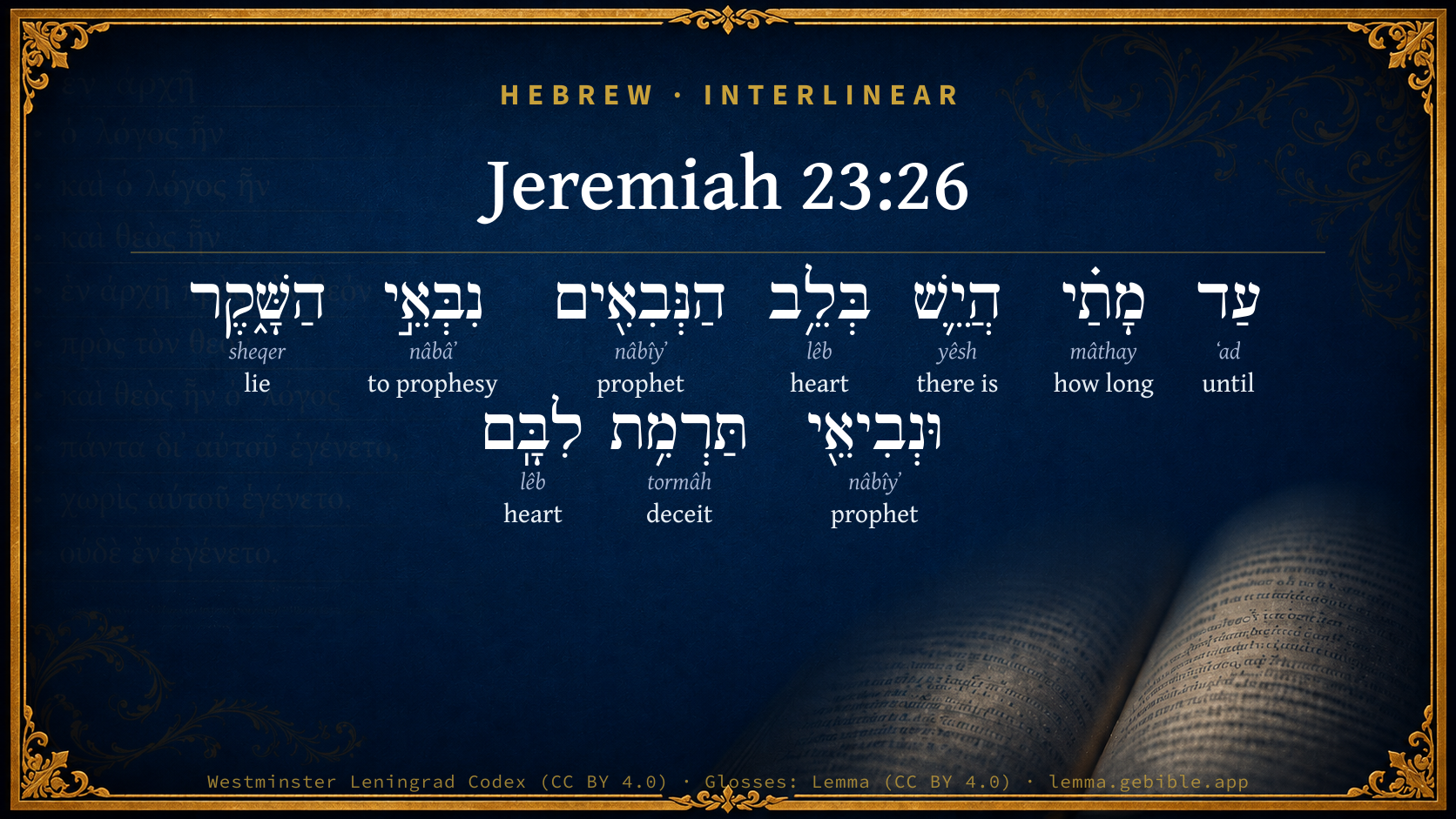
Hebrew (Westminster Leningrad Codex) Jeremiah 23:26 appears in the Hebrew Old Testament. The text above is from the Westminster Leningrad Codex. Each word links to its Strong’s number, a concise gloss, and parsing drawn from the Open Scriptures Hebrew Bible morphology. Click any word for its full Brown-Driver-Briggs (BDB) entry.
Download image
Cite this verse

Jeremiah 23:26 (World English Bible). Public Domain. Lemma interlinear Bible study tool, https://lemma.gebible.app/v/jeremiah/23/26.

Show BibTeX & RIS
BibTeX
RIS
English Translation
How long shall this be in the heart of the prophets who prophesy lies, even the prophets of the deceit of their own heart?
World English Bible · Public Domain
Download a study sheet

One document with this verse’s original text, its word-by-word gloss line, the meaning frame, cross-references with their text, attributed commentary, and full source and license credits — printable, and it pastes into notes with its structure intact.

This verse Autodidact and up

Study sheet (.html) Plain text (.txt)

A passage Seminary Student

Up to 50 verses in one chapter. A passage sheet keeps up to 6 commentary sources and 12 cross-references per verse, in the order this page ranks them, and says so on the sheet whenever that leaves anything out. Ask for a single verse and you get the Autodidact verse sheet above.

Everything on this page stays free to read, with no account — the sheet is a download of what is already on screen, not access to it.

Want to remove ads? Support Godless Engineer
Compare translations 3

The same verse in 3 English versions, stacked beneath the original-language interlinear above. Click any original word for its lexicon entry.

Each is an independent rendering of the whole verse — the interlinear is not word-aligned to these translations.

Highlighted words mark where these versions differ — a whole-verse word diff, not a word-by-word alignment.

  • World English Bible Public Domain
    How long shall this be in the heart of the prophets who prophesy lies, even the prophets of the deceit of their own heart?
  • King James Version Public Domain
    How long shall this be in the heart of the prophets that prophesy lies? yea, they are prophets of the deceit of their own heart;
  • unfoldingWord Literal Text CC BY-SA 4.0
    Until when will this be in the heart of the prophets, the ones prophesying falsehood and the prophets of the deceit of their heart?

unfoldingWord Literal Text — © unfoldingWord, licensed CC BY-SA 4.0. Word-aligned USFM3 via Door43 (git.door43.org/unfoldingWord/en_ult).

Versions to compare (up to 4)

3 of 4 selected

Show all 18 translations

Every available English version of this verse, each an independent rendering of the whole verse.

  • World English Bible Public Domain
    How long shall this be in the heart of the prophets who prophesy lies, even the prophets of the deceit of their own heart?
  • Berean Standard Bible Public Domain
    How long will this continue in the hearts of these prophets who prophesy falsehood, these prophets of the delusion of their own minds?
  • Majority Standard Bible Public Domain
    How long will this continue in the hearts of these prophets who prophesy falsehood, these prophets of the delusion of their own minds?
  • King James Version Public Domain
    How long shall this be in the heart of the prophets that prophesy lies? yea, they are prophets of the deceit of their own heart;
  • American Standard Version (1901) Public Domain
    How long shall this be in the heart of the prophets that prophesy lies, even the prophets of the deceit of their own heart?
  • Revised Version (1885) Public Domain
    How long shall this be in the heart of the prophets that prophesy lies; even the prophets of the deceit of their own heart?
  • Geneva Bible (1599) Public Domain
    Howe long? Doe the prophets delite to prophecie lies, euen prophecying the deceit of their owne heart?
  • Douay-Rheims (1899) Public Domain
    How long shall this be in the heart of the prophets that prophesy lies, and that prophesy the delusions of their own heart?
  • Young's Literal Translation Public Domain
    Till when is it in the heart of the prophets? The prophets of falsehood, Yea, prophets of the deceit of their heart,
  • Literal Standard Version CC BY-SA 4.0
    Until when is it in the heart of the prophets? The prophets of falsehood, || Indeed, prophets of the deceit of their heart,
  • Unlocked Literal Bible CC BY-SA 4.0
    How long will this go on, prophets who prophesy lies from their minds, and who prophesy from the deceit in their hearts?
  • unfoldingWord Literal Text CC BY-SA 4.0
    Until when will this be in the heart of the prophets, the ones prophesying falsehood and the prophets of the deceit of their heart?
  • Darby Bible Public Domain
    How long shall [this] be in the heart of the prophets who prophesy falsehood, and who are prophets of the deceit of their own heart?
  • World Messianic Bible Public Domain
    How long will this be in the heart of the prophets who prophesy lies, even the prophets of the deceit of their own heart?
  • Webster's Bible Public Domain
    How long shall this be in the heart of the prophets that prophesy lies? yes, they are prophets of the deceit of their own heart;
  • Free Bible Version CC BY-SA 4.0
    How long will this continue? How long will these prophets go on prophesying these lies which are just the product of their own deluded minds?
  • Bible in Basic English Public Domain
    Is (my word) in the hearts of the prophets who give out false words, even the prophets of the deceit of their hearts?
  • JPS Tanakh (1917) Public Domain
    How long shall this be? Is it in the heart of the prophets that prophesy lies, and the prophets of the deceit of their own heart?

Literal Standard Version (2020), Covenant Press — licensed CC BY-SA 4.0. Text via the HelloAO Bible API (eBible.org). Unlocked Literal Bible (unfoldingWord) — licensed CC BY-SA 4.0. Text via the HelloAO Bible API (eBible.org). unfoldingWord Literal Text — © unfoldingWord, licensed CC BY-SA 4.0. Word-aligned USFM3 via Door43 (git.door43.org/unfoldingWord/en_ult). Free Bible Version, Dr. Jonathan Gallagher — licensed CC BY-SA 4.0. Text via the HelloAO Bible API (eBible.org).

Word by word

More ways to search: Search by grammar → Find every occurrence → Compare this word →

Practice this passage: Drill this verse → Learn its vocabulary →

תַּרְמִ֥ת
tormâh
H8649
“deceit of”
Noun, Common, Feminine, Singular, Construct
Part of Speech
Noun
Type
Common
Gender
Feminine
Number
Singular
State
Construct
Full BDB Definition

Origin: from H7411

TWOT: 2169c

treachery, fraud, deceit, deceitfulness
  1. עַד ʻad H5704 “until” Preposition
  2. מָתַ֗י mâthay H4970 “how long” Particle, Interrogative
  3. הֲיֵ֛שׁ yêsh H3426 “there is” Particle, Interrogative + Particle, Demonstrative
  4. בְּלֵ֥ב lêb H3820 “in/at · heart of” Preposition + Noun, Common, Masculine, Singular, Construct
  5. הַנְּבִאִ֖ים nâbîyʼ H5030 “the · prophets” Particle, Definite Article + Noun, Common, Masculine, Plural, Absolute
  6. נִבְּאֵ֣י nâbâʼ H5012 “prophesying” Verb, Niphal, Participle Active, Masculine, Plural, Construct
  7. הַשָּׁ֑קֶר sheqer H8267 “the · lie” Particle, Definite Article + Noun, Common, Masculine, Singular, Absolute
  8. וּנְבִיאֵ֖י nâbîyʼ H5030 “and · prophets of” Conjunction + Noun, Common, Masculine, Plural, Construct
  9. לִבָּֽם lêb H3820 “heart · their” Noun, Common, Masculine, Singular, Construct + Suffix, Personal, 3rd Person, Masculine, Plural

About this verse

These counts appear in no published source. They are computed here, from the morphology-tagged text and Lemma’s own curated glosses. What Lemma adds →

10
words
8
distinct lemmas
Prophets
section

Notable vocabulary

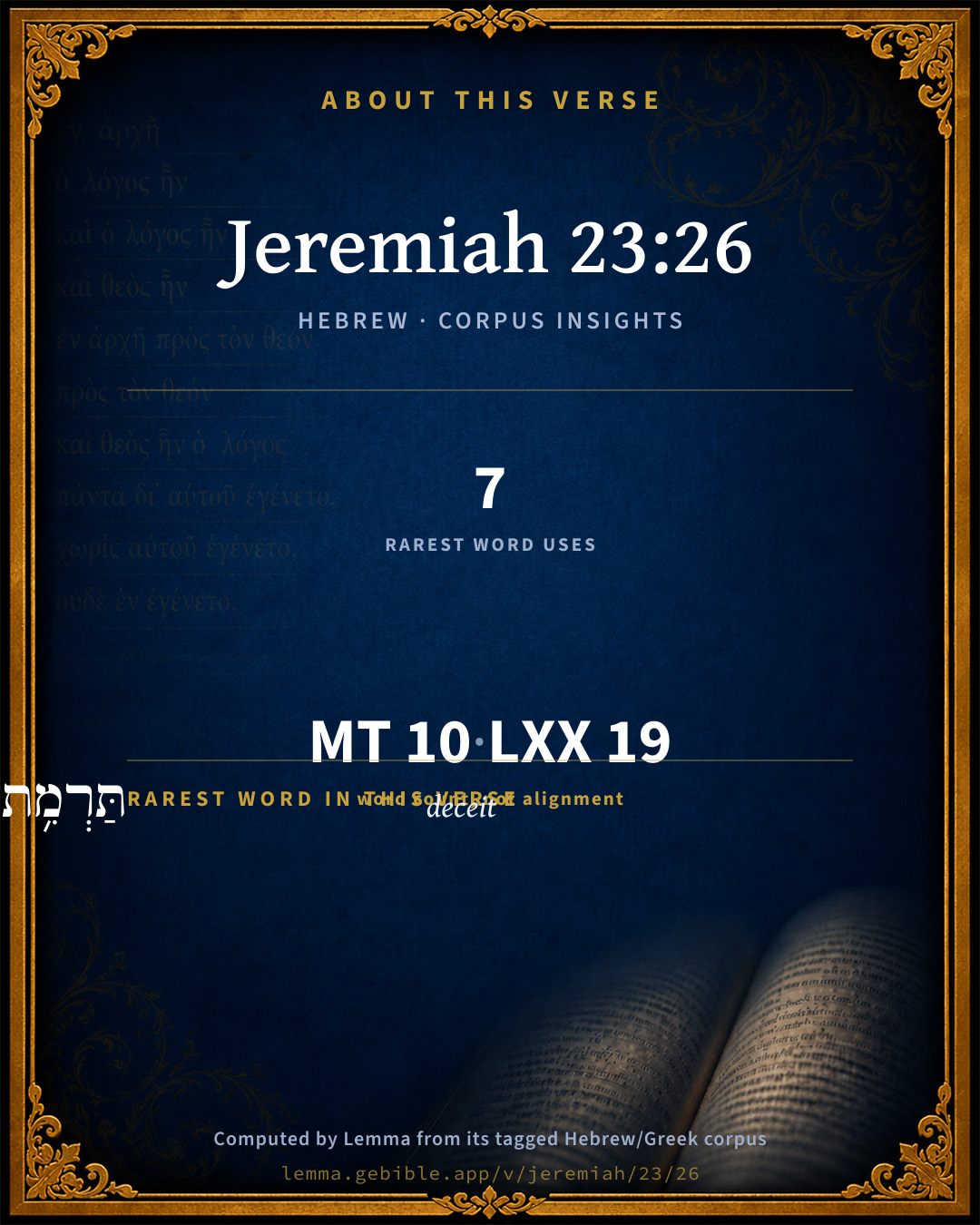
The rarest word here is תַּרְמִ֥ת deceit H8649 — appearing just 7 times in the whole Hebrew Bible.

Shared distinctive vocabulary

תַּרְמִ֥ת deceit H8649 occurs in 6 verses of the Hebrew Bible. Also found in:

Grammatical profile

  • 1 verb
  • 6 nouns
  • 1 preposition
  • 2 particles

Verb forms

  • נִבְּאֵ֣י Niphal · Participle Active

Repetition

Words recur within this verse — often emphatic in Hebrew:

  • בְּלֵ֥ב heart H3820 ×2
  • הַנְּבִאִ֖ים prophet H5030 ×2

Hebrew & Septuagint length

In the original languages it is 10 Hebrew tokens and 19 Greek tokens — but the two are counted differently (Hebrew bundles its prefixes and suffixes into one token; the Greek is in lemma form), so that isn’t a like-for-like length.

Cross-references

12

Topical passages linked to Jeremiah 23:26 in the Treasury of Scripture Knowledge — connected by theme and wording, ordered by reader-vote popularity; previews shown in the World English Bible.

  • 1 Timothy 4:1–2 But the Spirit says expressly that in later times some will fall away from the faith, paying attention to seducing spirits and doctrines of demons,
  • Jeremiah 14:14 Then Yahweh said to me, The prophets prophesy lies in my name; I didn't send them, neither have I commanded them, neither spoke I to them: they prophesy to you a lying vision, and divination, and a thing of nothing, and the deceit of their own heart.
  • 2 Thessalonians 2:9–11 even he whose coming is according to the working of Satan with all power and signs and lying wonders,
  • 2 Timothy 4:3 For the time will come when they will not listen to the sound doctrine, but, having itching ears, will heap up for themselves teachers after their own lusts;
  • 2 Peter 2:13–16 receiving the wages of unrighteousness; people who count it pleasure to revel in the day-time, spots and blemishes, reveling in their deceit while they feast with you;
  • Psalms 4:2 You sons of men, how long shall my glory be turned into dishonor? Will you love vanity, and seek after falsehood? Selah.
  • Isaiah 30:10 who tell the seers, "Don't see;" and to the prophets, "Don't prophesy to us right things, speak to us smooth things, prophesy deceits,
  • Jeremiah 4:14 Jerusalem, wash your heart from wickedness, that you may be saved. How long shall your evil thoughts lodge within you?
  • Jeremiah 13:27 I have seen your abominations, even your adulteries, and your neighing, the lewdness of your prostitution, on the hills in the field. Woe to you, Jerusalem! you will not be made clean; how long shall it yet be?
  • Jeremiah 17:9 The heart is deceitful above all things, and it is exceedingly corrupt: who can know it?
  • Hosea 8:5 Let Samaria throw out his calf-idol! My anger burns against them! How long will it be before the are capable of purity?
  • Acts 13:10 and said, "Full of all deceit and all cunning, you son of the devil, you enemy of all righteousness, will you not cease to pervert the right ways of the Lord?

Cross-references courtesy of OpenBible.info (CC BY 4.0).

Hebrew and Greek witnesses Masoretic Hebrew ↔ Greek Septuagint

The same verse in the two great witnesses to the Old Testament, shown verse-for-verse.

These are two independent witnesses, not word-aligned to each other, and the Septuagint is shown in lemma (dictionary) form.

Hebrew Jeremiah 23:26 Masoretic · Westminster Leningrad Codex

עַד מָתַ֗י הֲיֵ֛שׁ בְּלֵ֥ב הַנְּבִאִ֖ים נִבְּאֵ֣י הַשָּׁ֑קֶר וּנְבִיאֵ֖י תַּרְמִ֥ת לִבָּֽם

How long shall this be in the heart of the prophets who prophesy lies, even the prophets of the deceit of their own heart?

World English Bible · Public Domain

Greek LXX Structure differs

In the Septuagint, Jeremiah is about an eighth shorter than the Hebrew and arranges its material differently — the Oracles Against the Nations (Hebrew chapters 46–51) appear in the middle of the Greek book, after 25:13. Because the chapter and verse boundaries do not line up, a verse-for-verse comparison with the Hebrew is not shown.

A verse-for-verse comparison isn’t shown here because the chapters and verses don’t line up. Switch to the LXX edition with the MT / LXX toggle above to read the Greek directly.

Hebrew: Westminster Leningrad Codex (CC BY 4.0). Greek: Septuagint (public domain); English from a public-domain English Septuagint. How the Septuagint differs from the Hebrew →

Targum (Aramaic paraphrase)

1

The Targum is the ancient Jewish Aramaic paraphrase of the Hebrew Scriptures — an interpretive translation, not the Hebrew text itself. Onkelos (literal) and Pseudo-Jonathan (expansive) render the Torah, and Jonathan the Prophets. Coverage is partial: where no permissively-licensed English translation exists for a verse, only the Aramaic is shown. This is verse-level text, not a word-by-word alignment to the Hebrew.

  1. Targum Jonathan Prophets (Joshua–Malachi)
    עַד אֵימָתַי אִית בְּלִבְּהוֹן דִנְבִיֵי שִׁקְרָא דְמִתְנַבָּן שְׁקַר וּמִתְנַבָּן רְשַׁע לִבְּהוֹן:

    (no public-domain English translation for this verse)

    Targum Jonathan — Aramaic: “Mikraot Gedolot” (public domain). English: “Sefaria Community Translation” (CC0 1.0 (public-domain dedication)); “London "Chaldee Paraphrase," 1871” (public domain). Text via Sefaria.

Commentary

Notes on Jeremiah 23:26 from classic Christian and Jewish commentators (each source and its license shown beneath its notes). The classic Christian expositions comment on the surrounding passage and are grouped to its opening verse, so a note may address several verses; the Jewish commentaries on the Tanakh (Rashi and others) are per-verse, so they appear only where the commentator wrote on this verse.

Lemma curates 59 commentaries, every one of them public domain or Creative Commons licensed, each selected and text-cleaned for this edition rather than reprinted as found. About our sources →

Trapp's Complete Commentary

John Trapp

Jer 23:26 How long shall [this] be in the heart of the prophets that prophesy lies? yea, [they are] prophets of the deceit of their own heart;

Ver. 26. How long shall this be in the hearts? &c., ] q.d., Will they never give over lying to the Holy Ghost, {Act 5:3} and flying against the light (of their own consciences), as bats do. Nam quod argute commenti sunt, haec aiunt ex Spiritu se dicere; studio enim suis mendaciis plebi imponunt, falsumque data opera docent; { a} for they father their falsities upon the Spirit of truth, cozening the credulous multitude. And this they do wittingly and incessantly.

{a} Oecolamp.

John Trapp, A Commentary or Exposition upon All the Books of the Old and New Testament (1647–1656) — public domain. Text from a community e-Sword module.

Geneva Bible (1599)

Geneva Bible translators

Hebrew, Is it in the heart of the Prophets?

Geneva Bible (1599) marginal notes — public domain. Text via Bolls.life.

Jamieson, Fausset & Brown

Robert Jamieson, A. R. Fausset & David Brown

prophets--a different Hebrew form from the usual one, "prophesiers." "How long," cries Jeremiah, impatient of their impious audacity, "shall these prophecy-mongers go on prophesying lies?" The answer is given in Jer 23:29-34.

Jamieson, Fausset & Brown — Commentary Critical and Explanatory on the Whole Bible (1871) — public domain (CC PDM 1.0). Text via the HelloAO Bible API.

John Calvin's Commentaries

Here God reproves the false prophets, and also promises to his people what was especially to be desired, — that he would cleanse his Church from such pollutions. He then shews that it was his purpose to take vengeance, because the false prophets had dared in such an impious and bold manner to abuse his sacred name. For it ever occurred to their minds, “How is it that God permits this? Is it because he cares not for the safety of his people? or does it give him any delight when he sees truth mingled with falsehood, and light with darkness?” Hence God here shews that he for a time bore with that sacrilegious audacity which the false prophets practiced, but that he did not so connive at it as not at length to punish them.

How long? he says, which is the same as though he had said, “It shall not be perpetual; though I may delay, yet they shall know that they have with extreme perverseness abused my forbearance.” And he also enhances their crime by saying, How long shall it be in the heart of the prophets to prophesy falsehood? By this way of speaking he intimates, that they erred not through ignorance, as many do, who through want of knowledge bring forth what they do not understand; but God here complains that these prophets, as it were designedly, rose up to suppress the truth. Then by heart is to be understood thought or purpose; as though he had said, that they designedly made a false pretense as to his name, that it was their settled purpose to deceive the people.

He adds, that they were prophets of the deceit of their own heart. This deceit of the heart is put in opposition to true doctrine; and thus God intimates that whatever men bring forward from themselves is deceitful, for nothing can proceed from them but vanity. There is yet no doubt but that he condemns that foolish conceit, of which the false prophets proudly boasted, that they were alone wise, as the case is now under the Papacy; how arrogantly do unprincipled men prattle whenever they speak of their own figments? Nothing can be more silly, and yet they think that they surpass the angels in acuteness and in high speculations. Such was the arrogance displayed by the false prophets of old. But God declares that whatever men invent, and whatever they devise, which they have not received from his mouth, is only the deceit of the heart.

And this ought to be carefully noticed; for there are many plausible refinements, in which there is nothing solid, but they are mere trifles. If, then, at any time these vain thoughts seem pleasing to us, let us bear in mind what Jeremiah says here, that whatever proceeds not from God is the deceit of the heart; and further, that though the whole world applaud falsehoods and impostures, we ought yet to know that everything is a deceit which has not God himself as its author.

John Calvin's Commentaries (1540-1563) — public domain. Text from the Calvin Translation Society English edition (1840s-50s) via the Christian Classics Ethereal Library (ccel.org). Calvin's coverage is partial (roughly two-thirds of the Bible); uncommented books and verses are honest gaps, never fabricated. The 19th-century editor's footnotes and remarks are omitted so the notes are faithfully Calvin's own voice.

Ellicott's Commentary for English Readers

(26) How long shall this be . . .?—The Hebrew text gives a double interrogative: How long? Is it in the heart of the prophets that prophesy lies, prophets of the deceit of their own hearts? Do they think to cause my people . . .? A conjectural alteration of the text gives “How long is the fire in the heart of the prophets . . .?” as if anticipating the thought of Jer_23:29, and reproducing that of Jer_20:9.

A Bible Commentary for English Readers, edited by Charles John Ellicott (1878–1897) — public domain. Text from a community e-Sword module.

The Cambridge Bible for Schools and Colleges

gen. ed. J. J. S. Perowne

26. The opening words are evidently corrupt. Co. accepts Du.’s suggestion to substitute (by a not violent change in MT.) a third “I have dreamed” (cp. Jer_7:4, Jer_22:29) for “How long,” and for “shall this be … prophets” to read (by a different division of words) “Will the heart of the prophets turn.”

The Cambridge Bible for Schools and Colleges (gen. ed. J. J. S. Perowne; Cambridge University Press, 1878–1918) — public domain. Text from a community e-Sword module.

John Gill's Exposition

How long shall this be in the heart of the prophets that prophesy lies?.... To invent such lies, and deceive the people, and turn them away from God; agreeably to the preceding and following verses: this shows that this was not through ignorance and inadvertence; it was a meditated and studied thing by them; they contrived it in their hearts, and they were resolute and bent upon it, and took much delight and pleasure in it; their hearts were in it, and it was in them to do as they did; and in this way they had been long, but should continue no longer. Or the words may be rendered, "how long?" (h) and a stop be put there, being a short abrupt expression, like that in Psa 6:3; and the sense be, how long shall they go on thus, pretending to dreams, and visions, and revelations from the Lord, and so impose upon the people? shall they always go on after this manner? no, they shall not: and then the next words may be read, "is there any thing in the heart of the prophets that prophesy lies?" (i) nothing that is good; truth is not there; nothing but lies and deceit; the word of God is not there, as it is with the true prophet of the Lord, "he that hath my word", as in Jer 23:28; there is no fear of God, nor knowledge of him and his will, nor faith in him, nor love to him, or any regard to his honour and glory;

yea, they are prophets of the deceit of their own hearts; they prophesy nothing but what their own deceitful hearts suggest to them, whereby they are deceived themselves, and deceive others, Ti2 3:13.

(h) "quousque?" Cocceius, Schmidt; "quousque tandem", Junius & Tremellius, Piscator; "usque quando?" De Dieu. (i) "an est in corde prophetarum?", De Dieu, Gataker, Schmidt.

John Gill's Exposition of the Whole Bible (1746–1763) — public domain (CC PDM 1.0). Text via the HelloAO Bible API.

Albert Barnes' Notes on the Bible

Some translate, “How long? Is it in the heart of the prophets that prophesy lies, and prophesy the deceit of their heart - do they purpose to make My people forget My name by their dreams which they tell one to another?”

Albert Barnes' Notes on the Bible (1834–1885) — public domain. Text from a community e-Sword/MySword module.

Matthew Poole's English Annotations

Will these prophets never have done? Have they not deceived people long enough with their lies, and the deceit of their own hearts; and that not unwarily, and by involuntary mistake, but of set purpose, it being in their heart, their purpose and design, to do it. Some join it to the following verse, and make the sense this: Do these prophets, that publish lies, and the deceits of their hearts, for my revealed will, think to cheat my people always, and to cause my people to forget my name? as it followeth in the next verse.

Matthew Poole's English Annotations on the Holy Bible (1683–1685) — public domain. Text from a community e-Sword/MySword module.

Whedon's Commentary on the Bible

Daniel D. Whedon

26. How long, etc. — Rather, How long? Is it in the minds of the prophets that prophesy falsehood in my name — the prophets of the deceit of their heart? Impatient of their impious audacity Jeremiah cries out, “How long?” and then draws out his question more explicitly.

Daniel D. Whedon (gen. ed.), Commentary on the Old and New Testaments (1874–1909) — public domain. Text from a community e-Sword module.

The Pulpit Commentary

How long shall this be in the heart, etc.? i.e. how long shall this be their purpose, viz. to prophesy lies? But this rendering leaves out of account a second interrogative which in the Hebrew follows "how long." It is better to translate this difficult passage, with De Dieu and many moderns, thus: "How long (quousque durabit haec ipsorum impudentia)? Is it in the heart of the prophets that prophesy lies, and the prophets of the deceit of their own heart; are they thinking (I say) to cause my people to forget," etc.? On this view, ver. 27 resumes the question interrupted in ver. 26.

The Pulpit Commentary (1880–1919), ed. H.D.M. Spence-Jones & Joseph S. Exell — public domain. Text from a community e-Sword module.

Rashi

Rabbi Shlomo Yitzchaki (Rashi)

How long [will this be]? That they will prophesy falsely? Do these prophets who prophesy falsely have in their heart to execute their thoughts that they are thinking to cause My people to forget My name, etc.?

deceit an expression of מִרְמָה, deceit.

Rashi on the Tanakh — English translations: “The Judaica Press complete Tanach with Rashi, translated by A. J. Rosenberg” (CC BY 4.0); “Pentateuch with Rashi's commentary by M. Rosenbaum and A.M. Silbermann, 1929-1934” (public domain); “The Metsudah Tanach series, Lakewood, N.J” (CC BY 4.0); and “The Book of Joshua, Metsudah Publications, 1997” (CC BY 4.0). Text via Sefaria.

Lesson kit

Teaching starters — assembled from the data on this page, not authored interpretation. Every prompt links to the verse data it draws on. Edit before teaching.

Jeremiah, in the Prophets, opens this verse with 10 words (8 distinct Hebrew lemmas). Its most distinctive word is tormâh (“deceit”). A historical commentator’s framing appears above. Read the whole chapter for the surrounding context.

Discussion questions

  1. How does “deceit” (tormâh) shape what this verse is saying?
  2. Judges 9:31 shares the word «deceit» with this verse. How do the two illuminate each other?
  3. “heart” occurs 2× in this one verse. What is the effect of the repetition?
  4. These translations render this verse differently; the difference is in the English rendering, not the original. What questions does that raise?
  5. The verb «נִבְּאֵ֣י» is Niphal Participle Active. How does its form color the action?
  6. Reading how Trapp's Complete Commentary and Geneva Bible (1599) read this verse, where do the two commentators agree and where do they part?

Things to notice

Reading settings

Reading text

Shown beneath each verse's original-language words.

Old Testament
Old Testament edition

Read the OT as the Masoretic Hebrew (MT) or the Greek Septuagint (LXX).

English shown for the Greek Septuagint (in the Hebrew ↔ Greek comparison).

Comparing translations? Open the Compare panel on any verse page to stack up to four side by side.