Jeremiah 51:17

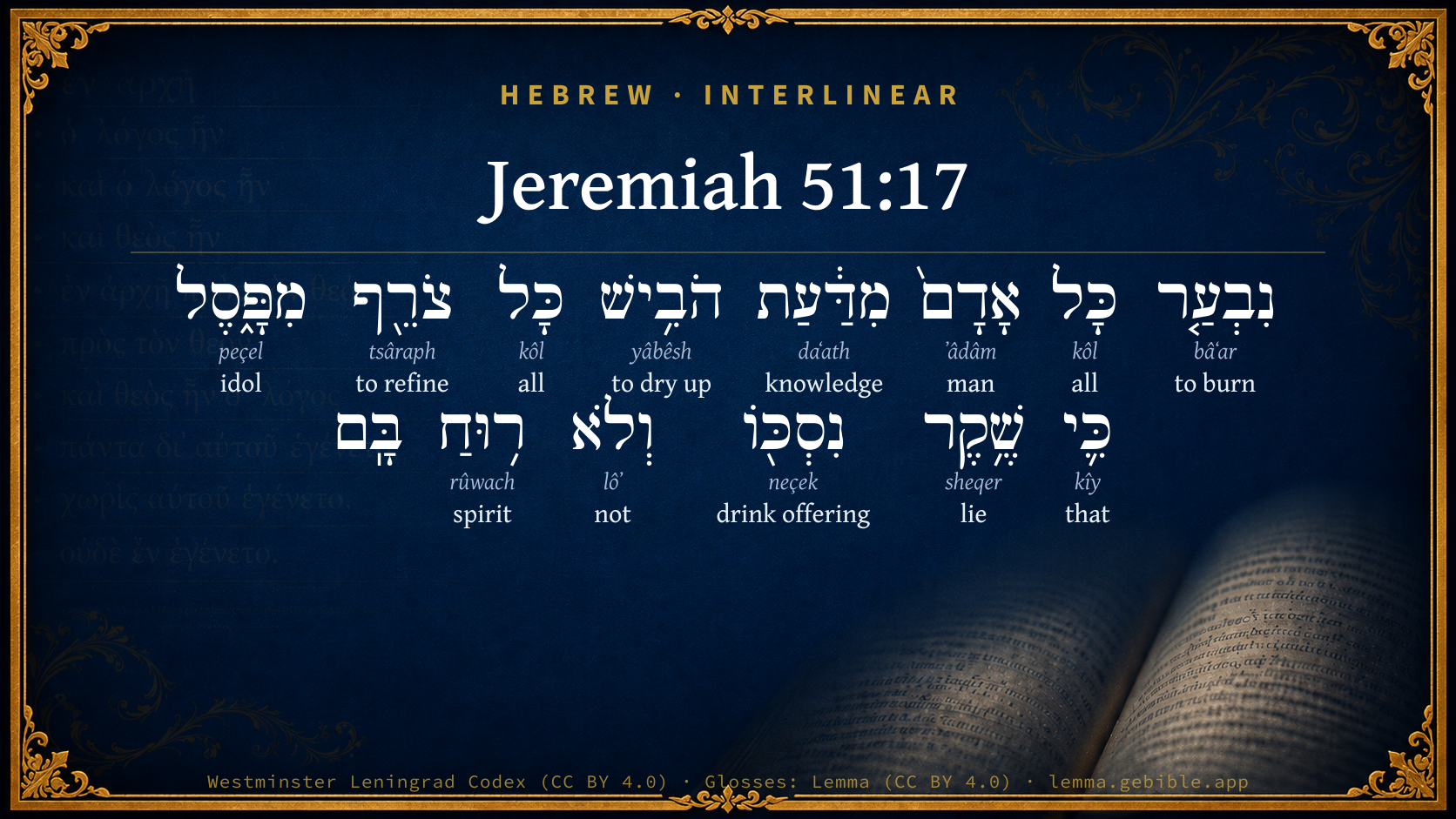
Hebrew (Westminster Leningrad Codex) Jeremiah 51:17 appears in the Hebrew Old Testament. The text above is from the Westminster Leningrad Codex. Each word links to its Strong’s number, a concise gloss, and parsing drawn from the Open Scriptures Hebrew Bible morphology. Click any word for its full Brown-Driver-Briggs (BDB) entry.
Download image
Cite this verse

Jeremiah 51:17 (World English Bible). Public Domain. Lemma interlinear Bible study tool, https://lemma.gebible.app/v/jeremiah/51/17.

Show BibTeX & RIS
BibTeX
RIS
English Translation
Every man is become brutish [and is] without knowledge; every goldsmith is disappointed by his image; for his molten image is falsehood, and there is no breath in them.
World English Bible · Public Domain
Download a study sheet

One document with this verse’s original text, its word-by-word gloss line, the meaning frame, cross-references with their text, attributed commentary, and full source and license credits — printable, and it pastes into notes with its structure intact.

This verse Autodidact and up

Study sheet (.html) Plain text (.txt)

A passage Seminary Student

Up to 50 verses in one chapter. A passage sheet keeps up to 6 commentary sources and 12 cross-references per verse, in the order this page ranks them, and says so on the sheet whenever that leaves anything out. Ask for a single verse and you get the Autodidact verse sheet above.

Everything on this page stays free to read, with no account — the sheet is a download of what is already on screen, not access to it.

Want to remove ads? Support Godless Engineer
Compare translations 3

The same verse in 3 English versions, stacked beneath the original-language interlinear above. Click any original word for its lexicon entry.

Each is an independent rendering of the whole verse — the interlinear is not word-aligned to these translations.

Highlighted words mark where these versions differ — a whole-verse word diff, not a word-by-word alignment.

  • World English Bible Public Domain
    Every man is become brutish [and is] without knowledge; every goldsmith is disappointed by his image; for his molten image is falsehood, and there is no breath in them.
  • King James Version Public Domain
    Every man is brutish by his knowledge; every founder is confounded by the graven image: for his molten image is falsehood, and there is no breath in them.
  • unfoldingWord Literal Text CC BY-SA 4.0
    Every man has become ignorant, without knowledge. Every metalworker is put to shame by his idols. For his cast images are frauds, and there is no life in them.

unfoldingWord Literal Text — © unfoldingWord, licensed CC BY-SA 4.0. Word-aligned USFM3 via Door43 (git.door43.org/unfoldingWord/en_ult).

Versions to compare (up to 4)

3 of 4 selected

Show all 18 translations

Every available English version of this verse, each an independent rendering of the whole verse.

  • World English Bible Public Domain
    Every man is become brutish [and is] without knowledge; every goldsmith is disappointed by his image; for his molten image is falsehood, and there is no breath in them.
  • Berean Standard Bible Public Domain
    Every man is senseless and devoid of knowledge; every goldsmith is put to shame by his idols. For his molten images are a fraud, and there is no breath in them.
  • Majority Standard Bible Public Domain
    Every man is senseless and devoid of knowledge; every goldsmith is put to shame by his idols. For his molten images are a fraud, and there is no breath in them.
  • King James Version Public Domain
    Every man is brutish by his knowledge; every founder is confounded by the graven image: for his molten image is falsehood, and there is no breath in them.
  • American Standard Version (1901) Public Domain
    Every man is become brutish `and is' without knowledge; every goldsmith is put to shame by his image; for his molten image is falsehood, and there is no breath in them.
  • Revised Version (1885) Public Domain
    Every man is become brutish and is without knowledge; every goldsmith is put to shame by his graven image: for his molten image is falsehood, and there is no breath in them.
  • Geneva Bible (1599) Public Domain
    Euery man is a beast by his owne knowledge: euery founder is confounded by the grauen image: for his melting is but falsehood, and there is no breath therein.
  • Douay-Rheims (1899) Public Domain
    Every man is become foolish by his knowledge: every founder is confounded by his idol, for what he hath cast is a lie, and there is no breath in them.
  • Young's Literal Translation Public Domain
    Brutish hath been every man by knowledge, Put to shame hath been every refiner by a graven image, For false `is' his molten image, And there is no breath in them.
  • Literal Standard Version CC BY-SA 4.0
    Every man has been brutish by knowledge, || Everyone has been put to shame—from refining a carved image, || For his molten image [is] falsehood, || And there is no breath in them.
  • Unlocked Literal Bible CC BY-SA 4.0
    Every man has become ignorant, without knowledge. Every metalworker is put to shame by his idols. For his cast images are frauds, and there is no life in them.
  • unfoldingWord Literal Text CC BY-SA 4.0
    Every man has become ignorant, without knowledge. Every metalworker is put to shame by his idols. For his cast images are frauds, and there is no life in them.
  • Darby Bible Public Domain
    Every man is become brutish, so as to have no knowledge; every founder is put to shame by the graven image, for his molten image is falsehood, and there is no breath in them.
  • World Messianic Bible Public Domain
    “Every man has become stupid and without knowledge. Every goldsmith is disappointed by his image, for his molten images are falsehood, and there is no breath in them.
  • Webster's Bible Public Domain
    Every man is brutish by his knowledge; every founder is confounded by the graven image: for his molten image is falsehood, and there is no breath in them.
  • Free Bible Version CC BY-SA 4.0
    Everyone is stupid; they don't know anything. Every metalworker is embarrassed by the idols they make. For their images made of molten metal are fraudulent—they're not alive!
  • Bible in Basic English Public Domain
    Then every man becomes like a beast without knowledge; every gold-worker is put to shame by the image he has made: for his metal image is deceit, and there is no breath in them.
  • JPS Tanakh (1917) Public Domain
    Every man is proved to be brutish, for the knowledge — every goldsmith is put to shame by the graven image — that his molten image is falsehood, and there is no breath in them.

Literal Standard Version (2020), Covenant Press — licensed CC BY-SA 4.0. Text via the HelloAO Bible API (eBible.org). Unlocked Literal Bible (unfoldingWord) — licensed CC BY-SA 4.0. Text via the HelloAO Bible API (eBible.org). unfoldingWord Literal Text — © unfoldingWord, licensed CC BY-SA 4.0. Word-aligned USFM3 via Door43 (git.door43.org/unfoldingWord/en_ult). Free Bible Version, Dr. Jonathan Gallagher — licensed CC BY-SA 4.0. Text via the HelloAO Bible API (eBible.org).

Word by word

More ways to search: Search by grammar → Find every occurrence → Compare this word →

Practice this passage: Drill this verse → Learn its vocabulary →

מִפָּ֑סֶל
peçel
H6459
“from · idol”
Preposition + Noun, Common, Masculine, Singular, Absolute
Part of Speech
Preposition + Noun
Type
Common
Gender
Masculine
Number
Singular
State
Absolute
Full BDB Definition

Origin: from H6458

TWOT: 1788a

idol, image
  1. נִבְעַ֤ר bâʻar H1197 “to burn” Verb, Niphal, Perfect, 3rd Person, Masculine, Singular
  2. כָּל kôl H3605 “all of” Noun, Common, Masculine, Singular, Construct
  3. אָדָם֙ ʼâdâm H120 “man” Noun, Common, Masculine, Singular, Absolute
  4. מִדַּ֔עַת daʻath H1847 “from · knowledge” Preposition + Noun, Common, Feminine, Singular, Absolute
  5. הֹבִ֥ישׁ yâbêsh H3001 “to dry up” Verb, Hiphil, Perfect, 3rd Person, Masculine, Singular
  6. כָּל kôl H3605 “all of” Noun, Common, Masculine, Singular, Construct
  7. צֹרֵ֖ף tsâraph H6884 “refining” Verb, Qal, Participle Active, Masculine, Singular, Absolute
  8. כִּ֛י kîy H3588 “that” Conjunction
  9. שֶׁ֥קֶר sheqer H8267 “lie” Noun, Common, Masculine, Singular, Absolute
  10. נִסְכּ֖וֹ neçek H5262 “drink offering · his” Noun, Common, Masculine, Singular, Construct + Suffix, Personal, 3rd Person, Masculine, Singular
  11. וְלֹא lôʼ H3808 “and · not” Conjunction + Particle, Negative
  12. ר֥וּחַ rûwach H7307 “spirit” Noun, Common, Both, Singular, Absolute

About this verse

These counts appear in no published source. They are computed here, from the morphology-tagged text and Lemma’s own curated glosses. What Lemma adds →

14
words
12
distinct lemmas
Prophets
section

Shared distinctive vocabulary

מִפָּ֑סֶל idol H6459 occurs in 30 verses of the Hebrew Bible. Also found in:

Grammatical profile

  • 3 verbs
  • 8 nouns
  • 1 preposition
  • 1 conjunction
  • 1 particle

Verb forms

  • נִבְעַ֤ר Niphal · Perfect
  • הֹבִ֥ישׁ Hiphil · Perfect
  • צֹרֵ֖ף Qal · Participle Active

Repetition

A word recurs within this verse — often emphatic in Hebrew:

Cross-references

12

Topical passages linked to Jeremiah 51:17 in the Treasury of Scripture Knowledge — connected by theme and wording, ordered by reader-vote popularity; previews shown in the World English Bible.

  • Jeremiah 10:14 Every man is become brutish [and is] without knowledge; every goldsmith is disappointed by his engraved image; for his molten image is falsehood, and there is no breath in them.
  • Habakkuk 2:18–19 "What value does the engraved image have, that its maker has engraved it; the molten image, even the teacher of lies, that he who fashions its form trusts in it, to make mute idols?
  • Psalms 14:2 Yahweh looked down from heaven on the children of men, To see if there were any who did understand, Who did seek after God.
  • Isaiah 44:18–20 They don't know, neither do they consider: for he has shut their eyes, that they can't see; and their hearts, that they can't understand.
  • Jeremiah 50:2 Declare you among the nations and publish, and set up a standard; publish, and don't conceal: say, Babylon is taken, Bel is disappointed, Merodach is dismayed; her images are disappointed, her idols are dismayed.
  • Romans 1:20–23 For the invisible things of him since the creation of the world are clearly seen, being perceived through the things that are made, even his everlasting power and divinity; that they may be without excuse.
  • 1 Corinthians 1:19–21 For it is written, "I will destroy the wisdom of the wise, I will bring the discernment of the discerning to nothing."
  • Psalms 53:1–2 The fool has said in his heart, "There is no God." They are corrupt, and have done abominable iniquity. There is no one who does good.
  • Psalms 115:5 They have mouths, but they don't speak; They have eyes, but they don't see;
  • Psalms 115:8 Those who make them will be like them; Yes, everyone who trusts in them.
  • Psalms 135:17–18 They have ears, but they can't hear; Neither is there any breath in their mouths.
  • Psalms 92:5–6 How great are your works, Yahweh! Your thoughts are very deep.

Cross-references courtesy of OpenBible.info (CC BY 4.0).

Hebrew and Greek witnesses Masoretic Hebrew ↔ Greek Septuagint

The same verse in the two great witnesses to the Old Testament, shown verse-for-verse.

These are two independent witnesses, not word-aligned to each other, and the Septuagint is shown in lemma (dictionary) form.

Hebrew Jeremiah 51:17 Masoretic · Westminster Leningrad Codex

נִבְעַ֤ר כָּל אָדָם֙ מִדַּ֔עַת הֹבִ֥ישׁ כָּל צֹרֵ֖ף מִפָּ֑סֶל כִּ֛י שֶׁ֥קֶר נִסְכּ֖וֹ וְלֹא ר֥וּחַ בָּֽם

Every man is become brutish [and is] without knowledge; every goldsmith is disappointed by his image; for his molten image is falsehood, and there is no breath in them.

World English Bible · Public Domain

Greek LXX Structure differs

In the Septuagint, Jeremiah is about an eighth shorter than the Hebrew and arranges its material differently — the Oracles Against the Nations (Hebrew chapters 46–51) appear in the middle of the Greek book, after 25:13. Because the chapter and verse boundaries do not line up, a verse-for-verse comparison with the Hebrew is not shown.

A verse-for-verse comparison isn’t shown here because the chapters and verses don’t line up. Switch to the LXX edition with the MT / LXX toggle above to read the Greek directly.

Hebrew: Westminster Leningrad Codex (CC BY 4.0). Greek: Septuagint (public domain); English from a public-domain English Septuagint. How the Septuagint differs from the Hebrew →

Targum (Aramaic paraphrase)

1

The Targum is the ancient Jewish Aramaic paraphrase of the Hebrew Scriptures — an interpretive translation, not the Hebrew text itself. Onkelos (literal) and Pseudo-Jonathan (expansive) render the Torah, and Jonathan the Prophets. Coverage is partial: where no permissively-licensed English translation exists for a verse, only the Aramaic is shown. This is verse-level text, not a word-by-word alignment to the Hebrew.

  1. Targum Jonathan Prophets (Joshua–Malachi)
    אִטַפָּשׁוּ כָּל עַמְמַיָא מִלְמִידַע חוּכְמְתָא בְּהִית כָּל קִינֵי מִלְמֶעְבַּד צְלַם אֲרֵי שִׁקְרָא אַתִּיכוּנוּן וְלָא רוּחָא בְּהוֹן:

    (no public-domain English translation for this verse)

    Targum Jonathan — Aramaic: “Mikraot Gedolot” (public domain). English: “Sefaria Community Translation” (CC0 1.0 (public-domain dedication)); “London "Chaldee Paraphrase," 1871” (public domain). Text via Sefaria.

Commentary

Notes on Jeremiah 51:17 from classic Christian and Jewish commentators (each source and its license shown beneath its notes). The classic Christian expositions comment on the surrounding passage and are grouped to its opening verse, so a note may address several verses; the Jewish commentaries on the Tanakh (Rashi and others) are per-verse, so they appear only where the commentator wrote on this verse.

Lemma curates 59 commentaries, every one of them public domain or Creative Commons licensed, each selected and text-cleaned for this edition rather than reprinted as found. About our sources →

Trapp's Complete Commentary

John Trapp

Jer 51:17 Every man is brutish by [his] knowledge; every founder is confounded by the graven image: for his molten image [is] falsehood, and [there is] no breath in them.

Ver. 17. Every man is brutish.] See Jer 10:14.

John Trapp, A Commentary or Exposition upon All the Books of the Old and New Testament (1647–1656) — public domain. Text from a community e-Sword module.

Geneva Bible (1599)

Geneva Bible translators

Read Jer. 10:14.

Geneva Bible (1599) marginal notes — public domain. Text via Bolls.life.

Adam Clarke's Commentary

Verse 17. Every man is brutish by his knowledge] He is brutish for want of real knowledge; and he is brutish when he acknowledges that an idol is any thing in the world. These verses, from fifteen to nineteen, are transcribed from Jer 10:12-16.

Adam Clarke's Commentary on the Bible (1810–1826) — public domain. Text from a community e-Sword/MySword module.

John Calvin's Commentaries

This verse is usually explained, as though the Prophet pointed out how men glide into errors and fancies, even because they seek to be wise according to their own notions; and Paul, in the first chapter to the Romans, assigns it as the cause of idolatry, that men become vain in their own wisdom, because they follow whatever their own brains suggest to them. This doctrine is in itself true and useful; for men have devised idols for themselves, because they would not reverently receive the knowledge of God offered to them, but rather believed their own inventions: and as mere vanity is whatever man imagines according to his own thoughts, it is no wonder that those who presumptuously form their own ideas of God, become wholly foolish and infatuated. But it is evident from the context, that the Prophet means here another thing, even that the artificers who cast or forge idols, or form them in any other way, are wholly delirious in thinking that they can, by their own art and skill, make gods. A log of wood lies on the ground, is trodden under foot without any honor; now when the artificer adds form to it, the log begins to be worshipped as a god; what madness can be imagined greater than this? The same thing may be said of stones, of silver, and of gold; for though it may be a precious metal, yet no divinity is ascribed to it, until it begins to put on a certain form. Now when a melter casts an idol, how can a lump of gold or silver become a god? The Prophet then upbraids this monstrous madness, when he says, that men are in their knowledge like brute beasts, that is, when they apply their skill to things so vain and foolish. But he mentions the same thing twice, according to the common usage of the Hebrew style; for we know that the same thing is often said twice for confirmation by the prophets.

After then having said that men are infatuated by knowledge, he adds, that they were made ashamed by the graven image There seems to be an impropriety in the words; for פסל, pesal, “graven,” does not well agree with צרף, tsareph, “the caster,” or founder; but the Prophet, stating a part for the whole, simply means, that all artificers are foolish and delirious in thinking that they can by their own hand and skill cast or forge, or in any way form gods. And to prove this he says, that there is no spirit or breath in them; and this was a sufficient proof; for we know that God is the fountain of life, and hence he is called by Moses

“the God of the spirits of all flesh.” (Numbers 16:22)

Whatever life, then, is diffused through all creatures, flows from God alone as the only true fountain. What, then, is less like divinity, or has less affinity to it, than a lump of gold or of silver, or a log of wood, or a stone? for they have no life nor rigor. Nothing is more fading than man, yet while he has life in him, he possesses something divine; but a dead body, what has it that is like God? But yet the form of a human body comes nearer to God’s glory than a log of wood or a stone formed in the shape of man. It is not, then, without reason that the Prophet condemns this madness of all the heathens, that they worshipped fictitious gods, in whom yet there was no spirit. It follows, —

John Calvin's Commentaries (1540-1563) — public domain. Text from the Calvin Translation Society English edition (1840s-50s) via the Christian Classics Ethereal Library (ccel.org). Calvin's coverage is partial (roughly two-thirds of the Bible); uncommented books and verses are honest gaps, never fabricated. The 19th-century editor's footnotes and remarks are omitted so the notes are faithfully Calvin's own voice.

John Gill's Exposition

They are vanity, the work of errors: in the time of their visitation they shall perish. See Gill on Jer 10:15.

.

Jeremiah 51:19

jer 51:19

jer 51:19

jer 51:19The portion of Jacob is not like them; for he is the former of all things: and Israel is the rod of his inheritance: the Lord of hosts is his name. See Gill on Jer 10:16.

John Gill's Exposition of the Whole Bible (1746–1763) — public domain (CC PDM 1.0). Text via the HelloAO Bible API.

Haydock's Catholic Bible Commentary

Every man, &c. That is, every maker of idols, however he boasts of his knowledge and skill, does but shew himself a fool in pretending to make a god. (Challoner) (Wisdom xiv. 18.) --- By his, or "by default of knowledge;" (a scientia. Haydock) as the Hebrew may also mean. The Babylonians were so confounded, they knew not what to do. (Calmet) --- Protestants, "Every man is brutish by his knowledge." Marginal note, or "is more brutish than to know," chap. x. 14. (Haydock)

George Leo Haydock (1774–1849), Haydock's Catholic Family Bible and Commentary, 1859 edition — public domain. Excludes Psalms (Douay-Rheims chapter numbering differs from Protestant) and Deuterocanonical books (Catholic canon only).

unfoldingWord translationNotes

Door43 World Missions Community

General Information:

Translate many of the words in these verses as in Jeremiah 10:14-16.

has become ignorant

"is lacking knowledge" or "does not know"

Every metalworker is put to shame by his idols

This can be stated in active form. AT: "Every metalworker's idols put him to shame" or "As for every metalworker, his idols shame him" (See: Active or Passive)

they will perish at the time of their punishment

This speaks of the final destruction of the idols. AT: "there will be a time when God will destroy them" (See: Personification)

the portion of Jacob

Here "Jacob" represents the people of Israel. God being their "portion" is an idiom that means that they worship him. AT: "the portion of Israel" or "whom the people of Israel worship" (See: Metonymy and Idiom)

the molder of all things

"the creator of all things" or "the one who created all things"

Israel is the tribe of his inheritance

This speaks of Israel belonging to Yahweh as if it were something that Yahweh gained through inheritance. AT: "The tribe of Israel belongs to him" (See: Metaphor)

translationWords

know

shame

false god

image

life

works

mock

perish

punish

God

Jacob

tribe

inherit

Yahweh of hosts

name

unfoldingWord translationNotes — © Distant Shores Media and the Door43 World Missions Community, licensed CC BY-SA 4.0. Source: git.door43.org/Door43/en_tn.

Rashi

Rabbi Shlomo Yitzchaki (Rashi)

Every man is brutish [i.e.,] whoever makes a graven image for a god.

molten images [As translated], an expression [denoting] molten images.

Rashi on the Tanakh — English translations: “The Judaica Press complete Tanach with Rashi, translated by A. J. Rosenberg” (CC BY 4.0); “Pentateuch with Rashi's commentary by M. Rosenbaum and A.M. Silbermann, 1929-1934” (public domain); “The Metsudah Tanach series, Lakewood, N.J” (CC BY 4.0); and “The Book of Joshua, Metsudah Publications, 1997” (CC BY 4.0). Text via Sefaria.

Lesson kit

Teaching starters — assembled from the data on this page, not authored interpretation. Every prompt links to the verse data it draws on. Edit before teaching.

Jeremiah, in the Prophets, opens this verse with 14 words (12 distinct Hebrew lemmas). Its most distinctive word is peçel (“idol”). A historical commentator’s framing appears above. Read the whole chapter for the surrounding context.

Discussion questions

  1. The word peçel carries the sense “idol.” How does it shape the verse?
  2. How does Exodus 20:4, which shares the word «idol», read alongside this verse?
  3. What does the repetition of “all” (2× in this one verse) do in this verse?
  4. These translations render this verse differently. What is at stake in choosing one wording over another?
  5. «נִבְעַ֤ר» is a Niphal Perfect verb. How does that grammatical form shape the action described?
  6. Compare how Trapp's Complete Commentary and Geneva Bible (1599) read this verse. Where do they agree or differ?

Things to notice

Reading settings

Reading text

Shown beneath each verse's original-language words.

Old Testament
Old Testament edition

Read the OT as the Masoretic Hebrew (MT) or the Greek Septuagint (LXX).

English shown for the Greek Septuagint (in the Hebrew ↔ Greek comparison).

Comparing translations? Open the Compare panel on any verse page to stack up to four side by side.