
Psalms 7:14

Hebrew (Westminster Leningrad Codex) Psalms 7:14 appears in the Hebrew Old Testament. The text above is from the Westminster Leningrad Codex. Each word links to its Strong’s number, a concise gloss, and parsing drawn from the Open Scriptures Hebrew Bible morphology. Click any word for its full Brown-Driver-Briggs (BDB) entry.
Download image
Cite this verse

Psalms 7:14 (World English Bible). Public Domain. Lemma interlinear Bible study tool, https://lemma.gebible.app/v/psalms/7/14.

Show BibTeX & RIS
BibTeX
RIS
English Translation
Behold, he travails with iniquity; Yes, he has conceived mischief, And brought forth falsehood.
World English Bible · Public Domain
Download a study sheet

One document with this verse’s original text, its word-by-word gloss line, the meaning frame, cross-references with their text, attributed commentary, and full source and license credits — printable, and it pastes into notes with its structure intact.

This verse Autodidact and up

Study sheet (.html) Plain text (.txt)

A passage Seminary Student

Up to 50 verses in one chapter. A passage sheet keeps up to 6 commentary sources and 12 cross-references per verse, in the order this page ranks them, and says so on the sheet whenever that leaves anything out. Ask for a single verse and you get the Autodidact verse sheet above.

Everything on this page stays free to read, with no account — the sheet is a download of what is already on screen, not access to it.

Want to remove ads? Support Godless Engineer
Compare translations 3

The same verse in 3 English versions, stacked beneath the original-language interlinear above. Click any original word for its lexicon entry.

Each is an independent rendering of the whole verse — the interlinear is not word-aligned to these translations.

Highlighted words mark where these versions differ — a whole-verse word diff, not a word-by-word alignment.

  • World English Bible Public Domain
    Behold, he travails with iniquity; Yes, he has conceived mischief, And brought forth falsehood.
  • King James Version Public Domain
    Behold, he travaileth with iniquity, and hath conceived mischief, and brought forth falsehood.
  • unfoldingWord Literal Text CC BY-SA 4.0
    Behold he is pregnant with wickedness, and he conceives trouble, and he births lies.

unfoldingWord Literal Text — © unfoldingWord, licensed CC BY-SA 4.0. Word-aligned USFM3 via Door43 (git.door43.org/unfoldingWord/en_ult).

Versions to compare (up to 4)

3 of 4 selected

Show all 18 translations

Every available English version of this verse, each an independent rendering of the whole verse.

  • World English Bible Public Domain
    Behold, he travails with iniquity; Yes, he has conceived mischief, And brought forth falsehood.
  • Berean Standard Bible Public Domain
    Behold, the wicked man travails with evil; he conceives trouble and births falsehood.
  • Majority Standard Bible Public Domain
    Behold, the wicked man travails with evil; he conceives trouble and births falsehood.
  • King James Version Public Domain
    Behold, he travaileth with iniquity, and hath conceived mischief, and brought forth falsehood.
  • American Standard Version (1901) Public Domain
    Behold, he travaileth with iniquity; Yea, he hath conceived mischief, and brought forth falsehood.
  • Revised Version (1885) Public Domain
    Behold, he travaileth with iniquity; yea, he hath conceived mischief, and brought forth falsehood.
  • Geneva Bible (1599) Public Domain
    Beholde, hee shall trauaile with wickednes: for he hath conceiued mischiefe, but he shall bring foorth a lye.
  • Douay-Rheims (1899) Public Domain
    And in it he hath prepared the instruments of death, he hath made ready his arrows for them that burn.
  • Young's Literal Translation Public Domain
    Lo, he travaileth `with' iniquity, And he hath conceived perverseness, And hath brought forth falsehood.
  • Literal Standard Version CC BY-SA 4.0
    Behold, he travails [with] iniquity, || And he has conceived perverseness, || And has brought forth falsehood.
  • Unlocked Literal Bible CC BY-SA 4.0
    Think about the one who is pregnant with wickedness, who conceives destructive plans, who gives birth to harmful lies.
  • unfoldingWord Literal Text CC BY-SA 4.0
    Behold he is pregnant with wickedness, and he conceives trouble, and he births lies.
  • Darby Bible Public Domain
    Behold, he travaileth with iniquity, yea, he hath conceived mischief, and brought forth falsehood:
  • World Messianic Bible Public Domain
    Behold, he travails with iniquity. Yes, he has conceived mischief, and brought out falsehood.
  • Webster's Bible Public Domain
    \\7:13\\He hath also prepared for him the instruments of death; he ordaineth his arrows against the persecutors.
  • Free Bible Version CC BY-SA 4.0
    See how the wicked conceive evil! They are pregnant with trouble. They give birth to dishonesty.
  • Bible in Basic English Public Domain
    That man is a worker of evil; the seed of wrongdoing has given birth to deceit.
  • JPS Tanakh (1917) Public Domain
    (7-15) Behold, he travaileth with iniquity; yea, he conceiveth mischief, and bringeth forth falsehood.

Literal Standard Version (2020), Covenant Press — licensed CC BY-SA 4.0. Text via the HelloAO Bible API (eBible.org). Unlocked Literal Bible (unfoldingWord) — licensed CC BY-SA 4.0. Text via the HelloAO Bible API (eBible.org). unfoldingWord Literal Text — © unfoldingWord, licensed CC BY-SA 4.0. Word-aligned USFM3 via Door43 (git.door43.org/unfoldingWord/en_ult). Free Bible Version, Dr. Jonathan Gallagher — licensed CC BY-SA 4.0. Text via the HelloAO Bible API (eBible.org).

Word by word

More ways to search: Search by grammar → Find every occurrence → Compare this word →

Practice this passage: Drill this verse → Learn its vocabulary →

יְחַבֶּל
châbal
H2254
“to bind”
Verb, Piel, Imperfect, 3rd Person, Masculine, Singular
Part of Speech
Verb
Stem
Piel
Form
Imperfect
Person
3rd Person
Gender
Masculine
Number
Singular
Full BDB Definition

Origin: a primitive root

TWOT: 592 , 593 , 594 , 595

to bind - (Qal) - to bind - to take a pledge, lay to pledge - (Qal) to hold by a pledge, take in pledge, hold in pledge - (Niphal) to give a pledge, become pledged - to destroy, spoil, deal corruptly, offend - (Qal) to spoil, corrupt, offend - (Niphal) to be ruined - (Piel) to destroy, ruin - (Pual) to be ruined, be broken - to bring forth, travail - (Piel) to writhe, twist, travail
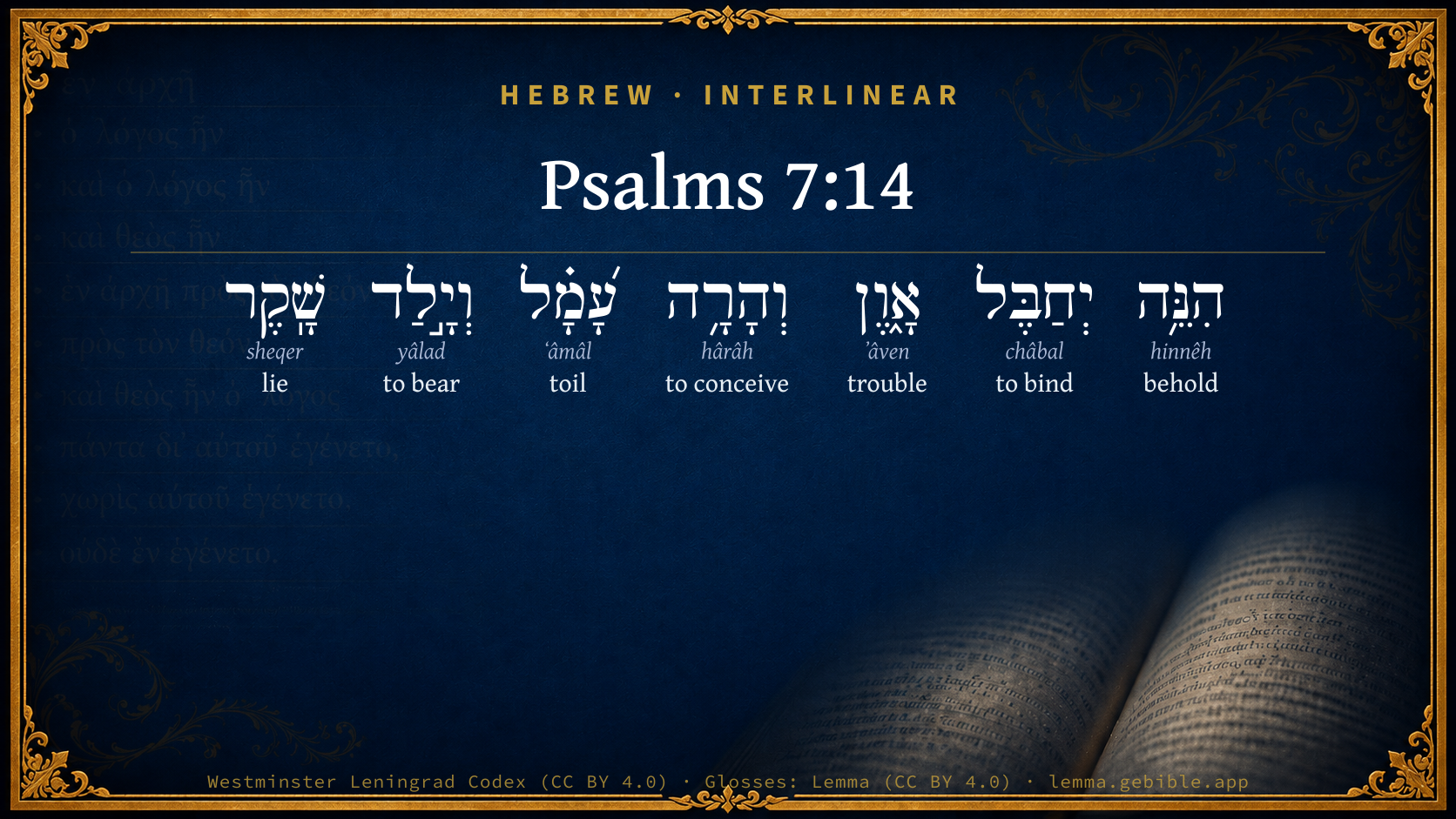
  1. הִנֵּ֥ה hinnêh H2009 “behold” Particle, Demonstrative
  2. אָ֑וֶן ʼâven H205 “trouble” Noun, Common, Masculine, Singular, Absolute
  3. וְהָרָ֥ה hârâh H2029 “and · to conceive” Conjunction + Verb, Qal, Sequential Perfect, 3rd Person, Masculine, Singular
  4. עָ֝מָ֗ל ʻâmâl H5999 “toil” Noun, Common, Both, Singular, Absolute
  5. וְיָ֣לַד yâlad H3205 “and · to bear” Conjunction + Verb, Qal, Sequential Perfect, 3rd Person, Masculine, Singular
  6. שָֽׁקֶר sheqer H8267 “lie” Noun, Common, Masculine, Singular, Absolute

About this verse

These counts appear in no published source. They are computed here, from the morphology-tagged text and Lemma’s own curated glosses. What Lemma adds →

7
words
7
distinct lemmas
Wisdom
section

Shared distinctive vocabulary

יְחַבֶּל to bind H2254 occurs in 23 verses of the Hebrew Bible. Also found in:

Grammatical profile

  • 3 verbs
  • 3 nouns
  • 1 particle

Verb forms

  • יְחַבֶּל Piel · Imperfect
  • וְהָרָ֥ה Qal · Sequential Perfect
  • וְיָ֣לַד Qal · Sequential Perfect

Hebrew & Septuagint length

In English translation the verse runs 14 words from the Hebrew and 14 from the Septuagint (LXX English) — the same length.

A rough comparison of the two English renderings, which tokenize alike — not a word-level alignment.

Word counts can differ between the Hebrew and the Greek without any difference in meaning — e.g. the Hebrew direct-object marker אֵת has no separate Greek word, and Greek often adds the article ὁ.

In the original languages it is 7 Hebrew tokens and 12 Greek tokens — but the two are counted differently (Hebrew bundles its prefixes and suffixes into one token; the Greek is in lemma form), so that isn’t a like-for-like length.

Cross-references

5

Topical passages linked to Psalms 7:14 in the Treasury of Scripture Knowledge — connected by theme and wording, ordered by reader-vote popularity; previews shown in the World English Bible.

  • Job 15:35 They conceive mischief, and bring forth iniquity. Their heart prepares deceit."
  • James 1:15 Then the lust, when it has conceived, bears sin; and the sin, when it is full grown, brings forth death.
  • Isaiah 33:11 You shall conceive chaff, you shall bring forth stubble: your breath is a fire that shall devour you.
  • Job 15:20 The wicked man travails with pain all his days, Even the number of years that are laid up for the oppressor.
  • Isaiah 59:4–5 None sues in righteousness, and none pleads in truth: they trust in vanity, and speak lies; they conceive mischief, and bring forth iniquity.

Cross-references courtesy of OpenBible.info (CC BY 4.0).

Hebrew and Greek witnesses Masoretic Hebrew ↔ Greek Septuagint

The same verse in the two great witnesses to the Old Testament, shown verse-for-verse.

You’re reading Greek Psalm 7 (Hebrew Psalm 7). The Septuagint counts the superscription, so verse numbers can differ from the Hebrew — chapter-level alignment, not verse-by-verse. Numbering follows Rahlfs.

These are two independent witnesses, not word-aligned to each other, and the Septuagint is shown in lemma (dictionary) form.

Hebrew Psalms 7:14 Masoretic · Westminster Leningrad Codex

הִנֵּ֥ה יְחַבֶּל אָ֑וֶן וְהָרָ֥ה עָ֝מָ֗ל וְיָ֣לַד שָֽׁקֶר

Behold, he travails with iniquity; Yes, he has conceived mischief, And brought forth falsehood.

World English Bible · Public Domain

Greek LXX Greek Psalm 7:14 Septuagint · lemma form

καί ἐν αὐτός ἑτοιμάζω σκεῦος θάνατος ὁ βέλος αὐτός ὁ καίω ἐκἐργάζομαι

Behold, he has travailed with unrighteousness, he has conceived trouble, and brought forth iniquity.

LXX2012 (modern English Septuagint) · Public Domain

Hebrew: Westminster Leningrad Codex (CC BY 4.0). Greek: Septuagint (public domain); English from LXX2012 (modern English Septuagint) (Public Domain). How the Septuagint differs from the Hebrew →

Commentary

Notes on Psalms 7:14 from classic Christian and Jewish commentators (each source and its license shown beneath its notes). The classic Christian expositions comment on the surrounding passage and are grouped to its opening verse, so a note may address several verses; the Jewish commentaries on the Tanakh (Rashi and others) are per-verse, so they appear only where the commentator wrote on this verse.

Lemma curates 59 commentaries, every one of them public domain or Creative Commons licensed, each selected and text-cleaned for this edition rather than reprinted as found. About our sources →

Trapp's Complete Commentary

John Trapp

Psa 7:14 Behold, he travaileth with iniquity, and hath conceived mischief, and brought forth falsehood.

Ver. 14. Behold, he travaileth with iniquity] Heb. he shall travail, or he continually travaileth; he taketh as great pains to go to hell as a travailing woman doth to be delivered.

And hath conceived mischief] See Job 15:35, {See Trapp on "Job 15:35"}

And brought forth falsehood] Or, a lie, that is, a disappointment. See Isa 26:18. The Jews have a proverb, Quicquid genuit mendacium, dispellit maledictio (R. Solomon).

John Trapp, A Commentary or Exposition upon All the Books of the Old and New Testament (1647–1656) — public domain. Text from a community e-Sword module.

The Biblical Illustrator

Joseph S. Exell

Psa_7:14-16

Behold, he travaileth with iniquity.

The enemies of the Church

1. That all the labour of wicked men against the Church is but labour in vain in respect of their own intent and expectation.

2. That the labour of wicked men is turned clean contrary to their own intent and expectation. These things are set down in metaphor and in express speech. Doctrine: The wicked counsels and enterprises of the enemies of the Church are not only vain in respect of others, but mischievous against themselves. God scattereth the devices of the crafty, so as they cannot accomplish what they enterprise.

The misery of the enemies of the Church may be seen in four particulars.

1. All their pain and labour is for their own destruction.

2. That they live in perpetual peril of destruction.

3. That unexpected destruction comes when they expect the sweet fruit of all their labour.

4. That the mischief plotted against the greatest enemies recoils upon themselves, as a gun overcharged and recoiling. There is little cause why Gods people should envy the prosperity of their enemies, or study for revenge. They should rather pity them, and pray for them, so many as are curable, for their last dish will mar all the feast. Little do they know what they are doing. They are twisting a cord to hang themselves. They are digging a pit, but the earth falls on them, and smashes them to pieces. (T. Taylor, D. D.)

The saints sagety in evil times

These words express the conception, birth, carriage, and miscarriage of a plot against David. In which consider--

I. What his enemies did. This is likened to a bodily conception, for the mind hath such as well as the body. The seed of it was some wicked thought cast in by Satan, the understanding was the womb to conceive, the will to consent. From first to last, from the conception to the bringing forth, they intended the destruction of David, but brought forth their own ruin.

1. And how great was their sin? It was voluntary and with delight, and it was spiritual and artificial--there was much art and cunning in it: they were very diligent in it, for it was a curious web. Judas is awake when Peter is asleep. And, which is worst of all, they were so well pleased with the bent of their own brain that they travailed of it. The more the soul dwells on any sinful plot, the more estrangement there is from God. The more deliberate in sin, the more the soul is pleased with it. Many seek out the delight of sin before they act, as Esau pleased himself by thinking, the day of mourning for his father would come, wherein he might be revenged of his brother.

2. But by whom and against whom was this plotting? By children of the Church, not uncircumcised Philistines; and that opposition is the bitterest of all.

3. And it was against David, a man after Gods own heart. Envy hath an ill eye. It cannot look on goodness without grief. And this plot was cunningly carried. First, they kill his good name, that so slander may make way for violence. Satan is a liar first, and then a murderer. See what David did. Innocency was his best apology. He saw God in the wrongs he suffered. We need not be ashamed to learn some things of our very enemies. If they be so set on evil, why not we on good? I am sure we serve a better Master. True love is full of inventions; it will be devising of good things.

II. What God did. Now I come to their miscarriage. They brought forth a lie, God defeated them.

1. How this was done. By disappointing them. They fell into danger of their own contriving, and into the same danger that they plotted for another. Compare the history of Haman and Mordecai. Why does God do this? First, in regard to Himself. He will be known to be God only wise. Secondly, in regard of His tender care over His children, who are the apple of His eye. Another reason is, the virulence of the enemies whose fierceness turns to Gods praise (Psa_9:16). And Gods children will give Him no rest. They prevail on Him by importunity.

3. But it will be objected that wicked men do prevail over the children of God. Tully could say, The gods show how much they esteem the Jewish nation, by suffering so often to be conquered. Where, then, is the bringing forth of a lie? I answer, when they do prevail it is but one part only, not the whole. Over mens lives, but not their spirits. A true Christian conquers when he is conquered. Our enemies shall do no more nor less than God wills: their mischievous attempts fail in the end; for did ever any harden themselves against God and prosper long? The greatest torment of the damned spirit is that God turns all his plots for the good of those he hates most.

III. What we all should do. We are bidden behold.

1. The subtlety, malice, and restless endeavour of the enemies of goodness, and their bootless enterprise, they bring forth a lie.

2. But especially the mercy of God to His children, and how He confounds their enemies. (R. Sibbes.)

The Biblical Illustrator, edited by Joseph S. Exell (c. 1880s–1900s) — public domain. Text from a community e-Sword module.

Joseph Benson's Commentary

Psa 7:14. Behold, he — That is, the wicked, travaileth with iniquity, &c. — This metaphor denotes his deep design and vigorous endeavours for doing mischief; and his restlessness and pain till he have accomplished it. “When an evil thought,” says Dr. Horne, “is instilled into the heart of man, then the seed of the wicked one is sown; by admitting, retaining, and cherishing the diabolical suggestion in his mind he ‘conceiveth’ a purpose of mischief; when that purpose is gradually formed and matured for the birth, he ‘travaileth with iniquity;’ at length, by carrying it into action, he

‘bringeth forth falsehood.’ The purity of the soul, like that of the body, from whence the image is borrowed, must be preserved by keeping out of the way of temptation.”

Joseph Benson's Commentary on the Old and New Testaments (1811–1818) — public domain. Text from a community e-Sword module.

J. A. Alexander on Psalms

Joseph Addison Alexander

15. (Psa 7:14). Behold, he, the wicked man, will writhe, or travail (with) iniquity, (towards others), and conceive mischief (to himself), and bring forth falsehood, self-deception, disappointment. The meaning seems to be, that while bringing his malignant schemes to maturity, he will unconsciously conceive and bring forth ruin to himself.

Joseph Addison Alexander, The Psalms Translated and Explained (1850) — public domain. Text from a community e-Sword module.

Tyndale Open Study Notes

Tyndale Open Resources

7:14 Evil begins with small words or steps, and gives birth to increasingly worse deeds as time goes on (see Isa 59:4-5).

Tyndale Open Study Notes — © Tyndale Open Resources, licensed CC BY-SA 4.0. Text via the HelloAO Bible API.

Geneva Bible (1599)

Geneva Bible translators

Isa. 59:4; Job 15:35

Geneva Bible (1599) marginal notes — public domain. Text via Bolls.life.

Jamieson, Fausset & Brown

Robert Jamieson, A. R. Fausset & David Brown

The first clause expresses the general idea that wicked men labor to do evil, the others carry out the figure fully.

Jamieson, Fausset & Brown — Commentary Critical and Explanatory on the Whole Bible (1871) — public domain (CC PDM 1.0). Text via the HelloAO Bible API.

Adam Clarke's Commentary

Verse 14. He travaileth with iniquity] All these terms show the pitch of envy, wrath, and malevolence, to which Saul had carried his opposition against David. He conceived mischief; he travailed with iniquity; he brought forth falsehood-all his expectations were blasted.

Adam Clarke's Commentary on the Bible (1810–1826) — public domain. Text from a community e-Sword/MySword module.

John Calvin's Commentaries

14 Behold, he shall travail David has hitherto shown how great and formidable the danger was which was near him. In this verse, laughing to scorn the presumptuous and foolish attempts of Saul, and his magnificent preparations, he declares that they had failed of accomplishing their object. “Disant que tout cela est alle en fumee.” — Fr. “Saying that the whole ended in smoke.”

“Pource que Dieu l’a frustre de son attente et renverse toutes ces meschantes entreprises.”—Fr.

“Pour toutes violences et outrages.”—Fr.

“C’est a dire, se decoyvent et ne viendront a bout de ce qu’ils couvent en leurs coeurs.”—Fr.

John Calvin's Commentaries (1540-1563) — public domain. Text from the Calvin Translation Society English edition (1840s-50s) via the Christian Classics Ethereal Library (ccel.org). Calvin's coverage is partial (roughly two-thirds of the Bible); uncommented books and verses are honest gaps, never fabricated. The 19th-century editor's footnotes and remarks are omitted so the notes are faithfully Calvin's own voice.

Ellicott's Commentary for English Readers

(14) Behold, he travaileth.—The poet’s thought recurs to the calumniator, whose sin has deserved all this Divine wrath, and he sees the truth that God’s judgments are not arbitrary, but follow naturally on sin as its consequence. The verb “travaileth” gives the general figure, which is elaborated in the two clauses which describe the stages of conception and pregnancy. (For the image, comp. Job_15:35.)

A Bible Commentary for English Readers, edited by Charles John Ellicott (1878–1897) — public domain. Text from a community e-Sword module.

The Cambridge Bible for Schools and Colleges

gen. ed. J. J. S. Perowne

14. Render the second line,

Yea he conceiveth mischief and bringeth forth falsehood.

Words of studied ambiguity are chosen, ironically describing the action of the wicked man in its intention and its result. The ‘iniquity’ (lit. worthlessness: see on Psa_5:5) which he laboriously plans is destined to prove vanity and failure: the ‘mischief’ which he conceives for others issues in calamity for himself: the resultant ‘falsehood’ deceives not others but himself. Cp. for the figure, Job_15:35; Isa_33:11; Isa_59:4.

14–16. The punishment of the wicked described from another point of view as the natural result of his own actions. He falls into the snare which he laid for others.

The Cambridge Bible for Schools and Colleges (gen. ed. J. J. S. Perowne; Cambridge University Press, 1878–1918) — public domain. Text from a community e-Sword module.

John Gill's Exposition

Behold, he travaileth with iniquity,.... Is full of it, and big with it, as a woman with child, and eagerly desires to bring it forth, and is in pain till he commits it;

and hath conceived mischief; that which is injurious to God and the perfections of his nature, a transgression of his law, and an affront to his justice and holiness, is doing wrong to fellow creatures, and harm to themselves, either to their name and credit, or to their substance and estates, or to their bodies and souls, and it may be to them all; and yet this they conceive, they devise it in their hearts, and form schemes how to bring it to pass, and which they do with great freedom, deliberation, and pleasure;

and brought forth falsehood; or "vanity" (k), or a vain thing, as the same word is rendered in Job 15:35; no fruit at all, but wind, or stubble, Isa 26:17; that which deceives does not answer the expectation, but the contrary to it; the sense is, that wicked men having devised mischievous things against the saints, they are big with expectations of success, and strive to bring their purposes to bear, but are miserably disappointed, for it all ends in vanity and vexation of spirit to themselves.

(k) "rem inanem", so some in Vatablus; "vanitatem", Gejerum.

John Gill's Exposition of the Whole Bible (1746–1763) — public domain (CC PDM 1.0). Text via the HelloAO Bible API.

Albert Barnes' Notes on the Bible

Behold, he travaileth with iniquity - The wicked man does. The allusion here is to the pains and throes of child-birth; and the idea is, that the wicked man labors or struggles, even with great pain, to accomplish his purposes of iniquity. All his efforts, purposes, plans, are for the promotion of evil.

And hath conceived mischief - That is, he hath formed a scheme of mischief. The allusion here is common when speaking of forming a plan of evil.

And brought forth falsehood - The birth is falsehood; that is, self-deception, or disappointment. It does not mean that falsehood was his aim or purpose, or that he had merely accomplished a lie; but the idea is, that after all his efforts and pains, after having formed his scheme, and labored hard (as if in the pangs of child-birth) to bring it forth, it was abortive. He would be disappointed, and would fail at last. This idea is expressed more distinctly in the following verse, and the design of the whole is to say that any plan or purpose of wickedness must be in the end a failure, since God is a righteous Judge, and will vindicate His own cause.

Albert Barnes' Notes on the Bible (1834–1885) — public domain. Text from a community e-Sword/MySword module.

Matthew Poole's English Annotations

He, i.e. the wicked, as is undeniably manifest from the matter and context.

Conceived mischief, and brought forth falsehood: this metaphor noteth his deep design, and continued course, and vigorous endeavours for the doing of mischief, and his restlessness and pain till he have accomplished it.

Matthew Poole's English Annotations on the Holy Bible (1683–1685) — public domain. Text from a community e-Sword/MySword module.

The Treasury of David

Charles H. Spurgeon

Ver. 14. In three graphic pictures we see the slanderer's history. A woman in travail furnishes the first metaphor.

He travaileth with iniquity. He is full of it, pained until he can carry it out, he longs to work his will, he is full of pangs until his evil intent is executed.

He hath conceived mischief. This is the original of his base design. The devil has had doings with him, and the virus of evil is in him. And now behold the progeny of this unhallowed conception. The child is worthy of its father, his name of old was,"the father of lies," and the birth doth not belie the parent, for

he brought forth falsehood. Thus, one figure is carried out to perfection; the Psalmist now illustrates his meaning by another, taken from the stratagems of the hunter.

Ver. 14. Behold he travaileth with iniquity, etc. The words express the conception, birth, carriage and miscarriage, of a plot against David. In which you may consider:(1.) What his enemies did. (2.) What God did. (3.) What we all should do: his enemies' intention, God's prevention, and our duty; his enemies' intention, he travaileth with iniquity, and conceiveth mischief; God's prevention, he brought forth a lie; our duty, Behold ... Observe the aggravation of the sin, he conceiveth. He was not put upon it, or forced into it: it was voluntary. The more liberty we have not to sin, makes our sin the greater. He did not this in passion, but in cold blood. The less will, less sin. Richard Sibbs.

Ver. 14. He travaileth with iniquity, and hath conceived mischief. All note that conceiving is before travailing, but here travailing, as a woman in labour, goeth first; the reason whereof is, that the wicked are so hotly set upon the evil which they maliciously intend, that they would be immediately acting of it if they could tell how, even before they have conceived by what means; but in fine they bring forth but a lie, that is, they find that their own hearts lied to them, when they promised good success, but they had evil. For their haste to perpetrate mischief is intimated in the word rendered "persecutors" (Ps 7:13), which properly signifieth ardentes, burning; that is, with a desire to do mischiefand this admits of no delay. A notable common-place, both setting forth the evil case of the wicked, especially attempting anything against the righteous, to move them to repentancefor thou hast God for thine enemy warring against thee, whose force thou canst not resistand the greedy desire of the wicked to be evil, but their conception shall all prove abortive. J. Mayer, in loc.

Ver. 14. And hath brought forth falsehood. Every sin is a lie.

Augustine.

Ver. 14. "Earth's entertainments are like those of Jael.

Her left hand brings me milk, her right, a nail."

Thomas Fuller.

Ver. 14-15. They have digged a pit for usand that low, unto helland are fallen into it themselves.

"No juster law can be devised or made, Than that sin's agents fall by their own trade."

The order of hell proceeds with the same degrees; though it give a greater portion, yet still a just proportion, of torment. These wretched guests were too busy with the waters of sin; behold, now they are in the depth of a pit, "where no water is." Dives, that wasted so many tuns of wine, cannot now procure water, not a pot of water, not a handful of water, not a drop of water, to cool his tongue. Desideravit guttam, qui non dedit micam. (Augustine Hom. 7) A just recompense! He would not give a crumb; he shall not have a drop. Bread hath no smaller fragment than a crumb, water no less fraction than a drop. As he denied the least comfort to Lazarus living, so Lazarus shall not bring him the least comfort dead. Thus the pain for sin answers the pleasure of sin ... Thus damnable sins shall have semblable punishments; and as Augustine of the tongue, so we may say of any member ... If it will not serve God in action, it shall serve him in passion. Thomas Adams.

Ver. 14-16. Illustrate by three figures the devices and defeat of persecutors.

Charles H. Spurgeon's The Treasury of David (1869–1885) — public domain. Psalms only. Text from a community e-Sword/MySword module.

Whedon's Commentary on the Bible

Daniel D. Whedon

14-17. He travaileth—Literally, he shall bring forth with pain. The dark hearted Cush of the title now re-appears. He brings forth in his conduct, with agony, what he had already conceived in his heart. Both his character and punishment are described, and he shall reap as his reward what he hath sown. Psa_7:15-16. These are eternal truths in ethics and in the moral government.

Pit—An allusion to the mode of catching wild animals.

Fallen into the ditch which he made—Here is the lex talionis—the most literal form of retributive justice. When will men learn there is “a God that judgeth in the earth?” Psa_58:11. The closing verse of the psalm is a spontaneous outbreak of praise to God for his righteous dealings with men.

Daniel D. Whedon (gen. ed.), Commentary on the Old and New Testaments (1874–1909) — public domain. Text from a community e-Sword module.

The Pulpit Commentary

Behold, he travaileth with iniquity, and hath conceived mischief, and brought forth falsehood. (comp. Job_15:35 Isa_59:4) The "falsehood" intended is probably the bringing of false charges against David (see vers. 3-5).

The Pulpit Commentary (1880–1919), ed. H.D.M. Spence-Jones & Joseph S. Exell — public domain. Text from a community e-Sword module.

John Wesley's Explanatory Notes

Travelleth - This metaphor denotes his deep design, and vigourous endeavours for doing mischief, and his restlessness and pain 'till he have accomplished it.

John Wesley, Explanatory Notes Upon the Whole Bible (1754–1765) — public domain. Text via the GEBible commentary corpus.

Keil & Delitzsch

C. F. Keil & F. Delitzsch

(Heb.: 7:15-18) This closing strophe foretells to the enemy of God, as if dictated by the judge, what awaits him; and concludes with a prospect of thanksgiving and praise. Man brings forth what he has conceived, he reaps what he has sown. Starting from this primary passage, we find the punishment which sin brings with it frequently represented under these figures of הדה and ילד (הוליד, חבּל, חיל), זרע and קצר, and first of all in Job 15:35. The act, guilt, and punishment of sin appear in general as notions that run into one another. David sees in the sin of his enemies their self-destruction. It is singular, that travail is first spoken of, and then only afterwards pregnancy. For חבּל signifies, as in Sol 8:5, ὠδίνειν, not: to conceive (Hitz.). The Arab. ḥabila (synonym of ḥamala) is not to conceive in distinction from being pregnant, but it is both: to be and to become pregnant. The accentuation indicates the correct relationship of the three members of the sentence. First of all comes the general statement: Behold he shall travail with, i.e., bring forth with writhing as in the pains of labour, און, evil, as the result which proceeds from his wickedness. Then, by this thought being divided into its two factors (Hupf.) it goes on to say: that is, he shall conceive (concipere) עמל, and bear שׁקר. The former signifies trouble, molestia, just as πονηρία signifies that which makes πόνον; the latter falsehood, viz., self-deception, delusion, vanity, inasmuch as the burden prepared for others, returns as a heavy and oppressive burden upon the sinner himself, as is said in Psa 7:17; cf. Isa 59:4, where און instead of שׁקר denotes the accursed wages of sin which consist in the unmasking of its nothingness, and in the undeceiving of its self-delusion. He diggeth a pit for himself, is another turn of the same thought, Psa 57:7; Ecc 10:8. Psa 7:16 mentions the digging, and Psa 7:16 the subsequent falling into the pit; the aorist ויּפּל is, for instance, like Psa 7:13, Psa 16:9; Psa 29:10. The attributive יפעל is virtually a genitive to שׁחת, and is rightly taken by Ges. 124, 3, a as present: in the midst of the execution of the work of destruction prepared for others it becomes his own. The trouble, עמל, prepared for others returns upon his own head (בּראשׁו, clinging to it, just as על־ראשׁו signifies descending and resting upon it), and the violence, חמס, done to others, being turned back by the Judge who dwells above (Mic 1:12), descends upon his own pate (קדקדו with o by q, as e.g., in Gen 2:23). Thus is the righteousness of God revealed in wrath upon the oppressor and in mercy upon him who is innocently oppressed. Then will the rescued one, then will David, give thanks unto Jahve, as is due to Him after the revelation of His righteousness, and will sing of the name of Jahve the Most High (עליון as an appended name of God is always used without the art., e.g., Psa 57:3). In the revelation of Himself He has made Himself a name. He has, however, revealed Himself as the almighty Judge and Deliverer, as the God of salvation, who rules over everything that takes place here below. It is this name, which He has made by His acts, that David will then echo back to Him in his song of thanksgiving.

Keil & Delitzsch — Biblical Commentary on the Old Testament (1861–1891) — public domain (CC PDM 1.0). Text via the HelloAO Bible API. (Old Testament only.)

unfoldingWord translationNotes

Door43 World Missions Community

one who is pregnant with wickedness ... conceives destructive plans ... gives birth to harmful lies

David speaks of the things that a wicked person does as if the person were pregnant and wickedness was the baby. AT: "the wicked person. He makes plans to destroy people and produces harmful lies" (See: Metaphor)

His own destructive plans return to his own head, for his violence comes down on his own head

Destruction and violence are spoken of as if they hit a person's head or fall down on it. AT: "His own destructive plans destroy him, for his violence attacks him" or "When he plans to destroy others, others destroy him; when he attacks others, others attack him" (See: Metaphor)

translationWords

head

just

praise

unfoldingWord translationNotes — © Distant Shores Media and the Door43 World Missions Community, licensed CC BY-SA 4.0. Source: git.door43.org/Door43/en_tn.

Rashi

Rabbi Shlomo Yitzchaki (Rashi)

And...for him And for the wicked man, the Holy One, blessed be He, has prepared deadly weapons.

for pursuers Heb. לדלקים, for pursuers, as (in Gen. 31:36): “that you pursued (דלקת) me.” And this is its meaning: His arrows to slay the wicked who pursue the righteous, the Holy One, blessed be He, will make and prepare them to slay them. Every [instance of] דליקה is an expression of pursuit.

Rashi on the Tanakh — English translations: “The Judaica Press complete Tanach with Rashi, translated by A. J. Rosenberg” (CC BY 4.0); “Pentateuch with Rashi's commentary by M. Rosenbaum and A.M. Silbermann, 1929-1934” (public domain); “The Metsudah Tanach series, Lakewood, N.J” (CC BY 4.0); and “The Book of Joshua, Metsudah Publications, 1997” (CC BY 4.0). Text via Sefaria.

Radak

Rabbi David Kimhi (Radak)

He hath also prepared him the instruments of death; And arrows for the pursuers doth he provide: – For himself and those that pursue with him after me he has prepared and provided arrows and instruments of death to kill me. And some explain ולו, for himself as equivalent to בעבורו (on his own account), meaning“ on account of his own life,” as though saying, the arrows which he has prepared him are against his own life, for he shall die by them. And דלקים (pursuers) is used as (in the text): “that thou hast so hotly pursued (דלקת) after me” (Gen. 31:36).

Radak on the Tanakh — English translations: “Sefaria Community Translation” (CC0 1.0 (public-domain dedication)); “Eliyahu Munk, HaChut Hameshulash” (CC BY 4.0); “Rabbi Mike Feuer, Jerusalem Anthology” (CC BY 4.0); and “R. David Kimhi on the first book of Psalms, Translated by R.G. Finch, London, 1919” (public domain). Text via Sefaria.

Lesson kit

Teaching starters — assembled from the data on this page, not authored interpretation. Every prompt links to the verse data it draws on. Edit before teaching.

Psalms, in the Wisdom, opens this verse with 7 words (7 distinct Hebrew lemmas). Its most distinctive word is châbal (“to bind”). A historical commentator’s framing appears above. Read the whole chapter for the surrounding context.

Discussion questions

  1. What does “to bind” (châbal) contribute to the verse as a whole?
  2. Exodus 22:26 shares the word «to bind» with this verse. How do the two illuminate each other?
  3. These translations render this verse differently. What is at stake in choosing one wording over another?
  4. The verb «יְחַבֶּל» is Piel Imperfect. How does its form color the action?
  5. Reading how Trapp's Complete Commentary and The Biblical Illustrator read this verse, where do the two commentators agree and where do they part?

Things to notice

Reading settings

Reading text

Shown beneath each verse's original-language words.

Old Testament
Old Testament edition

Read the OT as the Masoretic Hebrew (MT) or the Greek Septuagint (LXX).

English shown for the Greek Septuagint (in the Hebrew ↔ Greek comparison).

Comparing translations? Open the Compare panel on any verse page to stack up to four side by side.