Jeremiah 3:23

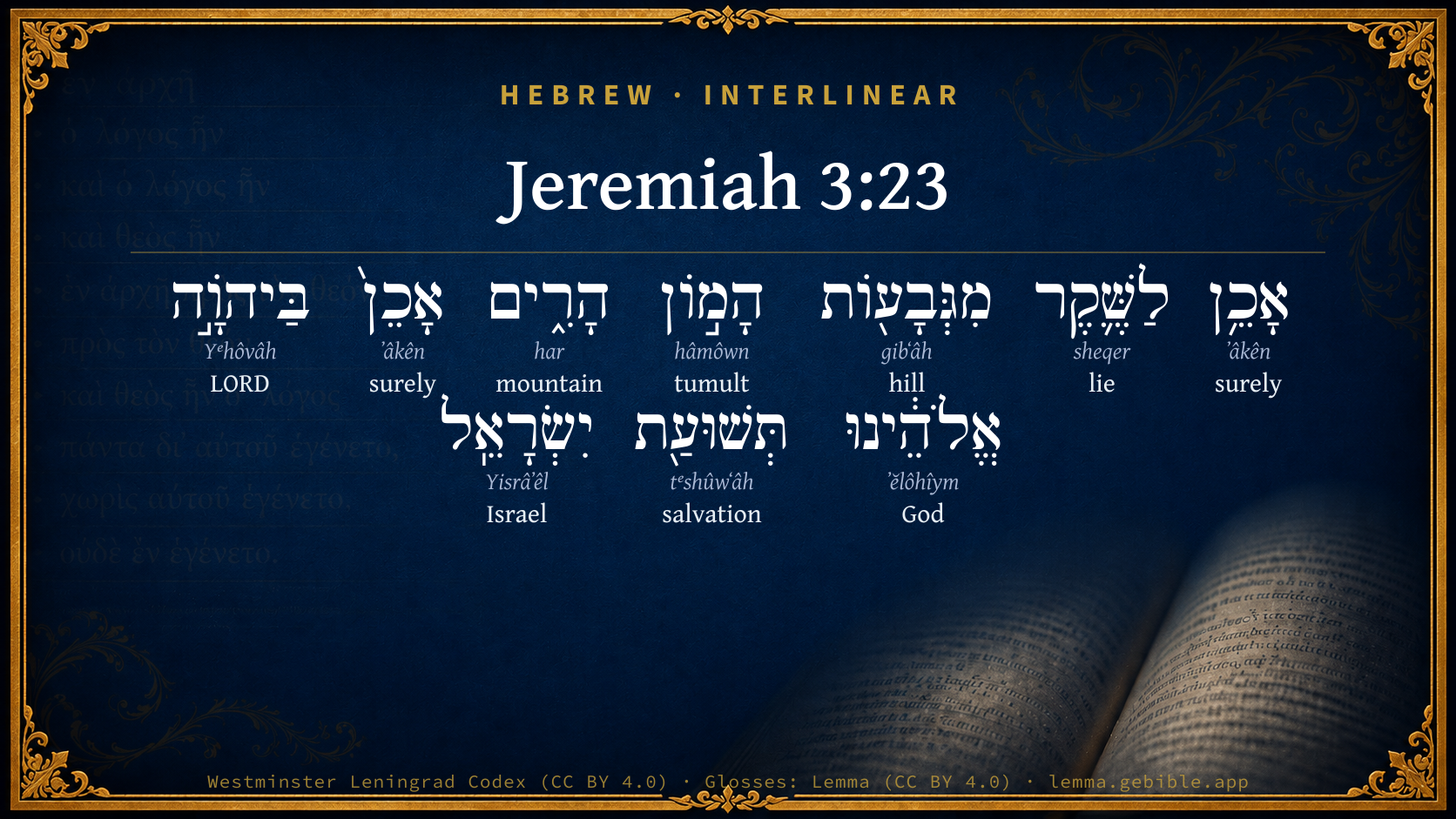
Hebrew (Westminster Leningrad Codex) Jeremiah 3:23 appears in the Hebrew Old Testament. The text above is from the Westminster Leningrad Codex. Each word links to its Strong’s number, a concise gloss, and parsing drawn from the Open Scriptures Hebrew Bible morphology. Click any word for its full Brown-Driver-Briggs (BDB) entry.
Download image
Cite this verse

Jeremiah 3:23 (World English Bible). Public Domain. Lemma interlinear Bible study tool, https://lemma.gebible.app/v/jeremiah/3/23.

Show BibTeX & RIS
BibTeX
RIS
English Translation
Truly in vain is [the help that is looked for] from the hills, the tumult on the mountains: truly in Yahweh our God is the salvation of Israel.
World English Bible · Public Domain
Download a study sheet

One document with this verse’s original text, its word-by-word gloss line, the meaning frame, cross-references with their text, attributed commentary, and full source and license credits — printable, and it pastes into notes with its structure intact.

This verse Autodidact and up

Study sheet (.html) Plain text (.txt)

A passage Seminary Student

Up to 50 verses in one chapter. A passage sheet keeps up to 6 commentary sources and 12 cross-references per verse, in the order this page ranks them, and says so on the sheet whenever that leaves anything out. Ask for a single verse and you get the Autodidact verse sheet above.

Everything on this page stays free to read, with no account — the sheet is a download of what is already on screen, not access to it.

Want to remove ads? Support Godless Engineer
Compare translations 3

The same verse in 3 English versions, stacked beneath the original-language interlinear above. Click any original word for its lexicon entry.

Each is an independent rendering of the whole verse — the interlinear is not word-aligned to these translations.

Highlighted words mark where these versions differ — a whole-verse word diff, not a word-by-word alignment.

  • World English Bible Public Domain
    Truly in vain is [the help that is looked for] from the hills, the tumult on the mountains: truly in Yahweh our God is the salvation of Israel.
  • King James Version Public Domain
    Truly in vain is salvation hoped for from the hills, and from the multitude of mountains: truly in the LORD our God is the salvation of Israel.
  • unfoldingWord Literal Text CC BY-SA 4.0
    Truly in vain from the hills, the commotion the mountains; truly in Yahweh our God the salvation of Israel.

unfoldingWord Literal Text — © unfoldingWord, licensed CC BY-SA 4.0. Word-aligned USFM3 via Door43 (git.door43.org/unfoldingWord/en_ult).

Versions to compare (up to 4)

3 of 4 selected

Show all 18 translations

Every available English version of this verse, each an independent rendering of the whole verse.

  • World English Bible Public Domain
    Truly in vain is [the help that is looked for] from the hills, the tumult on the mountains: truly in Yahweh our God is the salvation of Israel.
  • Berean Standard Bible Public Domain
    Surely deception comes from the hills, and commotion from the mountains. Surely the salvation of Israel is in the LORD our God.
  • Majority Standard Bible Public Domain
    Surely deception comes from the hills, and commotion from the mountains. Surely the salvation of Israel is in the LORD our God.
  • King James Version Public Domain
    Truly in vain is salvation hoped for from the hills, and from the multitude of mountains: truly in the LORD our God is the salvation of Israel.
  • American Standard Version (1901) Public Domain
    Truly in vain is `the help that is looked for' from the hills, the tumult on the mountains: truly in Jehovah our God is the salvation of Israel.
  • Revised Version (1885) Public Domain
    Truly in vain is the help that is looked for from the hills, the tumult on the mountains: truly in the LORD our God is the salvation of Israel.
  • Geneva Bible (1599) Public Domain
    Truely the hope of the hilles is but vaine, nor the multitude of mountaines: but in the Lord our God is the health of Israel.
  • Douay-Rheims (1899) Public Domain
    In very deed the hills were liars. and the multitude of the mountains: truly in the Lord our God is the salvation of Israel.
  • Young's Literal Translation Public Domain
    Surely in vain from the heights, The multitude of mountains -- Surely in Jehovah our God `is' the salvation of Israel.
  • Literal Standard Version CC BY-SA 4.0
    Surely in vain—from the heights, || The multitude of mountains—Surely the salvation of Israel [is] in our God YHWH.
  • Unlocked Literal Bible CC BY-SA 4.0
    Surely lies come from the hills, a confusing noise from the mountains; surely Yahweh our God is the salvation of Israel.
  • unfoldingWord Literal Text CC BY-SA 4.0
    Truly in vain from the hills, the commotion the mountains; truly in Yahweh our God the salvation of Israel.
  • Darby Bible Public Domain
    Truly in vain [is salvation looked for] from the hills, [and] the multitude of mountains; truly in Jehovah our God is the salvation of Israel.
  • World Messianic Bible Public Domain
    Truly help from the hills, the tumult on the mountains, is in vain. Truly the salvation of Israel is in the LORD our God.
  • Webster's Bible Public Domain
    Truly in vain is salvation hoped for from the hills, and from the multitude of mountains: truly in the LORD our God is the salvation of Israel.
  • Free Bible Version CC BY-SA 4.0
    There's no doubt that pagan worship from the hills is pure lies; the idolatry that comes from the mountains is just noise. Israel's salvation is in the Lord our God alone.
  • Bible in Basic English Public Domain
    Truly, the hills, and the noise of an army on the mountains, are a false hope: truly, in the Lord our God is the salvation of Israel.
  • JPS Tanakh (1917) Public Domain
    Truly vain have proved the hills, the uproar on the mountains; truly in the LORD our God is the salvation of Israel.

Literal Standard Version (2020), Covenant Press — licensed CC BY-SA 4.0. Text via the HelloAO Bible API (eBible.org). Unlocked Literal Bible (unfoldingWord) — licensed CC BY-SA 4.0. Text via the HelloAO Bible API (eBible.org). unfoldingWord Literal Text — © unfoldingWord, licensed CC BY-SA 4.0. Word-aligned USFM3 via Door43 (git.door43.org/unfoldingWord/en_ult). Free Bible Version, Dr. Jonathan Gallagher — licensed CC BY-SA 4.0. Text via the HelloAO Bible API (eBible.org).

Word by word

More ways to search: Search by grammar → Find every occurrence → Compare this word →

Practice this passage: Drill this verse → Learn its vocabulary →

About this verse

These counts appear in no published source. They are computed here, from the morphology-tagged text and Lemma’s own curated glosses. What Lemma adds →

10
words
9
distinct lemmas
Prophets
section

Notable vocabulary

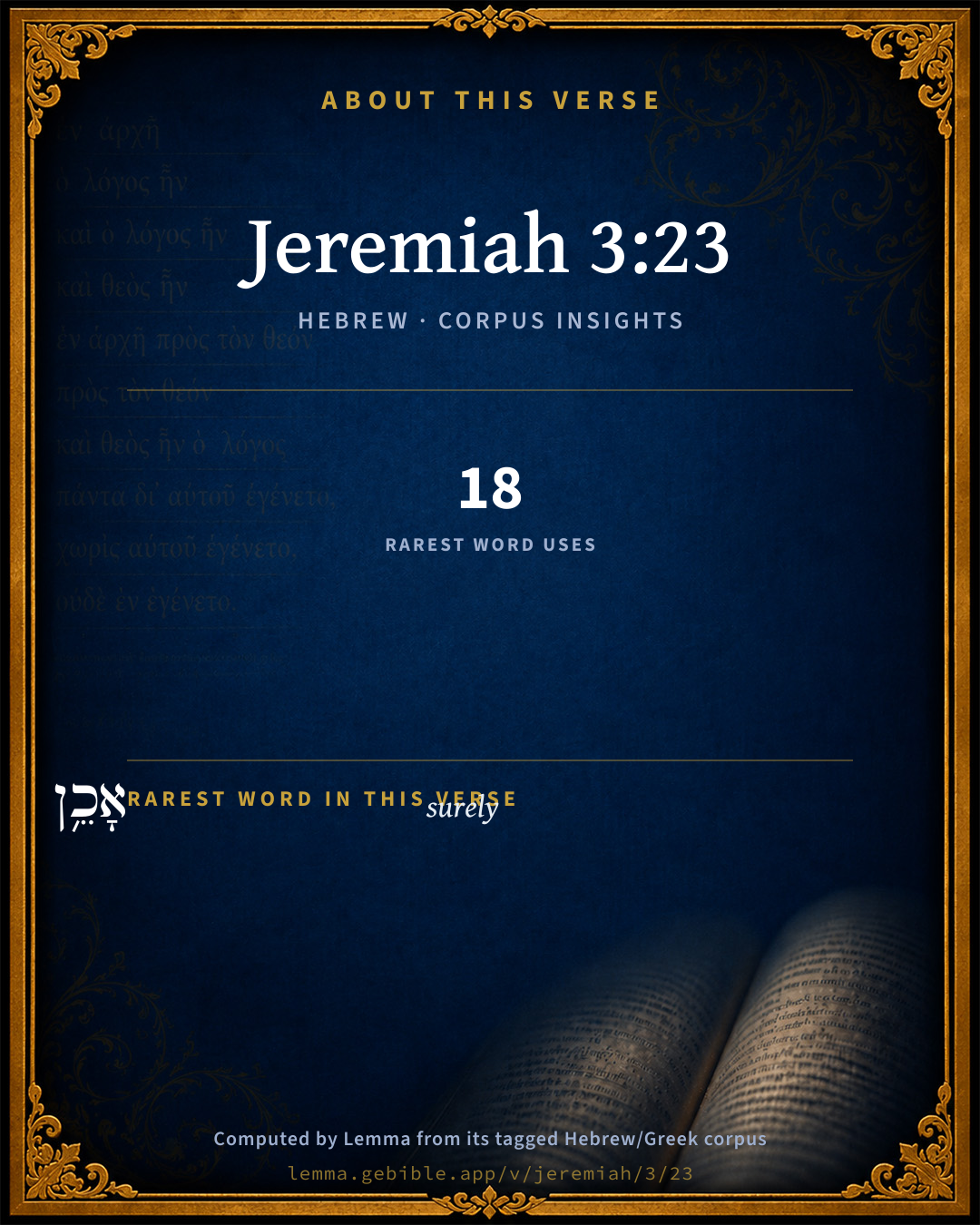
The rarest word here is אָכֵ֥ן surely H403 — appearing just 18 times in the whole Hebrew Bible.

Shared distinctive vocabulary

אָכֵ֥ן surely H403 occurs in 17 verses of the Hebrew Bible. Also found in:

Grammatical profile

  • 8 nouns
  • 2 adverbs

Repetition

A word recurs within this verse — often emphatic in Hebrew:

  • אָכֵ֥ן surely H403 ×2

Cross-references

19

Topical passages linked to Jeremiah 3:23 in the Treasury of Scripture Knowledge — connected by theme and wording, ordered by reader-vote popularity; previews shown in the World English Bible.

  • Psalms 121:1–2 I will lift up my eyes to the hills. Where does my help come from?
  • Psalms 3:8 Salvation belongs to Yahweh. Your blessing be on your people. Selah.
  • Isaiah 12:2 Behold, God is my salvation. I will trust, and will not be afraid; for Yah, Yahweh, is my strength and song; and he has become my salvation."
  • Ezekiel 20:28 For when I had brought them into the land, which I swore to give to them, then they saw every high hill, and every thick tree, and they offered there their sacrifices, and there they presented the provocation of their offering; there also they made their sweet savor, and they poured out there their drink-offerings.
  • Hosea 1:7 But I will have mercy on the house of Judah, and will save them by Yahweh their God, and will not save them by bow, nor by sword, nor by battle, by horses, nor by horsemen."
  • John 4:22 You worship that which you don't know. We worship that which we know; for salvation is from the Jews.
  • Psalms 37:39–40 But the salvation of the righteous is from Yahweh. He is their stronghold in the time of trouble.
  • Isaiah 43:11 I, even I, am Yahweh; and besides me there is no savior.
  • Isaiah 44:9 Those who fashion an engraved image are all of them vanity; and the things that they delight in shall not profit; and their own witnesses don't see, nor know: that they may be disappointed.
  • Isaiah 45:15 Most assuredly you are a God who hid yourself, God of Israel, the Savior.'
  • Isaiah 45:17 [But] Israel shall be saved by Yahweh with an everlasting salvation: you shall not be disappointed nor confounded world without end.
  • Isaiah 45:20 Assemble yourselves and come; draw near together, you who have escaped from the nations: they have no knowledge who carry the wood of their engraved image, and pray to a god that can't save.
  • Isaiah 46:7–8 They bear it on the shoulder, they carry it, and set it in its place, and it stands, from its place it shall not move: yes, one may cry to it, yet it can not answer, nor save him out of his trouble.
  • Isaiah 63:1 Who is this who comes from Edom, with dyed garments from Bozrah? this who is glorious in his clothing, marching in the greatness of his strength? I who speak in righteousness, mighty to save.
  • Isaiah 63:16 For you are our Father, though Abraham doesn't know us, and Israel does not acknowledge us: you, Yahweh, are our Father; our Redeemer from everlasting is your name.
  • Jeremiah 3:6 Moreover Yahweh said to me in the days of Josiah the king, Have you seen that which backsliding Israel has done? she is gone up on every high mountain and under every green tree, and there has played the prostitute.
  • Jeremiah 10:14–16 Every man is become brutish [and is] without knowledge; every goldsmith is disappointed by his engraved image; for his molten image is falsehood, and there is no breath in them.
  • Jeremiah 14:8 You hope of Israel, the Savior of it in the time of trouble, why should you be as a foreigner in the land, and as a wayfaring man who turns aside to stay for a night?
  • Jeremiah 17:14 Heal me, O Yahweh, and I shall be healed; save me, and I shall be saved: for you are my praise.

Cross-references courtesy of OpenBible.info (CC BY 4.0).

Hebrew and Greek witnesses Masoretic Hebrew ↔ Greek Septuagint

The same verse in the two great witnesses to the Old Testament, shown verse-for-verse.

These are two independent witnesses, not word-aligned to each other, and the Septuagint is shown in lemma (dictionary) form.

Hebrew Jeremiah 3:23 Masoretic · Westminster Leningrad Codex

אָכֵ֥ן לַשֶּׁ֛קֶר מִגְּבָע֖וֹת הָמ֣וֹן הָרִ֑ים אָכֵן֙ בַּיהֹוָ֣ה אֱלֹהֵ֔ינוּ תְּשׁוּעַ֖ת יִשְׂרָאֵֽל

Truly in vain is [the help that is looked for] from the hills, the tumult on the mountains: truly in Yahweh our God is the salvation of Israel.

World English Bible · Public Domain

Greek LXX Structure differs

In the Septuagint, Jeremiah is about an eighth shorter than the Hebrew and arranges its material differently — the Oracles Against the Nations (Hebrew chapters 46–51) appear in the middle of the Greek book, after 25:13. Because the chapter and verse boundaries do not line up, a verse-for-verse comparison with the Hebrew is not shown.

A verse-for-verse comparison isn’t shown here because the chapters and verses don’t line up. Switch to the LXX edition with the MT / LXX toggle above to read the Greek directly.

On this verse, Joseph Benson's Commentary discusses the Septuagint’s reading. Read the note in Commentary ↓

Hebrew: Westminster Leningrad Codex (CC BY 4.0). Greek: Septuagint (public domain); English from a public-domain English Septuagint. How the Septuagint differs from the Hebrew →

Targum (Aramaic paraphrase)

1

The Targum is the ancient Jewish Aramaic paraphrase of the Hebrew Scriptures — an interpretive translation, not the Hebrew text itself. Onkelos (literal) and Pseudo-Jonathan (expansive) render the Torah, and Jonathan the Prophets. Coverage is partial: where no permissively-licensed English translation exists for a verse, only the Aramaic is shown. This is verse-level text, not a word-by-word alignment to the Hebrew.

  1. Targum Jonathan Prophets (Joshua–Malachi)
    בְּכֵן לְשִׁקְרָא פְלַחְנָא עַל רָמָתָא וְלָא לַהֲנָאָה אִתְרְגֵישְׁנָא עַל טוּרַיָא בְּרַם בְּמֵימְרָא דַייָ אֱלָהָנָא פּוּרְקַן יִשְׂרָאֵל:

    (no public-domain English translation for this verse)

    Targum Jonathan — Aramaic: “Mikraot Gedolot” (public domain). English: “Sefaria Community Translation” (CC0 1.0 (public-domain dedication)); “London "Chaldee Paraphrase," 1871” (public domain). Text via Sefaria.

Commentary

Notes on Jeremiah 3:23 from classic Christian and Jewish commentators (each source and its license shown beneath its notes). The classic Christian expositions comment on the surrounding passage and are grouped to its opening verse, so a note may address several verses; the Jewish commentaries on the Tanakh (Rashi and others) are per-verse, so they appear only where the commentator wrote on this verse.

Lemma curates 59 commentaries, every one of them public domain or Creative Commons licensed, each selected and text-cleaned for this edition rather than reprinted as found. About our sources →

Trapp's Complete Commentary

John Trapp

Jer 3:23 Truly in vain [is salvation hoped for] from the hills, [and from] the multitude of mountains: truly in the LORD our God [is] the salvation of Israel.

Ver. 23. Truly in vain is salvation hoped for from the hills.] Heb., Truly in vain from the hills, the multitude, the mountains: it is like to that in Hos 14:3, "Asshur shall not save us; neither will we say any more to the works of our hands, Ye are our gods." {See Trapp on "Hos 14:3"}

Truly in the Lord our God.] They trust not God at all that trust not God alone.

John Trapp, A Commentary or Exposition upon All the Books of the Old and New Testament (1647–1656) — public domain. Text from a community e-Sword module.

Joseph Benson's Commentary

Jer 3:23. Truly in vain is salvation hoped for from the hills — From idols worshipped on hills and mountains. It is a continuation of that form of confession begun Jer 3:22, drawn up with a reference to the present state of the idolatrous Israelites; wherein they express their abhorrence of those idols which they worshipped upon the hills and mountains, and declare their firm resolution of adhering to, and depending upon, the Lord their God. There being nothing in the original of this clause for salvation is hoped for, it has been differently interpreted by learned men. The LXX. render it, οντως εις ψευδος ησαν οι βουνοι, και η δυναμις των ορεων, Truly the hills and the power of the mountains were for a lie. And the Vulgate nearly to the same sense, Vere mendaces erant colles, et multitudo montium, Truly the hills were liars, and the multitude of mountains; that is, they were deceitful: they promised what they did not perform. To the same purpose the Syriac. Blaney renders the verse,

“Surely the hills are lies; the tumult of mountains: surely in Jehovah our God is the salvation of Israel.” “The people,” he observes, “acknowledge that the hills, the places sacred to idolatrous worship, and the tumultuous rites with which that worship was accompanied, (see 1Ki 18:26; 1Ki 18:28,) were mere impostures, deceiving and disappointing those that trusted in them; whereas Jehovah was indeed the author of salvation to his people.”

Joseph Benson's Commentary on the Old and New Testaments (1811–1818) — public domain. Text from a community e-Sword module.

Jamieson, Fausset & Brown

Robert Jamieson, A. R. Fausset & David Brown

multitude of mountains--that is, the multitude of gods worshipped on them (compare Psa 121:1-2, Margin).

Jamieson, Fausset & Brown — Commentary Critical and Explanatory on the Whole Bible (1871) — public domain (CC PDM 1.0). Text via the HelloAO Bible API.

John Calvin's Commentaries

And in the same sense is to be taken what follows, Surely, deceit is from the hills, and the multitude of mountains, or, from the multitude of mountains, as the letter מ is to be repeated. Here the Prophet more fully expresses the evidence of their repentance, as though he had said, “We have been deceived by the hills and the multitude of mountains; we thought that there would be more defense from a large number of gods than if we worshipped one God: this deception has led to ruin. Let then all these deceits be now discarded; for we shall be content with the only true God.” In short, the Israelites confess, in these words, that they had been drawn into ruin by the worst of errors, while they sought many gods, and did not acquiesce in the one true God.

Then they add, for surely in Jehovah our God is salvation They set here the one true God in opposition to all their idols, as though they had said, that the cause of all their evils was, that they did not continue in the service of the one true God, but wandered after a multitude of Gods. We hence see that these two things cannot possibly be connected, — to worship the true God, — and to seek for ourselves various other gods, and to form vain hopes, as they do, who are not satisfied with the only true God. It follows —

John Calvin's Commentaries (1540-1563) — public domain. Text from the Calvin Translation Society English edition (1840s-50s) via the Christian Classics Ethereal Library (ccel.org). Calvin's coverage is partial (roughly two-thirds of the Bible); uncommented books and verses are honest gaps, never fabricated. The 19th-century editor's footnotes and remarks are omitted so the notes are faithfully Calvin's own voice.

Ellicott's Commentary for English Readers

(23) Truly in vain . . .—The italics show the difficulty of the verse, and represent an attempt to get over it. According to the senses given to the word translated “multitude” we get, in vain (literally, as a lie) from the hills is the revelry (as in Amo_5:23), or the wealth, or the multitude, of the mountains. The first gives the best meaning, and expresses the confession of the repentant Israelites that their wild ritual on the high places had brought them loss and not gain.

A Bible Commentary for English Readers, edited by Charles John Ellicott (1878–1897) — public domain. Text from a community e-Sword module.

The Cambridge Bible for Schools and Colleges

gen. ed. J. J. S. Perowne

23. Truly in vain is the help that is looked for from the hills, the tumult on the mountains] The Hebrew construction is difficult. MT. reads, Truly in vain from the hills the tumult the mountains. Probably a word such as sound should be restored in the first clause, while the change of a Hebrew vowel point enables us to insert on in the second. So Dr. The tumult (mg. noisy throng) denotes the orgies that attended on idol worship. Cp. Hos_4:13.

The Cambridge Bible for Schools and Colleges (gen. ed. J. J. S. Perowne; Cambridge University Press, 1878–1918) — public domain. Text from a community e-Sword module.

John Gill's Exposition

Truly in vain is salvation hoped for from the hills, and from the multitude of mountains,.... From any natural defence, by hills and mountains encompassing; or from idols worshipped on hills and mountains. So the Targum,

"truly in vain we worship upon the hills, and for no profit are we gathered upon the mountains;''

and to this purpose Jarchi and Kimchi interpret it; or from the multitude of the people, the kingdoms of the world, and the nations of the earth, from whom the Jews have in vain expected salvation and deliverance:

truly in the Lord our God is the salvation of Israel; or, "in the Word of the Lord our God", as the Targum; in Christ, the essential Word of God, is the salvation of all the chosen people, both Jews and Gentiles; it was put into his hands by his Father, and it is wrought out by him; and it resides in him, and it is to be had in him, and in him only, Act 4:12, who is God the Lord, and therefore was able to effect it, and to give it; and hence these repenting ones, discarding all other saviours, apply to him for it.

John Gill's Exposition of the Whole Bible (1746–1763) — public domain (CC PDM 1.0). Text via the HelloAO Bible API.

Albert Barnes' Notes on the Bible

Rather, Surely “in vain from the hills” is the revelry of the mountains. The penitents contrast in it the uselessness of idol-worship with the salvation which Yahweh gives to His people.

Albert Barnes' Notes on the Bible (1834–1885) — public domain. Text from a community e-Sword/MySword module.

Haydock's Catholic Bible Commentary

Liars, unfruitful; and the idols have left us empty. (Calmet) --- They were placed on the hills. (Houbigant)

George Leo Haydock (1774–1849), Haydock's Catholic Family Bible and Commentary, 1859 edition — public domain. Excludes Psalms (Douay-Rheims chapter numbering differs from Protestant) and Deuterocanonical books (Catholic canon only).

Matthew Poole's English Annotations

From the hills, i.e. either from their idols, which were worshipped upon hills, a metonymy of the subject, Jer 2:20, idols of the hills; or from any other external power whatsoever, either of persons or things, as the strength of hills, or forts, high places, and strong places, and assistance from kings, Hos 14:3.

The multitude of mountains, viz, the abundance of them that they have in their mountains, or the multitude of sacrifices which they offer in the mountains, or to multiply sacrifices.

Quest. But doth not the psalmist hope for salvation from the hills? Psa 121:1.

Answ. Yes, the hills of the Land of Promise, which were a pledge of God’s favour to his people, especially those two of Zion and Moriah, where God did peculiarly manifest his presence, Psa 87.

In the Lord our God is the salvation of Israel; or, our salvation which we do now acknowledge is only in our God, and not in idols, of which we have had ample experience, Psa 44:7; 130:7,8. See Isa 43:10,11; Ho 13:4,9.

Matthew Poole's English Annotations on the Holy Bible (1683–1685) — public domain. Text from a community e-Sword/MySword module.

Whedon's Commentary on the Bible

Daniel D. Whedon

23. In vain… from the hills — Various translations of this text have been made: “Surely in vain from the hills is the revelry of the mountains.” — Dean Smith. “As certainly as hills are false, mountains are empty sound,” etc. — Nagelsbach. “Surely hills are lies, the tumult of the mountains.” — Blayney. “In vain resounds from the hills revelry, even from the mountains.” — Ewald. “Truly the sound from the hills, from the mountains, is become falsehood.” — Keil. This last conforms closely to the original, and gives a sense manifestly congruous with the context. The passage states the falseness of idolatrous trusts, and calls back the thought of the people to the one God as the only ground of confidence.

Daniel D. Whedon (gen. ed.), Commentary on the Old and New Testaments (1874–1909) — public domain. Text from a community e-Sword module.

The Pulpit Commentary

Truly in vain, etc. An obscure and (if corruption exists anywhere) corrupt passage, which, however, it is hopeless to attempt to emend, as the corruption consists partly in wrong letters, partly in omitted letters or words (or both); and, moreover, the text employed by the Septuagint appears to have presented the same difficulty. The latter point is especially noteworthy. It is far from proving that the traditional text is correct; what it does suggest is that the writings of the prophets were at first written down in a very insecure manner. The rendering of the Authorized Version is substantially that of Hitzig, who explains "the multitude of the mountains," as meaning "the multitude of gods worshipped on the mountains too forced an expression for so simple a context. It seems most natural to suppose (with Ewald, Graf, and Keil), a contrast between the wild, noisy cultus of idolatrous religions, and the quiet spiritual worship inculcated by the prophets. Compare by way of illustration, the loud and ostentatious demonstrations of Baal"s ritual in 1Ki 18, with the sober, serious attitude of Elijah in the same chapter. The word rendered in the Authorized Version "multitude" has a still more obvious and original meaning, viz. "tumult;" and probably the Targum is not far from the true sense in rendering, "In vain have we worshipped upon the hills and not for profit have we raised a tumult on the mountains.

From false to true salvation.

I THE NEED OF SALVATION. This seems to be confessed before as much as after repentance. In both conditions Israel must turn somewhere for deliverance.

1. The need is universal. Israel was in national danger; but socially and privately men felt a vague sense of unrest and helplessness, and their heathen rites were a proof of this. The mystery of existence, the weariness of toil, the sorrow and disappointments of common experience, the terror of death, make men feel their helplessness. All religions witness to this fact.

2. The need is felt to be such that only religion can meet it. Men instinctively cry to their gods in the storm. (Jon_1:5) This element of religion is retained when every other vestige of it has vanished. This element is common to the most diverse forms of religion, the most degraded equally with the most elevated. Is not such a fundamental fact of human nature a ground for hope? Can we believe that such a deep, instinctive cry will meet with no response?

II THE FALSE HOPE OF SALVATION. Israel had turned to the pagan worship on the hills for deliverance; but in vain.

1. Superficially regarded, there was much to recommend this.

(1) It was conspicuous and imposing on the hilltops.

(2) It was noisy; there was tumult on the mountains. The more noise and hustle there is in a thing the more important does it seem to those who forget that the real power is with "the still small voice" and the "gentleness" that makes great.

(3) It was popular; in religious matters, as in all else, unthinking people go with the multitude.

(4) It was multiform; not one temple service, but sacrifices on every hill. Unspiritual people put faith in the number of prayers, the amount of gifts, etc., rather than in the motive and spirit which prompt them.

(5) It was easy to follow; it required no purity of life, no spiritual effort of faith. Men like a cheap religion.

2. Experience proved the hope to be false. The salvation was hoped for in vain. Heathen gods neither protected from external foes nor cured the internal wretchedness of Israel. This must have been the case, because

(1) they were not gods at all, the ground of the hope did not exist;

(2) the corruption which was permitted and encouraged in the rites with which these gods were served was the very source of the nation"s ruin. The hope of salvation was the cause of destruction. So is it whenever men turn from God to lower grounds of confidence. The very apostasy thus committed is the source of the ruin which it is expected to avert. It is a great thing to have made the discovery of this fact. To see the mistake of the false hope is the first step towards deliverance.

III THE TRUE HOPE OF SALVATION. "Truly in Jehovah our God is the salvation of Israel.

1. God only caw deliver, since he only can control nations and subdue the hearts of individual men.

2. God does deliver by his providence in outward events and his spiritual help in the internal battle with sin.

3. God is known as the Deliverer by his actions in the past. Israel turns to "Jehovah our God," the God who had often shown himself as a Savior. He who rightly reads the story of his own past life will see in it reasons for trusting God for the future. 4. God is sought as the Deliverer when all other refuges fail. After making the painful discovery mentioned in the earlier part of the verse, Israel comes to recognize the true salvation, but not till then. Trouble is good if it reveals the rottenness of our mistaken hope in time to set us free to seek the true hope. Yet how sad that men should need to have the veil thus forcibly torn from their eyes!

The Pulpit Commentary (1880–1919), ed. H.D.M. Spence-Jones & Joseph S. Exell — public domain. Text from a community e-Sword module.

John Wesley's Explanatory Notes

The hills - From idols which were worshipped upon hills. Mountains - The multitude of sacrifices, which they offer in the mountains.

John Wesley, Explanatory Notes Upon the Whole Bible (1754–1765) — public domain. Text via the GEBible commentary corpus.

unfoldingWord translationNotes

Door43 World Missions Community

Surely lies come from the hills

Here "the hills" represent the people's worship of false gods on the hills. The people now realize that those false gods could not guide and help them. AT: "The false gods that we worshiped on the hills could not guide us" (See: Metonymy)

a confusing noise from the mountains

People made a lot of noise on the hills and mountains when they worshiped false gods. AT: "We made a confusing noise on the mountains while we worshiped them, but they did not help us" (See: Assumed Knowledge and Implicit Information)

surely Yahweh our God is the salvation of Israel

"surely Yahweh our God is the savior of Israel" or "surely Yahweh our God is the only one who can save Israel"

shameful idols have consumed what our ancestors have worked for

This represents the people of Israel losing many of their possessions because they offered them to the idols. (See: Metaphor)

their flocks and cattle, their sons and daughters

This is a list of animals and people that the people of Israel had killed and offered to the idols.

Let us lie down in shame. May our shame cover us

These phrases share similar meanings and emphasize that the people are fully aware of their shameful behavior. AT: "Let us be completely humiliated" (See: Parallelism)

May our shame cover us

Being fully aware of their shame is spoken of as if shame were covering them like a blanket or a garment. (See: Metaphor)

from the time of our youthfulness

Possible meanings are that 1) "the time of our youthfulness" refers to when each person was young. AT: "from when we were young" or 2) "the time of our youthfulness" is a metaphor that refers to when Israel was first becoming a nation. AT: "from when we were first becoming a nation" (See: Metaphor)

have not listened to the voice of Yahweh our God

Here "listened" represents obeying, and "the voice of Yahweh" represents what Yahweh has said. AT: "have not obeyed what Yahweh our God has said" (See: Metonymy)

translationWords

save

false god

consume

works

flocks

cow

sin

voice

unfoldingWord translationNotes — © Distant Shores Media and the Door43 World Missions Community, licensed CC BY-SA 4.0. Source: git.door43.org/Door43/en_tn.

Rashi

Rabbi Shlomo Yitzchaki (Rashi)

Truly, in vain we awaited from the hills and the multitude of mountains where we worshipped idols.

Truly in truth.

Rashi on the Tanakh — English translations: “The Judaica Press complete Tanach with Rashi, translated by A. J. Rosenberg” (CC BY 4.0); “Pentateuch with Rashi's commentary by M. Rosenbaum and A.M. Silbermann, 1929-1934” (public domain); “The Metsudah Tanach series, Lakewood, N.J” (CC BY 4.0); and “The Book of Joshua, Metsudah Publications, 1997” (CC BY 4.0). Text via Sefaria.

Lesson kit

Teaching starters — assembled from the data on this page, not authored interpretation. Every prompt links to the verse data it draws on. Edit before teaching.

Jeremiah, in the Prophets, opens this verse with 10 words (9 distinct Hebrew lemmas). Its most distinctive word is ʼâkên (“surely”). A historical commentator’s framing appears above. Read the whole chapter for the surrounding context.

Discussion questions

  1. What does “surely” (ʼâkên) contribute to the verse as a whole?
  2. How does Genesis 28:16, which shares the word «surely», read alongside this verse?
  3. What does the repetition of “surely” (2× in this one verse) do in this verse?
  4. The translations on this page render this verse differently — a whole-verse word diff, not a word-by-word alignment. What might account for the different wordings?
  5. Compare how Trapp's Complete Commentary and Joseph Benson's Commentary read this verse. Where do they agree or differ?

Things to notice

  • These translations choose different wording for 8 words in this verse.
  • “surely” occurs 2× in this single verse.
  • 9 distinct Hebrew lemmas span 10 words in this verse.

Reading settings

Reading text

Shown beneath each verse's original-language words.

Old Testament
Old Testament edition

Read the OT as the Masoretic Hebrew (MT) or the Greek Septuagint (LXX).

English shown for the Greek Septuagint (in the Hebrew ↔ Greek comparison).

Comparing translations? Open the Compare panel on any verse page to stack up to four side by side.