
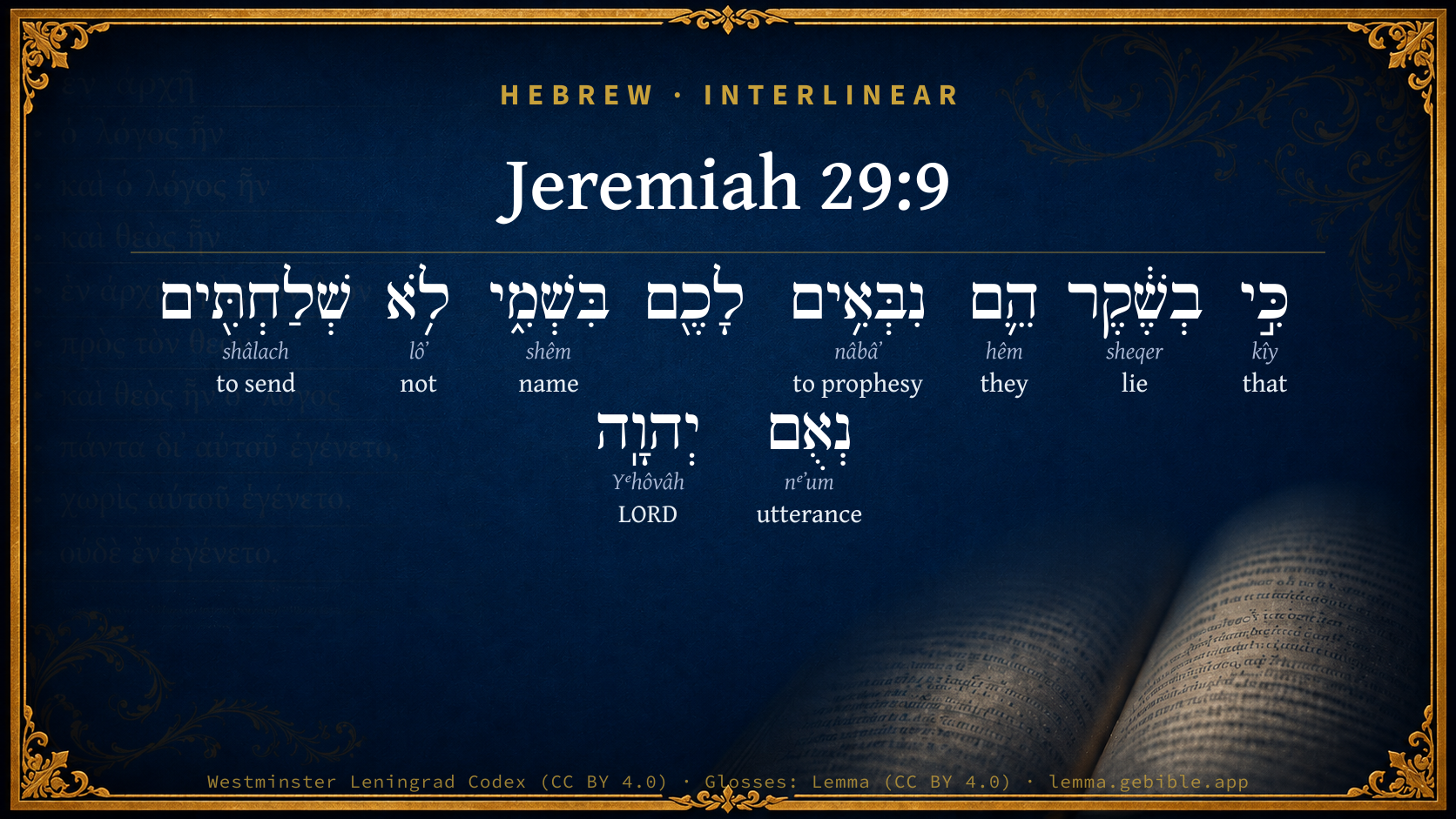
Jeremiah 29:9

Hebrew (Westminster Leningrad Codex) Jeremiah 29:9 appears in the Hebrew Old Testament. The text above is from the Westminster Leningrad Codex. Each word links to its Strong’s number, a concise gloss, and parsing drawn from the Open Scriptures Hebrew Bible morphology. Click any word for its full Brown-Driver-Briggs (BDB) entry.
Download image
Cite this verse

Jeremiah 29:9 (World English Bible). Public Domain. Lemma interlinear Bible study tool, https://lemma.gebible.app/v/jeremiah/29/9.

Show BibTeX & RIS
BibTeX
RIS
English Translation
For they prophesy falsely to you in my name: I have not sent them, says Yahweh.
World English Bible · Public Domain
Download a study sheet

One document with this verse’s original text, its word-by-word gloss line, the meaning frame, cross-references with their text, attributed commentary, and full source and license credits — printable, and it pastes into notes with its structure intact.

This verse Autodidact and up

Study sheet (.html) Plain text (.txt)

A passage Seminary Student

Up to 50 verses in one chapter. A passage sheet keeps up to 6 commentary sources and 12 cross-references per verse, in the order this page ranks them, and says so on the sheet whenever that leaves anything out. Ask for a single verse and you get the Autodidact verse sheet above.

Everything on this page stays free to read, with no account — the sheet is a download of what is already on screen, not access to it.

Want to remove ads? Support Godless Engineer
Compare translations 3

The same verse in 3 English versions, stacked beneath the original-language interlinear above. Click any original word for its lexicon entry.

Each is an independent rendering of the whole verse — the interlinear is not word-aligned to these translations.

Highlighted words mark where these versions differ — a whole-verse word diff, not a word-by-word alignment.

  • World English Bible Public Domain
    For they prophesy falsely to you in my name: I have not sent them, says Yahweh.
  • King James Version Public Domain
    For they prophesy falsely unto you in my name: I have not sent them, saith the LORD.
  • unfoldingWord Literal Text CC BY-SA 4.0
    For they are prophesying deceitfully to you in my name. I did not send them—this is Yahweh’s declaration.’

unfoldingWord Literal Text — © unfoldingWord, licensed CC BY-SA 4.0. Word-aligned USFM3 via Door43 (git.door43.org/unfoldingWord/en_ult).

Versions to compare (up to 4)

3 of 4 selected

Show all 18 translations

Every available English version of this verse, each an independent rendering of the whole verse.

  • World English Bible Public Domain
    For they prophesy falsely to you in my name: I have not sent them, says Yahweh.
  • Berean Standard Bible Public Domain
    For they are falsely prophesying to you in My name; I have not sent them, declares the LORD.”
  • Majority Standard Bible Public Domain
    For they are falsely prophesying to you in My name; I have not sent them, declares the LORD.”
  • King James Version Public Domain
    For they prophesy falsely unto you in my name: I have not sent them, saith the LORD.
  • American Standard Version (1901) Public Domain
    For they prophesy falsely unto you in my name: I have not sent them, saith Jehovah.
  • Revised Version (1885) Public Domain
    For they prophesy falsely unto you in my name: I have not sent them, saith the LORD.
  • Geneva Bible (1599) Public Domain
    For they prophecie you a lie in my Name: I haue not sent them, saith the Lord.
  • Douay-Rheims (1899) Public Domain
    For they prophesy falsely to you in my name: and I have not sent them, saith the Lord.
  • Young's Literal Translation Public Domain
    For with falsehood they are prophesying to you in My name; I have not sent them, an affirmation of Jehovah.
  • Literal Standard Version CC BY-SA 4.0
    for they are prophesying with falsehood to you in My Name; I have not sent them, a declaration of YHWH.
  • Unlocked Literal Bible CC BY-SA 4.0
    For they are prophesying deceitfully to you in my name. I did not send them—this is Yahweh's declaration.'
  • unfoldingWord Literal Text CC BY-SA 4.0
    For they are prophesying deceitfully to you in my name. I did not send them—this is Yahweh’s declaration.’
  • Darby Bible Public Domain
    For they prophesy falsely unto you in my name: I have not sent them, saith Jehovah.
  • World Messianic Bible Public Domain
    For they prophesy falsely to you in my name. I have not sent them,” says the LORD.
  • Webster's Bible Public Domain
    For they prophesy falsely to you in my name: I have not sent them, saith the LORD.
  • Free Bible Version CC BY-SA 4.0
    They are prophesying lies to you in my name; I have not sent them, declares the Lord.
  • Bible in Basic English Public Domain
    For they are saying to you what is false in my name: I have not sent them, says the Lord.
  • JPS Tanakh (1917) Public Domain
    For they prophesy falsely unto you in My name; I have not sent them, saith the LORD.

Literal Standard Version (2020), Covenant Press — licensed CC BY-SA 4.0. Text via the HelloAO Bible API (eBible.org). Unlocked Literal Bible (unfoldingWord) — licensed CC BY-SA 4.0. Text via the HelloAO Bible API (eBible.org). unfoldingWord Literal Text — © unfoldingWord, licensed CC BY-SA 4.0. Word-aligned USFM3 via Door43 (git.door43.org/unfoldingWord/en_ult). Free Bible Version, Dr. Jonathan Gallagher — licensed CC BY-SA 4.0. Text via the HelloAO Bible API (eBible.org).

Word by word

More ways to search: Search by grammar → Find every occurrence → Compare this word →

Practice this passage: Drill this verse → Learn its vocabulary →

בְשֶׁ֔קֶר
sheqer
H8267
“in/at · lie”
Preposition + Noun, Common, Masculine, Singular, Absolute
Part of Speech
Preposition + Noun
Type
Common
Gender
Masculine
Number
Singular
State
Absolute
Full BDB Definition

Origin: from H8266

TWOT: 2461a

lie, deception, disappointment, falsehood - deception (what deceives or disappoints or betrays one) - deceit, fraud, wrong - fraudulently, wrongfully (as adverb) - falsehood (injurious in testimony) - testify falsehood, false oath, swear falsely - falsity (of false or self-deceived prophets) - lie, falsehood (in general) - false tongue - in vain
  1. כִּ֣י kîy H3588 “that” Conjunction
  2. הֵ֛ם hêm H1992 “they” Pronoun, Personal, 3rd Person, Masculine, Plural
  3. נִבְּאִ֥ים nâbâʼ H5012 “prophesying” Verb, Niphal, Participle Active, Masculine, Plural, Absolute
  4. בִּשְׁמִ֑י shêm H8034 “in/at · name · my” Preposition + Noun, Common, Masculine, Singular, Construct + Suffix, Personal, 1st Person, Common, Singular
  5. לֹ֥א lôʼ H3808 “not” Particle, Negative
  6. שְׁלַחְתִּ֖ים shâlach H7971 “to send · them” Verb, Qal, Perfect, 1st Person, Common, Singular + Suffix, Personal, 3rd Person, Masculine, Plural
  7. נְאֻם nᵉʼum H5002 “utterance of” Noun, Common, Masculine, Singular, Construct
  8. יְהוָֽה Yᵉhôvâh H3068 “LORD” Noun, Proper

About this verse

These counts appear in no published source. They are computed here, from the morphology-tagged text and Lemma’s own curated glosses. What Lemma adds →

10
words
9
distinct lemmas
Prophets
section

Grammatical profile

  • 2 verbs
  • 4 nouns
  • 1 pronoun
  • 1 preposition
  • 1 conjunction
  • 1 particle

Verb forms

  • נִבְּאִ֥ים Niphal · Participle Active
  • שְׁלַחְתִּ֖ים Qal · Perfect

Cross-references

3

Topical passages linked to Jeremiah 29:9 in the Treasury of Scripture Knowledge — connected by theme and wording, ordered by reader-vote popularity; previews shown in the World English Bible.

  • Jeremiah 27:15 For I have not sent them, says Yahweh, but they prophesy falsely in my name; that I may drive you out, and that you may perish, you, and the prophets who prophesy to you.
  • Jeremiah 29:31 Send to all them of the captivity, saying, Thus says Yahweh concerning Shemaiah the Nehelamite: Because Shemaiah has prophesied to you, and I didn't send him, and he has caused you to trust in a lie;
  • Jeremiah 29:23 because they have worked folly in Israel, and have committed adultery with their neighbors' wives, and have spoken words in my name falsely, which I didn't command them; and I am he who knows, and am witness, says Yahweh.

Cross-references courtesy of OpenBible.info (CC BY 4.0).

Hebrew and Greek witnesses Masoretic Hebrew ↔ Greek Septuagint

The same verse in the two great witnesses to the Old Testament, shown verse-for-verse.

These are two independent witnesses, not word-aligned to each other, and the Septuagint is shown in lemma (dictionary) form.

Hebrew Jeremiah 29:9 Masoretic · Westminster Leningrad Codex

כִּ֣י בְשֶׁ֔קֶר הֵ֛ם נִבְּאִ֥ים לָכֶ֖ם בִּשְׁמִ֑י לֹ֥א שְׁלַחְתִּ֖ים נְאֻם יְהוָֽה

For they prophesy falsely to you in my name: I have not sent them, says Yahweh.

World English Bible · Public Domain

Greek LXX Structure differs

In the Septuagint, Jeremiah is about an eighth shorter than the Hebrew and arranges its material differently — the Oracles Against the Nations (Hebrew chapters 46–51) appear in the middle of the Greek book, after 25:13. Because the chapter and verse boundaries do not line up, a verse-for-verse comparison with the Hebrew is not shown.

A verse-for-verse comparison isn’t shown here because the chapters and verses don’t line up. Switch to the LXX edition with the MT / LXX toggle above to read the Greek directly.

Hebrew: Westminster Leningrad Codex (CC BY 4.0). Greek: Septuagint (public domain); English from a public-domain English Septuagint. How the Septuagint differs from the Hebrew →

Targum (Aramaic paraphrase)

1

The Targum is the ancient Jewish Aramaic paraphrase of the Hebrew Scriptures — an interpretive translation, not the Hebrew text itself. Onkelos (literal) and Pseudo-Jonathan (expansive) render the Torah, and Jonathan the Prophets. Coverage is partial: where no permissively-licensed English translation exists for a verse, only the Aramaic is shown. This is verse-level text, not a word-by-word alignment to the Hebrew.

  1. Targum Jonathan Prophets (Joshua–Malachi)
    אֲרֵי בְשִׁקְרָא אִינוּן מִתְנַבָּן לְכוֹן בִּשְׁמִי לָא שְׁלַחְתִּינוּן אֲמַר יְיָ:

    (no public-domain English translation for this verse)

    Targum Jonathan — Aramaic: “Mikraot Gedolot” (public domain). English: “Sefaria Community Translation” (CC0 1.0 (public-domain dedication)); “London "Chaldee Paraphrase," 1871” (public domain). Text via Sefaria.

Commentary

Notes on Jeremiah 29:9 from classic Christian and Jewish commentators (each source and its license shown beneath its notes). The classic Christian expositions comment on the surrounding passage and are grouped to its opening verse, so a note may address several verses; the Jewish commentaries on the Tanakh (Rashi and others) are per-verse, so they appear only where the commentator wrote on this verse.

Lemma curates 59 commentaries, every one of them public domain or Creative Commons licensed, each selected and text-cleaned for this edition rather than reprinted as found. About our sources →

Trapp's Complete Commentary

John Trapp

Jer 29:9 For they prophesy falsely unto you in my name: I have not sent them, saith the LORD.

Ver. 9. For they prophesy falsely.] As Jer 27:15; Jer 28:15.

John Trapp, A Commentary or Exposition upon All the Books of the Old and New Testament (1647–1656) — public domain. Text from a community e-Sword module.

John Calvin's Commentaries

He confirms what he had said by this reason, that they ran without being called, according to what we found in Jeremiah 23:21. He then repudiates these false prophets, for they spoke not from the mouth of God. But the difference was rendered very obscure and indistinct, when they pompously alleged the name of God and professed that they brought forward nothing but what they had learnt from him; yet as we have elsewhere said, no one can be deceived except willingly and knowingly; for God never leaves his faithful people destitute of the spirit of discernment, provided they offer themselves cordially and sincerely to be taught by his true and legitimate servants. And then the Jews ought to have examined all the doctrines and all the prophecies by the rule of the Law. But if the Law was difficult to be understood, they ought, as I have said, to have sought of God the spirit of wisdom and discernment.

Jeremiah then did not without reason reject whatever the false prophets boasted of, for the purpose of gaining the approbation and applause of the people; for they were not sent nor approved by God. So also at this day, every one who wishes to distinguish with certainty between various doctrines, by which the world is agitated, nay, shaken, can without difficulty attain his object, provided he offers himself as a scholar to Christ, and connects the Law and the Prophets with the Gospel, and makes use of this rule to prove all doctrines; and provided in the meantime he trusts not to his own acumen, but submits himself to God and seeks of him the spirit of judgment and discrimination. It ought also to be observed, that in the same way the false prophets can be abundantly exposed when we thus shew that they are not sent by God; and we further convince them of vanity, when we prove their doctrine to be inconsistent with the Law and the Gospel.

However this may be, this principle ought to be held, that none ought to be attended to, but those who can shew that they bring messages from God and are furnished with his word. We have said elsewhere, that in order that any one may be accounted as sent by God, it is necessary, first, that he should be rightly called, and secondly, that he should faithfully execute his office; for whosoever thrusts in himself without the command of God, though he may speak what is true and holy, he yet deserves not the name of a Prophet or teacher; and then vocation itself will not be sufficient, except there be faithfulness and integrity. But what Jeremiah mainly insists on here is, that those who promised the people a return in a short time did not speak from the mouth of God: They prophesy falsely, he says, in my name; how? Because I have not sent them. It follows —

John Calvin's Commentaries (1540-1563) — public domain. Text from the Calvin Translation Society English edition (1840s-50s) via the Christian Classics Ethereal Library (ccel.org). Calvin's coverage is partial (roughly two-thirds of the Bible); uncommented books and verses are honest gaps, never fabricated. The 19th-century editor's footnotes and remarks are omitted so the notes are faithfully Calvin's own voice.

John Gill's Exposition

For they prophesy falsely unto you in my name,.... They pretended to have the authority of God for what they said; that their prophecies and dreams were from him, and as such they delivered them in his name; though they were false ones; that they might be the better received by the people:

I have not sent them, saith the Lord; they had no mission or commission from the Lord, no warrant or authority from him; they set up themselves; and ran without being sent; and prophesied out of their own hearts what came into their heads, the fancies of their own brain, or the delusions of Satan, under whose power and influence they were; therefore sad must be the case of a people giving heed to such seducing spirits.

John Gill's Exposition of the Whole Bible (1746–1763) — public domain (CC PDM 1.0). Text via the HelloAO Bible API.

Lesson kit

Teaching starters — assembled from the data on this page, not authored interpretation. Every prompt links to the verse data it draws on. Edit before teaching.

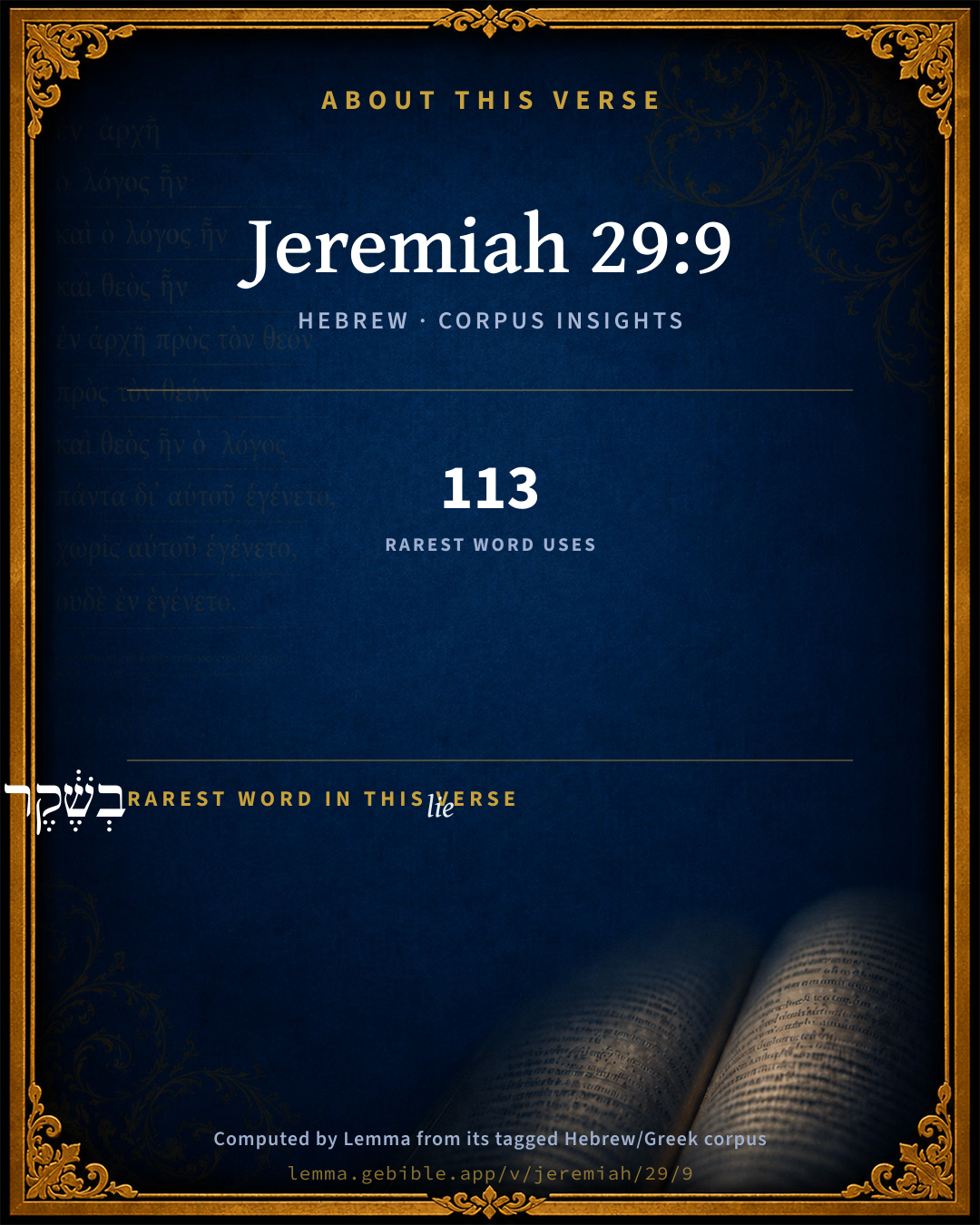
Jeremiah, in the Prophets, opens this verse with 10 words (9 distinct Hebrew lemmas). Its most distinctive word is sheqer (“lie”). A historical commentator’s framing appears above. Read the whole chapter for the surrounding context.

Discussion questions

  1. What does “lie” (sheqer) contribute to the verse as a whole?
  2. How does Jeremiah 27:15, which shares this passage’s theme, read alongside this verse?
  3. The translations on this page render this verse differently — a whole-verse word diff, not a word-by-word alignment. What might account for the different wordings?
  4. «נִבְּאִ֥ים» is a Niphal Participle Active verb. How does that grammatical form shape the action described?
  5. Compare how Trapp's Complete Commentary and John Calvin's Commentaries read this verse. Where do they agree or differ?

Things to notice

Reading settings

Reading text

Shown beneath each verse's original-language words.

Old Testament
Old Testament edition

Read the OT as the Masoretic Hebrew (MT) or the Greek Septuagint (LXX).

English shown for the Greek Septuagint (in the Hebrew ↔ Greek comparison).

Comparing translations? Open the Compare panel on any verse page to stack up to four side by side.