Jeremiah 3:10

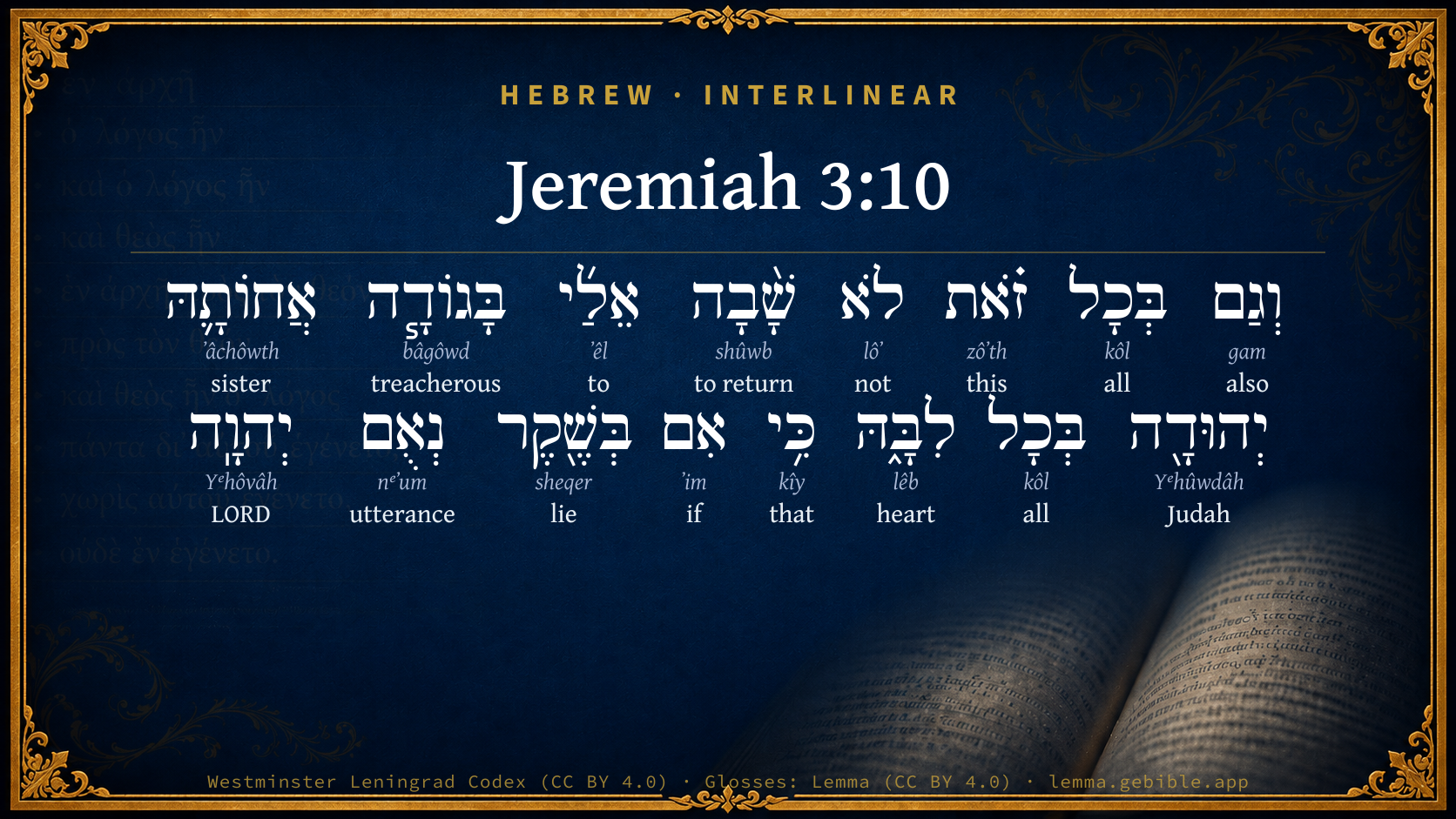
Hebrew (Westminster Leningrad Codex) Jeremiah 3:10 appears in the Hebrew Old Testament. The text above is from the Westminster Leningrad Codex. Each word links to its Strong’s number, a concise gloss, and parsing drawn from the Open Scriptures Hebrew Bible morphology. Click any word for its full Brown-Driver-Briggs (BDB) entry.
Download image
Cite this verse

Jeremiah 3:10 (World English Bible). Public Domain. Lemma interlinear Bible study tool, https://lemma.gebible.app/v/jeremiah/3/10.

Show BibTeX & RIS
BibTeX
RIS
English Translation
Yet for all this her treacherous sister Judah has not returned to me with her whole heart, but only in pretense, says Yahweh.
World English Bible · Public Domain
Download a study sheet

One document with this verse’s original text, its word-by-word gloss line, the meaning frame, cross-references with their text, attributed commentary, and full source and license credits — printable, and it pastes into notes with its structure intact.

This verse Autodidact and up

Study sheet (.html) Plain text (.txt)

A passage Seminary Student

Up to 50 verses in one chapter. A passage sheet keeps up to 6 commentary sources and 12 cross-references per verse, in the order this page ranks them, and says so on the sheet whenever that leaves anything out. Ask for a single verse and you get the Autodidact verse sheet above.

Everything on this page stays free to read, with no account — the sheet is a download of what is already on screen, not access to it.

Want to remove ads? Support Godless Engineer
Compare translations 3

The same verse in 3 English versions, stacked beneath the original-language interlinear above. Click any original word for its lexicon entry.

Each is an independent rendering of the whole verse — the interlinear is not word-aligned to these translations.

Highlighted words mark where these versions differ — a whole-verse word diff, not a word-by-word alignment.

  • World English Bible Public Domain
    Yet for all this her treacherous sister Judah has not returned to me with her whole heart, but only in pretense, says Yahweh.
  • King James Version Public Domain
    And yet for all this her treacherous sister Judah hath not turned unto me with her whole heart, but feignedly, saith the LORD.
  • unfoldingWord Literal Text CC BY-SA 4.0
    And even in all of this, her treacherous sister Judah has not returned to me with all her heart, but only in deceit—the declaration of Yahweh.”

unfoldingWord Literal Text — © unfoldingWord, licensed CC BY-SA 4.0. Word-aligned USFM3 via Door43 (git.door43.org/unfoldingWord/en_ult).

Versions to compare (up to 4)

3 of 4 selected

Show all 18 translations

Every available English version of this verse, each an independent rendering of the whole verse.

  • World English Bible Public Domain
    Yet for all this her treacherous sister Judah has not returned to me with her whole heart, but only in pretense, says Yahweh.
  • Berean Standard Bible Public Domain
    Yet in spite of all this, her unfaithful sister Judah did not return to Me with all her heart, but only in pretense,” declares the LORD.
  • Majority Standard Bible Public Domain
    Yet in spite of all this, her unfaithful sister Judah did not return to Me with all her heart, but only in pretense,” declares the LORD.
  • King James Version Public Domain
    And yet for all this her treacherous sister Judah hath not turned unto me with her whole heart, but feignedly, saith the LORD.
  • American Standard Version (1901) Public Domain
    And yet for all this her treacherous sister Judah hath not returned unto me with her whole heart, but feignedly, saith Jehovah.
  • Revised Version (1885) Public Domain
    And yet for all this her treacherous sister Judah hath not returned unto me with her whole heart, but feignedly, saith the LORD.
  • Geneva Bible (1599) Public Domain
    Neuerthelesse for all this, her rebellious sister Iudah hath not returned vnto mee with her whole heart, but fainedly, sayth the Lord.
  • Douay-Rheims (1899) Public Domain
    And after all this, her treacherous sister Juda hath not returned to me with her whole heart, but with falsehood, saith the Lord.
  • Young's Literal Translation Public Domain
    And even in all this her treacherous sister Judah hath not turned back unto Me with all her heart, but with falsehood, an affirmation of Jehovah.'
  • Literal Standard Version CC BY-SA 4.0
    And even in all this her treacherous sister Judah has not turned back to Me with all her heart, but with falsehood,” a declaration of YHWH.
  • Unlocked Literal Bible CC BY-SA 4.0
    Then after all of this, her faithless sister Judah returned to me, not with all her heart, but with a lie—this is Yahweh's declaration.”
  • unfoldingWord Literal Text CC BY-SA 4.0
    And even in all of this, her treacherous sister Judah has not returned to me with all her heart, but only in deceit—the declaration of Yahweh.”
  • Darby Bible Public Domain
    And even for all this her treacherous sister Judah hath not returned unto me with her whole heart, but with falsehood, saith Jehovah.
  • World Messianic Bible Public Domain
    Yet for all this her treacherous sister, Judah, has not returned to me with her whole heart, but only in pretense,” says the LORD.
  • Webster's Bible Public Domain
    And yet for all this her treacherous sister Judah hath not turned to me with her whole heart, but feignedly, saith the LORD.
  • Free Bible Version CC BY-SA 4.0
    Despite all this, her unfaithful sister Judah didn't come back to me in sincerity. She only pretended to do so, declares the Lord.
  • Bible in Basic English Public Domain
    But for all this, her false sister Judah has not come back to me with all her heart, but with deceit, says the Lord.
  • JPS Tanakh (1917) Public Domain
    and yet for all this her treacherous sister Judah hath not returned unto Me with her whole heart, but feignedly, saith the LORD —

Literal Standard Version (2020), Covenant Press — licensed CC BY-SA 4.0. Text via the HelloAO Bible API (eBible.org). Unlocked Literal Bible (unfoldingWord) — licensed CC BY-SA 4.0. Text via the HelloAO Bible API (eBible.org). unfoldingWord Literal Text — © unfoldingWord, licensed CC BY-SA 4.0. Word-aligned USFM3 via Door43 (git.door43.org/unfoldingWord/en_ult). Free Bible Version, Dr. Jonathan Gallagher — licensed CC BY-SA 4.0. Text via the HelloAO Bible API (eBible.org).

Word by word

More ways to search: Search by grammar → Find every occurrence → Compare this word →

Practice this passage: Drill this verse → Learn its vocabulary →

בָּגוֹדָ֧ה
bâgôwd
H901
“treacherous”
Adjective, Adjective, Feminine, Singular, Absolute
Part of Speech
Adjective
Type
Adjective
Gender
Feminine
Number
Singular
State
Absolute
Full BDB Definition

Origin: from H898

TWOT: 198c

treacherous, deceitful
  1. וְגַם gam H1571 “and · also” Conjunction + Particle, Accusative
  2. בְּכָל kôl H3605 “in/at · all of” Preposition + Noun, Common, Masculine, Singular, Construct
  3. זֹ֗את zôʼth H2063 “this” Pronoun, Demonstrative, Feminine, Singular
  4. לֹא lôʼ H3808 “not” Particle, Negative
  5. שָׁ֨בָה shûwb H7725 “to return” Verb, Qal, Perfect, 3rd Person, Feminine, Singular
  6. אֵלַ֜י ʼêl H413 “to · me” Preposition + Suffix, Personal, 1st Person, Common, Singular
  7. אֲחוֹתָ֛הּ ʼâchôwth H269 “sister · her” Noun, Common, Feminine, Singular, Construct + Suffix, Personal, 3rd Person, Feminine, Singular
  8. יְהוּדָ֖ה Yᵉhûwdâh H3063 “Judah” Noun, Proper
  9. בְּכָל kôl H3605 “in/at · all of” Preposition + Noun, Common, Masculine, Singular, Construct
  10. לִבָּ֑הּ lêb H3820 “heart · her” Noun, Common, Masculine, Singular, Construct + Suffix, Personal, 3rd Person, Feminine, Singular
  11. כִּ֥י kîy H3588 “that” Conjunction
  12. אִם ʼim H518 “if” Conjunction
  13. בְּשֶׁ֖קֶר sheqer H8267 “in/at · lie” Preposition + Noun, Common, Masculine, Singular, Absolute
  14. נְאֻם nᵉʼum H5002 “utterance of” Noun, Common, Masculine, Singular, Construct
  15. יְהוָֽה Yᵉhôvâh H3068 “LORD” Noun, Proper

About this verse

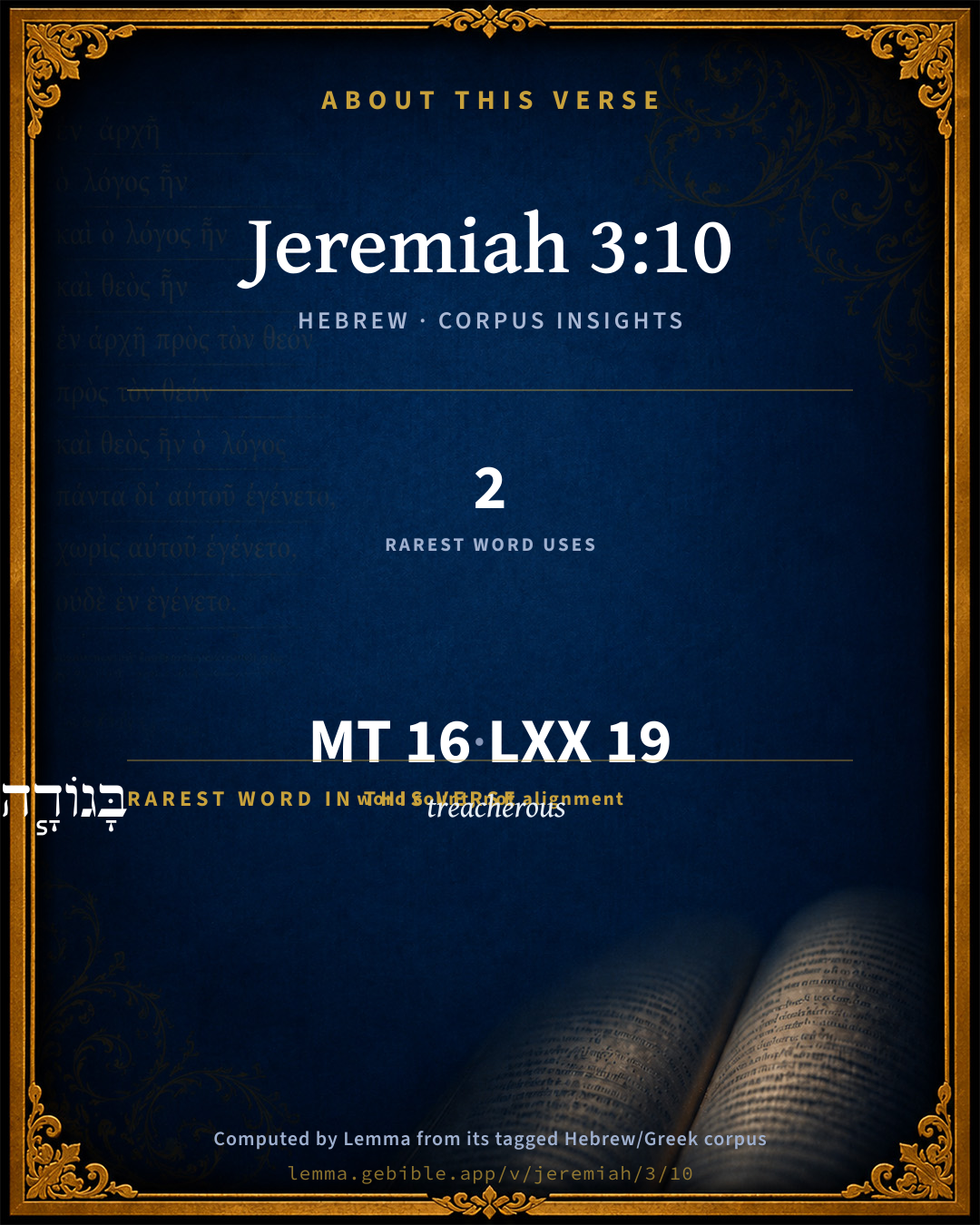
These counts appear in no published source. They are computed here, from the morphology-tagged text and Lemma’s own curated glosses. What Lemma adds →

16
words
15
distinct lemmas
Prophets
section

Notable vocabulary

The rarest word here is בָּגוֹדָ֧ה treacherous H901 — appearing just 2 times in the whole Hebrew Bible.

Shared distinctive vocabulary

בָּגוֹדָ֧ה treacherous H901 occurs in 2 verses of the Hebrew Bible. Also found in:

Grammatical profile

  • 1 verb
  • 8 nouns
  • 1 adjective
  • 1 pronoun
  • 1 preposition
  • 2 conjunctions
  • 2 particles

Verb forms

  • שָׁ֨בָה Qal · Perfect

Repetition

A word recurs within this verse — often emphatic in Hebrew:

  • בְּכָל all H3605 ×2

Hebrew & Septuagint length

In the original languages it is 16 Hebrew tokens and 19 Greek tokens — but the two are counted differently (Hebrew bundles its prefixes and suffixes into one token; the Greek is in lemma form), so that isn’t a like-for-like length.

Cross-references

7

Topical passages linked to Jeremiah 3:10 in the Treasury of Scripture Knowledge — connected by theme and wording, ordered by reader-vote popularity; previews shown in the World English Bible.

  • Hosea 7:14 They haven't cried to me with their heart, But they howl on their beds. They assemble themselves for grain and new wine. They turn away from me.
  • Jeremiah 12:2 You have planted them, yes, they have taken root; they grow, yes, they bring forth fruit: you are near in their mouth, and far from their heart.
  • 2 Chronicles 34:33–35:18 Josiah took away all the abominations out of all the countries that pertained to the children of Israel, and made all who were found in Israel to serve, even to serve Yahweh their God. All his days they didn't depart from following Yahweh, the God of their fathers.
  • Psalms 18:44 As soon as they hear of me they shall obey me. The foreigners shall submit themselves to me.
  • Psalms 66:3 Tell God, "How awesome are your deeds! Through the greatness of your power, your enemies submit themselves to you.
  • Psalms 78:36–37 But they flattered him with their mouth, And lied to him with their tongue.
  • Isaiah 10:6 I will send him against a profane nation, and against the people of my wrath will I give him a charge, to take the spoil, and to take the prey, and to tread them down like the mire of the streets.

Cross-references courtesy of OpenBible.info (CC BY 4.0).

Hebrew and Greek witnesses Masoretic Hebrew ↔ Greek Septuagint

The same verse in the two great witnesses to the Old Testament, shown verse-for-verse.

These are two independent witnesses, not word-aligned to each other, and the Septuagint is shown in lemma (dictionary) form.

Hebrew Jeremiah 3:10 Masoretic · Westminster Leningrad Codex

וְגַם בְּכָל זֹ֗את לֹא שָׁ֨בָה אֵלַ֜י בָּגוֹדָ֧ה אֲחוֹתָ֛הּ יְהוּדָ֖ה בְּכָל לִבָּ֑הּ כִּ֥י אִם בְּשֶׁ֖קֶר נְאֻם יְהוָֽה

Yet for all this her treacherous sister Judah has not returned to me with her whole heart, but only in pretense, says Yahweh.

World English Bible · Public Domain

Greek LXX Structure differs

In the Septuagint, Jeremiah is about an eighth shorter than the Hebrew and arranges its material differently — the Oracles Against the Nations (Hebrew chapters 46–51) appear in the middle of the Greek book, after 25:13. Because the chapter and verse boundaries do not line up, a verse-for-verse comparison with the Hebrew is not shown.

A verse-for-verse comparison isn’t shown here because the chapters and verses don’t line up. Switch to the LXX edition with the MT / LXX toggle above to read the Greek directly.

Hebrew: Westminster Leningrad Codex (CC BY 4.0). Greek: Septuagint (public domain); English from a public-domain English Septuagint. How the Septuagint differs from the Hebrew →

Targum (Aramaic paraphrase)

1

The Targum is the ancient Jewish Aramaic paraphrase of the Hebrew Scriptures — an interpretive translation, not the Hebrew text itself. Onkelos (literal) and Pseudo-Jonathan (expansive) render the Torah, and Jonathan the Prophets. Coverage is partial: where no permissively-licensed English translation exists for a verse, only the Aramaic is shown. This is verse-level text, not a word-by-word alignment to the Hebrew.

  1. Targum Jonathan Prophets (Joshua–Malachi)
    וְאַף בְּכָל דָא לָא תָבוּ לְפוּלְחָנִי מִשִׁקְרַיָא אֲחֵיהוֹן דְבֵית יְהוּדָה בְּכָל לִבְּהוֹן אֱלָהֵין בְּשִׁקְרָא אֲמַר יְיָ:

    (no public-domain English translation for this verse)

    Targum Jonathan — Aramaic: “Mikraot Gedolot” (public domain). English: “Sefaria Community Translation” (CC0 1.0 (public-domain dedication)); “London "Chaldee Paraphrase," 1871” (public domain). Text via Sefaria.

Commentary

Notes on Jeremiah 3:10 from classic Christian and Jewish commentators (each source and its license shown beneath its notes). The classic Christian expositions comment on the surrounding passage and are grouped to its opening verse, so a note may address several verses; the Jewish commentaries on the Tanakh (Rashi and others) are per-verse, so they appear only where the commentator wrote on this verse.

Lemma curates 59 commentaries, every one of them public domain or Creative Commons licensed, each selected and text-cleaned for this edition rather than reprinted as found. About our sources →

Trapp's Complete Commentary

John Trapp

Jer 3:10 And yet for all this her treacherous sister Judah hath not turned unto me with her whole heart, but feignedly, saith the LORD.

Ver. 10. Hath not turned unto me with her whole heart.] Josiah did, but the people did not, as soon appeared, when in the next king’s reign they fell off as fast as leaves do in autumn. And so they did here, when Queen Mary set up Popery.

John Trapp, A Commentary or Exposition upon All the Books of the Old and New Testament (1647–1656) — public domain. Text from a community e-Sword module.

Albert Barnes' Notes on the Bible

Her treacherous sister Judith - These words are a sort of refrain, thrice Jer 3:7-8, Jer 3:10 repeated before God finally pronounces Judah more culpable than Israel.

Albert Barnes' Notes on the Bible (1834–1885) — public domain. Text from a community e-Sword/MySword module.

Whedon's Commentary on the Bible

Daniel D. Whedon

10. Treacherous sister Judah — Mark the solemn iteration of this accusing phrase in Jer_3:7-8; Jer_3:10-11.

Feignedly — Such language as this makes us know that the reformation of Josiah, remarkable and impressive as it was, was not of that radical character which the case demanded. And so we understand how it was that the destruction of the city so soon followed the most splendid religious pageant Jerusalem ever witnessed. 2 Chronicles 35.

Daniel D. Whedon (gen. ed.), Commentary on the Old and New Testaments (1874–1909) — public domain. Text from a community e-Sword module.

Tyndale Open Study Notes

Tyndale Open Resources

3:10 Like the northern tribes of Israel, the people of Judah did not see anything immoral about idol worship; they treated the Lord’s objections lightly. The people did not really repent, but pretended to do so under the pressure of Josiah’s authority (2 Chr 34:32). Their religion was tainted with deception (Jer 12:2; Hos 7:14).

Tyndale Open Study Notes — © Tyndale Open Resources, licensed CC BY-SA 4.0. Text via the HelloAO Bible API.

Geneva Bible (1599)

Geneva Bible translators

Judah feigned for a time that she did return, as under Josiah and other good kings, but she was never truly touched, or wholly reformed, as appeared when occasion was offered by any wicked prince.

Geneva Bible (1599) marginal notes — public domain. Text via Bolls.life.

Jamieson, Fausset & Brown

Robert Jamieson, A. R. Fausset & David Brown

yet--notwithstanding the lesson given in Israel's case of the fatal results of apostasy.

not . . . whole heart--The reformation in the eighteenth year of Josiah was not thorough on the part of the people, for at his death they relapsed into idolatry (Ch2 34:33; Hos 7:14).

Jamieson, Fausset & Brown — Commentary Critical and Explanatory on the Whole Bible (1871) — public domain (CC PDM 1.0). Text via the HelloAO Bible API.

John Calvin's Commentaries

He goes on with the same subject, — that the Jews were not moved by any fear when they saw the dreadful vengeance executed on their brethren on account of their sins. Her perfidious sister, he says, returned not to me, that is, after so many warnings by the prophets and such an example of punishment. He however adds an explanation, — she turned not with her whole heart, but feignedly and falsely.

The Prophet anticipates here such objections as the Jews might have alleged, “What! thou deniest that we have returned! Is not the whole land cleansed from idolatries? Is not God worshipped according to the requirements of the law? Is there any more an altar seen under the shades of trees or on hills?” As then they might have thus evaded the charge as they usually did, the Prophet obviates such an evasion and says, “Though they have ill appearance given some tokens of repentance, yet they have only put on a disguise and have acted falsely towards God; for there is no integrity in them.” We now more clearly see why he had before specifically mentioned the time of Josiah; for the Jews then returned feignedly to God: there was in the king and in a few a right feeling, but in the rest dissimulation only. God then in a few words shews, that he cares not for that reformation which is false and feigned, but that he requires a genuine feeling within: hence he thus concludes —

John Calvin's Commentaries (1540-1563) — public domain. Text from the Calvin Translation Society English edition (1840s-50s) via the Christian Classics Ethereal Library (ccel.org). Calvin's coverage is partial (roughly two-thirds of the Bible); uncommented books and verses are honest gaps, never fabricated. The 19th-century editor's footnotes and remarks are omitted so the notes are faithfully Calvin's own voice.

Ellicott's Commentary for English Readers

(10) And yet for all this . . .—Judah was so far worse than Israel that there had been a simulated repentance, as in the reformations under Hezekiah and Josiah, but it was not with the whole heart and soul, but “feignedly,” or, more literally, with a lie.

A Bible Commentary for English Readers, edited by Charles John Ellicott (1878–1897) — public domain. Text from a community e-Sword module.

John Gill's Exposition

And yet for all this,.... Though the two tribes saw the lightness and filthiness of the sin Israel was guilty of, and how the land was defiled with it, the stupidity of it, and the punishment inflicted on account of it:

her treacherous sister Judah hath not turned unto me with her whole heart, but feignedly, saith the Lord; there was a show of reformation in Josiah's time, but it was but a show; there was no true, hearty cordial repentance for the sin of idolatry, only a feigned one; there was an outward removal of it, and reformation from it, but inwardly the desires of the heart were to it; the good king, with some few others, were hearty in it, but the greater part played the hypocrite; the following reigns proved the truth of this.

John Gill's Exposition of the Whole Bible (1746–1763) — public domain (CC PDM 1.0). Text via the HelloAO Bible API.

Haydock's Catholic Bible Commentary

Falsehood. Their reform was only apparent, under Joas, &c. (Calmet)

George Leo Haydock (1774–1849), Haydock's Catholic Family Bible and Commentary, 1859 edition — public domain. Excludes Psalms (Douay-Rheims chapter numbering differs from Protestant) and Deuterocanonical books (Catholic canon only).

Matthew Poole's English Annotations

Though God saw what she did, and though she saw the shameful idolatry of Israel, and what she had suffered, yet she was not warned; see Jer 3:8; but fell to idolatry under Manasseh, who undid what Hezekiah had done, 2Ch 33:3, though under fair pretences she dissembled with God in the days of Josiah, 2Ch 34:32,33, as appeared by her sudden revolt, viz. in less than three months after Josiah’s death, 2Ki 23:31,32.

Matthew Poole's English Annotations on the Holy Bible (1683–1685) — public domain. Text from a community e-Sword/MySword module.

The Pulpit Commentary

For all this; i.e. though Judah had seen the punishment of apostate Israel. (Jer_3:7, Jer_3:8) So Rashi, Naegelsbach, Payne Smith. Most commentators suppose the phrase to refer to Judah"s obstinate wickedness (ver. 9), but this gives a weak sense. "Judah defiled the land, etc., and yet notwithstanding her repentance was insincere this is by no means a natural sequence of ideas. The right exposition increases the probability of the correction proposed at the beginning of ver. 8.

Insincere repentances.

I REPENTANCE IS INSINCERE WHEN IT DOES NOT POSSESS THE WHOLE HEART. Judah is accused of being "false," and of turning to Jehovah "feignedly," because she did not turn "with her whole heart.

1. True repentance must be found in the heart. Mere confession with the lip without a change of feeling is a mockery. (Isa_29:13) Simple amendment of external conduct is no repentance unless it is prompted by a sincere desire to do better, by a return to the love of goodness.

2. True repentance must possess the whole heart. It is not consistent with a lingering affection for sin. The penitent must not look back regretfully, like Lot"s wife, on the pleasant things he is renouncing. Repentance must be for sin, not for certain sins selected from the rest for condemnation; it means the desire to abandon all wickedness. People sometimes repent insincerely by confessing and abandoning trifling faults, while they cling to greater evils. A right repentance searches the dark depths of the soul and brings forth old buried sins, forgotten but not yet forgiven, darling bosom sins which have grown into the very life and can only be torn out from a bleeding heart, common sins which are classed among a man"s habits and which he excuses to himself as being "his ways." Such repentance is no superficial emotion, no sentiment of the hour stirred in the church only to be forgotten as soon as a man re-enters his worldly associations. It must be thorough, profound, overwhelming. Yet it is not to be measured by the number of tears shed, but by its practical fruits, the solid proofs of a desire for a better life. (Luk_3:8-14)

II INSINCERE REPENTANCE CANNOT BE ACCEPTED BY GOD.

1. Such repentance is inexcusable. Judah had failed to profit by the solemn lessons of her sister"s sin and ruin. In face of such terrible warnings, how foolish to cling still to the old life even while pretending to turn from it!

2. Such repentance is only self-deceiving. The hypocrite would deceive God, but failing to do this he deceives himself. He is the dupe of his own design. For he imagines that his fraud will serve him some good purpose, whereas it is detected by God and frustrated from the first.

3. Such repentance is useless. Judah gains no deliverance by her feigned repentance. God is Spirit, and can only be approached in spirit. (Joh_4:24) Any other pretended return to him is no return. We do not come to God by simply entering a church, nor please him by the mechanical observance of an external service. (Isa_1:11-15) The insincere repentance is a double mistake, its trouble is all wasted, its tears all shed to no purpose, and the falsehood of it is a new offence increasing guilt before God. To turn to God only with the lip is thus not merely not to turn to him at all, it is to wander still further from him. Let us beware, therefore, of using the familiar language of confession if we are not really desiring to renounce sin and be reconciled to God. Let repentance, of all things, be true and whole-hearted.

The Pulpit Commentary (1880–1919), ed. H.D.M. Spence-Jones & Joseph S. Exell — public domain. Text from a community e-Sword module.

John Wesley's Explanatory Notes

And yet - Though God saw what she did, and though she saw the shameful idolatry of Israel, and what she had suffered.

John Wesley, Explanatory Notes Upon the Whole Bible (1754–1765) — public domain. Text via the GEBible commentary corpus.

Rashi

Rabbi Shlomo Yitzchaki (Rashi)

And yet for all this that they saw the misfortune of the retribution of their companions.

but falsely Josiah’s generation would show themselves as righteous although they were wicked. They would make forms of pagan deities on the inside of their doors, half on this door and half on this one, and when the destroyers of idols would inspect, the door would be open, and they would not notice it.

Rashi on the Tanakh — English translations: “The Judaica Press complete Tanach with Rashi, translated by A. J. Rosenberg” (CC BY 4.0); “Pentateuch with Rashi's commentary by M. Rosenbaum and A.M. Silbermann, 1929-1934” (public domain); “The Metsudah Tanach series, Lakewood, N.J” (CC BY 4.0); and “The Book of Joshua, Metsudah Publications, 1997” (CC BY 4.0). Text via Sefaria.

Lesson kit

Teaching starters — assembled from the data on this page, not authored interpretation. Every prompt links to the verse data it draws on. Edit before teaching.

Jeremiah, in the Prophets, opens this verse with 16 words (15 distinct Hebrew lemmas). Its most distinctive word is bâgôwd (“treacherous”). A historical commentator’s framing appears above. Read the whole chapter for the surrounding context.

Discussion questions

  1. What does “treacherous” (bâgôwd) contribute to the verse as a whole?
  2. How does Jeremiah 3:7, which shares the word «treacherous», read alongside this verse?
  3. What does the repetition of “all” (2× in this one verse) do in this verse?
  4. These translations render this verse differently; the difference is in the English rendering, not the original. What questions does that raise?
  5. «שָׁ֨בָה» is a Qal Perfect verb. How does that grammatical form shape the action described?
  6. Compare how Trapp's Complete Commentary and Albert Barnes' Notes on the Bible read this verse. Where do they agree or differ?

Things to notice

Reading settings

Reading text

Shown beneath each verse's original-language words.

Old Testament
Old Testament edition

Read the OT as the Masoretic Hebrew (MT) or the Greek Septuagint (LXX).

English shown for the Greek Septuagint (in the Hebrew ↔ Greek comparison).

Comparing translations? Open the Compare panel on any verse page to stack up to four side by side.