
Jeremiah 5:2

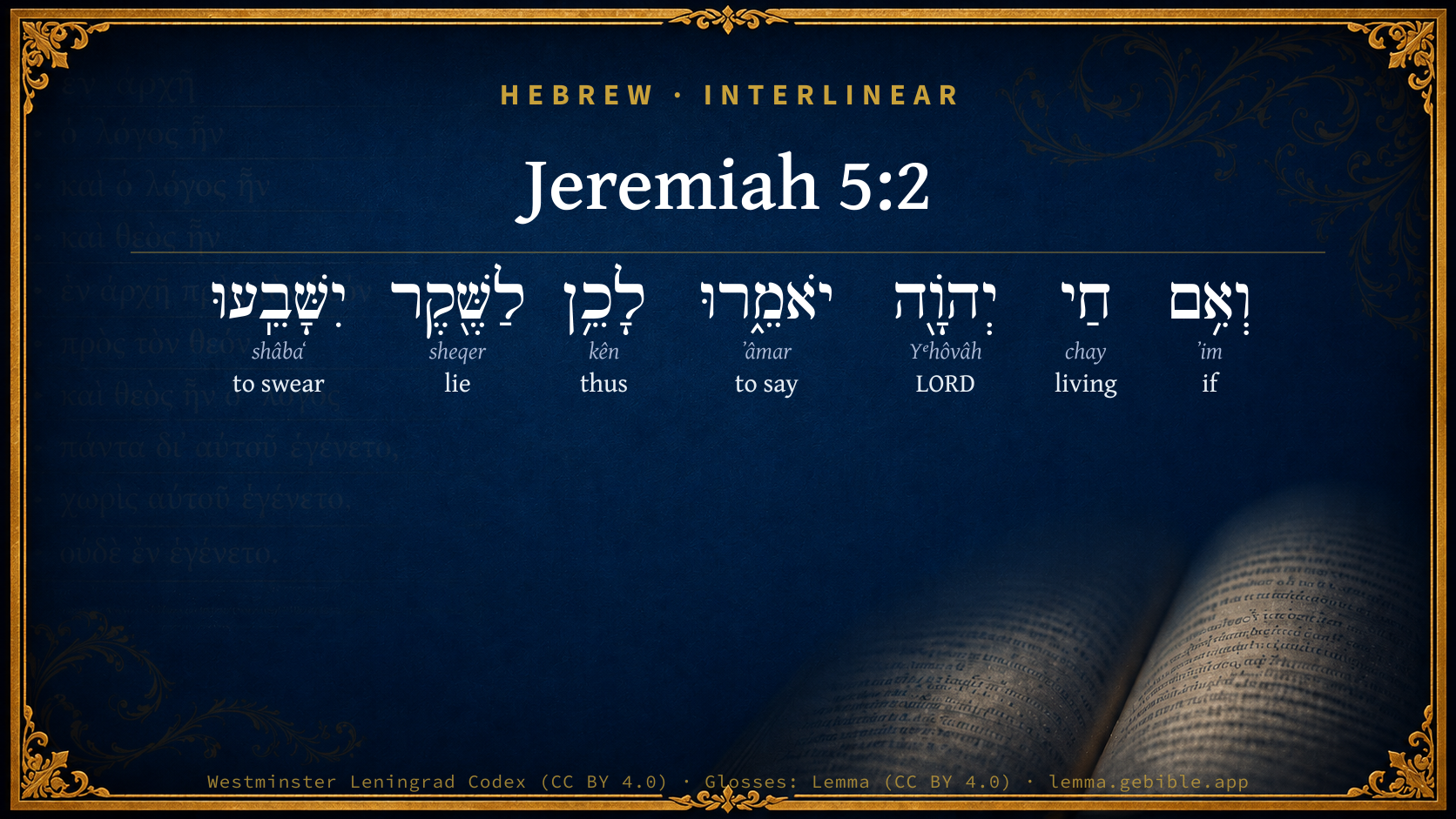
Hebrew (Westminster Leningrad Codex) Jeremiah 5:2 appears in the Hebrew Old Testament. The text above is from the Westminster Leningrad Codex. Each word links to its Strong’s number, a concise gloss, and parsing drawn from the Open Scriptures Hebrew Bible morphology. Click any word for its full Brown-Driver-Briggs (BDB) entry.
Download image
Cite this verse

Jeremiah 5:2 (World English Bible). Public Domain. Lemma interlinear Bible study tool, https://lemma.gebible.app/v/jeremiah/5/2.

Show BibTeX & RIS
BibTeX
RIS
English Translation
Though they say, As Yahweh lives; surely they swear falsely.
World English Bible · Public Domain
Download a study sheet

One document with this verse’s original text, its word-by-word gloss line, the meaning frame, cross-references with their text, attributed commentary, and full source and license credits — printable, and it pastes into notes with its structure intact.

This verse Autodidact and up

Study sheet (.html) Plain text (.txt)

A passage Seminary Student

Up to 50 verses in one chapter. A passage sheet keeps up to 6 commentary sources and 12 cross-references per verse, in the order this page ranks them, and says so on the sheet whenever that leaves anything out. Ask for a single verse and you get the Autodidact verse sheet above.

Everything on this page stays free to read, with no account — the sheet is a download of what is already on screen, not access to it.

Want to remove ads? Support Godless Engineer
Compare translations 3

The same verse in 3 English versions, stacked beneath the original-language interlinear above. Click any original word for its lexicon entry.

Each is an independent rendering of the whole verse — the interlinear is not word-aligned to these translations.

Highlighted words mark where these versions differ — a whole-verse word diff, not a word-by-word alignment.

  • World English Bible Public Domain
    Though they say, As Yahweh lives; surely they swear falsely.
  • King James Version Public Domain
    And though they say, The LORD liveth; surely they swear falsely.
  • unfoldingWord Literal Text CC BY-SA 4.0
    And if they say, ‘ Yahweh alive,’ surely they swear falsely.” ts\*

unfoldingWord Literal Text — © unfoldingWord, licensed CC BY-SA 4.0. Word-aligned USFM3 via Door43 (git.door43.org/unfoldingWord/en_ult).

Versions to compare (up to 4)

3 of 4 selected

Show all 18 translations

Every available English version of this verse, each an independent rendering of the whole verse.

  • World English Bible Public Domain
    Though they say, As Yahweh lives; surely they swear falsely.
  • Berean Standard Bible Public Domain
    Although they say, ‘As surely as the LORD lives,’ they are swearing falsely.”
  • Majority Standard Bible Public Domain
    Although they say, ‘As surely as the LORD lives,’ they are swearing falsely.”
  • King James Version Public Domain
    And though they say, The LORD liveth; surely they swear falsely.
  • American Standard Version (1901) Public Domain
    And though they say, As Jehovah liveth; surely they swear falsely.
  • Revised Version (1885) Public Domain
    And though they say, As the LORD liveth; surely they swear falsely.
  • Geneva Bible (1599) Public Domain
    For though they say, The Lord liueth, yet doe they sweare falsely.
  • Douay-Rheims (1899) Public Domain
    And though they say: The Lord liveth; this also they will swear falsely.
  • Young's Literal Translation Public Domain
    And if they say, `Jehovah liveth,' Surely to a falsehood they swear.
  • Literal Standard Version CC BY-SA 4.0
    And if they say, YHWH lives, || Surely they swear to a falsehood.”
  • Unlocked Literal Bible CC BY-SA 4.0
    Although they say, 'As Yahweh lives,' yet they are swearing falsely.”
  • unfoldingWord Literal Text CC BY-SA 4.0
    And if they say, ‘ Yahweh alive,’ surely they swear falsely.” ts\*
  • Darby Bible Public Domain
    And if they say, [As] Jehovah liveth! surely they swear falsely.
  • World Messianic Bible Public Domain
    Though they say, ‘As the LORD lives,’ surely they swear falsely.”
  • Webster's Bible Public Domain
    And though they say, The LORD liveth; surely they swear falsely.
  • Free Bible Version CC BY-SA 4.0
    They may make promises in my name, but they're not sincere.
  • Bible in Basic English Public Domain
    And though they say, By the living Lord; truly their oaths are false.
  • JPS Tanakh (1917) Public Domain
    And though they say: 'As the LORD liveth', surely they swear falsely.

Literal Standard Version (2020), Covenant Press — licensed CC BY-SA 4.0. Text via the HelloAO Bible API (eBible.org). Unlocked Literal Bible (unfoldingWord) — licensed CC BY-SA 4.0. Text via the HelloAO Bible API (eBible.org). unfoldingWord Literal Text — © unfoldingWord, licensed CC BY-SA 4.0. Word-aligned USFM3 via Door43 (git.door43.org/unfoldingWord/en_ult). Free Bible Version, Dr. Jonathan Gallagher — licensed CC BY-SA 4.0. Text via the HelloAO Bible API (eBible.org).

Word by word

More ways to search: Search by grammar → Find every occurrence → Compare this word →

Practice this passage: Drill this verse → Learn its vocabulary →

לַשֶּׁ֖קֶר
sheqer
H8267
“to/for the · lie”
Preposition, Determined + Noun, Common, Masculine, Singular, Absolute
Part of Speech
Preposition + Noun
Type
Common
Gender
Masculine
Number
Singular
State
Absolute
Full BDB Definition

Origin: from H8266

TWOT: 2461a

lie, deception, disappointment, falsehood - deception (what deceives or disappoints or betrays one) - deceit, fraud, wrong - fraudulently, wrongfully (as adverb) - falsehood (injurious in testimony) - testify falsehood, false oath, swear falsely - falsity (of false or self-deceived prophets) - lie, falsehood (in general) - false tongue - in vain
  1. וְאִ֥ם ʼim H518 “and · if” Conjunction + Conjunction
  2. חַי chay H2416 “living” Adjective, Adjective, Masculine, Singular, Absolute
  3. יְהֹוָ֖ה Yᵉhôvâh H3068 “LORD” Noun, Proper
  4. יֹאמֵ֑רוּ ʼâmar H559 “to say” Verb, Qal, Imperfect, 3rd Person, Masculine, Plural
  5. לָכֵ֥ן kên H3651 “to/for · thus” Preposition + Adverb
  6. יִשָּׁבֵֽעוּ shâbaʻ H7650 “to swear” Verb, Niphal, Imperfect, 3rd Person, Masculine, Plural

About this verse

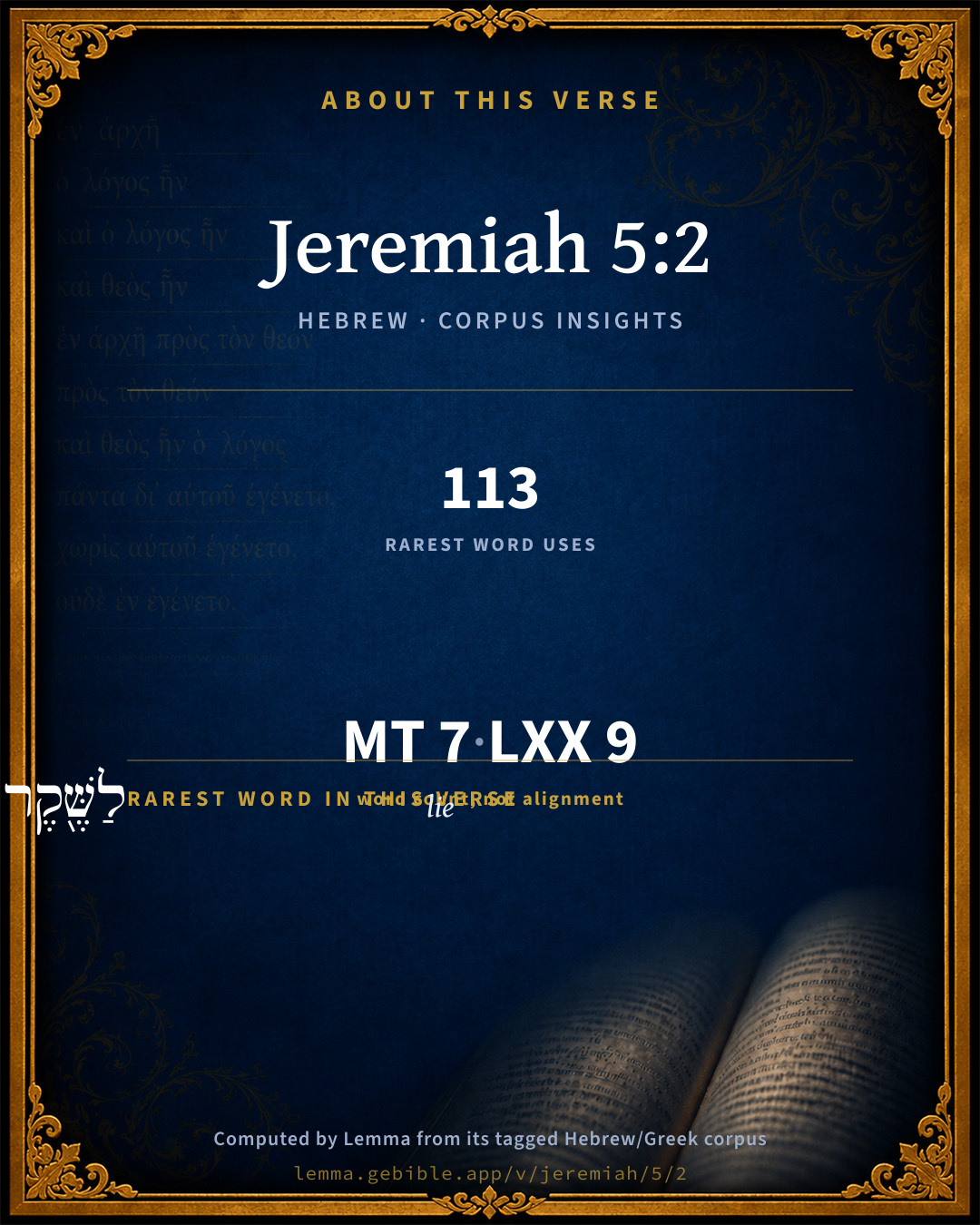
These counts appear in no published source. They are computed here, from the morphology-tagged text and Lemma’s own curated glosses. What Lemma adds →

7
words
7
distinct lemmas
Prophets
section

Grammatical profile

  • 2 verbs
  • 2 nouns
  • 1 adjective
  • 1 conjunction
  • 1 adverb

Verb forms

  • יֹאמֵ֑רוּ Qal · Imperfect
  • יִשָּׁבֵֽעוּ Niphal · Imperfect

Hebrew & Septuagint length

In the original languages it is 7 Hebrew tokens and 9 Greek tokens — but the two are counted differently (Hebrew bundles its prefixes and suffixes into one token; the Greek is in lemma form), so that isn’t a like-for-like length.

Cross-references

12

Topical passages linked to Jeremiah 5:2 in the Treasury of Scripture Knowledge — connected by theme and wording, ordered by reader-vote popularity; previews shown in the World English Bible.

  • Titus 1:16 They profess that they know God, but by their works they deny him, being abominable, disobedient, and unfit for any good work.
  • Jeremiah 4:2 and you shall swear, As Yahweh lives, in truth, in justice, and in righteousness; and the nations shall bless themselves in him, and in him shall they glory.
  • Leviticus 19:12 "'You shall not swear by my name falsely, and profane the name of your God. I am Yahweh.
  • Isaiah 48:1 Hear you this, house of Jacob, who are called by the name of Israel, and are come forth out of the waters of Judah; who swear by the name of Yahweh, and make mention of the God of Israel, but not in truth, nor in righteousness
  • Jeremiah 7:9 Will you steal, murder, and commit adultery, and swear falsely, and burn incense to Baal, and walk after other gods that you have not known,
  • Hosea 4:1–2 Hear the word of Yahweh, you children of Israel; For Yahweh has a charge against the inhabitants of the land: "Indeed there is no truth, Nor goodness, Nor knowledge of God in the land.
  • Hosea 10:4 They make promises, swearing falsely in making covenants. Therefore judgment springs up like poisonous weeds in the furrows of the field.
  • 2 Timothy 3:5 holding a form of godliness, but having denied the power thereof. Turn away from these, also.
  • Hosea 4:15 "Though you, Israel, play the prostitute, Yet don't let Judah offend; And don't come to Gilgal, Neither go up to Beth Aven, Nor swear, 'As Yahweh lives.'
  • Zechariah 5:3–4 Then he said to me, "This is the curse that goes out over the surface of the whole land; for everyone who steals shall be cut off according to it on the one side; and everyone who swears falsely shall be cut off according to it on the other side.
  • Malachi 3:5 I will come near to you to judgment; and I will be a swift witness against the sorcerers, and against the adulterers, and against the perjurers, and against those who oppress the hireling in his wages, the widow, and the fatherless, and who deprive the foreigner of justice, and don't fear me," says Yahweh of Hosts.
  • 1 Timothy 1:10 for the sexually immoral, for homosexuals, for slave-traders, for liars, for perjurers, and for any other thing contrary to the sound doctrine;

Cross-references courtesy of OpenBible.info (CC BY 4.0).

Hebrew and Greek witnesses Masoretic Hebrew ↔ Greek Septuagint

The same verse in the two great witnesses to the Old Testament, shown verse-for-verse.

These are two independent witnesses, not word-aligned to each other, and the Septuagint is shown in lemma (dictionary) form.

Hebrew Jeremiah 5:2 Masoretic · Westminster Leningrad Codex

וְאִ֥ם חַי יְהֹוָ֖ה יֹאמֵ֑רוּ לָכֵ֥ן לַשֶּׁ֖קֶר יִשָּׁבֵֽעוּ

Though they say, As Yahweh lives; surely they swear falsely.

World English Bible · Public Domain

Greek LXX Structure differs

In the Septuagint, Jeremiah is about an eighth shorter than the Hebrew and arranges its material differently — the Oracles Against the Nations (Hebrew chapters 46–51) appear in the middle of the Greek book, after 25:13. Because the chapter and verse boundaries do not line up, a verse-for-verse comparison with the Hebrew is not shown.

A verse-for-verse comparison isn’t shown here because the chapters and verses don’t line up. Switch to the LXX edition with the MT / LXX toggle above to read the Greek directly.

Hebrew: Westminster Leningrad Codex (CC BY 4.0). Greek: Septuagint (public domain); English from a public-domain English Septuagint. How the Septuagint differs from the Hebrew →

Targum (Aramaic paraphrase)

1

The Targum is the ancient Jewish Aramaic paraphrase of the Hebrew Scriptures — an interpretive translation, not the Hebrew text itself. Onkelos (literal) and Pseudo-Jonathan (expansive) render the Torah, and Jonathan the Prophets. Coverage is partial: where no permissively-licensed English translation exists for a verse, only the Aramaic is shown. This is verse-level text, not a word-by-word alignment to the Hebrew.

  1. Targum Jonathan Prophets (Joshua–Malachi)
    וְאִם בִּשְׁמָא דַייָ יָמָן בְּכֵן לְשִׁקְרָא אִינוּן מִשְׁתַּבְּעִין:

    (no public-domain English translation for this verse)

    Targum Jonathan — Aramaic: “Mikraot Gedolot” (public domain). English: “Sefaria Community Translation” (CC0 1.0 (public-domain dedication)); “London "Chaldee Paraphrase," 1871” (public domain). Text via Sefaria.

Commentary

Notes on Jeremiah 5:2 from classic Christian and Jewish commentators (each source and its license shown beneath its notes). The classic Christian expositions comment on the surrounding passage and are grouped to its opening verse, so a note may address several verses; the Jewish commentaries on the Tanakh (Rashi and others) are per-verse, so they appear only where the commentator wrote on this verse.

Lemma curates 59 commentaries, every one of them public domain or Creative Commons licensed, each selected and text-cleaned for this edition rather than reprinted as found. About our sources →

Trapp's Complete Commentary

John Trapp

Jer 5:2 And though they say, The LORD liveth; surely they swear falsely.

Ver. 2. And though they say, The Lord liveth,] i.e., Albeit they talk religiously, as those pretenders also did, {Isa 66:5} and make a great flaunt, as if some great matter, with Simon Magus, {Act 8:9} yet they are arrant hypocrites, and therefore odious to me who desire "truth in the inward parts." {Psa 51:6} These neither "say the truth," nor "do" it. {1Jn 3:10}

John Trapp, A Commentary or Exposition upon All the Books of the Old and New Testament (1647–1656) — public domain. Text from a community e-Sword module.

Matthew Poole's English Annotations

Though they say, The Lord liveth; though when they swear, they use the form of an oath, and say, The

Lord liveth, Jer 5:2, or, By the living God. By swearing here we may understand all their service of God, by a synecdoche, swearing being a part of God’s worship. Surely they swear falsely; yet, or therefore, they swear falsely; either they swear to that which is false; or if to that which is true, they are so perfidious to me, that they do it deceitfully, not in sincerity, and in reverence to that holy name by which they swear: possibly they may often speak of God, and not swear by false gods, Jer 5:7, but it is all but hypocrisy and deceit, Isa 48:1; Jer 12:2; 42:5,20; 2Ti 3:5. It is neither in truth nor righteousness, two of the principal qualifications of a lawful oath. Thus they prostitute the name of God, making themselves guilty, not of hypocrisy only, but sacrilege.

Matthew Poole's English Annotations on the Holy Bible (1683–1685) — public domain. Text from a community e-Sword/MySword module.

Joseph Benson's Commentary

Jer 5:2. And though they say, The Lord liveth, &c. — Though, when they swear, they use the common form of an oath, and say, The Lord liveth, or, as the Lord liveth, or, by the living God. Surely, or rather, nevertheless, they swear falsely — That is, either, 1st, They are not sincere in the profession they make of respect to God, but are false to him; they honour him with their lips, but their hearts are far from him, nor have they any proper conviction or sense that he lives and sees them, Gen 16:13-14. Or, 2d, Though they appeal to God only, they make no conscience of calling him to witness a lie: though they do not swear by idols, they forswear themselves, which is no less an affront to Jehovah, as the God of truth, than the other is to him, as the only true God.

Joseph Benson's Commentary on the Old and New Testaments (1811–1818) — public domain. Text from a community e-Sword module.

Geneva Bible (1599)

Geneva Bible translators

Though they pretend religion and holiness, yet all is but hypocrisy: for under this kind of swearing is contained the true religion.

Geneva Bible (1599) marginal notes — public domain. Text via Bolls.life.

Jamieson, Fausset & Brown

Robert Jamieson, A. R. Fausset & David Brown

(Tit 1:16).

swear falsely--not a judicial oath; but their profession of the worship of Jehovah is insincere (Jer 5:7; Jer 4:2). The reformation under Josiah was merely superficial in the case of the majority.

Jamieson, Fausset & Brown — Commentary Critical and Explanatory on the Whole Bible (1871) — public domain (CC PDM 1.0). Text via the HelloAO Bible API.

Adam Clarke's Commentary

Verse 2. The Lord liveth] Though they profess to bind themselves by Jehovah, as if they acknowledged him their God and only Lord, yet they swore falsely; for not believing in him, they took a false oath; one by which they did not believe themselves bound, not acknowledging him as their Lord. See on Jer 4:2.

Adam Clarke's Commentary on the Bible (1810–1826) — public domain. Text from a community e-Sword/MySword module.

John Calvin's Commentaries

This is added by way of anticipation; for the Jews, as it is well known, thought that they had a cover for all their vices, inasmuch as they had God’s name continually in their mouths. Since then they professed to worship the God of Abraham, they thought that this pretext was sufficient to cover all their wickedness. The Prophet obviates this objection, and shews that this disguise was of no avail, because in thus using God’s name, they profaned it: and he goes still further; for he shews that the Jews, not only in common practice, were wholly destitute of the fear of God, but that when anything of a religious kind appeared among them, it was sacrilegious; and this is far worse than when God’s name is forgotten, and wretched men allow themselves a full license in sinning, as though they could not conceal their wickedness: for when they openly provoke God, and as it were dishonor him to his face, how detestable and how monstrous is their impiety! This then is what Jeremiah sets forth, Though they say, Live does Jehovah, yet in this they swear falsely

We now perceive the Prophet’s meaning: In the first place, he takes away from hypocrites their vain confidence in thinking that God would be propitious to them, provided they avowed his name, without considering how precious God’s name is, but regarding it as nothing to swear carelessly by his name: but the Prophet not only condemns the hypocrisy of the Jews, but, as I have said, he enhances their wickedness; for they hesitated not to profane God’s sacred name, and to carry on, as it were, an open war with him, by abusing his name in swearing.

By mentioning, Live does Jehovah, he refers to the words which the godly also use when they make an oath; for when they appeal to the living God, it is the same thing as though they stood before his tribunal; and at the same time said, that they knew that though God may defer his vengeance, yet an account must be given, because he ever lives. Thus the godly acknowledge that there is nothing gained by delay, in case God suspends his vengeance, if they swear falsely. But the Prophet, as I have already said, applies this to hypocrites, who seemed to ascribe great honor to God, for nothing is more specious than their words: gall indeed was in their heart, while honey was on their lips. Hence the Prophet derides this false pretense, and says, “Even when they swear most solemnly as to the words used, and shew a high concern for religion, nevertheless they swear falsely.” Some render לכן, lacen, surely, or certainly; but the meaning will be plainer, if we render it “nevertheless.” It follows —

John Calvin's Commentaries (1540-1563) — public domain. Text from the Calvin Translation Society English edition (1840s-50s) via the Christian Classics Ethereal Library (ccel.org). Calvin's coverage is partial (roughly two-thirds of the Bible); uncommented books and verses are honest gaps, never fabricated. The 19th-century editor's footnotes and remarks are omitted so the notes are faithfully Calvin's own voice.

Ellicott's Commentary for English Readers

(2) The Lord liveth.—The words imply that a distinction between the binding powers of different formulæ of adjuration, like that of the later scribes (Mat_23:16), was already in some degree prevalent. The guilt of the men of Jerusalem was that they took the most solemn formula of all, “Jehovah liveth,” and yet were guilty of perjury. In Jer_5:7 we find traces of the practice of swearing by other gods, with which this “oath of Jehovah” is apparently contrasted.

Falsely.—Literally, upon falsehood.

A Bible Commentary for English Readers, edited by Charles John Ellicott (1878–1897) — public domain. Text from a community e-Sword module.

The Cambridge Bible for Schools and Colleges

gen. ed. J. J. S. Perowne

2. Though, as professed servants of Jehovah, they take the most solemn form of oath, yet they use it to give weight to a lie. Cp. Isa_48:1.

surely] This rendering is obtained by the change of one letter in MT., which has “therefore” in defiance of the sense.

The Cambridge Bible for Schools and Colleges (gen. ed. J. J. S. Perowne; Cambridge University Press, 1878–1918) — public domain. Text from a community e-Sword module.

John Gill's Exposition

And though they say, the Lord liveth,.... It might be said, that there were multitudes that made mention of the name of the Lord, that professed it, and swore by it; which sometimes is put for the worship and service of God, Deu 10:20 and therefore it could not be so difficult a matter to find a man of integrity and uprightness among them; this is answered by allowing there were persons that did do so: but then it must be observed,

that surely they swear falsely; they abused the name of God, and were guilty of perjury: or the sense is, they were only nominal professors, hypocritical worshippers; in words professed to know God, but in works denied him; had a form of religion and godliness, but without the power of it.

John Gill's Exposition of the Whole Bible (1746–1763) — public domain (CC PDM 1.0). Text via the HelloAO Bible API.

Albert Barnes' Notes on the Bible

Though they take the most binding form of oath, they do so only as a means of deceiving others.

Albert Barnes' Notes on the Bible (1834–1885) — public domain. Text from a community e-Sword/MySword module.

Haydock's Catholic Bible Commentary

Falsely. Some may confess my name. But they swear falsely, chap. iv. 2. (Calmet) --- Unless the requisite conditions be observed, an oath is unlawful. (Worthington)

George Leo Haydock (1774–1849), Haydock's Catholic Family Bible and Commentary, 1859 edition — public domain. Excludes Psalms (Douay-Rheims chapter numbering differs from Protestant) and Deuterocanonical books (Catholic canon only).

Whedon's Commentary on the Bible

Daniel D. Whedon

2. Falsely — Implying an outward confession of Jehovah, but combining with it spiritual hypocrisy, falling in perfectly with the intimations which came in other ways, that these were times of outward rather than inward religion.

Daniel D. Whedon (gen. ed.), Commentary on the Old and New Testaments (1874–1909) — public domain. Text from a community e-Sword module.

The Pulpit Commentary

And though they say, The Lord liveth. Though they asseverate by the most solemn of all oaths. (contrast Jer_4:1, Jer_4:2) Surely. So the Syriac. This rendering, however, involves an emendation of one letter in the text. The ordinary reading is literally therefore, but may etymologically be taken to mean "for all this," "nevertheless."

The Pulpit Commentary (1880–1919), ed. H.D.M. Spence-Jones & Joseph S. Exell — public domain. Text from a community e-Sword module.

John Wesley's Explanatory Notes

Though - Though when they swear, they use the form of an oath, and say, the Lord liveth, or by the living God: yet it is neither in truth nor righteousness.

John Wesley, Explanatory Notes Upon the Whole Bible (1754–1765) — public domain. Text via the GEBible commentary corpus.

Lesson kit

Teaching starters — assembled from the data on this page, not authored interpretation. Every prompt links to the verse data it draws on. Edit before teaching.

Jeremiah, in the Prophets, opens this verse with 7 words (7 distinct Hebrew lemmas). Its most distinctive word is sheqer (“lie”). A historical commentator’s framing appears above. Read the whole chapter for the surrounding context.

Discussion questions

  1. How does “lie” (sheqer) shape what this verse is saying?
  2. Titus 1:16 shares this passage’s theme. How do the two illuminate each other?
  3. These translations render this verse differently; the difference is in the English rendering, not the original. What questions does that raise?
  4. The verb «יֹאמֵ֑רוּ» is Qal Imperfect. How does its form color the action?
  5. Reading how Trapp's Complete Commentary and Matthew Poole's English Annotations read this verse, where do the two commentators agree and where do they part?

Things to notice

Reading settings

Reading text

Shown beneath each verse's original-language words.

Old Testament
Old Testament edition

Read the OT as the Masoretic Hebrew (MT) or the Greek Septuagint (LXX).

English shown for the Greek Septuagint (in the Hebrew ↔ Greek comparison).

Comparing translations? Open the Compare panel on any verse page to stack up to four side by side.