
Jeremiah 7:8

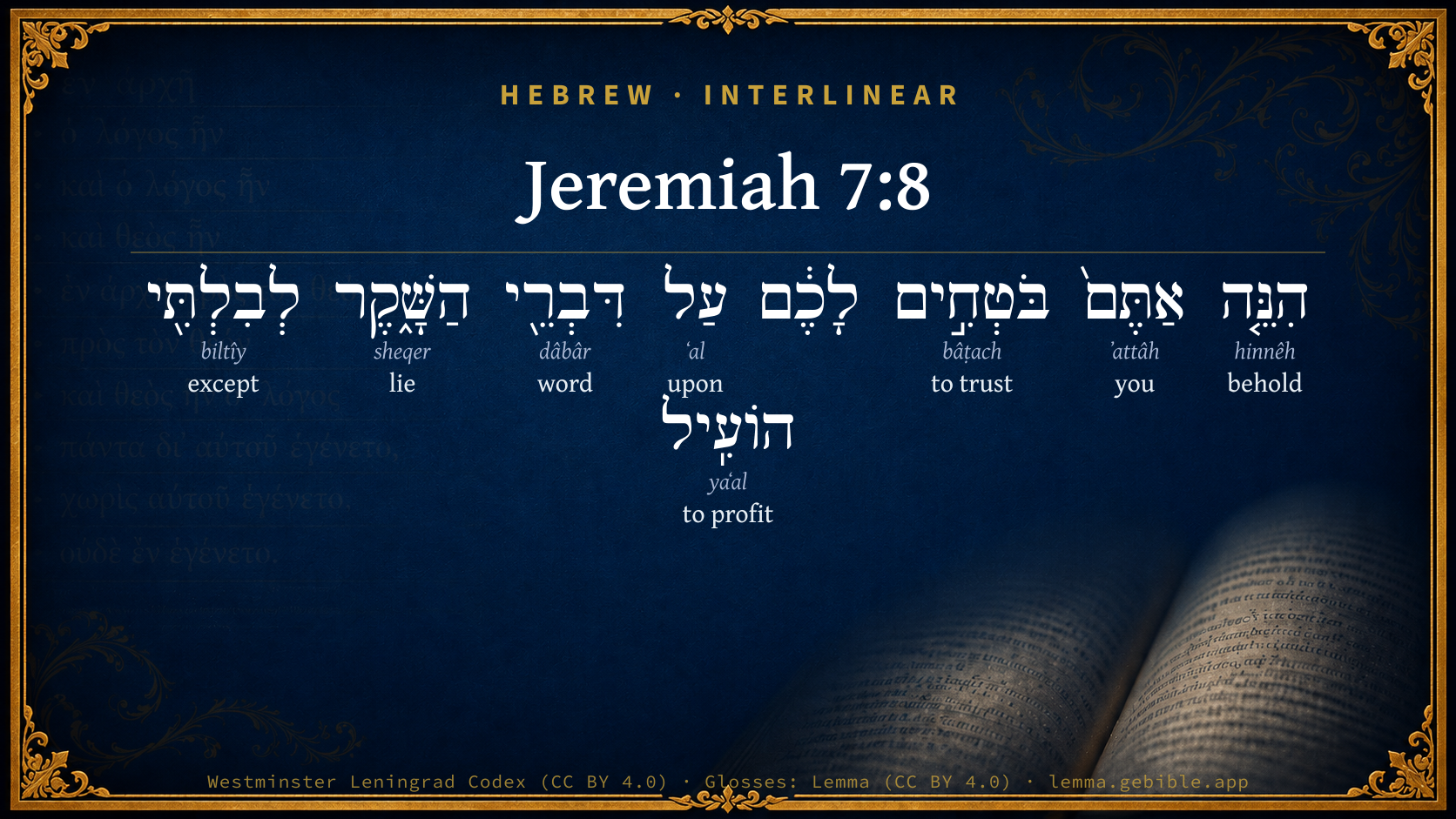
Hebrew (Westminster Leningrad Codex) Jeremiah 7:8 appears in the Hebrew Old Testament. The text above is from the Westminster Leningrad Codex. Each word links to its Strong’s number, a concise gloss, and parsing drawn from the Open Scriptures Hebrew Bible morphology. Click any word for its full Brown-Driver-Briggs (BDB) entry.
Download image
Cite this verse

Jeremiah 7:8 (World English Bible). Public Domain. Lemma interlinear Bible study tool, https://lemma.gebible.app/v/jeremiah/7/8.

Show BibTeX & RIS
BibTeX
RIS
English Translation
Behold, you trust in lying words, that can't profit.
World English Bible · Public Domain
Download a study sheet

One document with this verse’s original text, its word-by-word gloss line, the meaning frame, cross-references with their text, attributed commentary, and full source and license credits — printable, and it pastes into notes with its structure intact.

This verse Autodidact and up

Study sheet (.html) Plain text (.txt)

A passage Seminary Student

Up to 50 verses in one chapter. A passage sheet keeps up to 6 commentary sources and 12 cross-references per verse, in the order this page ranks them, and says so on the sheet whenever that leaves anything out. Ask for a single verse and you get the Autodidact verse sheet above.

Everything on this page stays free to read, with no account — the sheet is a download of what is already on screen, not access to it.

Want to remove ads? Support Godless Engineer
Compare translations 3

The same verse in 3 English versions, stacked beneath the original-language interlinear above. Click any original word for its lexicon entry.

Each is an independent rendering of the whole verse — the interlinear is not word-aligned to these translations.

Highlighted words mark where these versions differ — a whole-verse word diff, not a word-by-word alignment.

  • World English Bible Public Domain
    Behold, you trust in lying words, that can't profit.
  • King James Version Public Domain
    Behold, ye trust in lying words, that cannot profit.
  • unfoldingWord Literal Text CC BY-SA 4.0
    Behold! You trust for yourself in words of deceit to no benefit.

unfoldingWord Literal Text — © unfoldingWord, licensed CC BY-SA 4.0. Word-aligned USFM3 via Door43 (git.door43.org/unfoldingWord/en_ult).

Versions to compare (up to 4)

3 of 4 selected

Show all 18 translations

Every available English version of this verse, each an independent rendering of the whole verse.

  • World English Bible Public Domain
    Behold, you trust in lying words, that can't profit.
  • Berean Standard Bible Public Domain
    But look, you keep trusting in deceptive words to no avail.
  • Majority Standard Bible Public Domain
    But look, you keep trusting in deceptive words to no avail.
  • King James Version Public Domain
    Behold, ye trust in lying words, that cannot profit.
  • American Standard Version (1901) Public Domain
    Behold, ye trust in lying words, that cannot profit.
  • Revised Version (1885) Public Domain
    Behold, ye trust in lying words, that cannot profit.
  • Geneva Bible (1599) Public Domain
    Beholde, you trust in lying woordes, that can not profite.
  • Douay-Rheims (1899) Public Domain
    Behold you put your trust in lying words, which shall not profit you:
  • Young's Literal Translation Public Domain
    Lo, ye are trusting for yourselves On the words of falsehood, so as not to profit.
  • Literal Standard Version CC BY-SA 4.0
    Behold, you are trusting for yourselves || On the words of falsehood, so as not to profit.
  • Unlocked Literal Bible CC BY-SA 4.0
    Behold! You are trusting in deceitful words that do not help you.
  • unfoldingWord Literal Text CC BY-SA 4.0
    Behold! You trust for yourself in words of deceit to no benefit.
  • Darby Bible Public Domain
    Behold, ye confide in words of falsehood that cannot profit.
  • World Messianic Bible Public Domain
    Behold, you trust in lying words that can’t profit.
  • Webster's Bible Public Domain
    Behold, ye trust in lying words, that cannot profit.
  • Free Bible Version CC BY-SA 4.0
    But look at you! You go on believing in these deceptions, these worthless words.
  • Bible in Basic English Public Domain
    See, you put your faith in false words which are of no profit.
  • JPS Tanakh (1917) Public Domain
    Behold, ye trust in lying words, that cannot profit.

Literal Standard Version (2020), Covenant Press — licensed CC BY-SA 4.0. Text via the HelloAO Bible API (eBible.org). Unlocked Literal Bible (unfoldingWord) — licensed CC BY-SA 4.0. Text via the HelloAO Bible API (eBible.org). unfoldingWord Literal Text — © unfoldingWord, licensed CC BY-SA 4.0. Word-aligned USFM3 via Door43 (git.door43.org/unfoldingWord/en_ult). Free Bible Version, Dr. Jonathan Gallagher — licensed CC BY-SA 4.0. Text via the HelloAO Bible API (eBible.org).

Word by word

More ways to search: Search by grammar → Find every occurrence → Compare this word →

Practice this passage: Drill this verse → Learn its vocabulary →

About this verse

These counts appear in no published source. They are computed here, from the morphology-tagged text and Lemma’s own curated glosses. What Lemma adds →

9
words
8
distinct lemmas
Prophets
section

Notable vocabulary

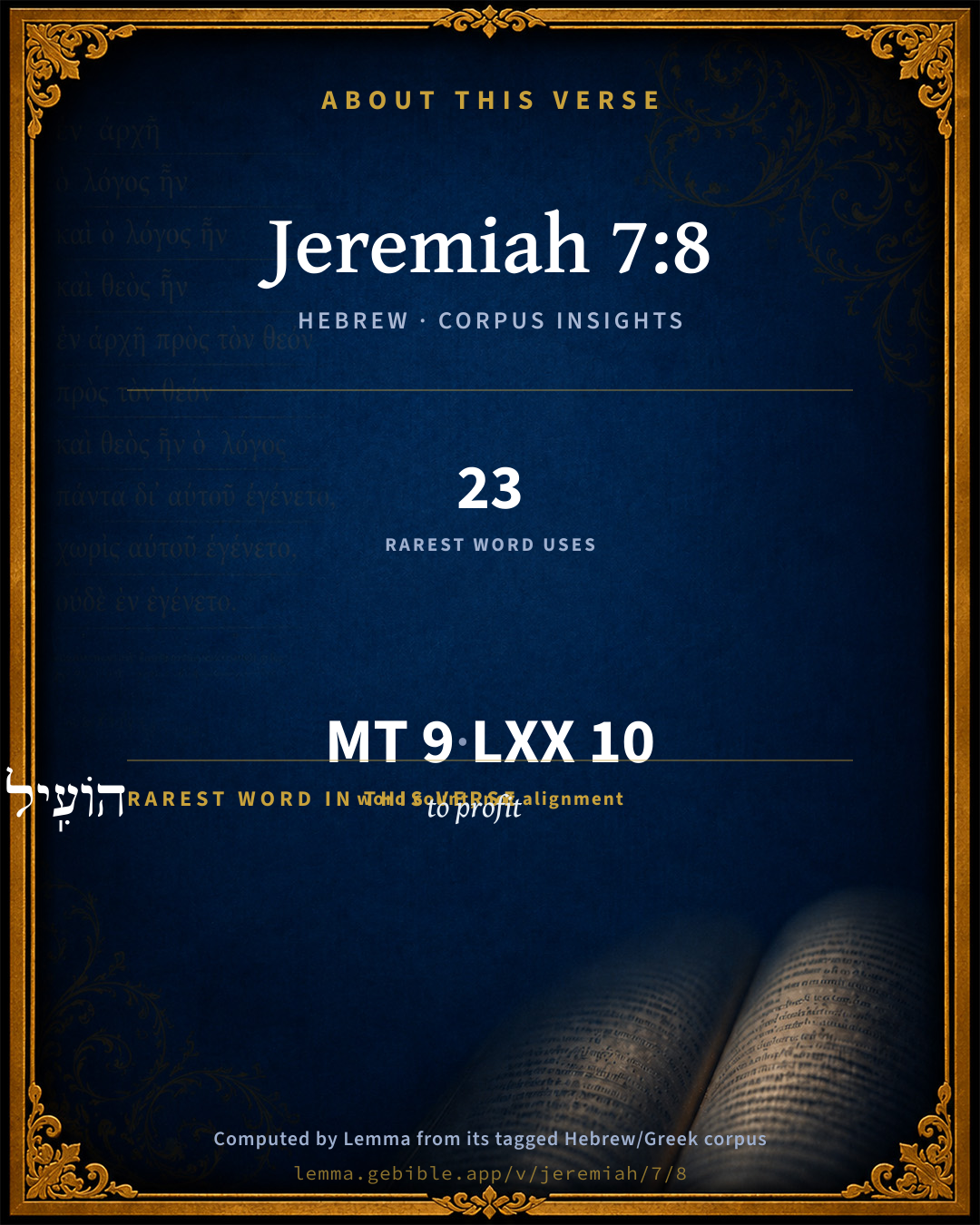
The rarest word here is הוֹעִֽיל to profit H3276 — appearing just 23 times in the whole Hebrew Bible.

Shared distinctive vocabulary

הוֹעִֽיל to profit H3276 occurs in 21 verses of the Hebrew Bible. Also found in:

Grammatical profile

  • 2 verbs
  • 2 nouns
  • 1 pronoun
  • 2 prepositions
  • 1 conjunction
  • 1 particle

Verb forms

  • בֹּטְחִ֣ים Qal · Participle Active
  • הוֹעִֽיל Hiphil · Infinitive Construct

Hebrew & Septuagint length

In the original languages it is 9 Hebrew tokens and 10 Greek tokens — but the two are counted differently (Hebrew bundles its prefixes and suffixes into one token; the Greek is in lemma form), so that isn’t a like-for-like length.

Cross-references

11

Topical passages linked to Jeremiah 7:8 in the Treasury of Scripture Knowledge — connected by theme and wording, ordered by reader-vote popularity; previews shown in the World English Bible.

  • Isaiah 28:15 Because you have said, We have made a covenant with death, and with Sheol are we at agreement; when the overflowing scourge shall pass through, it shall not come to us; for we have made lies our refuge, and under falsehood have we hid ourselves:
  • Isaiah 30:10 who tell the seers, "Don't see;" and to the prophets, "Don't prophesy to us right things, speak to us smooth things, prophesy deceits,
  • Jeremiah 4:10 Then said I, Ah, Lord Yahweh! surely you have greatly deceived this people and Jerusalem, saying, You shall have peace; whereas the sword reaches to the life.
  • Jeremiah 5:31 the prophets prophesy falsely, and the priests bear rule by their means; and my people love to have it so: and what will you do in the end of it?
  • Jeremiah 7:4 Don't you trust in lying words, saying, The temple of Yahweh, the temple of Yahweh, the temple of Yahweh, are these.
  • Jeremiah 8:10 Therefore will I give their wives to others, and their fields to those who shall possess them: for everyone from the least even to the greatest is given to covetousness; from the prophet even to the priest every one deals falsely.
  • Jeremiah 14:13–14 Then said I, Ah, Lord Yahweh! behold, the prophets tell them, You shall not see the sword, neither shall you have famine; but I will give you assured peace in this place.
  • Jeremiah 23:14–16 In the prophets of Jerusalem also I have seen a horrible thing: they commit adultery, and walk in lies; and they strengthen the hands of evil-doers, so that none does return from his wickedness: they are all of them become to me as Sodom, and the inhabitants of it as Gomorrah.
  • Jeremiah 23:26 How long shall this be in the heart of the prophets who prophesy lies, even the prophets of the deceit of their own heart?
  • Jeremiah 23:32 Behold, I am against those who prophesy lying dreams, says Yahweh, and do tell them, and cause my people to err by their lies, and by their vain boasting: yet I didn't send them, nor commanded them; neither do they profit this people at all, says Yahweh.
  • Ezekiel 13:6–16 They have seen falsehood and lying divination, who say, Yahweh says; but Yahweh has not sent them: and they have made men to hope that the word would be confirmed.

Cross-references courtesy of OpenBible.info (CC BY 4.0).

Hebrew and Greek witnesses Masoretic Hebrew ↔ Greek Septuagint

The same verse in the two great witnesses to the Old Testament, shown verse-for-verse.

These are two independent witnesses, not word-aligned to each other, and the Septuagint is shown in lemma (dictionary) form.

Hebrew Jeremiah 7:8 Masoretic · Westminster Leningrad Codex

הִנֵּ֤ה אַתֶּם֙ בֹּטְחִ֣ים לָכֶ֔ם עַל דִּבְרֵ֖י הַשָּׁ֑קֶר לְבִלְתִּ֖י הוֹעִֽיל

Behold, you trust in lying words, that can't profit.

World English Bible · Public Domain

Greek LXX Structure differs

In the Septuagint, Jeremiah is about an eighth shorter than the Hebrew and arranges its material differently — the Oracles Against the Nations (Hebrew chapters 46–51) appear in the middle of the Greek book, after 25:13. Because the chapter and verse boundaries do not line up, a verse-for-verse comparison with the Hebrew is not shown.

A verse-for-verse comparison isn’t shown here because the chapters and verses don’t line up. Switch to the LXX edition with the MT / LXX toggle above to read the Greek directly.

Hebrew: Westminster Leningrad Codex (CC BY 4.0). Greek: Septuagint (public domain); English from a public-domain English Septuagint. How the Septuagint differs from the Hebrew →

Targum (Aramaic paraphrase)

1

The Targum is the ancient Jewish Aramaic paraphrase of the Hebrew Scriptures — an interpretive translation, not the Hebrew text itself. Onkelos (literal) and Pseudo-Jonathan (expansive) render the Torah, and Jonathan the Prophets. Coverage is partial: where no permissively-licensed English translation exists for a verse, only the Aramaic is shown. This is verse-level text, not a word-by-word alignment to the Hebrew.

  1. Targum Jonathan Prophets (Joshua–Malachi)
    הָא אַתּוּן מִתְרַחְצִין לְכוֹן עַל פִּתְגָמֵי נְבִיֵי שִׁקְרָא בְּדִיל דְלָא לַהֲנָאָה:

    (no public-domain English translation for this verse)

    Targum Jonathan — Aramaic: “Mikraot Gedolot” (public domain). English: “Sefaria Community Translation” (CC0 1.0 (public-domain dedication)); “London "Chaldee Paraphrase," 1871” (public domain). Text via Sefaria.

Commentary

Notes on Jeremiah 7:8 from classic Christian and Jewish commentators (each source and its license shown beneath its notes). The classic Christian expositions comment on the surrounding passage and are grouped to its opening verse, so a note may address several verses; the Jewish commentaries on the Tanakh (Rashi and others) are per-verse, so they appear only where the commentator wrote on this verse.

Lemma curates 59 commentaries, every one of them public domain or Creative Commons licensed, each selected and text-cleaned for this edition rather than reprinted as found. About our sources →

Trapp's Complete Commentary

John Trapp

Jer 7:8 Behold, ye trust in lying words, that cannot profit.

Ver. 8. Behold, ye trust, &c.] See on Jer 7:4.

John Trapp, A Commentary or Exposition upon All the Books of the Old and New Testament (1647–1656) — public domain. Text from a community e-Sword module.

Joseph Benson's Commentary

Jer 7:8-11. Behold, ye trust in lying words — Uttered by your false prophets, who promise you peace, and sooth you up in your impenitence. Will ye steal, murder, &c. — Jeremiah does not charge them with the transgression of the ritual law of Moses, but with the breach of the weightier matters of the moral law. Thus the prophets showed the Jews a more excellent way of serving God than by relying upon external ceremonies of their worship, which might have prepared their minds for the reception of the gospel. And come and stand before me, &c. — Will ye be guilty of the vilest immoralities, even such as the common interest, as well as the common sense, of mankind must reprobate? Will ye swear falsely? — A crime which all nations have always held in abhorrence? Will ye burn incense to Baal? — A dunghill deity, that sets up as a rival with the great Jehovah; and, not content with that, will you walk after other gods too, whom ye know not — And by all these crimes put a daring affront upon the Lord of hosts? Will you exchange a God, of whose power and goodness you have had such long experience, for gods of whose ability and willingness to help you know nothing? And when you have thus done the most you can to affront and insult the infinite and eternal Jehovah, your creator and preserver, your governor and judge, will you have the effrontery and impudence to come and stand before him in this house, which is called by his name, and in which his name is called upon, under a pretence of worshipping and serving him — stand before him as servants, waiting his commands, as suppliants, expecting his favour? Will you act in open rebellion against him, and yet rank yourselves among his subjects, among the best of them? By this it would seem you think that either he doth not discover, or doth not dislike your wicked practices; to imagine either of which is to put the highest indignity possible upon him. It is as if you should say, We are delivered to do all these abominations — If they had not the face to say this in so many words, yet their actions spoke it aloud. God had many times delivered them, as they could not but acknowledge, and had been a present help to them when otherwise they must have perished. By these means he designed to bring them to himself; by his goodness to lead them to repentance; but they, resolving notwithstanding to persist in their abominations, said, in effect, in direct contradiction to God’s true intent, in showing them this kindness, that he had delivered them to put them again into a capacity of rebelling against him. Will ye, says the prophet, interpret the deliverances God hath formerly vouchsafed you, as so many licenses to commit new crimes? Or, do you think, when you offer your propitiatory sacrifices, that they will wipe away the guilt of all your past offences, and that you may securely return to your former wicked practices, having such a certain and easy method of obtaining pardon? Is this house, &c., become a den of robbers in your eyes? — Do you think it was built, not only to be a rendezvous of, but a place of shelter to, the vilest malefactors; who perform an outward service to me there, that they may continue the more securely in their sins? Mark well, reader, those that think to excuse themselves in unchristian practices, with the Christian name, and sin the more boldly and securely, because there is a sin-offering provided, do in effect make God’s house of prayer a den of thieves; as the priests did in Christ’s time, Mat 21:13. But could they thus impose upon God? no, Behold, I have seen it, saith the Lord — Have seen the real iniquity through the counterfeit and dissembled piety. Though men may deceive one another with the show of devotion, yet they cannot deceive God.

Joseph Benson's Commentary on the Old and New Testaments (1811–1818) — public domain. Text from a community e-Sword module.

Tyndale Open Study Notes

Tyndale Open Resources

7:8-10 steal, murder, commit adultery, lie: The people’s behavior violated most of the Ten Commandments (Exod 20:3-7, 13-17). • burn incense . . . chant: Israel’s relationship with God did not depend on any magical, ritual connection with him. It depended on their keeping the terms of his covenant. The things they were doing violated the terms of that relationship and denied the Lord’s holy character.

Tyndale Open Study Notes — © Tyndale Open Resources, licensed CC BY-SA 4.0. Text via the HelloAO Bible API.

Jamieson, Fausset & Brown

Robert Jamieson, A. R. Fausset & David Brown

that cannot profit--MAURER translates, "so that you profit nothing" (see Jer 7:4; Jer 5:31).

Jamieson, Fausset & Brown — Commentary Critical and Explanatory on the Whole Bible (1871) — public domain (CC PDM 1.0). Text via the HelloAO Bible API.

John Calvin's Commentaries

He again teaches what we observed yesterday, — that the glorying of the Jews was foolish, while they boasted of the Temple and of their sacrifices to God. He calls their boastings the words of falsehood, as we have explained, because they wholly turned to a contrary end what God had instituted. It was his will that sacrifices should be offered to him in the Temple — to what purpose? To preserve unity of faith among the whole people. And sacrifices, what was their design? To shew the people that they deserved eternal death, and also that they were to flee to God for mercy, there being no other expiation but the blood of Christ. But there was no repentance, they were not sorry for their sins; nay, as we shall presently see, they took liberty to indulge more in them on account of their ceremonies, which yet ought to have been the means of leading them to repentance. They were then the words of falsehood when they separated the signs from their ends. The reality and the sign ought indeed to be distinguished the one from the other; but it is an intolerable divorce, when men lay hold on naked signs and overlook the reality. There was in the sacrifices the reality which I have now mentioned: they were reminded by the spectacle that they were worthy of eternal death; and then, they were to exercise penitence, and thus to flee to God’s mercy. As there was no account made of Christ, no care for repentance, no sorrow for sins, no fear of God, no humility, it was an impious separation of what ought to have been united.

We now then more clearly see why the Prophet designates as words of falsehood, that false glorying in which hypocrites indulge, in opposition to God, when they would have him satisfied with naked ceremonies. Hence he adds, that they were words that could not profit, as though he had said, “As ye seek to trifle with God, so he will also frustrate your design.” It is indeed certain that they dealt dishonestly with God, when they attempted to satisfy his judgment by frigid ceremonies. He therefore shews that a reward was prepared for them; for they would at length find, that no fruit would come from their false dealings. It follows —

John Calvin's Commentaries (1540-1563) — public domain. Text from the Calvin Translation Society English edition (1840s-50s) via the Christian Classics Ethereal Library (ccel.org). Calvin's coverage is partial (roughly two-thirds of the Bible); uncommented books and verses are honest gaps, never fabricated. The 19th-century editor's footnotes and remarks are omitted so the notes are faithfully Calvin's own voice.

Ellicott's Commentary for English Readers

(8) Lying words.—With special reference to those already cited in Jer_7:4.

A Bible Commentary for English Readers, edited by Charles John Ellicott (1878–1897) — public domain. Text from a community e-Sword module.

The Cambridge Bible for Schools and Colleges

gen. ed. J. J. S. Perowne

8. that cannot profit] Or perhaps, so that ye profit not.

8–11. See introd. note on the section.

The Cambridge Bible for Schools and Colleges (gen. ed. J. J. S. Perowne; Cambridge University Press, 1878–1918) — public domain. Text from a community e-Sword module.

John Gill's Exposition

Behold, ye trust in lying words,.... What they are dissuaded from, Jer 7:4, is here affirmed they did, and which is introduced with a note of asseveration, attention, and admiration; it being a certain thing that they did so; and was what was worthy of their consideration and serious reflection upon; and it was astonishing that they should, since so to do was of no advantage to them, but the contrary:

that cannot profit; temple worship and service, legal sacrifices and ceremonies, could not take away sin, and expiate the guilt of it; or justify men, and render them acceptable to God; these, without faith in the blood and sacrifice of Christ, were of no avail; and especially could never be thought to be of any use and profit, when such gross abominations were indulged by them as are next mentioned.

John Gill's Exposition of the Whole Bible (1746–1763) — public domain (CC PDM 1.0). Text via the HelloAO Bible API.

Matthew Poole's English Annotations

Behold; take notice of it, and think of it seriously.

Ye trust in lying words; either flattering yourselves with your own conceits, whereby, in your discourses, you strengthen one another; or depending upon the delusions of your false prophets, Jer 5:31; 23:26,27; or rather, bolstering yourselves up upon your privileges or bare ceremonies, which you so much boast of, as Jer 7:4; all which he tells them will profit them nothing.

Matthew Poole's English Annotations on the Holy Bible (1683–1685) — public domain. Text from a community e-Sword/MySword module.

The Pulpit Commentary

Vers. 8-15. The formalism of Jewish religion exposed. The lesson of Shiloh.

Lying words; such as those quoted in ver. 4.

The Pulpit Commentary (1880–1919), ed. H.D.M. Spence-Jones & Joseph S. Exell — public domain. Text from a community e-Sword module.

Scofield Reference Notes

C. I. Scofield

trust

(See Scofield "Psa 2:12").

The Scofield Reference Bible (1917 edition), notes by C. I. Scofield — public domain. Text from a community e-Sword module.

Kretzmann's Popular Commentary

Paul E. Kretzmann

The Warning Example of Shiloh

v. 8. Behold, ye trust in lying words, those of the false prophets, the hypocritical leaders, that cannot profit, which brought only harm and the curse upon them.

v. 9. Will ye steal, murder, and commit adultery, and swear falsely, and burn incense unto Baal, the chief idol of the heathen nations round about, and walk after other gods whom ye know not, who have never manifested and proved themselves as the true God did, by His words and works,

v. 10. and come and stand before Me in this house, in brazen hypocrisy, Cf Eze 23:39, which is called by My name, and say, We are delivered to do all these abominations? They believed that, in spite of the threats announced by the prophet, they had nothing to fear, that the calamities which Jeremiah insisted were impending would not strike them, that their hypocritical behavior would have no evil consequences. But the Lord has His rejoinder ready.

v. 11. Is this house, which is called by My name, the Temple where Jehovah revealed Himself, become a den of robbers in your eyes? a place where they feel safe with their loot, a refuge where they hope to plan further abominations. Behold, even I have seen it, saith the Lord, namely, the fact that this abuse of the Temple is taking place.

v. 12. But go ye now unto My place which was in Shiloh, where I set My name at the first, namely, when the Tabernacle was erected there, Deu 12:11; Jos 18:1, and see what I did to it for the wickedness of My people Israel. Because the northern nation persisted in its idolatrous practices, the Lord not only took away the Tabernacle from Shiloh, but He also brought a complete destruction upon the entire country of the ten tribes. This fact is intended as an example of warning to Judah.

v. 13. And now, because ye have done all these works, saith the Lord, becoming guilty of the various forms of wickedness which He has enumerated in His reproofs, and I spake unto you, rising up early, in His earnest zeal for their welfare, and speaking, but ye heard not, and I called you, but ye answered not, being willfully disobedient and stubborn,

v. 14. therefore will I do unto this house, which is called by My name, wherein ye trust, placing their confidence in the external building, and unto the place which I gave to you and to your fathers, as I have done to Shiloh. As the Lord had ceased to dwell in the midst of the disobedient Israelites, when He took from them His sanctuary, so He would cease to dwell at Jerusalem.

v. 15. And I will cast you out of My sight, completely disowning them, as I have cast out all your brethren, descendants of the same forefather, Abraham, even the whole seed of Ephraim, the ten tribes. The evidences of the goodness of the Lord are intended at all times to lead men to repentance.

Paul E. Kretzmann, Popular Commentary of the Bible (1921–1924) — public domain. Text from a community e-Sword module.

unfoldingWord translationNotes

Door43 World Missions Community

Connecting Statement:

Yahweh continues giving Jeremiah his message to the people of Judah.

General Information:

The word "you" in these verses refers to the people of Judah.

Behold!

The word "Behold" here alerts us to pay attention to the information that follows.

Do you steal, kill, and commit adultery? Do you swear ... and walk after other gods whom you have not known?

These questions expect a positive answer to make the point that God knows the sins they are committing. This can be translated as a statement. AT: "You steal, kill, and commit adultery. You swear ... and walk after other gods whom you have not known." (See: Rhetorical Question)

swear deceitfully

"lie even in your oaths"

walk after other gods

Here walking after is a metonym for following after with the intent to serve and obey. See how you translated this in Jeremiah 7:6. AT: "serve other gods" (See: Metonymy)

Then do you come and stand ... so you can do all of these abominations?

This question expects a positive answer to make the point that God knows the hypocrisy of their words and actions. This can be translated as a statement. AT: "Then you come and stand ... so you can do all of these abominations." (See: Rhetorical Question)

house that is called by my name

This is a metonym for Yahweh's temple. It can be expressed in active form. AT: "house that belongs to me" or "temple where you worship me" (See: Metonymy and Active or Passive)

Is this house, which carries my name, a den of bandits in your eyes?

This question expects a positive answer to make the point that God knows what they think about Yahweh's temple. This can be translated as a statement. AT: "This house, which carries my name, is a den of bandits in your eyes!" or "You act as though you think this house, which is called by my name, should be a place where bandits can go to hide!" (See: Rhetorical Question)

this house, which carries my name

Yahweh's temple is spoken of as if it was carrying the name of Yahweh. This has a similar meaning to "this house that is called by my name" in the previous verse. (See: Idiom)

bandits

violent people who steal and destroy

But behold, I have seen it

"But I certainly have seen what you are doing"

this is Yahweh's declaration

Yahweh speaks of himself by name to express the certainty of what he is declaring. See how you translated this in Jeremiah 1:8. AT: "this is what Yahweh has declared" or "this is what I, Yahweh, have declared" (See: First, Second, or Third Person)

translationWords

trust

deceive

adultery

oath

incense

Baal

know

house

name

preach

save

abomination

Yahweh

declare

unfoldingWord translationNotes — © Distant Shores Media and the Door43 World Missions Community, licensed CC BY-SA 4.0. Source: git.door43.org/Door43/en_tn.

Lesson kit

Teaching starters — assembled from the data on this page, not authored interpretation. Every prompt links to the verse data it draws on. Edit before teaching.

Jeremiah, in the Prophets, opens this verse with 9 words (8 distinct Hebrew lemmas). Its most distinctive word is yaʻal (“to profit”). A historical commentator’s framing appears above. Read the whole chapter for the surrounding context.

Discussion questions

  1. The word yaʻal carries the sense “to profit.” How does it shape the verse?
  2. 1 Samuel 12:21 shares the word «to profit» with this verse. How do the two illuminate each other?
  3. These translations render this verse differently. What is at stake in choosing one wording over another?
  4. The verb «בֹּטְחִ֣ים» is Qal Participle Active. How does its form color the action?
  5. Reading how Trapp's Complete Commentary and Joseph Benson's Commentary read this verse, where do the two commentators agree and where do they part?

Things to notice

Reading settings

Reading text

Shown beneath each verse's original-language words.

Old Testament
Old Testament edition

Read the OT as the Masoretic Hebrew (MT) or the Greek Septuagint (LXX).

English shown for the Greek Septuagint (in the Hebrew ↔ Greek comparison).

Comparing translations? Open the Compare panel on any verse page to stack up to four side by side.